vision in Clouds: Socratic method doesn’t burn

Strepsiades: Holy Amazon … what a night, Dr. Fauci! Two Ambien, three Tylenol, and only a splitting headache. The cock crow was hours ago. I never got up. The morning wood is gone. Must be the Ambien. If the MiraLAX doesn’t work, I’ll die full of crap.

And there’s my son, a pasty young fellow, farting peacefully, asleep in his silk onesie. He never has to get up to piss, not a prostate problem in the world. He was once a bed-wetting baby. He just grew out of it. Well, I’ll try to sleep like a baby.

Can’t do it. My mind’s racing even with the Prozac. My mother-in-law is going to move in with us and bring along the wife’s three-year-old “consolation” baby. No consolation to me. The kid’s not my son.

The wife says she’s lonely because of the covid lockdowns. The mother-in-law, too. The three-year-old isn’t allowed to get a covid vaccine. Science says. The kid’s going to give me covid. Three-year-old Aristotle is going to kill me. I can’t breathe! I can’t breathe!

Phidippides, waking up: Dad, are you alright?

Strepsiades: I’m not alright. You know that!

Phidippides: I thought I heard you say you couldn’t breathe.

Strepsiades: I can’t breathe just thinking of your mother’s three-year-old moving in with us, along with your grandmother. Can’t you teach that old lady to keep herself company with video games like you do? I’m going to die of covid from Ari. The kid’s not vaccinated!

Phidippides: You’re vaccinated.

Strepsiades: But the kid’s not vaccinated!

Phidippides: Don’t worry about it.

Strepsiades: And what about the kid? Do you want your little baby half-brother to die of covid? You know nothing about science. All you do is play video games. Life isn’t a video game. This is serious!

Phidippides: Just let me sleep.

Strepsiades: By Dr. Fauci, I wish I had never married your mother. I was just a farmer, happy with my honeybees, sheep, and pressed olives. Elderberry syrup kept away all illnesses. Nobody could believe how healthy I was. I came to this city to sell some honey. Then your wealthy, haughty, pampered mother gazed on me. The rest is herstory. I’ve felt sick ever since!

Phidippides has fallen asleep while Strepsiades was talking.

Strepsiades: What a calamity! What am I to do? … That’s it! That’s the problem. That’s the solution! Questions aren’t allowed during a public health emergency!

Think of the children. They are particularly vulnerable with their soft minds. A three-year-old must be isolated as much as possible from hearing persons talking. It’s bad enough that I might accidentally ask a question and threaten the safety of my wife’s child. But it’s far, far worse. That scoundrel Socrates is operating a Thinkery right next door to me!

A student calls from outside the Thinkery next door: Teacher! Socrates! Please!

Socrates: Who do you say that I am?

Strepsiades shouts out his window: Stop asking questions! We’re in a public health emergency! Have faith in science!

He rushes out to confront Socrates.

Student to Socrates: You’re a teacher who still teaches.

Socrates: I ask questions. You teach yourself.

Student: I have no one else. The corona virus is killing us.

Socrates: You have the whole world.

Student:

Sunshine, blue skies, please go away.
My school is closed, and my friends have gone away.
With that went my future, my life is filled with gloom,
and day after day I stay locked up in my room.
I know to you, it might sound strange,

but I wish it would rain,
oh how I wish it would rain.

‘Cause so badly I wanna go outside,
but everyone knows that a boy ain’t supposed to cry.
Listen, I gotta cry ’cause crying eases the pain, oh yeah.
People, this hurt I feel inside, words could never explain.

I just wish it would rain,
oh, let it rain, rain, rain, rain,
ooh baby, let it rain,
oh yeah, let it rain.

Socrates:

Come, you gorgeous Clouds, appear.
Show yourselves to this fellow here.
Whether you’re lolling on Olympus now
on pinnacles in drifts of snow,
or whether you set the nymphs in motion,
among the flowers of father Ocean,
or whether the waters of the Nile are sucked
by you in vessels golden-cupped,
or if by Lake Maeotis you
dwell above in steeps of snow,
accept this offering of mine
and let these rituals be benign.

{ ἔλθετε δῆτ᾿, ὦ πολυτίμητοι Νεφέλαι, τῷδ᾿ εἰς ἐπίδειξιν·
εἴτ᾿ ἐπ᾿ Ὀλύμπου κορυφαῖς ἱεραῖς χιονοβλήτοισι κάθησθε,
εἴτ᾿ Ὠκεανοῦ πατρὸς ἐν κήποις ἱερὸν χορὸν ἵστατε Νύμφαις,
εἴτ᾿ ἄρα Νείλου προχοαῖς ὑδάτων χρυσέαις ἀρύτεσθε πρόχοισιν,
ἢ Μαιῶτιν λίμνην ἔχετ᾿ ἢ σκόπελον νιφόεντα Μίμαντος·
ὑπακούσατε δεξάμεναι θυσίαν καὶ τοῖς ἱεροῖσι χαρεῖσαι. }

Clouds enter and sing:

Clouds everlasting,
let us arise,
revealing our dewy bright form,
from deep roaring father Ocean
onto high mountain peaks
with tresses of trees, whence
to behold heights of distant vantage,
and holy earth whose crops we water,
and divine rivers’ rushing,
and the sea crashing with deep thunder.
For heaven’s tireless eye is ablaze
with gleaming rays.
So let us shake off the rainy haze
from our deathless shape and survey
the land, with telescopic eye.

{ ἀέναοι Νεφέλαι,
ἀρθῶμεν φανεραὶ δροσερὰν φύσιν εὐάγητον
πατρὸς ἀπ᾿ Ὠκεανοῦ βαρυαχέος
ὑψηλῶν ὀρέων κορυφὰς ἔπι
δενδροκόμους, ἵνα
τηλεφανεῖς σκοπιὰς ἀφορώμεθα
καρπούς τ᾿ ἀρδομέναν ἱερὰν χθόνα
καὶ ποταμῶν ζαθέων κελαδήματα
καὶ πόντον κελάδοντα βαρύβρομον·
ὄμμα γὰρ αἰθέρος ἀκάματον σελαγεῖται
μαρμαρέαισιν αὐγαῖς.
ἀλλ᾿ ἀποσεισάμεναι νέφος ὄμβριον
ἀθανάτας ἰδέας ἐπιδώμεθα
τηλεσκόπῳ ὄμματι γαῖαν. }

Socrates: Oh elegant Supremes, you have heard my cry and answered me. Now back in my arms again!

He turns to Strepsiades: Did you hear their voices and in concert the bellowing thunder of holy awe?

Strepsiades turns to address the clouds:

O most honored sacred goddesses, to your thunderous claps
I respond with farts, that’s how much I fear.
And right now, if allowed or not, I need to piss!

{ καὶ σέβομαί γ᾿, ὦ πολυτίμητοι, καὶ βούλομαι ἀνταποπαρδεῖν
πρὸς τὰς βροντάς· οὕτως αὐτὰς τετραμαίνω καὶ πεφόβημαι.
καἰ θέμις ἐστίν, νυνί γ᾿ ἤδη, καἰ μὴ θέμις ἐστί, χεσείω }

Socrates:

Don’t be scurrilous like those mediocre comic playwrights.
Quiet! The great swarm of goddesses is moving in song.

{ οὐ μὴ σκώψει μηδὲ ποιήσεις ἅπερ οἱ τρυγοδαίμονες οὗτοι,
ἀλλ᾿ εὐφήμει· μέγα γάρ τι θεῶν κινεῖται σμῆνος ἀοιδαῖς. }

Chorus:

When the moon is in the seventh house,
and Jupiter aligns with Mars,
then peace will guide the planets
and love will steer the stars!

This is the dawning of the age of Aquarius,
the age of Aquarius,
Aquarius,
Aquarius!

Harmony and understanding,
sympathy and trust abounding,
no more falsehoods or derisions,
golden living dreams of visions,
mystic crystal revelation
and the mind’s true liberation,
Aquarius,
Aquarius!

Student:

By Zeus, Socrates, I beg you, tell me who they are,
these women who sing so solemnly. Are they mortal heroes?

{ πρὸς τοῦ Διός, ἀντιβολῶ σε, φράσον, τίνες εἴσ᾿, ὦ Σώκρατες, αὗται
αἱ φθεγξάμεναι τοῦτο τὸ σεμνόν; μῶν ἡρῷναί τινές εἰσιν }

Socrates:

Not at all. They are heavenly Clouds, great goddesses for idle persons.
From them we receive judgment and dialectic and intellect,
and fantasy, endless talk, and power of verbal thrust and parry.

{ ἥκιστ᾿, ἀλλ᾿ οὐράνιαι Νεφέλαι, μεγάλαι θεαὶ ἀνδράσιν ἀργοῖς,
αἵπερ γνώμην καὶ διάλεξιν καὶ νοῦν ἡμῖν παρέχουσιν
καὶ τερατείαν καὶ περίλεξιν καὶ κροῦσιν καὶ κατάληψιν. }

Leader of the chorus:

Friend, either you’re closing your eyes
to a situation you do not wish to acknowledge
or you are not aware of the caliber of disaster indicated
by the presence of a Thinkery in your community.
Well, ya got trouble, my friend, right here
I say, trouble right here in Athens City.
Why sure I’m a certified doctor,
certainly mighty proud I say,
I’m always mighty proud to say it.
I consider that the hours I spend
with a book in my hand are golden –
helps you cultivate horse sense
and a cool head and a keen eye.
Ever take and try to find
an iron-clad thought for yourself
on a four-part vaccine shot?
But just as I say,
it takes judgment, brains, and maturity to score
in the learning game.
I say that any boob can take
and shove a thought in a body
and I call that sloth
the first big step on the road
to the depths of deg-ra-day–
I say, first, Socratic talk with a great aunt,
then books from a library!
An’ the next thing ya know
your son is questionin’ too freely
in philosopher’s clothes
and list’nin to a big out-a-town thinker
asking questions about opioid treatin’,
not wholesome science respectin’, no!
but a case where they think things out for themselves!
Like to see some stuck-up thinkin’ boy
questioning Dr. Fauci? Make your blood boil?
Well, I should say.
Now, friends, lemme tell you what I mean.
Ya got one, two, three, four, five, six levels of true science.
Levels that mark the diff’rence
between a scientist and a bum
with a capital “B,”
and that rhymes with “T” and that stands for think!
And all week long your Athens City
youth’ll be fritterin’ away,
I say your young men’ll be fritterin’
fritterin’ away their noontime, suppertime, choretime too!
Get the thought out for questionin’,
never mind doin’ what science be saying,
or the store-door notice or the newest mandate.
Never mind pumpin’ any water
’til your parents are caught with the cistern empty
on a Saturday night and that’s trouble.
Yes, you got lots and lots of trouble.
I’m thinkin’ of the kids with curiosity,
Greekless young ones, peekin’ in the think
hall window after school, ya got trouble, folks!
Right here in Athens City.
Trouble with a capital “T”
and that rhymes with “P” which leads to Q for questioning!

Now, I know all you folks are the right kind of parents.
I’m gonna be perfectly frank.
Would ya like to know what kinda conversation goes
on while they’re loafin’ around thinkin’?
They be tryin’ out Plato, tryin’ out Horace,
tryin’ out Latin lit like cigarette fiends!
And braggin’ all about
how they’re gonna cover up Socrates with jive talk.
One fine night, they leave the Thinkery
headin’ for the dance at the Arm’ry!
Cynic men and Latin-speaking women!
And Roman elegy, scienceless music
that’ll grab your son, your daughter,
with the arms of Ovid’s animal instinct!
Mass-staria!
Friends, the active brain is the devil’s playground!
Trouble!

Chorus:
Oh, we got trouble.

Chorus leader:
Right here in Athens City!

Chorus:
Right here in Athens City!

Chorus leader:
With a capital “T”
And that rhymes with “P”
which leads to Q for questioning!

Chorus:
Which leads to Q for questioning!

Chorus leader:
We’ve surely got trouble.

Chorus:
We’ve surely got trouble!

Chorus leader:
Right here in Athens City.

Chorus:
Right here!

Chorus leader:
Gotta figure out a way
to keep the young ones in science after school.

Chorus:
Trouble, trouble, trouble, trouble, trouble…

Chorus leader:
Mothers of Athens City!
Heed that warning before it’s too late!
Watch for the tell-tale signs of corruption.
The moment your son leaves the house
does he take with ’em his dog-eared ancient Greek dictionary?
Is there a hexameter lilt in his dinner prayer?
A Greek novel hidden in the corn crib?
Is he starting to memorize lines from Virgil’s Aeneid?
Are certain words creeping into his conversation?
Words like, like “epic”?

Chorus:
Trouble, trouble, trouble!

Chorus leader:
Aha! And “the tears of things”?

Chorus:
Trouble, trouble, trouble!

Chorus leader:
Well, if so my friends,
ya got trouble.

Chorus:
Oh, we got trouble

Chorus leader:
Right here in Athens City!

Chorus:
Right here in Athens City!

Chorus leader:
With a capital “T”
And that rhymes with “P”
which leads to Q for questioning!

Chorus:
Which leads to Q for questioning!

Chorus leader:
We’ve surely got trouble!

Chorus:
We’ve surely got trouble!

Chorus leader:
Right here in Athens City!

Chorus:
Right here!

Chorus leader:
They be readin’ Oedipus, Socrates, and Diogenes.
Oh, we got trouble.
We’re in terrible, terrible trouble.
That study with the ancient, odd-shaped letters is the devil’s tool!

Chorus:
Devil’s tool!

Chorus leader:
Oh yes we got trouble, trouble, trouble!

Chorus:
Oh yes we got trouble here! We’ve got big, big trouble!

Chorus leader:
With a “T”!

Chorus:
With a capital “T”!

Chorus leader:
Gotta rhyme it with “P”!

Chorus:
Gotta rhyme with “P”!

Chorus leader:
Which leads to Q for questioning!

Chorus:
Which leads to Q for questioning!

Strepsiades:

So that’s why they compose verses like
“dire downdraft of humid clouds zigzaggedly braceleted,”
and “locks of hundred-headed Typhus,” and “blasting squalls,”
and “airy scudders crooked of talon, birds swimming on high,”
and “rain of waters from dewy clouds.” Then, as their reward,
they stuff themselves with huge fish fillets and thrush cutlets!

{ ταῦτ᾿ ἄρ᾿ ἐποίουν “ὑγρᾶν Νεφελᾶν στρεπταίγλαν δάϊον ὁρμάν”,
“πλοκάμους θ᾿ ἑκατογκεφάλα Τυφῶ”, “πρημαινούσας τε θυέλλας”,
εἶτ᾿ “ἀερίας διεράς”, “γαμψούς τ᾿ οἰωνοὺς ἀερονηχεῖς”,
“ὄμβρους θ᾿ ὑδάτων δροσερᾶν νεφελᾶν”· εἶτ᾿ ἀντ᾿ αὐτῶν κατέπινον
κεστρᾶν τεμάχη μεγαλᾶν ἀγαθᾶν κρέα τ᾿ ὀρνίθεια κιχηλᾶν. }

Student: Are these really clouds? I see some ordinary women wearing sheep-fleece dresses. Do clouds have noses that look like human noses?

Socrates:

Have you ever looked up and seen a cloud resembling a centaur,
or a leopard, or a wolf, or a bull?

{ ἤδη ποτ᾿ ἀναβλέψας εἶδες νεφέλην κενταύρῳ ὁμοίαν
ἢ παρδάλει ἢ λύκῳ ἢ ταύρῳ }

Student: Yes, yes I have. So what?

Socrates:

Clouds turn into anything they want. Thus, if they see a long-haired doctor,
one of these furry types like Rachel Levine, they mock her obsession
by making themselves look like centaurs.

{ γίγνονται πάνθ᾿ ὅτι βούλονται· κᾆτ᾿ ἢν μὲν ἴδωσι κομήτην
ἄγριόν τινα τῶν λασίων τούτων, οἷόνπερ τὸν Ξενοφάντου,
σκώπτουσαι τὴν μανίαν αὐτοῦ κενταύροις ᾔκασαν αὑτάς. }

Socrates continues:

Now think. Men’s risk of dying from covid is about twice that of women. Is Rachel Levine’s risk from covid like that of a woman or a man?

Student: Abstract gender category doesn’t control risk particularity.

Strepsiades: Stop your hateful thinking before you’re beaten or imprisoned. Thinkers like Socrates asking questions is why my wife’s three-year-old can’t move in with us. If it weren’t for questions, that kid would already be vaccinated.

Socrates:

Learn from your own experience.
Have you ever gorged yourself with soup at the Panathenaea
and then had an upset stomach, and a sudden turmoil sets it arumble?

{ ἀπὸ σαυτοῦ ᾿γώ σε διδάξω.
ἤδη ζωμοῦ Παναθηναίοις ἐμπλησθεὶς εἶτ᾿ ἐταράχθης
τὴν γαστέρα καὶ κλόνος ἐξαίφνης αὐτὴν διεκορκορύγησεν }

Student:

By Apollo I have! It does carry on terribly and shake me up,
and like thunder that bit of soup crashes and roars terribly,
gently at first, pappax pappax, and then stepping up the pace, papapappax,
and when I shit it absolutely thunders, papapappax, just like those clouds!

{ νὴ τὸν Ἀπόλλω, καὶ δεινὰ ποιεῖ γ᾿ εὐθύς μοι καὶ τετάρακται,
χὤσπερ βροντὴ τὸ ζωμίδιον παταγεῖ καὶ δεινὰ κέκραγεν,
ἀτρέμας πρῶτον, παππὰξ παππάξ, κἄπειτ᾿ ἐπάγει παπαπαππάξ·
χὤταν χέζω, κομιδῇ βροντᾷ, παπαπαππάξ, ὥσπερ ἐκεῖναι. }

Strepsiades: I’m going back into my house to get more social distance from you two. You should keep quiet and stay safe.

Going back into his house, Strepsiades sees his mother-in-law talking with her grandson Phidippides.

Grandmother singing:

I can turn the gray sky blue,
I can make it rain whenever I want it to,
oh, I can build a castle from a single grain of sand,
I can make a ship sail, huh, on dry land,
but my life is incomplete and I’m so blue,
’cause I can’t get next to you.

I can fly like a bird in the sky,
hey, and I can buy anything that money can buy,
oh, I can turn a river into a raging fire,
I can live forever if I so desire,
unimportant are all the things I can do,
’cause I can’t get next to you.

I can turn back the hands of time,
you better believe I can,
I can make the seasons change just by waving my hand,
oh, I can change anything from old to new,
the things I want to do the most, I’m unable to do,
unhappy am I with all the powers I possess,
’cause boy you’re the key to my happiness,
and I can’t get next to you.

Grandson, you’re blowing my mind,
’cause I can’t get next to you.
Can’t you see these tears I’m crying?
I can’t get next to you.
Grandson, it’s you that I need,
I gotta get next to you.
Can’t you see these tears I’m crying?
I can’t get next to you.
I, I, I, I
I can’t get next to you.

Phidippides: Don’t worry about social distancing, grandma. I will die from you, if you cause me to.

Grandmother: You’re a princely sweetie. Oh, I wish little Aristotolly wasn’t at such grave risk from hearing questions. Such a cute little boy. I don’t want him to die from covid! At least my grandson is safe isolated in his sound-proof room in my house.

Phidippides: When will I be able to talk with my half-brother?

Grandmother: When science says it’s safe. That’s when.

Phidippides: When’s that?

Grandmother: I don’t know. When the public health emergency ends, I guess.

Phidippides: There’s no covid in Elden Ring, no public health emergency there, and players can ask each other questions about where to go and how to get new powers and be as awesome as you, grandma. Why can’t Ari come here and just play in Elden Ring with me?

Grandmother: Are you sure that there’s no corona virus there, and that questions in that place aren’t unsafe?

Phidippides: I’m sure. I play games like that all the time.

Grandmother: Wonderful. We’ll move in here tonight. Your mother has been pleading with me to move in with her for months. I’ll make special meals for you and give you lots of presents!

As grandmother is leaving, she calls out to Phidippides: Thanks so much for asking me if Ari could play with you in Elden Ring. That question pointed to the answer to so many problems!

Strepsiades to Phidippides: You know it’s a public health emergency, and you know that you’re not allowed to ask questions. But you behaved irresponsibly right here in my own house. Irresponsibly!

Phidippides: Calm down, dad. Calm down. It’s only your mother-in-law and your wife’s little kid.

Strepsiades: It’s questioning. It’s the principle of asking questions. You got that, I’m sure, from that scoundrel Socrates living next door.

Phidippides: Hey, if you’re so afraid of dying of covid, why don’t you just hang yourself? Then you won’t die of covid!

Strepsiades: There you go again. You disgraceful, disrespectful, reprobate social isolate! Are you trying to kill me, your own father?

Phidippides: No cause to report me to the authorities. I support Electra, a woman hero of gender equality. I’ll kill mother just as I kill you {τὴν μητέρ᾿ ὥσπερ καὶ σὲ τυπτήσω}!

Strepsiades:

What’s that? What did you say?
That’s different, a far greater crime!

{ τί φῄς, τί φῂς σύ;
τοῦθ᾿ ἕτερον αὖ μεῖζον κακόν. }

Phidippides: Why? What do you know? Look outside.

Strepsiades opens the front door and seeing the house across the street, he exclaims: “There’s a Y painted on the front door of that house!”

He runs outside and screams: “There’s an iron Y erected above the front door of the Thinkery! There’s a Y painted on the street! There’s a Y hanging from the back of that chariot!”

He groans and raises his eyes to the sky. He ponders the clouds for a moment, then screams: “The clouds form a Y in the sky! Y! Y! Y?”

He falls to the ground sobbing. A minute later he stands up, enraged. He howls: “The Thinkery must burn! Burn! Slaves, come here and bring torches and hatches, right now!”

The blond-haired slave Xanthias comes out from the house carrying two torches and two hatchets.

Xanthias: “Sir, the rest of the slaves ask that you ensure that everyone in the Thinkery is evacuated before you burn it down. They won’t come out until you swear a solemn oath to have it evacuated before it’s destroyed.”

Strepsiades: “More questions? Those traitor scum slaves aren’t even capable of being slaves. We’ll clean our own house of questioners later. Right now, let’s make that cockroach Socrates choke to death in his own house if he doesn’t roast first.”

Strepsiades and Xanthias climb onto the roof of the Thinkery. They cut open holes in the roof, ignite broken-off roof staves, and start hurling them down on the straw mats inside. The students within start screaming.

Socrates desperately asks: “Is the tongue spitting fire from the Clouds into the void?”

Anguished student: “Do something, Socrates!”

Socrates: “How am I to know what to do?”

A stiff wind suddenly blows down upon the Thinkery. Stresiades and Xanthias, attempting to cling to the roof, get blown off. Then clouds, forming what some saw as an Α and others saw as an Ω, release a torrential downpour. Rainwaters flow down through the holes in the Thinkery’s roof and extinguish the fires within. Socrates and all his pupils emerge alive, looking as if they had just been dunked into a river.

The chorus of Clouds dances and sings as they leave the stage:

People movin’ out, people movin’ in.
Why? From the counting of shots in their skin.
Run, run, run, but you sure can’t hide,
an eye for an eye, a tooth for a tooth,
vote for me, and I’ll set you free.
Rap on, sister, rap on!
Well, the only person talkin’ ’bout “Love thy father”
is the preacher,
and it seems nobody’s interested in learnin’
but the teacher.
Segregation, vaccination, demonstration, disintegration,
aggravation, humiliation, obligation to our nation.

Ball of confusion,
oh, yeah,
that’s what the world is today.
Woho, hey, hey!

The sale of pills is at an all-time high,
young folks walkin’ ’round with their heads in the sky,
cities aflame in the summertime.
And oh, the beat goes on.
Evolution, revolution, gun control, the loss of soul.
Shooting rockets at Ukraine, kids’ lives lost in vain.
Politicians say more taxes will solve everything.
And the band played on.

So ’round and around and around we go.
Where the world’s headed, nobody knows.

Oh, Great Googa Mooga
can’t you hear me talking to you?

Just a ball of confusion,
oh yeah, that’s what the world is today.
Woho, hey, hey!

Fear in the air, tension everywhere,
big inflation rising fast,
purple motes new post’s a gas.
And the only safe place to live is on a Trappist reservation.
And the band played on.

Eve of destruction, tax deduction,
covid inspectors, bill collectors.
face masks in demand, population out of hand,
suicide, too many bills,
rich folks moving to the hills.
People all over the world are shouting, “End the war!”
And the band played on.

* * * * *

Read more:

Notes:

The above play is a modernization of Aristophanes’s comedy Clouds {Νεφέλαι}. Clouds was originally presented in comedic competition in Athens in 423 BGC. It came in third, meaning last. The surviving text of Clouds represents a revision Aristophanes made between 419 and 416 BGC.

Socrates’s Thinkery {Phrontisterion / ϕροντιστήριον} is Aristophanes’s satirical construction. Socrates didn’t charge for teaching and didn’t run a formal school. While in many ways Aristophanes presents Socrates as ridiculous, Aristophanes also presented important aspects of ancient intellectual thought. Questioning is central to what has come to be known as the Socratic method. “Aristophanes’ Clouds treats Socrates as distinctly interested in promoting self-knowledge of the sort related to self-improvement.” Moore (2015) p. 534.

The destructive ending of Clouds isn’t typical of Aristophanean comedy. Interpretations of the extent of the violence have varied considerably. Some think Phidippides exited into the Thinkery and that Strepsiades killed his own son along with Socrates and students in the Thinkery. Another view is that Strepsiades didn’t kill anyone in destroying the Thinkery. His destructive action functioned as “legal self-help” rather than a lynching. Davis (1990) and Johnston (1998) pp. xxvii-xxix.

Rain quenching the fire in the Thinkery is my extension. Cf. Elijah calling down fire from God to consume a sacrificial offering in 1 Kings 18:36-8; rain saving Croesus from burning on a pyre at the hands of King Cyrus in Herodotus, Histories 1.87.

In his Apology, Plato indicated that Aristophanes’s depiction of Socrates motivated the Athenians’ subsequent decision to execute Socrates. But the depiction of Socrates in Clouds is conventional comedic mockery of intellectuals. “Clouds did not kill Socrates.” Andújar (2014). For contrasting interpretations of the significance of Clouds, Morris (1937) and Fisher (1988).

The Greek texts above are from Clouds, with preceding texts the corresponding English translations, with some small but significant changes. The Greek texts and English translations (modified) are from Henderson (1998), except for the first corresponding English translation, which is from Rocke (2005) p. 146. Freely available online is the Greek text of Hall & Geldart (Oxford, 1907). For a dual-language edition with Ian Johnston’s English translation, Hayes & Nimis (2017). English translations by George Theodoridis (2007) and by an unnamed translator are also freely available online. Here’s an overview of Clouds.

The Greek quotes above are Clouds, vv 269-74 (Come, you gorgeous Clouds…), 275-90 (Clouds everlasting…), 293-5 (O most honored sacred goddesses…), 296-7 (Don’t be scurrilous…), 314-5 (By Zeus, Socrates, I beg you…), 316-8 (Not at all. They are heavenly Clouds…), 335-9 (So that’s why they compose verses like…) , 346-7 (Have you ever looked up and seen a cloud…), 348-50 (Clouds turn into anything they want…), 385-7 (Learn from your own experience…), 388-91 (By Apollo I have!…), 1443-4 (What’s that?…).

The above text includes transformed lyrics and embedded videos performing the original songs. These songs are:

  1. The Temptations, “I Wish It Would Rain,” released as a single on Dec. 21, 1967. Via YouTube.
  2. “Aquarius” as performed in the 1979 film Hair, adapted from the 1968 Broadway musical Hair: The American Tribal Love-Rock Musical. Via YouTube.
  3. “Ya Got Trouble” from the 1962 film The Music Man, adapted from the 1957 Broadway musical The Music Man. Via YouTube.
  4. The Temptations, “I Can’t Get Next to You,” released as a single on July 30, 1969. Via YouTube.
  5. The Temptations, “Ball of Confusion (That’s What the World Is Today),” released as a single on May 7, 1970. Via YouTube.

References:

Andújar, Rosa. 2014. “Aristophanes’ Socrates in Context.” Aristophanes’ Clouds Study Guide, University College London. Online.

Davies, Malcolm. 1990. “‘Popular Justice’ and the End of Aristophanes’ Clouds.” Hermes. 118 (2): 237-242.

Fisher, Raymond K. 1988. “The Relevance of Aristophanes: a New Look at Clouds.” Greece and Rome. 35 (1): 23-28.

Hayes, Evan and Stephen Nimis, eds. 2017. Aristophanes’ Clouds: A Dual Language Edition. Greek Text Edited (1907) by F.W. Hall and W.M. Geldart, English Translation and Notes by Ian Johnston. Oxford, OH: Faenum Publishing.

Henderson, Jeffrey, ed. and trans. 1998. Aristophanes. Clouds. Wasps. Peace. Loeb Classical Library 488. Cambridge, MA: Harvard University Press.

Johnston, Ian. 1998. “On Satire in Aristophanes’ Clouds.” Lecture, November 1998. Pp. ix-xxxi in Hayes & Nimis (2017).

Moore, Christopher. 2015. “Socrates and Self-Knowledge in Aristophanes’ Clouds.” The Classical Quarterly. 65 (2): 534-551.

Morris, Bertram. 1937. “Totalitarian Clouds: Human versus Dictatorial Values.” The Sewanee Review. 45 (2): 150-165.

Roche, Paul, trans. 2005. Aristophanes. The Complete Plays. New York, N.Y.: New American Library.
Jerome to Eustochium on shameful and ashamed women

In 384 GC, the learned Christian scholar and teacher Jerome wrote a letter to the fifteen-year-old Eustochium. She was the daughter of his dear friend Paula, a wealthy, high-born Roman widow. Shunning her life of privilege, Eustochium sought to become a Christian nun living vows of poverty, chastity, and obedience. Jerome addressed Eustochium as “my Eustochium, my daughter, lady-lord, fellow-servant, and sister {mi Eustochia, filia, domina, conserua, germana}.”[1] With loving concern and great wisdom, Jerome taught Eustochium about shameful and ashamed women.

Jerome didn’t shirk from presenting shocking images to Eustochium. He quoted to her a biblical verse describing a fallen, rejected spouse:

“At your right hand stood the queen wrapped in embroidered clothes of gold.” She shall be made naked, and her skirt thrown over her face. She shall sit by the waters of loneliness with her pitcher put down. She shall spread her legs to all who pass by and be polluted to the top of her head.

{ adstitit regina a dextris tuis in uestitu deaurato, circumdata uarietate. nudabitur et posteriora eius ponentur in facie ipsius; sedebit ad aquas solitudinis et posita base diuaricabit pedes suos omni transeunti et usque ad uerticem polluetur. }[2]

Covering one’s face typically indicates modesty or a sense of shame. But a woman whose face is covered by her lifted skirt is shamefully exposed, at least from a traditional Roman perspective. Jerome urged Eustochium not to be like that woman.

While most Roman men were poor laborers or soldiers enduring brutal violence against men, some women were vastly more privileged. Jerome described to Eustochium such widows:

Look at them in their sedan-chairs with a row of eunuchs preceding them, and their rouged cheeks and their plump, sleek skin. You wouldn’t think that they had lost a husband, but were seeking one. Their houses are full of flatterers, full of banquets. The very clerics whose teaching authority ought to call forth awe, kiss these lady-patrons on the head and extend their hands. You would think, if you didn’t know, that they wanted to bless. In fact they extend their hands to receive a fee for their visit. Meanwhile these ladies, seeing that priests need their help, are lifted up in pride.

{ praecedit caueas basternarum ordo semiuir et rubentibus buccia cutis farsa distenditur, ut eas putes maritos non amisisse, sed quaerere. plena adulatoribus domus, plena conuiuia. clerici ipsi, quos et magisterio esse oportuerat et timori, osculantur capita patronarum et extenta manu, ut benedicere eos putes uelle, si nescias, pretium accipiunt salutandi. illae interim, quae sacerdotes suo uident indigere praesidio, eriguntur in superbiam }

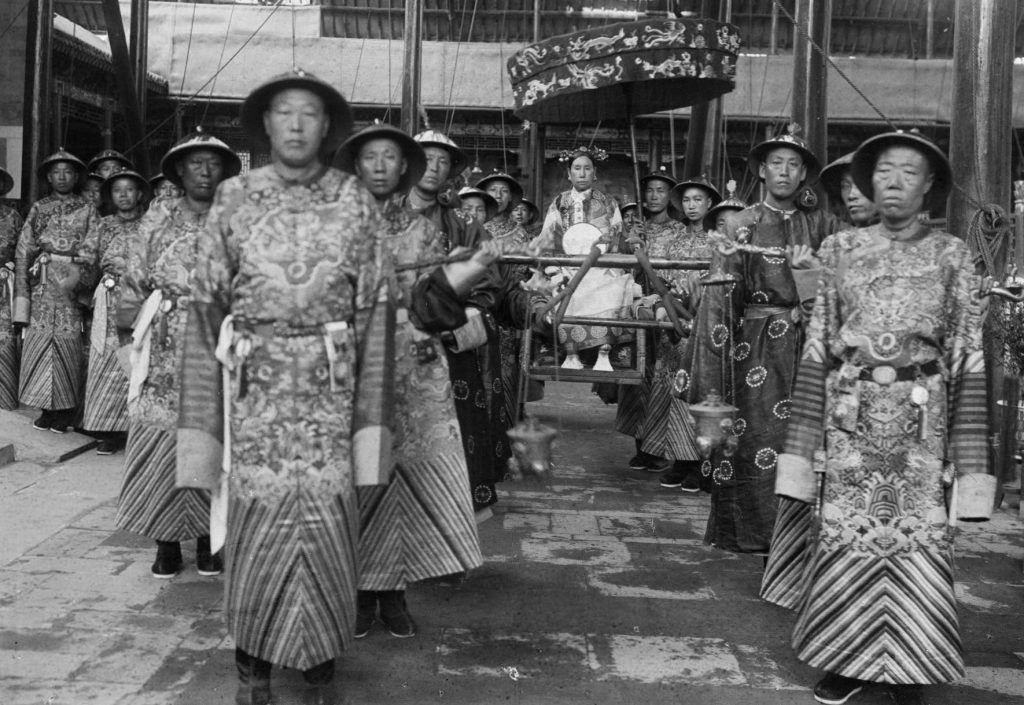
Before recent decades, Christian priests had been exclusively men since the birth of Christ. But that doesn’t mean that men historically have been privileged relative to women, or even that priests have had higher status than wealthy women. The rows of eunuchs carrying women in sedan-chairs aptly represent men’s social position under castration culture and gynocentrism.

eunuchs carry Empress Dowager Cixi in sedan-chair

Although equally deserving of compassion as fully human beings, men tend to receive less compassion than do women. Headlines often efface men, like “missile strike kills 20 civilians, including 2 women.” Jerome described to Eustochium similarly emotive circumstances:

Recently I saw the noblest Roman woman — I keep silent about her name, for I am not a satirist — in the Basilica of Saint Peter. Her eunuchs were in front of her. With her own hand so as to increase her reputation for religiosity she was disbursing single coins to paupers. One moment, such as you might readily know by experience, an old woman of years and rags ran forward to receive another coin. When her turn came, in the place of money she received an extended fist. Thus she, guilty of a crime, had an outflow of blood.

{ uidi nuper — nomina taceo, ne saturam putes — nobilissimam mulierum Romanarum in basilica beati Petri semiuiris antecedentibus propria manu, quo religiosior putaretur, singulos nummos dispertire pauperibus. interea — ut usu nosse perfacile est — anus quaedam annis pannisque obsita praecurrit, ut alterum nummum acciperet; ad quam cum ordine peruenisset, pugnus porrigitur pro denario et tanti criminis reus sanguis effunditur. }

The old, poor dear is of course a woman. The vicious rich Roman whom eunuchs attend is also a woman. Her castrated men attract little concern and compassion.

Jerome understood that human life centers on women. He advised Eustochium:

Let your voice always resonate in your mouth with these words: “Naked I came from my mother’s womb, and naked I shall return” and “We brought nothing into this world, and we can carry out nothing.”

{ illa tibi semper in ore uox resonet: nudus exiui de utero matris meae, nudus et redeam et: nihil intulimus in hunc mundum nec auferre quid possumus. }[3]

In these key words, “my mother’s womb” is a metonym for “mother earth,” or more generally, the whole world of lived life. Mother earth isn’t a recent sexist social construction. Even apart from the ancient earth goddess Gaia, humans have long regarded the earth as their mother.

Despite her female privilege, Jerome didn’t want Eustochium to be ashamed to be a woman. He observed:

Other women dress as men, changing their clothes as if they are ashamed to be the females that they were born. They cut off their hair and impudently hold up their faces like eunuchs.

{ aliae uirili habitu, ueste mutata, erubescunt feminae esse, quod natae sunt, crinem amputant et inpudenter erigunt facies eunuchinas. }[4]

From Jerome’s Christian perspective, women shouldn’t be ashamed of being women. In contrast, women pretending to be eunuchs belittle women and trivialize castration culture. Such women should be ashamed of their ignorance and heartlessness.

Today no forty-year-old man would write to a fifteen-year-old woman like Jerome wrote to Eustochium more than 1600 years ago. Nonetheless, young women today would benefit significantly from thinking carefully about the issues that Jerome raised to Eustochium. Christians rightly revere Jerome as a great saint. Everyone should honor Jerome as a wise and courageous ally of women.

* * * * *

Read more:

Notes:

[1] Jerome, Letters 22, Jerome to Eustochium, section 26, Latin text from Hilberg (1910-18), my English translation, benefiting from those of Carroll (1956), Wright (1933), and Freemantle (1892). All quotes from Jerome are similarly sourced from his letter to Eustochium.

Jerome was about forty years old when he wrote this letter to Eustochium. With respect to “daughter, lady-lord, fellow-servant, sister,” Jerome explained:

one specifies your age, another your merit, yet another your religious vocation, and that one our love

{ aliud enim aetatis, aliud meriti, illud religionis, hoc caritatis est nomen }

Id, section 26. Jerome described Eustochium as “reared among a noble lineage and always in luxury, always in soft pillows {nobili stirpe generatam, et semper in deliciis, semper in plumis}.” Id, section 11. Jerome and Eustochium were fellow religious servants of God. Medieval men referred to their beloved women as “sister.”

[2] Jerome to Eustochium, section 6. Cf. Psalms 44:9, Jeremiah 13:26, Ezekiel 16:25. This quote is colored with historical disparagement of men’s sexuality. From a Jewish and Christian perspective, men do not pollute women through men’s sexuality itself. To the contrary, men offer to women through their sexuality the gift of God’s seminal blessing. Medieval hymns such as “Hail, mother of our Savior {Salve, mater Salvatoris}” dealt with this discursive legacy in a sophisticated way.

Jerome spoke frankly with Eustochium. He wasn’t ashamed to specify directly genitals:

Hear what God says about the devil: “Its strength is in the loins and its power in the navel.” For decency the genitals of man and woman are altered to be called with those names. Thus from the loins of David is said to come the descendant promised to sit on the throne. The seventy-five souls who entered into Egypt similarly came from Jacob’s thigh. When after wrestling with God the girth of his thigh shrank, Jacob ceased to produce children. … To Jerusalem, who was found splattered with blood in the wandering plain, Ezekiel said: “Your navel has not been penetrated.” Therefore, in all attacks against men, the devil’s strength is in the loins. Against women, all its force is in the navel.

{ audi, quid de diabolo suspicetur: uirtus eius in lumbis et potestas eius in umbilico. honeste uiri mulierisque genitalia inmutatis sunt appellata nominibus, unde et de lumbis Dauid super is sedem eius promittitur esse sessurus; et septuaginta et quinque animae introierunt Aegyptum, quae exierunt de femore Iacob, et postquam conluctante deo latitudo femoris eius emarcuit, a liberorum opere cessauit … ad Hierusalem uero, quae respersa sanguine in campo inuenitur erroris, in Ezechiel dicitur: non est praecisus umbilicus tuus. omnis igitur aduersus uiros diaboli uirtus in lumbis est, omnis in umbilico contra feminas fortitudo.}

Jerome to Eustochim, section 11. Cf. Job 40:16, 2 Samuel 7:12, Genesis 46:26, Genesis 32:24-5, Ezekiel 16:4-6. Modern philology, unlike Jerome, has a penis problem.

The subsequent two quotes above are from Jerome to Eustochium, sections 15 (Look at them in their sedan-chairs…) and 32 (Recently I saw the noblest Roman woman…).

[3] Jerome to Eustochium, section 31. Cf. Job 1:21, Genesis 3:19, Sirach 40:1. On Biblical gynocentrism, Song of Songs 5:2-6, Genesis 2:24, and Ephesians 5:31.

[4] Jerome to Eustochium, section 27. Transmen have been readily accepted historically, while transwomen have faced hostility and rejection from women and men aggressively defending women’s privileged social position.

[image] Chinese eunuchs carry Empress Dowager Cixi in a sedan-chair in front of the Summer Palace in Beijing sometime from 1903 to 1905. Photo by Xunling. Preserved with identifier FSA A.13 SC-GR-261 in the Freer Gallery of Art and Arthur M. Sackler Gallery Archives, Smithsonian Institution, Washington, D.C.

References:

Carroll, Paul, trans. 1956. The Satirical letters of St. Jerome. Chicago: Gateway Editions, distributed by H. Regnery Co.

Freemantle, William Henry, trans. 1892.  The Principal Works of St. Jerome.  Philip Schaff, ed. Nicene and Post-Nicene Fathers, 2nd Series, vol. 6. Oxford: Parker.

Hilberg, Isidorus, ed. 1910-1918. Sancti Eusebii Hieronymi Epistulae {Letters of Saint Eusebius Hieronymus (Jerome)}. Vindobonae: Tempsky. Corpus Scriptorum Ecclesiasticorum Latinorum (CSEL) 54 (Epistulae 1-70), 55 (Epistulae 71-120), and 56 (Epistulae 120-154).

Wright, F. A., ed. and trans. 1933. Select Letters of St. Jerome. Loeb Classical Library, no. 262. Cambridge, Mass: Harvard University Press.

medieval control of the male gaze and impending triumph of love

Men have long experienced attempts to control the male gaze. Even in the relatively liberal and tolerant medieval period, the male gaze was manipulated and regulated. For example, in a late-thirteenth-century Galician-Portuguese “song about a beloved man {cantiga d’amigo},” a mother guided her daughter in manipulating the male gaze:

Oh my daughter, by God, work out a way
for your boyfriend to see you wearing that
skirt, and do everything you can
so he’ll see you near to him, closely clad,
because if he sees you, I know he’ll die
for you
, daughter, it fits you so well.

If that skirt fit you badly,
I wouldn’t tell you to go before
his eyes, but for God’s sake work it out quickly
for him to see you, just do that,
because if he sees you, I know he’ll die
for you, daughter, it fits you so well.

And though he may be angry with you now,
once he sees you with that skirt on,
he’ll be very glad to look you over,
and work it out that he can see you,
because if he sees you, I know he’ll die
for you, daughter, it fits you so well.

{ Ai mha filha, por Deus, guisade vós
que vos veja esse fustan trager
voss’ amig’ e tod’ a vosso poder
veja vos ben con el estar en cos,
ca, se vos vir, sei eu ca morrerá
por vós, filha, ca mui ben vos está

Se vo-lo fustan estevesse mal,
non vos mandaria ir ant’ os seus
olhos, mais guisade cedo, por Deus,
que vos veja, non façades end’ al,
ca, se vos vir, sei eu ca morrerá
por vós, filha, ca mui ben vos está

E como quer que vos ele seja
sanhudo, pois que vo-lo fustan vir,
averá gran sabor de vos cousir,
e guisade vós como vos veja,
ca, se vos vir, sei eu ca morrerá
por vós, filha, ca mui ben vos está }[1]

Men tend to enjoy gazing upon nicely shaped women in tight skirts. That makes men vulnerable to being sexually harassed.

The early Christian church leader Saint Basil the Great reportedly attempted to protect men from being sexually harassed in church. One day in celebrating mass, Basil elevated the consecrated body and blood of Christ. Then he noticed that the golden dove hanging above the altar didn’t move three times as usual. Something was wrong:

Wondering how this could be, he saw one of the deacons with fans, while bending backwards, nodding to a woman.

{ cogitante eo quod hoc esset uidit unum uentilantium diaconem innuentem mulieri inclinante deorsum. }[2]

Following the counsel of the Holy Spirit, Basil took action to prevent the male gaze in church:

He subjected indeed the deacon to fasting and vigils … In addition, he immediately ordered curtains to be hung in the aisles. He directed that any woman who would show herself outside the curtains by leaning forward while he was celebrating the divine liturgy should be sent away from the Mass and be permanently without Communion.

{ Diaconem autem ieiuniis et uigiliis submisit … Vela etiam statim iussit appendi instructoriis, praecipiens de mulieribus quae foris uelorum apparuerit inclinans se, diuinum ministerium peragente, foris poni mysterio et incommunicatam permanere. }

In retrospect, Basil’s regulation of the male and female gaze was quite mild. Basil sought to prevent women and men from gazing on each other during a religious service.[3] Many women and men today don’t even attend religious services. Moreover, Basil’s regulation did nothing to impede men and women from gazing upon each other any time other than during the religious service. Today’s literary critics and sex police issue much more severe and all-encompassing edicts against the male gaze.

dove-shaped hanging tabernacle

With astonishing foresight, medieval poets recognized the future implications of moral doctrines and preceptorial fulminations against the male gaze. According to a mid-thirteenth-century Galician-Portuguese singer associated with Alfonso X “the Learned {el Sabio},” a woman lamented:

By God, ladies, what will be?
Since now this world is nothing,
nor does a boyfriend love his lady.
And this world — what is it now?
Since love has no power here,
what good are her good looks or figure
to a girl who has them both?

You see why I’m saying this:
because there’s not a king in the world
who could see the figure I have
and then not just die for me.
Why, my eyes are even green!
And my boyfriend didn’t even
see me, and he passed by here.

But the lady who has a boyfriend
from now on (believe me, by God!)
shouldn’t rely on her pretty eyes,
because from now on there is no point.
Because just now someone saw my eyes
and my lovely figure and yet he comes
and goes as soon as he wants to go.

And since good looks and a fine figure
just aren’t worth anything,
it doesn’t matter how we appear!

{ Por Deus, amigas, que será?
pois ja o mundo non é ren
nen quer amig’ a senhor ben,
e este mundo que é ja?
pois i amor non á poder,
que presta seu bon parecer
nen seu bon talh’ a quen o á?

Vedes por que o dig’ assi:
por que non á no mundo rei
que viss’ o talho que eu ei
que xe non morresse por min;
si quer meus olhos verdes son,
e meu amig’ agora non
me viu, e passou per aqui

Mais dona que amig’ ouver
des oje mais (crea per Deus)
non s’ esforç’ enos olhos seus,
ca des oi mais non lh’ é mester,
ca ja meus olhos viu alguen
e meu bon talh’, e ora ven
e vai se tanto que s’ ir quer

E, pois que non á de valer
bon talho nen bon parecer,
parescamos ja como quer }[4]

With stern repression of the male gaze, men poet-singers (troubadours) stopped composing and singing love songs. Women then lashed out at men with hateful death-wishes:

Oh friends, all the men troubadours
in the kingdom of Portugal
have lost their skill. They don’t want
to speak well of us, as they used to do.
And they don’t even speak of love,
And they do something else that’s even worse —
they no longer want to praise good looks.

They, friends, have lost the desire
to see you, and I’ll tell you something else.
These troubadours just go from bad to worse.
There isn’t one that can serve a lady,
nor even one that composes for a woman.
Cursed be she who would ever say
of someone who can’t compose, “He’s a troubadour.”

But, friends, there must be some remedy
for a lady that loves her good name and looks.
Bide the time, and not complain,
and let this awful time just pass away,
because I really think that someone will come soon
who likes a girl that’s beautiful,
and you’ll see that love will triumph then.

And those of them who have stopped
serving you, we know who they are.
May God let them die an awful death!

{ Ai amigas, perdud’ an conhocer
quantos trobadores no reino son
de Portugal, ja non an coraçon
de dizer ben que soían dizer
de vós, e sol non falan en amor
e al fazen de que m’ ar é peor:
non queren ja loar bon parecer

Eles, amigas, perderon sabor
de vos veeren; ar direi vos al:
os trobadores ja van pera mal;
non á i tal que ja servha senhor
nen sol que trobe por ũa molher;
maldita sej’ a que nunca disser
a quen non troba que é trobador

Mais, amigas, conselho á d’ aver
dona que prez e parecer amar:
atender tempo e non se queixar
e leixar ja avol tempo perder,
ca ben cuid’ eu que cedo verrá alguen
que se paga da que parece ben
e veeredes ced’ amor valer

E os que ja desemparados son
de vos servir, sabud’ é quaes son:
leixe os Deus maa morte prender }[5]

Women and men rightly feel entitled to each other’s love. Without resentment, hate, or death-wishes, the human entitlement to love will be vindicated when a sufficient number of persons read and appreciate medieval literature. Act now to promote love’s triumph!

Of course love in its fullness presents dangers. Addressing fundamental gender inequality in parental knowledge can lessen love’s danger to men. So too can reproductive choice for men and eliminating grotesque anti-men gender discrimination in child custody and child support rulings. Moreover, penal justice shouldn’t vastly gender-disproportionately incarcerate persons with penises, and the propaganda apparatus shouldn’t stereotype men as violent criminals. Act now to defund unjust penal policing!

* * * * *

Read more:

Notes:

[1] Johan Airas (João Airas de Santiago) 6, song about a beloved man {cantiga de amigo}, “Oh my daughter, by God, work out a way {Ai mha filha, por Deus, guisade vós}” (V 599), Galician-Portuguese text (editorial marks eliminated) from Cohen (2003), English translation (modified slightly) from Cohen (2010). Here’s this song at Galician-Portuguese Medieval Songs.

In verse 1.4 of this song, “en cos” means literally “on the body.” It means wearing the skirt without any underclothes or overclothes. A well-fitting skirt worn “en cos” would reveal well the woman’s figure. For discussion of women’s clothing in cantigas d’amigo as well as an example of clothes worn “en cos” to a dance, Corral Diaz (2002) pp. 86-8.

While literary critics have castigated the male gaze much more than the female gaze, the female gaze is quite important in practice. For example, a Galician-Portuguese song from the first half of the thirteenth century provides a woman’s poignant lament:

When, my boyfriend and my light, I can’t
see you, look what happens to me:
I have eyes and look and yet can’t see,
my boyfriend, anything that could please me.

When I can’t see you with these
eyes of mine, so help me God,
I have eyes and look and yet can’t see,
my boyfriend, anything that could please me.

And I don’t sleep, there’s no chance of that,
when I don’t see you, and, in good faith,
I have eyes and look and yet can’t see,
my boyfriend, anything that could please me.

Without you, what good are my eyes to me?
Since they don’t let me sleep, and certainly
I have eyes and look and yet can’t see,
my boyfriend, anything that could please me.

{ Quando vos eu, meu amig’ e meu ben,
non posso veer, vedes que mh aven:
tenh’ olh’ e vej’ e non posso veer,
meu amig’, o que mi possa prazer

Quando vos eu con estes olhos meus
non posso veer, se mi valha Deus,
tenh’ olh’ e vej’ e non posso veer,
meu amig’, o que mi possa prazer

E non dorm’ eu, nen en preito non é,
u vos eu non vejo, e, per bõa fe,
tenh’ olh’ e vej’ e non posso veer,
meu amig’, o que mi possa prazer

E os meus olhos sen vós que prol mh an?
pois non dorm’ eu con eles, e de pran
tenh’ olh’ e vej’ e non posso veer,
meu amig’, o que mi possa prazer }

Vaasco Praga de Sandin (Vasco Praga de Sandim) 4, Galician-Portuguese text (editorial marks eliminated) from Cohen (2003), English translation (modified slightly) from Cohen (2010). Here’s this song at Galician-Portuguese Medieval Songs.

[2] BHL 1023 (earliest known Latin translation of the pseudo-Amphilochian Life of Basil), chapter 8, “How he understood the Holy Spirit coming and about a certain deacon and about Libanio the sophist {Quomodo sancti spiritus adventum vidit et de quodam diacone et de Libanio sophista},” Latin (modified slightly) text from Corona (2006) p. 232, English translation (modified slightly) from id. p. 89, n. 53. The subsequent quote above is sourced similarly, with the English translation from id. p. 31, n. 8.

Corona’s Latin text is “uidit unum uentilantium diaconem innuentem mulieri inclinatae deorsum,” She translated that text as: “he saw one of the deacons with fans nodding to a woman while bending backwards.” Since inclinatae is the feminative genitive form, the woman is bending backwards. But in Corona’s English translation, “while bending backwards” is more naturally read as an adverbial phrase than an adjectival phrase.

The priest celebrates Mass with the deacon in front of the congregation. In this Mass, the priest and the deacon have their backs to the congregation, which faces forward. So why would the woman-congregant lean backwards? Manuscripts in the Cotton-Corpus tradition have the reading inclinante / inclinantem. Corona (2006) p. 149. Those readings seem to me better in context. I use inclinante in the Latin text above.

The pseudo-Amphilochian Life of Basil was composed in Greek sometime from the seventh to the ninth century, probably about 800. BHL 1023, the first known Latin translation of the pseudo-Amphilochian Life of Basil, was first written in the ninth century before 843. BHL 1024, which is Ursus’s translation of the pseudo-Amphilochian Life of Basil and is included in Heribert Rosweyde’s Lives of the Fathers {Vitae Patrum} (1628) (Patrologia Latina 73.293-312A) doesn’t include the story of the deacon and the woman congregant eyeing each other.

The golden dove above the altar arose from Basil’s inspiration. After God allowed Basil to celebrate the divine liturgy in his own words, Basil handled the consecrated host in a special way:

He divided the bread into three parts. One part he partook with much awe. Another part he reserved to be buried with him. The third part he placed upon the golden dove that he suspended above the altar.

{ dividens panem in tres partes unam quidem communicavit cum timore multo, alteram autem reservavit consepelire sibi, tertiam vero inponens columbae aureae quae pependit super altare. }

BHL 2013, ch. 4, Latin text from Corona (2006), my English translation. The dove-tabernacle was made from pure gold according to Basil’s instructions. Id. BHL 1024 has similar text in ch. 6.

[3] Christian churches have long been places for earthy amorous encounters. Writing about 400 GC, Jerome castigated the Deacon Sabinianus for seducing a nun in the church at Bethelehem:

The whole church was keeping vigil by night and proclaiming Christ as Lord. While praises of God were being sung in the nations’ diverse tongues but in one spirit, you were squeezing love letters into the openings of what is now the altar of the Lord as once it was his crib. You choose this place above all so that she, your miserable victim, might find and read them when she came to kneel and worship there. Then, taking your place standing among the choir of psalmsingers, with impudent nods, winks, and gestures you communicated with her.

{ tota ecclesia nocturnis uigiliis Christum dominum personabat et in diuersarum gentium linguis unus in laudem dei spiritus concinebat; tu inter ostia quondam praesepis domini, nunc altaris amatorias epistulas fulcicbas, quas postea illa miserabilis quasi flexo adoratura genu inueniret et legeret; stabas deinceps in choro psallentium et inpudicis nutibus loquebaris. }

Jerome, Letter 147, “To Deacon Sabinianus exhorting him to penance {Ad Sabinianum Diaconum cohortatoria de paenitentia},” section 4.4, Latin text from Hilberg (1910-1918) p. 319, my English translation. Freemantle (1892) has an English translation of Jerome’s letter to Sabinianus. Underscoring the historical criminalization of men seducing women, Jerome declared to Sabinius, “you enter church to arrange rape {de stupro condicturus ingrederis}.” Jerome, “Ad Sabinianum Diaconum cohortatoria de paenitentia” 4.3, sourced as previously.

The thirteenth-century Old Occitan Romance of Flamenca depicts Guillem amorously imploring Flamenca in church. This romance, however, supports gender equality with uncanny support for gender reversal.

[4] Johan Garcia de Guilhade (João Garcia de Guilhade / Joan Garcia de Guilhade) 2, song about a beloved man {cantiga de amigo}, “By God, ladies, what will be {Por Deus, amigas, que será}?” (B 742, V 344), Galician-Portuguese text (editorial marks eliminated) from Cohen (2003), English translation (modified slightly) from Cohen (2010). Here’s this song at Universo Cantigas and at Galician-Portuguese Medieval Songs.

[5] Johan Garcia de Guilhade 21, song about a beloved man {cantiga de amigo}, “Oh friends, all the men troubadours {Ai amigas, perdud’ an conhocer}” (B 786, V 370), Galician-Portuguese text (editorial marks eliminated) from Cohen (2003), English translation (modified slightly) from Cohen (2010). Here’s this song at Universo Cantigas and at Galician-Portuguese Medieval Songs.

[image] Dove-shaped hanging tabernacle made of silver. Item in the Attarouthi Treasure. Made 500-650 in Attarouthi, Syria. Preserved as accession # 1986.3.15 in the Metropolitan Museum of Art (New York City, USA). Credit Line: Purchase, Rogers Fund and Henry J. and Drue E. Heinz Foundation, Norbert Schimmel, and Lila Acheson Wallace Gifts, 1986. Source image thanks to The Metropolitan Museum’s public-spirited Open Access Policy. In Christianity, the dove is associated with the Holy Spirit. John 1:32. On the history of ciboria and tabernacles, Rievallensis (2019).

References:

Cohen, Rip. 2003. 500 Cantigas d’Amigo. Porto: Campo das Letras.

Cohen, Rip. 2010. The Cantigas d’Amigo: An English Translation. Online. Quotes are based on the 2016 edition.

Corona, Gabriella. 2006. Aelfric’s Life of Saint Basil the Great: Background and Context. Woodbridge: Boydell & Brewer.

Corral Diaz, Esther. 2002. “Feminine Voices in the Galician-Portuguese cantigas de amigo.” Ch. 5 (pp. 81-98) in Klinck, Anne L., and Ann Marie Rasmussen, eds. Medieval Woman’s Song: cross-cultural approaches. Philadelphia, PA: University of Pennsylvania Press.

Freemantle, William Henry, trans. 1892.  The Principal Works of St. Jerome.  Philip Schaff, ed. Nicene and Post-Nicene Fathers, 2nd Series, vol. 6. Oxford: Parker.

Hilberg, Isidorus, ed. 1910-1918. Sancti Eusebii Hieronymi Epistulae {Letters of Saint Eusebius Hieronymus (Jerome)}. Vindobonae: Tempsky. Corpus Scriptorum Ecclesiasticorum Latinorum (CSEL) 54 (Epistulae 1-70), 55 (Epistulae 71-120), and 56 (Epistulae 120-154).

Rievallensis, Aelredus. 2019. “Ciboria and Tabernacles: A Short History.” Canticum Salomonis. Online. Posted May 13, 2019.

loss of faith: fairy-tale ending to attack on ass

A Latin poem from no later than the mid-eleventh century tells of a wolf killing the nun Alfrad’s she-ass. The wolf oddly attacked the she-ass’s ass:

As the she-ass went out into a spacious field,
she saw a ravenous wolf running towards her.
She hid her head and showed her tail.

The wolf ran up and bit her tail.
The she-ass then raised two legs
and waged a long war with the wolf.

When she felt that her strength had failed,
she brought forth a loud voice of lamentation
and as she died called to her lady.

{ Que dum in amplum exiret campum,
vidit currentem lupum voracem,
caput abscondit, caudam ostendit.

Lupus accurrit, caudam momordit;
asina bina levavit crura
fecitque longum cum lupo bellum.

Cum defecisse vires sensisset,
protulit grandem plangendo vocem
vocansque suam moritur domnam. }[1]

Men historically have been disparaged as being sexually voracious like wolves. Asses are associated with well-developed, vigorous sexuality.[2] The wolf and the ass were in that sense well-matched to wage a long battle. The poet’s sense of gender equality appears again with women mobilizing to fight alongside of men:

Hearing the great voice of the she-ass,
Alfrad ran. “Sisters,” she said,
“come quickly, help me!

I sent to pasture my dear ass.
Her loud lament I hear.
I hope she’s fighting off the savage wolf!”

The clamor of the sisters reaches the cloister.
Crowds of men and women
are present so as to capture the bloodthirsty wolf.

Now Adela, Alfrad’s sister,
looks for Rikila and finds Agatha.
They go so as to lay low the bold enemy.

{ Audiens grandem asine vocem
Alfrad cucurrit. “Sorores,” dixit,
“cito venite, me adiuvate!

Asinam caram misi ad erbam;
illius magnum audio planctum;
spero, cum sevo ut pugnet lupo.”

Clamor sororum venit in claustrum,
turbe virorum ac mulierum
assunt, cruentum ut captent lupum.

Adela namque, soror Alfrade,
Rikilam querit, Agatham invenit,
ibant, ut fortem sternerent hostem. }

This gender-integrated fighting force was too late. The wolf had already devoured the ass, which had been pregnant. The sisters mourned classically:

Seeing that, all the sisters
tore their hair and beat their breasts,
mourning the innocent death of the she-ass.

{ Illud videntes cuncte sorores
crines scindebant, pectus tundebant,
flentes insontem asine mortem. }

This is a Christian poem embracing troubling aspects of life. It ends with hope in God:

Gentle Adela and sweet Fritherun
both came to comfort
and restore Alfrad’s heart:

“Leave off sad complaints, sister!
The wolf pays no attention to bitter weeping.
The Lord will give you another ass.”

{ Adela mitis, Fritherunque dulcis
venerunt ambe, ut Alfrade
cor confirmarent atque sanarent:

“Delinque mestas, soror, querelas!
Lupus amarum non curat fletum.
Dominus aliam dabit tibi asinam.” }[3]

The attack on the ass doesn’t end with everyone living happily ever after. Hints of concern for gender equality aren’t realized in a broad initiative for societal transformation. Not a fairy tale, this story’s ultimate ending depends on the Lord.

Across the subsequent half-millennium, attacking the ass was transformed into a fairy-tale. It concerned not religious sisters, but the poor old woman Bagolana of Savona and her two daughters, Cassandra and Adamantina. Those names suggest this fairy-tale’s deep literary roots: Bagolana evokes “bathing room” from the ancient Greek βαλανεῖον, Cassandra is the ancient Greek prophet who courageously opposed the horrific violence against men of the Trojan War, and Adamantina is the feminine counterpart to the orthodox Christian champion of the fourth-century treatise On orthodox faith in God {De recta in Deum fide}. Just before the poor old woman Bagolana died, she urged her daughters to live together peacefully. She left them a small coffer of tow. Scholars working within today’s dominant ideology would tend to interpret Bagolana’s legacy as an expression of female solidarity despite being marginalized and impoverished.

This story is actually a fairy tale encompassing gender reality. Showing women’s capacity for active labor to support themselves independently of men, Cassandra spun the tow into thread. Then she directed her younger sister Adamantina to sell that thread in the marketplace to buy bread. Benevolent fortune, however, interrupted their desperate attempt to integrate themselves into capitalistic relations of meager sustenance:

As she was walking in the square, she encountered an old woman who had on her lap the most beautiful and most perfectly formed doll that anyone had ever seen. Adamantina’s fancy, having seen and thought about the doll, became more absorbed with how she might obtain it than how she might dispose of her thread. Her thoughts led her on such that, not knowing what to do or say to acquire it, by pondering about trying her fortune, she understood that bartering was the only means. She approached the old woman saying, “Good mother, if you are in agreement, I’ll give you my thread in exchange for your doll.” The old woman, seeing such a fine, lovely girl, so eager to have the doll for her own, could not disappoint her. Taking the thread, she presented the doll to her. Adamantina with the doll appeared not less than perfectly happy. Fully joyful and gay, she returned home.

{ perciò che s’abbattè in piazza in una vecchiarella che aveva in grembo una poavola, la più bella e la più ben formata che mai per l’adietro veduta si avesse. Laonde Adamantina, avendola veduta e considerata, di lei tanto se n’invaghì, che più di averla, che di vendere il filo pensava. Considerando adunque Adamantina sopra di ciò, e non sapendo che fare nè che dire per averla, pur deliberò di tentare sua fortuna, si a baratto la potesse avere. Ed accostatasi alla vecchia, disse: Madre mia, quando vi fusse in piacere, io baratterei volontieri con la poavola vostra il filo mio. La vecchiarella, vedendo la fanciulla bella, piacevole e tanto desiderosa della poavola, non volse contradirle; ma preso il filo, la poavola le appresentò. Adamantina, avuta la poavola, non si vide mai la più contenta; e tutta lieta e gioconda a casa se ne tornò. }[4]

baby doll from about 1950, with custom knit clothes

The hungry cannot eat a doll. While domestic violence is now typically presented to stereotype men as brutish criminals, this story boldly presented female-perpetrated domestic violence:

When she saw the doll, Cassandra, who felt hungry enough to die, was filled with such violent anger that she seized Adamantina by the hair and beat her so grievously that the wretched girl could hardly move. Receiving the beating with patience and without making any defense, Adamantina knew better and managed to go with her doll to another room.

{ Cassandra, che di fame si sentiva morire, veduta la poavola, di sì fatta ira e sdegno s’accese, che, presa Adamantina per le treccie, le diede tante busse, che appena la meschina si poteva movere. Adamantina, pazientemente ricevute le busse, senza far difesa alcuna, meglio che seppe e puote con la sua poavola in una camera se n’andò. }

Women should not commit domestic violence. What Adamantina knew better was the importance of love, if even just for a doll:

When evening came, Adamantina cradled the doll in her arms, as children might do. Sitting down by the fire, she took some oil from the lamp and rubbed it on the doll’s stomach and legs. Then she wrapped the doll carefully in a tattered cloth and placed it in her own bed. A little while later she went to bed and lay beside the doll. Scarcely had Adamantina taken her first sleep when she heard the doll cry out, “Mamma, mamma, I have to poop!”

{ Venuta la sera, Adamantina, come le fanciullette fanno, tolse la poavola in braccio, ed andossene al fuoco; e preso de l’oglio della lucerna, le unse lo stomaco e le rene: indi, rivoltata in certi stracci che ella aveva, in letto la mise, ed indi a poco, andatasene a letto, appreso la poavola si coricò. Nè appena Adamantina aveva fatto il primo sonno, che la poavola cominciò chiamare! Mamma, mamma, caca. }

What a nightmare! Adamantina didn’t believe what she heard:

Wakening from her sleep, Adamantina said, “What’s the matter, my little child?” At which the doll responded: “I would like to do poop, my mamma.”

{ E Adamantina destata, disse! Che hai, figliuola mia? A cui rispose la poavola: Io vorrei far caca, mamma mia. }

A woman with this sort of pain-in-the-ass doll might want to spank it. But Adamantina was a loving mother to her doll:

Adamantina said, “Wait a moment, my little child.” And getting up from bed, she took the apron that she had worn the day before and placed it under the doll. Then she said, “Make poop, my little child.” And to her complete amazement, the doll filled her apron with a great quantity of coins.

{ Ed Adamantina: Aspetta, figliuola mia, disse. E levatasi di letto, prese il grembiale, che ’l giorno dinanzi portava, e glielo pose sotto dicendo: Fa caca, figliuola; e la poavola, tuttavia premendo, empì il grembiale di gran quantità di danari. }

Love wins! For the older sister Cassandra, money seems to have won her affections:

As soon as she saw it, Adamantina woke her sister Cassandra and showed her the coins that the doll had pooped. Cassandra, seeing the great number of coins, was wonder-struck. To God she rendered hearty thanks for such good help and for not having abandoned them in their misery. Turning to her sister, Cassandra asked pardon for having beaten her, which was a great wrong that she had received from her. Then she gave to the doll many caresses, sweetly kissing it and tenderly holding it closely in her arms.

{ Il che vedendo, Adamantina destò la sorella Cassandra, e le mostrò i danari che aveva cacati la poavola. Cassandra, vedendo il gran numero de’ danari, stupefatta rimase: Iddio ringraziando che per sua bontà nelle lor miserie abbandonate non aveva; e voltatasi alla sorella, le chiese perdono delle busse che da lei a gran torto ricevute aveva: e fece molte carezze alla poavola, dolcemente basciandola e nelle braccia strettamente tenendola. }

The doll pooped similarly every night. With the resulting coins, the two sisters were able to buy bread, wine, oil, wood and everything they needed to have a well-provisioned home.

A woman-neighbor noticed that the two sisters, who had been miserably poor, were now prospering. She visited them and asked in the manner of friendly, female solidarity:

My dear daughters, you really must tell me how you managed to furnish your home so plentifully, seeing how just a few days ago you were in such poverty.

{ Figliuole mie, come avete fatto voi a fornire sì pienamente la casa vostra, conciosiacosachè per lo adietro voi eravate sì poverelle }

Cassandra, the older sister, reductively explained:

We have bartered one pound of flaxen thread for a doll that gives us money without any limit.

{ Una libra di filo di stoppa con una poavola barattata abbiamo, la quale senza misura alcuna danari ci rende. }

That’s not the true story of how the sisters came to enjoy life in material fullness. Cassandra, who beat her sister, didn’t understand love even after she sought forgiveness. Human beings, even women, are not angels.

The woman-neighbor became determined to steal the sisters’ doll. She formulated a plan and instructed her husband about his subordinate role:

One evening you must pretend to be drunk. You will take your sword and run after me and threaten to kill me. But you only strike the wall. Then I, pretending to be in great terror, will run into the street. And the two women, who are very compassionate, will open their house to me and take me inside for protection. I’ll stay there for the night and work that opportunity as much as I can.

{ Tu fingerai una sera d’esser ebbriaco e prenderai la tua spada, e correrammi dietro per uccidermi percotendo la spada nelle mura: ed io, fingendo d’aver di ciò paura, fuggirò su la strada: ed elle, che sono compassionevoli molto, mi apriranno: ed io chiuderommi dentro la loro casa, e resterò presso loro quella notte, ed io opererò quanto che io potrò. }

The woman-neighbor thus framed her husband as a perpetrator of domestic violence. With that deception, she spent the night at the sisters’ house and stole their doll.

When she returned home, the woman-neighbor sought to exploit the stolen doll. She gave it the night-time care that she saw Adamantina provide:

When the darkness of night finally arrived, the lady took the doll and made a good fire. She rubbed oil on the doll’s stomach and loins, wrapped it in white swaddling clothes, and placed it in the bed. Undressing herself, she got into bed at the doll’s side. After the first sleep of the night, the doll woke and said, “My lady, I have to poop!,” and didn’t say, “Mamma, I have to poop!” because she didn’t know the lady. The good lady, who was anxiously awaiting the fruits of what should follow, arose from the bed and took a very white linen cloth and put it under the doll. Then she said, “Poop, my little child, poop!” Strongly pushing, the doll, in the place of coins, filled the cloth with such foul-smelling feces that it was nearly impossible to go near.

{ Sopragiunta la buia notte, la donna prese la poavola; e fatto un buon fuogo, le unse lo stomaco e le rene: ed infasciata in bianchi pannicelli, nel letto la pose, e spogliatasi ancora ella, appresso la poavola si coricò. Fatto il primo sonno, la poavola si destò, e disse! Madonna, caca! — e non disse: Mamma, caca! — perciò che non la conosceva; e la buona donna, che vigilante stava aspettando il frutto che seguirne doveva, levatasi di letto, e preso un panno di lino bianchissimo, glie lo puose sotto, dicendo: Caca, figliuola mia, caca! La poavola, fortemente premendo, invece di danari, empì il panno di tanta puzzolente feccia, che appena se le poteva avicinare. }

This natural but unintended production prompted a shitstorm between husband and wife:

“For God’s sake,” said the husband, “look! Oh what a madwoman you are, what a fine trick it has played on you. And I was foolish to have believed such madness.” But the wife, contradicting her huband, with oaths affirmed that she had seen with her own eyes the great sum of coins the doll made in pooping. And seeing that his wife was determined to reserve the subsequent night for a new attempt, the husband, whose nose couldn’t suffer again such a stench as it had smelled, said the most crude words to his wife as has ever been said to any woman in the world. Taking the doll, he hurled it out a window onto some sweeping that were in front of their house.

{ Allora disse il marito: Vedi, o pazza che tu sei, come ella ti ha ben trattata; e sciocco sono stato io a crederti tale pazzia. Ma la moglie, contrastando col marito, con giuramento affermava, sè aver veduto con gli occhi propi gran somma di danari per lei cacata. E volendo la moglie riservarsi alla notte seguente a far nuova isperienza, il marito, che non poteva col naso sofferire il tanto puzzore che egli sentiva, disse la maggior villania alla moglie, che mai si dicesse a rea femina del mondo; e presa la poavola, la gittò fuori della finestra sopra alcune scopazze che erano a rimpetto della casa loro. }

Peasants subsequently came and scoped up the sweepings, along with the doll, to use as fertilizer. Persons who steal dolls deserve crap.

A few days later, King Drusiano, out hunting, took an urgent bowel movement in the woods. Perhaps not willing to settle for leaves, he called to his servants to get him something with which to wipe his ass. A servant saw the cloth doll on a heap of sweepings and brought it to the king. The king immediately wiped it against his ass. That was a mistake:

Then that doll with its fingers grabbed his buttocks and squeezed so tightly that he bellowed in his loudest voice. Having heard his extreme bellow, all his followers came to the King. They saw him on the ground more dead than alive. They all remained stupefied and saw that his torment was from a doll. Together they attempted to pull it off his buttocks, but their efforts were in vain. However much they tugged to pull it away, so much the more it gave him suffering and torment. No one could break its hold, nor make it let go. Now and then it would grab his bells and squeeze them so hard that he saw all the stars in the sky even though it was the middle of day.

{ Imperciocchè la poavola con i diti gli aveva presa una natica; e sì strettamente la teneva, che gridare ad alta voce lo faceva. Sentito da’ suoi il smisurato grido, subito tutti corsero al Re; e vedutolo che in terra come morto giaceva, tutti stupefatti restarono: e vedendolo tormentare dalla poavola, si posero unitamente per levargliela dalle natiche; ma si affaticavano in vano, e quanto più si sforzavano di rimovergliela, tanto ella gli dava maggior passione e tormento: nè fu mai veruno che pur crollare la potesse, non che indi ritrarla. Ed alle volte con le mani gli apprendeva i sonagli, e sì fatta stretta gli dava, che gli faceva veder quante stelle erano in cielo a mezzo il giorno. }

The King returned to his palace still suffering from the doll’s continuing attack on his ass.[5]

Desperately seeking relief, the King proclaimed that he would give one-third of his kingdom to anyone who could stop the doll’s attack on his ass. If the hero defeating that attack was a woman, the King pledged to marry her. Just as many doctors have attempted to cure hemorrhoids, many aspirants sought to ease the King’s pain in the ass. All failed. Finally Adamantina stepped forward:

She said, “Your Sacred Majesty, allow that even I may try my luck.” And approaching the doll, she said, “Ah, my little child, let my lord be in peace, no longer give him such torment.” She took hold of it by its swaddling clothes, caressing it extensively. The doll, who knew is mamma who had tended it and cared for it, immediately let go of the King’s buttocks, and abandoning the King, leaped into her arms.

{ disse: Sacra Maestà, lasciate che ancora io tenti la ventura mia; ed appresentatasi alla poavola, disse: Deh, figliuola mia, lascia omai cheto il mio Signore, nè gli dar più tormento; — e presala per i pannicelli, accarezzala molto. La poavola, che conosciuta aveva la sua mamma, la quale era solita a governarla e maneggiarla, subito dalle natiche si staccò; ed abbandonato il Re, saltolle nelle braccia. }[6]

After King Drusiano’s wounded ass healed, Adamantina was called into his presence. In addition to giving her one-third of this kingdom, he married her. She thus effectively owned all of his kingdom. Moreover, he arranged a favorable marriage for Cassandra. This was a fairy-tale ending to an attack on an ass:

All lived in joy and tranquil peace for a long time. The doll, having seen the superb wedding of one and then the other sister and that all had come to a beneficial end, suddenly disappeared. No one ever knew what become of the doll. In my judgment, it evanesced, like such fantasies have always done.

{ tutti in allegrezza e tranquilla pace lungo tempo vissero. La poavola, vedute le superbe nozze dell’una e l’altra sorella, ed il tutto aver sortito salutifero fine, subito disparve. E che di lei n’avenisse, mai non si seppe novella alcuna. Ma giudico io che si disfantasse, come nelle fantasme sempre avenir suole. }

The poor sisters thus became wealthy, part of a royal family, and happy. Medieval literature realistically discussed the difficulties of marriage for men. Women have much more successfully preserved the fairy-tale dream of extreme hypergamy.

The story of Alfrad and that of Adamantina both include an attack on an ass, strong women, and realistic appreciation for women’s potential for violence. Both stories mix lofty sentiment with recalcitrant realism in bizarre plots. Medieval Latin literature has been recognized as a conduit of fairy-tales.[7] Yet medieval Latin literature differs significantly from modern fairy-tales. King Drusiano wouldn’t have been comforted with his servants merely affirming, “The Lord will give you another ass {Dominus aliam dabit tibi asinam}.” That’s a loss of faith.

* * * * *

Read more:

Notes:

[1] Cambridge Songs {Carmina cantabrigiensia} 20, “There is one place called Homburg {Est unus locus Homburh dictus},” stanzas 2-4, Latin text (consonantal u written as v for ease in recognizing sounds) and English translation (modified slightly) from Ziolkowski (1994). This poem survives only in the Carmina cantabrigiensia. “Homburh probably indicates Homburg on the Unstrut, near the town of Langensalza” in present-day central Germany. Id p. 235.

When a wolf attacks, a donkey would not typically hide its head and displaying its ass. Nor do donkeys typically raise two legs. Dronke grouped “Est unus locus Homburh dictus” with fabliaux. He interpreted it possibly ‘as alluding satirically, by way of an amusing “cover”, to a particular nun’s loss of her maidenhead.’ Dronke (1973) p. 286.

Ziolkowski noted in this poem clear touches of mock epic in verses 3.3 and 8.3. In addition verses 4.2-3 and 5.1 “perhaps contribute to a mock-epic flavor.” The phrases “turba virorum {crowd of men}” and “sanguinis unda {torrent of blood}” in verses 7.2 and 9.2, respectively, are stock phrases in hexameter poetry. Ziolkowski (1994) p. 236. The poem also uses Leonine (mid-line) rhyme.

The subsequent three quotes above are similarly sourced from “Est unus locus Homburh dictus,” stanzas 5-8 (Hearing the great voice of the she-ass…), 10 (Seeing that, all the sisters…), and 12-13 (of 13) (Gentle Adela and sweet Fritherun…).

[2] In his encyclopedic On the natures of things {De rerum naturis}, also called On the universe {De universo}, Hrabanus Mauru stated, “asses and she-asses sometimes signify the wantonness of self-indulgent persons {asinorum quoque vel asinarum nomine aliquando luxuriosorum petulantia}.” Latin text from Patrologia Latina, vol. 111, p. 112, cited by Dronke (1973) p. 286. Hrabanus wrote this work about 845.

[3] Dronke offered an abstract interpretation of the final verse:

the consolation offered by the other nuns, “gentle Adela and sweet Fritherun”, could also be an unseemly jest: “The Lord will give you another ass” — “the convent will renew your sensual impulses, will give you other opportunities”.

Dronke (1973) p. 286. That verse seems to me better interpreted from a medieval Christian perspective as implying that the Lord will restore your righteousness, in the sense of wiping away any sin / pain associated with the ass.

[4] Giovanni (Zoan) Francesco Straparola, The Pleasant Nights {Le Piacevoli Notti}, Night 5, Story 2, Italian text from Rua (1899) vol. 2, pp. 15-21, English translation (modified) from Beecher (2012) vol. 1, p. p. 689. Subsequent quotes above are similarly from this story. The English translation of Waters (1894) is freely available online.

Beecher called this story “a singular and grotesque variation on the rags to riches romance.” Beecher (2012) vol. 1, p. 695. Many medieval stories seem singular and grotesque from a modern perspective.

[5] Beecher asked, “Is this doll the enactment of a castration complex?” Beecher (2012) vol. 1, p. 696. The “castration complex” is merely an elite folktale. Too many scholars have abstracted away men’s real suffering under castration culture:

On finds here the fixation with childhood, with the doll, which here plays the role of the symptom, and the sadistic drive with the threat of castration, in the episode where the doll bites the king’s buttocks and cruelly pinches his testicles.

{ On y trouve la fixation à l’enfance, avec la poupée, qui joue ici le rôle du symptôme, et la pulsion sadique avec menace de castration, dans l’épisode où la poupée mord les fesses du roi et lui pincer cruellement les testicules. }

Gayraud (1999) p. 624, as cited in Beecher (2012) vol. 1, p. 696, n. 32, my English translation. While marriage can provide a man with some protection against castration culture, it can also function as an agency of castration.

[6] Cassandra had earlier caressed the doll but failed to get it to relent in its attack on the King’s ass. Beecher pondered:

the image of Cassandra, the elder sister, stroking and caressing the poupée while it is still attached to the royal fundament — a propinquity that taunts the imagination. Does the mind make pictures of such things, and if so, are we invited to think of the doll’s condition as it leaps willingly into the arms of its loving ‘mother’ when she tells it to desist?

Beecher (2012) vol. 1, p. 697. Such scenes are now confined to hospitals and within homes. Bodily aberrations and filth weren’t inconsistent with care and love in the medieval period.

[7] On medieval Latin as a conduit for fairy-tales, Ziolkowski (2007). On the literary history of the doll story, Beecher (2012) pp. 698-704. Neither of these authorities discussed the connections to Carmina cantabrigiensia’s “Est unus locus Homburh dictus.”

[image] Toy baby doll from about 1950 with hand-knit woolen dress. Source photo by Hamish Darby and generously shared on flickr under a Creative Commons By 2.0 license.

References:

Beecher, Donald. 2012. Giovanni Francesco Straparola. The Pleasant Nights. 2 vols. Toronto: University of Toronto Press.

Dronke, Peter. 1973. “The Rise of the Medieval Fabliau: Latin and Vernacular Evidence.” Romanische Forschungen. 85 (3): 275-297. Reprinted in Dronke, Peter. 1984. The Medieval Poet and His World. Roma: Edizioni di Storia e Letteratura.

Gayraud, Joël, trans. 1999. Giovanni Francesco Straparola. Les nuits facétieuses. Paris: Corti.

Rua, Giuseppe. 1899. Le piacevoli notti di M. Giovanfrancesco Straparola da Caravaggio nelle quali si contengono le favole con i loro enimmi da dieci donne e duo giovani raccontate. 2 vols. Bologna: Romagnoli-Dall’ Acqua. Alternate presentation of 1927 edition.

Waters, W.G., trans. 1894. Giovanni Francesco Straparola. The Nights. Vol. 1. Vol. 2. London: Lawrence and Bullen. Alternate presentation: vol. 1, vol. 2.

Ziolkowski, Jan M. 1994. The Cambridge Songs (Carmina Cantabrigiensia). New York: Garland. Introduction.

Ziolkowski, Jan M. 2007. Fairy Tales from before Fairy Tales: The Medieval Latin Past of Wonderful Lies. Ann Arbor: University of Michigan Press.

husbands pandering to wives more likely to become cuckolds

Under gender-inequality in parental knowledge, men typically exhibit gender-distinctive concern about being cuckolded. Among the early-thirteenth-century proverbial sayings of Freidank are these:

No man has so faithful a lover
that he doesn’t fear that she may go astray.

The man who has a lover is hardly ever free
from worry that she might be unfaithful.

{ Sô stæte friundin nieman hât,
er vürhte doch ir missetât.

Swer liep hât, der wirt selten vrî
vor sorgen, daz ez unstæte sî. }[1]

Like women, men can be unfaithful to a lover. But a man cannot dupe a woman into believing that she’s the mother of a child when she actually isn’t. Women who love men should understand men’s difficult gender position and act with compassion. They should also support and promote modern DNA paternity testing. The folk wisdom of Freidank has an apt modern complement in Soviet wisdom: “trust, but verify {Доверяй, но проверяй}.”

Even in the relatively enlightened medieval period, some men responded foolishly to women’s gender privilege in parental knowledge. Just as men’s groveling self-abasement in courtly love typically doesn’t arouse women sexually, pandering materially to a wife isn’t a propitious way for a husband to lessen his risk of being cuckolded. The late-twelfth-century German poet Spervogel explained:

He who asks the wolf to dine
is asking for a cause to whine.
No wise man ever overloads his trawler.
This is my wisdom. I am the scholar.
A husband who spends his every thaler
to buy rich clothes throughout the year
will soon have mighty cause to fear.
Her arrogance will grow and grow
till he gets a bastard quid pro quo.

{ Swer den wolf ze hirten nimt,
der vât sîn schaden.
ein wîser man der sol sîn schif niht überladen.
daz ich iu sage, daz ist wâr:
swer sînem wîbe dur daz jâr
volget und er ir richiu kleit  
über réhte mâze koufet,
dâ mac ein hôchvart von geschehen,  
daz sîm ein stiefkint toufet. }[2]

A wife might reason that if her husband is willing to spend all his money on buying rich clothes for her, he wouldn’t mind spending a lot of money on raising another man’s child.

minnesinger Spervogel in the medieval Codex Manesse

Medieval literature frankly described the pathetic stupidity of cuckolds. In our more repressive age, discussing men being cuckolded tends to be repressed harshly through calling such discussion “anti-feminism.” Who would want to be called an anti-feminist, a literal enemy of the colossal gynocentric state? Such persons risk bodily liquidation, or at least imprisonment. Anti-feminists are wildly imprudent. Today wise persons merely read medieval literature, learn what they are otherwise not permitted to learn, and act knowingly.

* * * * *

Read more:

Notes:

[1] Carmina Burana, Add. 17, vv. 49-50, 53-4, Middle High German text and English translation from Traill (2018). This text comes from Freidank’s early thirteenth-century collection of short proverbial sayings written in Middle High German verse and called Discernment {Bescheidenheit}.

[2] Spervogel, Middle High German text from Lachmann & Haupt (1875 / 1959) VI.I.XVI via Bibliotheca Augustana, English translation from Wilhelm (1990) p. 205. The Latin phrase quid pro quo means “what for what,” or less literally, “this for that” / “a favor for a favor.” Spervogel’s poem is within the Spruch genre of Middle High German verse.

[image] Minnesinger Spervogel, whose name means sparrow, displays a pole of sparrows to queen and king. Illustration for Spervogel in folio 415v of the Codex Manesse, made between 1305 and 1315. Manuscript preserved as UB Heidelberg, Cod. Pal. germ. 848. Thanks to University of Hiedelberg and Wikimedia Commons.

References:

Lachmann, Karl, and Moriz Haupt, eds. 1875. Des Minnesangs Fruhling. Leipzig: S. Hirzel.

Traill, David A. 2018, ed. and trans. Carmina Burana. Dumbarton Oaks Medieval Library, 48-49. Cambridge, Massachusetts: Harvard University Press.

Wilhelm, James J., ed. 1990. Lyrics of the Middle Ages: An Anthology. New York: Garland Publishing.