courtly love learning led to student’s humiliation

For more than a century, students of medieval literature have been studying courtly love. Students have been taught that men-abasing courtly love ennobles men. That’s literally sadistic. Even worse, such teaching contradicts dominant ideals of gender equality, at least superficially. Students of medieval literature deserve a more excellent way.

According to Straparola’s mid-sixteenth-century The Pleasant Nights {Le Piacevoli Notti}, at a feast in Bologna the student Filenio Sisterno attempted to initiate an affair with the married Signora Emerenziana. Dancing with her, he whispered in her ear:

Esteemed lady, so great is your beauty that it surpasses all others my eyes have ever seen. There is not a lady alive who could ensnare my heart as you have done. If only I could hope that you felt the same, I’d be the happiest man in the world. But if you prove to be cruel, you’ll soon see my lying dead at your feet, knowing yourself to the cause of my demise. Because I love you so dearly, for indeed, I couldn’t do otherwise, you should accept me as your servant, disposing of my person and the little I can call mine as if they were your own. I couldn’t win a higher favor from Heaven than to find myself subject to such a mistress, for you’ve captured me in the snare of love as though I were a bird.

{ Valorosa donna, tanta è la bellezza vostra, che senza alcun fallo quella trapassa ogni altra che io vedessi giamai. E non vi è donna veruna a cui cotanto amore io porti, quanto alla vostra altezza; la quale se mi corrisponderà nell’amore, terrommi il più contento e il più felice uomo che si truovi al mondo; ma, altrimenti facendo, tosto vedrammi di vita privo, ed ella ne sarà stata della mia morte cagione. Amandovi adunque io, Signora mia, com’io fo ed è il debito mio, voi mi prenderete per vostro servo, disponendo e di me e delle cose mie, quantunque picciole siano, come delle vostre proprie. E grazia maggiore dal cielo ricevere non potrei, che di venire suggetto a tanta donna, la quale come uccello mi ha preso nell’amorosa pania. }

That’s the typically nonsense of men-abasing courtly love. Not responding to these words, Signora Emerenziana returned to her seat after their dance. Then Filenio danced with the married lady Panthemia. He whispered in her ear:

Certainly there is no need, most gracious lady, for me to be lavish of words in setting forth the depth and ardor of love I have for you and ever will have as long as this soul of mine inhabits and rules my unworthy body. How blessed I would be if I might posses you as the lady of my heart and my very own mistress. Loving you as I do and being wholly yours, as you may easily understand, I beg you to accept me as your most humble servant. My life and all I have to live for depends on you and you alone.

{ Certo non fa mestieri, gentilissima madonna, che io con parole vi dimostri quanto e quale sia il fervido amore che io vi porto e porterò, fin che questo spirito vitale reggerà queste deboli membra e infelici ossa. E felice, anzi beato mi terrei, all’ora quando io vi avessi per mia patrona, anzi singolar signora. Amandovi adunque io sì come io vi amo, ed essendo io vostro, sì come voi agevolmente potete intendere, non arrete a sdegno di ricevermi per vostro umilissimo servitore, perciò che ogni mio bene e ogni mia vita da voi e non altronde dipende. }

That’s more courtly love idiocy. Panthemia didn’t respond to Filenio.

Courtly love ideology encourages men’s suffering in love. Filenio soldiered on. He invited the most beautiful Sinforosia to dance. Then he said to her:

Most honorable lady, perhaps I may seem to you presumptuous beyond all measure to reveal the secret love that I have borne and still bear for you. Please don’t blame this offense on me, but on your beauty, which raises you high above all the others and make me your slave. I’ll say nothing of your delightful manners, nor of your surpassing virtues, which are great enough to bring down the gods from the heavens. So if your loveliness, the work of nature and not of art, can allure the immortal gods, no marvel that it should constrain me to love you and to keep your image in my inmost heart. I beg you then, sweet lady, the only comfort of my life, to reserve some tenderness for the one who dies for you a thousand times a day. If you grant me this grace, I’ll owe my life to you. I can recommend myself only to your kindness alone.

{ Onestissima madonna, forse io parerò non poco prosontuoso scoprendovi ora il celato amore che io vi portai e ora porto; ma non incolpate me, ma la vostra bellezza, la quale a ciascaduna altra donna vi fa superiore, e me come vostro mancipio tene. Taccio ora i vostri laudevoli costumi; taccio le egregie e ammirabili vostre virtù, le quali sono tante e tali, che hanno forza di far discendere giù d’alto cielo i superni Dei. Se adunque la vostra bellezza, accolta per natura e non per arte, aggradisce agli immortali Dei, non è maraviglia se quella mi stringe ad amarvi e tenervi chiusa nelle viscere del mio cuore. Pregovi adunque, gentil Signora mia, unico refrigerio della mia vita, che abbiate caro colui che per voi mille volte al giorno more. Il che facendo, io riputerò aver la vita per voi, alla cui grazia mi raccomando. }

Sinforosia sighed. Mindful of her honor as a married woman, she didn’t reply. Attempting to make up with quantity of attempts what he lacked in seductive skill, Filenio continued to express self-abasing courtly love to more women at the dance. Courtly lovers are slow learners. Filenio had no love success.

Even worse, Emerenziana, Panthemia, and Sinforosia subsequently spoke with each other about their experiences at the dance. They learned that Filenio had attempted to initiate love affairs with all three of them. Men’s sexuality has been relatively harshly controlled throughout history. These women accordingly didn’t celebrate Filenio’s strong, independent sexuality. They sought to punish him for his “fake love {fittizio amore}.”
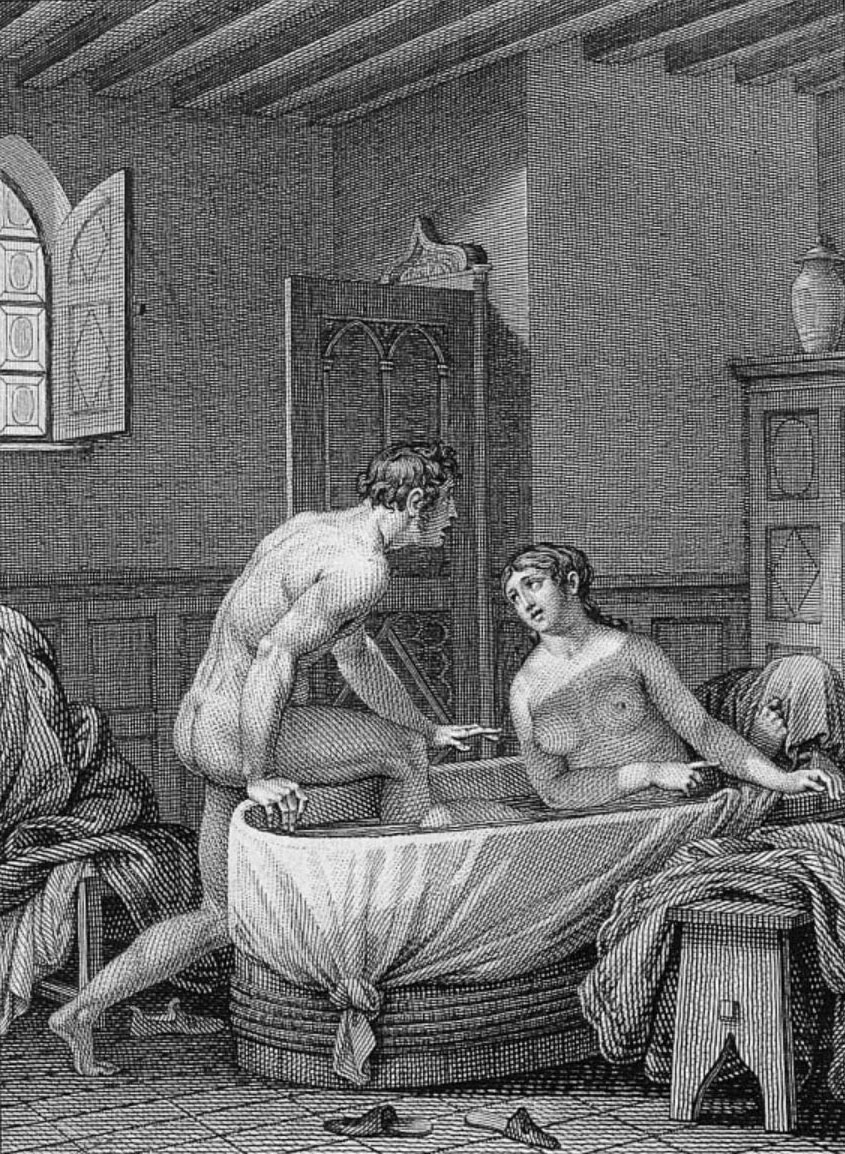
in a bath tub, a married woman terrorizes another man who aspired to love her

The three women horribly humiliated and abused the foolish courtly lover Filenio. Emerenziana enticed him to her house with the promise of sex in her husband’s absence. Filenio took off his clothes and got in bed with her. As Emerenziana had planned, her husband soon returned. She directed Filenio to hide under the bed, where she had prepositioned thorny branches. Filenio stayed silently naked in his bed of thorns all night long as husband and wife slept together above him. Straparola commented:

I leave to you to think about how that miserable one found himself at the end of the night. He was likely not to retain his penis as he had to remain without the use of his tongue.

{ Io lascio considerare a voi a che termine quella notte si ritrovasse il miserello; il quale poco mancò che senza la coda non restasse, sì come era rimasto senza favella. }

Emerenziana thus acted as a vicious agent of castration culture. After her husband departed the next morning, Filenio, bleeding and fearing that he would soon die, returned home. The diligent care of a physician fortunately returned him to good health.

Then Panthemia feigned interest in sleeping with him. She invited him to her home. When he was undressed and ready to get into bed with her, she sent him into an adjacent room to get some perfume. There, as she had planned, he stepped on a loosened floorboard and fell into a underlying storeroom for cotton and wool. He had to pull out old stones in a wall to escape, naked and exhausted.

Some time later, Sinforosia pretended to want to sleep with him. She enticed him into her house and treated him to cakes and wines before bed. But she had drugged the wine. Once the drug rendered Filenio unconscious, she had a maid drag him out into the street. When he awoke, he was naked, lying on bare ground, and half-frozen. Only by the strength of his youthfulness did he survive.

Filenio’s triple ordeals reversed his three declarations of courtly love. He then acted to demonstrate the goodness of the male gaze and the personal way in which the three women’s husbands loved them. To avoid the crooked path of Filenio, every student should study the troubadour Bernart de Cornilh and his humane defender Arnaut Daniel. All things work together for good for those who understand medieval literature.

* * * * *

Read more:

Notes:

The story above is from Giovanni (Zoan) Francesco Straparola, The Pleasant Nights {Le Piacevoli Notti}, Night 2, Story 2. The quotes use Italian text from Rua (1899) and English translation (modified) from Beecher (2012). The English translation of Waters (1894) is freely available online. Sraparola’s text uses phrases from Boccaccio. Beecher (2012) vol. 1, pp. 312-3. Boccaccio was an incisive critic of court love.

Reflecting a deeply entrenched gender problem in philology, both Waters and Beecher obscured the reference to the student’s penis. The Italian explicitly refers to the scholar’s “coda”:

Io lascio considerare a voi a che termine quella notte si ritrovasse il miserello; il quale poco mancò che senza la coda non restasse, sì come era rimasto senza favella.

Waters translated this passage as:

I leave you to figure in what plight the poor wretch found himself that night, seeing that he dared not call out, though he was like to lose a good part of his breech through the torment he was suffering.

Beecher translated the passage as:

I leave you to imagine further the plight of the poor wretch that night, as likely to end up an amputee as he was speechless.

The Italian word “coda” means most centrally “tail.” In context, it clearly refers to the scholar’s penis. His penis suffered torment from the thorns. Adding piquancy to this passage, medieval literature uses thorn as a figure for the penis. The words “breech” and “amputee” in Waters’s and Beecher’s translations obscure the penis. As meninist literary criticism insists, medieval literary study must become more inclusive and welcoming of penises.

Beecher described the women’s treatment of Filenio as “humiliation of his masculine pretensions.” Beecher (2012) vol. 1, p. 309. A man seeking to love multiple women isn’t “pretentious.” But if he attempts to do so under delusions of courtly love, he’s foolish.

[image] In a bath tub, a married woman manipulates her husband to terrorize another man who aspired to have sex with her. Drawing entitled “The two money-changers {Lex deux changeurs}.” The medieval fabliau “Lex deux changeurs” was a source for Straparola’s story about Filenio Sisterno. This drawing is from between pages 204 and 205 in vol. 4 of Legrand (1829).

References:

Beecher, Donald. 2012. Giovanni Francesco Straparola. The Pleasant Nights. 2 vols. Toronto: University of Toronto Press.

Legrand d’Aussy, Pierre Jean-Baptiste. 1829. Fabliaux ou contes, fables et romans du XIIe et du XIIIe siècle: traduits ou extraits. Paris: Renouard.

Rua, Giuseppe. 1899. Le piacevoli notti di M. Giovanfrancesco Straparola da Caravaggio nelle quali si contengono le favole con i loro enimmi da dieci donne e duo giovani raccontate. 2 vols. Bologna: Romagnoli-Dall’ Acqua. Alternate presentation of 1927 edition.

Waters, W.G., trans. 1894. Giovanni Francesco Straparola. The Nights. Vol. 1. Vol. 2. London: Lawrence and Bullen. Alternate presentation: vol. 1, vol. 2.

the male gaze desires to see a woman’s face

When men gaze upon an attractive woman, they aren’t just looking at her body as a sexual object. Men want to see a woman’s face. A man gazes upon a beautiful woman’s face with a sense for her personal, human uniqueness. He imagines her relating to him personally with warm receptivity and generous appreciation. Consider, for example, a medieval Latin poet reveling in a woman’s beauty:

O my sweetness, totally full of sweetness,
O how beautiful and dignified you appear in my eyes!
Your head seems to be crowned with gold,
your eyes shine like a golden beam.
Golden hair, a milk-white neck leading away,
a charming throat you have, all full of sweetness.
The lyre of your hands is wrought such as a gold instrument.
You alone I indeed call elegant, more than all others.
I judge you beautiful, marked in that blemishes you have none.

{ O dulcedo mea, tota dulcedine plena,
O quam pulchra meis oculis et honesta videris!
In cono capitis auro tu consimilaris,
Effulgent oculi tibi sicut radius auri,
Aurea cesaries, dimissaque lactea cervix,
Guttur habes lepidum, cuncta dulcedine plenum,
Testudo manuum, tornatilis, talis ut aurum.
Immo te solam plus cunctis dico decoram —
Censeo te pulchram maculam quia non habes ullam. }[1]

The male gaze is associated with the moral risk of dehumanization. Medieval men loved women so ardently that some veered into gyno-idolatry. No matter how beautiful a woman appears, she isn’t a goddess. She’s a fully human being, just as every man is.

Isleworth Mona Lisa, excerpt of face

A medieval literary motif of voyeurism highlights that a woman’s face is vital to a man’s personal appreciation of her. In a fabliau from the first half of the thirteenth century, a money-changer was having a sexual affair with his fellow money-changer’s wife. One day when he was in bed with his friend’s wife, he invited his friend over to the bedroom. He proclaimed:

I have the most beautiful lover
that ever was. She lies next to me.

{ que j’ai la plus tres bele amie
qui onques fust, qui lez moi gist. }[2]

With men’s natural curiosity, the friend asked to see her. Recognizing her husband’s voice, she hid her face. The man, however, uncovered her beautiful hair. Then he showed off her feet and legs and thighs and breasts and neck. That display, proceeding mainly from the feet upward, reverses the top-down direction of the typical medieval “description of a young woman {descriptio puellae}.” He refused to show her face. The husband admired the woman’s wonderful loveliness. But without seeing her face, he didn’t recognize that the woman was actually his wife.

In Straparola’s mid-sixteenth-century The Pleasant Nights {Le Piacevoli Notti}, the importance to a husband of seeing his wife’s face is affirmed in triplicate. According to Straparola, three eminent married women of Bologna cruelly abused a scholar after he sought their love simultaneously. In revenge, the scholar forced the three ladies to get naked in bed together. Then he invited their husbands into the room:

He said to them, “My Lords, I have brought you here for a little solace through a diversion. I intend to show you the prettiest sight you’ve ever seen.” Having then led the husbands to the bed with a torch in his hand, gently he began to life up the covering at the ladies’ feet. He turned it back far enough to reveal the pretty limbs beneath it as far as the knees. Their husbands were now gazing upon their wives’ white limbs and petite feet. When he had done this, he then uncovered them to the middle and displayed their legs whiter than alabaster. Their legs seemed like columns of polished marble, and their bellies were rounded in so shapely a fashion that nothing could be finer. Next uncovering their fair bodies yet a little more, he showed their gently swelling bosoms with the two round breasts so delicate and tender that they might have compelled the great god Jove to kiss and fondle them.

{ disseli: Signori miei, io vi ho quivi condotti per darvi un poco di solacio e per mostrarvi la più bella cosa, che a’ tempi vostri vedeste giamai; — e, approssimatosi al letto con un torchietto in mano, leggermente cominciò levar il linzuolo da’ piedi e invilupparlo, e discoperse le donne sino alle ginocchia; ed ivi li mariti videro le tondette e bianche gambe con i loro isnelli piedi, maravigliosa cosa a riguardare. Indi discopersele sino al petto, e mostrolli le candidissime coscie che parevano due colonne di puro marmo, col rotondo corpo al finissimo alabastro somigliante. Dopo, scoprendole più in su, li mostrò il teneretto e poco rilevato petto con le due popoline sode, delicate e tonde, che arebbeno costretto il sommo Giove ad abbracciarle e basciarle. }[3]

This descriptio puellae again proceeds unconventionally from feet upwards. Like most men, the husbands wanted to see not just these beautiful women’s bodies, but also their faces:

The wives lay quite still, not daring so much as to cough in order that they not be recognized. The husbands kept urging the scholar to uncover the ladies’ faces. But more careful in other men’s wrongs than in his own, he would not agree to that.

{ Elle stavano chete e non osavano zittire, acciò che conosciute non fussero. I mariti tentavano il scolare che le discoprisse il volto; ma egli, più prudente nell’altrui male che nel suo, consentire non volse. }

Although these women’s stripped clothes looked suspiciously similar to their wives’ clothes, the husbands left the room without recognizing that the three beautiful women were in fact their wives. Back at home, they questioned their wives. Their wives denied everything. These good men listened to the women and believed.

The male gaze desires to see a woman’s face. Medieval Christians appreciated the biblical unity of women and men. Men’s and women’s desires for each other were regarded as so vitally important that married persons were required under canon law to have sex with each other if either lovingly sought so. Medieval European authorities sought to dissuade men from gyno-idolatry by emphasizing women’s bodily reality:

If her guts showed, and the rest of her meat showed,
you would perceive what filth her white skin hides.
If gleaming purple cloth covers vile excrement,
by this who, except the insane, would love the excrement?

{ Viscera si pateant, pateant et caetera carnis,
Cernes quas sordes contegat alba cutis.
Si fimum vilem praefulgens purpura velet,
Ecquis ob hos fimum vel male sanus amet? }[4]

Such poetry has been largely ineffectual. When men see a beautiful woman’s face, they don’t think of her as excrement, guts, and meat. They see her as a marvelous human being, and sometimes even a goddess. The most significant problem historically hasn’t been men objectifying or dehumanizing women. It’s been men deifying women.

* * * * *

Read more:

Notes:

[1] “In the fullness of your many allurements, dearest one {Ubere multarum, carissima, deliciarum}, ” vv. 3-11 (of 11), Latin text of Munich, Clm 19411, folio 70v, from Dronke (1965) vol. 2, p. 463, my English translation, benefiting from that of id. p. 464. The source manuscript was written in the twelfth or thirteenth century. Donke noted that v. 8 quotes Maximianus, Elegies 1.93.

The phrase “totally full of sweetness {tota dulcedine plena}” was used in the liturgy for translating the relics of Vitalis of Savigny in 1243. Auvry (1898) vol.3, p. 339-40. Cf. “full of grace {gratia plena}” in Luke 1:28 and the “Hail, Mary {Ave, Maria}” prayer.

[2] About two money-changers {Des deus changeors}, incipit “Whoever makes a rhyme or story {Qui que face rime ne fable},” vv. 74-5, Old French text and English translation (modified) from Dubin (2013) pp. 248-9 (fabliau 21). For a freely available Old French text, Montaiglon & Raynaud (1872) vol. 1, pp. 245-54. For a later version of this fabliau, Antoine de la Sale, The Hundred New Novels {Les Cent nouvelles nouvelles}, nouvelle 1, The reversed medal {La medaille a revers}, Middle French text in Lacroix (1884), English translation in Douglas (1899).

[3] Giovanni (Zoan) Francesco Straparola, The Pleasant Nights {Le Piacevoli Notti}, Night 2, Story 2, Italian text from Rua (1899), English translation (modified) from Beecher (2012) vol. 1, p. 306. The subsequent quote above is similarly from this story. The English translation of Waters (1894) is freely available online.

The Book of the knight of the Landry Tower {Livre du chevalier de la Tour-Landry}, Ch. 22, tells of the knight Boucicaut offending three ladies by simultaneous seeking their love. This book dates to 1381. From about the same time, a story similar to that of Des deus changeors is in Ser Giovanni Fiorentiono’s The gullible man {Il pecorone} as story 2.2. Beecher (2012) p. 311. In the Old French lay Ignaure, the knight Ignaure simultaneously loves twelve ladies. He thus far outdoes Boucicaut while suffering similar persecution from the women.

[4] Anselm of Canterbury, “Song about Contempt for the World {Carmen de contemptu mundi},” Latin text from Patrologia Latinae 155.697, my English translation. These verses are also cited in Roger de Caen / Alexander Neckam, “About the life of a monk {De vita monachorum},” vv. 401-4. For the latter poem, Wright (1872) vol. 2, pp. 175ff. Matheolus, a vigorous thirteenth-century voice of men’s sexed protest, similarly emphasized women’s non-divine corporeality: “A woman adorned with clothing is manure covered with snow {Vestibus ornata mulier nive stercus copertum est}.” Matheolus, Lamentations of Little, Little Matheus {Lamentationes Matheoluli} vv. 1973-4, Latin text from Van Hamel (1892), my English translation. Given the historical prevalence of violence against men, men’s mortal ugliness was much more readily apparent than women’s.

[image] Isleworth Mona Lisa (excerpt). Early sixteenth-century oil on canvas portrait of Lisa Gherardini, probably by Leonardo da Vinci. Source image via Wikimedia Commons.

References:

Auvry, Dom Claude. 1898. Histoire de la congregation de savigny. Rouen: A. Lestringant.

Beecher, Donald. 2012. Giovanni Francesco Straparola. The Pleasant Nights. 2 vols. Toronto: University of Toronto Press.

Douglas, Robert B., trans. 1899. Antoine de la Sale. One hundred merrie and delightsome stories: right pleasaunte to relate in all goodly companie by joyance and jollity: les cent nouvelles nouvelles. Paris: Charles Carrington.

Dronke, Peter. 1965. Medieval Latin and the Rise of European Love-Lyric. 2 vols. Vol. 1Vol. 2. Oxford: Clarendon Press.

Dubin, Nathaniel. 2013. The Fabliaux. New York: Liveright.

Lacroix, Paul, ed. 1884. Les Cent nouvelles nouvelles: dites les Cent nouvelles du roi Louis XI; éd. rev. sur l’édition originale, avec des notes et une introduction. Paris: Charpentier.

Montaiglon, Anatole de, and Gaston Raynaud. 1872. Recueil général et complet des fabliaux des XIIIe et XIVe siècles. Paris: Libr. des Bibliophiles.

Van Hamel, Anton Gerard, ed. 1892. Mathéolus, Jean Le Fèvre. Les lamentations de Mathéolus et le livre de leesce de Jehan Le Fèvre, de Ressons: poèmes français du XIVe siècle. Paris: Bouillon.

Rua, Giuseppe. 1899. Le piacevoli notti di M. Giovanfrancesco Straparola da Caravaggio nelle quali si contengono le favole con i loro enimmi da dieci donne e duo giovani raccontate. 2 vols. Bologna: Romagnoli-Dall’ Acqua. Alternate presentation of 1927 edition.

Waters, W.G., trans. 1894. Giovanni Francesco Straparola. The Nights. Vol. 1. Vol. 2. London: Lawrence and Bullen. Alternate presentation: vol. 1, vol. 2.

Wright, Thomas, ed. 1872. The Anglo-Latin satirical poets and epigrammatists of the twelfth century. London: Longman.

wine song and peace in Le Jeu de Saint Nicolas

About the year 1200, shortly before the Fourth Crusade, Jean Bodel’s Play of Saint Nicolas {Jeu de Saint Nicolas} highlighted violence against men and possibilities for peace. Fairly arbitrated settlements and miraculous conversions explicitly produce peace in this play. More subtly, wine song and wine drinking unify men across religions and cultures.

Le Jeu de Saint Nicolas doesn’t establish a moral binary of good Christians and bad non-Christians. The prologue describes non-Christians attacking Christians:

There used to be a pagan king
whose country bordered on Christendom.
War raged all the time between them.
One day this pagan attacked
the Christians at the very moment
when they were least expecting it.
They were caught completely unaware,
and many of them were killed or captured.

{ Que jadis fu uns rois paiiens
Qui marchissoit as crestïens.
Chascun jour ert entr’eus la guerre;
Un jour fist li paiens requerre
Les crestïens en itel point
Que il ne se gaitoient point;
Decheü furent et souspris;
Mout en i ot et mors et pris. }[1]

Yet less than twenty-five verses after the end of this prologue, the Christians are described as attacking the non-Christians. A messenger informs the pagan king:

King, never since Noah built the ark
was such an army, such a force
known as the one which has invaded us.
Their foragers run all over the place.
Whores and scoundrels and lecherous brutes
go burning your kingdom to ashes.
King, unless you plan a defense,
the land will go to ruin and loss.

{ Rois, tes empires ne teuls os
Ne fu puis que Noeus fist l’arche,
Con est entree en ceste marche.
Par tout keuxent ja li fourrier,
Putain et ribaut et houlier
Vont le pais ardant a pourre.
Roys, s’or ne penses de rescourre,
Mis est a perte et a lagan. }

A Christian army of “whores and scoundrels and lecherous brutes {putain et ribaut et houlier}” isn’t holy. That description draws in part on historically entrenched disparagement of men’s sexuality. But here it’s more than merely a gender convention. In the context of explicitly contradictory identifications of the attacker, it also undermines a moral binary of good Christians and bad non-Christians.

In Le Jeu de Saint Nicolas, Christians and non-Christians similarly relate to sacred images. A wooden statue of Saint Nicolas has a central role. The non-Christian king, however, has his own sacred image called Tervagan. The king castigates Tervagan for the Christians’ invasion of his land:

Ah! You son of a whore, Tervagan,
have you permitted this to happen?
How I regret the gold with which
I cover your filthy face and body!
I swear, if my oracle doesn’t tell me immediately
how to destroy all the Christians,
I’ll have you burned and melted down
and handed out among my men,
since you are worth more than silver —
you’re made of the finest gold of Arabia.

{ A! fiex a putain, Tervagan,
Avés vous dont souffert tel oeuvre?
Com je plaing l’or dont je vous cuevre
Che lait visage et che lait cors!
Certes, s’or ne m’aprent mes sors
Les crestïens tous a confondre,
Je vous ferai ardoir et fondre
Et départir entre me gent.
Car vous avés passé argent:
S’estes du plus fin or d’Arrabe. }

The king treats Tervagan as some Christians treated their own holy images. Muslims typically were much more averse to sacred personal representations than were medieval Christians. Tervagan is a wholly imaginative construct that makes the African pagan king’s piety similar to Christian piety.[2]

Fighting between two non-Christian officials ends in an arbitrated peace and a wine song. In the king’s land, city magistrates appointed Connart as an official crier — a voice broadcaster of royal proclamations. Town businesspersons hired Raoul as a commercial crier — a voice advertiser. The two get into a physical fight over the boundaries of their respective jobs. A tavern-owner intervenes and establishes an occupational separation. Raoul then honors this peace by crying a sophisticated, ironically humorous wine song:

Wine newly tapped
from a full gallon and a full barrel,
smooth, tasty, full-bodied and fat,
leaps like a squirrel in the woods,
without any bite of rot or mold,
short of dregs and dry and thin,
as clear as a sinner’s tears.
It lingers on the lecher’s tongue —
other men shouldn’t taste it.

{ Le vin aforé de nouvel,
A plain lot et a plain tonnel,
Sade, bevant, et plain et gros,
Rampant comme escuireus en bos,
Sans nul mors de pourri ne d’aigre.
Seur lie court et sec et maigre,
Cler con larme de pecheour;
Croupant seur langue a lecheour;
Autre gent n’en doivent gouster. }[3]

To the tavern-patron / thieve Pincedé, Raoul continued his praise of the wine:

See how it swallows its foam,
and leaps and sparkles and cools!
Hold it on the tongue a little,
so soon you’ll sense wine beyond wine.

{ Vois con il mengüe s’escume,
Et saut et estinchele et frit!
Tien le seur le langue un petit,
Si sentiras ja outrevin. }[4]

Scholars have failed to sense anything in this beyond literal praise of wine. An editor of a scholarly edition of Le Jeu de Saint Nicolas wrote about this cry for wine:

Through the years this cry gave me many difficulties, and after having in my imagination tasted and analyzed many wines, I tried to render it in modern French:

The wine is freshly tapped, a full batch and a full barrel, tasty, supple, solid and fleshy, rising like a squirrel in the woods, without any trace of mold or sourness, nourished from its dregs, full-bodied, firm and nervous, clear as a sinner’s tear, lingering on the tongue of gourmets: others must not touch it!

What oenologist could say it better than Jean Bodel?

{ Ce cri m’a donné, pendant des années, beaucoup de fil à retordre, et, après avoir, en imagination, dégusté et analysé beaucoup de vins, j’ai essayé de le rendre en français moderne:

Le vin mis en perce tout fraîchement, à plein lot et à plein tonneau, sapide, souple, solide et charnu, montant comme écureuil au bois, sans nulle trace de moisi ni d’aigre, nourri de sa lie, corsé, ferme et nerveux, limpide comme larme de pécheur, s’attardant sur la langue des gourmets: les autres ne doivent pas y toucher!

Quel œnologue dira mieux que Jehan Bodel? }[5]

Jean Bodel wrote as a witty poet, not as an oenologist. In Raoul’s wine song, Bodel used the following rhetorical devices:

  • ambiguous characterizations that could be interpreted badly: “wine newly tapped {le vin aforé de nouvel}” could mean already opened wine tapped again or more simply, stale wine
  • contradictory descriptions: “fat {gros}” versus “thin {maigre}”
  • deliberately bad promotional claims: “without any bite of rot or mold {sans nul mors de pourri ne d’aigre}” (negative imagery) and “other men shouldn’t taste it {autre gent n’en doivent gouster}” (reverse selling)
  • obscure similes: “leaps like a squirrel in the woods {rampant comme escuireus en bos}” and “as clear as a sinner’s tears {Cler con larme de pecheour}”
  • negative characterizations of customers: “lecher {lecheour}”

This wine song uses playful rhetoric similar to that of classical Arabic wine songs. Its contradictory rhetoric is similar to al-Jahiz’s essay on “Drink & Drinkers.” No evidence exists that Jean Bodel, born in the commercial city Arras in northern France, knew Arabic wine songs. Yet an Arabic scholar about the year 1200 who knew French would probably call Raoul’s poetic touting of wine a wine song.[6] Bodel’s wine song brings together in common appreciation Arabic and Christian culture at the lowest level of society. Wine songs are associated with loving, not fighting.

In the tavern, a physical fight between thieves is settled with impartial arbitration and wine. Pincedé and Cliquet fight over stakes in a dice game. They knock over tables and tear each other’s clothes. The tavern-keeper tells them to stop and establishes an arbitrator by mutual agreement. The arbitrator orders a fair division of the stakes. Then he says:

And you, Cliquet, now pour some wine
and offer Pincedé a drink.
I want you two to be in accord,
since the matter is at my judgment.

{ Et tu, Cliquet, verse vin ens.
Si donne a boire Pinchedé.
Jel voeil que soiés acordé,
Puisqu’il est en men jugement. }

Cliquet in response declares:

Pincedé, I apologize to you for it.
I give you this wine to indicate our accord.

{ Pinchedé, je le vous ament:
Par acorde le vin vous doins. }

Cliquet and Pincedé then drink in turn from the same cup. In an ironic conclusion to their fight, Pincedé says:

And I pardon you, Cliquet, for it.
I know that it was the wine that made you do it.

{ Cliquet, et je le vous pardoins;
Bien sai que vins le vous fist faire. }

These passages should be read with respect to the wine-sharing of the Christian Eucharist and with appreciation for liturgical parody. Love of Christ at least nominally inspired Crusaders to try to liberate Jerusalem from Muslim rule. Wine here is also a sign of peace among quarreling non-Christian thieves. Recognized for witty wordplay, Jean Bodel also wove allusions with great sophistication.

The statue of Saint Nicolas miraculously saved the non-Christian king’s treasure from thieves. In response to that miracle, the king converted from worshiping a medley of gods to worshiping Saint Nicolas:

Saint Nicholas, I give myself
to your protection and ask for your mercy
without deceit and without treachery.
Sir, I swear that I’m your man.
I renounce Apollo and Mahomet
and that scoundrel Tervagan.

{ Sains Nicolais, je me rent chi
En te garde et en te merchi
Sans fausseté et sans engan:
Sire, chi devieng jou vostre hom.
Si lais Apolin et Mahom
Et che pautonnier Tervagan. }

The king’s conversion isn’t actually Christian and appears to be behaviorally insignificant. Christians relate to the statue of Saint Nicolas like the king relates to Tervagan. Moreover, an emir supporting the king refers to the statue of Saint Nicolas as a “a horned Mahomet {un mahommet cornu},” where “horned” apparently refers merely to the mitre on Saint Nicolas’s head. Underscoring the behavioral commonality between Christians and non-Christians, the non-Christian thieves swear by Saint William, Saint Leonard, and even Saint Nicholas.[7]

petitioning Saint Nicolas in the medieval manuscript of Le Jeu de Saint Nicolas

Jean Bodel’s Jeu de Saint Nicholas isn’t a morality play. It subtly questions men killing fellow men in religiously motivated war.[8] Jean Bodel added to the literary tradition of Saint Nicolas’s icon miracle the tavern scene and the thieves, and the wine song and the wine-sealed peace. These brilliant literary innovations place Jean Bodel in league with the Archpoet in expressing humane concern for men’s lives.

* * * * *

Read more:

Notes:

[1] Jean Bodel, The Play of Saint Nicholas {Le Jeu de Saint Nicolas}, vv. 9-16, Old French text from Warne (1951), English translation (modified) from Axton & Stevens (1971). Subsequent quotes from this play are similarly sourced, unless otherwise noted.

Le Jeu de Saint Nicolas is the earliest surviving non-liturgical play in the French language. It has survived in one manuscript: Bibliothèque nationale de France, MS Français 25566. That manuscript was written about 1300 in Arras, France. Jean Bodel was born in Arras and is closely associated with Arras. On Jean Bodel and his context, Frank (1972) Ch. 10 and Symes (2007).

The Saint Nicolas in Bodel’s play is the fourth-century Saint Nicholas of Myra. Nicholas served as Bishop of Myra, which today is in Turkey. The first written life of Saint Nicholas is a Greek text from the sixth century. The life and miracles of Saint Nicholas / Nicolas subsequently became widely distributed. The Fleury Playbook / Book of the Plays of Fleury {Livre de Jeux de Fleury}, written about 1200 in the Loire Valley of France, includes four Latin plays about miracles of Saint Nicolas. They are Three Daughters {Tres Filiae} (Saint Nicolas gives the three daughters money for dowries), Three Clerks {Tres Clerici} (Saint Nicolas resurrects three pickled clerks), The Image of Saint Nicolas {Iconia Sancti Nicholai} (an statue of Saint Nicolas guards a man’s treasure and saves it from thieves), and The Son of Getron {Filius Getronis} (Saint Nicolas helps to rescue a boy that a king kidnapped). Bodel’s play drew most directly upon Iconia Sancti Nicholai.

Le Jeu de Saint Nicolas is thought to date to about 1200, but whether the prologue was part of the original play is a matter of dispute. Some scholars believe that the prologue was added for a performance in 1288. On scholarly debate about this issue, Ramey (2002) pp. 4-6. Ramey’s suggestion seems to me worthy:

I would suggest that the prologue is authentic, and the omissions and revisions are deliberate, not to prepare the audience, but to intentionally put the audience off-guard.

Id. p. 5.

Subsequent quotes above from Le Jeu de Saint Nicolas are vv. 126-33 (King, never since Noah built the ark…), 134-43 (Ah! You son of a whore, Tervagan…), 645-52 (Wine newly tapped…), 658-61 (See how it swallows its foam…), 948-51 (And you, Cliquet, now pour some wine…), 952-3 (Pincedé, I apologize to you for it…), 958-9 (And I pardon you, Cliquet, for it…), 1461-6 (Saint Nicholas, I give myself…).

[2] Lambert (2014) makes this point strongly:

The role of Tervagant is, it seems, to be exactly mirrored by the role attributed to the figure of St Nicolas.

Id. p. 371.

[3] In the above English translation, I’ve followed the Old French as closely as possible while also trying to bring out what I perceive to be Jean Bodel’s playful rhetoric. Here’s the translation of Axton & Stevens (1971):

New wine, just freshly broached,
Wine in gallons, wine in barrels,
Smooth and tasty, pure, full-bodied,
Leaps to the head like a squirrel up a tree.
No tang of must in it, or mould —
Fresh and strong, full, rich-flavoured,
As limpid as a sinner’s tears;
It lingers on a gourmet’s tongue —
Other folk ought not to touch it!

Id. p. 99.

[4] The word mengüe is a form of the Old French verb mengier / mangier, which means “to eat.” Hence v. 658 could be translated more jarringly as “See how it eats its foam”. Here’s the translation of Axton & Stevens (1971):

Look how it swallows up its froth!
And leaps and sparkles, bubbles too!
Just hold it on the tongue a minute,
I tell you, you’ll taste a super-wine.

Id. p. 99.

[5] Henry (1986) p. 29, original in French, my English translation. Others have also interpreted Jean Bodel’s wine song as straightforward crying of wine. Translations of “lecheour” suggest how it has been interpreted. The translations are “gourmet” and “connoisseurs” in Axton & Stevens (1971), p. 99, and Mandel (1982) p. 56. The Old French word “lecheour” comes from words meaning “lick” and has as primary meanings in medieval Anglo-Norman “lecher, lecherous lover, scoundrel, and glutton.” It’s a word associated with low culture, not high culture.

A simpler wine cry occurs in the Courtois d’Arras, vv. 102-13. One of Jean Bodel’s contemporaries apparently composed Courtois d’Arras in Arras in the first quarter of the thirteenth century

[6] On the classical Arabic wine song, Kennedy (1997). I’ve suggested that Moriuht, which Warner wrote in Rouen early in the eleventh century, is similar to eminent classical Arabic literature. Troubadour song shows influence of Arabic literature. See, e.g. Alfonso X’s song about the dean of Cádiz. On medieval Europeans understanding of the Islamic world, Ninitte (2016). On other ludic elements of Le Jeu de Saint Nicolas, Dinshaw (1980).

[7] This reference to Saint Nicholas as a horned Mohamet (v. 458) has been suppressed in translation. Lambeth (2014) p. 372. For a medieval reference to a mitre as horned, see my post on Burnel and seminal action in the Mirror of Fools {Speculum stultorum}.

The thieves swear by Saint William, Saint Leonard, and Saint Nicholas in vv. 1115, 1134, and 1135. Lambeth observed of this cultural mixing:

This distinguishes Bodel’s work from other semi-fictionalised works in which the Saracens are more commonly depicted swearing by Apollon, Tervagant and Mahomet. There is nothing in these scenes, apart from the Emir’s initial summoning by Auberon, which identifies the pub crawlers as anything other than local Arrasians.

Id. The non-Christian king surely doesn’t reside in Arras. Describing the tavern scenes simply as set in Arras seems to me to flatten Jean Bodel’s deliberate, sophisticated cultural mixing. Symes (2007) interprets the tavern scenes as being in Arras. Overall, Lambeth (2014) shows important limitations of that interpretation. The wine song itself seems to me to belong more to the classical Arabic world than to urban Arras about the year 1200.

[8] Declaring that “critics have tended to read the Jeu as a crusade cheerleading piece,” Ramey sought to “challenge the univocal reading of the Jeu as exhortation to crusade.” Ramey (2002) pp. 10, 1. Symes (2007) and Lambeth (2014) contribute further to appreciating the cultural complexity of Bodel’s play.

[image] A man petitioning Saint Nicolas. Illumination from the first page of the manuscript of Le Jeu de Saint Nicolas. On folio 68r of Bibliothèque nationale de France, MS français 25566. Image via BnF Gallica.

References:

Axton, Richard, and John E. Stevens, trans. 1971. Medieval French Plays. New York: Barnes & Noble.

Dinshaw, Carolyn L. 1980. “Dice Games and Other Games in Le Jeu de Saint Nicolas.” PMLA / Publications of the Modern Language Association of America. 95 (5): 802-811.

Frank, Grace. 1972. The Medieval French Drama. Oxford: Clarendon Press.

Henry, Albert. 1986. “A propos d’un texte œnologique en ancien français.” Bulletin de la Classe des Lettres et des Sciences Morales et Politiques. 72 (1): 16-29.

Jeanroy, Alfred, ed. 1925. Jean Bodel. Le jeu de Saint Nicolas. Paris: É. Champion.

Kennedy, Philip F. 1997. The Wine Song in Classical Arabic Poetry: Abū Nuwās and the literary tradition. Oxford: Clarendon Press.

Lambert, Sarah. 2014. “Playing at crusading: cultural memory and its (re)creation in Jean Bodel’s Jeu de St Nicolas.” Journal of Medieval History. 40 (3): 361-380. Reprinted in Cassidy-Welch, Megan & Anne Lester, ed. 2015. Crusades and Memory: rethinking past and present. London: Routledge.

Mandel, Oscar, trans. 1982. Five Comedies of Medieval France. Washington D.C.: University Press of America.

Ninitte, Florence. 2016. La tradition arabo-musulmane dans le Speculum historiale et dans sa traduction française par Jean de Vignay: Enjeux d’un transfert culturel. Doctoral Dissertation. Université Catholique de Louvain.

Ramey, Lynn Tarte. 2002. “Jean Bodel’s Jeu de Saint Nicolas: A Call for Non-Violent Crusade.” French Forum. 27 (3): 1-14.

Symes, Carol. 2007. A Common Stage: theater and public life in medieval Arras. Ithaca, N.Y.: Cornell University Press.

Warne, Frank Julian, ed. 1951. Jean Bodel. Le jeu de Saint Nicolas. Oxford: Blackwell.

natural and mechanical figures against gyno-idolatry

From the perspective of monotheistic religions like Judaism, Christianity, and Islam, idolatry is a terrible failing. Men nonetheless are prone to gyno-idolatry. The great classical Roman dispeller of delusions Lucretius vigorously satirized gyno-idolatry. Medieval authors more humanely used figures of natural scenery and nature-driven machines to emphasize the bodily humanity that unites women and men.

Boccaccio’s Corbaccio, an outrageous medieval work of men’s sexed protest, challenged gyno-idolatrous belief that women don’t fart. A specter recounted metaphorically his experience of sleeping with his wife:

What shall I say further to you therefore about the village of Evilhole, placed between two lofty mountains? From here sometimes just as from Mount Etna, first with great thunderclaps and then silently, issues forth a sulfurous smoke. It’s so fetid and repulsive that it pollutes the whole surrounding countryside. I do not know what to say to you about it except that, when I lived near it (for I remained there longer than I would have liked), I was offended many times by such blasts that I thought to die there something other than a Christian death.

{ Che ti dirò adunque più avanti del borgo di Malpertugio, posto tra due rilevati monti, del quale alcuna volta, quando con tuoni grandissimi e quando senza, non altrimenti che di Mongibello, spira un fummo sulfureo sì fetido e sì spiacevole che tutta la contrada atorno apuzola? Io non so che dirmiti, se non che, quando io vicino v’abitai (ché vi stetti più che voluto non arei), assai volte, da così fatto fiato offeso, mi credetti altra morte fare che di cristiano. }[1]

The two lofty mountains are his wife’s buttocks. Men historically have been attracted to women with large buttocks. Evilhole {Malpertugio} was the name of the gate in Bologna through which criminals passed on their way to execution. Evilhole here figures the wife’s anus. Her farting is like volcanic eruptions from Mount Etna {Mongibello} in Sicily. The ancient Greek philosopher Empedocles reportedly committed suicide by jumping into a volcanic crater of Mount Etna.[2] Imaginatively realizing his metaphor, the narrator admits to thoughts of unchristian death: suicide by sodomy in attempting to plug Evilhole. Boccaccio’s Corbaccio was appreciated in medieval Europe as a morally instructive work. Yet some might perceive in it a comic sense.

medieval windmill

John Heywood’s The Play of the Weather, which he composed about 1530 within the circle of the learned and devout Thomas More, similarly treats corporal reality. In this play, persons with different interests petition the god Jupiter for favorable weather. A water-miller seeks more rain and less wind. A wind-miller asks for more wind and less rain. The two millers viciously and ridiculously argue with each other about the relative merits of wind and water. The wise fool Merry-Report interrupts their bickering:

Stop, foolish knaves, for your reasoning is such
that you have reasoned even enough and too much.
I heard all the words that you both have had,
so help me God, the knaves be more than mad!
Neither of them two has wit nor grace
to perceive that both mills may serve in their place.
Between water and wind there is no such discord,
but each mill may have time for use in accord.
This matter I can tell by experience,
for I have my own not far hence,
in a corner together — a couple of mills
standing in a marsh between two hills.
They’re not from inheritance, but by my wife.
She is endowed in the tail for the term of her life
with one for wind and the other for water.
And between them both, I thank God, there stands another.
And, let this be solemnly spoken,
the water gate is no sooner open
then boom goes the windmill even straight behind,
there God help the devil and all they grind.

{ Stop folyshe knaue, for your reasonynge is suche
That ye haue reasoned euen ynonght and to muche
I harde all the wordes that ye bothe haue hadde
So helpe me god the knaues be more then madde
Nother of them bothe that hath wit nor grace
To perceyue that bothe mylles may serue in place
Betwene water and wynde there is no suche set
But eche myll may haue tyme to vse his fet
Whiche thynge I can tell by experiens
For I haue of myne owne not farre from hens
In corner togyther a couple of mylles
Standynge in a marres betwene two hylles
Nat of wherytaunce but by my wyfe
She is feofed in the tayle for terme of her lyfe
The one for wynde the other for water
And of them bothe I thanke god there standeth nother
For in a good houre be it spoken
The water gate is no soner open
But clap sathe the wyndemyll euyn streight behynde
There is good spedde, the deuyll and all they grynde }[3]

Just as in Boccaccio’s Corbaccio, the two hills represent the wife’s buttocks, and the wife farts. This important medieval understanding has now been largely lost, as least in literary works and public discourse.

Merry-Report frankly acknowledges his own bodily limitations. He reports that his wife often has sex with other men: “my water-mill many times is clogged {my water myll many tymes is choked}.” The water miller counsels:

So will she be, though you in working burst your bones,
except that you be perfect in setting your stones.
Don’t worry about the balls — beware your boner.
Yet as to the balls, before you have worked her,
consider if the balls lack good grinding.

{ So wyll she be thought ye shulde bruste your bones
Excepte ye be perfyte in settynge of stones
Fere nat the lydger beware your conner
Yet this for the lydger or ye haue wonne her
Perchaunce your lydger dothe lacke good peckynge }

Merry-Report responds:

So says my wife, and that causes all our quarreling.
She would have the mill grinding, grinding, grinding every day!
But, by God, millers must grind when they may.
So often have I ground that my stones have become very thin,
and all my other gear isn’t worth a pin,
because with grinding and grinding I have been so working
that I have ground a good grinding-rod to nothing.
However, if I stick no better with her,
my wife says she will have a new miller.

{ So sayth my wyfe and that maketh all our checkynge
She wolde haue the myll peckt, peckt peckt euery daye
But by god myllers must pecke when they maye
So ofte haue we peckt that our stones wax ryght thynne
And all our other gere nat worth a pynne
For with peckynge and peckynge I haue so wrought
That I haue pecke a good peckynge yron to nought
Howe be it yf I stycke no better tyll her
My wyfe saythe she wyll haue a newe myller }

Classical Latin literature recognized the epic disaster of men’s impotence. But bodily life is as it is.

Imaginative literature allows persons to perceive what they couldn’t otherwise perceive. That isn’t necessarily fantasies. In fact, even without imaginative literature, humans are fully capable of creating their own nonsense such as gyno-idolatry or belief in misogyny and patriarchy. Imaginative literature like Boccaccio’s Corbaccio and John Heywood’s Play of the Weather helps persons to perceive nothing more than human existential reality.

* * * * *

Read more:

Notes:

[1] Giovanni Boccaccio, Il Corbaccio, section 295, Italian text from Padoan (1994) via the Decameron Web, English translation (modified slightly) from Cassell (1993). The subsequent localization of Evilhole {Malpertugio} in Bologna is from Cassell (1993) p. 138, n. 255.

Boccaccio is thought to have written the Corbaccio about 1355, although Padoan dates it about 1365. Cassell (1993) p. xxvi. Boccaccio wasn’t shunned for having written the Corbaccio. Showing the extent of medieval interest in the Corbaccio, the Florentine notary Ser Lodovico Bartoli translated it into ottava rima about 1387. The Corbaccio was regarded as a “moral tract” for nearly three centuries following its composition. After the fall of the Middle Ages and the long slide to ignorance, repression, and bigotry, the Spanish Church in 1631 placed Boccaccio’s Corbaccio on the index of prohibited books. Id. pp. xxi-ii. Here’s some discussion of modern literary criticism of the Corbaccio.

[2] On Empedocles committing suicide by jumping into a volcanic crater of Mount Etna, Diogenes Laertius, Lives and Opinions of Eminent Philosophers 8.69, 8.74. Different stories exist about how Empedocles died.

[3] John Heywood, The Play of the Weather, A new and very merry interlude of all manners of weather {The Play of the Wether, A new and a very mery enterlude of all maner wethers} vv. 710-29, Middle English text from Heywood (1544?), my English modernization. Axton & Happé (1991) is the best current critical edition. It uses the original Tudor spelling. For editions with modernized spelling, Bevington (1975) and Staging the Henrician Court. The subsequent three quotes above are similarly from The Play of the Weather, vv. 739, 740-44, and 745-53.

The Play of the Weather, called an “interlude,” encompasses aspects of morality plays, debate poems, and Shakespearean comedy. Bevington characterized this play as “essentially courtly.” Bevington (1975) p. 990. For context and review of interpretations of this play, Ailles (2013), Mullini (2017), and Staging the Henrician Court.

Merry-Report is the first character called a Vice in an English play. But Merry-Report has characteristics of a Shakespearean fool:

Mery Reporte has not the sinister and mischievous traits of later Vices, nevertheless he already impersonates a Vice’s ability in wordplay, bawdy language, and performance, and such a character’s skill in manoeuvring the plot, albeit a thin one like this.

Mullini (2017) p. 33. On the differences between Vices and Fools, Rycroft (2009).

[image] Medieval windmill: countships grainmill of Zeddam {Grafelijke Korenmolen van Zeddam}, Netherlands. This windmill was built early in the fifteenth century. Source image via Rasbak and Wikimedia Commons.

References:

Ailles, Jennifer L. 2013. “Ecocritical Heywood and The Play of the Weather.” Early Theatre. 16 (2): 185-196.

Axton, Richard and Peter Happé, eds. 1991. The Plays of John Heywood. Suffolk: D.S Brewer.

Bevington, David M. 1975. Medieval Drama. Boston: Houghton Mifflin.

Cassell, Anthony K. trans. 1993. Giovanni Boccaccio. The Corbaccio, or, The Labyrinth of Love. Binghamton, N.Y.: Medieval & Renaissance Texts & Studies.

Heywood, John. 1544?. The play of the wether. A newe and very mery enterlude of all maner wethers made by Iohn Heywood. The players names. Iupiter a god. Mery reporte the vyce. The gentylman. The marchant. The ranger. The water myller. The wynde myller. The gentylwoman. The launder. A boy the left that can play. London: W. Middleton. Via Early English Books.

Mullini, Roberta. 2017. “The Play [not only] of the Wether: Gender, Genre, and Wordplay in a Very Early Modern Comedy.” British Institute of Florence. Online.

Padoan, Giorgio, ed. 1994. Giovanni Boccacio. “Il Corbaccio.” In Carlo Delcorno, ed. Tutte le opere di Giovanni Boccaccio. Volume 5, Book 2. Milano: Mondadori.

Rycroft, Eleanor. 2009. “The Vice and the Fool.” Staging the Henrician Court. Online.

great Saint Alexander Akimetes’s wicked rationalizing

According to a story that Goscelin of Saint-Bertin heard in the middle of the eleventh century, the anchorite Alexander was highly virtuous. Humble persons understand the risk of temptations and pray not to be led into them. The devil shrewdly seeks great persons like the anchorite Alexander, who became Saint Alexander Akimetes.

monk who had sex with an anchoress and killed a man becomes hairy anchorite in solitude and penance

After stealing a squalling baby girl from her cradle, the devil disguised as a monk brought her to the anchorite Alexander. The devil-monk said:

This baby girl is my sister’s daughter, deprived of both her parents. In pity I took her because she was facing death. From this I have anguish in my soul. It is unlawful to keep her in the cloister under my abbot and entirely impious to abandon her. You with your fraternal holiness and famous solitude are her sole refuge. With mercy as a foster-father you should thus take her and nourish her until she has strength to provide for herself.

{ Hanc sororis mee natam, utroque parente orbatam, collegi miseratus perituram. Hinc angor animi, quia et in cenobio sub abbate meo hanc tenere est inordinatum, et abicere prorsus impium. Tua fraterna sanctitas et famosa solitudo unicum est refugium, ut hanc misercordie alumnus suscipias, et, dum sibi preuidere valeat, enutrias. }[1]

No solitary monk with Christian love could reject a needy baby girl. Alexander the anchorite accepted her and raised her into a beautiful young woman. Then he had sex with her. She became pregnant.

nun shows hairy anchorite their baby

The devil disguised as a monk re-appeared to Alexander and asked about the girl. The hermit, “groaning deeply from the suffering of his conscience {conscientie dolore altius ingemiscens},” confessed his sin. The devil then urged him to commit a terrible crime with elaborate rationalizing:

He was famous for sanctity and advanced in age. Nothing is worse than an elderly apostate. If from the former odor of sanctity were to burst among the people such fetid disgrace, immediately everything would be mixed with uproar and scandal. The whole world, not so much against him as against all holy men, would be armed with hatreds, slanders, curses, mockeries, and reproaches. Everything holy would be cursed by all. He would be more guilty of the ruin of many than of his own crime. There remained for him one remedy, such that by one evil he might extinguish so many evils. Let him slit the throat of the unfortunate woman and bury her along with that crime in the earth, away from the sight of Heaven and all human notice. He could thus more easily be penitent and satisfy divine mercy rather than human madness.

{ illum esse preclarum sanctimonia, prouectum etate, nil turpius sene apostato, si in populum eruperit de priori odore tam feda infamia; protinus omnia turbis et scandalis misceri, totum mundum, non tam in eum quam in omnes sanctos uiros, odiis, detractionibus, maledictis, subsannationibus, conuitiis armari, omne sacrum ab omnibus execrari, illum perditionis multorum magis quam proprii criminis esse reum, unum sibi, ut uno malo tam multa mala extingueret, restare remedium, infelicem mulierem iugularet, et a conspectu celi omnique humana notitia cum scelere terra obrueret, eum facilius penitere et satisfacere posse apud diuinam clementiam, quam apud humanam uesaniam. }

The hermit Alexander, “relying on that good master of perdition {bono magistro perditionis fretus},” killed his “spouse {coniunx}” and buried her body.

The devil then appeared to Alexander and sought to claim him. Doing evil puts one in league with the devil. So the devil said to Alexander:

Ah, most evil of men, now you have become entirely mine. No one has obeyed my suggestions more cruelly than you. Well, lost one, was it not sufficient for you to have debauched without also staining your brothel with blood?

{ Eia, sceleratissime hominum, iam totus meus effectus es; nemo credulius meis suggestionibus paruit. Hem, perdite, non satis erat constuprasse, nisi et lupanar maculasses sanguine? }

In despair Alexander called on Christ. The devil fled in terror. God can overcome any demon. Moreover, Christian tradition offers much compassion toward holy harlots. Shouldn’t men truly sorrowful for their evil acts be offered mercy?

hairy anchorite with chain around his neck led to punishment

Alexander wasn’t redeemed instantaneously. He suffered a long, punishing Ovidian transformation:

Casting himself on the ground, he for three days continuously overflowed with such tears that blood flowed out from his weeping. At last standing up, he had before his eyes an open oak-tree, shining from within as if from golden metal. He approached and attempted to examine it. When he put both hands into it, the tree closed itself and detained the sinner against God. So that I don’t linger too much, there for fifteen years he is said to have stood, content with no other food than falling nuts and leaves, and no other drink than that which the dew and rain gave.

{ Hic triduo continuo affusus humi tantis lacrimis inundauit, ut cruor a fletibus excurrerit. Tandem erectus, quercum patentem, et quasi fuluo metallo deintus relucentem, pre oculis habuit. Accesssit experiendi studio, utque utrasque manus iniecit, arbor se occlusit et Dei preuaricatorem alligatum tenuit. Ibi, ne multum morer, quindecim annos stetisse perhibetur, cibo uel potu non alio contentus quam glandes et folium cadens, quam ros et pluuia dabat. }[2]

Alexander stood with the wood of the tree for fifteen austere years. Christ didn’t offer him cheap mercy.

One day King Gundofor was hunting in the woods. He came upon an old man encased in the tree. That old man was Alexander, who explained his crime and pointed to the woman’s grave nearby. Given the dates and circumstances, the King realized that the girl had been his own baby daughter. When he dug up her grave, he found her body uncorrupted and shining as if she were alive. She had received the bodily honor of a holy martyr. The murderer Alexander sought forgiveness from this holy martyr. Forgiveness involved the specific ritual of her foregoing capability to punish him:

Praying, the father placed the rod of forgiveness into the uncorrupted fingers of his daughter. Having taken it, she cast it from her in the manner of indulgence. At that same moment, the oak-tree, parting, set the captive free. Released from guilt and from long being bound, Saint Alexander sprang forth at liberty.

{ Pater orans festucam remissoriam incorruptis digitis nate imponit, illa susceptam more indulgentis proicit. Eodem momento quercus dehyscens captiuum relaxat, solutusque reatu et diutino nexu sanctus Alexander liber emicat. }[3]

As a martyr, the woman could bless Alexander from Heaven. At her grave site, King Gundofor built a huge monastery, lavished upon it royal wealth, and distinguished it by establishing within it a college of three hundred monks. The King then gave up his throne and himself became a monk there. Penance and forgiveness produced abundant holy fruits.

The monk Goscelin of Saint-Bertin recorded this story of illicit marriage and vicious murder within a long, ardent letter to his beloved nun Eve. She was about twenty years younger than he. Some today would say that’s creepy.[4] It was not so for loved-filled medieval women and men. Goscelin told this story to Eve to show the supernatural goodness and marvelous mercy of God. Medieval Christians believed that “from our evil God remakes his goods {de malis nostris sua bona reformat}.” Even those of us who aren’t medieval Christians might hope that to be true!

* * * * *

Read more:

Notes:

[1] Goscelin of Saint-Bertin, Comforting Book {Liber confortatorius}, Latin text from Talbot (1955) pp. 104-5, English translation (modified) from Barnes & Hayward (2004) pp. 191-2. All subsequent quotes are similarly sourced from this story of Alexander in Liber confortatorius.

This story of Alexander is “a previously unnoticed example of the ‘hairy anchorite’ story.” Barnes & Hayward (2004) p. 190, ft. 49. On the “hairy anchorite” story type, Williams (1935) and Matheson (2019) pp. 218-24.

This story seems to be more specifically about Saint Alexander Akimetes (died 430 GC). He spent time in solitude in the desert near Antioch. He was also associated with founding of monasteries of Acoemetae {ἀκοίμηται} monks, including a monastery in the Byzantine capital Constantinople. Acoemetae monks celebrated the divine service perpetually through relays of monks. The practice of perpetual adoration continues that tradition.

[2] Ovid tells of Daphne being assimilated into a laurel tree and Myrrha transformed into a myrrh tree. Ovid, Metamorphoses 1.525-52 (Daphne) and 10.431-502 (Myrrha). Lucian’s True History tells of men having their bodies joined inseparably to grape trees.

[3] Cf. 1 Corinthians 4:21, Luke 5:17-26. A “festuca {rod}” is possibly a “praetor’s rod (vindicta) laid upon the slave’s head in manumission (Plaut. Mil. Glor. iv. 1, 15; Pers.v. 175).” Peck (1898) via Perseus or Logeion. Using a “rod of forgiveness {festuca remissoria}” isn’t a well-attested medieval practice of forgiveness. On the origins of the idea of forgiveness, Konstan (2010). Jesus associated forgiveness with bodily self-mutilation.

[4] O’Brien O’Keeffe offered an intellectually elaborate interpretation of Goscelin as creepy through the story of Alexander:

I am arguing that the fantasy of Alexander {the devil’s depiction of spiritual disaster should Alexander’s crime be known} shows us that Goscelin’s desire for Eve, here as an obscene filling, requires her death. It is a death he has imagined before in the LC {Liber confortatorius} by ventriloquizing her burial in her cell. Such a death fends off the wicked eye and sly finger and, in ensuring her silence, guarantees Goscelin’s continuing desire for Eve.

O’Brien O’Keeffe (2012) p. 237. That interpretation seems to me to reflect the anti-meninism now pervasive in medieval literary scholarship. Goscelin profoundly loved Eve and surely did want her to have her throat slit. The story of Alexander occurs in Liber confortatorius, Book IV, as part of Goscelin’s extensive exhortation to humility and his descriptions of reversal of fortune and the world turned upside down in Christ.

Hayward and Hollis offered a much more provisional biographic interpretation of Goscelin’s story about Alexander:

If we wish to argue that there is an element of sexual anxiety in Goscelin’s admission of sin in his appeals for the intercession of Eve in Book I, here {the story of Alexander}, if at all, is the narrative reflex of a guilty conscience.

Hayward & Hollis (2004) p. 397. Medieval Christians understood all persons, even women, to be guilty of sin. Men commonly feel sexual desire toward young, beautiful, warmly receptive women. Goscelin may have felt sexual desire toward Eve. That doesn’t necessarily mean that he indulged in lust in his heart or other activities that medieval Christian authorities would regard as sinful. It also doesn’t mean that he felt sexual anxiety or had a guilty conscience. He may have felt instead that he was a healthy heterosexual man.

[images] (1) Hairy anchorite enters seclusion. The devil enticed a monk to have sex with a nun. The monk then killed a miller who witnessed the monk and nun embracing. Feeling guilty, the monk confessed to a bishop. He then became a hairy anchorite and entered seclusion. Illumination in an instance of the Decretals of Gregory IX, edited by Raymund of Penyafort (or Peñafort), with the glossa ordinaria of Bernard of Parma in the margin. This manuscript, commonly known as the Smithfield Decretals, was made between about 1300 and 1340. Detail from folio 117v of British Library, MS Royal 10 E IV. The story of this monk / hermit is painted on the lower margins of folios 113v-118v. (2) Nun shows hairy anchorite their baby. Similarly a detail from folio 133r of the Smithfield Decretals. This image is from the story of a hairy anchorite who had a sexual affair with a nun. It plays across the bottom margins of folios 125v-136v. (3) A hairy anchorite with a chain around his neck is led away to punishment. Similarly a detail from folio 134r of the Smithfield Decretals. The official apparently is holding a rod indicating punishment. Men continue to suffer harsh punishment from unplanned parenthood.

References:

Barnes, W. R. and Rebecca Hayward, trans. 2004. “Goscelin’s Liber confortatorius.” Part 2 (pp. 97-216) in Hollis (2004).

Hayward, Rebecca, and Stephanie Hollis. 2004. “The Female Reader in the Liber confortatorius.” Pp. 385-399 in Hollis (2004).

Hollis, Stephanie, ed. 2004. Writing the Wilton Women: Goscelin’s Legend of Edith and Liber confortatorius. Turnhout: Brepols.

Konstan, David. 2010. Before Forgiveness: The Origins of a Moral Idea. Cambridge: Cambridge University Press.

Matheson, Anna. 2019. “New Developments in the Study of the Wild Man in Medieval Irish Literature.” Pp. 203-226 in Bouget, Hélène, and Magali Coumert, eds. Quel Moyen Âge?: La recherche en question. Histoires Des Bretagnes. Brest: Éditions du CRBC, Université de Bretagne occidentale.

O’Brien O’Keeffe, Katherine. 2012. Stealing Obedience: Narratives of Agency and Identity in Later Anglo-Saxon England. Toronto: University of Toronto Press.

Peck, Harry Thurston. 1898. Harper’s Dictionary of Classical Antiquities. New York: Cooper Square Publishers.

Talbot, C. H, ed. 1955. “The Liber Confortatorius of Goscelin of Saint Bertin.” Pp. 1-117 in M. M. Lebreton, J. Leclercq, C. H. Talbot, eds. Analecta Monastica: Textes et études sur la vie des moines au moyen age. 3rd series. Studia Anselmiana, 37. Rome: Herder.

Williams, Charles Allyn. 1935. The German Legends of the Hairy Anchorite: with two old French texts of La vie de Saint Jean Paulus. Urbana, IL: University of Illinois.