
sexual harassment of men in the Middle Ages: the case of Galo

codpiece

During the Middle Ages in the king of Asia’s court, the queen fell in love with Galo, a foreign knight. He prudently and appropriately declined her advances. But she gave him rich presents and persisted in soliciting him from her position of superior authority. Even if the king’s court had a human resources department, it probably would have trivialized a woman’s sexual harassment of a man, as many do today. Fortunately, Galo’s close friend Sadius intervened to help end the sexual harassment. Such peer support is crucial for addressing sexism, domestic violence, and rape.

Sadius, who was the king’s nephew, approached the queen privately about her relationship to Galo. He began by praising her noble birth, her beauty, and her virtue. Noting that no man could resist her sexual allure, he praised her firm chastity. Then he added:

Yet one, and one only, do I know whom I could praise for like firmness, if the God of Love hadn’t made him impotent. In this matter for which we all admire and are amazed at him, there is entirely no doubt about him. [1]

The queen inquired about the man’s name. Sadius responded coyly:

Truly, he who is not to be compared to any man; yet the Lord who has enriched and endowed him with every kind of good fortune, in this alone has condemned him, or as he himself avers, saved him.

Suspecting that he was referring to Galo, the queen questioned and flattered Sadius, urgently seeking the man’s name. Sadius made her promise to keep the matter secret. After she so promised, he said:

It is my Galo, who, though he could extort every favor from women, confesses to me alone that he is completely empty of working potency. [2]

The queen inwardly groaned. She didn’t manage to completely suppress her tears. She quickly retreated into privacy and solitude. Sadius brought the news to Galo. They both rejoiced at the apparent success of their scheme to end the queen’s sexual harassment of Galo.

The queen, however, wasn’t willing merely to believe a horrifying story. Unlike today, in the Middle Ages persons sought actual evidence for sensational claims. The queen resolved to investigate whether Sadius lied about Galo. She summoned the noblest palace maiden:

She instructed and guided her to slid with wiles into nakedly embracing with Galo, to touch his penis, and then chastely bring back word whether he was potent or not. [3]

The queen greatly envied the maiden performing the task that she had assigned to her. The queen lay down on a couch and thought about Galo:

With what gentle reproof would he tell me that I was married and consecrated to the king, that he was his sworn man, and that he would for my sake do everything — but added: “Except that!” Good God! how huge was that “that”! All that I sought was “that”: “that” was everything. What, then, did he say? “All except that?” No, it was “all except all”, which is, being interpreted, nothing. And certainly he could have said more truly, “My lady, for your sake I will do all nothing.” And I wish that by such a nonsensical phrase he had shown me his true meaning and condemned me with an eternal repulse. O God, who ever snatched himself so harshly from such an embrace? Either the sighs of the young and old are false, or this face could rouse the ardor of any man. Yet my mirror is true. O, but I had forgotten! Sadius is faithful and truthful: he lost his genitals. The more fool is he, to conceal his disgrace from me, that he cannot be touched, to spurn me that I might not spurn him in return! Truly if he had favored me, I would have been his most closely joined and clinging friend, and if there were a delay in discovering him, a hand could stray that certainly would be able to detect whether he is female or male or neuter. O, it is not as I believed! Sadius lies, he is a man, the signs are certain that he is a man, intact, without defect. O what a wretch and fool I am to have sent the cleverest of girls on my own errand!

The queen then, blaming herself and still pondering at length Galo’s potency, agonized about the possibility of her maiden enjoying a tryst with Galo. The maiden had gone to him all dressed up. The maiden’s name was Ero, just an ‘s’ short of eros.

When Ero returned from her meeting with Galo, the queen anxiously and peevishly questioned her. Ero explained:

I came to him, I touched, but was repulsed. Nonetheless, I have no doubt that he is potent.

The queen then pressed questions about why she had taken so long and why she went dressed as if she were going to her wedding. Ero said:

It was good for me to be able to please him, until I knew him, and I nearly pleased; I perceived him fully a man and willing, if you had known him. But when he noticed that I was smaller, and less suited to him than you, I was cast out at once.

The queen understood what had happened. She declared that Ero had “wickedly committed adultery.” The queen then furiously attacked Ero:

she seized her by the hair and maltreated her, and wounded her with fists and feet, and handed her over half dead to her companions, to be strictly watched and have no license allowed to her. [4]

The queen had intensely desired to commit adultery with Galo. She now intensely hated him. She now sought to publicly humiliate him and get him killed.

Although Sadius and Galo’s impotency ruse was exposed, they succeeded in ending the queen’s sexual harassment. Challenges to public honor and personal safety were the sort of problems that medieval knights were much more accustomed to addressing. With a long knightly romance, disguised identities, and fierce personal combat, Galo and Sadius subsequently preserved Galo’s honor and his life. Those knightly affairs matter little to men in today’s modern societies.

Sexual harassment of men and boys continues to be a problem. Even sexual assault tends not to be taken seriously. Many persons refuse to believe that, according to the leading U.S. national survey, about equal numbers of women and men are raped. When a woman rapes a minor, newspapers commonly report that she “had sex,” not the legal fact that she raped. Women who rape boys and men are entitled to collect child support from them. A female teacher who sexually exploited a boy got less punishment than a woman who had sex with a dog. In such circumstances, men must learn to claim convincingly that they are impotent.

*  *  *  *  *

Read more:

Notes:

[1] De societate Sadii et Galonis (Of the friendship of Sadius and Galo), in Walter Map, De nugis curialium, Dist. 3, c. 2, from Latin trans. James (1983) p. 215. McDonough (1985) provides a detailed list of textual corrections. Id., p. 301, observes that the translation “lacks clarity” in some lines concerning sexual matters. I’ve checked McDonough’s corrections and amended the translation to track more closely the Latin. What I’ve translated as the God of Love is in the Latin Veneris (Venus). All the above quotes are similarly from James (1983) pp. 215-23, with modifications for clarity.

Levine (1988), a comically mistitled scholarly article, sneers at Map’s story of Sadius and Galo:

Presumably, Walter’s bitterly misogynistic posture is sufficient justification for his apparent carelessness, if not triviality.

Levine also reads Map’s story to reveal the “bitter­ness of his anti‑feminism.” Id. pp. 99, 98. That’s the name-calling school of literary criticism. It supports the perpetuation of patriarchal ideology and the devaluation of literature of men’s sexed protest.

Other scholars have provided more thoughtful and appreciative readings. Bennett (1941) explores the intricate structure of the story. Bennett describes Sadius and Galo as:

an outstanding example of the art of fiction in the late twelfth century … one of the finest, if not the finest of Latin chivalric romances — a civilized and polished narrative, urbane, sophisticated, and vigorous.

Id. pp. 34, 56. Hume (1975) considers how Map constructed the story. She similarly describes it as “a splendid piece of work.” Id. p. 423.

[2] For the Latin uacuum se penitus ab opere, James (1983), p. 215, has “he cannot.” I’ve supplied a clearer translation above.

[3] The Latin:

Instruit eam et docet aditum, quo possit in Galonis amplexus illabi, nudamque se nudo iungere, manum iubet inicere pudendis, et ut casta referat utrum possit an non.

Id. translates:

She gave her all instructions, told her how to insinuate herself into Galo’s good graces, with no holds barred; to put her finger on the spot, and without risking herself, to bring back word whether he was a man or no.

That translation obscures amplexus nudamque se nudo iungere, as well as the specifics of the spot. I’ve provided a more explicit translation above.

Andreas Capellanus, De amore 1.6.471, advocates lacertique amplexum et verecundum amantis nudae contactum (“embracing with the arms and chaste contact with the unclothed lover”). Walsh (1982) p. 180-1. That peculiar concept is similar to the peculiar advice that the queen gives her maiden with respect to Galo. De nugis curialium apparently didn’t circulate in the Middle Ages. If there was influence, and that seems probable, it apparently went from De amore to De nugis curialium. The latter is thought to have been drafted mainly in 1181 and 1182. Map died between 1208 and 1210. Brooke’s Introduction, pp. xviii, xxiv-xxxi, in James (1983). These facts suggest that De amore was written before 1210, and probably before 1182.

[4] Modern medieval literary scholarship, like modern public discourse generally, tends trivialize women as perpetrators of domestic violence. In reality, women are fully as capable and as active as men in committing domestic violence.

[image] Prince Don Carlos of Austria wearing his codpiece, painted c. 1558. Held in the Prado Museum, Madrid, Spain. Thanks to Web Gallery of Art and Wikimedia Commons.

References:

Bennett, R. E. 1941. “Walter Map’s Sadius and Galo.” Speculum. 16 (1): 34-56.

Hume, Kathryn. 1975. “The Composition of a Medieval Romance: Walter Map’s ‘Sadius and Galo.'” Neuphilologische Mitteilungen. 76 (3): 415-423.

James, M. R. trans., C. N. L. Brooke, and R. A. B. Mynors, eds. 1983. Walter Map. De nugis curialium {Courtiers’ trifles}. Oxford, Oxfordshire: Clarendon Press.

Levine, Robert. 1988. “How to Read Walter Map.” Mittellateinsches Jahrbuch. 23: 91-105.

McDonough, Christopher J. 1985. Review of James, Brooke & Mynors (1983), De nugis curialiumMittellateinisches Jahrbuch 20: 294-302.

Walsh, P.G., trans. 1982. Andreas Capellanus on love {De amore}. London: Duckworth.
virgin Christina of Markyate perceived manly beauty & sexuality

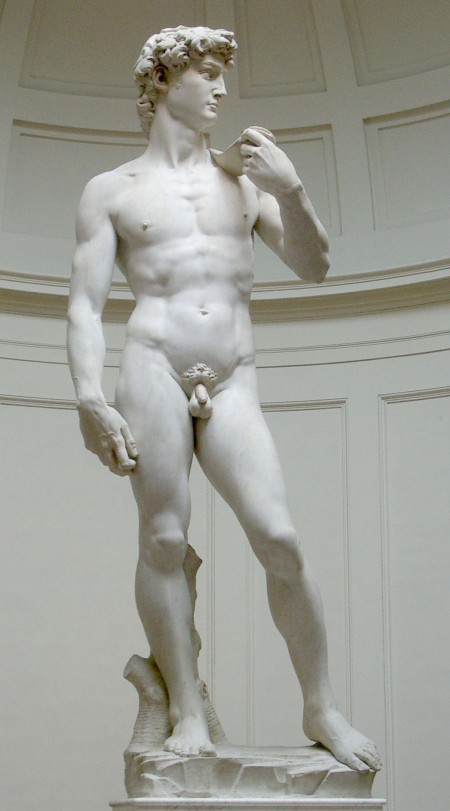
Sculpture of David by Michelangelo

As a young girl, Christina of Markyate resolved to spend her life as a virgin dedicated to Christ. That spiritual aspiration co-existed with Christina’s perception of men’s beauty and men’s sexual allure. Men’s sexuality is commonly controlled through punitive threats. Christina, in contrast, was blessed with visionary experiences that enabled her to overcome her sexual desire.

In response to the bishop of Lincoln’s anger at her taking over a hermitage at Markyate, Christina moved in with a cleric. Unfortunately, they both developed strong sexual desires for each other. With fasting, prayer, and tears, Christina managed to resist temptation. Yet that was a constant, tiring struggle. To end her sexual feelings for the cleric, Christina moved out of his residence and back to the hermitage.

A visionary experience eased Christina’s lust. Life alone in the hermitage initially was scarcely better for Christina:

there, day and night, she prostrated herself in prayer. Weeping and lamenting, she begged to be freed from temptation. Even in solitude she unwillingly endured lustful urges. [1]

But then Jesus brought her extraordinary consolation:

In the guise of a small child, he came to the arms of his sorely tested spouse and remained with her a whole day, not only being felt but also seen. The maiden took the child in her hands, gave thanks, and pressed him to her bosom. And with immeasurable delight she held him at one moment to her virginal breast, at another felt him in her innermost being.

Pressing the Christ child to her breast is a maternal image. Yet Christina also understood herself to be Christ’s spouse. Feeling him “in her innermost being” is a sexual image. The maternal-sexual experience of Christ changed Christina such that “the fire of lust was so completely extinguished that never after could it be revived.”

Christina retained appreciation for men’s beauty. After Christina had decided to make her formal profession of perpetual virginity at the Monastery of the Blessed Mother of God Ever Virgin, she had an astonishing vision early one morning:

behold! there gathered around her young men of extraordinary beauty. What a remarkable sign of mercy and divine approval! [2]

Three of the young men greeted her. None of them attempted to seduce her. They said:

Hail virgin of Christ. The Lord Jesus Christ had commanded that greetings be sent to you.

The extraordinarily beautiful young men thus conveyed to Christina greetings from the man whom she understood to be her spouse. After that visionary experience, “never did she feel the slightest twinge from those illnesses which had afflicted her before.”

The devil continued to attack Christina. When she lay down by herself to sleep, she was troubled:

For it seemed to her that the devil might stifle her, or by his nefarious arts drag her into some obscene games. But when he was foiled in his unwearying attempts to debauch her mind, the poisonous serpent plotted to break her steadfastness by creating false rumors and spreading abroad unheard-of and incredible slanders through the bitter tongues of his agents.

Christina repelled worldly attacks on her character by praying for those who maligned her. The devil then sought to seduce her with blasphemy:

He suggested time and again horrific ideas about Christ, detestable notions about his holy mother, but she would not listen. He kept attacking her, but was put to flight. … Taking up new and more exquisite weapons of temptations, he attacked the virgin all the more intensely since it pained him so deeply to be beaten by a young virgin. Finding her alone in the chapel, he sometimes molested her with such grotesque apparitions and terrified her with such harsh threats that any other person would easily have been driven mad.

Persecuted and tormented with such thoughts, Christina prayed:

She threw herself before the eye of God and placed herself at his mercy. But when she remembered that God leaves no sin unpunished, she wondered if by chance these and many other grievous ills might not have come about through her own fault. She prostrated herself on the ground and, raising her mind, she prayed earnestly to Jesus, for she was afraid that if help did not come soon, she would be tempted beyond her strength

Rapt in prayer, she rose to heaven and heard prophetic words that seem to concern sexual temptations:

Do not be afraid of these horrible temptations, for the key of your heart is in my hand and the lock of your mind and body is in my custody and no one can enter unless I allow it.

After hearing these words, Christina immediately felt free of anxiety. Whenever she subsequently felt “assailed by temptation or overwhelmed by sorrow,” she remembered these words and was comforted.[3]

Sexual desire is built into human nature and has driven the evolution of the species for millions of years. That deeply rooted biological reality provides important context for understanding the enormity of current efforts to teach young women to fear young men and to destroy heterosexual desire. Despite the extensive efforts of secular authorities, few young women are likely to be able, without the love of Christ, to imitate Christina of Markyate in remaining perpetually virgin.

*  *  *  *  *

Read more:

Notes:

[1] Life of Christina of Markyate 45, from Latin trans. Talbot, Fanous & Leyser (2008) p. 48. I reference the text with the Latin section numbers and the page in the English translation of id. Subsequent quotes are from Life of Christina of Markyate 45 p. 48 (In the guise…; fire of lust…), 52 pp. 53-3 (behold…; hail virgin of Christ…; never did she…), 53 pp. 54-5 (For it seemed…; He suggested…) 54 pp. 55-6 (She threw…; Do not be afraid…; assailed by temptation).

[2] Christina commonly remarks on men’s physical attractiveness. See, e.g. Life of Christina of Markyate 47 p. 49: “handsome figure” of a man.

[3] Women students of medieval literature today seemed to be comforted with regurgitating mind-numbing, Soviet-quality indoctrination:

I conclude that the medieval understanding of sex and gender, as delineated by Thomas Laqueur, allowed Christina of Markyate’s male counterparts to perceive her as both male and female, which gave her extraordinary opportunities to challenge traditional gender and religious roles for women.

Bolen (2012) abstract. Like having a cat as a pet, such comfort will not endure.

[image] Sculpture of David.  By Michelangelo, made 1501-04. Now at the Galleria dell’Accademia, Florence. Thanks to Rico Heil and Wikimedia Commons.

References:

Bolen, Angela Ruth. 2012. “Christina of Markyate, Manly Woman of God: Mysticism, Monasticism, and Masculinity in Twelfth-Century England.” Boise State University Theses and Dissertations. Paper 312.

Talbot, C.H. trans, Samuel Fanous and Henrietta Leyser, rev. and ed. 2008. The life of Christina of Markyate. Oxford: Oxford University Press.

Valerian saw and respected Cecilia's angel lover

Ecstasy of Saint Cecilia in sexless marriage with Valerian

Lacking a loving friend like Valerius or the intervention of angels, Valerian ardently sought to marry Cecilia. She had troubling associations with Bona Dea, the so-called Good Goddess.[1] Bona Dea was a traditional Roman fertility god that women worshiped in December. While pretending to abstain from wine and sex, the women in secret rites of Bona Dea engaged in wild orgies.[2] Valerian had no idea what marriage with Cecilia would be like. He was in for a wedding-night shocker.

Despite her association with Bona Dea and her going through with her marriage to Valerian, Cecilia wanted to remain a virgin. She sang in her heart to God alone:

Keep my heart and my body spotless, and let me not be mixed-up. [3]

She started wearing a hair shirt under her golden clothes. She fasted and prayed and sought the support of holy women and men in heaven:

She summoned the angels with prayers, disturbed the apostles with tears, and prevailed upon the entire holy procession serving Christ, that with their prayers they would help her commend her chastity to the Lord. [4]

Cecilia seemed to have believed that having sex with her husband would contaminate her. That’s a demeaning view of men’s sexuality.

The most widely distributed medieval version of Cecilia’s life doesn’t even bother to explain why she married Valerian if she didn’t want to have sex with him. But a version that probably dates from the late fifth century explains:

The resolve of her family and fiancé was raging around her with such force that she could not reveal the desire of her heart or disclose by clear indications that she loved only Christ. [5]

In medieval Europe, loving only Christ was highly respected. Moreover, a woman couldn’t be married without her consent. Perhaps Cecilia was too meek to declare her dedication to Christ and refuse to consent to marriage with Valerian. But even by the relatively weak standards for rationalizing women’s behavior, that’s completely implausible.

Cecelia showed on her wedding night that she was a strong, independent woman. Celicia and Valerian were then together in the bedroom for the first time as husband and wife. She said to him:

O dearest and most loving young man, I have a secret to tell you if you will swear to do everything in your power to keep it hidden.

Was it that her mother wanted to move in with them? But that couldn’t remain a secret. Perhaps a venereal disease? Pregnant already? Several secret children with other men? Valerian, mind racing with possibilities, swore to keep Cecilia’s secret. Cecilia then said:

I have an angel of God as my lover, who guards my body with extreme jealousy. If he should see any indication that you touch me with polluted love, he will immediately release his rage against you, and you will lose the best part of your wonderful youth. But if he knows that your love for me is pure and spotless and that you keep my virginity completely unimpaired, then he will love you just as he loves me and will show you his favor. [6]

A lover already? An angel lover? A bisexual angel lover? Manly men don’t put up with this kind of bizarre crap from their wives. Valerian declared:

If you want me to believe your words, show me this angel; and if I determine that he is truly an angel of God, then I will do as you say. But if you love another man, I will run you both through with my sword.

Valerian probably lacked good legal alternatives for terminating his marriage and receiving compensation for the damage done to him. If you want peace, work for justice in divorce courts.

Cecilia led Valerian to believe and see her angel lover. Sex is so simple that all kinds of animals do it. Seeing an angel lover required a multi-step process. Cecilia explained to Valerian:

If you promise to follow my advice, permit yourself to be purified in the unfailing wellspring, and believe there is one God in heaven, living and true, then you will be able to see him.

Cecilia directed Valerian to go to the third milepost from the city on the Appian Way. There he asked some destitute persons to show him the holy old man Urban. The holy old man Urban purified Valerian’s wild, fierce masculine sexuality with a prayer:

Lord Jesus Christ, good shepherd, sower of chaste purposes, receive the fruit of the seeds which you sowed in Cecilia. Lord Jesus Christ, good shepherd, your handmaiden Cecilia zealously serves you like a disputatious sheep. For her spouse, whom she received as a fierce lion, she has sent to you as a very gentle lamb. This man would not have come here if he did not believe. Therefore, Lord, open the gate of his heart to your words, that he may recognize you as his Creator and renounce the devil with all his vainglorious displays and idols. [7]

Valerian proclaimed: “One God, one faith, one baptism; one God and Father of all, who is above all and in us all.” He believed as all Christians believe. More distinctively, instead of a fierce lion for a husband, Cecilia got a very gentle lamb. Wimpy husbands who see their wives’ lovers as angels help to sustain sexless marriages.

Having a sexless marriage isn’t necessary to be a perfect Christian. Cecilia’s angel lover gave both Cecilia and Valerian crowns of “shimmering roses and gleaming lilies” as a sign of their sexless marriage to each other. The angel lover also promised to fulfill whatever Valerian wished. Valerian could have asked the angel for a beautiful mistress to provide him consolation within his sexless marriage to Cecilia. With better faith, Valerian instead asked that he and his brother Tiburce be made perfect Christians. They were made perfect Christians. That didn’t require Tiburce to enter into a sexless marriage.

Like Valerian and Margery Kempe’s husband, many husbands today have sexless marriages. These aren’t marriages in which their wives have angel lovers. Their wives simply refuse to provide affirmative consent, in accordance with all duly established sex regulations, when their husband requests permission to initiate an act of marital sexual relations. In such circumstances, husbands should seek an angel lover and strive to imitate Cecilia, a widely celebrated saint.

*  *  *  *  *

Read more:

Notes:

[1] The church of Saint Cecilia in Trastevere was regarded as having been built upon the house in which Cecilia lived. Archaeological investigation showed that underneath the church are ruins of an important shrine to Bona Dea. Connolly (1994) pp. 40-51.

Bona Dea, also known as Fauna and Fatua, came to be associated with various myths. One myth suggests that Bona Dea (Fauna) was the wife of Faunus. Faunus found her secretly drinking wine. As punishment for that offense, he beat her with myrtle twigs. Plutarch, Roman Questions 20. A more exaggerated variant has Fauna drinking a “a full vessel of pure wine.” Her husband Faunus then beat her to death with myrtle. He subsequently deified her out of regret for his violence against her. Versnel (1994) p. 273.

Another Bona Dea myth anticipates discourse about rape culture. This myth is factually inconsistent with the previous one:

It is said too that she {Fauna / Bona Dea} was the daughter of Faunus, and that she resisted the amorous advances of her father who had fallen in love with her, so that he even beat her with myrtle twigs because she did not yield to his desires though she had been made drunk by him on wine. It is believed that the father changed himself into a serpent, however, and under this guise had intercourse with his daughter.

Macrobius, Saturnalia 1.12.20-9, from Latin trans. Brouwer, from Versnel (1994) p. 273. Common features of the myths are mythic claims about men’s violence against women and mythic depictions of men’s moral inferiority to women.

Publius Clodius Pulcher, a young patrician, barely escaped alive after, dressed as a woman, he attended the Bona Dea ritual. For a conventional political discussion of the incident, Yoshida (2008). The Clodius Pulcher incident with Bona Dea indicates the extent of social acceptance of violence against men and the harsh punishment of men transgressing women’s privileges.

The life of Saint Cecilia, like the myth of Fauna / Bona Dea and Faunus, depicts Valerian’s moral inferiority to his wife Cecilia. The cult of Bona Dea at Trastevere, perhaps reflecting Juvenal’s revelations, associates Bona Dea with cures of blindness. Enlightenment and truly seeing is an important theme in the life of Saint Cecilia.

[2] Juvenal, Satires 6.314-41. See also Juvenal, Satires 1.36, 5.18; Tibullus 1.6.21-2; Ovid, Ars amatoria 3.631-37.

[3] My translation from the Latin Fiat cor meum et corpus meum immaculatum, ut non confundar, from ll. 10-11 of In festo Sancte Cecilie virginis et martyris (On the feast of Saint Cecilia, Virgin and Martyr), Paris, Bibliothèque Nationale, MS. Latin 3278 (dating to later thirteenth century), in print with English translation in Reames (2005) pp. 516-27. MS. Latin 3278 is an abbreviated version of Passio S. Caeciliae, but is identical with the latter through to the middle of the Christian catechism of Valerian’s brother Tiburce. Reames (1990) p. 338. All subsequent quotes are from early in the Passio S. Caeciliae. They are thus taken from Reames’s text of MS. Latin 3278, in Reame’s English translation unless otherwise noted.

Singing in the heart has deep biblical resonances. In biblical language, the heart encompasses the whole moral orientation of the person. Singing is associated with joy and cosmic order. Ephesians 5:18-9 declares:

be filled with the spirit as you sing psalms and hymns and spiritual songs among yourselves, singing and making melody to the Lord in your hearts

For further discussion of the biblical resonances of singing in the heart, Connolly (1994) pp. 64-6. The biblical Song of Songs made clear to medieval Christians that joy in the Lord doesn’t require sexless marriage.

Passio S. Caeciliae is now thought to have been written sometime between 486 and 545. The best edition of Passio S. Caeciliae is currently generally regarded to be Delehaye (1936) pp. 194-220, based on Municipal Library of Chartres MS. 144 (from the tenth century) and Paris, Bibliothèque Nationale MS. Latin 10861 (from the eight century).

[4] This text isn’t included in the life of Saint Cecilia in Jacobus de Voragine’s Legenda aurea (Golden legend), written in the 1260s. Reames (2006) pp. 504-16 provides a Latin text with English translation of the life in the Legenda aurea. Ryan (2012) provides an English translation of the full Legenda aurea. Across manuscripts of Legenda aurea, omissions of text in the life of Saint Cecilia are common, but rewritings are rare and additions practically non-existent. Reames (2006) p. 496. For an insightful analysis of differences in versions of the life of Cecilia, Reames (1980).

Major scholarly works on saints, sexuality, and chastity are tainted with gynocentric values and misandry. Like much medieval scholarship, scholarly works on saints’ lives show little understanding of medieval men’s very high mortality, prevalent violence against men, disparagement of men’s genitals, and oppressive, pervasive courtly ideology of men’s subordination in love to women, among other injustices. Leading scholarly works on saints and sexuality have mainly served to reinforce dominant gynocentric ideology:

everywhere — embedded in language, in law, and in practice — is the association between heterosexual intercourse and the subordination of women.

Elliot (1993) p. 157. Tell that to Matheolus, Merlin, Aristotle, Ruodlieb, the Ménagier de Paris, two married women and a widow, and many others from medieval times. Just as with anti-men bias in criminal law, medieval men’s sexual hardships are conceptually excluded from concern:

Altogether 64 of 151, or 42 percent, of the female saints in our sample had conflicts of one sort or another arising from their sexual lives. For men the corresponding figures are 137 of 713, or just over 19 percent. The facts themselves, stated in this bare way, are eloquent. The differences bespeak both cultural prejudice and social reality.

Weinstein & Bell (1982) p. 97. Unfulfilled sexual desire is a source of enormous conflict in men’s lives. It also motivates much violence against men. Apparently such conflicts didn’t count in “conflicts … arising from their sexual lives.” That reflects cultural prejudice and social reality: the relatively low social value of men’s sexuality.

[5] This text also isn’t in the life of Saint Cecilia in Jacobus de Voragine’s Legenda aurea. The Legenda aurea version was very widely distributed. While nearly contemporary collections of saints’ lives have survived in only a couple of dozens of manuscripts:

Jacobus’s Legenda Aurea, by contrast, has survived in almost a thousand manuscript copies of the Latin text alone, with another five hundred or so manuscripts containing translations of all or part of the Legenda into one or another of the great European vernaculars.

Duffy, Intro. p. xi in Ryan (2012).

This above quoted text and the previously quoted text also weren’t incorporated into Chaucer’s verse version of the life of Saint Cecilia, the Second Nun’s Tale in the Canterbury Tales. Recent discussion of the Second Nun’s Tale emphasizes currently fashionable academic claims about transgressing boundaries:

the ambiguity about the gender of the speaker in the Prologue, rather than indicating incomplete revision, might have been purposefully left by Chaucer because it sets aside gender boundaries that create exclusive categories.

Dobbs (2013) p. 215. Chaucer, envisioning the future, also ironically celebrated in the Second Nun’s Tale the humanistic genius of Christine de Pizan. Flewellyn (2009).

[6] The Legenda aurea version of Cecilia’s life is more direct about the threat to Valerian: statim feriet te (“he will immediately kill you”), my translation from Latin text at Reames (2006) p. 205.

[7] Bibliothèque Nationale, MS. Latin 3278 has ap{i}s tibi argumentosa deservit, which Reames translates as “serves you like an ingenious bee.” Reames (2006) pp. 506-7. While apis argumentosa is a common manuscript variant, ovis argumentosa also exists. The earliest surviving manuscript, Bibliothèque Nationale, MS. Latin 10861 (dates to the eighth century) witnesses to ovis. Moreover, the translation “ingenious bee” has only diffuse relevance in context. Connolly (1994), n. 28, p. 293, insightfully states:

That the word was originally ovis seems evident from the context, for Christ has just been addressed as a “good shepherd” who is attended by Cecilia, and Valerian has been changed from lion to lamb — all rather more in keeping with the activity of a sheep than a bee.

The translation “busy bee” in Ryan (2012) p. 705 is best understood as a back projection from Chaucer’s Second Nun’s Tale, ll. 195-6:

Lo, lyk a bisy bee, withouten gile,
Thee serveth ay thyn owene thral Cecile.
{Lo, like a busy bee, without guile,
Always thine own servant Cecile serves Thee.}

In the early Life of Cecilia, the disputatious sheep Cecilia used her argumentative skills to convince Valerian to accept a sexless marriage. That’s significant for understanding men’s subordination to women. The shift to Cecilia the “busy bee, without guile” reflects Chaucer’s anti-meninism, along with the more general women-are-wonderful effect.

[image] Ecstasy of Saint Cecilia in sexless marriage with Valerian. Raphael, 1516-17. Held in Pinacoteca Nazionale, Bologna. Thanks to Wikimedia Commons.

References:

Connolly, Thomas. 1994. Mourning into joy: music, Raphael, and Saint Cecilia. New Haven: Yale University Press.

Delehaye, Hippolyte. 1936. Étude sur le légendier romain, les saints de novembre et de décembre. Bruxelles: Société des Bollandistes.

Dobbs, Elizabeth A. 2013. “The Canaanite Woman, the Second Nun, and St. Cecilia.” Christianity & Literature. 62 (2): 203-222.

Elliott, Dyan. 1993. Spiritual marriage: sexual abstinence in medieval wedlock. Princeton, N.J.: Princeton University Press.

Flewellyn, Meghan. 2009. “Medieval Feminine Humanism and Geoffrey Chaucer’s Presentation of the Anti-Cecilia.” University of New Orleans Theses and Dissertations. Paper 998.

Reames, Sherry L. 1980. “The Cecilia Legend as Chaucer Inherited It and Retold It: The Disappearance of an Augustinian Ideal.” Speculum. 55 (1): 38-57.

Reames, Sherry L. 1990. “A Recent Discovery concerning the Sources of Chaucer’s ‘Second Nun’s Tale.'” Modern Philology. 87 (4): 337-361.

Reames, Sherry L. 2005. “The Second Nun’s Prologue and Tale.” Pp. 491-527 in Correale, Robert M., and Mary Hamel. Sources and analogues of the Canterbury tales. Volume II. Woodbridge: D.S. Brewer.

Ryan, William Granger, trans. and Eamon Duffy, intro. 2012. Jacobus de Voragine. The golden legend: readings on the saints. Princeton, N.J.: Princeton University Press.

Versnel, Hendrik S. 1994. Inconsistencies in Greek and Roman religion Vol. 2:  Transition and reversal in myth and ritual.. Rev. Ed. Leiden: Brill.

Weinstein, Donald, and Rudolph M. Bell. 1982. Saints & society: the two worlds of western Christendom, 1000-1700. Chicago: University of Chicago Press.

Yoshida, La’akea. 2008. “Clodius Pulcher: Caesar’s Willing Puppet. The Bona Dea Affair and Its Effect on Cicero and the Fall of the Republic.” Hohonu: A Journal of Academic Writing. 6(2): 3-8.

do not hide your face from me: Parius’s bad-breath conspiracy

Listerine stops bad breath

Even though love bears all things, bad breath can sour a close personal relationship. If you notice a friend or intimate hiding his face from you, consider three possibilities:

  1. You have bad breath.
  2. He has bad breath.
  3. He no longer loves you and no longer cares for you.

Many persons tend to assume the worst, meaning the third possibility. That’s a mistake. As awkward as it might be, you need to speak openly in your personal relationships. Simply say, “Do I have bad breath?” If the answer is yes, try to figure out why you have bad breath. Is it from something you have done, or have failed to do? Love is patient. Have hope that your bad breath will be cured and have faith that your friend or intimate will again turn his face to you.

In twelfth-century Latin literature, the story of Parius and Lausus instructs about the dangers of not speaking openly about bad breath in close personal relationships. Parius and Lausus were personal assistants to the Babylonian king Ninus. They were also close friends. Parius, however, began to envy Lausus. Parius’s envy grew so malicious that he plotted to murder Lausus. Driven by jealousy, Heracles’s wife had accidentally poisoned him with an envenomed robe of Nessus. Parius murdered Lausus by inducing him to wrap himself in sheets containing the poison of Nessus. Lausus died without perceiving his friend Parius breathing evil toward him.

King Ninus, who suspected nothing, then put Parius in charge of training Lausus’s son. The boy subsequently became the king’s favorite. That development infuriated Parius. He plotted to ruin the boy through a claim of bad breath.

Parius told the boy that he had bad breath. Parius explained that the king, not wishing to humiliate the boy, didn’t tell him about his putrid breath. Parius instructed the boy to take care to turn his face from the king when near him. The boy, mortified to learn of the stench he was bearing, subsequently changed his behavior drastically:

the boy never presumed to approach his lord if not summoned, carried out his service with bowed head, and did all his offices about the king with averted face. [1]

The king interpreted the boy’s strange new conduct to be a lingering effect of illness:

He bore with him long, and made no charge of malice or deceit, kindly putting the best interpretation on his conduct.

Parius scolded the boy whenever he came near the king. The boy became tearful and withdrawn. Parius positioned himself as the sole acceptable servant for the king.

The king was mystified by his favored boy’s new distance and personal diversion. The king questioned the boy about the matter. The boy, in shame, said nothing. The king privately confronted Parius and demanded to be told the truth. Parius pleaded:

Have pity on me, most merciful of kings, do not make me the accuser and cause of death to this boy whom I have brought up and loved with singular affection, as I loved his father. This matter I have kept from you, I confess, through my excessive love for him. If by some exercise of mercy his fault may meet with pardon, I have by my silence invited death, led astray partly by kindness to the boy, partly by my own simplicity. What my lord now compels me — weeping and reluctant as I am — to confess, I barely wrung from him through extreme insistence, and — though I know well he lied — he swore to me, against my certain knowledge, that in tending the king’s head and face he suffered great discomfort and he compared your breath (which undoubtedly in its excellent savour excels the fruits of summer or fresh balsam) to bilgewater. I die and deserve death as I speak the words. This is why he avoids my lord so despicably, why he turns away his face, bows his head, puts his hand before his mouth, and shuns speech with you.

Such are the intrigues of courtiers. The king believed Parius. Enraged, the king arranged to have the boy killed.

The death of the boy was to be a sensational public event. The king planned to have the boy killed as he rode forward to be honored with primacy over Babylon for one year. Parius, however, convinced the boy to transfer that honor to him. As Parius rode forward for the honor, an assassin stepped out and thrust a sword into his heart and killed him. The boy, horrified, threw himself on his dead foster-father’s body and wept.

The king realized that the wrong person had been killed. He summoned the boy for a private audience:

The boy, instructed by the dead Parius, knelt before him with bowed head, his hand on his mouth. The king’s anger rose afresh. Already inwardly designing another death for him, he said “Why do you put hour hand to your nose? How is it that to you alone I have become loathsome? Is the stench of my mouth so strong that you can come no nearer?” The boy said: “No, rather that of mine, lord, and I seek to save you from perceiving it.” The king: “Who told you of it?” The boy: “Parius told me, whom he loved as none else, that which all had kept from me, that the stench of my mouth was so evil that my presence was offensive to you. Therefore my hope of waiting upon you near at hand was cut off. Therefore is my hand always held before my breathing, that my foulness may not trouble you, or the calm purity of your serene countenance be tainted by my defect. And as a recompense for this warning and for all the other faithful care he had bestowed on me, he begged of me that honour which you had conferred on me, and he obtained it.

The king recognized that Parius had deceived and manipulated the boy. Parius with poetic justice had put himself before the sword. The king restored the boy to favor. He ordered that Parius’s corpse be hung on a gibbet for all to see and revile.

If someone is turning his face from you, speak up. Seek to understand the problem and correct it.

Your face, Lord, do I seek.
Do not hide your face from me.

Hear my prayer, O Lord;
let my cry come to you.
Do not hide your face from me
in the day of my distress.

Answer me quickly, O Lord;
my spirit fails.
Do not hide your face from me,
or I shall be like those who go down into the Pit. [2]

*  *  *  *  *

Read more:

Notes:

[1] De contrarietate Parii et Lausi (Of the variance between Parius and Lausus), in Walter Map, De nugis curialium, Dist. 3, c. 3, from Latin trans. James (1983) p. 255. Subsequent quotes, unless otherwise noted, are from this story, id. pp. 255-61. I’ve made some minor changes in the translation for readability.

Stories of misunderstanding about bad breath exist in historical literature from more than 2300 years ago. This specific bad-breath story occurs in the Anglo-Norman Gesta Romanorum as well as in other medieval story collections. See story 101 in Bright (2019). For references to other medieval story collections containing it, id. p. 661, source note to 101. For a more general review of instances of the motif, Lee (1909) pp. 232-5. The specific motif of bad breath doesn’t occur in the Decameron.

[2] From Psalms 27:9, 102:2, 143:7. See also, e.g. Psalm 13:1. The relevant Vulgate phrase ne abscondas faciem tuam a me doesn’t occur in the story of Parius and Lausus. The over-all structure of the story reflects the motif of Psalms 7:14-6, 10:2, 9:16, etc.

[image] Listerine Advertisement, from Redbook magazine, June 1956, Vol. 107, No. 2. Thanks to Classic Film on flickr.

References:

Bright, Philippa, ed. and trans. 2019. The Anglo-Latin Gesta Romanorum: from Oxford, Bodleian Library, Douce MS 310. Oxford Medieval Texts. Oxford: Oxford University Press.

James, M. R. trans., C. N. L. Brooke, and R. A. B. Mynors, eds. 1983. Walter Map. De nugis curialium {Courtiers’ trifles}. Oxford, Oxfordshire: Clarendon Press.

Lee, A. Collingwood. 1909. The Decameron: its sources and analogues. London: David Nutt.