
Author: Douglas Galbi
servants and eunuchs destroy joyful sexual fulfillment
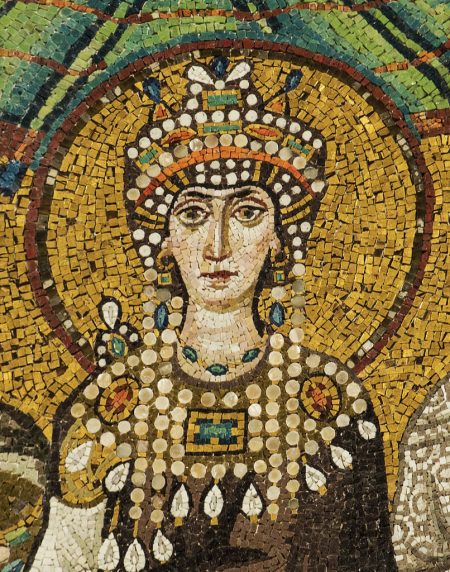
The King was away on business, fighting enemies abroad. His eunuch counselors wrote to him:
The lamentations, the suffering, the agony, the bewilderment, the restless petulance, and the terrible anxiety which you saw in our queen and mistress are at an end. They have settled, receded and passed away. Now come days of joy and happiness. Tears have stopped, grief is banished, and in their place come ease and freedom.
What seemed to have cheered Queen Chrysorroi was solitude in a curtained pavilion in the royal garden. In fact, what cured her misery was trysts with a laborer, an assistant gardener:
There she found the laborer and she played with him. He alone had won the queen’s love and they embraced with frequent kisses. The garden became the bridal chamber of Aphrodite, the mirror of the Graces and the dwelling place of Love. They spent the day in much happiness. The night returned with all its sweetness. On its arrival, winged Love again took the laborer and with every joy of desire brought him to the queen.
The laborer, who spent much time “digging in the garden,” was actually Queen Chrysorroi’s former and never-forgotten boyfriend Kallimachos.
After rescuing Chrysorroi from a dragon, Kallimachos had managed, with considerable effort, to persuade her to have sex with him. Their affair didn’t begin with a drunken hook-up or a casual Tinder bang:
After some time, after many days, they formed the wish to unite their souls and they joined their hearts in indissoluble links, duly binding their love with most terrible oaths. Love, the king, was present at their words, received their oaths himself and wrote the contracts; contracts for which he stood between them as guarantor.
Christian marriage requires publicly witnessed vows. No one witnessed the pseudo-marriage of Chrysorroi and Kallimachos. Love the king in the above text is a personification and a moral rationalization. Many persons today engage in similar conceptual strategies, but with rather less literary sophistication.
Chrysorroi and Kallimachos found great pleasure from successful seduction. They went to a private pool and bathed together:
Only the tongue of Aphrodite could describe the pleasure and charms of their bathing. … He {Kallimachos} looked at her and, as he looked, he reaped the sweet fruits of pleasure. I mean something sweeter than everything sweetest. Time alone saw the remarkable sight, the pleasure beyond words, which they enjoyed in the pool.
After bathing together, they enjoyed delights together on a couch near the pool. They subsequently lived a life of amorous passion and bliss in Dragon Castle.
An inadvertent sighting and a witch’s spells destroyed the happiness of Kallimachos and Chrysorroi. One day a king saw Chrysorroi and Kallimachos leaning over the wall of Dragon Castle and enjoying the wonderful view. The King was immediately struck with love for the beautiful Chrysorroi. Beautiful women have incredible power over men. The King became desperately lovesick. He was willing to try anything to gain the love of Chrysorroi. A witch offered him her services. She conjured a scene of a damsel in distress. Kallimachos foolishly rushed to rescue the damsel in distress. Then, with a magic apple, the witch put Kallimachos into a death-like state. When Chrysorroi came to mourn over Kallimachos’s body, the King abducted her to be his queen.
Servants and eunuchs conspired to expose Queen Chrysorroi and Kallimachos when they renewed their love affair. Kallimachos eventually regained life, found Chrysorroi, and took up a job working in the royal garden. Queen Chrysorroi’s many comforters and eunuchs wondered why the Queen seemed much happier. They instructed her maid to spy on her. The maid saw the Queen having sex in the garden with the laborer Kallimachos. The maid reported to the eunuchs:
I have seen her deceitful little game. The gardener’s laborer, the one who does the digging — she is embracing him, she is sleeping with him! I watched all this last night and I saw her playing with him, kissing him, sleeping with him. O what a wicked and unnatural deed! But if you want to see the horror yourselves, spend this coming night in the garden. We shall sit together and wait. You will learn the tricks of this little whore.
The eunuchs hid themselves with the maid and saw Chrysorroi having sex with Kallimachos. They were horrified. The eunuchs reported their finding to the King. Chrysorroi and Kallimachos potentially faced severe punishment merely for resuming their passionate affair.
Beware of servants and eunuchs. Whether working in college administrations, human-resource departments, or departments of education or justice, servants and eunuchs lack appreciation for sexual pleasure. They destroy mutual joy.
* * * * *
Read more:
- Chrysorroi described Kallimachos as deserving her love because of his labors
- wisps of hair and imaginary arrow whip great warrior Alexander
- characterizing Mary at the cross in Byzantine competition for attention
Notes:
The above story is from the medieval Byzantine romance Kallimachos and Chrysorroi. It apparently was written in Constantinople between 1320 and 1340. The quotations above are from the translation of Betts (1995): l. 2125ff, pp. 78-9 (The lamentation…); l. 2155ff, p. 79 (There she found…); l.755ff, p. 52 (After some time…; Only the tongue of Aphrodite…); . 2210ff, p. 80 (I have seen…).
The text makes clear Chrysorroi’s wonderful beauty:
The lady was completely alluring. She inspired love. Her charms were beyond description, and her graces outdid those of the Graces themselves. Her hair flowed down in rivers of lovely curls and shone on her head with a gleam which surpassed the golden rays of the sun. Her body, which was whiter than crystal, beguiled the sight with its beauty as it seemed to blend the charms of roses with its color. Just the sight of her face alone shook your entire soul, your entire heart. Indeed, the lady seemed to be the image of Aphrodite and of every other beauty that the mind can conceive. But why prattle on? Why describe at length the beauty of her body? A few words would suffice to define it. All the women that the world has produced, whether before or after her — or her contemporaries — can only be compared to her charms as one might compare a monkey to Aphrodite.
Kallimachos and Chrysorroi l. 805ff, trans. Betts (1995) p. 53. That concluding comparison probably risked offending contemporary female auditors or readers. But Byzantium arguably had a more tolerant society than those in which the male gaze is disparaged, penalized, or criminalized.
Kallimachos’s bathing with Chrysorroi draws upon literary figures from the Greek Anthology. That bathing is not only pleasurable, but also therapeutic. Agapitos (1990).
Discovery of a queen’s trysts in a garden in Constantinople is an important element in Chrétien de Troyes’s twelfth-century French romance Cligès. Western European romances had considerable influence on later Byzantine romances. See Beaton (1996) Ch. 9. As Cligès suggests, Byzantine romances also influenced Western European romances. See also Jeffreys (1980) and Jeffreys (2013).
[image] Mosaic depicting Empress Theodora (reigned 527-548 GC). In the Basilica of San Vitale (built A.D. 547), Italy. Photo thanks to Petar Milošević and Wikimedia Commons.
.jpg)
References:
Agapitos, Panagiotis A. 1990. “The Erotic Bath in the Byzantine Vernacular Romance Kallimachos and Chrysorrhoe.” Classica et Mediaevalia 41: 257-73.
Beaton, Roderick. 1996. The Medieval Greek romance. 2nd ed., revised and expanded. London: Routledge.
Betts, Gavin. 1995. Three medieval Greek romances. Garland Library of Medieval Literature, vol. 98. New York: Garland Pub.
Jeffreys, Elizabeth. 1980. “The Comnenian Background to the romans d’antiquité.” Byzantion 50:455-86.
Jeffreys, Elizabeth. 2013. “Byzantine Romances: Eastern or Western?” Pp. 217-33 in Marina S. Brownlee and Dimitri H. Gondicas, eds. Renaissance encounters: Greek East and Latin West. Leiden: Brill.
conservative medieval women impeded progress toward gender equality

Whoever truly desires
Something is supposed to ask for it.
What? Shall I ask him to love me?
Never. And why? No woman
Makes the mistake of asking
A man for his love, unless
She’s totally out of her mind.
The world would know I was mad,
If I ever permitted my mouth
To speak such scandalous words. [1]
In addition to many other historical gender inequalities, men have long been disproportionately burdened with soliciting amorous relationships. Men are thus the gender that predominately experiences interpersonal rejection in love. Men’s disadvantage in love is deeply associated with sexual welfare inequality and men’s subordination to women. Chrétien de Troyes’s twelfth-century French romance Cligès shows the extent to which conservative medieval women resisted progress toward gender equality in love.
Gender inequality in love persists at least in part because it supports women’s rule. In Cligès, Fenice vigorously guarded the words of Cligès to her:
She kept rehearsing in her heart
Those moments when he’d said farewell,
How his color changed, and went pale,
His tears and his sorrowful face,
How he’d come before her, weeping,
And humbly fallen to his knees,
As if in adoration.
…
He’d told her he was hers to command.
How refreshing these few words!
They traveled straight from tongue
To heart; she set them in her mouth
To keep them forever safe,
Not daring to entrust this treasure
To some different hiding place.
Where could she hold them half
As well as deep in her heart?
She never allowed them out,
Fearing robbers and brigands. [2]
Where your treasure is, there your heart is also. Burying men’s subordination in love deep within women’s hearts prevents love from increasing.[3] That hurts women. As should also be said, that hurts men.
To achieve gender equality, the world must be set right. In Cligès, the narrator exclaims:
Tell me, oh Lord, where girls’
Timidity comes from, their frail,
Fearful, innocent silence?
I feel as if I’m seeing
Hounds fleeing a hare,
Trout chasing after beavers,
Lambs after wolves, pigeons
Pursuing eagles. Or peasant men fleeing
Their shovels, which earn them their weary
lives. Or ducks after falcons,
Storks after hawks, minnows
Splashing after pike,
Antelope hunting lions:
The world all upside down! [4]
Writers have long used the figure of the world upside down. In seventh-century BGC Greece, Archilochus imagined impossible reversals to marvel at the willingness of men to marry. In fourteenth-century GC Italy, Boccaccio used the figure of the world turned upside down as an opportunity to discuss women’s guile.[5] Chrétien de Troyes injected into the well-known figure of the world upside down a key figure of men’s oppression: peasant men fleeing from their burdensome physical labor. That’s a natural reaction of thinking men, quite unlike images of unnatural reversal such as pigeons pursuing eagles.
To perceive social injustices obscured under dominant ideology, one must distinguish between natural and unnatural impossibilities. Women desire amorous relationships as much as men do. Women soliciting amorous relationships and accepting rejection just as men do is a socially constructed impossibility. In reality, women pursuing men and being rejected is no more impossible than paternity certainty and reproductive rights for men. The gender system constructs men to be the rejected gender so as to support women’s command over men (women on top). Women on top was the preferred position of conservative medieval women and remains the preferred position of many women scholars today.[6]
Women pretend to live in “frail, fearful, innocent silence.” Men actually live that way. When men and women reject gynocentrism and insistently, to the point of raucous disorder, speak out about issues important to men’s lives, the world will be turned upside down. That will be all for the better.
* * * * *
Read more:
- gender inequality in life expectancy: massaging gender gaps
- domestic violence in fabliau and farce
- with castrated father, Perceval taught to be woman-pleaser
Notes:
[1] Chrétien de Troyes, Cligès ll. 992-1001, from Old French trans. Raffel (1997) pp. 32-3. Sordamour is speaking about her love for Alexander. When citing Raffel’s translation, I cite the line numbers in his English translation. Those line numbers are close to line numbers in Old French editions (which have slightly varying line numbers by edition).
The mid-fifteenth-century Burgundian prose transmutation of Cligès seems to have recognized the injustice in Sordamour’s gender privilege. That prose account inserted the story of a young woman weeping sorrowfully in the woods. In solitude she cried out to herself:
I consider myself the most wretched and, among all those complaining about their misfortune and sorrowful life, the lady who most bitterly laments the loss of her dear beloved, who left her of late to go off in search of adventure. … Oh, if only he had know my desire when he left. Alas, if I had revealed it to him, he would not have gone away
Burgundian prose Cligès, Ch. 53, from French trans. Grimbert in Grimbert & Chase (2011) p. 125.
[2] Cligès ll. 4348-54, 4370-80, trans Raffel (1997) pp. 138-9. The text concerns Fenice and her lover Cligès.
[3] Cf. Matthew 6:21, 25:14-30.
[4] Cligès ll.3828-41, trans Raffel (1997) pp. 121-2. Id. has “Or peasants / their shovels, which earn them their weary / Lives.” The Old French text for the relevant lines (ll. 3834-5) is:
et si fuit li vilains sa maigle,
dom il vit et dom it s’ahane.
Ed. Harf-Lancner (2006) p. 268. These lines clearly refer to peasant men. I’ve made that explicit above. The verb fuit echoes the figure’s first verb foïr (“hounds fleeing a hare”). Making that echo explicit helps to indicate the importance of the lines about the peasant men.
Raffel insightfully translated ll. 3827-9 (the first three lines of the above quote). All other translations I’ve examined have obscured Chrétien’s critical subtlety. Here’s Raffel’s translation:
Tell me, oh Lord, where girls’
Timidity comes from, their frail,
Fearful, innocent silence?
In a recent authoritative edition, the Old French for those lines is:
Dex!, ceste crienme don li vient,
c’une pucele seule crient {tient A},
sinple et coarde, foible et quoie?
Harf-Lancner (2006) p. 266. While medieval manuscripts of Cligès differ significantly (see Sturges (1994) pp. 208-11), the above text captures all the relevant variation across manuscripts. Translators have wrongly assumed that the subject of these lines is Cligès. Some leading translations:
God! whence comes this fear, that he should shrink from a lonely girl, feeble and timid, simple and mild?
Trans. Owen (1987) p. 88.
God, whence comes his fear of a single maiden, simple and timid, feeble and shy?
Trans. Staines (1990) p. 133.
Dieu!, d’où lui vient cette crainte d’une seule jeune fille, modeste et peureuse, faible et silencieuse?
Harf-Lancner (2006) p. 267. These translations, while within the range of meanings of the text, don’t recognize Chrétien’s play with reversals across the text and the relevant context. They also don’t recognize reversal relevant to women’s dominant position within the men-degrading ideology of courtly love. Within that ideology, a woman ruled over the man who loved her. The man cringed in fear of her displeasure.
With fidelity to the text of the Old French manuscripts, a translation need not anachronistically add support for the currently dominant gender structure of amorous rejection. Rather than implying a prepositional phrase, c’une pucele seule is most directly translated as “She is a single young girl.” Both crient and the manuscript variant tient make sense as third-person intransitive verbs. The best literal English translation of the three lines seems to me to be:
God!, whence comes to her this fear,
She, a single, young woman, fears {holds back},
simple and timid, feeble and shy?
This translation is consistent with Chrétien’s subtle but significant critique of the degrading gender position of men. This translation is substantially the same as Raffel’s. He deserves credit for his superior insight.
Translations of Chrétien into English are relatively significant in education about medieval literature. Sturges observed:
Chrétien’s works, the first (and, for most readers, among the best) extant Arthurian romances, are taught in virtually every {U.S.} college and university-level course on Arthurian literature, whether it focuses on the Middle Ages exclusively or surveys the entire tradition.
Sturges (1994) p. 205. Id. provides a general review of English translations. For translations of medieval Arthurian literature more generally, Lacy (2006).
[5] Other ancient examples of the “world turned upside down” topos are Isaiah 11:6-8, Acts 17:6-7, and Virgil, Eclogues 8.53.7. On the “world turned upside down” topos more generally, Curtius (1953) pp. 94-8 and Kunzle (1978).
[6] See, e.g. Davis (1978). Kunzle appreciates “discontented, lower-class elements who sought or fantasized about the subversion of the existing order.” Yet he opines that, with respect to the domestic hierarchy, “there was no (male) popular desire to change.” Kunzle (1978) pp. 40, 42. That view reflects fundamental misunderstanding of literature of men’s sexed protest. Unlike such scholars, great medieval women writers showed generous and perceptive sympathy for men’s concerns.
[image] The Hay Chasing the Horse. Illustration of proverb. Engraving attributed to Pieter Bruegel, dated 1568/69. The circular caption (in Flemish) is in English translation:
For the hay to go after the horse, is perverted, mark this, you girls who offer yourselves up so shamelessly. It is not proper for you to court the young men; but it is proper for the horse to go after the hay.
Trans. Kunzle (1978) p. 69.
References:
Curtius, Ernst Robert. 1953. European literature and the Latin Middle Ages. New York: Pantheon Books.
Davis, Natalie Zemon. 1978. “Women on Top: Symbolic Sexual Inversion and Political Disorder in Early Modern Europe.” Ch. 5 (pp. 147-92) in Barbara A. Babcock, ed. The reversible world: symbolic inversion in art and society. Cornell University Press.
Grimbert, Joan T. and Carol J. Chase, trans. 2011. Chrétien De Troyes in prose: the Burgundian Erec and Cligés. Cambridge: D.S. Brewer.
Harf-Lancner, Laurence, ed. and trans. 2006. Chrétien de Troyes. Cligès: Édition bilingue, Publication, traduction, présentation et notes. Champion Classiques, Série Moyen âge 16. Paris: H. Champion.
Kunzle, David. 1978. “World Upside Down: The Iconography of a European Broadsheet Type.” Ch. 1 (pp. 39-94) in Barbara A. Babcock, ed. The reversible world: symbolic inversion in art and society. Cornell University Press.
Lacy, Norris J. 2006. “Translation of Medieval Arthurian Literature.” Pp.49-61 in Lacy, Norris J. A history of Arthurian scholarship. Cambridge: D.S. Brewer.
Owen, D.D.R., trans. 1987. Chrétien de Troyes. Arthurian romances. Everyman’s Library. London: J.M. Dent & Sons.
Raffel, Burton, trans. 1997. Chrétien de Troyes. Cligès. New Haven: Yale University Press.
Staines, David, trans. 1990. The complete romances of Chrétien de Troyes. Bloomington: Indiana University Press.
Sturges, Robert S. 1994. “Chrétien de Troyes in English Translation: A Guide to the Issues.” Arthuriana. 4 (3): 205-223.
Chrysorroi described Kallimachos as deserving her love because of his labors

In the fourteenth-century Byzantine romance Kallimachos and Chrysorroi, a maid and three royal eunuchs caught Queen Chrysorroi having sex in the garden with her dragon-killing lover Kallimachos. Eventually Chrysorroi and Kallimachos came before the King for judgment and punishment. Kallimachos telling the story of his strenuous effort to gain the love of Chrysorroi saved them from being executed for adultery. The underlying romantic ideal is that men, but not women, earn love through their labor.
Chrysorroi, a strong, smart woman, led the case for the defense. She used the well-established rhetoric of setting out a hypothetical case (declamation) and questioning the judge (anacoenosis):
A man plants a vine with his own hands, hoes it, prunes it, puts a fence around it, weeds it carefully, tends it, spends the whole day with a sling frightening away birds who wish to destroy it, walks around by night to guard it. He suffers hardship and agony. At harvest time another man comes and seizes possession of it for himself. He harvests it and eats its fruit. As for the previous owner who planted the vine and labored over it, the second man wants to kill him. Do you consider this just, or do you consider that the first owner should enjoy the fruits of his labor? [1]
The King responded:
I judge that the previous owner should enjoy the fruit of his toil and that the evil robber and thief should be beheaded to frighten others who might wish to do wrong or steal.
The audience applauded the King’s judgment and “praised the beauty of justice.” Chrysorroi then identified Kallimachos as a king analogous to the laborer in her hypothetical story. She analogized herself as the vine that he tended. The King hearing the case was the new owner of the vine, that is of his Queen Chrysorroi.[2] But she declared Kallimachos’s right to enjoy the fruit of his labor:
This {Kallimachos} is the king whom the witch rendered a corpse with her spells. This is the king who rescued me from my woes, who killed the dragon, who is my true lord. Whom did he wrong in enjoying the fruit of his labor?
The King was silent and shuddered in amazement. He asked about Kallimachos’s story. Having heard it, he generously disposed of Kallimachos:
The King then freed Kallimachos from his chains and gave him to Chrysorroi. The King, I think, felt pity because of Fortune’s cruelty and, bestowing on them a not undeserved favor, he ordered a detachment of the army to escort them wherever they wished.
While Kallimachos earned the right to love Chyrsorroi, she wasn’t given to him as property that he acquired through labor.[3] The King gave Kallimachos to Chrysorroi as if he were property. Men earning love doesn’t necessarily raise men’s social status.
The moral economy of love in Kallimachos and Chrysorroi parallels that of virtue. Virtue has as a root the Latin term for man, vir. Yet men aren’t naturally credited with being virtuous. Men must perform acts according to socially sanctioned criteria to be credited with virtue. For Kallimachos and his two brothers, virtue determined who would inherit their father’s kingdom. Their father said to them:
The one who shows great military valor, strength, intelligence, and proper wisdom, the one who acts the most kingly way, and gains a great trophy with his mighty exploits, to him shall I give the command of the empire, him shall I crown and make king in my place. [4]
Men must develop a sense of entitlement. Only very few persons can be a king or queen. But every man is entitled to love as a human being. Support men’s entitlement to love!
* * * * *
Read more:
- Byzantine bride-shows: mothers dominate sons in choosing wives
- translatio studii et imperii: Chrétien de Troyes’ Ovidian Cligès
- Kassia redeemed classical culture with repentance of fallen woman
Notes:
[1] Kallimachos and Chrysorroi ll. 2450ff, from vernacular medieval Greek trans. Betts (1995) p. 85. Subsequent quotes above are from ll. 2460-2600, id. pp. 85-7, and ll. 60ff, id. p. 38.
The Greek text (Καλλίμαχος καὶ Xρυσορρόη) is written in unrhymed political verse. External evidence indicates that Andronikos Komninos Vranas Doukas Angelos Palaeologos (Andronikos Palaeologos), a nephew of the Byzantine Emperor Michael VIII, wrote it between 1320 and 1340. Kallimachos and Chrysorroi has survived in only one early sixteenth-century manuscript. Kallimachos and Chrysorroi engages in sophisticated intertextuality with Chariton’s Chaereas and Callirhoe and is now appreciated as a “highly learned text.” Van Steen (1998); Agapitos (2015) p. 77.
The figure of a woman as a vine or garden has biblical roots. See e.g. Song of Songs 4:12-15. James 2:2-4 provides an example of a hypothetical case and ensuing question. Judicial rhetoric was a major field of study in Byzantium. Angelo (2010) p. 304.
[2] Merely from the sight of her, the King was struck with terrible lovesickness for Chrysorroi. With the help of a witch’s tricks, the King abducted Chrysorroi. He then made Chrysorroi his queen.
[3] The idea that women have been men’s property up until recent decades of liberation is a misandristic myth. Wilson & Daly (1992) has been influential work in such myth-making. See note [4] to my post on Sexual Coercion in Primates and Humans.
[4] Kallimachos’s two brothers turned back from attempting to confront serpents at Dragon Castle. The second brother prudently and comically observed:
I too shall flee these serpents. Unnecessary fighting with wild beasts is forbidden by both convention and good strategy.
Kallimachos and Chrysorroi l. 225ff, trans. Betts (1995) p. 41. These considerations contrast sharply with social forces that promote highly disproportionate violence against men.
[image] Man earning love. Rice farmer in Sierra Leone showing a part of his harvest, 2006. Photo thanks to Laura Lartigue (USAID) and Wikimedia Commons.

References:
Angelou, Athanasios. 2010. “Rhetoric and history: the case of Niketas Choniates.” Ch. 16 (pp. 289-305) in Ruth J. Macrides, ed. 2010. History as literature in Byzantium: papers from the Fortieth Spring Symposium of Byzantine Studies, University of Birmingham, April 2007. Surrey, England: Ashgate.
Agapitos, Panagiotis A. 2015. “Contesting Conceptual Boundaries: Byzantine Literature and Its History.” Interfaces: A Journal of Medieval European Literature. 1: 62-91.
Betts, Gavin. 1995. Three medieval Greek romances. Garland Library of Medieval Literature, vol. 98. New York: Garland Pub.
Van Steen, Gonda A. H. 1998. “Destined to Be ? Tyche in Chariton’s Chaereas and Callirhoe and in the Byzantine Romance of Kallimachos and Chrysorroi.” L’antiquité Classique. 67 (1): 203-211.
Wilson, Margo and Martin Daly. 1992. “The Man Who Mistook His Wife for a Chattel.” Ch. 7, pp. 289-322, in J.H. Barkow, L. Cosmides, J. Tooby, eds. The Adapted Mind: Evolutionary psychology and the generation of culture. Oxford University Press. New York.
Wednesday’s flowers
