translatio studii et imperii: Chrétien de Troyes’ Ovidian Cligès

Tantalus

Ancient books tell us all
we know of ancient history
and what life was like, back then.
And we’ve learned from those books that in Greece
knighthood and learning ranked
above all other things.
Ancient learning, like knighthood,
passed from Greece to Rome,
and has reappeared, now,
in France. [1]

Just as the New Yorker provides readers everywhere easy means to imagine themselves as citizens of the cultural capital, courtiers in twelfth-century France enjoyed imagining themselves as heirs to the martial prowess and literary learning of ancient Greece and Rome. That idea of historical and spatial succession has come to be known as translatio studii et imperii.[2] Chrétien de Troyes invoked that idea in the prologue to his twelfth-century French verse romance Cligès. He meant to ridicule intellectual and political pretensions.

Knighthood as understood in the European Middle Ages was unknown in ancient Greece and Rome. Men in ancient Greece and Rome typically fought as part of well-organized, well-trained groups of foot soldiers. Individual challenges were fought on foot. The difference between combat in ancient Greece and Rome and combat in medieval Europe rested in part on a technological difference. Stirrups didn’t exist in ancient Greece and Rome. A rider lacking stirrups and carrying heavy-weight armor and weapons could easily fall off his horse.[3] Not surprisingly, the understanding of chivalry prior to the European Middle Ages concerned a husband worthily serving his wife sexually. Chrétien probably understood this historical difference. His invocation of knighthood in ancient Greece and Rome is best understood as ridiculing the idea of translatio studii et imperii.

Cligès more directly treated translatio studii et imperii comically. For example, in Constantinople, the knight Cligès urged his beloved Fenice to flee with him to Britain. He said to her:

Don’t say you won’t go: please!
When Paris brought beautiful
Helen to Troy, her welcome
was joyous, but not so splendid
as yours and mine will be,
all through the lands ruled
by King Arthur, my uncle. [4]

Helen and Paris brought a terrible war to Troy. Many Trojans undoubtedly came to hate Helen. She later called herself a “shameless whore” for going to Troy. Paris was killed in the Trojan War. Cligès figuring himself and his beloved Fenice as Paris and Helen shows comic ignorance of ancient Greek history.

Fenice further underscored lack of learning from ancient books. Fenice’s primary ethical concern turned on the medieval romantic tale of Tristan and Iseult. She didn’t want others to talk about Cligès and her being like the adulterous Tristan and Iseult. She told Cligès:

They’d call me
a shameless whore, and you
they’d call a fool. It’s better
to remember Saint Paul’s advice,
and follow it. He teaches that those
who can’t remain chaste should always
carefully arrange their affairs
so no one knows what they’re doing
and no one can criticize. [5]

Saint Paul didn’t teach that if you keep an affair secret it’s not a sin. Paul embraced being called a fool for Christ. Moreover, Fenice being called a “shameless whore” invokes Cligès’s reference to Helen of Troy in his immediately preceding words to Fenice. Both Cligès and Fenice ridiculously misunderstand ancient literature, even biblical literature deeply infused in life and thought in medieval Europe.

In the romance Cligès, a siege on behalf of an adulterer is averted only by the husband’s death from pain and grief. Cligès and his German princess lover Fenice plotted to deceive her husband Alis, Emperor of Byzantine, by faking her death. They arranged for her to live in a secluded, underground palace where they could safely have trysts. However, a knight named Bernard, perhaps after the renowned monastic reformer canonized in 1174, inadvertently discovered them sleeping naked together. He informed the Emperor. Fenice and Cligès then fled to Britain. There Cligès pleaded for help from his uncle King Arthur. King Arthur prepared a huge fleet to sail east to Constantinople and besiege the city on behalf of the adulterer Cligès. Only the Emperor’s death from pain and grief from Fenice’s betrayal avoided war. That plot makes a mockery of the matter of Troy.

Cligès invokes wide-ranging spatial references. Both Alexander and his son Cligès, described as Greeks, travel west from the Byzantine capital Constantinople to seek honor in the British court of King Arthur. They marry British and German princesses, respectively. Alexander’s father, the Emperor in Constantinople, is described as ruling Greece. Alexander’s brother, Emperor Alis, takes up residence in Athens.[6] These plot elements connect East and West.

The places and identities in Cligès don’t cohere within translatio studii et imperii. Britain isn’t the same as France or Germany. The leading centers of learning and the most powerful empire in western Eurasia after the fall of the Roman Empire were Islamic.[7] Moreover, the Byzantines called themselves Romans, not Greeks. Athens had become a city of the Roman Empire. After the fall of the western Roman Empire, Athens remained a city of the Roman Empire in Byzantine eyes. Cligès most directly invokes Rome in Chrétien’s claim in the prologue that he translated Ovid. Ovid fabricated involuted, ironic myths. So too did Chrétien de Troyes. In Cligès, the most important genealogy associated with translatio studii et imperii isn’t the father Alexander, but his wife Tantalis.

*  *  *  *  *

Read more:

Notes:

[1] Chrétien de Troyes, Cligès ll. 27-36, from Old French trans. (modified insubstantially) from Raffel (1997) p. 2. I use line numbers from Raffel’s translation. They are close to the Old French line numbers. The Old French terms translated as knighthood and learning are chevalerie and clergie, respectively. Those words are rooted in the English words chivalry and clergy.

Many Old French editions of Cligès are freely available online. So too is the English translation of W.W. Comfort (1914).

[2] For an introduction to the idea of translatio studii et imperii, see Debora Schwartz’s webpage. McLoone (2012) provides extensive discussion. McLoone observes:

The most frequently cited medieval passage on translatio studii et imperii is found in the prologue to Chretien de Troyes’ Cliges. His explication of translatio has become something of a benchmark for modern understandings of this medieval trope as used in vernacular romances …. Chretien’s reading of translatio has become the modern reading, especially as regards the vernacular romance and lay traditions; it emphasizes the continuity of the transmission of knowledge (clergie) and power (chevalrie).

Id. p. 4. For discussion of translatio focused on Cligès, Kinoshita (1996). Just as with respect to courtly love, modern readers have failed to understand Chrétien’s sophistication in addressing translatio studii et imperii.

[3] Horses in ancient Greek and Rome were more commonly used to pull chariots. Among the Greeks, Alexander the Great pioneered riding horseback into battle (see mosaic of the Battle of Issus). Armed horseback riders (cavalry) called cataphracts were probably known in Persia from about 2600 years ago. Nonetheless, in ancient Greece and in the Roman Empire before the fall of the western part, foot soldiers predominated. The cost of horses and armor was also a factor limiting cavalry among the large armies of Persia and the Roman Empire.

[4] Cligès ll. 5281-7, trans. (modified insubstantially) from Raffel (1997) p. 167. Subsequent references are similarly sourced and cited by line number and page in id. Haidu (1968) takes seriously the comic in Clegès, but doesn’t appreciate the extent to which comic irony extends to ideology of courtly love and translatio studii et imperii.

[5] Cligès ll. 5304-12, p. 168. For Paul on being a fool for Christ, 1 Corinthians 4:10. Paul urged all to refrain from sex. He added as a concession:

But if they are not practicing self-control, they should marry. For it is better to marry than to be aflame with passion.

1 Corinthians 7:9. Fenice was acutely concerned about being people saying that Cligès and she were like Tristan and Iseult:

I’d sooner by torn apart
than see Cligès and myself
relive the love of Tristan
and Iseult, a shameful story
to tell, full of foolishness.

For however much I’ve suffered
for loving you, and being
loved, no one can call you
Tristan or me Iseult.
Love is not worthy of its name
when it’s wrong, and people can say so.

Cligès ll. 3126-30, 5241-46, pp. 99, 166.

[6] For the Emperor in Constantinople ruling Greece, Cligès ll. 2374-5, p. 76. On Emperor Alis living in Athens, Cligès ll. 2429-31, 2449-50, p. 78. The Emperor is also described as ruling over “Greece and Constantinople.” Cligès l. 9, p. 3.

[7] Ninth-century Baghdad was the capital of the enormous, intellectually vibrant Abbasid Caliphate. Scholars in Baghdad drew upon Roman, Greek, Egyptian, Arabic, Syrian, and Indian learning. Consider, for example, al-Jahiz’s scholarship. In Central Asia in the eleventh century, al-Biruni had far more learning than anyone in Paris. Ibn Abi Usaibia surveyed vast learning in Damascus at the beginning of the thirteenth century.

Learning from the Islamic world entered western Europe through Sicily and Spain. Noting the importance of various cities around the Mediterranean in the twelfth century, Kinoshita observes:

At about the same time that Chrétien was narrating the Greek prince Alexandre’s chivalric pilgrimage westward to the Arthurian court, an English scholar named Daniel of Morley was setting out on his own pilgrimage — an intellectual quest, if you will, for the cutting-edge thinking of his day. Going first to Paris, he was quickly disillusioned by the quality of the scholarship he found there; then, hearing of Toledo’s reputation as a center for the ‘learning of the Arabs’ (doctrina Arabum), he hurried there ‘and was not disappointed’ — subsequently returning to England to share his enthusiasm with (among others) John of Oxford, the new bishop of Norwich.

Kinoshita (2008) p. 52.

[image] Tantalus. Oil painting by Gioacchino Assereto, 1630s-1640s. Held in Auckland Art Gallery. Thanks to Wikimedia Commons.

References:

Haidu, Peter. 1968. Aesthetic Distance in Chrétien de Troyes: irony and comedy in Cligès and Perceval. Genève: Droz librairie.

Kinoshita, Sharon. 1996. “The Poetics of Translatio: French–Byzantine Relations in Chrétien de Troyes’s Cligés.” Exemplaria. 8 (2): 315-354.

Kinoshita, Sharon. 2008. “Chrétien de Troyes’s Cligés in the Medieval Mediterranean.” Arthuriana. 18 (3): 48-61.

McLoone, Katherine Ann. 2012. Translatio studii et imperii in medieval romance. Ph. D. Thesis, University of California, Los Angeles.

Raffel, Burton, trans. 1997. Chrétien de Troyes. Cligès. New Haven: Yale University Press.

gender in evolutionary understanding of violence against men

dead and wounded men

Interpersonal violence among adults in human societies is highly disproportionately violence against men. For example, four times more men than women die from interpersonal violence in the U.S. today. In western Europe about 1400, the life expectancy of men at age 20 was 9.4 years less than the corresponding life expectancy for women. Violence against men accounted for a large share of that gender inequality. Any reasonable understanding of the evolution of violence must consider disproportionate violence against males.

Study of warfare among Turkana nomadic pastoralists in East Africa indicates that disproportionate violence against men spans a wide range of socio-political structures. With life primarily organized around small herds of cattle, goats, camels, sheep, and donkeys, the Turkana don’t have large, formal institutions:

The Turkana are a large ethnolinguistic group with the social organization of a small-scale society. They are politically uncentralized, egalitarian, and economically undifferentiated. They lack formal or centralized institutions of leadership or coercive authority. They reside in nomadic settlements comprised of households that disperse and aggregate seasonally. [1]

Turkana men come together to form raiding parties of several hundred warriors without kin or day-to-day community ties. The raiding parties attack neighboring ethnic groups to acquire cattle and to deter those groups from intruding upon Turkana territory. Such warfare gender-disproportionately shortens men’s life expectancy:

Between puberty and the start of their reproductive period, 14% of Turkana men die in warfare, accounting for 45% of mortality during that life stage. During their reproductive period, 9% of men die in warfare, accounting for 60% of mortality during that period. …  Twenty percent of all male deaths (including infants and children) are a result of warfare. [2]

Social control, including that exercised by women, supports men’s deaths in warfare:

When a warrior’s behavior in a raid deviates from that of his comrades, he is subjected to informal verbal sanctions by his age-mates, women, and seniors. If there is consensus in the community that the act merits more serious sanctions, corporal punishment is initiated. Corporal punishment is severe: the coward or deserter is tied to a tree and beaten by his age-mates. One participant had scars on his torso from being whipped by his age group more than a decade earlier. During this process the violator is told not to repeat this mistake. Corporal punishment often culminates with the violator pleading for forgiveness and sacrificing an animal from his herd. [3]

Third-party sanctions, or more generally culture, explain both disproportionate violence against men and lack of social concern about disproportionate violence against men.

In many societies, violence against men is formally taught to boys. Boys are oriented toward combat through training in military skills, warrior apprenticeship, games and contests to establish martial skills, pain endurance and other endurance tests, and recounting legends and stories to reinforce martial attitudes.[4] Among the nineteenth-century, North American nomadic hunting-gathering Apache tribe:

Boys are warned that girls will not marry a cowardly or lazy person. Youths are particularly trained in endurance and in running. One test involves running a course with a mouth full of water which may not be swallowed (if the boy swallows the water on the way, the trainer sees that he doesn’t do it a second time). They match youths of the same age and have them engage in running contests and fighting. They were even expected to take on known superior fighters. They also engage in mock fights with slings to learn both attack and defense. Later they fight in teams with bows and arrows, and though the arrows are small, they can inflict severe damage. Later still, they are trained in handling horses, and in long cross-country journeys without food or sleep. [5]

The Jivaro, an primarily agricultural people of northern Peru and western Ecuador, inculcate military duties in boys:

when a boy is about the age of six, he is instructed each morning {by his father} on the necessity of being a warrior and incited to avenge the feuds in which his family is involved. Such admonishment “is repeated every morning regularly for more than five years, until the parent sees that the son has been thoroughly inoculated with the warlike spirit and the idea of blood revenge.” From the age of seven, boys are regularly taken on war expeditions with their fathers and, though they do not actually engage in combat, they get accustomed to the methods of warfare, and learn to defend themselves and not to be afraid. At the age of 15 or 16 the Jivaro youth undergoes an initiation during which he must observe numerous taboos and in which he is given a narcotic drink and tobacco to smoke in order to transfer the power of the tobacco to him. “This power will automatically show itself in all the work and occupations incumbent on him as a male member of society. He will be a brave and successful warrior and be able to kill many enemies….” [6]

In some societies, men can opt out of the duties of war. Yet the pattern of selective service for war that continues in the U.S. today has been prevalent historically in large, culturally elaborate societies.

A recent study of vervet monkeys indicates that females play a key role in generating and supporting violence against males. Intergroup aggression in vervets consists of vocalizations, charging, chasing, and biting. Both females and males participate in such aggression. Females usually take the lead in organizing and instigating intergroup conflict. Adult males, which are about 1.5 times larger than adult females, are stronger fighters. Adult females prod adult males in their group into fighting with both rewards and punishments:

During pauses {in intergroup aggression}, females selectively groomed males that had participated in the previous aggressive episode, but aggressed male group members that had not. In subsequent (i.e. future) episodes, males who had received either aggression or grooming participated above their personal base-line level. Therefore, female–male aggression and grooming both appear to function as social incentives that effectively promote male participation in intergroup fights. [7]

Vervets are socially sophisticated primates. Group members observe males being rewarding for fighting and punished for not fighting. Those actions plausibly have broader social implications:

Grooming and tolerance (i.e. the lack of aggression) are important services exchanged in the formation and maintenance of social bonds in primates, and it is possible that punishment and rewards have a disproportionate impact on male behaviour because these social interactions influence the quality of male–female social relationships. That is to say, receiving punishment could  damage the target male’s social relationship(s), either with the female actor(s) directly (i.e. experience based) or with other female group members who have observed the social incentive (i.e. reputation or information based). Conversely, receiving rewards could improve bond strength and potentially signal to other female group members that the target male is a valuable social partner.

More elaborate culture in humans plausibly enables such social effects to be more powerful. Greater cultural development seems to be associated with more disproportionate violence against males relative to violence against females.

Human culture provides significant, under-appreciated evidence of women’s social power and its relation to violence against men. The 2009 elite scholarly study Sexual Coercion in Primates and Humans and the current elite consensus that “violence against women is the most pressing human rights problem remaining in the world” cannot be understand apart from symbolic power. Pre-Islamic Arabic tahrid poetry and modern social shaming of men into combat provide close analogs to the behavior of female vervet monkeys. Given vastly increased human tools of violence, the fate of human civilization may rest on the possibility of developing sophisticated, humane self-consciousness of the social manipulation of men.

*  *  *  *  *

Read more:

Notes:

[1] Mathew & Boyd (2011) p. 11375.

[2] Id. p. 11376. Id. defined “reproductive period” thus: “The reproductive period {for men} begins with marriage or the birth of a child and ends when a person no longer sires children.”

[3] Id. p. 11377-8. Inter-personal violence is much more common among humans than among other species of mammals and is deeply rooted in human evolution. Gómez et al. (2016). A set of human hunter-gather skeletons recovered from Nataruk, west of Lake Turkana, from about 10,000 years ago, indicates disproportionate violence against men. Out of nine securely sex-typed skeletons indicating evidence of having died violently, six were males. Mirazón et al. (2016).

[4] Goldschmidt (1988) p. 53. In Goldschmidt’s survey of the ethnography on 27 pre-state, non-literate societies, 12 reported pain endurance tests for boys.

[5] Id. p. 54, based on Opler (1941).

[6] Goldschmidt (1988) pp. 54-5, quoting Stirling (1938) p. 51 and Karsten (1935) p. 242.

[7] Arseneau-Robar et al. (2016) Abstract. The subsequent quote is from id. p. 6. The factual characterization of vervet monkeys in the above paragraph is also from id. On the social sophistication of vervet monkeys, Cheney & Seyfarth (1989).

[image] Gassed. Men killed and wounded in gas attack in World War I. John Singer Sargent, oil on canvas, 1919. Item Art.IWM ART 1460 in Imperial War Museum (UK). Thanks to Google Art Project and Wikimedia Commons.

References:

Arseneau-Robar, T. Jean Marie, Anouk Lisa Taucher, Eliane Müller, Carel van Schaik, Redouan Bshary, and Erik P. Willems. 2016. “Female monkeys use both the carrot and the stick to promote male participation in intergroup fights.” Proceedings of the Royal Society B: Biological Sciences. 283 (1843): 20161817.

Cheney, Dorothy L. and Robert M. Seyfarth. 1989. “Redirected Aggression and Reconciliation Among Vervet Monkeys, Cercopithecus Aethiops.” Behaviour. 110 (1): 258-275.

Goldschmidt, Walter. 1988. “The inducement to military conflict in tribal societies.” Ch. 3 (pp. 47-65) in Rubinstein, Robert A., and Mary LeCron Foster, eds. The Social dynamics of peace and conflict: culture in international security. Boulder: Westview Press.

Gómez, José María, Miguel Verdú, Adela González-Megías, and Marcos Méndez. 2016. “The phylogenetic roots of human lethal violence.” Nature. 538 (7624): 233-237.

Karsten, Sigfrid Rafael. 1935. The head-hunters of Western Amazonas. The life and culture of the Jibaro Indians of Eastern Ecuador and Peru. Commentationes humanarum litterarum, 7. Helsingfors.

Mathew, Sarah, and Robert Boyd. 2011. “Punishment sustains large-scale cooperation in prestate warfare.” Proceedings of the National Academy of Sciences of the United States of America. 108 (28): 11375-80.

Mirazón Lahr M, F Rivera, RK Power, A Mounier, B Copsey, F Crivellaro, JE Edung, et al. 2016. “Inter-group violence among early Holocene hunter-gatherers of West Turkana, Kenya.” Nature. 529 (7586): 394-8.

Opler, Morris Edward. 1941. An Apache life-way; the economic, social, and religious institutions of the Chiricahua Indians. New York: Cooper Square Publishers.

Stirling, Matthew Williams. 1938. Historical and ethnographical material on the Jivaro Indians. Washington: U.S. G.P.O.

wisps of hair and imaginary arrow whip great warrior Alexander

arrow womanThe bold Greek warrior Alexander was struck with love for Sordamour, the niece of King Arthur. Yet he didn’t dare to speak of his love for her. He imagined her as an arrow, especially fashioned for him. He thought of her notch:

The notch at the end of the shaft
And the feathers are so close, if you look
Carefully, that the space between
Is barely a knife blade thick,
So straight and even that it’s easy
To see how perfectly crafted
And without mistake it was made. [1]

Alexander described Sordamour’s eyes as like a pair of glowing candles. She had an eloquent tongue, a limpid complexion, and a lovely nose. Her laughing little mouth contained smooth, even ivory teeth, and her neck was eight times whiter than ivory. Alexander continued in thought:

from the base
Of her throat to the top of her bodice,
I see a bit of covered
Breast, whiter than snow.
There’d be no sorrow left,
Had I seen all of Love’s barb:
I could tell you, then, exactly
How it was made, and of what.
But I haven’t, so it’s not my fault
That I can’t fully describe
What I’ve never fully seen.

Most men find women’s bodies wonderfully crafted. Men shouldn’t be killed for gazing upon a woman’s body. For Alexander, the problem was lack of opportunity. He could imagine Sordamour’s notch and feathers, but not more:

Love has shown me only
Feathers, and the notch in the shaft.
For the arrow was left in its quiver —
That is, in the clothes the girl
was wearing.

If he had more Christian piety, Alexander might have prayed for intercession to Saint Marina, Saint Pelagia, or Saint Mary of Egypt. Alexander, however, found some comfort in a strand of Sordamour’s hair that she wove into a shirt given to him. That strand of hair was all he had to hold:

Lying in his bed, this thing
Which could give no delight delighted
Him, offered him solace
And joy. He held it all night

Such is the fate of men who don’t learn from medieval women’s poetry and medieval Latin love lyrics.

Alexander undervalued himself as a man. After being appreciated as a hero in King Arthur’s court, Alexander sought out Queen Guinevere to propose a marriage between him and Sordamour. When Queen Guinevere proposed to Alexander and Sordamour that they marry, Alexander said:

Your words delight me; I thank you,
My lady, for speaking them. And since
You know my wishes so well,
There’s no reason to hide them.
If I’d the courage, I’d have spoken
For myself, and long ago.
Silence has been painful. Still,
It may well be that this girl
Has no interest in making me hers
Or letting herself be mine.
But all the same, even
if she does not want me, I am hers.

Degrading men bodes poorly for men’s relationships with women. Sordamour and Alexander did marry. He envisioned her as “queen for the chessboard on which he’d be king.” About nine months after their marriage, she gave birth to a son. They had no further children. Alexander died young of a mysterious illness. Sordamour, too sorrowful to live, died shortly thereafter.[2] They probably suffered from sexless marriage.

*  *  *  *  *

Read more:

Notes:

[1] Chrétien de Troyes, Cligès ll. 775-81, from Old French trans. Raffel (1997) p. 26. Subsequent quotes (cited by line number and page in id) are from ll. 839-49, p. 28 (from the base…); ll. 850-4, p. 28 (Love has shown me only…); ll. 1632-35, p. 53 (Lying in his bed…); ll. 2305-16, p. 74 (Your words delight me…); ll. 2356-7, p. 75 (queen for the chessboard…).

[2] Lacy concludes:

Chrétien never explicitly condemns courtliness in this romance {Cligès}, or in his others, but the heavily ironic presentation of character and event throughout and the equivocating conclusion of the work must at the very least throw doubt on the value and validity of things courtly.

Lacy (1984) pp. 23-4. The vast majority of modern medieval scholars have failed to condemn unequivocally men-degrading courtly love ideology.

[image] Isis-Aphrodite. Painted terracotta sculpture. Roman Period, 2nd century GC, Egypt. Item 1991.76: Purchase, Lila Acheson Wallace Gift, 1991. On view in Gallery 138 at The Metropolitan Museum of Art (New York City).

References:

Lacy, Norris J. 1984. “Cligès and Courtliness.” Interpretations / Arthurian Interpretations. 15(2): 18-24.

Raffel, Burton, trans. 1997. Chrétien de Troyes. Cligès. New Haven: Yale University Press.

Byzantine bride-shows: mothers dominate sons in choosing wives

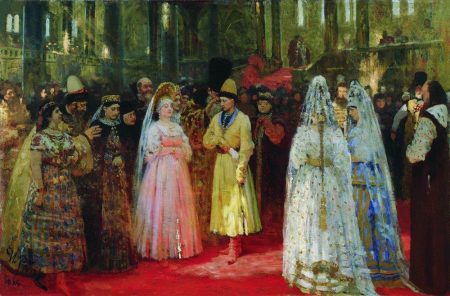
bride show in 19th-century Russia

A seldom-recognized historical antecedent to today’s beauty pageants is bride-shows that occurred early in the Byzantine Empire. Byzantine bride-shows selected from a wide-ranging search the bride for the Emperor or the Emperor’s heir. After becoming Empress, she sometimes went on to rule in her own right. The Byzantine bride-show thus provided a remarkably open opportunity for a woman to gain a place at the top of society.[1] In relation to ordinary person’s lives, Byzantine bride-shows suggest risks in a mother dominating the choice of her son’s wife even in a relatively tolerant society.

Men in pursuing intimate relationships are usually attracted to beautiful women. Today, that preference tends to be disparaged. For being attracted to a woman who was not fat, one young man recently was called bigoted and mean, and he was slapped. At a much higher level of social salience, the Harvard men’s soccer team recently had their whole season canceled because some team members were privately rating the attractiveness of members of the women’s soccer team. Simply stating that young, slender, warmly receptive women are much more sexually attractive than old, fat, bitterly men-hating women is well on its way to becoming a criminal offense in modern, democratic societies.

Compared to such societies, medieval Byzantine society was more tolerant and allowed greater personal freedom. In the fourteenth-century Byzantine romance Belthandros and Chrysantza, the King of Eros ordered Belthandros to select the most beautiful woman from among forty noble women. Belthandros told one that she had “flabby and superfluous flesh.” After she stepped forward for his judgment and stepped back from his rejection, her body was “drenched with much perspiration.” Belthandros rejected other women for having a frigid mind, red and bleary eyes, a unibrow, an improperly proportioned body, bad teeth and hairy hands. The woman Belthandros selected as the most beautiful he described as having fallen from the bosom of the moon:

Her hair is the color of gold and matches her figure. Its thickness is like that of the grass of Paradise or of celery in a garden. All the graces of the world seem to sit upon her and make her their dwelling. Certainly, beyond any doubt, her forehead bears your {the King of Eros’s} imprint of mottled gold. If a man casts a glance at her eyes, they immediately tear at the roots of his heart. In the depths of their lake tiny cupids swim, shoot their arrows and sport. Art created her jet-black eyebrows and with consummate skill made them bridges. The Graces forged the fair one’s nose and to the Graces belong her mouth and her pearly teeth. Her cheeks are rose-red, her lips have the color of nature. Certainly, her mouth is perfumed. Her chin is round in shape, she is tall and her arms are white and delicate, her neck is as from a lathe. Her waist is slender and shows the great skill of the one who fashioned it like a thin reed. As for the angle of her neck and her litheness! Indeed, her body is so perfect in composition that the Graces seem to come from her. Her bosom is a paradise of love. The apples {of her breasts} shine even on a casual glance. Her look and gait are miraculous. When she walks with confidence and glances up and down, she ravishes your senses and tears at discretion. [2]

This description strangely omits the women’s buttocks. Nonetheless, Belthandros and Chrysantza indicates that men in medieval Byzantium had considerable freedom of expression in judging women’s beauty.

The marriage of Sophia of Montferrat and John VIII Palaiologos in Constantinople in 1421 underscores the importance to men of a bride’s appearance. John agreed to marry Sophia, sight unseen, as part of a grand strategy to build a political alliance and gain military aid for Constantinople. However, aspects of Sophia’s appearance turned out to be unpleasant:

The young woman was extremely well-proportioned in body. Her neck was shapely, her hair blondish with braids flowing down to her ankles like glimmering golden streams. Her shoulders were broad and her arms, bosom, and hands well-proportioned. Her fingers were transparent. She was tall in stature and stood very straight — but her face and and lips, the condition of her nose, and the arrangement of her eyes and eyebrows were extremely unpleasant. In general, she may be described in the words of the vulgar adage: “Lent from the front and Easter from behind.” [3]

John never slept with his wife Sophia. After five years of sexless marriage, Sophia returned home and became a nun in the Dominican convent at Trino.

Byzantine mothers recognized men’s interest in women’s beauty. The Emperor’s wife Eudocia in 882 arranged a bride-show for her son Leo. She selected twelve beautiful women from her own native city. She interviewed them and then narrowed the group to three for closer examination:

All the rest she ordered to go home, after she had provided them with many presents and much money. Only these three she took with her to the Palace. Examining them in a bath and finding that the saint {Theophano} by far surpassed the other two in beauty, she dressed her in imperial garments, took her by the right hand and went in to see her husband the Emperor Basil. Throwing her at his feet, she proclaimed her a worthy bride for their son. [4]

At his wife’s behest, the Emperor forced their son Leo to marry Theophano. While Theophano apparently was quite beautiful in the nude, Leo found her unattractive in other ways. He complained, “{I} did not marry her of my own free will, but out of fear of my father, and greatly distressed.”[5] Soon after marrying Theophano, Leo took a mistress. About five years after their marriage, Theophano retired to a convent and lived as a nun. After she died, Leo promptly married his mistress.[6] Even if a mother makes a thorough inspection of a potential wives in a bride-show, her son’s marital pleasure isn’t ensured.

In Byzantine bride-shows, the royal mother dominated the selection of her son’s wife. For example, the Byzantine Empress Irene in 788 organized a bride-show for her eighteen-year-old son Constantine VI. Under her orders, envoys searched across the full expanse of the Empire for suitably beautiful women. The envoys carried an imperial measure, an ideal portrait, and a shoe to evaluate women’s height, facial appearance, and feet.[7] Thirteen promising candidates were brought to the Byzantine capital. Empress Irene and Stauracius, the head of government, reviewed the women. They judged Maria of Amnia to have the most beauty, intelligence, and grace.[8] Constantine VI, however, disliked the choice of Maria of Amnia for his wife. He soon came to hate her. He even claimed that she was trying to poison him. In 795, Constantine sent Maria and her daughters to live in convent. He then remarried in the following year.[9] In remarrying, he presumably chose his own wife.

Men deserve the right to choose freely a beautiful wife according to their own sense of beauty. In four out of the five historically documented Byzantine bride-shows, the mother of the groom organized the bride-show and either chose or effectively rigged what sort of woman became her son’s wife. In the remaining bride-show, the mother couldn’t dominate because she apparently was dead.[10] A leading historian of the Byzantine bride-shows observed:

bride-shows generally served the imperial parents well, even if they served the imperial bride-grooms rather less well. … In most cases the wishes of the bridegrooms were ignored. [11]

Today, parents who understand the extent of anti-men discrimination in family courts might well encourage their sons not to marry. But if a man wants to get married, he should be able to have a bride-show, judge the participants as he considers appropriate, and make his own free choice.

*  *  *  *  *

Read more:

Notes:

[1] On the historicity of the bride-shows, Treadgold (2004). On women at the top of Byzantine society, see the highly regarded gynocentric scholarship of Judith Herrin, e.g. Herrin (2001) and Herrin (2013). Men’s opportunities to ascend to the top of society are much more tightly circumscribed than women’s are.

Today, beauty pageants privilege women who are already extraordinarily privileged in attractiveness. These beauty pageants are relatively insignificant gynocentric spectacles.

[2] Belthandros and Chrysantza, from Greek trans. Betts (1995) p. 18. The previous short quotes are from id., pp. 15-7. Belthandros went on to marry the woman he selected as most beautiful, but that marriage didn’t follow directly from the beauty pageant.

[3] Doukas (fifteenth-century Byzantine historian), Fall of Constantinople, from Greek trans. Magoulias (1975), quoted and revised by Gilliland Wright (2013) p. 135. The vulgar adage, “Lent from the front and Easter from behind” suggests the frigidity of death and Boccaccio’s sense of the resurrection of the flesh. A current, less cultured version of that adage is, “She’s a butterface {but-her-face}.”

[4] Life of Saint Theophano, excerpt, from Greek trans. Rydén (1985) p. 185. Treadgold (1979) p. 407 provides a similar translation. The Life of Saint Theophano was written after 900 GC, probably by Magister Slocacas, a relative of Theophano. Alexakis (1995).

The bride selection process described in Esther 2:2-18 involved the king sleeping with each candidate successively. That rather modern selection process goes further than having one’s mother inspect naked wife-candidates. Both procedures help to lessen a concern expressed in Theophrastus’s Golden Book on Marriage.

[5] Vita Euthymii, excerpt trans. Treadgold (1979) p. 408.

[6] Theophano died about 897. Leo VI’s mistress and subsequent wife was Zoe Zaoutzaina. She died about 899. Leo then married Eudokia Baïana, who died in 901. Despite strong church opposition, Leo married a fourth time (to Zoe Karbonopsina).

All of Leo’s wives were “immortalized by unofficial sainthood and by imperially sanctioned art.” Gerstel (1997) p. 707. A contemporary commenter related the popular adoration of Theophano to Lucian’s account of Alexander’s attempt to deify his close friend Hephaestion:

the same thing has also happened in our time and everybody is seized by a hysteria characteristic of women so as to proclaim the emperor’s {late wife} Theophano a saint.

Scholiast, attributed to Magistros Slokakas, from Greek trans. Alexakis (1995) p. 47.

[7] The specific characteristics of the imperial measure (βασιλικóν μéτρον), the ideal portrait (λαυρᾶτον), and the shoe (τζαγγιον) aren’t known. The original Greek terms are given in Rydén (1985) p. 175.

[8] Women in the bride-shows were not judged merely on beauty. Treadgold (1979) pp. 409-10. Cf. Vinson (2004) pp. 105, 119: “the winner was chosen solely on the basis of physical appearance”; Byzantine bride shows defined “beauty as the sole measure of a woman’s worth.” Vinson nonetheless declares:

This heart-wrenching disparity between the fictionalised ideal of courtship and the lived reality of elite women should instill in us a healthy sense of caution as we approach the problem of Byzantine bride shows.

Id. p. 105.

[9] For the evidence on the bride-show for Constantine VI, see Treadgold (1979), pp. 397-400, and Rydén (1985), pp. 175-6.  The account of this bride-show indicates the challenges of maintaining solidarity among women:

The merciful man’s granddaughter {Maria of Amnia} suggested to the others, “My sisters, let us make an agreement among ourselves of the kind called sisterhood by adoption that the one of us who becomes empress should take care of the others.” But Gerontianos’ daughter, who was very rich and good-looking, answered, full of conceit, “I know for certain that I am the richest and noblest and best-looking and that the emperor will choose me.” Maria blushed and said no more.

From Nicetas of Amnia, Life of St. Philaretos the Merciful (dated 821/22), from Greek trans. Rydén (1985) p. 175. Rydén (2002) provides a full critical edition. Solidarity among women is more easily maintained in oppressing men.

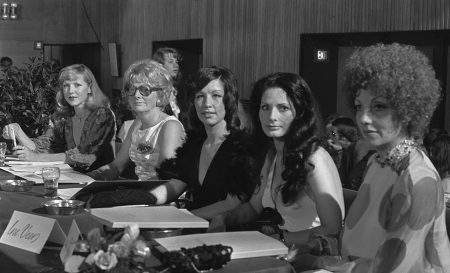
jury for 1973 Miss Ansterdam beauty pageant

[10] On Stauracius’s mother apparently being dead, Treadgold (1979) p. 409. In three of the five bride-shows, the father was dead. Here’s a table of the bride-show participants and parents. Two facts underscores mothers’ dominance in organizing and running the bride-shows: a mother (Irene) organized the first one, and a mother (Eudocia Ingerina) dominated the bride-show in which the father was also living. Vinson (1999) discusses how bride shows affirmed traditional gender roles.

Having the father run the bride-show, which was less consistent with traditional gender roles, also didn’t serve the son’s interests. Nicephorus I, Stauracius’s father, organized and ran the bride-show for Stauracius in 807. Nicephorus reportedly debauched two participants. He married his son to Theophano, a less beautiful participant. Moreover, Theophano had already been betrothed and had already had sex with her betrothed many times. Treadgold (1979) p. 401.

[11] Treadgold (1979) p. 413, Treadgold (2004) p. 50. Serving to buttress dominate ideology, Vinson declares:

In creating the illusion of romance and equality, the accounts of the Byzantine bride shows conceal the darker truth that their focus on female beauty serves as a means of disempowering the bride and her family and placing the wife under the exclusive control of her husband. The marriages arranged in this manner can thus be seen as a reversion to a type of wedlock common in the old Roman republic

Vinson (2004) p. 120. For nineteenth-century American context relevant to Vinson’s perspective, consider Sanger’s influential work on prostitution and the Crabtree case.

[images] (1) Choosing a Bride for the Grand Duke. Oil on canvas painting by Ilya Repin, 1884-87. Held in the Perm State Art Gallery, Russia. The Grand Duke is probably Grand Duke Nikolay Nikolayevich Romanov of Russia (the Elder, 1831-91). Thanks to Wikimedia Commons; (2) Jury for the 1973 Miss Amsterdam beauty pageant. Dutch National Archives, The Hague, Fotocollectie Algemeen Nederlands Persbureau (ANeFo), 1945-1989, Nummer toegang 2.24.01.05 Bestanddeelnummer 926-4364. Thanks to Wikimedia Commons.

References:

Alexakis, Alexander. 1995. “Leo VI, Theophano, a ‘Magistros’ Called Slokakas, and the ‘Vita Theophano’ (BHG 1794).” Byzantinische Forschungen 21 (Stephanos Efthymiadis, Claudia Rapp, and Dimitris Tsougarakis, eds. Bosphorus: Essays in the Honour of Cyril Mango): 45-56.

Betts, Gavin. 1995. Three medieval Greek romances. Garland Library of Medieval Literature, vol. 98. New York: Garland Pub.

Gerstel, Sharon E. J. 1997. “Saint Eudokia and the Imperial Household of Leo VI.” The Art Bulletin. 79 (4): 699-707.

Gilliland Wright, Diana. 2013. “The Brides of 1420: Men Looking at Women’s Bodies.” Ch. 8 (pp. 133-52) in Neil, Bronwen, and Lynda Garland, eds. Questions of gender in Byzantine society. Farnham, Surrey, England: Ashgate,

Herrin, Judith. 2001. Women in purple: rulers of Medieval Byzantium. Princeton, N.J.: Princeton University Press.

Herrin, Judith. 2013. Unrivalled influence: women and empire in Byzantium. Princeton: Princeton University Press.

Magoulias, Harry J. trans. 1975. Doukas. Decline and fall of Byzantium to the Ottoman Turks. Detroit: Wayne State University Press.

Rydén, Lennart. 1985. “The bride-shows at the Byzantine court: history or fiction?” Eranos: Acta Philologica Suecana. 83(1-2): 175-191.

Rydén, Lennart. 2002. The life of St Philaretos the merciful written by his grandson Niketas: a critical edition with introduction, translation, notes, and indices. Uppsala: Uppsala University Library.

Treadgold, Warren T. 1979. “The Bride-Shows of the Byzantine Emperors.” Byzantion: revue internationale des études byzantines
(Brussels). 49: 395-413.

Treadgold, Warren. 2004. “The Historicity of Imperial Bride-Shows.” Jahrbuch der Österreichischen Byzantinistik. 54: 39-52.

Vinson, Martha. 1999. “The life of Theodora and the rhetoric of the Byzantine bride show.” Jahrbuch Der Österreichischen Byzantinistik. 49: 31-60.

Vinson, Martha. 2004. “Romance and reality in the Byzantine bride shows.” Ch. 6 (pp. 102-20) in Brubaker, Leslie, and Julia M. H. Smith, eds. Gender in the early medieval world: East and West, 300-900. Cambridge, U.K.: Cambridge University Press.