characterizing Mary at the cross in Byzantine competition for attention

Mary at the foot of the cross

In Byzantine culture, Mary, the mother of Jesus, was a central figure. Byzantine laments for the crucifixion sometimes directed more attention to the weeping Mary than to the crucified Jesus.[1] In sixth-century Byzantine kontakia of Romanos the Melodist, realistic, emotional dialogue set within Christian salvation history richly characterizes Mary. These imaginative developments are best understood as a result of the Byzantine church intensely competing for attention with secular theater.

In Romanos’s kontakion On Mary at the Cross, Mary is an ordinary mother in extraordinary circumstances. Jesus the Christ set his face like flint to Jerusalem and resolutely went to his death according to the will of God the Father. Mary wearily followed her son Jesus to the cross. She insistently questioned him:

Why do you follow this swift path?
Is there another wedding in Cana,
and do you rush there to turn water into wine?
Should I go with you, my child, or should I wait for you?
Give me word, O Word, some word, and do not pass me by in silence.[2]

Where are you going? Should I wait for you? Why don’t you talk to me? These are common questions of mothers to their children. Mary’s subsequent exclamation, “Woe is me,” is also a common refrain of women in gynocentric society and in tragedy.[3] Mary reminds Jesus that his men friends have forsaken him:

Peter does not accompany you —
he who said to you,
“I shall never deny you, even if I die.”
Thomas has left you — he who said: “Let us all die with him.”
And again the others, well-known and intimate friends.[4]

Implicit in Mary’s recounting of Jesus’s missing friends is Mary’s presence. Mary implicitly reminds Jesus that she is more loyal to him than are his closest friends.

Mary argues with her son Jesus and doesn’t easily relent. Jesus urges Mary to stop weeping, to banish her grief, and to be joyful. He figuratively reminds her that she is the center of the church and that all those in the church will serve her. Mary responds:

I rub the tears from my eyes,
and I rub my heart still more,
but my thinking cannot be silenced.

She then reminds Jesus about what he has done in the past. She questions why he is behaving differently now and putting himself in peril:

Raising up the dead, you did not become dead
nor rest in a tomb, O my son and my life. Why, then,
do you say,
“If I do not suffer, Adam is not redeemed?”
Command, O Savior, and straightaway the cripple picking up
his bed walks.
Indeed, even if Adam had been buried deep in a tomb,
as you have raised up Lazarus from the tomb with your voice,
do even so with him.
All things serve you as the Creator of all.
Why, then, do you hasten, my child? Do not
hurry to slaughter.
Do not court death.

Understanding women’s preferential concern for other women, Jesus tells Mary that he also seeks to save Eve. Even then Mary persists in objecting to Jesus following God the Father’s way. If Jesus continues in that way, when will she see him again? Will she no longer be able to visit him? In response to these implorings, Jesus promises to Mary that she will be the first to see him risen from the tomb. He promises to her that she’ll see Eve risen to her former life. He also declares that he must suffer to redeem all suffering and fallen persons. Mary finally acquiesces with self-focus and self-concern:

I shall conquer, child, I shall conquer my suffering.

Grant that I come with you, for it helps me to look upon you.

In Romanos’s kontakia, Mary isn’t an idealized, abstract figure. She has numerous roles, including God-bearer, intercessor, and protector. She also has the character of an “ordinary woman of the people,” a “suburban mum.”[5] Her character is unbounded (“well rounded”) in the sense of requiring empathetic understanding. Mary reveals in Romanos’s imagined dialogue the complex, engaging emotions of a living mother.

Romanos’s characterization of Mary includes large emotional swings. In the kontakion On Mary at the Cross, the refrain “my son and my God” evokes the Apostle Thomas declaring “my Lord and my God.” Thomas sought simple, objective evidence of Jesus’s resurrection. When he touched the wounds of the crucified Jesus, Thomas jumped to the wholly different mode of encountering Jesus as a personal relation to the divine. Mary continually moves between mundane sense and divine sense with the refrain “my son and my God.” Indicating emotional lability, Jesus tells Mary, “do not lament, Mother, but rather cry with joy.”[6]

Romanos’s kontakion On the Annunciation similarly characterizes Mary as a vital, unbounded person and evokes rapidly shifting emotions. Mary is the blessed virgin:

Hail, virgin undefiled, hail, maiden called of God,
hail, chaste, and beautiful and delightful virgin,
hail, virgin full of grace, who did not know a seed time, chaste,
hail, mother who knew no man,
hail, virgin wife. [7]

This characterization disparages men’s sexuality and idealizes Mary’s distance from ordinary sexual relations with men. Yet when the angel Gabriel comes to announce Mary’s forthcoming pregnancy, she responds with worldly suspicion and shrewdness. She declares to Gabriel:

Concerning what you have said, do not conceal from me where it was said.
Was this matter about me spoken of in Heaven?
Why, then, do you not tell me that you are an angel and not human?

Mary treats Gabriel as if he might be an ordinary man trying to seduce her. She questions Gabriel further. With figurative language, Mary shows keen appreciation for heterosexual functioning:

As for the sea that you mentioned to me, the prophet
cleft it with his rod.
This miracle did not happen without some intermediary.
At first it was Moses, then prayers, and the rod were intermediaries.

She confesses to Gabriel that “your beauty, your appearance, your voice” frighten me terribly. Nonetheless, she ultimately recognizes that Gabriel is sent to her from Heaven, and she rejoices in their encounter. With a lovely touch of ordinary, personal psychology, Mary later blames her husband Joseph for the affair:

Where were you, my wise husband?
Why did you not guard my virginity?

Like those to whom Romanos addressed his kontakia, Joseph represents the ordinary community of Christian believers. He responds with his sense of Mary’s emotional range and lability:

Both terrible and sweet does she appear
to me now, and it gives me pause.
I gaze upon burning heat in snow,
Paradise in a furnace,
I gaze upon a smoking hill, upon a divine flower with young freshness,
upon an awesome throne, on a pitiable footstool!

Persons difficult to categorize simply are engaging characters. In Byzantine culture, Mary the mother of Jesus was such a character.

Byzantine homilies had techniques in common with theater. A recent scholarly book entitled The Necessity of Theater defined theater and characters broadly enough to make theater and characters unavoidable in any human society:

Theater is the art of finding human action worth watching, and it mostly does this by finding human characters worth caring about. [8]

A more subtle, historically engaged study distinguished orthodox ritual in Byzantium from theater:

As a solo performer confronted with a virtual sea of hundreds if not thousands of people, some of them easily distracted, the priest relied on the principles of classical rhetoric to keep the laity both engaged and informed. … Of particular interest for theatre scholars is the use of ēthopoieia, “characterization,” by the clergy. In the context of an exegetical homily, ēthopoieia often took the form of a fictional dialogue involving two or more biblical characters. In the past, homilies with dialogue have been ideologically positioned as proto-dramatic on the naïve assumption that all ritual, being primitive, represented a lower-order of cultural development. But the clergy’s long acquaintance with theatre, their theological objections to play-acting; and above all the conservative mode of self-presentation assumed in classical rhetoric argue heavily against this theory. Even when reciting dialogue “in character” as it were, the clergy worked within a carefully constructed regime of diction and gesture, transmitted orally and visually for centuries, which they regarded as distinct from theatre. [9]

Orthodox ritual in Byzantium presented human characters worth caring about from a Christian perspective.[10] More generally, theatrical techniques have long contributed to Christian understanding. The biblical story of Jesus and the Canaanite women makes best sense when understood dramatically. De Maria Magdalena, written in Latin about 1200, is meaningfully interpreted as theatrical lectio divina. Using theatrical techniques while disdaining theater is eminently feasible.

Byzantine circumstances of reception plausibly drove emphatic characterization and emotional lability in Byzantine homilies. The extent of empathetic characterization and emotional lability is generally associated with the intensity of competition for attention relative to competition for acclaim. Christian ritual in Byzantium was heavily engaged in competition for attention:

most if not all of his {John Chrysostom’s} congregation came to {church} services after years of attending theatrical shows year-round, and lacked the training or appreciation for rhetoric Chrysostom took for granted. Chrysostom couldn’t help but notice how restless his flock was every time he stepped up to speak, competing as he did with everything from social climbers to the occasional pick-pocket. … competition between clergy and mimes for audiences was clearly intense. What developed throughout late Antiquity was the equivalent of a media war in which the ambo {platform from which clergy addressed the church congregation} served as the launching pad for anti-theatrical invective while the public stage responded with biting clerical critiques. Both venues enjoyed an avid following, and the popularity of Christian satire was so great that as late as the sixth century Emperor Justinian still had to remind his subjects that it was illegal to masquerade as church folk [11]

Empathetic characterization and emotional lability aren’t necessarily related to any specific medium or abstract form. Byzantine clerics could reject liturgical drama, yet embrace empathetic characterization in homilies. On the other hand, liturgical drama could present scripturally circumscribed, static, indicative characters rather than unbounded, dynamic, empathetic characters like Mary in Romanos’s kontakia. Byzantine icons plausibly generated a stronger sense of personal presence than did many conventional, realistic images.[12] In late eighteenth-century Europe, competition for attention in print was associated with empathetic characterization and romantic sensibility of the sublime in proliferating novels. The nature of symbolic competition, rather than the abstract form of expression, drives the extent of engaging characterization and emotional dynamics.

*  *  *  *  *

Read more:

Notes:

[1] Alexiou (1974) p. 62. In the Epitáphios Thrénos, “she {Mary}, rather that Christ, is the central figure.” Id. p. 65. That lament is known to have existed from the fourteenth century. It continues to be performed within the liturgical calendar of the Greek Orthodox Church. Id.

Mary’s lament at the foot of Jesus’s cross was a sub-genre of religious lyric in western Europe. Examples include Carmina Burana, additional 4, “Weep, loyal souls {Flete, fideles animae}”; and Carmina Burana, additional 14, “Not previously knowing lamentation {Planctus ante nescia}.” For Latin text and English translation, Traill (2018).

[2] Romanos the Melodist, On Mary at the Cross, st. 1, excerpt, from Greek trans. Carpenter (1970) vol. 1, p. 196. In this and subsequent quotations, I have modernized the English of Carpenter’s translations to make the text more accessible to ordinary readers. Lash (1995) provides an alternate English translation.

On Jesus setting his face like flint to fulfill the Father’s will for him in Jerusalem, see Luke 9:51 and Isaiah 50:7.

[3] Alexiou has astutely observed:

when “religion” passes from church to hearth, from liturgy to dance and song, from Communion to family meal, women do not only mediate — they take over. … Through tales, songs, and dances, women have been at least equal partners in the transmission of Greek language, myth, and metaphor.

Alexiou (2002) pp. 406, 412. The phrase “at least equal partners” is consistent with seldom-discussed gynocentric dominance. On deep roots of gynocentrism in Jewish and Christian tradition, consider Genesis 2:24.

Tradition known from about the ninth century figures Mary as inspiring Romanos. On Christmas Eve, Mary gave Romanos a papyrus scroll and ordered him to eat it. The textual food from Mary inspired Romanos to preach and sing melodiously. Thus, on Christmas Eve, Mary symbolically gave birth to Romanos as a sacred homilist and poet. Gador-Whyte (2013) p. 77, provides an English translation of the relevant text. Cf. Revelation 10:9-11, Ezekiel 3:3.

[4] Romanos the Melodist, On Mary at the Cross, st. 3, excerpt, trans. Carpenter (1970) vol. 1, p. 197. The subsequent three quotes from this kontakion are likewise st. 7, p. 199 (I rub the tears…); st. 8, pp. 199-200 (Raising up the dead…); st. 15, p. 202 (I shall conquer…).

[5] “Mary reacts to her son’s theological arguments not as a woman who is divinely inspired, but as an ordinary woman of the people.” Alexiou (1974) p. 63. Romanos depicts Mary as an “ordinary, caring mother”; “ordinary human being”; “loyal mother.” Gador-Whyte (2013) pp. 77, 87, 90. Gador-Whyte attributes to Roger Scott the sense of Mary as “suburban mum,” but doesn’t provide a specific citation. See id. pp. 87, 91.

Men, most of whom are ordinary human beings, aren’t mothers. Men, however, are often caring human beings. Most men are also loyal to their families despite facing acute anti-men sex discrimination in family courts. Romanos’s characterization of Mary isn’t constrained by gender stereotypes. His characterization of Mary is more like describing an ordinary, caring, loyal father.

[6] Romanos the Melodist, On Mary at the Cross, st. 3, excerpt, trans. Carpenter (1970) vol. 1, p. 198. The refrain “my son and my God” occurs at the end of every strophe of the kontakion. For the apostle Thomas’s exclamation, “my Lord and my God,” John 20:28.

[7] Romanos the Melodist, On the Annunciation I, st. 1, excerpt, from Greek trans. Carpenter (1970) vol. 2, p. 9. The Akathistos, which Carpenter attributes to Romanos, alternates strophes with long lists of hails to Mary. For a translation, id. pp. 300-9.

Subsequent quotes from On the Annunciation are from st. 6, pp. 11-2 (Concerning what you have said…); st. 9, p. 13 (As for the sea…); st. 11, p. 13 (your beauty…); st. 12, p. 14 (Where were you…); st. 13, pp. 14-5 (Both terrible and sweet…).

[8] Woodruff (2008) p. 22.

[9] White (2015) pp. 59-60. For Byzantine homilies interpreted as proto-drama, see, e.g. Bogdanos (1976). On the sources and influence of Romanos’s dramatic techniques, Cunningham (2008).

[10] Romanos constructed himself within his homilies as one such person. Gador-Whyte has observed:

As a preacher, Romanos is concerned to make his congregation follow this call {to live according to Christ’s example}. One way he does so is by vivifying the Gospel events, creating dialogues for characters and presenting them as believably real and believably sixth-century characters. He makes the Gospel present. … The congregation is encouraged to identify with Romanos’ personae on a number of levels, so that he need only place himself within the story to make the congregation feel that they too are participating in it.

Gador-Whyte (2011) p. 36.

[11] White (2015) pp. 61, 74. Dialogue in homilies “seem to represent at least a ‘wake-up call’ to the audience.” It served the need to “engage the listener’s attention.” Carpenter (2003) pp. 112-3. White (2015), p. 72, states:

priests distrusted applause and regarded it as their duty to enlighten their congregations, not entertain them.

Priests may have supported such ideology, but surely they needed to get persons to attend church and listen to homilies in order to enlighten them. Disliking and distrusting competition for attention isn’t sufficient to free persons from it.

Writing about 1100, Honorius of Autun explicitly compared traditional Greco-Roman theater with the Christian Mass:

It is known that those who recited tragedies in the theaters represented to the people, by their gestures, the actions of conflicting forces. Even so, our tragedian represents to the Christian people in the theater of the church, by his gestures, the struggle of Christ, and impresses upon them the victory of his redemption.

{ Sciendum quod hi qui tragoedias in theatris recitabant, actus pugnantium gestibus populo repraesentabant. Sic tragicus noster pugnam Christi populo Christiano in theatro Ecclesiae gestibus suis repraesentat, eique victoriam redemptionis suae inculcat. }

Gem of the Mind {Gemma animae}, Book 1, Chapter 83, Latin text and English translation from Bevington (1975) p. 9. Honorius of Autun (Honorius Augustodunensis) was a student of Amalarius of Metz. Here’s a English translation of the full chapter. The full Latin text is available in Patrologia Latina 172:541ff.

[12] On (eastern) icons in relation to (western) liturgical drama, Maguire (2003). Introductions to some medieval Byzantine vernacular Greek romances underscore the popular appeal of emotional lability. Here’s the introduction to Belthandros and Chrysantza:

Come! Attend a moment all you young people. I wish to tell you the fairest tale, a beautiful and usual story. Whoever wants to taste of its sadness and joy will also wonder at its account of daring and bravery.

Trans. Betts (1995) p. 5. The introduction to Kallimachos and Chrysorroi similarly declares:

Joy and grief are mixed, even blended together. … if you read this tale and learn the matter of its verses, you will see the workings of Love’s bitter-sweet pangs.

Id. p. 37. Likewise Livistros and Rodamini:

come now and hear with me of love’s passion in the fair story which I shall tell. … I am going to tell a wonderful tale of love and of the terrible sufferings endured by a man of many trials and woes whom Love persecuted.

Id. p. 95.

[image] Icon of the Crucifixion, Novgorod School, c. 1360. Held in Musée du Louvre, Paris. Thanks to Wikimedia Commons.

References:

Alexiou, Margaret. 1974. The ritual lament in Greek tradition. Cambridge: Cambridge University Press.

Betts, Gavin. 1995. Three Medieval Greek romances. New York: Garland.

Bevington, David M. 1975. Medieval Drama. Boston: Houghton Mifflin.

Bogdanos, Theodore. 1976. “Liturgical Drama in Byzantine Literature.” Comparative Drama. 10 (3): 200-215.

Carpenter, Marjorie, trans. & ed. 1970. Kontakia of Romanos, Byzantine melodist. Columbia: University of Missouri Press.

Cunningham, Mary. 2003. “Dramatic device or didactic tool? The function of dialogue in Byzantine preaching.” Ch. 7 (pp. 101-13) in Elizabeth Jeffreys, ed. Rhetoric in Byzantium: papers from the thirty-fifth Spring Symposium of Byzantine Studies, Exeter College, University of Oxford, March 2001. Aldershot: Ashgate.

Cunningham, Mary B. 2008. “The reception of Romanos in middle Byzantine homiletics and hymnography.” Dumbarton Oaks Papers. 62: 251-260.

Gador-Whyte, Sarah. 2011. “Self-Construction: ‘Auto-Ethopoeia’ in Romanos’ Kontakia.” Melbourne Historical Journal. 39(2): 23-37.

Gador-Whyte, Sarah. 2013. “Changing Conceptions of Mary in Sixth-Century Byzantium: The Kontakia of Romanos the Melodist.” Ch. 5 (pp. 77-92) in Neil, Bronwen, and Lynda Garland, eds. 2013. Questions Of Gender In Byzantine Society. London: Ashgate Publishing Group.

Lash, Ephrem, trans. 1995. Romanos the Melodist. On the life of Christ: kontakia. San Francisco: HarperCollins Publishers.

Maguire, Henry. 2003. “Byzantine rhetoric, Latin drama and the portrayal of the New Testament.” Ch. 14 (pp. 215-34) in Elizabeth Jeffreys, ed. Rhetoric in Byzantium: papers from the thirty-fifth Spring Symposium of Byzantine Studies, Exeter College, University of Oxford, March 2001. Aldershot: Ashgate.

Traill, David A. 2018, ed. and trans. Carmina Burana. Dumbarton Oaks Medieval Library, 48-49. Cambridge, Massachusetts: Harvard University Press.

White, Andrew Walker. 2015. Performing Orthodox ritual in Byzantium. Cambridge: Cambridge University Press.

Woodruff, Paul. 2008. The necessity of theater: the art of watching and being watched. Oxford: Oxford University Press.

Kassia redeemed classical culture with repentance of fallen woman

By now the Huntress had reached Olympus heights
and made her way to the bronze-floored house of Zeus.
And down she sat on her Father’s lap, a young girl,
sobbing, her deathless robe quivering round her body.
But her Father, son of Cronus, hugged her tight
and giving a low warm laugh inquired gently,
“Who has abused you now, dear child, tell me,
who of the sons of heaven so unfeeling, cruel?
Why, it’s as if they had caught you in public,
doing something wrong ….” Wreathed in flowers
the one who halloos the hunt cried out at once,
“Your own wife, Father! The white-armed Hera beat me!
This strife, this warfare plaguing all the immortals —
Hera’s all to blame!”

{ ἣ δ᾽ ἄρ᾽ Ὄλυμπον ἵκανε Διὸς ποτὶ χαλκοβατὲς δῶ,
δακρυόεσσα δὲ πατρὸς ἐφέζετο γούνασι κούρη,
ἀμφὶ δ᾽ ἄρ᾽ ἀμβρόσιος ἑανὸς τρέμε: τὴν δὲ προτὶ οἷ
εἷλε πατὴρ Κρονίδης, καὶ ἀνείρετο ἡδὺ γελάσσας:
“τίς νύ σε τοιάδ᾽ ἔρεξε φίλον τέκος Οὐρανιώνων
μαψιδίως, ὡς εἴ τι κακὸν ῥέζουσαν ἐνωπῇ;”
τὸν δ᾽ αὖτε προσέειπεν ἐϋστέφανος κελαδεινή:
“σή μ᾽ ἄλοχος στυφέλιξε πάτερ λευκώλενος Ἥρη,
ἐξ ἧς ἀθανάτοισιν ἔρις καὶ νεῖκος ἐφῆπται.” }[1]

Artemis sought comfort in the arms of the Father. Perhaps she had been caught behaving in public in the manner of Mary of Egypt. Could that be, she who seemed impervious to Eros and despised men gazing on her? No matter. The Father God Zeus, infinitely merciful to women, wreathed her in flowers. He hugged her tightly and gently suggested that men had abused her. This Father, a master of deceptions, knew how to seduce women.

Artemis the Huntress spent her time hunting in the woods rather than studying the liberal arts. She lacked learning in the dominant ideology and was less easily duped. She inadvertently blurted out the truth: the ruling goddess Hera viciously perpetrated domestic violence and incited war. The Father God, on his throne in the ethereal heights, laughed deep in his heart. While carrying out his many amorous affairs, he delighted in seeing female and male gods engaging in all-out conflict.

Among mortals, the gender structure of violence was less just than among the gods. The harlot Helen of Tory incited men and gods to seek to kill each other in the long and terrible Trojan War. In intense fighting, the goddess of wisdom Athena struck the god of war Ares in the neck with a huge boulder. Helen merely watched men kill other men. So it has long been in earthly violence, as if a matter of divine indifference.

Kassia repented for Helen and Trojan War

Deeply engaged in classical culture, Byzantine intellectuals pondered the Judgment of Paris and the Trojan War. An account of the bride-show for Emperor Theophilos in Constantinople in 830 alluded to these events. Theophilos’s mother instructed him to give a golden apple to the woman with whom he was most pleased. The beauty of the young, noble woman Kassia struck Theophilos. With acute awareness of the matter of Troy, he said to her:

Through a woman the common evils flowed.

{διὰ γυναικὸς ἐρρύη τὰ φαῦλα.} [2]

Byzantine culture combined classical Greek culture and Christian culture. Kassia responded:

And also through a woman superior things well up.

{ἀλλὰ καὶ διὰ γυναικὸς πηγάζει τὰ κρείττω.}

Utterly shocked by what Kassia said, Theophilos passed by her and gave the golden apple to another woman. Kassia used the present tense in describing a woman’s effect. Superior things cannot begin in merely recalling the events of ancient Greek epic.[3]

A highly learned woman and a leader of a convent, Kassia reformed classical culture and repented women’s role in violence against men. Among Kassia’s maxims:

I hate the one who does everything for the sake of vainglory.

It is better to be defeated than to win unfairly.

It is better to possess grace from the Lord,
than beauty and wealth that does not gain grace.

{ Μισῶ τὸν δόξης χάριν ποιοῦντα πάντα.

Κρεῖσσον ἡττπασθαι τοῦ νικᾶν ἀπεικότως.

Χάριν κεκτῆσθαι κρεῖττον παρὰ κυρίου
ἤπερ ἀχαρίτωτον κάλλος καὶ πλοῦτον. }[4]

Ancient Greek men competed for glory and strove to be heroes. Kassia hated classical men heroes. Drawing upon the celebrating cunning of Odysseus, the Greeks defeated the Trojans with the trick of the Trojan horse. Within Kassia’s values, it would have been better for the Greeks to have been defeated. While Kassia recognized that a woman’s bodily beauty provides consolation, she regarded that beauty as less important than a woman being an instrument of grace from the Lord.

Most importantly, Kassia utterly re-figured the relation of women to God. Invoking terms from classical Greek tragedy — woe to me (Οἴµοι) and lamentations of my heart (στεναγµοὺς τῆς καρδίας) — she recognized women’s culpability in the tragic fate of men. She recognized that women, like men, cause harm through desire for wrongful behavior (ἔρως τῆς ἁµαρτίας). She appreciated a man’s sacrifice for her, to the extent of his giving up his life for her. With specific acts of love, the woman repents of her behavior that has caused so much harm to men. Rejecting the privilege of special paternal solicitude for women, she humbly appeals for mercy in the judgment of God.[5]

Lord, the woman fallen
into many sins,
recognizing your Divinity,
rises to the status of myrrh-bearer,
and mourning brings to you myrrh
before your burial.
Woe to me, she says,
for night holds for me
the ecstasy of intemperance
gloomy and moonless,
a desire for sin.
Accept the springs of my tears,
you who with clouds spread out
the water of the sea:
bend down to me
to the lamentations of my heart,
You who made the heavens incline
by your ineffable humiliation.
I will tenderly kiss your sacred feet,
I will wipe them again
with the hair of my head;
the feet whose sound
Eve heard in Paradise
in the afternoon,
and hid in fear;
who can delineate
the multitude of my sins
and the depths of your judgment,
my Redeemer, savior of souls?
Do not disregard me, your servant,
you whose mercy is infinite.

{ Κύριε, ἡ ἐν πολλαῖς ἁµαρτίαις
περιπεσοῦσα γυνή,
τὴν σὴν αἰσθοµένη Θεότητα,
µυροφόρου ἀναλαβοῦσα τάξιν,
ὀδυροµένη µύρον σοι
πρὸ τοῦ ἐνταφιασµοῦ κοµίζει·
Οἴµοι! λέγουσα,
ὅτι νύξ µοι συνέχει
οἶστρος ἀκολασίας.
ζοφώδης τε καὶ ἀσέληνος,
ἔρως τῆς ἁµαρτίας·
δέξαι µου τὰς πηγὰς τῶν δακρύων,
ὁ νεφέλαις στηµονίζων
τῆς θαλάσσης τὸ ὕδωρ·
κάµφθητί µοι
πρὸς τοὺς στεναγµοὺς τῆς καρδίας,
ὁ κλίνας τοὺς οὐρανοὺς
τῇ ἀφράστῳ σου κενώσει·
καταφιλήσω τοὺς ἀχράντους σου πόδας,
ἀποσµήξω τούτους δὲ πάλιν
τοῖς τῆς κεφαλῆς µου βοστρύχοις·
ὧν ἐν τῷ Παραδείσῳ
Εὔα τὸν δελινὸν
κρότον τοῖς ὠσὶν ἠχηθεῖσα,
τῷ φόβῳ ἐκρύβη·
ἁµαρτιῶν µου τὰ πλήθη
καὶ κριµάτων σου ἀβύσσους
τίς ἐξιχνιάσει,
ψυχοσῶστα, Σωτήρ µου;
µή µε τὴν σὴν δούλην παρίδῃς
ὁ ἀµέτρητον ἔχων τὸ µέγα ἔλεος. }[6]

*  *  *  *  *

Read more:

Notes:

[1] Homer, Iliad, 21.505-13, Greek text of Oxford 1920 edition, English translation from Fagles (1990) p. 536. Freely available online is the English translation Murray (1924) for the Loeb Classical Library.

[2] Kassia’s name occurs in numerous variants, including Kassiani and Cassiane. This and the subsequent quote are from the chronicle of Symeon the Logothete, Greek text of Kazhdan, Khronika Simeona Logofeta, Viz. Vrem. XV (1959), as cited in Afinogenov (1997) p. 11. The twelfth-century Byzantine historian Ioannes Zonaras provides a nearly identical Greek text (see 3.354 in Ioannis Zonarae, Epitomae Historiarum, libri XIII-XVIII, ed. Th. Büttner-Wobst, Bonn 1897). The translation is mine, drawing upon Rydén (1985) p. 187, Afinogenov (1997) p. 11, and Silvas (2006) p. 21. The phrases occur in a homily written between 431 and 530. Afinogenov (1997) p. 11, citing Patrologia Graeca 50.791-6 and 10.1171-77.

An alternate text for the exchange between Theophilos and Kassia is:

Through a woman evils came to man.
{Ἐκ γυναικὸς τὰ χείρω.}

Through a woman better things began.
{Kαὶ ἐκ γυναικὸς τὰ κρείττω.}

Greek text of Leo Grammaticus (Bonn ed., (1824), pp. 213-4), trans. Treadgold (1979) p. 403. Id., n. 29, notes comparison with the Greek text of Pseudo-Symeon (“Symeon Magister”), Bonn. ed (1838) pp. 624-5. The above text seems to have been relatively influential. It appears in Bourboulis (1953) pp. 3-5, the Wikipedia entry for Kassia, and McLees (2011) p. 57. Treadgold (2004) p. 43, n. 17, observes that the text “is still not properly edited.” The couplet may have become well-known in variant forms. The form cited above seems to me more classically poetic.

[3] Scholars have facilely associated the couplet with the contrasting figures of Eve and Mary, the mother of Jesus:

In the dialogue Theophilos refers to the story of the Fall in the Old Testament. Kassia, on the other hand, reminds him of the incarnation through the Virgin Mary, and thus reveals his primitive state of mind.

Rydén (1985) p. 188. “The references, quoted in verse, are of course to Eve and the Virgin.” Treadgold (2004) p. 43. From a Byzantine perspective, the incarnation through the Virgin Mary was a specific event in history and would invoke the past tense. Cf. the rationalizing effort of Silvas (2004) p. 21, n. 10. Moreover, there’s no apple, no less a golden one, nor a beauty contest in the Genesis account of the serpent seducing the innocent Eve. The matter of the Trojan War deeply infused learned Byzantine culture. The Judgment of Paris and Kassia’s troparion on the woman’s repentance are the most relevant contexts for interpreting the dialogue.

[4] Kassia, Maxims and Gnomic verses, Greek text and English translation from Zugravu (2013) pp. 210, 213, 216. Id. provides a slightly modified version of the Greek texts and translations of Tripolitis (1992).

[5] Literary scholarship, along with culture in general, has tended to obscure men’s distinctive gendered being. One result has been terrible misunderstandings. Consider, for example, the obfuscation of men’s being in an influential interpretation of Kassia’s troparion on the fallen woman:

the individual expectation of salvation becomes extended to all mankind; the specific vice is blurred, and Mary’s cry of the heart is the expression of everyman’s {sic} psychological suffering: I am a sinner but God is merciful.

Kazhdan, Sherry & Angelidē (1999) pp. 319-20.

[6] Kassia, “Κύριε, ἡ ἐν πολλαῖς ἁµαρτίαις” (“The Fallen Woman”) sticheron idiomelon sung presently in Orthodox liturgy for Holy Wednesday, Greek text and English translation from Zugravu (2013) p. 234, following Tripolitis (1992). Here’s an easily accessible online Greek text, an alternate English translation, and performed versions in Greek and in English. Kassia’s tetraodion on Holy Saturday was still in liturgical use in the Eastern Church in the first half of the fourteenth century. Simic (2014).

[image] “Great deeds! Against the dead!” Los desastres de la guerra, plate No. 39 (1st edition, Madrid: Real Academia de Bellas Artes de San Fernando, 1863). By Francisco Goya, 1810-20. Thanks to Museo del Prado (Spain) and Wikimedia Commons.

References:

Afinogenov, Dmitry. 1997. “The Bride-show of Theophilos: Some Notes on the Sources.” Eranos: Acta Philologica Suecana. 95: 10-18.

Bourboulis, Photeine P. 1953. Studies in the History of Modern Greek Story-Motives. Thessalonike: Etaireia Makedonikōn Spoudōn.

Fagles, Robert, trans. and Bernard Knox, intro. and notes. 1990. The Iliad. New York, N.Y., U.S.A.: Viking.

Kazhdan, Alexander P., Lee Francis Sherry, and Christina Angelidē. 1999. A history of Byzantine literature. Vol. 1. 650-850. Athens: National Hellenic Research Foundation, Institute for Byzantine Research.

McLees, Nectaria Mother. 2011. “Byzantine Bride-Shows and the Restoration of Icons: A Tale of Four Iconophile Empresses.” Road to Emmaus 51:34-69.

Rydén, Lennart. 1985. “The bride-shows at the Byzantine court: history or fiction?” Eranos: Acta Philologica Suecana. 83: 175-191.

Silvas, Anna M. 2006. “Kassia the Nun, c.810-c.865: An Appreciation.” Ch. 2 (pp. 17-39) in Garland, Lynda, ed. Byzantine women: varieties of experience 800-1200. Aldershot: Ashgate.

Simic, Kosta. 2014. “‘Senseless and Old’: A Note on the Nachleben of Kassia’s Poetry.” Ephemerides Liturgicae 128: 238-248.

Treadgold, Warren T. 1979. “The Bride-Shows of the Byzantine Emperors.” Byzantion: revue internationale des études byzantines
(Brussels). 49: 395-413.

Treadgold, Warren. 2004. “The Historicity of Imperial Bride-Shows.” Jahrbuch der Österreichischen Byzantinistik. 54: 39-52.

Tripolitis, Antonia, ed. and trans. 1992. Kassia: the legend, the woman, and her work. New York: Garland.

Zugravu, Gheorghita. 2013. Kassia the Melodist. And the Making of a Byzantine Hymnographer. Thesis (Ph.D.) — Columbia University, 2013.

men’s voices in Romanos the Melodist’s kontakia on the resurrection

angel of the dawn: woman in imagination of resurrection

Across nearly two millennia of literature, Joseph of Arimathea is relatively silent. Joseph took Jesus’s dead body down from the cross and wrapped it in his own linen. Another man, Nicodemus, provided about a hundred pounds of myrrh and aloes to preserve Jesus’s body. Joseph of Arimathea and Nicodemus together placed Jesus’s body in a tomb.[1] In literature invoking Christian figures, why haven’t these men been given more significant voices?

In a sixth-century kontakion of Romanos the Melodist, the guards at Jesus’s tomb offer profound insight into gender hierarchy. The guards were ordinary working men. They followed orders, endured dangerous, demanding work, and one turned over a large share of his earnings to support his ex-girlfriend and her child. The guards understood the prevailing gender hierarchy:

he {Jesus} was approachable by the women,
And to us wretched men he was not approachable,
that fiery one.
He conversed with them; he threatened death to us.
Them he strengthened; and humbled us with fear,
and overtaking us, he buried us.
To the women he was gay; with us he became as one
rather haughty,
And he mortified us, but he nerved them [2]

One guard exclaimed:

I have seen the Lord, Christ God
uttering the word “Hail” to the myrrh-bearing women,
and one of them was a whore.
I beg to be raised up from crushing child-support payments,
I’m no silent, stoic Joseph,
and my Mary isn’t like his Mary! [3]

The guard wept. Men aren’t supposed to weep. Another guard taunted him, saying:

Man up! Stop complaining! It’s your fault!
You’re a misogynistic, slut-shaming, privileged man.
If you didn’t want to be forced to pay, you shouldn’t
have had sex with a woman.

Men live in cages that they themselves guard. Few dare ask for social justice for men:

At this the holy men, fear-stricken, said,
— For what reason has he not been seen by us?
Perhaps he thought our liberty too great?

Our liberty has turned to daring,
our boldness deemed contempt.
Perhaps that is why we have not seen him, for we are unworthy. [4]

Men lack confidence in their own worthiness. Men don’t understand that they are as much God-bearers as women are.[5]

Unlike men, women sense that they are highly favored. For example, Mary Magdalene didn’t regard herself as a harlot. She also had enough self-confidence to tell Jesus what to do:

Behold, you are three days dead, you, who make all things new.
You, who raised Lazarus after four days,
you, who made a swift runner of him bound with bandages,
you lie in the tomb — if I only knew where you were buried,
so I might like the harlot wet with my tears
not only your feet but yes, your whole
body and tomb,
saying, “Lord, as you raised up the
widow’s son, so raise yourself;
you who brought to life Jaeirus’ daughter,
why linger longer in the tomb?
Arise, stand by, be manifest to those who seek you,
who offer raising-up to the fallen. [6]

Men need not go as far as telling God what to do. But men must have the courage to speak to women and men about men’s wants and men’s concerns.

Jesus appreciated the need for women to instruct men. After he rose from the dead as Mary Magdalene instructed, Jesus told Mary:

So let your tongue, women, utter aloud these things,
explaining them to the sons of the kingdom
who wait for me to rise, the living one.
Make haste, Mary, and gather the disciples.
For I shall use you as a loud-voiced trumpet:
ring out peace to the fear-stricken ears
of my friends in hiding [7]

Mary responded, “Like Moses I am glorified!” So she was. Mary urged the apostles (all men) to be strong, courageous, and joyful:

Why so downhearted? Why cover your faces?
Lift up your hearts — Christ is risen.
Stand in line for the dance, and say with us
“The Lord is risen.”
He who was born before the dawn has shone out,
so cease glowering looks, send forth new shoots.
Spring is here: blossom forth branches,
in fruitfulness, not in vexation.
Let us all clap our hands and say “He is risen
who offers raising-up to the fallen.”

Romanos the Melodist included Mary Magdalene among “wise women,” “God-bearing women,” “full of wisdom.” Men should listen to her. Spring is here. Blossom forth. Men should speak out full of confidence in their own redemption.

*  *  *  *  *

Read more:

Notes:

[1] John 19:38-42.

[2] Romanos the Melodist, On the Resurrection II, st. 18, excerpt, from Greek trans. Carpenter (1970) vol. 1, p. 269. The guards’ insight can be further appreciated by comparing the differing responses of angels to Zechariah and the virgin Mary respectively questioning angelic prophecies. Compare Luke 1:20 to Luke 1:35.

[3] This stanza and the following one are my interpretations in the spirit of ancient kontakia. The former includes a quote from Romanos the Melodist, On the Resurrection I, st. 1, trans. Alexiou (2002) p. 431. Carpenter (1970), vol. 1, pp. 314-25, translates this kontakion under the title On the Resurrection VI.

[4] Romanos the Melodist, On the Resurrection I, st. 4-5, excerpts, trans. Alexiou (2002) pp. 435-7.

[5] Emphasis on the virgin birth of Jesus tends to distance men from the divine. At the same time, the privilege of the blessed virgin Mary has been readily generalized to all women, including whores. For example, in a homily he delivered early in the fifth century, Proclus of Constantinople declared:

What we celebrate is the pride of women and the glory of the female, thanks to the one who is both mother and virgin. Lovely is the gathering! … Let nature leap for joy, and let women be honored!

Homily 1, On the Holy Virgin Theotokos 1, excerpt, from Greek trans. Constas (2003) p. 137.

[6] Romanos the Melodist, On the Resurrection I, st. 8, trans. Alexiou (2002) pp. 437-9. On bodily expansion of action with water, cf. John 13:9. Carpenter (1970), vol. 1, pp. 314-25, translates the refrain line as “He who offers resurrection to the fallen.” Alexiou emphasizes more Jesus’s specific agency with the translation “he who offers raising-up to the fallen.”

[7] Romanos the Melodist, On the Resurrection I, st. 12, excerpt, trans. Alexiou (2002) p. 441.  The subsequent two quotes are from st. 14, p. 443 (Like Moses…) and st. 22, id. p. 449 (Why so downhearted…). The ensuing short quoted phrases are from st. 2 and 3, id. p. 433.

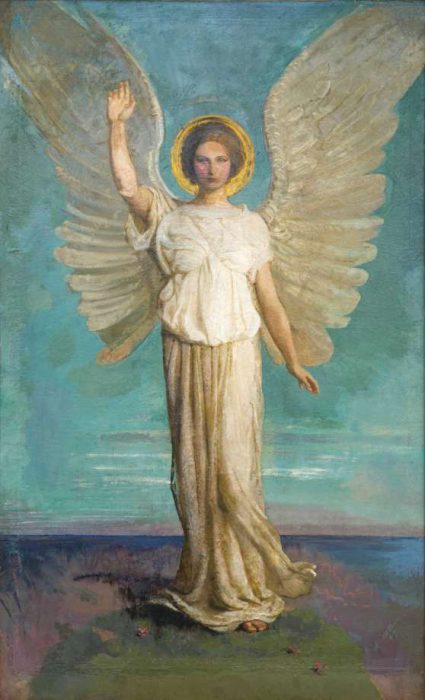
[image] Angel of the Dawn. Oil on canvas painting by Abbott Handerson Thayer, 1919. Held in St. Anselm Abbey School, Washington D.C. Gift of Mrs. Charles Plunket. Image thanks to the Albany Times Union. Wikimedia Commons has a smaller version. Abbott Handerson Thayer painted many women angels while recognizing the grave danger men vastly disproportionately face in war.

References:

Alexiou, Margaret. 2002. After antiquity: Greek language, myth, and metaphor. Ithaca: Cornell University Press.

Carpenter, Marjorie, trans. & ed. 1970. Kontakia of Romanos, Byzantine melodist. Columbia: University of Missouri Press.

Constas, Nicholas. 2003. Proclus of Constantinople and the cult of the Virgin in late antiquity: homilies 1-5, texts and translations. Leiden: Brill.

poor Prodromos: an abused husband in 12th-century Byzantium

abused husband

In twelfth-century Byzantium, the poet Theodore Prodromos appealed to the Emperor John II. Prodromos, a forerunner of oppressed husbands crying out in marital wilderness, implored:

Although I seem, lord, to laugh and play at once,
I am oppressed by endless grief and burdensome affliction,
by grave indisposition and suffering — what suffering!
Hearing of suffering, don’t suppose I have a rupture,
or any of your graver and less obvious troubles:
it’s no eyesores, plain to see, nor shivering fever either,
it isn’t heartburn, nor inflammation of the lung,
no gut-knot shit-face, no dropsy, no bronchial troubles ..
No, I have a nagging wife whose tongue wags on and on,
pugnaciously parading parapets and predictions,
redundantly recounting me the rightness of her cause. [1]

Men’s keen sense of competition with other men makes them reluctant to complain about their wives. If husbands do complain, lack of compassion for men tends to compound their hurt. Prodromos, a highly sophisticated poet, found in a plea to the Byzantine Emperor a rare opportunity to make a pioneering first-personal literary account of a husband’s suffering from his abusive wife.

Just as gender norms teach men not to cry, men learn to be afraid to express fear. Yet within the particular circumstances of his appeal, Prodromos openly expressed fear:

I will make manifest this woman’s spitefulness,
yet, lord, I fear those more brazen fellows,
lest they should hear me, and go to my home
and write reports about me unexpectedly.
I would far rather, lord, they buried me alive,
and put me in the earth, and dug me into it,
than she should learn of what has just been written.
For I fear her cackling and fury, I fear
her threats and invective. It would take little
for the idea to pop into her head, and here we go,
she orders her servants and her nurse to grab me,
put me out and throw me in the street and
bash me in the head in three places. Who
will avenge me and get rid of such a shrew? [2]

Prodromos’s fear of his wife throwing him out of their house should be interpreted as realistic. Today men can be thrown out of their homes with a standard-form ex parte restraining order, or through gender-profiling men for domestic violence arrest. The same gynocentric social forces realistically would enable Prodromos’s wife to have him thrown out into the street. At the same time, the Byzantine Emperor was imagined to be all-powerful. A plea for relief from gynocentric oppression was thus figuratively appropriate to direct to the Byzantine Emperor.[3]

Prodromos’s wife complained about Prodromos in a way thoroughly realistic to men today. She complained:

You sit in my house, but pay no heed to upkeep:
the marbles are worn and faded, the floor has sagged,
the tiles are dangling loose, the roof’s completely rotten,
nothing is left of all the lettering, plaster, glass,
nor of marble cornices nor finely-wrought mosaics,
the walls are tumbling down, the garden has run wild,
while the doors have all turned inside out from warping,
the banisters are hanging loose from end to end,
the outside parapets have fallen inward to the garden.
You’ve never changed a door, there isn’t a sound floorboard,
you’ve never changed a tile, nor yet repaired a wall;
you haven’t even called a builder in to fix it,
nor bought a single nail to knock into a floorboard! [4]

Men must do more than merely earn enough money to provide a woman with a luxurious house. Men must also maintain the house through completing home-maintenance tasks that their wives assign to them on a to-do list. Modern scholarly studies of gender-egalitarian marriage don’t count such work as housework. With similar reasoning, Prodromos’s wife complained that she did almost all the housework:

As for me, I do your housework, direct
your servants, and take care of your children
better than would the best of nurses. I watch
over your business, I run around, get tired,
beat myself up, wearing a linen and cotton
dress made by my own hands. I am both your house
manager and your servant. I spin and weave
the wool, spin and work the linen, make shirts
and pants, and stitch together cotton. I serve
the church as deacon and sexton, head
of the chorus and notary, while like a chick,
you stay with open mouth for pecking and
pass your days waiting for when I will be able
to serve you well. [5]

Like Matheolus’s wife Petra, Prodromos’s wife complained that he didn’t serve her well according to traditional standards of chivalry:

That’s why I wonder what I need from you
and what you do for me. If you don’t
have the courage to stroke effectively,
it isn’t necessary to throw yourself
into my wetness, but continue to lead your
little, placid, quiet and nonchalant life,
scratch your leprosy, and leave me in peace. [6]

Even though his wife disparaged him, Prodromos remained fond of her and meals. Like most fathers, Prodromos also deeply loved his children and especially enjoyed eating meals with them.

Just as family courts today regularly deprive men of contact with their children, so too did Prodromos’s wife. Prodromos recounted one such occasion:

My wife took the children, returned with them
into the apartment and locked the door.
I could do nothing but go to bed alone,
without sexual or culinary comfort,
in darkness and despair. Awake early,
I headed straight to her room and, hand
on the doorknob, I shouted to her: “I wish
you good morning, my wife,” and “Will you not
open for me, my sweetheart? Do you not want
to see me?” I exhaled three deep sighs, but
heard no echo, no response, not a word,
not a murmur. I went back to sit down
and cry. When mealtime came, Sire, I went
to bed and fell asleep. But, in my sleep,
smell of stew came over my eyelids.
I jumped out of bed, and getting up hastily
and sniffing with more flair than a bloodhound,
I saw stew in the middle of the room.
The children were gathered and seated
for the meal, the table had been set and
covered with a tablecloth. Seeing this, your servant
could not contain his rejoicing, hoping that
he would be invited to sit down and share a meal.
But time passed and I saw nothing for me. [7]

Such circumstances drive men to despair. Is it any wonder than four times more men than women commit suicide?

Despite being deprived of a meal and the company of his children and wife, Prodromos didn’t succumb to despair. He recognized the importance of drama in women’s lives and acted accordingly:

I got up in haste, seized and put on my
mostly sleeveless jacket, wrapped myself in my
Tombritza nightgown, put on my head my wool
turban, grabbed my long stick and headed toward the room.
There I found a closed door, and I stayed on
the threshold. Then I started shouting incessantly:
“Hey, have mercy on me, my wife, do not leave
me outside!” My children, who weren’t informed
of anything, rushed forward, and immediately
armed themselves with cudgels, sticks, and stones,
and descended the stairs all four together.
But their mother, who had understood everything,
shouted to them: “Let him in, this is without
a doubt a poor wretch, a beggar, a pilgrim.”
Your servant was ecstatic because he was
hungry. The children returned to a better
disposition, and so I could climb the stairs
of my house along with them. I went in
and sat down without being asked, without
waiting for someone to invite me to the table.
As soon as I saw before me a plate
full of soup, salted meat, and large pieces of food,
I seized this dish with both hands, and this abundant
broth, these hearty dishes, warmed my heart.

Many husbands are no better than poor wretches and beggars in their own homes. Yet if they are willing to play along with their wives’ need for drama, they can still get a good meal. A husband’s stomach is more important to him than his heart.

Violence against men and social structures under which men are coerced into transferring resources to women are hazardous to discuss. Yet in his twelfth-century plea to the Byzantine Emperor, Prodromos addressed these issues forthrightly:

Such misfortunes, o crown-bearing overlord, have I suffered
from a combative and thrice-roguish wife,
when she saw me returning empty-handed to our house.
Should then your benevolence not reach me, o senior monarch,
and should you not satiate this insatiate woman with gifts and presents,
I tremble, I am scared, I fear lest I should be murdered before my time,
and you shall be deprived of your Prodromos – the best pronouncer of your praises. [8]

Courtiers in Byzantium, like courtiers in the ancient Islamic world, competed with poetry for imperial favor. Courtiers commonly produced poems praising a ruler. Prodromos alluded to that practice, but produced a much more sophisticated and innovative poem.

Poor Prodromos’s twelfth-century plea to the Byzantine Emperor is a literary pioneer of realism and the novel. Prodromos constructed a long, realistic but fictional poetic narrative of his mundane life. He positioned that narrative as having universal public significance. That’s essentially the literary strategy of the prose novels that rapidly proliferated in late-eighteenth century Europe.[9]

Like the medieval Latin lamentations of Matheolulus, Prodromos’s plea is an under-appreciated masterpiece of men’s sexed protest. Matheolulus’s work is more figurative, while Prodromos’s plea is more novelistic. Both provide vital insight into men’s social position. Both deserve more attention in socially conscious, critical literary studies that’s also fun.[10]

*  *  *  *  *

Read more:

Notes:

[1] Ptochoprodromika I, “Prodromos, kyros Theodoros, to the Emperor Mavroiannes,” ll. 15-25, from Greek trans. Alexiou (2002) p. 131. The Emperor Mavroiannes {John the Black} was John II Komnenos (reigned 1118-43), who came to be called Kaloiannes {John the Good}. Id. p. 129. For the translation of l. 22, based on Alexiou (2016b) p. 53, I’ve inserted “gut-knot” so that the translation for σκορδαψόν is “gut-knot shit-face.” Id. notes:

the ailment involved obstruction of the intestines, with the result that the patient may shoot projectile faeces from the mouth

The above post should not be interpreted to imply that I suffer from such an illness.

The poem survives only in one thirteenth-century manuscript, Manuscript Bibliotheque nationale de Paris, grec 396 (additional manuscript description and bibliography). An image of the manuscript is freely available online. The manuscript poses significant editing challenges, including physical damage to the manuscript and indications of interpolations. Hesseling & Pernot (1910) is a well-regarded edition freely available online. The currently leading edition is Eideneier (1991). The French translation from the edition of Miller & Legrand (1875) is available online. The most detailed discussion of the poem in English is Alexiou (1999) pp. 93-102.

The author of the poem is commonly referred to as Ptochoprodromos (poor Prodromos). The poem is associated in style and manuscript collocation with perhaps three other poems (poem counts vary based on treatment of pieces as proems). Those poems together are known as Ptochoprodromika. For a review of the poems, Banev (2008).  Scholars dispute their attribution to Theodore Prodromos, a leading twelfth-century Byzantine literary writer. On Prodromos’s life and works, Bazzani (2007) pp. 211-4. Prodromos was “one of the most inventive Komnenian poets.” Zagklas (2016) p. 225. The treatment of men’s domestic concerns in the poem is highly inventive in its realism. Alexiou (1986), pp. 332-5, Alexiou (2002), p. 128, and Agapitos (2015), pp. 23-33, support attributing the Ptochoprodromika to Prodromos.

The Ptochoprodromika are written in vernacular Greek in fifteen-syllable accentual verse called politikos stichos (political verse). For a review of use of that verse form, Jeffreys (1974). The Ptochoprodromika have been confidently dated to 1140-1170. Agapitos (2015) p. 4.

Leading Byzantinist Margaret Alexiou has been working on an English translation and commentary of the Ptochoprodromika with a terminus ad quem securely datable to the early 1980s. Alexiou (1986) p. 301 noted that her article:

incorporates, inevitably, much of the collective work done during the course of the academic year 1983/4 by staff and postgraduate members of the Byzantine Text Seminar (Centre for Byzantine Studies, University of Birmingham), which is preparing for publication a translation, glossary and full commentary on the four poems. Work on the fourth is nearing completion.

Readers eagerly awaiting that edition read in 1999:

This paper is based on research carried out for an edition of the Ptochoprodromic Poems, with Greek text and facing English translation, introduction, commentary,and glossary,to be completed in collaboration with Michael Hendy. … I am currently compiling a glossary for the bilingual edition under preparation by myself and Michael Hendy.

Alexiou (1999) p. 91, note; p. 108, n. 42. Ardent followers of Alexiou’s work read in 2002:

These questions {about the Ptochoprodromika} will be fully addressed in an edition I am currently preparing with Michael Hendy

In 2010, Alexiou was a Summer Research Fellow at the Dumbarton Oaks Research Library and Collection. Her research project was “Ptochoprodromika: Edition, Translation, Commentary, with Introduction.” She reported:

This project aimed to bring as close to publication as possible the text, translation, and commentary of the Ptochoprodromika of Theodore Prodromos. A working text has been established for Poem I (MS G) (274 lines), Poem II (MS G) (117 lines) + (MS H) (150 lines), the so-called Maiuri Poem (65 lines), Poem III (MS H) (approximately 550 lines) + MSS CSA and g (approximately 200 lines), Poem IV (MS G) (167 lines), its Proem (MSS CSA) (56 lines), and the ending (MS g) (150 lines). Facing translation is now complete for all passages to be presented in the main section.

Dumbarton Oaks (2010) provides some additional translated sections of the Ptochoprodomika not available in other of Alexiou’s publications. Despite a mysterious blog excerpt, the full text of all the Ptochoprodomika seems not to have yet appeared in English translation. Those who deeply respect and closely follow Alexiou’s meticulous scholarship read in 2016 of “my forthcoming edition” and “my textual commentary (in draft).” Alexiou (2016a) p. 222; Alexiou (2016b) p. 53. Given the literary importance of the Ptochoprodomika, all men, women, and children should rally to Alexiou’s aid and provide her with all the support and encouragement necessary for her to complete this important work after more than thirty years of effort.

[2] Ptochoprodromika I, ll. 26-32 (trans. Alexiou (1986) p. 336), ll. 33-9, my English translation from the French prose translation of Bouchet (2012) p. 12. I lineate my translation from the French for consistency. All quotations from id. appear similarly.

[3] Like scholars in many other fields, Byzantinists have failed to recognize gynocentric oppression. Instead, Byzantine scholars have engaged with patriarchal myths:

In recent years some scholars have tended to imagine Byzantine women as living in a male-dominated environment, in a military society where men inevitably exercised power, under the oppression of “patriarchy.”

Kazhdan (1998) p. 1. Scholars who don’t recognize a wide range of injustices against men readily apparent today can hardly analyze credibly Byzantine history, society, or literature.

[4] Ptochoprodromika I, ll. 75-87, trans. Alexiou (2002) p. 136.

[5] Ptochoprodromika I, ll. 90-101, from Bouchet (2012) p. 14.

[6] Ptochoprodromika I, ll. 102-7, from Bouchet (2012) p. 14. Prodromos’s wife further told him:

If you wanted to play the fop, seduce
and marry a woman, you had only to choose
one of your condition, a tavern-keeper’s
daughter, freckled, lame, ragged and penniless,
or better a saleswoman of shameful herbs coming
from her village of Maninéa. Why did
you turn the head of the poor orphan that I
was by showing me sweet eyes and an assiduous
courting, you surrounded by the procession
of your male friends?

Id. ll. 108-13. In context, “shameful herbs” suggests sexual stimulants.

[7] This and the subsquent quote are from Ptochoprodromika I, ll. 221-67, from Bouchet (2012) pp. 17-8.

[8] Ptochoprodromika I, ll. 268-74, trans. Agapitos (2015) p. 28. Alexiou (2002) p. 132 provides an alternate English translation.

[9] The prominent late-eighteenth-century English historian Edward Gibbon called the Byzantines a “degenerate people.” Gibbon declared of Byzantine literature:

Their prose is soaring to the vicious affectation of poetry; their poetry is sinking below the flatness and insipidity of prose. The tragic, epic, and lyric muses were silent and inglorious: the bards of Constantinople seldom rose above a riddle or epigram, a panegyric or tale; they forgot even the rules of prosody; and with the melody of Homer yet sounding in their ears, they confound all measure of feet and syllables in the impotent strains which had received the name of political or city verses.

Gibbon (1781/1841) vol. 4, p. 26. That’s a failure of enlightenment, but not as culpable or damaging as failures of enlightenment today.

[10] A nineteenth-century Irish historian declared, “The history of the empire is a monotonous story of the intrigues of priests, eunuchs and women.” Lecky (1869) p. 13. James (2010), p. 1, cites that quote and discusses it, but ignores the lack of attention to husbands. Id. p. 2, however, does acknowledge that Byzantine literature included fun.

More generally, it’s necessary to “rewrite the history of Byzantine literature.” Agapitos (2015) p. 41. More attention to men’s sexed concerns and comparative analysis with medieval Latin literature will be vital to such rewriting. For those who consider such a direction to be subversive, Alexiou (2013) offers lessons in the art of subversion. For a comparison of twelfth-century Greek and Latin begging poems, Kulhánková (2010).

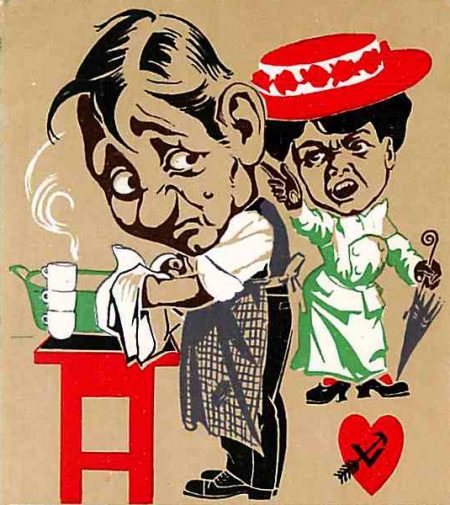
[image] A husband being verbally abused by his wife. Image from the Vinegar Valentine, Valentine Comics Series # 1, dated 1908. Images of husbands being physically abused by their wives were common in medieval Europe. Domestic violence against men continues not to be taken seriously today.

References:

Agapitos, Panagiotis A. 2015. “New genres in the twelfth century: the schedourgia of Theodore Prodromos.” Medioevo Greco. 15(1): 1-41.

Alexiou, Margaret. 1986. “The Poverty of Écriture and the Craft of Writing: Towards a Reappraisal of the Prodromic Poems.” Byzantine and Modern Greek Studies. 10 (1): 1-40. Reprinted, pp. 301-35, in Nagy, Gregory, ed. 2001. Greek literature. Vol. 9. Greek literature in the Byzantine period. New York: Routledge. I cite pages numbers from the Nagy reprint.

Alexiou, Margaret. 1999. “Ploys of Performance: Games and Play in the Ptochoprodromic Poems.” Dumbarton Oaks Papers. 53: 91-109.

Alexiou, Margaret. 2002. After antiquity: Greek language, myth, and metaphor. Ithaca: Cornell University Press.

Alexiou, Margaret. 2013. “Literary subversion in Byzantium: A partial and personal perspective.” Ch. 15 Afterword (pp. 281-8) in Dimiter Angelov and Michael Saxby, eds. Power and subversion in Byzantium: papers from the 43rd Spring Symposium of Byzantine Studies, Birmingham, March 2010. Farnham, Surrey: Ashgate Variorum.

Alexiou, Margaret. 2016a. “Of Longings and Loves: Seven Poems by Theodore Prodromos.” Dumbarton Oaks Papers. 69: 209-24.

Alexiou, Margaret. 2016b. “On σκορδαψός: gut-knot or eyesore? A tribute to BMGS.” Byzantine and Modern Greek Studies. 40 (01): 49-54.

Banev, Guentcho. 2008. “Ptochoprodromos.” Encyclopaedia of the Hellenic World. World-wide web, from Constantinople.

Bazzani, Marina. 2007. “The Historical Poems of Theodore Prodromos, the Epic-Homeric Revival and the Crisis of the Intellectuals in the Twelfth Century.” Byzantinoslavica. 65: 211-228.

Bouchet, René, trans. 2012. Satires et parodies du Moyen âge grec. La roue à livres, 63e. Paris: Les Belles Lettres. (review)

Dumbarton Oaks Research Library and Collection. 2010. Textual basis for  “Of Mice and Muses.” Byzantine Theatron performance on 29 July 2010, featuring Dumbarton Oaks Byzantine Summer Fellows and colleagues as Muses, Slaves, and Chorus of Mice. Andrew White, Dramaturg.

Eideneier, Hans. 1991. Ptochoprodromos: Einführung, kritische Ausgabe, deutsche Übersetzung, Glossar. Köln: Romiosini.

Gibbon, Edward. 1781. The history of the decline and fall of the Roman Empire: By Edward Gibbon, Esq; in six volumes. Dublin: Printed for William Hallhead.

Hesseling, D.-C. and H. Pernot, eds. 1910. Poèmes prodromiques en grec vulgaire. Amsterdam: Johannes Müller, 1910.

James, Liz. 2010. “Byzantium: A Very, Very Short Introduction.” Ch. 1 (pp. 1-8) in James, Liz, ed. A companion to Byzantium. Chichester, West Sussex, U.K.: Wiley-Blackwell.

Jeffreys, Michael J. 1974. “The nature and origins of the political verse.” Dumbarton Oaks Papers. 28: 141-95.

Kazhdan, Alexander P. 1998. “Women at Home.” Dumbarton Oaks Papers. 52: 1-17.

Kulhánková, Markéta. 2010. “Vaganten in Byzanz, Prodromoi im Westen. Parallellektüre von byzantinischer und lateinischer Betteldichtung des 12. Jahrhunderts.” Byzantinoslavica 68: 241-256.

Lecky, William Edward Hartpole. 1869. History of European morals from Augustus to Charlemagne. Vol. 2 Vol. 2. New York: D. Appleton and Co.

Miller, E. and Emile Legrand, ed. and trans. 1875. Trois poëmes vulgaires de Théodore Prodrome. Collection de monuments pour servir à l’étude de la langue néo-hellénique, no. 7. Paris: Maisonneuve et Cie.

Zagklas, Nikos. 2016. “Theodore Prodromos and the use of the poetic work of Gregory of Nazianzus: Appropriation in the service of self-representation.” Byzantine and Modern Greek Studies. 40 (02): 223-242.