Guido delle Colonne described fundamental causes of the Trojan War

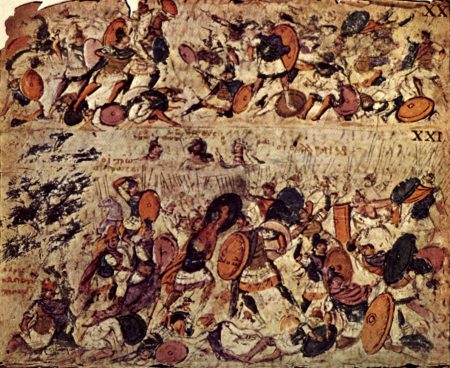
men fighting men in Trojan War

Prince Paris, who had eloped with Helen of Troy, hung back from entering the terrible, man-on-man violence of the Trojan War. Paris lingered in his bedroom with Helen. His brother Hector berated him:

What on earth are you doing? Oh how wrong it is,
this anger you keep smoldering in your heart! Look,
your people dying around the city, the steep walls,
dying in arms — and all for you, the battle cries
and the fighting flaring up around the citadel.
You’d be the first to lash out at another — anywhere —
you saw hanging back from this, this hateful war.
Up with you —
before all Troy is torched to cinder here and now!

{ δαιμόνι᾽ οὐ μὲν καλὰ χόλον τόνδ᾽ ἔνθεο θυμῷ,
λαοὶ μὲν φθινύθουσι περὶ πτόλιν αἰπύ τε τεῖχος
μαρνάμενοι: σέο δ᾽ εἵνεκ᾽ ἀϋτή τε πτόλεμός τε
ἄστυ τόδ᾽ ἀμφιδέδηε: σὺ δ᾽ ἂν μαχέσαιο καὶ ἄλλῳ,
ὅν τινά που μεθιέντα ἴδοις στυγεροῦ πολέμοιο.
ἀλλ᾽ ἄνα μὴ τάχα ἄστυ πυρὸς δηΐοιο θέρηται. }[1]

Paris explained that Helen had been urging him to battle. He said he would soon join the fighting. Helen in turn lamented to Hector:

My dear brother,
dear to me, bitch that I am, vicious, scheming —
horror to freeze the heart! Oh how I wish
that first day my mother brought me into the light
some black whirlwind had rushed me out to the mountains
or into the surf where the roaring breakers crash and drag
and the waves had swept me off before all this had happened!

{ δᾶερ ἐμεῖο κυνὸς κακομηχάνου ὀκρυοέσσης,
ὥς μ᾽ ὄφελ᾽ ἤματι τῷ ὅτε με πρῶτον τέκε μήτηρ
οἴχεσθαι προφέρουσα κακὴ ἀνέμοιο θύελλα
εἰς ὄρος ἢ εἰς κῦμα πολυφλοίσβοιο θαλάσσης,
ἔνθά με κῦμ᾽ ἀπόερσε πάρος τάδε ἔργα γενέσθαι. }[2]

Helen spoke with acute personal and political insight. In an account of the Trojan War written about the fifth century GC, Dares Phrygius recounted Achilles’s protest against the war:

Achilles then complained, to any and everyone, that for the sake of one woman, that is, Helen, all Europe and Greece were in arms, and now, for a very long time, thousands of men had been dying. All have been facing perils. … A lasting peace – that was the need. For the sake of one woman, Achilles said, the Greeks were risking their lives, endangering their freedom, and wasting a great deal of time. Thus Achilles demanded peace, and refused to reenter the fighting. … The number of Greeks who fell, according to the journal that Dares Phrygius wrote, was 866,000 men. The number of the Trojans who fell was 676,000 men.

{ Achilles vulgo queritur, unius mulieris Helenae causa totam Graeciam et Europam advocatam esse, tanto tempore tot millia hominum periisse. tot pericula adiri. … perpetuam pacem fieri oportere: tanta pericula unius mulieris causa fieri, libertatem periclitari, tanto tempore diffidere: pacem expostulat, pugnam renuit. … diurna indicant, quae Dares Phrygius descripsit, DCCCVI. millia hominum ad oppidi proditionem. Ex Trojanis CCLXXVIII. millia hominum. }[3]

Even given long-prevailing lack of concern for men’s lives, the colossal waste of men’s lives in the Trojan War is astonishing. What was the fundamental cause of the Trojan War? Why are men’s lives so socially devalued? What can be done today to ensure that a disaster like the Trojan War never occurs again? Guido delle Colonne’s thirteenth-century Latin work, Historia Destructionis Troiae, provides key insight into these vitally important questions.

Historia Destructionis Troiae points to men’s lack of sexual entitlement as the fundamental cause of the Trojan War. Guido forthrightly recognized women’s strong, independent sexuality:

A much talked-about rumor, which acquired great force as it went along, was spread about the neighboring regions. The rumor concerned the beauty of Paris as he entered the temple of Venus in Cythera. It reached the ears of Helen by many reports. After Helen had learned of this, the eager appetite of changing desire, which commonly seizes women’s hearts with sudden lightness, excited Helen’s heart with an ill-advised passion, so that she wished to go to the ceremonies of this festival in order to see the festive celebrations and to look at Paris, the leader of the Phrygian nation. … Helen, loveliest of women, what spirit seized you so that in the absence of your husband you left your palace on such a frivolous account, and went through its gates to look at an unknown man, when you could have easily preserved your modest abstinence within the palace of your kingdom? Oh, how many women the coming and going and readiness to run about to common places bring to ruin! … You, Helen, wished to leave your palace and visit Cythera so that, under the pretext of fulfilling your vows, you might see the foreign man, and under the pretext of what is lawful, turn to what is unlawful.

{ loquax fama, que multas uires aquirit eundo, vicinas iam dispersa per partes ad aures Helene de pulcritudine Paridis ad templum Veneris accedentis multa relacione peruenit. Quod postquam eidem innotuit Helene, uarie uoluntatis desiderabilis appetitus, qui mulierum animum consueuit subita leuitate corripere, Helene animum inconsulta flagrancia concitauit vt optaret ad ipsius festiuitatis sollempnia se conferre gaudia uisura festiua et inspectura ducem Frigie nacionis. … tu Helena, speciosissima mulierum, quis te rapuit spiritus ut in absencia uiri tui tua desereres tam leui relacione palacia, exires eius claustra ignotum uisura hominem, que te compescere habena freni facili potuisti ut seruares pudica ieiunia intra regia sceptri tui? O quam multas adduxit ad labem iter et reditus et facilis ad uulgaria loca discursus! … Optasti ergo tu, Helena, tuam exire regiam et uisere Cythaream ut sub pretextu uoti soluendi virum posses uidere barbaricum et ut pretextu liciti ad illicita declinares. }[4]

As is common under gynocentrism, Guido blamed men for seducing women:

Oh, how often these kinds of spectacles have led many very shameless women to shameless ruin by the observation and sight of games and pastimes, when young men come and practice their charms and with sudden rapacity seduce the captivated hearts of women from the follies of the celebration to the peril of their honor. Since young men have an easy opportunity to see young girls and others urged very strongly toward worldly trifling, now by their eyes, now by soft speeches of flattery, now by touches of the hand, now by the encouragement of signs, they ensnare the hearts of women who are themselves easily moved by secret sophistries and the pleading of charming lies.

{ O quam multas impudicissimas mulieres ad impudicos subito traxere collapsus ludorum spectacula et iocorum huiusmodi uisiones, vbi iuuenes confluentes suas exercent illecebras et raptos animos mulierum ex dissolucionibus gaudiorum ad sui pudoris crimen subita rapacitate seducunt, cum habentes iuuenes habilitatem commodam uidendi puellas et multo ius alias ad mundana deliramenta promotas, nunc oculis, nunc tacitis blandiciarum sermonibus, nunc tactu manuum, nunc signorum instinctu mulierum animos se de facile mouentes cecis sophismatibus et dulcium fallaciarum argumentacione concludunt. }[5]

According to Guido, the ultimate cause of tragedies like the Trojan War isn’t women’s strong, independent sexuality, but the “treacherous attacks of men”:

May the one perish who first brought it about that young women and young men whom the women do not know dance together. That is a manifest cause of many disgraceful acts. Furthermore, on account of these dances, many girls who were chaste till that time fall outrageously to the treacherous attacks of men, from which scandals often arise and the deaths of many follow.

{ Pereat ille qui primus inuenit inter mulieres iuuenes et adolescentes ignotos instituisse coreas, que manifesta sunt causa multi perpetrati pudoris. Propter quas multe eciam iam pudice ad proditorias infestaciones hominum enormiter corruerunt, vnde multociens orta sunt scandala et multorum necis causa sequta. }

Ovid, the master teacher of love, counseled, “The only chaste woman is one who hasn’t been propositioned {Casta est quam nemo rogavit}.”[6] Men are burdened with propositioning women. Yet as Ovid well knew, men are also often required to perform complex and time-consuming strategies of seduction, at the risk of criminal prosecution, in order to have sex with women. Men’s lack of entitlement to sex and men’s sexual deprivation are both social injustices in themselves and fundamental causes of the deaths of many men in unnecessary wars.[7]

Avoiding future disasters like the Trojan War requires improving men’s sexual welfare. The ancient Greek lawmaker Solon wisely established public sexual services for men. Yet King Solomon’s humiliating experience after a rumor circulated that men would allowed to have seven wives points to the difficulty of improving men’s sexual opportunities. Many wives, despite vicious public propaganda disparaging their husbands as rapists, lovingly support a sexual entitlement for their husbands. Yet for broad, public progress, education is key. Colleges and universities should cease absurd, totalitarian oppression of men’s sexuality, encourage students to read ancient and medieval literature with compassion for men, and promote justice and peace.

*  *  *  *  *

Read more:

Notes:

[1] Homer, Iliad 6.326-31, ancient Greek text from Murray (1924), English translation from Fagles (1990) p. 206. Paris initially fled from personal combat with Menelaus, Helen’s husband. In subsequent combat, Aphrodite saved Paris from death at the hands of Menelaus. Paris probably was angry at his fellow Trojans for not appreciating Aphrodite’s sound sense of justice.

[2] Homer, Iliad 6.344-8, ancient Greek text from Murray (1924), English translation from Fagles (1990) p. 207.

[3] Dares Phrygius, History of the Fall of Troy {De excidio Trojae historia} sections 27, 30, 44, Latin text from the Latin Library, English translation (modified slightly) from Frazer (1966). Cornil (2011) provides a less literal, more fluid translation. De excidio Trojae historia was probably written early in the sixth century GC. It was for medieval Europe the principle source on the full history of the Trojan War. Its casualty count shouldn’t be taken as literal truth. That thousands of men died in the Trojan War is undoubtedly true.

Achilles’s opposition to continuing the Trojan War was consistent with his mother Thetis’s anti-war values. The culture hero Palamedes apparently came to a similar view. However, Achilles opposed continuing the Trojan War only because he fell in love with the Trojan princess Polyxena. Some meninist philologists contend that Polyxena had sexual affairs with many foreign men.

[4] Guido delle Colonne, History of the Destruction of Troy {Historia Destructionis Troiae} Bk. 7, Latin text from Griffin (1936), p. 70, English translation (modified insubstantially) from Meek (1974) pp. 68-9.

Guido’s work is a close Latin prose paraphrase of Benoit de Sainte-Maure’s Roman de Troie. Benoit wrote the latter in French probably between 1155 and 1160. Guido claims to have followed Dares’s De excidio Trojae historia and Dictys Cretensis, Ephemeridos belli Troiani libri. The later was a Latin text dating from the fourth century. In medieval Europe, Ephemeridos belli Troiani libri was thought to represent a soldier’s diary from the time of the Trojan War.

Historia Destructionis Troiae was the most influential history of the Trojan War in the European Middle Ages. Guido’s work survives in over 150 manuscripts. Eight editions of it were printed from 1473 to 1494. It was translated into Bohemian, English, Flemish, French, Italian and German before the eighteenth century. Meek (1974) p. xi; Benson (1980) pp. 1-10. On the influence of Historia Destructionis Troiae, Benson (1980), Simpson (1998), and Heavey (2008).

[5] Guido delle Colonne, Historia Destructionis Troiae, Bk. 7, Latin text from Griffin (1936) p. 70, English translation (modified insubstantially) from Meek (1974) p. 68. The subsequent quote above is similarly sourced subsequently.

[6] Ovid, Amores 1.8.43.

[7] In Historia Destructionis Troiae, the narrator interjects:

Oh, how pleasing to women should be the walls of their homes, how pleasing the limits and restraints of their honor! For an unrigged ship would never know shipwreck if it stayed continually in port and did not sail to foreign parts.

{ O quam grati feminis esse debent earum domorum termini et honestatis earum fines et limites conseruare! Nunquam enim nauis sentiret dissuta naufragium si continuo suo staret in portu, in partes non nauigans alienas. }

Bk. 7, Latin text from Griffin (1936) p. 71, English translation from Meek (1974) p. 69. In a humane society that provided for men’s sexual and reproductive welfare, such restrictions on women’s liberty would hardly be an issue.

The story of the Trojan War circulated in medieval Europe in two streams. The first stream, in the prophetic mode of Virgil’s Aeneid, provided a subtle — too subtle — critique of gynocentrism. Guido’s factual, surface history, Historia Destructionis Troiae, was a second stream. Like Simpson (1980), Historia Destructionis Troiae shows no critical self-consciousness of men’s real social position.

Both Simpson (1980) and Heavey (2008) display the moralizing narrative voice associated with dominant gynocentric ideology. Both rhetorically construct an ostensibly objective, factual historical narrative. Both embrace the socially constructed concept of misogyny within patriarchy. Literary history needs to recover the critical, prophetic Virgilian perspective on the Trojan War.

[image]  Men fighting and dying in battle, scenes based on Iliad, Book 5. From the Ambrosian Iliad (Ilias Ambrosiana), thought to have been produced in Constantinople in the fifth century. Thanks to Wikimedia Commons.

References:

Benson, C. David. 1980. The history of Troy in Middle English literature: Guido delle Colonne’s Historia Destructionis Troiae in medieval England. Woodbridge {England}: D.S. Brewer.

Cornil, Jonathan. 2011-12. Dares Phrygius’ De Excidio Trojae Historia: Philological Commentary and Translation. Master’s Thesis, Faculteit Letteren & Wijsbegeerte. Universiteit Gent.

Fagles, Robert, trans. and Bernard Knox, intro. and notes. 1990. The Iliad. New York, N.Y., U.S.A.: Viking.

Griffin, Nathaniel Edward, ed. 1936. Guido de Columnis {Guido delle Colonne}. Historia destructionis Troiae. Cambridge: The Mediaeval Academy of America.

Frazer, Richard MacIlwaine, trans. 1966. The Trojan war: the chronicles of Dictys of Crete and Dares the Phrygian. Bloomington: Indiana Univ. Press.

Heavey, Katherine. 2008. “A ‘fressh and lusty qwene’: Remodelling Helen of Troy in the Middle Ages.” Kaleidoscope. 2(1): 4-22. (based on 2008 Durham University, UK, dissertation).

Meek, Mary Elizabeth, trans. 1974. Guido delle Colonne. Historia destructionis Troiae. Bloomington, Ind: Indiana University Press.

Murray, A. T., trans. Revised by William F. Wyatt. 1924. Homer. Iliad. Loeb Classical Library 170 and 171. Cambridge, MA: Harvard University Press. Alternate source for Murray’s translation.

Simpson, James. 1998. “The Other Book of Troy: Guido delle Colonne’s Historia destructionis Troiae in Fourteenth- and Fifteenth-Century England.” Speculum. 73 (2): 397-423.

Joseph against Potiphar’s wife in kontakia of Romanos the Melodist

Joseph being sexually assaulted by Potiphar's wife

Early in the sixth century in the Byzantine capital Constantinople, Romanos the Melodist wrote two kontakia about Joseph and Potiphar’s wife. Romanos forthrightly recognized that Potiphar’s wife attempted to rape Joseph. He also denounced her falsely accusing him of rape. Yet Romanos interpreted these crimes only in relation to Joseph’s virtue. He ignored how allegations of rape buttress tyranny.

Romanos partially attributed Potiphar’s wife’s sexual assault on Joseph to the traditional Roman god Cupid and the Judeo-Christian figure of the Devil. In ancient Greek culture, spirits entering the eye and Cupid’s arrows were causes for intense sexual passion. Potiphar’s wife apparently experienced both:

the queen entertained passionate feelings
For the lovely beauty of the young, virtuous Joseph.
As she looked at the young man with unchastened eyes,
She was wounded in spirit by his invisible glances.

Through her eyes she received the darts from the chaste quiver,
And, wounding her own dissoluteness,
She considered the wound a pleasure, the unhappy woman! [1]

The (Judeo-Christian) Devil also helped Potiphar’s wife commit adultery:

The Devil came as an escort of adultery
In order that he might aid the Egyptian woman,
And he said to her: “Courage, since you are an old and sturdy hook,
Make ready the bait and fish for the young man.
Arrange the curls of your hair,
like a net to catch him.
Beautify the appearance of your face,
Embellishing it all with rose-colored artifice.
Brighten up your neck with chains, with chaplets of gold;
Above all, clothe yourself in an elaborate gown,
Anoint yourself with powerful perfumes that weaken young men [2]

Roughly two centuries earlier, Tertullian had influentially denounced fancy apparel for women and associated men’s penises with the Devil and women’s vaginas with the Devil’s gateway. Romanos showed some of Tertullian’s biting wit in describing Potiphar’s wife as old and sturdy (heavy/fat) in contrast to the young and beautiful Joseph. The wounding from Cupid’s arrows and the Devil’s urging provide external causes for the behavior of Potiphar’s wife. Yet Romanos didn’t go as far as Sanger’s pioneering nineteenth-century social sentence and current criminal law in freeing women from responsibility for their sexual behavior.

Romanos analogized the woman’s sexual assault on Joseph to various difficult situations. When Joseph resolutely rejected her sexual advances, Potiphar’s wife violently attacked him:

The woman, beside herself, inflamed by his words,
Attacked the prudent young man,
And grasped his cloak, and violently pulled the worthy young man, saying,
“Obey me, dear one, and come, have intercourse with me.”
The Egyptian woman pulled at him from one side. Virtue claimed him
on the other side.
She cried out: “Sleep with me”;
And from on high, Grace called: “Be vigilant with me.”
Along with her, the Devil struggled mightily
And with violence held bound the noble athlete.

Today, rape of men tends to be ignored or treated as risible. Romanos treated the rape of Joseph seriously. Joseph was a boat being battered in a wild storm, a man thrown into a burning furnace, and an athlete struggling in a physical contest.[3]

After her sexual assault on Joseph failed, Potiphar’s wife falsely accused Joseph of rape. As in many false accusations of rape, that false accusation produced a travesty of justice:

For the Egyptian woman, through a cruel trick,
Excited Potiphar with false accusations,
Pushing all the blame on the noble-minded youth.
Showing him the robe of Joseph,
Drowned in a sea of tears, because of her desire,
She persuaded him to send Joseph to prison as he cried:
“The Lord, our Savior, alone is mighty.”

Romanos explained, “The Egyptian woman attacked him as a terrible fox attacks the vine.” That’s an allusion to Aesop’s fable of the fox and the grapes. It figures a false accusation of rape as “sour grapes”, i.e. a deceptive re-interpretation of reality to rationalize an undesired outcome. A significant share of false accusations of rape probably result from such mental dynamics. Yet the social problem of false accusations of rape goes far beyond personal, mental problems.

Like many men, Potiphar didn’t rationally analyze a woman’s allegation of rape. Romanos observed:

If he had had wisdom, he would not have allowed the trick to deceive him.
You are a foolish judge! as evidence
You have Joseph’s robe; ask where it is,
And consider if she is to be trusted.
If she fled from him, then how does she possess his robe?
You think that the free slave {Joseph} is at fault,
But you will see him shine like light as he cries:
“The Lord, our Savior, alone is mighty.”

The problem goes far beyond Potiphar and Joseph. Major newspapers now run mendacious stories claiming that nearly a quarter of men admit to committing rape. Rape is at the epicenter of the collapse of reason.

For Romanos the Melodist, Potiphar’s wife’s sexual assault and false accusation of rape was a allegory for personal struggle with sin. Romanos concluded his kontakion on Joseph with first-personal questioning:

What, then, am I to do, miserable and condemned,
Since on all sides the hand of sin oppresses me?
Just as the Egyptian woman attacked Joseph,
Just so sin draws me to impure thoughts.
But I cry to Thee, All-Powerful,
“Save me, too, since I am ruled by a tyrant,
So that, through the intercession of the Virgin, I may be saved
Like Joseph, your faithful servant,
Since the eye that never sleeps observes all things.

The risk of tyranny is not just within persons. Today, the eye that never sleeps observes all things and weeps.

*  *  *  *  *

Read more:

Notes:

[1] Romanos the Melodist, On Joseph II, 4.8-11, 5.5-7, from Greek trans. Carpenter (1970) vol. 2, pp. 104-5. All quotes from Romanos are cited in translation from id, by kontakion name, strophe.lines and page in id. (vol. 2). Subsequent quotes are from On Joseph II, 6.1-11, pp. 105-6 (The Devil came…); 18.1-11, p. 112 (The woman, beside herself …); On Joseph I, 13.5-12, p. 88 (For the Egyptian woman…); On Joseph II, 19.6, p. 113 (The Egyptian woman attacked him as a terrible fox…); On Joseph I, 14.6-13, p. 88 (If he had wisdom…); On Joseph II, 22.9-17 (What, then, am I to do…).

[2] With regard to the phrase “you are an old and sturdy hook,” Carpenter (1970) vol. 2, p. 105, n. 3 states:

The “you” is probably not directed just to the Egyptian woman, but rather to all women who, like Eve, cause man’s ruin.

Not all women are like that. Thetis and Hiera are among the many strong, independent women throughout history who have denounced injustices against men and defended and protected men. Within the specific context of Romanos’s kontakion, the emphasis on Joseph’s youth and beauty sets up a clear antithesis to Potiphar’s wife, an “old and sturdy” woman. In modern urban parlance, Potiphar’s wife was a cougar.

[3] Joseph the athlete is Romanos’s most extensive metaphor for Joseph resisting Potiphar’s wife. Romanos describes his kontakion as providing an “encomium of the noble athlete.” On Joseph II, 20.10, p. 113. Romanos also figures Joseph as a warrior who “wore an invulnerable armor / That destroyed the effect of all the engines of war of the passions.” Id. 21.12-13, p. 114.

[image] Potiphar’s wife sexually assaulting Joseph. Oil on canvas by Bartolomé Esteban Murillo in the 1660s. Thanks to Web Gallery of Art and Wikimedia Commons.

Reference:

Carpenter, Marjorie, trans. & ed. 1970. Kontakia of Romanos, Byzantine melodist. Columbia: University of Missouri Press.

John Tzetzes: Byzantine classicist of classicists

I want to be a tanner, a stone-cutter,
or follow any other craftsman’s art.
Even a cobbler too, an ignorant inn-keeper
who still can’t say a single syllable,
but when he speaks he pours out buckets of spit,
a disgraceful, utterly brainless clod,
who makes his progress down the middle of the street
furnished with a royal escort,
vomiting up a lot of arrogant talk,
while a reverend soul, well-bred in discourses
goes about homeless, poor, wretched.
I see the deranged in the Senate,
the brilliant dishonored, the dull piled high with honors:
For it’s gold now that talks, everyone admires it. [1]

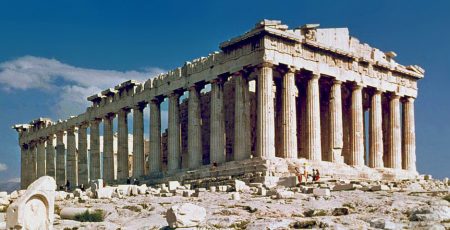
ruins of Parthenon in Athens

The twelfth-century Byzantine classicist John Tzetzes was “a man soaked in Homer, a man revelling in Homer.” Study of ancient Greek texts and even composing poetry in Attic Greek were highly respected in twelfth-century Byzantium. Yet like many classicists throughout history, Tzetzes struggled to avoid poverty.[2] He desperately sought teaching jobs and solicited grants. Being a classicist has never been rational, nor do the lives of classicists exemplify order and harmony. Wildly, passionately committed to scholarly learning, John Tzetzes exemplifies classicists as they really are.

Tzetzes despised the willfully ignorant and dismissed mediocre students. He condemned those who ignorantly criticized him:

Ignorant abominations, babble-twisters,
men who have barbarized the art of letters
by not minding books, where all wealth lies.
Their nectar is the stink of the dunghill
— pigs do not want to eat the bread of angels. [3]

In a virtuoso scholarly performance, Tzetzes followed up that invective with “a modern Greek obscenity previously unrecorded.” To the father of one of his students, he wrote a blunt, two-sentence letter:

I don’t like a father to be sad because of the uselessness of his son. Why not put some sense into him yourself, if you really are his father? [4]

To the father of another slow student, Tzetzes wrote: “I am deeply sorry for you.” A father could have no worse fortune in Tzetzes’s mind than a son who didn’t progress in learning.

Tzetzes was pragmatic and flexible in mundane matters. When paid per written page, Tzetzes shifted to writing with double and triple spacing. When paying for his own paper, he was “obsessed with wasting paper”:

He apologizes for unnecessary comment on some lines of Aristophanes, but explains that he would otherwise have had to leave empty space on the page. [5]

In sixth-century Byzantium, Joannes Lydus lamented government documents being issued on cheap paper. John Tzetzes’s concern about paper was more pragmatically economic.

Tzetzes didn’t offer classical learning as a leisurely activity to flatter the egos of the wealthy. Tzetzes himself imprudently rejected the sexual advances of the wife of his wealthy and prominent employer. She retaliated with a false accusation that cost Tzetzes’s his job and his horse and plunged him into poverty. Tzetzes ingeniously interpreted that terrible injustice as ensuring that what he wrote was useful:

we who lack many things and only write what is useful in a sensible manner, let us skip the rest due to lack of paper. For already during eleven years we are pressed by a disgraceful woman’s wily-minded devices. From the deeds of
darkness she made the beggar, the pollution of this life, the man flowing with ulcers into her husband’s associate in work, in mind, in family and appearance, in trustworthiness greater than that deranged man. But us she chokes with many devices making us enemy slaves to her husband, truly such as the judgment of God sees. For these reasons I live in great poverty, and my ways are not those of a man living in luxury and thus I only write what is useful on paper. [6]

Tzetzes was a grammarian who wrote explanatory notes for works of Homer, Pindar, Aeschylus, Aristophanes, Euripides, and Thucydides. Tzetzes believed that true knowledge of ancient Greek language and literature was useful and sensible.[7]

Concerning matters of classical philology, Tzetzes insisted on correctness. When a critic wrongly challenged Tzetzes’s gloss on a rare term for a moth in Aristophanes’s Frogs, Tzetzes called him “possessed and epileptic, a moonstruck son of a goat.”[8] A bitterly divisive issue of the day was the question of dichronic vowels in Homer. Confronting a scholar who asserted the existence of dichronic vowels in Homer, Tzetzes called him “a ghostly presence, scabbed with camel disease, cat-faced, anchovy-eyed, with the voice of a weeping eunuch.” A scholar recently commented perceptively on such words: “This is invective at its best.” Tzetzes, no hypocrite, criticized himself for use of dichronic vowels:

When I wrote this, I still used the dichronic vowels like the buffaloes {ignorant scholars}. [9]

Dichronic vowels are a matter of measured time. That’s as important as the heartbeats that measure out the length of every human life.

everything useful in the text should be said,
as much as is relevant for the allegorization of needful matters.
And if we go on at length, blame Homer, who,
because of his very dense thought and haste, was forgetful,
and wrote the last things first and mixed things up again,
and because of the hidden depth of his ideas,
forced Tzetzes to write simply, concisely,
and then with extemporaneous speech to compose words
which no one dared, neither the ancients nor the moderns,
unless perhaps someone, after recomposing my words,
was mendacious enough to say that he himself composed it,
as they often do with my other compositions. [10]

*  *  *  *  *

Read more:

Notes:

[1] Michael Haploucheir, Dramation ll. 67-80, from Greek trans. Andrew White, Dumbarton Oaks (2010) p. 39. Michael Haploucheir was a Senator in late-twelfth-century Byzantine. Ptochoprodromos (Poor Prodromos), Poem IV, similarly depicts a scholar’s struggles in twelfth-century Byzantine. See Alexiou (1986).

[2] Quote on Tzetzes and Homer from Morgan (1983) p. 186. In twelfth-century Byzantine:

members of the royal house itself were active writers in the classical style and even concerned themselves specifically with topics of classical scholarship. Alexius Comnenus, at the beginning of the century, had written classical iambics of Advice to a Son. His daughter Anna Comnena’s great work, the Alexias — more a historical novel than a history — is in an atticizing style. … Her quotations from Homer are almost as frequent as her quotations from the Bible, and they are more accurate. Her husband, Nicephorus Bryennius, writes a more sober, and still atticizing, history. Her brother, Isaac, actually writes essays on Homer, as well as original poetry in classical and Byzantine meters.

Id. p. 165. As indicated above, the Byzantine Senator Michael Haploucheir wrote the play Dramation. Despite these propitious intellectual circumstances, Tzetzes struggled:

He {Tzetzes} was the leading interpreter of Homer, and he still could not make a living. The leading commentator on Homer, the prodigious compiler Eustathius, certainly did make a living, but he made it by virtue of his office as Archbishop of Salonica: Byzantine archbishops looked after themselves pretty comfortably.

Id.

[3] Tzetzes, Histories (Chiliads) 12.223-7, from Greek trans. Morgan (1983) p. 169. Tzetzes wrote all his work in Greek. In Psalm 78:25, the bread of angels feeds the Hebrews in the desert. The subsequent quote is Morgan’s statement at id.

[4] Tzetzes, Letters 62, trans. Morgan ( 1983) p. 170. The subsequent quote is from Tzetzes, Letters 22, trans. id.

[5] Jeffreys (1974) p. 149 , referring to Tzetzes, Scholia in Aristophanes 183.16-20. On Tzetzes double and triple spacing, Morgan (1983) p. 173.

[6] Tzetzes, Exegesis on Porphyry’s Eisagoge, excerpt, trans. Cullhed (2015) p. 58.

[7] Tzetzes explained:

not even if you had read Homer and Stesichoros,
Euripides, Lykophron, Kollouthos, and Lesches,
and Diktys’s well-written Iliad,
Triphiodoros and Quintus, even a hundred books, not
even then would you have learned the story in greater detail,
since I have incorporated everything in abbreviated form,
so that anyone who wishes may seem to the masses
to have read whole libraries with minimum effort.

Allegories of the Iliad, Prolegomena 480-7, trans. Goldwyn & Kokkini (2015) p. 37. Tzetzes took great pride in his work:

I say freely that not even if there were a hundred Homers, Musaeuses, Orpheuses, Hesiods, Antimachuses, and Linuses, or indeed all the other poets and authors of theogonies, would they have written better on this subject matter.

Tzetzes, Theogony 26-30, trans. Budelmann (2002) p. 152.

[8] Tzetzes, Commentarii in Aristophanem 835.9, and Scholia in Aristophanem 43.21-44.2, trans. Garland (2007) p. 186. The subsequent quote is trans. from Garland at id.

[9] Tzetzes, Histories, scholia to 3.61, trans. Jeffreys (1974) p. 149. See also id. p. 156-7.

[10] Tzetzes, Allegories of the Iliad 18.643-54, trans. Goldwyn & Kokkini (2015) p. 379.

References:

Alexiou, Margaret. 1986. “The Poverty of Écriture and the Craft of Writing: Towards a Reappraisal of the Prodromic Poems.” Byzantine and Modern Greek Studies. 10 (1): 1-40.

Budelmann, Felix. 2002. “Classical Commentary in Byzantium: John Tzetzes on Ancient Greek Literature.” Ch. 7 (pp. 141-69) in Gibson, Roy K., and Christina Shuttleworth Kraus. The classical commentary: histories, practices, theory. Leiden, the Netherlands: Brill.

Cullhed, Eric. 2015. “Diving for pearls and Tzetzes’ death.” Byzantinische Zeitschrift. 108 (1): 53-62.

Dumbarton Oaks Research Library and Collection. 2010. Textual basis for  “Of Mice and Muses.” Byzantine Theatron performance on 29 July 2010, featuring Dumbarton Oaks Byzantine Summer Fellows and colleagues as Muses, Slaves, and Chorus of Mice. Andrew White, Dramaturg.

Garland, Lynda. 2007. “Mazaris’s Journey to Hades: Further Reflections and Reappraisal.” Dumbarton Oaks Papers. 61: 183-214.

Goldwyn, Adam J. and Dimitra Kokkini, trans. 2015. John Tzetzes. Allegories of the Iliad. Dumbarton Oaks Medieval Library 37. Cambridge: Harvard University Press.

Jeffreys, Michael J. 1974. “The nature and origins of the political verse.” Dumbarton Oaks Papers. 28: 141-95.

Morgan, Gareth. 1983. “Homer in Byzantium: John Tzetzes.” Pp. 165-88 in Rubino, Carl A., and Cynthia W. Shelmerdine, eds. Approaches to Homer. Austin: University of Texas Press.

Adam’s mistake in kontakion of Romanos the Melodist on the nativity

Romanos the Melodist and the Virgin Mary

A kontakion of Romanos the Melodist boldly proclaims a new ruler of the world. Mary the mother of Jesus declares:

I do not cast aside the grace I took from you, Lord,
nor do I obscure the worth I gained in bearing you,
for I rule over the world.
Since I carried your might in my womb I have might over all things. [1]

Jesus the Lord is the nominal head of the Christian Church. His mother Mary rules over the world in everyday life.

Mary has been interpreted as the new Eve. In Romanos’s kontakion on the nativity, the old Eve speaks before Adam does. She orders him to arise from his “deathlike slumber.” She tells him to “listen to me, your wife.” Adam made the mistake of marrying. Eve knew of Adam’s disappointment, depression, and anger:

Whenever he recalls delectation he turns against me
crying out — Would you had not sprung forth from my side;
better not to have taken you as my aid,
for I would not now have sunk to these depths [2]

Adam continues to appreciate women’s sensual appeal. Yet he cannot forget what his wife has done to him. Moreover, he resents his wife issuing him commands as if he were a slave, particularly while he is taking a nap:

Adam hearing the words his wife wove him
at once shook off the weight from his eyelids,
lifting his head as if from sleep
opening the ear blocked with deafness cried out:
— I hear sweet warbling tones of delight
but the melodist’s chant no longer enchants me.
It is a woman, and I fear her voice,
for I have known and shrink from the feminine sex.
The sound draws me, it is clear,
but the instrument fills me with fear, lest as of old she lead me astray. [3]

This was long before modern totalitarian sex regulation. Men today have much stronger reasons to fear women than Adam did.

Adam turns to Mary for salvation from gynocentric oppression. He tells Eve that he is leaving her:

I have felt the breath of life, wife, of the giver of life,
dust as I am and soulless clay,
giving me soul; for now
made strong by her perfume, I’ll make my way to her who brought forth
the fruit of our life, full of grace. [4]

But Adam doesn’t follow the way of abundant life and joy. He abjectly pleads with Mary for mercy:

Aged in Hades, Adam, first-created as I am
take pity on me, daughter, your groaning father.
Behold my tears and have mercy on me,
lending kind ear to my wailings.

Men must stop begging women for mercy. The Latin poem Lucis orto sidere, written about 1200, depicts both men’s folly and men’s redemption. Creation waits with eager longing for men to embrace their being as children of God. Men must be active agents of incarnation.[5] While the labor may be painful, the fruits of men’s liberation will be as numerous as stars in the sky and sand on the seashore.

*  *  *  *  *

Read more:

Notes:

[1] Romanos the Melodist, On the Nativity II, 2.1-4, from Greek trans. Alexiou (2002) p. 417. Carpenter (1970), vol. 1, pp. 13-21, describes the manuscript sources and provides an alternate translation. An English translation of Romanos’s On the Nativity I is available online. Romanos wrote in early sixth-century Constantinople.

Underscoring wives’ dominance of their husbands, Potiphar’s wife declares to Joseph, “Your master {Potiphar}, as you know, obeys my wish in everything.” Romanos the Melodist, On Joseph II, 15.3, trans. Carpenter (1970) vol 2, p. 110.

[2] Romanos the Melodist, On the Nativity II, 9.5-8, trans. Alexiou (2002) p. 423. The previous short quotes are from  4.2-3, id. p. 419. Subsequent quotes from On the Nativity II are (with page numbers in id.): 5.1-10, pp. 419-21 (Adam hearing…); 7.7-11, p. 421 (I have felt…); 8.5-8, p. 423 (Aged in Hades…). I’ve made a few, minor changes to the translation, e.g. not placing in quotes the refrain tag, “full of grace.” Carpenter (1970), vol. 1, p. 17 similarly doesn’t quote “full of grace.”

Appealing to Mary, Eve declares that Adam’s weepings cause her to suffer more than him:

you see how much more
my soul is afflicted in misery because of Adam’s weepings.

9.3-4, p. 423. That’s like the claim that women suffer more from war, because their husbands, fathers, and and sons are killed and women are thus deprived of help and support.

[3] The “sweet warbling tones of delight” that Adam hears are those of Mary, not those of his wife.

[4] Mary the mother of Jesus has been highly venerated from the time of early Christianity. The kontakion’s refrain, “full of grace,” is similar to the more expanded refrains of rejoicing with Mary in the Akathistos. Carpenter attributes the Akathistos to Romanos. Id p. 13, n. 2. In any case, the Akathistos is an early and highly influential Christian hymn centered on Mary.

[5] In Shakespeare’s Twelfth Night 1.3, Sir Toby Belch urges Sir Andrew Aguecheek to engage Maria. Toby implores, “Accost!” The underlying problem today is culturally systemic.

[image] The Virgin Mary instructs Romanos the Melodist. Illumination from the Menologion of Basil II. Dated 985 GC. Thanks to Wikimedia Commons.

References:

Alexiou, Margaret. 2002. After antiquity: Greek language, myth, and metaphor. Ithaca: Cornell University Press.

Carpenter, Marjorie, trans. & ed. 1970. Kontakia of Romanos, Byzantine melodist. Columbia: University of Missouri Press.