saintly Fenice in Cligès shows scope of medieval Latin literature

Bodhisattva Guanyin, Song Dynasty, China

In Chrétien de Troyes’s late-twelfth-century Arthurian romance Cligès, Empress Fenice represents a saint in the Latin tradition of Saint Marina. Other motifs and structures in Cligès apparently came from Latin literature connecting to Byzantium and the Islamic world. Although Chrétien wrote Cligès in the vernacular (French), he built Cligès upon the broad scope of medieval Latin literature.

Cligès explicitly describes Empress Fenice as a saint. When Fenice apparently died, persons all around the city of Constantinople wept and lamented that Death had killed “the best, most saintly woman”. She was “someone better / Than best, better than them all.” The craftsman John built a magnificent tomb intended to hold “the remains of some holy saint.” John told the Emperor that Empress Fenice could be buried in that tomb:

By placing her body there,
Surely it would hold a saint. [1]

The Emperor agreed:

We’ll bury her body with those
Of the other saints, in front of
Saint Peter’s holy cathedral.

Fenice was thus positioned as a saint to be venerated for her holiness.

Fenice’s death was a deception that she designed to enable her to live with her lover Cligès. A woman cuckolding her husband wasn’t regarded as a saintly in the Middle Ages. Yet Cligès is more than a romance featuring a false saint and a duped populace.

Fenice experienced torture like that which martyr-saints suffered. While in her potion-induced death-like state, Fenice was slapped, hit, and kicked. She was whipped on her bare back. Blood ran freely from the lines cut into her flesh. Molten lead was then poured onto her palms. Finally her entire body was to be roasted on a grill.[2]

Three “wizened doctors” from Salerno administered these tortures. Salerno was where, late in the eleventh century, Constantine the African had translated Arabic medical texts into Latin. The most learned doctor of the three began the treatment of Fenice by placing his hand on her chest. That suggests sexual healing like the young medical student applied to a beautiful woman’s corpse in the Latin Apollonius of Tyre. The literature of Christian martyrdom, Salerno, and sexual healing all point to Latin literature.

Moreover, the Latin Solomon and Marcolf seems to have informed two aspects of the story about the torturing doctors. Cligès states:

These clever doctors remembered
Solomon’s wife, who hated
Her husband so much she pretended
Death to deceive him.

The story of Solomon’s wife faking death to deceive her husband is part of the Solomon and Marcolf tradition.[3] Just as in Solomon and Marcolf, a mob of women storming the nominal center of ruling power pushes the story in Cligès forward:

Women poured through the palace
Door like a charging army

Acting without respect to formal political authority, the women administered “natural” punishment to the doctors for torturing Fenice. The women gave:

The three doctors what they’d asked for,
Not waiting for the emperor to return
Or any of his stewards. They threw
the doctors through the open
Windows, down to the courtyard
Below, where all three died,
The necks broken, and their ribs,
Their arms, and their legs. No woman’s
Work was ever better
Done! The three doctors
Had earned the wages they’d gotten,
And the mob of women had paid them.

The earliest Latin manuscript of Solomon and Marcolf dates to 1410, but the story of Solomon and Marcolf seems to have been well-known no later than 1000.[4] The Latin text of Solomon and Marcolf has a peculiar literary form that points to Hebrew literature created in the ninth-century in the Abbasid Caliphate. Solomon and Marcolf likely existed as Latin literature when Chrétien wrote Cligès.

The literary scope of Cligès has tended to be under-appreciated. A romance written in French and infused with Frankish customs, Cligès also has strong Byzantine elements. A large section of its plot is set in Constantinople, with emperors, empresses, eunuchs, and court intrigue. The double-romance structure of Cligès is the same as that of the slightly earlier twelfth-century Byzantine novels. Fear that subsequent Byzantine empresses would emulate Fenice might relate to a peculiar passage in the Byzantine novel Rhodanthe and Dosikles. A medieval scholar has suggested that Chrétien used as a source “a Byzantinized version of the Persian tale of Vis and Ramin.”[5] Such a broad literary scope is consistent with Cligès’s use of Solomon and Marcolf. Just as with Solomon and Marcolf, Latin literature is the most plausible medium connecting Chrétien to literature across western Eurasia.[6]

In sharp contrast to courtly glorification of women, Cligès presents the saintly Empress Fenice as a flesh-and-blood human being. Social appearance, rather than saintly values, largely motive Fenice’s actions. Unlike a saint, Fenice complains of her fleshly suffering as a martyr under the three doctors’ tortures:

I can’t believe I’m still
Alive: those doctors hurt me.
They beat me and tore at my flesh.

The saintly, adulterous Fenice incorporates appreciation for women well-known through the Indian Sukasaptati and the western Eurasian Sindibad / Seven Sages corpus. Fenice points forward to the comedic humanism of Boccaccio’s Corbaccio.[7] Underneath it all, Fenice is a figure of the transgressive and subversive humanism and cosmopolitanism of medieval Latin literature.

Love had committed no crime,
joining these two together,
For when they lay in each other’s
Arms, hugging and kissing,
Their joy, their pleasure, seemed
To make the world a better
Place. Can one ask for more?

*  *  *  *  *

Read more:

Notes:

[1] Chrétien de Troyes, Cligès ll. 6076-7, from Old French trans. Raffel (1997) p. 192. I cite quotes from Cligès using line numbers and pages from Raffel’s translation. Raffel’s line numbers are close to the Old French line numbers.

The three previous short quotes are from Cligès, l. 5782, p. 182 (the best…); ll. 5830-1, p. 184 (someone better…); l. 6073, p. 192 (remains of some holy saint). Subsequent quotes are from ll. 6079-81, p. 192 (We’ll bury…); ll. 5788-9, p. 183 (wizened doctors from Salerno); ll. 5857-60, p. 185 (These clever doctors…); ll. 6014-5, p. 190 (Women poured…); ll. 6024-35, p. 190 (The three doctors…); ll. 6255-7, p. 197 (I can’t believe…); ll. 6317-23, p. 199 (Love had committed no crime…).

[2] Cf. e.g. the martyrdom of Saint Juliana of Nicomedia.

[3] Ziolkowski (2008) pp. 288-98 (ABE 2: alternate ending of Latin text), p. 334 (SAT 16: Cligès references), pp. 339-42 (SAT 19: Middle High German Salman und Morolf), 355-6 (SAT 30: fourteenth-century German poem Salomon und Markolf (Spruchgedicht)). Regarding the parallel between the wife’s feigned death in Solomon and Marcolf and Cligès, “This parallel is one of a few indications that strongly suggest a Byzantine origin for the motif.” Id. p. 296.

[4] Ziolkowski (2008) pp. 6-9.

[5] Grimbert (2005) p. 123, citing Polak (1974). Ziolkowski observed that Cligès “seems indebted in several of its major motifs to Eastern sources.” Ziolkowski (2008) p. 334.

Agipitos presents a rather different view. “Needless to say, no Medievalist ever saw the Byzantine color of the Cligès as an indication of the text’s ‘Byzantine character’.” Agapitos (2010) p. 161. What would constitute “Byzantine character” is unclear. More generally, Agapitos sees only a late, narrow channel for interaction between medieval Greek and Latin literature:

If examined dispassionately and with due consideration for the available evidence, the only time where some form of cultural osmosis between the Greeks and Latins could take place under Byzantine administration was the Laskarid empire of Nicaea after its stabilization and the first six decades of the Palaiologan government in Constantinople, in other words the hundred years between 1220 and 1320.

Agapitos (2012) p. 331. This view seems to me to greatly under-estimate the extent of cultural osmosis.

[6] Green noted:

Where, before Chrétien’s works, we do find more than episodic or incipient fiction, informing the whole structure and permitting invention without ties to historicity, is in such medieval Latin epics as Ecbasis Captivi and Ruodlieb (to these Ysengrimus could possibly be added). However few these ‘forerunners’ may be, they suggest that here, too, Latin literature, although soon to be overtaken by the vernacular, was still in the lead. … In acting as a bridge between Latin and the vernacular, the French poet {Chrétien de Troyes} was performing one of the culturally most important tasks of the cleric at the court of the lay aristocracy.

Green (2012) p. 61. The cleric not only bridged Latin and the vernacular, but also cultures separated spatially by long distances.

[7] Beaton concluded:

there is a balance of probability that Boccaccio really was acquainted with aspects of Byzantine and ancient Greek fiction through the mediation of contemporaries active in the Frankish-controlled regions of Greece and the Levant.

Beaton (2013) p. 220.

[image] Photo of a wooden figure of the Bodhisattva Guanyin. China, Song Period (960-1279 GC). Item 54-6-6 in the Penn Museum (University of Philadelphia, PA). Photo by Douglas Galbi. I’ve modified the image to remove some background clutter.

References:

Agapitos, Panagiotis A. 2010. “From Persia to the Provence: Tales of Love in Byzantium and Beyond.” ACME: Annali della Facoltà di Lettere e Filosofia dell’Università degli Studi di Milano. 63(2): 153-69.

Agapitos, Panagiotis A. 2012. “In Rhomaian, Frankish and Persian Lands: Fiction and Fictionality in Byzantium and Beyond.” Pp. 235-367 in Agapitos, Panagiotis A., and Lars Boje Mortensen, eds. Medieval narratives between history and fiction: from the centre to the periphery of Europe, c. 1100-1400. Copenhagen: Museum Tusculanum Press.

Beaton, Roderick. 2013. “Boccaccio and the Greek World of his Time: A Missing Link in the ‘True Story of the Novel.'” Pp. 212-20 in Brownlee, Marina Scordilis, and Dimitri Gondicas, eds. Renaissance encounters: Greek East and Latin West. Leiden: Brill.

Green, Dennis H. 2012. “The Rise of Medieval Fiction in the Twelfth Century.” Pp. 49-61 in in Agapitos, Panagiotis A., and Lars Boje Mortensen, eds. Medieval narratives between history and fiction: from the centre to the periphery of Europe, c. 1100-1400. Copenhagen: Museum Tusculanum Press.

Grimbert, Joan Tasker. 2005. “Cligés and the Chansons: A Slave to Love.” Ch. 10 (pp. 120-36) in Lacy, Norris J., and Joan T. Grimbert, eds. A companion to Chrétien de Troyes. Cambridge: D.S. Brewer.

Polak, Lucie. 1974. “Tristan and Vis and Ramin.Romania. 95 (378): 216-234.

Raffel, Burton, trans. 1997. Chrétien de Troyes. Cligès. New Haven: Yale University Press.

Ziolkowski, Jan M., ed. and trans. 2008. Solomon and Marcolf. Cambridge, Mass: Harvard University.

damsel instructed hero on how to slay dragon

Digenis Akritis slays dragon

Dragon Castle was filled with gold, precious stones, and sumptuous furnishings. Yet the place seemed to be bereft of human beings. Amid all the splendor, Kallimachos felt lonely.

He entered a room made of gold. The gold and pearls of its ceiling depicted the heavens; the ruler Chronos, the father of castration culture; and the white planet of Zeus, Chronos’s son who would depose him. The star of Aphrodite glowed alluringly. The figure of Ares seemed to be frolicking with her. Athena, the goddess of wisdom, also appeared in the ceiling. Her figure apparently prompted the narrator only then to notice a solitary girl hanging from the ceiling by her hair.

My senses reel, my heart quivers! By the hair! Perverse invention of Fortune! She was hanging by the hair! Words fail me. I am speechless. I write this with a heavy heart. The girl in all her charms was hanging by the hair. [1]

After surveying the ceiling and upon seeing the girl hanging from her hair, Kallimachos froze in place like a stone. He was like a person viewing art:

He simply set his eyes on her and he stood there looking. He told himself that she too was one of the paintings. Such is the power of beauty to uproot the soul, to bewitch the tongue and voice, and to overwhelm the heart. Kallimachos stood gazing intently at the woman, at the many graces and great beauty of the maiden. His heart was wrenched. Saying nothing, he stood gazing at her with conflicting feelings. He was amazed at her beauty but he pitied her grief. In his shattered soul, he could only groan.

The girl hanging from her hair didn’t berate Kallimachos for the crime of the male gaze. She offered him practical, life-saving instruction:

This is the house, the abode of a man-eating dragon. Don’t you hear the thunder? Don’t you see the lighting? He’s coming! Go now, hide yourself. He is a dragon and he is strong. He is the offspring of a man-eater. If you conceal yourself in a hiding place and take care, with luck you will live. Look, you see the silver vessel lying there? Get down and crawl underneath it. Perhaps you may escape the dragon’s boundless strength. Go! Get down! Hide and keep quiet! He’s coming now!

As men generally do, Kallimachos followed the girl’s directions. From his hiding place, Kallimachos observed a fearsome dragon enter the room. The dragon flogged the girl from head to toe, ate a large, sumptuous meal, and then fell asleep.

Once the dragon was completely asleep, the damsel gave the hero further instructions. She spoke to the still-hiding Kallimachos:

Sir, are you still alive in your fear or are you dead? Do not be afraid! Show more courage! Come out. Abandon your fear if by chance you have survived the sight of my many tortures and the terror of the dragon. Come out now and quickly slay the beast.

The terrified Kallimachos emerged from his hiding place. He was silent and passive. The lady said to him:

Show no cowardice. This is your chance to kill the beast while it sleeps. and, for a start, to save your body and soul. You are wearing a sword. Draw it and strike the man-eater. Slay in your turn the one who has slain many human lives. Slay the bane of my entire heart.

Kallimachos followed the lady’s instructions:

Kallimachos stood up, sighed, and with a noble gesture valiantly raised his sword. He smote the sleeping dragon with all his might but the blow did not even wake him.

The maiden sighed disdainfully at the performance of Kallimachos’s sword. Then she gave him further instruction:

Throw away that wooden sword of yours or we’ll be slaughtered. Take the key on the pillow. You see the dragon’s cupboard there? Open it. You’ll find his sword. It has a magnificent ruby hilt. If you have the strength to draw it, if you do not tremble from fear but stand and strike with it, you will cut the monster in two.

Channeling his inner Odysseus, Kallimachos succeeding in drawing the dragon’s sword.[2] He struck the dragon with it and cut him in two. Kallimachos then freed the damsel hanging from her hair.

Kallimachos subsequently spent considerable time trying to chat up the girl. She, who was nude, was tearful and off-putting. Finally the lady said to him:

You see my poor body naked. First bring some of the clothes which the dragon hung up inside and kept after receiving them from my parents, and cover me with them. And carry out the greedy creature’s body as I hate to see its corpse even in death. Light a fire, turn it into fine ash, and then you will learn of my family, of my land and where I was born.

An enduring structure of gender oppression is requiring men to take out the trash, as if men as a gender are essentially connected to trash. Kallimachos lacked meninist consciousness. He thus followed the lady’s orders without a word of protest. With some additional seductive labor, Kallimachos eventually won the love of that damsel, the lady Chrysorroi.

The romance of Kallimachos and Chrysorroi probably was written in Constantinople between 1320 and 1340. Its story of Chrysorroi instructing Kallimachos on how to slay a dragon is obviously a romantic parody.[3] Its humor is heightened in contrast to the story of Digenis slaying a dragon in the Byzantine epic Digenis Akritis. The latter story probably dates from no later than the tenth century.[4] Digenis slaying a dragon would have provided well-known context for interpreting Chrysorroi instructing Kallimachos to slay a dragon.

For Digenis, slaying a dragon was merely a minor interruption to a mid-day nap. One day at noon, Digenis retired for a nap by a spring. His wife graciously sprinkled rose-water over him as nightingales and other birds sang. With Digenis sleeping soundly, his wife went to wet herself in the spring. A dragon attacked her and attempted to rape her. She shrieked, “Wake up, my lord, and rescue your dearest.” The sleeping hero responded to his damsel in distress:

The shriek rang in my heart,
and I promptly sat up and saw the intruder
(for the spring was straight in front of me on purpose);
I drew my sword and found myself at the spring,
for my feet ran swiftly like wings.
As I reached him he revealed a hideous apparition to me,
huge and terrifying to human eyes —
three gigantic heads, completely engulfed in fire;
from each it gushed out flame like lightning flashes;
as it changed its position it let out a thunderclap,
so that the earth and all the trees seemed to shake.
Thickening its body and drawing its heads into one,
growing thin behind and making a sharp tail,
at one moment coiling itself and then unfolding again,
it launched its whole attack against me.
But I, reckoning this spectacle as nothing,
stretched my sword up high with all my might
and brought it down on the ferocious beast’s heads,
and cut them all off at once. It collapsed on the ground,
twitching its tail up and down in its last spasms.
I wiped my sword and replaced it in its scabbard,
summoned my boys who where some way off
and ordered that the dragon be removed at once.
When this had been done at indescribable speed,
the boys ran back to their own tents,
while I went back to my couch to sleep once more,
for the sweet sleep I had been enjoying drew me back again
as I had not yet had my fill of it when I was first woken. [5]

As in Kallimachos and Chrysorroi, the dragon is associated with thunder and lightening. But unlike Kallimachos, Digenis responds quickly and acts on his own initiative. He slays the dragon easily, without the help of a woman’s instructions. He then directs a servant to dispose of the dragon’s body. Digenes wasn’t the sort of man who would act as woman’s servant in disposing of trash. Compared to Kallimachos, Digenis was a less modern sort of hero.

Men as a gender should not be assumed to have exclusive responsibility to slay dragons. The most dangerous dragons today are cultural. Women and men can best slay these dragons by recovering a sense of humor and being brave enough to laugh.

*  *  *  *  *

Read more:

Notes:

[1] Kallimachos and Chrysorroi ll. 450ff, from medieval vernacular Greek trans. Betts (1995) p. 46. I’ve eliminated Betts’s parentheses and ellipses. Subsequent quotes are drawn from ll. 455-640, trans. id. 45-50.

[2] Cf. The suitors unable to string Odysseus’s bow in Odyssey, Bk. 21.

[3] Highly learned scholars have failed to recognize the parody. Cupane astonishingly declared, “Kallimachos is a hero and has to behave as one.” Cupane (2014) pp. 194-5. This misreading may have been driven by Manual Philes’s near-contemporary 161-verse allegorization of the story of Kallimachos and Chrysorroi. On that allegorization, id. pp. 196-7. Cupane more generally declared that the Byzantine vernacular romances are not parodies. Id. p. 193.

Byzantine literature has an undeserved reputation for tediousness. Kazhdan, Sherry & Angelidē (1999), Ch. 7, doesn’t do enough to dispel that misunderstanding. Alexiou (2002), pp. 129-48, on Ptochoprodromos provides better insight. Ptochoprodromos on an abused husband even rivals Lamentationes Matheolulus in raucousness and wit.

Haldon (2002) and Kyriakis (1973) provide more general reviews of the Byzantine comic sense. Haldon cites the Byzantine joke:

A man is walking down the street when a neighbour runs up to him and says, ‘Hey, your house is on fire!’ ‘Don’t worry,’ replies the man, ‘I’ve got the key.’

Haldon (2002) p. 64. Halsall, the editor of the associated volume of essays Humour, history and politics in late antiquity and the early Middle Ages, declared:

This joke {is} possibly the best in this collection of essays (certainly that which got the biggest laugh at the conference where these papers were originally presented)

Halsall (2002) p. 1-21. Chrysorroi, while hanging by hair, instructing Kallimachos on how to deal with a dragon is surely funnier than that joke.

[4] The epic Digenis Akritis probably originated in an oral tale in Byzantium in the ninth or tenth centuries. The epic apparently never was established in a canonical text. Jeffreys (1998) pp. xxx-xli, lvi-lvii.

[5] Digenis Akritis (Grottaferrata ms.) 6.58-85, from medieval vernacular Greek trans. Jeffreys (1998) p. 157. The Grottaferrata manuscript of Digenis Akritis was written about 1300.

Kallimachos and Chrysorroi uses the word δράκων for the monster. Betts translates that word as “dragon.” For discussion of the translation issue, see Betts (1995) p. 35. For consistency in the above quoted translation of Digenis Akritis, I’ve substituted “dragon” for δράκον in place of Jeffreys’s “serpent.”

[image] Digenis Akritis fights dragon. Zeuxippus ceramic decoration, scratched on slip and under the glaze (sgraffito). Dated late-twelfth / early-thirteenth century. Found in Kherson, Ukraine. Preserved in Hermitage Museum (St. Petersburg, Russia), inventory # X728. Image thanks to Qantara. I’ve modified the image to obscure some obtrusive photographic glare. Other images of Digenis fighting a dragon exist on a Byzantine dish and a Byzantine plate, both dating from the twelfth century.

References:

Alexiou, Margaret. 2002. After antiquity: Greek language, myth, and metaphor. Ithaca: Cornell University Press.

Betts, Gavin. 1995. Three medieval Greek romances. Garland Library of Medieval Literature, vol. 98. New York: Garland Pub.

Cupane, Carolina. 2014. “Other Worlds, Other Voices: Form and Function of the Marvelous in Late Byzantine Fiction.” Pp. 183-202 in Roilos, Panagiotis, ed. Medieval Greek storytelling: fictionality and narrative in Byzantium. Wiesbaden : Harrassowitz Verlag.

Haldon, John. 2002. “Humour and the everyday in Byzantium.” Ch. 2 (pp. 48-71) in Halsall, Guy, ed. Humour, history and politics in late antiquity and the early Middle Ages. Cambridge: Cambridge University Press

Jeffreys, Elizabeth, ed. and trans. 1998. Digenis Akritis: the Grottaferrata and Escorial versions. Cambridge, United Kingdom: Cambridge University Press.

Kyriakis, Michael J. 1973. “Satire and slapstick in seventh and twelfth century Byzantium.” Byzantina 5: 291-306

Kazhdan, Alexander P., Lee Francis Sherry, and Christina Angelidē. 1999. A history of Byzantine literature. Vol. 1. 650-850. Athens: National Hellenic Research Foundation, Institute for Byzantine Research.

Livistros and Rhodamne shows men under despotic Eros in Byzantium

Eros and Psyche

In the mid-thirteenth-century Byzantine romance Livistros and Rhodamne, Rhodamne learns that her long-lost husband, the Latin knight Livistros, is alive. She exclaims:

My doubts are many and my disbelief great. A dead man come back to life — who will believe it? If he is really alive, which I doubt, how has he come to me? [1]

Byzantine writers could hardly express such doubts openly with respect to Christ in thoroughly Christian Byzantine society. That’s also true with respect to the legitimacy of gynocentrism. In Livistros and Rhodamne, Love (Eros) is God. He rules heaven and earth despotically. Men’s position of abjection within that despotism ineluctably inspires doubts.

Livistros and Rhodamne begins with the story of a MGTOW nightmare. Livistros recounted his original bliss as a single man:

Joy was my companion, serenity my friend. Never was there any happiness or pleasure which I lacked. And amid so much joy, amid so many pleasures, amid all my wealth and prosperity, amid the many luxuries and delights which I possessed and had at my command and in which I took pleasure, no concern for love ever came to me. My mind was completely free of passion. The thought of love did not enter my mind. I lived unsubdued, in freedom, without Love’s tortures, and beyond desire. [2]

One night, Livistros dreamed that a squadron of winged, armed men arrested him. They took him before the three-faced God Love, who sat on a throne flanked by two women. Love set before Livistros the choice of servitude or death: he could either become enslaved to Love, or have his head cut off.[3] Livistros begged Love for mercy. Forgiving Livistros for his prior life of bliss, Love gave Livistros passion for the beautiful princess Rhodamne, daughter of the Emperor Chrysos. Livistros did obeisance to Love and swore an oath of servitude. He thus was enthralled with love for Rhodamne.

Livistros went in search of Rhodamne just like a man would in today’s Dark Age of ignorance, bigotry, and superstition. He spent two years searching for her. After he finally found the Silver Castle where she lived, he didn’t just knock on the door and introduce himself. He camped outside her castle and wrote to her daily. He would tie his letters to arrows and shoot them over the castle wall. For six months she didn’t reply.

Modern master-teachers of love would probably grade Livistros’s love letters as meriting an omega grade for seductive savvy. Consider his first love letter to Rhodamne:

If your soul had learnt of me, if you knew who I am and for whom I suffer, if there were anywhere a person to tell you how much time I have spent for you, how many dangers I have run and woes I have endured, what manner of things have happened to me because of you — I think that if you had feelings of stone and a heart of iron you would take pity on me when you learnt what I suffer. I have no-one who could tell you of me. I have only Love and I have confidence in him. I hope that he puts concern for me into your heart. He is slow to act. He is sluggish in what he promised me. I have no-one to whom I can tell my sufferings. Believe me, my heart is being torn by my troubles. Here now is my letter, read what I suffer. Know whose message it is. Have mercy on him. Pity him. For two years now he has been wandering because of desire for you.

Is there any question about what would be most women’s reaction to this? Pathetic. Cringe-worthy. Ridicule him to your girlfriends. Livistros wrote like this daily for six months without a reply.[4] That shows as little empirical sense as believing that “violence against women is the most pressing human rights problem remaining in the world.” At least Rhodamne didn’t declare that she feared that Livistros was stalking her and have a restraining order imposed on him.

Rhodamne’s closest advisor, a eunuch, finally responded to Livistros’s letters. He represented the interest of scribes, but wrote with a frankness that few academics today would dare venture:

Know that the lady sighs with desire for you. She has fallen in love with you and suffers for your woes. But young women give themselves a haughty air. If she has not yet yielded to you, do not think that she does not desire you. This is through the haughtiness of the lady who was born of the sun. But write, write, Livistros, write. Do not be indolent. She has your earlier letters. She keeps them and reads them. She examines them word by word and her soul reflects on your misery of two years.

Livistros followed the eunuch’s advice and kept writing love letters to Rhodamne. Showing no understanding of biblical wisdom about the undesirability of a leaky roof, Livistros wrote:

They say that if a drop falls constantly on a rock, whatever the nature of the drop and the nature of the stone, the steady beating bores through the stone because the water’s dripping cannot be averted. I used to find this extraordinary. I was always amazed how a drop can pierce stone.

But when I examine the matter I do not believe what men say. I do not think that a drop can bore through stone. My passion, as it beat on the rock of your heart, should have worn it away. For drops my passion has these many letters, my messages, my words of love. I think that if my letters’ words had fallen on stone, even though it were rooted in Hades, the stone would have been wrenched up and would have come to understand my letter; however lifeless it was, it would have been transformed into intelligence.

So a drop is powerless against stone. It does not have the quality they say and their words are lies. A virtuous women’s heart surpasses a rock in hardness. The dew of my soul is now powerless and the spring of my heart cannot drip. It remains for me to beseech you, for me to confide my heart’s woes to you. It has submitted to the judgment of your love, my lady, and the courtesy of your mind. [5]

The lady finally wrote a reply letter to Livistros. He was overjoyed. He responded with a request for a token from the lady: “I shall regard it as I would you.”

Rhodamne, who lived long before the time of the Apocalypse Opener, was furious at Livistros’s effrontery. She responded:

It is enough that you have the letter which I wrote and that you have now bent an inflexible mind to desire. As for your eagerness to obtain a token as well from me and receive in your hands a pledge of my love, I am amazed that you feel no shame when you say so. In writing this to me the violence of your passion had led you too far. You will not see another letter from me. As long as you try to make me give you a token, you will die waiting as far as a letter goes. You will certainly not see one.

Livistros replied that, when he read her letter, “I saw death incarnate leap out and imperiously strike down my entire heart.” He complained that she was killing him. Perhaps with some awareness of men’s lifespan deprivation relative to women, Rhodamne in turn felt sorry for Livistros. She subsequently declared that in another letter from her.

In an uncharacteristic display of gender leadership, Livistros sent Rhodamne a ring. The ring had a ruby stone and layers of iron, gold, and lodestone forming the ring. Rhodamne was delighted with that token. She in turn sent Livistros a token of her. It was a ring of intertwined iron and lodestone “clasping each other so tightly as to be never wrenched apart.”

Livistros then wrote the lady with a request to meet with her. College sex-tribunal inquisitors today might classify such a letter as attempted rape. Rather than calling down authoritative punishment upon Livistros, Rhodamne merely replied and harshly dismissed his request as not worthy of a reply:

It did not befit my heart, it did not become my mind for me to write a reply to this last letter of yours. My hands should have cut it up and banished it from the world. You would have learnt from this that, even if you do love, you should not be so brazen in showing it. You should have counted the time, you should have watched the days and attended to what was happening. This alone would have sufficed. You must now realize that your letter made my heart angry with you, fearsomely angry, that your soul was impatient to receive another message or token of my love.

In his reply letter to her, Livistros described Rhodamne’s letter as an executioner. He exclaimed: “you have killed the man who is dying for you.” The lady didn’t reply. After three days, Livistros wrote another groveling letter. Again Rhodamne didn’t reply. After another four days, Livistros wrote another pathetic, self-abasing letter to her.

Rhodamne ultimately agreed to meet with Livistros. They met at dawn on a wooded hill with countless trees blooming with various flowers. The hill was across from a meadow. Livistros saw Rhodamne riding across the meadow to their appointed meeting-place in the woods:

The horse she rode was as white as snow and its forelock and mane were plaited with tassels of red silk which blazed like fire. Her dress was in the Latin fashion. Over a red and gold garment she wore a brightly coloured cloak which trailed far back over the ground. In one hand she held a tame parrot, which sat there without constraint and said in a human voice, “This lady makes slaves of souls not yet possessed by passion, and she shackles hearts still free; she subdues the senses of those reared in the mountains and desolate places.” And I paused from gazing at that wondrous lady with her rare beauty and indescribable appearance, and marveled at how the bird had been enslaved and was able to tell of its servitude with a human voice.

The bird of course was talking about Livistros. But at least the lady wasn’t satisfied with the company of cats. Rhodamne and Livistros united in love:

Ask not how we embraced and with what love, how long we talked and on how many subjects, nor is it fit for me to tell you.

As Ovid understood, explicitly telling isn’t necessary. Who doesn’t know the rest of what happened?

Rhodamne arranged to have Livistros engage in men-on-men violence and also incited him to murder an old woman. Verderichos, the king of Egypt, loved Rhodamne. Her father preferred Verderichos to Livistros for her husband. She proposed that the men fight for her. She told her father:

I prefer Livistros; you Verderichos. Tell them to mount their horses and joust. I shall take the one who conquers with his arms. Combat will decide what is best.

The men tore into each other with no consciousness of the pervasiveness of violence against men in gynocentric society:

His tongue screeched out, “Swine, now you die! And I replied, “Now you die, dog!”

Livistros won the combat and thus Rhodamne for a wife. More importantly, neither man was killed. An old woman, disparaged as a witch,  was less fortunate. Drawing upon the diction of a witch, Rhodamne incited Livistros to kill the old woman:

I conjure you by the misfortunes you have suffered for me, I conjure you by my love and my passion — kill this foul and evil woman. Her magic art exiled me from you and rendered you lifeless.

Acting according to his wife’s wishes, Livistros drew his sword and decapitated the old woman. Fortunately Livistros was not arrested and did not become another man in the vastly disproportionate incarceration of men.

Like Chrétien de Troyes’s twelfth-century French romance Lancelot, Livistros and Rhodamne subtly critiques social devaluation of men’s lives. Eros in Livistros and Rhodamne has three faces for the boy, adult, and old man of men’s lives. Those faces all speak as one in an over-representation of eros.[6] Yet the rule of eros doesn’t exclude other faces of love. Livistros’s relationship with his friend Klitovon is an example of mutual friendship (philia). Christian understanding of a freely given gift of self (agape) appears as a shadow in relation to Livistros’s needy, pathetic expressions of eros. Livistros and Rhodamne raises doubts about the rule of eros. This romance calls for additional faces of love for men.

*  *  *  *  *

Read more:

Notes:

[1] Livistros and Rhodamne S2495f, from medieval vernacular Greek trans. Betts (1995) p. 170. Betts transliterates the heroine as Rodamni. The hero is also commonly transliterated as Libistros. Livistros and Rhodamne apparently was composed in the mid-thirteenth century (probably between 1248 and 1261) in the Laskarid court in Nicaea. Agapitos (1999) p. 112; Agapitos (2013) pp. 415-6.

Five manuscripts of Livistros and Rhodamne have survived. The manuscripts have corruptions and lacunae. In addition, they don’t seem to represent a common source text. Betts (1995) pp. 92-3 discusses the manuscripts. Agapitos (1999), Appendix, provides a preliminary critical edition of the dream sequence (N186 – N560). Bett’s translation represents the S manuscript, supplemented with other manuscripts where necessary.

For similar examples of provocative invocations of Christian concerns in twelfth-century Byzantine novels, Burton (1998).

[2] Livistros and Rhodamne N100ff, trans. Betts (1995) p. 96. Subsequent quotes, cited by approximate beginning text line and page in id., are: S160, p. 122 (If your soul has learnt…); S460, p. 128 (Know that the lady…); S520, p. 130 (They say that if a drop…); S660, p. 133 (It is enough…); S840, p. 136 (It did not befit my heart…); S1065, p. 141 (The horse she rode…); S1115, p. 142 (Ask not…); S1165, p. 143 (I prefer Livistros); E2312f, p. 144 (His tongue screeched…); S2760, p. 175 (I conjure you…).

[3] The two women personify Truth (socially constructed gynocentric truth) and Justice (men-criminalizing justice). On God providing a choice, cf. Deuteronomy 30:19.

[4] Men in love in Byzantium were astonishingly passive. In Belthandros and Chrysantza, the hero let two years and two months pass before he spoke to his beloved Chrysantza. He spoke to her only after she confessed aloud in a garden that she burned with love for him. Belthandros and Chrysantza l. 835ff, from medieval vernacular Greek trans. Betts (1995) p. 20.

[5] On biblical wisdom, cf. Proverbs 27:15.

[6] Livistros and Rhodamne N290, p. 104; P470, p. 105. In vernacular Byzantine romances, the God Eros is ideologically omnipotent like the Byzantine emperor. The God Eros is “lord emperor, master of all the earth, commander of the inanimate world, ruler of animate beings, examiner of every soul, judge of the law of desire, helper of love, friend of respect.” Livistros and Rhodamne N317-20, trans Agapitos (1999) p. 122. Betts (1995) p. 105 is similar. The depiction of Eros reflects contemporary imperial practice. Agapitos (2013) pp. 399-401.

Courtiers and patrons in the French court at Champagne and at the Laskarid court in Niceaea may have enjoyed and supported romances of men’s abjection in eros. Modern medieval scholars have celebrated men-abasing courtly love. Yet the abjection of men would have been significantly damaging to the lives of Byzantine men and women, just as it is today.

Christoforatou has recognized a critical perspective on eros:

we must allow for the possibility that the ongoing struggle between sovereign power {Eros} and human subject in the surviving {Byzantine} novels was seen for what it truly was: a shameless act of sovereign tyranny. … the authors of the Komnenian and Palaiologan novels manage to both condemn and justify the violent acts of their rulers through a dubious sovereign model that deprives the imperial figure of the most significant attributes of imperial governance: prudence (sophrosyne), temperance (phronesis), justice (dikaiosyne) and civility (eunomia). In so doing, they bring to the fore a sovereign figure that conflates the boundaries between the just and the violent, the private and the public, operating as a legitimate tyrant and basileus.

Christoforatou (2011) pp. 334, 337. That critical perspective becomes more focused when understood in terms of gynocentrism and men’s abjection in love.

[image] Eros and Psyche. Etching and aquatint. By Jean-Claude-Richard, Abbé de Saint-Non after François Bouche, 1766. National Gallery of Art (Washington, DC), Accession No. 1984.57.3, Gift of Regina Slatkin.

References:

Agapitos, Panagiotis A. 1999. “Dreams and the Spatial Aesthetics of Narrative Presentation in Livistros and Rhodamne.” Dumbarton Oaks Papers. 53: 111-147.

Agapitos, Panagiotis A. 2013. “The ‘Court of Amorous Dominion’ and the ‘Gate of Love’: Rituals of Empire in a Byzantine Romance of the Thirteenth Century.” Ch. 14 (pp. 389-416) in Beihammer, Alexander Daniel, Stavroula Constantinou, and Maria G. Parani, eds. Court ceremonies and rituals of power in Byzantium and the medieval Mediterranean: comparative perspectives. Leiden: Brill.

Betts, Gavin. 1995. Three medieval Greek romances. Garland Library of Medieval Literature, vol. 98. New York: Garland Pub. (review)

Burton, Joan B. 1998. “Reviving the Pagan Greek Novel in a Christian World.” Greek, Roman and Byzantine Studies. 39 (2): 179.

Christoforatou, Christina. 2011. “Figuring Eros in Byzantine Fiction: Iconographic Transformation and Political Evolution.” Medieval Encounters. 17 (3): 321-359.

violence against man led to woman’s head crushed by stone

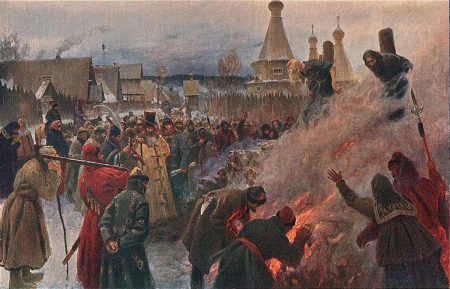
burning men: Old Believers

The extent of criminalization of men and violence against men easily prompts despair among the warm-hearted. In twelfth-century Byzantium, the eminent writer Theodore Prodromos apparently turned to macabre comedy as a remedy for despair. In his novel Rhodanthe and Dosikles, Prodromos described bizarrely reverberating violence and vindication through fierce inquisitorial fire.

Kratandros fell in love with his neighbor, the maiden Chrysochroe. He revealed his flame for her through a messenger. She agreed to marry him. They arranged secretly for him to come to her room on an appointed evening. Then they would give and receive pledges of love in person.

The lovers’ attempt to meet generated macabre comedy. With images used in figuring the seduction of a virgin, Kratandros reported moving forward:

when I approached the gate at the entrance,
I opened the doors that were shut,
drawing back their wooden bolt,
and putting forward a quiet foot
I hastened to make my way to Chrysochroe. [1]

Unfortunately the door-keeper noticed him. She called Chrysochroe’s father from bed and summoned fellow servants to violence against Kratandros. He was guilty of nothing more than loving Chrysochroe and acting to fulfill mutual arrangements for a meeting. Facts matter little in criminalizing men for loving women:

they all immediately rushed off to catch
the escaping intruder and kill him with clubs and stones.
One clasped in his hands a club
or rather one or other of the doorposts,
another dug up the house or tore it apart
and seized a hand-sized stone in both his hands,
all — armed with whatever they chanced on —
threatened noisy violence to this disturber of the night. [2]

Tearing down one’s house to attack, without questioning or immediate danger, a fleeing man represents a ridiculous over-reaction. It’s as ridiculous as claiming that nearly a quarter of men admit to being rapists. Yet many today respond to such literature only in the crudest of ways. A more humane response is laughter within a sense of despair and absurdity.[3]

Subsequent events heighten a comic sense of despair and absurdity. What happened, according to Kratandros’s telling, is inconceivable:

And nowhere chancing on Kratandros
(would that they had; what point is there in my continuing to live?)
their good aim was a mis-hit at the maiden.
For Lestias’ ill-judged fist,
hoping for Kratandros,
miserably slew — alas, alas — the miserable Chrysochroe,
shattering her head with a huge stone.

Misandary and violence against men has enormous, seldom-counted harm. Here, with Kratandros hidden outside, those social injustices register as a huge stone crushing an innocent maiden’s head. Those social injustices further register as Lestias and his fellow servants then claiming that Kratandros murdered Chrysochroe.

No one engaged reason to understand and judge the events. Chrysochroe’s father believed the false accusation and condemned Kratandros:

O accursed Kratandros, all-daring insolence,
implacable robber, savage-souled being,
how could you destroy such a maiden
by stealth, craftily, wilfully, heartlessly?
I am amazed and astonished
that the rock did not turn back on itself
(having acquired natural understanding)
to kill the thrower with a just judgment,
but it wilfully struck Chrysochroe.
And you, despoiler and slayer of the girl,
may you undergo a deserved death in the future,

and having slain my daughter
with a dreadful blow from a most accursed stone,
you — unhappy one — will expire pitiably, crushed by stones.

Like men who believe in patriarchy, Kratandros blamed himself for the terrible injustices:

Alas, wretched father of a wretched daughter,
it is I who have deprived your offspring,
your maiden, of life and dear existence.
Accuse me of your daughter’s death,
summon me to the tribunal and seek judgment,
drawing me, dragging me to the lawgivers’ houses,
demanding the penalty deemed right by the laws.
It is generally decreed, as you have just said,
that he who strikes with stones should be struck with stones.
I myself would yearn for death by stoning
since Chrysochroe died from a stone.
Let the hand of Lestias alone slay me,
which accursedly killed the maiden.
Do not be slow to charge me with murder;
for I long to go to where Chrysochroe is. [4]

That response is sadly characteristic of men. While men have no reproductive rights whatsoever, many men worry deeply about perceived threats to women’s reproductive rights. While four times more men than women die from violence, many men believe that violence against women is the most pressing human rights issue in the world today. Men don’t value their own intrinsic human being.

A fierce inquisitorial flame fantastically delivered justice to Kratandros. Chrysochroe’s father, probably urged on by his wife, had Kratandros summoned before the tribunal on a charge of murder. Chrysochroe’s father appealed to the court for Kratandros to “at least suffer a rock-borne death.” With Kratandros moving forward to plead guilty, his father, perhaps acting according to his wife’s order, intervened. He rightly called the murder charge “fabricated.” Given pervasive judicial bias against men, Kratandros’s father turned to the fantastic option of trial by fire.[5] Attendants of a goddess’s temple lit a fire “seven times more fierce than usual.” Kratandros recounted:

So the temple attendants lit the fire
and requested the murderer to enter it.
When I went into the middle of the flame,
I trod on the fire and stayed within it, unburnt.

Kratandros was thus found innocent of murder. As Kratandros’s dear friend Dosikles said, what a “strange and wonderful matter.”

The innocent maiden Chrysochroe had her head crushed by a stone intended for the head of an innocent, loving man. Perhaps eventually the rock of misandry will turn back on its throwers. That may be humanity’s best hope for justice.

*  *  *  *  *

Read more:

Notes:

[1] Theodore Prodromos, Rhodanthe and Dosikles ll. 1.173-77, from Atticizing Greek trans. Jeffreys (2012) p. 25. Prodromos was “perhaps the most versatile, inventive, and prolific” writer in Byzantium in the first half of the twelfth century. He probably wrote Rhodanthe and Dosikles in Constantinople in the 1130s under Byzantine Emperor John II Komnenos. This novel imitates settings and plot elements of ancient Greek novels, particularly Heliodoros’s Ethiopika and Achilles Tatius’s Leucippe and Clitophon. Rhodanthe and Dosikles is in nine books of twelve-syllable iambic verse. Prodromos probably presented parts of it in oral performance at the imperial court’s theatron. Id., introduction, pp. 3-14.

A gate with shut doors poetically figures a virginal womb. In the Hebrew bible, a foot is a figure for a man’s penis. Byzantine novels include “clever genital innuendo.” Kaldellis (2007) p. 266.

[2] Rhodanthe and Dosikles ll. 1.182-9, trans. Jeffreys (2012) pp. 25-6. Subsequent quotes are (cited by line number in Book 1 and page in id.’s translation): ll. 190-6, p. 26 (And nowhere chancing…); ll. 252-62, 267-9, p. 28 (O accursed Kratandros…); ll. 293-306, p. 29 (Alas, wretched father…); ll. 386-9, p. 32 (So the temple attendants…). Short quotes within the text are from this range of line numbers and pages.

[3] Writing about Hellenism in Byzantium, Kaldellis observed:

In American public life, only comedians may hint at the truth. They are allowed this by the guardians of opinion because their apparent lack of seriousness places them outside the realm of consequential political discourse; it also transmutes our indignation into laughter, neutralizing it. So too with “Hellenic” satire in Byzantium. The fiction of rhetorical imitation and satire’s conciliatory foolishness diffused the implied challenge to Orthodoxy and the court.

Kaldellis (2007) p. 276. Prodromos was far more perceptive, daring, and sophisticated than popular comedians in American public life today. At the same time, orthodoxy today is more oppressive and more ridiculous than it was in Byzantium.

[4] In an astonishing analysis of these events, MacAlister declared:

Although technically innocent of Chrysochroe’s murder, Kratandros had expressed his responsibility for it and so, like certain characters in the ancient novel, had pleaded guilty at the subsequent murder trial in the expectation that the penalty would be death (1.347-49). But unlike the ancient novel situations where the pleading character provokes death and voluntarily pleaded guilty to a crime for which he or she is invariably totally innocent, the situation here is one in which the pleading character willingly pleaded guilty to a crime for which he does carry some guilt: had Kratandros not been secretly visiting the maiden, the uproar which had caused her death would not have taken place. Prodromos thus dispels any idea of voluntary provocation of death by the fact that, in the final analysis, Kratandros could be considered ultimately responsible for the murder.

MacAlister (1996) p. 122. With equally convincing reason, scholars such as MacAlister are ultimately responsible for vastly disproportionate violence against men and vastly disproportionate incarceration of men.

Dosikles latter echoes Kratandros’s unwarranted self-accusation of murder. After a storm in which the pirate ship carrying Rhodanthe captive vanished, Dosikles imagined that she was dead. He declared, “it is I who am your murderer, not the tempest.” Rhodanthe and Dosikles l. 6.350, trans. Jeffreys (2002) p. 107.

Prodromos may well be engaging in satire of Christian and imperial orthodoxy. Kaldellis (2007) pp. 270-6. But Prodromos’s satire of gynocentrism is more daring and more interesting. Prodromos’s novel “shows clearly with what artistry and subversive irony old topoi can be reinvented and presented.” Cupane (2014) p. 188.

[5] Trial by fire was not practiced in Byzantium. Jeffreys (2012) p. 31, notes 36-8, which cite Heliodoros 10.8-9 and Daniel 3.19-24 for comparison. Kratandros’s trial by fire differs significantly from the Heliodoros 10.8-9. The latter describes a trial of chastity by stepping on a burning gridiron. In Daniel 3.19-97, King Nebuchadnessar had Shadrach, Meshach, and Abednego thrown into a fiery furnace for refusing to worship a golden statue. They walked around in the flames and remained unburned while joyfully praying to their god, the god of Jews and Christians. In context, Kratandros’s trial by fire functions within the twelfth-century Byzantine literary practice of “mixing the unmixable.” Roilos (2005) p. 237 (in Ch. 4, “Comic Modulations”), citing the late thirteenth or early fourteenth-century critique of Timarion by Konstantinos Akropolites.

[image] The Burning of Protopope Avvakum. Painting by Grigoriy Myasoyedov, 1897. Thanks to Wikimedia Commons.

References:

Cupane, Carolina. 2014. “Other Worlds, Other Voices: Form and Function of the Marvelous in Late Byzantine Fiction.” Pp. 183-202 in Roilos, Panagiotis, ed. Medieval Greek storytelling: fictionality and narrative in Byzantium. Wiesbaden : Harrassowitz Verlag.

Jeffreys, Elizabeth, trans. and notes. 2012. Four Byzantine novels: Theodore Prodromos, Rhodanthe and Dosikles; Eumathios Makrembolites, Hysmine and Hysminias;  Constantine Manasses, Aristandros and Kallithea; Niketas Eugenianos, Drosilla and Charikles. Liverpool: Liverpool University Press.

Kaldellis, Anthony. 2007. Hellenism in Byzantium: the transformations of Greek identity and the reception of the classical tradition. Cambridge, UK: Cambridge University Press.

MacAlister, Suzanne. 1996. Dreams and suicides: the Greek novel from antiquity to the Byzantine Empire. London: Routledge.

Roilos, Panagiotis. 2005. Amphoteroglossia: a poetics of the twelfth-century Medieval Greek novel. Hellenic Studies Series 10. Washington, DC: Center for Hellenic Studies.