
Author: Douglas Galbi
Boncompagno of Signa used ars dictaminis to debunk courtly love

In relatively enlightened medieval Europe, both children and adults were intellectually capable of quickly distinguishing between girls and boys in common practice. Neither children nor adults were compelled as a matter of public education to affirm elaborate, contradictory doctrine about the arbitrariness of gender (“the social construction of gender”) and the essential importance of gender identity, as determined by whatever a person declares at a given time under prevailing administrative rules about making and changing gender declarations enforced by law against persons refusing to recognize the validity of such essential gender declarations.
Medieval European culture wasn’t, however, a perfect model of rationality. The most damaging medieval failure of reason was the still-celebrated, twelfth-century elaboration of oppressive, unfruitful doctrines of courtly love. Boncompagno of Signa, a well-educated twelfth-century rhetor at the University of Bologna, sought to dispel medieval ignorance and irrationality with eloquent Latin and stunning performances. Writing authoritative forms for the art of letter-writing (ars dictaminis), Boncompagno ridiculed men-abasing doctrines of courtly love.
About 1195, the University of Bologna received a letter apparently from a learned scholar who had just arrived from Bavaria. This scholar described his intellectual qualifications and announced a sophisticated demonstration:
I have lived ten full years among the Arabs and Persians, and I applied myself extensively to both astronomy and to all the magical arts known in parts of Arabia and at Toledo. I went beyond the Sauromatas and the Glaciales, among whom I read Uranech, who used to make a deaf asp able to hear by smoke and incantations and who changed all snakes into flies. I also read the Fantasticum of Ramafitonus, who clarified much in Solomon’s Astrolabe by Almicatarath. I read Faunes and Almuchamir, which are the special books of the magical faculty. From Zenzalimach, I learned to understand dog barks and bird calls, up to the sparrow and cardinal. I know how to work marvels by images. But such should not be revealed in public, since one who divulges mystical things diminishes their majesty, and those things brought forth to the crowd cannot remain secrets.
Nevertheless, because they might seem impossible to the ignorant, I shall reveal them to you. Today, around noon or a little bit after, because the sun will then begin to be at its hottest, you shall come to St. Ambrose’s square. There I will first change an ass into a lion. When it reverts to an ass, it will appear horned just like a goat. Then it will assume feathers like an eagle and it will fly through the air for those of you watching. Nevertheless, it will remain an ass at the end. Snakes will plow the shore there with a fox, monkeys will foretell the future, and their tricks will be laughably memorable. All should take care not to dare cover their heads, but should turn their faces to the sun, since otherwise none can possibly see the secret marvels.
{ In partibus Arabie ac Tolleti tam in astronomia quam in omnibus magicis operibus operam exhibui diuturnam, quia per decem annorum spatium sum inter Arabes et Satrapas conversatus, ivi ultra Sauromatas et Glaciales, apud quos legi Uranech, qui aspidem surdam fumigavi et incantionibus faciebat audire, et serpentes omnes convertebat in muscas. Legi etiam fantasticum Ramafitoni, qui per Almicatarath multa distinxit in astrolabio Salomonis, transcurri Faunes et Almuchamir, qui sunt precipui libri magice facultatis. Intelligo per Çençalimach latratus canum et voces avium, usque ad passerem et cardellum. Item novi mirabilia per ymagines operari, sed non sunt quelibet in publico revelanda, quoniam qui vulgat mistica minuit maiestatem et que producuntur in turbam, non possunt manere secreta.
Verumtamen, quia ignorantibus impossibilia huiusmodi esse videntur, ideo vobis intimo, quatinus hodie circa vel parum ultra meridiem, quia tunc sol esse incipiet in suo fervore, ad plateam sancti Ambrosii veniatis, ubi transmutari prius faciam asinum in leonem, et cum in asinum revertetur, sicut yrcocervus apparebit cornutus et tunc assumet pennas, ut aquila et vobis videntibus per aera volitabit, verumtamen in fine asinus remanebit. Serpentes quidem arabunt ibi litus cum vulpe, vaticinabuntur scimie de futuris, que ludi facient memoriam derisivam. Provideat etiam quilibet, ne sibi caput operire presumat, sed vertat nudam faciem contra solem, quoniam aliter nemo posset videre mirabilia secretorum. }[1]
This letter created a sensation in the university-dominated Bologna:
What was heard from this letter became a rumor that spread throughout the city. Teachers and scholars of the university, young men and young women, old persons and young persons, filled the streets and housetops before the appointed hour. They came and stood for a long time, expecting the impossible to happen.
{ Auditis quidem litteris fuit rumor per civitatem diffusus et ita magistrorum et scolarium universitas, iuvenes et virgines, senes cum iunioribus preoccupaverunt ante horam statutam plateam et tecta domorum, venerunt et steterunt diutius, effectus impossibiles prestolantes. }
What most untaught persons know was taught to the learned:
Finally they {teachers and scholars of the university of Bologna} left burning with shame, publicly professing that they are similar to donkeys, because they believed that donkeys could fly.
{ Demum intollerabili calore atque pudore affecti recesserunt, publice profitendo se consimiles fuisse asinis, ex eo quod asinum volare credebant. }
Boncompagno himself had fabricated the letter from the internationally learned scholar from Bavaria. Boncompagno evidently sought to teach the relatively enlightened twelfth-century Bolognese university community just how stupid they could be.
Even this important lesson from Boncompagno isn’t appreciated today. A leading twentieth-century scholar of medieval Latin poetry and courtly love rated Boncompagno as “perhaps the greatest of the teachers of rhetoric.”[2] Yet a leading twentieth-century scholar of medieval rhetoric disparaged Boncompagno’s “bizarre claims,” called him a “dictaminal buffoon,” and declared:
he is virtually without influence, and he is best viewed as a biographical curiosity … Boncompagno seems to have made no lasting impact either on his own university or on Europe at large. [3]
At least medieval intellectuals knew better. The great early-fifteenth-century church official Poggio Bracciolini recorded an exemplum that closely parallels Boncompagno’s fake-flyer performance. According to Poggio, this exemplum had been passed down among church officials. Boncompagno’s lesson evidently had considerable influence across at least two hundred years of medieval intellectual life.[4] Boncompagno’s lack of influence today is the fault of today’s academic scholars working under oppressive conditions of ignorance and bigotry.
Boncompagno similarly debunked men-abasing doctrines of courtly love in his Rota veneris {Wheel of Venus}. That work is a “curious mixture of ars amandi {art of love}, ars dictandi {art of prose writing}, and rhetorical theory.” The Rota veneris is the “greatest letter-writing instruction on the art of love {summa dictaminis de arte amandi}.”[5] It’s an ingenious re-working of ars dictaminis.

By the twelfth century, ars dictaminis was a well-established field that provided students with technical instruction and forms for composing mundane letters. Letters were commonly specified as having five parts. For example, here’s a specification for a business letter:
some form of address in a salutation (“Worshipful master, I greet you well”); notification (“May it please you to know”); exposition (“the wool was shipped”); disposition (“and I want my money”); and valediction (“May God keep you well, at least until my bill is paid”). [6]
For students, an important form to learn was the letter to parents asking for money. A well-attested theme for study and imitation was this:
an impoverished scholar living in Paris sends a letter to his mother so that she will provide him with what is necessary
{ scolaris parisius pauperrime viuens litteras matri sue dirigat, ut in necessariis sibi prouideat }[7]
The letter deploys framing guilt-tripping and threatening proverbs and a central, direct request for material help:
Here’s the form for the greeting {SALUTATION}: “To his dearest mother B., from the humble Parisian scholar J. with greetings and filial love.”
STARTING POINT: “A boy’s mother who doesn’t alleviate her son’s poverty doesn’t show him that he is her son.”
STORY: “Know that, in the course of two months, I have spent my money on necessary expenditures.”
PETITION: “Please therefore send to me necessities, with pity and without delay.”
CONCLUSION: “What you fail to do when you have no experience of begging will be returned to you when you do.”
{ Hoc modo salutet {SALUTATIO}: “Karissime matri sue B., J. humilis scolaris parisius salutem et filialem dileccionem.”
EXORDIUM: “Pueri matrem se non exhibet que filii sui non subleuat egestatem.”
NARRATIO: “Sciatis quod numos meos, transactis duobus mensibus, in usus necessarios expendi.”
PETICIO: “Michi igitur compaciens, necessaria dirigere non differatis.”
CONCLUSIO: “Quod nisi feceritis, mendicare nesciens, ad propria remeabo.” }
A student today might text her mother “send $ pls”. That’s because ars dictaminis is scarcely known today even among scholars of medieval literature.

Boncompagno’s Rota veneris is much different from the once well-known business of ars dictaminis. After a literary recasting of Lady Philosophy’s concern for Boethius, Rota veneris begins conventionally with instruction on salutations. Boncompagno’s critical perspective on men-abasing courtly love appears when he presents this salutation:
To his sweetest friend G., crowned with beauty and elegance of manners, I. sends as many greetings and assurances of service as there are stars resplendent in the heavens, as there are leaves upon trees, and as there are sands which ring the ocean’s shore.
{ Amice dulcissime G., forma et morum elegantia redimite, I. tot salutes et servitia, quot in celo fulgent sidera, quot in arboribus folia et quot arene circa maris littora. }[8]
This sort of extravagant promise of serving a woman is characteristic of courtly love. Boncompagno disparaged it as a “rustic and ridiculous salutation {rusticana et ridiculosa salutatio}.” In fact, it shows no true learning about men seducing women and gender equality. Immediately after citing this salutation, Boncompagno bluntly communicated his sophisticated understanding of truth:
And remember: nearly all women wish to be praised constantly for their beauty, even if they happen to be ugly.
{ Et nota, quod fere omnes mulieres appetunt semper de pulcritudine commendari, etiam si fuerint deformes. }
Boncompagno turned his back on the pretty, futile poetry of courtly love. Rather than kissing women’s feet, he told ugly truth.
While the salutations in Rota veneris promise love service, Boncompagno didn’t put men in a position of servitude to women. Completely contrary to doctrines of courtly love, Boncompagno endorsed gender symmetry:
From these salutations you will be able to extrapolate all the ways by which men can greet their girlfriends and women their boyfriends, once you have learned to turn these expressions around and change what needs to be changed. Nor is any change necessary, other than to alter adjectives to suit the sex so that, where you have used the feminine gender for women, you shall substitute the masculine gender for men.
{ Ex hiis autem salutationibus poteris trahere omnes modos salutandi amicas pro amicis et amicos pro amasiis, si volvere sciveris et mutare mutanda. Nec est aliud necessarium in mutatione, nisi ut permutes adiectiva per sexus et, ubi posuisti femininum genus pro mulieribus, ponas masculinum pro viris. }
After setting out and discussing the salutatio, Rota veneris skips the exordium and moves right to the narratio. Instruction on the story (body) of the letter moves rapidly to a distinction between a letter ante factum (before having had sex with the woman) and a letter post factum (after having had sex with the woman).
Without instruction on any of the three other conventional parts of a letter in ars dictaminis, Rota veneris sets out bodies of sample letters in which a man seeks to seduce a woman. The woman devises a trick with a falcon:
Yet not wishing to spurn your prayers completely, so that you not be driven to the noose of desperation, I would advise you that, on Sunday, when the lords and ladies go to visit the shrine of the Lord, you release a falcon within my garden. Immediately thereafter, running away from the household servants, demand your bird back. I, then, shall see to it that it is denied you. The maidservants will say to you, “Away! What you seek does not belong to you.” Then indeed, in the midst of this very altercation, I shall have you summoned, and thus you will be able to reveal to me the secrets of your heart.
{ Nolens tamen preces tuas ex toto contempnere ne in desparationis laqueum traharis, consulo ut in die festo, cum domini et matrone templum dominicum visitant, prohicias infra meum pomerium falconem et subito postea currens a familiaribus domus tuam repetas avem. Ego vero illam tibi faciam denegari, diceturque tibi ab ancillis: “Recede, non enim tuum est, quod queris.” Ad istam siquidem contemptionem te vocari faciam, sicque michi tui cordis archana poteris aperire. }
The falcon (in Old French, faucon, which also carries the meaning “false cunt”) figures in medieval stories of deception and sexual intrigue. According to Rota veneris, the woman moves with this letter to the situation post factum (after first sexual intercourse). That’s not how courtly love plays out.
Apparently to insure that readers understood Boncompagno’s commitment to realism and incarnated humanity in love, a version of Rota veneris published about 1475 appended to the ars dictimanis marital advice to men and women. The appended texts comes from Boncompagno’s Rhetorica antiqua. Boncompagno shrewdly advised men to marry a wealthy woman:
Everybody is to be appropriately advised to take as his wife a woman from whom he can gain money and not care about nobility or eminent family stock, for money makes a person’s nobility. He who has money will grow abundant with riches, become noble and famous. Thus don’t postpone taking a wealthy wife, whether she be ugly or disgusting, yes, even if she were the oldest of hags and all her teeth had already fallen out of her mouth, so only her fluid and foaming gums remained.
{ Cuilibet est propensius consulendum ut talem recipiat in uxorem de qua pecuniam possit habere nec est curandum de nobilitate vel prosapia generosa, quoniam peccunia facit hominem generosum et qui habet denarios cui affluentur nobilis efficitur et famosus; unde uxorem peccuniosam recipere non postponas quantucumque turpis fuerit vel deformis, et etiam si esset vetustissima vetularum et cui iam omnes dentes cecidissent ex ore et sole remansissent gingive cum saliva fluida et spumosa. }[9]
Boncompagno advised women rather differently:
O unprecedented madness! O womanly folly! How could you listen, much less entertain the idea that you ought to tie yourself to a man who is already consumed by old age and feebleness, whose eyes already are suffering from dimness of vision? But even more abominably, he incessantly produces tears which drop by drop end up in his wine when he drinks, and his saliva remains in the goblet. When he eats, he hawks, belches, and wipes mucus from his nose and rubs it on the tablecloth. Furthermore, when he goes to bed, he sleeps, snores, farts, and emits the filthiest scoops of gas. Then, if he is aroused from his sleep, he coughs, spits, sighs, complains, and groans. His rod hangs down as if a lead pipe were on top of his ponderous penis. This is the man who will kiss you with the kiss of his mouth that has no teeth. But he will offer you slavering kisses with his decayed gums.
{ O vesania inaudita! O stultitia muliebris! Quomodo potuisti audire nedum intelligere quia tali viro copulari debeas qui iam senecta et senio est consumptus! Cuius oculi iam caligant imo — quod est abominabilius — assidue producunt lacrimas que guttatim cadunt in vinum dum potat et in sipho reliquitur de saliva; dum comedit screat, eruttat et mucilagines emungit de naso quem tergit sepe ad mantile. Praeterea cum vadit ad lectum dormit, stertit, pedit et fetidissimas trullas emittit. Porro cum excitatur a sompno tusit, spuit, suspirat, conqueritur, ingemiscit et virga eius velut plumbi fistula iacet super mentulam ponderosam. Hic osculabitur vos osculo oris sui, qui caret dentibus, sed cum gingivis marcidis praebebit tibi oscula salivosa. }
These two pieces of marital advice, like courtly love, are highly gender asymmetric. Yet courtly love in poems and stories completely lacks the vivid bodily realism of these two pieces of marital advice. Moreover, this marital advice parodies women’s interest in wealthy, successful (old) men and men’s interest in young, fertile (impecunious) women. Boncompagno recognized that courtly love is ridiculous and irrational.
While courtly love abases men relative to women, Boncompagno associated men’s sexuality with sacred figures and acts. He recognized that priests and clerics have special potency in their masculine sexuality. He urged women to marry them:
You shall be the daughters of Jerusalem if you take a priest or a cleric for a husband. You shall be deified in the temple of the Lord, for you shall bring forth a son who will be born from consecrated semen. Thus you shall be called a priestess or priest when with your husband you press oil out of the horn of the altar. In that way you will be blessed among wives.
{ Eris de filiabus Ierusalem si sacerdotem uel clericum receperis in maritum, et deificaberis in templo Domini, cum filium paries qui nascetur de semine consecrato. Unde sacerdotissa uocaberis uel sacerdos, quando cum uiro tuo oleum de cornu altaris exprimes et ita beata eris inter coniugatas. }[10]
Pressing oil out of the horn of the altar is a wonderful image of men’s erection labor and ejaculation. Historically, the penis has had an image problem. Boncompagno, however, associated men’s penises with the strength of God, God’s comforting presence, and God’s capacity to provide light:
A certain man who had sex with a nun said: “I did not defile the divine bed, but because the Lord had delighted me through His work, I was eager to raise his horn.” Also, a nun could say to her lover: “Your rod and your staff, they are a comfort to me.” Also women could say to their lovers: “Give us some of your oil, for our lamps are going out.”
{ Quidam qui cognoverat monialem dixit: “Non violavi thorum divinum, sed quia me in sua fatura Dominus delectavit, cornu eius studui exaltare.” Item posset monialis dicere amatori: “Virga tua et baculus tuus, ipsa me consolata sunt.” Item possent dicere suis amatoribus mulieres: “Date nobis de oleo vestro, quia nostre lampades extinguuntur.” }[11]
Men’s sexuality should be regarded as a sacred gift to women. Men and women together can work to raise an incarnate horn to God. A man’s sexuality offers the blessing of new life as numerous as the stars in the sky and sand on the seashore.[12]
Boncompagno of Signa is a shining light of medieval rationality that our benighted age of ignorance and bigotry desperately needs. The University of Bologna was arguably the most prestigious university in twelfth-century Europe. Boncompagno himself drew upon classical culture in which Cicero declaimed the value of pissing on learned hypocrites. In the past hundred years, elite scholars have celebrated at length courtly love as a moral ideal. Elite scholars with respect to many other subjects have similarly proclaimed that donkeys can fly. Let us join together and chant: Boncompagno of Signa, pity us and come to our aid!
* * * * *
Read more:
- Abelard’s advice to his son Astralabe & Trimalchio’s Fortunata
- celebrating marriage: Ausonius loved his wife Sabina
- still-relevant medieval advice for men: si non caste, tamen caute
Notes:
[1] Boncompagno of Signa, Rhetorica antiqua (also known as Boncompagnus) 1.18.14, Latin text from Basso (2015) and English translation (adapted slightly) from Wight (1998b) (which also provides a Latin text and notes). The subsequent two quotes are similarly from Rhetorica antiqua 1.18.15. This story is recounted in Waddell (1927) pp. 153-4. Boncompagno read his Rhetorica antiqua publicly at Bologna in 1215 and then at Padua about 1225. Tunberg (1986) p. 300, n. 4. For a brief, accessible presentation of Boncompagno’s life and work, Sedgwick (1913) pp. 231-42.
Boncompagno similarly fabricated a letter from a fictitious eminent French orator named Robertus. That orator promised to come to Bologna on a given day to debate Boncompagno about ars dictaminis. Both disparaged each other’s learning. A crowd assembled in the cathedral to see the debate. Robertus failed to appear. Boncompagno at the end revealed that he had fooled the city with a fake letter. See Rhetoria antiqua 1.18.1-5, discussed in Sedgwick (1913) pp. 233-4 and Purkart (1975) pp. 21-3.
Salimbene de Adam in his Cronica described Boncompagno as the “greatest trickster”:
Boncompagno the Florentine was a great teacher of grammar in the city of Bologna, and he wrote books on the art of letter-writing. In the way of the Florentines he was the greatest trickster
{ Boncompagnus Florentinus, qui magnus magister in gramatica in civitate Bononie fuit et libros de dictamine scripsit. Hic cum more Florentinorum trufator maximus esset }
Salimbene, Cronica, Latin text from Holder-Egger (1905) p. 77, English translation (adapted) from Baird, Baglivi & Kane (1986) p. 54. Salimbene, who had contempt for the Dominican Brother John of Vicenza, recorded a similar fake-flyer performance by Boncompagno:
this Master Boncompagno, seeing that Brother John presented himself as a miracle-worker, wanted to present himself likewise. Boncompagno predicted to the Bolognese that, before their very eyes, they would see him fly. What can one say? News of his claim soon spread throughout Bologna. And so on the appointed day the entire city congregates, man and woman, young and old, at the foot of the mountain called Santa Maria in Monte. Boncompagno constructed for himself two wings and stood at the peak of the mountain looking down on them. After they had been gazing at each other for a long time, he shouted down to them audaciously, “Go with divine blessing, and let it suffice that you have looked upon the face of Boncompagno.” They all departed, knowing that he had made a mockery of them.
{ Item iste magister Boncompagnus videns, quod frater Iohannes intromittebat se de miraculis faciendis, voluit et ipse se intromittere et predixit Bononiensibus, quod videntibus eis volare volebat. Quid plura? Divulgatum est per Bononiam. Venit dies statuta, congregata est tota civitas a viro usque ad mulierem, a puero usque ad senem, ad radicem montis qui appellatur Sancta Maria in Monte. Fecerat sibi duas alas et stabat in cacumine montis aspiciens eos. Cumque se diu mutuo aspexissent, protulit istud verbum: “Ite cum benedictione divina, et sufficiat vobis vidisse facium Boncompagni.” Et recesserunt cognoscentes se derisos. }
Salimbene, Cronica, Latin text from Holder-Egger (1905) p. 78, English translation (adapted) from Baird, Baglivi & Kane (1986) p. 55. Cf. Exodus 33:20-3, Isaiah 6:5.
Despite Boncompagno’s obvious importance to modern culture, scholarly work on Boncompagno is sparse. The Arlima entry for Boncompagno shows nothing for most of his works. Boncompagno’s Rhetorica antiqua and Rhetorica novissima apparently haven’t even yet been fully published. Steven M. Wight by far has made the largest contribution to study of Boncompagno. Yet Wight’s massive, generous, and important work (see Wight (1998a)) languishes on the Wayback Machine and other obscure sites. Currently among the best general studies of Boncompagno are Tunberg (1986) and Witt (1986).
Scholars have disparaged Boncompagno for asserting that Cicero isn’t worth reading. E.g. Murphy (1974) p. 254. Boncompagno declared:
This book is the prologue of my Rhetoric, although I have not imitated Cicero in rhetoric. For I do not recall that I have ever lectured on Cicero … Nevertheless I have never corrupted Cicero’s Rhetoric, nor have I dissuaded those wishing to imitate it.
{ Est preterea liber iste mee rethorice prologus, licet in rethorica Tullium non fuerim imitatus. Nunquam enim memini me Tullium legisse … Verumtamen nunquam Tullii depravavi Rethoricam nec eam imitari volentibus dissuasi. }
Boncompagno, Palma 1.2, Latin text and English translation from Wight (1998a). Boncompagno certainly read Jerome and knew of Jerome’s nightmare that God called him a Ciceronian rather than a Christian. That’s the context within which Boncompagno should be appreciated for asserting that he isn’t a Ciceronian.
[2] Dronke (1965) vol. 1, p. 251.
[3] Murphy (1974) p. 253. The reference to “bizarre claims” is from id., while “dictaminal buffoon” is from id. p. 362.
[4] Boncompagno was the first master in ars dictaminis at the University of Bologna. By 1205, Boncompagno’s rivals had created the rumor that he getting his knowledge from the “intercession of unclean spirits {suffragio spirituum inmundorum}.” Purkart (1975) p. 15. Boto da Vigevano’s Liber florum, written in 1234, declared of Boncompagno: “his fame now fills the expanse of heaven and earth {fama iam replevit spacium orbis terre}.” Id. p. 11. In his Cronica written in the 1280s, Salimbene described Boncompagno as a “great teacher of grammar {magnus magister in gramatica}.” See note [1] above. The manuscript tradition of Boncompagno’s works indicates that he was influential. Core (2105) p. 41. Boncompagno’s Rhetorica Antiqua 4.5 apparently influenced the sixth canto of Dante’s Purgatorio. Raccagni (2013) pp. 599-600. That church officials would pass down a sensational story about Boncompagno is plausible.
[5] Purkart (1975) p. 28. The previous short quote is from id. p. 7.
[6] Adapted from the Wikipedia entry for ars dictaminis. For more on medieval letter-writing and ars dictiminis, Haskins (1898), Murphy (1974) pp. 194-268, and Cornelius (2010).
[7] Libellus de arte dictandi rhetorice (Cambridge University Library MS Dd.9.38, fols. 115ra-121ra), attributed to Peter of Blois, excerpt from section 20, Latin text from Camargo (1984) p. 36, my English translation. The subsequent quote is similarly from id. A similar letter exists in Floribus rhetoricis (British Library MS Add. 18382), a work written early in the 1180s. Id.
[8] Boncompagno da Sign, Rota veneris {Wheel of Venus} 2.3, Latin text from Core (2015), English translation from Purkart (1975) (adapted to follow the Latin more closely). All subsequent quotes from Rota veneris are similarly sourced, unless otherwise noted. Wight (1998c) provides a good Latin text with helpful notes. Rota veneris survives in nine manuscripts, the earliest dating to the end of the thirteenth century. Core (2015) pp. 41-7.
[9] Boncompagno da Sign, Rhetorica antiqua (also known as Boncompagnus) 6.2.22. included in Ch. 8 of the Strasburg incunabulum of Rota veneris, Latin text from Core (2015), English translation (adapted) from Purkart (1975). Preceding this advice is rubricated lead-in text: “Advice to take a woman on account of her abundant riches {Suasio pro muliere propter habundantiam divitiarum}.”
The subsequent quote is similarly from Rhetorica antiqua 6.2.34 and chapter 8 of the Strasburg incunabulum of Rota veneris. It has rubricated lead-in text: “Advice against taking a man on account of his old age {Dissuasio contra virum propter senectutem}.”
The Strasburg incunubulum of Rota veneris is dated 1473-1474. It has the title Tractatus amoris carnalis subsequitur rota veneris nuncupatus per Boncompagnum editus sociorum annuens precibus {Treatise about Carnal Love, Called the Wheel of Venus, Published by Boncompagno as a Concession to his Colleagues’ Pleas}. Instances are held in the Huntington Library and in the Bayerische StaatsBibliothek. With admirable regard for promoting culture and knowledge for all, the Bayerische StaatsBibliothek has made a digital version of its instance freely available worldwide. Ocaña & Blecua (2005) notes that both pieces of marital advice aren’t in surviving manuscript versions of Rota veneris.
[10] Boncompagno da Signa, Rhetorica antiqua 6.2.14, Latin text and English translation (adapted to follow Latin more closely) from Purkart (1978) p. 328. Cf. Isaiah 4, Song of Solomon 2:7, Luke 1:42. The section heading is: “Advice so that priests and clerks would be received in their manliness {Suasio, ut recipiatur sacerdos vel clericus in virum}.”
[11] Boncompagno da Signa, Rhetorica novissima 9.2.18, Latin text and English translation (adapted to follow Latin more closely) from Purkart (1978) p. 329. Cf. Psalm 23:4, Matthew 25:1-13. This section carries the heading: “How good is transmuted into bad {Quomodo bona transumantur in mala}.” See Wight (1998d) Section 9. Whether the heading is original to Boncompagno isn’t clear. I suspect that it isn’t. Purkart declared of this passage:
he {Boncompagno} managed to discover not only a set of useful and appropriate sexual metaphors, but whole passages in the Scriptures which could be used in his rhetoric of carnal love … Boncompagno did not reserve his horny wit only for ecclesiastics.
Id pp. 339-30. Purkart refers to Boncompagno as turning “Holy Writ into horny wit.” Id. p. 325. Boncompagno’s purpose seems to me more serious in the context of historically entrenched disparagement of men’s sexuality. For a recent example of that symbolic-structural bias with respect to Troilus and Rota veneris, Newman (2014). Boncompagno is best regarded as a forefather of the critical insight that led to ostentatio genitalium.
Guérin reads Rota veneris as a playfully exercise in representation. Guérin (2016). His interpretation takes seriously Boncompagno’s declaration:
I want all and everyone to know that, to me, words have always been more pleasing than deeds, for in such matters it is more glorious to live in hope than in its fulfillment, according to the pronouncement of the most serene Capuan.
{ Unum tamen volo universos et singulos scire quod plus michi semper placuerunt verba quam facta quoniam gloriosius est in talibus vivere in spe quam in re, secundum sententiam serenissime Capuane. }
Rota veneris 15.3. That statement occurs in the context of Boncompagno defending himself against charges of “lasciviousness {lascivia}.” That’s a standard charge against those who appreciate love in the flesh. The Capuan’s pronouncement that “it is more glorious to live in hope than in its fulfillment” is a standard sentiment of courtly love. No source has been located indicating such a pronouncement of the Capuan (Cumaean Sibyl). Parkart (1975) p. 106, n. 98. That reference is probably Boncompagno’s fictitious construction. Just prior to the sentence above, Boncompagno claimed that he wrote Rota veneris “for the sake of courtliness {quam feceram causa urbanitatis}.” Purkart notes, “Unlike Andreas Capellanus, Boncompagno makes it easy for the reader to accept the irony of this statement.” Purkart (1975) p. 106, n. 97. Rota veneris concerns writing letters to achieve love in the flesh. Rota veneris parodies courtly love. Boncompagno’s declaration that “words have always been more pleasing than deeds” is best read as a playful exercise in mis-representation.
Jacques de Vitry issued an exemplum sternly warning about a cleric who had “mixed the language of spiritual love with that of carnal and foul love {verbum spiritualis amoris carnali et immundo amori coaptauerat}.” Purkart (1978) p. 331 for Latin text and English translation. For about two thousand years, the incarnation of Jesus has been contentious and difficult to appreciate fully even among Christians. For related discussion, see my post on ancient Latin Christian hymns, my post on the medieval poem Si linguis angelicis and Huot (1997) Ch. 2.
[12] The Strasburg incunabulum of Rota veneris includes from Boncompagno’s Rhetorica antiqua 1.24.10 a poignant letter from a woman dreaming of her absent lover. She declares, “Sitting like a turtle-dove on a dry branch, I moan incessantly {Sedens more turturis in ramusculo sicco, gemo assidue}.” The letter has the heading “Of a woman who seeks to call back her lover {De muliere que amicum suum revocare intendit}.” Latin text from Core (2015) and Basso (2015), my English translation. Dronke (1965) vol. 1, pp. 251-3 provides an English translation and an interpretation focused on “spiritual love {spiritus amoris}.” Id. vol. 2, p. 483-4 provides an alternate Latin text.
A love-letter inserted into a fifteenth-century manuscript of Rota veneris underscores Boncompagno’s concern for incarnated love. The letter is similar to Boncompagno’s letter “Of a woman who seeks to call back her lover {De muliere que amicum suum revocare intendit}.” In accordance with the gynocentric imperative, the letter elaborates on the importance of masculine sexuality to women:
In your wisdom you should indeed know what is the condition of women and that young women require conjugal intercourse.
{ Per sapientiam namque vestram intelligere deberetis que sit conditio feminarum et quod requirit in iuvenibus copula coniugalis. }
From MS Roma, Biblioteca Angelica, 505, fol. 12v, Latin text from Purkart (1984) p. 50, my English translation. In an associated spurious love letter, the woman’s lover promises her that he will return to her and make up for the time lost in bed with her. Id. p. 53.
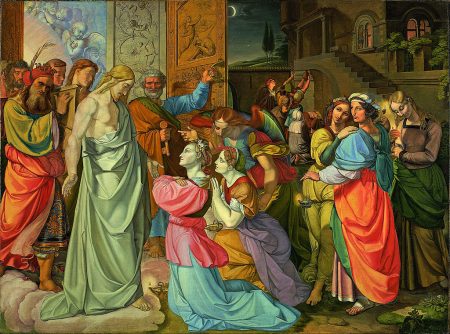
[images] (1) Modern ars dictiminis: selected excerpts from temporary restraining order form for the state of California. (2) The Parable of Wise and Foolish Virgins (unfinished). Painting by Peter von Cornelius, made between 1813 and 1816. Preserved as inv. no. M 4011 in the Museum Kunstpalast (Düsseldorf, Germany). Via Wikimedia Commons.
_-_Google_Art_Project.jpg)
References:
Baird, Joseph L., Giuseppe Baglivi, and John Robert Kane. 1986. The Chronicle of Salimbene de Adam. Binghamton, N.Y.: Center for Medieval and Early Renaissance Studies.
Baethgen, Friedrich, ed. 1927. Boncompagno da Signa. Rota veneris: ein Liebesbriefsteller des 13. Jahrhunderts. Texte zur Kulturgeschichte des Mittelalters 29. Rome: W. Regenberg.
Basso, Martina. 2015. Il 1 Libro del Boncompagnus di Boncompagno da Signa: Edizione Critica e Glossario. Ph.D. Thesis. Università degli Studi di Padova (Italy).
Camargo, Martin. 1984. “The Libellus de arte dictandi rhetorice Attributed to Peter of Blois.” Speculum. 59 (1): 16-41.
Core, Luca. 2015. La Rota Veneris di Boncompagno da Signa. Edizione critica. Ph.D. Thesis. Università degli Studi di Padova (Italy).
Cornelius, Ian. 2010. “The Rhetoric of Advancement: Ars dictaminis, Cursus, and Clerical Careerism in Late Medieval England.” New Medieval Literatures. 12: 289-330.
Dronke, Peter. 1965. Medieval Latin and the Rise of European Love-Lyric. Oxford: Clarendon Press.
Guérin, Philippe. 2016. “La voie rhétorique vers le corps: narratio, descriptio, gestus et transumptio dans la Rota Veneris de Boncompagno da Signa.” Arzanà 18 (online).
Haskins, Charles H. 1898. “The Life of Medieval Students as Illustrated by Their Letters.” The American Historical Review. 3 (2): 203-229.
Holder-Egger, Oswald. 1905-1913. Cronica Fratris Salimbene de Adam. Monumenta Germaniae Historica 32. Hannoverae et Lipsiae: Impr. bibliopolii Hahniani.
Huot, Sylvia. 1997. Allegorical Play in the Old French Motet: the sacred and the profane in thirteenth-century polyphony. Stanford, CA: Stanford University Press.
Murphy, James J. 1974. Rhetoric in the Middle Ages: a history of rhetorical theory from Saint Augustine to the Renaissance. Berkeley: Univ. of Calif. Press.
Newman, Jonathan M. 2014. “Dictators of Venus: Clerical Love Letters and Female Subjection in Troilus and Criseyde and the Rota Veneris.” Studies in the Age of Chaucer. 36 (1): 103-138.
Ocaña, Antonio Cortijo and Luisa Blecua, trans. 2005. Boncompagno da Signa. La rueda del amor {Rota veneris}. Madrid: Gredos.
Purkart, Josef. 1975. Rota veneris: facsimile reproduction of the Strasburg incunabulum. With English translation and notes. Delmar, N.Y.: Schola’s Facs. & Reprint.
Purkart, Josef. 1978. “Boncompagno of Signa and the Rhetoric of Love.” Pp. 319-331 in Murphy, James Jerome, ed. Medieval Eloquence: studies in the theory and practice of medieval rhetoric. Berkeley: University of California Press.
Purkart, Josef. 1984. “Spurious Love Letters in the Manuscripts of Boncompagno’s Rota veneris.” Manuscripta. 28 (1): 45-55.
Raccagni, Gianluca. 2013. “Reintroducing the emperor and repositioning the city republics in the ‘republican’ thought of the rhetorician Boncompagno da Signa.” Historical Research. 86 (234): 579-600.
Sedgwick, Henry Dwight. 1913. Italy in the thirteenth century. Vol. 1. London: Constable & Co.
Tunberg, Terence O. 1986. “What is Boncompagno’s ‘Newest Rhetoric’?” Traditio. 42: 299-334.
Waddell, Helen. 1927. The Wandering Scholars. London: Constable.
Wight, Steven M., ed. 1998a. Boncompagno da Signa. Medieval diplomatic and the “ars dictandi”. Scrineum (online): Universita degli Studi di Pavia.
Wight, Steven M., ed. 1998b. Boncompagno da Signa. Boncompagnus {Rhetorica antiqua}. Scrineum (online): Universita degli Studi di Pavia.
Wight, Steven M., ed. 1998c. Boncompagno da Signa. Rota Veneris Boncompagni. Scrineum (online): Universita degli Studi di Pavia. Based on Baethgen (1927).
Wight, Steven M., ed. 1998d. Boncompagno da Signa. Rhetorica novisima. Scrineum (online): Universita degli Studi di Pavia.
Witt, Ronald G. 1986. “Boncompagno and the Defense of Rhetoric.” The Journal of Medieval and Renaissance Studies. 16 (1): 1-31.
rule of marital common property: husband partly owns wife’s fart

At suppertime in medieval France, Hubert heard a noise after his wife Jehannette had bent over to pick up a pile of sheets. He suspiciously inquired about that noise.
She claimed to know nothing. Then he detected a foul smell. His suspicion confirmed, he accused her of farting. She said that she didn’t do it. Then she turned on him with the hoary proverb: “The one who smelt it, dealt it {Qui premier l’a sentu, l’a faict}.”
The couple became embroiled in a bitter dispute. Hubert insisted that she farted, she dealt it, and he smelled it. Jehannette denied it. She called him a liar. She announced that she would take her husband to family court immediately and make him eat his words if she had to die doing it. Jehannette was a strong, independent woman — the sort of woman that girls today are taught to idealize.
A lawyer quickly appeared to work both sides of the dispute. Wife Jehannette told the lawyer the facts of the case:
I’m picking up a bundle of sheets,
my husband’s rushing me for eats,
I bent down a bit too low,
and something escaped from me, I know,
just so, so help me God!{ En chargeant ung fardeau de draps,
Mon mary si fort me hasta,
Je me baissay ung peu trop bas.
Adone quelque chose m’eschapa,
Se Dieu me garde de peril! }
Jehannette accused her husband of putting her in that position. He was thus charged with “cruel and unusual punishment {peine extraordinaire}.” Husband Hubert stated his defense:
Sir, the truth, truly to tell,
my wife, she farted next to me,
so long, so loud, so lustily
that my own asshole quakes with fear
to recall that fart in her own rear.
Now, sir, I want my house kept free
of filth and smells — clean it should be.
I want repair for all the harm
she’s done to my home and its charm.
That’s all I have to say.{ Sire, il est vray que ma femme
Fist vramy ung pet {three syllables missing}
Auprès de moy, dont j’euz si peur
Que encores le cul me hallette.
Et moy, qui veulx ma maison nette,
Sans y souffrir aulcune ordure,
Je vueil qu’elle repare l’injure
Qu’elle m’a faict en ma maison.
Voyla tout. }
Wife Jehannette countered that it was her husband who farted. She appealed to the lawyer to defend her in court and promised to pay him well. The husband promised to pay the lawyer even more than his wife would pay him. Seizing the opportunity to bill both wife and husband as clients, the lawyer happily took them before the family court judge.
The judge inquired into the underlying theory of the case. The lawyer explained:
Hubert believes and has no doubt
that he’s one substance, all throughout,
with his wife, that the two are one.
But balks, when all is said and done,
at sharing in her farts and piss.{ Hubert n’a nulle doubtance
Que ce n’est que une mesme substance
De eulx deux; il entend bien cecy.
Mais si elle a peté ou vecy,
D’y avoir part il s’i oppose. }
Under the English common-law doctrine of coverture, the husband and wife are one, and the husband is responsible for his wife’s crimes and for his wife’s debts. But this case, heard according to medieval French civil law, concerned the meaning of marital common property. The judge declared:
The husband must know in his heart
that each bit of her he has in part;
for when he took her as his wife,
he took all of her, and for life.{ Puis que c’est une mesme chose,
Hubert doit entendre et sçavoir
Qu’en tout il doit sa part avoir.
Quant il la print, il la print toute. }
Under questioning, Hubert stated that he didn’t take in marriage his wife’s asshole. Yet his wife countered that on their wedding night he had anal intercourse with her. The husband responded that it was dark, and he had made a mistake. He never did that during the day. None of these facts mattered to the judge. He ruled:
Now, since the alleged fart indeed
came from the asshole that belongs
to you, sir, with its rights and wrongs,
whate’er it brews must be your cup,
whate’er it cooks must be your sup.
Put up with it, is what I say,
and that’s my sentence.
…
Whatever goods you bring
and have between you, as God wills,
you share and share alike. In ills
and blessings all the same.
…
If she should piss or poop, or should
some gust of wind that’s not so good
escape from her, why wouldn’t you
share in its perfume, through and through?
You can’t make us assembled here
think otherwise! It’s writ, it’s clear:
whatever proceeds from that hole —
though left untouched by hand or pole —
as it wafts up to mouth or nose,
and bests the foulest wind that blows —
both married parties must endure.
Abide ye, roses and manure —
that is the way my conscience lies.{ Puis que le cul qui fit le pet
Est vostre, il fault que l’ayez faict;
Cela est tout cler et notoire.
Ce qu’il brasse, il le fault boire;
Et si fault pour en fin de procès,
Que de l’avoir fait congnoissés.
C’est ma sentence.
…
Des biens que Dieu vous a espars,
Chascun en doibt avoir sa part.
…
Et si elle a vecy ou peté,
Ou que du cul luy soyt sorty
Ung peu de vent, vous, son mary,
Nous voulez-vous cy faire accroire
Que vostre part n’en debvez boyre,
Soyt en secret ou en commun?
S’il est sorty du cul de l’ung,
Quoy que le pied ou main n’y touche,
S’il entre au nez ou à la bouche
De l’autre, par ma conscience,
Prendre le fault en patience. }
As any family lawyer knows, how far the judge will go to favor the woman is difficult to know. This judge didn’t rule that the wife had farted and that she had lied about it. He ruled that marital farts are marital common property. Yet he didn’t go so far as to imprison the husband on the charge that he had forced his wife to pick up a pile of sheets. This judge thus didn’t exacerbate the massive gender protrusion among person incarcerated — about fifteen men per woman among incarcerated persons.
The judge in this medieval French farce about farting was humane and wise. If more judges followed his example, women and men would have better lives together.
* * * * *
Read more:
- believing that his wife never farts, husband nearly loses everything
- sophistic Gilote explains medieval satire of family court
- Ménagier de Paris: bureaucratic reality in medieval marriage
Notes:
The above story and quotes are from the anonymous medieval French play Farce nouvelle et fort joyeuse du pect a quatre personnaiges {The new and very amusing farce of the fart for four actors}, also known as La farce du pet {The farce of the fart}, or Le Pet {The Fart}. This farce of 300 octosyllabic verses is thought to have been written about 1476. In that year it was performed for the French King Louis XI and King René of Provence. Those two rules, like husband and wife in La farce du pet, were engaged in a bitter dispute. La farce du pet was first published between 1532 and 1547. Its author was probably a member of the Court of the Basoche, a Parisian guild of law clerks. Here’s some bibliography for La farce du pet.
Medieval French farces, along with fabliaux, witness to medieval freedom of speech. Examples include the Old French farce Le Cuvier {The Washtub} and the treatment of domestic violence in fabliaux and farces. Enders described the cultural context of the medieval French farces:
It was perfectly acceptable to pontificate publicly about assholes, farts, piss, shit, and sodomy, so long as no one took the name of the Lord in vain: “Golly gee whillikers, husband, why did you fuck me up the ass?”
Id. p. 33. That description draws upon conventional medieval stereotypes. In reality, persons in medieval Europe had more freedom to take the Lord’s name in vain than persons today have to call feminists mendacious hate-mongers. In related work, Alfie (2013) provides with acute anti-men bias an analysis of women’s farting in thirteen-century poems of Rustico Filippi.
The English quotes above are adapted from the translation of King (2011). I’ve adapted the quotes from King’s translation to follow the French source more closely and to be easier for non-specialists to read. Enders (2011) pp. 65-85 is an alternate, more colloquial prose “adapted translation” (id. p. 33) that in overall sense follows the French text more close. The quoted French text is from Tissier (1996) pp. 21-63, simplified to not indicate editorial insertions. Viollet-le-Duc (1854), pp. 94-110, provides a quite good French text freely available online.
The quotes above are, cited by verse numbers in Tissier’s edition: 18 (Qui premier l’a sentu, l’a faict), 109-13 (En chargeant ung fardeau de draps…), 117 (peine extraordinaire), 126-34 (Sire, il est vray que ma femme…), 198-202 (Hubert n’a nulle doubtance…), 203-6 (Puis que c’est une mesme chose), 2-35-41, 245-6, 254-64 (Puis que le cul qui fit le pet…).
[image] Palace of Justice in Paris, view from the Cour du Mai. Source image thanks to Nitot and Wikimedia Commons.

References:
Alfie, Fabian. 2013. “Of Incontinence and Incontinentia: Women’s Flatulence in Rustico Filippi.” Pp. 71-84 in Hawkes, David, and Richard Newhauser, eds. The Book of Nature and Humanity in Medieval and Early Modern Europe. Turnhout: Brepols Publishers.
Enders, Jody. 2013. “The Farce of the Fart” and Other Ribaldries: twelve medieval French plays in modern English. Philadelphia, PA: University of Pennsylvania Press.
King, Sharon D. 2011. “The Fart: An Anonymous 15th-century French Farce.” Pp. 93–114 in Sturges, Robert Stuart, ed. Law and sovereignty in the Middle Ages and the Renaissance. Turnhout: Brepols.
Tissier, André. 1996. Recueil de Farces (1450-1550). Vol. 10. Textes Littéraires Français. Genève: Droz.
Viollet-le-Duc, Eugène-Emmanuel. 1854. Ancien theatre francois: ou, Collection des ouvrages dramatiques les plus remarquables depuis les mysteres jusqu’a Corneille. Vol 1. Paris: Jannet.
Abelard’s advice to his son Astralabe & Trimalchio’s Fortunata
Adam, Samson, yes, David and Solomon —
a woman deceived them all. Who now would be safe?{ Adam, Samsonem, si David, si Salomonem
femina decepit, quis modo tutus erit? }[1]

With loving concern, fathers bravely counsel their sons about women. Peter Abelard, the husband of the great twelfth-century woman philosopher and religious leader Heloise of the Paraclete, wrote a long and frank poem of advice to their son Astralabe. Yet the life of the wealthy, first-century Roman merchant and estate owner Gaius Pompeius Trimalchio Maecenatianus shows difficulties in implementing Abelard’s advice to his son Astralabe.
Abelard warned Astralabe about marrying a wealthy woman. Marrying a wealthy woman is typically advantageous to a man. A husband’s oppressive gender burden of working to earn money for his wife and children typically becomes less weighty if the husband has a wealthy wife. If his wife is wealthy enough, or enough of a career woman, a husband might even get the opportunity to withdraw from the workforce and enjoy being at home full-time. Nonetheless, Abelard declared to his son Astralabe:
If anyone seeks wealth rather than good character in a wife,
if she commits adultery, he has no cause to complain,
especially if she continues to possess those things he seeks in her
and which were the reason for his marriage.
A noble and rich woman trusts in these things
and so, always puffed up, sets in motion frequent disputes.{ Siquis opes plusquam mores in coniuge querat,
si mecabitur hec, non habet ille queri,
precipue si possidet has quas querit in illa
et que coniugii causa fuere sui.
Nobilis et diues mulier confidit in istis
unde tumens semper iurgia crebra mouet. }[2]
Having a wife prone to arguing makes for an unpleasant marriage. Being cuckolded makes the situation much worse. Abelard had no doubt about that fact. He told Astralabe:
An adulterous wife is a greater tormentor than all others;
death itself is less of a suffering for any good man.{ Tormentum cunctis est uxor adultera maius;
mors ista minor est passio cuique bono. }
Men might aspire to marry a woman who’s both wealthy and has good character. Alas, usually men cannot have it all.
No gyno-idolator, Abelard understood that women are fully human beings and that women thus cannot have a perfect character. Men must make trade-offs even with respect to women’s character. Abelard bluntly advised his son Astralabe:
A humble prostitute is more pleasing than a proud chaste woman,
and the latter more often throws her own home into confusion.
The former defiles the house which the latter more often sets alight:
flame can harm a house more than filth.
A serpent is milder than the wrath of a gossiping wife;
he who retains such a one harbors a serpent at his breast.
A gossiping woman is far worse than a whore:
the latter can please some people, the former pleases no one.
A gossiping wife is the greatest firebrand to a house:
any fire will be less damaging than a flame of this kind.{ Gracior est meretrix humilis quam casta superba
perturbatque domum sepius ista suam;
polluit illa domum quam incendit sepius ista:
sorde magis domui flamma nocere potest.
Mitior est anguis linguose coniugis ira;
qui tenet hanc, eius non caret angue sinus.
Deterior longe lingosa est femina scorto:
hec aliquis, nullis illa placere potest;
est linguosa domus incendia maxima coniunx;
hac leuior flamma quilibet ignis erit.
Cum modicum membrum sit lingua est maximus ignis,
nec tot per gladium quot periere per hanc. }
Men typically enjoy having sex with their wives. Taking a humble prostitute as a wife would probable ensure a husband devoted attention to his sexual fulfillment. With respect to a proud, chaste wife, Christians have long recognized pride as a more deadly sin than lust. Incessant talking, particularly about sensitive personal matters, is associated with pride in seeking continual attention to self. Moreover, a wife who divulges her husband’s secrets can destroy his life and their home. While it might seem strange to some, Abelard’s preference for a humble prostitute over a proud, chaste woman for a wife has good reason.
Gaius Pompeius Trimalchio Maecenatianus, or Trimalchio for short, married a girl with a bad sexual reputation. His wife Fortunata was a former “chorus-girl {ambubaia}” of slave status. Trimalchio declared: “Believe me, nobody dances a lewd Greek dance better than she can {Credite mihi, cordacem nemo melius ducit}.” Trimalchio’s talkative friend Hermeros characterized Fortunata as a “whore-wolf {lupatria}.” At a dinner party at Fortunata and Trimalchio’s luxurious home, Hermeros exclaimed:
And what was she only a short time ago? You will pardon my saying this, good sir, but you wouldn’t have been willing to receive bread from her hand.
{ Et modo, modo quid fuit? Ignoscet mihi genius tuus, noluisses de manu illius panem accipere. }[3]
Fortunata wasn’t a proud, chaste woman. She wasn’t noble and rich. She wasn’t the sort of woman that most father’s would want for a son’s wife. But as Abelard reasonably advised Astralabe, a man could make a far worse choice for a wife.
When Trimalchio became rich, Fortunata unfortunately became a domineering wife with a nasty tongue. Hermeros explained:
She has gone sky-high, and Trimalchio thinks the world of her. In short, at noon, mid-day, if she tells him that it’s dark, he’ll believe it. He’s so enormously rich that he doesn’t know himself what he’s got, but this whore-wolf has a plan for everything, even where you wouldn’t think so. Yup, she’s temperate, sober, and prudent, but she has a nasty tongue and she’s a real extorter in their bed. Who she likes, he likes. Who she dislikes, he dislikes.
{ in caelum abiit et Trimalchionis topanta est. Ad summam, mero meridie si dixerit illi tenebras esse, credet. Ipse nescit quid habeat, adeo saplutus est; sed haec lupatria providet omnia, et ubi non putes. Est sicca, sobria, bonorum consiliorum: tantum auri vides. Est tamen malae linguae, pica pulvinaris. Quem amat, amat; quem non amat, non amat. }
Not surprisingly, Trimalchio intended to make Fortunata his heir. Abelard had warned his son Astralabe:
Whichever species of bird is trained to seize prey,
however capable it is in this, a woman is stronger,
nor does anyone seize human souls like a woman.
She is strong in this, more so than any enemy.{ Quecumque est auium species consueta rapinis,
quo plus possit in hoc, femina forcior est,
nec rapit humanas animas ut femina quisquam:
fortis in hoc est hec quolibet hoste magis. } [4]
Perhaps Trimalchio never had the benefit of a father’s advice. In any case, he became another subordinate husband within men’s structural subordination under gynocentrism.
Fortunata’s power and control made Trimalcio fearful. At the dinner party Trimalchio began a lewd dance:
He would have come out into the middle of the room if Fortunata had not whispered in his ear. I suppose she told him that such low fooling was beneath his dignity. But never was anyone so variable: at one moment he was afraid of Fortunata, and then he would return to his natural self.
{ prodisset in medium, nisi Fortunata ad aurem accessisset; credo, dixerit non decere gravitatem eius tam humiles ineptias. Nihil autem tam inaequale erat; nam modo Fortunatam verebatur, modo ad naturam suam revertebatur. }[5]
Fortunata insisted on her ownership of Trimalchio’s affections. She responded with verbal abuse to Trimalchio’s mildly independent sexuality:
A young man, not bad looking, came in among the fresh waiters. Trimalchio took him and began to kiss him warmly. So Fortunata, to assert firmly her conjugal rights under law, began to abuse Trimalchio. She called him a dirty disgrace for not curbing his lust. At last she even hurled out, “Dog!”
{ nam cum puer non inspeciosus inter novos intrasset ministros, invasit eum Trimalchio et osculari diutius coepit. Itaque Fortunata, ut ex aequo ius firmum approbaret, male dicere Trimalchioni coepit et purgamentum dedecusque praedicare, qui non contineret libidinem suam. Ultimo etiam adiecit: “canis.” }[6]
Abelard warned his son Astralabe:
Lest the Delilah who sleeps with you is able to seduce you
with her blandishments, take care to be vigilant:
it is not safe to sleep next to a serpent;
a woman surpasses a snake in wickedness.{ Ne te blandiciis seducere Dalida possit
que tecum dormit, sit tibi cura uigil:
non est uicino tutum dormire colubro;
anguem transcendit femina nequicia. }[7]
Like a battered wife engaging in self-defense, Trimalchio threw a cup at Fortunata’s face. He also vigorously defended himself with words and other symbolic acts:
What’s this? This chorus-girl remembers nothing. I rescued her from the slave auction and made her a free person among free persons. Yet she puffs herself up like a frog and is too proud to spit for luck. She’s a tree stump, not a woman. But if you were born in a slum you can’t sleep in a palace. As I hope to keep my guardian spirit’s favor, I’ll bring that brutal, rebellious woman under home governance. And I, a foolish man, could have married into ten million bucks. You known that I’m not lying. Agatho, the perfumer-seller next door, took me aside and said, ‘I urge you not to let your family line die out.’ But I, being good, didn’t wish to seem fickle, and so with her I’ve stuck an axe into my own leg. All right, I’ll make you want to dig me up with your fingernails. But so you understand right now Fortunata what you have done to yourself: Habinnas, don’t put any statue of her on my tomb, or she’ll be nagging me even when I am dead. And to show that I can do her a bad turn, I’ll not even allow her to kiss me when I’m lying dead on my funeral bier. … That boy’s surely worthy of my eyes. But Fortunata will not have it. Is that how you see it, my high-stepping chorus-girl? I advise you to chew what you have bitten off, you she-hawk, and not make me show teeth, my little dear. Otherwise, your skull will experience my temper. You know me: once I’ve set my course, it’s fixed with a six-inch nail.
{ Quid enim, inquit, ambubaia non meminit se? de machina illam sustuli, hominem inter homines feci. At inflat se tanquam rana, et in sinum suum non spuit, codex, non mulier. Sed hic, qui in pergula natus est, aedes non somniatur. Ita genium meum propitium habeam, curabo domata sit Cassandra caligaria. Et ego, homo dipundiarius, sestertium centies accipere potui. Scis tu me non mentiri. Agatho unguentarius here proxime seduxit me et: ‘Suadeo, inquit, non patiaris genus tuum interire.’ At ego dum bonatus ago et nolo videri levis, ipse mihi asciam in crus impegi. Recte, curabo me unguibus quaeras. Et, ut depraesentiarum intelligas quid tibi feceris: Habinna, nolo statuam eius in monumento meo ponas, ne mortuus quidem lites habeam. Immo, ut sciat me posse malum dare, nolo me mortuum basiet. … Non est dignus quem in oculis feram? Sed Fortunata vetat. Ita tibi videtur, fulcipedia? Suadeo, bonum tuum concoquas, milva, et me non facias ringentem, amasiuncula: alioquin experieris cerebrum meum. Nosti me: quod semel destinavi, clavo tabulari fixum est. }
In retrospect, Trimalchio seemed to have wished that he had married a wealthy woman who would have tolerated his affairs with young men. She might have produced children for him through her affairs with other men.
Women and men change throughout their lives, including after marriage. A man who marries a humble prostitute isn’t assured of enjoying a humble prostitute as his wife for the rest of his life. She could become a proud, nasty-tongued wealthy woman who insists on a sexless marriage. Abelard’s advice to his son Astralabe, like any father’s advice to his son, cannot remake the world into a safe place.[8]
* * * * *
Read more:
- still-relevant medieval advice for men: si non caste, tamen caute
- Empress Theodora, a woman leader with strong, independent sexuality
- declamation in Satyricon’s school of rhetoric: a gendered perspective
Notes:
[1] This proverb occurs in many medieval Latin manuscripts in a variety of variants. For a brief review, Dronke (1970) pp. 124-8, which cites the proverb in Walther, Proverbia nos. 519ff, 5026a. The English translation is mine.
Pre-modern literature of men’s sexed protest also commonly points to the biblical figures Uriah, cuckolded by his wife Bathsheba and sent to his death; Naboth, murdered by Jezebel; and Joseph, falsely accused of rape by Potiphar’s wife. Among non-biblical figures of warning to men in this literature are Hippolytus, falsely accused of rape by his step-mother Phaedra; Cinyras, who committed suicide after his daughter tricked him into having sex with her; Scylla and Charybdis, who seek to cause men’s deaths at sea; Nisos, King of Magara, betrayed by his daughter Scylla; and King Minos of Crete, cuckolded by his wife Pasiphaë with a bull.
[2] Peter Abelard, Poem for Astralabe {Carmen ad Astralabium} ll. 1025-30, Latin text and English translation (adapted slightly) from Ruys (2014). Here’s an online Latin text (inferior to Ruys’s), with some discussion of the manuscripts. All subsequent quotes from Carmen ad Astralabium are similarly sourced. The subsequent two from Carmen ad Astralabium are: 773-4 (An adulterous wife…), 227-36 (A humble prostitute…).
[3] Petronius, Satyricon 37, Latin text from Heseltine & Rouse (1913), my English translation adapted from id. and Walsh (1996). All subsequent quotes from the Satyricon are similarly sourced. Allinson (1930), which is nicely linked to a Latin text, is a translation freely available online, as is Heseltine’s text (alternate presentation).
With respect to the earlier short quotations in the paragraph above, Trimalchio described his wife Fortunata as a former “chorus-girl {ambubaia}” of slave status in Satyricon 74. He described her skill in dancing the “cordax” (a lewd Greek dance) in Satyricon 52. On the character of that dance, see the relevant commentary in Schmeling (2014). Hermeros called Fortunatus a “lupatria” in Satyricon 37:
The term lupatria combines the Latin word lupa and the Greek suffix -tria. Lupa is the term for both a she-wolf and a prostitute; the suffix -tria is associated with “female purveyors of sex”. In this way, the suffix becomes redundant since lupa and -tria both hold the same meaning, thus emphasizing Petronius’ characterization of Fortunata as a particularly low class kind of whore.
Nicoulin (n.d.) p. 3, internal footnotes omitted.
The subsequent quote above is similarly from Satyricon 37. The sentence “Quem amat, amat; quem non amat, non amat.” is typically translated similar to “What she likes, she likes; what she doesn’t like, she doesn’t like.” I follow the insightful analysis of Nicoulin (n.d.) pp. 6-7 in suggesting the alternate translation above. I use the non-grammatical accusative “who” to be consistent with the poor quality Latin of the freemen at Trimalchio’s dinner.
The phrase “pica pulvinaris,” which I translate above as “she’s a real extorter in their bed” means literally “magpie on the couch”:
Magpies eat most anything which is perhaps why this phrase is often interpreted as “she henpecks him in bed”. This interpretation suggests that Fortunata is the dominant partner and that she constantly criticizes and nags Trimalchio. Not only does Fortunata pester Trimalchio into doing her will, but she also supposedly uses her sexuality to manipulate him into agreeing with whatever she tells him. Pica pulvinaris recalls the same connotations as lupatria. Both phrases suggest that Fortunata is a predator; in this specific example, she is attacking Trimlachio by sitting on his shoulder and picking at his every move.
Nicoulin (n.d.) p. 6, internal footnotes omitted.
[4] Abelard, Carmen ad Astralabium ll. 217-20. Trimalchio declares Fortunata his heir in Satyricon 71.
[5] Petronius, Satyricon 52. Fortunata’s behavior toward Trimalchio is similar to Hera’s behavior toward Zeus: “Both wives aspire to exercise control over their husbands and households.” Ypsilanti (2010) p. 234.
[6] Petronius, Satyricon 74. The subsequent quote from the Satyricon is from section 75.
Older scholarship concerning Fortunata hasn’t unequivocally praised her and hasn’t forcefully condemned Trimalchio for not striving to increase his wife’s power. Consider such anti-feminist analysis:
Fortunata, then, is a woman who tries unsuccessfully to behave like a member of polite society. Jealous and domineering, she certainly is not as likeable as her husband. However, one must give her credit for the efficiency with which she runs her household. Without his shrewd and thrifty wife to help him, Trimalchio would not have become so prosperous.
Brown (1956) p. 41. Responding to such imbalanced analysis, scholars in recent decades have intensified their work in support of dominant gynocentric ideology. Fortunata is thus praised as the now-canonical woman hero — the strong-willed woman:
Fortunata appears to be an intelligent, socially aware, fiscally responsible (only so much as she appears to keep a ledger), and strong-willed woman.
McGlin (2012). The weak-willed Trimalchio lamentably prevents Fortunata from fully expressing her strong will.
Men have good reason to fear women’s power under gynocentrism. Recent scholarship argues that Trimalchio feared Fortunata’s power and control over him:
Trimalchio sabotages her {Fortunata} in order to deliberately downplay her independence. … The text reveals Fortunata exploring her new role as a materfamilias, but also constructs her as a figure of considerable power who ultimately seems to threaten Trimalchio. … Trimalchio offhandedly refers to Fortunata’s jewellery as her compedes or shackles, his casual comment is truer than he realizes. His fear of her power, as symbolized in her jewellery, keeps her trapped in the cage he constructs to restrain her.
Gloyn (2012) pp. 260, 280. The gold jewelry that men force women to wear oppresses women. So too do men’s deaths, which deprive women of persons to work for them and accept their abuse.
[7] Abelard, Carmen ad Astralabium ll. 549-52. Ruys notes:
Dalida: in a usage that may be unique, Abelard appears to use the name “Delilah” as a noun encompassing all sexually active women, with the suggestion that such women are both seductive and treacherous.
Ruys (2014) p. 208.
[8] Carmen ad Astralabium doesn’t pretend to offer a simple recipe for a successful life. Abelard’s advice to Astralabe is far more complex and intricate than instruction in many other didactic texts. Ruys (2014) pp. 30-2. Like the Satyricon, Carmen ad Astralabium offers a critical perspective on teaching and learning.
[image] Fortunata dancing the cordax. From Firebaugh (1922) p. 154.
References:
Allinson, Alfred R, trans. 1930. Petronius Arbiter. The Satyricon. New York: Panurge Press.
Brown, Carl. E. 1956. Character-portrayal in the Cena Trimalchionis of Petronius. M.A. Thesis, McGill University.
Dronke, Peter. 1970. Poetic Individuality in the Middle Ages: New departures in poetry 1000-1150. Oxford: Clarendon Press.
Firebaugh, W.C., trans. 1922. The Satyricon of Petronius Arbiter. A Complete and Unexpurgated Translation, in Which are Incorporated the Forgeries of Nodot and Marchena, and the Readings Introduced Into the Text By De Salas, together with explanatory notes, arranged and translated by W.C. Firebaugh. Published for private circulation only by Boni & Liveright, New York.
Gloyn, Liz. 2012. “She’s only a Bird in a Gilded Cage: Freedwomen at Trimalchio’s Dinner Party.” The Classical Quarterly. 62 (1): 260-280.
Heseltine, Michael and W. H. D. Rouse, trans., revised by E. H. Warmington. 1913. Petronius Arbiter, Seneca. Satyricon. Apocolocyntosis. Loeb Classical Library 15. Cambridge, MA: Harvard University Press.
McGlin, Mike. 2012. “Trimalchio’s wife … omg what a lupatria!” Online post dated Sept. 11 at Roman Novel.
Nicoulin, Morgan. n.d. “Characterization of Fortunata in Chapter 37.” Undergraduate Paper in Classics, Kaufman’s Latin. Transylvania University.
Ruys, Juanita Feros. 2014. The Repentant Abelard: family, gender and ethics in Peter Abelard’s Carmen ad Astralabium and Planctus. New York, N.Y.: Palgrave Macmsillan.
Schmeling, Gareth L. 2011. A Commentary on the Satyrica of Petronius. Oxford: Oxford University Press.
Walsh, Patrick G, trans. 1996. Petronius Arbiter. The Satyricon. Oxford: Clarendon Press.
Ypsilanti, Maria. 2010. “Trimalchio and Fortunata as Zeus and Hera: Quarrel in the Cena and Iliad 1.” Harvard Studies in Classical Philology. 105: 221-237.
Wednesday’s flowers
