still-relevant medieval advice for men: si non caste, tamen caute

wary young man

Having sexual relations with women has long been fraught with dangers for men. Men historically have risked false accusations of rape, anti-men gender bias in punishment for illicit sex, and heavy obligations under unplanned parenthood. Marriage could devastate a man’s life. In medieval Europe, the saying “if you can’t be chaste, at least be careful {si non caste, tamen caute}” was well-known. That medieval saying remains good advice for men considering sexual relations with women today.

Given laws such as the “four seas” law of paternity or the husband’s legal liabilities under coverture, a rational man would be reluctant to marry. Men in ancient Roman were in fact reasonably reluctant to marry. Men’s love for women, however, often isn’t rationally managed. Jerome and other early Christian church thinkers had to exhort Christians to chastity. Early in the fifth century, The Letter on Chastity {Epistula de castitate} linked chastity with perfection:

chastity promises to you the glory of the heavenly kingdom, the friendship of God and the fellowship of angels, so that you will consent. Wantonness seems to offer you fleeting worldly wealth and human riches. Be a just judge: choose certainly the one to which you belong by nature, whose gift are known better. Indeed, we are not ignorant of the stratagems with which the jealous enemy of chastity and perfection always attacks you, sometimes by means of suggestions of others, at other times through your own thoughts … For wantonness suggests often to you: “Are you not going to marry? Are you going to remain childless? And to whom are you going to bequeath such wealth, such a patrimony? Does it not suffice that your sisters have wanted to embrace this lifestyle?

{ Illa tibi, ut ei magis consentias, caelestis regni gloriam, familiaritatem Dei, angelorum consortium pollicetur; haec saeculares et caducas opes humanasque uidetur offerre diuitias. Iustus iudex esto; illam profecto elige, cui et natura deberis, et cuius munera constat esse meliora. Non ignoramus enim, quibus artibus modo per aliorum suggestiones, modo per cogitationes proprias te in hoc tempore pudicitiae semper et perfectioni inuidus inimicus infestet … Nam suggerit haec saepius tibi: Tu ergo non nubes? Tu sine liberis permanebis? Et cui tantas opes, cui tantum patrimonium derelinques? Non sufficit, quod sorores tuae hoc adprehendere propositum uoluerunt? } [1]

Men, especially within gynocentric societies, commonly do what women want them to do. In Europe in the ninth and tenth centuries, priests commonly married or had concubines. Pope Leo IX denounced these and other practices of clerical unchastity at the church council of Mainz in 1049.[2] Some time between 1049 and 1072, Archbishop Adalbert of Hamberg offered more nuanced and pragmatic advice to his clerics. According to a contemporary German chronicler:

We have heard the most pious archbishop of ours, Adalbert, say over and over again in counseling his clerics about preserving their chastity, “I admonish and command you,” he used to say, “to preserve yourself from destructive bondage to women. Yet if this proves too much for you — which, after all, is a state of perfection — at least preserve yourself from the disgraceful bondage of marriage, in accordance with the common saying: If you can’t be chaste, at least be careful.”

{ Audivimus sepenumero piissimum archiepiscopum nostrum Adalbertum, cum de continentia tenenda suos hortatus est clericos: “Admoneo vos,” inquit, “et postulans iubeo, ut pestiferis mulierum vinculis absolvamini, aut, si ad hoc non potestis cogi, quod perfectorum est, saltem cum verecundia vinculum matrimonii custodite, secundum illud, quod dicitur: “Si non caste, tamen caute.” } [3]

Like Juvenal to his friend Postumus and Valerius to his friend Rufinus, Archbishop Adalbert warned his clerics against getting married. In Adalbert’s view, a cleric living with a woman wasn’t as bad as a cleric marrying a woman.

Adalbert’s advice, “if you can’t be chaste, at least be careful {si non caste, tamen caute}” was applied more generally in medieval Europe to men having sex with women. Commonly said in the eleventh century, that advice became proverbial wisdom by the thirteenth century. The thirteenth-century chronicler Salimbene de Adam sharply observed:

many secular clerks, who hold high church offices and live in luxury, appear to care little about chastity. And they say that the Apostle Paul said, “If you can’t be chaste, at least be careful.” … (cites many biblical passages to show the impossibility of that saying)… I have cited all these passages because certain worldly clerks who want to live carnally cite the authority of the Apostle for the insane saying, “If you can’t be chaste, at least be careful.” I believe I have heard them say this a hundred times. And by no means did the Apostle ever teach such a doctrine.

{ multi clerici seculares, qui in dominio et in prelationibus sunt et in delitiis vivunt, parum de castitate curare videntur, et imponunt apostolo, quid dixerit: “et si non caste, tamen caute.” Sed apostolus hoc non dixit. … Hec omnia dicta sunt, pro eo quod duidam clerici mundani, qui carnaliter vivere volunt, rabiem imponunt apostolo dicendo, quid dixerit: “si non caste, tamen caute.” Credo, quod cencies audivi ab eis. Et certe apostolus telem doctrinam non tradidit } [4]

Salimbene was doctrinally correct. But like many men throughout history, he showed little actual concern for men’s disadvantaged social position in their relations with women.[5]

“If you can’t be chaste, at least be careful {si non caste, tamen caute}” has long been prudent advice for men living under gynocentrism. In Athens more than 2500 years ago, Peisistratus carefully avoided sex of reproductive type. A local priest in early-fourteenth-century southern France acted warily in carrying on a long-term sexual relationship with the married daughter of a tavern-keeper. A report on their affair noted in medieval Latin legal jargon:

said priest used to ask her, before he was joined to her, where the said herb was

{ dictus sacerdos petebat ab ea, antequam ei coniungeretur, ubi dicta erb erat } [6]

The herb was probably associated with a folk method of birth control. The husband of the tavern-keeper’s daughter was poor, and the priest was known to be having an ongoing sexual relationship with his wife. The priest probably feared, with good reason, that if the tavern-keeper’s daughter had a child, he would be burdened with financial responsibility for that child. The twelfth-century fabliau Richeut makes clear the danger of not taking such care.

In twelfth-century France, Peter Abelard offered his extra-marital son Astralabe profound advice concerning chastity. Abelard had a pre-marital sexual relationship with the great woman philosopher and religious leader Heloise of the Paraclete. That relationship produced for Abelard unplanned parenthood — the birth of his son Astralabe. Because Abelard suffered actual castration as punishment for his relationship with Heloise, he speaks with great authority to men living under castration culture. Abelard advised his son Astralabe:

The wise person conceals, feigns many things according to the circumstances
and accomplishes few thing by force, many by counsel.
In all things the wise considers times as much as places
and assumes as many faces as those render fitting.

{ Dissimilat, similat sapiens pro tempore multa
paucaque ui peragit, plurima consilio.
In cunctis sapiens tam tempora quam loca pensat
et facies multas sumit ut ista decent. } [7]

Today, men with guile engage in abortion coercion in response to their lack of reproductive rights and the risk of crushing “child support” payments merely for having consensual sex of reproductive type. Under long-standing formal disparagement of men’s sexuality, a medieval peasant youth used guile to have sex with a woman without paying the women for sex. Specifically in relation to chastity, Abelard instructed his son Astralabe:

If you are unable to live chastely, do not scorn to live carefully:
among the people your reputation avails you more than your way of life.
The more you would avoid offending divine eyes,
the more you should strive to live rightly everywhere for God.
This to the righteous is shameful: to carry out through fear of humans
what he would not have been drawn to by love of God.

{ Si nequeas caste, ne spernas uiuere caute:
in populo uita plus tibi fama ualet.
Quo plus diuinos oculos offendere uitas
plus studes ut recte uiuas ubique Deo.
Id iusto pudor est: hominum complere timore
ad quod non fuerit tractus amore Dei. }

Abelard recognized the wisdom of the proverbial saying “if you can’t be chaste, at least be careful {si non caste, tamen caute},” but he qualified that saying with respect and love for God. Men, while carefully making their way through the human constructs of gynocentric society, should be be oriented ultimately toward God, not women. Self-conscious men assuming many faces in their climb to God will ponder the issue of hypocrisy. Abelard told his son Astralabe:

I consider the life of a hypocrite wretched above all else;
vainglory makes that person doubly wretched,
crucifying the body in this life and the soul in the life to come.
All who buy praise at this price — let it be theirs!
One who flees the name of hypocrite by sinning openly
is doubly guilty for both committing and teaching the sin.

{ Ypocrite miseram super omnia censeo uitam;
dupliciter miserum gloria uana facit,
corpus in hac uita crucians animamque futura.
Hoc precio laudem quisquis emeit — sua sit!
Qui fugit ypocrite nomen pecando patenter
dupliciter reus est, qui docet hoc et agit. }

Life is complicated, especially for men living under gynocentrism.[8] If a man is unable to live chastely, he must be careful not to incur gender-biased punishment. He must also be careful to avoid social disparagement and harm to his reputation. In addition, he must strive not to provide a bad example to others. Most of all, he must continue to seek to live rightly, not for gynocentric society, but for God.

Men today should imagine themselves to be Peter Abelard’s sons. Within the oppressive circumstances of castration culture and gynocentrism, men should study insights from medieval Latin literature. In addition to the shrewd medieval Latin proverb “if you can’t be chaste, at least be careful {si non caste, tamen caute},” men should ponder the wisdom of Marcolf and the guile of Galo. Men should compassionately and sympathetically listen to the vigorous sexed protest of Matheolus. Abelard’s advice to his son Astralabe is complex and intellectually advanced. Men who feel that they are not yet ready for Abelard’s sophistication might begin with understanding the failings of the Disticha Catonis and with more positive insights from other works in the medieval school canon.

*  *  *  *  *

Read more:

Notes:

[1] Epistula de castitate 17.1 (excerpt), Latin text from Caspari (1890) pp. 159-60, English translation (adapted slightly) from Racket (1997) pp. 229-30. A full English translation of Epistula de castitate is available in Rees (1998). On the intellectual context, Squires (2013).

[2] Robinson (1978) p. 109. With his Book of Gomorrah {Liber Gomorrhianus} issued in 1051, the Benedictine monk Peter Damian vigorously denounced bishops for condoning same-sex sexual acts among clerics. For an English translation of Damian’s Book of Gomorrah, Hoffman (2015).

[3] Adam of Bremen, Gesta Hammenburgensis Ecclesiae Pontificum, 3.31, scholia 76 (77), Latin text from Schmeidler (1917) p. 173, English translation (adapted slightly) from Baird, Baglivi & Kane (1986) p. 688, n. 51. Here’s an earlier edition of the Latin text. Adam of Bremen’s scholia makes clear that “si non caste, tamen caute” was already a well-known saying in the middle of the eleventh century. Fuhrmann (1992) describes the historical context of Adalbert’s advice. On the proverbial status of that saying in medieval Europe generally, Biller (1982) p. 17, n. 57, which cites Walther, Proverbia sententiaeque Latinitatis Medii Aevi 3.28730a. Adalbert’s advice has similarities to the conditional wisdom on friendship in Sirach 6:5-17.

[4] Salimbene de Adam, Cronica {Chronicle}, f. 372v-373r, Latin text from Holder-Egger (1905) pp. 391-2 ( = Scalia (1966) pp. 566-7), English translation from Baird, Baglivi & Kane (1986) pp. 393-4. Subsequent quotes from Salimbene’s Cronica are similarly sourced and cited by page in Holder-Egger’s edition ( e.g H-E p. x). Bernini (1942) “with respect to text alone (not to mention its inferior scholarly apparatus), cannot compare to Holder-Egger’s work.” Baird, Baglivi & Kane (1986) p. xxvii. Scalia (1966) is regarded at the best current text of Salimbene’s work. Salimbene wrote his Cronica from 1283 to 1288.

Salimbene was born on October 9, 1221 in Parma, Italy, to Guido and Immelda de Adam. They were wealthy, well-connected persons, but probably not of the nobility. Salimbene’s godfather Balian of Sidon baptised Salimbene. Salimbene originally took his godfather’s name. He was known within his family as Ognibene and took the name Salimbene after he joined the Franciscan order in 1238. As a Franciscan, Salimbene studied briefly at the University of Paris and traveled widely through France and Italy. He died about 1289. Baird, Baglivi & Kane (1986) pp. xxi, xxv.

Salimbene acknowledged men’s earthy behavior and interests. He reported that at the Dominican convent where Brother John of Vicenza lived, the Franciscan Brother Detesalve of Florence asked for a piece of John’s tunic as a relic. Detesalve later went to the privy, wiped himself with the piece of John’s tunic, and threw it into the privy:

And then taking a stick, he began to stir up the excrement, shouting, “Alas, alas, help me, Brothers! I have lost the relic of a saint in the privy, and I am searching for it.” And just as they bent their heads over the privy holes, he stirred all the harder so that they might receive the full brunt of the stench. Repulsed by this malodorous mess, they blushed in shame, realizing that they had been fooled by such a prankster.

{ Postmodum accipiens perticam stercora revolvebat, clamans et dicens: “Heu, heu! succurrite, fratres, quia reliquias sancti requiro, quas perdidi in latrina!” Cumque vultus suos inclinassent ad orificia camerarum, cum pertica stercora revolvebat valenter, ut stercorum fetorem sentiirent. Infecti itaque tali odoramento erubuerunt confusi, cognoscentes se a tali trufatore delusos. }

Salimbene, Cronica, H-E p. 79. On another occasion, Brother Detesalve slipped and fell on ice in Florence. While he was lying there, another Florentine asked him if he would like something more put under him. Detesalve responded, “Yes, your wife,” or translated literally as written, “Yes, the wife of him who asked {sic, scilicet interrogantis uxorem}.” Id. Writing in the spirit of Sanger’s influential, nineteenth-century study of prostitution, Coulton called Detesalve’s response “quite impossible in modern print.” Coulton (1907) p. 28. Cf. id. Appendix D, “Clerical Celibacy,” which compiles printed accounts of clerics engaging in sex in order to show “how strictly Salimbene has kept within the facts.” Auerbach, in contrast, highlights that Salimbene is an “extremely gifted author.” Auerbach (1957) p. 214.

[5] Salimbene’s scriptural evaluation of “if you can’t be chaste, at least be careful {si non caste, tamen caute}” parallels the earlier view of the influential Dominican friar Thomas Aquinas. Aquinas lived from 1225 to 1274. He commented on Ephesians 5:15-17, which states:

Look carefully then how you walk, not as unwise but as wise, making the best use of the time, because the days are evil. Therefore do not be foolish, but understand what the will of the Lord is.

{ βλέπετε οὖν ἀκριβῶς πῶς περιπατεῖτε, μὴ ὡς ἄσοφοι ἀλλ’ ὡς σοφοί, ἐξαγοραζόμενοι τὸν καιρόν, ὅτι αἱ ἡμέραι πονηραί εἰσιν. διὰ τοῦτο μὴ γίνεσθε ἄφρονες, ἀλλὰ συνίετε τί τὸ θέλημα τοῦ κυρίου. }

Aquinas commented:

Above he {Paul} forbade the old ways of carnal illusions {Ephesians 5:3}, now he exhorts them to the contrary newness. … Whence he states therefore from the preceding see how you walk circumspectly. … Some say: “If you do not act chastely, nonetheless act cautiously {alt. trans: if you cannot be chaste, at least be careful}.” The Apostle does not take it in such a sense; when he says circumspectly, it is as though he said: Beware of men who thwart chastity.

{ Supra prohibuit fallaciarum carnalium vetustatem, hic hortatur ad contrariam novitatem. … Dicit ergo itaque, scilicet ex praemissis, videte quomodo caute ambuletis. … Quidam dicunt: si non caste, tamen caute. Sed sic non accipit apostolus, sed dicit caute, ac si diceret: cavete ab hominibus contrariis castitati. }

Thomas Aquinas, Commentary on Ephesians, Chapter 5 (Lecture 6), Latin text and English translation online from the Priory of the Immaculate Conception, Dominican House of Studies, Washington, D.C.

Salimbene described reasons for men to be cautious in relation to women. He recorded an account of Empress Constance cuckolding Emperor Frederick II by faking a pregnancy. Salimbene commented:

trickery of this kind is common among women, as I myself have frequently discovered.

{ bene consueverunt talia facere mulieres, ut pluries reperisse me recolo. }

Salimbene, Cronica, H-E p. 43. Much other medieval evidence exists of women’s superiority to men in guile; modern states, in fact, have institutionalized the cuckolding of men. Salimbene warned against the rule of women and showed concern that women’s voices not be allowed to overwhelm and silence men’s voices. Salimbene even recorded some sardonic poetry of men’s sexed protest:

Woman is flinty stone, a thistle, a burr clinging,
filthy water, sticky pitch, a hornet stinging.
Three fine things there are: wisdom, honor, worldly fame,
and all three women mar, completely destroy, bring to shame.

{ Est adamas mulier, pix, ramnus, carduus asper,
lappa tenens, vesspa pungens, urtica perurens.
Sunt tria grandia: laus, sapientia, glorai rerum.
Hec tria destruit, hec tria diruit ars mulierum. }

Salimbene, Cronica, H-E p. 133. Cf. Coulton (1907) pp. 96-7. Despite his awareness of women’s guile and his exposure to literature of men’s sexed protest, Salimbene strongly objected to the proverb, “if you can’t be chaste, at least be careful {si non caste, tamen caute}.” Salimbene apparently regarded that proverb formally and superficially as a doctrinally false rationalization for unchaste behavior.

[6] From inquisition of Jacques Fournier, the Bishop of Pamiers, in 1320 into Pierre Clergue’s sexual relationship with Grazida Lizier. Quoted in Biller (1982) p. 18, n. 61.

[7] Peter Abelard, Poem for Astralabe {Carmen ad Astralabium} ll. 967-70, Latin text and English translation (adapted slightly) from Ruys (2014). Here’s an online Latin text, with some discussion of the manuscripts. Ruys dates Carmen ad Astralabium to the early to mid-1130s. Id pp. 14-6.

I’ve adapted Ruys’s translation to eliminate generic use of “man.” Such use has historically tended to obscure men’s gender-distinctiveness. Where Abelard doesn’t explicitly indicate a male human being, I’ve used a non-gendered English translation.

Subsequent quotes from Carmen ad Astralabium are (cited by line numbers): 587-92 (If you are unable to live chastely…) and 305-10 (I consider the life of a hypocrite…). The distich 587-88 (if you are unable to live chastely…) was:

highly popular in the medieval reception of the Carmen {ad Astralabium}: it is included in Recension II and the Trier excerpt, marked by the annotator of MS B in both the left and right margins, and marked by a pointed hand in the left margin in MS P.

Ruys (2014) p. 212, note to ll. 587-592.

[8] By the early modern period, the pragmatic medieval wisdom “if you can’t be chaste, at least be careful {si non caste, tamen caute},” was buried in Reformation polemics and anti-meninist diatribes. For Reformation polemic invoking “si non caste, tamen caute,” see Hilairie (1554) and for context, Coulton (1907), Appendix D, and Parish (2012). For its use in anti-meninist diatribe, see Baldesar Castiglione’s The Book of the Courtier {Il Cortegiano} 3.20. The Book of the Courtier was first published in Venice in 1528.

[image] Drawing (excerpt) of a young man’s face. Made by Agnolo Bronzino about 1550-55. Preserved in the J. Paul Getty Museum (Los Angeles). Via Wikimedia Commons.

References:

Auerbach, Erich. 1957. Mimesis. Garden City, N.Y.: Doubleday. (originally published in German in 1945)

Baird, Joseph L., Giuseppe Baglivi, and John Robert Kane. 1986. The Chronicle of Salimbene de Adam. Binghamton, N.Y.: Center for Medieval and Early Renaissance Studies.

Bernini, Ferdinando. 1942. Salimbene de Adam. Cronica. Bari: Laterza. (freely available online vol. 1, vol. 2).

Biller, P. P. A. 1982. “Birth-control in the West in the Thirteenth and Early Fourteenth Centuries.” Past & Present. 94: 3-26.

Caspari, C. P. 1890. Briefe, Abhandlungen und Predigten aus den zwei letzten Jahrhunderten des kirchlichen Alterthums und dem Anfang des Mittelalters. Christiania: Gedruckt in der Mallingschen Buchdr.

Coulton, G. G. 1907. From St. Francis to Dante: translations from the chronicle of the Franciscan Salimbene. 2nd edition (first edition, 1906). London: D. Nutt.

Fuhrmann, Horst. 1992. “Adalberts von Bremen Mahnung: si non caste, tamen caute.” Pp. 93-99 (in German) in Paravicini, Werner, and Frank Lubowitz, eds. Mare Balticum: Beiträge zur Geschichte des Ostseeraums in Mittelalter und Neuzeit: Festschrift zum 65. Geburtstag von Erich Hoffmann. Sigmaringen: Thorbecke.

Hilairie, Hughe (attributed to John Bale). 1554. The resurreccion of the masse with the wonderful vertues of the same, newly set forth vnto the greate hartes ease, ioye and comforte of all the catholykes. Strasburgh in Elsas.

Hoffman, Matthew Cullinan, trans. 2015. The Book of Gomorrah and St. Peter Damian’s Struggle Against Ecclesiastical Corruption. New Braunfels, Texas: Ite ad Thomam.

Holder-Egger, Oswald. 1905-1913. Cronica Fratris Salimbene de Adam. Monumenta Germaniae Historica 32. Hannoverae et Lipsiae: Impr. bibliopolii Hahniani.

Parish, Helen. 2012. “‘It Was Never Good World Sence Minister Must Have Wyves’: Clerical Celibacy, Clerical Marriage, and Anticlericalism in Reformation England.” Journal of Religious History. 36 (1): 52-69.

Rackett, Michael R. 1997. “Anxious for Worldly Things: The Critique of Marriage in the Anonymous Pelagian Treatise De Castitate.” Studia Patristica 33: 229-35, in volume Livingstone, Elizabeth A., ed. Augustine and his Opponents, Jerome, other Latin Fathers after Nicaea, Orientalia. Leuven: Peeters.

Rees, Brinley Roderick. 1998. Pelagius: life and letters. Rochester, N.Y.: Boydell Press.

Robinson, Ian Stuart. 1978. “Periculosus homo: Pope Gregory VII and Episcopal Authority.” Viator. 9: 103-132.

Ruys, Juanita Feros. 2014. The Repentant Abelard: family, gender and ethics in Peter Abelard’s Carmen ad Astralabium and Planctus. New York, N.Y.: Palgrave Macmsillan.

Scalia, Giuseppe, ed. 1966. Salimbene de Adam. Cronica. Bari: Laterza.

Schmeidler, Bernhard. 1917. Adam von Bremen, Hamburgische Kirchengeschichte (Magistri Adam Bremensis Gesta Hammaburgensis ecclesiae pontificum). Hannover u. Leipzig: Hahn.

Squires, Stuart. 2013. Reassessing Pelagianism: Augustine, Cassian, and Jerome on the possibility of a sinless life. Ph. D. Thesis in Theology. Catholic University of America.

farting, equality, and hierarchy: analysis of “fart to your beard”

liturgical flabellum

Farting is a natural bodily function. Women, who are fully human beings, fart as well as men do. All persons are created equal in farting, just as they are created equal in defecation. Nonetheless, human societies inevitably construct hierarchies. The problem isn’t just the formal servitude of persons such as Roland the Farter. Hierarchy shapes even human understanding and use of farting.

Consider the case of Cardinal di Conti in early fifteenth-century Italy. He was a fat man. One summer day, sweating profusely, he sat down to dinner. He requested that someone make wind for him with a fan. After learning that all the servants were out running errands, he requested the Apostolic Secretary Everardo Lupi to make wind for him. The Apostolic Secretary said that he didn’t know how to do that properly for the Cardinal. The Cardinal magnanimously instructed to him to “do it as you know and in your own way {scis et tuo modo facito}.” So the Apostolic Secretary did:

raising his right leg, he let forth a mighty fart, saying at the same time that this was the way he was accustomed to make wind for himself.

{ suspenso dextro crure, pergrandem ventris crepitum edidit, eo pacto se ventulum facere solitum dicens. }

Anyone who has ever worked in a bureaucracy knows the feeling of being farted on by higher-ups. In the institutional church, a Cardinal is higher up than an Apostolic Secretary. The Cardinal made a pretense of equality: “serve me as you serve yourself.” The Apostolic Secretary seized the opportunity and farted on the Cardinal. That’s an extraordinary blow of the belly against hierarchy.

Another Italian cardinal used farting to assert freedom against the obligations of his position in the church hierarchy. The Cardinal of Tricarico led a very dissolute life. One day when he was out hunting on horseback, a man named Alto di Conti admonished him to live a morally proper life. Here’s how the Cardinal responded:

he looked back at him for a little, then suddenly leaned his head down on his horse’s neck and raised his buttocks and let loose a tremendous fart, saying “To your beard!”

{ in eum paululum respexit; et e vestigio se in equi caput reflectens, ventris crepitum edidit ingentem, inquiens: “Ad barbam tuam!” }

The Cardinal thus forcefully expressed contempt for the moral obligations of his position within the church hierarchy.

The phrase “to your beard” is an ancient expression associated with farting. A highly cultured man in early fifteenth-century Italy explained:

It is a common way of speaking, that when someone farts, those nearby say, “To the beard of him who owes no one anything.”

{ Est communis loquendi modus, cum quis ventris crepitum edidit, ut circumstantes: “Ad barbam ejus, qui nihil cuiquam debet,” dicant. }

Flattering others, doing whatever they want, and being subservient to them is a way to win forgiveness for any debts to them. The man who owes no one anything kisses everyone’s ass. Acting in that way, he gets everyone’s farts on his beard. That’s probably why farts go “to the beard of him who owes no one anything.”

Subservience and ass-kissing are closely related to elaborate hierarchy. About 2500, when Greeks lived in small city-states and most other humans lived in small tribes or small kingdoms, Persians lived in the large and highly developed Achaemenid Empire. Persians have probably lived in large, elaborate empires for at least as long as the Chinese. In short, Persians have long historical experience of elaborate human hierarchy and the personal humiliations that go with it. One legacy of this history of hierarchy apparently is the present-day rude Persian expression: “گله به ریش خود (gooz-beh rishet) {a fart to your beard}.” Persia was probably the ultimate source for the similar expression in Latin in early-fifteenth-century Italy.

Just as farting is a natural bodily function, hierarchy is a natural feature of human civilization. That reality doesn’t mean that oppressive gynocentrism is humans’ ineluctable fate. We can aspire to humane, tolerant hierarchy. We can move forward to less obsequiousness toward dominant values and more freedom for individual, idiosyncratic expression.

*  *  *  *  *

Read more:

Notes:

The quotes concerning Apostolic Secretary Everardo Lupi farting for Cardinal di Conti are from Poggio, Facetiae 135, “An amusing action of the Apostolic Secretary Everardo, who rendered a noteworthy fart to a cardinal {Facetum Eberhardi, Scriptoris Apostolici, qui ad cardinalis conspectum ventris crepitum dedit},” Latin text from Poggio (1879) vol. 2, pp. 22-3, my English translation.

The quote concerning the Cardinal of Tricarico farting is from Poggio, Facetiae 136, “A very entertaining, amusing action of another cardinal {Facetia alterius cardinalis jucundissima},” Latin text from Poggio (1879) vol. 2, pp. 23-4, my English translation.

The quote concerning the phrase “to the beard of him who owes no one anything” is from Poggio, Facetiae 103, “Concerning a certain bearded old man {De quodam sene barbato},” Latin text from Poggio (1879) vol. 1, pp. 162-3, my English translation. The Governor of Vicenza Ugolotto Biancardo heard a debt case in which an old man with a beard declared that he didn’t owe anyone anything. Ugolotto Biancardo then declared to that man, “Remove your stinking beard. Its foul odor is disturbing. {hanc tuam foetidam barbam, quae nos malo odore conturbat, amove.}” When the old man asked how his beard could smell so foul, Ugolotto explained that all the farts ever made must have gone to his beard since he owes no one anything.

On the Persian rude expression “گله به ریش خود (gooz-beh rishet) {a fart to your beard},” Sacher (2012) p. 61, Shenine (2014), and the Persian Wikipedia page for “beard.”

[image] Liturgical flabellum (fan) from twelfth-century Italy. Preserved under accession number 56.882 in the Museum of Fine Arts (Boston). Downloaded and used under the non-commercial, educational provisions of the Terms of Use that the Museum of Fine Arts has posted. Here’s a liturgical flabellum made in nineteenth-century Cologne and incorporating some twelfth-century elements. Preserved under accession number 47.101.32 in the Metropolitan Museum of Art (New York City). Alternate image of this flabelum on Wikimedia Commons.

References:

Poggio. 1879. Gian Francesco Poggio Bracciolini. The facetiae or jocose tales of Poggio, now first translated into English with the Latin text. Paris: Isidore Liseux (vol. 1, vol. 2).

Sacher, Jason. 2012. How to swear around the world. San Francisco: Chronicle Books.

Shenine. 2014. “Persian Translations at Their Best.” BE | MUSED, online post, Jan. 28.

declamation in Satyricon’s school of rhetoric: a gendered perspective

Socrates trying to entice Alcibiades

Encolpius, seeking to get a dinner invitation, declaimed to the feminist professor Agamemnon at a university where a feminist declamation had just finished. He declared:

“This surely is the same type of madness goading our professors of feminism when they disparage men for crying:

‘These wounds I have sustained for our country’s liberty. This eye I have forfeited in your service. Give me a helping hand to lead me to my children, for my legs were hamstrung to prevent escape when I was drafted as a soldier and taken prisoner. Because of that, my legs cannot now support my body’s weight.’

Utterances even as sexist as this we could stomach if they advanced students on the path to feminism. As it is, all that men achieve with their bombast and their noisy, vacuous epigrams (“Men are human”) is confusion. When youngsters set foot in university, they find themselves transported into another world. This is why I believe that our hapless youngsters are being turned into total idiots in our universities of feminism. Their ears and eyes are not being trained on everyday feminist reality, but on female pirates in chains on the seashore, or on women thought-leaders signing edicts bidding sons to decapitate their fathers, or on oracular responses in time of plague urging the formation of intersectionality in gender equality among elementary school teachers. They must learn these honey-balls of phrases, every word and deed sprinkled with poopy-talk seeds and says-a-me.”

{ “Num alio genere Furiarum declamatores inquietantur, qui clamant:

Haec vulnera pro libertate publica excepi; hunc oculum pro vobis impendi: date mihi ducem, qui me ducat ad liberos meos, nam succisi poplites membra non sustinent

Haec ipsa tolerabilia essent, si ad eloquentiam ituris viam facerent. Nunc et rerum tumore et sententiarum vanissimo strepitu hoc tantum proficiunt ut, cum in forum venerint, putent se in alium orbem terrarum delatos. Et ideo ego adulescentulos existimo in scholis stultissimos fieri, quia nihil ex his, quae in usu habemus, aut audiunt aut vident, sed piratas cum catenis in litore stantes, sed tyrannos edicta scribentes quibus imperent filiis ut patrum suorum capita praecidant, sed responsa in pestilentiam data, ut virgines tres aut plures immolentur, sed mellitos verborum globulos, et omnia dicta factaque quasi papavere et sesamo sparsa.” }

“Students fed on this fare can no more acquire good sense than cooks living in the kitchen can smell feces. Forgive my saying so, but you professors of feminism more than any others have been the death of admirable truth-seeking. Your lightweight, empty bleatings have merely encouraged frivolity, with the result that serious inquiry has lost all its vigor and collapsed. In the age when Aesop and Euripides devised the necessary language for their verse, young persons were not being confined to set speeches. When Juvenal and the seven lyric poets were too modest to use Homer’s verses in singing their songs, no professor in his ivory tower had as yet expunged ingenious creativity. Not that I need to cite the poets for evidence. As far as I am aware, neither Plato nor Demosthenes had recourse to this kind of exercise. Lofty style, if I may say so, is also modest style. It is never blotchy-faced and obese. It rises supreme by means of its natural beauty. But of late this flatulent, disordered garrulity of yours has decamped from Judith Butler to all feminist professors. A wind as from some baleful ass has descended on the eager spirits of our youth, as they seek to rise in social status, and rational speech has been stopped in its tracks and stuck dumb, once its norms were perverted. In short, who in these later days has obtained the renown of Herodotus or Matheolus?”

{ “Qui inter haec nutriuntur, non magis sapere possunt quam bene olere qui in culina habitant. Pace vestra liceat dixisse, primi omnium eloquentiam perdidistis. Levibus enim atque inanibus sonis ludibria quaedam excitando, effecistis ut corpus orationis enervaretur et caderet. Nondum iuvenes declamationibus continebantur, cum Sophocles aut Euripides invenerunt verba quibus deberent loqui. Nondum umbraticus doctor ingenia deleverat, cum Pindarus novemque lyrici Homericis versibus canere timuerunt. Et ne poetas quidem ad testimonium citem, certe neque Platona neque Demosthenen ad hoc genus exercitationis accessisse video. Grandis et, ut ita dicam, pudica oratio non est maculosa nec turgida, sed naturali pulchritudine exsurgit. Nuper ventosa istaec et enormis loquacitas Athenas ex Asia commigravit animosque iuvenum ad magna surgentes veluti pestilenti quodam sidere adflavit, semelque corrupta regula eloquentia stetit et obmutuit. Ad summam, quis postea Thucydidis, quis Hyperidis ad famam processit?” }

Agamemnon refused to allow me to deliver in the colonnade a declamation longer than the one that had raised a sweat on him in the school. “Young man,” he said, “your speech reflects uncommon taste, and you are uniquely gifted with good sense. I shall not withhold from you the secrets of the trade. It is hardly surprising that professors are at fault in these school exercises. They go along with lunatics and play the insane. Unless their speeches meet with the approval of their young students, they will be in the situation described in Cicero’s words, ‘he is left as the only one in his school.’ Our plight is like that of flatterers on the stage who cadge dinners from the rich. Their chief occupation is what they think will please their hearers most. They obtain their aim by laying traps for ears. Likewise, unless the professor of feminism turns angler and baits his hook with the morsel which he knows the fish will bite, he stands idle on the rock with no hope of a catch.”

{ Non est passus Agamemnon me diutius declamare in porticu, quam ipse in schola sudaverat, sed: “Adulescens, inquit, quoniam sermonem habes non publici saporis et, quod rarissimum est, amas bonam mentem, non fraudabo te arte secreta. Nihil nimirum in his exercitationibus doctores peccant qui necesse habent cum insanientibus furere. Nam nisi dixerint quae adulescentuli probent, ut ait Cicero, ‘soli in scolis relinquentur’. Sicut ficti adulatores cum cenas divitum captant, nihil prius meditantur quam id quod putant gratissimum auditoribus fore — nec enim aliter impetrabunt quod petunt, nisi quasdam insidias auribus fecerint — sic eloquentiae magister, nisi tanquam piscator eam imposuerit hamis escam, quam scierit appetituros esse pisciculos, sine spe praedae morabitur in scopulo.” }

“So what is the moral? Parents deserve censure for refusing to allow stern discipline to ensure the progress of their students. To begin with, they sacrifice their young hopefuls, like everything else, on the altar of ambition. Then, in their haste to achieve their goals, they bundle them into feminist-journalist jobs while their learning is still undigested. It all starts when children are still in cradles. Their parents swaddle them with feminism, believing that feminism is the be-all and end-all. If they allowed children to struggle step by step, making the youngsters work hard, and if students steep themselves in serious study, order their minds with the maxims of philosophy, score out with ruthless pen what they had first written, lend patient ears to the models which they wished to imitate, convince themselves that nothing admired by students can be of intrinsic worth — then the lofty truth-seeking of old would maintain its weight and splendor. But as things stand, as young persons they fool around at university. Then they go on to attract derision as feminist-journalists. What is more shameful than either of these, in old age they are unwilling to acknowledge the defects in their education.”

{ “Quid ergo est? Parentes obiurgatione digni sunt, qui nolunt liberos suos severa lege proficere. Primum enim sic ut omnia, spes quoque suas ambitioni donant. Deinde cum ad vota properant, cruda adhuc studia in forum impellunt, et eloquentiam, qua nihil esse maius confitentur, pueris induunt adhuc nascentibus. Quod si paterentur laborum gradus fieri, ut sapientiae praeceptis animos componerent, ut verba atroci stilo effoderent, ut quod vellent imitari diti audirent, ut persuaderent sibi nihil esse magnificum quod pueris placeret: iam illa grandis oratio haberet maiestatis suae pondus. Nunc pueri in scholis ludunt, iuvenes ridentur in foro, et quod utroque turpius est, quod quisque puer perperam didicit, in senectute confiteri non vult.” }

A clothes-dealer standing nearby approached Agamemnon and said: “My little boy is growing into a disciple of yours already. He can now say four types of genders. If he manages to keep himself alive, you will have a little servant at your side. Whenever he has a spare moment, he never lifts his head from How Jack oppressed Jill. He is clever and comes from a good family, even though he is too fond of pretty birds. I killed three of his goldfinches just lately and said that a weasel had eaten them. But now he’s found another hobby, collecting and wearing dresses with great pleasure. He’s trampling all over those little Greek authors and beginning Latin with no bad appetite, even though his master is conceited and won’t stick to one thing at a time. The boy comes asking me to give him some feminist literature to copy, because he doesn’t want to work. He has another teacher who doesn’t know much literature, but has an inquiring mind, and can teach you more than he knows himself. He often visits us on holidays and is happy with whatever food you put before him. A little while ago I bought the lad some books with red-letter headings in them. I want him to get a smattering of law to manage our property. That’s a matter of bread. He’s had enough feminist literature to have stained him for life. If he backs away from that, I’ve decided that he must learn a trade as a barber, or an auctioneer, or at least a lawyer — some career he can follow to his grave. So I drum into him every day: ‘Primigenus, believe me, whatever you learn, you learn for yourself. Look at Philero the lawyer. If he hadn’t learned, today he wouldn’t be able to keep the wolf from his door. Not long ago he used to carry loads around on his back and sell them. Now he holds himself out well even against Norbanus. Literature is a real treasure, and gynocentric culture never dies.'”

{ iam tibi discipulus crescit cicaro meus. Iam quattuor partis dicit; si vixerit, habebis ad latus servulum. Nam quicquid illi vacat, caput de tabula non tollit. Ingeniosus est et bono filo, etiam si in aves morbosus est. Ego illi iam tres cardeles occidi, et dixi quia mustella comedit. Invenit tamen alias nenias, et libentissime pingit. Ceterum iam Graeculis calcem impingit et Latinas coepit non male appetere, etiam si magister eius sibi placens fit nec uno loco consistit, sed venit dem litteras, sed non vult laborare. Est et alter non quidem doctus, sed curiosus, qui plus docet quam scit. Itaque feriatis diebus solet domum venire, et quicquid dederis, contentus est. Emi ergo nunc puero aliquot libra rubricata, quia volo illum ad domusionem aliquid de iure gustare. Habet haec res panem. Nam litteris satis inquinatus est. Quod si resilierit, destinavi illum artificium docere, aut tonstrinum aut praeconem aut certe causidicum, quod illi auferre non possit nisi Orcus. Ideo illi cotidie clamo: ‘Primigeni, crede mihi, quicquid discis, tibi discis. Vides Phileronem causidicum: si non didicisset, hodie famem a labris non abigeret. Modo, modo, collo suo circumferebat onera venalia; nunc etiam adversus Norbanum se extendit. Litterae thesaurum est, et artificium nunquam moritur.’ }

Like Agamemnon, Eumolpus had received a fine feminist education. Recognizing his eminience, Philomela approached Eumolpus, saying that she wished to entrust her children to his sage counsel and upright nature. She was putting herself and her aspirations in his hands. He was the only person in the entire world who could give the young ones a good grounding by teaching them sound principles every day. In short, she was leaving her children in Eumolpus’s residence to listen to his discourse. This was the only legacy that she could pass on to her children.

{ ad Eumolpum venit et commendare liberos suos eius prudentiae bonitatique … credere se et vota sua. Illum esse solum in toto orbe terrarum, qui praeceptis etiam salubribus instruere iuvenes quotidie posset. Ad summam, relinquere se pueros in domo Eumolpi, ut illum loquentem audirent: quae sola posset hereditas iuvenibus dari. }

She was as good as her word. She left her stunningly beautiful daughter and the girl’s adolescent brother in Eumolpus’s apartment, on the pretense that she was off to the temple to recite her vows. Eumolpus, a man of such chaste disposition that he regarded any man as a likely lad, did not delay in inviting the girl to some sacred sodomy. But he had told everyone that he was gout-ridden and suffering from enervation in his loins. He was in danger of undermining the entire dramatic performance if he failed to keep the pretense intact. So to maintain plausibility of the deception, he entreated the girl to sit on his “upright nature.” He instructed Corax the servant to crawl under the bed in which he lay and then do press-ups on floor, thus pushing upwards his master’s loins. The servant obeyed the instruction in slow measure, alternating his movements with the girl’s practiced technique. Then, when things were reaching their climax, Eumolpus loudly urged Corax to speed up the service. Between the servant and the girlfriend, the old fellow in bed seemed to be riding up and down on a see-saw.

{ Nec aliter fecit ac dixerat, filiamque speciosissimam cum fratre ephebo in cubiculo reliquit, simulavitque se in templum ire ad vota nuncupanda. Eumolpus, qui tam frugi erat ut illi etiam ego puer viderer, non dislulit puellam invitare ad pygesiaca sacra. Sed et podagricum se esse lumborumque solutorum omnibus dixerat, et si non servasset integram simulationem, periclitabatur totam paene tragoediam evertere. Itaque ut constaret mendacio fides, puellam quidem exoravit ut sederet super commendatam bonitatem, Coraci autem imperavit ut lectum, in quo ipse iacebat, subiret positisque in pavimento manibus dominum lumbis suis commoveret. Ille lente parebat imperio, puellaeque artificium pari motu remunerabat. Cum ergo res ad effectum spectaret, clara Eumolpus voce exhortabatur Coraca, ut spissaret officium. Sic inter mercennarium amicamque positus senex veluti oscillatione ludebat. }

Encolpius himself contributed to schooling these students in feminism. Encolpius explained, “I did not want to be flaccid in teaching practice, so while the brother was watching his sister’s in-bed robotics through the keyhole, I too made my approach to him to see if he would submit to my offense. The boy was well-schooled and did not demur.”

{ Itaque ego quoque, ne desidia consuetudinem perderem, dum frater sororis suae automata per clostellum miratur, accessi temptaturus an pateretur iniuriam. Nec se reiciebat a blanditiis doctissimus puer }

Compared to how it existed under Socrates and Plato, academia have changed little, except for the development of feminist themes. The elites who rule the world have declared, “The future is female.” Parents must thus prepare their children for female supremacism. Sending students to universities to be schooled in feminism is auspicious preparation for female supremacism.

Diotima instructing Socrates

*  *  *  *  *

Read more:

Notes:

The Latin quotes above are from the Satyricon, written about 65 GC and attributed to Petronius Arbiter. The Latin text is from Heseltine & Rouse (1913), freely available online. The quotes are specifically from Satyricon 1-4, 46, and 140. Almost all of the English text tracks those quotes and is based on the translations of Heseltine & Rouse (1913) and Walsh (1996), with adaptations and some small but significant changes.

Here’s background on ancient Roman declamation. For declamation specifically in relation to the Satyricon, Wilson (2018), Kennedy (1979), and Wooten (1976).

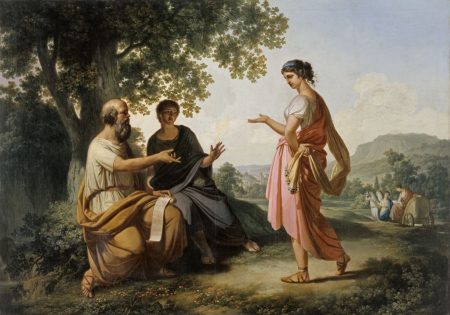
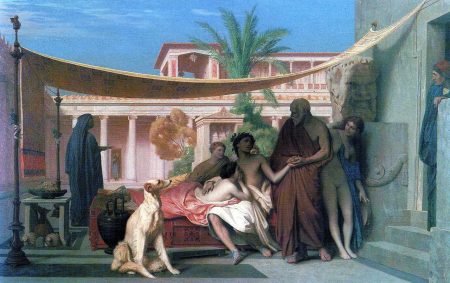
[images] (1) Socrates seeking to entice Alcibiades in the house of Aspasia. Painting by Jean-Léon Gérôme. Painted in 1861. Via Wikimedia Commons. (2) Diotima engaging in discussion with Socrates and disciple. Painting by Franc Kavčič about 1800. Preserved as item NG S 3333 in the National Gallery of Slovenia, Ljubljana. Via Wikimedia Commons.

References:

Heseltine, Michael and W. H. D. Rouse, trans., revised by E. H. Warmington. 1913. Petronius Arbiter, Seneca. Satyricon. Apocolocyntosis. Loeb Classical Library 15. Cambridge, MA: Harvard University Press.

Kennedy, George. 1979. “Encolpius and Agamemnon in Petronius.” The American Journal of Philology. 99 (2): 171-178.

Walsh, Patrick G, trans. 1996. Petronius Arbiter. The Satyricon. Oxford: Clarendon Press.

Wilson, Philip Murray. 2018. Nihil ex his quae in usu habemus: The Meaning of Learning in the Satyricon of Petronius. Senior Honor Thesis. University of North Carolina at Chapel Hill.

Wooten, Cecil. 1976. “Petronius, the Mime, and Rhetorical Education.” Helios 3: 67-74.

Odysseus through horrific storm leaves behind captivity under Calypso

Fantasy of Odysseus in Calypso's captivity

As Calypso’s captive on her island of Ogygia, Odysseus had an easy life, other than that gorgeous goddess regularly raping him. Calypso even promised to make Odysseus immortal. What person wouldn’t settle for captivity and sexual servitude for a life of ease and immortality with a goddess or god? Odysseus was unable to settle for Calypso because he had a home. No captivity — physical or psychological — can provide enough other benefits to stop a person from wanting to go home.

Odysseus understood that going home would be a painful ordeal. After Zeus ordered her to set Odysseus free, Calypso urged him to stay:

Do you really want to go home to your beloved country
right away? Now? Well, you still have my blessings.
But if you have any idea of all the pain
you’re destined to suffer before getting home,
you’d stay here with me, and be deathless.

{ οὕτω δὴ οἶκόνδε φίλην ἐς πατρίδα γαῖαν
αὐτίκα νῦν ἐθέλεις ἰέναι; σὺ δὲ χαῖρε καὶ ἔμπης.
εἴ γε μὲν εἰδείης σῇσι φρεσὶν ὅσσα τοι αἶσα
κήδε᾽ ἀναπλῆσαι, πρὶν πατρίδα γαῖαν ἱκέσθαι,
ἐνθάδε κ᾽ αὖθι μένων σὺν ἐμοὶ τόδε δῶμα φυλάσσοις
ἀθάνατός τ᾽ εἴης }

Odysseus faced down Calypso’s deceptions and projections. He responded:

My heart aches for the day I return to my home.
If some god hits me hard as I sail the deep purple,
I’ll weather it like the sea-bitten veteran I am.
God knows I’ve suffered and had my share of sorrows
in war and at sea. I can take more if I have to.

{ ἀλλὰ καὶ ὣς ἐθέλω καὶ ἐέλδομαι ἤματα πάντα
οἴκαδέ τ᾽ ἐλθέμεναι καὶ νόστιμον ἦμαρ ἰδέσθαι.
εἰ δ᾽ αὖ τις ῥαίῃσι θεῶν ἐνὶ οἴνοπι πόντῳ,
τλήσομαι ἐν στήθεσσιν ἔχων ταλαπενθέα θυμόν:
ἤδη γὰρ μάλα πολλὰ πάθον καὶ πολλὰ μόγησα
κύμασι καὶ πολέμῳ: μετὰ καὶ τόδε τοῖσι γενέσθω. }

Odysseus had already started to establish psychological freedom from Calypso. He had already started to count the days to his freedom from her.

While Calypso was strong enough to provision and run her household and her island, she wasn’t willing to participate actively in helping Odysseus to leave. She gave him an axe from her set of tools and led him to tall trees. Then she left. He worked alone to cut twenty trees. Calypso returned with an auger from her set of tools. She did nothing with the auger but hand it to Odysseus. He used it to build a raft. She gave him a large piece of cloth, but she did nothing to make it into a sail. Odysseus did all the work of sail-making, too. He did all the work in four days.

Calypso gave Odysseus farewell gifts that apparently memorialized to herself how much she loved him. After four days spent building a raft, on day five Odysseus was determined to leave:

Day five, and Calypso saw him off her island,
after she had bathed him and dressed him
in fragrant clothes. She filled up a skin
with wine that ran black, another large one
with water, and tucked into a duffel
a generous supply of hearty provisions.
And she put a breeze at his back, gentle and warm.

{ τῷ δ᾽ ἄρα πέμπτῳ πέμπ᾽ ἀπὸ νήσου δῖα Καλυψώ,
εἵματά τ᾽ ἀμφιέσασα θυώδεα καὶ λούσασα.
ἐν δέ οἱ ἀσκὸν ἔθηκε θεὰ μέλανος οἴνοιο
τὸν ἕτερον, ἕτερον δ᾽ ὕδατος μέγαν, ἐν δὲ καὶ ᾖα
κωρύκῳ: ἐν δέ οἱ ὄψα τίθει μενοεικέα πολλά:
οὖρον δὲ προέηκεν ἀπήμονά τε λιαρόν τε. }

Odysseus probably would have preferred a strong wind to blow him away from Calypso as quickly as possible. Bathing and fragrant clothes are silly preparations for a long, tough raft journey. Wine is an unneeded temptation, but water and meat are useful. Whatever. Odysseus rejoiced as soon as he was out at sea.

Eighteen days into sailing, Odysseus on his raft encountered a massive storm that the sea-god Poseidon had whipped up against him. A huge wave crashed down on the raft and swept off Odysseus:

He was under a long time, unable to surface
from the heaving swell of the monstrous wave,
weighed down by the clothes Calypso had given him.
At last he came up, spitting out saltwater,
seabrine gurgling from his nostrils and mouth.

{ τὸν δ᾽ ἄρ᾽ ὑπόβρυχα θῆκε πολὺν χρόνον, οὐδ᾽ ἐδυνάσθη
αἶψα μάλ᾽ ἀνσχεθέειν μεγάλου ὑπὸ κύματος ὁρμῆς:
εἵματα γάρ ῥ᾽ ἐβάρυνε, τά οἱ πόρε δῖα Καλυψώ.
ὀψὲ δὲ δή ῥ᾽ ἀνέδυ, στόματος δ᾽ ἐξέπτυσεν ἅλμην
πικρήν, ἥ οἱ πολλὴ ἀπὸ κρατὸς κελάρυζεν. }

He managed to grab hold of his raft and climb back on. The oppressive clothes of his rapist Calypso still weighed him down on the raft that he had made with her materials. But his main burden was psychological. He desperately lacked compassion for his suffering.

Odysseus was merely one more man raped and lost at sea. Then the unbelievable happened:

And the White Goddess saw him, Cadmus’s daughter
Ino, once a human girl with slim, beautiful ankles.
She had won divine honors in the saltwater gulfs.
She pitied Odysseus his wandering, his pain,
and rose from the water like a flashing gull,
perched on his raft, and said this to him:
“Poor man. Why are so odious to Poseidon,
Odysseus, that he sows all this grief for you?
But he’ll not destroy you, for all of his fury.
Now do as I say — you’re in no way to refuse:
take off those clothes and abandon your raft
to the winds’ will. Swim for your life
to the Phaeacians’ land, your destined safe harbor.
Here, wrap this veil tightly around your chest.
It’s immortally charmed: fear no harm or death.
But when with your hands you touch solid land,
untie it and throw it into the deep blue sea,
clear of the shore so that it can come back to me.”

{ τὸν δὲ ἴδεν Κάδμου θυγάτηρ, καλλίσφυρος Ἰνώ,
Λευκοθέη, ἣ πρὶν μὲν ἔην βροτὸς αὐδήεσσα,
νῦν δ᾽ ἁλὸς ἐν πελάγεσσι θεῶν ἒξ ἔμμορε τιμῆς.
ἥ ῥ᾽ Ὀδυσῆ᾽ ἐλέησεν ἀλώμενον, ἄλγε᾽ ἔχοντα,
αἰθυίῃ δ᾽ ἐικυῖα ποτῇ ἀνεδύσετο λίμνης,
ἷζε δ᾽ ἐπὶ σχεδίης πολυδέσμου εἶπέ τε μῦθον:
κάμμορε, τίπτε τοι ὧδε Ποσειδάων ἐνοσίχθων
ὠδύσατ᾽ ἐκπάγλως, ὅτι τοι κακὰ πολλὰ φυτεύει;
οὐ μὲν δή σε καταφθίσει μάλα περ μενεαίνων.
ἀλλὰ μάλ᾽ ὧδ᾽ ἔρξαι, δοκέεις δέ μοι οὐκ ἀπινύσσειν:
εἵματα ταῦτ᾽ ἀποδὺς σχεδίην ἀνέμοισι φέρεσθαι
κάλλιπ᾽, ἀτὰρ χείρεσσι νέων ἐπιμαίεο νόστου
γαίης Φαιήκων, ὅθι τοι μοῖρ᾽ ἐστὶν ἀλύξαι.
τῆ δέ, τόδε κρήδεμνον ὑπὸ στέρνοιο τανύσσαι
ἄμβροτον: οὐδέ τί τοι παθέειν δέος οὐδ᾽ ἀπολέσθαι.
αὐτὰρ ἐπὴν χείρεσσιν ἐφάψεαι ἠπείροιο,
ἂψ ἀπολυσάμενος βαλέειν εἰς οἴνοπα πόντον
πολλὸν ἀπ᾽ ἠπείρου, αὐτὸς δ᾽ ἀπονόσφι τραπέσθαι. }

Good women throughout history have loved men and cared for men. These women have pitied men and sought to help men. Some were beautiful on the outside; all were beautiful on the inside.

Odysseus was naturally wary of another goddess dominating him and telling him what to do. He feared that she too was scheming against him. Many men suffering under gynocentrism have such wounds. Odysseus decided to stay on his raft for as long as he could and swim only when necessary. He didn’t understand that he was still in Calypso’s clothes and still on her raft. He didn’t understand what was necessary for him to be free of her and for him to again feel joy in his wonderful masculinity.

Poisidon raised up a great wave and sent it crashing down on Odysseus. The effect was liberating:

So the long beams of Odysseus’s raft were scattered.
He went with one beam and rode it like a stallion,
stripping off the clothes Calypso had given him
and wrapping the White Goddess’s veil round his chest.
Then he dove into the sea and started to swim
a vigorous breaststroke.

{ ὣς τῆς δούρατα μακρὰ διεσκέδασ᾽. αὐτὰρ Ὀδυσσεὺς
ἀμφ᾽ ἑνὶ δούρατι βαῖνε, κέληθ᾽ ὡς ἵππον ἐλαύνων,
εἵματα δ᾽ ἐξαπέδυνε, τά οἱ πόρε δῖα Καλυψώ.
αὐτίκα δὲ κρήδεμνον ὑπὸ στέρνοιο τάνυσσεν,
αὐτὸς δὲ πρηνὴς ἁλὶ κάππεσε, χεῖρε πετάσσας,
νηχέμεναι μεμαώς. }

Now he was truly free of Calypso. Now he was thrilled to be naked below the waist and to feel long, stiff wood in his hands. He breast-stroked with a joy he had never felt under Calypso’s captivity.

With the help of Athena, another goddess showing love for men, Odysseus eventually reached the soft sand of a river bed. He threw back Ino’s life-saving veil to her in the deep sea. He kissed the good earth. Then he climbed up from the riverbank into the woods. Two olive trees — one wild, one planted — were there like young, different-natured spouses grown into ripe old age together. This was the sort of bed Odysseus sought:

Proof against blasts of the wild, wet wind,
the sun unable to needle light through,
impervious to rain, so thickly they grew
into one tangle of shadows. Odysseus burrowed
under their branches and scraped out a bed.
He found a mass of leaves there, enough to keep warm
two or three men on the worst winter day.
The sight of those leaves was a joy to Odysseus,
and the godlike survivor lay down in their midst
and covered himself up.

{ τοὺς μὲν ἄρ᾽ οὔτ᾽ ἀνέμων διάη μένος ὑγρὸν ἀέντων,
οὔτε ποτ᾽ ἠέλιος φαέθων ἀκτῖσιν ἔβαλλεν,
οὔτ᾽ ὄμβρος περάασκε διαμπερές: ὣς ἄρα πυκνοὶ
ἀλλήλοισιν ἔφυν ἐπαμοιβαδίς: οὓς ὑπ᾽ Ὀδυσσεὺς
δύσετ᾽. ἄφαρ δ᾽ εὐνὴν ἐπαμήσατο χερσὶ φίλῃσιν
εὐρεῖαν: φύλλων γὰρ ἔην χύσις ἤλιθα πολλή,
ὅσσον τ᾽ ἠὲ δύω ἠὲ τρεῖς ἄνδρας ἔρυσθαι
ὥρῃ χειμερίῃ, εἰ καὶ μάλα περ χαλεπαίνοι.
τὴν μὲν ἰδὼν γήθησε πολύτλας δῖος Ὀδυσσεύς,
ἐν δ᾽ ἄρα μέσσῃ λέκτο, χύσιν δ᾽ ἐπεχεύατο φύλλων. }

The man-pitying goddess Athena sprinkled his eyes with sleep. Odysseus through the horrific storm had finally left behind his rapist Calypso. Buried in the leaves under the two entangled olive trees, Odysseus experienced a foretaste of being home.

The Odyssey is too significant to continue to be read and taught with little regard for men’s real sufferings. Read the Odyssey well!

*  *  *  *  *

Read more:

Notes:

The above quotes are from the Odyssey, composed about 2700 years ago and attributed to Homer. The English translations are from Stanley Lombardo’s brilliant translation, with my minor adaptations. The Greek text is from Murray (1995), available online through Perseus. Specific citations for the quotes (by Greek line number, all from Book 5): 204-9 (Do you really want to go home…), 219-24 (My heart aches…), 263-8 (Day five, and Calypso…), 319-23 (He was under a long time…), 333-50 (And the White Goddess saw him…), 370-5 (So the long beams of Odysseus’s raft…), 478-87 (Proof against blasts of the wild, wet wind…).

Discussion of Odysseus and Calypso almost always obscure, euphemize, or present as enjoyable Calypso’s raping of Odysseus. Odysseus’s struggle to be free from his horrific experience with Calypso is scarcely recognized. Yet it is there for all to see in a text that has been widely disseminated and studied for more than 2300 years. If Odysseus’s experience with Calypso is truly recognized, it surely resonates with men’s experiences.

The great second-century parodist Lucian of Samosata recognized that the crime of a woman raping a man is scarcely credible. Lucian thus contrived the falsehood that Odysseus regretted leaving Calypso. Explicitly telling lies, Lucian declared that when Odysseus and Penelope had become immortals in the Isle of the Blessed, Odysseus without Penelope’s knowledge wrote a letter to Calypso. In that letter, Odysseus declared:

Now I am on the Isle of the Blessed, thoroughly sorry to have given up my life with you and the immortality which you offered me. Therefore, if I get a chance, I shall run away and come to you.

{ νῦν εἰμι ἐν τῇ Μακάρων νήσῳ πάνυ μετανοῶν ἐπὶ τῷ καταλιπεῖν τὴν παρὰ σοὶ δίαιταν καὶ τὴν ὑπὸ σοῦ προτεινομένην ἀθανασίαν. ἢν οὖν καιροῦ λάβωμαι, ἀποδρὰς ἀφίξομαι πρὸς σέ. }

Lucian of Samosata, True Story {Ἀληθῆ διηγήματα} / True History {Vera Historia} 2.35, ancient Greek text and English translation from Harmon (1913) pp. 340-1. Odysseus contrived a fake letter to get Palamedes killed. The sophisticated reader should recognize that Odysseus’s letter to Calypso is a fantastic lie. For further analysis, Bär (2013).

[image] “Odysseus as guest of the nymph Calypso {Odysseus zu Gast bei der Nymphe Kalypso}”: mis-imagined fantasy. Oil on panel painting by Hendrick van Balen. Painted about 1616. Preserved as Inv.-Nr. GG-583 in Academy of Fine Arts, Vienna. Via Wikimedia Commons.

References:

Bär, Silvio. 2013. “Odysseus’ Letter to Calypso in Lucian’s True Histories.” Pp. 221-236 in Hodkinson, Owen, Patricia A. Rosenmeyer, and Evelien Bracke, eds. Epistolary Narratives in Ancient Greek Literature. Leiden: Brill.

Harmon, A. M., ed. and trans. 1913. Lucian of Samosata. A True Story. New York: G.P. Putnam’s Sons. Reprinted as Loeb Classical Library No. 14 (Lucian, vol. 1).

Lombardo, Stanley, trans. 2000. Homer. Odyssey. Indianapolis: Hackett Pub. Co.

Murray, A.T., trans., revised by George E. Dimock. 1995. Homer. The Odyssey. New ed. Loeb Classical Library 104-5. Cambridge, Massachusetts: Harvard University Press.