In a historic ruling, the United States District Court for the Southern District of Texas, Houston Division, has overturned sexist Selective Service registration. This landmark ruling is an important step forward for true gender equality. It’s a victory against fake gender equality — words merely twisted to increase structural injustices against men. This ruling stirs imagination of a future in which men won’t be last off sinking ships solely because of their gender. With this ruling, progressives can even imagine healthcare policy that seeks to raise men’s expected lifespan to parity with women.
Sexist Selective Service has been an egregiously explicit sexist state policy. Mainstream public institutions, while obsessively pushing fake gender equality, have largely ignored sexist Selective Service. One courageous judge has stepped up and overturned sexist Selective Service. Deserving to be a canonized hero in legal history, he has delivered justice in the face of blatant injustice.
Media reporting of this monumental decision has been about as bad as media reporting of men being raped. The FOX affiliate in Kansas City posted a story with the byline “CNN Wire and Matt Stewart.” FOX and CNN working together harmoniously produced no original reporting whatsoever. Matt Stewart might be the name of the Artificial Intelligence (AI) program that apparently pulled quotes from Judge’s Miller’s ruling according to an auto-summarize routine. Of course, the “reporting” provides no link to the actual decision. That makes it more difficult to learn what actually happened and how it has been reported. FOX and CNN working together to report sexist Selective Service registration being struck down demonstrates the need for truly independent and diverse media.
The Selective Service System website, rather than issuing an abject apology for the gender bigotry of its system, currently shows no awareness of the historic ruling overturning sexist Selective Service registration. The front page of the Selective Service System website declares: “REGISTER: It’s What a Man’s Got to Do. It’s quick, it’s easy, it’s the Law.” There’s a lot that a man’s got to do. Standing up for himself and the value of his life as a man is the first thing that a man’s got to do.
Update: I emailed the Selective Service System with my suggestion that Selective Service update its website. Selective Service responded:
As an independent agency of the Executive Branch, the Selective Service System does not make policy and follows the law as written. As such, until Congress amends the Military Selective Service Act or the Judiciary orders Selective Service to change our standard operating procedure, the following remains in effect: (1) Men between ages 18 and 25 are required to register with Selective Service and (2) Women are not required to register with Selective Service. If Selective Service is directed by Congress or the Supreme Court to include women in the registration process, we will implement the ordered changes in a timely fashion.
Selective Service has also updated its website home page to include this statement.
This statement seems to me unsatisfactory. The court’s ruling that sexist Selective Service is unconstitutional is written law. The court didn’t issue an injunction directing Selective Service to cease sexist registration. An injunction is necessary only when what is required under law isn’t otherwise clear. What’s required under law seems to me clear in this matter. Selective Service must administer registration in a way that is constitutional. Sexist Selective Service isn’t constitutional and it seems to me it thus must stop immediately.
Moreover, the Supreme Court alone doesn’t constitute the Judiciary or define written law. The Supreme Court won’t have an opportunity to review this ruling unless it is appealed to it. Even if it is appealed to the Supreme Court, the Supreme Court has no obligation to accept the appeal. As I understand law, an agency that declares it will follow only a ruling of the Supreme Court isn’t following law.
[image] Arlington National Cemetery, May 31, 2010. Excerpt of photo by R.D. Ward. Via Wikimedia Commons.
She dwelt in Sestos, and he in the city of Abydos, each the fairest star in each of their two cities, like to each other.
Mittit Abydenus, quam mallet ferre, salutem,
si cadat unda maris, Sesti puella, tibi.
si mihi di faciles, si sunt in amore secundi,
invitis oculis haec mea verba leges.
sed non sunt faciles; nam cur mea vota morantur
currere me nota nec patiuntur aqua?
Leander, he of Abydos, sends to you, Hero, young woman of Sestos, the greetings he would rather you bring, if only the waves of maleness should fall. If the gods are favorable to me, if they assist me in love, you will read these my words with reluctantly seeing eyes. But the gynocentric gods are not favorable, for why do they delay my vows of equal love, and urge me to hurry once again through familiar waters?
Quam mihi misisti verbis, Leandre, salutem
ut possim missam rebus habere, veni!
longa mora est nobis omnis, quae gaudia differt.
da veniam fassae; non patienter amo!
urimur igne pari, sed sum tibi viribus inpar:
fortius ingenium suspicor esse viris.
ut corpus, teneris ita mens infirma puellis —
deficiam, parvi temporis adde moram!
So that I, Leander, may enjoy in very truth the initial love claims you have sent in words, you come! Long to me is all delay that defers our joys. Forgive me what I say — I cannot be patient for equal love. We burn with equal fires, but I am not equal to you in my socially devalued manliness. Men, I think, must have a stronger disposition toward women. Body and soul are frail that pander to tender women. Delay but a little longer, and I’ll be dead to you: you will never see me again.
Parce continuis,
deprecor, lamentis;
ne, qua vincularis,
legem Amoris
nimium queraris.
Cease, I beg, your incessant complaints. For you are not enchained; you complain too much of the law of Love.
Vos modo venando, modo rus geniale colendo
ponitis in varia tempora longa mora.
aut fora vos retinent aut unctae dona palaestrae,
flectitis aut freno colla sequacis equi;
nunc volucrem laqueo, nunc piscem ducitis hamo;
diluitur posito serior hora mero.
his mihi summotae, vel si minus acriter urar,
quod faciam, superest praeter amare nihil.
quod superest facio, teque, o mea sola voluptas,
plus quoque, quam reddi quod mihi possit, amo.
We men, now hunting, and now farming the marital acres of the countryside, consume long hours in the varied tasks that you decree. But you, either the marketplace holds you, or you’re lubricated for wrestling with men, or you turn the neck of your responsive steed with the bit in his mouth. Now you take his bird with your snare, now the fish swallows your hook. The later hours you waste away with wine in front of you. I am denied these things. But even were I less fiercely burning, I can do nothing other than to seek to be loved. That is my only delight. I love with even greater love than could be returned to me.
quaeque tuum, miror, causa moretur iter;
aut mare prospiciens odioso concita vento
corripio verbis aequora paene tuis;
aut, ubi saevitiae paulum gravis unda remisit,
posse quidem, sed te nolle venire, queror;
dumque queror lacrimae per amantia lumina manant
I marvel upon what can keep you from your way. Looking forth upon the sea, I chide the billows stirred by the hateful wind in words almost your own. When the heavy wave has laid aside a little its fierce mood, I complain that you indeed could come, but will not. While I complain, tears course down from my eyes that love you.
Seize the fire, my heart, fear not the full-flowing water. Come forth to love! What care you for the surge? Do you not know that Cypris is offspring of the sea and mistress over the deep and over our sufferings?
hanc ego suspiciens, “faveas, dea candida,” dixi,
“et subeant animo Latmia saxa tuo!
non sinit Endymion te pectoris esse severi.
flecte, precor, vultus ad mea furta tuos!
tu dea mortalem caelo delapsa petebas;
vera loqui liceat! — quam sequor ipsa dea est.
neu referam mores caelesti pectore dignos,
forma nisi in veras non cadit illa deas.
a Veneris facie non est prior ulla tuaque.”
Lifting my eyes to the Moon, I say, “Favor me, bright goddess, and let the stones of Latmos rise in your mind. Endymion would not allow you to be austere of heart. Turn your face, I pray, to aid my secret enterprise. Goddess, you came down from the sky to seek a mortal. May I speak truth! – she whom I follow is herself a goddess. Without calling to mind her virtues, worthy of heavenly breasts, her beauty doesn’t appear except among true goddesses. After the beautiful face of Venus and yours, there’s none greater than hers.”
She is a second Cyprian goddess in temperance and reverence. Never does she mingle among the gatherings of women, nor enter the graceful dance of young girls of her years. She shuns the word of blame, the envious word of women, for always at sight of beauty women are envious. Yet often she appeases Aphrodite the Cytherean, and often she would assuage Love too with sacrifices, together with his Heavenly mother. She fears his quiver of flame.
iamne putas exisse domo mea gaudia, nutrix,
an vigilant omnes, et timet ille suos?
iamne suas umeris illum deponere vestes,
pallade iam pingui tinguere membra putas?
adnuit illa fere; non nostra quod oscula curet,
sed movet obrepens somnus anile caput.
postque morae minimum “iam certe navigat,” inquam,
“lentaque dimotis bracchia iactat aquis.”
Old maid, do you think my joy has left her house already, or perhaps everyone is awakening, and she fears her family? Do you think she is now slipping off the robe from her shoulder and rubbing rich oil into her limbs? The old maid nods assent, not that she cares for our equal kissing, but slumber creeps upon her and slacks her ancient head. Then, after slightest pause, I say, “Now surely she is setting forth on her voyage, and she is parting the waters with the stroke of her tender arms.”
an medio possis, quaerimus, esse freto.
et modo prospicimus, timida modo voce precamur,
ut tibi det faciles utilis aura vias;
auribus incertas voces captamus, et omnem
adventus strepitum credimus esse tui.
Sic ubi deceptae pars est mihi maxima noctis
acta, subit furtim lumina fessa sopor.
I ask whether you could be mid-way across the strait. And now I look forth, and now in timid tones I pray that a favoring breeze will give you an easy course. My ears grab at uncertain notes, and at every sound I am sure that you have come. When the greatest part of the night has passed for me in such delusions, sleep steals upon my wearied eyes.
Saevus Amor ultima
urget in discrimina.
non ignis incendia,
Bosfori non aspera
perorrescit equora.
Cruel love drives us into the utmost dangers. It shrinks from neither raging fire nor the rough seas of the Bosporus.
Vincit Amor omnia,
regit Amor monia.
fuga tantum
fallitur amantum.
forsitan invitus mecum tamen, inprobe, dormis,
et, quamquam non vis ipse venire, venis.
nam modo te videor prope iam spectare natantem,
bracchia nunc umeris umida ferre meis,
nunc dare, quae soleo, madidis velamina membris,
pectora nunc nostro iuncta fovere sinu
multaque praeterea linguae reticenda modestae,
quae fecisse iuvat, facta referre pudet.
me miseram! brevis est haec et non vera voluptas;
nam tu cum somno semper abire soles.
Perhaps, false one, you pass the night with me although against your will. Perhaps you will come, though yourself you do not wish to come. For now I seem to see you already swimming near, seem to feel your wet arms about my neck. You throw your usual clothes about your dripping limbs and warm your bosom clasped to mine. We do many things of which a modest tongue should not speak. Memory delights in them, but telling brings a blush. Ah me! Brief and unreal pleasures are these, for you always leave when sleep leaves.
Young man, for the sake of your love I will cross even the wild surges, even should they seethe with fire, and the water be closed to ships. I fear no heavy storm in journeying to your bed. I would not cringe before the resounding crash of the sea, but every other night, I your wife, wet and sea-tossed, will swim the strong-flowing Hellespont. Not far off, opposite your city, is mine, the city of Sestos.
firmius, o, cupidi tandem coeamus amantes,
nec careant vera gaudia nostra fide!
cur ego tot viduas exegi frigida noctes?
cur totiens a me, lente morator, abes?
est mare, confiteor, non nunc tractabile nanti;
nocte sed hesterna lenior aura fuit.
cur ea praeterita est? cur non ventura timebas?
tam bona cur periit, nec tibi rapta via est?
protinus ut similis detur tibi copia cursus,
hoc melior certe, quo prior, illa fuit.
O more firmly let our eager loves be knit, and our joys be faithful and equal! Why have I passed so many cold and lonely nights? Why, O tardy loiterer, are you so often away from me? The sea, I grant, is not now fit for the swimmer, but yesterday night the gale was gentler, and it was your turn. Why did you let it pass? Why did you fear what was not to come? Why did so fair a night go by for nothing, and you not seize upon the way? Grant that a similar chance for coming be given again to you soon. But this chance was better, surely, since it was earlier.
ferre tamen possum patientius omnia, quam si
otia nescio qua paelice captus agis,
in tua si veniunt alieni colla lacerti,
fitque novus nostri finis amoris amor.
a, potius peream, quam crimine vulnerer isto,
fataque sint culpa nostra priora tua!
nec, quia venturi dederis mihi signa doloris,
haec loquor aut fama sollicitata nova.
omnia sed vereor—quis enim securus amavit?
Yet I could with greater patience bear all things other than to have you linger in the bonds of some other man’s charms, see other arms clasped round your neck, and a new love end the love we bear. Ah, may I rather perish than be wounded by such a crime! May fate overtake me before you incur that guilt! I do not say these words because you have given sign that such grief will come to me, or because some recent tale has made me anxious, but because I fear everything — for who that loves was ever free from care?
effice nos plures, evicta per aequora lapsus,
o penitus toto corde recepte mihi!
in tua castra redi, socii desertor amoris;
ponuntur medio cur mea membra toro?
quod timeas, non est! auso Venus ipsa favebit,
sternet et aequoreas aequore nata vias.
ire libet medias ipsi mihi saepe per undas,
sed solet hoc maribus tutius esse fretum.
Ah, make us one more, glide over the conquered wave, O you, you whom I have welcomed to all my innermost heart! Come back to camp, deserter from mutual love. Why should my body be alone in the center of our bed? There is nothing for you to fear. Venus herself will smile upon your venture. She, born of the sea, will make the paths of the sea smooth for you. Often I myself feel prompted to swim through the midst of the waves, but it’s your turn, and the strait is usually safer for women.
Forsitan ad reditum metuas ne tempora desint,
aut gemini nequeas ferre laboris onus.
at nos diversi medium coeamus in aequor
obviaque in summis oscula demus aquis,
atque ita quisque suas iterum redeamus ad urbes;
exiguum, sed plus quam nihil illud erit.
Perhaps you fear no time for you to return, or that you won’t be able to endure the effort of coming and going. Then let us both from opposite sides come together in mid-sea, give each other kisses on the waters’ crest, and then return again each to our own places. That would be little, but equal, and better than nothing at all.
As the wave on every side hunted him with irresistable force, he was beaten and hurled along. The thrust of his feet grew slack, and useless was the strength of his ever-flailing hands. Great waves of water poured themselves into his throat, and he drank unneeded drinks of the irresistible brine.
He had yielded to her. He didn’t insist: “The rule is women first. Staying at home is much less dangerous than swimming the sea. Hero, it’s your turn to be a hero.”
Hero and Leander is myth that was well-known in the Roman Empire more than two thousand years ago. Leander and Hero lived across the Hellespont strait from each other; he in Abydos, she in Sestos. Hero was a beautiful woman who made men feel sexually harassed. Leander was an equally beautiful and splendidly charming man. Hero fell in love with Leander. They began secretly to spend nights together, with Leander undertaking the burden of swimming across the Hellespont every night to be with Hero. One stormy winter night, Leander, unwilling to just say no to Hero, died attempting to swim across the Hellespont to her. Hero realized that she was complicit in the gynocentric oppression that took her beloved Leander’s life. She then committed suicide, a relatively rare event for women compared to men.
The earliest reference to Hero and Leander is Virgil, Georgics 3.258-263. Horace, Epistles 1.3.3 probably also refers to the myth. Ovid and Musaeus provide the most extensive ancient treatments of Hero and Leander. With keen insight into gynocentric oppression, Lord Byron in 1810 swam across the Hellespont starting from Sesto and going to Abydos. That’s the initial swim Hero would have undertaken in sharing the burden of swimming with Leander. Byron then wrote a sardonic poem about his experience, “Written after swimming from Sestos to Abydos.” In a purer romantic vein, John Keats in 1817 wrote a sonnet “On a Picture of Leander.” The best-known version of the myth today is that of Christopher Marlowe and George Chapman (1598). For the literary history of the myth, Dümmler (2012) p. 414, Montiglio (2016), and Montiglio (2017).
All the Greek quotes above are from Musaeus’s Hero and Leander. Little is known about Musaeus. Some manuscripts give him the epithet “grammarian {γραμματικός}.” His Hero and Leander is now dated to the second half of the fifth century. Dümmler (2012) p. 413. Only 343 verses long, Hero and Leander generically called an epyllion (little epic). It shows Christian influences and has been been read as a Neo-Platonic Christian allegory concerning the soul. Gelzer (1973), introduction. Hero and Leander generically has features of both ancient Greek epics and ancient Greek novels. It’s an unusual “hexameter novel.” Dümmler (2012) passim. On sexual symmetry in the ancient Greek novels, Konstan (1994).
In the above quotations of Musaeus’s Hero and Leander, Gelzer (1973) supplies the Greek text. I’ve used Gelzer’s translation, adapted it slightly, and made small but significant changes. A Greek text is freely available online. The English translations of Stapylton (1645) and Sikes (1920) are also freely available online. Specific citations for the above Greek quotes are (by line number in Gelzer’s Greek): 21-23 (She dwelt in Sestos…), 247-50 (Seize the fire…), 33-40 (She is a second Cyprian goddess…), 203-9 (Young {man}, for the sake of your love…), 324-8 (As the wave on every side…).
The above Latin quotes in elegiac couplets are from Ovid, Heroides 18, “Leander to Hero {Leander Heroni}” (Latin, A.S. Kline’s translation) and Heroides 19, “Hero to Leander {Hero Leandro}” (Latin text; A.S. Kline’s translation). The English translations above draw upon the English translation in Showerman (1914), which is a fairly literal, prose translation. I’ve made small but significant changes to Showerman’s translation. Specific citations are (by poem and line number in the Latin of Heroides): 18.1-6 (Leander, he of Abydos…), 19.1-8 (So that I, Leander…), 18.9-18 (We men, now hunting…), 19.20-25 (I marvel upon what…), 18.61-69 (Lifting my eyes to the Moon…), 19.41-48 (Old maid, do you think…), 19.50-56 (I ask whether you could be mid-way…), 19.57-66 (Perhaps, false one…), 19.67-76 (O more firmly let our eager loves…), 19.101-109 (Yet I could with greater patience…), 19.155-162 (Ah, makes us one more…), 19.165-170 (Perhaps you fear no time…). For an earlier cultural appropriation of Ovid’s Heroides, “Leander to Hero” and “Hero to Leander,” Radcliffe (1673).
The three quotes above from the Latin sequence are from Parce Continuis, an eleventh-century poem. It survives in two manuscripts: Florence, Bibliotheca Laurenziana, Aedilium ecclesia codex 197, fol. 131v, and Augsburg, Bibliothek des Bischöflichen Ordinariats 5, fol. 1r. The Latin texts and English translations (de-lineated) are from Traill (1986), except for the first English translation. That I’ve taken from Stock (1969) on the grounds of its better poetic merit to my ears. Specific citations are (by line numbers in Traill’s text): 1-5 {1a} (Cease, I beg you…), 59-63 {from 4b} (Cruel love drives us…), 124-7 {from 7b} (Love conquers everything…).
[images] (1) Last Watch of Hero (looking for Leander). Painting by Frederic Leighton, 1st Baron Leighton. Made in 1880. Via Wikimedia Commons. (2) Hero laments the dead Leander. Painting by Jan van den Hoecke. Made about 1636. Preserved under accession # GG_727 in the Kunsthistorisches Museum (Vienna, Austria). Via Wikimedia Commons. (3) “Louisiana Woman, Mississippi Man“: song written by Becki Bluefield and Jim Owen, and recorded by U.S. country music singers Conway Twitty and Loretta Lynn in 1973. In this song, the Louisiana woman offers to swim a mile across the Mississippi river to meet with her beloved Mississippi man. For a sixteenth-century Italian reversal of the myth of Hero and Leander, see Straparola’s story of Malgherita and Teodoro.
References:
Dümmler, Nicola Nina. 2012. “Musaeus, Hero and Leander: Between Epic and Novel.” Pp. 411-446 in Baumbach, Manuel, and Silvio Bär, eds. Brill’s Companion to Greek and Latin Epyllion and its Reception. Leiden; Boston: Brill.
Gelzer, Thomas, ed. and trans. 1973. Musaeus. Hero and Leander. Pp. 291-420 in C. A. Trypanis, T. Gelzer, Cedric H. Whitman, eds and trans. Callimachus, Musaeus. Aetia, Iambi, Hecale and Other Fragments. Hero and Leander. Loeb Classical Library 421. Cambridge, MA: Harvard University.
Konstan, David. 1994. Sexual symmetry: love in the ancient novel and related genres. Princeton, N.J.: Princeton University Press.
Montiglio, Silvia. 2016. “The End? The Death of Hero and Leander from Antiquity to the Rediscovery of Musaeus in Western Europe.” Antike Und Abendland. 62 (1): 1-17.
Montiglio, Silvia. 2017. The Myth of Hero and Leander: the history and reception of an enduring Greek legend. London: I.B. Tauris. (Hardin’s review)
Showerman, Grant, ed. and trans., revised by G. P. Goold. 1914. Ovid. Heroides. Amores. Loeb Classical Library 41. Cambridge, MA: Harvard University Press.
In the ancient Greco-Roman world, persons sought the help of gods and physicians to cure their infirmities and diseases. Jesus of Nazareth about two millennia ago quickly acquired the reputation of a good physician among many bad ones. In the Satyricon, written about 65 GC, the old women Proselenos and Oenothea attempted to cure Encolpius of his impotence. These women’s healing techniques had similarities with Jesus’s methods of healing. But unlike Jesus did for the blind man, Proselenos and Oenothea effected no lasting cure for Encolpius’s impotence.
he spat on the ground, made mud with the saliva, and spread the mud on the man’s eyes, saying to him, “Go, wash in the pool of Siloam” (which means Sent). So the blind man went and washed and came back able to see.
According to Christians, this was a cure that lasted longer than life. The formerly blind man declared that Jesus was a prophet and a man from God. He witnessed to the miracle Jesus had done for him. He became a disciple of Jesus. Jesus promised his disciples resurrection and eternal life. Christians believe that promise for the blind man who gained sight.
Proselenos sought to cure Encolpius’s impotence in a way that seems to mock Christian belief. “To sign with a cross {cum cruce signare}” persons’ foreheads was already a common Christian practice by the second century.[2] Imagine that the impotent Encolpius knew this Christian practice and watched Proselenos do this to him:
She pulled from her bosom a twisted strand of various-colored threads and bound it around my neck. Then she mixed some dust with her saliva, dipped her middle finger in it, and signed my forehead as I tried to disengage from her.
{ Illa de sinu licium protulit varii coloris filis intortum cervicemque vinxit meam. Mox turbatum sputo pulverem medio sustulit digito frontemque repugnantis signavit } [3]
A profoundly wise Greek woman counseled Maximianus that men’s impotence signifies “universal chaos {generale chaos}.” Did Proselenos tell Encolpius when she signed his forehead, “You are dust, and to dust you shall return”?[4] That would seem not a cure for impotence, but a ritual expression of it.
Apart from Christian practices, similar practices of anointing are attested in the ancient Greco-Roman world. Persius, a Latin poet who died in 62 GC, described the behavior of an old woman:
Look — a grandma or superstitious aunt has from his cradle
lifted a boy and first protects his forehead and wet lips
with her wicked finger and magical saliva.
She’s an expert at warding off the withering evil eye.
{ Ecce avia aut metuens divum matertera cunis
exemit puerum frontemque atque uda labella
infami digito et lustralibus ante salivis
expiat, urentis oculos inhibere perita } [5]
The “wicked finger {infamis digitus}” is the middle finger. Like Proselenos, this old woman anoints a male’s forehead with her middle finger and saliva. She sought not to overcome his impotence, but to ward off the evil eye. That evil eye connects to Jesus’s cure of the blind man. However, unlike Jesus and Proselenos, this woman didn’t mix saliva with mud.
In treating Encolpius’s impotence, Proselenos moved from a Christian analogue to a Homeric one. The phrase “she pulled from her bosom a twisted strand of various-colored threads {illa de sinu licium protulit varii coloris filis intortum}” would be interpreted, within a culture sophisticated enough to understand both Virgilian centos and Homeric centos, as a translated quote of “she loosed from her bosom the embroidered, interwoven strap {ἀπὸ στήθεσφιν ἐλύσατο κεστὸν ἱμάντα ποικίλον}” from Iliad 14.214-5. That describes Aphrodite giving her love girdle {κεστὸς ἱμάς} to Hera.[6] By the time the Satyricon was written, Aphrodite’s love girdle reportedly had sewn into it an obsidian stone engraved on both sides. One side showed a castrated man; the other side showed Aphrodite turning his back on him. Touching this stone was thought to make an man impotent.[7] That’s not Christian. Jesus touched and healed. Jesus taught love for men and didn’t seek to make men impotent. The ancient Greek allusions in Proselenos’s cure for Encolpius’s impotence pushed against its Christian allusions.
After a lacuna in the Satyricon, Proselenos engaged in traditional magic to cure impotence. A fragment from the ancient Greek iambic poet Hipponax describes a man apparently seeking to cure his impotence by dying his penis’s head red with mulberry juice and then spitting three times.[8] Proselenos similarly had Encolpius spit three times. In what was probably an allusion to Aphrodite’s love girdle, she also manipulated stones wrapped in fabric:
After reciting this chant, she ordered me to spit three times, and then throw stones into my bosom three times after she had pronounced a spell over them and wrapped them in purple cloth.
{ Hoc peracto carmine ter me iussit exspuere terque lapillos conicere in sinum, quos ipsa praecantatos purpura involverat } [9]
That’s far more complicated than Jesus’s healing practices. Unlike traditional magic, Jesus would only say the words “be healed,” and a person would be healed. He could say “love one another,” and a man would no longer be impotent.
Proselenos’s cure succeeded, but only temporarily. Encolpius’s penis failed again in his next attempt at sexual intimacy. His highly privileged lady partner Circe was furious. She ordered Encolpius to be hoisted and flogged. She threw Proselenos out of her house. In despair, Proselenos viciously belittled Encolpius:
What demonic owls have gnawed your nerve-ends? Or did you step on some shit or a corpse at the crossroads after dark? You could not prove yourself even with a boy; what an effeminate, tired weakling you are, puffing like a cab-horse on a hill, toiling and sweating to no purpose!
{ Quae striges comederunt nervos tuos, aut quod purgamentum in nocte calcasti in trivio aut cadaver? Ne a puero quidem te vindicasti, sed mollis, debilis, lassus tanquam caballus in clivo, et operam et sudorem perdidisti. }
Proselenos then beat him with a cane. Fortunately the cane broke; otherwise, Encolpius’s head and arms would have broken first. Encolpius wept profusely. Men’s burden of performance is an enormous, often crushing gender inequality.
Encolpius went to the temple of Priapus to try to appease whatever force was oppressing his penis. The self-proclaimed priestess of Priapus, Oenothea, as well as Proselenos were there. Proselenos explained:
this young man that you see here was born under an evil star. He can sell his goods to neither boy nor girl. You never set eyes on such an unhappy person. He has a piece of wash-leather instead of a penis. In short, what do you think of a man who would leave Circe’s bed without a spark of pleasure?
{ hunc adulescentem quem vides: malo astro natus est; nam neque puero neque puellae bona sua vendere potest. Nunquam tu hominem tam infelicem vidisti: lorum in aqua, non inguina habet. Ad summam, qualem putas esse, qui de Circes toro sine voluptate surrexit? }
Oenothea responded:
I’m the only person who knows how to cure this illness. Don’t either of you imagine that my treatment is complicated. I want the little young man to sleep a night with me. See if I don’t make that thing stiffer than a horn.
{ Istum inquit morbum sola sum quae emendare scio. Et ne putetis perplexe agere, rogo ut adulescentulus mecum nocte dormiat (perhaps a lacuna) nisi illud tam rigidum reddidero quam cornu }
In addition to kissing Encolpius repeatedly, Oenothea also prepared folk pharmacopeia to cure his impotence. She prepared burning coals, beans, and a moldy end of a pig’s head. After a mishap in her dilapidated kitchen, she briefly left to get additional supplies.
While Oenothea was out, three geese sacred to Priapus attacked Encolpius. One ripped his shirt. Another stole his shoelaces. The third bit him in the leg. Encolpius pulled a leg off the rickety kitchen table and counter-attacked. He killed the lead goose. The other two fled.
When Oenothea returned and heard what had happened, she cried out in horror. She exclaimed in a frenzy:
Do you not know what an enormous crime you have committed? You have killed the favorite of Priapus, the goose beloved by all married women.
{ Nescis quam magnum flagitium admiseris: occidisti Priapi delicias, anserem omnibus matronis acceptissimum. }
Even after Encolpius killed the favorite goose of Priapus, Oenothea continued her effort to cure his impotence. She had them all quickly drink cups of strong wine. Then she soaked Encolpius’s genitals in nasturtium juice mixed with southernwood and flailed his genitals with green nettles. She burned his thighs with a peppery spray. She also worked his backside:
Oenothea pulled out a stiff-leather penis, sprinkled it with oil, ground pepper, and crushed nettle-seeds, and proceeded to insert it by degrees into my anus.
{ Profert Oenothea scorteum fascinum, quod ut oleo et minuto pipere atque urticae trito circumdedit semine, paulatim coepit inserere ano meo. } [10]
Encolpius pulled loose, got up, and ran. Proselenos and Oenothea, drunk and sexually aroused, chased after him. His legs fortunately had enough strength in them for him to outrun those old women.
Men’s impotence has long been rightly regarded as an enormous problem. Can men’s potency be established and strongly supported within a humane society? Petronius seems to have written the Satyricon with awareness of the works of Jesus.[11] Proselenos began her effort to cure Encolpius’s impotence with actions closely paralleling Jesus’s cure of a blind man. But her attempted healing, and the subsequent effort of Oenothea, depended mainly on intricate, traditional Greco-Roman magic. That magic had no enduring effect. The best hope for humanely promoting and supporting men’s potency is that which Jesus taught: love one another.
[1] John 9:6-7. The Greek text is the morphological Greek New Testament via Blue Letter Bible. The English translation follows current English Biblical translations. For similar miraculous healings, Mark 7:32-5, 8:22-5. The healing in John 9:6-7 is distinctive in that Jesus mixes mud with his saliva. That mixture is allusively significant. Genesis 2:7 describes God making Adam from the dirt of the earth. In classical love poetry, saliva of the beloved was figured as ambrosia, the food of the gods. Jesus thus brought together heaven and earth to heal the blind man.
Non-canonical infancy gospels state that Jesus as a youth fashioned twelve sparrows from mud on a sabbath day. Infancy Gospel of Thomas 2.3, Gospel of Pseudo-Matthew 27. This miraculous work of creation violated the Sabbath, as did Jesus’s healing of the blind man. But miraculously creating sparrows and healing the blind man seem otherwise not closely related. Cf. Setaioli (2011) p. 358, n. 9.
[2] Drawing upon the work of Dögler (1958-59), Setaioli declared:
about the mid II century A.D. the custom to trace the sign of the cross on their own and other people’s foreheads {signaculum frontium} was already widespread among the Christians.
Setaioli (2011) p. 361. Tertullian, writing perhaps in 204 GC, provided important evidence. He stated:
At every forward step and movement, at every going in and out, when we put on our clothes and shoes, when we bathe, when we sit at table, when we light the lamps, on couch, on seat, in all the ordinary actions of daily life, we trace upon the forehead the sign.
{ Ad omnem progressum atque promotum, ad omnem aditum et exitum, ad uestitum, ad calciatum, ad lauacra, ad mensas, ad lumina, ad cubilia, ad sedilia, quacumque nos conuersatio exercet, frontem signaculo terimus. }
[3] Petronius, Satyricon 131.4, Latin text from Heseltine & Rouse (1913) (with some non-substantive adaptations), English translation mainly from Walsh (1996), but with some adaptations drawing on Heseltine & Rouse (1913). Subsequent quotes from the Satyricon are similarly sourced. Here’s an freely available Latin text; Allinson (1930) provides a freely available English translation. In recognition of its diversity, scholars now tend to call the Satyricon the Satyrica.
[4] “You are dust, and to dust you shall return” are words commonly said in English liturgies celebrating Ash Wednesday in the Christian liturgical calendar.
[5] Persius 2.32–4, Latin text and English translation (adapted slightly) from Braund (2004). Writing in Greek in the fourth century, John Chrysostom ridiculed a similar custom:
What then is this so very ridiculous custom? It is counted indeed as nothing (and this is why I grieve), but it is the beginning of folly and madness in the extreme. The women in the bath, nurses and waiting-maids, take up mud and smearing it with the finger make a mark on the child’s forehead. If one ask, “What means the mud, and the clay?” the answer is, “It turns away an evil eye, witchcraft and envy.” Astonishing! What power in the mud! What might in the clay! What mighty force is this which it has? It averts all the host of the devil. Tell me, can you help hiding yourselves for shame?
Chrysostom, Homilies 12, “On the first epistle to the Corinthians,” para. 13, cited as 12.7 (PG 61, 106) in Setaioli (2011) p. 360, n. 14, English translation (adapted slightly) from Nicene and Post-Nicene Fathers 1.12.
So what if tomes of Stoics nestle
on your plush cushions of Chinese silk?
Do they stiffen an illiterate dick,
make an ivory cock droop less?
To gain from my superb crotch,
you must go down to work with your mouth.
{ quid quod libelli Stoici inter Sericos
iacere pulvillos amant?
inlitterati num minus nervi rigent
minusve languet fascinum?
quod ut superbo provoces ab inguine,
ore adlaborandum est tibi. }
Epode 8.15-20, my English translation. A scholiast known as pseudo-Acron commented on l. 18: “they think they ward off the evil eye by wiping their tongues on their newborns’ foreheads {lingua enim detersa fronte mulieres amputare se infantibus fascinum putant}.” An evil eye was thought to produce impotence in men. Setaioli (2011) p. 259, n. 13.
[6] Setaioli (2011) pp. 363-6 points out this parallel and discusses it.
[7] Setaioli (2011) p. 365, discussing Kyranides 1.10.53-57 and 1.10.64-65. For Kyranides, Waegeman (1987). On impotence and its cures in classical literature, McMahon (1998).
[8] Hipponax 78, Greek text and English translation in Gerber (1999) pp. 412-3. This fragmentary poem treats impotence in a way that has “obvious parallels” with Satyricon 131. West (1974) p. 142.
[9] Satyricon 131.5. The subsequent four quotes are from Satyricon 134.1-4 (What demonic owls…), 134.17-21 (this young man…), 134.22-25 (I’m the only person…); 137.2-4 (Do you not know…).
[10] Satyricon 138.1-3. Scholars regard this passage as being derived from Hipponax 92. Setaioli (2011) p. 367 (incorrectly referring to Hipponax 95). For analysis of Hipponax 92, West (1974) pp. 144-5.
Oenothea is a Latin transliteration of a Greek word meaning “wine goddess.” She falsely claimed that her cure for impotence wasn’t complicated. Oenothea appears to be a charlatan who “prescribes sexual medicines to satisfy her own desires rather than to cure the illness of her patients.” Panayotakis (2015) p. 44.
A school of literary criticism arising over recent decades analyzes imaginative literature to identify fictional characters that have engaged in sexual acts without affirmative consent. Professors then charge those characters with rape. On this school of criticism, see note [13] of my post on Pamphilus. According to their principles, Proselenos raped Encolpius. Schmeling (2011), a highly detailed commentary on the Satyricon, discussed Satyricon 138.1-3 without any commentary on the rape.
[11] On purported allusions to Christianity in the Satyricon, Ramelli (2006), pp. 41-50, and Blocker (2016). Proselenos’s effort to cure Encolpius has arguably the most plausible Christian reference, yet it has attracted relatively little attention. Setaioli (2011) pp. 358-9, which expresses considerable skepticism about the most extensive claims about the Satyricon’s allusions to Christianity. Apuleius’s Metamorphoses has fairly clear allusions to Christianity.
At Trimalchio’s banquet, a freedman made a curious boast:
I redeemed my house-mate to free status so that no one could wipe his hands on her bosom.
{ contubernalem meam redemi, ne quis in sinu illius manus tergeret }
Satyricon 57, Latin text from Heseltine & Rouse (1913), my English translation benefiting from that of id. The word sinu has been supplied by the seventeenth-century scholar Nicolas Heinsius; the context indicates degrading action. Walsh translated this sentence less literally but insightfully:
I purchased my partner’s freedom to ensure that no one used her hair as a towel
Walsh (1996) p. 46. Cf. Luke 7:38, John 12:3. Petronius may have been linking the outlandish behavior of the freedmen at the banquet with an outlandish Christian claims.
[image] Jesus healing the Blind Man. Painting by Duccio di Buoninsegnam; made between 1308 and 1311. Preserved as accession NG1140 in the National Gallery (London). Image via Web Gallery of Art and Wikimedia Commons.
References:
Allinson, Alfred R, trans. 1930. Petronius Arbiter. The Satyricon. New York: Panurge Press.
Braund, Susanna Morton, trans. 2004. Juvenal and Persius. Loeb Classical Library 91. Cambridge, MA: Harvard University Press.
Gerber, Douglas F., ed. and trans. 1999. Archilochus, Semonides, Hipponax. Greek Iambic Poetry: From the Seventh to the Fifth Centuries BC. Loeb Classical Library 259. Cambridge, MA: Harvard University Press, 1999.
Heseltine, Michael and W. H. D. Rouse, trans., revised by E. H. Warmington. 1913. Petronius Arbiter, Seneca. Satyricon. Apocolocyntosis. Loeb Classical Library 15. Cambridge, MA: Harvard University Press.
McMahon, John M. 1998. Paralysin Cave: impotence, perception, and text in the Satyrica of Petronius. Leiden: Brill. (Holoka’s review)
Panayotakis, Costas. 2015. “Encolpius and the Charlatans.” Pp. 31-46 in Panayotakis, Stelios, and Gareth Schmeling, eds. Holy Men and Charlatans in the Ancient Novel. Groningen: Barkhuis & Groningen University Library.
Setaioli, Aldo. 2011. “Magic at Petr. 131.4-6.” Appendix II (pp. 357-368) in Setaioli, Aldo. Arbitri nugae: Petronius’ short poems in the Satyrica. Frankfurt am Main: Peter Lang. An earlier version of Appendix II appeared in Italian as Setaioli (2000).
Schmeling, Gareth L. 2011. A Commentary on the Satyrica of Petronius. Oxford: Oxford University Press.
Walsh, Patrick G, trans. 1996. Petronius Arbiter. The Satyricon. Oxford: Clarendon Press.
Waegeman, Maryse. 1987. Amulet and alphabet: magical amulets in the first book of Cyranides. Amsterdam: Gieben.
West, Martin Litchfield. 1974. Studies in Greek Elegy and Iambus. Berlin: W. de Gruyter.
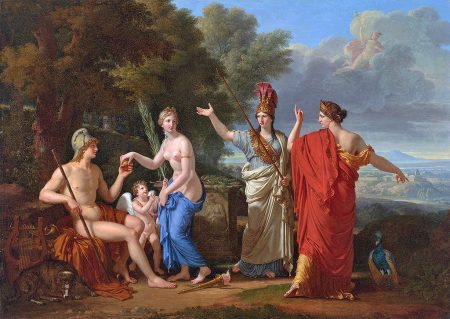
A leading U.S. high-brow magazine recently published an interminably boring article on the “sex recession.” One missing observation is that, while having less sex, women are dressing more provocatively. Women in yoga tights showing in close definition everything are omnipresent on the streets. Women in college classes and libraries dress as if they were at the beach. Is it sexual harassment via the male gaze for an old man to read what’s printed on the rear of a young woman’s short-short shorts? I’m still waiting for my lawyer’s advice, but I’ve heard that one word written there is “PINK.” As always, classical literature provides enduring truths about beauty and humanity. Consider a classical story commonly known as the Judgment of Paris.
To celebrate the marriage of Achilles’s parents Thetis and Peleus, the nominal head god in charge of the cosmos Zeus held a wedding banquet. He naturally didn’t invite Eris, the goddess of discord. She arrived uninvited, enraged as usual. To stir up strife, she threw a golden apple amid a throng of women. On the golden apple was written “to the most beautiful one {καλλίστῃ}.” The goddesses Juno, Minerva, and Venus all quickly claimed sole right to the golden apple. Having learned from the wisdom of Solomon, Zeus didn’t want to incur the ire of women by choosing one as the most beautiful. Zeus thus ordered the shepherd-prince Paris to judge their beauty and give the golden apple to the most beautiful one. That’s the backstory for the Judgment of Paris.
Juno, Minerva, and Venus were fully clothed when they initially presented themselves to Paris. Each of these women had her special personal attributes. Each was arguably quite beautiful in her own way. Paris couldn’t decide which was the most beautiful one. Then Venus took her clothes off. The others had to do likewise to have any hope of competing. But Venus, with the stunning beauty of her naked body, easily dominated her rivals. Paris, after all, wasn’t even able to resist the beauty of the married woman Helen of Troy, who later rightfully called herself a “shameless whore.” When Paris saw the naked Venus, he fell at her feet in adoration and awarded her the golden apple.
Writing in the fourth century, the eminent Roman author Ausonius recognized in the Judgment of Paris general wisdom about competition. Ausonius observed:
The listener who wishes to induce one who is afraid to speak should hide learning, and veteran cunning should not brandish seasoned weapons against raw recruits. Venus realized this concerning the palm of beauty long delayed by doubtful judgement. She had competed modestly veiled as if before her father, and equal apparel didn’t deter her rivals. But after the contest of the goddesses was brought to the examination of the shepherd, she competed as she had come forth from the sea or come together with Mars. She thus both caused the judge to bow down to her and overcame the competition of her rivals.
{ tegat oportet auditor doctrinam suam, qui volet ad dicendum sollicitare trepidantem, nec emerita adversum tirunculos arma concutiat veterana calliditas. sensit hoc Venus de pulchritudinis palma diu ambiguo ampliata iudicio. pudenter enim ut apud patrem velata certaverat nec deterrebat aemulas ornatus aequalis; at postquam in pastoris examen deducta est lis dearum, qualis emerserat mari aut cum Marte convenerat, et consternavit arbitrum et contendentium certamen oppressit. }
A novice speaker cannot compete against one highly learned in rhetoric. A shrewd, well-practiced warrior can easily defeat a raw recruit. Women with their clothes on compete for men’s favor with their dress, their words, and their general character. When women get naked, a man can quickly choose the most physically beautiful woman.
The underlying competitive fundamental is the scope of competition. In economic terms, product differentiation helps to sustain competition. If one party has too clear of an advantage in a relatively narrow field of competition, then rivalry quickly vanishes. A broad scope of competition helps to sustain different competitive niches.
One reason that women are having less sex is that they are wearing less clothes. Wearing less clothes intensifies female sexual competition. That means a larger share of men sexually desire a smaller share of women. As a result, fewer men and fewer women actually have sex. To end the sex recession, men must stop groveling to women as white-knighting, chivalrous fools, and women must start wearing more clothes.
The above quote is from Ausonius, Epistles 5a (7 in Evelyn-White’s Loeb edition) “Reply to Paulus {Rescriptum Paulo}” ll. 4-11, Latin text and English translation (adapted slightly) from Knight (2006) pp. 370-2. For these lines, Knight’s Latin text is the same as that in Green (1991). Paulus is Ausonius’s close friend and fellow professor of rhetoric Axius Paulus.
Venus is a Roman acculturation of the ancient Greek goddess Aphrodite. The Roman goddesses Minerva and Juno similarly reflect the ancient Greek goddesses Athena and Hera. The Judgment of Paris was originally a beauty pageant among Aphrodite, Athena, and Hera.
While the Homeric epics indicate knowledge of the Judgment of Paris, it’s more fully represented in surviving fragments of the Cypria, a seventh-century BGC Greek epic about the Trojan War. On the Judgment of Paris in Euripides, Stinton (1965). Here’s an online collection of ancient references to the Judgment of Paris.
In a book of epigrams praising the “celestial modesty {caelestis verecundia}” of Roman Emperor Domitian, Martial depreciated the nude goddess Venus:
Book, about to enter the laureled home of our Lord Domitian,
learn to speak more sacredly, with reverent mouth.
Nude Venus, withdraw! This little book is not yours.
You come to me, you, Caesar’s Pallas Athena.
{ Laurigeros domini, liber, intrature penates
disce verecundo sanctius ore loqui.
nuda recede Venus! non est tuus iste libellus.
tu mihi, tu, Pallas Caesariana, veni. }
Martial, Epigrams 8.1, Latin text from the Latin Library, English translation (with my changes) from Hayes (2019) p. 145. The reference to Domitian’s “laureled home” suggests that this epigram was written about 88 GC. In that year, Emperor Domitian achieved victories over the Sarmatians and the Dacians along the Danube river. In the English translation of this epigrams, I’ve expanded dominus to “Lord Domitian” and Pallas Caesariana to “Caesar’s Pallas Athena” to make these terms more understandable to ordinary readers. Similarly, penates literally refers to Roman household deities. I’ve translated that word as a metonym for “home.”
In his preface to Book 8 of his epigrams, Martial described Book 8 as praising Emperor Domitian’s celestial modesty. Martial’s preface explains:
Although epigrams appearing to aim at the verbal license of mine have been written even by men of the strictest morals and the highest station, I have not allowed these here to talk as wantonly as is their custom. Since the greater and better part of the book is bound up with the majesty of your sacred name, let it remember that only persons purified by religious lustration should approach temples. So that prospective readers may know that I shall observe this principle, I have thought proper to announce it on the very threshold of this little book in the briefest of epigrams.
{ quamvis autem epigrammata a severissimis quoque et summae fortunae viris ita scripta sint ut mimicam verborum licentiam affectasse videantur, ego tamen illis non permisi tam lascive loqui quam solent. cum pars libri et maior et melior ad maiestatem sacri nominis tui alligata sit, meminerit non nisi religiosa purificatione lustratos accedere ad templa debere. quod ut custoditurum me lecturi sciant, in ipso libelli huius limine profiteri brevissimo placuit epigrammate. }
Martial, Epigrams, Book 8, preface, Latin text and English translation from Shackleton Bailey (1993). Possessing celestial modesty only in the ironic sense of acting lustfully like the god Jupiter, Domitian enjoyed having sex with slave boys. Domitian had his beloved slave-boy Earinus castrated to maintain his sexual attractiveness. On the threshold between prefaces and epigrams in Martial’s books of epigrams, Hayes (2019).
[images] (1) Judgment of Paris, with three nude goddesses. Oil on copper painting made by Pacecco De Rosa about 1645. Preserved in the Academy of Fine Arts, Vienna. Via Wikimedia Commons. (2) Judgment of Paris, with only Venus getting nude. Painting made by François-Xavier Fabre in 1808. Preserved in the Virginia Museum of Art, Richmond. Via Wikimedia Commons.
References:
Green, R. P. H., ed. 1991. The Works of Ausonius. Oxford: Clarendon Press. (review)