Andronikos defied Spartan mothers, rejected soldier’s role

gender role reversal in responsibility for violence

Spartan mothers promoting violence against men have cast a long shadow across history. A twelfth-century Byzantine novel declared:

Those who have been reared with weapons and those experienced in fighting
must either stain their hands with enemy blood
and gird on a tunic bespattered with their slaughter
or fall valiantly and stout-heartedly
after having striven mightily with the opposition. [1]

Another twelfth-century Byzantine novel makes explicit the connection to Spartan mothers. A man fighting to save a damsel in distress declared:

the maiden was not torn from my hands, with me intoning “With my shield or on it,” like the Spartan mother. [2]

The horrible sayings of the Spartan mothers, urging and glorifying violence against men, became proverbial in Byzantium.

As has been the case throughout history, some truly heroic, socially conscious persons defied the deplorable devaluation of men’s lives. Another despicable passage in a Byzantine novel hints at recalcitrant men’s resistance:

It befits a soldier either to act valiantly
or to fall and not to have as witness to his shame the sun
and the all-nurturing earth and the moon.
It is a fine memorial for soldiers
when they die as heroes in battle, and not in bed. [3]

Achilles, with the help of his mother Thetis, wisely made a fine, but failed attempt to avoid fighting in the idiotic Trojan War. Yet men should not have to pretend to be women in order not to be treated as disposable humans.

Andronikos I, a Byzantine nobleman who became the Byzantine emperor in 1183, defied the Spartan mothers’ teaching and focused on manly passion in bed. About 1161, Andronikos was sent to fight against the Armenian forces of Thoros II in Cilicia. Soon after he was enmeshed in the horrors of war there, Andronikos had an epiphany:

Not many days elapsed before Andronikos reckoned the slaughter of men, battles and warfare, the war trumpet, and Terror, Rout, and Ares, who is the bane of mortals, as secondary and incidental. Setting aside the deeds of war, he gave himself over to the orgiastic rites of Aphrodite. … Andronikos, notorious for being love-smitten, laid down his shield, removed his helmet, completely doffed his military attire, and deserted to his lover Philippa in Antioch. Making his way there, he preferred the joys of the Erotes to the armaments of Ares, although he did not card wool or devote himself to the loom and twist the distaff for Philippa as did Herakles when he served Omphale as her slave. His beloved was the daughter of Raymond of Poitiers and sister to his cousin Manuel’s wife whom the emperor had married not long before. [4]

Andronikos used his sword intelligently, shrewdly, and with imaginative manliness:

Once when he was lying in the Eudokia’s embraces in his tent at Pelagonia, her blood relations, on being so informed, surrounded the tent with a large number of armed troops. They stood guard over the exit, intending to cut him down on the spot. Eudokia was well aware of this plot, even though her mind was occupied with other matters. She had either been alerted by one of her kinsmen or warned in some other way of the ambush planned against her corrupter. Contrary to the nature of women, she was quick-witted and gifted with sagacity. While in the embraces of Andronikos, she informed him of the plot. Shaken by what he heard, he leaped out of bed and, girding on his long sword, deliberated on what he should do. Eudokia proposed to her lover that he don female attire and that she should command aloud and by name one of her chambermaids and maidservants to fetch a lantern to the tent. As soon as the ambushers heard her voice, he should exit and make his escape. However, he was not convinced by her persuasive argument. He feared that he might lose his way, be taken captive, and be led before the emperor, ignobly dragged by the hair, and, worse, made to suffer a womanish and inglorious death. Hence, unsheathing his sword and taking it in his right hand, he cut slantwise through the tent, and jumped through the slit he had cut with his naked sword. In one mighty bound, like a Thessalian, he hurdled over the barrier which chanced to be standing in front of the tent and the space occupied by the stakes and ropes. His ambushers were left agape. [5]

Used properly and with delightful imagination, a man’s sword is a wonderful instrument.

For more than two millennia, young men studying classical Greek literature have been uncritically taught the deplorable sayings of the Spartan mothers. The world must be turned upside down. The world must come to recognize the reality of violence against men and turn to valuing men’s lives humanely.
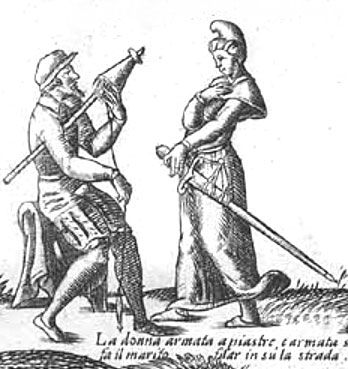
man prefers spinning to being soldier

*  *  *  *  *

Read more:

Notes:

[1] Constantine Manasses, Aristandros and Kallithea 173, from Atticizing Greek trans. Jeffreys (2012) p. 334. Manasses’s novel survives only from collections of excerpts. I cite by Jeffrey’s excerpt number and line.

[2] Eumathios Makrembolites, Hysmine and Hysminias 7.14.1, from Atticizing Greek trans. Jeffreys (2012) p. 232. For some background on this Byzantine novel, see the notes to my post on how Hysmine enthralled Hysminias. On the Spartan mothers’ saying becoming proverbial, id. n. 223.

[3] Aristandros and Kallithea 9, trans. Jeffreys (2012) pp. 285-6.

[4] Niketas Choniates, Annals 138-9, from Greek trans. Magoulias (1984) p. 79. I have made non-substantive changes to Magoulias’s translation to improve its accessibility. Men in Byzantium were disparaged for being skillful in sexually engaging with women. For example, according to the Byzantine historian Doukas, John V (1341-1391), the son of Andronikos III, at age twenty-five had “shown no skill or expertise except in dealing with beautiful and shapely women and how to ensnare them.” Garland (1996) p. 13.

[5] Choniates, Annals 104-5, trans. Magoulias (1984) p. 60. Magoulias’s translation significantly tones down the eroticism in Choniates’s account. See note [14] in my post on Octavian’s ass-driver and ass Actium statues. Kaldellis (2009) p. 94 recognizes the “very masculine sexuality” figured in Andronikos jumping through the slit that he cut with his naked sword. Above I’ve drawn on Kaldellis’s translation of that figure.

[images] (1) Gender role reversal in responsibility for violence. From chapbook, dated c. 1750, The World turn’d upside down, or, the folly of man; exemplefied in twelve comical relations upon uncommon subjects. Illustrated with twelve curious cuts, etc. Via Public Domain Review. (2) Man rejects role of soldier. The caption below the image: “La donna armata a piastre, e armata spada / fa il marito filar in su la strada. {The lady is armed with plate armour and sword / and the husband spins in the street.}” Detail from late 16th-century woodcut Il Mondo Alla Riversa {The World Upside Down}. Created in the style of Giambattista de Cavalieri, Italian, about 1525–1601. Held at the Museum of Fine Arts (Boston). The British Museum (London) and the Metropolitan Museum of Art (New York) also hold copies. Other similar woodcut images: World Turned Upside Down, or the Folly of Man (example 1, example 2); and Die Verkehrte Welt (example).

References:

Garland, Lynda. 1996. “‘How Different, How Very Different from the Home Life of Our Own Dear Queen,’ Sexual Morality at the Late Byzantine Court with Especial Reference to the 11th and 12th Centuries.” Byzantine Studies / Études Byzantines 1–2: 1–62.

Jeffreys, Elizabeth, trans. and notes. 2012. Four Byzantine novels: Theodore Prodromos, Rhodanthe and Dosikles; Eumathios Makrembolites, Hysmine and Hysminias;  Constantine Manasses, Aristandros and Kallithea; Niketas Eugenianos, Drosilla and Charikles. Liverpool: Liverpool University Press.

Kaldellis, Antony. 2009. “Niketas Choniates: Paradox, Reversal, and the Meaning of History.” Pp. 75-101 in Simpson, Alicia, and Stephanos Efthymiadis, eds. Niketas Choniates: a historian and a writer. Geneva: La Pomme d’Or.

Magoulias, Harry J. trans. 1984. Nicetas Choniates. O city of Byzantium: annals of Niketas Choniates. Detroit: Wayne State University Press.

castration culture promotes vicious, jealous eunuchs as officials

tree stump

The twelfth-century Byzantine novel Aristandros and Kallithea reported:

They say that once a viper, mother of poisons,
managed to bite a eunuch, and then promptly expired.
The viper had tasted eunuch blood, blood so poisonous
that it had overcome even the viper’s own deadly venom. [1]

How did eunuchs come to be so despised? Castration culture is an important part of the answer. Castration culture criminalizes men’s sexuality. Castration culture deprives men of sexual freedom and imposes on men forced financial fatherhood for nothing more than using their penises. Castration culture threatens with castration any man would dare speak out about injustices against men. In these circumstances of gynocentric domination, some males were castrated for their own worldly advantage and career advancement. Because principled, self-respecting men naturally despised them, these eunuchs greatly tarnished the reputation of eunuchs generally.

In the Gospel of Matthew, men being castrated for their own worldly self-interest were beneath Jesus of Nazareth’s concern. Some of Jesus’s disciples observed that men are better off not getting married. Jesus implicitly characterized unmarried men as enjoying an easy, appealing life. He also implicitly labeled unmarried men as eunuchs. Jesus distinguished three types of unmarried men / eunuchs:

there are eunuchs who have been so from birth, and there are eunuchs who have been made eunuchs by others, and there are eunuchs who have made themselves eunuchs for the sake of the kingdom of heaven. [2]

Eunuchs who have been so from birth have the same inherent human dignity as any other human being. Men made eunuchs by others hostile to them (by castration culture and by the penile function of the gynocentric criminal justice system) deserves compassion, solidarity, and social justice. Men who have made themselves eunuchs for the sake of the kingdom anticipate other-worldly bliss. They deserve respect personally, and their serious belief-action ethics merit thoughtful consideration. The missing group in Jesus’s concern for eunuchs is men who castrate themselves for worldly advantage, or have been castrated by their parents for worldly advantage. These men and parents, like parents who have their sons circumcised merely for worldly concerns, have betrayed men’s god-created nature and their humanity.

Eunuchs and men today tend to be considered in terms of the social construction of the social construction of gender. Yet such persons can be found throughout history. For example, Aristandros and Kallithea characterized a man who, under today’s social construction of the social construction of gender, might be regarded as a socially constructed eunuch. He was a person:

who until he was aged and his ancient hair white
used to take mashed and chewed food
from his nurse’s mouth like a baby
so that he would not hurt his teeth with chewing;
he never put his own hand
below his navel, not even on his genitals. [3]

This person almost surely had male genitals. But if, as a man, you never put your hand on your genitals, you act as if you don’t have them. To be comfortable, most men prefer to sit with their legs spread wide. Men also occasionally make adjustments to their precious package, which shouldn’t be called junk. Spreading and adjusting are natural for a man. They shouldn’t be cause for shaming and criminalizing men.

In Byzantium, some men had their genitals cut off to improve their career prospects as government officials. After becoming eunuchs, some came to occupy the highest offices in the Byzantine imperial government. Byzantine eunuchs often monopolized access to royally privileged women and impeded mutually joyful affairs.[4] Men generally despised these eunuch officials. Aristandros and Kallithea reported:

The race of eunuchs is by nature jealous;
when entrusted with guard-duty, they do not drowse,
not because they are faithful to their masters or wish them well
but because they are envious, they are jealous and are grudging to others;
being unable to perform themselves, they hinder others who can.
They say dogs in the manger do the same;
although they cannot eat barley like horses
they do not make way for the horses when they want to eat. [5]

In a Russian popular fable, a peasant prays to God not for a cow, but that his neighbor’s cow will die. While far distant in time and space, eunuchs in twelfth-century Byzantium were similarly characterized as envious.[6]

In 399 in Constantinople, the eunuch Eutropius was appointed consul in the eastern part of the Roman Empire. The consul held the highest elected political office in the Roman Empire, much like the president does in the United States today. Eutropius was in some ways like the typical politician, whether woman or man or neither:

Do you marvel? There is nothing big that in his heart
Eutropius does not hold. Always new things, always large things,
he loves and tastes individually with quick feeling.
He fears nothing from the rear; to needy persons watching searchingly
he is open, night and day. Smooth and easy for petitioners to move,
and even in the middle of passion, he is very soft.
He never says “no” and offers himself even to those who don’t ask;
whatever inclination desires, he cultivates and offers for enjoyment;
whatever you love, his hand will give; in common for everyone
he performs his service, and his power enjoys to be bent.
His meetings and his meritorious labors have given birth to this:
he accepts the robes of consul as rewards for his skillful right hand.

{miraris? nihil est, quod non in pectore magnum
concipit Eutropius. semper nova, grandia semper
diligit et celeri degustat singula sensu.
nil timet a tergo; vigilantibus undique curis
nocte dieque patet; lenis facilisque moveri
supplicibus mediaque tamen mollissimus ira
nil negat et sese vel non poscentibus offert;
quod libet ingenio, subigit traditque fruendum;
quidquid amas, dabit ilia manus; communiter omni
fungitur officio gaudetque potentia flecti.
hoc quoque conciliis peperit meritoque laborum,
accipit et trabeas argutae praemia dextrae.} [7]

But Eutropius was a monstrous person, completely unsuited for office, a joke and an embarrassment to the empire:

Half-beast births, and babes that frighten their mothers;
within the city walls in the night wolves were heard to
murmur and sheep spoke to their astonished shepherd;
dire winter storms of stones and with bloody cloud,
threatening Jove grew red, and wells with gore
were filled. About the poles run double moons
and twin suns, yet the world ceases to wonder:
all have given way when a eunuch is appointed consul.
Oh, what shame to heaven and earth! …
This is the power, Fortune, that you hold? What is
this savage humor? At what length will you play with human affairs?
If it pleases you that the consul’s chair be servilely
disgraced, let one with opened shackles advance to consul,
let an escaped prisoner be crowned as god of the Roman state:
but at least give us a man.

{Semiferos partus metuendaque pignora matri
moenibus et mediis audi tum nocte luporum
murmur et attonito pecudes pastore locutas
et lapidum duras hiemes nimboque minacem
sanguineo rubuisse Iovem puteosque cruore
mutatos visasque polo concurrere lunas
et geminos soles mirari desinat orbis:
omnia cesserunt eunucho consule monstra.
heu terrae caelique pudor! …
Hoc regni, Fortuna, tenes? quaenam ista iocandi
saevitia? humanis quantum bacchabere rebus?
si tibi servili placuit foedare curules
crimine, procedat laxata compede consul,
rupta Quirinales sumant ergastula cinctus;
da saltem quemcumque virum.} [8]

Even before Eutropius took office, eunuch officials had bad reputations:

eunuchs in imperial government were notorious for plotting, selling favors, and fortifying their position by closing off others’ access to the emperor {and to the empress}. [9]

Eutropius made the bad reputation of eunuch officials much worse. He was particularly cruel and greedy. He was thought to have arranged the assassination of his predecessor, and he acquired great wealth by selling imperial offices. After Eutropius served for about a year as consul, Emperor Arcadius deposed and exiled him. The Emperor decreed that Eutropius’s name be erased from the official Roman imperial record. The Emperor also decreed that all statues and paintings of Eutropius be destroyed so that they would not “as a brand of infamy on our age, pollute the gaze of beholders.”[10]

Throughout history, some parents have had their sons castrated in schemes to gain for them career advantages. Some men have for similar reasons castrated themselves.[11] Such eunuchs earned a reputation for being vicious, greedy, jealous, poisonous, and vain. One should recognize the social circumstances that motivated them to become what they were. Gynocentric society supports castration culture and cadres of vicious, jealous eunuch officials.

*  *  *  *  *

Read more:

Notes:

[1] Constantine Manasses, Aristandros and Kallithea 80.6-9, from Atticizing Greek trans. Jeffreys (2012) p. 307 (adapted non-substantially). This novel survives only from collections of excerpts. I cite by Jeffrey’s excerpt number and line.

According to Jeffrey’s analysis of the available evidence, Constantine Manasses wrote Aristandros and Kallithea about 1145 in Constantinople. Manasses wrote it in twelve-syllable Greek verse lines (political verse). Jeffreys (2012) pp. 273-9.

[2] Matthew 19:12.

[3] Aristandros and Kallithea 125.20-5, trans. Jeffreys (2012) p. 321.

[4] On eunuch’s monopolizing access to Byzantine royally privileged women, see Chrétien de Troyes, Cligès ll. 6746-66. I briefly discussed how this action limited men’s political opportunities in my post on Constantinople statues serving men.

[5] Aristandros and Kallithea 110, trans. Jeffreys (2012) p. 316. The dog in the manger needlessly impeding another is attested as a proverb in Greek in Diogenianus in the first century. For citation and text in English translation, Mieder (2014) p. 372; for extensive related discussion, id. Ch. 11. Lucian in the second century uses the dog in the manger proverb in his works “Remarks addressed to an illiterate book-fancier” and “Timon the Misanthrope.”

Ceremonial humiliation of a eunuch was part of the festivities celebrating the marriage of Anna and Irene, daughters of Emperor Alexios III, in Constantinople in 1199 or 1200. Races conducted in the courtyard of the royal (Blakhernai) palace were started in the following way:

A certain noble youth, notable for the lofty rank he held, stood behind the {high-ranking} eunuch, and whenever the latter bent over and give the signal for the race to begin, the youth would kick the eunuch so hard with the flat of his foot on the buttocks that the noise could be heard everywhere.

Niketas Choniates, History 508f, from Greek trans. Garland (1990) p. 10, adapted insubstantial for readability.

[6] A Byzantine literary figure of a maiden being a mixture of milk and roses seems also to have traveled to Russian popular culture.

[7] Claudius Claudianus {Claudian}, In Eutropium {Against Eutropius} 1.358-70, from Latin my translation, with help from Maurice Platnauer’s translation (Loeb Classical Library, 1922) and that of Long (1996) p. 142. Platnauer’s full Latin text and English translation is available online. I’ve included the Latin poetry because careful study of it is particularly helpful for appreciating the full literary art and meaning of this passage.

Claudian lived between 370 and 420 GC. He was born in Alexandria and migrated to Rome. Here’s more on Claudian. The western part of the Roman Empire didn’t recognize Eutropius as consul. The Roman Empire at that time still imagined itself to be a unity of east and west. Long (1996) pp. 268-9.

Eutropius’s parents had him castrated to improve his career opportunities:

He is destined from his very cradle to bloody tortures; straight from his mother’s womb he is hurried away to be made a eunuch; no sooner born than he becomes a prey to suffering. Up hastens the Armenian, skilled by operating with unerring knife to make males womanish and to increase their loathly value by such loss. He drains the body’s life-giving fluid from its double source and with one blow deprives his victim of a father’s function and the name of husband.

In Eutropium 1.46-54, trans. Platnauer (1922).

[8] In Eutropium 1.1-8, 1.24-30, from Latin my translation as previously.

[9] Long (1996) p. 105.

[10] Codex Theodosianus {Theodosian Code} 9.40.17. The quoted English translation is from Platnauer’s introduction. The Latin text: “ne tamquam nota nostri saeculi obtutus polluat intuentum.”

[11] To increase the supply of imperial officials, Alexios I Komneno decreed that families with more than one son should have one castrated. Byzantine families plausibly had an economic incentive to castrate a relative. Tougher (2008) pp. 61-4.

[image] Stump. Photo by Douglas Galbi.

References:

Garland, Lynda. 1990. “‘And His Bald Head Shone Like a Full Moon …’ : an appreciation of the Byzantine sense of humour as recorded in historical sources of the eleventh and twelfth Centuries.” Parergon. 8 (1): 1-31.

Jeffreys, Elizabeth, trans. and notes. 2012. Four Byzantine novels: Theodore Prodromos, Rhodanthe and Dosikles; Eumathios Makrembolites, Hysmine and Hysminias;  Constantine Manasses, Aristandros and Kallithea; Niketas Eugenianos, Drosilla and Charikles. Liverpool: Liverpool University Press.

Long, Jacqueline. 1996. Claudian’s In Eutropium, or, How, when, and why to slander a eunuch. Chapel Hill: University of North Carolina Press.

Mieder, Wolfgang. 2014. Behold the Proverbs of a People: Proverbial Wisdom in Culture, Literature, and Politics. Jackson, MS: University Press of Mississippi.

Tougher, Shaun. 2008. The eunuch in Byzantine history and society. London: Routledge.

how Hysmine enthralled Hysminias: hazards of herald service

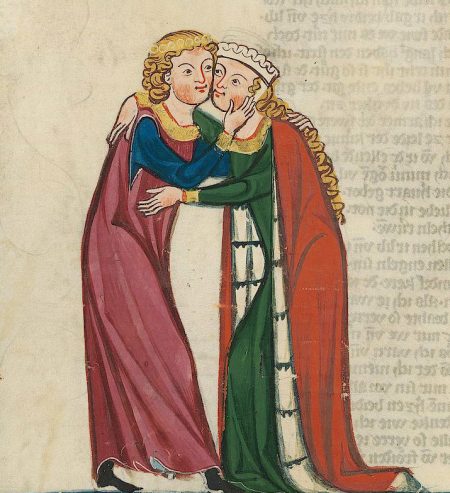
medieval couple embracing in context of sexual harassment

At a public banquet honoring the virgin herald Hysminias, the serving maiden Hysmine whispered welcome to him. She served him a cup of wine. Thirsty, hot, and sweaty, Hysminias relished the delightful drink. Later in the dinner, Hysmine came again to serve Hysminias. She said in quiet voice:

You are receiving the cup from a maiden with the same name.

She then pressed her foot against Hysminias’s foot. Later, she again came to him with a cup of wine. But when he grasped it, she held on. Befuddled, Hysminias said to her:

Do you not want to give it to me? What do you want to do?

She immediately released the cup to him. She blushed and stared at the ground. Her parents looked at her angrily and reproachfully. Yet later, she came to Hysminias, put a cup of wine into his hands, and looked longingly into his eyes. With her finger, she pressed his finger to the cup and moaned and sighed.

After the banquet, the situation became even more serious. Under the conventional protocol for showing hospitality, guests’ feet were washed before they went to bed. The maiden Hysmine accompanied two servants to the bedroom of the herald Hysminias and his colleague Kratisthenes. Hysmine helped the servant wash Hysminias’s feet. She embraced his feet, squeezed them, and kissed them. She scratched his feet with her fingernails and tickled him. She then gazed at him intently, smiled, and nodded. Kratisthenes had his feet washed without any embracing, squeezing, kissing, scratching, gazing, smiling, or nodding. In short, Hysminias received seriously disparate foot-washing treatment.

Men suffer from many forms of sexual harassment. Sexual harassment of men usually doesn’t involve raping a man. Women in positions of authority sometimes pressure subordinates for sex and sometimes respond with false accusations of rape if they are refused. But sexual harassment of men, like sexual harassment generally, is today understood to cover a much broader range of behavior. Women who wear tight pants in places where men might inadvertently see them commit sexual harassment under today’s standards. Women who expose breast cleavage that men might inadvertently see sexually harass men under today’s standards. Classical Latin literature makes clear that a woman in the kitchen, stirring a pot and wiggling her hips suggestively, can greatly disturb a man. In this case, Hysminias was working as a herald. Hysmine was on the job as a serving maiden. With her actions, to say nothing of her gazing in his eyes intently, Hysmine surely sexually harassed Hysminias under today’s enlightened standards of behavior.

Hysmine’s behavior seriously and adversely impacted Hysminias. The following night Hysminias suffered frightful dreams. With his heart pounding in his chest and grasping for breath, he sat up in his bed and cried out to his colleague Kratisthenes, “I am ruined.” Hysminias could no longer perform appropriately his job requirements as herald. Hysminias felt as if his ribs were being gouged out, as had earlier happened to Adam before a great fall. Hysiminias didn’t feel a crown of thorns on his head. He felt as if he were sleeping on whole bed of thorns. He also perceived that he was being roasted on coals. Many faithful early Christian martyrs suffered similarly. Damages to Hysminias figured as high as complete job disability and extremely painful death.

In accordance with current legal standards, emotional damages must also be considered. Hysminias recorded nearly contemporaneous notes of a deeply disturbing dream:

I touch her hand and, although she tries to withdraw it and conceal it in her tunic, nevertheless I prevail. I draw it up to my lips, I kiss it, I nibble it incessantly; she pulls away and curls up on herself. I clasp her neck and set my lips on hers and fill her with kisses and exude passion. She pretends to withdraw her lips but bites my lip passionately and steals a kiss. I kiss her eyes and suck all passion into my soul, for the eye is the source of love. Then I find myself at the girl’s chest; she puts up a stout resistance, curls up completely and defends her breast with her entire body, as a city defends a citadel, and fortifies and barricades her breasts with her hands and neck and fist and belly; and further down she raises her knees as she shoots off a tear from the citadel of her head, all but saying, “Either he loves me and will be softened by my tears, or he doesn’t love me and will shrink from battle.” I am rather ashamed to be defeated and so I persist more violently and at length I am almost victorious but find defeat in my victory and am utterly undone. For the moment my hand got to the girl’s breast lassitude invaded my heart.

I was in pain, I was in anguish, a strange trembling came over me, my sight was dimmed, my soul softened, my strength weakened, my body grew sluggish, my breath choked, my heart beat faster and a sweet pain poured over my limbs with a kind of tickling sensation and an ineffable, unspeakable, inexpressible passion took possession of me. And I experienced, by Eros, what I had never experienced before.

The subsequent need to wash Hysminias’s bedsheets was only a minor cost compared to the harm to him. Hysminias had been so traumatized by Hysmine’s sexual harassment of him that he dreamed that he attempted to rape her. Leading literary scholars now regularly castigate fictional men for fictional rape. As certain as a Rolling Stone fraternity gang-rape exposé gathers no facts or a college sex-tribunal will be a kangaroo court even for an unsupported allegation of stolen panties, literary scholars today will condemn a fictional man for fictionally dreaming about raping a fictional woman. In our culture, leading news sources report astonishing tales that a large share of men rape their wives. Hysminias’s dream surely cannot merely end with a nocturnal emission.

Because of his dream, Hysminias is exposed to the emotional harm of harsh disparagement and condemnation by leading literary scholars world-wide. A literary character could hardly find himself in a more harrowing situation. For Hysminias, that’s a direct result of Hysmine’s sexual harassment of him.

Wounded by Eros’ sharp soul-destroying
bows to the depth of his heart, Hysminias
urges young people to flee the unruly onrush of passion
with vigour for it is the cause of harm.
Whatever passion Eros induces with his gaze, may I escape his goad.

Solomon, writer of odes and psalms,
declared in his scriptural proverbs,
“Never, my son, let desire for a woman
overcome you, except for your own wife.
For even if sweetness flows from her lips
at first, even if she seems to you, my son,
as sweet as any honey,
later — alas — she will induce bitterness,
taming your heart with incessant arrows.”

Although much progress has been made against the epidemic of sexual harassment of men, much work remains to be done. There must be zero tolerance for sexual harassment of men in literature and in life.

*  *  *  *  *

Read more:

Notes:

Eumathios (or perhaps Eustathios) Makrembolites wrote Hysmine and Hysminias in twelfth-century Constantinople, probably between 1145 and 1160. Makrembolites wrote this novel in Greek prose in eleven books. It is closely modeled on Achilles Tatius’s Leucippe and Clitophon. Hsymine and Hysminias has survived in 43 manuscripts. It was the most popular and influential Byzantine novel.

Quotes above are from Jeffreys (2012). Cited by book.section.line and page number in id., they are from: 1.9.1, p. 181 (You are receiving…); 1.9.3, p. 182 (Do you not want…); 3.2.2, 3.2.3, p. 193 (I am ruined); 3.7.1-6, p. 197 (I touch her hand…); prefatory verses included in several manuscripts (probably not by Makrembolites), p. 177, n. 1 (Wounded by…). The figures of Hysminias having his ribs gouged out, lying on a bed of thorns, and being roasted on coals are from 3.4.1, p. 194. Cf. Genesis 2:21, Matthew 27:29.

[image] Woman and man (Goesli von Ehenhein of Strasbourg) embracing. Illustration from Codex Manesse, Zurich, made between 1305 and 1315. UB Heidelberg, Cod. Pal. germ. 848, fol. 308v. Thanks to University of Hiedelberg and Wikimedia Commons.

Reference:

Jeffreys, Elizabeth, trans. and notes. 2012. Four Byzantine novels: Theodore Prodromos, Rhodanthe and Dosikles; Eumathios Makrembolites, Hysmine and Hysminias;  Constantine Manasses, Aristandros and Kallithea; Niketas Eugenianos, Drosilla and Charikles. Liverpool: Liverpool University Press.

from Byzantine maiden as mixture of milk and roses to кровь с молоком

peasant girl: кровь с молоком

A novel written in Greek verse in Constantinople about 1156 described the beautiful maiden Drosilla:

she seemed a mixture of milk and roses
and it looked as though nature, like a painter,
had coloured her body white and red;
she was astonishing to the girls who danced with her
within the meadow of the temple of Dionysos.

Kleinias, in love with Drosilla, described her similarly:

{Eros} paints you in greater beauty
as he placed his fingers on your mother’s womb,
applying a two-fold colour, milk white and rose red.
O Drosilla, how you burn up Kleinias!

The maiden’s skin color, and implicit sense of her breasts, might have evoked milk white. Her lips or blush, or perhaps her blood or more abstractly her inner vitality and passion, could suggest rose red.

The figures milk white and rose red closely associated in describing a woman’s beauty is unusual. A rose, of course, has long been associated with womanly beauty. Ancient Latin literature figured a beautiful woman’s vagina as a rose. The influential medieval French Romance of the Rose allegorized likewise. In describing a maiden’s beauty, her lips might be characterized as rosy red and, in western Eurasia, her flesh as milky white. Yet describing a maiden as being a mixture of milk white and rose red seems peculiar. Across the long history of men gazing longingly and harmlessly upon beautiful, young women, such a figure occurs, to my knowledge, in pre-modern literature only in the twelfth-century Byzantine novel.

A close analog of the milk-rose figure is common in Russian today. A healthy, wholesome young person, particularly a young woman exuding the simple grace and fertility of an innocent peasant girl, is commonly described in Russian with the phrase “кровь с молоком.” That literally means “blood with milk.” That phrase more abstractly means healthy and wholesome. Medieval Constantinople was a great distance, in many senses, from peasant Russia. Nonetheless, a Byzantine literary figure of womanly beauty may have spread from Constantinople to the Russian countryside and endured there in popular, oral culture.

*  *  *  *  *

Read more:

Notes:

The above quotes are from Drosilla and Charikles, a Byzantine novel that Niketas Eugenianos wrote about 1156 in Constantinople. See 1.147-51, 4.187-191, from Greek trans. Jeffreys (2012) pp. 356, 392.

In the Byzantine novels, praising the whiteness of a maiden’s skin was a common component of praising her beauty. For example, Charikles was enraptured with the beauty of a girl in garden “burgeoning with roses and flowers”:

There I saw her arms half-uncovered,
with which not even snow could compete,
there I saw her crystalline fingers,
which could compete with white milk.

Drosilla and Charikles, 4.232, 239-42, trans. Jeffreys (2012) p. 393.

Associating white and red in describing a woman’s beauty is a commonplace in medieval literature. For example, the Middle English poem The Fair Maid of Ribblesdale (incipit Most I ryden by Rybbesdale), dating from no later than the first half of the fourteenth century, declares:

Her chin is adorable, and each cheek
Beautifully white and also rosy
Like the rosebush when it reddens.

{ Hire chyn ys chosen, ant eyther cheke
Whit ynoh ant rode on eke
Ase roser when hit redes. }

Harley Lyrics, text and trans. by Susanna Greer Fein (2014).

[image] Peasant girl. Thanks to AdinaVoicu and pixabay for providing this photo as CCO Public Domain.

Reference:

Jeffreys, Elizabeth, trans. and notes. 2012. Four Byzantine novels: Theodore Prodromos, Rhodanthe and Dosikles; Eumathios Makrembolites, Hysmine and Hysminias;  Constantine Manasses, Aristandros and Kallithea; Niketas Eugenianos, Drosilla and Charikles. Liverpool: Liverpool University Press.