functioning penis should be appreciated as a blessed peacemaker

peacemaker: colt revolver gun

Men tend to be competitive and often fight with other men in various ways for coveted statuses and positions. Clubs, spears, guns, and missiles are associated with war and death. But a penis isn’t like those weapons. Masculinity doesn’t fundamentally signify fighting, war, and death. A functioning penis should be appreciated as a blessed peacemaker that helps to create new life.

In our age of cultic belief in toxic masculinity, medieval Latin literature is vitally important for recovering proper appreciation for the penis. Consider the story of “a widowed woman who desired to have an elderly man {mulier vidua quae cupiebat habere virum provecta aetate}.” The widow appreciated that a man could provide companionship and help:

although what is permitted now in this age no longer concerned her, she desired nonetheless a quiet, elderly man for companionship and mutual help in ordinary life, rather than for any other motive, because she believed she should think about the salvation of her soul rather than the gratification of her flesh.

{ se, licet jam de vita hujus saeculi non curaret, cupere tamen virum quietum provecta aetate, societatis potius et communis vitae subsidii, quam alterius rei causa, cum potius de salute animae quam corporis lascivia esset cogitandum } [1]

A neighbor presented to the widow a man with qualities she apparently sought. The man incidentally “was crippled in his masculinity {mancum virilibus esse}.” The widow wasn’t interested in marrying him. She explained:

I would never want to be joined to that man. If he lacks a Peacemaker (thus she named the Father of humanity), then when it happens that a serious altercation or dispute with each other arises, what Mediator (she believed she should live peacefully with her husband) among us could restore peace?

{ Istum ego virum nullo pacto volo. Nam si Pacialis (ita enim hominum appellavit Genitorum) desit, quis Mediator (pacifice enim cum viro vivendum est), si quando, ut fit, altercatio gravior aut discordia invicem oriretur, constitueret inter nos pacem? } [2]

In the European Middle Ages, the Holy Spirit was understood to bring peace. Genetrix and Mediatrix — words cognate to Father {Genitorum} and Mediator — were used to venerate Mary, the mother of Jesus. Recognizing that a husband’s penis could help to foster peace between spouses rightly puts the penis in exalted company.[3]

Men’s competitive concern for the effective functioning of their penises tends to be regarded as ludicrous. Consider the old joke:

Two men walking on the George Washington Bridge stop to take a piss. While pissing, one says to the other, “The water’s cold!” The other responds, “Yeah, and it’s deep, too!” [4]

In considering arms races or penis jousting, simply disparaging men is facile and unfair. Both sorts of competition arise from societal structures in which women are intimately entangled.

Medieval Latin literature tells the story of a Florentine man defending his beautiful wife. Admirers constantly followed her. Some festively serenaded her nightly with music and lighted torches on the street outside her house. One night their trumpets awakened the husband. He and his wife jumped out of bed and rushed over to the window. On the street below was a raucous and bawdy crowd. The husband called out in a loud voice for them to look in his direction:

When all eyes were directed toward his voice, he thrust his large, erect penis outside the window. He then told them that their labors were foolish and useless, because they could see that he himself was more fruitfully equipped with that which satisfies a wife than they were. He therefore advised them to refrain from pointlessly pestering them. As a result of this very witty and elegant display, they desisted from further trouble.

{ Cum oculos omnes ad eam vocem sustulissent, ille, exerto et extra fenestram porrecto, cujus erat copiosus Priapo, inanem laborem et inutilem sumere illos ait, cum viderent se habere unde, etiam uberius quam ipsi possent, uxori satisfaceret; itaque consulere ut huic eorum molestiae parcerent non profuturae. Quo perfacete dicto, ab superflua cura destiterunt. } [5]

The husband’s penis acted as a peacemaker in quelling aggressive sexual competition with other men. Especially when opponents possess trumpets, such competition cannot be easily ignored or merely wished away. Men living within gynocentric society must stand up and show other men that they are better equipped to please women. That’s simply a common reality of men’s lives.

A man’s penis is an organ for making love, not war. Peacemaking depends on men’s penises. Men should be encouraged to use their penises as much as loving possibilities allow.

peacemaker bomber

*  *  *  *  *

Read more:

Notes:

[1] Poggio, Facetiae 209, “A widowed woman who desired to have an elderly man {Mulier vidua quae cupiebat habere virum provecta aetate},” Latin text from Poggoi (1879) vol. 2, pp. 133-4. Here and subsequent quotes include my English translation, drawing upon that of id., but tracking the Latin more closely. The subsequent quote is from id.

[2] Arabic literature from tenth-century Baghdad validates the widow’s insight. The eminent scholar Abu ‘Ali al-Qali (died 967) wrote:

Some ill will came between a man and his wife, and they shunned one another for a few days. Then he jumped on top of her and took her. And when he had emptied himself, she said: “Shame on you! Every time there is ill will between us, you bring me an intercessor whom I cannot refuse.” And in another tale a woman, mourning the passing of her days and particularly her nights with his “upright judge,” said to her aging husband: “The one who used to resolve our disputes has died.”

Quoted in Nu’aymī (2009) p. 64. Baghdad in the tenth century was far more developed than any medieval European city.

[3] On the Holy Spirit as Peacemaker, see e.g. Galations 5:22. The ancient Marian hymn Sub tuum praesidium {Under your protection}, when translated into Latin in the eleventh century, invoked Mary with the words Sancta Dei Genetrix {Holy Mother of God}. Mary was regarded as Mediatrix from no later than the fourth century.

Medieval Latin literature helped to foster appreciation for men’s sexuality by developing the figure of the erotic Paternoster. That figure first appeared in the anonymous Latin poem Prisciani regula, written about 1200. Ziolkowski (1987) p. 31. About 250 years later, the figure occurs in Poggio, Facetiae 214, “Which is more acceptable to God, he who says, or he who does {Quid sit acceptius deo, dicere aut facere?}.” This brief tale concludes: “He who makes a paternoster is more deserving than he who says one {plus meretur qui facit Pater Noster, quam qui dicit}.”

Poggio, Facetiae 172, “A Florentine Knight, who made a pretence of going out, and hid himself in the bedroom, unknown to this wife {De equite Florentino qui, fingens se iturum foras, inscia conjuge in cubiculo latuit}, Poggoi (1879) vol. 2, pp. 82-3, presents a more complex figure of peace-making. In that story, a wife proposed to her steward that they first make war by him sticking his spear (penis) in her wound (vagina), and then they make peace by exchanging kisses. The husband, hiding in the bedroom, interrupted to prevent this sexual process of bringing about peace.

[4] This joke has a variety of minor variants. Richard Pryor reportedly used it in standup comedy forty years ago. It occurs in the major 1996 motion picture Sling Blade. For those who don’t understand the joke, Yahoo! Answers provides an explanation.

[5] Poggio, Facetiae 209, “An appropriate, but crude, gesture of a Florentine {De facto cujusdam Florentini justo, sed bruto},” Latin text from Poggoi (1879) vol. 2, pp. 180-1.

[images] (1) Colt “Peacemaker” single-action Army revolver. Made in 1874. Preserved in Metropolitan Museum of Art (New York), acc. # 59.143.4 (Gift of John E. Parsons, 1959). Via Wikimedia Commons. (2) U.S. Air Force B-36J “Peacemaker” bomber. U.S. Air Force photo via Wikimedia Commons.

References:

Nu’aymī, Salwá (Salwa al Neimi), from Arabic trans. Carol Perkins. 2009. The proof of the honey. New York: Europa Editions.

Poggio. 1879. Gian Francesco Poggio Bracciolini. The facetiae or jocose tales of Poggio, now first translated into English with the Latin text. Paris: Isidore Liseux (vol. 1, vol. 2).

Ziolkowski, Jan M. 1987. “The Erotic Paternoster.” Neuphilologische Mitteilungen. 88 (1): 31-34.

pathetic stupidity of cuckolds described in medieval Latin literature

the face of a cuckold

Men are concerned about women’s sexual fidelity for good evolutionary reasons. Associated with that evolutionary psychology is millennia of world literature expressing men’s justified concern about being cuckolded. Medieval Latin literature, which provided men with a relatively good opportunities to express their interests and protest against gynocentric oppression, depicted cuckolds as pathetic, stupid men.

Egbert of Liège’s early-eleventh-century schoolbook for young boys provided the basics. In easily memorized Latin hexameters, Egbert drilled into boys contempt for cuckolds:

A cuckold burns devotedly for an adulterous wife. He excuses her when she’s under suspicion and forgives her stumblings in advance.

{ Zelotipam curruca suam devinctius ardet,
suspectam excusat, prior offensacula donat. } [1]

Women have long been privileged in formal criminal justice systems. Yet a man need not personally uphold such female privilege. If he doesn’t want to risk paying “child support” for children that aren’t his biological children, he must have the courage to stand up and confront his wife or girlfriend. That tends to be quite difficult for most men. Good education of boys can help them to develop into strong, courageous, no-nonsense men.

Medieval Latin literature depicted cuckolds as men so ignorant that they don’t understand the obvious. For example, a man knocked loudly at the door of a woman’s house. Imitating her husband’s stuttering voice, he called out to be admitted. Then:

The stupid husband, who was at home, hearing that voice, said to his wife, “Giovanna, open the door, Giovanna, let him in, for he seems to be me.”

{ Vir autem stolidus, domi existens, audita illius voce: “Joanna, aperi, Joanna, introduc illum,” inquit: “nam videtur idem, qui ego, esse.” } [2]

In another case, a wife named Petruccia asked her husband to buy her new shoes. Like most husband do, he fulfilled his wife’s request. But when he was out of the house and his wife saw a young man passing by, she signaled to him to come in. She went upstairs with the young man and in her haste lay down right near the stairs. That place could be seen from the doorway. Then she did what literary scholars today would regard as rape if a man did it:

Pulling the youth down upon her, embracing his buttocks with her legs and feet, she focused on the work of her desire.

{ Superimposito autem juvene, clunes ejus cruribus ac pedibus amplexa, concupito operi intendebat. } [3]

Her husband brought a friend home for lunch. The husband entered the house first:

seeing near the stairs his wife vigorously waving her feet above a young man, he said, “Hey, Petruccia! By the ass of a donkey (their favorite oath), if that’s the way you walk about, you’ll never wear out those new shoes!”

{ visaque apud scalas uxore supra juvenem pedes commovente: “Ohe! Petrucia,” inquit, “per culum asini!” (ut mos es illis jurandi) “si hoc mode ambulaveris, nunquam istos calceos consumes.” }

It’s one thing to imagine that your wife walks upon the clouds. But if your wife’s back is on the ground, another man is on top of her, and her feet are waving in the air, you should have sufficient mental functioning to suspect that you’re being cuckolded.

Being a cuckold is a miserable way to live. When she saw her husband about to enter their house, one wife hid her lover under the bed. She then accused her husband of wanting to be thrown into prison. She said that the sheriff’s officers were looking for him to imprison him for debt. Trembling with fear, the husband begged his wife for advice. She told him to climb up into their pigeon house. She would then lock the door and remove the ladder so that no one would suspect that he was there. The husband followed his wife’s advice. After he was securely locked up in the pigeon house, she brought her lover out from under the bed. The wife and her lover then pretended that the Sheriff’s officers had returned. The lover took the role of the sheriff, and the wife pretended to defend vigorously her husband. Hiding in the pigeon house, the husband shook with fear. After the wife and her lover had finished that act:

both went to bed and devoted their night to the work of Venus; meanwhile the husband was withdrawn in hiding among the pigeons and their feces.

{ ambo in lectu profecti ea nocte Veneri operam dederunt; vir delituit inter stercora et columbos. } [4]

Cuckolds spend their nights with sub-human birds. They live immersed in shit. Don’t let that happen to you.

Men must learn practical means to avoid being cuckolded. Delusions that women are naturally much less evil than men don’t help. Men must be wary of gynocentric and demonic advice. For example, in fifteenth-century Rome, Francesco Filelfo dreamed that a demon told him:

“Take this ring,” he said, “and finger it diligently on your finger. So long as it is held there, your wife will never, without your knowledge, have sex with another.”

{ “Cape hunc,” ille inquit, “annulum et diligenter in digito serva. Nam dum in eo gestaveris hunc, nunquam uxor, te inscio, cum alio concumbet. } [5]

Such technology would be even more helpful than DNA paternity testing. But Filelfo soon realized that he was in an unsustainable position:

Joyfully he awoke from sleep and perceived that he had his finger in his wife’s cunt.

{ Prae gaudio excitatus a somno, sensit se digitum habere in uxoris cunno. }

Scholars will soon better recognize that Ovid’s ring poem (Amores 2.15) is associated with the supernatural.[6] The progression from Ovid’s ring poem to the medieval Latin De pulice indicates the mundane devaluation of men’s sexuality under gynocentrism. Men cannot count on demons and the supernatural to save them from cuckolding.

In the Byzantine Empire, both physical statues and sophisticated literary romances addressed men’s risk of being cuckolded. In the highly developed societies of today, men are disparaged even for being concerned about being cuckolded. Yet men aren’t necessarily destined to be pathetic, stupid cuckolds. With study of literature, particularly medieval Latin literature, men can find enlightenment and be more sophisticated men.

*  *  *  *  *

Read more:

Notes:

[1] Egbert of Liège, The Well-Laden Ship {Fecunda ratis} 1.659-60, Latin text and English translation from Babcock (2013) pp. 72-3. Despite the soundness of this teaching, Egbert of Liège generally provided schoolboys with gynocentric lessons supporting the demonology of men’s sexuality.

Egbert at least acknowledged social realities of cuckoldry:

When the boyfriends wails sadly at the funeral of the wife’s son,
and the father, in contrast, sings, that is called cuckoldry.

{ Vitricus ut plorat privigni funera tristis
et pater econtra cantat, cukerella vocatur. }

Fecunda ratis 1.719-20, Latin text and English translation (modified) from Babcock (2013)

[2] Poggio, Facetiae 68, “Of a stupid husband who mistook for himself a man imitating his voice {De viro stolido qui simulantem vocem credidit se ipsum esse},” Latin text from Poggoi (1879) vol. 1, pp. 110-1, with my English translation, drawing upon that of id., but tracking the Latin more closely. All the subsequent English translations are made similarly.

[3] Poggio, Facetiae 66, “What a Perugian said to his wife {Dictum Perugini ad uxorem},” Latin text from Poggoi (1879) vol. 1, pp. 107-8. The subsequent quote is from id.

[4] Poggio, Facetiae 10, “Of the woman who deceived her husband {De muliere quae virum defraudavit},” Latin text from Poggoi (1879) vol. 1, pp. 28-9.

[5] Poggio, Facetiae 133, “A vision of Francesco Filelfo {Visio Francisci Philelphi},” Latin text from Poggoi (1879) vol. 2, pp. 20-1. The subsequent quote is from id.

A similar story subsequently appears in Rabelais, Gargantua and Pantagruel 3.28 (“How Friar John comforted Panurge in the doubtful matter of cuckoldry“). This story became famous in many languages. It’s commonly known as “The Ring of Hans Carvel.”

[6] Laskaris (2018).

[image] Face of a cuckold. Figure in printed edition of Poggio’s Facetiae. Poggio (1879) p. 6.

References:

Babcock, Robert Gary, ed. and trans. 2013. Egbert of Liège. The well-laden ship. Dumbarton Oaks Medieval Library 25. Cambridge MA: Harvard University Press.

Laskaris, Julie. 2018. “Ovid’s Enchanted Ring Poem: Amores 2.15.” Paper to be presented at the 149th meeting of the Society For Classical Studies, Boston, January 4-7.

Poggio. 1879. Gian Francesco Poggio Bracciolini. The facetiae or jocose tales of Poggio, now first translated into English with the Latin text. Paris: Isidore Liseux (vol. 1, vol. 2).

preparing men for erection labor in the 13th-century Islamic world

Sultan's potions for men's sexual labor

An Arabic book entitled The Book of Choice Sexual Stimulants and the Sultan’s Potions describes itself as a work that the eminent thirteenth-century scholar Nāsir al-Dīn al-Tūsī wrote at the commission of the caliph. The book is a reference work for Muslims too poor to afford a physician’s services. Apparently the caliph sought to ensure that the men of his realm could perform long and hard erection labor for women.[1] The Sultan’s Potions exemplifies the authoritative social construction of ordinary men’s obligation to engage in risky, uncompensated erection labor.

The Sultan’s Potions constructs large sexual risk for men. In its introduction, it declares:

As for the view held by a number of scholars that sexual intercourse is bad and harmful, and that it is not necessary for anyone to practice it, but rather that it should be abandoned, this is devoid of foundation, and erroneous … . It is clear that this statement is nonsensical and only applies to those who engage in coitus while being ignorant of the time and circumstances when it should or should not take place, of the conditions and regime it requires. [2]

Authorities today tend not to describe heterosexual intercourse as bad and harmful in itself. Yet rape-culture culture makes ordinary sexual interaction fraught with the risk of onerous punishment of the man. The Sultan’s Potions emphasizes the importance of men risking their well-being to navigate the rules of sexual interaction:

When coitus takes place in these cases, it results in the above-mentioned ailments {dousing of “innate heat”} and the individual’s destruction, in contrast with those who know how to manage coitus and its conditions. In the latter case, sexual intercourse does not cause any harm; rather, it is hugely beneficial, as we have mentioned, whereas there is no greater human pleasure than that of sexual intercourse. It is part of the natural disposition and it is mixed into the make-up of human beings and all other animals.

Men throughout history have carried a vastly gender-disproportionate burden of soliciting sexual relations. Socially constructing sex as a matter of great risk (great harms and great benefits) puts men at great risk.

The Sultan’s Potions instructs men in burdensome recipes for enhancing their penises. Consider this recipe:

Take house sparrows before they have acquired their flight feathers, tie them up with a string and hang them from the entrance of a beehive. Then, agitate the bees so that they start stinging the sparrows. Once the birds have been stung several times, take them down quickly and slaughter them, making sure not to waste one drop of their blood. Put them in a pot and pour over the aforementioned aromatic oil until the birds are fully cooked with it. Cover the pot and place on a fire until the sparrows are cooked thoroughly. Then, remove them, and strain the water with a cloth until the essence of the birds becomes infused in the oil.

With the help of a young, beautiful, warmly receptive woman, or one at least remembered as such, a man’s penis will swell strongly without any need for oil from sparrows stung by bees. Moreover, men don’t actually need their bodies to be activated with the help of ants:

Another recipe: take 100 small and black ants and put them in a flask. Pour on five dirhams of blue liquorice oil,  which should cover the ants; close the flask and hang it in the hot sun for 20 days. Then, vigorously pound everything until the mixture has fermented. At the time it is needed, take one qīrāt of Indian aloewood, crush it finely, put it in ten dirhams of hot water and wash the penis, hands, feet and armpits with the water. Take one drop of the ant oil from the glass, or another small quantity, without the water, and rub it on your fingers, teeth, armpits and elbows.

Procedures for lengthening a man’s penis are even worse. Here’s one:

Take fresh thick sheep dung and dry amber in an amount that is required for rubbing the penis, as well as one qīrāt of musk. Pound it and mix vigorously with two dirhams of very finely ground coconut. Get into the bath and forcefully massage your penis with the cyperus oil until your member become red. Then rub the ingredients mixed with the sheep dung on the penis in the way that you rub in a seal, and wrap it in a cloth from dawn till dusk. Afterwards, remove the cloth and wash the penis. You will see a wonder, since the penis will have grown twice in size. [3]

Men, DON’T DO THAT. Your God-given penis is sufficient for you. Don’t let gynocentric society convince you otherwise.

Men engage in arduous erection labor to please women as well as themselves. The Sultan’s Potions underscores the extent of men’s sexual obligations to women. To enable one man to serve many women, one potion:

strengthens coitus to the extent that even when one has intercourse for three days running, one need not worry about growing weak. One is able to pleasure ten slave girls and freewomen every night, without any trouble or discomfort, as stated by the ancient philosophers and physicians.

Men commonly have been burdened with the obligation of working outside the home during the day. Men then have to come home and take on the double burden of work within the home all night long. Is it any wonder that men’s lifespans are on average about five years shorter than women’s? One recipe for men’s sexual potency hints at men’s double burden of labor:

It is effective and you will see it works wonders. Even if you had ten slave girls you would be able to pleasure them without any trouble or a change in temperament. It has been tried and tested.

In ordinary circumstances, if a man has to provide sexual pleasure to ten women every night, he’s likely to become exhausted and irritable. That change in temperament is completely understandable. But men are socially disparaged for complaining, even under outrageous circumstances. The Sultan’s Potions provides pharmaceutical solutions to men’s double burden. One potion even promises to help men with the problem of “growing bored” with their sexual obligations.

In producing and disseminating knowledge, men haven’t shown adequate regard for their own gender. Ancient philosophers and physicians were predominately men. They generated the knowledge recorded in The Sultan’s Potions. That knowledge included:

the position during coitus that provides great pleasure to both the man and woman, as stated by the ancient philosophers and physicians who gained knowledge of this from their experiments. [4]

While men seek knowledge on how to provide great pleasure to men and women, women seek reproductive rights only for women. While men seek knowledge on how to provide great pleasure to men and women, gynocentric society advances outrageous claims about men raping women. Men love women more than women love men.

The war on men’s sexuality threatens the experimental method, scientific knowledge, and great pleasure for men and women. Women must step up and fight on behalf of men.[5]

*  *  *  *  *

Read more:

Notes:

[1] The introduction to The Sultan’s Potions states that the “Caliph of Qāzān” commissioned it because his son suffered paralysis of the lips. Medieval scholars recognized the importance of kissing as an activity leading toward sex. Newman declared:

the focus on the importance of female pleasure doing coitus and the benefits of kissing was at the heart of another innovation attributable to the Arabic tradition: foreplay.

Newman (2014) p. 54. That’s surely an exaggeration. Consider, for example, the presentation of kissing on the path to sex in Egbert of Liège’s early eleventh-century textbook for schoolboys, Fecunda ratis. See note [2] and related text in my post on Fecunda ratis.

Newman identified the “Caliph of Qāzān” as Abaqa Khan. He reigned from 1265 to 1282. Nāsir al-Dīn al-Tūsī lived from 1201 to 1274. However, another scholar reads the text as “Ghazan Khan.” He reigned from 1295 to 1304. That reading contributes to questioning whether the text is actually a medieval text.

Nāsir al-Dīn al-Tūsī extravagantly described himself in the third person:

The caliph asked the shaykh of the world, the king of scholars of the age, the teacher of scholars of all time, the pillar of Islam and all Muslims, preceptor of kings and sultans, one who is full of blessings, Master Nāsir al-Dīn al-Tūsī  — may the Almighty have mercy on him! — to compile a book on medicine that is small in size but has many benefits that will be useful to Muslims.

Intro., trans. Newman (2014) pp. 85-6.

The Sultan’s Potions may have been commercially commissioned. The attribution to a caliph (khan) plausibly could have been a marketing tactic. The oldest surviving manuscript of the work dates to 1793. Id. p. 68.

[2] Nāsir al-Dīn al-Tūsī, The Book of Choice Sexual Stimulants and the Sultan’s Potions, Intro., trans. Newman (2014) pp. 89-90. Subsequent quotes are from (cited by chapter and page number in id): Intro., p. 90 (When coitus takes place…); 13, p. 118 (Take house sparrows…); 13, pp. 118-9 (Another recipe…); 12, p. 117 (Take fresh thick sheep dung…); 4, p. 103 (strengthens coitus to the extent…); 4, p. 104 (It is effective…); 6, p. 108 (growing bored); 15, p. 120 (the position during coitus…).

[3] The Greek Magical Papyri include similar recipes for enhancing a man’s penis.

[4] The Sultan’s Potions draws upon the work of impressive authorities:

Allah the Almighty willing, in line with what was said about this by the ancient philosophers and physicians, who relied on their experiments and experience, in their books. They include Plato, Aristotle, Hippocrates, Palladius, Aristo, and scholars like them.

Intro., trans. Newman (2014) p. 91. Underscoring the importance of men’s sexual obligations, the great physician and scholar ibn Sina explained, “If a man can’t make her orgasm, some {women} turn to lesbianism.” Quoted in id. p. 41.

[5] Tendentious scholarly work in support of the dominant ideology, e.g. Gadelrab (2011), doesn’t help. Moreover, truthful understanding cannot be established with wildly unrealistic theory:

From a constructionist point of view, we could make the objection that there was no sex prior to the actual invention of the term.

Franke (2012) p. 161. Only an academic, social-constructivist fundamentalist could take such an objection seriously.

[image] Potion bottles. Thanks to Petr Kratochvil for releasing the source image under CCO Public Domain license on PublicDomainPictures.net

References:

Franke, Patrick. 2012. “Before scientia sexualis in Islamic culture: ‘ilm al-bāh between erotology, medicine and pornography.” Social Identities. 18 (2): 161-173.

Gadelrab, Sherry Sayed. 2011. “Discourses on Sex Differences in Medieval Scholarly Islamic Thought.” Journal of the History of Medicine and Allied Sciences. 66: 40-81.

Newman, Daniel L., ed. and trans. 2014. Nāsir al-Dīn al-Tūsī. The Sultan’s sex potions: Arab aphrodisiacs in the Middle Ages. London: Saqi. (Emily Selove’s review)

the female gaze, gender oppression, and men putting meat on the table

man putting his meat on dinner table

Over recent decades, literary scholarship has extensively discussed the male gaze and its role in gender oppression. But the female gaze has been marginalized and largely ignored. That blindness has hindered seminal work to penetrate the gender divide. The female gaze must be included within a broad-based effort to thrust forward to a better future.

The problematics of the female gaze are clearly apparent in the mid-fifteenth-century case of an elite, young, newly married Italian couple. He was a young and handsome nobleman. She was a member of an eminent and distinguished Florentine family. A feast for the couple was arranged for a few days after their marriage. At that feast, rather than being full of happiness and smiles as most newly married women are, this woman appeared sad and downcast.

Her mother took her aside for a private talk about her distress. Her mother sympathetically inquired:

Surely the thing was healthy enough to satisfy?

{ Nunquid res sint satis salvae? }[1]

Weeping, the young women reluctantly explained:

You haven’t married me with a man, but with one lacking in virility. He has nothing or only a fraction of that necessary to make a marriage.

{ Non enim me viro desponsastis, sed ei cui virilia desunt: nihil enim aut parum habet ejus partis, propter quam fiunt matrimonia. }

The mother grieved at her daughter’s misfortune. She told her husband and others. Soon everyone at the feast knew of his shortcoming. All lamented understandingly:

The whole house was filled with sorrow and despair. They were saying that the beautiful young women had been not married, but choked.

{ moestitia doloreque omnis impletur domus, cum non nuptam, sed suffocatam adolescentulam egregiam forma dicerent. }

They understood the wonderful goodness of men’s sexuality. They appreciated how much men’s sexuality benefits women. They sorrowed for the wife being deprived of what a husband most importantly provides for his wife.

The newly married young man didn’t understand the problem. When he arrived at the party, he saw all the disconsolate and pained faces. No one ventured to tell him the reason for the general sadness. At last, one was bold enough to tell him that “the young woman says that he is defective in sexual virility {dixisse puellam, mancum esse illum in virili sexu}.” The young husband wasn’t shaken. He remained confident and cheerful. He explained that he would soon dismiss that verdict.

After all had glumly finished their dinner, the young man rose to his feet and addressed the gathered friends and relatives. He appealed to them:

Fathers, in this matter in which I perceive I am being charged, I want you to offer your testimony as to the truth.

{ Patres, sentio me culpari in ea re, cujus vos testes esse an vera sit volo. }

Then the husband dramatically surmounted the classical heroine Phryne baring her breast to a Roman jury:

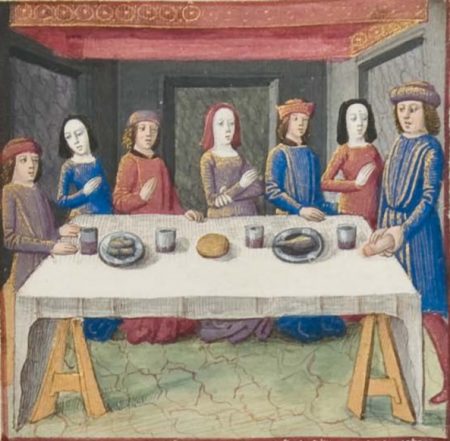
Then he pulls out a beautiful penis (from beneath a short tunic then in fashion), and places it on the dining table. Everyone is turned around by the rareness and magnitude of the thing. He then asks whether it deserves to be blamed or rejected.

{ Deinde educto formae egregiae Priapo (vestibus enim curtis tunc utebatur), ac supra mensam posito, omnes ad rei novitatem magnitudinemque convertit, et, an culpandus au rejiciendus esset, quaesivit. }

Their verdict was clear:

Most of the women wished that their husbands has been so greatly supplied. Many of the men felt that such great furnishing surpassed their own.

{ Major mulierum pars, ut viris suis talis copia inesset, optabant. Viri permulti se ad illo tali supellectili superari sentiebant }

Gynocentric society requires men to put meat on the table in order to prove that they are truly men. That’s oppressive. Men shouldn’t have to prove that they are men or work to be regarded as virtuous. A man can sufficiently provide for a woman with nothing more than his own natural self.

The unjust social construction of men’s obligation to provide for women arises in part from the female gaze. The female gaze of the wife forced the husband to put meat on the table. The wife herself explained:

Why do you blame or reproach me? Our little donkey, which I recently saw in the countryside, is merely a beast, and yet (stretching out her arm) it has a penis that long. This husband of mine, who is a man, doesn’t have one half as long.

{ Quid objurgatis? aut quid me reprehenditis? Asellus noster, quem ruri nuper conspexi, bestia est, et adeo (extenso brachio) oblongum membrum habet: his vir meus, qui homo est, non habet ejus medietatem. }

The female gaze upon male farm animals contributes to devaluing men’s sexuality. The female gaze forces men to put their meat on the table to establish publicly their sexual adequacy. That’s disgusting. To advance gender justice, women must stop gazing upon male farm animals.[2]

While pervasive and oppressive, the female gaze isn’t the greatest injustice that men face. Criminal justice systems operate with acute anti-men sex bias and thus produce a vastly gender-disproportionate population of men held behind bars. Men are deprived of reproductive rights and incarcerated for being unable to pay state-mandated sex payments (so-called “child support”). Men are deprived of custody of their children through grotesque anti-men bias in family courts. If those gender injustices could be even slightly mitigated, most men probably would be willing to tolerate the hardships arising from the female gaze.[3]

*  *  *  *  *

Read more:

Notes:

[1] Poggio, Facetiae 42, “Of a young woman who accused her husband of having too small of a penis {De adolescentula quae virum de parvo Priapo accusavit}”, Latin text from Poggoi (1879) vol. 1, pp. 75- 8, with my English translation, drawing upon that of id., but tracking the Latin more closely. Id. left untranslated text referring explicitly to the man’s penis. All the subsequent quotes above are similarly from id.

The young woman’s father is explicitly named. He was the Florentine knight Nereo de Pazzi, “among those {knights of Florence} a distinguished and eminent man of his time {inter caeteros suae aetatis egregii ac praestantis viri}.” He probably was embarrassed by his daughter’s behavior. Not all women are like that.

Priapus was a Greco-Roman god that become a focal point for classical poetic protests against the brutalization of men’s sexuality.

Gian Francesco Poggio Bracciolini was a medieval church official and scholar. He lived from 1380 to 1459. His Facetiae became a highly popular work. It survives in manuscripts, such as MS Lat 188. Houghton Library, Harvard University (dated 1466). and in many printed versions (the earliest surviving printed version is dated 1470). The Facetiae was translated into many vernacular languages and influenced the French story collection the Cent Nouvelles Nouvelles. Poggio was a manuscript collector who played an important role in preserving and transmitting classical texts.

[2] In affirming the strong, independent sexuality of his poetic persona, Ovid in Amores II.7 and II.8 subtly appropriated for a man the sexual characteristics of a donkey. Mills (1978).

[3] The meager work on the female gaze engages in remarkable contortions to validate dominant ideology and to cite cultic authorities:

the gaze must be literally female when women do the looking. In both stories women do effect the looking. But it is not the male-inscribed looking that Deveraux explains, as a female appraising herself as a man would appraise her, that is, “the eyes are female, but the gaze is male” (337). One could argue that the stories present a reader’s gaze gazing at a female gazing. But the female gaze is not a male-inscribed object of the gaze. Both females are viewing the phallus. Of course, the narratorial gaze is patriarchal because the women are viewed as lacking and wanting that guarantor of meaning elucidated by Burns who states that in fabliaux women protagonists can be “headless and unknowing in very specific, bodily ways” (196). This seems to be the case in which “loca,” or “empty upstairs,” is tantamount to being headless.

Cárdenas-Rotunno (2008) p. 87. Medieval scholars typically cited authorities for their truth value, rather than cultic status.

female gaze at man's penis

[images] (1) Man putting his meat (penis) on the dinner table. Illumination for story 80 in Les Cent nouvelles nouvelles, MS Hunter 252, f. 168v. This manuscript was created between 1461 and 1462. On depictions of men’s genitals in MS Hunter 252, Boneau (2006). On the illuminations in that manuscript more generally, Adams (1992). According to Wikimedia Common’s expert and influential interpretation of copyright law, an image of a illumination from a medieval manuscript is in the public domain under the jurisdiction of U.S. copyright law. (2) Man putting his meat (penis) on the dinner table. Illumination for story 80 in Les Cent nouvelles nouvelles in the edition of Douglas (1899). The difference between the two images indicates the increasing repression of men’s sexuality from the Middle Ages to the modern era.

References:

Adams, Alison. 1992. “The Cent nouvelles nouvelles in MS Hunter 252: The Impact of the Miniatures.” French Studies. 46(4): 385-394.

Boneau, Elise. 2006. “Obscenity out of the Margins: Mysterious Imagery within the Cent nouvelles nouvelles, MS Hunter 252.” eSharp 6(2): 1-18.

Cárdenas-Rotunno, Anthony J. 2008. “Assessing Asses and Lasses in the 1488 Spanish Esopete ystoriado.” Romance Quarterly. 55(2): 82-95.

Douglas, Robert B., trans. 1899. Antoine de la Sale. One hundred merrie and delightsome stories: right pleasaunte to relate in all goodly companie by joyance and jollity : les cent nouvelles nouvelles. Paris: Charles Carrington.

Mills, Suzanne. 1978. “Ovid’s Donkey Act.” The Classical Journal. 73 (4): 303-306.

Poggio. 1879. Gian Francesco Poggio Bracciolini. The facetiae or jocose tales of Poggio, now first translated into English with the Latin text. Paris: Isidore Liseux (vol. 1, vol. 2).