immiseration of erection labor only intensified in late capitalism

Throughout history, men have commonly paid women for sex. At the same time, men’s erection labor has been progressively alienated from them and turned into a means by which the gynocentric substructure disciplines and punishes. A momentous stage in this historical process occurred in the Industrial Revolution of late eighteenth-century England. As men were made subject to factory discipline, their sexual activity was also more strictly regulated. Men’s erection labor was immiserated to an extent surpassed only now under the sexual Stalinism of late capitalism.

man attempts de-icing

In England about 1800, population growth was roughly double that early in the eighteenth century. An increase in fertility predominately drove the increase in population growth.[1] Assuming health, economic welfare, and child-limitation practices didn’t change to increase fertility, the increase in fertility must have been driven by an increase in heteronormative sexual activity.

This hypothesized increase in sexual activity across eighteenth-century England occurred in conjunction with the rise of disciplined labor within factors. An influential scholar has suggested that these developments are connected:

I hypothesize that the invention of foreplay is an aspect of the history of capitalism, that the invention of industrial work-discipline is an aspect of the history of heterosexuality, and that both developments are in an important sense the same. [2]

In short, men’s erection labor was disciplined from spontaneous sexual play toward more efficient foreplay leading rigidly into heteronormative sexual activity to produce new human beings. Other than enjoying more children, men didn’t receive increased compensation for their increased erection productivity. That’s what scholars call the immiseration of erection labor, or immiserating growth. The capitalist system has continued to evolve through the same dynamic between the relations of sex and the material-biological forces that produce new human beings.

Within the gynocentric system of late capitalism, all methods for raising the collective esteem of women are put into effect at the cost of the individual man. All means for the development of gender equality undergo a dialectical inversion so that they become a means of dominating and exploiting men. Relations of men-subordinating gender equality distort the man into a fragment of a man, they degrade the penis to the level of an appendage to a wrongly constructed machine, and they destroy the actual content of his erection labor by turning it into a torment. They alienate him from the intellectual and emotional potentialities of sexual intercourse in the same proportion as mass-media representations are incorporated in it as a source of false imagination. They deform the conditions under which he interacts with women and subject him during the seduction process to a despotism the more hateful for its meanness. They transform his intimate relations into financial obligations and drag his wife and child into the roles of debt-collection enforcers on behalf of state “child support” agencies. These horrors of capitalist development are only now starting to be identified and criticized.

Men must no longer tolerate their erection labor being concealed with disdain. Relations of sex must be transformed. The material-seminal forces of human production must be priced in accordance with the full quantity of labor men perform throughout their lives. Let women again tingle with appreciation for men’s labor. Men must throw off the chains of gynocentric late capitalism, seize in their hands a vital means of sexual production, and work only as individuals laboring for their own pleasure.

*  *  *  *  *

Read more:

Notes:

[1] See Wrigley & Schofield (1981), Wrigley (1997).

[2] Abelove (1989) p.129. The relevant article is reprinted as the second chapter in Abelove (2005).

[image] A 92nd Aircraft Maintenance Squadron crane operator de-ices a KC-135 Stratotanker on the flightline for flight preparation Jan. 29, 2014, at Fairchild Air Force Base, Wash. Photo id. 140129-F-BN304-002. U.S. Air Force photo/Staff Sgt. Alexandre Montes. This and other works of U.S. government employees are in the public domain in the U.S.  See also men laboring to drill into dry rock.

References:

Abelove, Henry. 1989. “Some Speculations on the History of Sexual Intercourse during the Long Eighteenth Century in England.” Genders. 6 (Fall): 125-130.

Abelove, Henry. 2005. Deep gossip. Minneapolis, MN: University of Minnesota Press.

Wrigley, Edward Anthony, and Roger S. Schofield. 1981. The population history of England: 1541-1871 ; a reconstruction. London: Arnold.

Wrigley, Edward Anthony. 1997. English population history from family reconstitution, 1580-1837. Cambridge: Cambridge University Press.

trade slogans of Abbasid singing slave girls (qiyān) goaded men

young man rejects hetaera

Throughout history, women commonly have been socially more powerful than men. In addition, men’s sexuality typically has been devalued. Men today with good reason are extremely wary of expressing sexual interest in women. Even elite men in Baghdad in the early Abbasid caliphate were cautious in engaging with singing slave girls professionally associated with sexual affairs.

The trade slogans of the singing slave girls indicate men’s reticence and the social devaluation of men’s sexuality. Market prices aggregate a huge amount of information into a simple scalar indicator. Trade slogans of singing slave girls functioned similarly with respect to sexual relations for the elite in the early Abbasid caliphate. The girls advertised these trade slogans on their headbands, veils, brocades, bonnets, and foreheads as they performed publicly. Their trade slogans encouraged men to persevere in seeking relations with them:

  • “He who perseveres, wins.”
  • “If you are bold, do what you will!”
  • “He who desires and does not persevere shall die in his ignorance.”
  • “Passion and restraint are irreconcilable opposites.”
  • “The heart is unruly.”
  • “The shunning of inhibitions makes for a perfect character.”
  • “To do is pleasing, to make excuses is repugnant.”

Societies typically repress men’s sexuality much more harshly than women’s. The singing slave girls urged men not to fear those policing men’s behavior:

  • “If one day we feared the watchman, the eyes shall speak for the hearts: the wink sings the needs of the lover to the beloved.”
  • “One at one with one’s lover makes light of the watchman.”
  • “Dodging the watchman is good for lovers.”

The trade slogans also indicated that men must pay women for sex and meekly accept women wronging them:

  • “The generous is master; the stingy, base.”
  • “Bear the greatest wrong from one you love, so that, sinned against, you may say I am the sinner. For if you bear not the wrong, O lad, then the one that you love will leave you whether you like it or not.”

Reversing the more inclusive ancient wisdom, “Whoever is not against us is for us,” the trade slogan of one singing slave girl insisted, “He who is not with us, is against us.” All-powerful caliphs in the ancient Islamic world were subordinate to their slave girls. How can any ordinary man today hope to have a gender-egalitarian relationship with a women given prevailing, oppressive gynocentrism?

“Is it not a wonder that you and I are together in one house, yet you are neither intimate nor do you converse?”

Men must use their reason to adapt to gynocentric oppression. Deprived of reproductive rights and commonly forced into financial fatherhood, men in the ancient Greek world adjusted their sexual behavior to cope with the problem. Socially pressured into providing for women and putting meat on the table, husbands in ancient Rome responded by arranging home-based businesses for wives reluctant to work outside the home. Human reason is beautiful and invincible. Now more than ever, men must rely on reason.

*  *  *  *  *

Read more:

Notes:

All the quotes above, with one exception, are trade slogans of singing slave girls (qiyān) in Baghdad in the early Abbasid era. The trade slogans are given in al-Ghuzūlī, Matāli‘ al-budūr i, 278, from Arabic trans. Caswell (2011) pp. 278-9, with some non-substantial changes for readability. Id. also provides the name of the singing slave girl associated with the each trade slogan and where she displayed the slogan.

The phrase “Whoever is not against us is for us,” which a slave girl’s trade slogan reversed, is a saying of Jesus recorded in Mark 9:40. See also Luke 9:50.

One slave girl’s trade slogan indirectly indicates that some men grew weary of being sexual subordinate to slave girls: “He who desires us shall not tire of us.”

[image] A reclining young man, in the presence of a young woman dancer, indicates refusal and declares, “Philip is the most beautiful.” Tondo from an Attic red-figured kylix, ca. 490-480 BC. From Vulci. Held in the British Museum, acc. # GR 1848.6-19.7 (Cat. Vases E 68). Thanks to Jastrow and Wikimedia Commons.

Reference:

Caswell, Fuad Matthew. 2011. The slave girls of Baghdad: the Qiyān in the early Abbasid era. London: I.B. Tauris.

desperate wives should try farting to get sex from husbands

deadly explosion: possible result of uncontrolled farting

Leading newspapers have reported that a huge number of husbands have raped their wives. Allegations of inappropriate words or touching of a sexual nature are enough to have a man fired from his job and to ruin his reputation for life. Men seducing women has long been criminalized. Now university officials are earnestly teaching students and faculty that they must get affirmative consent for each step in a sexual interaction and that consent can be withdrawn at any time without prior notice. Not surprisingly, many husbands are now fearful of sexually accosting their wives. That’s raising public concern because wives are becoming unhappy. Some wives are even showing signs of madness. Fortunately, medieval Latin literature offers a solution.

While a young couple was walking through a meadow, they saw a flock of sheep. The wife had an active mind:

seeing that the rams mounted only certain ewes, she questioned why certain ones rather than others were copulating.

{ conspectis nonnullis ovibus quas arietes subigebant, quaesivit cur potius cum illis quam cum aliis coirent. }

Her husband jokingly explained:

When a ewe makes a fart, a ram presses into her.

{ Quae crepitum facit ovis, statim comprimitur ab ariete. }

The wife picked up on the figuring and turned to punning:

She burst forth to know if this were also the case with men.

{ Petiit illa numquid et viris id moris esset. }

The husband affirmed that it was. The sexually deprived wife then took explosive action:

She immediately cut loose a fart; the husband, having been caught by his own joke, had sex with his wife. After they had proceeded along St. Paul’s path a little way, the wife farted again. The husband was once again employed in the matrimonial practice. When they had nearly reached the end of the meadow, the woman, delighted with the game, emitted a third fart.

{ illa statim crepitum edidit; vir joco suo deprehensus uxorem cognovit. Cum deinde paulum viae processissent, iterum mulier pepedit. Vir denuo matrimonio usus est. Cum jam ad finem nemoris pervenissent, foemina, tali ludo gaudens, terio petum emisit. }

Medieval culture regarded with utmost seriousness men’s sexual obligation to their wives. This husband, however, wasn’t well-prepared for strenuous erection labor:

Then the husband, exhausted from copulation and walking, said, “Even if you were to shit out your heart itself, I wouldn’t again shake you under me. }

{ Tunc vir, coeundo et ambulando fessus: “Non si cor cacares,” ait, “te amplius subagitarem.” }

In vigorously servicing their wives sexually, husbands must endure whatever they shake out. Only a husband exhausted to the point of peevishness would complain of his wife giving out her heart as a result of sex.

Most husbands deeply love their wives. Yet in today’s circumstances of demonizing men’s sexuality, men are rightly fearful of showing sexual interest toward their wives or any other women. However, in the case of explosions and serious risks to bodily integrity, men will heroically press in to protect women from harm. Wives desperately seeking sex from their husbands should try farting. But not too often, because men not accustomed to heavy sexual labor will soon get exhausted and peevish.

*  *  *  *  *

Read more:

Notes:

The above story and quotes are from “The humorous tale of a young woman who farted {Facetia cujusdam adolescentulae quae emittebat petum},” Latin text from Poggio (1879) vol. 2, pp. 138-9, my English translation. That Latin text has witty wordplay that I’ve made some effort to translate.

[image] Deadly explosion. Possibly a result of uncontrolled farting. Image thanks to PrismTheDragon and Wikimedia Commons.

Reference:

Poggio. 1879. Gian Francesco Poggio Bracciolini. The facetiae or jocose tales of Poggio, now first translated into English with the Latin text. Paris: Isidore Liseux (vol. 1, vol. 2).

al-Alfiya, a thousand-man woman, shows intellectual decadence

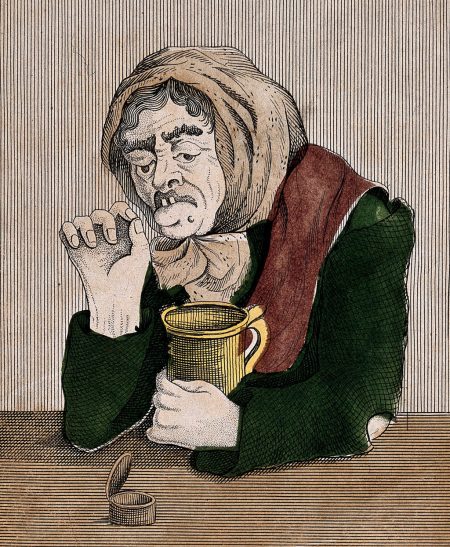
ugly, lonely old woman

Today’s intellectual leaders, both women and men, are like Fadia, an official in a French library:

Fadia. She is a desperate case. … I watched her leave the office and shook my head. I suspect she would be capable of taming even the fiercest erection. It’s clear that she hasn’t learned a thing. She’s at war with her body and with men’s bodies as well. It looks like it’ll be a long war. [1]

Plutocrats such as Melinda Gates are spearheading this bitter world-wide gender war. They are pygmies digging holes under the feet of intellectual giants such as the ancient Indian scholar al-Alfiya.

Al-Alfiya’s wisdom has been transmitted through the centuries in Persian and Arabic literature. Her name itself highlights one of her credentials:

this woman came to us through Indian erotica, and she became a legend passed on by the Arabs, essentially the men, with a certain degree of fear, envy, and admiration. The legend begins with her name. She was called al-Alfiya, “the thousand,” because she had slept with a thousand men. Although “slept” is deceiving… As if she had spent a thousand nights sleeping … She did not sleep and she would not let a single man sleep. The books say precisely, “She fucked a thousand men.” Words were exact, among the Arabs of ancient times. There was no business of sleeping or waking. To “fuck” was the word used. [2]

She was a leader among women back when women truly loved men:

groups of women gathered to visit her. They would say to her: “Sister, tell us what is required and we will do it. What is it that makes women settle in men’s hearts, what gives them pleasure and what morals do they abhor? What should we do in order to arouse their love and affection?” [3]

Al-Alfiya methodically described sixty positions for having sex. These sixty positions ranged from simple ones to ones requiring great physical agility.[4] If Al-Alfiya knew that international plutocrats of our age have inspired a poor, young woman in Guatemala to dream of “working in a big company and doing important things,” she would rightly cry.

In stark contrast to the gender divide that characterizes public life today, al-Alfiya helped men as well as women. A sixteenth-century Ottoman scholar reported:

there was once a king who completely lost his sexual potency. The physicians were not able to cure him with drugs. So they invented stories which they said had been told to them by a woman called Alfiyya. She was named so because a thousand (alf) men had slept with her. In their stories about all this she mentioned various positions and exciting situations. By hearing this, the king regained his potency. [5]

Some aspects of this account, which is relatively late, are probably faulty. Yet al-Alfiya undoubtedly did work to bring women and men together. She thus helped both men and women in immediate, tangible ways.

The eminent, ninth-century Arabic scholar al-Jahiz is thought to have discussed al-Alfiya. He presented her as a leading empirical scholar:

Al-Jahiz, who relates her teachings to us, celebrates her as being the most learned of all the people of her time with regard to the science of coition. What made him admire her still more was that, like himself, she belonged to that school of scholars who speak only of what they know from personal experience, and will only teach knowledge acquired through the direct observation of real phenomena. [6]

Nāsir al-Dīn al-Tūsī’s thirteenth-century Arabic work on improving sexual performance credited ancient philosophers and physicians — “Plato, Aristotle, Hippocrates, Palladius, Aristo, and scholars like them” — for gaining such knowledge through their own experiments.[7] Yet men scholars face severe constraints on their pursuit of sexual knowledge, particularly today. Al-Jahiz’s works play across earnestness and jest. One can more earnestly believe that al-Alfiya empirically established sexual knowledge than that Plato, Aristotle, Hippocrates, Palladius, Aristo, and other men scholars did.

Human intellectual leaders must regain their footing within more than a billion years of trillions of sexually reproducing organisms. All the money in the world cannot provide sufficient compensation for promoting misery among men and women. Moreover, with empirical certainty, they will come to know.

Scientia Duce -trade slogan of Isidore Liseux

*  *  *  *  *

Read more:

Notes:

[1] Nu’aymī (2009) p. 129 (with a few insubstantial adaptations).

[2] Id. p. 130. The ellipses are in the original. On the transmission of al-Alfiya’s knowledge, of which little is known for certain, see the entry for Azraqī Heravī (al-Azraqi, died about 1130) in the Encyclopaedia Iranica.

Alfiya (alfiyya) is a feminine adjective derived from alf (“one thousand”). A more accurate translation of Al-Alfiya is thus “the woman of one thousand”.

[3] Al-Tīfāshī, from Arabic trans. Newman (2014) p. 34. Al-Tīfāshī was a scholar who lived from 1184 to 1253. He traveled across the Islamic world from Algeria to Damascus.

[4] Nu’aymī (2009) p. 130-1. Al-Alfiya is associated with the book Alfiyya wa-shalfiyya. The origin of this book, which is lost, isn’t clear. It could have had a Indian, Persian, Arabic, or Byzantine origin. Alfiyya u Shalfiyya means literally “Of the penis and the vulva”.  Artan & Schick (2013) p. 158. That comes from the Persian word for penis, alfīya, combined with the Persian for vulva, shalfiya. See Steingass (1892) pp. 94, 757. By the eleventh century, alfīya also indicated wall paintings depicting sexual relations.

Parts of Alfiyya wa-shalfiyya apparently have been preserved in a sixteenth-century Ottoman work, The Repeller of Sorrows and Dispeller of Cares. For an English translation, Landor (2001). Al-Alfiya may have influenced the fifteenth-century Spanish work Speculum al foderi. For an English translation, Solomon (1990).

[5] The Ottoman scholar Tashköprüzāde (died 1561), from Turkish trans. Franke (2012) p. 169. This story has also been transmitted in Kashf al-zunun by Hajji Khalifah (died 1657), in a section on al-bah (ed. Istanbul, column 219).

[6] Nu’aymī (2009) p. 129.  “Her legend {that of al-Alfiya} was transmitted by Al-Jahiz and others.” Newman (2014) p. 34. However, according to an eminent scholar of classical Arabic literature, no reference to al-Alfiya exists in the surviving works of al-Jahiz. But al-Tifashi in Ruju` al-shaykh ila sibah fi l-quwwa `ala l-bah (“The Old Man’s Rejuvenation in his Powers of Copulation”) credits al-Jahiz with transmitting wisdom of al-Alfiya. See edition Cairo AH 1309, p. 64.

[7] From Arabic trans. Newman (2014) p. 91. See my post, “preparing men for erection labor in the 13th-century Islamic world.” An ancient Greek sex manual that the Greek courtesan Philaenis of Samos allegedly wrote declares in its preface that it is “for those who wish to live their life with knowledge gained scientifically, not unprofessionally.” Plant (2004) p. 46.

[image1] (1) Ugly, lonely old woman. Engraved carving (excerpt), early 19th-century Britain. Thanks to Wellcome Trust Collection, library ref. ICV No 19503, photo V0019108. Via Wikimedia Commons. (2) Trademark of Isidore Liseux, a late-nineteenth-century French scholarly publisher of sexually explicit medieval works. Scientia duce means “knowledge, lead on!”

References:

Artan, Tülay and Irvin Cemil Schick. 2013. “Ottomanizing pornotopia: changing visual codes in eighteenth-century Ottoman erotic miniatures.” Ch. 7 (pp. 157-207) in Leoni, Francesca, and Mika Natif, eds. Eros and sexuality in Islamic art. Farnham Surrey, England: Ashgate Publishing Company.

Franke, Patrick. 2012. “Before scientia sexualis in Islamic culture: ‘ilm al-bāh between erotology, medicine and pornography.” Social Identities. 18(2): 161-173.

Landor, Robert, trans. (2001). Gazali. Book of Shehzade: Dafiü’l gumûm, rafiü’l humûm. Cağaloğlu, Istanbul: Dönence.

Newman, Daniel L., ed. and trans. 2014. Nāsir al-Dīn al-Tūsī. The Sultan’s sex potions: Arab aphrodisiacs in the Middle Ages. London: Saqi.

Nu’aymī, Salwá (Salwa al Neimi), from Arabic trans. Carol Perkins. 2009. The proof of the honey. New York: Europa Editions.

Plant, I. M., ed. 2004. Women writers of Ancient Greece and Rome: An anthology. London: Equinox.

Solomon, Michael. 1990. The Mirror of coitus: A translation and edition of the fifteenth-century Speculum al foderi. Madison: Hispanic Seminary of Medieval Studies.

Steingass, Francis. 1892. Persian-English dictionary. London: Routledge & Kegan Paul Ltd. (digital database query)