
Ovid teaching men to cry vital to achieving gender equality
The old and foolish King Lear declared:
And let not women’s weapons, water-drops,
stain my man’s cheeks! …
No, I’ll not weep.
I have full cause of weeping, but this heart
shall break into a hundred thousand flaws
or ere I’ll weep. [1]
Rapidly a storm blew up. Within its devastating effects, Lear remained defiant:
Blow, winds, and crack your cheeks. Rage, blow.
You cataracts and hurricanoes, spout
till you have drenched our steeples, drowned the cocks.
You sulph’rous and thought-executing fires,
vaunt-couriers of oak-cleaving thunderbolts,
singe my white head. And thou, all-shaking thunder,
strike flat the thick rotundity o’ th’ world.
The hurricane (named after the furiously crying her) kills cocks and fuels thought-suppressing fires. Ovid, the master teacher of love, sniffed out much better than Lear the working of women’s crying game:
If your lover’s late, throw him a sweet glance, sigh
dramatically, deeply, ask him why,
then begin to cry
as though in a jealous passion — and then
claw his face with your nails.{ Spectet amabilius iuvenem, suspiret ab imo
Femina, tam sero cur veniatque roget:
Accedant lacrimae, dolor et de paelice fictus,
Et laniet digitis illius ora suis } [2]
Men have many reasons to cry today. Yet many men refuse to weep. Men won’t achieve gender equality with women until they learn to weep like women. Latin literature, especially Ovid, provides vital teaching to men on crying.
Men failing behind women in effective weeping is a relatively recent phenomenon. Empirical study makes clear that men today weep much less frequently than women do. Men also less often use tears to manipulate others.[3] But crying behavior wasn’t always gendered to provide men with less sympathy and less power. In Homer’s ancient Greek epics the Iliad and the Odyssey, revered warriors wept. Men and women in those ancient poetic masterpieces don’t differ in spontaneous expression of sorrow. Similarly, in ancient Greek tragedy, men cried in much the same circumstances as women did.[4] Major media today viciously disparaging men for crying. That’s a peculiar cultural development associated with today’s hard-heartedness toward men.
Ancient Latin literature recognized women’s sophisticated use of tears. Publilius Syrus, a Latin writer from Syria in the first century BGC, wrote maxims warning men about the power of women’s tears and women’s superior guile:
Women have learned to weep in order to deceive.
{ Didicere flere feminae in mendacium. }A woman’s tear is the spice of mischief.
{ Muliebris lacrima condimentum est malitae. }The ready tear means treachery, not grief.
{ Paratae lacrimae insidias non fletum indicant. }Women surpass men in scheming evil.
{ Malo in consilio feminae vincunt viros. } [5]
The Distichs of Cato, probably from the third or fourth century GC, advised men:
Fear not your angry wife’s words. But take care:
a woman by her weeping can ensnare.{ Coniugis iratae noli tu verba timere:
Nam lacrimis struit insidias, cum femina plorat. } [6]
The Distichs of Cato were a popular medieval Latin school text. Unfortunately, most students today never study medieval Latin literature. That particularly hurts men, because men are now not taught the importance of crying.
With formal educational institutions shirking their responsibilities, men must learn to cry by reading Ovid on their own. Ovid sets out women’s high standard of crying performance:
She can burst into tragic tears
and pretend that a jewel’s dropped from one of her ears.{ cum mendaci damno maestissima plorat,
Elapsusque cava fingitur aure lapis } [7]
What good man wouldn’t buy another for the poor dear? Publilius Syrus warned men:
Not tears but gifts can touch a courtesan.
{ Muneribus est non lacrimis, meretrix misericors. } [8]
The social construction of gender tends to support transfer of resources from men to women. But not all women are whores. Moreover, men who are guileful can get their lover’s gift back. In any case, well-educated men have to know how to cry when doing so is advantageous.
Tears, too, can be helpful — they can move stone.
If you can, show her cheeks wet with tears. If you have none
(they don’t always come on cue),
dab your eyes with water. Stage-manage the dew.{ Et lacrimae prosunt: lacrimis adamanta movebis:
Fac madidas videat, si potes, illa genas.
Si lacrimae (neque enim veniunt in tempore semper)
Deficient, uda lumina tange manu. } [9]
Crying is a critical survival skill for men living in gynocentric society:
Echo her views, whatever line she chooses.
If she laughs, laugh. If she cries, remember to do the same.
Your face must obey her rules.{ Quod dicet, dicas; quod negat illa, neges.
Riserit, adride; si flebit, flere memento;
Imponat leges vultibus illa tuis. }
That stricture applies mainly to today’s classroom discussions, workplace interactions with bosses, and expressing political views in public. Men seeking to stir women’s sexual desire must adopt more sophisticated strategies. Men who would practice the art of love without being incarcerated for their efforts must learn to cry.
Apart from any effects of the welfare of men or women, encouraging men to cry is necessary to achieve gender equality. Gender equality in crying existed in fifth-century democratic Athens. Gender equality in crying can be established under today’s Soviet-quality intellectual life. All that is necessary is sufficient ideological enlightenment and will.
* * * * *
Read more:
- blame men for lack of gender symmetry in love
- mis-educating daughters with mythic gender equality in guile
- study of De Secretis Mulierum enlightens mystified men
Notes:
[1] William Shakespeare, King Lear 2.4, ll. 272-3, 278-81. Lear is addressing his “two pernicious daughters” who engaged in “high-engendered battles” against their father. Id. 3.2 ll. 22-3. Such tragedy also exists today.
Shakespeare composed King Lear about 1605. Geoffrey of Monmouth’s medieval Latin work Historia Regum Britanniae (written about 1136) described King Lear ruling Britain with his three daughters. Here’s a review of Robert Falls’s production of King Lear.
Modern literary scholars have regrettably contributed to sustaining men’s inferior position. An eminent Shakespearean scholar declared of King Lear:
We admire the valor of his attempts (and they come quite early) to be patient, to compromise, to hold back womanish tears, to cling to his reason. Nothing is more moving than his bewildered attempts to meet “social” obligations as he kneels by Cordelia’s body. We love his manliness.{emphasis in original}
Alfred Harbage, Introduction to King Lear, in Harbage (1969) p. 1062. This oppressive view of manliness tends to be associated with repressing vigorous literature of men’s sex protest.
The subsequent quote is from King Lear 3.2 ll. 1-7.
[2] Ovid, Ars Amatoria (Art of Love) 3.675-8, from Latin trans. Michie (1993) p. 161. See also id. 3.291-2, Remedia Amoris 689-90, and Amores 2.18.5-13. Cf. Propertius 3.25.1-10.
[3] Vingerhoets (2013) pp. 129, 187-8. Here’s some gynocentric discussion of crying. Men cry less than women do even though men suffer more violence than women do, face devastating consequences of unplanned parenthood, and experience acute anti-men discrimination in family courts, among other heart-rending injustices against men.
[4] Föllinger (2009) and Suter (2009). For example, Agamemnon, commander-in-chief of the Greek armies at Troy, cried before his troops:
Lord marshal Agamemnon rose up in their midst,
streaming tears like a dark spring running down
some desolate rock face, its shaded currents flowing.
So, with a deep groan, the king addressed his armies
Homer, Iliad 9.13-7, from Greek trans. Fagles (1990) p. 232. Writing in sixth-century Constantinople, the government bureaucrat John Lydus was similarly unashamed to cry. He presented men crying as a natural response to understanding current circumstances:
With the extinction of most, or perhaps however, all of the traces of sage antiquity, one could not endure to continue to be free of tears when perceiving from what is set forth below how formerly the law used to take thought for the freedom of subjects, and how many the blessings were from which our time has fallen little by little as a result of the ill-fated plight of the governed.
Lydus, De magistratibus populi Romani 3.11, from Greek trans. Pazdernik (2009) p. 398. Lydus lamented cheap paper being used for important bureaucratic documents and lack of regard for bureaucratic forms.
[5] Publilius Syrus, Sententiae 153, 384, 536, 365, Latin trans. adapted from Duff & Duff (1934).
[6] Distichs of Cato (Disticha Catonis) 3.20, Latin trans. adapted from that of Chase (1922). Duff & Duff (1934) provides a Latin text with alternate translation. J. Marchand has also provided a Latin text with English translation (Bk. 1, Bk. 2, Bk. 3, Bk. 4). See also Chase (1922). Laura Gibbs provides many of Cato’s Distichs, along with helpful Latin translation notes.
[7] Ovid, Ars Amatoria 1.431-2, from Latin trans. Michie (1993) p. 31.
[8] Publilius Syrus, Sententiae 399, Latin trans. from Duff & Duff (1934) p. 67.
[9] Ovid, Ars Amatoria 1.659-62, Latin trans. lightly adapted from Michie (1993) p. 47. The subsequent quote is from Ars Amatoria 2.201-2, id. pp. 69, 71. Plato ridiculed his friends for crying at his impending death. Plato had much less wisdom than Ovid.
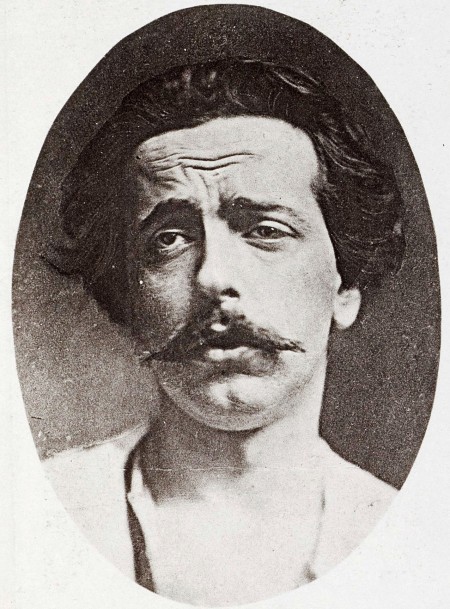
[image] Man expressing grief, but not crying. Portrait from fold-out plate of photographs from Chapter Vll, Low Spirits, Anxiety, Grief, Dejection in Charles Darwin, (1872), The Expression of Emotions in Man and Animals. Thanks to Wikimedia Commons.

References:
Chase, Wayland Johnson. 1922. The distichs of Cato: a famous medieval textbook. Madison: University of Wisconsin.
Duff, A. M., and J. Wight Duff, eds. and trans. 1934. Minor Latin poets. Loeb Classical Library. Cambridge, Mass: Harvard University Press.
Fagles, Robert, trans. 1990. Homer. The Iliad. New York, N.Y., U.S.A.: Viking.
Föllinger, Sabine. 2009. “Tears and Crying in Archaic Greek Poetry (especially Homer).” Pp. 17-36 in Fögen, Thorsten, ed. Tears in the Graeco-Roman world. Berlin: W. de Gruyter.
Harbage, Alfred, ed. 1969. Complete Pelican Shakespeare. London: Penguin Books.
Michie, James, trans. 1993. Ovid. The art of love. New York: Modern Library edition, 2002.
Pazdernik, Charles F. 2009. “Fortune’s Laughter and a Bureaucrat’s Tears: Sorrow, Supplication and Sovereignty in Justinianic Constantinpole.” Pp. 397-418 in Fögen, Thorsten, ed. Tears in the Graeco-Roman world. Berlin: W. de Gruyter.
Suter, Ann. 2009. “Tragic Tears and Gender.” Pp. 59-84 in Fögen, Thorsten, ed. Tears in the Graeco-Roman world. Berlin: W. de Gruyter.
Vingerhoets, Ad. 2013. Why only humans weep: unravelling the mysteries of tears. Oxford: Oxford University Press.
Euripides falsely accused of hating women

Euripides was an eminent and prolific fifth-century Athenian tragic playwright. Long after he was buried, he was accused of hating women. Those accusations were largely invented from fanciful readings of his plays. Euripides actually was a conventional elite man who ultimately bowed to the dominant interests of gynocentric society.
According to an ancient biographer, Euripides spent his days alone in a cave by the sea. In short, he spent time in a man cave. That’s normal, healthful, and important to men. The ancient biographer, however, pathologized masculine behavior:
His looks were melancholic, thoughtful, and severe; he hated laughter and he hated women. [1]
Just because a man spends time in a man cave doesn’t mean that he hates laughter and hates women.
Euripides was so conventional that he not only married, but married twice. Euripides experienced men’s vulnerability to cuckolding:
They say that after he married Mnesilochus’ daughter Choirile and realized that she was unfaithful, he first wrote the play Hippolytus, in which he exposes women’s immorality, and then he divorced her.
Greek tragedies are filled with instances of men’s immorality. No one would invent a biographical explanation for a playwright “exposing men’s immorality.” Gynocentric society suppresses public discussion of women’s immorality. Euripides was falsely accused of hating women because he didn’t pedestalize women.
Euripides’s second marriage was nearly the death of him. Euripides offered sage advice to his ex-wife’s new husband:
When her next husband said: “She is chaste in my household,” Euripides replied: “You’re a fool if you think the same woman will be chaste in one man’s house but not in another’s.” [2]
Apparently not prudently evaluating chastity before he married again, Euripides again faced the risk of forced financial fatherhood for some other man’s child. Ancient biographers used this misfortune to slander Euripides:
He {Euripides} took a second wife, but when he found she tended to be unchaste, he was more readily encouraged to slander women. The women planned to kill him and to come to his cave, where he spent his time writing. [3]
A twice-divorced man retreats to his man cave to seek consolation in writing. Is that a fair reason to smear him with an accusation of slander? Is that a fair reason for women to plan to kill him? Scholars today claim that Matheolus slandered women. That’s merely a common tactic to crush dissent. With Euripides, silencing him wasn’t enough. They also sought to kill him.
Euripides ultimately fell in line and served the ideological interests of gynocentric society. Women threatening gang violence intimidated him:
The women ganged up against him at the Thesmophoria and assembled in a group at the place where he happened to be resting. They spared him, first because of his poetry and then because he promised never again to say anything bad about them. For example, this is what he said about women in the Melanippe: “In vain men shoot their criticism at women. In vain men’s blame, like an empty bowshot, twangs at women and speaks ill of them. Women are better than men! I shall prove it” and so on. [4]
In short, Euripides became a female supremacist spewing sexist anti-men bigotry. That sort of bigotry is so common today that few recognize it while they slander others as women-haters.
While medieval anti-meninism is finally attracting scholarly attention, the roots of anti-meninism go back much farther than the Middle Ages. Like false accusations of rape, false accusations of hating women have a long and sordid history. Falsely accusing Euripides of hating women indicates societies that understand neither themselves nor brilliant, tragic literature.[5]
* * * * *
Read more:
- Peisistratus applied men’s birth control in ancient Greece
- Lucretia claiming rape incited Roman men to war without questioning
- Juvenal’s Satire 6 is no longer laughing matter
Notes:
[1] Life of Euripides, TrGF 5.1 T 1, from Greek trans. Lefkowitz (2012) p. 154. Subsequent quotes are from id. pp. 154-5, unless otherwise noted. The Life of Euripides is associated with surviving Greek manuscripts of Euripides’s tragedies.
[2] Euripides discovered that his wife was having an affair with “O best and darkest Cephisophon,” their “home-bred slave.” He couldn’t persuade her to end that affair, so he left her. Id. p. 155.
[3] In his play Thesmophoriazusae, Aristophanes gives details on the Confederacy of Women’s plot to kill Euripides. A character in one of Euripides’ Melanippe plays stated: “Except for my mother I hate all womankind.” Fr. 498, from Greek trans. Collard & Cropp (2008) p. 605. That character’s utterance seems to have been attributed to Euripides personally. Some women today hate all men, including their fathers.
[4] In this quote, the first part is from the second-century BGC biographer Satyrus of Callatis. Id. p. 87, p. 195, n. 12. The quote survives in a fragment with additional text that includes a men-disparaging claim and a NAWALT assertion:
no house deprived of a woman can be tidy and prosperous. … Why then should womankind be denigrated? Will the vain censures of men not cease and those excessively thinking if just one is found to be bad, to condemn all women alike? For my part I will make a distinction: on the one hand nothing is worse than a bad woman, but on the other nothing excels a good one in goodness. The natures of each are different.
Euripides, attributed to Melanippe, fr. 494 in Collard & Cropp (2008) pp. 595-7. From the same source, fr. 493 further defends women:
Hatred of womankind is a most grievous thing. Those who have fallen bring disgrace on those who have not, and the bad ones share their censure with the good; and where marriage is concerned men think they have no integrity at all.
Id. p. 595. Athenaeus records that Euripides liked women:
The poet Euripides also liked women. Hieronymus in his Historical Commentaries, for example, says the following: When someone remarked to Sophocles that Euripides hated women, Sophocles said: “In his tragedies he does; but he certainly likes women in bed!”
Athenaeus, Deipnosophists 13.557, from Greek trans. Olson (2010) p. 235. In the context of banter between Euripides and Sophocles, Deipnosophists 13.604f refers to Euripides forcefully kissing a courtesan and having sex with another man’s wife.
[5] Recent scholarship has tended to present Euripides as a champion of women. See, e.g. Long (2015), which describes women in ancient Greece as powerless and oppressed. Was Candaules’s queen really powerless? Even slave girls had astonishing power over caliphs in the ancient Islamic world. More generally, claims that Euripides hated women and claims that Euripides was a champion of women share a common, telling feature: they’re both centered on women.
[image] Bust of Euripides. Marble, Roman copy after a Greek original from c. 330 BGC. Preserved in Vatican Museums, Museo Pio-Clemntino, Sala delle Muse, Inv. 302. Thanks to Marie-Lan Nguyen and Wikimedia Commons.

References:
Collard, Christopher, and Martin Cropp, trans. 2008. Euripides. Fragments: Aegeus-Meleager. Loeb Classical Library 504. Cambridge, MA: Harvard University Press.
Lefkowitz, Mary R. 2012. The lives of the Greek poets. 2nd. Edition. Baltimore: Johns Hopkins University Press.
Long, Roderick T. 2015. “Ancient Greece’s Legacy for Liberty: Euripides on the Woes of Woman.” Column, December 31, 2015 at Libertarianism.org
Olson, S. Douglas, ed. and trans. 2010. Athenaeus VI, the learned banqueters. Loeb Classical Library. Cambridge, Mass: Harvard University Press.
mis-educating daughters with mythic gender equality in guile
Upholding the equal human dignity of every person shouldn’t compromise truth. In truth, men suffer more serious violence than women do. The idealistic medieval knight Geoffrey de la Tour Landry taught his daughters concern for violence against men. In truth, men tend to be less skilled in guile than women are. Geoffrey de la Tour Landry, in contrast, taught his daughters mythic gender equality in guile. Parents throughout the ages have largely failed to raise daughters who recognize their own strengths and acknowledge men’s weaknesses.

Geoffrey taught his daughters the story of a ropemaker, his wife, a prior, and a bawd. The ropemaker’s wife paid the bawd to set up a love affair for her with the prior. One night, the ropemaker in his home caught a glimpse of another man leaving. That was the prior after having sex with the ropemaker’s wife. The ropemaker fearfully told his wife that he had seen another man in their room. The wife pretended to afraid and declared “it must have been a devil or else a goblin or a spirit.”
The wife got the bawd to help convince her husband not to believe what his eyes saw. The bawd cleverly switched spinning black and white wool to convince the husband he couldn’t trust the black-and-white truth of his eyes:
She took in her hands a distaff with black wool and began to spin. Before he turned towards her again, she replaced it with white wool. Then the good man, who was plain and true, said to her, “My friend, it seemed to me that you just were spinning black wool.”
“Ha,” she said, “My friend, truly I wasn’t.” Then he went from her and when he turned towards her again, she had taken up the distaff with black wool. He watched her and said, “Fair gossip, you just had a spindle with white wool.”
“Ah, dear friend, what ails you now? In good faith, it isn’t so,” she said. “I can see that you’re dazed and deceived in your sight and your wits. Truly, men sometimes think they see something that they don’t see.”
The bawd / gossip then asked the good man (a medieval euphemism for a cuckold) if something was bothering him:
“By God, gossip, last night I thought I saw a black thing. I don’t know what it was, coming out of our room.”
“My good friend,” the old, false woman said. “It was nothing but the day and the night that strove together, and there was great lightening.” The good man was contented with the old woman’s falseness and thought she spoke truly.
The day and the night striving together and producing great lightening is like feeling the earth move. Like many men today, the ropemaker lacked literary learning.
Another time, the ropemaker early in the morning prepared to go to market to bring home some fish. Reaching for a sack that he had put at the foot of the bed, he unknowingly grabbed the prior’s breeches. When at the market he reached for his sack, he discovered that what he thought in the darkness was a sack was actually a man’s breeches. The prior, who had been hiding in the room between the bed and the wall, realized that the ropemaker had taken his breeches.
The prior fearfully told the wife what had happened. To arrange a coverup, the wife sought help from her friend the bawd. The bawd schemed:
“You put on a pair of breeches and I will, too, and we’ll tell him that all women wear them.” And so they did.
When the bawd saw the ropemaker returning home, she greeted him and inquired why he seemed to be angry. The ropemaker explained about the breeches and his suspicions of his wife. The bawd responded:
Oh, my friend, you are very much deceived about your wife. For truly, in the whole town there’s no one better than your wife, no one who keeps herself more faithfully and purely towards her husband than she does to you. In fact, she and I and many other good and honest women in this town have taken to wearing breeches on account of those lechers and seducers who do their will with good women. And just so you can know whether I lie or speak truly, look to see whether I wear them or not.” She pulled up her clothes and showed him the breeches. And he looked and saw that she spoke truly, and believed her.
Women deceive men with remarkable ease.
Geoffrey de la Tour Landry, however, added a mythic coda to the gritty reality of men’s inferiority in guile. Signally an other-worldly continuation, Geoffrey declared, “But in the end, evil will be known.” The ropemaker one day pretended to go on trip, but in reality he hid locally. He covertly observed his wife going into the prior’s house. Men usually aren’t so shrewd. Another time, the wife summoned the prior to come to her while she and her husband were in bed. The husband responded guilefully:
the good man heard the prior come in, so he snored and pretended to be asleep. When they were in the midst of their foul sin of lechery, he got so angry that he almost lost his memory and wits. He drew out a long knife with a sharp point, cast a little straw on the fire so he could see, and killed them both in bed.
In the Middle Ages just as today, men were typically punished more harshly for adultery than women were. The husband upheld ideals of gender equality by killing his wife in addition to the usual killing of the adulterous man.

Mythic gender equality is no substitute for true gender equality. Geoffrey de la Tour Landry and other parents should teach their daughters to recognize their superiority in guile. They should encourage their daughters to mentor their brothers, their lovers, and other men to become more relationally sophisticated. Helping men to become more relationally sophisticated would better enable women to find equal partners in men, and, more importantly, improve the welfare of men themselves.
* * * * *
Read more:
- women’s social superiority trumps sexual betraying men
- ass for lover: failing to distinguish men’s physical masculinity
- Decameron’s self-government confronts sex differences in guile
Notes:
The quotes above are from Geoffrey de La Tour Landry, Le livre du chevalier de La Tour Landry (Book of the Knight of Tour Landry / Book of the Knight of the Tower) ch. 62 (Of the roper or maker of cords and cables and the fat Prior), from Old French trans. Barnhouse (2006) p. 191. Subsequent quotes are from id. pp. 191-3. I’ve made a few minor changes in the translation for readability. For the Old French text and early modern English translations, see note [1] in my post on imprisoning a man.
[images] (1) Cuckold’s Haven. Broadside. Published in London in 1638. EBBA ID: 30036, British Library – Roxburghe 1.46-47. (2) An Answer to the London Cuckold. Published about 1685-8. EBBA ID: 21787, Pepys Library, Magdalene College – Pepys 4.123. Both images thanks to University of California, Santa Barbara, English Broadside Ballad Archive.
Reference:
Barnhouse, Rebecca, trans. 2006. Geoffrey de La Tour Landry. The book of the knight of the tower: manners for young medieval women. New York: Palgrave Macmillan.
Wednesday’s flowers
