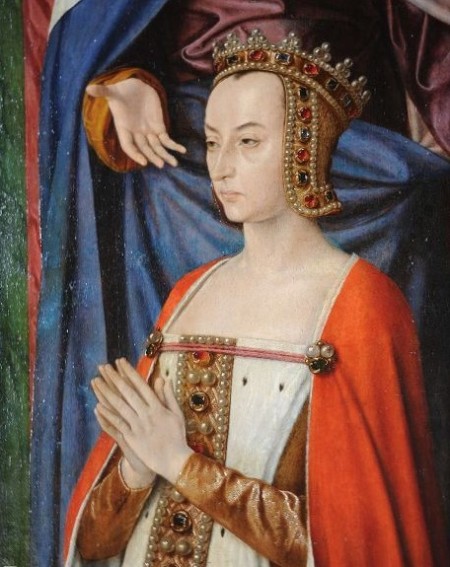
Anne of France & lessons for daughters in history of anti-meninism

Anne of France

Anne of France, who came to be known as “Madame La Grande,” was the oldest and favorite daughter of King Louis XI. Just before his death, he appointed her and her husband regent of the succeeding King Charles VIII, her younger brother. Anne dominated both her husband and her younger brother. As regent for King Charles, she was effectively ruler of France from 1483 to 1491. When King Charles begin ruling France himself, Anne then shifted to ruling her husband’s Duchy of Bourbon. She was a very powerful and highly privileged woman.[1]

Anne of France provided lessons not just for her daughter, but for all women. She taught the values and morals of a strong, independent woman with enormous political ambition:

Conscious always of her royal heritage, having served as virtual king of France for eight years, and in a moment when she faced her own mortality, Anne of France looked to her royal forebears when she decided to set down her own life-lessons for her daughter. Although clearly informed by her reading of books like those of Christine de Pizan — who was, like Anne herself, a woman writing to women — Anne aimed for something more than a simple guide to good behavior when she distilled her experience into the lessons she intended for her daughter. … Just as her father had defined the ideal king, Anne used her lessons to construct an ideal princess. … Anne presents a guidebook on governance for Suzanne {her daughter}, one not altogether unlike Machiavelli’s more famous book of advice for a would-be prince, written some fifteen years later. [2]

Intellectual historians, who have been predominately men, haven’t appreciated the importance of Anne of France. She trumped Machiavelli with thinking that few today realize continues to manipulate them.

Anne of France’s lessons for her daughter provide an extraordinary window into the unknown history of medieval anti-meninism. From the commanding heights of French royalty, Anne of France taught blunt lessons of anti-meninism:

There is no man of worth, however noble he may be, who does not use treachery, nor to whom it does not seem good sport to deceive or trick women of rank from one good family or another, it doesn’t matter which. And Doctor Lienard says there is no man so perfect who, in matters of love, is truthful or keeps his word, however firm or fervent — which I certainly believe. One time I heard a noble woman of great rank tell about a knight she knew who, in such a situation, took a solemn oath of his own free will, on his honor as a gentleman, on the altar and on a missal where Mass is said everyday — and this knight did not keep his oath for more than four hours! And, as she told me, the oath was very reasonable and, with all respect to his honor and conscience, he had no excuse whatsoever for breaking it except his own lust, weak will, and sudden change of heart. Therefore, my daughter, whatever flattering speeches or great signs of love that someone may make you, trust none of them. [3]

Not all men are like that. Some men aspire to be as dynamic and responsive to circumstances as women are.[4] All men shouldn’t be distrusted. History and the gender composition of prisoners show how readily society criminalizes men for seeking love. Latin literature documents at least one women with sympathy for outrageous persecution of men. Yet the massive historical stream of anti-meninist literature, which is deeply connected to the very act of writing in forcing pen to matter-mother, has shaped society from today’s affirmative-consent college sex codes to men not having any reproductive rights whatsoever.[5]

Until recently, men have written the bulk of anti-meninist literature, while women have written relatively little. The relative paucity of women’s writing indicates women’s shrewdness. After all, others will viciously attack you for whatever you write in accordance with the enormity of their misunderstandings. Anne of France, however, wrote fearlessly and openly. For example, in words preserved in writing to our day, Anne of France instructed her daughter:

Never behave as those arrogant mothers who display themselves with their daughters, next to whom they look like grandmothers! Such women are mocked. … I do not mean to say that a noblewoman, whatever her age or rank, should not, within reason, show herself to best advantage over others, but whatever beauty a woman has had, once she has passed the age of forty, there is no clothing, however beautiful, that can make the wrinkles on her face disappear.

Few today would dare utter such words, to say nothing of putting such words into writing.

Anne of France was deadly serious about imbuing her daughter with anti-meninism. Anne instructed her daughter:

Suffer no man to touch your body, no matter who he is, no holding of hands or pressing of feet. In conclusion, my daughter, remember those three aforementioned daughters who were the cause of their mother’s deaths, and do not behave so that your bad conduct is the cause of mine. [6]

That’s every daughter’s deepest fear: her bad behavior will cause her mother’s death. Anti-meninism fundamentally rests on belief that men are so evil that they shouldn’t be allowed to touch women. If a woman allows a man to touch her, she will cause her mother’s death. That potent psychological manipulation perpetuates anti-meninism from one generation of women to the next.[7]

Anne of France teaching her daughter lessons

A medieval scholar, like Anne herself, a woman writing to women, recently recognized Anne of France’s enormous importance for women. Anne of France’s lessons for her daughter are teachings of pure woman:

The world of the Lessons is curiously but significantly free of male control. For all the attention paid to Suzanne’s life as a daughter {of Anne}, paternal authority is absent. While a wife must be obedient {at least according to formal regulations}, the husband she must obey is an elusive presence, prone to folly, mistakes, and of course, absence, either because of war or death. As a mother, Suzanne must pay particular attention to the rearing of daughters; sons are never mentioned. [8]

Anne of France’s thinking seems to project an ideal anti-meninist world in which all males are eliminated. Women seeking to understand the effects of anti-meninism on their lives need to think through the history of women:

Only foolish women think nothing of their foremothers — of their mothers and grandmothers, or their aunts and sisters.

Anne of France was a leading foremother of medieval anti-meninism:

she shaped the lives of many influential women. At the moment of her death, two of them had taken their own places on the stage of early modern power and politics: Margaret of Austria, whom Anne raised and educated for ten years, was regent of the Netherlands for her nephew, the Habsburg emperor Charles V, while Louise of Savoy, who had been sent by her father to Anne of France when the girl was seven, had already served as regent of France for her son, Francis I, and would be called upon a second time to fulfill that role. They were only two of the generation of women she had influenced; in Brantôme’s words, “there were no ladies or daughters of great houses in her time who did not receive lessons from her.” Having shaped the next generation and distilled her principles into her Lessons, Anne of France had become a “mother” for women to “think back through.”

Women struggling with fear of causing their mother’s death should think back through Anne of France. Women beyond the age of forty, wandering whether they have lost their physical allure, should think back through Anne of France. Most importantly, woman wondering how anti-meninism has become strong enough to give them a life alone with their cats amid a civilization ready to collapse — they should think back through Anne of France.

*  *  *  *  *

Read more:

Notes:

[1] Jansen (2004) pp. 4-5, 71-2. Matarasso (2001), p. 19, observes: “there is no doubt that it was she {Anne of France}, not her husband, who was the dominant partner.” Matarasso also observed of Anne of France:

{she} could be both haughty and grasping in her public life. Cupidity was a characteristic she shared with many, but even in that age of ostentatious spending, when spenders needed to be getters, Madame’s lust for gold was remarked on.

Id. p. 107. Anne of France liked marble fountains. She acquired an Italian one that had been located in the city of Lyon. She also kept a menagerie of exotic animals. She pressured Lorenzo de Medici to give her his prized giraffe. Id.

[2] Jansen (2004) pp. 16, 17, 77.

[3] Les enseignements d’Anne de France, duchesse de Bourbonnois et d’Auvergne, à sa fille Susanne de Bourbon (The Lessons of Anne of France, duchess of Bourbon and Auvergne, to her daughter Susanne of Bourbon), from French trans. Jansen (2004) pp. 39-40. The subsequent two quotes are from id. p. 62 (women past the age of forty) and p. 43 (causing death of mother). Chazaud (1878) provides the French text. Chazaud dates Les enseignements to 1503-5; Jansen prefers the dating 1497-8. Jansen (2004) p. 10. Here’s a bibliography of scholarly work on Anne of France.

“Doctor Lienard ” is Leonardo di Matteo of Udine, an Italian Dominican prior born about 1400. Jansen (2004) p. 30, n. 12.

In discussing seduction, Anne of France declared, “the sin of the man who pursued her is even worse.” Id. p. 62. For adultery and for seduction, as for most crimes, gynocentric society is biased toward blaming men and exonerating women.

[4] Virgil, Aeneid 4.569, recognized women’s capabilities: varium et mutabile semper femina (woman is always varying and circumstantially responsive).

[5] On theorizing writing, see note [8] in my post on Bernard of Cluny.

[6] Anne of France also wrote Histoire du siege de Brest. That story features brutal violence against men. Matarasso (2001) pp. 196-7. Matarasso observed:

The Enseignements {Anne of France’s lessons for her daughter} are singularly lacking in love, almost shocking so when one considers that they were compiled by a mother for her only child, a girl of twelve or perhaps thirteen.

Id. p. 194. Anti-meninism tends to be associated not just with contempt for men, but also lack of true love for women and children.

[7] Anne of France was highly skilled in manipulating persons:

She learned to mask her natural arrogance and her impatience to get things done. … No one could play a waiting game better than she. She worked at one remove, through men who were often unaware that they were being manipulated. Again and again during her years in power she promised the earth only to renege when she had gained her ends.

Matarasso (2001) p. 20. Historians haven’t recognized the extent to which Anne of France manipulated women, including her own daughter.

[8] Jansen (2004) p. 89. The subsequent two quotes are from id. pp. 89-90. Matarasso excuses Anne of France and blames men for Anne of France’s anti-meninism and for her other lessons for her daughter:

Growing up at court in the late fifteenth century was a confusing business for a girl. The position of the noblewoman in the Middle Ages was deeply ambiguous.

Matarasso (2001) p. 37. Anne of France was a poor, over-privileged dear. Relative to her, peasant men had the advantage of clearly knowing the position of their harsh, brutal, and relatively short lives. Of course, books that Anne of France and other noblewomen had the learning and leisure to read also oppressed them:

the books that were their mainstay gave them deeply confusing and in the main negative views of themselves, of marriage and of their role in society. To become, as Anne did, one’s own woman in spite of it, must be hailed as a triumph of nature over nurture. … {Anne of France} passed on to her own daughter in her “Precepts” the low opinion of women which she herself had absorbed from men and books (it must be said that she had a low opinion of human nature generally).

Id. The manipulative claim, “you’ll be the death of me, your mother” almost surely wasn’t a tactic that Anne of France learned from men. More generally, if men are to be blamed for medieval anti-meninism, women should be credited for medieval literature of men’s sexed protests.

[images] (1) Anne of France. Detail from the Moulins Triptych. Made 1489-99 by Master of Moulins (Jean Hey). Thanks to the Yorck Project and Wikimedia Commons. (2) Anne of France giving lessons to her daughter Suzanne. Prefatory etching in Chazaud (1878).

References:

Chazaud, A.M. 1878. Les enseignements d’Anne de France, duchesse de Bourbonnois et d’Auvergne, à sa fille Susanne de Bourbon. Moulins: C. Desrosiers.

Jansen, Sharon L. 2004. Anne of France: lessons for my daughter. Woodbridge, Suffolk, UK: D.S. Brewer. (Linda Lierheimer’s review) (Judith Fai-Podlipnik’s review)

Matarasso, Pauline Maud. 2001. Queen’s mate: three women of power in France on the eve of the Renaissance. Aldershot: Ashgate.

with castrated father, Perceval taught to be woman-pleaser

Holy Grail saves men

The myth of the Holy Grail became central to European culture mainly through Chrétien de Troyes’s late-twelfth-century French romance Perceval, The Story of the Grail. Perceval’s father was castrated and his two older brothers killed in violence against men. Perceval’s mother taught Perceval to be, like the fatherless knight Boucicaut, a woman-server. Do you want to know the wisdom of the Archpriest of Talavera? Ask! Generations of students have been taught to remain silent. To discover the Holy Grail is to break the spell of gynocentrism.[1]

In the traditional understanding of chivalry, a good knight focused on performing at night in bed with his wife. Perceval’s mother, reflecting deeply rooted medieval anti-meninism, valued her husband for his skills in violence against men. She told Perceval:

No braver, more worthy knight,
Ever existed, more famous
And more feared, anywhere in all
The Western Islands, than your father. [2]

A man being famous and feared relates to a good knight only through the men-oppressing cultural construction of courtly love. That gender construct encourages the brutalization of men:

Your father, let me tell you,
Was wounded between the legs
And his whole body was crippled,
All the lands, and the immense
Treasure his bravery had won
Began to fall away,
and he died terribly poor. [3]

Perceval’s father didn’t respect the worth of his own sword and didn’t use it properly. He should have married a rich, beautiful woman like Circe and enjoyed an easy life. Men who fight to acquire wealth that is easily taken away are fools. What men naturally have is wondrously good. Men need only to take care not to be castrated.

Men must also ignore teaching that devalues their lives, even when that teaching comes from their own mothers. Perceval’s mother saw her husband suffering from castration. She saw her two older sons die in violence against men. Yet she taught her son Perceval:

Should you find a lady in need —
Anywhere, near or far —
Or a girl in need of protection,
Always offer your aid,
If they ask for it, for there’s no honor
That isn’t built on that base.

The honor of being a woman-server is built on the base of gynocentric society. Breaking the spell of gynocentrism starts with men saying “no” to damseling women.

Mothers should develop in their sons a sense of entitlement to love simply for being the men that they are. Perceval’s mother, in contrast, described love for Perceval as a rare gift that he should neither seek nor expect:

And if you court a woman,
Be careful you don’t harass her:
Do nothing that might displease her.
A kiss means a lot to a girl,
So if she allows you a kiss
Don’t ask for anything more:
Renounce it, I beg you, in my name.

The best response to such motherly advice is, “Hey mom, I’m hungry. Make me a sandwich!” Then read some medieval women’s love poetry for men’s seductive learning.

Perceval listened to his mother without understanding and foolishly sought to follow her advice. One day, he came across a girl sleeping alone on a bed in a tent. He entered the tent:

And the boy, innocent fool
That he was, said, “Girl, I greet you,
As my mother taught me I should.
That’s what she taught me: always
Greet a girl, no matter
Where you happen to find her.”

Imagining that they are doing what their mothers told them to do, boy-men are a menace to civilized society. So it was with Perceval. The girl told him to leave:

“But first I’ll kiss you,”
Said the boy, “no matter what,
Just as my mother taught me.”
“Oh no, you won’t, by God!”
Said the girl, “Not if I
Can help it! Leave, before
He finds you, or you’re good as dead.”

Unconcerned about that threat of violence, Perceval forcefully grabbed her and kissed her twenty times or more. That’s bad. That’s wrong. Perceval actions reduced the girl to misery, made her lover furious, and caused at least one other man to have his head chopped off. Perceval should never have sought to do as his mother taught him.

Perceval’s best moment came when he followed advice of the noble man Gornemant de Goort. Gornemant advised Perceval to stop telling others that he was doing what his mother taught him. Gornemant also advised Perceval not to speak too much.

One day when seeking lodging, Perceval met the beautiful woman Blanchefleur. She took him by the hand and led him to a secret room. There she sat next to him on a bed covered with a silken feather-quilt. Perceval said and did nothing. He maintained manly silence and immobility until Blanchefleur first spoke to him. She apologized that she could not offer him a better dinner.

Perceval went to bed by himself. He slept soundly and peacefully. Banchefleur, however, was too emotionally tormented to sleep. She got up during the night and went to Perceval’s room. She was dressed only in a nightshirt and a short cloak of bright red silk. Perceval was asleep:

And when she reached his bed
She stood there, weeping and sighing.
And then she knelt, bending
Over him, the tears flowing
So freely that they covered his face:
She could manage nothing more.
The flood of tears woke him,
Startled, wondering why
His face was covered with water.
And then he saw her kneeling
Next to his bed, and felt her
Clutching him round the neck.

Perceval didn’t tell her to leave. He didn’t accuse her of sexual harassment. He didn’t even blame her for wetting his bed. In short, Perceval acted with decency and compassion.

The rest of the story follows the pattern of manipulating men to engage in violence against men. Blanchefleur declared to Perceval that she was going to kill herself tomorrow. Stay away from crazy! She explained that some strong, bad, famous knight was besieging her castle. That’s not Perceval’s problem. But gynocentric ideas of glory, bravery, and courage promote dangerous, anti-meninist action to save a damsel in distress:

Ah, what an opportunity
For glory, if he’s brave enough
To seize it. And that’s what she came for,
Dropping her tears on his face,
In spite of the story she’d told him.
She’d come for that and nothing
Else, hoping, if he had
The courage, he’d decide to fight
For her castle, and for her lands, and for her.

The ersatz holy trinity is her, her, her. Perceval held her in his arms and kissed her. She didn’t tell him to stop. She spent the whole night with him, kissing all night long. That’s how men are used and abused.

Blanchefleur goaded Perceval into a dangerous fight. She said to him:

I see quite plainly that neither
Your age nor your courage are such
That you could possibly stand
Against so famous a knight,
So fierce and strong, as now
Awaits you, outside, for man
To man you’re bound to lose.

Perceval didn’t understand what she was doing:

“Just wait and see,” he said,
For I’m certainly going to fight him,
And nothing you say will stop me.”
She’d spoken as if to hold him
Back, though this was a battle
She longed for.

The fatherless Perceval needed the guidance of the Archpriest of Talavera. The Holy Grail is knowing the story of the glass flask. The alternative is continuing the folly of knights like Perceval and Suero de Quinones. Only with guile can men be freed from the spell of gynocentrism.[4]

*  *  *  *  *

Read more:

Notes:

[1] Recent scholarly work drawing on John of Salisbury’s Policraticus, Patrick Colm Hogan’s cognitive literary criticism, and Julia Kristeva’s psychoanalytic literary criticism has concluded:

Only something experienced as the agency of an immanent exteriority, for Chrétien grace, might bring natural pity or subcortical empathy to crave justice sufficiently to undo the totalising grip of those cravings for self-advancement to which necessities of flesh and exigencies of politics would seem to bind us. Absent such transformation, Chrétien intimates, what is wounded in psychic-sexual and socio-political life cannot begin to be healed.

Wehrs (2014) p. 294. The Archpriest of Talavara’s writing can be understood as an artifact of immanent exteriority.

[2] Chrétien de Troyes, Perceval (Percival), the story of the Grail {Perceval, le Conte du Graal} ll. 416-19, from Old French trans. Raffel (1999) p. 14. The line numbers are Raffel’s. They correspond closely to those of the Old French text. Chrétien apparently wrote Perceval about 1190. Perceval is also commonly spelled as Percival. In Wolfram von Eschenbach’s thirteenth-century Middle German version, the name is spelled Parzival.

The University of Ottawa has made available online an Old French text of Chrétien’s Perceval (switch text encoding from Unicode to Western to see the text correctly). Kirk McElhearn has provided the early part of the story, with the Old French and his modern English translation. Here’s a summary of the story. For literary history of Perceval, Alan Lupack at the Camelot Project.

[3] Chrétien, Perceval ll. 435-41,trans. Raffel (1999) p. 15. While in Perceval the father dies of grief after the death of his two sons in violence against men, in the thirteen-century Bliocadran Prologue the father (Bliocadran) is killed in a knightly tournament three days before Perceval is born. Eleven of Bliocadran’s brothers had also been killed in tournaments. To “protect” her son, Perceval’s mother takes him deep into an isolated, waste forest:

he must see no man
except the trusted few.
Thus she planned to protect him

Bliocadran Prologue ll. 481-3, from Old French trans. Rosenberg (2008). Perceval’s mother taught him that knights are devils:

If you should see any people
who are all dressed up
as if they were covered in iron,
remember they are really devils,
wicked and winged,
all ready to devour you.
Don’t stop to talk with them,
but run and come back home
and cross yourself with care

Id. ll. 755-76. The Bliocadran Prologue blames men for violence against men. It exonerate women, in particular Perceval’s mother, from responsibility for violence against men. Seeking to protect men from the distorted, men-destroying, medieval European understanding of chivalry is, however, unquestionably a praiseworthy endeavor. Better understanding of the Holy Grail contributes to that endeavor.

Castration was a significant issue for men in medieval Europe, as it is in different forms for men today. In Chrétien’s Perceval, the Fisher King was also castrated:

He was wounded in battle, and so badly
Hurt, so maimed, that without
Help he can’t even walk.
A spear struck him right
Between the legs, and the pain
Is still so great that riding
A horse is impossible.

Id. ll. 3510-16.

Subsequent quotes above from Chrétien’s Perceval are from (cited by line number in Raffel’s translation) ll. 533-8 (Should you find a lady in need…), 543-49 (And if you court a woman…), 681-86 (And the boy, innocent fool…), 693-99 (“But first I’ll kiss you,”…), 1965-76 (And when she reached his bed…), 2038-46 (Ah, what an opportunity…), 2118-24 (I see quite plainly that neither…), 2125-30 (“Just wait and see,” he said…).

[4] Tan’s insightful article concludes:

While the reader may well overlook the fact that Chrétien pioneers a new genre of lay theological inquiry in Perceval, he can scarcely avoid being affected by the rich spiritual dynamics of the narrative.

Tan (2014) p. 149. May the rich spiritual dynamics of Perceval today work to break the spell of gynocentrism!

[image] Bloody, captured man descends to the table of the Holy Grail. “Seven hands from heaven ” image from Estoire del Saint Graal, La Queste del Saint Graal, Morte Artu. Manuscript made in Northern France, first quarter of the 14th century. f. 76v of Royal 14 E III. Thanks to British Library.

References:

Raffel, Burton, trans. 1999. Chrétien de Troyes. Perceval, the story of the grail. New Haven: Yale University Press.

Rosenberg, Samuel N., tans. Lenora D. Wolfgang, intro. 2008. Introduction. Bliocadran (translation). The Camelot Project. Robbins Library, University of Rochester. Worldwide: Internet.

Tan, Sylvester George. 2014. “Perceval’s Unknown Sin: Narrative Theology in Chrétien’s Story of the Grail.” Arthuriana. 24 (3): 129-157.

Wehrs, Donald R. 2014. “Emotional Significance and Predation’s Uneasy Conscience in John of Salisbury and Chrétien’s Perceval.” Literature and Theology. 28 (3): 284-298.

realism of judgment & punishment in popular 14th-century vision

Saint Michael balancing souls in judgment

In France about 1372, the knight Geoffrey de la Tour Landry wrote a book to instruct his young daughters “how to govern themselves, and to keep themselves from evil.” To get material for his book, Geoffrey had two priests and two clerics read to him “the Bible, stories of kings, chronicles of France and England, and many other strange histories.”[1] Those readings probably included a popular, realistic story of a hermit’s vision of judgment and punishment.

The context of the hermit’s vision is a knight and his deceased wife. The knight loved his wife greatly. They were married only a short time before she died. The knight sought comfort from his uncle, a hermit. The knight wanted to know whether his wife was damned or saved. His uncle the hermit went into his chapel, prayed for a long time, and fell asleep. Then the hermit had a vision:

he saw the wife’s soul before Saint Michael the Archangel, with the Fiend on the other side. She was standing in a balance, her good deeds beside her. On the other side of the scale was the devil with all her evil deeds — like her gowns made of very fine cloth and furred with Calabrian fur, grey squirrel fur, and ermine.

The devil cried out in a high voice, “Sir, this woman had ten pair of gowns, long and short, and you know well half of them would have been enough, that is a long gown, two skirts and two short gowns. She might have been satisfied with those. The value of one of her gowns was too much by half compared to poor people’s coarse woolen clothes. They suffer such cold and hardship, yet she never took pity on them.”

Then the devil took the gowns and rings and jewels that men had given her for love, and also the vain and evil words she had said about others because of envy, and taken away their good reputations. Leaving behind no sin that she had done, he put them together in the balance and weighed them compared to her good deeds. The weighed much more than all the good she had ever done.

Thus the devil took her and forced her to put on her gowns that were now burning like fire, and he took her to Hell, the poor soul crying piteously. [2]

The idea of a post-death weighing of a person’s merits goes back at least to the ancient Egyptian Book of the Dead. From as early as the second century, Christians envisioned Saint Michael the Archangel as the master of the scales that weighed persons’ merits in judgment after death.[3] Post-death punishment reversing the effects of bad behavior is another ancient idea. In this vision, the women who enjoyed luxurious gowns wears those gowns burning like fire after her death.[4] The hermit’s vision presents these ancient punishment figures with contemporary, realistic detail: ten gowns of specific types and “furred with Calabrian fur, grey squirrel fur, and ermine,” compared to others’ “coarse woolen clothes.”  The hermit’s vision isn’t a literary work. It has, however, a striking combination of other-worldly vision and contemporary realism.[5]

A literary masterpiece of other-worldly vision and contemporary realism is Dante’s Commedia. Dante wrote his Commedia about a half-century before Geoffrey de la Tour Landry wrote his book of instruction for his daughters. Geoffrey, a soldier, almost surely hadn’t read Dante’s Commedia. Geoffrey may not even have been able to read and write. He may have “written” his book in the sense of giving oral directions to a cleric inscribing words. Perhaps the peculiar literary feature of other-worldly vision and contemporary realism arose through an authorial collaboration between a man of the contemporary world and a man of learned books. Dante can be understood as having combined both men within himself.

*  *  *  *  *

Read more:

Notes:

[1] Geoffrey de La Tour Landry, Le livre du chevalier de La Tour Landry (Book of the Knight of Tour Landry / Book of the Knight of the Tower) Prologue, from Old French trans. Barnhouse (2006) p. 32. For the Old French text and early modern English translations, see note [1] in my post on imprisoning a man.

[2] Le livre du chevalier de La Tour Landry, Ch. 50 (Du chevalier qui eut III femmes (“Of the knight who had three wives”)) trans. Barnhouse (2006) p. 125. The Old French description of the poor people’s clothes is I bonnes cottes de burel (“one good coat of coarse wool”). William Caxton’s translation, perhaps reflecting his experience as a mercer, is “1. ellys of burell or fryse.” Offord (1971) p. 74 (Ch. 51 in Caxton’s translation). Burell and fryse were types of coarse woolen cloth. Id. pp. 264, 275.

The privilege of elite women relative to ordinary men is obvious reality. Yet discussion of it tends to be suppressed in gynocentric society.

[3] In the apocrypal Testament of Abraham (probably written by Jewish Christians in Egypt in the second century), Saint Michael the Archangel supervises weighing the merits of souls in post-death judgment. Johnson (2005) p. 88. Dikê, the ancient Greek goddess of justice, was associated with holding a balance, e.g. in Bacchylides, Fragment 5 and Aeschylus, Libation Bearers 55 ff. For these and other relevant texts in English translations, see Dikê on the Theoi site.

[4] Such a reversal occurs in Lotario dei Segni’s De miseria humanae conditionis. He wrote that work in Italy in 1195. In Italian, punishment relating literally to undoing the sin is known as contrapasso. For the history of that idea, see note [5] in my post on De miseria humanae conditionis.

[5] For an additional example of realism, consider Le livre du chevalier de La Tour Landry, Ch. 17 (Comment nulle femme ne doit estre jalouse (“How women shouldn’t be jealous”)):

One time the wife chided this woman and reviled her concerning her husband. The second damsel said, “By my faith, what you say isn’t true.”

“You lie,” the first damsel replied, and thus they began to fight and to hit each other fiercely. And she who was accused took a staff and smote the other on the nose with such a stroke that she broke the bone.

Trans. Barnhouse (2006) p. 125. This story occurs as Ch. 15 in Caxton’s translation. Today, discussion of women’s violence, particularly women’s domestic violence, is often sternly repressed. In today’s orthodoxy, women are strong, independent, and equal to men, except that women are much less violent and evil than men.

[image] Last Judgement. In the lower part of the center panel, Saint Michael the Archangel balances souls in judgment. Triptych, oil on wood, 1466–1473. By Hans Memling. Held in National Museum, Gdańsk. Thanks to Wikimedia Commons. For a painting more focused on Saint Michael and his balance of justice, see the Last Judgment of Rogier van der Weyden, c. 1446-52.

References:

Barnhouse, Rebecca, trans. 2006. Geoffrey de La Tour Landry. The book of the knight of the tower: manners for young medieval women. New York: Palgrave Macmillan.

Johnson, Richard F. 2005. Saint Michael the Archangel in medieval English legend. Woodbridge, Suffolk, UK: Boydell Press.

Offord, M. Y., ed. 1971. Geoffroy de La Tour Landry. William Caxton. The book of the knight of the Tower. London: Oxford University Press.

Burchard of Worms’ penitential in tradition of Seneca’s Controversiae

penitential confession

De minimis non curat lex. Res ipsa loquitur. De lege ferenda. A teacher’s most fundamental task is to attract the attention of students. Without students, there is no teaching business. Without students’ attention, they learn nothing. Burchard of Worms, a well-educated, eleventh-century bishop, surely knew these truths.[1] In building up a cathedral school at Worms, he sought to attract and train priests to serve the people of his diocese. He thus presented penitential canons in the time-tested classical Latin style of Seneca’s Controversiae.

Burchard of Worms wrote a law book, his Decretum, explicitly for school teaching. He dedicated his book to Provost Brunicho of Worms. Brunicho may well have been the chief operational officer of the cathedral school at Worms. Burchard stated in his dedication to Brunicho:

you, beloved, requested that I deliver this little book, now at last concisely assembled, to young boys for study, so that what our coworkers, today in their maturity, had neglected due to the ineptitude of their predecessors, is handed over to those now of tender age and to others willing to learn. Indeed let them first be made apt students, and afterward both teachers and leaders of the people, and let them learn in schools what some day they ought to say to those committed to themselves. [2]

Many men are reluctant and fearful of speaking about the sins of women. That’s readily understandable. But young men tend to be interested in the sins of women, particularly sexual sins. To serve the needs of his schools, Burchard wrote sensational descriptions of women’s sins.

Burchard’s most sensational descriptions of women’s sins occur in the section of the Decretum most relevant to actual priestly work among the people. Hearing confessions and forgiving persons for their sins has been at least since the sixth century a major, day-to-day responsibility of working priests. Burchard included in his Decretum an explicit list of questions and responses for the use of priests in conducting confessions and administering penance.[3] Aspiring priests could thus easily understand how their studies related to their future job responsibilities.

Burchard’s Decretum engaged students creatively. For priests, just as for other bureaucrats, uninspired workers tend to view their jobs as routine and tedious. Burchard inspired imagination in student-priests studying the work of hearing confessions:

“Perhaps, most beloved,” the priest should tell the penitent, “you are unable to remember everything you have done. Therefore, I will interrogate you. Be careful not to hide anything by diabolical deception.” [4]

Many of Burchard’s interrogations are sensational:

Have you tasted your husband’s semen in order to make his love for you burn greater through your diabolical deeds? If you have, you should do seven years of penance on the appointed fast days.

Have you done what some women are accustomed to doing? They take their menstrual blood, mix it into food or drink, and give it to their men to eat or drink to love them more. If you have done this, you should do five years of penance on the appointed fast days.

Have you done what some women are accustomed to doing? They take a live fish and put it in their vagina, keeping it there for a while until it is dead. Then they cook or roast it and give it to their husbands to eat, doing this in order to make the men be more ardent in their love for them. If you have, you should do two years of penance on the appointed fast days.

Have you done what some women are accustomed to doing? They lie face down on the ground, uncover their buttocks, and tell someone to make bread on their naked buttocks. When they have cooked it, they give it to their husbands to eat. They do this to make them more ardent in their love for them. If you have, you should do two years of penance on the appointed fast days. [5]

These interrogations have literary sophistication scarcely imaginable in respected discourse today. Burchard sensationally figured oral sex as tasting your husband’s semen. While baking bread was a well-recognized medieval figure for having sex, Burchard sensationally dilated that figure and connected it explicitly to eating. Within the work of priests, eating bread evokes the holy sacrifice of the Mass. Within cultural circumstances disparaging and criminalizing men’s sexuality, Burchard affirmed wives’ gratitude and giving of thanks for their husbands’ sexual effort.[6]

Despite the burden of husbands’ work for their wives and families, some wives throughout history have lacked appreciation for their husbands. Juvenal, along with other classic Latin authors, recognized the problem of women killing their husbands with poison and other means. To the serious problem of domestic violence against men, Burchard brought great imagination:

Have you done what some women are accustomed to doing? They take off their clothes and smear honey all over their naked body. With the honey on their body they roll themselves back and forth over wheat on a sheet spread on the ground. They carefully collect all the grains of wheat sticking to their moist body, put them in a mill, turn the mill in the opposite direction of the sun, grind the wheat into flour, and bake bread from it. They then serve it to their husbands to eat, who then grow weak and die. If you have, you should do penance for forty days on bread and water. [7]

The woman’s naked body smeared with honey alludes to the bodily allure of women. But this interrogation reverses the figure of the woman’s eagerness and gratitude for the man’s service. Turning against the sexual-Eucharistic figure of making and eating bread, the mill turns backwards, and the husband dies. The penance of forty days on bread and water, associated with Christ’s purification in the desert, points forward to redemption and life-embracing relationships between women and men.[8]

With the modern dominance of gynocentric vernaculars, medieval Latin literature has been disastrously under-read. Those scholars working to buttress the dominant ideology have tended to dismiss medieval Latin literature as fantastical ragings of medieval monks isolated in their cells. Medieval canon law tends merely to provide grist for modern moral smugness.[9] Modern ignorance and narrow-mindedness obscures the wonders of medieval Latin literature.

*  *  *  *  *

Read more:

Notes:

[1] A canon of Worms wrote an admiring life of Burchard of Worms, apparently soon after Burchard’s death. According to that life, Burchard was born of a high-status family and studied in various places.

Burchard’s education was probably quite similar to that described by his contemporary Walter, bishop of Speyer, who worked on the Decretum with him. In his Libellus de studio poetae qui et scolasticus, the first book in his Vita of St. Christopher, Walter described reading various Latin writers from antiquity and late antiquity, including Boethius, Horace, Persius, Juvenal, Terence, and Vergil.

Austin (2004) p. 929, n. 1. Here’s a short, modern biography of Burchard of Worms.

[2] Burchard of Worms, Preface to the Decretum, from Latin trans. Somerville & Clark (1998) p. 100. Schmitz (1898), available online, provides an early critical edition of the Latin text. An earlier Latin edition is in Patrologia Latina 140, cc. 949-76. Burchard’s preface emphasizes the usefulness of his work and the importance of training and teaching priests.

[3] The priestly job responsibility of hearing private confessions seems to have been first formalized in Ireland in the sixth century. For overviews of medieval literature and practice of penance, Frantzen (1983) and Meens (2014).

Most of Burchard’s Decretum describes sins and associated penances. Bk. 19, Ch. 5, however, is entitled Corrector sive Medicus (“Edifier or Physician“). It provides prefatory instructions (ordo) to priests on confessions. It then includes questions and prescribed penances for affirmative answers.

Burchard adopted Decretum, Bk. 19, Ch. 5, in part from Book 6 of Halitgar of Cambrai’s early ninth-century “practical guide for confessors.” Hamilton (2001) p. 39. The question form, however, apparently comes from the the late-ninth-century Paenitentiale mixtum Pseudo-Bedae-Egberti. Burchard’s penitential ordo is similar to that of Regino of Prüm’s tenth-century penitential. Burchard, however, provided about 190 questions compared to Regino’s about forty. Körntgen (2006) pp. 109-10. Burchard’s sensational questions aren’t part of Regino’s penitential.

[4] Burchard of Worms, Decretum, Bk. 19, Ch. 5, Introduction, from Latin trans. Körntgen (2006) p. 114.

[5] Burchard of Worms, Decretum, Bk. 19, Ch. 5, from Latin trans. Shinners (1997) pp. 451-3, with my non-substantial adaptations. Shinners labels the above interrogations 154, 164, 160, and 161, respectively. The Latin text in Schmitz (1898), pp. 445, 447-8, numbers them 166, 176, 172, 173. While many penitential canons were carried through centuries and across different penitentials, Burchard himself apparently created these and other imaginative penitentials. Körntgen (2006) p. 110.

Oral sex is mentioned in some early penitentials. The tenth-century Anglo-Saxon Scriftboc Penitential (less properly also called Confessionale Pseudo-Egberti) states:

Whoever releases seed into the mouth is to fast seven years.

Whichever freeman has intercourse with his wife during the menstrual period is to fast forty days. And whoever drinks a man’s blood or his seed is to fast for five years.

X02.04.01 & X05.01.01 trans. Frantzen (2003), in Cultural Index / Sex: Male-Female. See also Payer (1984) pp. 29-30. The penitential canon closest to the above canons of Burchard is in the Arundel Penitential of the tenth or eleventh century:

If she mixes a fish that dies in childbirth with menstrual blood, makes it into bread, and gives it to her husband to eat and drink, she should do five years of severe penance.

{Si qua piscem in puerperio suo mortuum vel panen super vases (?) confectum suas vel menstruum sanguinem suum marito suo ad manducandum vel ad bibendum dederit, V annos graviter peniteat.}

Arundel Penitential 81, Latin text printed in Schmitz (1883) p. 459, my Latin translation.

[6] Medieval penitentials don’t include canons about men administering aphrodisiacs to their wives. Payer (1980) p. 351. Medieval wives apparently provided men with all the sexual love that they needed. Medieval men’s relatively difficult, exhausting lives may have contributed to making them tired in bed. Medieval canon law supported men’s limited energy reserves by establishing sex canons such that marital sex was licit less than 44 days a year after accounting for holy days and restrictions related to a woman’s menstrual cycle. Hamilton (2001) p. 197. On the other hand, one of Burchard’s canons penalized men having sex with their wives from behind, like a dog (“retro, canino more”). Schmitz (1898) p. 421 (canon 52). Some men may on occasion have preferred that position. The truly chivalrous medieval man was always ready to perform his duty even despite his own personal preference.

Juan Ruiz’s early fourteenth-century Spanish masterpiece, Libro de buen amor, includes a lyrical poem known as “Cruz cruzada, panadera” (Libro, stanzas 115-22). That poem mixes baking bread with religious and sexual allusions. It’s widely regarded as one of the most obscene poems in medieval literature. Some of Burchard of Worms’s Latin penitential canons are arguably more creative and more obscene.

[7] Burchard of Worms, Decretum, Bk. 19, Ch. 5, from Latin trans. Shinners (1997) p. 455 (canon 179). The Latin text of Schmitz (1898), p. 451, numbers this canon 193.

[8] Frantzen, a leading scholar of Anglo-Saxon literature, pointed the field toward literary study of early medieval penitentials in Frantzen (1983) Ch. 7, and Frantzen (1991). But the field of Anglo-Saxon studies hasn’t been welcoming to Frantzen’s challenging, non-conformist viewpoints.

While the literariness of Burchard’s penitential seems obvious, scholars have failed to recognize and understand it. Payer took too narrow a view of “functional utility”:

They {penitentials} were practical handbooks which would have had no conceivable raison d’etre aside from their functional utility in the administration of private penance. … There is no indication that the penitentials were conceived to have any other independent literary value such as a treatise of Augustine or a Biblical commentary of Jerome might have.

Payer (1984) p. 119. Austin declares, “we ought to look beneath the surface and not take his collection {Burchard’s penitential} at face value.” Austin (2004) p. 957. But she emphasized its theoretical-jurisprudential sophistication along with its use in straightforward pastoral care. Körntgen focused on just teaching, but took too narrow of a view of teaching:

it is hardly conceivable that a priest would have read the complete catalogue {in Burchard’s Bk. 19, Ch. 5} to the penitent believer. Should we therefore assume that Burchard’s penitential is a literary fiction, which was never intended to be used in the practice of penance? The practical significance of the work might be found in a different context. Burchard stresses in his preface that at least one of his aims for the whole collection was to educate the young clerics connected to the cathedral school in Worms. For such educational purposes the consequent amplification of the questionnaire would have provided the perfect assistance. Pupils in Worms and elsewhere could learn which kind of crimes they could encounter in the process of hearing confession and the kind of penances they should dispense for these. The question format, moreover, together with the fact that it was embedded in the ordo, provided a direct connection to the process of hearing confession. Pupils in this way not only learnt about the material side of penance, that is the possible kinds of sin and appropriate forms of penance; but also its ritual side, that is the liturgy of penance and the specific order in which confession should be heard and a penance determined.

Körntgen (2006) p. 114. The literary fictions included in Burchard’s penitentials, like the literary fictions in Seneca’s Controversiae, have practical teaching value in attracting attention. Scholars who question that claim could verify it by presenting Burchard’s sensational penitentials within the classroom. However, under some current totalitarian university administrations, such thought and expression probably would be inadvisable.

[9] Current laws regulating sexual behavior, paternity, and child custody are effectively more punitive, oppressive, and absurd than anything found in medieval canon laws. Men in the U.S. today have forced financial fatherhood legally imposed on them despite fraud and an explicit, written contract to the contrary. Many paternity judgments that impose crushing financial obligations on men are legally established through undue influence, mis-representation, and mis-service. Abortion laws effectively provide free choice to neither women nor men. The Crabtree case provides a fitting exemplar of the bigotry and irrationality of today’s family law.

[image] Penitent in confession with priest in Lviv, Ukraine. Thanks to Vodnik and Wikimedia Commons.

References:

Austin, Greta. 2004. “Jurisprudence in the Service of Pastoral Care: The Decretum of Burchard of Worms.” Speculum. 79 (4): 929-959.

Frantzen, Allen J. 1983. The literature of penance in Anglo-Saxon England. New Brunswick, N.J.: Rutgers University Press.

Frantzen, Allen J. 1991. “The ‘Literariness’ of the Penitentials.” English translation of new introduction to Frantzen, Allen J. 1991. La littérature de la pénitence dans l’Angleterre Anglo-Saxonne. Fribourg (Suisse): Éditions Universitaires {French trans. of Frantzen (1983)}.

Frantzen, Allen J. 2003. Anglo-Saxon Penitentials: A Cultural Database. Anglo-Saxon.net. Worldwide: Internet.

Hamilton, Sarah. 2001. The practice of penance, 900-1050. Woodbridge, Suffolk: Royal Historical Society.

Körntgen, Ludger. 2006. “Canon law and the practice of penance: Burchard of Worms’s penitential.” Early Medieval Europe. 14 (1): 103-117.

Meens, Rob. 2014. Penance in medieval Europe, 600-1200. Cambridge: Cambridge University Press

Payer, Pierre J. 1980. “Early medieval regulations concerning marital sexual relations.” Journal of Medieval History. 6 (4): 353-376.

Payer, Pierre J. 1984. Sex and the penitentials: the development of a sexual code, 550-1150. Toronto: University of Toronto Press.

Schmitz, Hermann Joseph. 1883. Die bussbücher und die bussdisciplin der kirche. Mainz: F. Kirchheim.

Schmitz, Hermann Joseph. 1898. Die Bussbücher und die Bussdisciplin der Kirche: nach handschriftlichen Quellen dargestellt. Vol. 2. Die Bussbücher und das kanonische Bussverfahren. Düsseldorf : L. Schwann.

Shinners, John Raymond. 1997. Medieval popular religion, 1000-1500: a reader. Peterborough, Ont., Canada: Broadview Press.

Somerville, Robert, and Bruce Clark Brasington. 1998. Prefaces to Canon Law books in Latin Christianity: selected translations, 500-1245. New Haven: Yale University Press.