Babio, courtly lover to his step-daughter, cuckolded & castrated

In the twelfth-century Latin comedy Babio, Babio is an “old man in love {senex amans}.” That’s an unfair classical figure of ridicule. Old men, just like old women, can love well. But Babio wasn’t in love with his rather difficult wife Petula. He loved his step-daughter Viola, and he loved her with the babbling nonsense of a courtly lover. That’s loving badly. Prone to delusions, Babio lost Viola and was cuckolded and castrated.

At the beginning of the story, the possibility of Viola leaving home to marry the local lord Croceus tormented Babio. He thought to himself:

With what means could I endure being separated from my companion Viola,
in whose mouth you bees make honeyed honeycomb?
Her eyes are stars, her hair is such as you carry forth, Phoebus.
Phyllis exists in her fingers, in her foot is Thais’s foot,
she bears Helen’s face and the slender figure of Corinna.
Noon is equal with her smile, and ivory with her teeth.
When seeing such a one, happy is he who is destined to touch her!
By day she emits incense, by night she has the taste of balsam.
Viola would shine completely, if her heart would shine faithfully,
if she would remain with me, if she would refuse to go far away!

{ Qua ratione queam Viola caruisse sodali?
Cuius in ore favum mellificatis, apes.
Sidera sunt oculi; quales fers, Phoebe, capilli;
Phillis inest digitis; in pede pes Thetidis.
Fert Helene faciem, gracilem praecincta Corinnam;
meridiem risu, dente coaequat ebur.
Talem cum videat, felix cui tangere fas est!
Thura die redolet, balsama nocte sapit.
Tota nitet Viola, niteat si pectore fido,
si mecum maneat, si procul ire neget. }[1]

Learned medieval descriptions of beautiful women proceed from the top of the head downward. Mixing up that form, Babio praised the beautiful woman’s ivory teeth after her praised her feet. Moreover, Phyllis was a shepherdess while Corinna was one of Ovid’s urbane beloveds. Other of the women paragons are inappropriate in context. Thais was a classical Greek sex-worker. Helen was a two-faced women who betrayed her husband and caused the horrific Trojan War.[2]

comic actor in Roman comedy

Babio engaged in gyno-idolatry like a learned cleric betraying his Christian vocation. Babio declaimed to Viola:

Flower of violets Viola, splendor of flowers inviolate,
likeness of spring, beauty of noonday,
gem of your family, happy engendering of your parents,
if the divinities weren’t jealous, you would nearly be a goddess.
Viola is more than a violet, more flowering than a fresh flower,
by your worth more worthy, and by your beauty more beautiful.

{ Flos viole Viola, floris nitor inviolati,
effigies veris, meridiane decor.
Gemma tui generis, felix genitura parentis,
si non invideant numina, paene dea.
Plus viola Viola, plus florens flore recenti,
plus pretio praestans, plusque decore decens. }

Only a creepy courtly lover would speak to his step-daughter like that. Babio begged Viola not to marry Croceus:

Will you stay or will you leave? If you stay, I can live.
If you go, I cannot. You control my fate.
I grant that Croceus is beautiful, and my figure is disfigured,
but he doesn’t surpass Paris, and I don’t follow behind a monster,
and pepper is chosen, and black wool selected,
and white hair, while it would remain, is merely an accustomed nuisance.
Be my lady, and I will be beneath you with my wholesome sex.
Croceus wishes to be your king. Babio will be your slave.

{ Stabis an abscedes? Si stas, ego vivere possum;
Si cedis, nequeo: tu mea fata tenes.
Pulcra licet Croceo, deformis sit mihi forma,
non Paridem superat, non ego monstra sequor.
Et piper eligitur et vellera nigra leguntur,
et nix cum maneat esse molesta solet.
Esto mihi domina, salvo tibi subdar sexu:
vult fore rex Croceus; Babio servus erit. }

Babio was a deformed old man with pungent smell, dark hairy skin, and a head of receding white hair.[3] These weren’t physical characteristics attractive to young women in medieval Europe. More importantly, self-abasement and willingness to be a woman’s slave doesn’t make a man attractive to most women. Viola pretended to want to remain with Babio. She actually despised him and sought to get far away from him as soon as possible.

When Croceus took Viola to be his wife, Babio was distraught. His mind was filled with the usual criminalization of men’s sexuality and a muddle of lurid rustic and scholastic thought:

Now Croceus violates Viola, playing at spreading her legs.
Now he’s handling her hidden parts. Banish, you wicked woman, the wicked deed!
You’ve suffered force, Viola. Now, I expect, the sexual act is a pleasure.
Not far indeed is it that a conjunction will be between them.
What I planted, he carried away. I sowed the field, another has harvested.
I cut down the bushes, another has seized the birds.
I live deprived of my soul. He took it when he took her.
I marvel that I live, a human not ensouled.
Babio is and is not. I’ve already perished. Yet who is speaking?
Babio. I change in a way that I am not what I am.
From nothing I have returned to nothing. I wish I were nothing.
I complain so as to be something, I complain not to be nothing.

{ Jam violat Violam Croceus, ludumique bipertit.
Abdita jam tractat. Pelle, nefanda, nefas.
Vim pateris, Viola; nunc, spero, facta voluptas.
Non procul est etiam quod “que” sit inter eos.
Quod posui tulit hic; sevi sata, messuit alter;
excussi dumos, occupat alter aves.
Vivo carens anima; tulit hanc dum tollitur illa.
Miror quod vivo non animatus homo.
Babio sum, non sum; perii dudum. Loquitur at quis?
Babio. More novo non ego sum quod sum.
In nichil ex nichilo redii. Vellem nichil esse.
Esse queror quicquam, non queror esse nichil. }

Unlike the student-slave Geta in the twelfth-century Latin comedy Geta, Babio didn’t study in Paris. Babio was a rustic living in a small home with cow dung on floor. Yet medieval abstract learning was so culturally influential that even the rustic Babio had acquired it.[4] Today, everyone recognizes that a man needs a woman like a plow needs a field. Men’s lives always matter even if a woman says that men are filled with toxic masculinity. In short, Babio wasn’t nothing even without Viola.

After voicing words of men’s sexed protest in response to what he regarded as Viola’s disloyalty, Babio realized that not all women are like that. He then incoherently re-directed his gyno-idolatry to his wife Petula:

She’s not like Viola. One is faithless, the other faithful;
one night, the other day; one a prickly bush, the other a rose;
one a wolf, the other a sacrificial lamb; one a serpent, the other a dove;
one light, the other weighty; one grief, the other glory.
A wolf amid brambles birthed one, a viper put her forth.
Amid hell an Erinys smelted Viola.
O how dissimilar Viola and Petula are! One young, the other getting old.
She’s well-worn more than fresh, more or less worthy.
The child isn’t such as the mother. Oil thus brings forth foam;
wine, dregs; wool, moths; water, ice.
Petula isn’t another Penelope, but almost herself;
the same modesty, and Petula almost more so.
Petula is not at all petulant, not at all inconstant, not at all flighty,
as if she were a woman with a man thrusting inside of her.
Petula is Penelope in piety, a Sabine in chastity,
a Livia in elegant attire, Marcia in faithful fidelity.
You should cultivate her again, Babio, and fulfill the marital contract’s debt.
Wholly inside of her, you should henceforth to your death entrust yourself to her.

{ Non Violam sequitur. Haec fallax, illa fidelis;
haec nox, illa dies; haec rubes, illa rosa;
haec lupus, illa bidens; haec serpens, illa columba;
haec levis, illa gravis; haec dolor, illa decus.
Sentibus hanc mediis genuit lupus, edidit aspis.
In medio baratri fudit Erinnys eam.
O quam dissimiles! Haec junior, illa senescens,
trita magisque recens, plusque minusque decens.
Non genus ut nutrix, oleum sic promit amurcam,
vina luem, tineam tela, latex glaciem.
Penelope Petula non altera, pene sed ipsa;
Ipsa pudicitia, peneque major ea.
Nil petulans Petula, nil mobile, nil leve sentit,
nec tamen esse potest foemina plena viro.
Penelope Petula pietate, pudore Sabina,
Labia munda situ, Marcida fida fide.
Hanc, Babio, recolas; huic foedera debita solvas;
totus in hanc pauses amodo fisus ei. }[5]

Despite all Babio’s classical references, he didn’t understand a vitally important lesson from the great classical dispeller of delusions Lucretius: gyno-idolatry is always folly. Neither Viola nor Petula was a goddess. Both were fully human, just as men are.[6]
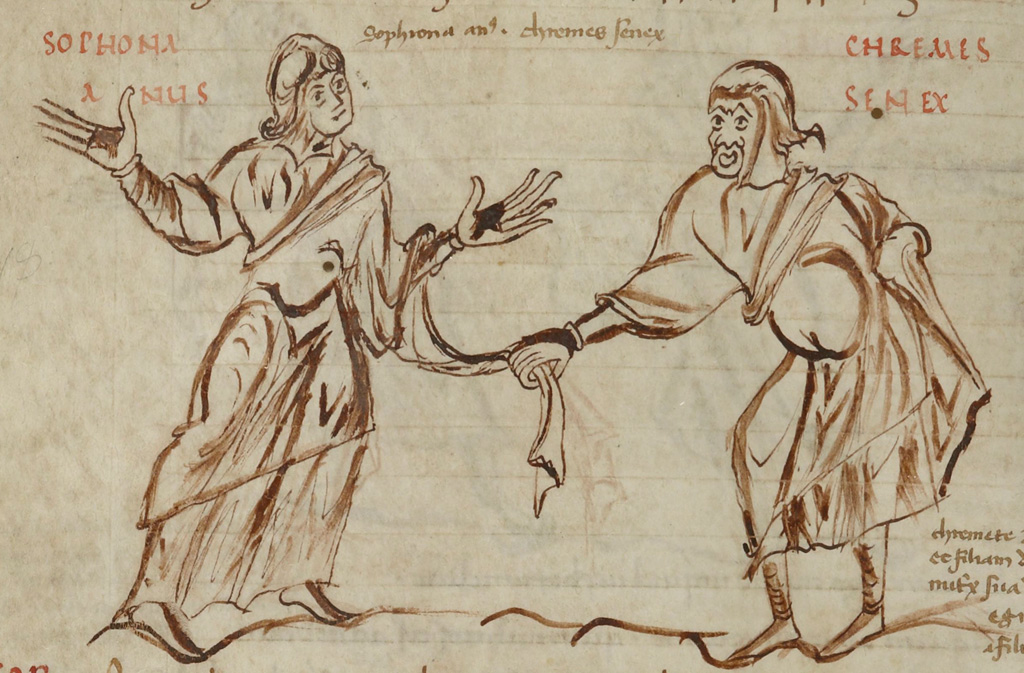
Sophrona and Chremes in Terence's Phormio

Babio soon learned that Petula was having sex with their servant Fodio. From a hidden place, Fodio spoke out in a disguised voice:

Folks are saying, Babio, that Fodio is adding to Petula,
as far as making a new being from their being together on four knees.

{ Plebs, Babio, recitat Petulam Fodio patuisse,
usque genu quarto connumerasse genus. }

Fodio’s name comes from the Latin verb fodere, which means to prick, thrust, or dig. That’s a figure for masculine sexual action. In short, Petula from her position of power and privilege within the household was having sex doggy-style with her servant Fodio. Babio sought to be a love servant to his step-daughter Viola. But he never served her in the way that Fodio was serving Petula.

Babio noticed that Fodio appeared to be receiving additional compensation. The impoverished servant who had a thin face, bare feet, tangled hair, and tattered clothes changed into a servant with full cheeks, well-shod feet, groomed hair, and splendid clothing. Babio realized whose goods Fodio was receiving:

Babio, they are your goods! Petula doesn’t save your goods for you.
While she serves them to Fodio, the servant has the goods.
While he serves them to her, Babio is badly served.
Cursed be such dignity of service!
More depraved than Viola, Fodio accomplishes worse.

{ Haec tua sunt Babio! Tua non tibi Petula servat.
Haec dum servit ei, dona satelles habet.
Haec dum servit ei, male servitur Babioni.
Servitii talis sit maledictus honor.
Prava nimis Viola, Fodius pejora patravit. }

Most men aren’t paid for their sexual work. Petula appreciated Fodio’s additional service. She was paying him additional for it. That meant that Babio was effectively paying for being cuckolded.

When Babio sought to hang Fodio for cuckolding him, Fodio insisted that he receive due process of law. Due process of law is an aspect of humane civilization no longer available to men students charged with sex crimes at many universities today. But due process of law matters. Using classical learning and a sophisticated Latin pun in a false oath of innocence, Fodio with the benefit of due process deceived Babio. More importantly, Petula testified in a support of Fodio with a verbal counter-charge against Babio:

So I seem to you an adulteress? Don’t nourish this gossip!
Perhaps you think all men and women are like you.
I seem to you a sex-worker Thais, but I strive more to be a chaste Sabine.
Because you’re as debauched as Gnatho you think I’m similar to Thais.
Either a frenzy presses upon you, or lethargy drives you away from me,
or you rage, or you’re made senseless by Lethe’s waters.
Your jealous mind doesn’t permit you to be calm.
A suspicious man has neither hope nor rest.

{ Moecha tibi videor: ne das ita pabula fame!
Forsitan hos et eas qualis es esse putas.
Thais ego videor; studui magis esse Sabina;
Me similem similis Thaida Gnato putas.
Aut frenesi premeris, aut te letargus abegit,
Aut furis, aut Lethes infatuaris aquis.
Mens tua zelotipa te non sinit esse quietum;
nec spem nec requiem suspiciosus habet. }

Women accuse men of being suspicious and angry to deflect attention from justified grounds for men’s suspicion and anger. As is commonly the case between women and men, the woman’s counterattack prevailed. Babio relented on hanging Fodio for adultery with Petula.

Babio subsequently sought to catch Petula and Fodio in the act of having sex and then to castrate Fodio. Men historically have been castrated for illicit but consensual sex. The famous medieval scholar Peter Abelard was castrated for his love affair with Heloise. The dwarf Segoncin was castrated for his love affair with Emperor Constance’s wife.[7] Babio similarly planned to castrate Fodio:

I carry my trusty knife.
May God give me daring. May it provide to him a sharp point!
Fodio will be captured; captured, he will not be totally transformed, but
I’ll take away simultaneously his slinging penis and his testicle stones.

{ … Artavum porto fidelem.
Det Deus ausa michi! Praestet acumen ei!
Captus erit Fodius; captus non totus abibit —
mecum devenient funda petraeque simul. }

Drawing upon deeply entrenched brutalization of men’s sexuality, Babio figured Fodio’s genitals as a sling and stones. Fodio was thus using a “weapon” to “attack” a woman. Babio in response planned only violence against the man. Punishment for adultery has long been strongly gender-biased toward punishing men.

Transforming the folktale motif of trickster tricked, the castrator was castrated. When Babio came again at night to catch Petula and Fodio together in bed, Petula mis-identified Babio as a thief. He was after all seeking to take her beloved Fodio from her. Supporting Petula’s strategy of mis-identification, Fodio in turn mis-identified Babio as an adulterer:

You aren’t Babio.
You’re an adulterer, and you’ll give up your dangling genital members to Fodio.

{ … Babio non es.
Moechus es et Fodio pendula membra dabis. }

Babio pleaded for a fair examination of himself in the light. Fodio refused that primitive element of due process:

There is no need to bring light.
I know within my heart that no Babio is here.
Now you’ll no longer be seen. You’ll henceforth not play three parts.
You’ll yield only your testicles, and you’ll suffer no greater harm.

{ Non est opus addere lumen.
Id scio corde tenus, Babio nullus adest.
Nunc eris eclipsis. Non ludes amodo ternis.
Symbola sola dabis, nolo nocere magis. }

Fodio then castrated Babio. A man’s testicles bear his seminal blessing. There can be no greater harm than to cut off a man’s seminal blessing. Babio cried out:

What would hurt more? Is there anything worse to bewail?

{ Ultra quis ledat? Est nimis ista queri? }

There can be nothing worse: castration is war on women. Cuckolded and castrated, Babio departed for the comfort of a monk’s life.

Smart medieval students learned from Babio the folly of imitating models of courtly lovers in medieval romances and troubadour lyrics. They learned of the dangers of gyno-idolatry, whether for a step-daughter or one’s wife. They saw the horror of castration culture in practice.[8] These are lessons that men and women today need to learn.

*  *  *  *  *

Read more:

Notes:

[1] Babio, vv. 33-42, Latin text of Bate (1976), with a few variant readings and generally normalized with classical Latin spellings and distinguishing u/v and i/j; my English translation, benefiting from those of Crawford (1977), Elliott (1984), and Symes (2012). Bate’s Latin text follows closely MS Oxford Digby 53. That manuscript was written in the last quarter of the twelfth century.

The best current critical edition of Babio is Dessì Fulgheri (1980). Unfortunately I haven’t been able to consult that book. Dessì Fulgheri’s Latin text formed the basis for Elliott’s and Symes’s English translations. The quotes from Babio presented here are substantively consistent with those translation and hence Dessì Fulgheri’s Latin text. For freely available Latin texts, Wright (1844), pp. 65-75, and De Douchet (1854).

Babio’s author, who apparently was English, isn’t securely known. Walter Map and Nigel of Canterbury are regarded as posssible authors. Bate (1976) p. 7, Ziolkowski (1993) p. 24. Babio probably was written mid-twelfth century, or between 1150 and 1185. Symnes (2012) p. 1, Bate (1976) p. 7, respectively. Babio has survived in seven manuscripts.

Babio consists almost exclusively of spoken verses (dialogues and monologues). Its plot of violence against men parallels the fabliau The townswoman of Orléans {La borgoise d’Orliens}. Scholars have debated at length the genre of Babio and other medieval Latin comedies and whether they were performed as plays. With respect to Babio, Faral (1924), Faral (1948), Brennan (1968), Axton (1974) pp. 29-30, and Symes (2012). In 2015, a staged reading of Babio in Symes’s translation took place at the Newberry in Chicago. Questions of Babio’s genre and performance seem to me less important than Babio’s presentation of men’s difficulties in their love for women and castration culture.

The name Babio evokes the confused speech associated with the biblical Tower of Babel:

Therefore it is called Babel, because there the Lord confused the language of all the world. From there the Lord scattered them over the face of the earth.

{ et idcirco vocatum est nomen eius Babel quia ibi confusum est labium universae terrae et inde dispersit eos Dominus super faciem cunctarum regionum.

עַל־כֵּ֞ן קָרָ֤א שְׁמָהּ֙ בָּבֶ֔ל כִּי־שָׁ֛ם בָּלַ֥ל יְהוָ֖ה שְׂפַ֣ת כָּל־הָאָ֑רֶץ וּמִשָּׁם֙ הֱפִיצָ֣ם יְהוָ֔ה עַל־פְּנֵ֖י כָּל־הָאָֽרֶץ׃ פ }

Genesis 11:9, Hebrew, Latin Vulgate, and English translation. Babel in the Tower of Babel actually refers to Babylon, but the association of Babel with confused speech is easily made. Cf. Pentecost in Acts 2:1-31 and Jesus’s injunction against “babbling” in prayer (Matthew 6:7).

Subsequent quotes from Babio are similarly sourced. The quotes above are (by verse number in Bate’s edition) vv. 47-52 (Flower of violets Viola…), 57-64 (Will you stay…), 179-90 (Now Croceus violates Viola…), 199-216 (She’s not like Viola…), 217-8 (Folks are saying, Babio…), 229-33 (Babio, they are your goods…), 287-94 (So I seem to you an adulteress…), 335-8 (I carry my trusty knife…), 445-6 (You aren’t Babio…), 449-52 (There is no need to bring light…), 458 (What would hurt more…).

[2] Babio comically fails in acting like a noble, generous host to Croceus and his retainers. Babio had the cow dung swept out of his home and a half-chicken prepared as a feast for Croceus. Croceus’s three servants got the usual beans and cabbage. Babio variously mimics the voices of peasants, courtly lovers, and clerics. Wailes (1974).

[3] MS Oxford Digby 53 includes a short prose preface that refers to Babio as a “priest {sacerdos}” five times. The text of Babio doesn’t indicate that he’s a priest, but married priests existed in twelfth-century England. Symes (2012) p. 1. The prose preface includes one obvious mistake. Other manuscripts of Babio don’t refer to him as a priest. Whether Babio was a priest or not, he was a rustic with impressive clerical learning.

[4] Babio conspicuously displayed learning in error-prone, ridiculous ways. He declared:

All the same, I know logic. Having well premeditated, I’ll prove
that Socrates is Socrates and that a human is a human.

{ Nosco tamen logicam: bene praemeditando probabo
Quod Socrates Socrates et quod homo sit homo. }

Babio, vv. 135-6. On this and related humor of logic, Ziolkowski (1993).

[5] This passage is filled with sexual double-entendres. In v. 209, Penelope Petula non altera, pene sed ipsa could also mean “Petula isn’t another Penelope, but she herself has a penis.” Similarly, v. 210. The pun arises from the medieval spelling pene of paene {nearly}, and the ablative form of penis {penis}, which is pene {with penis}.

Earlier Babio exultantly described himself as plus Iove pene potens (v. 76), which could mean “more potent with a penis than Jove.” Later Babio deprecatingly referred to himself as Babio pene senex (v. 174), which could mean “Babio, an old man with a penis.”

[6] Babio is misogynistic because the two women in it, Petula and Viola, are depicted as “carnal schemers, out for their own pleasure and advantage.” Elliott (1984) p. xli, citing Brennan (1968) p. 45. If a literary work doesn’t depict at least one woman as wonderful, modern scholars generally categorize it as misogyny. Ultra-orthodox scholars label any negative depiction of women as misogyny.

[7] According to Béroul, King Mark declared of Tristan:

He will meet a worse fate at my hands
than that inflicted by Constantine
on Segoncin, whom he had castrated
when he found him with his wife.

{ Par moi avra plus dure fin
Que ne fist faire Costentin
A Segoçon, qu’il escolla
Qant o sa feme le trova. }

Béroul, Tristan, vv. 277-80, Old French text and English translation by Lacy (1998). Lacy noted:

Segoncin (or Segestes), a character in a story well known during the Middle Ages, was a dwarf reputed to be the lover of the emperor’s wife.

Id. p. 205, n. 280.

[8] In relatively liberal and tolerant medieval Europe, Babio and other medieval Latin comedies were studied in schools:

Babio, like other comedies, was often used in schools. The chance to read and perform such plays provided an incentive to improve one’s Latin, and comedies were also an amusing way to learn verse forms, new vocabulary, classical syntax, and Greco-Roman mythology. Most importantly, they were funny; and they were often funny at the expense of characters frequently mocked by schoolboys and the young men they grew up to be — educated young men who were increasingly needed to run the burgeoning royal and papal bureaucracies of Europe in the twelfth century.

Symes (2012) p. 1. See also Bate (1979). Babio exemplifies more important life lessons as well. Students today also need such lessons, but aren’t getting them.

[image] (1) Comic actor depicted at the start of Terence’s Andria. Illumination from a ninth-century manuscript compilation of Terence’s plays. Made in France, perhaps at Rheims. From folio 3r in Bibliothèque nationale de France, MS Latin 7899, via Gallica. (2) Chremes pulling on Sophrona in Terence’s Phormio. Similarly from folio 167v in Bibliothèque nationale de France, MS Latin 7899.

References:

Axton, Richard. 1974. European Drama of the Early Middle Ages. London: Hutchinson University Library.

Bate, Keith. 1976. Three Latin Comedies. Toronto: Published for the Centre for Medieval Studies by the Pontifical Institute of Mediaeval Studies. Contains Latin texts of Geta, Babio, and Pamphilus.

Bate, Keith. 1979. “Language for School and Court: Comedy in Geta, Alda and Babio.” L’eredità classica nel Medioevo: il linguaggio comico, atti del 3. convegno di studio, Viterbo, 26-27-28 maggio 1978. Viterbo: Agnesotti. 

Brennan, Malcolm M., trans. 1968. Babio. A twelfth century profane comedy. Translated with introduction and notes. Charleston, SC: Military College of South Carolina.

Crawford, James Martin. 1977. The Secular Latin Comedies of Twelfth Century France. Ph. D. Thesis. Indiana University, USA.

De Douchet, Jules. 1854. “Babio.” Columns 1291-1314 in Migne, J.P., ed. Nouvelle Encyclopédie Théologique. vol. 43. Dictionnaire des mystères. Paris: S’imprime et se vend chez J.P. Migne.

Dessì Fulgheri, Andrea. “Babio.” Pp. 242-301 in in Bertini, Ferruccio, ed. Commedie latine del XII e XIII secolo. Vol. 2. Genova: Istituto di filologia classica e medievale.

Elliott, Alison Goddard, trans. 1984. Seven Medieval Latin Comedies. New York: Garland.

Faral, Edmond. 1924. “Le Fabliau Latin au Moyen Âge.” Romania. 50 (199): 321-385.

Faral, Edmond, ed. and trans. (French). 1948. De Babione: Poème comique du 12. siècle, avec une introduction, des notes et un glossaire. Paris: Champion.

Lacy, Norris J. 1998. “Béroul’s Tristan.” Pp. 3-218 in Lacy, Norris J., ed. Early French Tristan Poems. Vol. 1. Cambridge: D.S. Brewer.

Symes, Carol, trans. 2012. “Babio.” Pp. 10-21 in Christina M. Fitzgerald and John T. Sebastian, eds. The Broadview Anthology of Medieval Drama. Peterborough, Ontario: Broadview Press. (cited by online pages 1-11)

Wailes, Stephen L. 1974. “Role-Playing in Medieval Comediae and Fabliaux.” Neuphilologische Mitteilungen. 75 (4): 640-649.

Wright, Thomas, ed. 1844. Early mysteries, and other Latin poems of the twelfth and thirteenth centuries. London: Nichols and Sons.

Ziolkowski, Jan M. 1993. “The Humour of Logic and the Logic of Humour in the Twelfth-Century Renaissance.” The Journal of Medieval Latin. 3: 1-26.
Chastelaine de Vergi: the tragedy of men’s subservience to women

In the influential thirteenth-century romance Chastelaine de Vergi, the lady (chastelaine) holding the important castle at Vergi in Burgundy granted her love to a brave and bold knight. She stipulated that if he told anyone of their love, she would cease loving him. That arbitrary, other-worldly condition exemplifies her power and control over him within the courtly literary ideal of sexual feudalism.[1] The Duke of Burgundy, the chastelaine’s uncle, was similarly subservient to his wife. The Chastelaine de Vergi shows that men’s subservience to women inexorably transforms love into death.

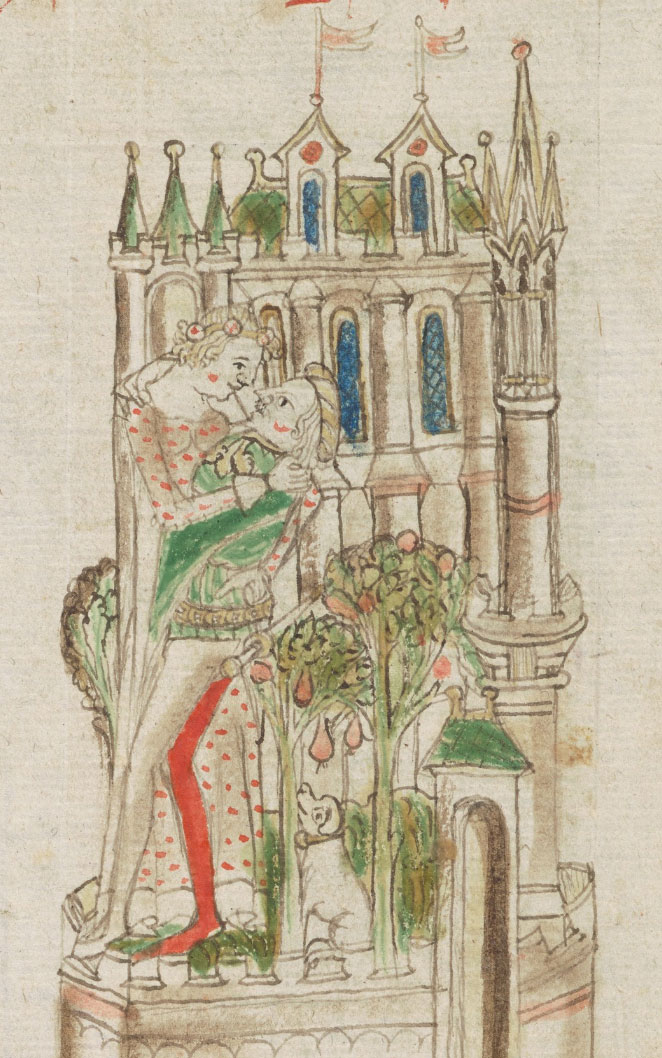
the Chastelaine de Vergi and the knight embrace

The Chastelaine de Vergi poignantly represents gender trouble within its first forty verses. The chastelaine and her beloved, subservient knight arranged the following terms for their trysts:

The knight would come every day
at the time she set for him.
He wouldn’t move from his hiding place
until he saw a little dog running through the garden.
And then without delay he would come
into her chamber, knowing well
that at that hour no one would be there
apart from the lady alone.

{ li chevaliers toz jors vendroit
au terme qu’ele li metroit.
Ne ne se mouvroit d’un anglet
de si que un petit chienet
verroit par le vergier aler.
Et lors vendroit sanz demorer
en sa chambre, et si seüst bien
qu’a cele eure n’i avroit rien
fors la dame tant seulement. }[2]

Men have long been disparaged as being sexually like dogs. Here the knight is summoned like a dog for sex with the lady by a little dog running through the lady’s garden. The pun Vergi / vergier and the association of a garden with a woman’s vagina underscores the sexual figure that encompasses the man / dog. Meninism is the radical notion that men are human beings. Because meninist literary criticism has been marginalized and excluded, scholars have failed to recognize the gender trouble at the very beginning of the Chastelaine de Vergi.

The Duchess of Burgundy subsequently sought sexual service from this handsome and vigorous knight. She was his social and political superior and effectively part of his managing authority. After failing to attract his attention with her indications of amorous interest, she informed him of the quid pro quo he could expect for having sex with a highly placed women:

My lord, you are handsome and brave —
everyone says so, thanks be to God.
You clearly deserve
to have a lover in such a high place
that you would gain honor and praise from it,
and such a lover would suit you very well.

{ Sire, vous estes biaus et preus,
ce dïent tuit, la Dieu merci:
si avriiez bien deservi
d’avoir amie en si haut leu
qu’en eüssiez honor et preu,
que bien vous serroit tele amie. }

Faced with a situation even more dangerous than the question, “Do I look fat?”, the knight declared that he hadn’t given any thought to it. The duchess in response advised the knight with an implicit threat:

“In faith,” she said, “A long wait
could be harmful to you — that is my view.
So I advise you to take a lover
in a high place, if you see
that you are well loved there.”

{ Par foi, dist ele, longue atente
vous porroit nuire, ce m’est vis.
Si lo que vous soiez amis
en un haut leu, se vous veez
que vous i soiez bien amez. }

The knight attempted to defuse this situation by saying that he didn’t understand what she was saying, that he was just a lowly knight, and that he wouldn’t strive to love so highly and so advantageously. The duchess then bluntly issued to him a self-answering question:

Tell me whether you are now aware
that I have granted you my love,
I who am a high-ranking, honored lady.

{ Dites moi se vous savez ore
se je vous ai m’amor donee,
qui sui haute dame honoree? }

In medieval Europe, a knight couldn’t go on Twitter to denounce a duchess for sexually harassing him. In any case, few would be concerned about him, too. The knight thus had to assert personally a well-recognized medieval standard of ethical behavior:

My lady, I was not aware of this,
but I would like to have your love
in sincerity and in honor.
But may God protect me from such a love
that would be wrong on my part or yours
in a way bringing shame on my lord,
for at no time and in no way
would I undertake any error
such as acting unreasonably,
churlishly, or disloyally
towards my lawful, natural lord.

{ Ma dame, je ne le sai pas;
mes je voudroie vostre amor
avoir par bien et par honor.
Mes de cele amor Dieus me gart
qu’a moi n’a vous tort cele part
ou la honte mon seignor gise,
qu’a nul fuer ne a nule guise
n’enprendroie tel mesprison
comme de fere traïson
si vilaine et si desloial
vers mon droit seignor natural. }

The knight acted ethically and courageously. The duchess, however, became furious at him. She pretended that she hadn’t propositioned him:

Sir Fool, and who is asking you to do that?

{ dans musars, et qui vous en prie? }

As they both certainly knew, she was. He prudently acquiesced to her fiction. He then said nothing more about the matter.[3]

Because the knight sexually rejected her, the duchess retaliated against him. That night, in bed with her husband the duke, she started to cry. Her husband immediately asked her what was the matter. She responded:

“Certainly,” she said, “I am greatly distressed
that no high-born man knows
who is faithful to him and who is not.
Rather, they show more kindness and honor
to those who to them are traitors,
and yet none of them realizes it.”

{ Certes, dist ele, j’ai duel grant
de ce que ne set nus hauz hom
qui foi li porte ne qui non;
mes plus de bien et d’onor font
a ceus qui lor trahitor sont,
et si ne s’en aperçoit nus. }

Realizing that she was alluding to him, he said that he didn’t understand why she was saying this, that he was innocent of such behavior, and that he wouldn’t allow a traitor to be in his service. She responded:

“Hate then,” she said, “the one
(she named him) who today never stopped
all day long begging of me
that I give him my love,
and he told me that for a very long time
he had been of this mind,
but had never before dared to tell me.
And I set my mind, fair lord,
that I would tell you of it at once.
And to be cooking up this destruction
he was from a while ago considering it,
because that he has another beloved
we have seen no signs.
So I beg of you as a favor
that in this matter you look to your honor
as you know to be right.”

{ Haez donc, dist ele, celui
(sel nomma) qui ne fina hui
de moi proier au lonc du jor
que je li donaisse m’amor,
et me dist que mout a lonc tens
qu’il a esté en cest porpens:
onques mes ne le m’osa dire.
Et je me porpenssai, biaus sire,
tantost que je le vous diroie.
Et ce pert estre chose vroie
qu’il ait pieça a ce penssé;
de ce qu’il a aillors amé
novele oïe n’en avon.
Si vous requier en guerredon
que vostre honor si i gardoiz
com vous savez que il est droiz. }[4]

The duchess thus falsely accused the knight of seeking her carnal love. Despite ample possibilities for faking, women’s tears typically evoke men’s acute concern. In present-day high-income societies, a boss seeking sex with her subordinate via offers of quid pro quo and threats clearly violates labor law and incurs a high liability, but a secretary seeking sex with his boss isn’t regarded as a serious offense. In medieval society, the pattern of culpability was the reverse. The duchess exploited both universal norms and the particular norms of her medieval society to retaliate strongly against the knight who rejected her sexual propositioning.

After merely listening and believing his wife, the duke the very next day condemned the knight. The duke didn’t first tell the knight of the accusation against him, ask him to respond to it, and then thoroughly and objectively investigate the matter. Instead, the duke declared that the knight had acted with great treachery. The duke banished the knight forever from his lands and declared that he would be hanged if he should return and be captured.[5]

Angry and bewildered, the knight declared his innocence. He protested the terrible wrong that his false accuser had done. But the duke permitted no normal process of seeking justice:

“It is of no use for you to answer the charge,”
said the duke, “for there’s no point to it.
She herself has recounted to me
in what manner and in what way
you have begged her and beseeched her
like an envious traitor,
and you said some things,
perhaps, about which she has kept quiet.”

{ Ne vous vaut riens li escondit,
fet li dus, ne point n’en i a.
Cele meïsme conté m’a
en quel maniere et en quel guise
vous l’avez proïe et requise
comme trahitres envious.
Et tel chose deïstes vous,
puet estre, dont ele se test. }

Insinuation of additional, vaguely specified crimes typifies corrupt justice. In proceedings of today’s university sex crime tribunals, simply being a man is enough for the persecuted to be guilty of a massive structure of imagined, historical crimes.

In the Chastelaine de Vergi, the justice process was sexually perverted. The knight declared:

Nothing I might say is of any use,
yet there is nothing I would not do,
so that I would be believed,
for nothing of this sort has happened.

{ Riens ne m’i vaut que j’en deïsse,
si n’est riens que je n’en feïsse
par si que j’en fusse creü,
quar de ce n’i a riens eü. }

The repetition of “nothing {riens}” three times in these four lines is ominously nihilistic.[6] The duke at first merely requested a sworn oath like that a witness commonly offers in a judicial proceeding:

If you are willing to swear to me
by your loyal oath,
that you will tell me truly
what I ask of you,
by your words I would certainly know
whether or not you have done
that for which I have suspicion towards you.

{ Se vous me volez fiancier
par vostre leal serement
que vous me direz vraiement
ce que je vous demanderoie,
par vostre dit certains seroie
se vous avriiez fet ou non
ce dont j’ai vers vous soupeçon. }

Witnesses under oath in a judicial proceeding can be asked only questions relevant and proper to the proceeding. The knight readily agreed to the duke’s request for sworn testimony. That choice shouldn’t be regarded as ethically fraught. It’s judicially normal.[7]

The duke set up a question with relevance to the duchess’s charge of attempted seduction. He noted that the knight dressed elegantly and acted like a man in love with a woman. The duke reasoned:

And when no one knows of
any unmarried woman or lady that you love,
I think to myself that it must be my wife,
who has told me that you have been pleading to her.
Hence I cannot be made to disregard this
by anything that anyone could do,
because I think such turns this affair;
that is, if you don’t tell me of another
elsewhere that you love passionately
and you let me know of it without doubt
in its full truth.
And if you don’t want to do so,
then, like a perjurer, get yourself
away from my land without delay!

{ Et quant d’aillors ne s’aperçoit
nus qu’amez damoisele ou dame,
je me pens que ce soit ma fame,
qui me dist que vous la proiez.
Si ne puis estre desvoiez
por riens que nus me saiche fere,
que je cuit qu’ainsi voist l’afere,
se vous ne me dites qu’aillors
amez en tel leu par amors
que m’en lessiez sanz nule doute
savoir en la verité toute.
Et se ce fere ne volez,
comme parjurs vous en alez
hors de ma terre sanz deloi! }

The chastelaine had imposed secrecy upon the knight regarding their love affair. This line of questioning thus greatly troubled him. He began to cry. Rather than showing pity toward the knight, as a judge would toward a crying woman, the duke accused him of believing that he would betray a secret. The duke insisted that he wouldn’t betray a secret even if he were brutally tortured. He swore that he would maintain secrecy. The knight then told him that he loved the duke’s niece, the chastelaine de Vergi.

Neither the knight nor the duke recognized bounds of relevance and propriety in considering the duchess’s charge against the knight. The knight could have declared under oath that he loved another woman. He could have refused to name her on the grounds that her specific identify wasn’t relevant to refuting the duchess’s accusation. One might argue that her specific identity is relevant to corroborating his love for her.

The duke, however, went far beyond the need of corroborating the knight’s love relationship. The duke asked to go with the knight that evening to his tryst with the chastelaine. The knight reprehensibly granted the duke’s request. All night long while the knight was having sex with the chastelaine, the duke was watching and listening from a hidden spot outside. Voyeurism surely wasn’t necessary for adjudicating the duchess’s charge against the knight.[8] Perhaps the duke was sexually frustrated within his marriage and wanted to observe whole-hearted love.

Later that day during dinner, the duke expressed his affection for the knight. The duchess, realizing her scheme to create hate had failed, was distressed. Claiming that she felt ill, she left the dinner early. When the duke went to her, she told him that she felt ill because the duke cherished the knight despite her telling him he had sexually solicited her. To that social drama, the duke responded simply and lovingly:

“Ah!” said the duke, “My sweet friend,
know that I would believe
neither you nor any other person
because never in any way
did what you told me actually happen.
Indeed, I know well that he’s totally innocent of it.
He never had any thought of doing that.
Much have I learned of his situation,
so don’t ask me about it any further.”

{ Ha! fet li dus, ma douce amie,
sachiez je n’en croiroie mie
ne vous ne autre creature
que, onques por nule aventure
avenist ce que vous me dites.
Ainz sai bien qu’il en est toz quites;
n’onques ne penssa de ce fere.
Tant ai apris de son afere,
si ne m’en enquerez ja plus. }

The duke then left without even criticizing his wife for her vicious false accusation.

Rather than regretting her action, the duchess burned to know what the duke had learned about the knight’s situation. The duchess planned to manipulate her husband sexually:

In her heart she thought out a scheme
by which she could know it all well
if she waited until the evening
when she had the duke in her arms.
She knew well that in such delight
she could do, without any doubt,
better what she wished than at any other time.

{ quar en son cuer engin porpensse
qu’ele le porra bien savoir,
s’ele se sueffre jusqu’au soir
qu’ele ait le duc entre ses braz.
Ele set bien de tieus solaz
en fera, ce ne doute point,
mieus son voloir qu’en autre point. }

Not pervasively censored through authoritative name-calling, medieval literature frankly recognized husbands’ difficulties in keeping secrets from their wives and wives’ tendency to talk about their husbands’ secrets. With respect to secrets and many other matters, many husbands are weak in relation to their wives.

When the duke came to bed, the duchess withdrew to one side of the bed. She pretended not to like the duke being next to her. Not permitting him more than a kiss, she called him false, deceitful, and disloyal. She said that he had never loved her. When he asked what was the matter, she claimed that he was concealing from her all his thoughts, such as what the knight had told him. She claimed falsely that she had always told him everything. Then she categorically declared:

So be assured now, without any doubt,
that I will never again have trust
in you nor love you in the way
that I have in the past.

{ Si sachiez ore, sanz doutance,
que ja mes n’avrai tel fiance
en vous, ne cuer de tel maniere,
com j’ai eü ça en arriere. }

After saying this, the duchess began to cry. Deceitful women defeat weak men by projecting their own wrongs onto men, by pretending to be terribly hurt, and by crying.

The duke pitied the poor dear. He explained that if he revealed the knight’s secret, great harm could result. The duchess assured him that she would never reveal any of his secrets. Then she again cried. The duke embraced her and kissed her. He said that he would tell her, but if she ever said a word of what he told her, she would die. She fully agreed to that condition. Then he told her all about the knight’s secret love for the chastelaine de Vergi. Learning how passionately the knight loved a women less noble than she, the duchess felt utterly humiliated. She immediately began to hate the chastelaine and plot to harm her.

With the chastelaine and the duchess dominating the duke and the knight, love led to death. When the duke held court for the feast of Pentecost, the duchess before the dance called the chastelaine a “good mistress {bone mestresse}” who had “learned the art  / of training the little dog {apris le mestier / du petit chienet afetier}.” That taunt revealed knowledge of the chastelaine’s trysts with the knight. Going into the dressing room, the chastelaine grieved intensely that the knight had revealed their love to the duchess. She wrongly surmised that the knight didn’t love her, but instead loved the duchess. She pardoned her beloved knight and then died from a broken heart.

The knight, looking for the chastelaine, went into the dressing room. He saw her lying on a bed. Embracing and kissing her, he rather belatedly, like a blind lover, discovered that she was dead. A young serving-woman had overhead the exchange between the duchess and the chastelaine and the latter’s grief. She told the knight what had happened. Like Pyramus believing that a lion had devoured Thisbe, the knight blamed himself:

“Ah! Alas!” said he, “My sweet love,
the most courtly and the finest
that ever was and the most loyal,
like a disloyal scoundrel
I have killed you!”

{ Ha! las! dist il, Ma douce amor,
la plus cortoise et la meillor
c’onques fust et la plus loial,
comme trichierres desloial
vous ai morte! }

He then grabbed a sword and plunged it into his heart. Bleeding profusely, his dying body fell onto the chastelaine’s dead body.

The young serving-woman rushed out and told the duke what had happened. He went into the room and pulled out the sword piecing the knight’s heart. Then he returned to the dance hall. In the sight of everyone, he thrust the sword into the duchess’s scheming head. She fell dead at his feet. The duke told all what had happened. Grief-stricken, he declared that he would leave to become a Templar knight in the horrific violence against men of the Crusades.[9]

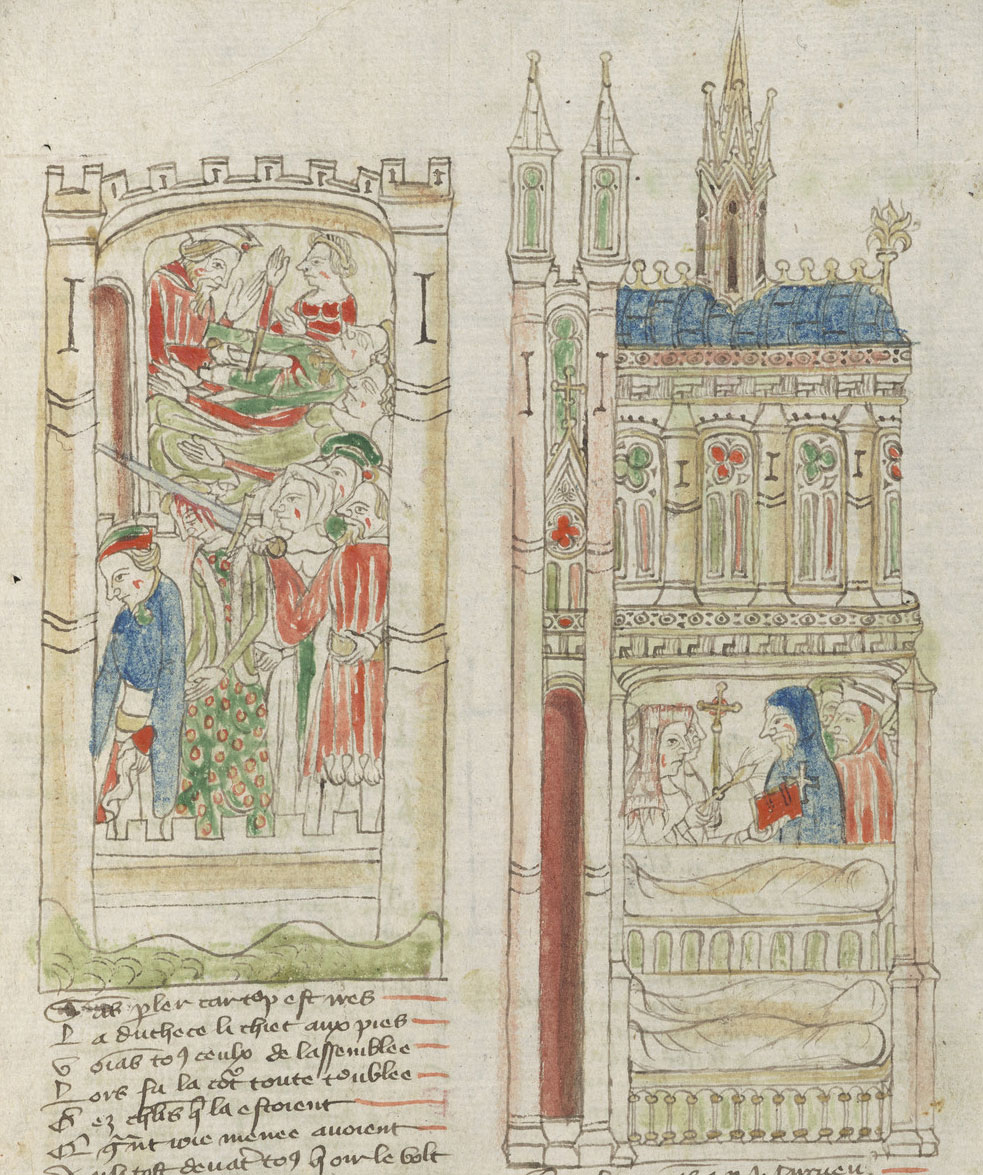
deaths in the Chastelaine de Vergi

Men’s subservience to women, like men’s impotence, creates tragedy in romance between women and men. Within the fallen condition of gynocentrism, signs of truth exist but aren’t understood. Amid other ladies, the duchess praised the chastelaine for having “learned the art  / of training the little dog {apris le mestier / du petit chienet afetier}.” That telling sign hasn’t been understood:

The ladies heard what was said,
but they didn’t understand its meaning.
They returned with the duchess
to take part in the dancing.

{ Les dames ont oï le conte,
mes ne sevent a qoi ce monte;
o la duchoise s’en revont
aus caroles que fetes ont. }

Many literary scholars have been participating in a dance of death.[10] Persons who seek the fullness of life must be open to a new spirit of truth. Let them play their tune. You can refuse to dance. You can read rightly the signs, truly promote gender equality, and seek to help those grievously misled.[11]

*  *  *  *  *

Read more:

Notes:

[1] A beautiful, other-worldly woman imposed a similar condition on Lanval in Marie de France’s lai Lanval. That woman, however, heroically saved Lanval from a false accusation of attempted seduction.

The Chastelaine de Vergi signals its close relation to lyric by including (vv. 295-302) a stanza from a song by the chastelain de Couci (Guy de Thourotte), a trouvère. On this lyric insertion, Marnette (2021). Guillaume de Machaut’s True Poem {Voir Dit}, from about 1365, used extensively lyric insertion. The chastelain de Couci became associated with the eaten-heart motif that appears in the lai Ignaure. The Chastelaine de Vergi also refers (v. 269) to a genre of lyric debate in two parts (jeu parti) included in the corpus of trouvère songs.

[2] Chastelaine de Vergi, vv. 31-9, Old French text from Arrathoon (1975) (except without quotation marks and indenting), English translation (modified slightly) from Burgess & Brook (2016), pp. 214-26. Burgess & Brook’s translation is based on the late thirteenth-century Paris, Bibliothèque nationale de France, MS français, 837, folios 6rb-11ra, as edited by Whitehead (1944). In my view, Arrathoon (1975) represents scholarly progress beyond Whitehead (1944). The differences are small, but scholarly progress should be honored. Where necessary, I’ve modified Burgess & Brook’s English translation to be in accord with Arrathoon’s text. Arrathoon (1984b) provides an edition and English translation based on Arrathoon (1975), but with less extensive scholarly documentation.

Arrathoon explained her enormous, masterful work with her declaration: “the Chastelaine de Vergi is a masterpiece which deserves to be transmitted intact to posterity.” Arrathoon (1975) p. iii. Her commitment to truth and the virgin composition didn’t reflect devaluation of agency and interpretive vigor. She also provided an English paraphrase. She explained:

my interpretation of the text must inevitably emerge from such a paraphrase as the key to the art of translation is to interpret rather than search out appropriate words and expressions to create a more or less correct, but probably very stiff mosaic of the original in the second language.

Id. p. 148. Here Arrathoon seems to me mistaken. Making cultural heritage more broadly available has high humanistic and democratic value. Faithful translation can produce a translation that’s fluently readable and readily accessible to a broad readership. Burgess & Brook (2016) exemplifies such translation.

Fairly good Old French texts and modern French and English translations of the Chastelaine de Vergi are readily accessible online. For Old French texts with modern French translations, Raynaud & Foulet (1912) and Bédier (1927). For English translations, Terry (1995), Ch. 8; Mason (1911); and Kemp-Welch (1903).

The Chastelaine de Vergi has survived in twenty-two manuscripts. It was originally composed in the middle of the thirteenth century. Its author isn’t known, but Jean Renart, author of Guillaume de Dole and the Lai de l’Ombre, is plausible.

Scholars have debated the marital status of the chastelaine de Vergi. The text doesn’t clearly specify her marital status. She plausibly could be a widow or a married woman. Arrathoon reviewed the scholarly debate and argued convincingly for the chastelaine being a married woman engaged in adultery with the knight. Arrathoon (1984a) pp. 342-5.

The genre of the Chastelaine de Vergi also has been a matter of scholarly controversy. The narrator provides a brief, moralizing introduction and conclusion. The conclusion declares, “And by this exemplum one should {Et par cest example doit}…” (v. 951). The reliability of the narrator, however, is suspect. On the genre of the Chastelaine de Vergi, Arrathoon (1984a) and Sweet (2017). Categorizing the Chastelaine de Vergi as a lai produced the benefit of it being included in Burgess & Brook (2016).

The Chastelaine de Vergi was widely distributed and influential. Giovanni Boccaccio and Eustache Deschamps included the chastelaine de Vergi in their catalogs of famous lovers. Jean Froissart cited the Chastelaine de Vergi in his book The Prison of Love {La Prison amoureuse}, written about 1372. So too did Evrart de Conty in his The Book of Love Chess Moralized {Le Livre des Eschez amoureux moralisés} from about 1390. In the fifteenth century, the Chastelaine de Vergi was lightly adapted into a prose work called the Chastelaine du Vergier, as well as into novella 70 of Marguerite de Navarre’s Heptaméron (1558), and into François du Souhait’s play Radegonde, Duchesse de Bourgogne (1599). But most important of all, the influential early female supremacist Christine de Pizan mentioned it in her Book of the City of Ladies {Livre de la Cité des Dames} (1405). On the reception of the Chastelaine de Vergi, Sweet (2017), Leushuis (2007), Huot (2001), Virtue (1997), and Gauthier (1985).

Subsequent quotes from the Chastelaine de Vergi are similarly sourced. They are vv. 60-5 (My lord, you are handsome…), 68-72 (“In faith,” she said…), 84-6 (Tell me whether you are now aware…), 89-98 (My lady, I was not aware of this…), 100 (Sir Fool…), 114-9 (“Certainly,” she said…), 125-40 (“Hate then,” she said…), 196-203 (“It is of no use for you to answer the charge,”…), 207-10 (Nothing I might say…), 218-24 (If you are willing to swear to me…), 254-67 (And when no one knows of…), 541-49 (“Ah!” said the duke…), 558-64 (In her heart she thought out a scheme…), 605-8 (So be assured now…), 716-8 (good mistress / learned the art…), 885-9 (“Ah! Alas!” said he…), 717-8 (learned the art…), 719-22 (The ladies heard what was said…).

[3] Women’s sexual harassment and rape of men has been made nearly unspeakable in recent decades through bigotry and harshly enforced ignorance. Such repression didn’t exist in medieval Europe. Medieval European literature even included vigorous voices of men’s sexed protest.

[4] For v. 134, Arrathoon chose the MS. A/E/G0 reading over the MS. C reading Et si puet estre chose vraie. She argued that this reading is more likely to be the best authorial text for a variety of reasons, including that “it underlines the theme of appearance and reality that recurs whenever the duchess enters the scene.” Arrathoon (1975) p. 110. With its documented, highly contextual justification, Arrathoon’s textual choice cannot be fairly characterized as tendentious or aggressive editing. Any translation error for v. 134 is mine.

[5] Prior to recent intensified gynocentrism, perceptive readers recognized the duke’s weakness relative to his wife. About 1903, the eminent archivist-paleographer Louis Brandin noted the freshness of the duchess’s character, including:

her influence over her weak husband, unable to sleep as soon as she has persuaded him that one of his vassals has threatened his honour, and equally unable to keep a secret when his wife turns her back upon him in bed

Kemp-Welsh (1903) pp. xi-xii (introduction by Louis Brandin). About 1944, Frederick Whitehead observed that the Chastelaine de Vergi concerns:

not the dangers of disclosing a secret love, but only the danger of making the disclosure to a weak and indiscreet man dominated by a vindictive wife who bears a grudge against one of the lovers

Whitehead (1944) p. xiv. In his 1951 edition of this book, White deleted this sentence and implicitly apologized for apparently offending women. On this textual history, Sweet (2017) pp. 348-9. Huot deserves credit for acknowledging “dangers for men in being manipulated by their wives.” Huot (2001) p. 269.

Men’s subservience to women isn’t just a medieval literary ideal. In interpreting the Chastelaine de Vergi, Lacy declared:

As Arrathoon puts it (355), the author was “juxtaposing a literary ideal to ‘real life.'” The lover in lyric tradition is subject to the dictates of love and (should she so desire) to the whims of the lady.

Lacy (1990) p. 122, citing Arrathoon (1984a) p. 355. Scholars have tended to complacently accept men being subject to the whims of women in literary ideals and in real life. Meninism provides a critical perspective on men’s subordination to women in both literature and life.

[6] On lexical patterning in the Chastelaine de Vergi, Shirt (1980) and Hunt (1993).

[7] The knight’s oath to the duke has been interpreted as “the well known device of the open-ended promise,” also called “the binding gift {don contraignant}.” E.g. Hunt (1993) pp. 136-7. An influential example of an open-ended promise is Herod’s promise to Herodias’s beautifully dancing daughter. That promise resulted in John the Baptist’s beheading. Matthew 11:2–7, 14:6–12; Mark 1:14, 6:17–29; Luke 3:19–20, 7:18–25, 9:9. More generally, context can implicitly limit an open-ended promise. In court proceedings, witnesses normally swear to tell the whole truth. That doesn’t mean that they must tell the truth about matters judged not relevant and proper within the given judicial proceeding.

[8] Literary critics haven’t recognized the transgression of reasonable judicial procedure culminating in voyeurism in the Chastelaine de Vergi. Similar failure is now grossly apparent in university sex-crime tribunals. Much modern literary criticism has developed to be similar to the reasoning of Geta after he apparently encountered his double:

Here we encounter a contradiction every bit as powerful as the paradox of virginity: that love only exists to the degree that it is secret; that secret love only exists to the degree that it is revealed; and revealed, it is no longer love. … For if love must be kept secret to exist, then, as in the case of the virgin, there can be no way of speaking of it that does not imply its transgression. “La Chastelaine de Vergi” can, in a profound sense, be considered to be “La Chastelaine de Virginité” or “The Lady of Virginity.”

Bloch (1991) p. 123. Persons can have a secret love affair. They could speak about it only between themselves while having a secret love affair. They could also love each other without speaking about it. “La Chastelaine de Vergi” as “The Lady of Virginity” is as ridiculous as Bloch’s totalizing idea of medieval misogyny.

[9] With admirable sympathy for a man, Arrathoon characterized the knight as a “victimized hero.” Arrathoon(1984a) p. 346. Because the duke merely listened and believed his wife’s false accusation of the loyal knight, the duke raged at him extensively. With wonderful textual engagement now all but lost among literary critics, Arrathoon declared:

By this time, we fairly ache for the knight to tell the duke what an evil creature his wife is. How can we not share his righteous indignation? … But what is uppermost in the knight’s mind, as befits the lover of lyric poetry, is not the loss of his own honor, but the possible physical separation from his lady ….

Id. p. 347. In my view, the knight deserves blame for accepting men-abasing ideals of courtly love. But those who support and exploit men-abasing ideals of courtly love deserve more blame.

In response to Arrathoon, Lacy offered a caricature of medieval casuistry. He argued:

The duchess precipitates the crisis, and the narrator presents her as an unequivocally lascivious, jealous, devious, and despicable woman. But if we are led to condemn her, because both her vengeful motive and her brazen method are hateful, it is also true that the duke, the only one of the four protagonists to survive, betrayed a trust and violated a promise, thereby contributing almost as directly as his wife to the developing tragedy. … In fact, if blame has to be assigned, it is hard to escape the conclusion that it belongs to the knight, just as the narrator announces.

Lacy (1990) pp. 119-20. Perhaps justifiably contemptuous of this analysis, Hunt (1993) didn’t even cite Lacy (1990). The introduction-apologue, which directs blame to the knight, is “hopelessly simplistic” and misleading in its surface meaning. Hunt (1993) p. 139. Hunt forthrightly characterized the duchess as “a mulier perniciosa, a maleficent woman who lies at will and systematically prosecutes a vendetta based on lies.” Id. p. 134. Among the characters of the Chastelaine de Vergi, the duchess is by far the most blameworthy. The duchess provides:

the fundamental radix malorum, the remorseless vendetta of an irredeemably evil woman for whom no juster fate can be devised than death. In the presence of lies, deception and malevolence there can be no simple defence.

Id. p. 139. That’s an exaggeration. One simple defense is to avoid such women as much as possible.

Recognition of women acting with evil intent wasn’t suppressed and censored in medieval Europe. For example, a medieval proverb attributed to the classical Greek philosopher Timaeus declares:

He who takes a rogue as his porter,
a traitor as his confidant,
or a wicked woman as his wife
cannot die without suffering great trouble.

{ Qui de felon fet son porter
De traictour son conseiller
De folle fame sa moillier
Ne pueut mourir sanz encombrier }

From the fifteenth-century manuscript Angers, Bibliothèque municipale, MS 548, folio 57v, as transcribed and translated (modified slightly) by Sweet (2017) p. 351.

[10] Men in medieval lyric poignantly describe themselves as lovesick to death for women. These men receive little sympathy today:

Men may talk incessantly of dying for love in their poetry and in their speeches in narrative texts, but usually they do not actually die for love. Women do sometimes talk about dying for love (though they do so a lot less), but when the chips are down, die they do. Men talk the talk; women walk the walk.

Gaunt (2006) p. 144. The totalizing gender dichotomy “men talk the talk; women walk the walk” reflects the anti-men gender bigotry now prevalent in the humanities. The claim that men don’t actually die for love is absurd given the influence of the Iliad on the European literary tradition. But expressing contempt for men is highly valued within dominant literary scholarship:

women have an ethical system imposed upon them in troubadour lyric, one which, in romance, requires them to make the supreme sacrifice for love, while men often merely talk about it. … in dying in inappropriate or troublesome ways, some women and queers may uncover the insidious lure of a symbolic order in which men bleat endlessly about their willingness to die for love while walking all over women.

Id. p. 210. Belief that men construct ethical systems independent from women’s preferences and behaviors is absurd. The claim “women have an ethical system imposed upon them” seems to me merely to exemplify poor-dearist signaling for scholarly credit. Medieval trobairitz described men’s subservience to women under what was essentially sexual feudalism. The scholarly claim that “men bleat endlessly about their willingness to die for love while walking all over women” could be characterized as childish anti-meninism. Gaunt’s book, highly acclaimed among academics, fittingly concludes with misandristic representations of sadism and death.

[11] Cf. Matthew 11:17. The deaths of the chastelaine, knight, and duchess, as well as the self-exile of the duke, occurred on Pentecost. De Looze observed:

La Chastelaine de Vergi, unlike Lanval, reveals a profound lack of confidence in the spoken word and oral discourse in general. … In fact, the only complete version of the events is the written one we read. The spoken versions are all fragments: flawed, incomplete, trapped in the narrow, partial truth of human speech. The miracle of the pure and true verbal act — the miracle of Pentecost — surpasses humans, for whom the closest approximation to a discourse of immanent truth is the written word.

De Looze (1985) p. 43. As literary criticism of the Chastelaine de Vergi indicates, pure and true verbal acts require more than just writing words.

[images] (1) The chastelaine de Vergi and the knight embrace. Illumination from folio 90r in an early fifteenth-century manuscript, Cambridge, Trinity Hall, MS 12. (2) Killings and funerals for three in the Chastelaine de Vergi. From folio 96r of Cambridge, Trinity Hall, MS 12.

Additional visual representations: Ivory caskets made in France early in the fourteenth century are decorated with carved scenes from the Chastelaine de Vergi. See, for example, 17.190.180 in the Metropolitan Museum and 1892,0801.47 in the British Museum.

References:

Arrathoon, Leigh A. 1975. La chastelaine de Vergi: a new critical edition of the text with introduction, notes and an English paraphrase. Ph.D. Thesis, Department of Romance Languages and Literatures. Princeton University.

Arrathoon, Leigh A. 1984a. “Jacques de Vitry, the Tale of Calogrenant, La Chastelaine de Vergi, and the genres of medieval narrative fiction.” Ch. 9 (pp. 281-368) in Arrathoon, Leigh A. The Craft of Fiction: Essays in Medieval Poetics. Rochester, MI: Solaris Press.

Arrathoon, Leigh A., ed. and trans. 1984b. The Lady of Vergi. Merrick, N.Y.: Cross-Cultural Communications.

Bédier, Joseph, ed. and trans. (French). 1927. La Châtelaine de Vergy. Conte du XIIIe siècle. Paris: L’édition d’art H. Piazza.

Bloch, R. Howard. 1991. Medieval Misogyny and the Invention of Western Romantic Love. Chicago: University of Chicago Press.

Burgess, Glyn S., and Leslie C. Brook, trans. 2016. Twenty-Four Lays from the French Middle Ages. Liverpool: Liverpool University Press.

de Looze, Laurence. 1985. “The Untellable Story: Language and Writing in La Chastelaine de Vergi.” The French Review. 59 (1): 42-50.

Gaunt, Simon. 2006. Love and Death in Medieval French and Occitan Courtly Literature: martyrs to love. Oxford: Oxford University Press.

Gauthier, Barbara Anna, ed. and trans. 1985. La Chastelaine du Vergier: A Critical Edition. Ph.D. Thesis, Vanderbildt University.

Kemp-Welch, Alice, trans. 1903. The Chatelaine of Vergi: a 13th century French romance. Paris: P. Geuthner. Here’s an alternate presentation of this text via York’s In parentheses Publications.

Hunt, Tony. 1993. “The Art of Concealment: La Châtelaine de Vergi.” French Studies. 47 (2): 129-141.

Huot, Sylvia. 2001. “The Chastelaine de Vergi at the Crossroads of Courtly, Moral, and Devotional Literature.” Pp. 269-279 in Joan Tasker Grimbert and Carol J. Chase, eds. Philologies Old and New: Essays in Honor of Peter Florian Dembowski. Princeton: Princeton University Press.

Lacy, Norris J. 1990. “Narrative Method and the Question of Guilt in La Chastelaine De Vergi.Romance Notes. 31 (2): 119-124.

Leushuis, Reinier. 2007. “Dialogue, Space, and Selfhood in La Chastelaine de Vergi and Marguerite de Navarre’s Heptaméron 70.” Romanic Review. 98 (4): 323-341.

Marnette, Sophie. 2021. “Quoting Lyrics and Subjectivities in the Chastelaine de Vergy.” Pp. 233-249 in Gilbert, Jane and Griffin, Miranda, eds. Futures of Medieval French: Essays in Honour of Sarah Kay. Woodbridge: Boydell Press.

Mason, Eugene, trans. 1911. French Mediaeval Romances from the Lays of Marie de France. London: J.M. Dent & Sons.

Raynaud, Gaston, and Lucien Foulet, ed. and trans. (French). 1921. La Chastelaine de Vergi: poème du XIIIe siècle. Third Edition. Paris: H. Champion. This edition is based on Paris, BnF, fr. 837. Here’s an alternate presentation of this text via Base de Français Médiéval.

Shirt, David J. 1980. “La Chastelaine de Vergi – ­ the technique of stylistic cohesion.” Reading Medieval Studies. 6: 81­99.

Sweet, Rachel. 2017. “No Text is an Island: The Chastelaine de Vergi’s Exemplarity in Context.” Pp. 347-366 in in Pratt, Karen, Bart Besamusca, Matthias Meyer, and Ad Putter, eds. The Dynamics of the Medieval Manuscript: Text Collections from a European Perspective. Göttingen: V&R Unipress.

Terry, Patricia, trans. 1995. The Honeysuckle and the Hazel Tree: medieval stories of men and women. Berkeley: University of California Press.

Virtue, Nancy. 1997. “Le Sainct Esperit… parlast par sa bouche: Marguerite de Navarre’s Evangelical Revision of the Chastelaine de Vergi.” The Sixteenth Century Journal. 28 (3): 811-824.

Whitehead, Frederick, ed. 1944. La Chastelaine de Vergi. Manchester University Press: Manchester.