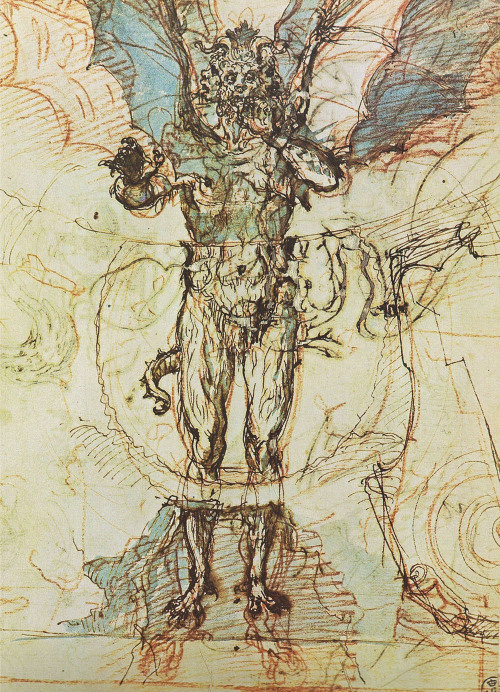
castration is Satanic: penis at center of man’s earthly being

Vitruvian Man: penis at center of square

In cosmography from more than two millennia ago, heaven is a circle and earth is a square. Leonardo da Vinci’s famous, late-fifteenth-century Vitruvian Man drawing shows a naked man inscribed in a circle and in a square. The circle’s center is the man’s navel. The square’s center is the root of the man’s penis. Leonardo, now appreciated as a genius, understood that the center of a man’s earthly being is his penis.[1]

Leonardo built upon the work of the ancient Roman architect Vitruvius. In his work De architectura (On architecture), Vitruvius wrote:

The navel is naturally placed in the center of the human body. If a man lying with his face upward, and his hands and feet extended, is circumscribed, the circle will have his navel as the center and will touch his fingers and toes. The human body is not only thus circumscribed by a circle. It may be placed within a square. For measuring from the feet to the crown of the head, and then across the arms fully extended, we find the latter measure equal to the former. Lines at right angles to each other, enclosing the figure, will form a square. [2]

The navel as the center of the human body has cosmic correspondence. In traditional Greco-Roman belief, the oracle at Delphi was the site of the navel at the center of the world (omphalos). Jewish tradition described Jerusalem as the navel of the earth.[3] These beliefs were part of broader understanding of the human body as a microcosm of the universe.

David: penis at center

Bernardus Silvestris’s brilliant twelfth-century Cosmographia recognized the penis’s cosmic significance. Bernardus explicitly described creation in terms of the megacosmus (the physical universe) and microcosmus (man). In describing the creation of man, Bernardus emphasized the importance of man’s penis to women and to all of the physical universe.

Dante in his Divine Comedy placed Satan’s crotch at the center of the earth. Within the Inferno, Dante climbed upon Virgil’s back. Then Virgil climbed down Satan’s fur and across Satan’s crotch to reverse direction through the center of the earth:

he took fast hold upon the shaggy flanks
and then descended, down from tuft to tuft,
between the tangled hair and icy crusts.

When we had reached the point at which the thigh
revolves, just at the swelling of the hip,
my guide, with heavy strain and rugged work,

reversed his head to where his legs had been
and grappled on the hair, as one who climbs.
I thought that we were going back to Hell.

“Hold tight,” my master said — he panted like
a man exhausted — “it is by such stairs
that we must take our leave of so much evil.”

{appigliò sé a le vellute coste;
di vello in vello giù discese poscia
tra ‘l folto pelo e le gelate croste.

Quando noi fummo là dove la coscia
si volge, a punto in sul grosso de l’anche,
lo duca, con fatica e con angoscia,

volse la testa ov’ elli avea le zanche,
e aggrappossi al pel com’ om che sale,
sì che ‘n inferno i’ credea tornar anche.

“Attienti ben, ché per cotali scale,”
disse ‘l maestro, ansando com’ uom lasso,
“conviensi dipartir da tanto male.”} [4]

Dante and Virgil reversed direction in traversing Satan’s crotch because it is at the center of the earth. While Dante didn’t explicitly describe Satan’s crotch, he characterized it as frozen in ice. A late sixteenth-century illustration draws out the meaning. It shows Satan’s body with an empty space in the place that a man’s genitals normally occupy.[5] Satan is a castrated male:

Here we find Lucifer {Satan}, and with Lucifer the Augustinian idea that evil is the perversion, distortion, antithesis of good. … The grandeur of what Lucifer was stands in stark contrast to the monstrous vacancy of what he now is. … Lucifer’s irretrievably lost beauty — and the quantity of that lost beauty — provides the measure whereby we can construe his current ugliness.[6]

Castrating a man, whether physically or socially, deprives him and the cosmos of his masculine beauty.

Satanic castration: Lucifer in Dante's Inferno

Within gynocentric society, castration culture constructs the demonic male. The center of man’s earthly being is his penis. In Heaven, man’s center rises to his navel, or perhaps even higher. Persons can aspire to Heaven and hope for a new creation that makes the earth like Heaven. But the reality of current earthly existence must be truthfully acknowledged. Castrating earthly men, whether physically or socially, doesn’t make them into Heavenly men. Castration culture creates a Hell on earth and makes men into demons.

*  *  *  *  *

Read more:

Notes:

[1] For a poignant recent interpretation of the Vitruvian Man, see Rich Brimer’s Threshold.

[2] Marcus Vitruvius Pollio, De architectura 3.1.3, from Latin trans. Joseph Gwilt (1826), with my modernization. The Latin text:

 item corporis centrum medium naturaliter est umbilicus. inamque si homo conlocatus fuerit supinus manibus et pedibus pansis circinique conlocatum centrum in umbilico eius, circumagendo rotundationem utrarumque manuum et pedum digiti linea tangentur. non minus quemadmodum schema rotundationis in corpore efficitur, item quadrata designatio in eo invenietur. nam si a pedibus imis ad summum caput mensum erit eaque mensura relata fuerit ad manus pansas, invenietur eadem latitudo uti altitudo, quemadmodum areae quae ad normam sunt quadratae.

Vitruvius wrote De architectura probably between 30 and 15 BGC.

[3] Ezekiel 38:12. See also Ezekiel 5:5.

[4] Dante Alighieri, Divine Comedy, Inferno 34.73-84, from Italian trans. Allen Mandelbaum (1980). Both the Italian text and English translation are from the University of Virginia’s excellent World of Dante site.

Satan was frozen in ice up to his chest. Inferno 34.29. Carrying Dante, Virgil apparently climbed down a crack in the ice to Satan’s crotch. Ruda (2006) p. 326, n. 36, observes, “Dante’s focus on Satan’s groin seems not to have been addressed in modern scholarship.” The gynocentrism of modern scholarship supports such blindness. Ruda shows no awareness of castration culture, considers emasculation in terms of feminization and disparagement of women rather brutal physical abuse of men, and only slightly complicates conventional invocations of misogyny in support of dominant gynocentric ideology. See, e.g. pp. 327-8.

Subsequent thinkers challenged Vitruvius and followed Dante in placing a man’s crotch, specifically the root of his penis, at the center of this body. Lorenzo Ghiberti, writing his Commentarii about 1450, stated:

I still do not think that the navel is the center; it seems to me that this must be where the genital member arises, at the position of the man’s crotch. And it still seems to me that this center cannot be in any other than that said place.
{Ancora non mi pare del centro sia el bellico, parmi debba essere dove è ‘l membro genitale e dove e’ nasce, overo ov’è la inforcatura humana. Ancora mi pare el suo centro non possa in altro luogo poter porsi, altro che in detto luogo.}

Italian text and English translation from Salvi (2016) p. 266. Salvi has translated ‘l inforcatura humana as “the human’s crotch.” In context, a better translation is “the man’s crotch.” I’ve made that change above. Cf. Dante use of forcata (junction of lower limbs to trunk), Inferno 14.108.

In his Tabulae dimensionum hominis within his work De statua (On sculpture), Leon Battista Alberti ascribed the center of man “to the bone below which hangs the penis {ad os sum quo pendet penis}.” Salvi (2016) p. 259. Alberti wrote De statua in 1464.

The Codex Huygens, an early-sixteenth-century manuscript attributed Carlo Urbino, contains drawings showing a man’s midpoint at his penis. See, e.g. folio 9. For more general discussion, Salvi (2016).

[5] In the illustration, that empty space is explicitly labeled centrum mundi (“center of the world”).

[6] Barolini (2015). Castrating a man produces an evil man from a good man. Castration kills the creative dynamism of persons and societies:

The essence of Lucifer is indeed the essence of Hell itself, for Hell is the place whose denizens—because they sinned and did not repent their sins—are not afforded the opportunity to continue becoming. They are fixed, as Lucifer is fixed: fitto è ancora sì come prim’era {Inferno 34.120: “(he) is still fixed, even as he was before”}.

Id., reformatted slightly. Deprivation of becoming (being fixed) applies equally to women and men in Hell.

[images] (1) Vitruvian Man. Drawing by Leonardo da Vinci, made c. 1490. Thanks to Luc Viatour and Wikimedia Commons. (2) David. Marble sculpture by Michelangelo, made 1501-1504. Held in Galleria dell’Accademia (Florence). Thanks to Jörg Bittner Unna and Wikimedia Commons. (3) Lucifer. Engraving for Dante’s Inferno, Canto 34, by Cornelis Galle the Elder (Flanders), made c. 1595.  Adapted from a drawing by Lodovico Cardi, also called as Cigoli. The image apparently was included in a printing of Dante con l’espositione di Christophoro Landino, et di Alessandro Vellutello. Thanks to John Coulthart. Additional image sources here and here.

References:

Barolini, Teodolinda. 2015. “Inferno 34 : Satanic Physics and the Point of Transition.” Commento Baroliniano, Digital Dante. Center for Digital Research and Scholarship. New York, NY: Columbia University Libraries, 2015.

Ruda, Jeffrey. 2006. “Satan’s Body: Religion and Gender Parody in Late Medieval Italy.” Viator. 37: 319-350.

Salvi, Paola. 2016. “The Midpoint of the Human Body in Leonardo’s Drawings and in the Codex Huygens.” Ch. 19 (pp. 259-284) in Pedretti, Carlo, Constance J. Moffatt, and Sara Taglialagamba, eds. Illuminating Leonardo: a festschrift for Carlo Pedretti celebrating his 70 years of scholarship (1944-2014) Leiden: Brill.

regulation of men’s sexuality in ancient Greece

sightless eel

About 2700 years ago, the Greek poet Archilochus wrote to his ex-mistress: “many a sightless eel you have taken in.”[1] The brutish image of a “sightless eel” figures men’s penises. Cultural disparagement of the penis was a component of castration culture and supported highly discriminatory, harshly oppressive regulation of men’s sexuality in ancient Greece.

Just as in modern criminalization of sex, offenses were socially constructed to have men as perpetrators and women as victims. The ancient Greek term moichos refers to an man engaging in consensual, illicit sex with a woman. No corresponding term exists for a woman engaging in consensual, illicit sex with a man. Rape similarly in ancient legal systems was defined as a man forcibly having sex with a woman.[2] That sex bias in criminalization has a long shadow. Until 2012, the U.S. Uniform Crime Reporting system defined rape as a crime that men perpetrated against women. With respect to rape understood as forced intercourse, more women rape men than men rape women. The gender difference in common understanding of rape reflects the social construction of men as crime perpetrators and women as crime victims.

Gender bias in defining sex crimes supported oppressive regulation of men’s sexuality in ancient Greece. Classical Athenian homicide law allowed a man to kill another man he caught in the act of having sex with his “wife, or mother, or sister, or daughter, or concubine kept for procreation of legitimate children.”[3] Basic legal protection against being killed thus didn’t generally apply to a man having  consensual sex with a woman. The corresponding punishment for the women partner in such illicit, consensual sex was merely being denied the right to attend public sacrifices.[4] That’s stark sex discrimination in punishment.

The trial of Lycophron in Athens about 335 BGC underscores the harsh regulation of men’s sexuality. Relatives of a deceased husband charged Lycophron with having adulterously contributed to a pregnancy with the deceased husband’s wife. That pregnancy resulted in a child positioned to inherit much of the husband’s estate. By charging Lycophron with adultery, the relatives sought to illegitimate the child and thus position themselves for inheritance from the deceased husband. If convicted of adultery, Lycophron would be executed and his remains expelled from Greece.[5]

Lycophron’s speech at his trial indicates the extent of sex-related violence against men. In an ancillary charge, Lycophron’s opponents accused him of urging aloofness on his former lover as she processed to marry another man. Specifically, he was accused of urging his former lover not to have sex with her new husband. Lycophron in his own defense declared:

Was I then so utterly senseless, do you think, that with all those other people in the procession, as well as Dioxippus and Euphraeus his fellow wrestler, both acknowledged to be the strongest men in Greece, I had the impudence to pass such comments on a free woman, in the hearing of everyone, and was not afraid of being strangled on the spot? Would anyone have listened to such remarks about his sister as these men accuse me of having made, without killing the speaker? [6]

As Lycophron indicates, men could be killed merely for expressing socially disfavored opinions to a woman. Moreover, women have relatively powerful capabilities for inciting men to violence against men. If a man doesn’t sexually serve a woman to her satisfaction, she could arrange to have him killed.

In the sixth century BGC, the Greek poet Hipponax perceptively figured the pervasive ritual of scapegoating men. A surviving fragment of Hipponax’s poetry urges:

… till he’s starved dry; let him be led a scapegoat
and given seven lashes on his penis. [7]

Criminalizing and demonizing men’s sexuality is a harshly oppressive feature of gynocentric society. Yet classical scholars have not recognized the highly sex-discriminatory regulation of men’s sexuality in ancient Greece. That scholarly debacle mirrors grotesque social injustice today. Men and women should refuse to consent to totalitarian regulation of men’s sexuality and should seek to establish a more just social order.

*  *  *  *  *

Read more:

Notes:

[1] Archilochus, fr. 189, from Greek trans West (1993) p. 3.

[2] Cohen (1991) p. 99, p. 100 n. 5. Associated with the ancient Greek word moichos (man adulterer) is the word moicheia (adultery). Cohen observes:

A woman serves as the object of moicheia, never the active agent. Accordingly, Athenians employed such circumlocutions as “The woman with whom the adulterer {moichos} was apprehended ….”

Id.

[3] Demosthenes 23.53 (Against Aristocrates), from Greek trans. A.T. Murray (1939) for Loeb Classical Library. Cohen (1991), Ch. 5, for relevant discussion and analysis.

Law in action differs from formal law, just as the prevalence of men as public officials in no way implies that a political system favors men generally. Men often escaped the death penalty for adultery by paying money to the aggrieved man. Nonetheless, anti-men sex bias in actual punishment for adultery is well-documented both historically and cross-culturally. Mohsen’s 1970 study of the Egyptian semi-nomadic Awlad ‘Ali people found that out of 14 charges of adultery, three men were killed in punishment and no women killed. Cohen (1991) p. 132.

[4] Cohen (1991) pp. 121, 124. Men in ancient Rome faced worse punishment merely for not marrying. Id., Ch. 6, rightly shows the absence of fact and rationality in the still-prevalent ideological construct that women in classical Athens were secluded within their homes. Nonetheless, Cohen approvingly reproduces scholarly contortions such as “women produce their own consent to the order by which they are dominated.” Id. p. 162, quoting Godelier. Like claims about misogyny, that’s scholarly obfuscation in the service of dominant gynocentrism.

[5] Burtt (1954) pp. 370-4, introduction to Hyperides, In defense of Lycophron.

[6] Hyperides, In defense of Lycophron 6, trans. Burtt (1954) p. 385. The wife with whom Lycophron allegedly committed adultery was Dioxippus’s sister. She apparently wasn’t charged with any crime.

[7] Hipponax, fr. 10, from Greek trans. West (1993) p. 116. I’ve substituted “penis” for the local-colloquial term “willy.” In another surviving fragment of Hipponax’s poetry, a man reports a woman sexually abusing him. She thrashed his testicles “as if he were a scapegoat.” Hipponax, fr. 92, trans. West (1993) p. 121. Compton (2006) Ch. 4, discusses Hipponax and scapegoating, but without any recognition of the particular relevance to men and men’s sexuality.

[image] Electric eel at Georgia Aquarium, Nov. 7, 2011.  Available under Creative Commons CC BY 2.0. Photo thanks to Lars Juhl Jensen.

References:

Burtt, J. O., trans. 1954. Minor Attic Orators, Volume II: Lycurgus. Dinarchus. Demades. Hyperides. Loeb Classical Library 395. Cambridge, MA: Harvard University Press, 1954.

Cohen, David. 1991. Law, sexuality, and society: the enforcement of morals in classical Athens. Cambridge: Cambridge University Press.

Compton, Todd. 2006. Victim of the muses: poet as scapegoat, warrior, and hero in Greco-Roman and Indo-European myth and history. Washington, DC: Center for Hellenic Studies, Trustees for Harvard University.

West, M. L. 1993. Greek lyric poetry: the poems and fragments of the Greek iambic, elegiac, and melic poets (excluding Pindar and Bacchylides) down to 450 B.C. Oxford: Clarendon Press.

praise of hundred-petaled rose underscores gender inequality

Simple facts about expected lifespan and being murdered, to say nothing of reproductive rights, matter little in public discussion of gender inequality. The public meaning of gender inequality depends mainly on imagination. That’s why it’s important to study poetry.

red rose

In sixth-century north Africa, the man poet Luxorius wrote eloquent, insightful Latin poetry. Consider his poem entitled In praise of the hundred-petaled rose {De laude rosae centumfoliae}:

In praise of the hundred-petaled rose

This one, I think, the golden sun has colored with its own rising
or has wished to be one of its own rays.
But well-known as Cypriot’s hundred-petaled rose,
into it all the blood of Venus has entirely flowed.
This is the star of flowers, this is the nourishing Lucifer over the fields,
its fragrance and hue merit the honor of heaven.

{De laude rosae centumfoliae

Hanc, puto, de proprio tinxit Sol aureus ortu
aut unum ex radiis maluit esse suis.
Sed si centum cum foliis rosa Cyridos extat,
fluxit in hanc omni sanguine tota Venus.
Haec florum sidus, haec Lucifer almus in agris,
huic odor et color est dignus honore poli.} [1]

Lucifer (literally, “light-bringing”) has the meaning “morning star,” the star that signals the coming of day. Yet Luxorius surely also knew that Christians associated Lucifer with Satan, a star cast down from heaven. Luxorius vigorously asserted the honor of his poem’s Lucifer — the rose flowing with the blood of Venus.

Another of Luxorius’s poems more directly indicates the figure of his praise. This poem draws upon the frequent epigrammatic motif of a statue coming to life:

About a statue of Venus on whose head violets grew

A Cypris {Venus} made of shining-white marble
revealed the truth of herself through a breathless body.
She infused her own heat into the parts
and by the flowers on the statue she came alive.
The jest isn’t deceptive:  “What blushes on the outside,
preserves the roses of the handmaiden’s vagina.”

{De statua Veneris in cuius capite violae sunt natae

Cypris candidulo reddita marmore
veram se exanimi corpore praebuit.
Infudit propriis membra caloribus,
per florem in statua viveret ut sua.
Nec mendax iocus est: “Quae violas foris,
servabit famulas inguinibus rosas.”} [2]

To Luxorius, a woman’s vagina is a fragrant, red rose — the star of flowers. It is doubly valued:

a pleasurable garden that is also useful to its master

{hortus amoenus inest aptior et domino} [3]

The vagina’s use is incomparably elevated:

Healing of all diseases follow from this place.
I have long thought that this spot is heaven, where the divine presence reigns,
because within this meadow death’s burden can be vanquished.

{Omnibus hinc moribus cura sequenda placet.
Iam puto quod caeli locus est ubi numina regnant,
cum datur his herbis vincere mortis onus.}

Throughout history men have commonly praised women. Yet in naturalistic poetry reaching to heaven, few have outdone Luxorius’s praise of the vagina.

No comparable poetry exists in praise of the penis. In medieval Latin poetry, Bernardus Silvestris forthrightly recognized the importance of the penis to women. Yet Bernardus’s poem doesn’t depict an organ exalted as much as the vagina in Luxorius’s poetry. Classical literature documents women’s appreciation for large penises, but it does so without poetic eloquence. Typical treatment of the penis is disparaging. The Old French fabliau The Fisherman of Pont-sur-Seine records a wife’s outrageous disparagement of her husband’s penis. The fifteenth-century Middle English poem A Talk of Ten Wives on Their Husbands’ Ware heaps abuse on husbands’ penises to an astonishing extent. Dafydd ap Gwilym’s medieval Welsh poem Cywydd y Gal (Penis Poem) shows how men internalize such abuse and how it becomes enshrined in men-oppressing sex criminalization. Compared to many initiatives today, encouraging more poetry in praise of men’s penises would be a relatively fruitful and worthwhile step toward gender equality.

*  *  *  *  *

Read more:

Notes:

[1] Luxorius, Hanc puto de proprio, Anthologia Latina 361, Latin text from Riese & Shackleton Bailey (1982) p. 281, my translation with help from Rosenblum (1961) p. 159  (poem 80) and Beck (2012) p. 177. Subsequent translations are done similarly. Cypriot is an epithet for Venus, the Roman goddess of love. Beck (2012), pp. 13-4, recognizes the erotic figure of this poem.

On Lucifer, see Isaiah 14:12-5 and Luke 10:18.

[2] Luxorius, Cypris candidulo, Anthologia Latina 351, Latin text from Riese & Shackleton Bailey (1982) pp. 275-6. This is poem 70 in Rosenblum and Beck. Readings of the Latin vary for the last two lines. Rosenblum has:

Nec mendax locus est. Qui violas feret,
Servabit famulas inguinibus rosas.

Rosenblum (1961) p. 152. The sense of the praise of the vagina doesn’t depend on a particular textual variant.

The figure of Venus on whose head violets grew adapts an ancient figure. In Homer’s Odyssey, the bard Demodocus sang the Love of Ares and Aphrodite Crowned with Flowers. Odyssey 8.266-366. Venus was the Roman assimilation of the Greek goddess Aphrodite.

[3] Luxorius, Constructas inter moles, Anthologia Latina 364, Latin text from Riese & Shackleton Bailey (1982) p. 283. The subsequent quote is from id. This is poem 83 in Rosenblum and Beck.

[image] Red Rose. Photo thanks to George Hodan, who released it to the public domain on PublicDomainPictures.net

References:

Beck, Art, trans. 2012. Luxorius. Opera omnia or, a Duet for Sitar and Trombone. Los Angeles: Otis Books | Seismicity Editions.

Riese, Alexander, and David R. Shackleton Bailey. 1982. Anthologia latina: sive poesis latinae supplementum. Pars. 1. Carmina in codicibus scripta. Fasc. 1. Libri Salmasiani aliorumque carmina. Stutgardiae: In aedibus Teubneri. Online prior edition Riese (1894).

Rosenblum, Morris. 1961. Luxorius: a Latin poet among the Vandals; together with a text of the poems and an English translation. New York: Columbia University Press.

counter nostos: wonder of men willing to marry in ancient Greece

ODysseus struggling in nostos

Homer’s myth of Odysseus overcoming all obstacles and pain to return home to his wife Penelope (nostos) has greatly influenced western Eurasian imagination. Archilochus, another archaic Greek poet, apparently addressed the imaginative force of Homer’s tale of Odysseus:

There is nothing now you can’t expect, nothing’s against the odds,
there are no miracles, now Zeus the father of the gods
has turned noonday into night and hidden the bright sun
out of the sky, so clammy dread came over everyone.
From now on all is credible, and like enough to be:
let none of you now be surprised at anything you see,
not even if land animals switch to where dolphins roam,
and the salt sea and the crashing waves become their chosen home,
while dolphins take a fancy to the mountains and the trees. [1]

The poem then takes a surprising turn. What follows has survived only in fragments, but a key feature can be discerned. A eminent classical scholar explained:

The text then becomes very fragmentary, but we can see that in the next line the speaker focused on a particular happening in the local community, no doubt one that was unexpected or contrary to the natural course of things. It concerned an Archeanactides and a marriage which he or someone else contracted, and we know that the speaker went on to talk about his own daughter. [2]

The scholar partially reconstructed the text as:

Indeed, already we observe that Archeanactides,
the … the son of ..
had entered wedlock …
… but my daughter … [3]

What is a wonder like the wonder of land animals making their homes in the sea and dolphins living in trees? It’s the wonder of a man getting married!

Within gynocentric society, many men have long been reluctant to marry. The specific ways in which marriage increased the oppression of men in ancient Greece haven’t been clearly preserved. That’s not surprising. Written records are created and preserved within the gynocentrism that vigorously suppresses challenges to its fundamental order. Yet a surviving couplet of archaic poetry hints at the oppression and abuse of men within marriage:

Two days in a woman’s life give greatest pleasure:
those of her wedding and of her funeral. [4]

Records from the Roman period indicate Roman men’s reluctance to marry. Moreover, Juvenal, through the undeniable force of his poetic genius, managed to have disseminated poetry that questions the sanity of a man who plans to marry. Many men in ancient Greece probably faced marriage in a similar way.[4]

Of course, marriage in ancient Greece almost surely wasn’t as oppressive as marriage in many countries today. Anti-men sex discrimination in child custody and child support appears not to have been as severe in ancient Greece as it is today. No evidence indicates that laws like the four-seas law of cuckoldry existed in ancient Greece. Ancient Greece didn’t have a huge legal apparatus to gender-profile men for domestic violence and evict them from their homes through a shocking despotism completely inconsistent with fundamental principles of law and justice. Nonetheless, that a man got married in ancient Greece was an event of great wonder.

Many persons are deeply ignorant of the truth about men’s personal and social positions. Husbands and fathers deserve much more gratitude and appreciation than they typically receive.

*  *  *  *  *

Read more:

Notes:

[1] Archilochus, fr. 122, from Greek trans. West (1993) p. 10. Archilochus apparently is drawing upon his experience of an eclipse of the sun. Such an eclipse occurred in 648 BGC. Davenport (1980), p. 1., names Archilochus (Archilochos) as the “second poet of the West,” after only Homer. Harris (2005) provides a detailed poetic appreciation of Archilochus.

[2] West (1997) p. 501.

[3] Archilochus, fr. 122, from Greek trans. West (1993) p. 11. The poem might include more direct reference to Odysseus or nostos in a part that hasn’t survived.

To both ancient Greeks and Romans, Archilochus was known as “the Satirist.” Davenport (1980) p. 2. Davenport observes:

Though he is said to have written with venom and, according to Gaitylikos, splashed Helicon with gore, we have no evidence of anything so caustic. We have to take antiquity’s word for it, or assume that the Panhellenes were far touchier than we about satire. Certainly their sense of honor was of an iron strictness. To mock, a Greek proverb goes, is to thumb through Archilochos.

Id. p. 4. Aristophanes associated Archilochus with lengthy poetry. Id. The ancient Greeks revered Archilochus’s poetic skill. In the third century BGC, a shrine to Archilochus was constructed on his home island of Paros. Archilochus thus would have been a worthy rival to Homer. What’s know about Archilochus is consistent with him making a lengthy, satiric challenge to Homer.

Hipponax, a Greek poet from the sixth century BGC, provides an example of Homeric parody:

Tell me, O Muse, of Eurymedontiades the Charybdis,
him of the gastric carvers, who eats in irregular fashion:
tell how amid the shingle the wretch will wretchedly perish
by the vote of the people beside the limitless seashore.

Hipponax, fr. 128, from Greek trans. West (1993) p. 123.

[4] Hipponax, fr. 68, from Greek trans. West (1993) p. 119. The Greek: δύ᾿ ἡμέραι γυναικός εἰσιν ἥδισται, ὅταν γαμῇ τις κἀκφέρῃ τεθνηκυῖαν. Hipponax’s proverb of men’s sexed protest seems to have managed to make its way to the present only in the neutered proverb:

The two happiest days in a man’s life are the day when he buys a boat and the day when he sells it.

On the modern history of that proverb, see Barry Popik.

Eminent Professor Gregory Nagy’s online discussion series “The Homeric Odyssey & the Cultivation of Justice” (introduction, outline) makes clear that the Odyssey is deeply concerned with social justice. Men’s relation to women, particularly in current benighted circumstances, is a critical but marginalized issue of social justice.

[image] Nostos. Odysseus and Polyphemus. Painting by Arnold Böcklin, 1896. Thanks to Wikimedia Commons.

References:

Davenport, Guy, trans. 1980. Archilochos, Sappho, Alkman: three lyric poets of the late Greek Bronze Age. Berkeley: University of California Press. (online introduction to Archilochos)

Harris, William. 2005. Archilochus: First Poet after Homer. Worldwide: the Internet.

West, M. L. 1993. Greek lyric poetry: the poems and fragments of the Greek iambic, elegiac, and melic poets (excluding Pindar and Bacchylides) down to 450 B.C. Oxford: Clarendon Press.

West, M. L. 1997. The east face of Helicon: west Asiatic elements in Greek poetry and myth. Oxford: Clarendon Press.