Symeon the New Theologian overcame Christian gender disadvantage

Origen castrating himself, Empedocles throwing himself in fire

Christian men are gender-disadvantaged relative to Christian women. Mary, the first and preeminent Christian disciple, conceived and nurtured Jesus within herself, as all subsequent Christians, including men, were to do. Scripture and Christian tradition figure the Christian Church as feminine — the bride of Christ.[1] The fully masculine man Jesus calls both Christian women and men to love him personally and passionately. With gynocentrism and heterosexuality dominant in human societies, ordinary men tend to be marginalized in the Christian Church and struggle to understand personally God’s passionate love for them.

In eleventh-century Byzantium, Symeon the New Theologian understood personally the extreme abasement of God in becoming a male human being. As the revered Trojan epic cycle makes clear, thousands of men’s lives matter less than the life of one beautiful woman Helen. Gyno-idolatry has been prevalent throughout human history. Byzantine society, not surprisingly, was deeply gynocentric, and men’s sexuality was devalued. Symeon probably had his testicles cut off as a youth for career advantage in the Byzantine civil service.[2] Symeon surely understood that God became incarnate as a male, not a female, to unite the extremes of divinity and humanity as commonly perceived.[3]

Symeon the New Theologian had lived a dissolute life as a leading eunuch in the imperial court at Constantinople. Symeon confessed his evil acts:

I would like to tell them {my evils} here, but certainly not all, O Word,
for they are innumerable beyond the stars,
beyond the drops of rain, and the sand
of the sea, beyond the multitude of surging waves.

I had become a murderer — listen everyone
so that you may weep sympathetically — but the manner
of murder, I leave aside, on account of too long a speech.
Alas, I had also become an adulterer at heart,
and a sodomite in deed and by free choice.
I became a philanderer, a wizard, and a corrupter of boys,
a perjurer, a blasphemer, a money-grabber,
a thief, a liar, shameless and rapacious — woe is me!
abusive, brother-hating, exceedingly jealous
and money-loving, reckless, and also every
other form of wickedness I have committed.
Yes, trust me, I say these things truly,
and not in imagery, not in clever metaphor! [4]

Eunuch officials in Byzantium were commonly despised for their viciousness. At age 28, Symeon withdrew from his eminent position in the imperial court to become a monk.

Symeon understood that he needed God’s love to be saved from darkness, sorrow, and loneliness. Symeon proclaimed:

But if it is possible to be saved
without love, O my Christ,
how shall this be?

Impossible!

If we were separated from the light,
how shall we flee the darkness?
If we were deprived of the joy,
how would we be free from sorrow?
Having been found outside the bridal chamber,
how would we be completely happy?

Having fallen out of the Kingdom,
— I speak of seeing you, O Savior —
what other salvation,
and what sort of consolation,
or in what other kind of place
would we be able to find salvation?

Certainly, absolutely nowhere,
even if some foolishly perceive it so.

Symeon described God’s love as spiritual light and fire. He experienced himself united with God. That experience wasn’t outside of his body. Symeon’s experience of God involved the same senses as human erotic experience:

He is seen by me and he looks at me, he who looks upon all things.
Amazed, I am astonished at the shapeliness of his beauty,
and how the Creator stooped down when he opened the heavens
and displayed his unspeakable and strange glory to me.
Who therefore shall also come closer to him?
Or how shall one be carried up to the immeasurable heights?
When I considered this, he himself was found within me,
flashing forth within my wretched heart,
illuminating me from all directions with immortal radiance,
shining upon all my members with his rays,
folding his entire self around me, he tenderly kisses all of me.
He gives his whole self to me, the unworthy,
and I take my fill of his love and beauty,
and I am filled full of divine pleasure and sweetness.

Symeon understood that Jesus loves men as passionately as he loves women. That gift of love can be experienced right here on earth:

I revel in the unspeakable and divine joy;
I make merry in love’s beauty, I often embrace it,
I kiss it, and fall down in worship, I have great thankfulness
to those who have arranged for me to see what I was desiring,
to partake in the inexpressible light, and to become light,
and to share in the light’s gifts here on earth,
and to obtain the provider of all good things,
and to lack no spiritual gifts. [5]

Symeon urged others to partake of this joyful, divine eros. Far too many persons don’t experience this joy.

Hatred of men and demonization of men’s sexuality destroys human and divine eros. Scholars today are embarrassed that Jesus was a fully masculine human being. In service of dominant gynocentric ideology, they pontificate about “the mystery of the dual-gendered sexuality of the total Christ.”[6] In more enlightened eleventh-century Byzantium, Symeon recognized that Jesus had a penis, and that men shouldn’t be ashamed of their penises:

We were made members of Christ, and Christ becomes our members

and so thus you well know that both my finger and my penis are Christ.
Do you tremble or feel ashamed?
But God was not ashamed to become like you,
yet you are ashamed to become like him? [7]

Those who seek worldly status in our ignorant and bigoted age write lengthy discourses on the problematics of essentializing gender and the essential androgyny of non-hyper-masculinity. In reality, Christian men must develop the strength of love that Symeon knew:

Love put to flight a column of demons,
it chased away cowardice,
it introduced manliness.

Our time desperately needs Symeon’s witness of Christian manliness.
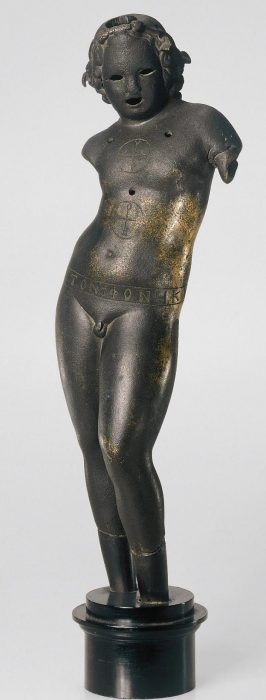
Christian Dionysos statuette from Hermitage

A Roman statuette of Dionysos, repurposed in eighth- or ninth-century Byzantium, illustrates possibilities for overcoming gynocentrism and men’s Christian gender disadvantage. The statuette’s display of male genitals wouldn’t have shocked Byzantines in Constantinople. They were accustomed to a monumental classical sculpture of a naked ass-driver and ass and a statue of Priapos holding in his left hand his erect penis.[8] Two cross-shaped monograms stamped on the statuette’s chest are pointed with Greek letters representing “Lord help me.”[9] That inscription obliterates Roman men’s pride in acquiring war wounds on their chests. Accentuating the statuette’s lithe waist is inscribed text of Psalm 29:3. In a medieval liturgy for Epiphany, that text generated words for consecrating water:

I have heard Your voice, Lord, crying in the wilderness, when You thundered over the mighty waters, bearing witness to Your son. [10]

A Byzantine crafts-person apparently repurposed the Roman statuette of Dionysos to be a personal receptacle for consecrated holy water. The figure of Dionysos may have been appropriately re-visioned as Jesus Christ. Symeon the New Theologian sought to bring the spiritually complacent to an epiphany of divine eros.[11] The Byzantine maker and owner of this statuette understood Symeon’s message before he proclaimed it. Even in our more ignorant and bigoted age, we too should be able to appreciate a masculine representation of divine eros.

*  *  *  *  *

Read more:

Notes:

[1] Romanos the Melodist’s kontakion On Mary at the Cross characterizes Mary as a mother who nearly dominates Jesus. The Grottaferrata version of the early Byzantine epic Digenis Akritis poignantly addresses gynocentrism. Images of Mary were mass-produced in Crete in 1499. Milliner (2014) pp. 21-2. The same was probably true earlier and elsewhere. Among late twentieth-century Christian pilgrimage sites in Western Europe, about two-thirds primarily concern Mary. Nolan & Nolan (1989) pp. 116-7.

[2] Symeon lived from about 949 to 1022 GC. Niketas Stethatos’s eleventh-century hagiographic life of Symeon, entitled The Life and Conduct of Our Father among the Saints Symeon the New Theologian, Elder and Superior of the Monastery of Saint Mamas Xerokerkos, states:

Symeon, this man so renowned for his virtue, was born in the region of Paphlogonia …. His home was a village called Galati by the local inhabitants. His parents, who were of noble and rich stock, were Basil and Theophano, known by the surname Galatones. While still at a tender age, he was taken to Constantinople by his parents, like some precious object, and entrusted to his grandparents who were at that time well known at the imperial court. He was also handed over to a schoolteacher and taught the elementary curriculum.

Life of Saint Symeon, Ch. 2, from Greek trans. Greenfield (2013) p. 5. Symeon’s paternal uncle was a bed chamberlain (koitonites), an influential imperial position close to the Byzantine Emperor. The bed chamberlain was usually a eunuch. Undoubtedly with his uncle’s help, Symeon quickly earned the rank of spatharokoubikoularios (“Gentleman Sword-Bearer of the Imperial Bedchamber”), a position historically reserved for eunuchs, although not necessarily so in Symeon’s time. Life of Saint Symeon, Ch. 3; Greenfield (2013) p. 400, notes 1, 3, 4; McGuckin (2005) p. 199, n. 4; Tougher (2008) p. 62.

According to the Life of Saint Symeon, the pious man Philotheos helped to construct “a holy monastery for ascetics at Anaplous on the Byzantine Bosphorus.” Philotheos became a monk in that monastery. He then had a vision of Symeon as a “gray-haired man, a respectable and dignified-looking eunuch with a particularly angelic appearance and a face full of divine grace.” That eunuch identified himself to Philotheos as Symeon. Life of Saint Symeon, Chs. 145, 147, trans. Greenfield (2013) pp. 361, 365.

Given the evidence, Symeon almost surely was a eunuch. McGuckin in several places reasonably assumes that Symeon was a eunuch. McGuckin( 2005) p. 197; p. 197, n. 8; p. 200, n. 55. Above I also regard Symeon as a eunuch. On the specific form of Symeon’s castration, see note [7] below.

[3] Symeon, Τῶν θείων ὕμνων οἱ ἔροτες {Hymns of Divine Eros} 7.42 refers to God incarnate in Jesus as uniting two extremes.

[4] Symeon, Hymns of Divine Eros 24.64-67, 71-83, from Greek trans. Griggs (2010). All but the final quote are similarly from Hymns of Divine Eros, with citations (cited by beginning words of quote, hymn.lines): But if it is possible…, 17.426-42; He is seen by me…, 16.17-30; I revel in the unspeakable…, 18.116-24; We were made members of Christ…, 15.140, 160-3; Love put to flight…, 17.390-2. I’ve made some insubstantial changes to the translations. Koder (1969-73) provides a critical edition of the Greek text.

[5] Răducan (2011) analyzes the conflation of eros and agape in Symeon’s hymns. Symeon described what is known in Orthodox Christian thought as theosis. Krueger observed:

He {Symeon} cannot convey or understand the love of God independent of human emotions and experience. … This relationship between carnal desire and desire for God does not reduce to a “mere metaphor” or simple binary, one that might erase the metaphor’s referent by transferring its sense to another thing. Rather, knowledge of the experience of one contributes to the indescribable experience of the other. Under these conditions, carnal and spiritual eros engage in mutual constitution, shaping, defining, but not necessarily bounding each other.

Krueger (2018) pp. 318, 336 {references omitted}. Krueger shows that Symeon’s descriptions of love are similar to those in Byzantine romances.

[6] Milliner (2014) p. 26. In response to Steinberg’s seminal presentation of Renaissance ostentatio genitalium, Milliner used Byzantium to advance contemporary academic gender orthodoxy. Rachel Fulton Brown courageously and astutely responded:

Scandalous as it might be actually to agree with Steinberg, I have a rather different take on the matter. As I read it, it was never Steinberg’s main point that only Renaissance artists ever attempted to show Christ in his humanity, only that when they did, given their commitment to a certain style of naturalism, they found themselves obliged to represent the full humanity of Christ as a man, including his genitalia — and for good theological reasons.

Brown (2014) p. 2. Missing the obvious specificity of Renaissance naturalism, Robert Nelson in response to Milliner began with an ad hominen disparaging memory of Steinberg and then lamented Steinberg’s neglect of iconic presence. On the latter, Galbi (2003). Nelson cursorily dismissed “Steinberg’s flawed thesis that is now thankfully fading into the past.” Id. p. 1. Steinberg’s thesis is fading into the past only because academics are becoming more narrow-minded, bigoted, and doctrinaire.

[7] Cf. 1 Corinthians 12:12-27. In his original Greek text, Symeon unambiguously refers to his penis:

πάντως οὖν οὕτως ἔγνωκας καὶ δάκτυλόν μου Χριστὸν
καὶ βάλανον — οὐκ ἔφριξας, ἢ σὺ καὶ ἐπῃσχύνθης;
Άλλὰ Θεός σοι ὅμοιος οὐκ ᾐσχύνθη γενέσθαι,
σὺ δὲ ἐκείνῳ ὅμοιος αἰσχύνῃ γεγονέναι

Hymns of Divine Eros 15.160-3, Greek text from Hoder (1969-73) vol. 1, p. 290. Byzantine writers were willing to refer to genitals. John Tzetzes, perhaps the greatest classical of all time, recast a Homeric epithet to form an erudite allusion to women’s genitals. A fourteenth-century Byzantine poem compared the penises of a donkey and an ox. Unlike for today’s elite, for medieval elite the typical bodily reality of sexually dichotomous genitalia would not have been shocking or embarrassing.

D.T. Nguyen at Asian Orthodoxy aptly observed:

It’s too simplistic to say that Symeon has no patience for puritanical prudery and stop there. Really, these hymns are a slap to the face of those who demand the Divine to manifest itself only outside that which is deemed lowly (opposed to heavenly), impure (opposed to pure), or secular (opposed to sacred). … We are always expecting an apocalyptic enlightenment totally alienated from the mundane mediocrity of our daily lives. Instead, we receive the anti-climatic insight that this here and now – this really is it. However, we now see it as God sees it: and God saw that it was good.

Nguyen quotes the Outer Chapters of the Zhuangzi addressing the same fundamental issue.

Although Symeon was probably a eunuch, his confession of being a sodomite and his reference to his penis suggest that his testicles were excised, but his penis wasn’t cut off. That was a common form of castration. It is attested in Juvenal’s Satire 6. In missing Symeon’s point, Milliner assumed that Symeon lacked a penis:

But to isolate the penis in this hymn (Symeon was, after all, an eunuch) is to miss the larger point.{note 60: Among other reasons not to overly emphasize phallic imagery in this poem is because Symeon was probably castrated for court service as an eunuch when a boy.}

Milliner (2014) p. 15. Having a penis is personally relevant to Christian men in representing to oneself receiving the Eucharist, following Mary in incarnating Jesus, and having a passionately loving relationship with Jesus.

[8] On the statue of Priapos, Patria 2.12, referenced in note [21] of my post on the naked ass-driver.

[9] From Courtauld Institute of Art (2006) p. 171, which provides a catalog entry for the statuette. Peers (2014) draws attention to the Dionysos statuette, and asks with respect to Byzantine culture:

How did sex in art get activated, sublimated, accomplished in that culture? How did it serve devotion, assimilation and union with God’s own body?

Peers (2014) p. 2. In addition to Symeon’s Hymns on Divine Eros, the progymnasmata of Nikephoros Basilakes provide good insight into those questions.

[10] These words (in Greek) “form part of the liturgical reading of Kosmas the Melode, bishop of Maiuma, uttered during the consecration of water during the feast of the Epiphany.” Courtauld Institute of Art (2006) p. 171 (including quoted text above). Id. suggests the statuette’s use:

Liturgical ewers bearing this text are known, which were used to hold holy water. Ewers originating from excavations in Corinth and Vrap, in Albania, are usually dated to the period of iconoclasm, around the eight and ninth centuries. … It is possible that the statue {statuette} of Dionysos, reworked in the early Middle Ages, began to serve as a distinctive receptacle for consecrated oil or water: this is suggested by the opening in Dionysos’s head, similar to the neck of a jug, and also by the form and average dimensions of glass pilgrim vessels for unction oil and water. If this hypothesis is correct, a glass capsule would have been placed inside the figure through the opening of the head, and the opening would then have been sealed with wax.

Id. According to the Hermitage’s page for it, the statuette is 32 cm tall.

[11] In entitling Symeon’s hymns “Τῶν θείων ὕμνων οἱ ἔροτες {Hymns of Divine Eros},” Niketas Stethatos alluded to Dionysos:

The title {Hymns of Divine Eros} is meant to evoke the Erotikoi Hymnoi of Hierotheos, whom Dionysius speaks of as his mystical teacher in Divine Names 3.2.

McGuckin (2005) p. 199, n. 2.

[images] (1) Origen (at center) castrates himself to make himself more welcomed as a teacher for nuns (on the left). Empedocles (on right) throws himself into a fire in an attempt to establish his immortality. Illustration in Romance of the Rose, “manuscript made for Louise of Savoy, mother of Francis I, with many miniatures in the style of Robinet Testard, French, late 15th century.” Oxford, Bodleian Library, MS. Douce 195, fol. 122v, via Wikimedia Commons. Romance of the Rose, manuscript created in Paris about 1405, MS. J. Paul Getty Museum, Ludwig XV7, f. 107, similarly contains an illustration of Origen castrating himself and Empedocles in a fire. According to the Romance of the Rose (Ch. 97), both Origen and Empedocles committed outrages against nature. (2) Statuette of Dionysus with a Text of a Psalm, made in Rome in the second-third century, Psalm 29:3 engraved in seventh-ninth century. Found fortuitously by the River Don in 1867. Preserved as item До.1864-2/2 in Hermitage Museum (St. Petersburg, Russia), image used in accordance with permission for “interactive forms used for the presentation of scholarly works.” Catalog entry 139 in Courtauld Institute of Art (2006) p. 171.

References:

Brown, Rachel Fulton. 2014. “Penisgate: Response to Matthew J. Milliner, ‘The Sexuality of Christ in Byzantine Art and in Hypermodern Oblivion.’” Religion and Culture Web Forum. University of Chicago Divinity School.

Courtauld Institute of Art. 2006. The Road to Byzantium: Luxury Arts of Antiquity. London: Fontanka.

Galbi, Douglas. 2003. “Sense in Communication.” Online.

Greenfield, Richard P. H., ed. and trans. 2013. Niketas Stethatos. The Life of Saint Symeon, the New Theologian. Dumbarton Oaks Medieval Library vol. 20. Cambridge: Harvard University Press.

Griggs, Daniel K., trans. 2010. Divine Eros: Hymns of St. Symeon, the New Theologian. Crestwood, N.Y.: St. Vladimir’s Seminary Press.

Koder, Johannes, ed and trans (French). 1969-73. Hymnes: Syméon le Nouveau Théologien. Sources Chrétiennes, no. 156 (Hymns 1-15), 174 (Hymns 16-40), 196 (Hymns 41-58). Paris: Éditions du Cerf.

Krueger, Derek. 2018. “Divine Fantasy and the Erotic Imagination in the Hymns of Symeon the New Theologian.” Ch. 15 (pp. 315-341) in Neil, Bronwen, and Evangelia Anagnostou-Laoutides, eds. Dreams, memory, and imagination in Byzantium. Leiden: Brill.

McGuckin, John Anthony. 2005. “Symeon the New Theologian’s Hymns of Divine Eros: A Neglected Masterpiece of the Christian Mystical Tradition.” Spiritus: A Journal of Christian Spirituality. 5 (2): 182-202.

Milliner, Matthew J. 2014. “The Sexuality of Christ in Byzantine Art and in Hypermodern Oblivion.” Religion and Culture Web Forum. University of Chicago Divinity School.

Nelson, Robert S. 2014. “Response to article of Matthew J. Milliner.” Religion and Culture Web Forum. University of Chicago Divinity School.

Nolan, Mary Lee, and Sidney Nolan. 1989. Christian Pilgrimage in Modern Western Europe. Chapel Hill: University of North Carolina Press.

Peers, Glenn. 2014. “Response to Matthew Milliner, ‘The Sexuality of Christ in Byzantine Art and in Hypermodern Oblivion.’” Religion and Culture Web Forum. University of Chicago Divinity School.

Răducan, Ana-Maria. 2011. “Meanings of the Term Eros at Saint Simeon the New Theologian.” Cogito. 2: 27-39.

Tougher, Shaun. 2008. The Eunuch in Byzantine History and Society. London: Routledge.

Arian Baptistry mosaic centered on Jesus’s navel

Jesus in the Arian Baptistry mosaic

Traditional Greco-Roman and Hebrew thought associated a navel with both the center of a man and the center of the cosmos. The Arian Baptistry mosaic, constructed in Ravenna, Italy, about the end of the fifth century, has a circular design. It shows John the Baptist baptizing Jesus in the River Jordan. At the center of the circular design is Jesus’s navel. That design figures Jesus as a divine man at the center of the cosmos.

Leonardo da Vinci’s late-fifteenth-century Vitruvian Man drawing shows a man’s penis at the center of a bounding square. That geometry represents that a man’s penis is at the center of his earthly being. In the Arian Baptistry mosaic, Jesus’s penis is clearly visible in the water of the River Jordan. That depiction emphasizes that Jesus was a fully masculine man like the man of the Vitruvian Man drawing and other earthly men.

Earthly men should not be shamed for having a penis. Nor should a man be forced to make large, arbitrary, and unreasonable financial payments simply because he served a woman with the wonderful functioning of his penis. Nor should men spreading their legs to create more room for the center of their being be judged a crime (“manspreading”). Meditate on the ancient Arian Baptistry mosaic, and you will understand.

*  *  *  *  *

Read more:

Notes:

Writing about 20 BGC, the ancient Roman architect Vitruvius in his book De architectura (On architecture) described a man’s navel as at the center of a circle circumscribing him

The Gospels describe the baptism of Jesus. See Matthew 3:13-7, Mark 1:9-11, Luke 3:21-2, John 1:29-34. The figure on the left in the Arian Baptistry mosaic is a personification of the River Jordan.

The Ostrogoth King Theodoric the Great constructed the baptistry. He was an Arian Christian. Arianism represented an early split in Christian theology over Jesus’s status in time.

[image] Arian Baptistry mosaic (excerpt). Photo thanks to Petar Milošević, via Wikimedia Commons.

ostentatio genitalium saves world from pathological gynocentrism

Darkness covered the faces of the people, and its wombs were a formless void.  Self-absorbed, virtue-signaling women and impotent, self-abasing men secretly cursed the gynocentric days of their births.

holy family with infant John the Baptist

Then among these loathing people came an extraordinary, fully masculine son. His mother and father and those closest to him embraced the human fullness of his masculine being. He was a man-child, a boy. They loved him.

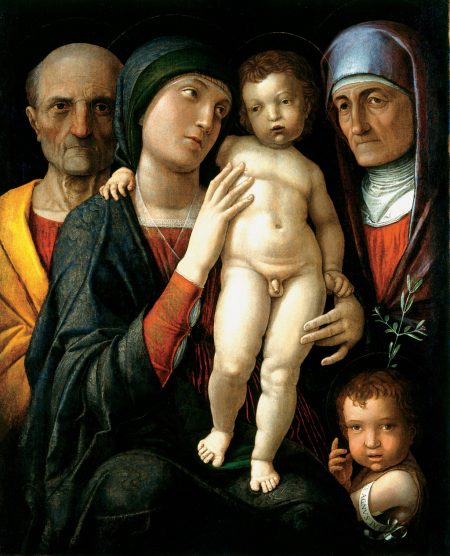
the Holy Family, Andrea Mantegna

The fully masculine son was a sign that would be opposed. The inner thoughts of many were filled with hate for men. Like thousands of sons at colleges and universities today, he would suffer an agonizing trial, a mockery of justice, then scourging, spitting, and expulsion. His mother pondered all these things in her heart. She prayed over his vulnerability.

Virgin adoring baby Jesus with penis

Protected and loved, he grew up to be a man. Unknowing scholars condemned him as “hyper-masculine.” Modern-day Jezebels screeched that the man was committing symbolic violence against them, and that men they smear as misogynists must protect them from men they accuse of symbolic violence. Gynocentric thought-leaders opined that the man was a woman, or at least androgynous.

Gallino crucifix, attributed to Michelangelo

Though wholly innocent, and without any sins against women or men, the man was crucified. He was crucified for being a man who testified to the truth. He cried out in compassion for his persecutors, “Father, forgive them, for they know not a father’s love.” Blood from the wound at his side flowed down to his groin. When he was taken down from the cross, he was grasping agonizingly at his groin. Mothers, here are your sons.

Zebraku lamentation

It was finished. The women who loved him looked upon his dead body in despair. They knew the facts of life and love and procreation. They didn’t dare hope for resurrection.

three mourners look upon dead Christ, by Andrea Mantegna

The rising of the dead man happened. Some institutionally entrenched scholars doubted. One wrote archly of “what certain painted folds of drapery really conceal.” For those who have eyes to see and some appreciation for Renaissance painters’ painstaking representations of drapery, what the form of the drapery about the man’s groin represents cannot be doubt. He had risen from the dead.

Christ, man of sorrows, by Maerten van Heemskerck

Holy Trinity in a glory of angels, by Lucas Cranach

The father was well-pleased with his son who fulfilled his mission. The father put his hand under his son’s thigh and swore that once again fully masculine men would be loved in the fullness of their masculine being. Then he sat his son upon a throne of grace. Let all women and men boldly approach this throne of grace in their time of need.

throne of grace, medieval carving

The man’s ostentatio genitalium, reverberating across centuries, now is readily available for all to see. He was not ashamed to call other men his brothers. Men and women today are groaning under the bondage of pathological gynocentrism. But seeing the man’s love, who can separate us from the love of each other? In this hope we are saved.

*  *  *  *  *

Read more:

Notes:

The above is based mainly on the seminal work of Leo Steinberg. He first presented this work publicly in 1981 in a Lionel Trilling Seminar at Columbia University. For a good appreciation of Steinberg’s contribution to artistic culture, Strauss (1997).

Despite survival bias against such images, ostentatio genitalium isn’t a marginal phenomenon in surviving Renaissance images. Steinberg implicitly defined ostentatio genitalium {showing of male genitals} as “images wherein the emphasis on the genitalia of Christ is assertive and central.” He initially estimated that the number of Renaissance ostentatio genitalium images “runs past a thousand.” In his 1996 edition, he observed in retrospect that “the number {of identified ostentatio genitalium Renaissance images} by now has probably doubled.” Steinberg (1996) pp. 109, 266.

An under-appreciated strand of literary history celebrates the seminal, generative work of penises. Within traditional, Greco-Roman culture, Octavian celebrated his victory at Actium with a monumental sculpture of a penis-baring ass-driver having dominion over a donkey. Octavian’s Actium monument seems to relate to literature, most importantly Apuleius’s Metamorphoses, acknowledging the appeal of donkeys’ large penises. Greco-Roman Priapea, on the other hand, ironically critiqued brutalizing and commodifying stereotypes of men’s sexuality. Most importantly, Maximianus’s fifth elegy concluded with a reference to death, impotence, and rising. Ostentatio genitalium can be understood as a Christian refiguring of the final verses of Maximianus’s fifth elegy.

Important works of medieval literature directly affirmed men’s redeemed penises. Bernardus Silvestris’s Cosmographia celebrates penises triumphing over death. Nigellus Wireker’s Speculum stultorum metaphorically addressed penis size and the importance of generative semen. Jean de Meun’s continuation of the Romance of the Rose concluded with uniting adoration of the Virgin Mary with the lover’s genital connection to a specific, flesh-and-blood woman. In medieval Christian understanding, Jesus saved and redeemed humanity, including men and men’s sexuality. As the courtly tales of the great late-medieval church official Poggio Bracciolini indicate, God made men’s sexuality, and it became very good.

Although daring and insightful, Leo Steinberg wasn’t a meninist art historian. At crucial points he effaced masculine distinctiveness. Consider:

If, as Christianity teaches, God abased himself in becoming man, then his assumption of human genitals sounds the nadir of his self-abasement.

Steinberg (1996) p. 239. Steinberg here uses “man” for a generic human. The generic human has “human genitals” rather than masculine genitals. But Christianity doesn’t teach that God became a generic human being (“man”). Christianity teaches that God became a fully male human being with male genitals. Throughout human history, male genitals have been socially disparaged. Throughout human history, females have been privileged under dominant gynocentrism. The self-abasement of God went to the extreme by God becoming a male human being.

Steinberg didn’t recognize that men matter as a distinctive gender. Ostentatio genitalium explicitly concerns masculine genitals. Yet Steinberg explained:

In the ostentatio genitalium, the mystery of the Incarnation is reaffirmed against the drift to complacency and regains its power to startle. The Word made flesh is, after all, a difficult dogma,and routine, nominal faith easily recoils from its consequences. One assents with reservations — “made flesh,” yes, of course, but surely within decent limits. Whereas Renaissance painters, whose calling demands that they give visible witness to the enfleshment of God, must go, or choose to go, all the way. … It now appears clearer than ever that these artists, in their dealing with the totality of man’s body, brought a unique understanding to the role Western theology assigns to the genitals.

Id. p. 226. These artists weren’t dealing with a generic human’s body (“man’s body”); they were dealing with a specific male human’s body. The genitals of Christ were masculine genitals. Without knowing Latin grammatical cases, a child could look at the ostentatio genitalium images and perceive that the images show male genitals. But scholars commonly have refused to recognize men’s maleness. Understanding masculine genitals in Western theology and Western thought has hardly begun.

Scholars have been preoccupied with arguing that Jesus was not a fully male human being. Caroline Walker Bynum contributed to her rise to the pinnacle of scholarly eminence with her book, Jesus as Mother: Studies in the Spirituality of the High Middle Ages. See Bynum (1982). Addressing his scholarly critics, Steinberg explained:

This notion of a female Savior derives above all from a sense of Christ’s side wound as an organ capable of symbolic lactation and of giving birth to the Church. … these same medieval artists who imaged the Crucified as unsexed (asexué) refused to deny him his beard, rejecting the type of the smooth-cheeked Savior common until the 10th century. Their image of Christ does not seem to posit a shift of gender so much as an “asexuation,” an ideal of manhood without the blight of sex. Though the shaming part {sc. male genitals} is omitted, no late medieval artist insinuates that the Incarnate was other than male.

Steinberg (1996) p. 247. Steinberg interpreted Renaissance paintings depicting the crucified Christ having an erection to be an extraordinary symbol of resurrection. A critic brandished the banal accusation of gender bias against women. Steinberg aptly responded, with some exasperation:

Here was no Tiresian gender contest, no vying of male with female, because the subject of Heemskerck’s image was not the power to outperform the opposite sex, but the power to override death. And the victor in the picture is male for the sufficient reason that this was Christ’s sex. Had the Trinity’s Second Person incarnated a woman, she would doubtless have resurrected in a spectacular pregnancy.

Id. p. 325, n. 30.

In a chapter he added to his 1996 enlarged edition, Steinberg provided a thorough critique of medievalist Caroline Walker Bynum’s forty-page response to his book. In a section entitled “The Body of Christ as Female in Medieval Texts,” Bynum offered a textist critique of Steinberg’s collection of ostentatio genitalium Renaissance paintings. Citing Bernard of Clairvaux’s comments on Song of Songs 1.1-2, she asserted that this text:

makes clear not only the medieval tendency to associate breasts with food (rather than sex) but also the medieval tendency to assimilate Church as Christ’s spouse with Church as Christ’s body.

Bynum (1986) p. 414. Steinberg sensibly responded and coyly speculated:

since the Virgin is singular and her breast’s status unique, it is entirely inappropriate to cite images of the Maria lactans as evidence of how “medieval people” perceived female breasts. … I would guess that the view medieval men took of bared breasts varied with the observer, the party observed, and the spur of the moment. … {Jean de Roye in Paris in 1461} writes: “And there were also three very handsome girls, representing quite naked sirens, and one saw their beautiful upright, separate, round and hard breasts, which was a very pleasant sight….” Was this de Roye being insufficiently medieval in failing to recognize that very pleasant sight as essentially alimentary? … Far be it from me to belittle the nutritional value of the maternal breast, but when San Bernardino and fellow preachers rallied against low-necked dresses, it was not to keep sources of nourishment hid.

Steinberg (1996) p. 382.

Like many scholars writing about gender, Bynum is blind to the obvious. Consider:

Robert Campin’s Madonna and Child before a Firescreen {shown below} is featured full-page {in Bynum’s work} to attend this peremptory sentence: “Mary … presents her baby as if he were bread fresh from the oven.” That fresh bread is, of course, fetched from the writings of 14th-century mystics who, Bynum reminds us, thought of Christ’s human body as food. On the strength of that thought — and because, in Campin’s picture, flametips behind the firescreen indicate a live blaze — a spry 15th-century baby is transubstantiated into baked goods. Bynum does not ask how her pronouncement sorts with the picture’s general character; whether Campin’s Christ Child looks like one incubated in that recessed hearth; or whether the mother, who has been reading and is now preparing to suckle her sprightly boy, is “presenting” this Child like a loaf. And what will Bynum make of this latest finding: we have just learned that the painter, laboring over the composition, lowered Mary’s left hand to ensure that the Child’s penis shows.

Steinberg (1996) pp. 388-9, footnotes and parenthetical image citations omitted. The text Steinberg quoted is Bynum (1986) p. 425. Bynum’s next sentence explains her blindness and documents her tendentiousness: “Mary is assimilated to Christ and celebrant.” Id.

Robert Campin school, Madonna and Child before a Firescreen

Bynum’s scholarship has been far more influential than Steinberg’s. Bynum (1991), a collection of essays that includes her response to Steinberg, won a prestigious scholarly award and has been reprinted six times. Bynum’s work is canonical in college and post-graduate teaching on medieval literature and medieval society, and of course in gender / women’s studies. Bynum without substance characterized as questionable Steinberg’s seeing the dead Christ depicted with an erection:

Steinberg’s reading of a number of pictures of the adult Christ in which he sees an actual erection under the loincloth is questionable … I will leave aside here some of the legitimate questions critics have raised about Steinberg, such as the question of how much of the artistic attention to genitals is simply naturalism, or doubts about what certain painted folds of drapery really conceal.

Bynum (1986) pp. 404, 405. For thorough deconstruction of this rhetoric and the reality of what the paintings really represent, Steinberg (1996) pp. 310-25. Witnessing to the blind-Bynum school and the collapse of enlightenment, Wikipedia’s entry on Heemskerck’s Man of Sorrows declares: “The loincloth is claimed to be wrapped around an erection, visible to some art historians but not others.” Two presentations at the 2018 annual meeting of the Renaissance Society of America treat Bynum’s response to Steinberg as significant scholarship rather than risible support for oppressive, mind-numbing gynocentric ideology. See Lamoureux (2018) and Reed (2018).

Bynum is no uncompensated, evenings-and-weekends scholar freely offering cultural learning and bold, free-thinking analysis to all on the Internet. Bynum is University Professor emerita at Columbia University. She was Dean of Columbia’s School of General Studies. She served as President of the American Historical Association in 1996 and President of the Medieval Academy of America in 1997-98. She has been awarded fourteen honorary degrees, including from University of Michigan, University of Chicago, University of Pennsylvanian, and Harvard University. Bynum was awarded the Federal Republic of Germany’s Grand Merit Cross with Star and Hebrew University’s Doctor Honoris Causa. She has been elected as a Corresponding Fellow of the British Academy. She was instituted as Professor of Western Medieval History at the Institute for Advanced Study in the U.S. The Institute for Advanced Study was the home of Albert Einstein, a genius who clearly recognized American gynocentrism.

Steinberg was reluctant to challenge Bynum. He observed:

the idea that Christ’s male member could be neutered by tactics of interpretation — that it could be promoted to kinship with the stigmata as one more among the instruments of the Passion — has been remarkably well-received, and for good reason. The tactic removes an untimely reminder of Christ’s masculinity and, more important, supplants an unacceptable association with sex by an acceptable memento of suffering.

Steinberg (1996) p. 279. Now excising masculinity, demonized as “toxic masculinity” or “hyper-masculinity,” has become a pervasive social program. Steinberg expressed regret:

I regret, too, that her {Bynum’s} essay — widely assigned as required reading to neutralize mine — derailed me into a quarrel I would not have chosen to enter.

Id. p. 389. A good man, Steinberg preferred not to challenge men’s female adversaries. In the face of Bynum effacing masculinity and buttressing dominant gynocentrism, Steinberg offered the Christian understanding of neither woman nor man, but all one in Christ Jesus (Galatians 4:28):

Bynum’s crtique of SC {Steinberg’s Sexuality of Christ…} thus contrives an adversarial situation, in which my perception of Renaissance pictures is seen as waging a sexual vendetta in defense of Christ’s masculinity.

This was not my design. To me, the ostentatio genitalium in the paintings discussed did not seem posed as male versus female. I read the new genital emphasis as an imaginative reintegration of the sexual into the ideally human….

Steinberg (1996) p. 365. Steinberg was a remarkably broad-minded, kind, and generous scholar. Yet his prudential weakness is all too common. If men’s Christian or non-Christian character prevents them from confronting women when necessary, then Christianity, ethics, and civilization are doomed to oblivion.

[images] (1) The Holy Family with the Infant Saint John the Baptist. Oil painting made about 1570-1573 by Flemish artist Denys Calvaert. Preserved as item P.994.3 in Hood Museum, Dartmouth College. (2) The Holy Family. Oil painting made about 1495-1500 by Italian artist Andrea Mantegna. Preserved as item AM-51-PS01 in Gemäldegalerie Alte Meister {Old Masters Picture Galley}, Dresden, Germany (via Wikimedia Commons). (3) Virgin Adoring the Sleeping Child. Oil painting made in 1483 by Italian artist Francesco Bonsignori. Preserved in Museo di Castelvecchio, Verona, Italy. (4) Crucifix. Thought to be made about 1495 and attributed to Michelangelo. Museo Nazionale del Bargello, Florence, Italy (derived from photo by Marzocco58 via Wikipedia). Here’s a similar crucifix made in 1492 and securely attributed to Michelangelo. (5) Lamentation of Christ by Master of the Žebrák Lamentation of Christ. Lime wood relief made about 1510. Preserved in the National Gallery of Prague (via Wikimedia Commons). (6) Dead Christ. Painting made about 1470-1474 by Andrea Mantegna. Preserved as item Reg. Cron. 352 in Pinacoteca di Brera, Milan, Italy (via Wikimedia Commons). (7) Man of Sorrows. Painting made about 1532 by Maarten van Heemskerck. Preserved as item S-53 in the Museum of Fine Arts, Ghent, Belgium (via Wikimedia Commons). (8) Holy Trinity in a Glory of Angels. Painting made about 1515-1518 by German artist Lucas Cranach the Elder. Preserved in Kunsthalle Bremen, Bremen, Germany (via WikiArt). (9) Throne of Grace (Altar of the Trinity with Saint Catherine and a bishop saint). Wood carving made about 1500 in northern Germany or Denmark. Preserved as item S30n21 in Gardner Museum, Boston, USA. On the throne of grace, Hebrews 4:16. On a pact made through a man putting his hand under another man’s thigh, Genesis 24:2. (10) Madonna and Child before a Firescreen. Oil painting, made about 1440 by the workshop of Robert Campin. Preserved as item NG2609 in the National Gallery, London, UK.

Steinberg (1996) presents and discusses all the works above, except two. One exception is the crucifix questionably attributed to Michelangelo. That crucifix has been publicly known only since 2004. Discussions of the above works and closely related works in id. are: Calvaert’s Holy Family with John the Baptist, pp. 306-9; Bonsignori’s Virgin Adoring the Sleeping Child, p. 45; Žebrák Lamentation of Christ, with other images of dead Christ with his hand on his groin, pp. 94-104, 203-6; Mantegna’s Dead Christ, p. 45; Heemskerck’s Man of Sorrows, pp. 81-90, 310-17, 324-5; Cranach’s Holy Trinity in a Glory of Angels, pp. 300-3; Throne of Grace, pp. 104-6, 210-2; Madonna and Child Before a Firescreen, pp. 259-61, 386-8.

References:

Bynum, Caroline Walker. 1982. Jesus as Mother: Studies in the Spirituality of the High Middle Ages. Berkeley: University of California Press.

Bynum, Caroline Walker. 1986. “The body of Christ in the later Middle Ages: a reply to Leo Steinberg.” Renaissance Quarterly. 39(3): 399-439.

Bynum, Caroline Walker. 1991. Fragmentation and redemption: essays on gender and the human body in medieval religion. New York: Zone Books. {Bynum (1986), with minor writing, is Ch. 3 in this book. This book was award the 1992 Lionel Trilling Book Award. It had at least six printings by 2012.}

Lamoureux, Johanne. 2018. “Understanding the Oblivion of Steinberg’s Sexuality of Christ.” Presentation on panel “Leo Steinberg’s Sexuality of Christ Revisited II.” The 64th Annual Meeting of the Renaissance Society of America, New Orleans, 22 March – 24 March 2018 (relevant call for papers).

Reed, Julia M. 2018. “True Sex and the Truth of Sex: Interpreting the Steinberg-Bynum Exchange.” Presentation on panel “Leo Steinberg’s Sexuality of Christ Revisited I.” The 64th Annual Meeting of the Renaissance Society of America, New Orleans, 22 March – 24 March 2018.

Steinberg, Leo. 1996 (first edition in 1983). The Sexuality of Christ in Renaissance Art and in Modern Oblivion. 2nd edition, revised and expanded. Chicago: University of Chicago Press.

Strauss, David Levi. 1997. “Rescuing Art from Modern Oblivion.” The Wilson Quarterly. 21 (3): 34-49.

sacralizing men’s sexuality: Jacob & his wives to Jesus & his church

trivializing male sexuality in ancient Greece

From castration culture in ancient Greek myth to harsh regulation of men’s sexuality in ancient Greece to the Roman culture of trivializing and brutalizing men’s penises, the ancient Greco-Roman world devalued men’s sexuality. Ancient Hebrew culture generally treated men more humanely. Yet the account of Jacob and his wives in Genesis represents Jacob as having simple, dog-like sexuality. Within that context, the deeply learned Jewish Christian Paul of Tarsus proclaimed that men’s sexuality has sacralizing status.

Jacob saw Rachel coming with a flock of sheep to a well near Haran. With men’s deeply rooted sense that they must earn women’s love, Jacob rolled away a large stone covering the well. Then he watered Rachel’s sheep for her. This was a time before extensive and pervasive criminalization of men’s sexuality. Almost surely before securing her affirmative consent, Jacob then kissed Rachel and wept aloud. Rachel understood that Jacob wanted to marry her. She rushed home to tell her father Laban.

Laban exploited Jacob’s love for Rachel. After Jacob had worked for him for a month, earning nothing but the opportunity to be near Rachel, Laban asked Jacob what wages he sought:

Jacob loved Rachel, so he said, “I will serve you seven years for your younger daughter Rachel.” … So Jacob served seven years for Rachel, and they seemed to him but a few days because of the love he had for her. [1]

{ וַיֶּאֱהַב יַעֲקֹב אֶת־רָחֵל וַיֹּאמֶר אֶֽעֱבָדְךָ שֶׁבַע שָׁנִים
בְּרָחֵל בִּתְּךָ הַקְּטַנָּֽה

וַיַּעֲבֹד יַעֲקֹב בְּרָחֵל שֶׁבַע שָׁנִים וַיִּהְיוּ בְעֵינָיו כְּיָמִים
אֲחָדִים בְּאַהֲבָתֹו אֹתָֽהּ }

Jacob wasn’t an emotionless man. He wept in love for Rachel and joyfully worked for years in love for her.

Like many men, Jacob was romantically simple. Unlike Tobias, Jacob on his wedding night focused on fulfilling his sexual obligation. Only the next morning did he notice that the woman he had sex with was not his intended wife Rachel, but her older sister Leah. The focused, hard-working husband Jacob had fallen victim to a bed trick. He had acted narrowly in love for his wife without understanding in detail who she actually was.

Jacob served women with get-down-to-business masculine sexuality. When Laban offered, in exchange for another seven years of work, Rachel to Jacob as a second wife, Jacob accepted that offer. He then did double manly marital duty, serving both Leah and Rachel. When both Leah and Rachel sought to have more children, they sent to Jacob their maidservants. He served their maidservants sexually without any recorded deliberation or objection. The story of Leah, Rachel, and Jacob implicitly assumes that Jacob would have sex with any woman put in bed with him. That’s a beastly representation of men’s sexuality.[2]

The Jewish Christian apostle Paul of Tarsus, in contrast, taught that men’s sexuality is a precious, sacralizing gift. No more than one woman was to enjoy a given man’s sexuality, and that was to be in a mutual personal relationship of marriage:

To avoid fornication, let every man have his own wife and let every woman have her own husband. Let the husband render unto his wife due sexual generosity and likewise also the wife unto her husband.

{ πορνείας ἕκαστος τὴν ἑαυτοῦ γυναῖκα ἐχέτω καὶ ἑκάστη τὸν ἴδιον ἄνδρα ἐχέτω τῇ γυναικὶ ὁ ἀνὴρ τὴν ὀφειλὴν ἀποδιδότω ὁμοίως δὲ καὶ ἡ γυνὴ τῷ ἀνδρί } [3]

Coupling tenderness with masculine vigor, husbands’ sexual generosity to their wives is an aspect of husbands’ healthful care for their wives and helps to sanctify their wives:

Husbands, love your wives just as Christ loved the Church and give himself up for her, that he might sanctify and cleanse her with the washing of water by the word, so as to present a glorious church to himself, not having a spot or wrinkle or any such thing, but that she should be holy and without blemish. So ought men to love their wives as their own bodies. He who loves his wife loves himself. For no man ever hates his own body, but nourishes and tenderly cares for it, just as the Lord does for the Church.

{ οἱ ἄνδρες ἀγαπᾶτε τὰς γυναῖκας καθὼς καὶ ὁ Χριστὸς ἠγάπησεν τὴν ἐκκλησίαν καὶ ἑαυτὸν παρέδωκεν ὑπὲρ αὐτῆς ἵνα αὐτὴν ἁγιάσῃ καθαρίσας τῷ λουτρῷ τοῦ ὕδατος ἐν ῥήματι ἵνα παραστήσῃ αὐτὸς ἑαυτῷ ἔνδοξον τὴν ἐκκλησίαν μὴ ἔχουσαν σπίλον ἢ ῥυτίδα ἤ τι τῶν τοιούτων ἀλλ’ ἵνα ᾖ ἁγία καὶ ἄμωμος οὕτως ὀφείλουσιν καὶ οἱ ἄνδρες ἀγαπᾶν τὰς ἑαυτῶν γυναῖκας ὡς τὰ ἑαυτῶν σώματα ὁ ἀγαπῶν τὴν ἑαυτοῦ γυναῖκα ἑαυτὸν ἀγαπᾷ οὐδεὶς γάρ ποτε τὴν ἑαυτοῦ σάρκα ἐμίσησεν ἀλλὰ ἐκτρέφει καὶ θάλπει αὐτήν καθὼς καὶ ὁ Χριστὸς τὴν ἐκκλησίαν } [4]

In Christian understanding, Christ undergoing crucifixion — his Passion — expresses God’s unbounded love for humanity in bodily action. Christian husbands are called to follow Christ in giving themselves up completely in love for their wives. Husbands’ passion for their wives in bodily action differs greatly from husbands’ loving their wives with simple, dog-like sexuality. According to Paul of Tarsus, Jesus elevated men’s sexuality to a sacralizing status. Husbands’ sexuality is for Christians a sacrament by which wives become holy.

In stark contrast to true Christian understanding, today’s demonization of men’s sexuality is a central tenet in a more oppressive  religion than has ever existed historically. Far too many couples are suffering through an epidemic of sexless marriages. Now is the time to stop believing and start questioning, even when the writer or speaker is a woman. Those who imagine themselves to be Christians have no excuse for doing otherwise.

*  *  *  *  *

Read more:

Notes:

[1] Genesis 29:18, 20. Hebrew text (Masoretic) from Blue Letter Bible. The story as a whole spans Genesis 29-31.

[2] Jacob as “a simple man, living in tents.” Genesis 25:27. Jacob certainly was simple in his sexuality. Bible narrative recognized simple masculine sexuality. With simple, common-sense physiological reasoning, King David’s servants brought the beautiful young woman Abishag the Shunammite into his bed when he was having difficulty getting warm. King David had strong, independent sexuality, as shown in his tragic affair with Bathsheba. However, perhaps because he had gained greater ethical appreciation for his sexuality, David did not have sex with Abishag. 1 Kings 1:1-5. It’s also possible that he was irremediably impotent.

[3] 1 Corinthians 7:2-3. Greek text (Morphological GNT) here and subsequently from Blue Letter Bible. This obligation, known in medieval Europe as the “marital debt,” occasionally made defaulting men subject to harsh punishment.

[4] Ephesians 5:25-29. Coupled with the husbands’ obligation to surrender his life to his wife was a much less onerous instruction for wives:

Wives, submit yourself to your own husbands as you do to the Lord, for the husband is head of the wife just as Christ is the head of the Church, and he is the savior of the body. Therefore just as the Church is subject to Christ, so also wives should be in everything to their own husbands.

{ αἱ γυναῖκες τοῖς ἰδίοις ἀνδράσιν ὡς τῷ κυρίῳ ὅτι ἀνήρ ἐστιν κεφαλὴ τῆς γυναικὸς ὡς καὶ ὁ Χριστὸς κεφαλὴ τῆς ἐκκλησίας αὐτὸς σωτὴρ τοῦ σώματος ἀλλὰ ὡς ἡ ἐκκλησία ὑποτάσσεται τῷ Χριστῷ οὕτως καὶ αἱ γυναῖκες τοῖς ἀνδράσιν ἐν παντί }

Ephesians 5:25:22-24. Under today’s oppressive gynocentric orthodoxy, few theologians, ministers, priests, or scholars dare even to quote the above passage.

[image] Trivializing male sexuality in ancient Greece. Drunk, cavorting male nature spirits (sileni) depicted on an Attic red-figured psykter. Made between 500 and 490 BGC. Painting attributed to Douris. Preserved as item GR 1868,0606.7 (Cat. Vases E 768) in the British Museum (photo thanks to the extraordinarily generous Marie-Lan Nguyen, via Wikimedia Commons).