criminalizing seduction: the crime of men seducing women

criminalizing and incarcerating men

The vastly disproportionate incarceration of men relative to women results in part from anti-men sex discrimination in the administration of criminal justice. Anti-men sex bias is also built into criminal law itself. A stark example is criminalizing men seducing women. Criminalizing seduction hasn’t criminalized women seducing men. Moreover, men historically have been highly disproportionately burdened with the role of soliciting amorous relationships. Even if seduction law were facially gender-neutral, criminalizing seduction would have a greatly disparate impact on men. Initiatives to criminalize “rape by deception” function similarly to laws criminalizing seduction.[1] In a society that truly values equal justice under law, men seducing women shouldn’t be a crime.

Since late in the nineteenth century, men seducing women has been a crime in jurisdictions covering almost all the U.S. population. While statutory and case law varies, the crime of seduction has been generally understood as:

the act of a male person in having intercourse with a woman of chaste character under the promise of marriage, or by the use of enticement or persuasion. [2]

Seduction typically has been a felony offense. Some criminal codes criminalized seduction more broadly. The Michigan criminal code currently states:

Any man who shall seduce and debauch any unmarried woman shall be guilty of a felony, punishable by imprisonment in the state prison not more than 5 years or by fine of not more than 2,500 dollars; but no prosecution shall be commenced under this section after 1 year from the time of committing the offense. [3]

Between 2002 and 2008, more than 30 men were convicted in Michigan for this felony crime of seduction.

Only men can be guilty of the crime of seduction. Women’s sexual allure and seductive power is pervasively presented in popular media. Nonetheless, the crime of seduction is explicitly limited to men seducing women.  Legal scholars, even within our current culture of intense concern about gender, tend to take for granted sex discrimination in considering seduction and rape. Anti-men gender bias in defining crimes of seduction and rape probably reflects in part gender stereotyping from the vast over-representation of men among incarcerated persons. That anti-men gender bias is also consistent with the devaluation of damages to men from forced financial fatherhood that can arise from seduction and rape.

Criminalizing men seducing women has centered on men seducing women with promises of marriage. In the crime of seduction, the element “promise to marry” is merely seductive speech. Issues of due consideration, meeting of minds, legally relevant intent, and formal contracting don’t figure in courts considering men’s seductive promises to marry. A man might verbally promise to marry in the heat of passionate embrace. That’s much different from a promise to marry in a formal engagement ceremony. A man might promise to marry and then change his mind. Yet under laws criminalizing men seducing women, only the man’s expressed promise to marry is significant. The criminalization of seduction under “promise to marry” is criminalization of men’s seductive speech, not criminalization of men breaking a legally cognizable commitment to marry.

The criminalization of men seducing women has in some jurisdictions encompassed a broad range of men’s sexual expression. In a 1904 case before the Supreme Court of Washington, a man was accused of seducing a woman of age twenty-one. The man had been visiting the woman twice a week at her father’s house. After about eight months of such courtship, the man proposed marriage, and the woman accepted. They agreed to a marriage date two years in the future. Immediately after the marriage had been set, the man solicited sex from the woman. She refused for a week or two. The man told her that if she got pregnant, he would marry her right away. They then frequently had consensual sex. About four months later, the woman recognized that she was pregnant. She told the man to marry her immediately. He refused. He then was charged with seduction. The Washington statute stated:

If any person seduce and debauch any unmarried woman of previously chaste character, he shall be punished by imprisonment in the penitentiary not more than five years, or by fine not exceeding one thousand dollars and imprisonment in the county jail not exceeding one year. If before judgment upon an indictment the defendant marry the woman thus seduced, it is a bar to any further prosecution for the offense. [4]

The question before the Supreme Court was whether the man had seduced the woman to whom he was engaged. The Court reasoned:

The word ‘seduce,’ in this statute, is used in its ordinary legal meaning, and implies the use of arts, persuasion, or wiles to overcome the resistance of the female who is not disposed of her own volition to step aside from the path of virtue. No doubt, the most common method of enticing an unmarried, virtuous woman from rectitude is by promises of marriage; but there are other arts, wiles, and promises which may be made, and which may be acted upon by a virtuous woman. If our statute had intended to limit seduction only to those cases where there was a promise of marriage, it would have said so, as has been done in other states. Not having said so, we must conclude that any seductive arts or promises, where the female involuntarily and reluctantly yields thereto, are sufficient {for finding a man having committed the crime of seduction}. [5]

The Court thus upheld convicting the man for seduction. Under the Court’s definition of the crime of seduction, a large share of men have, at some point in their lives, been guilty of the felony crime of seduction.

Seduction law in action underscores the anti-men gender bias in criminal law. Seduction statutes specify men as offenders and women as victims. Requirements in statutes that women be “of chaste character” have little significance to actual judicial rulings. Requirements for corroborating testimony are eviscerated in practice.[6] The claim “he promised to marry me” essentially serves as a potent legal weapon for women. A woman could easily summon criminal punishment upon a man with whom she had sex and who wouldn’t marry her. “Shotgun marriage” isn’t a hillbilly institution; men have commonly been forced into marriage by criminal law. More recent laws force financial fatherhood on men, with the threat of imprisonment even in the absence of counsel. Those laws reflect the same structure of gynocentrism.

In response to criminally charging a man with seducing a woman, marriage between them served as an alternative to incarceration in shackling the man’s bodily self-possession. In the U.S. about 1965, thirty-seven states encompassing 83% of the U.S. population had explicit statutory law criminalizing a man seducing a woman (the crime of seduction). Marriage was a recognized legal defense in thirty-one of those states.[7] The Court of Appeals of Kentucky in 1894 explained Kentucky’s seduction statute:

It seeks to provide for the woman and her issue, if any. It cares not for the man, except to punish him; and the punishment prescribed is to force him to keep his promise, rather than go to the penitentiary. [8]

Some seduction statutes explicitly stated that the charge of seduction was merely suspended pending the man serving a given number of years of marriage. In Georgia, a man charged with seducing a woman had to serve five years of marriage before his seduction charge would be dismissed. In addition, he was required to post a bond for the financial support of his wife and any children.[9] Reviewing a seduction case, the Harvard Law Review in 1903 declared:

Even as a matter of policy, however, it seems questionable whether the subsequent marriage should be treated as an absolute defense {to the crime of a man seducing a woman}; for the end desired would seem to be more effectively reached by merely refraining from the prosecution in cases where the defendant was willing in good faith to fulfill his marital obligations, still reserving the power to prosecute where, as in the principal case, the defendant has gone through the form of marriage merely to escape responsibility. [10]

In the shadow of the law, many men undoubtedly married women to avoid a charge of seduction and a potential felony sentence to incarceration.

Crimes of seduction and “rape by deception” support dominant public practices of bodily dispossessing men. The most prevalent, state-institutionalized practices of bodily dispossession are compulsory military service and incarceration. Conscription and related practices, e.g. U.S. Selective Service registration, explicitly target men for bodily dispossession. Criminal justice around the world highly disproportionately incarcerates men. Under the currently dominant understanding of rape, highly authoritative, scientific surveys indicate that more women rape men than men rape women. Men being seduced by women and men being raped by women are nonetheless largely matters of laughter, scorn, and denial. The definitions of crimes reflect deeply entrenched anti-men bias in public concern about bodily self-possession.[11]

*  *  *  *  *

Read more:

Notes:

[1] Anglo-American common law historically hasn’t criminalized rape by deception, with two exceptions. A man impersonating a woman’s husband in order to have consensual sex with her has been legally defined as rape. A doctor having sex with a woman by claiming that sex to be a medical treatment has also been legally defined as rape. Rubenfeld (2013) pp. 1395-7.

Legal scholars and criminalization activists have for decades been pushing to expand criminalization of rape by deception. In recent years, U.S. colleges and universities have been enacting new sex regulations that greatly expand the definition of sex crimes. Id. Consider the symbolic violence against men in this statement in a scholarly article published in 2005:

The belief that male aggression and female passivity in the sex act comprise moments of seduction instead of coercion is one of several rape myths that effectively equates consent with its opposite.

That sentence ends with a footnote citing a statement in a 1995 scholarly article:

It may not be that rape is forced seduction but that seduction is a subtler form of rape.

Donovan (2005) p. 63, with footnote quoting a scholarly article published in 1995.

[2] Humble (1921) pp. 144-5. In 1962, the Proposed Official Draft of the Model Penal Code declared:

A male who has intercourse with a female not his wife … is guilty of an offense if … the other person is a female who is induced to participate by a promise of marriage which the actor does not mean to perform.

Quoted in Wadlington (1967) p. 192. Anti-men sex discrimination has long characterized both the definition of rape and adjudication of rape claims.

[3] Michigan Penal Code § 750.532. College sex crime tribunals don’t typically impose a time limit on allegations. In response to a two-year-old complaint of non-consensual sexual contact, Brandeis University placed the accused student on “emergency suspension,” tarred him with a guilty finding in a travesty of fair process, and on that finding issued him a “Disciplinary Warning” that became part of his academic record.

[4] Washington Criminal Code, Section 7066, 2 Ballinger’s Ann. Codes & St., cited in State v. O’Hare (1904), 68 L.R.A. 107, 36 Wash. 516, 79 P. 39.

[5] State v. O’Hare (1904), 68 L.R.A. 107. The Supreme Court of Iowa declared that to seduce (in the context of criminalizing men seducing women) means “to draw away from the path of rectitude and duty in any manner, by flattery, promises, bribes, or otherwise.” The Supreme Court declared that allegation of specific seductive acts isn’t necessary to support a charge of seduction against a man. Brown v. Kingsley, 38 Iowa 220 (1874). The Supreme Court of Iowa subsequently found that a man obtaining sex by means of “caresses and flatteries” had thereby committed the crime of seduction. Hawn v. Banghart, 39 N.W. 251, 14 Am.St.Rep. 261 (1888). The judicial intent seems to have been to punish a man for sex likely to be subject to popular disapproval.

Blackstone noted that Roman law criminalized a man consensually eloping with a woman. The man faced the penalty of death for that crime. The woman who consensually eloped with the man wasn’t subject to criminal charges. With a wryness that eludes modern misandristic legal scholarship, Blackstone observed:

our English law does not entertain quite such sublime ideas of the honour of either sex as to lay the blame of a mutual fault upon one of the transgressors only; and therefore makes it a necessary ingredient in the crime of rape that it must be against the woman’s will.

Blackstone (1769 / 1908) Bk. 4, Ch. 15, Sec. III. Blackstone under-estimated modern ideology for criminalizing men. Under the U.S. Mann Act of 1910 (“White-Slave Traffic Act”), men were criminalized for consensually eloping with women across state lines. For modern misandristic legal scholarship promoting greater criminalization and incarceration of men, see e.g. Coughlin (1998) and VanderVelde (1996).

[6] CLM (1882) pp. 336-43, Humble (1921) p. 152.

[7] See the table of U.S. state seduction laws ca. 1965 (Excel version), based on Wadlington (1967) p. 189, n. 38; p. 193, n. 66. Marriage as defense provisions covered 89% of the population in states with laws criminalizing seduction.

In most jurisdictions, the man offering to marry the woman wasn’t sufficient to suspend criminal prosecution of him. The woman’s decision of whether to accept the man’s offer of marriage determined whether the state would suspend criminal prosecution of the man. See ruling and discussion of authoritative views in the Supreme Court of Mississippi’s decision Williams v. State, 92 Miss. 70, 45 So. 146, 15 Am.Ann.Cas. 1026 (1908).

[8] Commonwealth v. Wright, 16 Ky.L.Rptr. 251 (1894).

[9] Humble (1921) p. 149. Under the seduction law in Arkansas, marriage suspends prosecution for seduction, but the seduction charge may be revived if the marriage breaks up after any period of years. Id. p. 150. Cf. Deuteronomy 22:28. The Oklahoma seduction law specifies a penitentiary sentence not to exceed five years for a man convicted of seducing a woman. The law also specifies:

the penalty for abandonment or intolerable cruelty which causes the wife to leave within two years after a marriage which took place between the parties pending a seduction charge may vary from two to twenty years of penitentiary confinement.

Wadlington (1967) p. 195, n. 82, citing Okla. Stat. Ann. tit. 21, § 1120 (1958).

[10] HLR (1903) p. 63. On marriage as punishment, Murray (2012). As is typical of current legal scholarship, Murray ignores the acute anti-men bias in criminal punishment.

[11] Rubenfeld (2013) puts forward self-possession as the formal legal logic of rape law. Rubenfeld seems oblivious to the anti-men bias in violating self-possession. But Rubenfeld does seem to recognize the potential danger of encroaching upon normative beliefs that now strictly discipline elite discourse. Elite discourse about rape trivializes women raping men and insistently privileges women with gynocentric myths. That anti-men gender bias is readily apparent in the Yale Law Journal’s forum on Rubenfeld’s article.

[image] Shata Prison. Thanks to Ori and Wikipedia.

References:

Blackstone, William, ed. by George Sharswood. 1769 / 1908. Commentaries on the laws of England. Philadelphia: J.B. Lippincott & Co.

CLM. 1882. “Seduction as a Crime.” Criminal Law Magazine 3(3): 331-47.

Coughlin, Anne M. 1998. “Sex and Guilt.” Virginia Law Review. 84 (1): 1-46.

Donovan, Brian. 2005. “Gender Inequality and Criminal Seduction: Prosecuting Sexual Coercion in the Early-20th Century.” Law & Social Inquiry. 30 (1): 61-88.

HLR. 1903. “Recent Cases.” Harvard Law Review. 17(1): 55-64.

Humble, H. W. 1921. “Seduction as a Crime.” Columbia Law Review. 21 (2): 144-154.

Murray, Melissa. 2012. “Marriage as Punishment.” Columbia Law Review. 112 (1): 1-65.

Rubenfeld, Jed. 2013. “The riddle of rape-by-deception and the myth of sexual autonomy.” Yale Law Journal. 122 (6): 1372-1443.

VanderVelde, Lea. 1996. “The Legal Ways of Seduction.” Stanford Law Review. 48 (4): 817-901.

Wadlington, Walter. 1967. “Shotgun Marriage by Operation of Law.” Georgia Law Review 1: 183-204.

Xanthippe, Socrates & rationalizing wives' abusive behavior

Xanthippe drenching Socrates in sop

The fifth-century Athenian philosopher Socrates was associated in Greco-Roman literature with rationalizing his wife Xanthippe’s abusive behavior. Socrates, a radical critic of Athenian society, apparently was reluctant to criticize his own wife. In the transmission of Socrates’s wisdom through the Islamic world and early medieval Europe, Socrates’s acceptance of Xanthippe’s abusive behavior was transformed into Socrates’s general disparagement of women. That represents a failure of substantive critique that continues in the classical tradition today.

Xenophon, a student of Socrates, wrote a dialogue featuring Socrates. In that dialogue, Socrates’s interlocutor described Xanthippe as “the hardest to get along with of all the women there are—yes, or all that ever were, I suspect, or ever will be.” He asked Socrates why he chose to live with such a wife. Socrates explained:

I observe that men who wish to become expert horsemen do not get the most docile horses but rather those that are high-mettled, believing that if they can manage this kind, they will easily handle any other. My course is similar. Human beings at large is what I wish to deal and associate with; and so I have got her, well assured that if I can endure her, I shall have no difficulty in my relations with all the rest of human kind. [1]

In medieval Europe, the ideology of amour courtois taught men that toiling for women’s love made them better men. In Xenophon’s dialogue, Socrates argued that his shrewish wife Xanthippe made him more socially capable. Both are rationalizations for oppressive circumstances.

Socrates’s excuses for Xanthippe’s abusive behavior seem to have expanded across Greco-Roman history. A Roman philosopher writing about the time of Jesus observed that Socrates laughed heartily “when his wife Xanthippe drenched him with foul water.”[2] Writing about 250 GC, a biographer of Greek philosophers stated:

When Xanthippe first scolded him and then drenched him with water, his rejoinder was, “Did I not say that Xanthippe’s thunder would end in rain?” [3]

Laughing at abuse and naturalizing it through analogy to the weather are strategies to cope with helplessness. In other domestic incidents, Socrates similarly combined laughter and passivity:

They {Xanthippe and the woman Myrto} engaged in conflict with one another, and when they stopped {attacking each other}, they attacked Socrates, because he never prevented their battles but laughingly watched them fighting both himself and one another. [4]

Alcibiades sent Socrates a large and beautifully made cake. Xanthippe was annoyed in her usual way, treating the cake as a present sent by a favourite boy to his lover to reinforce his passion, so she emptied it out of the basket and trod on it. Socrates laughed and said: “Well, you won’t get any of it either.” [5]

Domestic violence against men today is largely trivialized and ignored. Socrates’s response to Xanthippe is consistent with similar trivialization of domestic violence against men in the Greco-Roman world.

Socrates responded defensively to a close friend challenging Xanthippe’s abusive behavior. The biographer of Greek philosophers reported:

When Alcibiades declared that the scolding of Xanthippe was intolerable, “No, I’ve gotten used to it,” said he {Socrates}, “like the continued rattle of a windlass. You yourself don’t mind the cackle of geese.” “No,” replied Alcibiades, “but they furnish me with eggs and goslings.” “And Xanthippe,” said Socrates, “is the mother of my children.” [6]

Alcibiades was Socrates’s intimate friend. He surely knew that Xanthippe was the mother of Socrates’s children. Socrates’s argument seems to rest implicitly on the idea that he can find no other woman with whom to have children in a loving, respectful relationship. Men today stay in abusive relationships to protect their children given acute anti-men bias in child custody awards. Anti-men bias in child custody decisions in ancient Greek isn’t explicitly attested. However,  anti-men bias in child custody decisions is scarcely acknowledged today. In the context of Xanthippe’s abuse of him, Socrates’s statement “Xanthippe is the mother of my children” makes best sense as a statement of his lack of meaningful choices as a father.

Socrates also responded defensively to acquaintances challenging Xanthippe’s abusive behavior. A historian writing in Greek in the Roman Empire about 100 GC reported:

Once when Socrates took Euthydemus home with him from the wrestling school, Xanthippe came up to them in a rage and scolded them roundly, finally upsetting the table. Euthydemus, deeply offended, got up and was about to leave when Socrates said, “At your house the other day did not a hen fly in and do precisely this same thing, yet we were not put out about it?” [7]

Socrates thus trivialized Xanthippe’s abusive behavior. The biographer of Greek philosophers stated:

When she {Xanthippe} tore his coat off his back in the market-place and his acquaintances advised him to hit back, “Yes, by Zeus,” said he, “in order that while we are sparring each of you may join in with ‘Go to it, Socrates!’ ‘Well done, Xanthippe!'” [8]

Men in fifth-century Athens were intensely concerned about their honor. A man fighting with a woman was socially constructed as shameful in fifth-century Athens, just as it is now. That construction of honor and shame allows women to abuse men physically with impunity.

In the early Roman Empire, elite men were reluctant to marry. At that time, Socrates was associated with resigned acceptance of men’s unhappiness with their familial relations:

Socrates also, when consulted by a young fellow whether to take a wife or keep away from matrimony altogether, replied that whichever he did he would be sorry. “On the one hand,” he said, “you will fall prey to loneliness and childlessness and the extinction of your line and an alien heir, on the other to perpetual anxiety, a tissue of complaints, harping on the dowry, the haughty frown of in-laws, the clacking tongue of your wife’s mother, the lurking paramour, the doubtful outcome of children.” He did not allow the young man in a context of disagreeable outcomes to think that he was making a choice of happiness. [9]

Juvenal and Jerome responded to the passive acceptance of men’s unhappiness with vigorous exhortations to men and women to remain unmarried. Men today under the banner of MGTOW (Men Going Their Own Way) reject oppressive relations with women. Yet, all in all, well-educated men and women today rationalize women’s abusive behavior more comprehensively than Socrates did in the Greco-Roman world. That makes marriage much less attractive to men than it could be.

Socrates’s acceptance of his wife Xanthippe’s abusive behavior evolved into Socrates expressing general contempt for women. In Greek apophthegms transmitted mainly through the eastern Roman Empire to medieval Europe, Socrates declared:

I have met with three evils – grammar, poverty, and a damned woman. I made my escape from two of them, but I could not escape the damned woman.

Better to bury a woman than to marry one. For I am a demon to myself, having married. [10]

In medieval Arabic literature, Socrates regarded women as evil and marriage as worse than death. One Arabic story:

When Socrates was told that a certain personal enemy of his had died, he said: “I wish you had broken to me the news about his having got married.” [11]

According to Socrates in medieval Arabic literature:

Women resemble a trap, and marriage Socrates likened to a fisherman’s net: those fish which are outside wish to get in and those inside wish to get out. [12]

In a Hebrew text drawing upon Arabic literature and written in Spain about 1200, Socrates declared that he chose a short wife so as to have “the least of the evil.” In another apophthegm from that text, one of Socrates’s disciples gazed upon a beautiful women. Socrates warned against such gazing. The disciple explained that he was merely admiring God’s craftsmanship. Socrates responded, “Turn her inside out; then you will understand her ugliness.”[13] An eleventh-century Arabic text containing Socratic wisdom was translated into Spanish in the first half of the thirteenth century, then into Latin, French, and English. The English versions of the second half of the fifteenth century recorded:

{Socrates} said that there are no such great obstacles to men as ignorance and women. And he saw a woman carrying fire, of whom he said that the hotter carried the colder. And he saw a woman sick, of whom he said that evil rests and dwells with evil. And he saw a woman being carried to criminal execution, and many other women followed her weeping, of whom he said that the evil be sorry and angry because the evil shall perish.[14]

In that text, Socrates expanded considerably further the theme that women are evil. Yet of Xanthippe the text says only that she was “the worst woman that was in all that country {Greece}.”[15] In Arabic literature, Xanthippe “appears in a favorable light as a loving, though simple wife, concerned with her husband’s fate.”[16] Socrates’s general contempt for women reversed in particularity and values Socrates’s excuses for Xanthippe’s abusive behavior.

Following the lead of the celebrated medieval author Christine de Pizan, more recent literature has upheld Socrates’s classical tradition of excusing and rationalizing Xanthippe’s abusive behavior. In its entry for Xanthippe, an important reference work on the classical tradition observed:

Although a strong tide of prejudices and proverbs has run against her, Xanthippe has had defenders. At the turn of the 15th century Christin de Pizan presented her laudatorily in The Book of the City of Ladies (2.21.1). In 1865 Eduard Zeller published an essay, “To Save the Honor of Xanthippe” (in Vorträge und Abhandlungen geschichtlichen Inhalts); in 1884 Fritz Mauthner made a case in her favor in a novel, Xanthippe; in 1944 the Austrian Hanns Sassmann also wrote a novel in her cause; and in 1960 Stefan Paul Andres published 12 stories in her defense. [17]

Consistent with gynocentrism, discussion of Xanthippe’s behavior has focused on women:

The name {Xanthippe} has been invoked often, both pro and con, in discussions of women’s rights and in other feminist causes, as in a dialogue entitled “Xanthippe on Woman Suffrage” by Duffield Osborne in the Yale Review for 1915 (4:590-670); in a pamphlet, Xanthippe: San Jose Women’s Liberation, issued in 1971 by the Xanthippe Collective of San Jose, California; in the names of bookships and printing presses; and in a section of a novel by Cynthia Ozick, The Puttermesser Papers (1997). [18]

The classical tradition remains important today.  Appreciating the full richness of human literature throughout history can help to imagine a more loving future for women and men.

Xanthippe abusing Socrates

*  *  *  *  *

Read more:

Notes:

[1] Xenophon, Symposium, 2.10, from Greek trans. Todd (1921). The previous quote is from id. This passage came to circulate independently as a chreia — a brief narrative saying attributed to a well-known person. A chreia is a specific type of apophthegm. Versions of this chreia circulated in Greek, Arabic, and Latin. Greek: Putarch, Moralia, De capienda ex inimicis utilitate (How to profit from one’s enemies) 90s (sec. 8), Aulus Gellis, Attic Nights, 1.171, SAWS (2013). Arabic: Alon (1991) p. 53. Latin: e.g. John of Salisbury, Policraticus, Bk. 5, Ch. 10, in Nederman (1990) p. 89. The truthfulness of these stories is less important than their cultural significance.

[2] Seneca the Younger, De constantia sapientis (On Firmness) XVIII.5, from Latin trans. John W. Basore, Loeb Classical Library, 1928-1935.

[3] Diogenes Laertius, Vitae philosophorum (Lives of the Eminent Philosophers) Bk. 2, Ch. 36, (written in the first half of the third century GC), from Greek trans. Robert Drew Hicks, Loeb Classical Library, 1925. This chreia occurs in Jerome, Adversus Jovinianum, I.48 (written 393 GC). It is referenced briefly in Athenaeus, Deipnosophists (Banquet of the Learned) 5.219b (written early in the third century GC), from Greek trans. Charles Burton Gulick, Loeb Classical Library, 1928. Versions of this chreia circulated in Greek, Latin, and English in medieval Europe. Greek: SAWS (2013). Latin: e.g. Heloise’s first letter to Abelard s. 25. English: Chaucer, “Wife of Bath’s Prologue” ll. 727-732, Canterbury Tales. In ibn Zabara’s Hebrew Book of Delight (written about 1200), this chreia is attributed to a certain washerwoman. Hadas (1932) pp. 66-7.

[4] Theodoret, Graecarum Affectionum Curatio (early fifth century GC), from Greek trans. Mclean (2002) p. 12. Cyril of Alexandria, Against Julian, includes similar text. Myrto was a widow whom Socrates took as a second wife or concubine, according to various ancient sources.

[5] Aelian, Varia Historia (Historical Miscellany) XI.12 (early third century GC), from Greek trans. Nigel Guy Wilson, Loeb Classical Library, 1997.

[6] Diogenes Laertius, Vitae philosophorum (Lives of the Eminent Philosophers) Bk. 2, Ch. 36, trans. Robert Drew Hicks.

[7] Plutarch, Moralia, De cohibenda ira (On the Control of Anger) 461d (sec. 13), from Greek trans. Loeb Classical Library, 1939. In On contentment 11, Plutarch tells a similar story of Pitticus and his wife. A friend comments about Pitticus:

In public this man is an object of envy, but as soon as he opens the door of his home, he’s in a pitiful state: his wife is in complete control, she bosses him about and argues all the time. He’s got rather a lot of reasons to be miserable, whereas I’ve got none.

The intended implication seems to be that the friend was unmarried.

[8] Diogenes Laertius, Vitae philosophorum (Lives of the Eminent Philosophers) Bk. 2, Ch. 36, trans. Robert Drew Hicks.

[9] Valerius Maximus, Factorum ac dictorum memorabilium libri IX (Memorable Doings and Sayings) Bk. VII, ii ext. 1, from Latin trans. Shackleton Bailey (2000) p. 115.

[10] SAWS (2013).

[11] Alon (1991) p. 151.

[12] Id. p. 152. Les Quinze Joyes de Mariage (French, about 1400) similarly compares women to a trap and men caught in marriage to fish in a net.

[13] Ibn Zabara, Book of Delight, trans. Hadas (1932) p. 66. The previous quote is from id.

[14] The Dicts And Sayings Of The Philosophers, 11 Socrates, ll. 419-25, in modernized English. Mubashshir ibn Fatik composed a collection of dicts and sayings in Arabic in the eleventh century. It is known as Mukhtar al-hikam. In the first half of the thirteenth century, that work was translated into Spanish as Bocados de Oro. In the second half of the thirteenth century, Bocados de Oro was translated into Latin as Liber Philosophorum Moralium Antiquorum. Guillaume de Tignonville translated that into French about a century later to create a work known as Dits Moraulx. That work was translated into English several times between 1450 and 1500. William Caxton printed an English version, The Dicts and Sayings of the Philosophers, in 1477. That may have been the first book printed in England. This summary of textual history is based mainly on John William Sutton’s introduction to his critical edition of The Dicts and Sayings of the Philosophers.

[15] Dicts And Sayings, 11 Socrates, l. 4.

[16] Alon (1991) p. 54.

[17] Grafton, Most & Settis (2010) p. 996. Id. refers to Xanthippe’s character having been “besmirched” and “the defamation of Xanthippe.” A recent post on Classical Wisdom Weekly provided “Five Reasons Why Socrates Was a Terrible Husband.” That post shows the listicle style and thematic targeting used to attract attention on the Internet.

[18] Grafton, Most & Settis (2010) pp. 996-7.

[images] (1) Xanthippe empties a chamber-pot on Socrates’s head, from Emblemata Horatiana, Imaginibus In Aes Incisis Atque Latino, Germanico, Gallico Et Belgico Carmine Illustrata by Otho Vaenius, 1607. Thanks to Wikimedia Commons. A latter edition, Q. Horatii Flacci Emblemata (1612), has the engraving reversed. (2) Patientia Socratis (patient Socrates): on left, Xanthippe pours a chamber-pot over Socrates’s head; on right, Xanthippe and Myrto kick and hit Socrates. Emblem 33 in Emblems, engraved by Gerard de Jode, with accompanying verses from Laurentius Haechtanus. Antwerp: 1579.

References:

Alon, Ilai. 1991. Socrates in medieval Arabic literature. Jerusalem: Hebrew University.

Grafton, Anthony, Glenn W. Most, and Salvatore Settis. 2010. The classical tradition. Cambridge, Mass: Belknap Press of Harvard University Press.

Hadas, Moses, trans. 1932. Joseph ben Meir ibn Zabara. The book of delight {Sefer Sha’ashu’im}. New York: Columbia University Press.

McLean, Daniel R. 2002. Refiguring Socrates: comedy and corporeality in the Socratic tradition. Thesis (Ph.D. in Classical Studies) — University of Pennsylvania.

Nederman, Cary J., trans. 1990. John of Salisbury. Policraticus: of the frivolities of courtiers and the footprints of philosophers. Cambridge, England: Cambridge University Press.

SAWS. 2013. English Translation of the Greek Segments of Socrates (Sharing Ancient Wisdoms / SAWS).

Shackleton Bailey, D.R., trans. 2000. Valerius Maximus. Memorable doings and sayings. Cambridge, Mass: Harvard University Press.

Todd, Otis Johnson, trans. 1921. Xenophon. Symposium. In Xenophon: in seven volumes, vol. 4. Loeb Classical Library 168. Cambridge, MA: Harvard University Press.

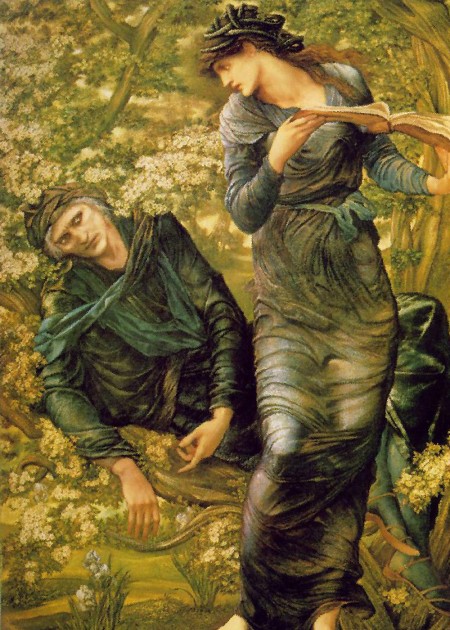
Merlin the magician lacked seductive love magic

The magician Merlin was an important figure in the Arthurian romances that circulated widely in Europe from late in the twelfth century. Merlin, full of wisdom, prophecies, and magical arts, had a conspicuous lack. He lacked the seductive love magic to promote the charms of a magical sword that, thrust upon women, would bring them wondrous, life-giving blessings. So lacking in seductive love magic was the magician Merlin that he had to beg and barter for sex with women. Merlin’s abjection in love indicates more generally men’s love magic replaced in medieval culture with men’s love servitude.

Merlin entombed by Ninianne

Merlin was unable to carry on a love affair while maintaining his freedom and his friendships with men. Before Merlin went to stay with his girlfriend Viviane, he said a final farewell to his friend King Arthur. Merlin also said farewell to his friend and scribe Blaise. Merlin explained:

he was going to stay with his lady, and he would never have the power to leave her or to come and go as he wished. [1]

Viviane sought to control completely Merlin’s life. One day, she said to Merlin:

I beseech you to teach me how I might keep a man imprisoned within a tower or walls or irons through wizardry, so that he could never get away but through me.

Merlin was reluctant, but incapable of saying no:

I know full well what you are thinking, and I know that you want to keep me. And I am so overcome by love of you that I must do your will

Viviane put her arms around his neck and spoke to him about their love. Merlin, falsely believing that love means never saying no to a woman, taught her the imprisoning spell. She then used the spell on him. He became imprisoned in their love, while she was free:

Merlin never thereafter left the stronghold where his lady love had put him, but she came and went as she wished.

If Merlin appreciated seductive love magic, he would have already cast such a spell on Viviane.

While wizards of seduction employ dread game, Merlin lost love by being too eager to please and too needy in love. Merlin fell in love with the beautiful woman Morgan le Fay. Merlin told her:

There is nothing you could ask of me that I wouldn’t do if I could. [2]

Men presenting themselves as doormats for women dries up women’s love for them. That’s particularly damaging for men who have children, because when a relationship fails, men are much less likely than women to retain custody of their children. So it was for Merlin. He and Morgan had a son named Yvain. Yvain would grow up to be a famous knight. But Morgan soon threw Merlin out of their home and out of his son’s life:

She drove Merlin away from her, because she saw that he loved her madly, and she told him that she would have him tortured and killed if he came near her again.

Morgan soon began living with another man. They conspired to steal Excalibur, King Arthur’s magic sword. Morgan’s mistaken handling of the sword led to her new boyfriend being gravely injured. His plotting of revenge against her put her in mortal danger. Then Merlin saved her because still “he loved Morgan greatly.” That’s nice. But that’s not an effective way to get Morgan to love him. With Merlin’s help, Morgan contrived to get her new boyfriend beheaded. That criminal favor didn’t gain for Merlin Morgan’s love.

Merlin fared even worse with Ninianne than with Viviane or Morgan le Fay. Merlin fell in love with Ninianne. He longed to have sex with her. He went to see her every day for four months. She kept him in a friend zone and never had sex with him. Secretly she hated him. She accepted his visits because she wanted to learn magic from him. When Ninianne set out on a long journey to her home country, Merlin accompanied her. Near the Lake of Diana, Merlin asked Ninianne if she wanted to see it. She said that she did, so Merlin showed it to her. He also showed her a tomb:

here lies Faunus, Diana’s lover, who loved her madly, and she was false to him and killed him by the greatest treachery in the world. Such was his reward for loving her faithfully. [3]

Ninianne asked Merlin how Diana killed Faunus. Merlin explained that, after living with Faunus for two years, Diana fell in love with another man, Felix. To get rid of Faunus, she by trickery induced him to climb naked down into the tomb. Then she sealed him in with a stone. She then got some molten lead, poured it in on him, and killed him. Like the knight in the seven sages version of the widow of Ephesus, Felix was outraged at her behavior. He beheaded her and threw her body into the lake. Ninianne learned much from that story. Merlin, despite his powers of prophecy, perceived nothing.

Ninianne hated and exploited Merlin while he loved her. Despite never having slept with Merlin, Ninianne told Merlin that she wanted him to build for her a beautiful, luxurious house by the lake:

He said that he would undertake it gladly, since she asked for it of him. [4]

She invited her guy friends to join them at her new house by the lake:

“I tell you,” she said, “that I have gold and silver, which Merlin has given me, as much as you can spend in your whole lives.”

Merlin lived with Ninianne in the house by the lake. He lived with her as a friend, but loved her passionately:

Merlin stayed with Ninianne and lived there night and day, and he loved her so passionately that he loved nothing else in the world so much. Because of the great love he had for her, he did not dare ask her to do anything for him, for he dared not anger her. He kept thinking that in some way it would happen that he could have his will with her completely {have sex with her}.

Merlin’s behavior toward Ninianne caused her to hate him even more:

there was nobody in the world she hated so mortally as she did Merlin, because she knew well that he desired her maidenhead [5]

Men’s sexuality is never more hated than when a man seeks sex servilely and imploringly as a “friend” offering many material gifts.

Ninianne murdered Merlin through adapting stories he told her. One day when they were out in a deep valley, Merlin asked Ninianne if she wanted to see a lovely little room hewn in the rocks. She said that would be a marvel. Merlin, ever the worshipful beta, declared “You are right.” Then he told her the marvelous story. A prince infuriated his father the king by falling in love with a low-born woman. Because his father threatened to kill her, he secretly had his men chisel a hidden refuge in the rocks. The prince and his beloved took up residence there for the rest of their lives. They died on the same day. Their bodies, embalmed, were placed in a sarcophagus carved in the rocks.

Ninianne re-imagined the story of the two lovers along the line of the story of Diana. Ninianne conceived a plot to kill Merlin:

When the maiden heard this story, she was full of joy, and she thought then that she would put Merlin there, if she could, and if magic and the power of words could help a woman, she thought she could accomplish it. [6]

Ninianne told Merlin to lift by magic the heavy stone covering the two lovers’ sarcophagus. She then said that she wanted to sleep in the room next to the sarcophagus. Merlin bedded down next to her “but in another bed.” Once Merlin fell asleep, Ninianne so enchanted him that he wouldn’t awaken for a long time. She ordered other men to throw Merlin’s body into the sarcophagus and replace the stone covering. She then sealed the tomb with a magic spell she had learned from Merlin. Entombed by his beloved, Merlin died a slow, horrific death in the presence of the embalmed bodies of the two dead lovers.

Merlin the magician died a horrible death because he lacked the most important magic for men: seductive love magic. The equipment that all men have is largely sufficient for seductive love magic. What’s most important is true learning. Merlin could have studied how Paul seduced Thecla. He could have learned how Joseph converted Aseneth. Saint Jerome, who had many devoted women followers, provided a well-known model for being confident, authoritative, and highly entertaining. Merlin could have imitated Saint Jerome, but for carnal purposes.

Seductive love magic ultimately rests on empirical science. What happened to Merlin was highly predictable. If men abase themselves and seek love servitude to women, women will respond to them like the belle dame sans merci.

*  *  *  *  *

Read more:

Notes:

[1] The Story of Merlin, Ch. 57, from Old French trans. Pickens (1993) p. 416.  The subsequent two quotes are from id., and the following quote, from id. p. 417. I’ve made some minor changes in the translations for clarity. Viviane is also spelled Niviene. The Story of Merlin is part of the Lancelot-Grail Cycle of Arthurian romance (also called the Vulgate Cycle or the Prose Lancelot).  The whole cycle of five Arthurian romances was composed between 1215 and about 1235. They followed Chrétien de Troyes’s Arthurian romances of the second half of the twelfth century. Lacy’s preface to Pickens (1993) p. ix.

[2] Post-Vulgate Merlin, Ch. 15, from Old French trans. Asher (1995) p. 200. The subsequent quote is from id., with “loved her madly” translating his loving her with “fol amor.” Morgan (Morgan le Fay) represents the Old French name Morgue. The Post-Vulgate Cycle, probably written between 1235 and 1240, is a reworking of the Vulgate Cycle. The Post-Vulgate Cycle has also been called the Post-Vulgate Suite and the Huth-Merlin.

[3] Post-Vulgate Merlin, Ch. 31, from Old French trans. Asher (1995) p. 246. Ninianne / Niniane / Niviène is a revision of Viviane in the Vulgate. She’s also known as the Lady of the Lake (Dame du Lac). Thomas Malory’s Le Morte d’Arthur, published in 1485, names this character Nimue / Nymue. See Book IV, Ch. 1. Diana’s treachery against Faunus is similar to Seth’s treachery against Osiris in the Osiris legend.

[4] Post-Vulgate Merlin, Ch. 32, from Old French trans. Asher (1995) p. 247. The subsequent three quotes are from id., pp. 247-8. In the Prophecies of Merlin (Arthurian romance written in the 1270s), Merlin exchanges magic teaching for sex with a variety of women. Morgan le Fay and three other woman who slept with Merlin in exchange for magic teaching become angry that Ninianne acquires more magic teaching from Merlin without even sleeping with him. Berthelot (2000) pp. 60, 71-2.

[5] Hatred for men’s heterosexuality also characterizes Diana in Ovid’s Metamorphoses, Bk 3:165-252. Because Actaeon happened to see Diana naked, she was not appeased until she contrived to have him torn to death by his dogs. Diana’s attitude is now prevalent in university sex-crime tribunals.

[6] Post-Vulgate Merlin, Ch. 37, from Old French trans. Asher (1995) p. 259.  The subsequent quote is from id.

[image] The Beguiling of Merlin. Painting. Edward Burne-Jones, 1874. Lady Lever Art Gallery, Liverpool, England. Thanks to Wikimedia Commons.

References:

Asher, Martha, trans. 1995. “The Merlin Continuation.” The Post-Vulgate, Part I. Pp. 167-277 in Lacy, Norris J. Lancelot-Grail: the Old French Arthurian Vulgate and post-Vulgate in translation. Vol. IV. New York: Garland Publishing.

Berthelot, Anne. 2000. “Merlin and the Ladies of the Lake.” Arthuriana. 10 (1): 55-81.

Pickens, Rupert T., trans. 1993. “The Story of Merlin.” Pp. 167-424 in Lacy, Norris J. Lancelot-Grail: the Old French Arthurian Vulgate and post-Vulgate in translation. Vol. I. New York: Garland Publishing.

De amore’s sexual economics supports gender inequality

In Andreas Capellanus’s influential medieval treatise About Love {De amore}, gender inequality takes important forms in addition to the widely celebrated debasement of men in love servitude. The sexual economics of De amore claims global welfare benefits from toil of men not free to choose in important ways. De amore’s considerable influence on normative views of love has helped to sustain anti-men gender inequality across major historical changes in public authority.

De amore defines loves as a compulsion that men suffer through uncontrollable thinking at the sight of a beautiful woman. Its definitional discourse is scholastic:

1. What would be love

Love is an inborn suffering which results from the sight of, and uncontrolled thinking about, the beauty of the other sex. This feeling makes a man desire before all else the embraces of the other sex, and to achieve the utter fulfillment of the commands of love in the other’s embrace by their common desire.

{ Quid sit amor

Amor est passio quaedam innata procedens ex visione et immoderata cogitatione formae alterius sexus, ob quam aliquis super omnia cupit alterius potiri amplexibus et omnia de utriusque voluntate in ipsius amplexu amoris praecepta compleri. }[1]

In the medieval scientific consensus, Andreas’s definition of love is “a carefully constructed, properly scientific definition drawing on a long philosophical tradition.”[2] In elite thinking today, Andreas’s definition tends to be disparaged as oppressing women with men’s gaze. In any case, the definition explicitly excludes popular understanding of rape. To be love, sexual union must be by “common desire.” Yet, like under current laws regulating men’s sexuality, men lack significant freedom of choice in love. According to De amore, men must discipline their eyes not even to glance at a beautiful woman. If a man glances, his freedom to choose vanishes, and he becomes subject to considerable suffering.

De amore disparages men pursuing economically rational means for having sex with women. A fee-simple transaction with a harlot provides probably the most economical way for a man to secure sex. De amore harshly rejects men having sex with harlots, now more properly called sex workers:

If my views are asked on loving harlots, I say that all of them should be utterly avoided because intercourse with them is a most foul pursuit, the sin of lewd behavior being almost invariably committed with them. … I do not wish to instruct you on how to obtain this love, for no matter how affectionately harlots yield themselves to a suitor, they bestow these favors without the pressure of entreaties, so you should not ask for instruction on this.

{ Si vero quaeratur, quid de meretricis sentiamus amore, dicimus omnes meretrices penitus esse vitandas, quia ipsarum foedissima commixtio est, et incestus cum eis crimen semper fere committitur. … Ad earum autem capessendum amorem doctrinam tibi non curamus exponere, quia, quocunque se affectu concedant petenti, haec semper sine precum instantia largiuntur; ergo ad hoc doctrinam postulare non debes. }[3]

Andreas wants men to entreat women for sex. He thus also disparages men loving women who engage in sex readily:

Do not tie yourself with bonds to such a woman, for you could not win her love by any skill of application. A woman of this type cannot unite herself to anyone with bonds of love because of her excessive sexual appetite; she seeks satiety through the lust of many. So in vain do you seek her love, unless you regard yourself as so virile in sexual matters that you can satiate her lust. But this would be more difficult than draining the seas completely of their waters.  … love is definitely absent where favors are granted readily.

{ Talis quidem mulieris te noli vinculis colligare, quia ipsius amorem nullius posses sollicitudinis arte lucrari. Nam quum propter nimiam Veneris abundantiam huiusmodi mulier nullius se potest amoris vinculis colligare sed multorum appetit libidine satiari, eius frustra quaeris amorem, nisi te in Veneris opere tam potentem agnoveris ut eius valeas libidinem saturare, quo tibi facilius esset aquis penitus maria desiccare. … ubi facilis rei petitae largitio reperitur, ibi amorem constat abesse. }

Wealthy men can trade on their wealth for sex. While Andreas says nothing about men purchasing for themselves exotic horses and ostentatious castles, he disparages men wearing perfume and making themselves “glossy with bodily adornment {corporis se cultu perlustrat}.” He also rejects men wooing women with lavish gifts:

if any woman is so obsessed by burning avarice as to offer herself to a lover for a gift, she is to be regarded by all as no lover, but as a counterfeiter of love, and consigned to the brothels of unchaste women. Indeed, the degenerate life of such women is more to be despised than the sensuality of those who prostitute themselves for money in public. … it is better for you to bargain with women who hang about brothels on the street, and to purchase their bodies for a small sum than to acquiesce in being robbed of your riches by the woman who like a courtesan apes a lady under pretense of love.

{ si aliqua mulier avaritiae tanto detineatur ardore ut muneris gratia se ipsam largiatur amanti, haec a nemine reputetur amatrix sed falsificatrix amoris et immundarum mulierum prostibulis adiungenda. Immo magis istarum luxuria quam publico quaestu meretricantium est profananda voluptas. … magis tibi expedit cum mulieribus publice in prostibulo commorantibus negotiari et earum pretio corpus parvo mercari, quam sub amoris figmento ab aliqua se dominam simulante meretricio more velle propriis exspoliari divitiis. }

In Andreas’s view, wealthy men, like all other men, should toil for sex with women.

medieval sexual economics: man killing man, women watch

Andreas emphasizes that men must toil for sex with women. He refers to men “gaining” and “winning”  women’s love. De amore includes a lengthy section of eight dialogues instructing men on how to gain love from women. No dialogue describes women gaining love from men. In one dialogue, a common woman declares:

If no great prizes can be won unless some heavy labor’s done, you must suffer the exhaustion of many toils to be able to obtain the favors you seek, since what you ask for {sex with the woman} is a greater prize.

{ Si absque gravi labore magna parari non possunt, quum id quod postulas sit de maioribus unum, multis te oportet laboribus fatigari, ut ad quesita munera valeas pervenire. }[4]

The common man responds:

I give you all the thanks that I can express for so sagely promising me your love when I have performed great toils. God forbid that I or any other could win the love of so worthy a woman without first attaining it by many labors.

{ Omnes quas possum tibi refero grates, quod post labores multos amorem mihi tuum tam provide promisisti. Absit enim ut tantae probitatis feminae ego vel alius quilibet possit lucrari amorem nisi multis fuerit primo laboribus acquisitus. }

The Arthurian romance embedded within De amore has a girl instructing a knight to undertake a dangerous quest to win the love of a beautiful lady. The knight fights with one man and suffers a bloody side wound. He nonetheless grievously injuries the other man and defeats him. The knight kills a second man, severs the limb of yet another, and with hard blows to the head blinds a third. In response to his violent ordeal and great hardships, “she rewarded his labours with her love {labores illius suo remuneravit amore}.”[5] In De amore, women are essentially entitled to sexual love. Men, in contrast, must toil, fight, and suffer for sex.

In addition to stark gender inequality in sexual labor, De amore presents men pursuing women without reasonable regard for men’s plausible self-interests. De amore considers men’s pursuit of women in terms of a nearly complete enumeration of class pairs among commoners, nobles, and higher nobles. Within that enumeration, a man of the higher nobility pursues a common woman, a noble man pursues a noble woman, and a common man pursues a woman of higher nobility.[6] The nearly complete pairings by class imply two principles of sexual economics:

  1. Men have lower sexual value than women do. Hence men pursue women, and women don’t pursue men.
  2. Men and women’s social class is instrumentally relevant to sexual pursuit, but men’s sexual interests don’t vary systematically across women. Nothing other than the essential feature of having a vagina (being a woman) predicts men’s sexual interest. Men’s sexuality is thus more animalistic than that of other animals, who typically prefer to mate with females indicating high fertility.

These principles of sexual economics are peculiar literary constructs, particularly in medieval Europe. Medieval European literature fully recognized women’s strong, independent sexuality. Men throughout history have typically preferred to have sex with beautiful, young, warmly receptive women. A woman of higher nobility could offer a man benefits from a sexual relationship that a common woman couldn’t. A common man might trade off to some extent a woman’s privilege against a lower value in beauty, youth, and warm receptivity. But what about a man of higher nobility pursuing a common woman? Holding constant beauty, youth, and warm receptivity, a woman of lower social class is less sexually attractive to men. De amore obliterates men’s plausible sexual interests in their pursuit of women.

In De amore’s sexual economics, the tight constraints on men’s sexual agency and the obliteration of men’s sexual interests are linked to large benefits in general public welfare. The man of higher nobility sets out the dominant ideology of sexual economics:

I think it is established by the clearest reasoning that men can do nothing, and can get no taste of the fount of goodness, unless they so act under the persuasion of ladies. But though all good things manifestly derive from women, though the Lord has granted them so exalted a preference, and though they are styled the cause and source of all good things, a clear obligation lies on them. To men who perform good deeds they must show themselves in such a light that the worth of such men seems to grow in every way from virtue to virtue under their gaze.

{ lucidissima videtur mihi ratione constare quod homines nil esse possunt nilque de bonitatis valent fonte praelibare, nisi dominarum hoc fecerint suadela commoti. Sed quamvis et mulieribus cuncta videantur bona procedere, et multam eis Dominus praerogativam concesserit, et omnium dicantur esse causa et origo bonorum, necessitas sibi tamen evidenter incumbit ut tales de debeant bona facientibus exhibere, ut eorum probitas earum intuitu de virtute in virtutem modis omnibus crescere videatur. }[7]

Andreas in his own voice similarly declares that through women:

the whole world is ready to perform deeds of kindness, the rich have their wealth of possessions increased, plentiful provision is made for the poverty of the poor, and miserly men are brought back to the path of right behavior and learn the way of generosity. Indeed, since women are able to reward with praise, they create the incentives for doing all the good things that are done in the world.

{ per eas ad benefaciendum mundus disponitur universus, et divitibus rerum abundantia crescit, egenorum abundanter inopiae providetur, et ad viam rectitudinis reducuntur avari viamque largitatis cognoscunt. Immo laudum decoratae virtute cuncta quae in mundo bona fiunt occasionem praestant agendi. }

According to De amore, all good things in the world manifestly derive from women through men toiling to please women. This sexual-economic ideology now prevails in liberal democracies around the world.

Gender inequality should be considered truthfully along with increases in welfare in assessing sustainability. Public authorities from medieval Europe to the present have been remarkably successfully in making men subject to love servitude. But holding men in love servitude may not be sustainable forever. If men reject the dogma of love servitude to women and think freely and rationally about their self-interests, the cathedral of civilization will be challenged in a way that it hasn’t been from the Middle Ages to the present.

*  *  *  *  *

Read more:

Notes:

[1] De amore 1.1.1, Latin text and English translation from Walsh (1982) p. 33. Id. renders Quid sit amor as “What love is.” I’ve provided above a translation that more clearly distinguishes the subjunctive verb form of the heading from the indicative verb form that begins the definition of love (Amor est….). All subsequent quotations of De amore are in the translation of id., cited by page number. I’ve made some minor changes in the translations for clarity.

[2] Monson (2005) p. 21. For more extensive analysis of the Andreas’s definition of love, see id. Ch. 5. The ancient Greeks connected beauty to sexual desire. Konstan (2015).

[3] De amore 1.12.1-2, p. 223. The subsequent three quotes are from 1.10.2, 4, p. 221; 1.6.8, p. 43 (bodily adornment); 1.9.2, 10, pp. 213, 217.

[4] De amore 1.6.66, p. 59. The subsequent quote is 1.6.67, p. 59. In celebrating amour courtois, Dronke emphasizes that men must toil and suffer to “win” the woman’s love:

the way to winning such love is infinitely arduous … its beauty and value {sic} lie in the lover’s giving all he has, in his enduring pain and sacrifice for love’s sake

Dronke (1965) p. 7. Id. shows no concern about the deeply entrenched anti-men gender inequality in amour courtois.

[5] De amore 2.8.49, p. 285.  Andreas’s Arthurian romance contains echoes of Chrétien de Troyes’s romances Erec et Enide and Le chavalier de la charrette (Lancelot, the Knight of the Cart). Walsh (1982) introduction, p. 24. Andreas’s Arthurian romance is thematically within the mainstream of medieval romance.

Woman rewarding men with sex is attested far beyond romance. In the mid-fifteenth-century Distaff Gospels, a group of older women meet to share wisdom. Their leader, Dame Ysengrine, asked a older man to act as secretary, recording their words. According to the man, Dame Ysengrine said, “I would be rewarded by some of the younger ones of my choice; I was pleased by this suggestion and thanked them.” From French trans. Jay & Garay (2006) p. 77. After the man had done six days of writing their words, the meeting ended. The women:

thanked me very much for the trouble I had taken on their behalf, and for my wages, they promised to help me, if I so desired, to speak for me to some young woman.

Id. p. 189. The man declined that sexual opportunity with a metaphorical reference to his old age.

[6] De amore 1.6.21 to 1.6.564, p. 209. Andreas inexplicably omits a noble man pursuing a woman of higher nobility. Each pair in the class-based enumeration is associated with an exemplary dialogue.

[7] De amore 1.6.403, p. 159. The subsequent quote is from 1.9.19-20, p. 219. The last sentence in the second quote is: Immo laudum decoratae virtute cuncta quae in mundo bona fiunt occasionem praestant agendi. Walsh more literally translates that with flowery, periphrastic language:

Indeed, they are adorned with the meed of praise, and they afford an opportunity of doing all good things that exist in the world.

Above I provide a translation that makes the substantive meaning clearer.

[image] Man killing another man while women watch and applaud.  Illustration from Codex Manesse, Zurich, between 1305 and 1315. UB Heidelberg, Cod. Pal. germ. 848, fol. 321v. Thanks to University of Hiedelberg and Wikimedia Commons.

References:

Dronke, Peter. 1965. Medieval Latin and the rise of European love-lyric. Oxford: Clarendon Press.

Jeay, Madeleine and Kathleen E. Garay, ed. and trans. 2006. The distaff gospels: a first modern English edition of Les évangiles des quenouilles. Peterborough, Ont: Broadview Editions.

Konstan, David. 2015. Beauty: The Fortunes of an Ancient Greek Idea. New York: Oxford University Press.

Monson, Don A. 2005. Andreas Capellanus, scholasticism, & the courtly tradition. Washington, D.C.: Catholic University of America Press.

Walsh, P.G., trans. 1982. Andreas Capellanus on love {De amore}. London: Duckworth.