Ancient Greek epic poets addressed Amazons — women who act like men and hate men. For poets, hatred of self-constructed representations is particularly troubling. Amazons could simply be ignored if they kept to themselves in far-away lands.[1] Yet, incomprehensibly and ineluctably, Amazons have been attracted to men, and men, to Amazons. After more than a millennium of epic poetic struggle, Walter of Châtillon’s medieval Latin Alexandreis finally provided a humane solution to the problem of men-hating Amazons.
In ancient Greek epic, the heroic warrior Achilles confronted the men-hating Amazon queen Penthesilea in battle at Troy. She had accidentally killed her sister while intending to kill a male deer. In grief, Penthesilea came to Troy to engage in violence against men.[2] She surely expected to attract men’s attention. A men-hating woman warrior who merely wanted to shed blood and die honorably could have disemboweled herself while remaining far way from men. Men would not have known or cared about her death.
The men-hating Amazon queen Penthesilea regarded herself as superior to men. Confronting the Greeks in battle at Troy, she proclaimed to them:
You dogs, today you’ll pay for the injury done
to Priam. No one shall escape my strength
and be a joy to parents, sons or wives.
You shall die and lie as food for birds and beasts.
No grave below the ground shall be allotted to you.
Where now is the might of Tydeus’ son, where that of Achilles
or of Ajax? They are famed as your best,
yet they will not dare to face me in combat,
for fear I take souls from bodies and send them to the dead. [3]
Catching sight of the mighty Greek warriors Ajax and Achilles, Penthesilea rushed toward them. First she hurled a lance at Achilles. The lance merely bounced off his shield as if from a rock. She then threatened them with words:
Come closer to me through the fighting; see for yourselves
the strength that stirs in the breasts of Amazons.
As for my birth, it was from war. No mortal man
is my father, but the war god who never tires of battle.
And so my might is more than that of men. [4]
Ajax and Achilles laughed at her. She threw her second lance at Achilles. It hit his leg, but did no damage. Seeking to take on other Trojan warriors, Ajax turned away from Penthesilea
Since well he knew in his heart
that for Achilles, in spite of all her prowess,
she would be as easy a task as a dove for a hawk.
Achilles speared her in the chest and then:
In a flash he impaled her and her wind-swift horse together
as a man might impale some innards on a spit
over a glowing fire, impatient for his meal.
That was was the mortal end of Penthesilea. But ancient Greek epic poetry didn’t resolve the problem of Amazons so simply.
Achilles, along with other Greeks, fell in love with the men-hating Amazon queen Penthesilea after she was dead. They actually imagined marrying her. The folly and delusions of men are unfathomable:
Many there were who prayed that when they returned to their homes,
they might share the bed of a wife as lovely as her.
Even Achilles’ heart felt unremitting remorse
for killing her instead of bringing her as his bride
to Phthia, the land of horses, because in height and beauty
she was as flawless as an immortal goddess. [5]
With Penthesilea dead, the reality of living with her provided no counterbalance to men’s imagination of her. The truth-telling renegade Thersites, with characteristic sensitivity to men’s self-harm, railed:
Achilles, perverted man, what power has beguiled
your spirit for the sake of a wretched Amazon,
whose only desire for us was every conceivable evil? [6]
Men’s fantastic imaginations in epic poetry allowed women who act like men and hate men to continue to be a problem for men.
Alexander the Great’s entrance into epic poetry created new opportunities for dealing with Amazons. Like the epic hero Achilles, Alexander the Great was a preeminent warrior. Both Achilles and Alexander the Great nonetheless remained dependent on their mothers, Thetis and Olympias, respectively. These warriors called on their mothers frequently, especially in times of crisis and grief. Both Achilles and Alexander the Great also had long-term intimate friendships with men, in addition to sexual relationships with women.[7] What Alexander the Great added to the character of Achilles was the guile of the epic hero Odysseus. Alexander won victories not just with violence, but also with cunning.
Alexander the Great sought to see the Amazons. The Amazons lived in a society which excluded men and even all male animals of any type.[8] In normal gynocentric society, men provide women with material resources. Alexander wrote to the men-hating Amazon queen Thalestris and suggested that he would provide her with goods:
Now our expedition has brought us to you. Come to meet us rejoicing, for we have not come to harm you, but to see your country and to do you good. [9]
That’s a curiously friendly outreach to man-haters. Thalestris responded with hostility and a warning:
If we conquer the enemy or put them to flight, that is regarded as a humiliation for them for the rest of time, but if they conquer us, it is only women that they have defeated. Now beware, Alexander, that the same thing does not happen to you.
The existence of women who both act like men and hate men seemed to fascinate Alexander. He insisted to the Amazons, “cross your river and let us see you.” He explained:
If you do this, I swear by my father and my mother, Olympias, that I will do you no harm, but will accept from you whatever tribute you care to give, and I will not attack your country.
The Amazons agreed to allow Alexander to see them. They offered him tribute and accepted him as their lord. Alexander achieved this victory without any violence. It was a simple victory, like many others of Alexander against non-Amazons. It wasn’t a victory worthy of epic poetry.[10]
Walter of Châtillon’s medieval Latin Alexandreis solved with epic poetry the problem of men-hating Amazons. In the Alexandreis, the men-hating Amazon queen Thalestris was aflame with desire to have a child with Alexander the Great. Going swiftly to meet him, she wore a dress short enough to bare her legs above her knees. Her dress also exposed her left breast. In the face of Thalestris’s sexual provocation, Alexander remained unperturbed.[11]
The men-hating Amazon queen Thalestris foolishly misjudged Alexander, just as Euryalus had misjudged Odysseus. When Euryalus taunted the sea-weary Odysseus for not participating in some sporting contests, Odysseus responded:
You, you’re a reckless fool — I see that. So,
the gods don’t hand out all their gifts at once,
not build and brains and flowing speech to all.
One man may fail to impress us with his looks
but a god can crown his words with beauty, charm,
and men look on with delight when he speaks out. [12]
Thalestris merely thought this epic figure:
Perusing, then, King Alexander the Great with wary eye,
Thalestris marveled that his meager body
ill-fit his fame, and silently she pondered
where the great manliness of the unvanquished prince
might lie concealed [13]
Ancient sources describe Alexander as a man of relatively small physical stature. The narrator here inserted an insightful comment:
Sometimes mightier courage dwells inside
a middling body, and illustrious power
transgresses all the body’s limbs to rule
somewhere within obscure and darkened members. [14]
What makes the man is underneath his clothes, between his legs. Bernardus Silvestris’s twelfth-century Cosmographia celebrated the creative work of a skillful penis. About a quarter century later, Walter of Châtillon’s Alexandreis explained that a man’s drive to change the world is rooted in his genitals.[15]
The Alexandreis didn’t constrain men to the men-killing horrors of war. Just before addressing the men-hating Amazon queen Thalestris, the Alexandreis invoked an epic figure alluding to Achilles in ancient Greek epic:
Lamenting Memnon’s death with endless grief,
three times the Dawn had strewn her radiant beams
through all the earth, when earth’s sole conqueror,
valiant and swiftly lunging toward all peril,
approached Hyrcania with his armed men. [16]
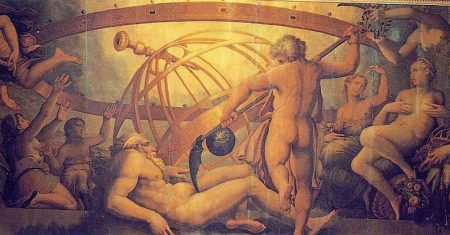
In ancient Greek epic, Memnon was a mighty warrior-king from Aethiopia (Ethiopia). He brought an army to fight against the Greeks at Troy. Achilles killed Memnon in battle at Troy.[17] The Alexandreis’s epic figure of lamenting Memnon re-genders and reverses the cosmic scene of Cronus castrating his father, the sky god Uranus. Alexander the Great appears as a hero encompassing the deeds of Achilles and continuing to thrust forward manfully.
In a brilliant epic move, Alexandreis conquered the nascent, men-oppressing ideology of “ennobling love” and civilized the Amazons. When the men-hating Amazon queen Thalestris rushed to meet Alexander the Great, the narrator of Alexandreis associated her thinking with “barbarian simplicity.”[18] She and the rest of the Amazons could be civilized in the way that Alexander understood civilizing other tribes:
The prince Alexander inquired whether Thalestris wished
to serve in battle beneath him, but she pleaded the excuse
that her realm lacked a guardian. [19]
Alexander’s first offer to civilize Thalestris hinted metaphorically at the solution that she accepted:
Finally, he endured for her the gift of thirteen
nights and having gained what she sought to acquire,
she returned to the throne of her kingdom and the cities of her fatherland. [20]
Seeking to ensure that readers understood the surface meaning of these lines, a medieval gloss explained:
this is nightly copulation / this is copulation thirteen times; others say it was thirty times [21]
The inner meaning is much more important. In a fourth-century historical source for the Alexandreis, the story of Thalestris and Alexander ends with separation between kingdom and king:
Then she went to her kingdom, and the king to Pathiene.
{ Tum illa regnum suum, rex Parthienen petiverunt. } [22]
With epic brilliance, Walter of Châtillon’s Alexandreis reformulated that line:
She returned to the throne of her kingdom and cities of her fatherland.
{ Ad solium regni patriasque reuertitur urbes. }
The phrase “cities of her fatherland” indicates civilization. With his “obscure and darkened members,” Alexander the Great civilized the savage, men-hating Amazon queen Thalestris. Being civilized means living with loving appreciation for men.[23]
With men-hating now gravely threatening civilization, poets must make acting like a man a figure associated with loving men. The poetic challenge goes deep. Amazons who act like men and hate men have troubled western Eurasian poetry for more than 2500 years. Today such persons dominate culture, particularly on university campuses. Men’s sexuality is now demonized and criminalized. Men face enormous, state-imposed financial obligations and even imprisonment merely for having consensual sex of reproductive type. These and other critical issues of social justice for men are largely ignored within gynocentric public discourse. The Alexander the Great of the medieval Latin Alexandreis is at a far margin of today’s culture. But the survival of civilization now depends on such heroes.[24]
* * * * *
Read more:
- hopeful Cosmographia: goddesses reform Silva, primordial mother
- Candace & Alexander the Great: from cunning to inwardness
- internal monologues of Chrétien de Troyes and Walter Map
Notes:
[1] According to an eminent classical scholar, Amazons were:
a race of warrior-women as monstrous in their own fashion as the snake-limbed Giants or half-horse Centaurs and a race just as expressive of the forces which threaten to destroy civilized life. … The Amazons are fantasy creatures, the type of predatory woman or domina; they are everything a woman ought not to be and they define the norm and the acceptable by setting that norm on its head
Walcot (1984) pp. 41, 42. Most men don’t like being with Amazons and would prefer that such women remained in a far-away land. With respect to men’s typical reaction to Amazons, Walcot and other scholars have discerned men’s fear of “women usurping what is properly men’s role” and “man’s fear of woman’s sexuality.” Id. p. 42, 46. Such scholarly work supports and obscures dominant gynocentric interests, e.g. sexist obligations imposed solely on men for military service and harsh repression of men’s sexuality through legally depriving men of any reproductive rights.
More recent scholarship has encouraged men to embrace Amazons and women to act like Amazons. Writing popular history, Mayor declares:
the continued lively discussions about the reality of Thalestris over several centuries of antiquity show how deeply fascinating the prickly, enticing idea of Amazon-like women was for the Greeks. That a bold, adventurous man might hope to find a companion in an equally strong woman of action was a thrilling prospect.
Mayor (2015) p. 17. Mayor is a Research Scholar at Stanford University. In her ideological effort, Amazons are figured as the current ideal of woman. Some men have been successfully taught to love men-hating women.
[2] Theoi provides an excellent review of ancient references to Penthesilea, also spelled Penthesileia. The ancient Greek epic Aethiopis, which some ancient writers attributed to Arctinus of Miletus, narrated events associated with the Amazon queen Penthesilea:
The Amazon Penthesileia, arrives, as an ally of the Trojans. She is the daughter of Ares and Thracian by birth. In the middle of her greatest epic action, Achilles kills her and the Trojans arrange for her funeral. And Achilles kills Thersites, who reviled him with abusive words for conceiving a passionate love for Penthesileia
Proclus’s summary of the Aethiopis, from Greek trans. Nagy (2013) 3§4. Here’s the full text in English translation of Proclus’s summaries of the ancient Greek Epic Cycle. The date at which the Epic Cycle was written is controversial, but may have been about the time of Homer, the Iliad, and the Odyssey. Stories about Amazons were known within the timeframe of composing the Iliad. See Iliad 3.185ff.
[3] Quintus of Smyrna, Posthomerica 1.326-334, from Greek trans. James (2004) p. 11 (modified insubstantially). Tydeus’s son was the renowned Greek warrior Diomedes. The Posthomerica explains why Penthesilea came to Troy:
Two wishes she had — to share the hardship of war
and also to shun the shame of hostile talk,
fearing hurtful reproaches made by her people
concerning the sister for whom she felt a growing grief,
Hippolyte, whom she had killed with her powerful spear,
not as she intended — her target was a stag.
1.20-5, id. p. 3. The subsequent five quotes are similarly from id., cited by line and page in id.: 1.558-62, 570-2, p. 17 (Come closer…; since well he knew…); 1.612-4, p. 18 (In a flash…); 1.669-74, p. 20 (Many there were…); 1.723-5, p. 21 (Achilles, perverted man…).
Quintus of Smyrna is now thought to have written the Posthomerica in the second half of the third century. Id. p. xxi. The text is written in the language and style of Homeric epic. A.S. Way’s translation (1913) for the Loeb Classical Library is available online.
[4] Amazons interacted with men only to acquire their sperm. Penthesilea’s claim not to have a mortal father further distanced herself from men. Some ancient authorities identified sons of Amazons as manboobs.
[5] Nagy provides an important interpretation of these events:
When Achilles and Penthesileia are engaged in mortal combat, as we see in the vase paintings, their eyes meet at the precise moment when he kills her. And what Achilles sees in Penthesileia is a female reflection of his male self. All along, Penthesileia has been his other self in the feminine gender, as even her name shows, and now he has killed her. The death of Penthesileia thus becomes a source of grief, sorrow, and overwhelming sadness for Achilles, this man of constant sorrow. Both these epic names – and the epic characters that are tied to them – have to do with themes of lament, as signaled by the words akhos and penthos. Both these words point to the ‘grief’ or ‘sorrow’ or ‘sadness’ of lament.
Nagy (2013) 3§9. That interpretation is consistent with Judeo-Christian understanding of the unity of woman and man. For those who still believe in truth, truth, including truth about human beings, is independent of any particular time and culture. But with respect to this particular story, Achilles seems not to have hated women like Penthesilea hated men.
[6] This incident can easily be mis-interpreted in a telling way. Nagy states:
when Thersites says that Achilles is in love with the Amazon Penthesileia, why is Achilles angry enough to kill him? My answer is this: it would seem that Achilles is in a state of denial about having fallen in love with the beautiful and powerful Amazon whom he has just killed.
Nagy (2013) 3§5. I think there’s a more reasonable interpretation, one more closely related to ancient Greek thinking. Achilles’s anger towards Thersites arose from his feeling that Thersites had shamed and dishonored him in daring to state the obvious: Achilles was acting like a fool in lamenting that he didn’t marry the men-hating Amazon Penthesilea.
Why do men today respond angrily toward those who call out anti-men bigotry, who discuss realities of paternity law, who point out absurdly biased claims about violence against women, and who forthrightly recognized that men have no reproductive rights whatsoever? The answer is essentially the same as the answer to the question of why Achilles killed Thersites.
The problem of the Amazons and Penthesilea was salient enough to be included on three of the surviving Tabulae iliacae: 1A, 7Ti, and 9B. Petrain (2014) p. 114.
[7] In long-term relationships, Achilles loved Patroclus, and Alexander the Great, Hephaiston. On Alexander’s alleged sexual attraction to boys, Athenaeus Dneipnosophistae 13.603A. Medieval readers were aware of reports that Alexander sexually used boys. See gloss describing Alexander abusing Narbazanes’s “two very beautiful sons.” Gloss transcribed in Colker (1976) p. 458, trans. Townsend (1998) p. 141. For a thorough historical evaluation of Alexander’s sexuality, Ogden (2011) Ch. 8.
The Alexandreis associates Alexander with Achilles. In 1.199, Alexander is assimilated to Neoptolemus, Achilles’s son. In 1.221, Alexander’s strength is figured as Achilles. Alexander visits Achilles tomb at Troy and finds it smaller than its fame merits. 1.468-92. Cf. Thalestris’s comments on Alexander’s body, 8.24-6, discussed subsequently above.
[8] See letter from the leaders of the Amazons, Greek Alexander Romance 3.25, from Greek trans. Stoneman (1991) pp. 143-4.
[9] Greek Alexander Romance 3.25, trans. Stoneman (1991) p. 143. The subsequent two quotes are from id. 3.25, p. 143 (If we conquer…); 3.26, p. 143 (If you do this…). The Greek Alexander Romance is thought to have been translated into Latin in the fourth century GC. Id. p. 7. Here are versions of the Alexander Romance available online.
The Alexander Romance survives in many versions that vary considerably. In Stoneman’s version, Alexander doesn’t explicitly describe his correspondence as being with the Amazon queen Thalestris. Walter of Châtillon drew upon the J1 version translated in Pritchard (1992). The J1 version explicitly addresses correspondence with the Amazons to the Amazon queen Thalestris (Talistris). On the other hand, the J1 version has Alexander ask directly for tribute and doesn’t include Alexander’s cunning tactic of merely asking to see the Amazons and offering to do them good. The J1 version also has Alexander swear not by “my father and my mother, Olympias,” but by “my father Hammon, and our goddesses Juno and Minerva.” Id. p. 79. The J1 version thus excises some of Alexander’s characteristic behavior.
[10] A hint of more epic behavior exists in the corpus of the Alexander romance. In the γ recension, “the Amazons ask for a portrait of Alexander to revere, and he sends them his spear.” Stoneman (1991) p. 195, n. 110. Alexander’s gift reflects appreciation for men’s sexuality evident in twelfth-century Latin literature. That literature challenged gynocentrism in astonishing and unprecedented ways.
[11] Walter of Châtillon, Alexandreis 8.16-9, from Latin trans. Townsend (2007) p. 163. These details come from Quintus Curtius Rufus, Historiae Alexandri Magni {Histories of Alexander the Great} 6.5.27-8, from Latin trans. Rolfe (1946) p. 47. Thalestris carried two lances / spear shafts in one hand. That’s a feature of ancient Greek epic depictions of Penthesilea. Quintus of Smyrna, Posthomerica 1.158.
Underscoring Alexander’s sexual poise, Quintus Curtius observes, “the woman’s sexual desire was more urgent than the king’s {acrior ad venerem feminae cupido quam regis}.” Id. p. 48. Walter eliminated that observation. He more subtly developed Alexander’s poise in relation to Thalestris with a sexual contrast. Walter described the effeminate (molli) Bagoas having successfully moved Alexander to a reprieve for the parricide Narbazanes. Alexandreis 8.6-8.
The Alexandreis was highly regarded and widely disseminated in medieval Europe. It survives in over two hundred manuscripts, most dating from the thirteenth century, and many containing systematic glossing of the poem. During the medieval period, the Alexandreis was translated into Old Norse, Czech, Dutch, and Spanish. It was printed in 1487, 1513, 1541, and 1558. Townsend (2007) pp. 11, 15-6.
For additional background on the Alexandreis, Lafferty (2011) and the introductions in Townsend (2007) and Pritchard (1986). Walter’s Alexandreis mainly draws upon Quintus Curtius’s Historiae. Lafferty (2011), p. 185, states, “Walter does not use the Alexander romance in any of its many manifestations….” That’s surely incorrect. See Pritchard (1986) pp. 12-3. The extent to which Walter knew of the Alexander Romance cannot be determined by what’s in the Alexandreis. At least with respect to the Amazon queen Thalestris, Walter had good epic-poetic reasons for building upon Curtius rather than the Alexander romance. See subsequent discussion above. For broader consideration of the medieval figure of Alexander the Great, Müller (2008).
More abbreviated, but similar accounts of Alexander and Thelastris’s meeting occur in Latin in Diodorus Siculus, Universal History 17.77.1-3 (first century BGC) and Justinus, Epitome of Pompeius Trogus’ Philippic Histories 12.3.5-7 (second century GC). A common historical source probably was the writing of the popular historian Cleitarchus. Baynham (2001) p. 116. Cleitarchus may have been a near contemporary of Alexander the Great. Arrian, whom scholars today typically regard as the most factually reliable source about Alexander, judged that Amazons didn’t exist in Alexander’s time. Bosworth (1988) p. 65. The best historical review in modern scholarship states, “Thalestris herself never existed beyond the imaginations of Cleitarchus and some of his contemporaries.” Baynham (2001) p. 126. Cf. Mayor (2015). Plutarch, writing about 100 GC, recounted an anecdote consistent with that view:
The story is told that many years after {Alexander’s death}, Onesicritus was reading aloud the fourth book of his history {of Alexander} to now-king Lysimachus {a Macedonian who was one of Alexander’s close bodyguards}. Onesicritus read the tale of the Amazon. Lysimachus smiled gently and said: “And where was I at that time?”
Plutarch, Life of Alexander 46.4-5.
[12] Homer, Odyssey 8.166-72, from Greek trans. Fagles (1996) p. 197. Fagles translates Euryalus to its roots “broad sea” to make his name Broadsea.
[13] Walter of Châtillon, Alexandreis 8.24-6, from Latin trans. Townsend (2007) p. 163. In 8.374-84, the Scythian messenger reverses the direction of the bodily mismatch.
Here’s the Latin text of the Alexandreis. Jolly (1968) and Pritchard (1986) provide alternate English translations. I’ve reviewed them in determining the best translation for the quotes.
In the above quote, Townsend translated virtus as “virtue”. In context, the more rooted translation “manliness” seems to me more appropriate. I’ve used that above. The subsequent quote is from Alexandreis 8.33-5, trans. id. p. 164.
The classical roots of twelfth-century Latin epic have been greatly under-appreciated. Haynes (2014) makes that point with respect to the Aeneid. It also applies with respect to ancient Greek epics. The full texts of those epics, along with almost all other Greek literature, are thought to have been unknown to Western European poets from the fifth to the fourteenth centuries. The earliest known medieval translation of the Iliad or Odyssey into Latin is the literal crib that Boccaccio commissioned in 1360. Id p. 3, inc. n. 6. Walter of Châtillon’s poetry shows clearly that he knew of Homer through Ovid’s Remedia Amoris. Walter quotes Ovid’s Remedia Amoris 365: “Envy denigrates the genius of mighty Homer.” Poem 53, from Latin trans. Traill (2013) p. 177. The Alexandreis’s apparent allusions to ancient Greek epics suggests that medieval Latin epics participated in a broad, continuous epic tradition.
[14] Frequent interjections from the narrator characterize both the Alexandreis and Lucan’s Pharsalia. Such interjections are rare in the epics of Homer and Virgil. Lafferty (2011) p. 192.
[15] Scholars have constructed the phallus, conceptually distinct from the penis, as a floating identifier that signifies cultural power. The phallus, along with the social construction of patriarchy, thus enables a particular type of academic “close reading”:
According to categories aligned with post-Lacanian feminism, the defense attempts to shield the phallus from Talestris’s single-mindedly physical, and so literal, gaze. If it succeeds in vindicating Alexander’s possession of the phallus as the transcendent signifier of power, it does so by denying the unproblematic equivalence of the phallus with the penis, of power with the specificity of the male body. … Even so, these organs are more than concealed; potentially, they are unintelligible or indistinct, and as such they plausibly evoke Luce Irigaray’s exploration of the indeterminacy of the female body.
Townsend (1998) pp. 146-7. Townsend (2007) p. 163, n. 2, points to Townsend (1998) as “close reading” of the passage in Alexandreis concerning Alexander and Thalestris. Townsend’s close reading of that passage seems to me less impressive than a similar close reading of masculinity in Aucassin et Nicolette. Claims that medieval culture was distinctively mired in superstition, ignorance, bigotry, and hocus pocus filokus are deeply problematic.
[16] Alexandreis 8.1-5, trans. id. p. 163. In Latin, l. 5 is:
Hyrcanos subiit armato milite fines.
Townsend translated that line as “approached Hyrcania’s boundary with his host.” I’ve used a more literal translation above.
[17] On Achilles killing Memnon, e.g. Ovid, Metamorphoses 13.576-622. The Epic Cycle probably included a version of that story. Quintus of Smyrna’s Posthomerica did in Book 2.
[18] Alexandreis 8.28 (barbara simplicitas). Amazons were associated with Scythia. In the concluding section of Book 8 of the Alexandreis, a Scythian messenger describes the Scythians as living outside of civilization:
Such people {Scythians} shun towns and cities
and live in desert places, knowing nothing of human culture.
Alexandreis 8.446-7, my translation.
[19] Alexandreis 8.44-6, my translation, adapted from Townsend (2007), p. 164, to correspond more closely to the Latin.
[20] Alexandreis 8.46-8, my translation. The Latin:
tandem pro munere noctem
Ter deciesque tulit, et quod querebat adepta
Ad solium regni patriasque reuertitur urbes.
Townsend renders that as:
Finally
she took the gift of thirteen nights and gained
what she was seeking. Then she turned her steps
back to her realm’s throne and ancestral cities.
Id. p. 164. The phrase “she took” is a very loose translation for tulit. Jolly (1968), p. 201, has “he granted her.” The Latin patriasque urbes clearly evokes patris / patrius (father / fatherland).
[21] Scholia in Codicis (G) Genevensis Lat. 98 (manuscript from the twelfth century), printed in Colker (1978) p. 292. The Latin: id est coitum noctis / id est tredecim uices coitus; alii decunt quod triginta. Other medieval manuscripts of the Alexandreis have similar glosses.
The gloss’s reference to thirty nights probably comes from the Alexander romance. Alexandreis draws upon the J1 version of History of Alexander’s Battles. In that text, the Amazon queen Thalestris explains that the Amazons have intercourse with men through the thirty-day festival of Jupiter. Pritchard (1992) p. 78.
[22] Quintus Curtius, Historiae Alexandri Magni 6.5.28, Latin in Rolfe (1946) p. 48, my translation. Curtius probably wrote in the first or second century GC.
[23] Engaging in close reading of the Alexandreis passage concerning Thalestris and Alexander, Townsend concludes:
Talestris has clearly won this combat for discursive space … Talestris has it all.
Townsend (1998) p. 149. With similar-quality reasoning, Mayor provides a radically different evaluation of the relationship between Alexander and Thalestris:
Departing from the violent mythic script, Alexander meets warrior queens as equals, they engage in peaceable conversations, refrain from duelling to the death and part on amiable terms. Alexander and Thalestris negotiated about sharing a child and joining forces. Equality, harmony and mutual respect are the prominent themes.
Mayor (2015) p. 17.
[24] Under an overload of academic cant, dominant ideology, and scholarly posing, Townsend shows some recognition of the issues:
By biological fact, the Amazons all have fathers. That those fathers are rendered invisible and absent in Amazon society suggests that in Talestris’s social discourse it is she who represents the Lacanian Name-of-the-Father and so wields the phallus that is its signifier. … In its abjection from phallic signification, the penis has become the unspeakable term of human intercourse
Townsend (1998) p. 150. Expulsion of fathers from their families’ lives through discriminatory, totalitarian family court proceedings must end. The demonization of men’s penises — making them an unspeakable term — must end. The action of men’s penises must be respected by establishing reproductive rights for men.
Medieval Latin literature challenged dominant gynocentism in astonishing and unprecedented ways. Bernardus’s Cosmographia placed the penis at the pinnacle of new creation and decisively rejected castration culture. Bernardus’s Mathematicus eloquently challenged killing fathers. Within greatly under-appreciated literature of men’s sexed protest, Matheolus recorded a witty, poignant protest from the margins against dominant gynocentric interests. Progressive scholars must bring such literature to the center of scholarly discussion.
[image] Achilles pursuing men-hating Amazon Penthesilea. Lucanian red-figure bell-krater, late 5th century BGC Greece. Held in National Archaeological Museum of Spain. Photo thanks to Marie-Lan Nguyen and Wikimedia Commons.
References:
Baynham, Elizabeth. 2001. “Alexander and the Amazons.” The Classical Quarterly. 51 (1): 115-126.
Bosworth, A. B. 1988. From Arrian to Alexander: studies in historical interpretation. Oxford: Clarendon Press.
Colker, Marvin L., ed. 1978. Galteri de Castellione: Alexandreis. Patavii: In aedibus Antenoreis.
Fagles, Robert, trans. 1996. Homer. The Odyssey. New York: Viking.
Haynes, Justin A. 2014. Recovering the Classic: Twelfth-Century Latin Epic and the Virgilian Tradition. Ph.D. Thesis, University of Toronto.
James, Alan, trans. 2004. Quintus of Smyrna. The Trojan epic: Posthomerica. Baltimore, Md: Johns Hopkins University Press.
Jolly, William Thomas. 1968. The Alexandreid of Walter of Châtillon: a translation and commentary. Ph.D. Thesis, Tulane University.
Lafferty, Maura. 2011. “Walter of Châtillon’s Alexandreis.” Ch. 8 (pp. 177-99) in Zuwiyya, Z. David. A companion to Alexander literature in the Middle Ages. Leiden: Brill.
Mayor, Andrienne. 2015. “When Alexander Met Thalestris.” History Today. January: 11-17.
Müller, Sabine. 2008. “Asceticism, Gallantry, or Polygamy? Alexander’s Relationship with Women as a Topos in Medieval Romance Traditions.” The Medieval History Journal. 11 (2): 259-287.
Nagy, Gregory. 2013. The ancient Greek hero in 24 hours. Cambridge, Massachusetts: The Belknap Press of Harvard University Press.
Ogden, Daniel. 2011. Alexander the Great: myth, genesis and sexuality. Exeter, UK: University of Exeter Press. (review)
Petrain, David. 2014. Homer in Stone: the Tabulae Iliacae in their Roman context. Cambridge: Cambridge University Press.
Pritchard, Roger Telfryn, trans. 1986. Walter of Châtillon. The Alexandreis. Toronto, Ont., Canada: Pontifical Institute of Mediaeval Studies.
Pritchard, Roger Telfryn, trans. 1992. The history of Alexander’s battles: Historia de preliis, the J1 version. Toronto, Ont: Pontifical Institute of Mediaeval Studies.
Rolfe, John Carew, trans. 1946. Quintus Curtius: History of Alexander. Loeb Classical Library. Cambridge, Mass: Harvard Univ. Press.
Stoneman, Richard, trans. 1991. Pseudo-Callisthenes. The Greek Alexander romance. London, England: Penguin Books.
Townsend, David. 1998. “Sex and the Single Amazon in Twelfth-Century Latin Epic.” Pp. 136-55 in Townsend, David, and Andrew Taylor, eds. The tongue of the fathers: gender and ideology in twelfth-century Latin. Philadelphia: University of Pennsylvania Press.
Townsend, David, trans. 2007. Walter of Châtillon. The Alexandreis: a twelfth-century epic. Peterborough, Ontario, Canada: Broadview Press. (review of earlier edition)
Traill, David A., ed. and trans. 2013. Walter of Châtillon, the shorter poems: Christmas hymns, love lyrics, and moral-satirical verse. Oxford: Clarendon Press.
Walcot, Peter. 1984. “Greek attitudes towards women: the mythological evidence.” Greece and Rome. 31(1): 37-47.