ten medieval wives on their husbands’ penises

snails mating

Friends, listen to me
Two words or three,
And harken to my song;
And I shall tell you a tale,
How ten wives sat at the pale,
And no man was them among.

Since we have no other song
For us to sing among,
Tales let us tell
Of our husbands’ ware,
Which of them most worthy are
Today to take the bell.

And I shall now begin with mine:
I know the span well and fine,
The length of a snail,
And ever worse he’s from day to day.
To great God ever I pray
To storm him with evil hail.

The second wife sat her near,
And said, “By the Cross, I have a ware
That is too so mini:
I span him in the morningtide,
When he was in his greatest pride,
The length of three pennies.

How should I be served with that?
I wish Gybbe, our gray cat,
Would pounce that tiny stick!
By Saint Peter all of Rome,
I’ve never seen a worse dick
Standing ready to prick.”

The third wife was full of woes,
And said that, “I have one of those
That’s nothing when I need;
Our man’s britches, when it’s torn,
His penis peepeth out forlorn
Like a legless centipede:

It dangles all within the hair:
Such a one I never ere,
Mounted up in the crotch-pair.
Yet the rascal is hoodless,
And of all things, useless!
Therein Christ give him care!”

The fourth wife of the flock
Said, “Our man’s piddlecock
Happily would I trade ’em in:
He is long, and he is small,
And also has the drooping pall;
God gave him no strength within!

The smallest finger on my hand
Is more than he, when he does stand:
Alas that I am unshaken!
Sadly mounting there to be slaken!
He should’ve been a woman
Had he been ever born.”

The fifth wife was full of joy
When she heard her fellow’s annoy,
And up she stood straight:
“Now you speak of a cock!
In all the world there’s no more to mock
Than has my bed mate.

Our man wanks like a fleeing deer,
He empties his cock once a year,
Just as does a buck:
When men speak of archery,
He must stand up close to me,
Or else his shot fails to fuck.”

The sixth wife’s named Sar;
She said: “My husband’s ware
Is of good size;
He is white as any milk,
He is soft as any silk,
Yet surely he will not rise.

I squeeze him up with my hand,
And pray to him that he will stand,
And yet he lies still.
When I see that all is naught,
I think many an angry thought;
Only Christ knows my will.”

The seventh wife sat on the bench,
And she cast her legs awrench,
And bade fill her wine:
“By Saint James of Gales,
In England and in Wales
There isn’t worse than mine!

When our man comes in,
And looks after that sorry pin
That should hang between his legs,
He is like, by the Cross,
A sorry lark brooding in moss
Upon two addled eggs.”

The eighth wife well knew ways of mates,
And said, “Seldom am I sate,
And so from many years I well say:
When the frost starts to act,
Our man’s cock contracts
And always goes away.

When the cuckoo begins to sing
Then the rascal begins to spring,
Like a bumblebee;
It cowers upon his balls,
I know not the worst of all,
I curse them all three!”

The ninth wife sat them near,
And held a span up on high
The length of a foot:
“Here is a penis of fair length,
But he bears a sorry strength —
God do him good —

I bow him, I bend him,
I stroke him, I wend him;
The devil him innerve!
Be he hot, be he cold,
Though I’ve torn him twofold,
Yet he will not serve.”

The tenth wife began her tale,
And said, “I have one of the small,
One that was winnowed away.
Of all naughts it is naught:
Clearly, it wouldn’t be bought,
He is not worth a nay.”

AMEN

The above poem is my modernized English version of a Middle English poem probably from the late-fifteenth century. The conventional title of the poem is A Talk of Ten Wives on Their Husbands’ Ware.[1] Ware means merchandise, and in this poem, the husbands’ penises. The medieval wives almost always refer to their husbands’ penises as he or him. They thus identify their husbands with their husbands’ penises.  The plural pronoun in “our man” tends to generalize a wife’s husband to all husbands.

The medieval wives’ talk occurs in a tavern. In line 5, I’ve used pale for nale (Middle English for tavern) to sustain the rhyme.  According to the poem’s most recent editor, the poem “offers a glimpse into feminine discourses on marital sex.” She describes the poem as “a venue for married women to identify with what must have been very real frustrations.”[2] The poem can thus be understood as an analogue of literature of men’s sexed protest. Benighted by the oppressive ideology of courtly love, men even today tend not to recognize the bawdiness of women’s talk among themselves.

The poem has attracted little scholarly attention. One medieval literature professor recently explained that the poem intrigued her as a nineteen-year old woman. She declared that the poem is “tinged with misogyny that was ripe for critique.” She explained:

it gives us a gaggle of ten women, who become bored and decide to compare and ridicule their husbands. In turn, they make fun of their husbands’ endowment, their sexual performance and their general inadequacy.

In modern literary criticism, misogyny, like patriarchy, covers everything.

The poem is highly repetitive. Its most creative aspect is the different figures the medieval wives use to disparage their husbands’ penises. That disparagement doesn’t reach the extreme of literal castration. Lines 7-10 indicate that the wives complain about their husbands because they know no other songs.

*  *  *  *  *

Read more:

Notes:

[1] A glossed version of A Talk of Ten Wives on Their Husbands’ Ware is available online in Salisbury (2002). Its manuscript source is Porkington MS, no. 10 (National Library of Wales at Aberystwyth; now called Brogynton MS II.1), fols. 56v-59v (1453-1500). The lines in that edition are mis-numbered after 68. To maintain common line numbers, the above poem include two lines numbered 68.

[2] Salisbury (2002) Introduction.

[image] Two snails (Helix pomatia) mating. Thanks to Jangle1969 and Wikimedia Commons.

Reference:

Salisbury, Eve. 2002. The trials and joys of marriage. Kalamazoo, Mich: Published for TEAMS in association with the University of Rochester by Medieval Institute Publications, Western Michigan University.

nude, bathing maidens: classical Arabic poetry and fabliau

three nude, bathing maidens

The most revered poem in classical Arabic literature is the Muʻallaqah of Imruʼ al-Qays. That poem contains outrageous male sexual memories. It generated a story in which nude, bathing maidens pelt with mud a leading classical Arabic poet. From a similar setting of nude, bathing maidens, a medieval European fabliau described a knight’s courtly behavior rewarded with magical power over women’s vaginas and anuses. The classical Arabic story is less interesting as a possible influence than as a touchstone for European cultural vibrancy.

The classical Arabic story is both intricately literary and realistically mimetic. The famous classical Arabic poet al-Farazdaq encountered outside the city nude maidens bathing in a pond. The maidens demanded that he tell them the story about Imruʼ al-Qays and nude maidens bathing in a pond. Al-Faradaq enacted the story of collecting their clothes and refusing to return the clothes until the maidens emerged naked from the water for him to see. But the maidens tricked him into turning his back. Then they ran at him. They pelted him with mud and covered his face, including his eyes, with mud. The maidens recovered their clothes and verbally abused al-Farazdaq. This story, along with the poetry of Imruʼ al-Qays, was preserved within the wide-ranging corpus of classical Arabic literature.[1]

The medieval European fabliau Le Chevalier Qui Fesoit Les Cons Parler {The Knight Who Made Cunts Talk} has a similar setting and similar cultural vibrancy. While traveling through the countryside, an impecunious knight and his squire came across nude maidens bathing in a stream:

Their clothing, right down to their shifts,
they’d hung upon a branch and left
garments made all of beaten gold
and worth a fortune, truth be told [2]

The knight’s squire grabbed the maidens’ clothes and galloped away. The knight pitied the pleading maidens and raced after his squire:

“Hand over now, so help you God,
those clothes; you’ll not carry them off!
To shame these damsels and to scoff
at them would be the height of baseness!”
“Consider rather what the case is,”
Huet {the squire} replies, “and don’t be silly.
They’re worth a hundred pounds, now really,
for richer garments I’ve not seen.
That sum within the next fourteen
years and a half you’d never win,
for all the tournaments you’re in.”

The knight insisted that he would return the maidens’ clothes, for that was the honorable thing to do, no matter how desperately poor he was. The knight thus gave the maidens back their clothes. He didn’t even seize the opportunity to see them naked.

For the knight’s great courtesy, the maidens rewarded him with extraordinary power over women’s bodies. One maiden promised:

Whatever way your path may turn
every woman and female beast
who’ve in their heads two eyes apiece
whom you meet, if you call, their cunts
will have to answer you at once.

The knight was ashamed at that promise. Then another maiden promised him:

Since it was right by reason’s laws
that if the cunt for any cause
should happen to be too obstructed
to answer promptly as instructed,
the asshole should speak in its place,
no matter what shame or disgrace
may come of it, once you have called.

The knight thought that the maidens were mocking him. He returned to his squire and explained how his courtesy had been rewarded with mockery. The squire reminded him that his courtly behavior was foolish.

The low bodily magic that the maidens bestowed on the knight ultimately vindicated his courtesy. The knight and his squire encountered a priest. The squire urged the knight to ask the cunt of the priest’s mare where he was going. The knight inquired of the feminine orifice in the mare’s hide:

What is your master’s destination?
Hide nothing, Mr. Cunt; tell all.

The mare’s cunt responded that the priest was going to visit his concubine. He intended to give her a large amount of money to buy a dress. When the priest heard the revelation of his mare’s cunt, he was struck with fear. He dashed away, dropping his money bag and leaving his well-equipped mare. The knight and the squire were delighted to acquire the priest’s wealth.

When the knight and squire came to stay at a count’s castle, they received further benefits. They received a warm welcome and a large meal. The knight was bedded in a luxurious chamber. Even better, the count’s wife told “one of her maids-in-waiting with charms beyond enumerating”:

if you are willing, go and spend,
for company and for delight,
this night in bed with that same knight
whose coming made us all so glad.
Go lie beside him all unclad
and serve him if he feels the need. [3]

The maid, who dared not object to her lady’s request, went to the knight’s bed, took off her clothes, and stretched out beside him. The knight awoke to the feel of her body. If she were he, and then were now, and they were in college, he might be expelled for sexual assault. But in this medieval fabliau, she wasn’t going to rape him:

I’ll do no harm, but satisfy
you. Come, and I’ll massage your head.

Without affirmative verbal consent, the knight responded sexually:

He held her close in his embrace
and kissed her on the mouth and face,
then put his hands on and caressed
her most delicious, lovely breast,
and, moving down, began to stroke
her cunt, and, as he did, he spoke:
“Now speak up, Mr. Cunt, because
I’m curious to know the cause
that brought your lady here to me.”

The maiden’s cunt revealed that the countess had sent her to the knight’s bed.[4] The maid, hearing her cunt speak, jumped up and ran away naked, clutching her chemise.

When the countess heard her maid’s story, she plotted to thwart the knight’s bodily power. At the meal the next day, the countess revealed that the knight had the power to make cunts talk at his command. All were astonished and impressed. The countess then proposed to wager a large sum of money that her cunt would not be so uncivil as to speak even if the knight commanded so. The knight accepted that bet. The countess then went to her room and stuffed her cunt with cotton. She returned to the dining hall for the test. The knight asked her cunt why she had gone to her room. No sound was heard in reply.

Fearing all was lost, the knight turned to his squire for advice. The squire responded wisely:

If Cunt can’t speak, then in that case
the butt will answer in its place.

The knight asked the countess’s asshole why her cunt wouldn’t respond. Her asshole explained:

it can’t sir,
because it has it muzzle full
either of cotton or of wool
the lady stuffed into her crack
locked in her room a while back.
Had not that wadding been inside,
it certainly would have replied.

Stuffing her cunt full of cotton was unfair. That perhaps was ordinary monthly behavior, but inappropriate in these particular courtly circumstances. The count told his wife to go and take the cotton out of her cunt and then return to the hall. When she did, the knight successfully had her cunt recount how it had been blocked. The knight thus collected a large amount of money from the unrigged wager.

Both classical Arabic poetry and medieval European fabliaux show freedom of expression and imaginative vitality now largely inconceivable in respectable society. In the context of Imruʼ al-Qays’s outrageous sexual exploits, the pelting of al-Farazdaq with mud plausibly represents a backlash against men’s sexual interests. Lovely maidens rewarding a knight with the power to make cunts and assholes talk redeems the knight from subordination to women in courtly love. Both stories thus show cultural dialogue about interests and values. Today, men are pelted with mud and urged to uphold medieval ideals of men’s servitude to women. Only marginal voices dare venture different perspectives. That indicates cultural stagnation.

*  *  *  *  *

Read more:

Notes:

[1] The story of al-Farazdaq is translated from Arabic in van Gelder (2013), “Lives of the Poets: al-Farazdaq Tells the Story of Imru’ al-Qays and the Girls at the Pond,” pp. 123-6. The story is probably from the eighth or ninth century GC.

[2] Le Chevalier Qui Fesoit Les Cons Parler (The Knight Who Made Cunts Talk) ll. 117-20, from Old French trans. Dubin (2013) p. 149. Subsequent quotes are from ll. 144-7, 210-4,  223-8, 274-5,  362-7, 386-7, 389-98, 545-6, 554-60, id. pp. 149-75. The fabliau is from the thirteenth century. An abbreviated version of the fabliau is available online in Harley MS 2253 Art. 87 and in print in Fein (2013). The fabliau contains within itself an attribution of it to Garin (Gwaryn / Guerin). The writer probably wasn’t the troubadour Garin lo Brun.

Seeing a person naked wasn’t necessarily embarrassing and sinful for medieval Christians. Christian ascetics honored the ideal nudus nudum Christum sequi (“naked follow the naked Christ”). That phrase became the credo of the Franciscan order formed in the thirteenth century.

In the late-twelfth-century Old French lais Graelent and Guingamor, the knights Graelent and Guingamor, both exiled from their courts, encounter a beautiful young woman / fay bathing in a forest spring. Both seize the woman’s clothes in a seduction play. In both instances, the woman protests strongly. The knight then relents, and the woman becomes a loyal lover to the knight. Compared to the earlier classical Arabic bathing-maiden story, the bathing maidens in Graelent and Guingamor treat the knights more humanely. For these lais, Burgess & Brook (2007) and my post on queens sexually harassing Graelent and Guingamor.

[3] Historically, women have commonly served as pimps and go-betweens.

[4] In the Harley MS 2253 version, the knight asks the maiden’s cunt whether she is a virgin. Her cunt responded:

Not at all, lord, certainly!
She’s had more than a hundred
Balls at her rear
That have split her banner!

That response provided in medieval times greater motivation for the women’s embarrassment.

[image] Three nude, bathing maidens. Paul Cézanne, 1879-1882. Held at Petit Palais, Paris. Thanks to Yorck Project and Wikimedia.

References:

Burgess, Glyn S., Leslie C. Brook, ed. and trans. 2007. French Arthurian Literature. Volume IV: Eleven Old French Narrative Lays. Cambridge, UK: D.S. Brewer.

Dubin, Nathaniel. 2013. The fabliaux. New York: Liveright.

Fein, Susanna, ed. with David B. Raybin, and Jan M. Ziolkowski, trans. 2014. The complete Harley 2253 Manuscript (vol. 1, vol. 2, vol. 3). Medieval Institute Publications, Western Michigan University. Kalamazoo, Michigan.

van Gelder, Geert Jan. 2013. Classical Arabic literature: a library of Arabic literature anthology. New York: New York University Press.

fighting temptation: Gawain and the Green Knight’s lessons for men

Gawain, warrior and lover led into temptation

Gawain was half-asleep in the early morning when the lady of the house silently slipped into the guest bedroom and sat close beside him. Gawain pretended to be asleep. He pondered in his conscience what might happen with this beautiful woman. After a long while, he opened his eyes, turned to her, and gestured in wonder:

With chin and cheek full sweet,
both white and red in blend,
full lovingly did she him greet
with small laughing lips, as a friend. [1]

Teasing him as an unwary sleeper, she taunted that she would hold him captive in bed. She explained that her husband and his men were far off, the others in the household were asleep, and they were behind a closed, locked door. Gawain responded:

I shall work at your will, and that I well like,
for I yield me utterly, and yearn for grace,
and that is best, as I believe, for I am obliged by need.

Gawain was famous as a courageous warrior and a lover. The lady recounted his renown. She then consented to being forced:

You are welcome to my body,
your own will to avail.
It behooves me of pure force
your servant be, and I shall. [2]

Gawain was a Christian. He was an honorable knight. Invoking God, Mary, and Christ, he resisted the temptation of her body by pledging her the pleasure of his speech and promising to serve her with acts of knightly violence against men.

Thus they talked of this and that till mid-morning passed,
and ever the lady let on that she loved him much.
The fighter fared with defense, and feigned full fair.

The lady decided to leave. She got up from the bed, and then cuttingly said to him:

That you be Gawain, it goes against what I know. [3]

What of the famous lover? Gawain disingenuously inquired why she wondered who he was. She questioned his ardor in the guise of courtesy:

One so good as Gawain is rightly considered,
with courtesy enclosed so completely in himself,
could not easily have lingered so long with a lady,
but he had craved a kiss, by his courtesy,
by some touch of some trifle at some tale’s end.

Gawain responded with utmost nobility:

“I shall kiss at your commandment, as a knight should,
and more, lest he displease you, so plead it no more.”
She comes nearer with that, and catches him in arms,
bows lovingly down and the liegeman kisses.
Either the other they courteously entrust to Christ.
She goes forth to the door without din more.

A man’s best defense against sexual temptation is acting like a self-abnegating servant to women. “As you wish, Buttercup,” tends in reality — medieval and modern — to deflate the sexual desire of women and men.

Gawain fell to the temptation of believing a beautiful woman. Acting as the courtly, servile man, Gawain successfully chilled the lady’s sexual overtures. But she then promised Gawain means of saving his life. She offered him a green girdle — a lace sash she had wrapped around her waist. She declared:

Whatever gallant is girt with this green lace,
so long as he has it neatly fastened about,
there is no horseman under heaven to hew him that could,
for he can not be slain by any stratagem upon earth.

Gawain believed her tale. Gawain forgot Jesus’s admonition:

Those who want to save their life will lose it. [4]

Gawain took the girdle from the lady and kept it. He later sorrowfully confessed and repented of that fault. Gawain was less than perfect. So too is every human being, even beautiful women. Gawain lamented:

It would be a gain
to love them well and believe them not, if a servant could do so. [5]

As Gawain recognize, such love isn’t possible. Men loving according to courtly ideals tend to believe lies.[6] The lesson for men is to love truly, and not believe that beautiful women are any more perfect than men themselves.

Green Knight who tested Gawain

Sir Gawain and the Green Knight, this work written in English probably late in the fourteenth century, begins and ends with reference to the destruction of Troy. Thousands of men died fighting over Helen at Troy. Sir Gawain and the Green Knight makes no explicit mention of Helen. Yet it concludes by relating the debacle at Troy to a recurring pattern of history and an exit from that history:

Once the siege and the assault was ceased at Troy,
as it is.
Many adventures here-before
have fallen such as this.
May he who bore the crown of thorns
bring us to his bliss! [7]

The Christian romance is completely unlike a chivalrous knight completely subservient in love to his lady, she who is a person as human as he. Men ultimately resist the temptation of believing beautiful women by aspiring to a higher love.

*  *  *  *  *

Read more:

Notes:

[1] Sir Gawain and the Green Knight ll. 1204-7, close translation from Middle English by Benson (2012) p. 91 (modified slightly). Alliteration is an important poetic technique in this work. Subsequent quotes above are similarly sourced and are from ll. 1214-6, 1237-40, 1280-2, 1293, 1297-1301, 1303-8, 1851-54, 2420-1, 2525-2530, id. pp. 93, 97, 99, 137, 179, 187. Most scholars believe Sir Gawain and the Green Knight to have been written in the late-fourteenth century. Ingledew (2006) pp. 7-12, argues for a mid-fourteenth-century date.

[2] When visiting Gawain in bed the next day, the lady again suggests that he force her sexually:

“By my faith,” said the merry gal, “you cannot be denied.
You are stout enough to constrain with strength, if you like,
if any were so churlish that she would deny you.”
“Yes, by God,” said Gawain, “good is your speech,
But threat does not thrive in the country where I live,
nor each gift that is not given with good will.
I am at your commandment, to kiss when you like.
You may take one when you will, and leave when you please.

ll. 1495-1502, trans. id. pp. 111, 113.

[3] Similarly, “If you be Wawain {Gawain}, it seems a wonder to me.” l. 1481, id p. 111.

[4] Matthew 16:25, Luke 9:24.

[5] Benson (2012), p. 179, translates “leude” as “lad.” That translation jars against the context of courtly love. Consistent with the meaning of “leud” as vassal or tenant, I’ve used the translation “servant” to underscore the context of courtly love.

The quoted line is from a passage associated with the literature of men’s sexed protest. In the context of Sir Gawain and the Green Knight, the presence of themes of men’s sexed protest has generated “strange and strained interpretations.” Dove (1972) p. 20. Men’s sexed protest has tended to be unfairly disparaged throughout history. The relevant passage actually is an important, integral part of Sir Gawain and the Green Knight. Lucas (1968), Fletcher (1971). It’s also consistent with the prior literary figure of Gawain. Dove (1972). Apparently having suffered harm from a woman’s guileful love, Gawain told Lady Bertilak that he had no lover, and wouldn’t accept one for awhile (ll. 1788-91).

[6] The elderly sorceress Morgan Le Fay had contrived the Green Knight’s test of King’s Arthur’s court. Fletcher (1971) and Scattergood (2000), Ch. 7, associate Gawain’s fault with gluttony and sloth. In medieval thinking, gluttony and sloth were sins associated with lechery as sins of the flesh. But Gawain’s fault ultimately was not using good reason.

[7] Sir Gawain and the Green Knight begins:

Once the siege and assault had ceased at Troy,
the burg battered and burned to brands and ashes,
the trouper that the tricks of treason there wrought
was tried for his treachery, the truest on earth.

ll. 1-4, id. p. 3. The first line of the poem is thus nearly identical to the first line in the concluding text quoted above. The “trouper … tried for his treachery,” probably meaning Antenor, is never explicitly identified. That obliqueness and the echoing of lines increases the salience of Troy and of missing reference to Helen.

The first stanza ends with Felix Brutus settling Britain. That changed nothing:

Where war and wrack and wonder
have often flourished there-in
and oft both bliss and blunder
have ruled in turn since then.

ll 16-19, id. p. 3. Gynocentrism is the underlying social structure that supports vastly disproportionate violence against men. Gynocentrism also suppresses reasoned public critique of oppressive social injustices such as forced financial fatherhood.

[images] (1) Gawain; (2) Green Knight, both images from British Library MS Cotton Nero A.x. (art. 3) f. 125/129 verso (illustration to Sir Gawain and the Green Knight, manuscript made c. 1400). Thanks to the Cotton Nero A.x. Project.

References:

Benson, Larry Dean, trans. 2012. Sir Gawain and the Green Knight: a close verse translation. Morgantown: West Virginia University Press.

Dove, Mary. 1972. “Gawain and the Blasme des Femmes Tradition.” Medium Aevum 41: 20-26.

Fletcher, P. C. B. 1971. “Sir Gawain’s Anti-Feminism.” Theoria: A Journal of Social and Political Theory. (36): 53-58.

Ingledew, Francis. 2006. Sir Gawain and the Green Knight and the Order of the Garter. Notre Dame, Ind: University of Notre Dame Press.

Lucas, Peter. 1968. “Gawain’s Anti-Feminism.” Notes and Queries. 15 (9): 324-5.

Scattergood, John. 2000. The lost tradition: essays on Middle English alliterative poetry. Dublin: Four Courts Press.

sophistic Gilote explains medieval satire of family courts

Celebrating women’s strong, independent sexuality isn’t merely a recent development. A dramatic poem performed at Winchester, England, in 1301 celebrates the “clever and resourceful sensualist” Gilote:

The poem works somewhat as a debate in which the dominant force is Gilote (promiscuity), who coerces and converts Johane (virginity) to her ways. … Gilote and Johane {then} proselytize sexual freedom to other women and eventually come to counsel young Wife (marriage) on the best way to take a lover and still retain her dowry from a wealthy old husband. [1]

Gilote represents not just an advocate for women’s promiscuity, but also social support for sophistic reasoning. Within gynocentric society, elites tend to relish stories of wives cuckolding husbands, accounts of women’s superior capabilities, and histories of enlightenment finally overcoming the brutal treatment women have long endured from their fathers, lovers, husbands, sons, and all other men. Men’s sexuality has long been subject to repressive laws. The social power of the sophistic Gilote supports the medieval and modern satire of family courts.

Gilote knows what she wants and acts strongly to get it. Gilote declares:

I have a lover worth prizing,
A clever and prudent and handsome young man,
And he finds me whatever I need.

I’m in joy and in delight,
Near my dear lover, who makes me happy,
By doing what pleases me at my will.

{ Je ay un amy que fet apreyser,
Coynte e sage e beal bachiler,
E tot me treove quanqe j’ay mester.

Je su en joie e en jolyveté,
Pres de mon cher ami, qe me fet lee,
De fere ce qe me plest a ma volenté. }[2]

Gilote suggests that her lover gets her kerchiefs and gloves. Those are tokens associated with courtly love, chivalry, and women inciting men to violence against men. While Gilote treats her lover like a servant in accordance with the ideals of courtly love, she also views lovers as interchangeable objects:

When my lover behaves badly in anything,
I’ll take another without making a plea,
And I’ll keep him according to my desire.
If he doesn’t conduct himself well, he’ll soon be exchanged.

{ Quant mon ami de rien ne mesfet,
Je prendroi un autre sauntz fere plet,
E tendroi a ly a ma volenté.
Si bien ne se porte, tost serra chaungé. }

Because women have long had a natural right to custody of children born outside of marriage and men no custody rights, exchanging men outside of marriage has long been relatively simple for women. A man’s person is socially vulnerable to being reduced to his penis and his wallet. To dominate and exploit a man, a woman doesn’t have to be particularly clever or cunning.  She need only be selfish and heartless.

Gilote, a skilled sophist, convinces the virgin Johane to take a lover. Because all women sin, Gilote reasons that any woman’s sexual sin has no significance. Gilote complains that if she married, she would be burdened with “way too many children.” She explains that Johane should take a lover because God commanded humans to multiply and increase. Her mother will help her explain her sexual affair to her father. If her father nonetheless objects, Gilote counsels ignoring him and blaming him:

And if your father then reproves you
And rails at you as he desires,
That you haven’t acted prudently,
Let it go. It’s nothing but wind.
And you must say: ‘Lord, if it please you,
Many a maiden has done this.
I’m neither the last nor the first,
And why should I be left behind?
If you’d arranged for me to be married well before,
I wouldn’t now be accused of this.
Have your daughters marry early,
For no virgin can protect herself.
Thought and desire condemn them —
There’s so much joy in the craft!’

{ E si vostre pere aprés vous reprent
E vous ledenge a soun talent,
Que vous avez fet noun pas sagement,
Lessez le passer. Ce n’est rien qe vent.
E si devez dire: ‘Sire, si vous plet,
Meinte pucele ad issi fet.
Ne su pas la dreine ne la premere,
E pur quoi serroi je lesse derere?
Si vous me ussez bel part avant mariee,
Ne fuisse je ore de cest arettee.
Fete vos files tost marier,
Quar nulle pucele se puet garder.
La pensee lur dampne e le voler —
Tant ad de joie en le mestier! }[3]

Even if a woman having extramarital sex is considered morally wrong, she will be forgiven. Gilote puts forward the example of Mary Magdalen and explains:

God loves more a sinner
Who’s converted at the very end
Than any virgin, according to Scripture.

{ Qe Dieus plus ayme un peccheour
Qe se converte a chief de tour
Qe nulle virgine, par escriptour. }

Gilote plans to confess at the very end of her life and be absolved of all her misdeeds. She urges Johane to do likewise. Johane follows her lead and takes a lover.

For those who fail to appreciate her reasoning, the poem explicitly characterizes Gilote as a sophist. Gilote is a “very eloquent woman” who urges Johane:

Educate yourself, girl! Educate yourself, fool!
You’re not very prudent. Come to school!

{ Afeytez vous, file! Afeitez vous, fole!
Vous estes meynz sage. Venez a l’escole! }

After Gilote educates Johane and Johane has the adventure of a lover, they become a wandering pair of teachers:

Johane went so much about Winchester
With her companion Gilote, who was headmaster,
Telling and preaching about this adventure,
That one can scarcely find a woman
Who won’t engage in such a task;
If she should be asked by a young man,
She scarcely knows how to turn down his love.

{ Tant ad Johane alé par Wyncestre
E Gilote sa compaigne, qe fust chef mestre,
De dire ceste aventure e de precher,
Qe a peyne une puet um trover
Que ne s’entremettra de tiel mestier;
Si ele soit requise de jeouene bachiler,
A peyne si ele savera son amour deveyer. }

Their teaching echoes the teaching of Ovid, the medieval master teacher of love. The school of sexually adventurous women that Gilote and Johane founded studied the text and glosses of sexual adventures and engaged in arguments. Eventually women throughout England and Ireland learned women’s love game. Only since the past decade have a significant number of men started to study pick-up techniques and game.

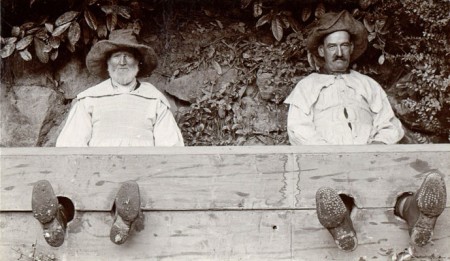
men being punished in stocks

Medieval law hindered men from enjoying the sexual freedom that Gilote, Johane, and other medieval women enjoyed. Dafydd ap Gwilym’s penis poem in fourteenth-century Wales describes the extensive medieval criminalization of men’s sexuality. A medieval English alliterative poem known as Satire on the Consistory Courts describes the punishment of men’s sexuality through ecclesiastical courts. The poem’s narrator protests:

If I should happen to lie on earth with a girl,
I must bow before them and learn their law,
And suffer all their decrees!

If I’m written into their record,
Then am I in disrepute,
For they lay blame on many a man
For women’s woe.

{ Yef Ich on molde mote with a mai,
Y shal falle hem byfore ant lurnen huere lay,
Ant rewen alle huere redes!

Yef Y am wreint in heore write,
Thenne am Y bacbite,
For moni mon heo maketh wyte
Of wymmene wo. }[4]

Like gynocentric society in general, the courts served women’s interests:

She begins at once to shriek and scream,
And says: “By my gabbing, it shall not go so!”
And “It’s all your fault!
You must wed me and make me a wife!”
But I’d rather by law lose my life
Than bow so at their feet!
Shall I bow at the foot of my foe?
Yes, she deceives so many
That I’m threatened there with thralldom,
By those who sit dark and sweaty;
There I’m sentenced by force
Before I go home.

{ Heo biginneth to shryke ant scremeth anon,
Ant saith: “By my gabbyng, ne shal hit so gon!”
Ant “That beo on ou alle!
That thou shalt me wedde ant welde to wyf!”
Ah me were levere with lawe leose my lyf
Then so to fote hem falle!
Shal Y to fote falle for mi fo?
Ye, monie byswyketh heo swo
Of thralles Y am ther thrat
That sitteth swart ant forswat;
Ther Y mot hente me en hat
Er Ich hom go. }[5]

For having sex outside of marriage, men in medieval England were punished by being beaten while they walked around the marketplace or the church. They could also be forced to marry the woman with whom they had sex. Medieval marriage required a man to assume financial and criminal responsibility for his wife. From the Middle Ages to the present, family courts have largely been for men a satire of justice.[6]

Men’s sexuality has much less social support than women’s sexuality. That reality hasn’t been widely recognized for medieval culture or modern culture. Persons who want to better understand medieval culture should start with studying imprisonment of men today for having sex and being too poor to pay their legally mandated sex payments, the current practice of forcing men to pay “child support” to their rapists, and the current law of forced financial fatherhood.

*  *  *  *  *

Read more:

Notes:

[1] Fein (2014) vol. 2, Art. 37, Gilote e Johane: Introduction. The Ludlow scribe copied Gilote e Johane before 1341. The previous quote is from Revard’s laudatory characterization of Gilote:

clever and resourceful sensualist, alert to every opportunity for pleasure and heedless of any moral or ethical restraint in pursuing her opportunities. … Gilote never shifts her ground or role, never faces opponents as clever or more cunning than she is; she not only keeps full control of all her lovers but teaches other women to do the same.

Revard (2004) pp. 119-20.

[2] Gilote e Johane, ll. 10-12, 49-51, from Old French trans. Fein (2014) vol. 2, Art. 37. Subsequent quotes are from id. ll. 121-4, 163-76, 134-6, 147-8, 203-9.

[3] In the second line (l. 164) of the quote, I’ve translated talent as “desires,” rather than “wants.” That choice seems to me to translate better the resonances of the Old French text.

[4] Ne mai no lewed lued libben in londe (commonly known as Satire on the Consistory Courts) ll. 4-6, 33-6, from Middle English trans. Fein (2014) vol. 2, Art. 40. The subsequent quote is from id. ll. 61-72. Scattergood (2002), p. 32, describes Satire on the Consistory Courts as a “highly literate piece of work. … Only a poet of great technical proficiency and confidence could write in this way.” Scattergood emphasizes the contrast between the narrator’s illiteracy and the court officials’ dominating use of texts and writing. The poem thus sharply contrasts its form and content.

The relation of Satire on the Consistory Courts to broader issues of men’s social position hasn’t been adequately appreciated. Scattergood notes that the poem includes allusions to men’s subservience to women in fin amour (courtly love). Id. pp. 35-6. The consistory courts are a public institution that subordinates men’s sexuality to women’s interests.

[5] Revard (2004), p. 123, describes the narrator as a “self-satirizing lecher.” Revard also explains that women fall short of being “theoretically perfect creatures … most often, because men are trying to seduce them into it.” On the other hand, Revard contrasts “Through-the-Looking-Glass Good Women” with “the sexiest Bad Girls.” Id. 121. Self-satire runs deep in such analysis.

[6] The Ludlow scribe of MS Harley 2253 arranged the texts of the anthology in a way that provides a variety of perspectives on medieval men’s social subordination to women. For example, the Life of Saint Marina (Art. 32) shows men’s vulnerability to a woman’s false accusation of rape. Supporting such injustice is men’s belief in women’s moral superiority (The Poet’s Repentance, Art. 33). Men’s oneitis for women (The Fair Maid of Ribblesdale, Art. 34; A Beauty White as Whale’s Bone, Art. 36) also contributes to men’s subordination to women.

[image] Men held in stocks. Adapted from photograph from the Builth Wells Historical Pageant, Aug. 11, 1909. Photograph by P.B. Abery. Record no. 3590090 from the P B. Aberty Collection. Dedicated to the Public Domain. Thanks to the National Library of Wales (Llyfrgell Genedlaethol Cymru) and Wikimedia Commons.

References:

Fein, Susanna, ed. with David B. Raybin, and Jan M. Ziolkowski, trans. 2014. The complete Harley 2253 Manuscript (vol. 1, vol. 2, vol. 3). Medieval Institute Publications, Western Michigan University. Kalamazoo, Michigan.

Revard, Carter. 2004. “The Wife of Bath’s Grandmother : Or, How Gilote Showed Her Friend Johane that the Wages of Sin is Worldly Pleasure, and How Both Then Preached This Gospel throughout England and Ireland.” Chaucer Review. 39 (2): 117-136.

Scattergood, John. 2000. The lost tradition: essays on Middle English alliterative poetry. Dublin: Four Courts Press.