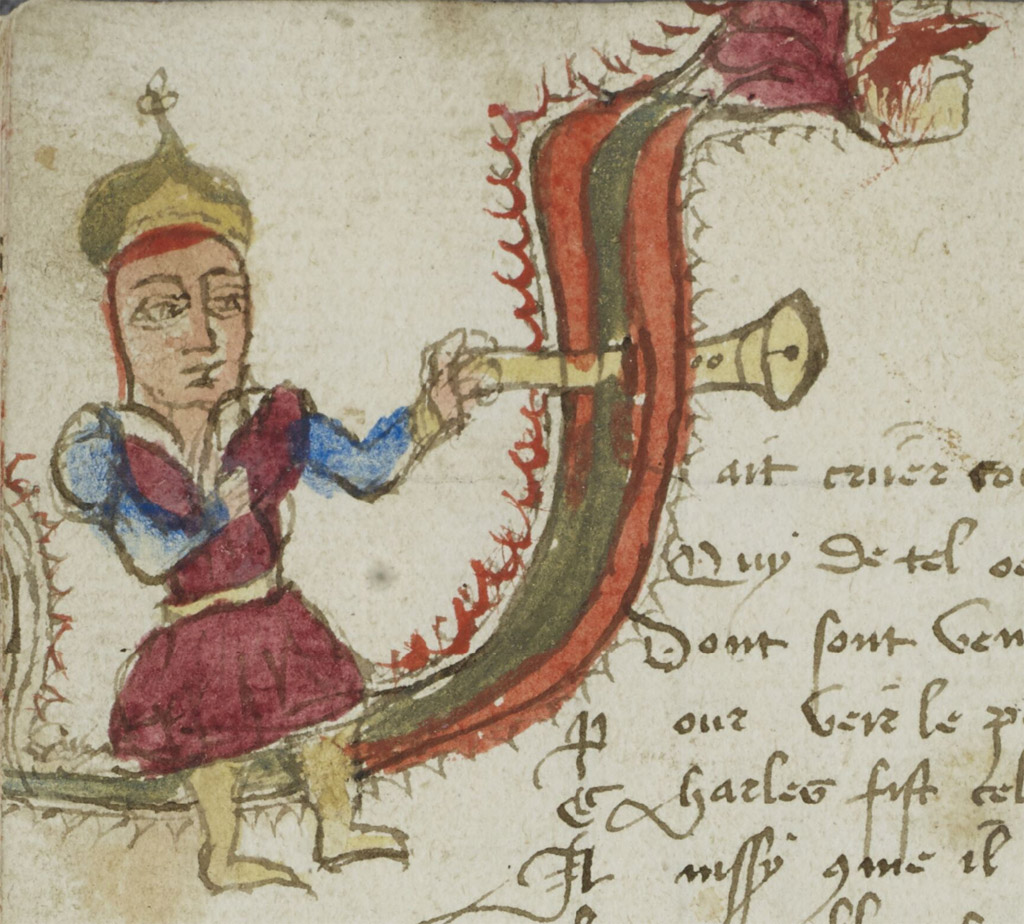
Amid the massive slaughter and butchery of men in the Old French “songs of deeds {chansons de geste},” rape occasionally occurs. The path to rape in the chanson de geste Floovant starts with Prince Floovant fighting on behalf of the French king Flores. Prince Floovant captured the enemy princess Maugalie. She was a young woman with jewel-like beauty. She pleaded to Floovant:
By the law of your god, have mercy! Do not allow me to be dishonored by your men.
{ … Por lou ton deu merci! Ne me laisiez tu pas à tes homes honir. }
Although he eagerly killed enemy men, Floovant wouldn’t allow an enemy princess to be dishonored:
“Lady-lord,” said Floovant, “for nothing you have said this. I wouldn’t allow you to endure it for 1000 pounds of pure gold.”
{ “Dame,” dit Floovans, “por néant l’avez dit; Je ne lou sofreroie por .M .livres d’or fin.” }
King Flores’s two sons betrayed their father and Floovant. The enemy thus rescued Maugalie and captured Floovant. Floovant’s loyal squire Richier, disguised as the enemy king’s nephew, infiltrated the enemy palace to attempt to rescue Floovant. Before Richier could accomplish a rescue, the enemy also captured twelve leading French knights. Richier was playing chess with Maugalie when he heard this terrible news:
Richier left the game so as to sit himself in the dust. The noble Maugalie, who had great beauty, sat herself next to him. The noble one thus conducted herself — she placed her arms about his neck so as to kiss him three times. “Cousin,” said the young woman, “what sort of men are the French?” “Lady-lord,” said Richier, “There will never be more valiant ones. Three of them would fight against thirty heathens.”
{ Richiers let le joer, si s’est aulez soioir. Maugalie la bale, qui grant bauté avoit, De joste lui s’essit, la bale, demenois; Ses branz li mit au coul, si l’ai baisié .III. foiz: “Cosins,” dit la pucelle, “qués homes sont François?” “Dame,” dit ai Richiers, “ja plus prouz n’en auroiz. Contre .XXX. paiens s’an conbatrient .III.” }
Maugalie didn’t ask Richier for affirmative consent before she kissed him. In short, by modern academic standards, she sexually assaulted him.
Maugalie’s offensive behavior became even worse when she secretly observed Richier sympathetically visiting Floovant and the other French prisoners. Maugalie then recognized Richier as a Frenchman who had once treated her kindly when she was a prisoner. He and the other Frenchmen were now in immediate mortal danger:
He fell at her feet and cried out for mercy: “If you wish, my lady-lord, we will not now die here.”
{ Il li chaï es piez et merci li criai: “Se vos volez, ma dame, nos i moromsnes jai.” }
From her position of controlling life and death for them, Maugalie proposed:
“Richier,” said the young woman, “brave, praiseworthy knight, if your feudal lord would avow fidelity such that he would take me as wife and equal partner, for love of him I will relinquish my god and never in another day of my life seek to love Mahomet. Then I will struggle to honor your heart and mind and for him and for the others, to do your will.”
{ “Richiers,” dit la pucelle, “frans chevalier loez, Se de ton seignour lege avoie féauté Que il me vosit panre à moilier et à pers, Por la sue amitié relanquirai mon dé, Jemais jor de ma vie ne quier Maom amer; Puis si me penerai de ton cors henorer Et de lui et des autres, à vostre velonté.” }
Richier conveyed Maugalie’s proposal to the imprisoned Floovant and his fellow French prisoners. Floovant enthusiastically consented to Maugalie’s marriage proposal. He clearly acted under a large power differential and dire distress. In short, by modern academic standards, Maugalie subjected Floovant to marital rape.
As folk wisdom teaches, what goes around, comes around. Soon after Maugalie raped Floovant, Maugalie’s father King Galeen forced her to marry the eminent knight Prince Maudaranz. Her father thus arranged for her to be raped by Maudaranz. Maugalie appealed to Richier for help. He arranged for Maugalie and the French knights to make a daring escape. In the battle during their escape, Floovant encountered Maudaranz and killed him. Maudaranz probably would have preferred to be raped.
Floovant’s father is the historical King Clovis I, ruler of the Franks from 509 to 511. Clovis united Gaul under his rule and founded the Merovingian dynasty. He converted to Christianity in 496 at the urging his wife Clotilde.
Floovant attracted citations and references in medieval works. Dutch, English, Icelandic, and Italian translations of Floovant were made. The Icelandic version is entitled Flovents Saga. Newth (2014) p. 10.
Maugalie expressed amorous interest in Floovant in a section of the text missing from the main manuscript, but surviving in other manuscript pages. For that additional text, Gehrt (1889). For a summary of Maugalie’s initiative and Floovant’s warm response, Juel (2007) pp. 74-5.
The quotes above are from Floovant, with the Old French text of Michelant & Guessard (1859) and my English translation, benefiting from the poetic translation of Newth (2014). The current best edition is Andolf (1941). That edition wasn’t readily available to me. The quotes above are Floovant, vv. 567-8 (By the law of your god…), 569-70 (“Lady-lord,” said Floovant…), 1472-8 (Richier left the game…), 1535-6 (He fell at her feet…), 1553-9 (“Richier,” said the young woman…).
[image] Amorous couple depicted in ceramic house. Made in twelfth or early thirteenth-century Iran. Such objects may have been wedding gifts. Preserved as accession # 20.120.66 in the Metropolitan Museum (New York). Credit: The Grinnell Collection, Bequest of William Milne Grinnell, 1920. Source image dedicated to the public domain by the public-spirited Metropolitan Museum.
References:
Andolf, Sven, ed. 1941. Floovant: Chanson de Geste du XIIe Siècle, Publiée avec Introduction, Notes et Glossaire. Uppsala, Sweden: Almquist & Wiksell.
Men too often are disparaged as being like dogs. That’s mean! Yet men would be told, as the saying goes, to take it like a man. Men suffering in silence from their hurt feelings should remember that the male dog Guinefort, later honored as a saint, saved a baby from a deadly serpent. Of course, the well-trained university student asks, “What about women?” In a famous medieval story now known as that of Iseut and Tristan, Tristan’s dog Hudein was more loyal to him than was his girlfriend Iseut. If men are dogs, at least men are loyal beasts.
After they both inadvertently drank a love potion, Iseut and Tristan ardently loved each other. They had sex, but they didn’t freely consent to have sex, because they acted under the influence of the love drug. In short, they raped each other. Iseut subsequently married King Mark of Cornwall. The king suspected Tristan of carrying on a love affair with Iseut and hence banished him from the realm. With Tristan in exile, Iseut and Tristan suffered severe lovesickness for each other.
Tristan secretly traveled back to Cornwall to visit Iseut. He cut his hair in a cross-shaped tonsure, stained his face with herb juices, transformed the sound of his voice, and carried a wooden stake on his shoulder. He dressed himself as a foolish madman, and he acted like one, too. He called himself Trantris, a name like Tristran (a version of Tristan), but with the syllables reversed.
After winning entrance to King Mark’s court, Tristan entertained the king by playing the fool. Tristan proposed trading his sister for Queen Iseut. Not recognizing Tristan, King Mark found that proposal to be foolishly amusing. Tristan foolishly proclaimed his ardent love for Iseut. He declared that she had cured him of his wound from fighting her uncle Morholt. He told the court of many other events in his relationship with Iseut. He even explicitly said that she was his mistress.
Iseut wasn’t amused. She angrily accused Trantris of lying about his name and what he had done. She thought he must be a soothsayer or magician, because what only she, Tristan, and her lady-in-waiting Brenguain knew, he knew. When Brenguain suggested that the fool actually was Tristan, Iseut completely dismissed that possibility:
No, he isn’t, Brenguain, because this one is ugly, hideous and very deformed, and Tristan is so shapely, a handsome man, well-made and very educated. One couldn’t find in any land any knight of greater renown. Thus I will never believe this one is the one I know as my lover Tristan. But this fool be cursed by God! Cursed be the hour that he lives, and let the ship be cursed that brought the fool to this place. Sad it was that he didn’t drown in the waves, out there is the deep sea.
{ Nu l’est, Brengain, kar cist est laiz, hidus e mult conterfait, e Tristran est tant alinnez, bels hom, ben fait, mult ensenez, ne serroit truvez en nul païs nul chevaler de greniur pris. Pur ço ne crerai je uwan k’iço sait mun ami Tristran. Mais cist fol soit de Deu maldit! Malete soit le ure ke il vit! E cele nef maldite sait en ki li fol en vint saendreit! Dol fu ke il ne nëat en le unde la hors en cele mer parfunde! }[1]
She didn’t recognize her beloved Tristan because he had changed his appearance and voice. She told him to go away.
Later, Brenguain brought Trantris to Iseut. They were alone. He approached her and wanted to kiss her. She retreated and shunned him. Trantris became distraught:
Alas! That I have lived so long when I have seen this sight that you hold me in disdain and now you regard me as so vile! In whom can I place my faith when Iseut won’t deign to love me, when Iseut considers me so vile that now she has no memory of me?
{ Allas! Ki tant ai vesquu quant je cest de vus ai vëu ke vus en desdein me tenez e pur si vil ore me avez! En ki me purreie mes fier quant Ysolt ne me deing’ amer, quant Ysolt a si vil me tient ke ore de mai ne li suvent? }
Ai Iseut, ai beloved! A man who is loved well is only slowly forgotten. Much valued is the fountain that rises well, the one whose stream is good and flows well, but from the hour that it dries up, that its water doesn’t rise and doesn’t issue forth, then it no longer receives praise. One is not made to love when one is disloyal.
{ Ohi! Ysolt, ohi! amie, hom ki ben aime tart ublie. Mult valt funteine ki ben surt, dunt li reuz est bon e ben curt, e de l’ure ke ele secchist, ke ewe n’i surt ne ewe ne ist, si ne fet gueres a praiser: ne fait amur quant voit boiser. }
Iseut said that she saw nothing to indicate that he was “Tristan the Lover {Tristran le Amerus}.” Considering him superficially, she didn’t perceive his inner being.
To get Iseut to recognize him, Tristan told of experiences they had together. Their adulterous trysts were daring and dangerous:
After blood-letting, we were there in your bed-chamber. But the crazy dwarf, born of a whore, sprinkled flour between our beds so by that means anyone would know if it were true — the love between us. But I realized that the flour was there. From my feet standing on my bed, I jumped into your bed. The jump broke the blood-letting wound in my arm and I bloodied your bed. When I jumped back, likewise I made bloody my own bed. Then King Mark came up there and found your bed bloody. He came to mine immediately and so found my bloody sheets. Queen, for love of you I was then chased away from the court.
{ … senez fumes en vostre chambrë u sumes. Mais li fol naims de pute orine entre noz liz pudrat farine kar par tant quidat saver le amur de nus, si ço fust veir; mais je de ço m’en averti: a vostre lit joinz peez sailli; al sailer le braz me crevat e vostre lit ensenglentat; arere saili ensement e le men lit refis sanglant. Li reis Marke i survint atant e vostre lit truvat sanglant; al men en vint eneslepas e si truvat sanglant mes dras. Raïne, pur vostre amité fu de la curt lores chascé. }[2]
Suspected of adultery, Iseut arranged to take an oath to allay concerns. On the day of her oath, Tristan, disguised as a pilgrim, carried her from a boat to the shore. On the shore, Iseut contrived a fall:
When you were coming ashore from the boat, in my arms I held you softly. I had well disguised myself as you had ordered me to do. I kept my head very bent down — you know what you said to me then — that I must let myself fall with you. Iseut, beloved, isn’t that true? Softly you fell to the ground, and you opened your thighs to me, and let me fall between them, and so saw all the people. By such means, as I understand it, Iseut, you were saved at judgment from the oath and the tale that you told in the king’s court.
{ Quant vus eisistes de la nef, entre mes bras vus tinc süef; – je me ere ben desguisee, cum vus me avïez mandé: le chef tenei’ mult enbrunc – ben sai quai me deïstes dunc: ke od vus me laissasse chair; – Ysolt amie, n’est ço vair? – süef a la terre chaïstes e voz quissettes me auveristes, e m’i laissai chaïr dedenz, e ço virent tuz les genz. Par tant fustes, ce je le entent, Ysolt, guari’ al jugement del serment e de la lai ke feïstes en la curt le rai. }
At the judgment proceeding, Iseut swore that no man had been between her thighs except her husband King Mark and “that pilgrim there” (Tristan in disguise), whom all had just seen fall between her thighs. She didn’t lie. She was only intentionally deceptive.[3]
When suspicion of adultery persisted, Tristan and Iseut fled from King Mark’s court. King Mark, however, tracked them down. He found them sleeping together in the forest. Tristan explained:
But God had worked for us. Mark found the sword between us as we were lying far apart. The king took the glove from his fist and placed it over your face, very softly, and he didn’t say a word, because he saw the sun’s ray that had burned you and made your face red. The king then went away and left us to sleep. After that, he didn’t have any suspicion that there was anything not good between us. He pardoned us from his anger, and at once he sent for us.
{ mais Deus aveit uvré pur nus, quant trovat le espee entre nus e nus rejumes de loins; li reis prist le gaunt de sun poing e sur la face le vus mist tant süef ke un mot ne dit, kar il vit un rai de soleil ke out hallé e fait vermeil; li reis s’en est alez atant si nus laissat dormant; puis ne out nul’ suspezïun ke entre nus öust si ben nun: sun maltalent nus pardonat e sempres pur nus envoiat. }
Despite these distinctive, memorable stories, Iseut didn’t believe that the man standing before her was Tristan. He lamented her disdain for him. He suspected that her love for him had been deceitful.
Then Tristan remembered that he had given Iseut his dog Hudein. Since she rejected him, he at least wanted his dog back from her. Brenguain brought Hudein:
Tristan said to him, “Come here, Hudein! Once you were mine, now I’m taking you back.” Hudein saw him, at once knew him, and greeted him joyfully, as is right to do. Never have I heard of a dog after returning to create greater joy than Hudein did to his master, such great love for him did he show. He rushed upon him, his head raised, rubbing him with his muzzle, patting him with his paws. Never did an animal show such great joy. It made one have great compassion for them.
{ Tristran li dit: ‘Ça ven, Huden! Tu fus ja men, ore te repren.’ Huden le vit, tost le cunuit, joie li fist cum faire dut. Unkes de chen ne oï retraire ke post meiur joie faire ke Huden fist a sun sennur, tant par li mustrat grant amur. Sur lui curt, leve la teste, unc si grant joie ne fist best’: bute del vis, fert del pé; aver en pöust l’en gran pité. }[4]
Tristan held Hudein and petted him. Still hurting from Iseut rejecting him, he complained to her:
My dog remembers me, I who nurtured him and trained him. You don’t, whom I loved so. Much does a dog have great nobility, and a woman great deceit!
{ Melz li suvient ke jo le nurri ki le afaitai ke vus ne fait ki tant amai! Mult par at en chen grant franchise e en femme grant feintise. }[5]
The next time you hear men disparaged as dogs, think to yourself: women should strive to be more like dogs.
Iseut finally became more like a dog. When Tristan shifted back to his natural voice, she finally recognized him. Then she loved him as ardently as he loved her:
Such joy she had from her lover, whom she held by her side, that her joy in no way could be contained. She would not allow him to depart that night. She said that he would have there a good guest-house and a fine bed, well-made and beautiful. Tristan sought nothing else beyond Queen Iseut and her alone. Tristan was joyful and happy. He knew that he would be well-lodged.
{ tele joi’ en ad de sun ami ke ele ad e tent dejuste li ke ele ne set cument contenir: ne le lerat anuit mes partir, dit k’i averat bon ostel e baus lit ben fait e bel. Tristran autre chosce ne quert fors la raïne Ysolt u ele ert; Tristran en est joius e lez: mult set ben ke il est herbigez! }
Men delight in being well-lodged. What’s wrong with that? I’d like to know, except there they go, cuckolding King Mark again. Neither Iseut nor Tristan was King Mark’s dog.
[1] The Madness of Tristan of Oxford {La folie Tristan d’Oxford} vv. 577-90, Old French (Anglo-Norman) text from Short (1993), English translation (modified) from Weiss (2009). Subsequent quotes from Folie Tristan d’Oxford are similarly sourced. Bliss (2018) provides excerpts of the Anglo-Norman text of Short (1993), with English translation. Rosenberg (1998) provides an Old French edition and English translation, but inadvertently missing vv. 952-995.
The Folie Tristan d’Oxford is “d’Oxford” because it survives only in MS Oxford Bodleian Douce d. 6 (SC 21983), folios 12v – 19r. That manuscript apparently was written in the last third of the thirteenth century. Folie Tristan d’Oxford is thought to have been composed in the last quarter of the twelfth century with the benefit of Thomas’s Tristan. The Madness of Tristan of Berne {La folie Tristan de Berne}, which survives mainly in MS Bern, Burgerbibliothek 354, folios 151rb-156rb, is similar to Folie Tristan d’Oxford, but the former is much shorter. For a correlation of themes in the Oxford and Bern Folie Tristan, Bromiley (1986) Appendix. For Old French text and English translations of both, Rosenberg (1998). On Tristan story themes in literary history, Schoepperle (1913).
In the Folie Tristan d’Oxford, the main characters are written as Tristran and Ysolt. The name Tristran supports the anagram Trantris. In the English-language text, I’ve normalized their names to Tristan and Iseut.
Subsequent quotes above are from Folie Tristan d’Oxford, vv. 694-700 (Alas! That I have lived so long…), 700-8 (Ai Iseut, ai beloved!…), 712 (Tristan the Lover), 739-56 (After blood-letting…), 819-34 (When you were coming ashore…), 881-94 (But God had worked for us…), 907-18 (Tristan said to him…), 934-8 (My dog remembers me…), 989-98 (Such joy she had…).
[2] Weiss’s translation inexplicably omits the reference to blood-letting. Blood-letting was a common medieval health practice. When virgin women have sex, many, but not all, experience a small amount of harmless blood flow. Iseut was not a virgin. This bloody bed incident alludes ironically both to blood flow in a woman’s first sexual intercourse and the brutalization of men’s sexuality.
The men who were enthralled by this story all desired Iseult {Iseut}. At times, she outraged them. At other times, they perhaps, in the end, pitied this young girl, who had been carried away, one day, by the murderer {Tristan} of her uncle, over the seas to the bed {as queen) of a man she did not know {King Mark}; they perhaps pitied this woman, from then on hounded, divided against herself, shared as between these two lions she saw in a dream when drowsy after love {adulterous sex with Tristan}, tearing her apart, torn between two antagonistic forces of equal power, desire and the law. This Iseult was pitiable, victim of her own passion and of the passion that her very presence sufficed to ignite among the men who were constantly close about her, and some of whom spent the night, in an opportune obscurity, a few paces from her bed.
{ Les hommes que l’histoire captiva désiraient tous Iseut. Par moments, elle les indignait. À d’autres moments n’avaient-ils pas pitié, en fin de compte, de cette fille que le meurtrier de son oncle avait un jour emportée au-delà des mers pour la conduire dans le lit d’un homme qu’elle ne connaissait pas, pitié de cette femme désormais traquée, divisée contre elle-même, partagée, comme entre ces deux lions qu’elle vit en songe, assoupie après l’amour dans la tiédeur des heures chaudes, la déchirant, écartelée entre deux forces antagonistes d’égale puissance, le désir et la loi. Iseut pitoyable, Iseut victime de son propre feu et du feu que sa seule présence attisait parmi les mâles qui la côtoyaient sans cesse et dont quelques-uns dormaient la nuit, dans une obscurité propice, à quelques pas de sa couche? }
Duby (1995) p. 129, English by Birrell (1997). Harper more objectively described qualities of Iseut: “immaturity, superficiality, selfishness, predisposition towards anger, violence, emotional outbursts and lack of judgement.” Harper (2003) p. 83. Not all men desire women like that.
[4] The Folie Tristan d’Oxford earlier describes Tristan giving Iseut a different dog:
Don’t you remember, my beautiful lover, about the little love-gift that I once sent you — a little dog that I bought for you? That was Little Grown, whom you held most dear.
{ Ne menbre vus, ma bele amie, de un’ petit’ drüerie kë une faiz vus envaiai, un chenet ke vus purchaçai? E ço fu le Petitcru ke vus tant cher avez ëu. }
Folie Tristan d’Oxford , vv. 757-62. The dog Little Grown {Petitcru} is a magical dog that appears in other romances of Iseut and Tristan. Hudein (also spelled Huden), in contrast, found Iseut and Tristan in the forest. Tristan trained him not to bark so as not to reveal their presence. Hudein, along with Tristan’s hawk, hunted food for them. Id. vv. 873-6. Hudein has slightly different names in different versions: Utant (Eilhart von Oberge’s Tristrant), Hudent (Folie Tristan de Berne and Béroul’s Tristan), Hiudan (Gottfried von Strassburg’s Tristan and Isolt), and Hodain (Sir Tristrem). Weiss (2009) p. 152, n. 40.
[5] In the Folie Tristan de Berne, Tristan says to his dog:
You haven’t lost the love you have for me. You’ve shown me a warmer welcome than the woman I loved so much.
{ Ne m’as mie t’amor toloite. Mout m’as montré plus bel sanblant Que celi cui j’amoie tant. }
Folie Tristan de Berne, vv. 523-5, Old French text and English translation (modified slightly) from Rosenberg (1998). Earlier Tristan declared appreciatively, “Dogs have a remarkable nature {Estrange nature a en chien}.” Folie Tristan de Berne v. 485, sourced as previously.
Neither Thomas’s Tristan nor Béroul’s Tristan includes Tristan praising his dog for loving him more than Queen Iseut does. But Béroul’s Tristan includes Tristan’s extravagant appreciation for dogs:
Solomon who is right said that it is his hound that is his lover.
{ Salemon dit que droituriers Que ses amis, c’ert ses levriers. }
Béroul’s Tristan, vv. 1461-2, Old French text and English translation (modified) from Lacy (1998b).
In Eilhart von Oberge’s Tristrant, Tristan, exiled, marries a second Iseut, Iseut of the White Hands. She treats him coldly. Tristan tells his companion Kaherdin that his first beloved Iseut (Queen Iseut / Iseut of Ireland and later Cornwall) loves the dog he gave her more than Iseut of the White Hands loves him. Queen Iseut’s caressing of the dog confirms Tristan’s claim. Schoepperle (1913) vol. 1, pp. 42, 44. The proverb “one who loves me loves my dog {qui l’aime il aime mon chien}” apparently was already current in the twelfth century. Id. p. 157.
Schoepperle calls Iseut’s love for Tristan’s dog “one of the extravagences of courtly sentiment” in Eilhart’s Tristrant. Id. But it’s also an example of men’s sexed protest with respect to Iseut of the White Hands. In the Folie Tristan d’Oxford and Folie Tristan de Berne, Tristan’s comparison of Hudein’s recognition of him with Queen Iseut’s superficial disregard for him is similarly an expression of men’s sexed protest. In dominant discourse, medieval expressions of men’s sexed protests have been unjustly marginalized and stigmatized through superficial, hateful name-calling.
[images] (1) Man lovingly holding dog. Source photo by Katie Cook. Photo made in Upper East Side of Manhattan in 2008. Generously offered on flickr under a Creative Commons By/2.0 license. (2) La Belle Isoude (Queen Iseut) recognizes Tristram (Tristan) at Tintagel. Stained glass panel (excerpt) designed by Edward Burne-Jones in 1862. This is one of thirteen Tristram and Isoude stained glass panels placed in Harden Grange, which was textile merchant Walter Dunlop’s house near Bingley in Yorkshire. Overall design by William Morris of Morris, Marshall, Faulker & Co.
Lacy, Norris J., ed. and trans. 1998b. “Béroul’s Tristan.” Pp. 3-218 in Lacy (1998a).
Rosenberg, Samuel N., ed. and trans. 1998. “Les Folies Tristan.” Pp. 219-310 in Lacy (1998a).
Schoepperle, Gertrude. Tristan and Isolt: a study of the sources of the romance. Volume 1. Volume 2. London: David Nutt. Alternate source.
Short, Ian, ed. 1993. The Anglo-Norman Folie Tristan. London: Anglo-Norman Text Society(ANTS) Plain Texts Series 10. London: Birbeck College. Alternate presentation.
Weiss, Judith. 2009. The Birth of Romance in England: The Romance of Horn, The Folie Tristan, The Lai of Haveloc, and Amis and Amilun; Four Twelfth-Century Romances in the French of England. Tempe, AZ: Arizona Center for Medieval and Renaissance Studies (ACMRS).
Georges Duby, who lived from 1919 to 1996, was “a grand master among medieval social historians.” He issued an intellectual autobiography in 1991 via the prestigious, woman-run publisher Éditions Odile Jacob. That book, like Duby’s major works on medieval women and gender, makes no mention of Henry Adams’s extraordinary Mont-Saint-Michel and Chartres, first privately printed in 1904. Recovering the missing history of Henry Adams in Georges Duby’s work provides important insight into gender and identity narratives over the past half century.
Georges Duby was a highly successful academic. The forward to the 1994 University of Chicago English translation of Duby’s intellectual autobiography depicted his influence:
During the 1980s his celebrity could best be appreciated on Thursday afternoons at the Collège de France: hundreds would queue up hours before his lecture to obtain a seat where they could see a distinguished master of short stature, with clear blue eyes, stylishly clad in a classic blazer, lecturing on women in the Middle Ages. Those not forewarned had to be content with the sonority of his impeccable pronunciation transmitted over a loudspeaker in an adjacent room. His audience ranged across the spectrum of Parisian society, from young students in jeans to the elegant “third age” crouched on the floor and in the aisles despite their shining pates and silvered bouffants. Perhaps more than Michel Foucault and Roland Barthes, his rivals for popularity at the Collège, Georges Duby was familiar to a broad audience through appearances on television, radio, and in the full-page newspaper advertisements for the SEPT, France’s new adventure into cultural television.[1]
In Paris in the autumn of 1973, Duby had directed his seminar at the Collège de France toward study of medieval kinship and sex. Duby remembered, “I perceived, sometimes, way off in the back of the room, Foucault discreetly taking notes {j’apercevais parfois, dans le lointain, au fond de la salle, Foucault, discret, prenant des notes}.”[2] Everyone, from young and old innocents to the now-superfamous Michael Foucault, learned from Georges Duby about women in medieval France.
For about two decades, Georges Duby earnestly sought to answer a peculiar question: “What do we know about woman {De la femme, que savons-nous}?”[3] Ponder that question. Medieval women were women, and they were human beings. You, a woman, might know quite a lot about yourself. Moreover, in all societies that have endured, women and men have led intimately intertwined lives. Women, men, and non-binary persons surely know a lot about women, including medieval women. Nonetheless, to externalize and circumscribe even what academic knowledge-professors know about “woman” seems like a Platonic word game or a foolish medieval knight’s quest.
The ladies of that distant period have for us neither faces nor bodies. One has the right to imagine them, at the time of grand parades at court occasions, dressed in gowns and mantles like those that drape the virgins and the female saints on the doorways and stained-glass windows of churches. But the actual bodies that the gowns and mantles both allowed to be uncovered and enveloped will always escape one’s gaze.
{ Les dames de ces temps lointains n’ont pour lui ni visage ni corps. Il a le droit de les imaginer, lors des grandes parades de cour, revêtues de robes et de manteaux semblables à ceux où se drapent les vierges et les saintes sur les portails et sur les vitraux des églises. Mais la vérité corporelle que robes et manteaux laissaient à découvert et qu’ils enveloppaient échappera toujours à son regard. }[4]
Living organisms have been sexually reproducing on earth for at least 1.2 billion years. Beings physically similar to today’s human beings have existed for at least two million years. Medieval men were able to imagine medieval women’s faces and bodies. Persons today surely can imagine the faces and bodies of human beings who lived only a thousand years ago. Of course, one can’t actually see today even the face of one’s spouse yesterday. Alas! Such pathos in history, which continues one day after another.
In Mont-Saint-Michel and Chartres, Henry Adams imaginatively transported himself and his niece to medieval France. The editor who brought Adams’s book to public circulation in 1913 praised the visionary quality of Adams’s book:
Greater, perhaps, even than his grasp of the singular entirety of mediaeval civilization, is Mr. Adams’s power of merging himself in a long dead time, of thinking and feeling with the men and women thereof, and so breathing on the dead bones of antiquity that again they clothe themselves with flesh and vesture, call back their severed souls, and live again, not only to the consciousness of the reader, but before his very eyes.[5]
The Virgin Mary was particularly alive to Adams in the massive, magnificent Chartres Cathedral:
With only half of an atrophied imagination, in a happy mood we could still see the nave and transepts filled with ten thousand people on their knees, and the Virgin, crowned and robed, seating herself on the embroidered cushion that covered her imperial throne; sparkling with gems; bearing in her right hand the sceptre, and in her lap the infant King; but, in the act of seating herself, we should see her pause a moment to look down with love and sympathy on us, — her people, — who pack the enormous hall, and throng far out beyond the open portals; while, an instant later, she glances up to see that her great lords, spiritual and temporal, the advisers of her judgment, the supports of her authority, the agents of her will, shall be in place; robed, mitred, armed; bearing the symbols of her authority and their office [6]
Adams’s sense of the Virgin Mary was like that of medieval women and men:
These people knew the Virgin as well as they knew their own mothers; every jewel in her crown, every stitch of gold-embroidery in her many robes; every colour; every fold; every expression on the perfectly familiar features of her grave, imperial face; every care that lurked in the silent sadness of her power; repeated over and over again, in stone, glass, ivory, enamel, wood; in every room, at the head of every bed, hanging on every neck, standing at every street-corner, the Virgin was as familiar to every one of them as the sun or the seasons; far more familiar than their own earthly queen or countess, although these were no strangers in their daily life; familiar from the earliest childhood to the last agony; in every joy and every sorrow and every danger; in every act and almost in every thought of life, the Virgin was present with a reality that never belonged to her Son or to the Trinity, and hardly to any earthly being, prelate, king, or kaiser; her daily life was as real to them as their own loyalty which brought to her the best they had to offer as the return for her boundless sympathy; but while they knew the Virgin as though she were one of themselves, and because she had been one of themselves, they were not so familiar with all the officers of her court at Chartres
Of course the Virgin Mary was an extraordinary woman. Nonetheless, she was also the mother to everyone who made themselves by faith adopted sisters and brothers of Jesus, the son of Mary.[7] Such understanding has become largely incomprehensible in the present-day European culture sphere, especially among learned historians.
What the public learned from Georges Duby about medieval women and men was astonishing. Georges Duby didn’t see the Virgin Mary in the way that medieval women and men did. He didn’t see her as the prominent, early twentieth-century medievalist Henry Adams did. As a late twentieth-century medieval historian, Duby taught that medieval men, convinced of their gender superiority, treated women as objects, strictly controlled women, and despised women:
For men, the woman was primarily an object. Men gave them, took them, and discarded them. The woman belonged among their assets and personal property. Or to proclaim their own glory, men displayed her at their side, pretentiously adorned, like one of the most beautiful pieces of their treasure, or else they hid her away in the innermost recesses of their residence, and if it was necessary to take her out, they concealed her behind the curtains of a litter, and behind the veil and mantle, since it was important to conceal her from the eyes of other men who might well wish to steal her away. Thus there existed a closed space reserved to women, but strictly controlled by masculine power. In the same way, the time of women was regulated by men, who assigned to the course of their lives three successive stages: girls, necessarily virgins; wives, necessarily submitting to husbands’ embraces, since their function was to bring their heirs into the world; and widows, necessarily reverting to chastity. The woman was subordinate in all cases to the man, in conformity with the hierarchies that, according to the divine plan, constituted the structures of Creation.
{ Pour eux la femme d’abord est un objet. Les hommes la donnent, la prennent, la jettent. Elle fait partie de leur avoir, de leurs biens meubles. Ou bien, pour affirmer leur propre gloire, ils l’exposent à leurs côtés, pompeusement parée, comme l’une des plus belles pièces de leur trésor, ou bien ils la cachent au plus profond de leur demeure et, s’il est besoin de l’en extraire, ils la dissimulent sous les rideaux de la litière, sous le voile, sous le manteau, car il importe de la dérober à la vue d’autres hommes qui pourraient bien vouloir s’en emparer. Il existe ainsi un espace clos réservé aux femmes, étroitement contrôlé par le pouvoir masculin. De même, le temps des femmes est régi par les hommes, qui leur assignent au cours de leur vie trois états successifs : filles, nécessairement vierges ; épouses, nécessairement soumises à leur étreinte car leur fonction est de mettre au monde leurs héritiers; veuves, nécessairement retournées à la continence. Subordonnées dans tous les cas à l’homme, conformément aux hiérarchies qui, selon le plan divin, constituent les membrures de la création. }[8]
Extravagant devotion to the virgin mother Mary across all strata of twelfth-century French society mattered little to Duby. In one of his final works, published in 1995, Duby declared:
In this society, everything official, everything that one lifted up in public, beginning with writing, was, in effect, in the masculine. … Let’s resign ourselves: nothing of the feminine appears except through the sight of men. But, fundamentally, have things so radically changed? Yesterday, as it is today, society doesn’t show anything of itself except that which it judges good to exhibit.
{ Au masculin, en effet, appartient dans cette société tout l’officiel, tout ce qui relève du public, à commencer par l’écriture. … Résignons-nous: rien n’apparaît du féminin qu’à travers le regard des hommes. Mais, au fond, les choses ont- elles si radicalement changé? Hier comme aujourd’hui, la société ne montre d’elle-même que ce qu’elle juge bon d’exhiber. }
Georges Duby seems to have marginalized and silenced medieval women for his own particular rhetorical purpose across many years. Explicitly noting that he drew upon medieval studies he did between 1967 and 1986, Duby in 1988 emphasized the maleness of medieval Europe and its associated characteristics:
The Middle Ages were resolutely male. All the remarks that reach me and inform me were held by men, convinced of the superiority of their sex. I hear only them. However, I listen to men speaking here in front of all about their desire, and consequently about women. Men were afraid of women and, to reassure themselves, despised them.
{ Ce Moyen Âge est mâle, résolument. Car tous les propos qui me parviennent et me renseignent sont tenus par des hommes, convaincus de la supériorité de leur sexe. Je n’entends qu’eux. Cependant, je les écoute ici parlant avant tout de leur désir, et par conséquent des femmes. Ils ont peur d’elles, et pour se rassurer, les méprisent. }[10]
According to Duby’s detailed studies of historical documents, medieval men weren’t afraid that women would shame them into violence against men, cuckold them, rape them, or extort money from them. Medieval men weren’t afraid that women would take advantage of medieval men’s ardent love for women and medieval men’s courtly obligation to do anything for women. According to Duby, men feared the power of women, women whom Duby’s research found to be powerless and regarded as intrinsically inferior by medieval men. Duby pushed his peculiar reasoning even further:
Nonetheless, women did not let themselves be so easily dominated, as men of the twelfth century learned from experience, and this is why men feared women. Fearing women, men regarded them as naturally bad.
{ Toutefois, les femmes ne se laissent pas si facilement dominer, les hommes du xiie siècle en font l’expérience, et c’est pour cela qu’ils les craignent. Les craignant, ils les jugent naturellement mauvaises. }
In short, medieval men feared and despised women because medieval men were stupid and naturally vicious. More recent scholarship typically limits such character defects to white Christian men born within the geographic boundaries of the nation. The valorizing mechanisms of French public intellectual life, along with followers throughout the world, judged Duby’s rhetoric to be not just reasonable, but profound. Rhetoric following Duby’s template has been enormously influential, especially within identity studies in America.
The intricacies of Georges Duby’s rhetoric deserve careful analysis. Well-versed in medieval and modern scholastic reasoning, Duby employed dialectic and casuistry in ways that make falsification nearly impossible. Consider for example, Duby’s concluding claim in volume 1 of his career-culminating 1995-6 work, Dames du XIIe siècle{Ladies of the 12th Century}:
Ladies of this period remained, it is certain, subject to the power of men, who still judged them as dangerous and frail. A few among the men, however, and a larger and larger number, discovered women as objects and subjects of love. These men looked at women with a less disdainful eye. It is thus that women imperceptibly began to extricate themselves from the strictest shackles in which masculine power held them.
{ Les dames de ce temps demeurèrent, c’est certain, soumises au pouvoir des hommes qui les jugeaient toujours dangereuses et fragiles. Quelques-uns d’entre eux cependant, et de plus en plus nombreux, les découvraient objets et sujets d’amour. Ils les regardaient d’un œil moins dédaigneux. C’est ainsi qu’insensiblement elles commencèrent à se dégager des plus strictes entraves où les tenait la puissance masculine. }
Women began to extricate themselves from the strictest shackles of masculine power when women in their shackles somehow compelled men to look upon them less disdainfully. When did this momentous and fundamentally important change in the male gaze occur? Through his detailed historical research, Duby identified the year in which more and more medieval men looked upon women less disdainfully:
it seems to me that one can situate around 1180, when the violent surge of growth sweeping through Europe was at its height, the time when the situation of these women was a little improved, when men became accustomed to treating them as persons, to negotiating with them, to enlarging the field of women’s freedom, and to cultivating those special gifts that made women closer to the supernatural. This is the main conclusion to emerge from my research.
{ il m’a semblé pouvoir situer vers 1180, alors que le violent élan de croissance qui emportait l’Europe se trouvait au plus vif de sa vigueur, le moment où la situation de ces femmes fut quelque peu exhaussée, où les hommes s’accoutumèrent à les traiter comme des personnes, à débattre avec elles, à élargir le champ de leur liberté, à cultiver ces dons particuliers qui les rendent plus proches de la surnature. Voici ce qui ressort le plus nettement de l’enquête qui j’ai menée. }[11]
Duby’s scholarly finding that women have special gifts that bring them closer than men to the supernatural echoes a theme of Adams’s Mont-Saint-Michel and Chartres. Adams, however, didn’t engage in the sort of total history that would allow him to produce Duby’s sensational claim that men became accustomed to treating women as persons in Europe around the year 1180. Despite that alleged momentous historical turning point, Duby nonetheless concluded that men in twelfth-century France didn’t appreciate women:
Eve attracted them, and Eve frightened them. Either men kept a prudent distance from women, or else they treated women very harshly, mocking them, entrenched in the stubborn conviction of their natural superiority. It was men, ultimately, who failed women.
{ Ève les attirait, Ève les effrayait. Ils s’écartaient prudemment des femmes, ou bien les rudoyaient, se gaussaient d’elles, retranchés dans la certitude têtue de leur supériorité naturelle. Ce sont eux, finalement, qui les ont manquées. }
Duby here uses Eve to represent all women. That’s apparent from a slightly different version of Duby’s historical finding featured on the back cover of Duby’s Dames du XIIe siècle, volume 3:
Women attracted them, and women frightened them. Confident of their superiority, men kept their distance from women or treated women very harshly. It was men, ultimately, who failed women.
{ Elles les attiraient, elles les effrayaient. Sûrs de leur supériorité, ils s’écartaient d’elles ou bien les rudoyaient. Ce sont eux, finalement, qui les ont manquées. }[12]
Eve was a medieval type for women. So was the Virgin Mary. Duby failed medieval women by typing them only as Eve. Duby failed medieval men by treating them very harshly. Duby treated medieval men as objects for deploying now-conventional academic rhetoric about oppressors and the oppressed. By projecting gender resentment onto medieval Europe, Duby historically naturalized it for the present.
Nearly a century earlier, Henry Adams engaged in more sophisticated rhetoric about medieval gender. In his book Mont-Saint-Michel and Chartres, Adams characterized women of twelfth-century France as behaving like men, but intellectually and socially superior to men. Adams described Mary, the virgin mother of Jesus, as a medieval goddess who effectively ruled France and controlled enormous economic resources. In Adams’s account, medieval women established the law under which medieval men lived:
In the twelfth century he {the French poet} wanted chiefly to please women, as Orderic complained; Isolde came out of Brittany to meet Eleanor coming up from Guienne, and the Virgin from the east; and all united in giving law to society. In each case it was the woman, not the man, who gave the law; — it was Mary, not the Trinity; Eleanor, not Louis VII; Isolde, not Tristan.[13]
Adams understood medieval women to be more powerful than men:
Always the woman appears as the practical guide; the one who keeps her head, even in love … The woman might be the good or the evil spirit, but she was always the stronger force. The twelfth and thirteenth centuries were a period when men were at their strongest; never before or since have they shown equal energy in such varied directions, or such intelligence in the direction of their energy; yet these marvels of history, — these Plantagenets; these scholastic philosophers; these architects of Rheims and Amiens; these Innocents, and Robin Hoods and Marco Polos; these crusaders, who planted their enormous fortresses all over the Levant; these monks who made the wastes and barrens yield harvests; — all, without apparent exception, bowed down before the woman.
Like Duby, but much less frequently, Adams scornfuly depicted men. Adams depicted men as souless, ignorant, and conceited:
If I were beginning again as a writer, I think I should drop the man, except as an accessory, and study the woman of the future. The American man is a very simple and cheap mechanism. The American woman I find a complicated and expensive one. Contrasts of feminine types are possible. I am not absolutely sure that there is more than one American man.
The American man is one-sided to deformity, and yet extraordinarily conceited, as far as literature reveals him. The American woman flatters him and rules him. He likes to be ruled. He is a peaceful, domestic animal, fond of baby-talk. I like him, for he is helpless and sympathetic; afraid of himself, of his women, of his children; yearning for love and dough-nuts; shocked at automobiles and Trusts; proud and puffed up at riding a horse and shooting a bear; he is a gentleman whom I knew well; in fact, though it is not anything I boast of, I was once an American man myself. Unluckily I was never an American woman.[14]
Adams disparaged men in his own person as a man. He didn’t imagine medieval women, in their dominant position and with their natural superiority, fearing men and despising men. Adams didn’t tell a history of vicious, oppressive men and virtuous, oppressed women. In such schematic history, the direction of liberation is obvious. For Adams, in contrast, liberation through historical encounter requires a difficult, perhaps impossible, will to believe.[15]
Not writing about medieval women in a way designed to attract attention and acclaim, Henry Adams was personally reticent in presenting Mont-Saint-Michel and Chartres to the public. He paid for it to be privately printed in 1904 in an edition of 150 copies. In 1912, he paid to have the book privately reprinted in a further edition of 500 copies. He apparently gave away these copies to interested persons. Only reluctantly he allowed the American Institute of Architects to bring out an edition to be publicly sold in 1913. Advance sales of the book were record-setting. It became “a high-status bestseller in its own time.” Mont-Saint-Michel and Chartres remained in print throughout the twentieth century, with a French translation published in 1955.[16]
Henry Adams similarly never published his medieval-themed poem “Prayer to the Virgin of Chartres.” His wrote this poem in 1901 and sent it only to Elizabeth Cameron. Both he and she were married, and she was twenty years young than he. She was a mother, with a daughter born in 1883. She named her daughter Martha, but had wanted to name her Marian. She didn’t name her daughter Marian because Henry had been away on business and wasn’t available to approve her naming her daughter after his wife. Henry was infatuated with Elizabeth, but she wasn’t interested in having a sexual affair with him.[17] His infatuation with her is an obvious subtext for his “Prayer to the Virgin of Chartres.” He was like a medieval man sending love poetry to a woman and unsuccessfully imploring her to have sex with him:
Before your majesty of grace and love, The purity, the beauty and the faith; The depth of tenderness beneath; above, The glory of the life and of the death.
When Blanche set up your glorious Rose of France, In scholar’s robes I waited on the Queen; When good Saint Louis did his penitence, My prayer was deep like his: my faith as keen.
What loftier prize seven hundred years shall bring, What deadlier struggles for a larger air, What immortality our strength shall wring From Time and Space, we may — or may not — care;
But years, or ages, or eternity, Will find me still in thought before your throne, Pondering the mystery of Maternity, Soul within Soul, — Mother and Child in One!
Help me to see! not with my mimic sight — With yours! which carried radiance, like the sun, Giving the rays you saw with — light in light — Tying all suns and stars and worlds in one.
Help me to know! not with my mocking art — With you, who knew yourself unbound by laws; Gave God your strength, your life, your sight, your heart, And took from him the Thought that Is — the Cause.
Help me to feel! not with my insect sense, — With yours that felt all life alive in you; Infinite heart beating at your expense; Infinite passion breathing the breath you drew!
Help me to bear! not my own baby load, But yours; who bore the failure of the light, The strength, the knowledge and the thought of God, — The futile folly of the Infinite![18]
Medieval men mixed love of God and love of an earthly woman to an extent nearly inconceivable now. Medieval men’s effusive poetry of their love for earthly women often extends even into gyno-idolatry. Adams adapted that characteristic of medieval men’s love poetry. Adams himself, however, was not Catholic. He was not Christian in the sense of affirming any established Christian creed or affiliating with any actual Christian church. But his “Prayer to the Virgin of Chartres” mattered much to Henry Adams. The final version of this never-published poem was found in the packet of Adams’s special papers at his death in 1918.[19]
Writing less personally than Henry Adams, Georges Duby produced his works within vigorous academic discussion and apparently keen interest in selling books. Duby’s book Medieval Marriage: Two Models from Twelfth-Century France (1978) was originally presented as lectures at Johns Hopkins University in the U.S. in 1977. This book presented model medieval misogyny of two types: marriage according to clerical misogyny and marriage according to feudal misogny.[20]
Duby’s subsequent book, Le chevalier, la femme et le prêtre: le mariage dans la France féodale {The knight, the woman and the priest: marriage in feudal France} (1981), built upon Duby’s two models of marriage misogyny. According to Duby, this subsequent work “went deeper and drew finer distinctions.”[21] Its title offered the frisson of a sensational love triangle. The feudal France of its subtitle, however, may have darkly dragged down sales. The English translation went with the love triangle, heightened with “lady” rather than “woman,” and a more topical subtitle hook: The knight, the lady and the priest: the making of modern marriage in medieval France (1993). Duby’s book apparently inspired a student to write in her notes:
I want to write something that will make me mad!! is sexy, controversial + anti-male, anti-marriage.
Online journalism has shown that enraging writing attracts readers. Duby’s work has probably similarly affected many students.
In 1988, Duby brought out the sensationally titled Mâle Moyen Âge {Male Middle Age}. Men typically regret becoming middle-aged. Mâle Moyen Âge consisted of three parts: one part on love and marriage, another part on family structure, and a mainly historiographic third part. Its English translation replaced Mâle Moyen Âge with the more broadly understandable title, Love and Marriage in the Middle Ages.
Duby’s last published work had the series title Dames du XIIe siècle {Ladies of the 12th Century} (1995-6). It was issued in three slim volumes totaling 379 pages in English translation, with pages relatively small for a scholarly history book.[22] The three volumes have no notes and no bibliographic references. Their English translation, issued by the prestigious University of Chicago Press, has the series title Women of the Twelfth Century. In American English, “women” is a more sober term than “ladies.”
Georges Duby’s books don’t even mention the radically different view of medieval women in Henry Adams’s Mont-Saint-Michel and Chartres. In his intellectual autobiography published in 1991, Duby exoticized American study of medieval Europe:
In the American universities, the study of the Middle Ages stands, and completely naturally, in a marginal position, a little like Indianism in our country, which isn’t without advantage.
{ Dans les universités américaines, l’étude du Moyen Age se tient, et tout naturellement, dans une position marginale, un peu comme chez nous l’indianisme, ce qui n’est pas sans avantage. }[23]
In fact, American thinkers in the late nineteenth and early twentieth centuries actively considered medieval Europe. The collegiate Gothic buildings that rose with the growth of U.S. universities early in the twentieth century display American intellectual engagement with medieval Europe.[24] Especially given Duby’s repeatedly declared desire to know medieval women, Duby might have at least mentioned a particularly relevant prior study of medieval women by an American medievalist. In any case, for their work both Duby and Adams probably would want women to be credited.
Georges Duby’s missing history of Mont-Saint-Michel and Chartres undergirds his historically distinctive rhetoric about medieval women and men. Duby influentially expounded for women and men an identity-based, totalizing narrative of supremacy, oppression, and social injustice. That narrative pattern now dominates intellectual life in the European cultural sphere.[25] To better understand this intellectual development, interested persons should study comparatively Henry Adams’s Mont-Saint-Michel and Chartres (1904) and Georges Duby’s career-culminating publication, Dames du XIIe siècle (1995-6).
[1] John Baldwin’s Foreword in Duby (1994a) p. vii. Duby was named the president of Société d’édition de programmes de télévision (SEPT) at its founding in 1986. SEPT was intended to provide publicly funded cultural and educational programming. Baldwin observed:
The French take great pride in cultivating an awareness of their past. Among those who practice history in France today, Georges Duby is arguably the most celebrated and productive, certainly among historians of the Middle Ages.
Id. Duby was a “Parisian mandarin,” one of the “two best Annales medievalists of the new generation.” Cantor (1991) pp. 126, 152.
Duby was appointed to Chair of the History of Medieval Society at the Collège de France (Paris) in 1970. He held that Chair until his retirement in 1991. Duby was elected to the forty-member Académie française in 1987. That was a rare honor for an academic. He received honorary degrees from the University of Cambridge, the University of Oxford, and Harvard University, among many other honorary degrees and awards. Professor Christopher Brooke, Gonville and Caius College, University of Cambridge, called Duby “a grand master among medieval social historians” in his backcover blurb on Duby (1997a). A French scholar in 2006 called Duby the “grand master of medieval studies {grand maître des études médiévales}.”
Duby described large crowds attending lectures of Michel Foucault and Roland Barthes at the Collège de France:
After 1968, the decentralization of the Sorbonne and its subsequent decline led many young persons to turn to the Collège de France. They traveled to invade the lectures and crowded to hear Michel Foucault and Roland Barthes, whom I saw, the one and the other, trembling at the thought of facing such crowds.
{ Après 1968, l’éclatement de la Sorbonne et son fléchissement détournèrent beaucoup de jeunes vers le Collège. On les voyait en envahir les cours, se presser autour de Michel Foucault, de Roland Barthes que j’ai vu l’un et l’autre trembler à l’instant d’affronter ces foules. }
Duby (1991) p. 148 (my English translation). For the published English translation, Duby (1994a) p. 88. Duby, an equally popular lecturer at the Collège de France, didn’t mention whether he also trembled at the thought of facing those crowds.
[2] Duby (1991) p. 200, my English translation, benefiting from that of Goldhammer for Duby (1994a). I translate Duby as closely as possible to the original French within the constraints of fluent English. Subsequent quotes from Duby’s works are similarly cited, with the French original cited first and the published English translation second. I note important differences between my English translation and the published English translation. In some cases I have converted pronouns to obvious referents for clarity.
[3] Duby (1991) p. 209; Duby (1994a) p. 126. Duby elaborated on the importance to him of the question “What do we know about woman {De la femme, que savons-nous}?”:
I am busy, in the moment even as I write these thoughts, to give an answer to this question. It has preoccupied me for about ten years. All my research, all my teaching revolves around it.
{ Je m’emploie, dans le moment même où j’écris ces réflexions, à donner réponse à cette question. Elle me retient depuis une dizaine d’années. Toutes mes recherches, tout mon enseignement tournent autour d’elle. }
Duby (1991) p. 211; Duby (1994a) p. 127. These words begin his chapter 17, “Projects {Projets}.” Goldhammer’s translation elides the temporal detail of Duby’s incredible claim “in the moment even as I write these thoughts {dans le moment même où j’écris ces réflexions}” with the translation “even as I write these memoirs.”
Duby highlighted a similar question in the concluding sentences of Le chevalier, la femme et le prêtre:
It is necessary nonetheless, amid all these men who alone, shouting, proclaimed what they had done or what they aspired to do, not to forget the women. We personally have talked a lot about them. What do we know about the women?
{ Il faudrait toutefois ne pas oublier parmi tous ces hommes qui seuls, vociférant, clamaient ce qu’ils avaient fait ou ce qu’ils rêvaient de faire, les femmes. On en parle beaucoup. Que sait-on d’elles? }
Duby (1981) p. 304. Bray translated these final three sentences in Le chevalier, la femme et le prêtre thus:
But amid the clamor of all these men asserting what they had done or wanted to do, we must not forget the women. Much has already been said about them. But how much do we really know?
{ Il faudrait toutefois ne pas oublier parmi tous ces hommes qui seuls, vociférant, clamaient ce qu’ils avaient fait ou ce qu’ils rêvaient de faire, les femmes. On en parle beaucoup. Que sait-on d’elles? }
Duby (1983) p. 284, with French text of Duby (1981) p. 304. By transforming the participle “vociférant” into a noun and not translating “seuls,” Bray softened Duby’s anti-men rhetoric. By making “on en parle” impersonal and adding the glosses “already” and “really,” Bray shifted the last two sentences toward an authoritative critique of prior scholarship.
Bray’s translation of these sentences was so attractive that they were included in a marketing blurb for Duby’s The knight, the lady and the priest. Moreover, eminent film and literary critic Kenneth Turan, writing in the popular U.S. public affairs journal Time, declared:
It is typical of Duby’s modest spirit and his book-long concern with the ancient status of beleaguered wives that he ends his study with a plea: ‘we must not forget the women. Much has already been said about them. But how much do we really know?’ Not everything, certainly, but far more than we did before the author began these charmingly erudite investigations.
In a preface added to The knight, the lady and the priest, Duby emphasized his concluding question:
The book concludes with a question: what do we know about the women? For my study of medieval marriage brought me to the frontiers of an unknown realm: the world of women. I had been hearing about women all along, but the speakers were always men representing members of the other sex as objects at once contemptible, terrifying, and tempting.
What I want to do next is try to demystify this male discourse and find out what the position of women really was in the period with which I am concerned.
Duby (1983) p. xx, Preface, labeled “Beaurecueil, June 1983.” Natalie Zemon Davis’s fawning introduction to The knight, the lady and the priest declared:
Duby ends his book with the moving query, how much do we learn about women from all this?
Duby (1983) p. xii. The straight-forward answer seems to be that we learn little about women after reading Duby’s book. Duby’s query thus seems less moving than pathetic. But it was moving in the sense that Duby found it so appealing that he subsequently moved it to Duby (1991) p. 209; Duby (1994a) p. 126, and to his final volume, Duby (1996) p. 147; Duby (1998) p. 121. For a remarkably ofuscatory eulogy of Duby’s rhetoric in Dames du XIIe siècle, e.g. “a discourse vehement and convincing, the most personal that the historian had ever put into his work {un discours véhément et convaincant, le plus personnel que l’historien ait jamais mis en oeuvre},” Bohler (1998).
What did Duby personally know about living women? He said little about them in his intellectual autobiography:
Often focusing narrowly on what he wrote, how he wrote it, and why he wrote it, Duby is more terse and circumspect in reviewing his own life and career than other recent practitioners of this genre of academic writing have been. He carefully preserves his privacy and avoids clear references to such academic wrangles as he could hardly have escaped. Indeed he sometimes treats his career, French academia, and the people he has worked with so cryptically that only insiders (that is, French insiders) will know how to decode his remarks.
White (1995).
[4] Duby (1995a) pp. 7-8; Duby (1997a) p. 1. Duby lamented that “objects that medieval women held in their hands and that we can still touch {les objets qu’elles ont tenus dans leurs mains et que nous pouvons encore toucher}” are rare. Id. What about bread, water, wood, milk, meat? Duby seemed uninterested in the ordinary substances of mundane life, then and now. He imagined medieval women wrapped in sumptuous Oriental fabrics that they gave in alms to wrap sacred relics in reliquaries. Id. Duby thus presented an exoticizing, unsacramental sense of substance in medieval women’s lives.
Early-modern men scientists sought to penetrate the secrets of nature, gendered feminine. Duby’s rhetoric is more explicitly directed at medieval women’s bodies:
I would like in effect to uncover the hidden part, the feminine, that which was the woman in those distant time. Here is what I now strive to know again.
{ Je voudrais en effet découvrir la partie cachée, la féminité. Ce qu’était la femme en ces temps lointains, voici ce qu’à présent je m’évertue à reconnaître. }
Duby (1988) p. 7; Duby (1994b) p. vii (from “Author’s Note”). Duby’s desire for medieval women parallels his perception of medieval men in relation to women: “Men prowled around women, longing to capture one {Ils rôdaient autour des femmes, languissant d’en capturer une}.” Men regarded women as “a territory of nostalgia and strangeness {un territoire de nostalgie et d’étrangeté}.” Duby (1995a) pp. 112, 117; Duby (1997a) p. 67, 70.
[5] Ralph Adams Cram, “Editor’s Note,” Adams (1904) p. vii, edition of 1913. Cram asked Adams, on behalf of the American Institutes of Architects, to be allowed to arrange publication for general sale. Adams reluctantly consented, but refused to participate in the venture. Id. p. v.
In its first two private printings in 1904 and 1912, the title didn’t hyphenate Mont Saint Michel. Its title was Mont Saint Michel and Chartres. Since the edition that Cram led in 1913, its title has been printed as Mont-Saint-Michel and Chartres. Ziolkowski (2018) vol. 3, p. 308, note to “Mont Saint Michel and Chartres.”
As a member of the eminent Adams political family, Henry Brooks Adams (lived 1838 to 1918) knew personally and extensively hidden gender power dynamics among the American elite. He had as his paternal grandfather John Quincy Adams, the sixth U.S. president, and as his great-grandfather John Adams, the second U.S. president. His maternal grandfather was Peter Chardon Brooks, a very wealthy merchant. Henry Adams’s father, Charles Francis Adams, served as U.S. president Abraham Lincoln’s ambassador to Britain and became a member of the U.S. House of Representatives.
[6] Adams (1904) p. 182. The subsequent quote above is from id. p. 183.
[7] John 1:12, Ephesians 1:5, Galatians 4:5.
[8] Duby (1995a) pp. 169-70; Duby (1997a) p. 101. The subsequent quote is from Duby (1995a) pp. 10-11; Duby (1997a) p. 3.
[9] Duby included a chapter titled “Héloïse” in Duby (1995a). The second and third sentences of that chapter, the longest chapter in the volume, declare:
What do we know about Héloïse? In truth, little of anything.
{ Que sait-on d’elle ? En vérité peu de choses. }
Duby (1995a) p. 73; Duby (1997a) p. 44. In truth, much more is known about Héloïse d’Argenteuil, Abbess of the Paraclete, than about almost all medieval men. Surviving writings of hers are three letters to Abelard, her customary for the Paraclete (Institutiones nostre), her preface and exegetical queries to Abelard in Problemata Heloissae, and possibly also the woman’s letters of the Letters of Two Lovers. We also know about her through Peter Abelard’s love for her.
Though he claimed to be arduously seeking women’s voices, Duby doubted the authenticity of Héloïse’s letters to Abelard. Duby also described them as misogynistic:
It is necessary in the first place to beware. This text is suspect. … Let us admit that Héloïse has truly written these three letters, which personally I doubt. … The thinking of those who prided themselves in writing necessarily expressed itself in these rigid, conventional forms, those of a rhetoric for which we have lost the practice. It is thus that the words attributed to Héloïse have come to us. And by these writings, composed to persuade a vast audience. … Have we considered how much the work for which I am trying to draw out the sense is misogynist?
{ Il doit en premier lieu se méfier. Ce texte est suspect. … Admettons qu’Héloïse ait bien écrit ses trois missives, ce dont personnellement je doute. … La pensée de quiconque se piquait d’écrire s’exprimait nécessairement dans ces formes rigides, conventionnelles, celles d’une rhétorique dont nous avons perdu l’usage. C’est ainsi que les paroles prêtées à Héloïse nous sont parvenues. Et par des écrits composés pour convaincre un vaste auditoire. … Mesure-t-on combien l’oevre dont je tente de dégager le sens est misogyne? }
Duby (1995a) pp. 90, 92, 93-4, 100; Duby (1997a) pp. 53, 54, 55, 59. Most scholars now regard Héloïse’s letters to Abelard to be authentic. Labeling Héloïse’s letters “misogynist” means only that modern scholars find something among what she says to be distasteful to them.
Duby’s silencing of medieval women is evident in the massive study, A History of Women in the West, for which Duby was the general editor along with Michelle Perrot. The nearly six-hundred page volume about women from the sixth to the fifteenth centuries is titled Silences of the Middle Ages. Klapisch-Zuber (1992). That volume includes only four brief references to Héloïse d’Argenteuil, Abbess of the Paraclete. It mentions Marie de France only three times, once under the heading “Fictional Language?” It never mentions Henry Adams and Mont-Saint-Michel and Chartres. This book, published by the prestigious Belknap Press of Harvard University, is a sobering testimony to missing history. It seems to have been composed to promote a particular gender ideology and Duby’s specific rhetorical position about medieval women.
[10] Duby (1988) p. 7; Duby (1994b) p. vii (from “Author’s Note”). The book blurb similarly proclaimed, “The Middle Age is resolutely male {Le Moyen Âge est mâle, résolument}.” The subsequent two quotes above are from Duby (1995a) p. 170; Duby (1997a) p. 102; and Duby (1995a) p. 174; Duby (1997a) p. 104.
[11] Duby (1996) p. 148; Duby (1998) p. 122. The subsequent quote above is from id.
[12] Birrell translated the concluding sentence of Duby (1996), “Ce sont eux, finalement, qui les ont manquées” as “It was men, ultimately, who failed women.” Duby (1998) p. 122. That sentence could be translated as, “It is men, ultimate, who had missed women.” Duby rhetorically positioned himself on a heroic quest to encounter medieval women. With the verb “manquer,” he seems to suggest that other men failed to encounter women by keeping a distance from women or treating women very harshly. Nonetheless, the translation “It was men, ultimately, who failed women” seems to me best because it clearly expresses Duby’s primary meaning.
Duby’s perception of medieval European gender oppression has scarcely been questioned since he triumphed with it. Cantor observed:
In the late 1970s and 1980s, both Duby and Le Roy Ladurie, handsome, articulate, well-groomed Parisians, became TV stars in the metropolis. No one in Paris questioned their perception of the Middle Ages. No one dared to.
Cantor (1991) p. 152.
[13] Adams (1904) p. 220. The subsequent quote above is from id. p. 246.
[14] Henry Adams to George Cabot Lodge, letter dated 27 April 1903, printed in Cater (1947) p. 544. Adams didn’t teach such gender bigotry in public lectures at Harvard University, where he was professor of medieval history from 1870 to 1877. Adams expressed this gender bigotry amid extravagant rhetoric in a personal letter to a fellow writer.
Both the novels that Adams wrote, Democracy and Esther, revolve around a central woman character. Adams published Democracy anonymously in 1880. He published Esther under the female pseudonym Frances Snow Compton. On women in these novels, Manheim (1990) pp. 607-16. In his letter to George Cabot Lodge, Adams declared:
In modern society, the man and his masculinity are at disadvantage. The woman is gaining on him. At least, it strikes me that she has literally driven his taste out of literature. Our magazines are wholly feminine.
Henry Adams to George Cabot Lodge, letter dated 27 April 1903, printed in Cater (1947) p. 544. One might ponder silently Georges Duby’s question: “But, fundamentally, have things so radically changed? {Mais, au fond, les choses ont- elles si radicalement changé?}” Duby (1995a) p. 11; Duby (1997a) p. 3.
Henry Adams had six siblings. His oldest sibling, Louisa Catherine Adams (lived 1831 to 1870), was seven years older than he. She married Charles Kuhn. Adams wrote of traveling with his older sister Louisa (“Mrs. Kuhn”) in Italy:
She was the first young woman he was ever intimate with — quick, sensitive, wilful, or full of will, energetic, sympathetic and intelligent enough to supply a score of men with ideas — and he was delighted to give her the reins — to let her drive him where she would. It was his first experiment in giving the reins to a woman, and he was so much pleased with the results that he never wanted to take them back. In after life he made a general law of experience — no woman had ever driven him wrong; no man had ever driven him right.
Adams (1907) pp. 75-6. As a sympathetic and intelligent woman, Louisa was probably appalled at some of her brother’s comments about men.
[15] In Chapter 10, “The Court of Queen of Heaven,” Adams concluded mournfully his visit to the Virgin of Chartres:
It was very childlike, very foolish, very beautiful, and very true, — as art, at least: — so true that everything else shades off into vulgarity, as you see the Persephone of a Syracusan coin shade off into the vulgarity of a Roman emperor; as though the heaven that lies about us in our infancy too quickly takes colours that are not so much sober as sordid, and would be welcome if no worse than that. Vulgarity, too, has feeling, and its expression in art has truth and even pathos, but we shall have time enough in our lives for that, and all the more because, when we rise from our knees now, we have finished our pilgrimage. We have done with Chartres. For seven hundred years Chartres has seen pilgrims, coming and going more or less like us, and will perhaps see them for another seven hundred years; but we shall see it no more, and can safely leave the Virgin in her majesty, with her three great prophets on either hand, as calm and confident in their own strength and in God’s providence as they were when Saint Louis was born, but looking down from a deserted heaven, into an empty church, on a dead faith.
Adams (1904) pp. 196-7. Chandler commented:
Henry Adam’s Mont-Saint-Michel and Chartres is the culminating work of the medieval revival; it is also the bitterest proof of its failure. For Adams’s book once again tells us that the creative society can only be based on faith; but it shows that even in the Middle Ages, such faith could not exist.
Chandler (1970) p. 233-4. Such faith has existed and continues to exist. Whether Christian faith will exist on earth in the future remains to be seen. Luke 18:8. While faith can contribute to a creative society, a creative society isn’t necessarily based on faith. For a different critique of Chandler’s view, Ziolkowski (2018) vol. 3, p. 186.
[16] For the edition sizes of 150 and 500 for two private printings of Mont-Saint-Michel and Chartres in 1904 and 1912, Ziolkowski (2018) vol. 3, p. 315, note to “printing it privately.” Adams distributed copies “only to his inner circle.” Id. p. 100. On the third, trade edition (1913) breaking records in advance sales at Houghton Mifflin, id. p. 367, note to “bestseller in its own time.” For the book as a “a high-status bestseller in its own time,” id. p. 185; similarly, id. p. 56. After the 1913 trade edition, Mont-Saint-Michel and Chartres stayed in print throughout the twentieth century. Princeton University Press issued an edition in 1989. Id. pp. 53, 315 (note to “stayed in print”). For the French edition, Adams (1955).
Adams handled publicity for his autobiography, The Education of Henry Adams, similarly. He first privately printed that book in an edition of forty copies. He made a subsequent private printing of 100 copies. Ziolkowski (2018) vol. 3, p. 315, note for “stayed in print.” The Education of Henry Adams was first printed for public sale in September, 1918, six months after Adams died. In 1919, it topped the American list of non-fiction bestsellers and received a Pulitzer Prize. For a recent edition, Adams (1907).
[17] Adams first composed “Prayer to the Virgin of Chartres” in 1901 and sent the fair copy only to Elizabeth Cameron. Ziolkowski (2018) vol. 3, p. 89. As a twenty-year old, the beautiful Elizabeth “Lizzie” Sherman married Senator James Donald Cameron in 1878. See collection guide for “Elizabeth Sherman Cameron Letters” at the Massachusetts Historical Society. Henry Adams married Marian “Clover” Hooper in 1872. On the naming of Elizabeth and James’s daughter Martha, Ziolkowski (2018) vol. 3, p. 95. On Adams’s infatuation with Elizabeth Cameron, id. pp. 59-62, 89, 93-4. The virginity of the Virgin in a sexual sense mattered little to Adams.
[18] Henry Adams, “Prayer to the Virgin of Chartres,” final nine stanzas. Henry Adams seems to have drawn inspiration from Adam of Saint Victor’s twelfth-century sequence for the feast of the Assumption of the Blessed Virgin Mary {Assumptio Beatae Mariae Virgins}, sequence incipit “Hail, singular Virgin {Ave, Virgo singularis.” See Adams (1904) p. 329. For a Latin edition and English translation of Adam of Saint Victor’s “Ave, Virgo singularis,” Wrangham (1881) vol. 2, pp. 172-9. After Henry Adams’s death in 1918, “Prayer to the Virgin of Chartres” was published in Adams & La Farge (1920).
Embedded in Adams’s “Prayer to the Virgin of Chartres” is his “Prayer to the Dynamo.” Adams saw dynamos at the Chicago Exposition of 1893 and in the machine gallery of the Champs de Mars at the Great Exposition of 1900 in Paris. Adams contrasted the dynamo and the Virgin Mary in Chapter 25, “The Dynamo and the Virgin (1900),” of The Education of Henry Adams. Adams (1907). Adams associated the Virgin Mary with unity and the dynamo with multiplicity. On that thematic contrast, Ziolkowski (1998) vol. 3, pp. 102-3.
Samuels commented about Adams’s “Prayer to the Virgin of Chartres”:
The “Prayer” expresses the essence of the Mont-Saint-Michel and Chartres. Not the male principle, not intellect nor the sword of action stormed Heaven, but the Woman, the compassionate Virgin and her miracles. All was tributary to her. The singular Mariolatry of the poem was the same as that of the book.
Samuels (1964) p. 228.
[19] Ziolkowski (2018) vol. 3, pp. 89-90. Adams was an “agnostic Mariolater.” Id. p. 68. Ziolkowski observed of this poem:
the lines express belief not in the religion surrounding the Blessed Virgin, but in the idea that womanhood could function as a counterweight to the modernity, on the outskirts of modernism, from which Adams sprang back. Mary is counterpoise or alter ego to both the modern and the masculine.
Id. p. 90. Adams wasn’t interested in becoming a Catholic. Samuels (1964) pp. 229-30. Adams quixotically declared:
even now I can fancy myself contented in the cloister, and happy in the daily round of duties, if only I still knew a God to pray to, or better yet, a Goddess; for as I grow older I see that all the human interest and power that religion ever had, was in the mother and child, and I would have nothing to do with a church that did not offer both.
Henry Adams to Elizabeth Cameron, November 12, 1891, from Levenson et al. (1982) vol. 3, pp. 560-1. Adam’s beloved Elizabeth Cameron, married to another man, was one of Adams’s goddesses. He continued: “There you are again! you see how the thought always turns back to you.” Id.
[20] Sarah Kay, a scholarly follower of Georges Duby, declared of Duby’s Medieval Marriage: Two Models from Twelfth-Century France, “His book could have been called Medieval Misogyny: Two Models.” Kay (1990) p. 131. Kay used “Medieval Misogny: Two Models” as a section heading in her scholarly article. Id.
[21] Duby (1983) p. xix (newly added preface).
[22] The page counts (counting only pages of text) for the three English volumes of Duby’s Women of the Twelfth Century are 104, 140, and 122 pages, respectively. The page size is relatively small for a learned history book. The page counts listed in bibliographic entries for the three French volumes of the source work, Duby’s Dames du XIIe siècle, are 173, 237, 217 pages, while the Kindle volumes are 127, 167, and 154 pages, respectively. The French print edition has remarkably narrow pages, the size of the book is padded with non-content pages at the front and back, and page numbering includes prefatory matter. The three volumes could have been easily accommodated within one, not particularly large, book. All three were published as mass-market paperbacks.
Georges Duby was a leading member of the younger generation of Annales scholars following in the tradition of Marc Bloch and Fernand Braudel:
What the younger generation of French medievalists learned from Bloch through Braudel was the importance of communication. It was not only what you said but how you said it, the way you communicated, the style with which you delivered your thesis — in short, marketing— that was so important and persuasive. … This is what made Bloch’s disciples so exciting. They knew how to gain attention, how to communicate, how to market their ideas. They made medieval studies more accessible; they expanded the audience for the Middle Ages. And they legitimated just about any form, any technique, any gimmick for selling the Middle Ages to the educated public.
Cantor (1991) pp. 154-5. Padding the size of a relatively small book is a well-recognized marketing technique, as is dividing / serializing a work to increase items sold.
[23] Duby (1991) p. 174; Duby (1994a) p. 104. Duby further observed:
Study of the Middle Ages there {in America} is pushed forward with remarkable acuity. Principally it is the history of the culture, under its literary, artistic, religious, philosophical, and legal forms, so that at times history in the narrow sense, is relegated to secondary mapping, in particular that of societies. The Germanic tradition conserves there solid positions from which they look with astonishment and not without some reprobation at the way that the historians of the Annales school pose questions. We should not take lightly the reproaches launched, ironically, against “French impressionism.”
{ Elle y est menée avec une remarquable acuité. Principalement l’histoire de la culture, sous ses formes littéraires, artistiques, religieuses, philosophiques, juridiques, ce qui relègue parfois au second plan l’histoire au sens étroit, en particulier celle des sociétés. La tradition germanique conserve ici de solides positions d’où l’on regarde avec étonnement et non sans quelque réprobation la façon dont les historiens des Annales posent les questions. Ne prenons pas à la légère les reproches lancés, ironiquement, contre le french impressionism. }
Id. Duby’s claim that French men about the year 1180 became accustomed to treating women as persons seems too temporally precise to count as “French impressionism.”
Historians haven’t considered Duby’s works on medieval women sufficiently critically. Reviewing Duby’s L’histoire continue, an academic historian commented:
Its open-mindedness, its “cool reason,” make it an inviting volume for the beginning historian, and a fitting testimonial to a life well spent. Because nearly half the volume is devoted to graduate education and the thesis process and the tools of research, I recommend it especially to all beginning graduate students and those who advise them.
Simon (1997). Historians should learn to be more sensitive to rhetoric. Duby undoubtedly provides students with a good case study in historical rhetoric.
Duby’s work on medieval women has been influential in the U.S. His claim about absences of women’s voices and his totalitarian, gender dominance analysis has influenced even his critics:
We are all indebted to him, and on both sides of the Atlantic, for the legitimacy he conferred on the history of women. But in the final accounting, we can’t limit ourselves to the parameters he erected for treating it. To accept them as is would return to capitulate in front of the power to impose silence that dominant discourses tend to arrogate to themselves.
{ Nous lui sommes toutes, et des deux côtés de l’Atlantique, redevables de la légitimité qu’il a conférée à celle-ci. Mais en fin de compte, nous ne pouvons nous limiter aux paramètres qu’il a érigés pour en traiter. Les accepter tels quels reviendrait à capituler devant le pouvoir d’imposer le silence que les discours dominants tendent à s’arroger. }
Farmer (1998) para. 20, my English translation. With subtlety of perception like that of Duby as a scholar of medieval women, Sconduto complained in a review of Duby (1998): “all that we find in his book is a display of misogynism.” Livingstone, in contrast, credited Duby with an elegant, convincing vision of medieval women and stressed his importance for academic careers. She nonetheless pointed out that medieval reality of women was much different from Duby’s vision:
The studies of Georges Duby have been extremely important for American medievalists interested in the history of women. Through his numerous works, he imposed a convincing vision of the female experience in the Middle Ages. But despite its elegance, this vision calls for an reexamination. The studies of Georges Duby retain their importance to the extent that they have shown the way to a whole generation of researchers, who in following his works have better defined the place of women in the medieval world. Even more importantly, the attention that Georges Duby brought to women in medieval society firmly asserted the legitimacy of this theme in university careers. Historians will not forget what they owe him in this regard. But other researchers who have taken up the torch highlight a rather different picture of medieval women and their experience. They emphasize the influence and the very important place occupied by women. They dispute this characterization of “male” that Georges Duby proposed for the Middle Ages. Women were not “on the margins.” They were not the “other.” No, they were individuals well-established at the heart of the relationships structuring the society. And the important matter is exactly there: that researchers, from now on, “hear” the voices of medieval women and can restore them to the story of the past.
{ Les recherches de Georges Duby ont eu une extrême importance pour les médiévistes américains intéressés par l’histoire des femmes. Par ses nombreux travaux, il a imposé une vision convaincante de l’expérience féminine au Moyen Âge. Mais en dépit de son élégance, cette vision appelle un réexamen. Les recherches de G. Duby gardent leur importance dans la mesure où elles ont montré le chemin à toute une génération de chercheurs, qui en l’empruntant a mieux défini la place des femmes dans le monde médiéval. Plus important encore : l’attention que G. Duby a portée aux femmes dans la société médiévale a solidement assis la légitimité du thème dans les carrières universitaires – les historiens n’oublieront pas ce qu’ils lui doivent à cet égard. Mais d’autres chercheurs qui ont repris le flambeau dressent un tableau asez différent des femmes médiévales et de leur expérience. Ils soulignent l’influence, la place fort importante occupée par des femmes, ils contestent cette caractérisation de « mâle » que G. Duby a proposée pour le Moyen Âge. Les femmes n’étaient pas « en marge ». Elles n’étaient pas l’« autre ». Non, elles étaient des individus bien installés au coeur des rapports structurant la société. Et l’important est bien là : que les chercheurs, désormais, « entendent » les voix des femmes médiévales et puissent les restituer au récit du passé. }
Livingstone (1998) para. 16. Henry Adams regarded medieval women to be at the heart of medieval society. He heard their voices and made them central to the story of the medieval past.
[24] Ziolkowski (2018) thoroughly considers American medievalism and the growth of collegiate Gothic buildings at U.S. universities.
[25] According to Georges Duby, twelfth-century France had “a system of values obstinately subordinating the feminine to the masculine {un système de valeurs subordonnant obstinément le féminin au masculin}.” Moreover, any appearances to the contrary are a conspiracy of power. Duby thus warned about “the appearances of power that men abandoned to women so as to better dominate women {les apparences de pouvoir qu’ils leur abandonnèrent afin de les mieux dominer}.” Duby (1995a) pp. 121, 173; Duby (1997a) pp. 72, 103. That’s the rhetoric of an ideological system closed to the truth.
[images] (1) Georges Duby receiving an honorary doctorate degree from Vrije Universiteit Amsterdam. Via Wikimedia Commons. Source image from the National Archives of the Netherlands. (2) Portrait of Elizabeth Sherman Cameron, beloved of Henry Adams. Painted by Anders Zorn in 1900. Courtesy of The Athenaeum. Via Wikimedia Commons. (3) Photographic portrait of Henry Adams about 1885 by William Notman. Via Wikimedia Commons. Source image preserved as Harvard University Archives, W384291_1. (4) Excerpt from handwritten notes found in an instance of Georges Duby’s The knight, the lady and the priest. The lined paper and notes being handwritten, as well as the sparse entries on date-due paste-in, suggest that the notes were probably made about the year 2000.
References:
Adams, Henry. 1904. Mont-Saint-Michel and Chartres. Published by authority of the American Institute of Architects, 1913. Twentieth impression, 1932. Cambridge, MA: Riverside Press.
Adams, Henry. 1955. Mont-Saint-Michel et Chartres. Translated into French by Georges Fradier and Jacques Brosse. Paris: Laffont, 1955. French translation of Adams (1904).
Duby, Georges. 1988. Mâle Moyen Age: De l’amour et autres essais. Paris: Flammarion. Translated into English as Duby (1994b).
Duby, Georges. 1991. L’histoire continue. Paris: Éditions Odile Jacob. For English translation, Duby (1994). Translated into English as Duby (1994a).
Duby, Georges. 1994a. History Continues. Translated by Arthur Goldhammer, with a foreword and notes by John W. Baldwin. Chicago, IL: University of Chicago Press. English translation of Duby (1991). Reviews: Simon (1997) and White (1995).
Duby Georges. 1994b. Love and Marriage in the Middle Ages. Translated by Jane Dunnett. Chicago: University of Chicago Press. English translation of Duby (1988).
Kay, Sarah. 1990. “Seduction and Suppression in ‘Ami et Amile.’” French Studies. 44(2): 129–142.
Klapisch-Zuber, Christiane, ed. 1992. Silences of the Middle Ages. Volume II of A History of Women in the West, Georges Duby and Michelle Perrot, general editors. Cambridge, MA: Belknap Press of Harvard University Press.
Levenson, J. C., Ernest Samuels, Charles VAndersee, Viola Hopkins Winner, eds. 1982-1988. The Letters of Henry Adams. 6 volumes: vol. 1, vol. 2, vol. 3, vol. 4, vol. 5, vol. 6. Cambridge, MA: Belknap Press of Harvard University Press.
Wrangham, Digby S., ed. and trans. 1881. The Liturgical Poetry of Adam of St. Victor: From the Text of Gautier. London: Kegan Paul, Trench, & Co. Vols. 1, 2, 3.
In the medieval epic Ami et Amile, Lubias was asleep with her husband Count Ami in their city of Blaye. The daughter of a rich and powerful man, she in marriage had brought him much land and gold. She expected him to fulfill his marital debt to her. However, Ami suddenly jumped out of bed and grabbed his sword. Lubias awoke. She asked her husband what troubled him. He explained that he had dreamed that his dear friend and nearly identical twin Count Amile was being mortally assaulted by her uncle Hardré. He said that he must leave immediately to help his friend.
Lubias offered no sympathy. Instead, she jealously assailed Amile:
“Sir,” she said, “well I know what you think. Now you would like to be in the city of Paris at the house of Count Amile, that perjuring glutton, who kisses and embraces the daughter of Charlemagne while my body is cast away in contempt. I wish that I would be told evil news of her — that her body would be delivered to evil whoredom!”
{ “Sire,” fait elle, “bien sai que voz panséz. Or voldriéz iestre a Paris la cité, Au conte Amile le glouton parjuré, La fille Charle baisier et acoler, Dont li miens cors est cheüz en vilté. Males nouvelles m’en puisse l’on conter, A mal putaige soit li siens cors livréz!” }[1]
Medieval women and men relished sex. Hardré alleged that Amile had sex with Princess Belissant, Charlemagne’s daughter:
I caught him naked with Belissant naked, in the way of a wife with her husband, and she did all the passion of love under him.
{ Qu’o Belissant nu a nu le reprins Si faitement com fame a son mari, Et la folie toute suz li fist il }
Lubias was jealous that she would be deprived of such pleasurable passion while Ami was with his friend Amile. But Ami’s trip was a matter of life and death for Amile. Truly loving wives should support their husbands’ friendships with men.
The man whom Lubias thought was her husband Ami soon returned home to Blaye from Paris. She greeted him and asked him for his sword. Lubias was the sort of wife who felt that she owned her husband’s sword. Declining to give it to her, he turned away. She then peevishly assailed him:
“Sir,” she said, “You have me under much contempt. Now you have returned from the court at Paris, you kissing and making pleasure with the daughter of Charlemagne, while my body is held under contempt. I pray to God, the Father who never lies, that I be allowed yet to hear evil news of her — that her body would be taken for evil whoredom!”
{ “Sire,” dist elle, “moult m’avéz enpor vil. Or revenéz de la cort de Paris La fille Charle baisier et conjoïr, Dont li miens cors est tenus enpor vil. Dex doinst, li Peres qui onques ne menti, Males nouvelles m’en laist encor oïr, A mal putaige soit li siens cors reprins.” }
The way a wicked wife slanders a husband’s friend, she will soon slander him. That’s what Lubias did to her husband. Of course, she would forgive him for her slander that if she got what she wanted from him. That night, they went to bed, naked as usual. “She expected to embrace him as her lover {elle le cuide acoler com son dru}.” She felt his hard, naked rod, but it was his steel sword! She recoiled in fear. He had placed it between them.
How could a husband be as cruel to his wife in bed as Margery Kempe was to her husband? The Middle English version of the story highlights her anger and astonishment at her husband’s lack of sexual interest in her:
The lady then looked upon him angrily with her two eyes. She thought her husband was insane. “Sir,” she said, “why are you behaving so? Thus you were never accustomed to do. What has changed your way?”
{ The levedi loked opon him tho Wrothlich with her eighen tuo, Sche wend hir lord were wode. “Sir,” sche seyd, “whi farstow so? Thus were thou noght won to do, Who hath changed thi mode?” }[2]
In the French epic Ami et Amile, Lubias angrily accused her husband and demanded a divorce:
“Sir,” she said, “what have you discovered about me? You have brought your sword to kill me, but by the faith I owe to my mother’s soul, if I live until the dawn of the next day, I will tell my cousins and my brothers, and they will take me immediately in front of the bishop, by such way to be separated from you and from your companionship.”
{ “Sire,” dist elle, “ou m’avéz voz trouvee? Por moi ocirre aportastez espee, Mais par la foi que doi l’ame ma mere, Se je vif tant que veingne l’ajornee, Gel conterai mes couzins et mes freres, Devant l’evesque m’averont tost menee. Par tel engieng serai de voz sevree, De vostre compaignie.” }
He in response lied that a doctor gave him medicine for a serious fever and forbid him to have sexual intercourse during the next thirty days. Apparently seeking to assert her sexual worth and provoke him to possessiveness, she lied that his friend Amile had sexual assaulted her.[3] He in turned lied to her that he would seek to cut off his friend’s head.
Medieval men didn’t merely listen and believe women. Medieval men knew that women, like men, sometimes lie. In fact, the man who was claiming to be Lubias’s husband Ami was actually her husband’s nearly identical friend Amile. They had swapped places so Ami could fight a judicial duel for Amile. At the level of body organs, all men function essentially the same. Lubias didn’t value her husband Ami extensively enough to be able to distinguish him from his friend Amile.
After substituting for his friend Amile in the judicial duel, Ami returned to his wife Lubias in Blaye. Amile, pretending to be Ami, urged Lubias to greet hospitably this visitor, whom she thought was Amile. To that reasonable request, she responded:
Gladly, sir, but only if you make the assurance that tonight in your bed you would lie with me and you wouldn’t put there your naked sword.
{ Volentiers, sire, mais que seüre fuisse Qu’en vostre lit anquenuit me geüsse, Que n’i fust mise la vostre espee nue. }
That’s straight-forward sexual coercion, with an ironic double-entendre using a brutalizing figure of a man’s penis. Amile readily made that promise. He knew of Ami’s love for his wife Lubias. He knew that Ami, not he, would be the one in bed with her. That night Lubias and Ami in bed together had sex. They “sufficiently enjoyed and delighted each other {gabé ont asséz et delitié}.”
Despite relishing sex with her husband, Lubias treated him wickedly. She threatened to have his friend Amile arrested and imprisoned for allegedly cheating in the judicial duel. Only Ami warning Amile to flee saved Amile from that fate. Evidently Lubias, not Ami, controlled the penal system of their realm.
Ami developed leprosy as a result of the deception he carried out to save his friend from judicial combat. Lubias responded to her husband’s terrible illness with hatred for him:
Lubias conceived for him such hate — the evil lady, whom God can damn to evil — that she would no longer deign to see him nor keep him nor serve him with her body or honor him, because she had no concern for God.
{ … Lubias le coilli en tel héz, La male damme, cui Dex puist mal donner, Que nel deingna veoir ne esgarder Ne de son cors servir ne honorer, Car de Deu nen ot cure. }
God is merciful, and those who respect God should also be merciful. Ami called out to his wife Lubias, “Come lie down, lady, don’t cease to sleep with me {Venéz jesir, damme, ne m’esveilliéz}.” She came to her husband:
Fully clothed, she sat by the count and took to the arranging of her deceptions. “Sir,” she said, “it has since much amazed me. You married me seven years ago from yesterday. Then you were healthy and solid and in good form. Now I see you so totally enfeebled that you can’t even walk or ride a horse. I wish to ask you, sir, that you would let me go in front of the bishop. You would be very good to agree.”
{ Toute vestue léz le conte s’assiet, De ses losenges le prinst a arraisnier: “Sire,” dist elle, “moult me puis merveillier. Voz me preïstez set ans ot avant ier. Dont estiiéz sains et saus et haitiéz, Or voz voi si dou tout affoibloier, Ne poéz mais aler ne chevauchier. Proier voz voil, sire, que me laissiéz Devant l’evesque, moult bien voz feriiéz.” }
In short, she asked him to agree to a divorce. For Lubias, marriage was not for better or for worse. Ami called her “totally savage and hard-hearted {tout sauvaige et grief}.” He appealed to God for help. She called him foolish.
Lubias was a strong, independent woman. She summoned two knights to take Ami before the bishop. There she denounced him and humiliated him. She probably claimed that he was unable to fulfill his marital debt to her. She declared:
Sir noble bishop, my husband is totally ill and leprous. Now take care sir, blessed bishop, to decree separation between me and Ami. I will give you my little Arabian mule and thirty pounds of Parisian coins.
{ … Sire evesques gentiz, Touz est malades et delgiéz mes maris. Or en panséz, sire evesques benis, Dou dessevrer entre moi et Ami. Je voz donrai mon murlet arrabi Et trente livres de deniers parisis }
The bishop was outraged. He refused to be bribed to treat a husband so cruelly. Lubias then exerted her authority as the wealthy, ruling woman of the city:
Lubias was made to behave madly when the bishop of the city so presented himself. She said, “Mine is this city and the honors taken here. This land is at my command. No bishop here can refuse to do my desire. No man here knows authority over me. Let go of your crosier. I forbid it to you.”
{ Lubias fu de fol contenement Quant a l’evesque de la ville se prent: “Moie est la ville et l’annors qu’i apent, Ceste terre est a mon conmandement. N’i a evesque, ne face mon talent, Nus hom n’i a par maistrie noient. Laissiéz la croce, que je la voz deffenz.” }
The bishop defied her. She then showed him her power:
And so Lubias sought out allies. She gave rich men money and had the town-dwellers equipped with robes of marten fur. Such persons entered the church and all together cried out to the bishop, “Why have you humiliated our lady, that you have made her intimate with a leper?”
{ Et Lubias si s’est tant poralee, As riches homes a donnees soudees Et as borjois piauls de martre affumblees, Icelle gens s’est el monstier entree Et tuit ensamble a l’evesque crierent: “Por qu’avéz voz nostre damme avillee, Qu’a un mezel l’avéz faite privee?” }
Struggling to oppose Lubias and her allies, the bishop convened in the city a panel of four bishops. Those four bishops implored God’s blessing upon Ami. They also allowed Lubias to send her husband away to a hovel outside their city of Blaye.[4]
Only Ami’s seven-year-old son Girard remained loyal to him. When he could, Girard took bread from the table and brought it to his father. But his kindness was discovered:
His mother saw him do that kindness and threatened him, saying she would throw him on the ground and pinch him and with her palms hit him such that the marks would appear there on his body. “Son of a leper, of a cripple, and of a beggar! I won’t let a day pass without beating you for him. I will not see a month pass after Easter that I don’t hang on your neck such a stepfather that if he doesn’t kill you for your love of your father, he’ll be too much of a coward.”
{ Voit le sa mere, si le chose et menace, Qu’encontre terre et a poins et a paumes Le batra tant que i parront les traces. “Fiz a mezel, a delgiet et a ladre! Ja n’iert uns jors que por lui ne voz bate. Ja ne verréz un mois apréz la Pasque Que sor le col te metrai tel parrastre, S’il ne te tue, il fera trop que lasches, Por l’ammor de ton pere.” }
Girard fought back against the men supporting his evil mother. He bashed four of them on the head with a club. Then he rushed into the kitchen and demanded a peacock for his father. The cook refused, explaining that Lubias would kill him for providing it. Girard then smashed the cook’s head with a club and killed him. Two other cooks saw this and were terrified. They agreed to bring provisions to Ami. Whether Lubias subsequently killed them isn’t mentioned. Ordinary men’s deaths attract relatively little interest in medieval literature.
Girard brought his father food. He kissed his father on the mouth and nose despite his father’s leprosy. His father told him to move away to avoid risk of leprosy. The son refused to obey his father:
You speak madness. Your flesh would never be vile to me. Much to the contrary, to me it’s sweet, very good, and pleasant, and by the apostle whom God gave a fine blessing, if you would see to flee and go, I will go with you, if I’m not then turned back. A more loyal man than me cannot be found here. Food and some bread I will seek by God — willingly I will do it.
{ De folie parléz. La vostre chars ne m’iert ja en vilté, Ansoiz m’est douce et moult bonne et soéz, Et par l’apostre cui Dex donna bon gré, Se voz en voi ne fuïr ne aler, G’irai o voz, se je m’en puis torner; Plus loial home de moi n’i trouveréz. De la vitaille, dou pain querrai por Dé, Volentiers le feroie. }
Ami decided to go, but he insisted that his son remain. Ami wanted his son to become a knight and receive his inheritance.
Like vicious anti-meninists, Lubias had no pity for her son or her husband. Her young, noble, innocent son she abused and imprisoned:
The wicked mother threatened Girard and knocked him to the ground with her fists and her feet. She summoned two lord knights, who by right of force took him and bound him and put him in a cellar under a tower.
{ La male mere le menace et sel fiert Encontre terre et as poinz et as piés. Elle en apelle douz barons chevaliers, Par droite force le fait panre et liier, Desoz la tor l’ont mis en un celier. }
When her starving husband met Lubias returning from church service outside of Blaye, he begged her for some crumbs from her table. She scorned him:
Sir invalid, you are tiring me too much. How quickly you now have taken to begging! When I had you thrown outside of Blaye, my steward and knights assured me that you would die quickly, that you would scarcely live. Now I see you so healthy and solid and in good form. May God who judges all not be pleased that you might live yet an entire month! I am too tired of you.
{ Sire malades, trop poéz anuier. Tost avéz ores aprins a porchacier. Quant je voz fiz fors de Blaivies gietier, Disoient moi serjant et chevalier Que morriéz tost, gaires ne viveriéz ; Or voz voi si sain et sauf et haitié. Ja Deu ne place qui tout a a jugier Que vouz soiéz passéz un mois entier! Trop en sui annuiie. }
She decreed that no one could give anything to Ami or to have anything to do with him. She wanted him to die of hunger and thirst. But two loyal serfs asked Lubias that they be allowed take Ami to beg with them in foreign lands. They promised that she would never see him again. With that promise, she permitted them to care for her starving, sick husband. She refused Ami’s request to see his son for one last time before he left.[5]
Literary evaluations of Lubias underscore the direction of medieval literary studies. Commenting on bitter words from Amile, William Calin in a scholarly study published in 1966 declared:
Lubias’ actions no doubt merit the diatribe. The list of her major crimes — seeking to bribe the bishop to annul her marriage, turning Ami out of house and home, wishing he were dead and to that end ordering that he be starved, beating and imprisoning their son Girard, threatening Girard with the prospect of a harsh stepfather, preventing father and son from seeing each other, from saying goodbye — is of a wickedness seldom matched in the chanson de geste.[6]
In an introductory essay published in 1981, the authors warned of “a certain anti-feminism” in this medieval story. They meant that it depicted a woman as thoroughly evil:
Lubias is unmitigatedly evil, a sensual, cruel, and mendacious woman, as incapable of love for her son Girard as for her husband Ami, and as intent upon destroying the bond between father and son as that between the two friends.[7]
To avoid anti-feminism under current scholarly standards, Satan, devils, and other completely evil beings must be depicted as male. A scholarly article published in 1990 explicitly drew upon Georges Duby’s dubious medieval history to declare Lubias a victim and a chattel passed among men. Naturally, “Lubias’s indignation is better founded than she knows.” Moreover, “Lubias speaks more truly than she knows” when she falsely accuses Amile of sexually assaulting her.[8]
With closely focused analysis, three other scholarly articles also found an “antifeminist, misogynistic element” in the depiction of Lubias. The good man William Calin, then recognized as a leading scholar of the chanson de geste, in response published in 1991 a scholarly article with a section headed “In defense of Lubias.” Calin first defined Lubias to be “evil incarnate” through no fault of her own. She was evil because she was the niece of the evil man Hardré, or because of misogyny. Literary scholars are rationalizing animals:
Lubias dislikes {her husband’s friend} Amile for defendable reasons: he declined the offer of her hand in marriage and passed her on to Ami {whom she didn’t have to agree to marry}; later, of course, she believes it is he who slew her uncle {who was trying to kill him}. She comes to dislike her husband Ami because he will not listen to her {or he listens to her and realizes that she’s lying}, because he prefers Amile to her {or perhaps not}, placing a higher price on friendship than on marriage {which should include friendship}.[9]
In Calin’s new interpretation, Lubias, who claimed to have hit Amile in the face and knocked him to the ground, can only use words as a weapon:
In opposition to the man’s coldness, to his physical mastery and refusal of her sexuality, the woman responds verbally. Lubias the woman resorts to speech, the only weapon that she can wield against her husband à armes égales, the only weapon with which she can wound him in turn.[10]
Words were not enough to have Ami expelled from his home into a hut outside of Blaye. Words were not enough to have their son Girard shackled and imprisoned underneath a tower. Lubias needed men to listen to her words and follow her directions. Men are remarkably willing to follow the directing words of even evil women. Calin concluded:
we are meant to comprehend and to empathize with Belissant and even, should one so wish, with Lubias.
In literary criticism over the past few decades, scholars have very much wished to empathize with despicably wicked women like Lubias.
Both women and men can act as if they are Satan-possessed. Both women and men can be cruel spouses. That’s reality painful to recognize, particularly for men in relation to women. Nonetheless, truly loving another human being requires appreciating the full extent of our humanity.
[1] Ami and Amile {Ami et Amile}, Continental version in decasyllabic verses {Version continentale en décasyllabes}, vv. 882-8 (50), Old French edition of Dembowski (1969), my English translation, benefiting from that of Rosenberg & Danon (1996). The verse numbers are followed by laisse in parentheses. Ami et Amile is also known as Amis and Amiles {Amis et Amiles}.
The daughter of Charlemagne is Belissant. Although she raped Amile, he forgave her and they married. Belissant compassionately supported Amile’s friendship with Ami. She also cared for Ami when he became a leper.
The Anglo-Norman version, Amis and Amilun {Amis et Amilun}, is more explicit about the wealth of the (unnamed) woman corresponding to Lubias. She was a count’s daughter. Amis (corresponding to Amile) benefited materially and in status by marrying her:
By inheritance she received half the revenue of the count. … Amis, as very quickly as he could, took leave respectfully and traveled to his country, toward his beloved, whom he loved like his life. Now he had risen to a high state, because he accrued through marriage great power and great honor. Great estates were under his rule, three counties and a half, as soon as the count had died.
{ Par heritage la meite Li fu acheu del counte. … Amis, al plus tost qu’il poeit, Conge ad pris si s’en aloyt En sun pais vers sa amie, Ke tant ama come sa vie. Or est mounte en haut estage, Kar cru li est par mariage Grant seignurie e grant honur; De grant terres ert il seingnur, De treis contez e demi, Si tost com li quens ert fini. }
Amis and Amilun {Amis et Amilun}, Anglo-Norman verse version, vv. 173-4, 771-80, Old French (Anglo-Norman) text from Kölbing (1884) pp. 129-30, my English translation, benefiting from that of Weiss (2009).
Subsequent quotes above, unless otherwise noted are similarly from the chanson de gesteAmi et Amile. Those quotes are vv. 1420-2 (73) (I caught him naked…), 1125-31 (62) (“Sir,” she said, “You have me under much contempt…”), 1163 (64) (She expected to embrace…), 1169-76 (65) (“Sir,” she said, “what have you discovered about me?…”), 1986-8 (99) (Gladly, sire, but only if…), 2005 (100) (sufficiently enjoyed…), 2062-66 (103) (Lubias conceived for him such hate…), 2070 (104) (Come lie down…), 2072-80 (104) (Fully clothed, she sat by the count…), 2092 (104) (totally savage and hard-hearted), 2119-24 (107) (Sir noble bishop…), 2132-8 (108) (Lubias was made to behave madly…), 2153-9 (109) (And so Lubias sought out allies…), 2235-43 (113) (His mother saw him do that kindness…), 2299-2307 (115) (You speak madness…), 2312-6 (116) (The wicked mother threatened Girard…), 2347-55 (117) (Sir invalid, you are tiring me…).
The story of Amelius and Amicus, as represented in a Latin verse summary that Raoul Le Tortier {Radulphus Tortarius} wrote about 1090, depicts the Lubias-character’s ardent, vigorous desire to have sex with her husband:
When at night he was lying with her in one bed, very frequently she pushed at the young man’s side. He averted his face, afraid even to give her a kiss. Because of her persistence during the night, he placed a bared sword between them. So she was made exceedingly sad.
{ Cum qua dum strato de noctibus incubat uno, Crebrius et pulsat illa latus iuvenis, Avertit faciem, metuit dare basia saltem; Sed sibi dum semper illa molesta foret, Noctibus assiduis nudus deponitur ensis Inter eos, tristis unde fit ipsa nimis. }
Radulphus Tortarius, Letters {Epistulae} 2, “To Bernarnd {Ad Bernardum},” vv. 173-8, Latin text from Ogle & Schullian (1933) p. 261, my English translation, benefiting from that of Leach (1937) Appendix A, “The Amis and Amilous Story of Radulfus Tortarius.”
[3] Lubias claimed that she slapped Amile in the face and knocked him to the ground when he attempted to sexually assault her. Medieval women weren’t afraid to defend themselves against men acting wrongly.
[4] The early Latin version underscores the Lubias-character’s cruelty to her husband in response to him becoming leprous:
For that reason, your most cruel wife expelled you like sweepings or waste from the house.
{ Peppulit idcirco tua te sevissima coniux Purgamenta velut quisquiliasve domus. }
Radulphus Tortarius, “Ad Bernardum,” vv. 293-4, my English translation, benefiting from that of Leach (1937) Appendix A,
[5] In Ami et Amile, Ami is miraculously cured of his leprosy and returns to Blaye. He publicly denounces Lubias for her treachery. He orders her exiled to the hovel in which she exiled him, but he provides her with a meager daily ration of bread. After a week passes, overcome with pity for Lubias, he restores her to her domain. Forgiveness is a fundamental Christian value.
[6] Calin (1966) pp. 73-4. Exasperated at Lubias’s lie that he sexually assaulted her, Amile bitterly declared:
So entirely crazy is one who trusts many women and who tells a woman about any of his secrets. Now I know well that Solomon told the truth: among seven thousand women, there isn’t three or four very perfect ones, whom I would wish to trust.
{ Tant par est fox qui mainte fame croit Et qui li dist noient de son consoil. Or sai je bien, Salemons se dist voir: En set milliers n’en a quatre, non trois, De bien parfaitez, qui croire les voldroit. }
Ami et Amile, vv. 1218-22 (67). No human woman or man is perfect. The alleged Solomonic wisdom that Amile cited is obviously ridiculous.
[7] Rosenberg & Danon (1996) p. 13 (Introduction, first published in 1981). Preceding the above quote is the phrase: “indeed, one may even speak of a certain anti-feminism in the poem.”
[8] Kay (1990) pp. 138, 140. Ford commented on the Lubias-character and added a sarcastic observation for the learned:
Her vindictiveness, even malignity, provides an interesting contrast, implied rather than specified, to Belisaunt’s original amorality and her later generosity. So much for “token” wives.
[9] Calin (1991) p. 83, with my interpolated glosses within braces. For the heading “In defense of Lubias,” the characterization “evil incarnate,” and the general exculpation, id. p. 82. Calin was responding explicitly to Vesce (1973), Zink (1987), Rosenberg (1987), and Kay (1990). Id. p. 78.
Preceding the above quote is the prefatory phrase, “In general terms, I said in The Epic Quest that….” Here “general terms” seems to mean blaming Hardré for Lubias’s wickedness. Calin (1966) p. 77. Earlier Calin at least observed that Lubias “remains oblivious to her husband’s inner soul, her ignorance symbolized by a parallel substitution of husbands.” Id. p. 97.
To distance himself from extremists, Calin warned, “the absolute pervasiveness of both clerical and feudal misogyny ought not to be exaggerated.” Calin (1991) p. 88. If misogyny really were absolutely pervasive, one could scarcely exaggerate it.
In the 1996 preface to Ami and Amile, first published in 1981, the authors declared:
The primacy of the companions’ friendship, however defined, not only displaces two strong female characters but raises the whole question of women’s roles in Old French narrative.
Rosenberg & Danon (1996) p. vii. Men’s friendship has scarcely been permitted to have significance beyond its relevance to strong female characters and the “whole question of women’s roles.”
[10] Calin (1991) p. 85. The subsequent quote above is from id. p. 88. It’s from the last sentence in the penultimate paragraph of that scholarly article.
[images] Decorated initials from a manuscript of the chanson de geste Ami et Amile made in 1465 in Artois, northern France. From folios 169v, 99v, 171r, 186r, and 103v of Arras, Bibliothèque municipale MS. 0704 (CGM 696).
Leach, MacEdward, ed. 1937. Amis and Amiloun. Early English Text Society 203. Oxford: Oxford University Press, 1937.
Ogle, Marbury B. and Dorothy M. Schullian, eds. 1933. Rodulfi Tortarii Carmina. Papers and Monographs of the American Academy in Rome, 8. Rome: American Academy in Rome.
Rosenberg, Samuel N. 1987. “Lire Ami et Amile: le regard sur les personnages féminins.” Pp. 67-78 in Jean Dufoumet, ed. Ami et Amile: Une chanson de geste de l’amitié. Paris: Champion.
Rosenberg, Samuel N, and Samuel Danon, trans. With a new afterword by David Konstan. 1996. Ami and Amile: A Medieval Tale of Friendship. Ann Arbor, MI: University of Michigan Press. Originally published by French Literature Publications Co., 1981.
Vesce, Thomas E. 1973. “Reflections on the Epic Quality of Ami et Amile: Chanson de Geste.” Mediaeval Studies. 39: 129–45. Reviewed by Samuel N. Rosenberg in Olifant 3(3) (March 1976): 221-5, with Vesce’s response.
Weiss, Judith. 2009. The Birth of Romance in England: The Romance of Horn, The Folie Tristan, The Lai of Haveloc, and Amis and Amilun; Four Twelfth-Century Romances in the French of England. Tempe, AZ: Arizona Center for Medieval and Renaissance Studies (ACMRS).
Danes (Vikings) sailed up the Seine and demanded tribute from Paris in 885. Count Ordo of Paris refused to pay. The Danes then besieged Paris, and the horrific matter of epic ensued:
Arrows fly from here and there, and blood falls through the air. Mixed with these are projectiles of hand-sling and battered catapult. Between earth and heaven nothing other is flying continually.
{ Pila volant hinc inde, caditque per aera sanguis, Conmiscentur eis fundae laceraeque balistae; Nil terras interque polos aliud volitabat. }[1]
Some Danes attempted to dig beneath the walls of the Franks’ tower guarding a bridge across the Seine. Count Ordo gave those Danes a special hair treatment:
He serves to them wax and pitch added to oil, mixed together and liquefied in a furnace and intensely hot. It burns and strips hair from the Danes’ necks. Indeed it kills some, and it persuades some to go to the river’s currents. As one, those of ours sing: “Scorched, you run to the Seine’s sea so that your heads would return with a mane once better arranged!”
{ Addit eis oleum ceramque picemque ministrans, Mixta simul liquefacta foco ferventia valde, Quae Danis cervice comas uruntque trahuntque, Occiduunt autem quosdam quosdamque suadent Amnis adire vada. Hoc una nostri resonabant: “Ambusti Sequanae ad pelagos concurrite, vobis Quo reparent alias reddendo iubas mage comptas.” }[2]
Abbot Ebolus, the brother of Ramnulf, Count of Poitiers, also fought strongly for Paris:
With just one spear he was able to pierce seven. Jesting, he ordered the others to take them to the kitchen.
{ Septenos una potuit terebrare sagitta, Quos ludens alios iussit praebere coquinae. }[3]
Killed like animals, the Danes became like meat for eating. This jesting allusion to cannibalism underscores the grotesque violence against men in the Danish siege of Paris.
With plunder Danish horsemen return. They press together in battle and approach the tower unharmed and sated with food. Dying, many go back to the river-boats before they throw stones, before weighted with stone-throwing at them. Breathing out the sweet breeze of life, the Danes tear their hair and cry. Wives assert to husbands: “From where do you come? You flee battle’s furnace? I know, Devil’s son, that no triumph of yours can surmount this. Have I not now devoted wheat, wine, and wild boars to you? So why do you so swiftly retreat to our bed-covering? Do you desire again to be served a meal? Returning, you glutton, like the others? May they merit similar honor!”
{ Huc praeda redeunt equites, certamina stipant, Incolumes adeunt speculam saturique ciborum, Anteque durcones multi repetunt morientes Quam lapides iaciant illamque gravent lapidando, Dulce quibus flamen Danae spirantibus aiunt, Quaeque suo lacerans crines lacrimansque marito: “Unde venis? Fornace fugis? Scio, nate diabli, Hanc nullus poterit vestri superare triumphus. Non tibi nunc Cererem vel apros Bacchumque litavi? Tamque cito quare repedas ad tegmina stratus? Haec iterum gestisne tibi poni? redeuntne Elluo, sic alii? Similem mereantur honorem.” }[4]
Women support violence against men by shaming men who flee from it. Women disparage men for “acting like women,” for preferring pleasure to suffering, and for avoiding men’s particular gender burdens. Women through their words, often unwritten, have epically significant power over men.
To avoid being shamed, men must develop verbal skills equal to those of women. The difficulty of that task shouldn’t be under-estimated. Consider, for example, the ancient Danish woman Gotvara. She was an extraordinarily powerful woman:
She flaunted her outstanding eloquence so much that she was accustomed to exhausting even skillfully speaking and loquacious men. She was effective in disputation and resourceful in all forms of debate. Since she fought with words, she was at sea with no form of questions, and she was also truly armed with determined responses. She was unwarlike, but no one could conquer this woman, because her tongue lent her arrows. Some she confuted with verbose petulance. Others, as if entangled in the connections of her ironies, she strangled in nooses of sophistries. Very lively was this woman’s wit. Moreover, she was super-potent in making agreements or rescinding them. Either way, wielding the sting of her tongue made her effective. For this reason she was skilled in destroying alliances and forming them. Thus the commerce of her double-edged tongue was for the purpose as she pleased.
{ quae eximiae procacitate facundiae quantumlibet disertos ac loquaces enervare solebat. Altercando quippe efficax erat et in omni disceptationum genere copiosa. Pugnabat siquidem verbis, non modo quaestionibus freta, verum etiam pervicacibus armata responsis. Imbellem nemo feminam debellare poterat, a lingua spicula mutuantem. Quosdam verbositatis petulantia refellebat, alios veluti quibusdam cavillationum nexibus implicatos fallaciarum laqueis strangulabat. Adeo vegetum mulieri ingenium fuit. Ceterum condere pacta aut rescindere praepotens erat, utriusque horum efficaciam oris aculeo gestans. Quippe disicere foedera ac sociare callebat. Ita ad utrumlibet anceps linguae commercium fuit. }[5]
Obviously Gotvara was no man’s chattel. She was a highly intelligent, highly capable woman. In the U.S. today, she would have a lucrative career as a big-city lawyer.
Gotvara took on the high-profile case of gaining for the Danish King Frothi marriage to Hanunda, the daughter of the King of the Huns. Hanunda disdained King Frothi because he wasn’t renowned for heroic feats. Gotvara, however, told Hanunda that Frothi was ambidextrous and skillful in swimming and fighting. Gotvara also secretly administered to her a love potion, Like women raping men today, use of love potions was not generally considered rape in medieval Europe. To the astonishment of Hanunda’s father, Gotvara successfully induced Hanunda to choose to marry Frothi.[6]
Could any man resist Gotvara’s power of persuasion? One could scarcely expect a husband not to be subordinate to his wife. King Frothi thus couldn’t be expected to stand against Gotvara’s words. He would have to fight and die, or be shamed as the Danish wives shamed their husbands at the siege of Paris. But King Gotar of Norway called a Norwegian man of non-noble birth Erik the Eloquent {Ericus Desertus}. Erik’s stepmother Kraka made with snake saliva a brew that gave Erik extraordinary power:
He rose through its internal workings to the highest quantity of human wisdom. The power of her feast, beyond what could be believed, engendered in him an abundance of all knowledge, so that he even had skill in translating voices of wild animals and cattle. Not only was he exceedingly clever in human affairs, but he indeed could interpret animal sounds in understanding of certain feelings. Moreover, he had an eloquence so gracious and ornate, such that whatever he desired to discuss, he polished with continuous charm of proverbs.
{ interna ipsius opera ad summum humanae sapientiae pondus evasit. Quippe epuli vigor, supra quam credi poterat, omnium illi scientiarum copiam ingeneravit, ita ut etiam ferinarum pecudaliumque vocum interpretatione calleret. Neque enim solum humanarum rerum peritissimus erat, verum etiam sensuales brutorum sonos ad certarum affectionum intellegentiam referebat. Praeterea tam comis atque ornati eloquii erat, ut, quicquid disserere cuperet, continuo proverbiorum lepore poliret. }[7]
With his cleverness, Erik killed Gotvara’s husband and sons. Furious, she challenged him to stake his life on a disputing competition with her. He accepted this fearsome challenge. To live, he would have to outdo Gotvara in speaking.
Benefiting from women’s privilege, Gotvara spoke first. She asked a tendentious question:
When you grind within the two-edged whetstone, doesn’t your quivering penis wear down the shaking buttocks?
That question disparaged Erik’s masculine sexuality. It also perhaps expressed what is now called homophobia. Erik the Eloquent didn’t complain to the king about Gotvara’s micro-aggression against him. Instead, he responded with exquisite reasoning:
Since nature has planted hairs on whomever it pleases, of course all have a place to carry one’s beard. In the act of sex, it is necessary for men to move their parts, since indeed all work has its particular motions. When buttock has been pushed away from buttock, or when the underlying vulva has seized the penis, why should a man refuse to add to this?
{ Ut cuivis natura pilos in corpore sevit, Omnis nempe suo barba ferenda loco est. Re Veneris homines artus agitare necesse est; Motus quippe suos nam labor omnis habet. Cum natis excipitur nate, vel cum subdita penem Vulva capit, quid ad haec addere mas renuit? }[8]
The hair on a mature woman’s vulva was commonly called a “beard.” With this reference, Erik undermined the gender binary. He also highlighted the naturalness of men’s sexual work. With his concluding question, he emphasized men’s seminal generosity. Gotvara grieved at Erik’s fluent response. She conceded to him her huge golden necklace for his victory.
The Danes besieging Paris in 885 had no recorded reply to their wives’ shaming taunts. Defeated, they perhaps returned to the horrific violence against men at the siege. But if they had acquired the flyting skill of Erik the Eloquent, they might have resisted their wives’ words. They might have enjoyed another good meal and warm beds instead of suffering more epic violence against men. With verbal dexterity, men have choices other than being eunuchs or tending their graves.[9]
[1] Abbo of Saint-Germain-des-Prés / Abbo the Crooked {Abbo Cernuus}, Battles for the City of Paris {Bella Parisiacae urbis} 1.86-8, Latin text from Dass (2007), my English translation, benefiting from that of id. and Adams & Rigg (2004). Abbo repeatedly used the figure of the sky filled with projectiles. See Bella Parisiacae urbis 1.260 and 2.245.
Subsequent quotes from Bella Parisiacae urbis are similarly sourced. My translation is more literal than that of Adams & Rigg, which is more more literal than that of Dass. The freely available Latin edition of Winterfield (1899) provides useful textual notes (including the manuscript glosses), with text that is nearly identical to that of Dass (2007). For a modern French translation, Guizot (1824).
Bella Parisiacae urbis has survived in one manuscript: Paris, Bibliothèque nationale de France, MS. lat. 13833 (written in the tenth century). This manuscript, which Abbo himself may have written, contains glosses in Latin:
As is explained in the Scedula {letter} prefacing the poem, Abbo himself was aware of the difficulties which the readers would face and therefore chose to gloss all the difficult words. Nearly half of the words of the third book are accompanied by one or more Latin glosses, yielding an average of three glossed lemmata per line.
Lendinara (2006) pp. 321-2. With respect to difficult words, Abbo wrote, “I have set glosses above with my own hand {propria manu linguas superieci}.” From Bella Parisiacae urbis, prefatory letter of dedication to Brother Gozlin.
Abbo was born in Neustria (present-day Normandy). He studied under Aimoin, a senior monk at the Abbey of Saint-Germain-des-Prés on the left bank of the Seine outside the walls of the medieval city of Paris. Abbo wrote Bella Parisiacae urbis as a young monk. He probably completed this epic in 897. Abbo apparently died some time after 922. Dass (2007) p. 1.
Subsequent quotes above from Bella Parisiacae urbis are vv. 1.100-7 (He served to them wax…), 1.109-10 (With just one spear…), 1.121-32 (With plunder Danish horsemen return…), 3.98-9 (The eunuch furnishes castles…).
[2] Vikings were known to groom their hair carefully and regularly. Dass (2007) p. 110, n. 32.
[3] The translation of Adams & Rigg has Ebolus direct other Danes (“the rest”) to the kitchen. That makes little sense.
Ebolus {Ebles} was appointed abbot of the Abbey of Saint-Germain-des-Prés in 881. Dass (2007) p. 110, n. 26. Ebolus was also a nephew of Gozlin, Bishop of Paris. Adams & Rigg (2004) p. 7. Abbo apparently faulted Ebolus for the Christian sins of avarice and lust. Bella Parisiacae urbis 2.437, discussed in Dass (2007) p. 119. n. 188. Cf. Adams & Rigg (2004) p. 57, n. 170. On Ebolus as a warrior-cleric, Adams (2008) pp. 154-6.
[4] Adams & Rigg (2004) mistakenly has the Danish wives tearing their hair and weeping. Those are classical gestures of mourning women. In fact, Abbo repeatedly invokes them for women. Bella Parisiacae urbis 1.389-90 and 2.265. However, in id. 1.126, the retreating Danish men are being mocked as acting like women. Dass (2007), in my view, gets the translation right.
Adams called this scene “unusual.” Adams (2008) p. 210. But Murphy noted:
Rolf Heller notes over forty examples of women in 29 family sagas who incite men to vengeance, Laxdale and Njal leading the list of frequency of instances. His word for these women is hetzerinnen, female inciters.
Murphy (1995) p. 111, n. 154. Women inciting men to participate in violent or dangerous activities isn’t unusual in men’s actual experience of participating in such activities. A highly influential medievalist trivialized this epically significant passage. Curtius (1953) p. 432.
[5] Saxo Grammaticus, Deeds of the Danes {Gesta Danorum} 5.1.2, Latin text from Olrik & Raeder (1931), my English translation, benefiting from that of Davidson & Fisher (1979-80). For a freely available, online English translation, Elton (1894). Gotvara is also written as Gøtvara, Gøtwara, and Gotwar. Saxo states that Gotvara had as husband Koli, an advisor to the Danish king Frothi III. Gesta Danorum 5.1.2. Other evidence suggests that her husband was Vestmar, and her sons, the Greps.
Subsequent quotes from Gesta Danorum are similarly sourced. Those above are from 5.2.8 (He rose through its internal workings…), 5.3.17 (When you grind…), 5.3.17 (Since nature has planted hairs…).
[6] Love potions, which now might be called rape drugs, figure in the story of Tristan and Isolt, among other medieval romances. Often a third party, usually a woman, administers them. In some cases, the rape victim of the love potion may not know that he is being raped. As in the case of Tristan and Isolt, both parties might rape each other.
Medieval thought emphasized formal procedures of consent for marriage. Saxo stated, “In ancient times, women entered into vows of marriage with the choice of a freely selected spouse {antiqui in matrimoniorum delectu libera nupturas optione donassent}.” Gesta Danorum 5.1.9. In fact, both spouses’ freely given consent was formally necessary for marriage in medieval Europe.
[7] Gesta Danorum 5.2.8. According to Gesta Danorum, Erik the Eloquent {Ericus Desertus} was a son of the Norwegian warrior Regner {Regnerus}. Erik served King Gøtar of Norway and became the ruler of Sweden. Icelandic geneologies include Eirikr hinn malspeki in lists of rulers. The Ynglinga Saga reports Eirik (Eirík the Eloquent or Eiríkr the Wise in Speech) as an early king of Sweden. Davidson (1979-80) p. 115. Johannes Magnus’s pseudo-historical The History of all Geatish and Swedish kings {Historia de omnibus Gothorum Sueonumque regibus}, published in 1554, reports Ericus “Diserti” / Erik III the Eloquent as the fortieth king of Sweden. Johannes dated Erik’s ascension to King of Sweden as 34 BGC.
[8] Elton declared:
This “flyting” is corrupt in every sense of the word. The readings in Erik’s reply (of which Holder’s text is here given) are hopeless. (Spurcum hoc et honestis indignum auribus carmen {This is a dirty and shameful song to honorable ears}. — St. {Stephanius})
Elton (1894) p. 171, n. 1, my glosses in brackets. Saxo’s text is intelligible, as the moral tenor of these comments indicate. Saxo, apparently a canon at Lund Cathedral, wrote Gesta Danorum at the request of Absalon, Archbishop of Lund and finished it about 1210. Elton’s note indicate that medieval scholars’ broad-mindedness had troubled subsequent scholars.
In Gesta Danorum, Erik also engages in flyting with Koli and Gotvara’s son Grep. Erik wins each contest. Flyting in Gesta Danorum isn’t status-differentiated:
It is important to note that, so far as we may read from the writings of Saxo, there is often little if any difference in content and manner between court-poetry and the sort of poetry which critics have assigned to the mimi {low-status performers}
Schuyler Allen (1910b) p. 44, with my added gloss. For some comments about flyting in Old Norse literature, Edmunds (1985) pp. 118-27.
[9] Offering moral advice to a cleric, Bella Parisiacae urbis starkly presents men’s choices:
The eunuch furnishes castles; the sad man, truth. And flesh furnishes one’s tomb, but a sad one.
{ Buggeus apparat et burgos, verum biliosus. Apparat atque bosor taphium sibi, sed biliosum }
Bella Parisiacae urbis 3.98-9. It further declares to the cleric:
You should have a shaggy wool cloak on your bed, and a beardless youth absent. Let geldings be abundant around you, but lovers absent.
{ Inque thoro amphyballum habeas, effebus et absit; Canterus sit habunde tibi, sed amasius absit. }
Bella Parisiacae urbis 3.30-1, Latin text for v. 31 emended from “absit” to “sit” in accordance with manuscript evidence given in Winterfield (1899) p. 117. Abbo apparently meant by “geldings” chaste religious men. A cleric writing for clerics, Abbo devalued men’s sexuality.
[image] Count Ordo and the Franks fight against Danes (Vikings) besieging Paris in 885-886 / The count Ordo defends Paris against the Norsemen, 885-886 {Le comte Eudes défend Paris contre des Normands, 885-886}. Painted by Jean-Victor Schnetz in 1837. Preserved as INV 7885 in the Louvre Museum (Paris).
Adams, Anthony, and A.G. Rigg. 2004. “A Verse Translation of Abbo of St. Germain’s Bella Parisiacae urbis.” The Journal of Medieval Latin. 14:1–68.
Curtius, Ernst Robert. 1953. European Literature and the Latin Middle Ages. Europäische Literatur und lateinisches Mittelalter (1947), translated from the Germany by Willard R. Trask. New York: Pantheon Books.
Dass, Nirmal, ed. and trans. 2007. Viking Attacks on Paris: The Bella Parisiacae urbis of Abbo of Saint-Germain-Des-Prés. Paris: Peeters.
Davidson, Hilda Ellis, commentary, and Peter Fisher, trans. 1979-80. Saxo Grammaticus. History of the Danes. Vol. 1 (English translation). Vol. 2 (commentary). Cambridge, GB: D.S. Brewer.
Guizot, François. 1824. “Siège de Paris par les Normands: Poème d’Abbon.” In Collection des Mémoires Relatifs a l’Histoire de France depuis la Fondation de la Monarchie Française jusqu’au 13 Siècle. Vol. 6. Paris: J.-L.-J. Brière.
Winterfield, Paul von, ed. 1899. “Abbonis Bella parisiacae urbis.” Pp. 72-122 in Poetae Latini Aevi Carolini, Vol. IV, Part I. Monumenta Germaniae Historica. Berlin: Weidmannos.