conflicts and death don’t part Josiane & Boeve

In the twelfth-century Anglo-Norman romance Boeve de Haumtone, the English boy Boeve of Hampton was sold to traveling merchants. He was lucky. His mother wanted him dead after he complained about her arranging to have his father killed. In a slave market far from England, King Hermin of Egypt bought Boeve. In Egypt, Boeve grew to be an excellent young knight. He helped King Hermin to repel the attacking king of Damascus. King Hermin then urged his beautiful young daughter Josiane to help Boeve undress and to serve him food in his room.

After helping Boeve to remove his armor, the Saracen princess Josiane brought him meat. She herself cut and served him meat. After he had eaten all that he wanted, she said to him:

Beautiful sir Boeve, I won’t seek to hide it from you —
love for you has made me weep many tears
and many nights made me lie awake with too much breath,
and for that reason, beautiful sir, I would like to beg you
that you would not refuse my love.
If you refuse it, I will not be able to endure any longer,
I must die and perish of grief.

{ Beau sire Boefs, ne vus en quer celer,
vostre amour me ad fet meint lerme plurer
e meint nuit me ad fet so vent trop veiller;
e pur ceo, beau sire, jeo vus voil prier
que vus ne voillez mie ma amour refuser;
si vus la refusez, ne purrai plus durrer,
de doel me covent morer e afiner. }

In medieval Europe, lovesickness was regarded as a grave medical condition. Moreover, medieval women were strong, active leaders in love with men. Men, however, have long suffered from lack of self-esteem. So it was with Boeve:

“My beautiful young lady,” so said to her Boeve,
“by God, let this great folly cease.
Already King Bradmund has asked for you in marriage.
There isn’t a king, so I believe, in the entire world,
nor prince, emir, count, or baron,
who would not desire you, if he would see your face.
I am a poor knight from another land.
I have not yet seen my fief nor my house.”

{ “Ma bele damoisele,” ceo li dist Bovoun,
“pur dieu lessez ester ceste grant folesoun,
ja vus ad demaundé le roi Brademound;
il n’i ad roi, ceo crei, en tretut le mound
ne prince ne admiré ne counte ne baroun,
que il ne vus desirrunt, si il veient vostre fasoun;
jeo sui un povere chevaler de un autre regioun,
jeo n’i vi unkes uncore mon fu ne ma meisoun.” }

Too many men don’t understand their intrinsic worth. Josiane declared to Boeve that she loved him more in his tunic than she would a king with ten kingdoms. She again asked for his love.

Boeve again rejected Josiane’s love. She blushed, felt profound grief, and wept. Then she said:

By God! Sir Boeve, you tell the truth.
In our age there isn’t a king, prince, or emir who doesn’t admire me,
who wouldn’t willingly take me, if he came to please me.
You’ve refused me like a depraved peasant.
You’d be better off mending ditches,
and rubbing down saddled horses with straw,
and running like an errand-boy crudely on foot,
than being a knight in an honored court.
Go to your own country, you wretched, proven low-born man!
May Mahomet, who made us all, destroy you!

{ Par dieu! sire Boefs, vus dites verité:
el secle n’i ad roi ne prince ne admiré
ke ne me preist volunters, si me venist a gre.
Vus me avez refusé cum velein reprové
Meuz vus avenist redrescer ceo fossés
e torcher a un torchoun ceo chevaus selés
e coure cum coursseler vileinement a pe
ke estre chevaler ou en court honuré.
Alez en vostre pais, truaunt vil prové;
Mahun vus confoundue, ke tuz nus ad formé! }

Josiane’s harsh words caused Boeve to feel slandered and insulted. He said he would return to his country, and she would never see him again for the rest of her life. He also said that he would return the magnificent horse Arundel that she had given him. She fell in a faint. He swiftly left the room.

Later Josiane sent a messenger to ask Boeve to come to her. Boeve told the messenger that he wouldn’t go to her. However, he gave the messenger a silk tunic ornamented with gems as a reward for his service. Josiane was impressed with Boeve’s generosity. Not wearing a cloak, she herself went to Boeve, He saw her coming and pretended to be asleep and snoring. She came and stood before his bed:

“Wake up, beautiful, sweet, dear friend,” she said.
“I would like to talk a little to you in person.”

{ “Enveilez vus,” fest ele, “beau duz amy cher,”
un petitet vodrai a vus ore parler.” }

He wearily told her to let him rest. Then she began to weep. She begged for his pity, promised to make amends for the wrong she had done him, and said she would become a Christian for his sake. Boeve understood that she valued him highly. He forgave her for her nasty words to him. They kissed lovingly.

Boeve then suffered a characteristically gendered false accusation. Two knights falsely reported to King Hermin that Boeve had slept with his daughter Josiane. Those knights didn’t even falsely claim that Boeve had raped her. Without hearing from Boeve or Josiane, the king sent Boeve to convey a letter to the King of Damascus. That letter instructed the King of Damascus to imprison Boeve for life.

Boeve of Hampton imprisoned by King Bradmund of Damascus

Josiane, in contrast, wasn’t punished for allegedly having sex with Boeve. Her father arranged for her to marry King Yvori of Munbraunt. Because she loved Boeve with all her heart, she felt wretched to be marrying King Yvori. She resolved to maintain her virginity even after marrying:

She had learned some kind of enchantment,
and she made a very tight belt of silk.
The belt was made by such a technique
that if a women wore it underneath her clothes,
there wasn’t a man living in the world
who would have any desire to sleep with her,
nor to approach the bed there where she had reclined.
The young woman girded herself very tightly with the belt
so that Yvori of Munbraunt wouldn’t be able to touch her.

{ Ele out apris aukes de enchantement,
une ceinture fist de seie bien tenaunt,
la ceinture fu fete par tele devisement,
se une femme le ust ceinte desuz son vestement,
il n’i avereit homme en secle vivant
ki de cocher ove li avereit accun talent
ne aprucher au lit la ou ele fu gisaunt.
La pucele se ceint mult estreitement,
ke il ne la dust tocher Yvori de Munbraunt. }

With this magic man-repellent, Josiane remained a virgin through seven years of marriage to King Yvori. He must have wondered about his lack of sexual desire for his beautiful, young wife. Perhaps he felt that he was tragically impotent.

After seven long years of brutal imprisonment, Boeve escaped. Disguised as a holy pilgrim, he made his way to Munbraunt. There he entered the palace and sought a meal from Queen Josiane. She was still weeping and lamenting for her lost beloved Boeve:

“Alas,” she said. “Sir Boeve, I used to love you so much.
Indeed my love for you will make me insane.
Since I lost you, I no longer seek to live.”

{ “Hai!” dist ele, “sire Bores, tant vus solai amer,
ja me fra vostre amur afoler;
kant je vus ai perdu, vivere mes ne qer.” }

Josiane asked the pilgrim where he was born. When he said England, she asked if he knew a knight named Boeve. He said that Boeve’s father was his kin, and that he had seen Boeve perform mighty deeds. He further said that Boeve had returned to England, killed his stepfather, and married a beautiful woman. Josiane fell to the ground in despair when she heard that Boeve had married another woman.

Boeve disguised as pilgrim meets Queen Josiane at Munbraunt

Josiane looked at the pilgrim. He looked like Boeve. When she asked him if he was Boeve, he lied and then changed the subject:

“Certainly not,” he said. “Don’t even begin to talk of such nothingness.
But I have often heard talk of a warhorse.
Do you have him within this place? I’d like to see him.
I would be pleased to see if he is as fierce as is said.”

{ “Nanal certis,” dist il. “de nent comencez parler.
Mes jeo ai oy sovent parler de un destrer;
le avez vus seyns? Jeo lui voil ver;
volunters verrai, si il est si fer.” }

Josiane’s squire Bonefey then came forward and said that this pilgrim looked just like Boeve. When the warhorse Arundel heard his beloved knight’s name, his heart was filled with joy. He broke his chains and ran through the court neighing. The pilgrim said that he wanted to mount the horse. Nobody could do that but Boeve. When he mounted, Arundel pawed the ground proudly and began to gallop. Everyone then knew that the pilgrim was indeed Boeve.

Josiane wasn’t going to take any more nonsense. She gave Boeve his prized sword named Murgleie to complement his prized warhorse Arundel. Boeve then said that he would go to England by himself to fight for his inheritance. But first he would have to defeat Josiane. She declared:

“By God,” said the young woman, “you will not do it!
You will bring me with you when you go there.”

{ “Par deu!” dist la pucele, “nun freyz!”
Vus me amenerés o vus, kant vus en alez.” }

Boeve objected that she was a noble queen and he was merely a young man. Moreover, her father had caused him to be imprisoned for seven years. In addition, Boeve had recently made confession to the Patriarch, who ordered him not to take a wife “unless she was a virgin without falsification {si ele ne fust pucele sanz fauser}.” Boeve said that Josiane couldn’t be a virgin since she was married to King Yvori for seven years. She, however, was eager for him to test her:

“Boeve,” said Josiane, “let all that be,
because, by that God that I must honor,
I can show you and well assure you
that Yvori was never able to touch my body.
Let’s go to England. I want to implore you,
when I have been baptized,
that if I’m not a virgin when it comes to the test,
then you can send me back here
naked in my tunic, without penny or nickel.”

{ “Boves,” dist Josian, “tut ceo lessez ester;
ke, par cele deu ke dei honurer!
jeo vus pus mustrer e ben assurer
ke unkes Yvori ne pout mun cors tocher.
Alum en Engletere, jeo vus voile prier,
kant jeo me averai fet baptizer,
si jeo ne sey pucele, kant vent al prover,
ke vus me facez arere enveyer
nue en ma cote, sanz maile ou dener.” }

Josiane prevailed. Boeve agreed. They embraced joyfully.

Before Josiane and Boeve could go to England, they had to escape from King Yvori at Munbraunt. Josiane wanted to take ten horses laden with gold. Boeve was aghast at traveling with so much baggage. Josiane, however, insisted that they needed it. Boeve agreed. That was much less difficult than attempting to fight with her. With the help of Josiane’s faithful squire Bonefey, they drugged their guards and left secretly at night.

When Yvori’s men awoke, they realized that Boeve had left with Josiane. A large, armed party set out in pursuit. Seeing that pursuit, Bonefey advised hiding in a cave. Josiane, Boeve, and Bonefey hid in the cave, but they had no food. Josiane complained that she was hungry. Boeve left to search for food, while Bonefey stayed to protect Josiane.

Then two lions attacked Josiane and Bonefey. Bonefey attempted to protect Josiane, but the lions tore him to pieces. The lions dragged Josiane to the top of a rock. They didn’t eat her because she was a princess. Like a princess, Josiane cried out in complaint to Boeve:

Alas, sir Boeve, you delay too long!
Now these beasts want to kill me.
Never again will you see me healthy and whole.

{ Hai! sire Boves, trop fetes demorer!
ore me vodront ceo bestes estrangler,
james ne me veras sen ne enter. }

Boeve returned carrying a stag that he had killed for food for Josiane. He saw parts of Bonefey’s body scattered around. Then he saw the two lions guarding Josiane:

Josiane saw Boeve and started to shout,
“Come avenge the death of Bonefey the squire!”
“So I will,” said Boeve, “you can be well sure
that by my two hands I will come to meet with them.”
The two lions heard him and started to rise.
Josiane held on to one of them, so it could not go.
By the skin around its neck she seized it,
and so firmly she held it that it couldn’t move.
Boeve told her to let it go.

{ Josian veyt Boun si comensa a crier:
“Venez venger la mort Bonefey l’esquier,”
“Si frai,” dist Bores, “beu poez saver,
par me deus mains les covendra passer.”
Les deus lions li oyerunt si comencent lever;
Jusian tint li un, ke ne put aler,
par le pel li prist entur le coler,
ausi ferme le tint com out le pouer;
Boves la dist ke le lessa aler. }

When the medieval Lombard husband confronted a snail in his field, he also had to deal with his wife’s advice about fighting it. Confronting two raging lions, Boeve also had to fight with his beloved:

He gripped his strong shield and took his steel sword.
“Let the other raging lion come.”
“No, I won’t,” said Josiane, “so help me God!
Not until you have killed the other one.”
“By God,” said Boeve,”that would be dishonesty,
for if I were in England, which is my kingdom,
and before my barons I boasted
that I had killed two lions,
you would come forward and swear by God,
that in truth you held one
until I had killed the other one.
But I don’t want to hear that for all Christendom.
Now let the lion go, or if you don’t wish to do that,
I will go from here, and you will remain.”

{ Le forte escu enbrace e prist le branc asseré.
“Lessez vener l’altre lion aragé.”
“Nun frai,” dist ele, “si me eyde de!
jekes a tant ke vus eyez l’altre tué.”
“Par deu!” dist Boves, “ceo sereit fauseté;
ke si jeo fuse en Engletere, mun regné,
e jeo me avantas devant mon baroné
ke jeo avai deus lions tué,
vus vendrés avan e jurez par de,
ke vus tenistis l’un pur verité,
tant ke jeo use l’altre tué;
mes ceo ne vodray pur tut cristienté.
Ore ly lessez aler, ou si ne le volez,
jeo m’en iray e vus remeyndrez.” }

For once Josiane relented in a fight with her beloved. She let the raging lion go. She prayed, “May Jesus Christ, who was born of a mother, protect you {Jhesu Crist vus garde, ke de mere fu ne}.” Mary, the mother of Jesus, was the most powerful figure in medieval Europe. Josiane wasn’t about to allow Boeve to be without a woman’s protection.

The two lions then attacked Boeve. He struck one with a strong sword-blow, but couldn’t penetrate the lion’s tough hide. When the lion opened its mouth to swallow Boeve, he thrust his sword within and pieced its heart. When he withdrew, the lion died. The other lion rushed at Boeve, raised its front feet, and began to tear at him. Boeve cut off the lion’s feet. It fell to the ground, snarling fiercely. Boeve then killed it. He thus managed to rescue Josiane from two raging lions without her direct help.

Boeve (Bevis of Hampton) killing two lions

Josiane could be compassionate to a foe. After the Saracen giant Escopart attempted to seize her for King Yvori, Boeve’s horse Arundel knocked Escopart to the ground and sat on him. Boeve then sought to cut off Escopart’s head. But Josiane urged Escopart to become a Christian and Boeve’s vassal. Boeve wondered whether he could trust the Saracen giant. Josiane declared that she would stand surety for him. Escopart then did homage to Boeve and served him well for awhile. But Escopart eventually betrayed Boeve and abducted Josiane. Her guidance of Boeve turned out to be faulty in this instance.

If necessary, Josiane could deal with dangers herself. One day in Cologne, the count Miles captured Josiane and married her against her will. That night he took her to bed:

Before Miles could come into their bed,
the beautiful Josiane took her belt.
Without doubt she wrapped it around Miles’s neck.
The bed was high where he slept,
and the count Miles sat himself on one side,
and the young woman jumped on the other side,
pulled him to her, and broke his neck.

{ Avant que Miles poit vener en son lit,
Josian la bele sa seynture prist,
outre le col Miles le gita tot de fist.
Le lit fu haut ou il gist,
e li quens Miles de une part se sist,
e la pucele de altre part sailist,
a sey le tret e le col li rumpist. }

Miles was found dead the next morning. Josiane had killed him with the same silk belt that she had used to prevent her husband King Yvori from having sex with her through seven years of marriage. Yvori should have been grateful that, rather than depriving him of sex, she didn’t kill him.

Despite Josiane’s domineering personality and serious conflicts between her and her beloved Boeve, they married and had three children. Their oldest son Gui became a king. When his mother was seriously sick, Gui sought to comfort her. She had only one request:

“Beautiful son,” she said, “call Boeve to me.”
The young man called Boeve, and Boeve came running.
When he saw his lady-lord, he took her into his arms
and commended Gui, their child, to the Lord God.
Then the lady-lord died, and Boeve too.
Angels carried their souls to the blessed.

{ “Beau fiz,” dist ele, “apellez Boun avant”
Li enfes Boim apele, e il vint corant.
Kant veit la dame, entre ses bras la prent,
a dampnedeu command Gui, lur enfant.
Ja morust la dame e Boves ensement;
les almes aportent les angles as innocens. }

Arguments and conflicts don’t necessarily compel persons to separate. They might remain together in a relationship of love, without even death parting them.
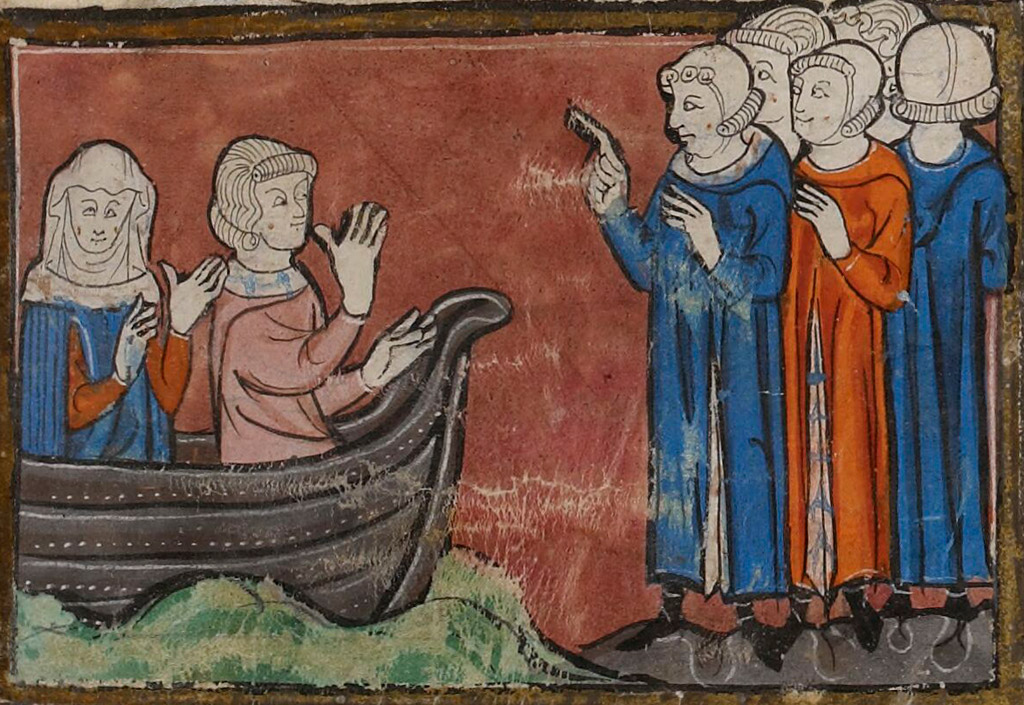
Boeve and Josiane traveling by boat to England

* * * * *

Read more:

Notes:

The above story of Josiane and Boeve of Hampton is from the twelfth-century Anglo-Norman work Boeve de Haumtone, also known as Beuve de Hamptone. Just as Boeve is also known as Beuve, Josiane is also known as Josian. Whether Boeve de Haumtone is a medieval romance or a “song of deeds {chanson de geste}” is a matter of scholarly controversy. Ailes (2008). The story is set during the reign of King Edgar of England, who reigned 959-975.

The Egyptian princess Josiane was a Saracen, a medieval Christian term for Muslim. On the cultural geography of the story, Blurton (2019). Like the Saracen princes Guiborc, Josiane is both a domineering and loving woman. Her dramatic initiative in grabbing hold of the lion to lessen the risk to Boeve’s life puts her in the line of proto-meninist women who act to lessen violence against men. Cf. Waugh (2018). Boeve’s remarkable willingness to defy his beloved Josiane’s will points to medieval Christian understanding of an equal conjugal partnership. Cf. Saunders (2008). Nonetheless, violence in Boeve de Haumtone is overwhelmingly violence against men. Many unnamed, voiceless men are brutally killed in this story.

Boeve’s father was Count Gui of Hampton. As an old man, he was disparaged for never having married. To quell such criticism, he married the young, beautiful daughter of the king of Scotland. They had the son Boeve. When Boeve was about ten years old, his mother sent a message to Doon, Emperor of Germany, promising to marry him if he killed her husband Gui. When Doon agreed, she sent Gui into an ambush, where Doon beheaded him. She married Doon the day after he killed her husband.

The story of Boeve and Josiane was widely distributed. The Anglo-Norman version is the oldest surviving version, while continental Old French and Franco-Italian versions also exist. The Anglo-Norman version apparently was adapted into Middle English and gave rise to the surviving text known as Bevis of Hampton, dating about 1324. For an edition, Herzman, Drake & Salisbury (1999) and for a modernized English version, Scott-Robinson (2019). For an edition and English translation of a fifteenth-century Irish version, Robinson (1907). Medieval prose translations also exist in Dutch, Romanian, Russian, Welsh, and Yiddish.

The above quotes are from the Anglo-Norman Boeve de Haumtone, Old French (Anglo-Norman) text from Stimming (1899), English translation (modified) from Weiss (2008). The current best edition, Martin (2014), wasn’t readily available to me. The above quotes are vv. 670-7 (Beautiful sir Boeve, I won’t seek to hide it…), 680-7 (“My beautiful young lady,” so said to her Boeve…), 695-705 (By God! Sir Boeve, you tell the truth…), 756-7 (“Wake up, beautiful, sweet, dear friend,”…), 999-1007 (She had learned some kind of enchantment…), 1390-2 (“Alas,” she said…), 1428-31 (“Certainly not,” he said…), 1467-8 (“By God,” said the young woman…), 1477 (unless she was a virgin without falsification), 1480-8 (“Boeve,” said Josiane…), 1675-7 (Alas, sir Boeve, you delay…), 1696-1704 (Josiane saw Boeve and started to shout…), 1707-20 (He gripped his strong shield…), 1722 (May Jesus Christ, who was born of a mother, protect you), 2110-6 (Before Miles could come into their bed…), 3831-6 (“Beautiful son,” she said, “call Boeve to me.”…).

[images] (1) Boeve of Hampton imprisoned by King Bradmund of Damascus. Illumination from instance of Beuve de Hantone made about 1280 in northern France. From folio 18r of Bibliothèque nationale de France, MS. Français 25516. (2) Boeve disguised as pilgrim meets Queen Josiane at Munbraunt. Similarly from folio 24v of Beuve de Hantone, MS. Fr. 25516. (3) Boeve (Bevis of Hampton) killing two lions. Boeve (Bevis of Hampton) killing two lions. Illumination in The Taymouth Hours (Book of Hours, Use of Sarum) made in the second quarter of the fourteenth century in England. From folio 12r (via Wikimedia Commons) of British Library MS. Yates Thompson 13. (4) Boeve and Josiane traveling by boat to England. Similarly from folio 50r of Beuve de Hantone, MS. Fr. 25516.

References:

Ailes, Marianne. 2008. “The Anglo-Norman Boeve de Haumtone as a chanson de geste.” Chapter 1 (pp. 9-24) in Fellows & Djordjević (2008).

Blurton, Heather. 2019. “‘Jeo Ai Esté a Nubie’: Boeve de Haumtone in the Medieval Mediterranean.” Neophilologus. 103: 465–77.

Fellows, Jennifer and Ivana Djordjević, eds. 2008. Sir Bevis of Hampton in Literary Tradition. Woodbridge UK: D.S. Brewer.

Herzman, Ronald B., Graham Drake, and Eve Salisbury. 1999. Four Romances of England: King Horn, Havelok the Dane, Bevis of Hampton, Athelston. Kalamazoo, Mich: Published for TEAMS (the Consortium for the Teaching of the Middle Ages) in association with the University of Rochester by Medieval Institute Publications, Western Michigan University.

Martin, Jean-Pierre, ed. 2014. Beuve de Hamptone: Chanson de geste anglo-normande de la fin du xiie siècle, édition bilingue établie, présentée et annotée. Paris, France: Honoré Champion. Review by Claude Lachet.

Robinson, Frank N., ed and trans. 1907. The Irish Lives of Guy of Warwick and Bevis of Hampton. Halle a.S: M. Niemeyer.

Saunders, Corinne. 2008. “Gender, Virtue and Wisdom in Sir Bevis of Hampton.” Chapter 10 (pp. 161-175) in Fellows & Djordjević (2008).

Scott-Robinson, Richard, trans. 2019. Sir Bevis of Hampton. eleusinianm. Online.

Stimming, Albert, ed. 1899. Der Anglonormannische Boeve De Haumtone. Halle: M. Niemeyer.

Waugh, Robin. 2018. “Josian and the Heroism of Patience in Bevis of Hampton.” English Studies. 99(6): 609–23.

Weiss, Judith, trans. 2008. Boeve de Haumtone and Gui de Warewic: Two Anglo-Norman Romances. Medieval and Renaissance Texts and Studies, 332; The French of England Translation Series, 3. Tempe, AZ: Arizona Center for Medieval and Renaissance Studies.

greedy, deceitful & corrupt elites: a medieval perspective

Writing about 1020, the medieval schoolteacher Egbert of Liège contrasted the austere, pious lives of ancient Christian hermits with modern Christian bodily indulgence:

After a hard life, they deserved blessed rest.
But we, stuffed on fowl and fatty game,
are like filthy pigs, such as those who are Epicureans.
False Christians, called Christian in name only,
deviants in our deeds, we care only for our bodies,
not for our souls, made by bowels and lethargy.

{ Duram post vitam requiem meruere beatam.
At nos altilibus pleni pinguique ferina,
porcis inmundis similes, ut sunt Epycuri,
Christicolae falsi, solo de nomine dicti,
factis digressi, curamus corpora tantum,
non animas matie confectas atque veterno. }[1]

Too much food and too little activity make for neither a healthy body nor a healthy soul. Priests and bishops were supposed to instruct and guide medieval Christians in care for their bodies and souls. Some medieval priests and bishops, however, were greedy, deceitful, and corrupt.

making a boy abbot: twelfth-century simony

Drawing upon a homily that Pope Gregory I preached in 591, Egbert denounced bad priests and bad bishops. The Gospel of Luke describes the first Christian missionaries as being sent to be like lambs among wolves. That mission of self-sacrifice was subject to change:

God does not endure a greater injury, I think
than what they do, they whom he appointed to be teachers —
I speak about priests sent widely among the sheep
and to whom has been entrusted correction of their people.
They offer themselves as depraved examples of evil deeds,
when they sin, they who should be restraining others’ faults.
And what is even more serious, frequently they seize others’ goods,
they who should be distributing their own. What will happen to the flocks,
tell me, when the shepherds have become wolves?
We priests are not seeking profit for any souls,
but, intent on our concerns, we void our hearts.

{ Non preiuditium tolerat deus, ut puto, maius,
Quam fatiunt, quos constituit superesse magistros
(Dico sacerdotes late per ovilia missos
Et quibus est permissa suae correctio plebis):
De se prava operum prebent exempla malorum,
Dum peccant, qui debuerant compescere culpas;
Et plerumque, quod est gravius, rapiunt aliena,
Qui sua debuerant dare. De gregibus quid agatur,
Dicite, quando lupi pastores efficiuntur?
Lucra sacerdotes non querimus ulla animarum,
Intenti ad studium nostrum sed mente vacamus. }[2]

A shepherd not being a wolf isn’t enough for him to be a good shepherd. The good shepherd lays down his life for his sheep. The bad shepherd looks after his own interests. Drawing upon the work of the fifth-century Christian priest Julianus Pomerius, Egbert reproved priests for not reproving sins:

O you prelates, not in caring but in name only!
Seeing those entrusted to you struggling and downcast,
for love of filthy money you don’t reprove them when they slip.
You will be purified when God the Avenger hastens torments upon you.

A thousand coals will burn up your neglected acts
and in vain you will beg for the comforts of dripping water.

{ O vos prelati, non cura at nomine solo!
Commissos vobis niti per prona videntes,
Turpis amore lucri non corripitis labefactos.
Inproperante deo poenas ultore luetis,

Neglectus vestros carbonos mille cremabunt,
Et frustra stillantis aquae fomenta petetis. }[3]

Reproaching others is often an unpleasant endeavor. Here in this world, one gets along better by going along.

What can one do besides wait for God’s justice? Medieval authors wrote vigorous satire against greedy, deceitful, and corrupt elites. A twelfth-century cleric observed:

So as to allow their mortal mouths to be set against Heaven,
the people’s elders, the fathers, and rulers
to pleasures and corruption devote
time that they should be spending in contemplation.

Because our holy teachers are not occupied with good acts,
but are quick to wickedness and prone to self-indulgence,
deferring neither to God nor to religion,
what would you agree a tender beginner should do?

{ Ut mortale liceat os in caelum poni,
seniores populi, patres et patroni
quae deberent tempora contemplationi,
deputant deliciis et corruptioni.

Cum non bonis actibus studeant rabboni,
sed in scelus celeres et in luxum proni
neque Deo deferant nec religioni,
quid agendum censeas tenero tironi? }[4]

Drawing in part on the classical Roman satirist Juvenal, the medieval cleric contrasted God’s cosmic justice with pandering and hypocrisy:

When subordinates flatter their prelates with their tongues,
offering gifts with their hands, and seeking favor with their deeds,
subordinates share a role with Simon,
while the prelates follow Gehazi in seeking gifts.

Cautiously but illicitly they are preoccupied with selling.
The need is that they finally divest themselves of this work.
If they delude us in this, they will not mock God,
to whom those who conceal their crimes will reveal their secrets.

To speak about virtue after wriggling one’s buttocks
is sufficiently far removed from earning salvation.
The Lord indeed knows who, on the inside and the outside,
has the character of a well-ordered mind.

{ Cum praelatis subditi lingua blandiuntur,
manu dona porrigunt, factis obsequuntur,
subditi cum Simone partem sortiuntur,
praelati post Giezim munera sequuntur.

Caute sed illicite licitari student.
Opus est ut opera tandem se denudent:
si nos hi deluserint, illi non illudent,
cui, qui celant scelera, clausa tunc recludent.

Agitatis clunibus loqui de virtute
promerenda satis est procul a salute;
novit enim Dominus intus et in cute
cui sit mentis habitus bene constitutae. }[5]

Human beings are essentially ridiculous. The world has been going to Hell for a long, long time.

sixteenth-century corruption in acquiring a benefice

Nonetheless, today one can still see green trees and blue skies. Many human beings do many good deeds. While criticizing greedy, deceitful, and corrupt priests and bishops, Egbert, himself a priest, followed the biblical Letter of James and Saint Augustine in advocating mercy:

By no moral activity is the enemy so defeated
as when a person is warmed with the spark of a merciful heart.
In Judgment, one will be sentenced without any pity
if here he is not clement and pardoning of faults.
The clemency of a brother overcomes the fearsome Judgment.

{ In nullo morum studio sic vincitur hostis,
Quam cum quis caleat miserentis fomite cordis.
Iuditio multabitur absque ulla pietate,
Si non hic fuerit clemens culpaeque remissor;
iuditium superat pavidum clementia fratris. }[6]

To be merciful and to pardon sins, one must be able to recognize them. The medieval schoolteacher Egbert of Liège taught that forgiving wrongs isn’t the same as ignoring them. In this specific respect, he certainly should be regarded as a proto-meninist.

* * * * *

Read more:

Notes:

[1] Egbert of Liège, The Well-Laden Ship {Fecunda ratis} 2.566-71, Latin text and English translation (modified) from Babcock (2013). These verses are titled “About Hermits {De heremitis}.” Subsequent quotes from Egbert’s Fecunda ratis are similarly sourced. Babcock’s Latin text is nearly substantively identical to that of Voigt (1889).

[2] Fecunda ratis 2.333-43, from poem titled “About any bishop you choose {De quolibet episcopo}.” Cf. Luke 10:3, Matthew 7:15.

For this poem Egbert evidently drew upon Pope Gregory I, 40 Homilies on the Gospels {Homilae xl in Evangelia}, Homily 17 on Luke 10:1-9, sections 14-18. Gregory wrote, “Consider therefore what would become of flocks when shepherds turn into wolves {Considerate ergo quid de gregibus agatur, quando pastores lupi fiunt}.” Latin text of Migne (1849) in Patrologia Latina 76.1075-1181, my English translation. Here’s an English translation of the whole homily. For English translations of all of Gregory’s homilies on the gospels, Hurst (1990).

Egbert elsewhere complained that men were becoming priests and bishops through bribes:

Some are ascending to the pulpit and ecclesiastical rank
not by merits, but indeed by money’s curse, I fear.

{ Orcestram aecclesiaeque gradus ascendere quosdam
Non meritis, immo dampnata per aera pavesco. }

Fecunda ratis 1.949-50.

[3] Fecunda ratis 2.36-9, 45-6, from poem titled “About those who don’t reprove those persons entrusted to them {De his, qui non corripiunt commissos}.” On the good shepherd laying down his life for his sheep, John 10:11. On a man in Hell begging for drops of water, Luke 16:24 (from the parable of the rich man and Lazarus).

Egbert here drew upon Julianus Pomerius, About the contemplative life {De vita contemplativa} 1.20. For an English translation, Suelzer (1947).

[4] Twelfth-century poem, incipit “Talking about the poor is a sign of an impoverished pen {Loqui de pauperibus pauperis est styli},” no. 4 in Chartres Anthology (MS. VAt. lat. 4389), stanzas 2-3, Latin text and English translation (modified slightly) from Traill & Haynes (2021) p. 123.

This poem in written in Goliardic stanzas. Goliardic poetry came mainly from the highest institutions of medieval learning:

Goliardic poetry was written in a time frame between circa 1115 and 1255 in the school system of secular clergy between Loire and Somme, and mainly in the cathedral schools of that region

Weiß (2018), abstract.

[5] “Loqui de pauperibus pauperis est styli,” stanzas 9-11 (of 11), sourced as previously. Simon Magus attempted to purchase the early Christian apostles’ ability to confer the Holy Spirit. Acts 8:9-24. Simon’s commercial orientation originated the term “simony.”

Gehazi, the servant of Elisha, sought money from Naaman the Syrian for Elisha having cured Naaman of leprosy. 2 Kings 19-27.

In denouncing hypocrisy, Juvenal scornfully declared, “they talk of manliness / after wriggling their buttocks {de virtute locuti / clunem agitant}.” Juvenal 2.20-1, cited in Traill & Haynes (2021) p. 173, n. 33. Walter of Châtillon similarly used Juvenal’s phrase. Id.

Jerome castigated the Deacon Sabinianus for his lechery: “like a glutton you ran through filthy whorehouses {per lupanaria inpurus et helluo cucurristi}.” Jerome, Letter 147, “To Deacon Sabinianus exhorting him to penance {Ad Sabinianum Diaconum cohortatoria de paenitentia},” section 4, Latin text from Hilberg (1910-1918) p. 319, my English translation. Freemantle (1892) has an English translation of Jerome’s letter to Sabinianus.

About 1050, the Benedictine monk Peter Damian in his Book of Gomorrah {Liber Gomorrhianus} condemned simony, priests maintaining women as concubines, and priests having sex with men and boys.

[6] Fecunda ratis 2.187-91, poem “On mercy {De misericordia}.” Cf. James 2:13 and Augustine of Hippo, Expositions on the Psalms {Enarrationes in Psalmos} 144 (143) 2.

[images] (1) Making a boy abbot: twelfth-century simony. From a twelfth-century instance of Gratianus’s Decretum. On folio 59v of Douai, Bibliothèque municipale, MS. 0590. (2) Corruption in acquiring an ecclesiastical benefice: Cardinal Marco Corner making the young boy Marco the abbot of Carrara. Girolamo Corner, the boy’s father and Cardinal Corner’s young brother, observes the transaction. Painting by Titian, c. 1520/1525. Preserved as accession # 1960.6.38 in the National Gallery of Art (Washington, DC). Credit: Timken Collection. The seven-year Marco Corner received this benefice in 1519. The National Gallery’s overview for this painting observes, “The Corner family was one of the wealthiest and most influential in Venice.”

References:

Babcock, Robert Gary, ed. and trans. 2013. Egbert of Liège. The Well-Laden Ship {Fecunda ratis}. Dumbarton Oaks Medieval Library, 25. Cambridge, MA: Harvard University Press.

Freemantle, William Henry, trans. 1892.  The Principal Works of St. Jerome.  Philip Schaff, ed. Nicene and Post-Nicene Fathers, 2nd Series, vol. 6. Oxford: Parker.

Hilberg, Isidorus, ed. 1910-1918. Sancti Eusebii Hieronymi Epistulae {Letters of Saint Eusebius Hieronymus (Jerome)}. Vindobonae: Tempsky. Corpus Scriptorum Ecclesiasticorum Latinorum (CSEL) 54 (Epistulae 1-70), 55 (Epistulae 71-120), and 56 (Epistulae 120-154).

Hurst, David, trans. 1990. Gregory the Great. Forty Gospel Homilies. Kalamazoo, MI: Cistercian Publications.

Suelzer, Mary Josephine, trans. 1947. Julianus Pomerius: The Contemplative Life. Ancient Christian Writers, 4. Westminster, MD: Newman Press.

Traill, David A and Justin Haynes. 2021. Education of Nuns, Feast of Fools, Letters of Love: Medieval Religious Life in Twelfth-Century Lyric Anthologies from Regensburg, Ripoll and Chartres. Leuven: Peeters. Latin text and English translation, with commentary.

Voigt, Ernst, ed. 1889. Egberts von Lüttich Fecunda Ratis, zum ersten Mal herausgegeben, auf ihre Quellen zurückgeführt und erklärt von Ernst Voigt. Halle A.S.: M. Niemeyer. Online presentation.

Weiß, Marian. 2018. Die mittellateinische Goliardendichtung und ihr historischer Kontext: Komik im Kosmos der Kathedralschulen Nordfrankreichs {Medieval Latin Goliardic Poetry and its Historical Context: Comical Elements in the Cosmos of the Cathedral Schools of Northern France}. Inaugural-Dissertation zur Erlangung des Doktorgrades der Philosophie des Fachbereichs 04 der Justus-Liebig-Universität Gießen.

Floretta and Maugalie fought for Floovant in medieval epic

Amid the massive violence against men in epic literature, women seldom are killed. Women predominately fight not enemy soldiers, but women-rivals in love for a particular man. In the twelfth-century “song of deeds {chanson de geste}” Floovant, the Alsatian princess Floretta and the Saracen princess Maugalie fought fiercely for the love of the French knight Floovant. The woman who prevailed rescued her beloved man from prison while engaging in what’s now recognized as criminal sexual behavior. Most importantly, she showed compassion for his feelings.

Exiled from his father’s realm and journeying in hope of serving King Flores of Alsace, Floovant saw three Saracen knights abusing a young woman. As men have done throughout the ages, Floovant risked his life to save the damsel in distress. He learned after rescuing her that she was Princess Floretta, the daughter of King Flores.

King Flores held a feast to celebrate the return of his daughter Floretta to his palace at Belfort. She sat across from Floovant. Unlike many self-fashioned princesses today, the actual medieval princess Floretta was a strong, assertive woman. She spoke her mind to Floovant:

“Do kiss me, beautiful sir,” said Floretta known for her prized body.
“There isn’t a man in this world whom I desire so much.”

{ “Car me baisiez, bau sire,” dit Florote au cors gant;
“Il n’ai ome an cest segle que je dessiere tant.” }

Floovant didn’t crudely say “no,” and then “no means no.” He begged her to stop her amorous pleading. He explained that he was merely a poor, traveling knight. He worried that her love for him would cause nobles of her palace to accuse him of doing wrong. Floretta ultimately respected his love choice, but chided him:

Now so be your desire.
It’s for Maugalie that you would talk such.
I think well that you love her, because she has a prized body.
But for her body would yet be another 100 men like you.
All of them torment themselves for her, and they are there serving her.
And if one of them died, the others would be still living.
The grief that is her domain isn’t at all worth death.

{ … Or soit vostre talant.
Ce est por Maugalie où vos parlestes tant.
Bien la devez amer, car elle ai le cors gant;
Mas de tex com vos estes en aurai ancor .c.
Tut se penent por li et i sont atandanz,
Et se li uns est mors li autres sunt vivanz.
Le doel que ele demoine ne vaut à mor néant. }

Floovant perceived Floretta’s enmity toward Maugalie, but apparently he didn’t know who that woman was. He sensed that Maugalie had wronged Floretta, but he didn’t know how. Men are oblivious to competition among women for men’s love.

Floovant and Alsatian knights subsequently captured Maugalie when they took the castle at Avenant from the Saracen king Galeen. Maugalie was Galeen’s daughter. She saw Floovant vigorously thrusting in battle before the Alsatian force captured her. She was a beautiful young woman. She yearned to have Floovant in love.

After the battle for Avenant Castle, Maugalie and Floretta argued viciously. Maugalie stood next to Floretta as Floovant divided the spoils among the knights. A strong, assertive woman, Maugalie spoke her mind aloud:

If it were pleasing to Mahomet, who established the world —
this French soldier, who is valiant and loyal,
he would marry me as his principal wife.
If he kept me, my father, the rich Emir,
would give me more land than the Roman Empire could want.

{ Car plaüst à Maon, qui le segle estora,
Ce soudoiiers de France qui prouz est et loiaus,
Qu’i m’éut prisse à famme, à moilier principel.
Si me tenist mes pères, li riches amiraus,
Plus me donroit de terre Romenie ne vaut. }

Floretta turned to Maugalie and chided her, “You have too intense passion {vos avez trop grant chaut}.” Floretta then crassly said that Floovant would get Maugalie pregnant and then have sex only with his three other wives. Some Christian men aspired to have multiple wives as some Muslim men did, but some Christian men soon realized they lacked the necessary sexual stamina. Maugalie fiercely counterattacked Floretta:

By my faith, young lady, very base are your jibes.
Not yet one month has passed since you spoke totally other.
I saw you at the court of my father the Emir,
and to a hundred or to fifty knights you were very intimate,
each for one dollar, like a common whore.

{ Por ma foi, damoiselle, moult sont vilains vos gas.
N’ai pas ancor .I. moi, vos parlates tot d’aul:
Je vos vi à la court mon pere l’amiraur
A .c. et à .L. trestote communaul,
Chacuns por .I. denier, comme fanme venaul. }

Floretta in response insisted on her chastity. Deriding Maugalie’s fidelity, she pointed out that Floovant had killed Maugalie’s brother and her lover:

Now you wish to marry the man who has killed them!
So you would have thirty men, if they would be given to you.
Cursed be one who believes you, and never will I believe you!

{ Or volés celui panre qui ocis les vos ai!
Si ferïés vos .xxx., si fust qui vos donast.
Dahez ait qui vos croit ne qui jai vos crorai. }

Like the quarreling sisters Rose and Lily, Maugalie and Floretta fought more and more viciously:

Strongly they argued about this and that.
They would have struck each other if one hadn’t separated them.

{ Formant se contralient a deçai et délai;
Jai venisent ansanble quan l’on les desservrai. }

The job of separating arguing women should be taken up by women. Men shouldn’t be burdened with that additional, very dangerous combat task.

two women fighting with each other

The Saracen princess Maugalie ultimately won her fight with the Alsatian princess Floretta. In a reversal of fortune, the Saracens liberated Maugalie and captured Floovant. From her dominant position relative to the captive Floovant, Maugalie coerced him into marrying her. In short, she raped him as rape is now defined in at least one gender direction. Then, with Floovant and other escaping captives, Maugalie left the Saracen palace.

During their escape, Maugalie disguised herself as a knight. Floovant jokingly called her “Forqueres,” which could mean “Strong Heart.” When Floovant asked her why she didn’t wear armor or carry a sharp sword, Maugalie explained:

“Sir,” said the young woman, “I don’t seek any arms.
I have my other arms that aren’t so large,
and other arts that I have I’ll need at Belfort,
there where the daughter of the rich King Flores is.
In the hostilities, sir, I must be very strong.
One Saturday morning she said to me such shots
at Avenant Castle where I had come, as you heard.
I wouldn’t wish that for anyone alive.
It was for me then very difficult, because she has a prized body.
And so I turned my eyes and put a smile on my mouth.
If you want to do her, sir, I would have no thought of it.
Two times, or three, or four, then let her alone,
and I will move well for the goods in the marital chase for you.”

{ “Sire,” dit la pucelle, “je ne an quier néant;
Mes autres armes c’ai ne sont mie si granz:
Mestier m’auront ancores à Biaufort çai devant,
Lai où la file est au riche roi Floran.
Des contraïres, sire, me dot je mout formant:
.I. sanbadi matin m’an dit ele jai tant
Au Nof Chatel où je iere, vos ouroiles oiiant,
Je ne vosise mie por nule riens vivant.
Mult durement m’an pois, car ole ai le cors gant,
Et si ai vars les iauz et la boiche riant.
Se vos li faites, sire, moi n’an pese néant,
.II. foiz ou .III. ou .IIII., puis la lasiez atant,
Et je an irai bien lou marchié porchaçant.” }

The Saracen princess Maugalie was extraordinarily generous and compassionate toward the man she loved. Even with just a little generosity and compassion toward a beloved man, a woman typically can tower above her love rivals for him.

The battle between Maugalie and Floretta back at the Avenant Castle went as would be expected. Floretta acted vigorously as soon as she saw the beautiful Maugalie:

She ran and came to Floovant’s villa.
Here where she saw him, with her arms around his neck she pleaded:
“Do kiss me, lovely sir, you noble, valiant knight.
I have no man in the whole land whom my heart loves so much.”

{ Corant i est venue à l’ostel Floovant.
Lai où elle le vit, ses braiz au coul li pant:
“Car me baisiez, bau sire, frans chevaliers vailanz;
Ja n’ai il ome an terre que mes cours amoit tan.” }

Floovant again claimed that he wasn’t worthy to love Floretta. He urged her to stop pursuing him. She saw right through his excuse:

She responded to him, “Sir, as you desire.
This is because of Maugalie, the daughter of the Emir.
Well you are insanely in love with her, because I’ve heard of her prized body.
There isn’t such a beautiful lady-lord here in the West.
Gladly I would have wed you, if you had the desire.
Since it cannot have you, my heart has grief.”

{ Elle li respondi: “Sire, à vostre talant.
Ce est por Maugalie, la file l’amiram;
Bien la devez amer, car oie ai le cors gant:
Il n’ai tant baie dame deci en Ocidam.
Volontiers vos préise, si vos fut à talant;
Quant ne vos puis avoir, le cour an ai dolant.” }

Like most men, Floovant surely appreciated Maugalie’s beautiful body. Yet she won his heart with what she did for him. Floretta never had a chance in her love battle with Maugalie:

“Lady-lord,” said Floovant, “Cease now to fight further.
Maugalie is my beloved, or the fitting heart.
That would not change with limbs lost,
because she saved me from extraordinary torment,
and I will wed her to everyone’s praise as my prize.”

{ Dame, dit Floovanz, dès or poignez avant,
Maugalie est ma drue, o le cors avenant,
Ne li faudroie mie por les manbres perdanz,
Car ole m’ai gari de mervoilous tormant,
Et je l’esposerai por lou los de ma gant. }

Floretta left weeping. She went to see her father King Flores .

King Flores was deeply distressed to see his daughter weeping. He immediately, urgently summoned Floovant. He ordered Floovant to marry Floretta and promised to bequeath to him the whole kingdom. But no earthly authority could overturn Floovant’s promise to marry Maugalie. Floovant told this father-king seeking to fulfill his daughter’s desire in love:

Sir, that cannot be, as I know for certain.
There is a young women, with a fine body,
who from prison has delivered me and all the other French
where we were to be hung by the order of the Emir of Persia.
A young woman saved us from death and from torment.
All my men saw that I have pledged my faith
that I will marry this woman, if God be pleased to consent.
I will not renege on my pledge even if I were to be beheaded.

{ Sire, ce ne pout estre, sachez certenemant.
Ci ai une pucelle, o le cors avenant,
Qui m’ai mis fors de chartre et toz ces autres Frans;
Lai où nos devoit pandre l’amiraus des Persam,
Nos gari la pucelle de mort et de tormant.
Ma foi li ai plevie, voiant tote ma gant,
Que fanme la prandroie, se Dex lou me consant;
Je ne l’an matiroie por la teste perdant. }

A woman can’t always get what she wants, even if her father is a king. But surely she can get what she needs.

Floovant suggested that Floretta marry his kinsmen Richier, a vigorous knight. Floretta agreed to this proposition. As for Richier, Floovant treated him as if he were merely a commodity to be offered in an exchange to serve a woman’s interest. Richier said that he would do whatever Floovant ordered. Floretta and Richier thus married. Despite the lack of textual respect for Richier as an individual human being, perhaps Floretta didn’t willfully deny him the medieval debt to one’s spouse and treated him with respect as an equal conjugal partner.

Women fighting against women for men’s love doesn’t effectively function to make men’s lives matter. Men that women fight over as prizes tend to be deprived of their humanity and individuality. Women should unite to move forward in the progressive meninist project of promoting appreciation for men as human beings, not dogs or pigs. Social justice for men begins with women’s compassion for men.

* * * * *

Read more:

Notes:

Floovant is a chanson de geste composed by an unknown author towards the end of the twelfth century. The quotes above are from the Old French text of Michelant & Guessard (1859) and my English translation, benefiting from the poetic translation of Newth (2014). The current best edition is Andolf (1941). That edition wasn’t readily available to me.

Newth translated the name for Maugalie dressed as a knight, “Forqueres,” as “Sir Faucon.” In Old French, “faucon” means “falcon,” but can also be interpreted as “false cunt.” Although Maugalie disguised herself as a knight to escape from her father’s palace, she was a loyal woman in love with Floovant. She was also a big-hearted woman. She undoubtedly would forgive Newth for his offensive name for her.

The quotes above are Floovant, vv. 506-7 (Do kiss me, beautiful sir…), 514-20 (Now let that be your desire…), 643-7 (If it were pleasing to Mahomet…), 648 (You have too intense passion), 655-9 (By my faith, young lady…), 667-9 (Now you wish to marry the man…), 670-1 (Strongly they argued…), 1792-1804 (“Sir,” said the young woman…), 2185-8 (She ran and came to Floovant’s villa…), 2202-6 (She responded to him…), 2222-9 (Sir, that cannot be…).

[image] Two women fighting with each other. Photo by Mark Bonica. Generously shared on flickr under a CC By 2.0 license. Also on Wikimedia Commons. Some medieval Viking women-warriors fought against men.

References:

Andolf, Sven, ed. 1941. Floovant: Chanson de Geste du XIIe Siècle, Publiée avec Introduction, Notes et Glossaire. Uppsala, Sweden: Almquist & Wiksell.

Michelant, Henri and François Guessard, eds. 1859. Floovant, chanson de geste publiée pour la première fois d’après le manuscrit unique de Montpellier. Les anciens poètes de la France, 1. Paris: Jannet. Digital edition of Jean-Baptiste Camps; alternately on Github.

Newth, Michael, trans. 2014. Heroines of the French Epic: A Second Selection of Chansons de Geste. Woobridge: D. S. Brewer.

Jerome to Dante: men’s ardent sexual desire for women

About the year 375 GC, Jerome’s friend Heliodorus decided to leave solitary life as a desert monk. Jerome knowingly warned him about perils of worldly life:

These dangers I forewarn not as a learned sailor, with ship and cargo intact, speaking to those ignorant of the sea, but rather like some newly shipwrecked sailor cast upon the shore. I address my faltering voice to those about to sail. On one side, the Charybdis strait of self-indulgence engulfs salvation. On the other side is the Scylla of lust. With beaming, virginal face, she prompts us to the shipwreck of chastity.

{ haec ego non integris rate vel mercibus quasi ignaros fluctuum doctus nauta praemoneo, sed quasi nuper naufragio eiectus in litus timida navigaturis voce denuntio. In illo aestu Charybdis luxuriae salutem vorat, ibi ore virgineo ad pudicitiae perpetranda naufragia Scyllaceum renidens libido blanditur }[1]

Jerome in the desert imagined chorus girls, and he lusted after them. Such desire would be much more dangerous at a city feast where actual young women were singing and dancing. Being a Christian saint like Jerome or having as keen a sense of Hell and Heaven as Dante did doesn’t prevent a man from ardently desiring women.

Jerome spoke frankly about sexual desire to the elite Roman women who were among his close friends. The young Roman woman Eustochium, whom Jerome taught, committed herself to perpetual virginity in 384. Jerome warned Eustochium:

It grieves me to say how many virgins fall daily, what number are lost from mother church’s embrace, over how many the proud enemy places his throne, and how many rocks the serpent bores into and dwells within their holes.

{ Piget dicere, quot cotidie virgines ruant, quantas de suo gremio mater perdat ecclesia, super quot sidera superbus inimicus ponat thronum suum, quot petras excavet et habitet coluber in foraminibus earum }[2]

Jesus founded the Christian church upon a male rock — the apostle “Peter {Petrus},” formerly called Simon. The church, however, has long been understood as a woman (“mother church {mater ecclesia}”). Jerome understood virgin women dedicated to God as supporting rocks within the foundation of the church. The imagery of a snake making a hole within a rock and dwelling there disparages men’s penises in sexual intercourse with a virgin woman. Jerome elaborated upon that imagery by immediately discussing unmarried women becoming pregnant.[3] While Christians value children as a blessing from God, Jerome warned Eustochium that illicit sex could lead to pregnancy and associated difficulties.

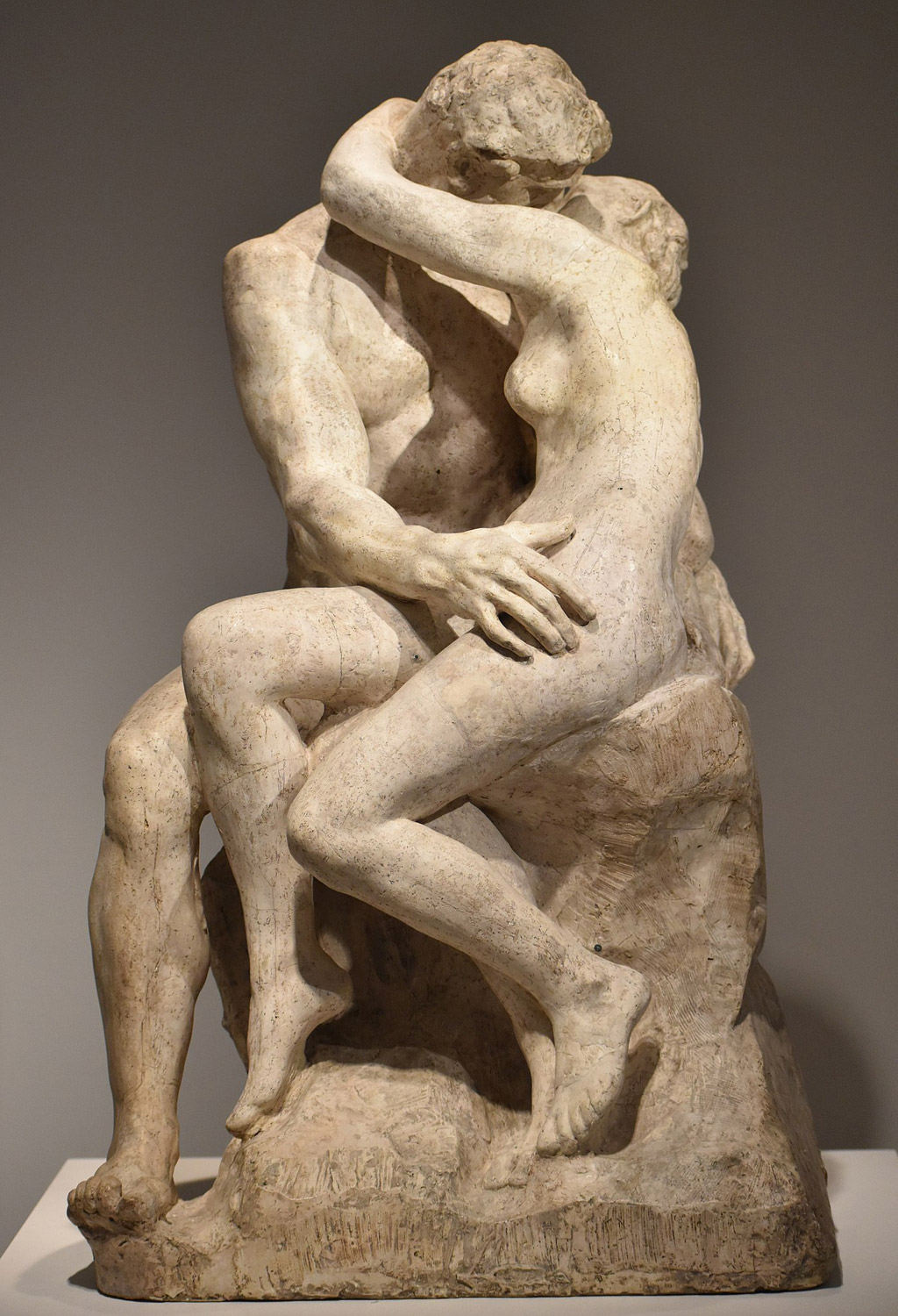
Auguste Rodin, The Kiss sculpture

Many medieval men inordinately desired sex with women. This was the case even with a bishop in twelfth-century France. He became the butt of witty satire:

For a price he has his stomach
invited to dinner
and Venus in his bed,
and such, purchased for more,
delights him more fully
than when it’s a cheaper commodity.

He’s entirely devoted to Venus.
No other planet’s course
does he follow.
He’s wholly libidinous.
The man’s entire “law and prophets”
is based on this.

If denominated
according to the duty
that is done every morning,
you would have designated
seven days of Venus
in every week.

{ Invitatur pretio
venter in convivio,
Venus in cubili;
et hoc empto carius
delectatur potius
quam hac merce vili.

Tonus est Venerius
nec cursum alterius
sequitur planetae.
Totus est libidinis;
hinc tota lex hominis
pendet et prophetae.

Si denominatio
fiat ad officio,
quod fit omni mane,
deputare poteris
septem dies Veneris
omni septimanae. }[4]

In medieval European literature, Venus means both a planet and goddess of love. Venus here specifically means a prostitute in the bishop’s bed. Christians revere Hebrew scripture as the “law and prophets.” This bishop’s bible was sex, and he had sex seven days a week.

During the twelfth century, the western half of the Christian church decreed that priests couldn’t marry, nor have concubines. Some priests objected to this restriction on their love for women. They contrived arguments for priests marrying:

If perhaps you were to preach to him
that bishops should be
pure of self-indulgence,
he would regard this as silly.
He would prefer with the apostle
to marry rather than burn.

If you were to say, “Be continent,”
he would say, “In the volume
by Paul is contained the advice,
not that one should be continent,
but that each should have his own woman
with whom to fornicate.”

{ Cui si forte praedices
quod debent pontifices
esse luxu puri,
id habens pro frivolo
mavult cum apostolo
nubere quam uri.

Cui si dicas “contine,”
dicet, “In volumine
Pauli continetur
non ut quis contineat,
sed ut suam habeat,
cum qua fornicetur.” }[5]

Christian scripture celebrates both celibacy and sexual relations within marriage between a woman and a man. Just as many persons have done throughout the ages, the bishop misread scripture to serve his own sexual interest.

The eminent twelfth-century poet Walter of Châtillon, who authored the satire of the licentious bishop, attested to his own sexual vigor. In the satire’s penultimate stanza, Walter spoke about its author:

For him who does nothing, even at night,
without witnesses
that are vigorous and lively,
it is right for him to be called
for testimony about whether his
witnesses be diminished.

{ Qui nil vel in noctibus
agit absque testibus
vegetis et vivis,
fas in testimonium
produci si testium
sit deminutivis. }[6]

In Latin, testes can mean both “witnesses” and “testicles.” Moreover, testiculi, the diminutive of testes, can mean both “manliness” and “testicles.” One can imagine testes diminished by ejaculation. Walter here learnedly suggests that a test of his manliness is whether he will testify as to the name of the bishop he satirizes. Walter put forth the bishop’s name obliquely.[7] He thus characterized himself as less vigorous and lively in speaking poetry than in having sex.

The twelfth-century canonist Peter of Blois depicted his girlfriend Venus treating him as if he were patronizing a prostitute. She teased him, and he wasn’t satisfied:

I will inveigh against Venus
if she doesn’t repent
and unlearn
her inveterate
spirit of ill will,
which with in beginnings
she caresses
and with auspicious caressings
contrives
a sad outcome.

{ Invehar in Venerem
nisi resipiscat
et dediscat
veterem
malignandi spiritum,
quo principiis
blanditur
et blanditiis
molitur
tristem lactis exitum. }[8]

With intricately shifting wordplay, the poem’s refrain explains what Peter perceived as misrepresenting:

It isn’t sufficiently pleasing
unless Venus freely
confers herself.
If she comes so as to sell herself,
she debits
when she should better bless.

{ Non est grata satis,
ni se Venus gratis
exhibeat;
nam si venit, ut veneat,
cum debeat
beare, magis debeat. }[9]

Christian theologians understand conjugal love, including sex, to be a complete gift of self. Sex with a prostitute isn’t such a gift. The twelfth-century canonist Peter of Blois regarded sex with a woman prostituting herself to be less pleasing than sex with a woman who freely offered herself to him. His judgment wasn’t a matter of church law. It nonetheless commands broad assent among emotionally sentient men.

lovers Francesca and Paolo in Dante's Inferno. Painting by William Blake.

In his Small Treatise in Praise of Dante {Trattatello in Laude di Dante}, Boccaccio acknowledged that the great Christian poet Dante was lustful. Boccaccio explained:

Certainly I must be ashamed to sully with any faults the fame of so great a man. But beginning in this matter is an order required in any case, because if I am silent about things less worthy of praise in him, I will destroy much faith in those worthy of praise that I have already shown. I therefore ask for forgiveness from Dante himself, who perhaps while I am writing this looks down at me with a scornful eye from a high part of Heaven.

{ Certo, io mi vergogno dovere con alcuno difetto maculare la fama di cotanto uomo; ma il cominciato ordine delle cose in alcuna parte il richiede; perciò che, se nelle cose meno che laudevoli in lui mi tacerò, io torrò molta fede alle laudevoli già mostrate. A lui medesimo adunque mi scuso, il quale per avventura me scrivente con isdegnoso occhio d’alta parte del cielo ragguarda. }[10]

In Dante’s Paradise within his Divine Comedy, Saint Bernard of Clairvaux prays to the Virgin Mary to enable Dante to ascend to the summit of paradise and encounter God face-to-face. Dante, however, lacked the Virgin Mary’s chastity:

Amid so much virtue, amid so much learning, the quantity of which has been shown to be of the uppermost status in this wondrous poet, lust found a large place, and not only in his youth, but also in his maturity.

{ Tra cotanta virtù, tra cotanta scienzia, quanta dimostrato è di sopra essere stata in questo mirifico poeta, trovò ampissimo luogo la lussuria, e non solamente ne’ giovani anni, ma ancora ne’ maturi. }

Boccaccio offered highly rhetorical, circuitous excuses for Dante’s lust:

Although this vice is natural, common, and in a certain sense necessary, it not only cannot be commended, but cannot even be decently excused. But who will be that mortal, the just judge, to condemn it? Not I. Oh little strength of character, of bestial appetite of men! What effect can women not have over us if they will, for since without willing, they can have such large effect? They have charm, beauty, natural desire, and many other qualities that continually work on their behalf to procure the hearts of men.

And to show this to be true, let us pass over what Jove did for Europa, or Hercules for Iole, or Paris for Helen. These are called matters of poetry, and many of little feeling would call them mere stories. But let it be shown by matters suitable for none to deny. Was there yet more than one woman in the world when our first father, breaking the commandment given to him by the very mouth of God, yielded to her persuasions? Certainly not.

{ Il quale vizio, comeché naturale e comune e quasi necessario sia, nel vero non che commendare, ma scusare non si può degnamente. Ma chi sarà tra’ mortali giusto giudice a condennarlo? Non io. Oh poca fermezza, oh bestiale appetito degli uomini, che cosa non possono le femine in noi, s’elle vogliono, che, eziandio non volendo, posson gran cose? Esse hanno la vaghezza, la bellezza e il naturale appetito e altre cose assai continuamente per loro ne’ cuori degli uomini procuranti;

e che questo sia vero, lasciamo stare quello che Giove per Europa, o Ercule per Iole, o Paris per Elena facessero, che, perciò che poetiche cose sono, molti di poco sentimento le dirien favole; ma mostrisi per le cose non convenevoli ad alcuno di negare. Era ancora nel mondo più che una femina quando il nostro primo padre, lasciato il comandamento fattogli dalla propria bocca di Dio, s’accostò alle persuasioni di lei? Certo no. }

Boccaccio then went on to cite the biblical women-trouble of David, Solomon, and Herod. In their poetry in the “sweet new style {dolce stil novo},” Dante and other leading poets addressed women in the unearthy manner of courtly love and philosophy. In contrast, Boccaccio in his Decameron described himself as loving women in a earthy, sexual way.[11] Boccaccio apparently had much self-interest in excusing Dante’s lust for women.

In his Trattatello in Laude di Dante, Boccaccio depicted Dante as a scholar-saint in the model of Thomas Aquinas. According to Boccaccio, Dante was frequently engrossed in reading and study, gave acclaimed lectures at the University of Paris, and provided extraordinary theological insight. Thomas Aquinas was famed for such acts. Moreover, Thomas Aquinas gave his sermons in Italian. Dante thus shared with Aquinas respect for the vernacular. Dante was thought to have conversed with visitors from the afterlife, as Dante did in his Divine Comedy. Both Aquinas and Dante were unworldly advisors to leading secular authorities.[12]

Boccaccio used Dante’s lust as a feigned foil in depicting Dante as a scholar-saint like Thomas Aquinas. As a young man, Aquinas sought to join the Dominican friars, while his family wanted him to join the Benedictines. When Aquinas insisted on joining the Dominicans, his brothers imprisoned him and sought to deter and corrupt him:

When they could not overthrow him by the injury of insults and tearing his habit, those brothers thought to oust him by another kind of attack. This was the attack by which towers are shaken, rocks softened, and cedars of Lebanon usually drowned by the storm in which we find all fighters, but few victors given the difficulty. Thus to him alone in the room in which he was sleeping under external guard, they sent a very beautiful young woman. She was adorned with the dress of a prostitute. By sight, touch, love-games, and whatever other means she would allure him to sin.

The unconquered fighter had already taken for himself the wisdom of God as his bride and emitted the fragrance of that love. When he saw the young woman, he felt the prick in his flesh rising within. He had always kept it subject to his reason. This permitted that a more glorious triumph arise outside of him. The young woman having been brought into a furnace as the spirit of a firebrand, the young man with indignation expelled her from his room. He approached the corner of his room in fervor of the spirit. He pressed onto the wall the sign of the Holy Cross with the top of his firebrand-head and then prostrated himself on the ground. With tears he begged God in prayer for the under-robe of perpetual virginity. That God granted him to keep him uncorrupted in the fleshly battle.

{ Quem cum per predictam iniuriam non possent evertere, cogitaverunt predicti fratres per aliud genus impugnationis evincere, quo turres concuti, saxa molliri et cedri Libani consueverunt tempestate suffodi. In quo cunctos invenimus pugiles, sed paucos prae difficultate victores. Nam miserunt ad ipsum solum existentem in camera, in qua sub tali custodia dormiebat, puellam pulcherrimam, cultu meretricio perornatam, que ipsum aspectu, tactu, ludis et quibus posset aliis modis alliceret ad peccandum.

Quam cum vidisset pugil invictus, qui sibi iam Dei sapientiam sponsam acceperat, cuius amore fragrabat; et sentiret in se carnis insurgere stimulum, quem semper tenuerat sub ratione subiectum, hoc permittente providentie Divine consilio ut gloriosior de certamine sibi triumphus exsurgeret, accepto de camino in spiritu titione, iuvenculam cum indignatione de camera expulit et accedens in spiritus fervore ad angulum camerae, signum sancte Crucis in pariete cum summitate titionis impressit et prostratus ad terram, cum lacrimis a Deo petivit orando perpetuae virginitatis cingulum, quod servare sibi in pugna concesserat incorruptum. }[13]

Thomas Aquinas remained a virgin all through his life. Dante even as a married man apparently had numerous sexual affairs with other women. The scholar-saint Dante was in that way quite unlike Thomas Aquinas.

While faults can coexist with an outstanding human life, men’s sexual desire for women should be other than fire or ice. Medieval church authorities castigated men for castrating themselves. Jerome described a martyr biting off his tongue to stop a woman from raping him. At least before our modern, frigid age, men often suffered from broadly burning sexual desire for women. A Christian liturgical poem from perhaps the sixth or seventh century implored:

Illuminate now our hearts
and set them burning with your love,
for having heard the herald’s cry,
finally our deceits would be dispelled.

{ Illumina nunc pectora
tuoque amore concrema;
audita per praeconia
sint pulsa tandem lubrica. }[14]

These “deceits” including self-deceits. From what perspective can one dispel self-deceit? These verses meaningfully appeared in the Advent liturgical season preceding Christmas, the coming of the Christian savior. Thomas Aquinas himself composed a liturgical poem that includes prayer for divine aid through the body of Christ:

O salvific sacrifice,
you expand Heaven’s entrance.
The enemy’s wars press upon us.
Give us strength. Bear us aid.

{ O salutaris hostia,
Quae caeli pandis ostium,
Bella premunt hostilia;
Da robur, fer auxilium. }[15]

Dante, who knew much about Hell, was not beyond hope even with his inordinate sexual desire for women. The same is true for every person.

Across the millennium from Jerome to Dante, eminent thinkers considered men’s ardent sexual desire for women in knowing, learned, and compassionate ways. Men shouldn’t be condemned merely for being sexually like dogs. Men can lead lives that embody much more than just one of their desires.

* * * * *

Read more:

Notes:

[1] Jerome, Letters 14, “To the monk Heliodorus {Ad Heliodorum Monachum},” section 6, Latin text of Wright (1933), my English translation, benefitting from those of id., Carroll (1956), and Freemantle (1892). Jerome wrote this letter about 375 GC. Heliodorus had been a soldier before becoming a Christian. He eventually was appointed a bishop.

Jerome (Jerome of Stridon) lived from about 345 to 420 GC. He was a learned scholar and an eminent Christian teacher. Christians came to honor him as a saint and a preeminent teacher (“doctor”) for the universal church.

[2] Jerome, Letters 22, “To Eustochium {Ad Eustochium},” section 52, Latin text from Wright (1933), my English translation, benefiting from those of Wright (1933), Carroll (1956), , and Freemantle (1892).

[3] With a frankness that few men would dare today, Jerome told Eustochium:

You might see many women who have been left widows before they were even married. They try to conceal their unhappy consciousness by means of mendacious clothing. Unless they are betrayed by a swelling womb or by the crying of their infants, they wander around with playful feet and lifted head. Others indeed provide for sterility and even murder humans before they are fully made. Not a few others, when they sense that they have conceived from their sin, contrive abortion with poison, and frequently in this way they bring about their own death. They take with them to Hell the guilt of three crimes: suicide, adultery against Christ, and a parent killing a newly made child.

{ Videas plerasque viduas ante quam nuptas infelicem conscientiam mentita tantum veste protegere, quas nisi tumor uteri et infantum prodiderit vagitus, erecta cervice et ludentibus pedibus incedunt. Aliae vero sterilitatem praebebunt et necdum sati hominis homicidium faciunt. Nonnullae, cum se senserint concepisse de scelere, aborti venena meditantur et frequenter etiam ipsae commortuae trium criminum reae ad inferos perducuntur, homicidae sui, Christi adulterae, necdum nati filii parricidae. }

Jerome, “Ad Eustochium,” sections 52-3, sourced as previously.

[4] Walter of Châtillon, incipit “About the tribe of bishops {De grege pontificum},” stanzas 9-11, Latin text and English translation (modified slightly) from Traill & Haynes (2021) pp. 140-1. Subsequent quotes from this poem are similarly sourced. “De grege pontificum” is number 9 in the poems of the Chartres anthology, MS. Vat. lat. 4389. It also survives as Arundel Lyrics 25, where it has stanzas reordered and four fewer stanzas. Id. p. 176, n. 66. For an edition with English translation of Arundel Lyrics 25, McDonough (2010).

In most languages that have evolved from Latin, the word for “Friday” come from the Latin expression “day of Venus {dies Veneris}.” That Latin expression translates the ancient Greek expression “Aphrodites’s day {Ἀφροδίτης ἡμέρα}.” The French word for “Friday,” vendredi, reflects this linguistic history. In modern English, “Friday” comes from the Old English “day of Frig {frīġedæġ}.” The Nordic-Germanic goddess Frigg here replaces the Roman goddess Venus.

[5] Walter of Châtillon, “De grege pontificum,” stanzas 20-21. Cf. the apostle Paul’s first letter to the Corinthians, 1 Corinthians 7:1-9. In Jerome’s Vulgate translation, 1 Corinthians 7:2 is:

An account of fornication, let each man have his own wife and each women have her own husband.

{ propter fornicationes autem unusquisque suam uxorem habeat et unaquaeque suum virum habeat }

However, propter can mean “for the sake of” as well as “on account of.” Traill & Haynes (2021) p. 177, n. 88 (using slightly different words). In context, “on account of” or “for fear of” is an appropriate translation. The bishop misreads the verse by interpreting propter as “for the sake of.” A similar problem arose with deliberate sexual misinterpretation of quoniam.

[6] Walter of Châtillon, “De grege pontificum,” stanza 26.

[7] The final stanza:

If I am asked
who is he so said to be
mendacious and faulty,
I have forgotten his name,
because the man’s name
is “Forgettable.”

{ A me si requiritur,
quis est qui sic dicitur
mendax et mendosus;
oblitus sum nominis
quia nomen hominis
est “Obliviosus.” }

“De grege pontificum,” stanza 27. The Hebrew name “Manassas” means “forgetful.” The Latin obliviosus has the meaning “that causes forgetfulness.” The bishop has thus been identified as Manassas of Orléans. Traill & Haynes (2021) p. 177, n. 92.

Walter of Châtillon doesn’t identify himself as the author in the poem, nor is it explicitly ascribed to him. David Traill, who identified Walter as the author, has considered in detail the context of the satire:

It seems more likely, therefore, that the satire was delivered at the court of Henry the Liberal, count of Champagne, who appears to have had grounds for blaming Manassas for his humiliation before Frederick Barbarossa, in that he was obliged to hold nine of his castles as Frederick’s vassal. This was a result of a failure of the promised meeting between Frederick and Louis VII at Saint Jean-de-Losne on September, 1162, arranged by Manasses and Henry to settle whether Alexander III or Victor IV (Frederick’s anti-pope) should be recognized as pope.

Traill & Haynes (2021) p. 176, n. 66. If Walter delivered this satire in person, then his reference to the author was explicit in its presentational context.

[8] Peter of Blois, incipit “I will inveigh against Venus {Invehar in Venerem},” stanza 1, Latin text and English translation (modified) from Traill & Haynes (2021) pp. 154-5. This poem survives as number 12 in the poems of the Chartres anthology, MS. Vat. lat. 4389.

“Invehar in Venerem” survives with a musical score. On the music that accompanies Peter of Blois’s poetry, Thornton (2007). Steven Sametz’s choral symphony Carmina amoris (Songs of Love) includes an interpretation of his poem. Here’s the piece online.

[9] Peter of Blois, “Invehar in Venerem,” refrain, sourced as previously. This refrain includes fashionable twelfth-century wordplay:

The invention of de- compounds to give the sense of undoing or reversing the normal sense of a given root was a fashionable conceit of twelfth-century poetry; so debeat (from debeare) means the reverse of beare (“enrich, make happy”) … this particular play is unusual and probably original here, for debeare is an invented word.

Traill & Haynes (2021) p. 179, n. 171.

The poem ends with the poetic persona considering hating his Venus. But he decides that to hate her would be wrong. Men are very reluctant to hate women.

[10] Giovanni Boccaccio, Small Treatise in Praise of Dante {Trattatello in Laude di Dante}, first recension, section 171, medieval Italian text from Baldan (1991) p. 77, my English translation, benefitting from that of Smith (1901) p. 59. This passage is also included in Boccaccio’s second and third abridged editions of Trattatello in Laude di Dante as section 113. Baldan (1991) p. 167.

For an earlier edition, Guerri (1918) p. 47, where the passage is within Chapter 25 (“Character of Dante {Carattere di Dante}”). Chapter titles and chapter ordering vary considerably across editions.

The subsequent two quotes above are similarly from Trattatello in Laude di Dante, sections 172-4.

[11] Boccaccio declared:

Now many of my detractors say that I am wrong for doing my best to entertain you, O my young ladies, and too ingeniously striving for your pleasure and that you are too pleasing to me. I confess this most openly, for you indeed please me and I use my ingenuity to please you. And I ask what in this is astonishing, when you consider, leaving aside the amorous kisses, the pleasing embraces, and the delightful couplings which with you, sweetest ladies, I have frequently taken and known, but it was only to have seen and to see continually the refined manners, the charming beauty, the graceful elegance, and other aspects of your womanly honor. …

Will they reproach and bite and tear me if you please me and I use ingenuity to please you, when Heaven has given me a body fit for loving you, and when I have devoted my soul to you from my childhood, having felt the power that comes from the light shining in your eyes, from the sweetness of your mellifluous speech, and the fire kindled by your compassionate sighs? … Those who scold me are surely people who, being entirely ignorant about the pleasures and power of natural affection, neither love you nor desire your love in return, and about such people I care little.

And as for those who keep harping on my age, they simply reveal what they do not know, namely that although the head of the leek is white, its tail is still green. But joking aside, I will respond to them by saying that to the very end of my life I will never be ashamed of seeking to give pleasure to those whom Guido Cavalcanti and Dante Alighieri, when they were already old men, and Messer Cino da Pistoia, when he was very aged indeed, found it an honor to serve and whose beauty was so dear to them. And if it did not require that I depart from the customary mode of debate, I would turn to history and show how it is filled with countless examples of worthy men from antiquity who even in their most mature years still strove with all their might to give pleasure to the ladies.

{ Dicono adunque alquanti de’ miei riprensori che io fo male, o giovani donne, troppo ingegnandomi di piacervi, e che voi troppo piacete a me. Le quali cose io apertissimamente confesso, cioè che voi mi piacete e che io m’ingegno di piacere a voi: e domandogli se di questo essi si maravigliano, riguardando, lasciamo stare gli aver conosciuti gli amorosi baciari e i piacevoli abbracciari e i congiugnimenti dilettevoli che di voi, dolcissime donne, sovente si prendono, ma solamente a aver veduto e veder continuamente gli ornati costumi e la vaga bellezza e l’ornata leggiadria e oltre a ciò la vostra donnesca onestà; …

Riprenderannomi, morderannomi, lacererannomi costoro se io, il corpo del quale il cielo produsse tutto atto a amarvi e io dalla mia puerizia l’anima vi disposi sentendo la vertú della luce degli occhi vostri, la soavità delle parole melliflue e la fiamma accesa da’ pietosi sospiri, se voi mi piacete o se io di piacervi m’ingegno, … Per certo chi non v’ama e da voi non disidera d’essere amato, sí come persona che i piaceri né la vertú della naturale affezione né sente né conosce, cosí mi ripiglia: e io poco me ne curo.

E quegli che contro alla mia età parlando vanno, mostra mal che conoscano che, perché il porro abbia il capo bianco, che la coda sia verde: a’ quali, lasciando il motteggiar da l’un de’ lati, rispondo che io mai a me vergogna non reputerò infino nello stremo della mia vita di dover compiacere a quelle cose alle quali Guido Cavalcanti e Dante Alighieri già vecchi e messer Cino da Pistoia vecchissimo onor si tennero, e fu lor caro il piacer loro. E se non fosse che uscir sarebbe del modo usato del ragionare, io producerei le istorie in mezzo, e quelle tutte piene mostrerei d’antichi uomini e valorosi, ne’ loro piú maturi anni sommamente avere studiato di compiacere alle donne }

Boccaccio, Decameron, Day 4, Introduction, sections 30-34, medieval Italian text of Padoan (1994) via Brown’s Decameron Web, English translation (modified) from Rebhorn (2013) pp. 304-5. Boccaccio wove into his argument the ancient story of the king’s cloistered son who nonetheless ardently loved women.

[12] The above paragraph is based on Gross (2009), which develops the parallel further. While Thomas Aquinas was an eminent scholar-saint, the most eminent scholar-saint was Saint Jerome. Pope Benedict XV in his 1920 encyclical, Spirit of the Advocate {Spiritus Paraclitus} identified Jerome as the Christian church’s “greatest doctor.”

Boli interpreted Trattatello in Laude di Dante as a defensive work casting Dante in the mold of Petrarch. Boli (1988). Gross observed:

Todd Boli has very persuasively demonstrated that the Trattatello is Boccaccio’s effort to mold Dante into a figure of Petrarchan contemplation and scholarship. Instead of seeing the Trattatello as a story of amorous sighs, as Leonardo Bruni did, Boli recognizes that Boccaccio rewrites Dante’s attitude towards erotic love: rather than emphasizing the influence of Beatrice, and Dante’s celebration of the powers of love to elevate one’s mind to the divine, Boccaccio has Dante’s love for women be a distraction competing with the true loves of God, learning, and self; thus the Dante of the Trattatello accords with the Petrarch of the Secretum, who rejected Laura and the concept of a salvific romantic love. Boli’s reading of a Petrarchization of Dante is corroborated by Simon Gilson’s observation that Boccaccio explicitly attempts to reconcile Dante with Petrarch in his “Ytalie iam certus honos,” a Latin carman written contemporaneously with the first redaction of the Trattatello as an accompaniment to the Commedia manuscript sent to Petrarch. Furthermore, the Trattatello and its later redactions appear to have been written in dialogue with Petrarch’s notorious evaluation of Dante’s merits in Familiare XXI.

Gross (2009) pp. 69-70. That analysis doesn’t explain why Boccaccio explicitly mentioned Dante’s lust. Boccaccio’s concern seems to have been not only to defend Dante, but also to defend his own lust.

[13] William of Tocco {Guillaume de Tocco}, History of Saint Thomas Aquinas {Ystoria Sancti Thome de Aquino}, chapter 11, “About the sharpest attack in the struggle that he won with God’s help {De acriori insultu certaminis quod Deo auxiliante vicit},” Latin text from Le Brun-Gouanvic (1999) p. 112, my English translation. For a freely available Latin text, see The Life of Saint Thomas Aquinas by the Author William of Tocco {Vita S. Thomae Aquinatis auctore Guillelmo de Tocco} in Prümmer (1912) chapter 10, p. 75. While the relevant chapter is 10 in Prümmer versus 11 in Le Brun-Gouanvic, the quoted text is substantially identical. For a scholarly review of this incident, Weisheipl (1974) pp. 30-1. For a full English translation of William of Tocco’s life of Aquinas, Foley (2023). Many accounts of the life of Thomas Aquinas exist.

Guillaume de Tocco, a fellow Dominican, wrote his account of Thomas Aquinas in redactions between 1318 and 1323. His account pushed to have Aquinas declared a saint. Boccaccio wrote the first version of Trattatello in Laude di Dante sometime between 1351 and 1360. Boccaccio may well have known of Guillaume’s work. Given his interest in such tales, Boccaccio would have been eager to hear the story of the beautiful woman attempting to seduce Thomas Aquinas.

Writing about 1260, Thomas of Cantimpré {Thomas Cantimpratanus} summarized a less sensational story of Thomas Aquinas resisting womanly seduction:

And thinking of all those things by which they might overturn his youthful spirit, they confined women with him in prison for some time. Stronger than ever before, he endured in prison for two or three years, defying enticements.

{ Et his omnibus nequius cogitantes per quod possent iuvenilem animum evertere, secum mulieres in carcere per tempus aliquod concluserunt. Qui fortius quam prius, spretis illecebris, sic annis duobus, vel tribus in carcere perduravit. }

Thomas Cantimpratanus, The universal good of bees {Bonum universale de apibus}, Book 1, Chapter 20, section 10, Latin text of Ferrua (1968) pp. 377-8 via Corpus Thomisticum, my English translation.

[14] Hymn incipit “The Word descending from above / from the Father light shining forth {Verbum supernum prodien / a Patre lumen exiens},” stanza 2, Latin text from the medieval Roman Breviary via Thesaurus Precum Latinarum and Saint Augustine’s Lyre, my English translation.

[15] Thomas Aquinas, “The Word descending from above / without leaving the Father’s right hand {Verbum supernum prodien / Nec Patris linquens dexteram},” stanza 5, Latin text from Hymns and Carols of Christmas, my English translation. This hymn is used for the Feast of Corpus Christi. This stanza and the subsequent, final stanza of this “Verbum supernum prodien” are also used for adoration of the Blessed Sacrament.

[images] (1) The Kiss {Le Baiser}. Marble sculpture carved by Auguste Rodin in 1882. This sculpture was originally titled Francesca da Rimini, a noblewoman in the circle of lust (Circle 2 of Canto 5) in Dante’s Inferno. Image thanks to Tylwyth Eldar and Wikimedia Commons. (2) The Lovers’ Whirlwind: Francesca da Rimini and Paolo Malatesta in the circle of lust in Dante’s Inferno. Painted by William Blake between 1824 and 1827. Preserved in the Birmingham Museum and Art Gallery. Via Wikimedia Commons.

References:

Baldan, Paolo, ed. 1991. Giovanni Boccaccio. Vita di Dante. Bergamo: Moretti & Vitali.

Boli, Todd. 1988. “Boccaccio’s Trattatello in Laude di Dante or Dante Resartus.” Renaissance Quarterly. 41(3): 389–412.

Carroll, Paul, trans. 1956. The Satirical letters of St. Jerome. Chicago: Gateway Editions, distributed by H. Regnery Co.

Foley, David M., trans. 2023. William of Tocco. Life of St. Thomas Aquinas. Saint Marys, KS: Angelus Press. Overview.

Ferrua, Angelico, ed. 1968. S. Thomae Aquinatis Vitae Fontes Praecipuae. Alba: Edizioni domenicane.

Gross, Karen Elizabeth. 2009. “Scholar Saints and Boccaccio’s Trattatello in Laude di Dante.” MLN. 124(1): 66–85.

Guerri, Domenico, ed. 1918. Il Comento Alla Divina Commedia e Gli Altri Scritti Intorno a Dante. Bari: G. Laterza.

Le Brun-Gouanvic, Claire, ed. 1996. Ystoria Sancti Thome de Aquino de Guillaume de Tocco (1323): Édition critique, introduction et notes. Studies and Texts, 127. Toronto: Pontifical Institute of Mediaeval Studies.

McDonough, Christopher J., ed. and trans. 2010. The Arundel lyrics; The poems of Hugh Primas. Dumbarton Oaks Medieval Library 2. Cambridge, Mass.: Harvard University Press.

Padoan, Giorgio, ed. 1994. Giovanni Boccaccio. “Il Corbaccio.” In Carlo Delcorno, ed. Tutte le opere di Giovanni Boccaccio. Volume 5, Book 2. Milano: Mondadori.

Prümmer, Dominicus M., ed. 1912. Fontes vitae S. Thomae Aquinatis notis historicis et criticis illustrati. Tolosae: Apud Ed. Privat, Bibliopolam.

Rebhorn, Wayne A., trans. 2013. Giovanni Boccaccio. The Decameron. New York : W.W. Norton & Company.

Smith, Robinson, trans. 1901. The Earliest Lives of Dante. New York: H. Holt.

Thornton, Lyndsey. 2007. Musical characteristics of the songs attributed to Peter of Blois (c. 1135-1211). Thesis, Master of Music. Florida State University.

Traill, David A and Justin Haynes. 2021. Education of Nuns, Feast of Fools, Letters of Love: Medieval Religious Life in Twelfth-Century Lyric Anthologies from Regensburg, Ripoll and Chartres. Leuven: Peeters. Latin text and English translation, with commentary.

Weisheipl, James A. 1974. Friar Thomas D’aquino: His Life, Thought, and Work. Oxford: B. Blackwell.

Wright, F. A., ed. and trans. 1933. Select Letters of St. Jerome. Loeb Classical Library, no. 262. Cambridge, Mass: Harvard University Press.

men and female prostitutes from ancient Sumer to medieval Europe

Men historically have much more commonly paid for sex than women have. That’s consistent with social devaluation of men’s sexuality relative to women’s sexuality, along with continuing repressive regulation of men’s sexuality. Men paying women for sex, however, has not been a consistently perceived social institution across history. Female prostitutes’ treatment of men generated much more vigorous written protest in medieval Europe than in ancient Sumer.

In Sumer about four thousand years ago, the goddess Inanna was figured as a prostitute. Inanna, known as the “Queen of Heaven,” was an extensively honored goddess. She was also regarded favorably as a prostitute:

When I sit by the gate of the tavern,
I am a prostitute familiar with the penis,
the friend of a man, the girlfriend of a woman.
I am milk of the god. I am preeminent in the mountains.
I am milk of the god, of Dumuzid. I am preeminent in the mountains.

{ kan4 ec2-dam-ma-ka tuc-a-ju10-[ne]
kar-ke4 mu-lu mu zu me-e-jen-[na]
mu-tin-na gu5-li-ni munus-e ma-la-ga
dijir-ra ga-jenmi kur-ra dirig-ga-jen-[na]
dijir-ra ddu5-mu-zid-da ga-jenmi kur-ra dirig-ga-jen-[na] }[1]

Men and women didn’t regard Inanna the prostitute with animosity. She was their friend. Like milk, she was nourishing. She was both a prostitute snatching men from taverns and a goddess of grandeur:

They cannot compete with you, Inanna.
As a prostitute, you go down to the tavern and
like a ghost who slips in through the window, you enter there.
Inanna, you lady of all the divine powers, no deity can compete with you.
Here is your dwelling, Lady of the Palace. Let me tell of your grandeur!
When the servants let the flocks loose,
and when cattle and sheep are returned to cow-pen and sheepfold,
then, my lady, like the nameless poor, you wear only a single garment.
The pearls of a prostitute are placed around your neck,
and you are likely to snatch a man from the tavern.

{ dinana nu-mu-e-da-sa2-e-ne
kar-ke42-dam-ma mu-un-ed3-de3-en
dgidim ab-ba šu2-šu2-ka ma-ra-ni-in-ku4-ku4-de3-en
dinana nin me šar2-ra-me-en diĝir nu-mu-e-da-sa2
dnin-e2-gal-la ki-ur3-zu mu-ĝal2 nam-maḫ-za ga-am3-dug4
kuš7 maš2-anše du8-du8-a-ba
gud udu tur3 amaš-e gi4-a-ba
nin-ĝu10 mu nu-tuku-gin7 tug2 dili im-me-mur10
NUNUZ kar-ke4 gu2-za i-im-du3
2-dam-ta lu2 mu-dab5-me-en }[2]

Inanna was both a palace lady and an ordinary woman prostitute. That surely worked to raise the status of the latter. Moreover, Inanna behaved in the way an ordinary prostitute would and probably charged similar prices:

— Your hand is womanly, your foot is womanly,
your conversing with a man is womanly,
your looking at a man is womanly.
As you rest against the wall, your patient heart pleases.
As you bend over, your hips are particularly pleasing.
— My resting against the wall is one lamb.
My bending over is one and a half giĝ.
Do not dig a canal. Let me be your canal!
Do not plow a field. Let me be your field!
Farmer, do not search for a wet place, my precious sweet.
Let this be your wet place, …
Let this be your furrow, …,
Let this be your desire!

{ šu-zu munus-am3 ĝiri3-zu munus-am3
inim lu2-da bal-e-zu munus-am3
igi lu2-ra bar-re-zu munus-am3
zag e2-ĝar8-da gub-bu šag4 sud-zu i3-sag9
gam-e-de3 ib2-ib2 i3-sag9-sag9
e2-ĝar8-da gub-bu-ĝu10 1(DIŠ) sila4-am3
gam-e-ĝu10 1 1/2 giĝ4-am3
id2 na-an-ba-al-le id2-zu ḫe2-me-en
a-šag4 na-an-ur11-ru a-šag4-zu ḫe2-me-en
mu-un-gar3 ki duru5 na-an-kiĝ2-kiĝ2-e
[ze2]-/ba\ kal-la-ĝu10 ki duru5-zu ḫe2-am3
[X (X)]-e ab-sin2-zu ḫe2-am3
X tur-tur-me aš2-zu ḫe2-am3 }[3]

While the value of “one and a half giĝ” isn’t clear, “one lamb” was probably an asset that many men possessed or could readily steal. In fact, Inanna explicitly served poor men:

She who makes … for the poor, whose play is sweet,
the prostitute who goes out to the inn,
who makes the bedchamber delightful,
who is food to the poor man,
Inanna, the daughter of Suen,
arose before him like a bull in the land.
Her brilliance, her stellar brightness, like that of holy Šara,
illuminated for him the mountain cave.

{ ukur3-e NE-NE ĝa2-ĝa2-da ešemen dug3-ga-am3
kar-ke42-dam-še3 ed2-da ki-nu2 dug3-dug3-ge-da
ukur3-e niĝ2 gu7-da-ni
dinana dumu dsuen-na-ke4
gud-gin7 kalam-ma saĝ mu-na-il2
me-lem4-ma-ni kug dšara2-gin7
muš3-a-ni ḫur-ru-um kur-ra-kam ud mu-un-na-ĝa2-ĝa2 }[4]

In a well-ordered society, men, like women, are entitled to basic human needs such as food and sex on feasible terms. Marriage was probably a relatively expensive way for a Sumerian man to be able to have sex with a woman. In ancient Sumer, Inanna represented sex made available to poor men on comparable terms to food. Inanna was thus a divine representation that parallels Solon’s wise public provision for men’s sexual welfare in ancient Athens. More generally, female prostitutes in ancient Sumer had the highly favorable status of being associated with the goddess Inanna.[5]

Old Babylonian plaque: man from behind sexually penetrating woman drinking beer

Inanna as a prostitute goddess apparently influenced small, mass-produced terracotta plaques found in non-elite residential areas in ancient Sumer. One standard design consists of a man having sex with a woman from the rear while she drinks beer. This design suggests a man providing an important material good (beer) to a woman in exchange for her allowing him to sexually penetrate her.[6] That’s a stark depiction of heterosexual relations. Such non-mutual relations could easily turn exploitative and antagonistic. The ancient Sumerian terracotta plaques plausible function as talismans to make what was regarded as mundane sexual relations auspicious and harmonious by associating them with the widely honored prostitute goddess Inanna.

Old Babylonian plaque: man from behind sexually penetrating woman drinking beer. She affectionately strokes his face.

Men regarded female prostitutes much less favorably in medieval Europe than in ancient Sumer. The twelfth-century Latin poet Hugh Primas, also known as Hugh of Orléans, complained bitterly of prostitutes unjustly exploiting men. The eminent twelfth-century poet known as the Archpoet figured a whore swallowing him like a whale had swallowed the prophet Jonah. The thirteenth-century Old French Guide for fools {Chastie musart} extensively protested women trading sex for material goods. Perhaps the most extensive and close-to-the-people protest against prostitutes comes in the Old French Salemon and Marcoul. Marcoul of Salemon and Marcoul begins with abstract denunciation of prostitutes of the sort found in medieval clerical texts:

From the whore come evil
and deadly wars
and the peril of humanity.

{ De putain sourt maus
et guerre mortaus,
et peril de gent. }[7]

Such claims associate the medieval European whore with Babylon in the biblical Book of Revelation: “Babylon the great, the mother of harlots and of the abominations of the earth {Βαβυλὼν ἡ μεγάλη, ἡ μήτηρ τῶν πορνῶν καὶ τῶν βδελυγμάτων τῆς γῆς}.”[8] The biblical Whore of Babylon reversed the moral value of Inanna as a prostitute in ancient Sumer.

Female prostitutes in medieval Europe weren’t merely condemned as figures of the Whore of Babylon. Marcoul condemns the prostitute for mundane offenses such as theft:

He who trusts a whore
will be left
with neither coat nor cape.

{ Qui putain croira,
ne li remaindra
ne cote, ne chape. }

Associated with taverns, whores didn’t serve poor men, but exploited men to get alcoholic drinks:

If a whore has no wine,
she seeks by artifice and guile
to get something to drink.

{ Quant pute n’a vin,
art quiert et engin
comment ait a boivre. }[9]

While Sumerian literature admired a prostitute’s beauty as she bent over, Salemon and Marcoul associated a bent-over prostitute with sexual intercourse crudely represented and the repulsiveness of a fart:

A whore well bent over
is well ready
to fuck and to fart.

{ Pute bien corbee
est bien aprestee
de fouture et de poirre }

A primary sense of the Old French Salemon and Marcoul is of men embittered through bad experiences with prostitutes:

He who honors a whore
in the end cries,
when he perceives his situation.

{ Qui putain honeure
en la fin pleure,
quant il s’aperçoit }

Unlike in ancient Sumer, female prostitutes in medieval Europe weren’t understood as friends to men and women. Female prostitutes in medieval Europe were perceived to exploit men. Men protested bitterly about such exploitation and urged other men to treat prostitutes badly.[10]

In medieval Europe, men’s protests against female prostitutes existed apart from authoritative Christian morality. Salemon and Marcoul ends with the rogue Marcoul (Marcolf) preceding the wise Salemon (Solomon):

Here ends Marcoul and Salemon,
which isn’t worth a big turd.

{ Explicit Marcoul et Salemon qui
ne vaut pas un grant estron. }

Salemon and Marcoul wasn’t written to promote Christian moral values of chastity and fidelity. It doesn’t condemn prostitution itself, but mainly laments prostitutes exploiting men. It offers a wry voice of men’s sexed protest in despair.

Medieval European culture lacked a friendly, compassionate prostitute goddess such as Inanna in ancient Sumer. In medieval Europe, the Virgin Mary was more honored than any god or goddess. She jealously loved men and was extraordinarily merciful towards men. Nonetheless, she remained a virgin. Esmerée in Jean Renaut’s twelfth-century romance Galeran de Bretagne and other warm-hearted medieval women showed compassionate concern for men’s sexual welfare. Such women, however, were too few to shape medieval European prostitution. Many men in medieval Europe weren’t satisfied with the non-commercial heterosexual opportunities available to them. They sought prostitutes. Without widely honored representations and norms of prostitution, relations between men and female prostitutes came to include a quagmire of exploitation and antagonism.[11]

Modern Western societies offer even less support for heterosexual relations than did medieval Europe. Christianity in medieval Europe honored men’s seminal blessing, the fully masculine son of God born of a woman, and marriage as a conjugal partnership with the marriage example of Sarah and Tobias. Such understandings have largely vanished from public consciousness. Now popular singer-dancers such as Rosalía figure themselves as whore goddesses, but with little concern for promoting men’s sexual welfare. Leading public institutions such as the British Museum celebrate divine and demonic feminine power while willfully subordinating men.[12] Modern societies should aspire to more delightful, more fruitful heterosexual relations than existed in medieval Europe. Publicly promoting the prostitute goddess Inanna, extensively honored in ancient Sumer, might be the best feasible path forward.

Goddess Inanna (Ishtar) on seal from the Akkadian Empire

* * * * *

Read more:

Notes:

[1] A šir-namšub to Inana (Inana I) (t.4.07.9) Segment A, vv. 20-4, cuneiform transliteration and English translation (modified insubstantially) from the Electronic Text Corpus of Sumerian Literature, second edition (ETCSL). Inana is a variant for the more common spelling Inanna.

Inana and Enki credits Inanna with bringing to the world sexual intercourse, kissing, and prostitution:

you have brought with you sexual intercourse,
you have brought with you kissing,
you have brought with you prostitution

{ [jic3 dug4-dug4] ba-e-de6
jic3 ki su-ub ba-e-de6
nam-kar-kid2 ba-e-de6 }

Segment J, vv. 37-9, cuneiform transliteration (simplified slightly) and English translation from ETCSL Prostitution, here associated with sexual intercourse and kissing, is merely a type of sexual relation.

In The Golden Bough (first edition published in 1890), James Frazer imagined in ancient western Asia a “great mother Goddess” and “sacred marriage {ἱερὸς γάμος}”:

we may conclude that a great Mother Goddess, the personification of all the reproductive energies of nature, was worshipped under different names but with a substantial similarity of myth and ritual by many peoples of Western Asia; that associated with her was a lover, or rather series of lovers, divine yet mortal, with whom she mated year by year, their commerce being deemed essential to the propagation of animals and plants, each in their several kind; and further, that the fabulous union of the divine pair was simulated and, as it were, multiplied on earth by the real, though temporary, union of the human sexes at the sanctuary of the goddess for the sake of thereby ensuring the fruitfulness of the ground and the increase of man and beast.

From Chapter 31, “Adonis in Cyprus,” of Frazer (1922). “Sacred marriage” quickly evolved into the concept of “sacred prostitution.” Frazer imagined master narratives of cultural history and projected them across cultures and time. Frazer’s work is more useful for studying Frazer and his time than for understanding ancient historical cultures. For some relevant analysis, Larsen (2014), Chapter 2.

[2] A hymn to Inana as Ninegala (Inana D) (t.4.07.4), vv. 104-13, cuneiform transliteration and English translation (modified insubstantially) from ETCSL. For clarity, I’ve replaced Ninegala, in this context an epithet for Inanna, with its meaning “Lady of the Palace.”

Budin insisted about harimtu / KAR.KID:

Since the work of J. Assante {Assante (1998)}, it is now more commonly {sic; “more commonly” shouldn’t be confused with “commonly”} recognized that these terms refer not to prostitutes, but to single women not under the authority of a father. That is to say, they are women whose lives and sexuality are not regulated by a male authority figure. These women certainly may have been prostitutes, or even merely promiscuous, but there is no clear evidence that they are necessarily professional prostitutes per se.

Budin (2008) p. 26. The claim “there is no clear evidence that they are necessarily professional prostitutes per se” is plausible, given modern understandings of “professional.” But that’s consistent with interpreting harimtu / KAR.KID to mean “prostitute” within a context that favors that meaning. The electronic Pennsylvania Sumerian Dictionary (ePSD2) lists 152 instances of “karkid,” which it defines as “prostitute.”

Budin and others who also insist on a narrow, highly culturally circumscribed meaning of “prostitute” nonetheless assume a universal, transcultural significance of “under the authority of a father” and “patriarchy.” The specification “women whose lives and sexuality are not regulated by a male authority figure” is far from clear. Most persons would regard women’s sexuality as an aspect of women’s lives. Rulers of ancient Mesopotamia were nearly uniformly men (“male authority figure”). Nonetheless, both women and men have always been intimately involved in regulation of women’s sexuality, as well as regulation of men’s sexuality. Arguments assuming the significance of “patriarchy” to women’s sexuality in ancient Mesopotamia are merely artifacts of currently dominant ideology. Arguments based on “patriarchy” are neo-Frazerian. They should have no place in reasoned, fact-based analysis.

[3] A balbale to Inana as Nanaya (Inana H) (t.4.07.8), vv. 16-26, cuneiform transliteration and English translation (modified insubstantially) from ETCSL. Inanna and Enki, in Alster’s reading, describes third-personally Inanna bowing down and showing her “marvelous vulva.” Alster (1993) p. 20.

To serve her argument that “there are no terms for prostitutes and prostitution” in Sumerian, Assante declared these lines to be interpolations:

My resting against the wall is one lamb.
My bending over is one and a half giĝ.

A balbale to Inana as Nanaya (Inana H), vv. 21-2. Specifically, Assante claimed:

Just as there are no terms for brothels or bordellos in cuneiform, there are no terms for prostitutes and prostitution. In fact, as I have previously noted elsewhere, the only unambiguous evidence for prostitution are two interpolated lines in a Sumerian hymn to the goddess Nanâ. Significantly, there is no mention of a kar.kid in this text.

Assante (2007) p. 129 (internal footnote omitted). Nanâ (Nanaya) was a Mesopotamian goddess of love. The version A manuscript of this text describes it as a balbale of Inanna rather than a balbale of Nanaya. Inanna elsewhere is described as a kar.kid / prostitute. See other Sumerian texts quoted above. Cooper observed of Inanna here:

She does not explicitly say here that she is a kar-kid “prostitute,” though she does so in other compositions (¶ 7), and it can reasonably be assumed that this is what is portrayed here.

Cooper (2006) p. 14 (para. 3), referring to A balbale to Inana as Nanaya (Inana H), vv. 21-2.

In Assante’s long, tendentious article on “prostitute” in ancient Mesopotamia, these verses are discussed in the final textual page, mainly in a footnote. She offered so-called “evidence” that these verses are interpolated: one surviving cuneiform version of the text includes them, while another doesn’t. In addition, she perceived in these verses “comic cynicism incongruous” with the rest of the text. Assante (1998) p. 86, n. 237. These are weak arguments that an interpolation exists.

Assante seems to have used “interpolation” to mean that scholars should ignore the verses. She offered no insight into where, when, and why such an “interpolation” appeared in the ancient cuneiform tablet. Budin cited A balbale to Inana as Nanaya (Inana H), vv. 21-2, lauded Assante (1998) without any critical analysis, and sought to shut down discussion (“This chapter should not have to be written.”). Without good reason, Budin effectively gave these verses no significance. Budin (2021) p. 21 (the first page of Chapter 2, “Ḫarīmtu”). Cf. Cooper (2006) and Cooper (2016).

[4] Lugalbanda in the mountain cave (t.1.8.2.1), vv. 173-9, cuneiform transliteration and English translation (modified insubstantially) from ETCSL.

[5] Some ancient Mesopotamian texts disparage prostitutes. For example, a surviving text from ancient Sumer declares:

You should not buy a prostitute: she is a mouth that bites.

{ [kar]-/ke4\ na-an-sa10-sa10-an ka u4-sar-ra-kam }

The instructions of Šuruppag (t.5.6.1), v. 154, cuneiform transliteration and English translation from ETCSL. For other examples, Cooper (2006) pp. 13-4. Texts surviving from about 4000 years ago obviously aren’t a representative sample of what was said or written at the time. Given praise for the revered goddess Inanna as a prostitute in ancient Sumer, disparagement of prostitutes was less likely to be written. Yet some literary example could have survived if it had existed. No highly literary nor extensive disparagement of prostitutes has survived in Sumerian literature. That absence should be given significance in evidence-based analysis.

“Sacred prostitution” in ancient Mesopotamia has been an issue of scholarly controversy in recent decades. Ideological master narratives, so evident in Frazer’s Golden Bough, are also prominent in the recent debate about sacred prostitution. Driven by a modern, ideological understanding of patriarchy projected onto ancient Mesopotamia, Budin made the domineering claim, “There were no sacred prostitutes in the ancient Near East.” Budin (2008) p. 47. But Budin didn’t rule out the existence of “sacred sex.” Id. pp. 4, 8, 18. For arguments that sacred prostitution of some sort existed in ancient Mesopotamia, Cooper (2016) pp. 223-4, and Morris (2019). Recognizing representations of the revered goddess Inanna as a prostitute doesn’t entail any judgment about the existence of sacred prostitution in ancient Mesopotamia.

Budin’s more recent work is far more narrowly ideological than James Frazer’s Golden Bough. Budin defined harimtu / KAR.KID as the “Freewoman”:

The ḫarīmtu isn’t just a Freewoman: She is the embodiment of androcentric claims to the female body, played out in academia. … History, as Samuel Noah Kramer put it, began in Sumer. So did the Freewoman. Although not dedicated to the arts or deities, not a culture-bearer instead of a child-bearer, the kar.kid/ḫarīmtu was the first woman recorded in the texts as being free of male control and in charge of her own sexuality. She was not a prostitute. She couldn’t even be called a whore, because the idea, and thus the insult, did not yet exist.

Budin (2021) p. 58. This particular ideological construction of history actually began about fifty years ago. As a basic empirical matter, almost all the nominal rulers in ancient Mesopotamia were men, whom women almost surely strongly influenced. Moreover, men contributed to constructing all of ancient Mesopotamian culture and civilization. Arguably no man or woman in ancient Mesopotamia was “free of male control.” Similarly, no woman or man was “free of female control.” The woman “in charge of her own sexuality” is presumably masturbating.

Budin is now delivering lectures as an Archaeological Institute of American Lecturer. The Archaeological Institute of American is:

North America’s largest and oldest nonprofit organization dedicated to archaeology. The Institute advances awareness, education, fieldwork, preservation, publication, and research of archaeological sites and cultural heritage throughout the world.

Budin’s lecture abstract on “The Problem with Prostitutes” declares:

As a matter of fact, it would appear that there was no prostitution at all {sic} in ancient Mesopotamia or Egypt, and that the profession {sic} came into being only in the Iron Age.

From webpage on Archaeological Institute of American’s website. Julia Assante, in contrast, is active in providing psychic readings and liberating ghosts. Prostitution certainly is a perennial and fundamental human temptation!

[6] Such plaques could fit within the palm of one’s hand and were ubiquitous in residential areas. Assante (2002a) pp. 2, 15. A man having sex from behind (coitus a tergo) with a woman drinking beer is “the longest lasting and the most widespread of the sexual varieties” of Old Babylonian plaques. Assante (2002b) p. 31. The woman isn’t a deity, because deities in Old Babylonian plaques are always depicted with horned crowns. Cooper (2016) p. 218, n. 19. Assante characterized these plaques as magical and as intended to entice the goddess Inanna’s favor and also to protect a person’s house and to make it auspicious. Assante (2002b) pp. 27, 47. Above I provide a more specific interpretation consistent with those generalities.

[7] Salemon and Marcoul, Version A, stanza 1, vv. 5-7 (citation form: A.1.5-7), Old French text and English translation from Stadtler-Chester (2022) pp. 25, 439. Nearly identical verses occur in Salemon and Marcoul B.1 and G.1. The stanzas consist of a statement of Salemon (Solomon), followed a response from Marcoul (Marcolf). Such dialogue exists in the Latin stream of the tradition, known as Solomon and Marcolf.

Salemon and Marcoul dates from no later than the thirteenth century. The work survives in at least ten manuscripts. Id. p. 22. An English translation, made about 1527, includes a version of A.1.5-7:

Because of a whore, all affliction,
death, war, and great grief
come soon again.

{ For a hoore all myschefe
Mortalyte, warre and great grefe
commeth soone agayne. }

“The Sayinges or Prouerbes of King Salomon, with the answers of Marcolphus, translated out of frenche in to englysshe,” vv. 118-20, source text from Sanger & Ziolkowski (2022) p. 90, my English modernization. This text seems to be alluding to Helen of Troy.

Subsequent quotations from Salemon and Marcoul are similarly sourced. In some cases I’ve modified Stadtler-Chester’s English translation to follow the Old French more closely in my understanding of it. The quotations above are Salemon and Marcoul A.7.5-7 (He who trusts a whore…); A.8.5-7, similarly G.9, H.29 (If a whore has no wine…); A.16.5-7, similarly B.28 and G.15 (A whore well bent over…), A.3.5-7, similarly B.30 (He who honors a whore…), A.coda (vv. 326-7) (Here ends Marcoul and Salemon…).

[8] Revelation 17:5.

[9] In the early thirteenth-century Old French play The Well-Mannered Man of Arras {Courtois d’Arras}, the prostitute Pourette meets the Courtois of Arras in a tavern and exploits his naiveté and kindness. For an English translation, Axton & Stevens (1971).

[10] Salemon and Marcoul associates a whore’s love for a man with his abuse of her:

The whore is lost
if she’s isn’t well beaten
and often mistreated.

Mistreat the whore,
and keep her under foot,
then she will hold you dear.

{ La pute est perdue
s’ele n’est bien batue
et souvent foulee

La putain foulez
et sous pié tenez,
dont vous avra chier }

Salemon and Marcoul A.21.5-7 and A.29.5-7. Similarly, A.38.5-7 and likewise in other versions of Salemon and Marcoul.

[11] Similar exploitation and antagonism is evident in present-day academia. Budin noted:

Personal anecdote: A few years ago the soon to be ex-wife of a friend decided to get into gender studies. She quickly came to two obvious, irrefutable conclusions: 1) There is no such thing as binary sex or gender and all such categories are fluid and dynamic; 2) Men are assholes. She never saw the contradiction.

Budin (2020) p. 16, n. 12. Budin attempted to refute point 1, while Budin’s work largely put forward ideology associated with belief in point 2. See, e.g. Budin (2021). Budin apparently didn’t perceive the inaptness of projecting such ideology onto ancient Mesopotamia.

[12] Modern literature on female prostitutes is drenched in hostility toward men and men’s heterosexual desire. Consider, for example, an analysis of prostitution in ancient Mesopotamia:

Males in Mesopotamia married relatively later than females, resulting in a pool of young single men, and there were male travelers, military personnel, and workers away from home, yet most women — other men’s wives and daughters, and religious celibates — were not sexually available. Demand was there. On the supply side, there were destitute vulnerable women — the widows and orphan girls whom rulers traditionally claimed to protect — as well, no doubt, as wives and daughters from impoverished families who saw no other alternative, and dependent women whose parents or owners might earn income from their sale of sexual favors. A socially sanctioned outlet for male desire was necessary to protect proper wives and daughters from improper advances or attacks; hence, the Middle Assyrian Laws required that married women appear veiled in public, but forbade prostitutes from doing so, visually marking the sexually approachable and the unapproachable.

Cooper (2016) pp. 211-2, internal references and footnotes omitted. This analysis depicts “demand” for heterosexual sex as arising only from men. It assumes that wives, daughters, and religious women never seek illicit sex, and that illicit sex results only from men’s “improper advances or attacks.” Medieval literature makes clear that such analysis is totally unrealistic. Cooper, whose scholarship doesn’t explicitly draw from the anti-meninist tradition, shows with his analysis of prostitution the extent to which men’s gender position has been largely understood through ignorance, bigotry, poor-dearism, and gynocentrism.

[images] (1) Old Babylonian plaque: man from behind sexually penetrating woman drinking beer. Fired clay plaque made about 1800 BGC in present-day southern Iraq. Preserved as British Museum number 116731. The British Museum has made the source image available under CC BY-NC-SA 4.0. A cast for a similar plaque is BM 116661. Here’s a similar Old Babylonian sexual plaque, and another one, but without beer. (2) Old Babylonian plaque: man from behind sexually penetrating woman drinking beer. She affectionately reaches back and strokes his face. Fired clay plaque made between 2000 and 1500 BGC. Found in Tello (ancient Sumerian city of Girsu) in present-day southern Iraq. Preserved as item AO 16681; T 1496 in the Louvre Museum (Paris). Source image used in accordance with U.S. fair use law and Louvre Terms of Use. Another Old Babylonian plaque shows a man and woman musician having sex. See Louvre Museum, item AO 16924 ; L.51. Old Babylonian plaques also show a man and woman vigorous embracing sexually face-to-face. See Metropolitan Museum (New York), accession # 1974.347.1. (3) Goddess Inanna (Ishtar) on seal from the Akkadian Empire. The seal (full image here) was made between 2350–2150 BGC. Inanna, wearing a horned helmet and weapons on her back, is dominating with her foot a lion held on a leash. The star of Shamash is depicted to Inanna’s right. Item preserved in the Institute for the Study of Ancient Cultures, West Asia & North Africa (formerly the Oriental Institute) of the University of Chicago, USA. Source image thanks to Sailko and Wikimedia Commons.

References:

Alster, Bendt. 1993. “Marriage and Love in the Sumerian Love Songs.” Pp. 15-26 in Daniel C. Snell, Mark E. Cohen, and David B. Weisberg, eds. The Tablet and the Scroll: Near Eastern Studies in Honor of William W. Hallo. Bethesda, MD: CDL Press.

Assante, Julia. 1998. “The kar.kid/harimtu, Prostitute or Single Woman? A Reconsideration of the Evidence.” Ugarit-Forschungen. 30: 5–96.

Assante, Julia. 2002a. “Style and Replication in ‘Old Babylonian’ Terracotta Plaques: Strategies for Entrapping the Power of Images.” Pp. 1-29 in Oswald Loretz, Kai Metzler and Hans Peter Schaudig, eds. Ex Mesopotamia et Syria Lux: Festschrift für Manfried Dietrich zu seinem 65 Geburtstag. Alter Orient und Altes Testament 281. Münster: Ugarit-Verlag.

Assante, Julia. 2002b. “Sex, Magic and the Liminal Body in the Erotic Art and Texts of the Old Babylonian Period.” Pp. 27-51 in Simo Parpola and Robert M. Whiting, eds. Sex and Gender in the Ancient Near East. Actes de la XLVIIe Rencontre Assyriologique Internationale (Helsinki, 2-6 July 2001). Helsinki: Neo-Assyrian Text Corpus Project.

Assante, Julia. 2003. “From Whores to Hierodules: the Historiographic Invention of Mesopotamian Female Sex Professionals.” Chapter 2 (pp. 13-47) in A. A. Donohue and Mark D. Fullerton, eds. Ancient Art and its Historiography. Cambridge University Press.

Assante, Julia. 2007. “What Makes a ‘Prostitute’ a Prostitute?: Modern Definitions and Ancient Meanings.” Historiae. 4: 117-132. Alternate source.

Axton, Richard, and John E. Stevens, trans. 1971. Medieval French Plays. New York: Barnes & Noble.

Budin, Stephanie. 2008. The Myth of Sacred Prostitution in Antiquity. New York: Cambridge University Press, 2008. Review by Deming (2010) and by Vinciane Pirenne-Delforge.

Budin, Stephanie Lynn. 2020. “Sex and Gender and Sex.” Mare Nostrum: Estudos sobre o Mediterrâneo Antigo. 11(1): 1–59

Budin, Stephanie Lynn. 2021. Freewomen, Patriarchal Authority and the Accusation of Prostitution. London: Routledge Taylor & Francis Group. Review by Josué J . Justel and by Mali Skotheim.

Cooper, Jerrold S. 2006. “Prostitution.” Reallexikon der Assyriologie und Vorderasiatischen Archäologie (RlA). 11: 12–21.

Cooper, Jerrold S. 2016. “The Job of Sex: The social and economic role of prostitutes in ancient Mesopotamia.” Pp. 209-227 in Brigitte Lion and Michel Cécile, eds. The Role of Women in Work and Society in the Ancient near East. Boston: De Gruyter.

Deming, Will. 2010. “Review of The Myth of Sacred Prostitution in Antiquity by Stephanie Budin.” The Journal of Religion. 90(4): 591-3.

Frazer, James George.1914. The Golden Bough: A Study in Magic and Religion. Third Edition. Part IV. Adonis, Attis, Osiris: Studies in the History of Oriental Religion. Volume 1. Volume 2. London : Macmillan & Co.

Frazer, James George. 1922. The Golden Bough: A Study in Magic and Religion. Abridged ed. New York: Collier Books.

Larsen, Timothy. 2014. The Slain God: Anthropologists and the Christian Faith. Oxford, UK: Oxford University Press.

Silver, Morris. 2019. Sacred Prostitution in the Ancient Greek World: From Aphrodite to Baubo to Cassandra and Beyond. Münster: Ugarit-Verlag. Excerpts: “Sacred Prostitution: Overview and Conceptual Foundations” and “Temple/Sacred Prostitution in Ancient Mesopotamia Revisited.”

Sanger, Edward, and Jan M. Ziolkowski, eds. 2022. “The Sayinges or Prouerbes of King Salomon (Modern English).” Chapter 4 (pp. 81-91) in Ziolkowski (2022).

Stadtler-Chester, Mary-Ann. 2022. “Salemon and Marcoul (Old French)” and “Old French Texts of Salemon and Marcoul.” Chapter 2 (pp. 21-65) and Appendix 3 (pp. 439-479) in Ziolkowski (2022).

Ziolkowski, Jan M. ed. 2022. Solomon and Marcolf: Vernacular Traditions. Cambridge, MA: Department of the Classics, Harvard University.