public discussion of rape based on ignorance, bigotry & superstition

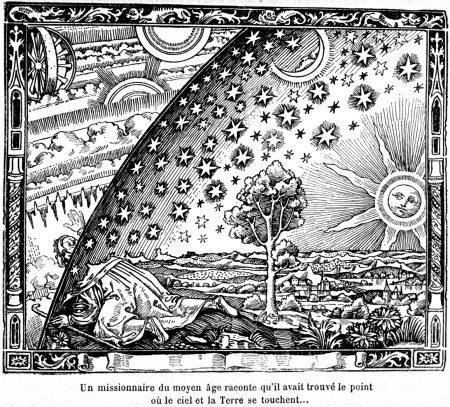
flat earth diagram of medieval understanding

High-quality, nationally representative survey data indicate that rape of men is about as prevalent as rape of women. Moreover, under current understandings of rape, women rape men about as often as men rape women. At the same time, criminal justice systems are highly biased toward punishing men. That produces a stark gender inequality. On any give day around the world, about fifteen times more men than women are sitting behind bars as prisoners of authoritative criminal justice systems. When is the last time you heard any public concern about that life-destroying gender inequality?

While important, largely untold facts about rape aren’t difficult to learn, contemporary public discussion of rape is mainly based on ignorance, bigotry, and superstition. A recent scholarly study declared:

Contemporary understandings of sexual victimization have been informed by the reality that men’s sexual violence toward women was ignored for centuries and remains dangerously well tolerated in many regions of the world. [1]

In reality, claims that a man committed sexual violence upon a women have been taken with deadly seriousness throughout history. Roman men, and subsequent historians, accepted Lucretia’s claim of rape without questioning. Lucretia’s claim of rape reportedly generated a bloody war and led to the founding of the Roman Republic. The ancient lives of saints Eugenia and Marina show that accusations that a man raped a woman were extremely damaging for the accused. Around the world and throughout history (except for recent decades), false accusations of rape have been a matter of intense concern. If men’s sexual violence toward women was historically ignored, historical concern about false accusations of men’s sexual violence toward women makes no sense. Belief that “men’s sexual violence toward women was ignored for centuries” reflects ignorance, bigotry, and superstition among scholars studying sexual violence today.

Pressure to honor orthodox dogma produces astonishing intellectual contortions in studying rape and sexual violence. A study of female perpetration of sexual violence declared:

While in no way seeking to minimize the very real phenomenon of male perpetration, we examine female perpetration so as to explore the gender dynamics at play and to understand sexual victimization more fully. In so doing, we argue that new attention to female sexual perpetration serves important feminist goals. [2]

In order to be well-regarded, scholarly work today must strive to serve feminist goals. In fact, the very real phenomenon of female perpetration has been much more commonly minimized than that of male perpetration. This study itself referred to “professionals & a culture of denial”:

Perhaps even more troubling than misperceptions concerning female perpetration among the general population are misperceptions held by professionals responsible for addressing the problem. Female perpetration is downplayed by those in fields such as mental health, social work, public health, and law [3]

One means of downplaying female perpetration is playing up female excuses. This study advocated research that “attends to women’s past victimization issues” and urged “taking into account the troubled background many such women possess.”[4] In studying men perpetrators of sexual violence, no equal concern is shown for those men’s past victimization issues and the troubled background of those men. Not surprisingly, the study called for “feminist approaches” to studying female perpetration.[5]

Scholarly ignorance, bigotry, and superstition constrains understanding of sexual violence. Within the mass of thoroughly anti-men gender-bigoted scholarship relating to criminal justice, one can find a rare nugget of good reason:

We conclude by recommending that public health and policy responses embrace a new, gender inclusive response to sexual victimization. This ought to entail, among other things, the attention of healthcare and criminal justice professionals to the reality of female perpetration, the inclusion of inmates in our national conversation about sexual victimization, and an expanded research agenda to study sexual victimization more comprehensively. [6]

Providing more funding for established scholars to pursue “an expanded research agenda to study sexual victimization more comprehensively” isn’t necessary. The public response to sexual victimization should reject gender bigotry, recognize the reality of female perpetrators, and include inmates, who are vastly disproportionately men. Rejecting ignorance, bigotry, and superstition isn’t a matter of doing more research under current scholarly incentives. Embracing truth and good reason requires a new commitment to enlightenment.[7]

*  *  *  *  *

Read more:

Notes:

[1] Stemple, Flores & Meyer (2017) p. 303. A nearly identical claim occurs in Stemple & Meyer (2014) p. e19. For discussion of the latter, see my post on rape of men.

Although about four times more men die from violence than do women, the international elite has prioritized violence against women:

For the last few decades, the prevailing approach to sexual violence in international human rights instruments has focused virtually exclusively on the abuse of women and girls. … There are well over one hundred uses of the term “violence against women” — defined to include sexual violence — in U.N. resolutions, treaties, general comments, and consensus documents. No human rights instruments explicitly address violence against men. … another term employed in human rights instruments dozens of times, “gender-based violence,” might reasonably be thought to include both males and females. … {however, } “gender-based violence” is used only to describe female victimization, thereby leaving no room for much-needed gender analysis of male rape.

Stemple (2009) pp. 605, 619. For related analysis, Stemple (2011).

[2] Stemple, Flores & Meyer (2017) p. 303. Stemple elsewhere explains that “neglecting male rape is bad for women and girls.” Stemple (2009) p. 606. Stemple, Flores & Meyer (2017) shows further concern to be consistent with the dominant ideology:

A focus on female perpetration might be skeptically viewed as an attempt to upend a women’s rights agenda focused on male-perpetrated sexual victimization. But attention to female perpetration need not negate concern about other forms of abuse. Moreover, a close look a sexual victimization perpetrated by women is consistent with feminist imperatives to undertake intersectional analyses, to take into account power relations, and to question gender-based stereotypes, as we explain.

Id. See also id. p. 309. This article doesn’t consider that it might be skeptically viewed as attempting to forestall thorough, deconstructive critique of the dominant ideology’s anti-men gender bigotry.

[3] Stemple, Flores & Meyer (2017) p. 309. A section heading in the article is “6. Professionals & a culture of denial.”

[4] Stemple, Flores & Meyer (2017) p. 309. The study declared, “female perpetration is frequently intertwined with women’s past experience of their own victimization.” Id. p. 304. It also urged “taking account of issues specific to lesbian and bisexual women,” thus excluding gay and bisexual men. Id. p. 309.

[5] Stemple, Flores & Meyer (2017) p. 309.

[6] Id. p. 303. The actual conclusion inserts excuses for female perpetration. See id. p. 309 and discussion above. Popular media has treated as stunningly revelatory Stemple’s reporting that women and men commit sexual violence in roughly equal proportions. What’s actually extraordinary is that a legal scholar has acknowledged that truth, even while striving to avoid undermining the dominant ideology.

[7] Lack of commitment to truth and good reason makes much scholarly literature on rape and sexual violence an ugly spectacle. Scholars have almost always lacked the courage to describe honestly the problem. Consider:

In 1975, Susan Brownmiller famously described rape as “nothing more or less than a conscious process of intimidation by which all men keep all women in a state of fear.” With the might and imprecision of a sledgehammer, Brownmiller’s words forced sex and gender to the center of the rape discussion. This perspective, usefully provocative in its era, reads today as an unreasonable generalization, particularly the author’s accusation that all men consciously use rape to intimidate. By creating a perpetrator class of men, Brownmiller dangerously sets up men as implausible victims.

Stemple (2009) p. 634 (internal footnotes omitted), citing Brownmiller (1975) p. 15. Underscoring her equivocal appreciation for Brownmiller’s work, Stemple credits Brownmiller with concern for male prisoner rape, but comments, “her claims strike me as dated {sic} and unreasonable.” Id. p. 634, notes 240, 241. Brownmiller’s claims are more honestly described as false, sexist, and hateful toward men. Nonetheless, Brownmiller’s claims became famous and enormously influential. They have contributed to expanding the criminalization of men seeking women’s love.

[image] Depiction (Flammarion engraving) imagining medieval view of a flat earth. From Flammarion (1888) p. 163. Image thanks to Wikimedia Commons. Here’s a colored version.

The caption under the engraving states in English translation: “A missionary of the Middle Ages tells that he had found the point where the sky and the Earth touch.” The engraving itself dates to no earlier than the late eighteenth century. Since the 5th century BGC, learned persons, including those in medieval Europe, have recognized that the earth is spherical. See note [7] and associated text in my post “earth’s a square, heaven a circle.”

References:

Brownmiller, Susan. 1975. Against our will: Men, women and rape. New York, NY: Simon and Schuster.

Flammarion, Camille. 1888. L’atmosphère: météorologie populaire {The Atmosphere: Popular Meteorology}. Paris: Librairie Hachette.

Stemple, Lara. 2009. “Male Rape and Human Rights.” Hastings Law Journal. 60 (3): 605-646.

Stemple, Lara. 2011. “Human Rights, Sex, and Gender: Limits in Theory and Practice.” Pace Law Review. 31 (3): 824-836.

Stemple, Lara, and Ilan H. Meyer. 2014. “The Sexual Victimization of Men in America: New Data Challenge Old Assumptions.” American Journal of Public Health. 104 (6): e19-e26.

Stemple, Lara, Andrew Flores, and Ilan H Meyer. 2017. “Sexual victimization perpetrated by women: Federal data reveal surprising prevalence.” Aggression and Violent Behavior. 34: 302-311.

misandry & castration culture repress alternate lifestyles for men

In the growing movement for men’s liberation, Men Going Their Own Way (MGTOW) has been highly influential. MGTOW is an alternate lifestyle for men that emphasizes men’s intrinsic human worth. MGTOW rejects men being merely tools in service to particular women and to gynocentric society in general. The backlash against MGTOW brings the dominant forces of misandry and castration culture to wage war on men. That isn’t a new phenomenon. When men in medieval Europe pursued an alternate lifestyle, they too were attacked with misandry and castration culture.

medieval Cistercian conversi at work

Men who sought to change their lives radically in medieval Europe could join monastic orders as conversi, also known as lay brothers. The conversi made monastic vows, but they were often illiterate and lacked deep knowledge of scripture and church teaching. Monks who were ordained as priests celebrated the sacraments, sang sacred music, and pursued advanced learning. The conversi worked in the fields and around the monastic houses to sustain the mundane life of the community. Some conversi sought to reform themselves from wrongful behavior in their prior, non-monastic lives. Others sensed oppressive, unholy circumstances in the secular world. Seeking an alternative, they became conversi.

According to the twelfth-century Latin masterpiece Speculum stultorum, the donkey Burnel threatened Cistercian conversi. Burnel had taken a path across the field of a Cistercian monastery near Lyons. The Cistercian brother Fromundus urged his dogs upon Burnel. The dogs tore into Burnel. One even bit off the end of his tail. Acting in the person of a papal envoy, Burnel cursed Fromundus for all his days.

Burnel’s lengthy anathema drew upon misandry and castration culture to threaten conversi. The papal envoy Burnel declared:

Those converts {conversi}, better known as perverts,
and from their actions drawing certain names —
if anyone catches them outside the church,
destroy their right-side eyes and feet.
And if bells not hang around their necks,
let the penises attached to them be cut off.

{ Istos conversos, quos perversos magis esse
constat, ut ex factis nomina certa trahant,
ecclesiae portam quisquis conspexerit extra,
mox oculos dextros auferat atque pedes.
Et nisi compana collo dependeat una,
mentula tollatur quodque cohaeret ei. }

Conversi were men pursing an alternate lifestyle relative to peasants and priestly monks. The papal envoy first attacked them by stereotyping them as sexual criminals. The papal envoy then sought to confine the conversi to church as if they were priestly monks. Like associating toxicity with masculinity (“toxic masculinity”), the papal envoy required that bells be attached to these men’s necks so that all would be warned of their coming. If men didn’t wear this signal of their menace, they would have their penises cut off. That’s how misandry and castration culture have functioned throughout history.

Men today have good reason to flee the lifestyle typically imposed on men. Be a worker drone, financially support women and children, and die for your country. Even before those roles were as devalued as they are today, what man would want only them for his life?  Few men would. Misandry and castration culture, among with myths of misogyny, patriarchy, and rape culture, are necessary to keep men confined within the soul-destroying structures of gynocentric society.

*  *  *  *  *

Read more:

Notes:

The above quote is from Speculum stultorum ll. 977-82, Latin text from Mozley & Raymo (1960) p. 53, my English translation, with some help from Regenos. Regenos translated those lines as:

That all those converts, rather perverts as
They’re known, get certain names to suit their deeds.
Who catches sight of them outside the church
Let him forthwith their eyes and feet destroy.
And if a bell be hung not from their necks,
Then let them be emasculated too.

Regenos (1959) p. 66. My translation follows the Latin more closely in vital words, e.g. penis, and is more easily readable, I hope.

In the above quote, the context of specific physical organs (eyes and feet) make clear that the proper translation for mentula is “penis.” The same is true in Bernardus Silvestris’s twelfth-century Cosmographia, Microcosmus 14.166.

[image] Medieval Cistercian conversi at work. Illustration from a psalter on the life of Saint Bernard of Claivaux. By Jörg Breu in 1500. Image thanks to Wikimedia Commons.

References:

Mozley, John H., and Robert R. Raymo, ed. 1960. Nigellus Wireker. Speculum stultorum. Berkeley: University of California Press.

Regenos, Graydon W, trans. 1959. Nigellus Wireker. The book of Daun Burnel the ass: Nigellus Wireker’s Speculum stultorum. Austin: University of Texas Press.

horse vs. mule: Burnel recognized value of seminal action

woman kissing donkey

In twelfth-century England, the donkey Burnel thought himself destined to become a bishop. Burnel had a traumatic childhood and low masculine self-esteem. Yet a donkey could offer more in love than could a man. Recognizing the value of seminal action, Burnel imagined himself being a bishop acting as a horse rather than as a mule.

A mule is the offspring of a male donkey and a female horse. A mule thus indicates a male donkey’s sexual broad-mindedness and vigor. Wrongly stereotyped as being stubborn, scientific testing suggests that mules are more flexible learners than are donkeys, horses, or dogs.[1] Male mules, however, are sterile. No matter how much erection labor a male mule performs for a female, the female will not get pregnant. Mules thus cannot become biological fathers.[2]

The donkey Burnel had no interest in becoming a spiritual father like a mule. In considering the role of bishop, Burnel pondered the two-horned bishop’s hat known as a mitre. In medieval Europe, an abbot could also wear a mitre. An abbot, however, lacked the sacramental capabilities of a bishop.[3] Burnel respected only fully capable fatherly horns:

No mitre nor its horns shall crown my head,
unless there’s present what accompanies it.
When all things else are lacking which belong,
what joy is there to hold the empty form?
Full bishop I shall be, for I don’t want
his honors as a mule, but as a horse.

The mule has genitalia, yet he
is always sterile and can’t reproduce.
So those who have no office, but the name,
have nothing but insignia to bear.
Forbid that I should rise and take such horns
as various ones have for themselves assumed.

I’d rather be content with both my ears
than have two horns like those appear on me.
In what they raise up, in that they’re closed off,
so mule and abbot in esteem are equal.
A lappet on an abbot’s head is worth
what testicles that hang from mules mean.
Those who in being bishops are curtailed
are made like abbots with emasculated mitres.

{ Mitra nec ascendet caput hoc neque cornua sumam,
si non affuerit quod solet inde sequi.
Cetera cum desint quae sunt comitantia mitrae,
quit juvat hac sterili conditione frui?
Plenus praesul ero, quia pontificalibus uti
nolo velut mulus, sed volo sicut equus.

Gignere cum nequeat, sua sic genitalia gestat
mulus et est sterilis tempus in omne suum.
Cum rem non habeant, sua sic insignia portant
hi qui nomen habent officioque carent.
Absit ut ascendam vel talia cornua sumam,
qualia sumpserunt ille vel ille sibi.

Auribus esse meis contentus malo duabus,
quam duo sic nasci cornua posse mihi.
In quibus excellunt quoniam patiuntur eclipsim
mulus et abbates sunt in honore pares.
Abbatis tantum capiti valet infula quantum
testiculos mulo pendere quisque velit.
Qui ne pontifices fiant sunt apocopati,
ut sint abbates syncopa mitra facit. }[4]

Horns have long been symbols of strength, virility, and cuckolding. Burnel regarded a mitre’s horns, like masculine genitalia, as beautiful and full of grace as they are, to be efficacious signs when linked to seminal action.

In medieval Europe, women and men of religious orders engaged in seminal action. According to Burnel, the secular canons thrust themselves into advocating a double duty of seminal action:

So this they strongly teach should be
observed by all through all posterity:
that as the ancient law provides, no one
should lack one girl, but each might have his two.
They love the world and grasp its fading flower,
and keep it watered lest it droop and die.

{ Illud praecipue tamen instituere tenendum
omnibus in tota posteritate sua:
lex vetus ut suasit, ne quilibet absque sua sit,
et quod quisque suas possit habere duas.
Hi sunt qui mundum cum flore cadente tenentes,
ne cito marcescat, saepe rigare student. }

The secular canons’ self-emptying love had effects on nuns, particularly abbesses, the shepherds of their convents:

Some bear no children, others do; and yet
they hide it all beneath the virgin’s name.
She who is given the honor of a pastor’s rod,
that one gives birth better and more abundantly.
Scarce one of them is found who can’t conceive
till age denies them this ability.

{ Harum sunt quaedam steriles, quaedam parientes,
virgineoque tamen nomine cuncta tegunt.
Quae pastoralis baculi donatur honore,
illa quidem melius fertiliusque parit.
Vix etiam quaevis sterilis reperitur in illis,
donec eis aetas talia posse negat. }

Under gynocentrism, signs of men’s seminal action are obscured with specious claims of virginity. Be not deceived. Women conceive almost always in conjunction with men’s seminal action.

With strong reason that would have warmed the loins of the Talavera clergy, Burnel sought to establish, for himself and others, a new religious order. Burnel’s new religious order would embrace and celebrate efficacious signs of the masculine grace that perpetuates life:

Surviving orders, apart from all delight,
a woman as my mate in lasting bond.
This order was the first, begun in Paradise,
established by the Lord, and by him blessed.
We would that this be kept forevermore
to which belonged my mother and my sire,
in which my entire race has always been,
and if it fail, the human race will end.

{ Ordine de reliquo placet ut persona secunda
foedere perpetuo sit mihi juncta comes.
Hic fuit ordo prior et conditus in Paradiso,
hunc Deus instituit et benedixit ei.
Hunc in perpetuum decrevimus esse tenendum,
cujus erat genitor cum genetrice mea,
et genus omne meum semper fuit ordinis hujus,
quo genus humanum deficiente cadet. }[5]

Burnel the donkey never become a bishop. The religious order of Burnel was never officially instituted. We call him a foolish donkey, dumber than a dumb ox, yet the soundness of his doctrine continues to resound in banging and bellowing throughout the entire world.[6]

Even in our sterile, mulish times, courageous laymen continue to engage in seminal action. Their efficacious masculinity is essential for the eternal life of humanity. It deserves to be celebrated.

*  *  *  *  *

Read more:

Notes:

[1] Osthaus (2013). Brighteyes, a horse owner in Georgia, explained:

mules are only stubborn because they are smart. Mules know that running into or away from everything isn’t going to work as well as thinking it through. Many people will tell you “Trust your mule.” Mules are sometimes smarter than people and are highly sensible.

[2] Birth control is vitally important for men because crushing sex payments are socially imposed on men who contribute sperm to a pregnancy. However, no other animal species imposes such payments on males.

[3] From about 1125 in western Europe, mitres began to have pointed horns rising on the sides of the head. Cornua (horns) became a popular medieval term for a mitre. Here’s a medieval drawing of a side-horned mitre inserted as marginalia in a manuscript of the Speculum stultorum. Mitres today more commonly have flaps that rise from front and back to meet at a point in the middle. See a review of the history of mitres, Mozley & Raymo (1960) p. 160, note to l. 1683, and symbols of the Office of Bishop.

Before 1050 in western Europe, abbots rarely wore mitres. Abbots subsequently began wearing mitres through grants of special favor. Abbots, however, didn’t have a bishop’s capability of consecrating Holy Chrism. Mozley & Raymo (1960) pp. 160, notes to ll. 1689, 1691-1702.

[4] Nigellus Wireker, Mirror of Fools {Speculum stultorum} ll. 1683-88, 1693-98, 1705-8, (additional couplet), 1709-10, Latin text from Mozley & Raymo (1960), with the additional couplet from Wright (1872) p. 70 (noting “These two lines are omitted in A.”). English translation from Regenos (1959) pp. 90, with my adaptations. For ll. 1705-8, (additional couplet), 1709-10, Regenos has:

In what things they excel, for they fall short,
The mule and abbot are in like esteem.
The fillet means the same on abbot’s head
As signs of masculinity in mules.
Those who from being bishops are deprived
The flattened miter does not abbots make.

Id. Above I’ve attempted a clearer and more literal translation of those lines.

The additional couplet exemplifies the poetic brilliance of Speculum stultorum. Consider:

A lappet on an abbot’s head is worth
what testicles that hang from mules mean.

{ Abbatis tantum capiti valet infula quantum
testiculos mulo pendere quisque velit. }

In this couplet, the ecclesiastical accoutrement lappet {infula} is separated by only two Latin syllables from testicles {testiculos}. Testicles hang downward in the front of a man’s body. A lappet (tied around the head) typically hangs downward in two strands at the back of the head. The couplet metaphorically compares the abbot’s lappet to a mule’s testicles. That’s an extraordinarily imaginative metaphor. Moreover, the reversals top to bottom in relation to a man’s trunk and back to front in relation to the man’s ventral plane are a microcosm of the “world turned upside down” theme of the Speculum stultorum. On divine folly and the trickster tricked in the Speculum stultorum, Mann (2009) pp. 133-6.

In a grave scholarly failure, the additional couplet doesn’t appear in Mozley & Raymo’s critical edition. While the couplet in omitted in manuscript A (British Museum, MS. Hareian 2422) of the Speculum stultorum, it apparently appears in manuscript B (British Museum, MS. Arundel 23) and manuscript C (British Museum, MS. Cotton Titus A 20), as well as in the fifteenth-century printed editions from Utrecht and Paris. Mozley & Raymo (1960) pp. 9, 15, 16 (notes to 10, Wright’s edition), which identifies and describes the manuscripts corresponding to Wright’s sigla. Suppressing this couplet is part of the oppressive history of obscuring men’s masculine being and denying men’s intrinsic virtue.

The leading scholarly works on medieval beast literature lamentably don’t cover Burnel’s thoughts on a bishop’s mitre, a mule, and seminal action. Having drawn a chronological line at 1150, Ziolkowski (1993) only mentions the Speculum stultorum peripherally. Mann (2009) spends a full chapter on the Speculum stultorum. Yet like medieval scholarship in general, id. shows little consideration for men’s distinctive being and ignores the Speculum stultorum’s striking references to a male mule’s genitals and testicles.

Subsequent quotes from the Speculum stultorum are sourced like that above. Cited by Latin text line numbers and page in Regenos (1959), they are: ll. 2321-6, p. 112 (So this they…); .. 2395-2400, p. 115 (Some bear no children…); ll. 2437-4, p. 117 (Surviving ordains…). I’ve made some adaptations to Regenos translation. I note particularly substantial changes.

[5] For Ordine de reliquo placet, Regenos translates “I’m pleased to borrow from the group that’s left.” The Latin phrase seems to me to carry a pun with the natural requirement of a species’s survival. To convey that sense, I’ve translated the Latin as “Surviving orders, apart from all delight.”

[6] Thomas Aquinas is today the most famous and influential medieval theologian. Aquinas’s fellow students, however, reportedly called him a “dumb ox.”  Albertus Magnus, an eminent philosopher and theologian of Aquinas’s time, reportedly stated:

We call him the dumb ox, but he will make resound in his doctrine such a bellowing that it will echo throughout the entire world.

{ Nos vocamus istum bovem mutum, set ipse adhuc talem dabit in doctrina mugitum, quod in toto mundo sonabit. }

Quoted in Resnick (2013) p. 7, from William of Tocco’s early fourteenth-century biography of Thomas Aquinas.

[image] Woman kissing donkey. Image thanks to Jaclou-DL, who generously made it available on pixabay under a CCO Creative Commons license.

References:

Mann, Jill. 2009. From Aesop to Reynard: beast literature in medieval Britain. Oxford: Oxford University Press.

Mozley, John H., and Robert R. Raymo, ed. 1960. Nigellus Wireker. Speculum stultorum. Berkeley: University of California Press.

Osthaus, Britta, Leanne Proops, Ian Hocking, and Faith Burden. 2013. “Spatial cognition and perseveration by horses, donkeys and mules in a simple A-not-B detour task.” Animal Cognition. 16 (2): 301-305.

Regenos, Graydon W., trans. 1959. Nigellus Wireker. The book of Daun Burnel the ass: Nigellus Wireker’s Speculum stultorum. Austin: University of Texas Press.

Resnick, Irven M. 2013. “Albert the Great: Biographical Introduction.” Pp. 1-14 in Resnick, Irven M., ed. A companion to Albert the Great: theology, philosophy, and the sciences. Leiden: Brill.

Wright, Thomas, ed. 1872. The Anglo Latin satirical poets and epigrammatists of the 12th century. Vol 1. Rolls Series. London: Longman.

Ziolkowski, Jan M. 1993. Talking animals: medieval Latin beast poetry, 750-1150. Philadelphia: University of Pennsylvania Press.

lives of saints Cyprian and Justina show man’s suffering in love

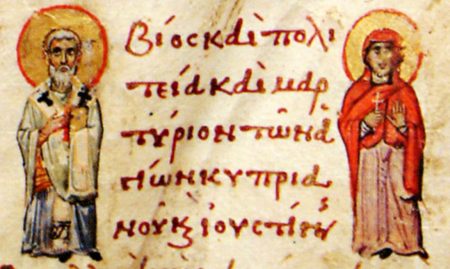
Saints Cyprian and Justina; illumination from 11th-century Byzantine menologion

About 1700 years ago in Antioch in present-day Turkey, a wealthy, well-educated man of high birth loved a beautiful, young woman. Her name was Ioustina. His name was Aglaïdas. Aglaïdas didn’t merely have the high masculine social status that typically attracts amorous attention from women. Aglaïdas {᾽Αγλαïδας} in ancient Greek means “beautiful, splendid.”[1] Aglaïdas, like Ioustina, was also physically beautiful.

Men’s great love for women often makes men vulnerable to sexual harassment by women. So it was for Aglaïdas:

seeing often the virgin {Ioustina}, when she passed by on her way to the house of God, he was fiercely stricken by her beauty as if by an arrow — even though, with fasting and prayer, she did everything in her power to make her beauty wither and disappear as if it were a perilous and dangerous thing. Still, with his lascivious eyes, at first he would watch the streets and wait for her; and when he came face to face with her, he would shower praises on her, extol her beauty, and laud her good fortune. Then he would slowly indicate his longing through some signals, casting many nets (as one might say) and preparing for a catch. Yet for the virgin all these ploys were nothing but sheer nonsense and an annoyance. She considered them as worthy of laughter rather than attention by chaste eyes and ears. [2]

Aglaïdas showered praise on Ioustina. He obviously hadn’t learned crucial insights for men from medieval women’s love poetry. Lacking the benefit of Juvenal’s counsel to his friend Postumus, or Valerius’s words of concern to his friend Rufinus, Aglaïdas asked Ioustina to marry him. Ioustina considered herself to be a bride of Christ, and she rejected bigamy. Her courageous action probably saved Aglaïdas from a sexless marriage like Cecilia had with Valerian.

After Ioustina refused to marry him, Aglaïdas resorted to force. Bridal capture has been a common ritual forced upon men across history and across societies. It functions to emphasize women’s relatively high value in gynocentric society. Aglaïdas, however, engaged in bridal capture without the implicit consent of Ioustina and her family:

as he found the maiden to be immovable, staunch, and impossible to capture with deceptive words (though he had moved every stone, as the proverb says) he gathered abundant help, hired those specialized in matters of love, and ambushed her on the road. He thus carried her off by force to wherever he wished.

Aglaïdas didn’t rape Ioustina. Adult male humans, like other adult male primates, hardly ever engage in sexual assault against females. Violence against men is much more prevalent than violence against women. After Aglaïdas abducted Ioustina, men of the community rushed to attack Aglaïdas:

As soon as news of this outrageous daring act {Aglaïdas abducting Ioustina} spread to the city and to the household of her mother, many strong men, armed with weapons, rushed to confront the brigands. With their appearance alone, they made those appalling abductors flee out of sight — not so much because they yielded to force but rather because they were driven powerfully away by the shame of the deed. Yet Aglaïdas (as his passion was more violent than any feeling of shame) cared neither for swords nor the crowd nor anything else. Instead, he embraced the maiden and was ready to suffer anything rather than be separated from her. Ioustina became instantly like Joseph, that most chaste and most courageous man. She held the sign of the cross before her like a weapon, not against Aglaïdas, but rather against the one who was stealthily attempting to wage war against her through him. She thus immediately repelled and pushed back that abominable man. She also poured all sorts of curses upon him and rained blows and spittle upon his face that deserved it. [3]

Aglaïdas thus suffered physical assault and public shaming. He also had Ioustina, whom he had not forced into sex, forcibly taken away from him.

Aglaïdas desperately sought to regain Ioustina. He valued her above his own life:

One thing was for him worse than death itself: losing Ioustina. For a short while, sadness overtook him and desolation depressed him. But as soon as his desire was again (so to speak) rekindled, untrained as he was and rather unschooled in its resistance, he could not wrestle his lust with gentlemanly reason. He did exactly as his passion demanded and thus prepared himself for new, secret endeavors.

To inspire Ioustina to love him, Aglaïdas employed the renowned sorcerer Kyprianos. Kyprianos had been born in Carthage to noble and wealthy parents. After he became famous in Carthage for his learning in philosophy and magic, he moved to Antioch to expand the scope of his reputation from North Africa to Mesopotamia. Explaining the sorrowful misfortune of his love for Ioustina, Aglaïdas said to Kyprianos:

You are the only consolation left to me for this misfortune. Placing my trust in you alone, until this very instance I restrained my urge to choose death over life. Worry not about the amount of wealth and gold you will obtain from me if you release me from this misfortune, as I will provide them to you abundantly and exceeding all your hopes.

Many men will give up anything, including their own lives, for women they love. That’s utter folly for a man when the woman doesn’t love him. Men, even men who are not Christian, should choose life over death. Men should not sell their souls to the devil for the love of women.

The soul-destroying gender inequality in love that most ordinary men endure generates little public concern. Using the power of the sign of the cross, Ioustina decisively defeated the most powerful magic that Kyprianos could summon to gain for Aglaïdas her love. Impressed with Ioustina’s power, Kyprianos converted to Christianity. Ioustina (Justina) and Kyprianos (Cyprian) today are celebrated as saints in Orthodox Christianity. Aglaïdas and his misfortune are largely forgotten.

What men need to overcome their suffering in love for women isn’t sorcery. Like Kyprianos, Merlin the magician lacked power in relation to women. Unlike Kyprianos, Merlin didn’t choose an alternate way to a full life. Merlin died a slow, horrific death amid embalmed bodies of dead lovers.

Men who don’t want to be in loveless Hell with Aglaïdas can benefit from perceptive study of saints’ lives. Saint Paul’s seduction of Thecla teaches men the importance of conveying mastery. Saint Jerome with his boldness and self-confidence gained many women followers. Saint Andronikos courageously asserted his own views in loving discussion with his wife. While risks and dangers exist, men can gain love without committing their souls to the devil.

*  *  *  *  *

Read more:

Notes:

[1] The text states that Aglaïdas was “allotted such a name perhaps due to his beauty.” Symeon Metaphrastes, Menologion, Life, Conduct, and Passion of Saints Kyprianos and Ioustina, para. 10, from Greek trans. Papaioannou (2017) p. 11. Id. pp. 284-5, note to 10, gives the Greek meaning of Aglaïdas. Ioustina is a Greek form of the Roman name Justina, which means fair or just. Kyprianos is a Greek name commonly known in English as Cyprian.

The Life of Kyprianos and Ioustina (Life of Cyprian and Justina) has an abundant manuscript tradition in Greek, Latin, Syriac, Arabic, Ethiopic, Coptic, and Slavonic. References to it exist in an encomium of Gregory of Nazianzos (ca. 329 – 390) and in a poem by the empress Athenais-Eudokia (ca. 400-460). Id. p. 283, note. In the Orthodox Christian calendar, the feast day for these saints is October 2. Here are narrative and prayers for the feast day of Cyprian and Justina. Here’s an English translation of a Coptic text, Confession and Martyrdom of Cyprian of Antioch.

[2] Metaphrastes, Life of Kyprianos and Ioustina, para. 10, from Greek trans. Papaioannou (2017) p. 11. I’ve made some insubstantial changes to this and subsequent quotes above to make them more easily readable. Casting nets to prepare for a catch apparently alludes to Luke 5:4.

Subsequent quotes are similarly from Metaphrastes’s Life of Kyprianos and Ioustina. Cited by paragraph and page in id., these quotes are from: 11, p. 13 (as he found the maiden…); 12, p. 13 (As soon as news…); 13, p. 15 (One thing for him…); 16, p. 17 (You are the only consolation…).

[3] An announcement of the publication of Christian novels from the Menologion of Symeon Metaphrastes quoted the account of Ioustina assaulting Aglaïdas. The announcement commented:

Like a scene from an old western, the anecdote combines melodrama and acts of derring-do; Ioustina becomes a scrappy heroine, both brave and wise {sic}, sensing the presence of greater evil behind the deeds of Aglaïdas.

Women’s violence against men is commonly trivialized within the anti-men sex bias of criminal justice systems.

[image] Saint Kyprianos (Cyprian) and Saint Ioustina (Justina). Illumination from the feast day for these saints (October 2) in an eleventh-century Byzantine menologion. Image thanks to Wikimedia Commons.

Reference:

Papaioannou, Stratis, ed. and trans. 2017. Christian novels from the Menologion of Symeon Metaphrastes. Dumbarton Oaks Medieval Library, Vol. 45. Cambridge, MA: Harvard University Press.