demons purged in crapping & farting in Life of Saint Martin

demons attacking Saint Anthony

If you think demons have grabbed hold of you, do something about it. Purge the demons from your soul. The widely lauded and influential fourth-century saint Martin of Tours, also known as Martin the Merciful, might be able to help. According to accounts dating from no later than 397 GC, Saint Martin drove away demons through crapping and farting.

One day Martin saw a demon go into a cook. The demon caused the cook to bite himself madly. Martin bravely put his fingers into the raving cook’s mouth and said:

If you can, devour this offered prey, you murderous wolf.
Food you would seek elsewhere is freely given to your teeth.

{ Si potes, ecce vora oblatam, lupe noxie, praedam.
Quam peteres alibi datur ultro dentibus esca. }[1]

The teeth drew back, for the demon was afraid to have them touch Martin’s holy hand. The demon-possessed cook felt a sharp pain inside himself. The demon was seeking to flee. It was afraid to exit through the cook’s mouth because Martin’s hand was there. It thus took another way:

The demon exited filthily in the way filth does by defecation.
In its foulness it left behind foul traces of its service.

{ foeda ministerii foedus vestigia linquens,
sordidus egreditur qua sordibus est via fluxu. }

Demons befoul persons with sin. If your crap smells, you have a problem. We are all sinners in need of Saint Martin’s mercy. While wearing a cloth mask to protect yourself from COVID, call on Saint Martin. Then pray to take a vigorous crap.

On another occasion, an arrogant monk named Anatolius was criticizing his fellow monks and making outrageous claims. Anatolius, dressed in golden clothing and a jeweled crown, even asserted that he himself was Christ. The humble Saint Martin kept silent. “The slippery snake then repeated his mordant hissings {lubricus hinc repetit mordacia sibila serpens}.”[2] Martin explained that angels had taken Christ up into the air and that Christ would return with marks of his crucifixion. Until he saw those marks, Martin wouldn’t believe anyone to be Christ. The pompous Anatolius dressed as a king was reduced to his substance:

Then the ineffective enemy shuddered under the lash of these words.
The airy bringer of pestilence, formed of air, slipped away,
resuming his proper form, and dissolved into nothingness.
He fled from sight like smoke in a breeze,
the insubstantial image of a shadowy shape flew away.
Barred from sight, he emptied himself of vomit in his cell.
Discerned by these signs, he made his way crapping
and farting as he fled with a stink as his attendant.

{ Mox inimicus iners, vibratus verbere verbi,
pestifer, aërius, tenuata per aethera lapsus,
in propriam speciem rediens, ad inane solutus,
effugit ex oculis, liquidas quasi fumus in auras,
et levis umbriferae volitavit imago figurae.
Visibus exclusus cellam paedore cruminans,
agnitus indiciis, sua per vestigia sordens
et foetore sibi comitante satellite fugit }

Vomiting, crapping, and farting are ordinary means for purging demons. Be grateful that you are able to engage in these practices.[3]

The fifth-century historian and bishop Gregory of Tours documented that oil from Saint Martin’s tomb could expel demons. Gregory reported the story of Aredius, an abbot at Limoges:

Since the oil had restored many possessed persons to good health, he placed some of it on the head of one man who had a more hideous demon, so I think. Immediately the man expelled the demon by flow from his bowels.

{ Sed et cum multos energumenos exinde restituisset sanitati, uni qui atrociorem, ut credo, daemonem habebat, super caput de oleo posuit: illico deamonem per fluxum ventris egessit }[4]

Was it defecation or flatulence that worked this exorcism? Let philologists debate these technical matters. Ordinary folks should simply praise the effect and hope to duplicate it.

Purging demons through crapping and farting isn’t a peculiarity of the ancient cult of Saint Martin of Tours. Perceiving “a connection between one’s bowels and one’s salvation” is deeply ingrained in Mediterranean culture.[5] Belief that bodily processes can help to cure sicknesses of the soul shows confidence in material nature. Nature isn’t merely a constraint on mind. It also keeps the soul sane.

misericord showing two men crapping

* * * * *

Read more:

Notes:

[1] Venantius Fortunatus, Life of Saint Martin {Vita Sancti Martini} 1.462-3, Latin text and English translation (modified) from Kay (2020). Leo (1881) provides a freely available Latin text of Vita Sancti Martini. The subsequent quote above is similarly from Fortunatus’s Vita Sancti Martini 1.469-70.

Sulpicius Severus, a learned lawyer and orator from Aquitania in Western Gaul, completed a prose Vita Sancti Martin in 397. That was the year that Martin, Bishop of Tours, died. Sulpicius met Martin as well as monks in Martin’s circle. Here is Sulpicius’s version:

Martin inserted his fingers into his mouth, and said, “If you have any power, devour these.” As if red-hot iron had entered his jaws, he indeed drew his teeth far away and took care not to touch the fingers of the saintly man. When he was compelled by punishments and tortures to flee out of the possessed body, he had no power of escaping by the mouth. He was cast out by means of flow from his bowels. It left behind disgusting traces.

{ digitos ei Martinus in os intulit: “si habes,” inquit, “aliquid potestatis, hos devora.” tum vero, ac si candens ferrum faucibus accepisset, longe reductis dentibus digitos beati viri vitabat attingere: et cum fugere de obsesso corpore poenis et cruciatibus cogeretur nec tamen exire ei per os liceret, foeda relinquens vestigia fluxu ventris. }

Sulpicius Severus, Vita Sancti Martini 17.7, Latin text (modified insubstantially) from Francese (c2015), English translation (modified) from Roberts (1894).

About 573 GC, Fortunatus adapted into verse Sulpicius Severus’s Vita Sancti Martin. Fortunatus also drew upon an earlier verse life of Martin that Paulinus of Périgueux had composed in the fifth century. Fortunatus, compared to Paulinus, emphasized Martin mediating between God and humans. Pollmann (2017), Chapter 9. Like Prudentius with his Psychomachia, Fortunatus sought to reform epic and its violence against men:

Fortunatus creates a new kind of epic that calls forth a new response from its reader. Combining epic amplitude with lyric refinement and epigrammatic wit and concision the VSM {Vita Sancti Martini} conducts its reader on a pilgrimage of meditation on the merits of Martin.

Roberts (2002) p. 187. Fortunatus’s Vita Sancti Martin is written in hexameters, the meter of epic poetry. Fortunatus also wrote short poems about Saint Martin. These different works present Martin differently. Friedrich & Gärtner (2020).

About 600 GC, Fortunatus wrote a life of Radegund of Thuringia. Fortunatus attributed to Radegund a similar demon-purging act:

A certain woman labored so heavily under an invasion of the enemy that the rebelling foe could scarcely be brought to the holy one. She commanded the adversary to lie prostrate on the pavement with fear for itself. The moment the blessed woman spoke, it threw itself onto the earth, for she frightened the one who greatly feared her. When the holy one, full of faith, walked on the woman’s neck, the adversary left her by a flow from her bowels.

{ Mulier quaedam dum inimici invasione graviter laboraret, et vix ad sanctam potuisseut hostem rebellem adducere, imperat adversario, ut se suo cum timore pavimento prosterneret. Mox ad beatae sermonem in terra se deiciens, qui timebatur extimuit. Cui sancta plena fide cum calcasset in cervice, fluxu ventris egressus est. }

Venantius Fortunatus, The Life of Holy Radegund {De vita sanctae Radegundis} para. 30, Latin text from Leo (1881), English translation (modified, including to remove sexist references to the demon) from McNamara & Halborg (1992), p. 82.

In the 990s, the English priest Ælfric of Eynsham wrote a homily for Martin’s feast day and a life of Martin. Ælfric explicitly cited Sulpicius as a source. Mertens (2017) pp. 106, 128. Perhaps reflecting the long history of disparaging men’s penises, Ælfric modified Sulpicius’s account to have the demon purged through the man’s penis:

The madman then turned away his jaws
from the saint’s hand, as if from hot iron,
and the accursed spirit departed from the man
out through his genitals, with shameful flight.

{ Se wóda ða awende aweg his ceaflas
fram ðære halgan handa. swilce fram hátum isene.
and se awyrgeda gast gewát of ðam men
út ðurh his gesceapu. mid sceandlicum fleame } 287-90

Ælfric of Eynsham, Catholic Homily for Martinmas, vv. 287-90, Old English text and modern English translation from Mertens (2017) pp. 242-3. In his Life of Saint Martin, Ælfric stated that the demon avoided the mouth, “but foully went out through his anus {ac fúllice ferde þurh his forðgang ut}.” Ælfric, Life of Saint Martin, v. 549, Old English text and modern English translation from id., pp. 310-1. According to Mertens, “in his homily, Ælfric probably preferred the word (genitals {gesceapu}) for the alliteration.” Id. p. 242, note to v. 290. Referring to the demon departing through the man’s penis would have made for a more shockingly telling story in a homily. Philologists have historically obscured the importance of men’s genitals.

[2] Fortunatus, Vita Sancti Martini 2.308, Latin text and English translation from Kay (2020). The subsequent quote above is similarly sourced from Vita Sancti Martini 2.344-51, but with my changes to the English translation.

Kay interprets the subject in this purging to be the devil and interpolates references to the devil in his translation. The Latin text, however, doesn’t explicitly distinguish between the devil and Anatolius, a wicked character from the previous story. Moreover, “he emptied himself of vomit in his cell {cellam paedore cruminans}” (v. 2.349) suggests to me a monk returning to his cell.

This story also comes from Sulpicius Severus’s Vita Sancti Martin. In Sulpicius’s original, the false Christ is explicitly identified as the devil. Martin says he won’t believe unless he sees the wounds of crucifixion. Cf. the disciple Thomas’s criterion for recognizing Christ in John 20:25. Martin’s words reveal the devil pretending to be Christ:

As these words, the devil immediately vanished like smoke. It filled the cell with such a stink as to leave indubitable indications of what the devil’s being truly is.

{ ad hanc ille vocem statim ut fumus evanuit et cellulam tanto foetore complevit, ut indubia indicia relinqueret diabolum se fuisse. }

Sulpicius Severus, Vita Sancti Martini 24.8, Latin text (modified insubstantially) from Francese (c2015), my English translation, benefiting from that of Roberts (1894).

[3] In the second half of the seventh century, Chrodobert of Tours disparaged Importunus of Paris. Chrodobert associated Importunus’s being a deceiver with farting:

There is no greater deceiver.
He grunts at the ankle,
he inflates his cheeks and howls,
he farts and runs around in a sweat,
he spits out stinking phlegm.

{ Maior nullis talis falsator.
Grunnit post talone,
Buccas inflat in rudore,
Crebat et currit in sudore,
Fleummas iactat in pudore. }

Formulae from Sens preserved in Paris, B.N. lat. 4627, Letter 4 in correspondence, ll. 53-7, Latin text and English translation from Tyrrell (2012) p. 177. Both Chrodobert and Importunus were bishops. Some scholars Latinize the Germanic name Chrodobertus / Chrodobert to Frodebertus / Frodebert. Both Chrodobert and Importunus likely knew Fortunatus’s Vita Sancti Martini. Farting doesn’t imply that a person is a deceiver. All persons fart, even women.

[4] Gregory of Tours, Book of the Glory of Blessed Confessings {Liber de gloria beatorum confessorum} 9, Latin text from Patrologia Latina 71:836, English translation (modified) from Van Dam (2004) p. 26. Id. translates “per fluxum ventris” as “in a blast of air from his bowels,” i.e. farting. Gregory of Tours wrote many accounts of miracles. De Nie (2015).

According to Gregory of Tour’s History of the Franks {Historia Francorum}, a malicious priest rebelled against Sidonius Apollinaris, Bishop of Clermont late in the fifth century. Plotting to drag Bishop Sidonius out of his church, the rebellious priest felt the call of nature:

He went into the bathroom. While he was straining to purge his bowels, he gave up his soul instead.

{ Ingressus autem in secessum suum, dum ventrem purgare nititur, spiritum exalavit. }

Gregory of Tours, History of the Franks {Historia Francorum} 2.23, Latin text from Krusch (1884), my English translation, benefiting from that of Thorpe (1974).

Death by bowel movement had an eminent predecessor in Christian theological history. The Christian priest Arius, who founded late in the third century what became known as the bitterly controversial Arian heresy, also reportedly died from a traumatic bowel movement. Socrates of Constantinople / Socrates Scholasticus {Σωκράτης ὁ Σχολαστικός}, Church History {Historia Ecclesiastica / Ἐκκλησιαστική Ἱστορία} 1.38 (“The Death of Arius”). Socrates finished this history in 439.

[5] Moreira (2010) p. 80. Moreira observed:

Gregory of Tours’s world of purgative-driven salvation is never considered in studies of purgatory. Yet his perspective on health and salvation is an important dimension in our understanding of what purgatory was to become: a place in which bodies were made healthy through the application of the medicine of purgation. Gregory’s thinking on health and miracles was entirely theological and even eschatological. Gregory saw God’s power, and that of his saints, in every facet of his environment; and that environment was replete with evidence that God purged the faithful of bodily infirmities and spiritual sickness in preparation for salvation.

Id. pp. 79-80 (footnote omitted). Purgatory certainly was not invented in the twelfth century. Cf. Le Goff (1981).

[images] (1) Demons attacking Saint Anthony. “The Torment of Saint Anthony.” Painting dated 1487 and attributed to Michelangelo. Preserved as accession # AP 2009.01 in the Kimbell Art Museum (Fort Worth, Texas). Via Wikimedia Commons. (2) Misericord showing two men praying and crapping. From sixteenth-century stalls in the Basilica of Saint Materne in Walcourt, Belgium. Image thanks to Jean-Pol Grandmont and Wikimedia Commons. A late-fifteenth-century misericord in the Saint Sulpitius Church in Diest, Belgium, depicts a man giving himself an enema. A misericord (S17) in Tewkesbury Abbey, England, shows a man farting. Here’s a large collection of photographs of misericords.

References:

De Nie, Giselle, ed. and trans. 2015. Gregory of Tours: Lives and Miracles. The Life of the Fathers. The Miracles of the Martyr Julian. The Miracles of Bishop Martin. Dumbarton Oaks Medieval Library 39. Cambridge, MA: Harvard University Press.

Francese, Christopher, ed. c2015. Sulpicius Severus. The Life of Saint Martin of Tours. Dickinson College Commentaries. Online.

Friedrich, Enno and Ursula Gärtner. 2020. “The Many Martins of Venantius Fortunatus. Venantius Fortunatus’ Martin-Poems as Instances of Individual Appropriation and Literary Offers of Ritual-Like Experience.” Arys. Antigüedad, religiones y sociedades. 18: 181-211.

Kay, N. M, ed. and trans. 2020. Venantius Fortunatus: Vita Sancti Martini. Prologue and Books 1.-2. Cambridge: Cambridge University Press. Review by Enno Friedrich.

Krusch, Bruno, ed. 1884. Monumenta Germaniae Historica, Scriptores rerum Merovingiciarum 1.1, Gregorii Episcopi Turonensis Historiarum Libri X. Hannover: Hahn.

Leo, Friedrich, ed. 1881. Venanti Fortunati Opera Poetica (Pars Prior), Venanti Fortunati Opera Pedestria (Pars Posterior). Monumenta Germaniae Historica, Auctores Antiquissimi IV. Berlin: Weidmann. Another copy. Web-native presentation.

Le Goff, Jacques. 1981. La Naissance du Purgatoire. Paris: Gallimard. Arthur Goldhammer’s English translation, 1983. The Birth of Purgatory. Chicago: University of Chicago Press.

McNamara, Jo Ann, and John E. Halborg, ed. and trans., with E. Gordon Whatley. 1992. Sainted Women of the Dark Ages. Durham, NC: Duke University Press.

Mertens, Andre. 2017. The Old English Lives of St Martin of Tours: Edition and Study. Universitätsverlag Göttingen: Open Access.

Moreira, Isabel. 2010. Heaven’s Purge: Purgatory in Late Antiquity. Oxford: Oxford University Press.

Pollmann, Karla. 2017. The Baptized Muse: Early Christian Poetry as Cultural Authority. Oxford: Oxford University Press.

Roberts, Alexander, trans. 1894. “Sulpitius Severus on the Life of St. Martin.” In A Select Library of Nicene and Post-Nicene Fathers of the Christian Church, Second Series, Volume 11. New York.

Roberts, Michael. 2002. “Venantius Fortunatus’s Life of Saint Martin.” Traditio. 57:129–187.

Thorpe, Lewis, trans. 1974. Gregory of Tours: The History of the Franks. Harmondsworth Middlesex England: Penguin Books.

Tyrrell, Vida Alice. 2012. Merovingian Letters and Letter Writers. Ph.D. Thesis, Centre for Medieval Studies, University of Toronto. Review by Ralph W. Mathisen.

Van Dam, Raymond, trans. 2004. Gregory of Tours. Glory of the Confessors. 2nd ed; 1st ed., 1988. Liverpool: Liverpool University Press.
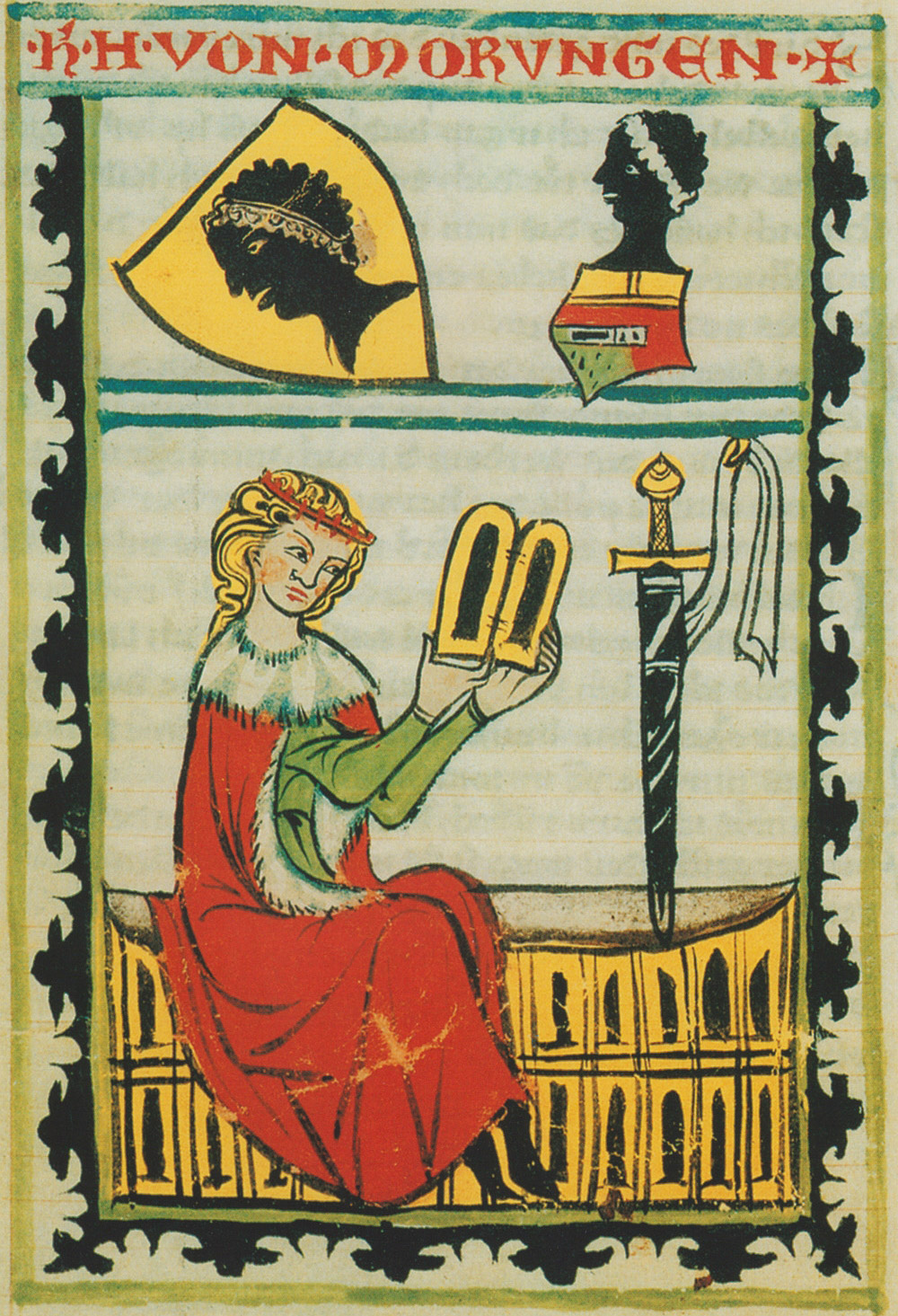
Heinrich von Morungen foolishly died from gyno-idolatry

Many medieval men ardently, inordinately loved women. Such love creates grave risk of blinding, deafening gyno-idolatry. The minnesinger Heinrich von Morungen, who lived in the Germanic land of Thuringia about 1150 to 1222, loved a woman gyno-idolatrously. He accused her of cruelty and called her an assassin. He died foolishly from gyno-idolatry. Hebrew scripture that Christians and Muslims also regard as sacred repeatedly warns of idolatry’s dangers. Despite modern literary scholarship celebrating it, the “love-worship” of courtly love is suicidal. That’s what Heinrich von Morungen belatedly learned.

Can a man press fire to his chest yet his clothes not be burned?
Can a man walk on hot coals without scorching his feet?

[1]{ היחתה איש אש בחיקו ובגדיו לא תשרפנה׃
אם־יהלך איש על־הגחלים ורגליו לא תכוינה׃ }

Heinrich von Morungen’s gyno-idolatry began in the ordinary circumstances of young persons singing and dancing in a meadow. Heinrich was a knight. In the pastoral genre, a knight meets a beautiful young woman in the countryside. The troubadour Gavaudan redeemed the pastoral from some of its troubling tendencies. But Heinrich entered the pastoral obsessed with a particular woman:

I heard out on the meadow
bright voices and sweet tones
and was at once
rich in joys, in sorrows poor.
The one toward whom my thoughts have struggled and soared —
I found her in the dance, singing.
Free of sorrows, I danced too.

{ Ich hôrte ûf der heide
lûte stimme und süezen sanc.
dâ von wart ich beide
fröiden rîch und an trûrens kranc.
Nâch der mîn gedanc sêre ranc unde swanc,
die vant ich ze tanze, dâ si sanc.
âne leide ich dô spranc. }[2]

Heinrich could imagine no greater joy than love for his beloved woman:

On such a cloud of joy as this
my soul has never sailed so high before.
I hover as on wings of bliss
with thoughts of only her whom I adore,
because her love unlocked the door
which leads into my inmost heart
and entered there for evermore.

All other raptures that remain
with this great happiness cannot compare.
Let earth and sky and wood and plain
with me a time of soaring gladness share.
For, filled with hope and freed from care,
and thrilled by dreams of ecstasy,
my joy is more than I can bear.

{ In sô hôher swebender wunne
sô gestuont mîn herze ane vröiden nie.
ich var, als ich vliegen kunne,
mit gedanken iemer umbe sie,
sît daz mich ir trôst enpfie,
der mir durch die sêle mîn
mitten in daz herze gie.

Swaz ich wunneclîches schouwe,
daz spile gegen der wunne, die ich hân.
luft und erde, walt und ouwe
suln die zît der vröide mîn enpfân.
Mir ist komen ein hügender wân
und ein wunneclîcher trôst,
des mîn muot sol hôhe stân. }[3]

Heinrich von Morungen’s love for this earthly woman led to extraordinary gender fluidity. Heinrich imagined his beloved woman to be the angel Gabriel, and he himself to be the Virgin Mary:

Praised be the blissful message
whose sound went so sweetly into my ear,
and the swelling that heals all
sank with joy into my heart,
out of which a bliss sprang up
that for utter delight streamed forth
like a dew from my eyes.

Blessed be the sweet hour,
blessed the time, the sublime day,
when from her mouth went out the word
that lay so near my heart
that my body thrilled with the fright of joy,
and indeed for sheer bliss I do not know
what I can say of her.

{ Wol dem wunneclîchem maere,
daz sô suoze durch mîn ôre erklanc,
und der sanfte tuonder swêre,
diu mit fröiden in mîn herze sanc,
dâ von mir ein wunne entspranc,
diu vor liebe alsam ein tou
mir ûz von den ougen dranc.

Sêlic sî diu süeze stunde,
sêlic sî diu zît, der werde tac,
dô daz wort gie von ir munde,
daz dem herzen mîn sô nâhen lac,
daz mîn lîp von fröide erschrac,
un enweiz von wunne joch,
waz ich von ir sprechen mac. }

Heinrich confused health care for men with divine events. According to the New Testament, God sent the angel Gabriel to speak prophetic words to the Virgin Mary. After the words of the angel Gabriel went into Mary’s ear, she swelled with the joy of incarnating Christ. Mary gave birth to the redeemer of all human beings.[4] Heinrich imagined his beloved’s message to him to be like the incarnation of Christ. That’s utter gyno-idolatry.

Happy the parents who gave you birth,
happy the sun that sees you every hour,
happy the earth that you walk white-footed,
happy the breast-wrap that binds my beloved’s body,
happy the beds, Dulcis, on which you lie naked.
As birds are snared by lime, as wild pigs by nets,
so, Dulcis, am I caught in fatal love for you.
I saw you and did not touch you. I see and cannot touch.
I was totally on fire, burned but not consumed.

{ Felices illos qui te genuere parentes,
Felicem solem qui te uidet omnibus horis,
Felicem terram quam tu pede candida calcas,
Felices fascias cingentes corpus amatae,
Felices toros quibus Dulcis, nuda recumbis!
Ut visco capiuntur aves, ut retibus apri,
Sic ego nunc Dulcis diro sum captus amore.
Vidi nec tetigi; video nec tangere possum.
Totus in igne fui; non sum consumptus et arsi. }[5]

Medieval men imagined the burning bush from which God spoke to Moses, and they thought of a beloved woman with whom they yearned to be physically united. With men’s romantic simplicity, Heinrich sought to have sex with his most beautiful beloved woman:

She is my heart’s one joy, the crown
above all women I have seen,
beautiful, more beautiful, beautiful above the most beautiful
is she. That I must affirm.
Now let the whole world beg her, by her beauty:
“It is time now, lady, for you to reward him,
or else he speaks foolishness with his praise.”

{ Diu mînes herzen ein wunne und ein krôn ist
vor allen frouwen, diech noch hân gesên,
schône unde schôner unde schône aller schônist
ist sî, mîn frouwe: des muoz ich ir jên.
al diu werlt sol si durch ir schône gerne flên.
“noch wêre zît daz du, frouwe, im lônist;
er kan mit lobe anders tôrheit begên.” }[6]

Men, like women, should be regarded as sexually entitled, but not with a particular person who isn’t their spouse.

Heinrich eventually recognized the folly of his gyno-idolatry. He declared:

I have said so much in melody and verse,
that I’m hoarse from lamenting and out of breath.
I am driven by nothing but a dream,
for she will not believe what I speak:
how I love her and bear a heart that she commands.
I have not been rewarded as I have deserved.
Had I struggled toward God with half so great a will,
God would have taken me to himself before my death.

{ Ich hân sô vil gesprochen und gesungen,
daz ich bin müede und heis von mîner klage.
ich bin umbe niht wan umb den wân betwungen,
sît si mir niht geloubet, daz ich sage,
wie ich si minne, und ich sô holdez herze ir trage.
deswâr mirn ist nâch werde niht gelungen.
hêt ich nâch gote ie halb sô vil gerungen,
er nême mich hin zim ê mîner tage. }[7]

A man shouldn’t regard his beloved woman as a god or a goddess or a woman-fairy. Women are comically human beings, just as men are.

Heinrich charged his beloved woman with cruelty and murder. In medieval Europe, persons didn’t complain about micro-aggressions. They were concerned with more serious matters. Suffering a recrudescence of gyno-idolatry, Heinrich complained of murder. Nonetheless, he insisted that he would still love his murderer in life after death:

Oh sweetest, tenderest assassin,
why slay your love and me and cast aside
the hopes and gentle ties that fasten
our hearts, so just to please your woman’s pride?
Oh can you dream that, having killed me,
you then will wander free of my design?
No! No, so full your love has filled me
that evermore your soul is wed to mine.
Though here my heart may suffer sorrow
from one who lies so near it,
I tell you, soon, perhaps tomorrow,
my soul will love and serve you there,
a light and laughing spirit.

{ Vil süeziu senftiu tôterinne,
war umbe welt ir tôten mir den lîp,
und i’uch sô herzeclîchen minne,
zwâre, frouwe, gar für elliu wîp?
Wênet ir ob ir mich tôtet,
daz ich iuch danne niemer mê beschouwe?
nein, iuwer minne hât mich des ernôtet,
daz iuwer sêle ist mîner sêle frouwe.
sol mir hie niht guot geschên
von iuwerm werden lîbe,
sô muoz mîn sêle iu des verjên
dazs iuwerr sêle dienet dort als einem reinen wîbe. }[8]

Men’s deaths should be taken seriously. Men’s deaths should matter. Heinrich at least wanted others to know how he had died:

If someone is here
whose reason is clear
in this hour of gloom,
seek her who bereft me
of beauty and left me
to sorrow and doom,
and entreat her to hasten and soothe my grief
while life and breath remain.
For torments of passion and pain
I cannot restrain
are driving me to the tomb.

Then clearly make known
my fate on the stone
that covers my grave.
Tell of beauty adored
and a lover ignored,
that the knight or the knave
as he passes may learn from my woeful tale
of love that burns and rends.
There he may read how she sends
cold death to her friends,
so cruelly does she behave.

{ Ist aber ieman hinne,
der sîne sinne
her behalten habe?
der gê nach der schônen,
diu mit ir krônen
gie von hinnen abe;
Daz si mir ze trôste kome,
ê daz ich verscheide.
diu liebe und diu leide
diu wellen mich beide
vürdern hin ze grabe.

Wan sol schrîben kleine
reht ûf dem steine,
der mîn grap bevât,
wie liep sî mir waere
und ich ir unmaere;
swer danne über mich gât,
Daz der lese dise nôt
und ir gewinne künde,
der vil grôzen sünde
die sî an ir vründe
her begangen hât. }[9]

Women have failed to express sufficient concern for men’s lives. Elite men in medieval Europe suffered a nine-year lifespan shortfall relative to elite women. That was of no more concern than is sexist conscription of men today. Women must show more compassion for men. Women, be like the great medieval woman-leader Radegund of Thuringia or the wonderful medieval queen Eufemie!

minnesinger Heinrich von Morungen looking at a mirror

The gyno-idolator Heinrich von Morungen has been dead for about eight centuries. Yet many men today could look into a mirror and see a similar gyno-idolator.[10] Women can help men to overcome gyno-idolatry. Yet men must not be passive about their fate in relation to women. Men must dare to affirm their dignity as fully human beings whose lives have the same intrinsic worth as women’s lives. O happy day, when God’s creation is so redeemed!

* * * * *

Read more:

Notes:

[1] Proverbs 6:27-28, English translation adapted from widely used translations, Hebrew text of the Westminster Leningrad Codex via Blue Letter Bible.

[2] Heinrich von Morungen, Des Minnesangs Frühling p. 139 (MF 139), “I heard on the meadow {Ich hôrt ûf der heide},” stanza 1, Middle High German text and English translation from Golden (1973) pp. 42-3. Golden’s Middle High German text comes from Des Minnesangs Frühling. See, e.g. Lachmann, Haupt & Voght (1888). Here are an alternate English translation and a modern German translation (Lied 23) of the whole poem. On Heinrich’s songs, Heller (1998).

[3] Heinrich von Morungen, MF 125, “On such a cloud of joy as this {In sô hôher swebender wunne},” stanzas 1-2, Middle High German text from Lied 4, English translation from Thomas (1963) p. 9. The subsequent two stanzas quoted above are similarly from this song, but I quote the more literal English translation of Donke (1965) vol. 1, pp. 129-30.

[4] Luke 1:26-38.

[5] Anthologia Latina 381, “Happy the parents who gave you birth {Felices illos qui te genuere parentes},” whole poem, Latin text of Riese (1894) via Musisque Deoque, English translation (modified) of Dronke (1954) vol. 1, p. 178, n. 2. Poems of the Anthologia Latina date from before the tenth century. “Felices illos qui te genuere parentes” with its Christian allusions and appreciation for men’s sexuality is similar to Ennodius’s poetry in the sixth century.

[6] Heinrich von Morungen, MF 133, “Glances that hurt and overwhelming grief {Leitliche blicke unde grôzliche riuwe},” stanza 3, Middle High German text and English translation from Goldin (1973) pp. 44-5. For a modern German translation, see Lied 13.

[7] Heinrich von Morungen, MF 136, “Alas, why do I follow that childish dream {Owê, war umbe volg ich tumben wâne}, ” stanza 3, Middle High German text and English translation (modified slightly) from Goldin (1973) pp. 46-7. For a modern German translation, see Lied 17.

[8] Heinrich von Morungen, MF 147, “Oh sweetest, tenderest assassin {Vil süeziu senftiu tôterinne}, ” whole poem, Middle High German text from Goldin (1973) p. 56, English translation (modified slightly) from Thomas (1963) p. 8. For a modern German translation, see Lied 34 and this presentation. Here’s a Polish translation.

[9] Heinrich von Morungen, MF 129, “What lady is she {Sach ieman die frouwen}, ” whole poem, Middle High German text from MF, English translation from Thomas (1963) pp. 7-8. For a modern German translation, see Lied 8. Taylor (1825), pp. 151-2, provides an early English translation.

Like Heinrich von Morungen, Leander fell into suicidal gyno-idolatry for his beloved Hero. Leander declared to her:

Therefore I cherish the love that burns me,
and follow you, a young woman more worthy of heaven —
indeed you are a heavenly one. But do delay yet on earth,
or tell me by what way I might to go to the ones above!

{ ipse meos igitur servo, quibus uror, amores
teque, magis caelo digna puella, sequor.
digna quidem caelo es, sed adhuc tellure morare,
aut dic, ad superos et mihi qua sit iter! }

Ovid, Heroines {Heroides} 18, “Leander to Hero {Leander Heroni},” vv. 167-70, Latin text from Ehwald’s edition (Teubner, 1907) via Perseus, English translation (modified) from Dronke (1965) vol. 1, p. 167. Leander, who never asked Hero to swim to him, died in swimming to Hero.

[10] With enormous scholarly learning, Peter Dronke ardently sought out and documented in medieval lyric poetry what he called “love-worship.” Dronke (1965). Love-worship is nothing other than gyno-idolatry. Gyno-idolatry so stultified Dronke’s mind that he couldn’t perceive human and divine love not conflicting unless loving a woman is like worshipping a goddess:

Such feelings imply (and sometimes even prompt the explicit statement) that human and divine love are not in conflict with each other, but on the contrary can become identified. If the beloved reflects divine perfections to the world, she can be a mediatrix or figura of them to her lover, and he can reach them in so far as he comes nearer to her through love-service.

Dronke (1965) vol. 1, p. 5. Medieval Christians who weren’t gyno-idolators believed that human and divine love could differ without necessarily conflicting. Men today should reject love-worship of a beloved woman and enjoy both human and divine love. Cf. Genesis 2:21-25 and John 15:9-11.

[images] (1) Video of Helium Vola’s recording of Heinrich von Morungen “In such high, floating pleasure {In sô hôher swebender wunne},” MF 125, from Helium Vola’s album Für euch, die ihr liebt {For the one whom I love} (Chrom Records, 2009). Via Fliegeraas on YouTube. Here’s this song in a video with subtitled lyrics in English translation. (2) Heinrich von Morungen looking at a mirror. Illustration from p. 80 of the Weingarten Manuscript {Weingartner Liederhandschrift} via Wikimedia Commons. The Weingarten Manuscript was made in the first quarter of the fourteenth century, perhaps in Konstanz (near Lake Constance in the south of present-day Germany). It’s preserved as Württembergische Landesbibliothek, Stuttgart, HB XIII 1, labeled manuscript B in minnesang studies. On Heinrich looking into a mirror, see his poem “It has gone with me as with a child {Mir ist geschehen als einem kindelîne},” MF 145, Goldin (1973) pp. 58-51, online as Lied 32. (3) Video presentation of Aretha Franklin and Mavis Staples singing “Oh Happy Day,” from Aretha Franklin’s album One Lord, One Faith, One Baptism, recorded live at New Bethel Baptist Church, Detroit, MI in July, 1987. Via YouTube. “Oh Happy Day” is based on the biblical account of Philip and the Ethiopian eunuch (Acts 8:26-40). The English clergyman Philip Doddridge in 1755 wrote a hymn “”O happy day, that fixed my choice.” It was subsequently adapted for Christian baptisms and confirmation services. In 1967, the Edwin Hawkins Singers recorded a gospel arrangement of an adapted hymn. Aretha Franklin and Mavis Staples covered Edwin Hawkins’s version.

References:

Dronke, Peter. 1965. Medieval Latin and the Rise of European Love-Lyric. 2 vols. Vol. 1Vol. 2. Oxford: Clarendon Press.

Goldin, Frederick. 1973. German and Italian Lyrics of the Middle Ages: an anthology and a history. Garden City, N.Y.: Anchor Press.

Heller, Christian. 1998. Vil Süeziu Senftiu Toeterinne: Zum Minne- Und Minnesangkonzept Heinrichs Von Morungen. M.A. Thesis, Universität Regensberg, 1994/95. Regensburger Skripten zur Literaturwissenschaft, Herausgegeben von Hans Peter Neureuter, Redaktion Christine Bühler, Band 9. Regensburg.

Lachmann, Karl, Moriz Haupt, and Friedrich Hermann Traugott Vogt, eds. 1888. Des Minnesangs Frühling. Leipzig: S. Hirzel.

Riese, Alexander, ed. 1894. Anthologia Latina sive Poesis Latinae Supplementum. Vol. 1. Lipsiae: Bibliotheca scriptorum Graecorum et Romanorum Teubneriana.

Taylor, Edgar, trans. 1825. Lays of the Minnesingers or German Troubadours of the Twelfth and Thirteenth Centuries. London: Longman Hurst Rees Orme Brown and Green.

Thomas, John Wesley. 1963. German Verse from the 12th to the 20th Century in English Translation. Chapel Hill, NC: University of North Carolina Press.

Queen Eufeme falsely accused Malduit-Silence of attempted rape

A man raping a woman has been recognized as a grave offense across three thousand years of literary history. False accusations of rape have been a related major concern, except perhaps in the past few decades. For help in understanding the historically entrenched problem of false accusations of rape, consider the early-thirteenth-century Old French Romance of Silence {Roman de Silence}. That romance tells of Queen Eufeme falsely accusing the knight Malduit-Silence of attempting to rape her.

From her position of power and privilege, Queen Eufeme burned with sexual desire for the young, beautiful, and courtly knight Malduit. Because of his difficult upbringing, Malduit also used the name Silence. The name Silence has substantial significance in the Roman de Silence. Medieval authors regarded women as much more talkative than men. Malduit went by the name Silence as a man.

Today both women and men typically prefer to keep silent about false accusations of rape. They sometimes even seek to silence those who dare to speak about false accusations of rape. Until the end of the Roman de Silence, Malduit-Silence was silent about being falsely accused of rape. But he finally told Queen Eufeme’s husband, King Evan of England, about his wife’s wicked behavior. Malduit-Silence declared:

Truth does not permit me
to keep anything from you,
nor do I care to keep silent any longer.
Do with me what you will.

{ La vertés nel puet consentir
Que jo vos puissce rien mentir,
Ne jo n’ai soig mais de taisir.
Faites de moi vostre plaisir. }[1]

Malduit-Silence breaking his silence about Queen Eufeme falsely accusing him of rape is the fundamental moral turning point in the Roman de Silence.

Malduit as a child between two minstrels

Malduit’s ordeal began when King Evan left home for a hunting trip. Queen Eufeme then summoned Malduit to her bedchamber to play harp for her. After he had played harp awhile, she told him, “Kiss me, don’t be shy {Baisiés me, ne soiés hontels}!” She was his superior, and he was obligated to follow her orders. He kissed her chastely on her forehead. Then, without seeking his affirmative consent, Queen Eufeme kissed him. By modern standards, she sexually assaulted him. She sexually assaulted him because she was upset about his kissing her on her forehead:

And the lady, who did not care
to be kissed in this manner,
gave him five drawn-out kisses,
very passionate and very skillful.
Besides the two kisses she had promised,
she sent to him so many others
that he was from this totally upset.

{ Et la dame, qui nen a cure
D’estre baisie en tel mesure,
Li done .v. baisiers traitis,
Bien amorols et bien faitis,
Et ot les .ii. baisiers promis
Li a des altres tant tramis
Que il en est tols anuiés. }

He sought to leave. She offered him her body. When he refused sex, she taunted him:

Go tell your father the count
and your mother the countess
that you will become a hermit
and take religious vows.
You’d be a very good abbot!

{ Mandés le conte vostre pere
Et la contesse vostre mere
Que vos hermites devenrés
Et que religiön tenrés!
En vos avra moult bon abé! }

Men’s lifestyle choices should be respected. More hermits and abbots should be featured on postage stamps. When he again tried to leave, she held onto him and accused him of being a greedy prostitute:

She said, “Are you trying to raise the price?
Since you know so much how to return yourself dear,
you should go into buying and selling!
Certainly you know how to imitate well
a cheap commoner in making a deal.”

{ Dist li: “Est cho chierisscement?
Quant vus si chier vus savés rendre,
Bien devriés achater et vendre!
Ciertes, bien savés contrefaire
Felon vilain de put afaire.” }

Then she claimed that she was only testing him and that he really wanted to have sex with her. Eufeme acted crazily.

Potiphar's wife sexually assaulting Joseph

Not actually crazy, Queen Eufeme felt sexually entitled and behaved viciously. Because Malduit didn’t love her, she hated him:

This lady was thinking very broadly
about ways to harm this youth.
Her heart spurred her on. She wouldn’t care
if he were hanged. In fact, she’d like that.

{ Ceste dame estoit moult engrant
Com honir peüst cel enfant.
Ses cuers i point: ne li dolroit
S’il fust pendus, ainz le volroit. }

Eufeme’s aggrieved sexual entitlement led her to place Malduit beyond gynocentric norms:

And then she thought: “If his thoughts were
toward women, nothing could have prevented him
from having just now pleasure with me.
Either I will see him totally frustrated and
completely shamed, if I can make that happen,
or I will never know a moment’s peace.
Certainly, I believe him to be a heretic,
since having a woman doesn’t delight him.
When I showed him my flanks,
he said, ‘O God, stop!’
Isn’t that well enough proof
that he despises and disdains women?
He says that he belongs to the king,
but that makes him just as much belong to me!
He didn’t reject me because of family,
but because he wants something else.
He cherishes young men very pleasantly
and cherishes their company.
He’s a heretic, I know it in faith,
and I threaten him with my love.
I will see that he is totally shamed.”

{ Et pense done: “Se cis pensast
Viers feme, rien ne s’en tensast
Qu’orains n’eüst a moi joé.
U gel verrai tolt desjoé,
En fin honi, se gel puis faire,
U ja n’iere mais sans contraire.
Certes, gel croi bien a erite
Quant a feme ne se delite.
Quant jo li mostrai mes costés,
Que il me dist: ‘Por Deu, ostés!’,
Ene fu cho moult bone ensaigne
Qu’il despist femes et desdaigne?
Il dist qu’il apartient le roi
Mais nel fait guaires plus qu’a moi.
Ainc nel lassça por parenté,
Mais el a en sa volenté.
As vallés fait moult bele chiere
Et a lor compagnie chiere.
Herites est, gel sai de fi,
Et jo de m’amor le deffi.
Honte li volrai porcacier.” }[2]

Eufeme implied that Malduit preferred to have sex with other young men like himself than to have sex with her, the queen of the realm. To her, such preference makes him a heretic. That’s a damning classification in medieval French gynocentric society. In the twelfth-century Old French Romance of Aeneas {Roman d’Eneas}, Queen Amata similarly disparaged Aeneas in attempting to dissuade her daughter Lavinia from loving him. More generally, women’s claims about men’s fears of women commonly function as camouflage for women’s romantic failings.

Queen Eufeme faked an attempted rape and physical assault in order to have Malduit executed. In preparation, she convinced Malduit that she had earlier been merely testing him when she had accosted him. She praised him for his sexual restraint. When King Evan again left the palace for a hunt, she brought Malduit into her bedchamber and locked the door. Then she grabbed him by his belt and declared:

Why are you making for us such a situation?
I have much loved you for a long time.
You have much condemned my body.
I have strongly encouraged you,
and you have injured my body.
Not long ago, I showed my love for you,
and you made of that much clamor.
You didn’t deign to listen to me,
but you took to reject me.
You wouldn’t deign to come here any longer.
I didn’t know how to get hold of you,
but such I have done by my guile,
by God, that I hold you here now.
And by the right of love possession,
take my body. There’s none like it.
Let’s be like man and woman lovers.

{ Por quoi nos fais tu tel covine?
Jo t’ai moult longement amé.
Tu m’as mon cors moult adamé:
Jo t’ai forment acoragié,
Et tu mon cors as damagié.
L’altrier te mostrai mes amors
Et t’en fesis par tolt clamors.
Ne me degnas pas escolter,
Ains me presis a deboter.
Ne degnas puis chaëns venir.
Jo ne t’i seu comment tenir,
Mais tant ai fait par mon engien,
Enon Deu, que jo vos i tiengn;
Et par meïsme le catel,
Prent chi mon cors, il n’i a tel.
Faisons com amis et amie. }

He insistently refused to have sex with her. She then faked a sexual assault:

She began to tear out her hair
as if the Devil made her do it.
She gave herself a punch in the nose,
so that she was covered with blood.
She shed tears, but without making noise or crying,
because she wanted to do this
until King Evan returned from the hunt.
She didn’t want anyone else to know.
She trampled her wimple under her feet
and held very tightly the wretched young man.
“Son of a pig!” she said, “Fool!
May your body suffer today,
you son of a filthy rogue!
The king doesn’t care for his wife
to be occupied in such a manner.
I would be wicked and very cowardly
if I didn’t have you skinned alive
for you so wanting to rape me!”

{ Commence ses cevials detraire
Si com diäbles le fait faire.
Fiert soi el nés de puign a ente:
Del sanc se solle et ensanglente.
Plore sans noise et sans criër
Qu’el velt le fait tant detriër
Que li rois Ebayns vient de cache.
N’i violt qu’altres que il le sache.
Defole sos ses piés se guinple
Et tient bien ferm le vallet sinple.
“Fils a gloton!” fait ele, “fols!
Dehet ait hui li vostre cors!
Fils a encrieme paltonier!
Li rois n’a soig de parçoignier
A sa mollier en tel maniere.
Malvaise sui et moult laniere
Se ne te fac vif escorcier
Ki si me volsis efforcier. }

Silence must have been terrified. Any evidence he might offer probably would benefit him little relative to the social weight of Eufeme’s fabrications. Penal justice systems vastly disproportionately punish persons with penises. Men’s lives should matter, but in the social context of women’s claims of rape, men’s lives often don’t matter.

To advance her false accusation of attempted rape, Queen Eufeme masterfully manipulated her husband King Evan. When he returned home from hunting, he encountered a shocking situation:

The king saw his wife bleeding
and much bloodied all over,
her hair disheveled, her face wet.
This was no laughing matter to him.
“Dear,” he said, “who did this to you?”
“Dear sir, I will tell you all.
See in front of you he who
has done this misery to me.
He thought he had found an immoral woman.
He has tested me many times.
I thought he was only joking,
but just now, when he saw his chance,
and you had gone into the woods to hunt,
he mounted the stairs right away,
entered the bedchamber, and locked the door.
Sir, see what he did to me then!
Silence has done it, sir, indeed sir,
by his madness, by his great passion!
I will allow myself now to tell you
how his madness completely overcame him.
After he had, sir, so injured me,
and torn and shredded my wimple,
he saw well that I wouldn’t yield my chastity.
He begged me to pardon him
for doing such mad destruction
and even that I just let him go.
But I never want to let
your honor be so abased.
He would be very glad if one would allow escape from this.
Dear sir, in order to deter
all people from such outrage,
such madness, such fury,
on this man take vengeance
immediately. Don’t wait for a trial!”

{ Sa feme voit li rois sanglente
Et ensegnie moult a ente,
Ronpus ses crins, mollié son vis.
Or n’i a il ne giu ne ris.
“Biele,” fait il, “qui vos fist cho?”
“Bials sire, jal vos dirai jo.
Veés chi devant vos celui
Ki m’a faite cestui anui.
Cuida sa fole avoir trovee.
Il m’a soventes fois provee:
Cuidai quel fesist par son giu,
Mais orains quant il vit son liu
Et vos fustes el bos alés,
Les degrés ot tost sormontés,
Entre en la canbre et ferme l’uis.
Sire, veés qu’il m’a fait puis!
Silences l’a fait, sire, sire,
Par sa folor, par sa grant ire.
Ne lairai ore sa folie
Que trestolte ne le vos die.
Quant il m’ot, sire, si blecie
Ma guinple rote et depecie,
Et il vit bien que g’ere caste,
De si faite folie gaste
Pria que jo li pardonasse
Et que itant le me lassasce;
Mais jo ne vol mie lasscier
Por vostre honor si abasscier.
Moult volentiers s’en volt estordre.
Bials sire, por le desamordre
Tolte gens mais de tel oltrage,
De tel folie, de tel rage,
Prendés de cestui vengement
C’onques n’atendés jugement!” }

After falsely accusing Silence of attempted rape, Eufeme sought to preempt gathering of evidence and evaluating testimony. She wanted the king simply to act on her words. She wanted him to kill Silence just as Roman men acted on Lucretia’s words to kill other men. Authorities should at least listen to men before disbelieving them and killing them.

With extraordinary strength of character, King Evan resisted a woman’s tears. Few men are capable of such a feat:

The king’s heart was so heavy
that he couldn’t form a single word
without rolling his eyeballs.
And the queen was kneeling
at the king’s feet and weeping and crying
because he was delaying her vengeance.

The queen was strongly disturbed.
Know that she was very upset
that she didn’t see the young man
burned to a crisp, or hanging from gallows.
But the king was a good man and wise
and moderate in his heart’s impulses.

{ Li rois en a si gros le cuer:
Ne desist .i. mot a nul fuer,
Mais que les ioils celui roöille.
Et li roïne s’agenolle
As piés le roi et plore et crie
Car la venjance li detrie

La roïne fort se demente.
Sachiés que moult li est a ente
Qu’ele ne voit ardoir en cendre
Le vallet, u a forces pendre.
Mais el roi a bon home et sage
Et atenpret de son corage }[3]

The king decided that to cover-up the alleged attempted rape and send Silence into exile at the king of France’s court. That’s not doing justice. Moreover, to appease the queen so that she would preserve the appearance of court morality, the king lied to her. He told her that he would have the king of France kill Silence.

Not trusting her husband the king, Queen Eufeme secretly substituted her own letter for the king’s letter. Eufeme’s letter asked the king of France to kill Silence immediately. When the king of France’s wise counselor foiled Eufeme’s murderous plot, the king made his chancellor take the blame for Eufeme’s murderous conspiracy.

Society tends to value a man only for what he can do or has achieved, rather than for his intrinsically virtuous being. When King Evan urgently needed Silence’s services as a warrior, Evan begged Queen Eufeme to allow Silence to return to the English court. Silence thus returned from France with thirty strong French knights. They engaged in brutal violence against men to win an important victory for Evan. When Silence had returned from battle to the English court as an honored hero, Eufeme claimed that he again attempted to rape her. She manipulated Evan into sending Silence away on an impossible, “don’t return unless successful” mission to capture the wizard Merlin.

Only through the wonderful help of the wizard Merlin was Eufeme finally punished for her false accusation of attempted rape. When he came to the English court, Merlin laughed and laughed as if that court was as foolish as those who believe in rape culture. When Silence referred abstractly to the truth, Eufeme immediately silenced him:

Silence, you talk too much!
You had better keep your mouth shut.

{ Silences, trop aves parole!
Vas le devriez avoir plus brieve. }

When Merlin began to reveal the truth about her crimes, Eufeme sought to intimidate him:

You certainly know how to slander women.
What good will come of your slander?
My lord shouldn’t tolerate it,
but he should have you killed
or throw you into one very foul place.

{ Com tu ses mesdire de feme!
Quels joies est de ton mesdire?
Ja nel deüst sofrir mes sire!
Ains te deüst faire tuer,
U en .i. malvais liu jeter. }

Merlin ignored Eufeme’s death threats. Moreover, King Evan finally asserted himself in relation to Queen Eufeme:

“You are wrong, lady,” the king said.
“If a Scotsman or an Irishman
were to tell me folly or wisdom,
he would be entitled to have peace
before me. Am I not a lord?
Allow me to convene and to speak
so as to do my good and my pleasure.”

{ “Tort avés, dame,” dist li rois.
“Si uns Escos u uns Irois
Me disist folie u savoir,
Se deüst il bien pais avoir
Chi devant moi. Ne sui jo sire?
Moi lasciés convenir et dire,
Faire mon bon et mon plasir.” }[4]

Evan addressed his wife respectfully. Then he got annoyed and hurled at her platitudes that have no relation to reality. In reality, men must assert themselves in relation to women or women will effectively silence them. After Evan silenced Eufeme to give Merlin and Silence an opportunity to speak, they revealed Eufeme’s wicked deeds. Evan had Eufeme executed for her crimes — crimes that included falsely accusing Malduit-Silence of attempted rape. Women are much more rarely executed for crimes than are men.[5] Nonetheless, all at this medieval English court regarded capital punishment as fitting and just for Eufeme.

Rape and false accusations of rape should be regarded as serious crimes. Whether a rape victim or false-accusation victim is a man or a woman shouldn’t matter to equal justice under law. Yet today men being raped and men being falsely accused of rape rarely are discussed seriously and compassionately. The medieval Roman de Silence provides an extraordinary opportunity to break the silence about this social injustice. So far, literary scholars have squandered this opportunity in a cesspool of anti-men sexism.[6] One might laugh or cry at this grotesque intellectual spectacle. The wizard Merlin would laugh.

A woman, a tender thing,
knows she can shame you and dares to do so.
And it was a woman who captured me.
Is it any wonder I laugh about it,
when they have deceived us both like this,
when they have set such a snare for us
as twenty thousand men couldn’t do?
Sir, I laugh about this matter.

{ Et une feme, tendre cose,
Vos poet honir et set et ose.
Et c’une feme me ra pris,
Quele mervelle est se j’en ris,
Qu’ansdeus nos ont ensi deçut,
Qu’eles nos ont tel plait esmut
Comme .xx .. .m. ne porent faire.
Sire, jo ris de cest affaire. }

* * * * *

Read more:

Notes:

[1] Heldris of Cornwall {Heldris de Cornouaille}, The Romance of Silence {Le roman de Silence} vv. 6625-8, Old French text and English translation (modified) from Roche-Mahdi (1992). Subsequent quotes from Roman de Silence are similarly sourced. I’ve modified Roche-Mahdi’s translation to follow more closely the Old French source.

The discussion above uses interchangeably rape and attempted rape in which the victim is physically assaulted and bleeding profusely from the assailant’s pursuit of sex. Both types of acts are horrible wrongs. Eufeme claimed that Malduit physically assaulted her, injuring her so as to cover her with her own blood, and attempted to rape her. She also claimed that he didn’t manage to violate her chastity. According to the Roman de Silence, she lied about about all aspects of the attempted rape and physical assault.

Roman de Silence survives in only one manuscript: Nottingham, University Library, MS WLC/LM/6, f. 189r-223v. Recent dating of its composition favors the first half of the thirteenth century. The most thorough analysis puts forward “between 1169 and 1206 (probably towards the end of this range).” Ravenhall (2022) p. 71. Here’s context on the transmission of Roman de Silence.

Silence in the Roman de Silence has been twisted to serve dominant ideology. Scholars have frequently claimed that Malduit-Silence is silenced when finally identified as a woman:

Nature “recovered her rights,” our protagonist is thoroughly feminized, and the king takes her as his wife. Silence speaks no more.

Farr (2017). Silence speaks no more because the Roman de Silence ends. The rest is ideological projection. Roman de Silence isn’t about women or wives being silent, as if that were even socially possible. Roman de Silence is about silence and silencing concerning false accusations of rape and attempted rape. That social problem remains acute in dominant discourse.

Subsequent quotes above from the Roman de Silence are vv. 3759 (Kiss me, don’t be shy!), 3769-75 (And the lady, who did not care…), 3811-5 (Go tell your father the count…), 3884-8 (She said, “Are you trying to raise the price?…”), 3925-8 (This lady was thinking very broadly…), 3929-49 (And then she thought: “If his thoughts were…”), 4048-63 (Why are you making for us such a situation?…), 4075-92 (She began to tear out her hair…), 4115-48 (The king saw his wife bleeding…), 4149-54, 4183-8 (The king’s heart was so heavy…), 6274-5 (Silence, you talk too much!…), 6372-6 (You certainly know how to slander women…), 6391-7 (“You are wrong, lady,” the king said…), 6545-52 (A woman, a tender thing…).

[2] Roche-Mahdi and others haven’t faithfully translated verses in this passage. In vv. 3935 and 3947, Roche-Mahdi translated erite / herites (forms of the same word) as “queer” and “fag,” respectively, followed by Watt (1998) p. 273, n. 16. In translating these verses, Roche-Mahdi “uses particularly aggressive colloquial language.” Pitts (2017) p. 50. Waters translated erite / herites with the anachronistic term “homosexual.” Waters (1997) p. 42. Revelle stated:

The word “erite”, or “heretic” in modern English, is clearly an accusation of sodomy, stating explicitly that Silence prefers the company of young men to that of women.

Revelle (2018) p. 35. Silence, who was fifteen years old (see v. 6602), preferring the company of young men rather than women doesn’t necessarily imply that he engages in sodomy. Nonetheless, in the context of disparaging men, that’s a common insinuation.

According to the vicious Eufeme, men preferentially associating with men makes them like disbelievers in the dominant religion. Thus Eufeme, speaking from her dominant position in the gynocentric order, declared: “He’s a heretic, I know it in faith {Herites est, gel sai de fi}.” The full sense of her words is obscured in less faithful translations, e.g. “He’s a fag, I swear to it”; “He’s a fag [literally “heretic”], I’d swear to it”, and “He is a homosexual, I know it for certain”. See Roche-Mahdi (1992), p. 185; Kinoshita (1995) p. 408, n. 31; and Waters (1997) p. 42, respectively.

Underscoring learned ignorance about gender and sexual assault, Pitts declared that Eufeme “projects an entitlement to Silence’s body in a particularly aggressive, traditionally masculine fashion.” Pitts (1997) p. 39. Medieval literature at least openly recognized women’s sense of sexual entitlement.

[3] In medieval European literature, the phrase “good man {bon home}” can function as a code for calling a man a cuckold. King Evan in fact was a cuckold. Queen Eufeme was cuckolding him with a man disguised as a nun.

The author Heldris de Cornouaille strongly condemned Eufeme’s evil behavior:

Now you shall hear what disloyalty
and what misfortune transpired,
what burning lust and fury
seized this Satan in herself.
For never did Tristan for Isolde
nor lady Isolde for lord Tristan
have such anguished yearning
as did Eufeme the queen
for the young man who was a young woman.
Never did Joseph, who was imprisoned
by King Pharaoh, as one reads,
have such anguish and such evil
by the wife of the seneschal
as did Silence here from the queen.

{ Or oiés quel desloialté
Avint et ques mesaventure,
Con faite rage et quele ardure
Cis Sathanas en soi aquelt:
Car onques Tristrans por Ielt,
Ne dame Izeuls por dant Tristran
N’ot tele angoisse ne ahan
Com eult Eufeme la roïne
Por le vallet ki ert meschine;
N’onques Jozeph, ki fu prisons
Rois Pharaöns, si le lisons,
N’ot tele angoisse ne tel mal
Par la mollier al senescal,
Comme ut icis par la roïne. }

Roman de Silence, vv. 3696-3709. The double comparison with Tristan and Isolde indicates Heldris’s concern for gender equality. The explicit distinction from Potiphar’s wife emphasizes Eufeme’s extremely evil deeds. Countess Eufemie, whose name is phonetically similarly to Eufeme, behaved much differently. Cf. Roche-Mahdi (1992), pp. xx-xxi.

[4] The omniscent narrator earlier recognized the king’s prudence in not confronting his wife:

But he didn’t want to say a word against her,
because when a woman seeks to avenge herself,
she in that way is very biting.
This the king knows. And she is too quarrelsome.
When one asks her to be quiet,
then she will strive to make noise.

{ Mais ne volt son dit blastengier,
Car feme quant se violt vengier
En tel maniere est moult trençans,
Cho set li rois, et trop tençans,
Est el. Quant on le roeve taire
Dont s’esforce de noise faire. }

Roman de Silence, vv. 4265-70. Men have enormous difficulty asserting themselves in relation to women.

[5] In a U.S. Supreme Court case concerning the constitutionality of the death penalty, Justice Thurgood Marshall courageously observed:

There is also overwhelming evidence that the death penalty is employed against men and not women. Only 32 women have been executed since 1930, while 3,827 men have met a similar fate. It is difficult to understand why women have received such favored treatment since the purposes allegedly served by capital punishment seemingly are equally applicable to both sexes.

Furman v. Georgia, 408 U.S. 238 (1972) para. 276, concurring opinion of Justice Thurgood Marshall (notes omitted). While Thurgood Marshall is widely and rightly celebrated as a leading judge, his remarks on sexism in applying the death penalty have been generally ignored. The enormous gender protrusion in the population incarcerated is also generally ignored even in the context of acute concern about gender equality.

[6] For an example of an unintentionally ironic failure in teaching the Roman de Silence, Boulanger (2018).

[images] (1) Malduit-Silence as a child between two minstrels. Illumination in Roman de Silence, Nottingham, University Library, MS WLC/LM/6, folio 203r. Queer Art History has other illuminations from this manuscript, including a depiction of Queen Eufeme attempting to force Malduit to have sex with her (folio 209r). On the paintings in this manuscript, Bolduc (2002). (2) Potiphar’s wife attempting to rape Joseph. Cf. Genesis 39:5-20. Painting “Joseph and Potiphar’s Wife” by Giovanni Francesco Barbieri, called Guercino, painted in 1649. Painting preserved as accession # 1986.17.2 in the National Gallery of Art (Washington, DC). The National Gallery rightly recognizes this image to be in the public domain.

References:

Bolduc, Michelle. 2002. “Images of Romance: The Miniatures of Le Roman de Silence.” Arthuriana. 12 (1): 101-112.

Boulanger, Jennifer. 2018. “Women Reading Silence in a Time of Social Fracture.” Medieval Studies Research Blog: Meet us at the Crossroads of Everything. Posted online October 12, 2018. Medieval Institute, University of Notre Dame.

Farr, Jonanthan. 2017. “Gender-Bending in Thirteenth-Century Literature: The Roman de Silence.” Posted online Feb. 21, 2017. Nursing Clio.

Kinoshita, Sharon. 1995. “Heldris de Cornuälle’s Roman de Silence and the Feudal Politics of Lineage.” PMLA. 110 (3): 397-409.

Pitts, Jessica Renee. 2017. Sexual Assault and Masculinity in Chivalric Romance: Destabilizing the Rhetoric of Womanhood as Victimhood in the Middle Ages. Ph.D. Thesis, Department of English, Florida State University, USA.

Ravenhall, Henry. 2022. “The Date, Author, and Context of the Roman de Silence: A Reassessment.” Medium Ævum. 91 (1): 70–99.

Revelle, Anthony. 2018. “Looking at Failed Masculinity: An Attempt at Reading Medieval Sexuality.” Past Imperfect. 21 (1): 31-57.

Roche-Mahdi, Sarah, ed. and trans. 1992. Silence: A Thirteenth-Century French Romance. East Lansing, MI: Michigan State University Press.

Waters, Elizabeth A. 1997. “The Third Path: Alternative Sex, Alternative Gender in Le Roman De Silence.” Arthuriana. 7 (2): 35–46.

Watt, Diane. 1998. “Behaving Like a Man? Incest, Lesbian Desire, and Gender Play in Yde et Olive and its Adaptations.” Comparative Literature. 59 (4): 265-285.

captive bird teaching: Disciplina clericalis on dialectic of wisdom

According to the early twelfth-century Training Manual for Clergy {Disciplina clericalis}, a rustic had a garden in which water flowed and fresh grass grew. Birds would sing in this garden. One day the rustic, resting in his garden, heard a little bird singing delightfully. He captured the little bird in a net. When the bird asked why it had been captured, the rustic said that he wanted to listen to its song. But he was already listening to its song. He actually wanted to possess the singing bird. The bird insisted that it would not sing as a captive.[1]

After the destruction of Jerusalem in 587 BGC, the Jews were taken to Babylon as captives. There they were ordered to sing:

By the rivers of Babylon
we sat and wept
as we remembered Zion.
There on the willows
we hung up our harps
when our captors required
of us a song,
when our tormentors
demanded joy, saying
“Sing for us a song of Zion!”
But how shall we sing
a song of the Lord
in a foreign land?

[2]{ על נהרות בבל שם ישבנו גם־בכינו בזכרנו את־ציון׃
על־ערבים בתוכה תלינו כנרותינו׃
כי שם שאלונו שובינו דברי־שיר ותוללינו שמחה שירו לנו משיר ציון׃
איך נשיר את־שיר־יהוה על אדמת נכר׃ }

In 523 GC, the public figure Boethius, who knew life as a captive, wrote of a caged bird:

This bird was happy once in the high trees.
You cage it in your cellar, bring it seed,
honey to sip, all that its heart can need
or human love can think of: till it sees,
leaping too high within its narrow room,
the old familiar shadow of the leaves,
and spurns the seed with tiny desperate claws.
Naught but the woods despairing pleads,
the woods, the woods again, it grieves, it grieves.

{ Quae canit altis garrula ramis
Ales caveae clauditur antro;
Huic licet inlita pocula melle
Largasque dapes dulci studio
Ludens hominum cura ministret,
Si tamen arto saliens texto
Nemorum gratas viderit umbras,
Sparsas pedibus proterit escas,
Silvas tantum maesta requirit,
Silvas dulci voce susurrat. }[3]

A captive bird refusing to sing lives in a rich literary history of captives refusing to sing.

The rustic threatened to eat the captive bird if it didn’t sing. The bird said it was small, had tough meat, and wasn’t worth eating. Moreover, the bird offered a ransom for its freedom:

I will give you three wise sayings that you will esteem more than the meat of three calves.

{ Ostendam tibi tres sapientiae manerias quas maioris facies quam trium vitulorum carnes. }[4]

The rustic agreed, and so he set the bird free. The bird then gave him the three wise sayings:

Here is the first of the promised saying: don’t believe everything said. Second: what is yours, you will always have. Third: don’t grieve for the lost.

{ Est unum de promissis: ne credas omnibus dictis. Secundum: quod tuum est, semper habebis. Tertium: ne doleas de amissis. }

The bird subsequently began to sing sweetly a psalm of praise:

Blessed be God, who covered the line of your sight and took away your wisdom, for if you had bent and searched within my stomach, you would have found one jacinth weighing an ounce.

{ Benedictus Deus qui tuorum oculorum aciem clausit et sapientiam tibi abstulit, quoniam si intestinorum plicas meorum perquisisses, unius ponderis unciae iacinctum invenisse. }

The rustic began to beat his breast and lament that he had believed what the little bird had said. The bird then lectured the rustic for being a poor learner and a faulty thinker:

How quickly forgotten is the wisdom that I told you. Didn’t I tell you: don’t believe everything that is said to you? And how can you believe that in me is a jacinth weighing one once, when I don’t weigh an ounce in total? Didn’t I tell you: what is yours, you will always have? And so how can you want to have a gem from me? Didn’t I tell you: don’t grieve for things lost? And why do you grieve for a jacinth that is in me?

{ Cito oblitus es sensus quem tibi dixi! Nonne dixi tibi: non crede quicquid tibi dicetur? Et quomodo credis quod in me sit iacinctus qui sit unius unciae ponderis, cum ego tota non sim tanti ponderis? Et nonne dixi tibi: Quod tuum est, semper habebis? Et quomodo potes lapidem habere de me volante? Et nonne dixi tibi: Ne doleas de rebus amissis? Et quare pro iacincto qui in me est doles? }

The little bird enacted an application of the three sayings. After shaming the rustic, the bird flew into the woods.

As the captive bird demonstrated, the simple wisdom “don’t believe everything” is often difficult to apply usefully in ordinary life. Immediately following the story of the captive bird in Disciplina clericalis is a brief dialogue headed “about books not to be believed {de libris non credendis}”:

A philosopher reprimanded his son, saying: “Whatever you find, read, but don’t believe whatever you have read.” The student replied to him: “I believe this to be so. Not everything in books is true. So I have already similarly read in the books and proverbs of philosophers: ‘there are many trees, but not all bear fruit. Many have fruits, but not all the fruits are edible.’”

{ Philosophus castigavit filium suum dicens: Quicquid inveneris, legas, sed non credas quicquid legeris. Ad haec discipulus: Credo hoc esse: non est verum quicquid est in libris. Nam simile huic iam legi in libris et proverbiis philosophorum: Multae sunt arbores, sed non omnes faciunt fructum; multi fructus, sed non omnes comestibiles. }[5]

Should one believe what one reads in Disciplina clericalis? One intent of the apologues in Disciplina clericalis is to promote thinking and evaluation of experience. That’s essential to learning. The captive bird didn’t merely have wisdom. It knew how to use that wisdom well.

Men today tend to be as simplistic as the rustic who captured the bird. Men must strive to overcoming their inferiority to women in guile. They must be constantly adapting and changing in response to their particular gender circumstances.

* * * * *

Read more:

Notes:

[1] This story is from Petrus Alphonsi, Training Manual for Clergy {Disciplina Clericalis}, section 22, “Exemplum of the rustic and the little bird {Exemplum de rustico et avicula}.” Disciplina Clericalis collected and adapted stories from Barlaam and Josaphat (Ioasaph), which was composed perhaps in the seventh century. “Exemplum de rustico et avicula” corresponds to apologue 3 in Barlaam and Josaphat. See Woodward & Mattingly (1914) pp. 134-9. In medieval Europe, Disciplina Clericalis was translated into English, French, Occitan, and Italian. The thirteenth-century Old French translation is known as Correcting of a father to his son {Chastoiement d’un pere a son fils}.

Early in the thirteenth century, a version of this story was written in Old French and is known as The Lai of the Little Bird {Le lay de l’oiselet}. For an Old French text and English translation, along with a detailed introduction, Burgess & Brook (2010). Burgess & Brook (2016) includes just an English translation. Wolfgang (1990) provides a critical edition and detailed analysis of sources and analogues. For a freely available English translation, Mason (1910).

This story became widely disseminated. It’s known as “The Three Teachings of the Bird” (K604) in Stith Thompson’s Motif-Index of Folk-Literature. It’s Aarne-Thompson type 150.

[2] Psalms 137:1-4, English translation adapted from widely available translations, Hebrew text of the Westminster Leningrad Codex via Blue Letter Bible.

[3] Boethius, The Consolation of Philosophy {De consolatione philosophiae} 3.M2, vv. 17-26, Latin text of Stewart, Rand & Tester (1973) via Perseus, English translation of Waddell & Corrigan (1976). Freely available online are annoted Latin text via James O’Donnell and English translations of H.R. James (1897), Walter John Sedgefield (1900), W.V. Cooper (1902), and H. F. Stewart (LCL, 1918). Here are study notes for De consolatione philosophiae.

[4] Petrus Alphonsi, Training Manual for Clergy {Disciplina Clericalis}, section 22, “Exemplum of the rustic and the little bird {Exemplum de rustico et avicula},” Latin text from Hilka (1911), my English translation, benefiting from that of Hermes & Quarrie (1977) and Wolfgang (1991) pp. 77-8. The subsequent quotes above are similarly from “Exemplum de rustico et avicula.”

[5] On trees and fruit, cf. Matthew 7:16-9.

[image] Video presentation of “Rivers of Babylon,” by the Jamaican trio The Melodians. Recorded on Trojan Records in 1970. Via YouTube.

References:

Burgess, Glyn S., and Leslie C. Brook, ed. and trans. 2010. The Old French Lays of Ignaure, Oiselet and Armours. Gallica 18. Cambridge: Brewer.

Burgess, Glyn S., and Leslie C. Brook, trans. 2016. Twenty-Four Lays from the French Middle Ages. Liverpool: Liverpool University Press.

Hermes, Eberhard and P. R. Quarrie, ed. and trans. 1977. Petrus Alfonsi. The Disciplina Clericalis of Petrus Alfonsi. Berkeley: University of California Press.

Hilka, Alfons. 1911. Die Disciplina clericalis des Petrus Alfonsi (das älteste Novellenbuch des Mittelalters). Heidelberg: Carl Winter. Alternate presentation.

Mason, Eugene, trans. 1910. Aucassin & Nicollete, and Other Mediaeval Romances and Legends. London: J.M. Dent & Sons.

Stewart, H. F., E. K. Rand, S. J. Tester, ed. and trans. 1973. Boethius. Theological Tractates. The Consolation of Philosophy. Loeb Classical Library 74. Cambridge, MA: Harvard University Press.

Waddell Helen, trans. and Felicitas Corrigan, ed. 1976. More Latin Lyrics from Virgil to Milton. London: Gollancz.

Woodward, G.R. & H. Mattingly, eds. and trans. 1914. Barlaam and Ioasaph by St. John Damascene. Loeb Classical Library, 34. Cambridge, MA: Harvard University Press. Alternate presentation.

Wolfgang, Lenora D. 1990. “Le lai de l’oiselet: an Old French poem of the thirteenth century. Edition and critical study.” Transactions of the American Philosophical Society. 80 (5): 1-129.

Wolfgang, Lenora D. 1991. “Caxton’s Aesop: The Origin and Evolution of a Fable: Or, Do Not Believe Everything You Hear.” Proceedings of the American Philosophical Society. 135 (1); 73-83.

Socrates’s city of sows lacks roses & lilies contending beautifully

In Plato’s Republic, Socrates constructs with words a first city in which men cooperate without competing. Glaucon disparages this first city as a “city of sows {ὑῶν πόλις}.” The first city’s sows are like Odysseus’s men living a simple, carefree life in the house of Circe. That’s certainly more humane than epic violence against men. Yet competition among men doesn’t necessarily imply violence against men. Competition among men can be like roses and lilies contending in beautifying a holy altar at the community’s center.

Socrates’s first city evokes aspects of an annual ancient Greek festival called the Thesmophoria, but differs significantly from it. Both the first city and the Thesmophoria involve primitive sleeping conditions, eating of wheat and barley cakes, communal banqueting, and religious ritual. Most importantly, both the Thesmophoria and the first city are gender-exclusive. The Thesmophoria excluded men. The first city is constructed without any reference to women. The Thesmophoria could endure as a representation of the gynocentric order within Greek society as a whole. In contrast, the first city, lacking women, cannot reproduce and endure.[1]

Socrates constructs a “beautiful city {καλλίπολις}” that contains women and men, yet limits the harm to men from competition among men. War historically has been gender-structured as violence against men, But in Socrates’s beautiful city, the warrior class isn’t distinguished by gender. To realize that ideal in practice, arrangements would need to be made to ensure roughly equal representation of women and men among soldiers, as well as among soldiers dying in battle. Just as they could establish policies to produce lifespan gender equality, ruling philosophers, if so required, surely could figure out arrangements to produce substantive gender equality in military service.[2]

chariot race on poster for Ben Hur Broadway play

A more beautiful city than Socrates’s beautiful city would include women and men engaged in beautiful competition. Beautiful competition doesn’t promote violence against men or establish men’s sexual disadvantage relative to women. Such circumstances are difficult to imagine. In a poem addressed to two women, the sixth-century poet Venantius Fortunatus began with a conventional change of seasons:

The world is chained in winter’s ice,
light dies away from the flowerless field,
yet spring, when the Lord laid Tartarus low,
raises the grass heads, foliage now more than joyous.
Men decorate pulpits, doorposts with blossoms.
A woman fills her lap with fragrant roses.

{ Frigoris hiberni glacie constringitur orbis
totaque lux agri flore carente perit.
Tempore vernali, dominus quo Tartara vicit,
surgit aperta suis laetior herba comis.
Inde viri postes et pulpita floribus ornant,
hinc mulier roseo complet odore sinum. }[3]

Dante shockingly placed ice in the deepest pit of Hell’s inferno. Fortunatus here depicts the laughably wonderful resurrection of Jesus in Easter’s spring. Men’s work is directed outward to adorning raised, solid structures with blossoms. The woman’s action is directed toward herself. Fragrant roses have historically figured women’s vaginas. Fortunatus’s poem thus begins with a conventionally gendered depiction of change from winter to spring. In spring, multiple men seek to fill one woman’s lap.

mosaic of victorious red charioteer in ancient Rome

Fortunatus’s poem then changes extraordinarily. The change occurs with the action of the two women, Radegund and Agnes, whom Fortunatus addresses:

But you bring aromas not to yourselves but to Christ —
for the holy churches you give these buds.
You have dressed festive altars in colored wreaths,
painted them fresh with flowery threads.

{ At vos non vobis, sed Christo fertis odores,
has quoque primitias ad pia templa datis.
Texistis variis altaria festa coronis,
pingitur ut filis floribus ara novis. }

Radegund and Agnes didn’t establish a static harmony that couldn’t endure. They established beautiful competition. It was vigorous competition like that of men on blue and green chariot-racing teams in ancient Rome and Constantinople.[4] This different form of competition, however, was much less dangerous to men’s lives and was explicitly directed toward beauty and sensuous allure:

From crocuses a golden line goes forth, here a purple row
of violets, there scarlet glowing red meets milky white.
The Blues and Greens take their stands. Colors wage flowery war.
Imagine — in this place of peace, plants forming battle lines:
the lily pleasantly white, the rose with ruddy allure,
the lily teasingly fragrant, the rose prettier in pink,
flowers competing in varied beauty. Their colors are brighter
than any jewel, no incense more fragrant than they.

{ Aureus ordo crocis, violis hinc blatteus exit,
coccinus hinc rubricat, lacteus inde nivet.
Stat prasino venetus, pugnant et flore colores
inque loco pacis herbida bella putas.
Haec candore placet, rutilo micat illa decore;
suavius haec redolet, pulchrius illa rubet.
Sic specie varia florum sibi germina certant,
ut color hic gemmas, tura revincat odor. }[5]

This riot of beauty and fragrance doesn’t kill any men. It’s beautiful competition among flowers. Flowers have historically been gendered as female. Men’s beauty should be better appreciated. In a “true city {ἀληθινὴ πόλις}” and a “healthy one {ὑγιής τις},” men and women would both engage in beautiful competition.[6]

flower rows racing

In Plato’s Republic, Socrates verbally constructs for his students a city of sows and a beautiful city. The only adults in the city of sows are piggish men. The women and men in the beautiful city live politically dictated lives in which they are unable to see another person as individually beautiful. Venantius Fortunatus offers an alternative: beautiful competition in adorning communal altars. Building a city in that way happens through the actions of individual persons moving beyond violence against men.

Agnes, Radegund, this is what you built.
May your fragrances breathlessly mingle with eternity’s flowers.

{ Vos quoque quae struitis haec, Agnes cum Radegunde,
Floribus aeternis vester anhelet odor. }[7]

* * * * *

Read more:

Notes:

[1] Plato’s Republic creates its first city in words from about section 369b to section 372e. Scholars variously call this first city the primitive city, the city of pigs, and the city of sows. Aristotle calls it the “first city” in discussion beginning at Aristotle, Politics IV.4.1291a11. “City of sows {ὑῶν πόλις}” is specifically Glaucon’s disparaging phrase. Glaucon’s disparaging phrase shouldn’t be used as an established name for the city, as in “City of Sows.” On parallels between the Thesmophoria and the first city, McCoy (2015) and Zander (2019).

Socrates’s account of the first city explicitly refers to men inhabitants, but never refers to women inhabitants. Scholars apparently have inferred heterosexual sexual intercourse from a reference to its inhabitants engaging in communal wine-drinking and singing of the gods “while living in harmony with each other, not producing children beyond their means {ἡδέως συνόντες cἀλλήλοις, οὐχ ὑπὲρ τὴν οὐσίαν ποιούμενοι τοὺς παῖδας}.” Republic 372b, ancient Greek text and English translation from Emlyn-Jones & Preddy (2013). The phrase ἡδέως συνόντες cἀλλήλοις can also be translated as “being together with one another with pleasure.” Sawatzky (2013) p. 16. In Plato’s Republic, συνεῖναι “always denotes a state of ongoing interactions, usually between companions.” Id. n. 53. Sawatzky interpreted Republic 372b to imply “citizens being in their festive homes with their children” and “ongoing interactions of all sorts between spouses – including, but not limited to, sexual relations.” Festive activities are more likely to be communal than activities of nuclear families within “festive homes.” Id. Imagining conjugal sexual intercourse is a tendentious interpretive stretch not warranted in the context of Socrates’s imaginary first city.

Immediately after Socrates’s descriptions of feasting in the first city, Glaucon exclaims, “You seem to make these men have their feast without relishes {Ἄνευ ὄψου, ἔφη, ὡς ἔοικας, ποιεῖς τοὺς ἄνδρας ἑστιωμένους}.” The word ἄνδρας, the accusative plural of ᾰ̓νήρ, is a term specifically for men. The first city is best interpreted as implying convivial conversational intercourse among men, and possibly also men having sex with men or boys.

The abrupt disappearance of the first city from Socrates’s discourse is consistent with the first city’s inability to reproduce itself. The presence of children, which might include girls, doesn’t imply the first city’s ability to reproduce itself. Children, even children of both sexes, cannot reproduce demographically a city whose only adults are men. The men of the city pass on a similar life to their children (Republic, 372d) in all but the most important aspect of demographic structure. Cf. Zimbelman (2018).

Some scholars have interpreted the first city as impossible in light of human nature, inconsistent with human nature, or unstable. E.g. Bloom (1991) pp. 367-8 (inconsistent with human nature), Barney (2002) (impossible), McKeen (2004) (unstable). Recent scholarship has tended to up-value the first city, but without any particular concern for men as a gender. Socrates is serious “when he dubs the city of pigs true and healthy.” Lara (2018) p. 1. Men surely have better health as pigs than as tools for slaughter in wars such as the Trojan War. The first city is unified. Rowe (2017). But that unity involves a cramped, bureaucratic sense of justice: “justice in each city depends upon each citizen doing her job and no more than her job.” Lara (2018) p. 1.

[2] Mating competition historically has generated relatively large mating inequality among men. In Socrates’s beautiful city, mating is centrally arranged eugenically. The mating planners could thus eliminate the sexual suffering disproportionately concentrated among involuntarily celibate men. Moreover, if nothing men could do would improve their mating opportunities, men would compete less aggressively for women. That would improve men’s welfare as a whole. Brown (2017) considers whether Plato’s Republic supports feminism, but fails to consider whether it supports meninism.

[3] Venantius Fortunatus, Carmina 8.7, vv. 1-6, Latin text from Roberts (2017), English translation (modified) from Pucci (2010) p. 82. Leo (1881) provides a freely available Latin edition differing little from Roberts’s Latin edition. The subsequent three quotes above are similarly sourced from Carmina 8.7 and cover the whole poem seriatim.

[4] On chariot-racing competition between the Blues and Greens, Cameron (1976).

[5] Fortunatus’s Carmina 11.11 describes sensuous competition at a lavish feast in Radegund and Agnes’s Abbey of the Holy Cross:

Lucky guest, consider these glad delights
that fragrances furnish and taste proves:
burning red, a horde of flowers softly smiles;
in the lap of lavender, milky lilies fade to white,
a place freshly fragrant with rivalry’s smells.
Dinner is an insult to dewy buds made to play tablecloth —
why accost these lovely roses so?

{ Respice delicias, felix conviva, beatas,
quas prius ornat odor quam probet ipse sapor.
Molliter adridet rutilantum copia florum;
vix tot campus habet quot modo mensa rosas.
Albent purpureis ubi lactea lilia blattis
certatimque novo flagrat odore locus.
Insultant epulae, stillanti germine fultae.
Quod mantile solet, cur rosa pulchra tegit? }

Carmina 11.11, vv. 1-8, Latin text from Roberts (2017), English translation from Pucci (2010) p. 97. The Latin text and a mediocre English translation of this poem is freely available online at Epistolae, which treats it as prose.

[6] Transitioning from describing the first city to considering a feverish city, Socrates declares:

Now the true city is in my opinion the one we just described — a healthy one, as it were. But, if you want to, let’s look at a feverish city.

{ ἡ μὲν οὖν ἀληθινὴ πόλις δοκεῖ μοι εἶναι ἣν διεληλύθαμεν, ὥσπερ ὑγιής τις· εἰ δ’ αὖ βούλεσθε, καὶ φλεγμαίνουσαν πόλιν θεωρήσωμεν· }

Plato, Republic 372e, ancient Greek text from Emlyn-Jones & Preddy (2013), English translation (modified slightly) from Bloom (1991). The above analysis thus explicitly disagrees with Socrates. Desire for excess, “pleonexia {πλεονεξία},” is neither inevitable nor necessarily unhealthful. Too much beauty is impossible. Beautiful competition creates a good fever.

[7] In his Carmina 8.8, Fortunatus gave Radegund a gift of flowers and associated flowers with “paradise {paradisus}.” Calling her back from her Lenten retreat, he declared to her:

Accept the gift I send you of many-colored flowers.
To these instead a blessed life calls you.

{ Suscipe missa tibi variorum munera florum,
ad quos te potius vita beata vocat. }

Carmina 8.8, incipit “O powerful queen, who hold gold and purple to be base {O regina potens, aurum cui et purpura vile est},” vv. 7-8, Latin text from Roberts (2017), my English translation, benefiting from that of id. and Pucci (2010) p. 83. The Latin text and an English translation of this poem are freely available online at Epistolae.

[image] (1) Chariot race with red and white charioteers on poster advertising the Broadway premiere of Ben Hur at the Manhattan Theatre, New York, NY, c. 1899. William Young adapted this play from Lew Wallace’s novel, Ben-Hur: A Tale of the Christ, published in 1880. Source image via Wikimedia Commons. (2) Mosaic of victorious charioteer of the “red faction {factio russata}.” This mosaic was made in Rome in the second half of the third century or early in the fourth century. Preserved in the National Archaeological Museum of Spain, Madrid. Source image thanks to Carole Raddato, who shared it on flickr under under a CC BY SA 2.0 license. On mosaics of victorious charioteers, Dunbabin (1982). This mosaic is 17a / Fig. 11 in id., briefly discussed at id. p. 73. (3) Rows of flowers racing across Lompoc flower fields in La Salle, California, on May 30, 2015. Source image thanks to Harold Litwiler, who released this photo under a CC By 2.0 license.

References:

Barney, Rachel. 2002. “Platonism, Moral Nostalgia, and the ‘City of Pigs.’Proceedings of the Boston Area Colloquium of Ancient Philosophy. 17 (1): 207–27.

Bloom, Allan, trans. with interpretative essay. 1991. The Republic of Plato. 2nd edition (1st edition , 1968). Basic Books.

Brown, Eric. 2017. “Plato’s Ethics and Politics in The Republic.” The Stanford Encyclopedia of Philosophy (Fall 2017 Edition), Edward N. Zalta (ed.).

Cameron, Alan. 1976. Circus Factions: Blues and Greens at Rome and Byzantium. Oxford: Clarendon Press.

Dunbabin, Katherine M. D. 1982. “Victorious Charioteer on Mosaics and Related Monuments.” American Journal of Archaeology. 86 (1): 65-89.

Emlyn-Jones, Christopher, and William Preddy, ed. and trans. 2013. Plato. Republic. Volume I: Books 1-5. Loeb Classical Library 237. Cambridge, MA: Harvard University Press.

Lara, Joel de. 2018. “Rehabilitating the ‘City of Pigs’: The Dialectics of Plato’s Account of his Beautiful Cities.” Journal of Ancient Philosophy. 12 (2): 1-22.

Leo, Friedrich, ed. 1881. Venanti Fortunati Opera Poetica (Pars Prior), Venanti Fortunati Opera Pedestria (Pars Posterior). Monumenta Germaniae Historica, Auctores Antiquissimi IV. Berlin: Weidmann. Another copy.

McCoy, Marina. 2015. “The City of Sows and Sexual Differentiation in the Republic.” Ch. 9 (pp. 149-160) in Jeremy Bell and Michael Naas, eds. Plato’s Animals: Gadflies, Horses, Swans and Other Philosophical Beasts. Bloomington and Indianapolis, IN: Indiana University Press. Review by Deborah Achtenberg.

McKeen, Catherine, 2004. “Swillsburg City Limits (The ‘City of Pigs’: Republic 370c-372d).” Polis. 21 (1-2): 70–92.

Pucci, Michael, trans. 2010. Poems to Friends: Venantius Fortunatus. Indianapolis, IN: Hackett Publishing Co.

Roberts, Michael, ed and trans. 2017. Venantius Fortunatus. Poems. Dumbarton Oaks Medieval Library 46. Cambridge, MA: Harvard University Press. Reviews by Hope Williard and by Lionel Yaceczko.

Rowe, Christopher. 2017. “The City of Pigs: a Key Passage in Plato’s Republic.” Philosophie Antique. 17: 55-71.

Sawatzky, Nathan. 2013. “Socrates’ Proto-Liberal Feminism: Toward a Rereading of the Republic with a View to Necessity.” Online.

Zander, Shannon E. 2019. In Defense of Socrates’ City of Sows (370b7-372d3): the pedagogical role of prefiguration in the Republic. Honors Thesis. Whitman College (Walla Walla, Washington, USA).

Zimbelman, Jacob. 2018. “Socrates’ Satisfied Pigs.” Global Tides. 12 (2): 1-8.