captive among Burgundians, Sidonius too sad to sing marriage

Living in the Gaulish city of Lyon in the early 460s, the Roman public official and poet Sidonius Apollinaris quartered Germanic Burgundians in his house. The Burgundians could serve as allies in Roman imperial intrigues and against invading Vandals and Visigoths. Sidonius apparently imagined that he had entered with the Burgundians a contubernium, a Roman quasi-marital relationship between a free citizen and a slave.[1] He was the slave and the woman to the Burgundian man. In that condition of exile from his Roman culture and Roman manhood, Sidonius lacked the strength to write a wedding song for his eminent Roman friend Catullinus. Sidonius imagined himself as being like the Jews, God’s chosen bride in Jewish understanding, living in exile in Babylon as represented in Psalm 137.

Why, as if I had the strength, do you order me
to compose a playful song honoring Venus?
I am among long-haired tentfuls
and enduring German words while
praising repeatedly with cringing face
what the gluttonous Burgundian sings,
he pouring upon his hair rancid butter!
Do you wish that I tell you what destroys poetry?
From this barbarian plucking is driven
my Thalia who has spurned the six-foot meter
since she saw these seven-foot patrons.
Happy are your eyes and ears,
happy too, one is pleased to call the nose
to which no garlic bulbs and foul onions
are belched out in the new morning from ten breakfasts,
and one not being as a little old grandfather or
a wet-nursing man, whom from the rise of dawn
men all so big as to be like giants attack,
such as not even Alcinous’s kitchen could endure.

{ Quid me, etsi valeam, parare carmen
Fescenninicolae iubes Diones
inter crinigeras situm catervas
et Germanica verba sustinentem,
laudantem tetrico subinde vultu
quod Burgundio cantat esculentus,
infundens acido comam butyro?
vis dicam tibi, quid poema frangat?
ex hoc barbaricis abacta plectris
spernit senipedem stilum Thalia,
ex quo septipedes videt patronos.
felices oculos tuos et aures
felicemque libet vocare nasum,
cui non allia sordidumque cepe
ructant mane novo decem apparatus,
quem non ut vetulum patris parentem
nutricisque virum die nec orto
tot tantique petunt simul Gigantes,
quot vix Alcinoi culina ferret. }[2]
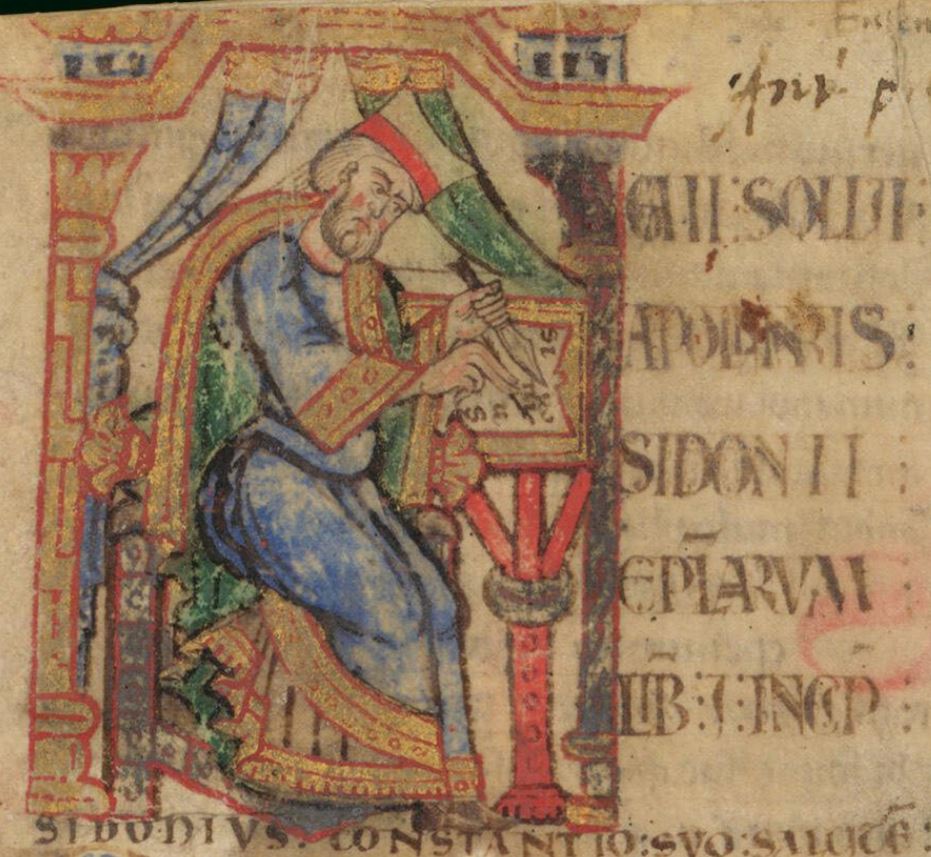
Sidonius Apollinaris writing

Sidonius laments his inability to sing a wedding song with poignant gender contrasts. The ancient Mediterranean world admired long hair in women, but not in men.[3] The long-haired Burgundian men, however, are tall, a manly attribute attractive to women. Sidonius figures himself being as weak as a “little old grandfather {vetulus patris parens}” and as feminine as a “wet-nursing man {nutricis vir}.” The crude Burgundian men devour food as do those engaged in physically demanding, male-gendered work such as plowing, heavy construction, and fighting. Moreover, the Burgundian men have no sense for the luxurious cosmetics that women typically prize much more than do men. Human societies, and primate social groups more generally, usually are centered on women. “Uncivilized” behavior, in contrast, tends to be associated with men. Sidonius’s classical Roman muse Thalia, a woman, flees from the Burgundian men. They are perhaps obtusely singing hexameter songs of epic violence against men.[4]

Sidonius apparently knew the experience of being gender-subordinate within the home. Gregory of Tours reported:

Without his wife knowing, Sidonius would remove almost all the silver vessels from their home and disburse them to the poor. When his wife became aware, she was scandalized by it. But then he would give the value to the needy in money and restore the wares to their home.

{ plerumque nesciente coniuge vasa argentea auferebat a domo et pauperibus erogabat. Quod illa cum cognosceret, scandalizabatur in eum, sed tamen, dato egenis pretio, species domi restituebat. }[5]

A Roman husband nominally had higher status than his wife. But she ruled their home just as the Burgundians ruled Sidonius’s home.

Sidonius’s reference to Alcinous’s kitchen is best understood to refer to Alcinous hosting Jason, Medea, and the Argonauts, and then the pursuing Colchians. The Colchians, whom the Greeks regarded as barbarians, demanded that the Argonauts give the Colchian woman Medea to them. The host Alcinous declared that Medea would go with the Colchians if she hadn’t consummated a marriage with Jason. Swayed by Medea’s pleading, Alcinous’s shrewd wife arranged for Medea and Jason to consummate immediately their marriage. Thus a consummated marriage served as an excuse for Alcinous to dismiss the barbarian Cochians’ demand. Since the marriage of his friend Catullinus was still pending, Sidonius had no such excuse for turning away the barbarian Burgundians.[6]

Having imagined himself as old and female in relation to the Burgundians, Sidonius tellingly provided them with law. A shrewd, flexible mind and cultural authority have wide-ranging value. Writing about the year 474 to his friend Syagrius, Sidonius declared:

How inexpressibly amazed I am that you have seized knowledge of the German tongue with such ease. And yet I remember that your boyhood included good schooling in liberal Roman studies. I know for certain that you often declaimed with spirit and eloquence before your professor of oratory. This being so, I would like you to tell me how you have managed to absorb so swiftly into your inner being the exact sounds of an alien race. After reading Virgil under the schoolmaster’s cane and toiling through the rich fluency of the varicose man Cicero from Arpinum, now you have burst forth before my eyes like a young falcon from an old nest.

{ quantum stupeam sermonis te Germanici notitiam tanta facilitate rapuisse. atqui pueritiam tuam competenter scholis liberalibus memini imbutam et saepenumero acriter eloquenterque declamasse coram oratore satis habeo compertum. atque haec cum ita sint, velim dicas, unde subito hauserunt pectora tua euphoniam gentis alienae, ut modo mihi post ferulas lectionis Maronianae postque desudatam varicosi Arpinatis opuentiam loquacitatemque quasi de harilao vetere novus falco prorumpas? }[7]

Defensively deploying wit like Cato the Elder confronting demands for more men teachers in elementary schools, Sidonius explained:

You have no idea what amusement it gives me, and others too, when I hear that in your presence the barbarian is afraid to perpetrate a barbarism in his own language. The bent elders of the Germans are astounded at you when you translate letters, and they adopt you as umpire and arbitrator in their mutual dealings. You are a new Solon of the Burgundians in discussing the laws, a new Amphion in tuning the lyre, but a three-stringed lyre. You are loved, your company is sought, you are much visited, you delight, you are picked out, you are invited, you decide issues and are heeded. Although these people are stiff and uncouth in body and mind alike, they welcome from you and learn from you their native speech combined with Roman wisdom.

{ aestimari minime potest, quanto mihi ceterisque sit risui, quotiens audio, quod te praesente formidet linguae suae facere barbarus barbarismum. adstupet tibi epistulas interpretanti curva Germanorum senectus et negotiis mutuis arbitrum te disceptatoremque desumit. novus Burgundionum Solon in legibus disserendis, novus Amphion in citharis, sed trichordibus, temperandis, amaris frequentaris, expeteris oblectas, eligeris adhiberis, decernis audiris. et quamquam aeque corporibus ac sensu rigidi sint indolatilesque, amplectuntur in te pariter et discunt sermonem patrium, cor Latinum. }

Sidonius wryly counseled Syagrius:

Only one thing remains, most clever of men: continue with undiminished zeal, even in your hours of ease, to devote some attention to reading. Like the most refined man that you are, observe a just balance between the two languages. Retain grasp of your Latin tongue, lest you be laughed at, and practice the other, in order to have a laugh at them.

{ restat hoc unum, vir facetissime, ut nihilo segnius, vel cum vacabit, aliquid lectioni operis impendas custodiasque hoc, prout es elegantissimus, temperamentum, ut ista tibi lingua teneatur, ne ridearis, illa exerceatur, ut rideas. }

Sidonius apparently followed such advice himself. The epitaph for him praised him for giving law to barbarians:

A leader of troops and a judge in the forum,
calm amid the swelling waves of the world,
constantly moderating the motions of cases,
he gave laws to the barbarian fury.
He brought back peace with considerable
counsel to kingdoms at war.

{ Rector militie forique iudex,
Mundi inter tumidas quietus undas,
Causarum moderans subinde motus
Leges barbarico dedit furori;
Discordantibus inter arma regnis
Pacem consilio reduxit amplo. }[8]

Like the Jewish Joseph rising to become vizier to the Egyptian pharaoh, Sidonius with his mind overcame the crude masculine strength of the Burgundians to become a judge for them.
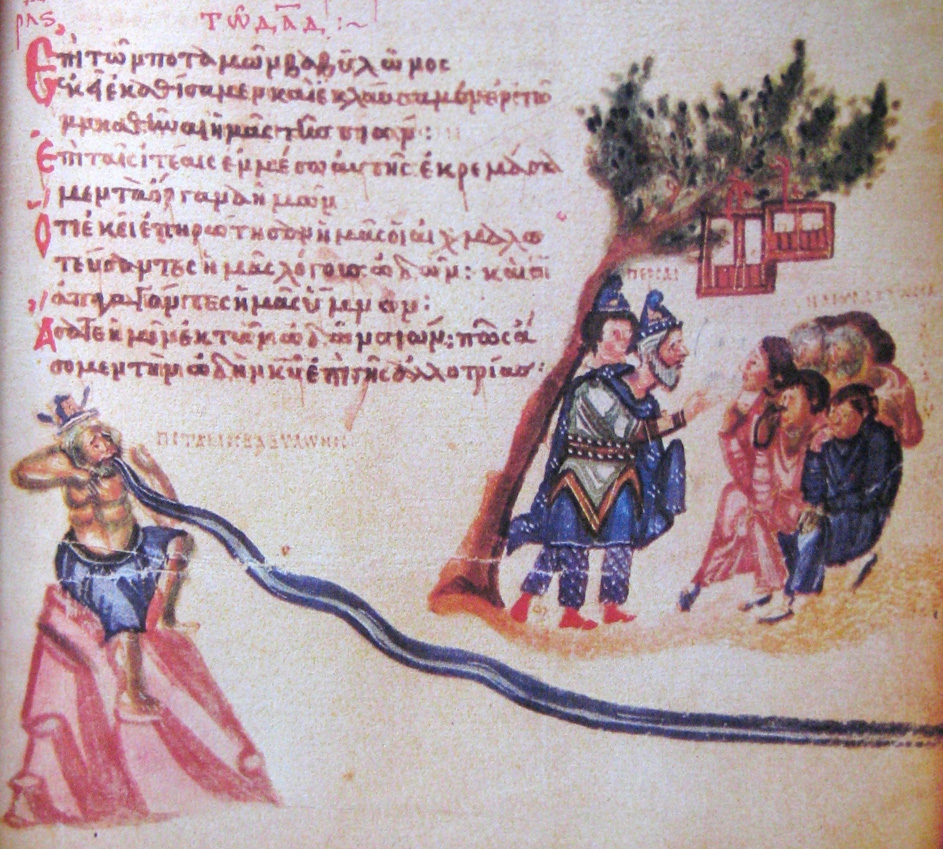
Jews in captivity in Babylon

In the middle of the twentieth century, the brilliant medievalist Helen Waddell poetically recognized the relationship of Sidonius’s lament to Psalm 137. She began her English adaptation of Sidonius’s poem with:

How should I, even if I could
write you Epithalamium [9]

Those two tetrameter verses are metrically close to a transposed beginning of the King James Version of Psalm 137:

There we sat down, yea we wept,
by the rivers of Babylon [10]

Sidonius all but weeps in his description of the Burgundians occupying his house. His lament for the muse Thalia in Waddell’s adaptation is similarly telling:

How can she write a six-foot line
with seven feet of patron?

That seems to correspond to the Psalm 137 verses:

How shall we sing the Lord’s song
in a strange land?

Waddell’s translation adds an extra foot to the line associated with seven feet. That change, like Sidonius’s original poem, invokes wry laughter. As a Roman facing non-Romans invading Gaul, Sidonius would have pondered the pain of Jews driven from their beloved Jerusalem and lamenting in Babylonian captivity. The humor of Sidonius’s poem shouldn’t be allowed to obscure the question of exile that it presents.
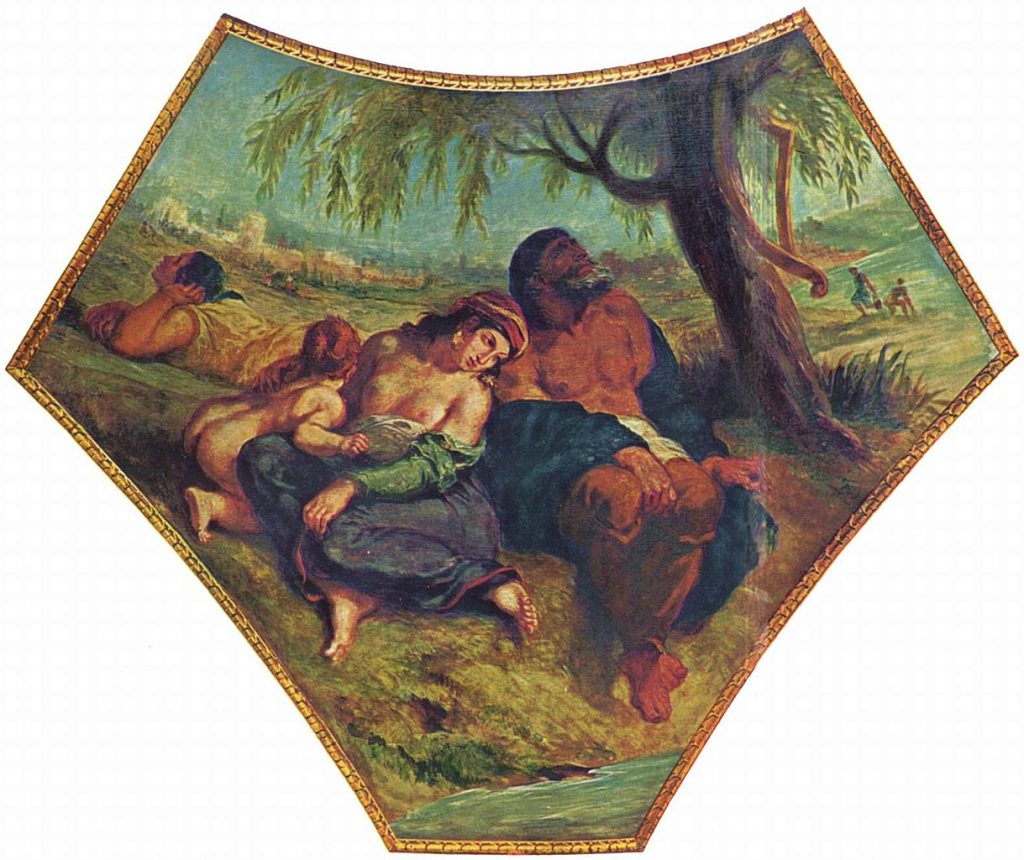
Jewish family in Babylonian exile

Sidonius attempting to compose a wedding song with Burgundians in his house coincides with him beginning to engage more extensively with Christianity. Soon after 461, Sidonius:

occupied himself with Christian concerns in Gaul, attending services at Lyons and sophisticated theological seminars at Vienne, reporting on the activities of bishops, and putting his poetic talents at their service. [11]

Pprobably in the 460s, Sidonius wrote his poem “Thanksgiving to Bishop Faustus of Riez {Eucharisticon ad Faustum Regensem episcopum}.” That poem deeply engages with Hebrew scripture.[12] In a letter securely dated to 468, Sidonius credited Christ as much as his literary style for his recent promotion to the top imperial administrative office, Praefect of Rome {Praefectus Urbi}:

I have atttained to the Praefect office under Christ’s help by the exercise of my literary style.

{ ad praefecturam sub ope Christi stili occasione pervenerim }[13]

Sidonius in 470 was elected Bishop of Clermont-Ferrand. When he died about 489, his epitaph declared:

You who will call on God with tears,
pour out your prayers over his fortunate tomb.
Known to all and read throughout the world,
there by you Sidonius is invoked.

{ Quisque hic cum lacrimis deum rogabis,
Dextrum funde preces super sepulchrum:
Nulli incognitus et legendus orbi
Illic Sidonius tibi invocetur }[14]

This epitaph suggest that Sidonius was invoked as a saint. Gregory of Tours called him “saintly {sanctus}.”[15] Sidonius in fact acquired a feast day as a saint in the Roman Catholic liturgical calendar.

Sidonius’s refusal to sing a wedding song with Burgundians in his house retreats into silence for fear of being called satire. The satirical problem in its deepest sense concerns exclusiveness in the relations of persons and peoples. A scholar recently characterized Sidonius’s poem as a “xenophobic portrait of the Burgundians.” In less anachronistic terms, Christians understand all to be children of God — whether Jew or Greek, slave or free, male or female — through faith in Christ.[16] Christians thus shouldn’t feel themselves to be exiled because of differences in language, food, and other aspects of human culture. Christians, however, honor in marriage special, exclusive love for one’s own spouse. Sidonius loved Latin culture exclusively.[17] His refusal to celebrate exclusive love with Burgundians in his house poignantly questions Christian universalism.

Is cultural exile less painful for a Christian than for a Jew? Amid the collapsing Roman Empire, Sidonius Apollinaris hosting Burgundians in his house considered that question. His poem refusing to celebrate marriage is dangerously close to satire on dominant pieties.[18]

Jews by a river in Babylon

* * * * *

Read more:

Notes:

[1] Sidonius regarded contubernia with disdain. Writing to Bishop Ambrosius, Sidonius disparaged the contubernium that “our dearly beloved man {dilectissimus noster}” had entered with a “slave-woman {ancilla},” “to whom his way of life has totally surrendered itself by obscene habit {se totum consuetudine obscena victus addixerat}.” As Sidonius approvingly explained, this young man, apparently a priest, had broken off his contubernium and married a young woman of lofty character and birth. Sidonius Apollinaris, Letter {Epistola} 9.6, “Sidonius to the Lord Bishop Ambrosius, Greetings {Sidonius Domino Papae Ambrosio salutem},” Latin text from Anderson (1965), my English translation, benefiting from that of id.

[2] Sidonius Apollinaris, Song {Carmen} 12, “Epigram to the Most Notable Man Catullinus, that because of the hostility of barbarians he is unable to write a wedding song {Epigramma ad u.c. Catullinum quod propter hostilitatem barbarorum epithalamium scribere non ualeret},” vv. 1-19 (of 22), Latin text from Anderson (1936), my English translation, benefiting from that of id. The poem’s title is from Kelly (2021), with my English translation. Here’s a version of Sidonius’s poems with metrical scansion. Sidonius’s works survive in substantial form in seventy-seven manuscripts. On the manuscript record for Sidonius, Dolveck (2020).

The title “Most Notable Man {vir clarissimus / u.c.} is a senatorial title ranking below “Illustrious Man {vir illustris}” and “Admirable Man {vir spectabilis}, respectively.

Sidonius literally refers to songs of “Fescennine celebration {Fescenninicola}.” Those are playfully crude songs associated with wedding celebrations. He also literally refers to Dione, another name for the classical love goddess Venus.

Sidonius apparently composed this poem in the early 460s. That dating is based on its reference to satire in its last verse. Sidonius was accused of writing satire in a public dispute in 461. See Sidonius, Letter {Epistola} 1.11, “Sidonius to his friend Montius, Greetings {Sidonius Montio suo Salutem}.” For the connection to Carmen 12, Stevens (1933) p. 66. The leading current analysis of dating Sidonius’s compositions states that Carmen 12 “probably” dates to 461 “or soon after.” Kelly (2020) p. 171.

Burgundians are well attested in Lyon in 457. In that year the western Roman Emperor Majorian expelled them from that city. Wood (2021) p. 119. The Visigoth military leader Ricimer arranged to have Majorian killed in 461. By 463, the Burgundian leader Gundioc was serving Rome as “Master of Soldiers {Magister Militum}” in Gaul. Id. p. 120. That suggests a return of Burgundian presence in Lyon sometime between 461 and 463. Wood described Sidonius as “carefully obscuring the extent to which he and his family worked with the Burgundian magistri militum.” Id. p. 136.

[3] Disparaging Seronatus, Sidonius declares:

He has judged it particularly beautiful to make the condemned ugly before punishing them: he makes men grow their hair long and cuts short women’s hair.

{ praecipue pulchrum arbitratus ante turpare quam punire damnandos; crinem viris nutrit, mulieribus incidit }

Sidonius, Epistola 5.13, “Sidonius to his friend Pannychius, Greetings {Sidonius Pannychio suo salutem},” Latin text and English translation (modified) from Anderson (1965).

[4] Sidonius wrote two wedding songs {epithalamia}, Carmina 11 and 15, both in hexameters. The muse Thalia, whose name means literally “flourishing,” is associated with hendecasyllable poetry of comedy and idyll. Sidonius wrote Carmen 12 in hendecasyllables.

[5] Gregory of Tours, History of the Franks {Historia Francorum} 2.22, Latin text from Krusch (1884), my English translation, benefiting from that of Thorpe (1974).

Sidonius’s wife Papianilla probably overshadowed him in family wealth and political power. They married about 452. She was a member of an aristocratic land-owning family based in Clermont. Her father was Eparchius Avitus, who ruled as the Western Roman Emperor from 455 to 456. Sidonius himself was born in Lyons to an aristocratic Roman family, but after his marriage to Papianilla he made Clermont his home. His wife’s family seems to have been more important to him than his natal family. Harries (1994) p. 174. Sidonius as a young man, about age 25, delivered to the Senate in Rome a panegyric to his father-in-law, Emperor Avitus. Papianilla and Sidonius’s marriage furthered their social and political goals. No surviving evidence indicates that they had an intimate emotional relationship. Mascoli (2016).

[6] On Alcinous, the Argonauts, and the Colchians, Apollonius of Rhodes, Argonautica 4.990–1225 and Pseudo-Apollodorus, Bibliotheca 1.9.25–26.

The reference to ten breakfasts suggests that Sidonius was hosting a contubernium (“tentful”) of Burgundian soldiers. The contubernium was a Roman, not Burgundian, military unit. The allusion to a contubernium is best understood to invoke an alternate meaning of contubernium: a marriage between a free Roman citizen and a slave.

Mratschek associated the reference to Alcinous’s kitchen to Alcinous hosting Odysseus. Mratschek (2020) pp. 23-4. But a central tension in that episode is Odysseus declining to marry the young, lovely Nausicaa. The hasty marriage of Medea and Jason after the armed, barbarian Colchians arrived Alcinous’s court seems to me a more telling allusion.

[7] Sidonius, Epistola 5.5, “Sidonius to his friend Syagrius, greetings {Sidonius Syagrio suo salutem},” Latin text and English translation (modified slightly) from Anderson (1965). For an alternate English translation, Dalton (1915). The subsequent two quotes above are similarly sourced from Epistola 5.5.

[8] Epitaph of Sidonius, Latin text from Montzamir (2017) Figure 4, English translation (modified slightly) from Wood (2021) p. 124, n. 125. On the new manuscript evidence concerning Sidonius’s epitaph, Furbetta (2015). On Sidonius giving law to the Burgundians, Wood (2021) pp. 123-5, Wood (2017) pp. 13-5.

[9] Waddell (1948) p. 21, reprinted in Waddell & Corrigan (1976) p. 87. Waddell presented this poem in the context of the sack of Troy:

Apollinaris Sidonius, Roman patrician and Bishop in Auvergne, was head and front of the Résistance when the Burgundians came, was captured by them, held a year in prison, released, and adored by them to the day of his death. But in the interval, a friend writes asking him to compose an Epithalamium for a marriage feast. Here is his reply. … It is a cartoon, in little, of the power in barbarian Europe of a conquered Rome.

Waddell (1948) pp. 20-1. Nebuchadnezzar’s sack of Jerusalem and the Jews’ Babylonian captivity fits well into Waddell’s context, but she didn’t mention it.

Few have been as effective as Helen Waddell in making medieval Latin poetry attractive to modern readers. While her English version of Sidonius’s song isn’t a faithful translation, it’s an interesting and insightful translation.

[10] The full text of Psalm 137 in the King James Version is readily available online. In the ninth century, the Germanic poet Gottschalk of Orbais more directly referred to Psalm 137 in his poem that begins:

How are you commanding me, little boy,
for what are you telling me, little son,
to sing a sweet song,
while I am far away in exile,
within this sea?
O why are you commanding me to sing?

{ Ut quid iubes, pusiole,
quare mandas, filiole,
carmen dulce me cantare,
cum sim longe exul valde
intra mare?
o cur iubes canere? }

Latin text from The Gottschalk Homepage, my English translation, benefiting from that of Godman (1985), p. 229. Perhaps Sidonius’s Carmen 12 partly inspired Gottschalk’s “Ut quid iubes, pusiole.” Sidonius’s works were known in early medieval France, but seemed to have “left little imprint on literature.” Hernández Lobato (2020) p. 666.

[11] Harries (2018).

[12] Sidonius’s “Thanksgiving {Eucharisticon}” / Carmen 16 (title from Kelly (2021) apparently was published as part of a book of minor poems in the mid-460s. Kelly (2020) p. 194. The dating of “Eucharisticon” could be from the mid-450s to the mid-460s. Kelly lists “early 460s?” Id. pp. 172, 174. Following older scholarship, Daly dates it “c. 465.” Daly (2000) p. 21.

Sidonius’s “Eucharisticon” is well-understood as a chapter added to Mamertus Claudianus’s About the Nature of the Soul {De statu animae}. Daly (2000) p. 23. Mamertus Claudianus, who was Sidonius’s contemporary, was a highly regarded Christian thinker in Gaul. See Sidonius, Epistola 4.11, analyzed in John (2022). Sidonius apparently had advanced to a similarly high level of Christian thought:

Internal evidence strongly suggests that his {Sidonius’s} sixteenth poem was an impressively original expansion of and commentary on insights that, in simpler, unrelated form, the friendly converse and the catechetical instruction of another close friend, Faustus of Riez, had originally shared with him. If so it must have assured Faustus that the baptism that he had adjudged Sidonius ready to receive was, by his mid-thirties, broadening and deepening its force in his life as he grew in his understanding of the Christian religion and moved toward becoming a conversus and a bishop.

Daly (2000) p. 71.

Sidonius’s grandfather Apollinaris, who served as Praetorian Praefect of Gaul under Roman Emperor Constantine III in 408, was the first in Sidonius’s male lineage to convert to Christianity. In his epitaph for Apollinaris, Sidonius called his illustrious grandfather’s conversion to Christianity his grandfather’s “greatest honor {maxima dignitas}.” Sidonius, Epistola 3.12, “Sidonius to his dear Secundus, Greetings {Sidonius secundo suo salutem}.” Sidonius’s grandfather was buried in Lyon in the Basilica of Saint-Just that Bishop Patiens of Lyon had constructed. On that major church, Epistola 2.10.

Sidonius’s Christian commitment has been devalued in the modern period. Stevens claimed that Sidonius lacked theological knowledge. Stevens (1933) pp. 132, 136. Modern historians have tended to view Sidonius as a “predominately secular figure.” Daly (2000) p. 20. “Studies of Sidonius and religion, however, have been rather lacking, especially more recently.” Mathisen (2018), which doesn’t cite Daly (2000) and omits piety-oriented verses of Sidonius’s epitaph. In modern narrative fiction drawing upon Sidonius’s life, “almost invariably, very little space is devoted in these novels to Sidonius’ role as a committed Christian, a bishop, clergyman, and future saint.” Giannotti (2020), p. 729.

[13] Sidonius, Epistola 1.9, “Sidonius to his friend Heronius, greetings {Sidonius Heronio suo salutem},” Latin text and English translation (modified) from Anderson (1936).

[14] Epitaph of Sidonius, Latin text from Montzamir (2017) Figure 4, English translation (modified slightly) from Wood (2021) p. 124, n. 125.

[15] Gregory of Tours, History of the Franks {Historia Francorum} 2.22, Latin text from Krusch (1884). For an English translation of Historia Francorum, Thorpe (1974). Sidonius’s feast day in the Roman Catholic liturgical calendar is August 21.

[16] Mratschek (2020) p. 21 (“xenophobic portrait of the Burgundians”). Cf. Galations 3:25-29. Sidonius had a particularly Roman sense of universality. He described Rome as “the one political entity in the whole world where only barbarians and slaves are foreigners {unica totius orbis civitate soli barbari et servi peregrinantur}.” Epistola 1.6, “Sidonius to his friend Eutropius, greetings {Sidonius Eutropio suo salutem},” Latin text from Anderson (1936), my English translation.

Sidonius explicitly referred to satire. His recusatio from composing an epithalamium for Catallinus ends:

But already my Muse is silent and pulls on reins
after only a few jesting hendecasyllables,
lest anyone should call even these lines satire.

{ Sed iam Musa tacet tenetque habenas
paucis hendecasyllabis iocata,
ne quisquam satiram vel hos vocaret. }

Sidonius, Carmen 12, vv. 20-2, Latin text and English translation (modified slightly) from Anderson (1936). Composing personally offensive satire was illicit. Before Emperor Majorian in Arles in 461, Paeonius falsely accused Sidonius of writing such satire. See Sidonius, Epistola 1.11, “Sidonius to his friend Montius, greetings {Sidonius Montio suo Salutem}.”

Mratschek interpreted Sidonius’s recusatio as alluding to “Ovid’s aphasia in exile in barbarous Tomis.” Mratschek (2020) p. 20. But Sidonius’s poem as a whole has little substantial contact with Ovid’s elegy. Mratschek perceived contemporary relevance of this recusatio in targeting Gundioc, the king of the Burgundians:

On the metapoetic level, what Catullinus received from Sidonius was not an innocuous wedding poem but a politically incorrect satire targeting Gundioc, king of Burgundy, who had reoccupied Lyon after the fall of Majorian and had been appointed to replace Aegidius as magister militum Galliarum. Gundioc, married to a sister of Ricimer, made Lyon his new capital and seized the provinces of Gallia Lugdunensis I, now Burgundy, and, in 463, Gallia Viennensis, the Rhône corridor. Sidonius’s twist in the last line is covertly a subversive criticism of the regime, its focus the final extinction of the genre under Majorian’s barbarian successors.

Id. p. 25 (footnotes omitted). Sidonius apparently had good relations with Gundioc and other Burgundian leaders. Wood (2021) pp. 122-6. Sidonius’s concern about writing satire seems to me better situated in relation to his allusion to Psalm 137.

[17] Early in the fifth century, the Gaul Rutilius Namatianus regarded Rome as a mother to Romans. Sidonius similarly seems to have regarded Rome as his mother. Harries argued:

A champion of Latin letters and Roman aristocratic values, Sidonius was also for most of his career an advocate of co-operation with the Goths of Aquitaine. Both a career politician and an ardent Christian, Sidonius in his writings reveals the confusion of loyalties afflicting an aristocracy under threat and the compromises necessary for survival. … For Sidonius, the conflict was not between Christianity and pagan classicism but between Roman culture, which he identified with the classical tradition, and barbarism.

Harries (1994), from book blurb and p. 3. Mratschek concluded:

On closer examination Sidonius’ references to the past are in no way as transparent as they seem to be: ‘they project everything to do with Sidonius himself and his personal experiences in a way that suggests they are viewed behind a mask or in a mirror’.

Mratschek (2013) p. 268, quoting Küppers (2005), p. 260. Sidonius was like a Jew, but one whose holy city was Rome and whose holy land included Roman Gaul. The central conflict in Carmen 12 seems to me to be between Sidonius’s exclusive love for Roman culture and his Christian faith.

Schlapbach highlighted that Sidonius is “decidedly self-conscious in more than one way.” She perceived formal tension in Sidonius’s recusatio from the Fescennine verses of epithalamium: “this poem claims to be neither a conventional wedding song nor a satire, but in some oblique way it is both.” Schlapbach (2020) pp. 45, 57. The poem is a wedding song in the sense that it depicts an unpleasant and undesired marriage between Sidonius and the Burgundians. The poem’s satire reflects upon Sidonius’s developing Christianity.

[18] van Waarden observed:

Elements of satire and invective as well as a broad array of all kinds of humour play an important role in Sidonius’ work. … Often, a critical (political) message seems to lurk below the innocent surface

van Waarden (2022) p. 1022. The political matter of fifth-century Roman imperial collapse was also a Christian matter.

[images] (1) Sidonius Apollinaris writing. Illumination at the beginning of a twelfth-century manuscript of Sidonius’s works. From folio 1r of Florence, Biblioteca Medicea Laurenziana, MS. Plutei 45.26. (2) Jews in captivity in Babylon. Illumination for Psalm 137 on folio 78v of the mid-ninth-century Chludov Psalter. Preserved as Moscow, Hist. Mus. MS. D.129. Via Wikimedia Commons. (3) Jewish family in Babylonian exile. Painting on a dome in the library of the Palais-Bourbon in Paris. Painted by Eugène Delacroix between about 1837 to 1848. Via Wikimedia Commons. (4) Jews in exile by a river in Babylon. Painted by Gebhard Fugel c. 1920. Via Wikimedia Commons.

References:

Anderson, W.B, ed. and trans. 1936 / 1965. Sidonius. Poems and Letters. With an English translation, introduction, and notes. 2 vols. Loeb Classical Library 296 and 420. Cambridge, MA: Harvard University Press. Vol. 1, Vol. 2.

Dalton, O.M. 1915. The Letters of Sidonius. 2 vols. Oxford: Clarendon Press. Vol. 1, Vol. 2. Both volumes in web-native form.

Daly, William M. 2000. “An Adverse Consensus Questioned: Does Sidonius’s Euchariston (Carmen XVI) Show That He Was Scripturally Naïve?” Traditio. 55: 19–71.

Dolveck, Franz. 2020. “The Manuscript Tradition of Sidonius.” Chapter 16 (pp. 479-507) in Kelly & van Waarden (2020). Addendum.

Furbetta, Luciana. 2015. “L’epitaffio di Sidonio Apollinare in un nuovo testimone manoscritto.” Euphrosyne: Revista de Filologia Classica. 43: 243-254.

Godman, Peter. 1985. Poetry of the Carolingian Renaissance. London: Duckworth.

Giannotti. Filomena. 2020. “Sidonius Reception: Late Nineteenth to Twenty-First Centuries.” Chapter 24 (pp. 705-729) in Kelly & van Waarden (2020).

Harries, Jill. 1994. Sidonius Apollinaris and the Fall of Rome, AD 407-485. Oxford: Clarendon Press.

Harries, Jill. 2018. “Sidonius Apollinaris (c. 430 – c. 489).” Entry in The Oxford Dictionary of Late Antiquity. Oxford, UK: Oxford University Press.

Hernández Lobato, Jesús. 2020. “Sidonius in the Middle Ages and the Renaissance.” Chapter 22 (pp. 665-685) in Kelly & van Waarden (2020).

John, Alison. 2022. “(Mis)Identifying Teachers in Late Antique Gaul: Sidonius’ Ep. 4.11, Mamertus Claudianus and Classical vs. Christian Education.” Mnemosyne. 75: 996-1020.

Kelly, Gavin. 2020. “Dating the Works of Sidonius.” Chapter 3 (pp. 166-194) in Kelly & van Waarden (2020).

Kelly, Gavin. 2021. “An Edition of the Paratexts of Sidonius’ Poems.” Posted online March 27, 2021 at sidonapl.org.

Kelly, Gavin, and Joop van Waarden. 2020. The Edinburgh Companion to Sidonius Apollinaris. Edinburgh: Edinburgh University Press. Reviews by Tabea L. Meurer and by Lena Walhgren-Smith.

Krusch, Bruno, ed. 1884. Monumenta Germaniae Historica, Scriptores rerum Merovingiciarum 1.1, Gregorii Episcopi Turonensis Historiarum Libri X. Hannover: Hahn.

Küppers, Jochem. 2005. “Autobiographisches in den Briefen des Apollinaris Sidonius.” Pp. 251-277 in Michael Reichel, ed. Antike Autobiographien. Werke – Epochen – Gattungen, Europäische Geschichtsdarstellungen 5. Cologne: Böhlau.

Mascoli, Patrizia. 2016. “Sidonio Marito e Vescovo: Matrimonio e Interesse Nella Gallia del V Secolo.” Classica et Christiana. 11: 193-199.

Mathisen, Ralph W. 2018. “Sidonius Apollinaris.” Entry in David G. Hunter, Paul J.J. van Geest, Bert Jan Lietaert Peerbolte, eds. Brill Encyclopedia of Early Christianity. Online.

Montzamir, Patrice. 2017. “Du nouveau sur l’épitaphe attribuée à Sidoine Apollinaire.” XXXIXe Réunion Association pour l’Antiquité Tardive, Jun 2017, Clermont-Ferrand, France. halshs-02275957.

Mratschek, Sigrid. 2013. “Creating Identity from the Past: The Construction of History in the Letters of Sidonius.” Chapter 13 (pp. 249-271) in Joop van Waarden and Gavin Kelly, eds. New Approaches to Sidonius Apollinaris. Leuven: Peeters. Another online instance.

Mratschek, Sigrid. 2020. “The Silence of the Muses in Sidonius Apollinaris (Carm. 12–13, Ep. 8.11): Aphasia and the Timelessness of Poetic Inspiration.” Journal of Late Antiquity. 13 (1):10–43.

Schlapbach, Karin. 2020. “Veriora Nomina Camenarum: Erudition Uncertainty and Cognitive Displacement As Poetic Strategies in Sidonius Apollinaris.” Journal of Late Antiquity. 13 (1): 44–61.

Stevens, Courtenay Edward. 1933. Sidonius Apollinaris and His Age. Oxford: Clarendon Press.

Thorpe, Lewis, trans. 1974. Gregory of Tours: The History of the Franks. Harmondsworth Middlesex England: Penguin Books.

van Waarden, Joop. 2022. “Leafing through Pliny with Sidonius: Sidon. Ep. 1.1, Plin. Ep. 1.1, 1.2, and 1.5, and Satire.” Mnemosyne. 75: 1021-1043.

Waddell, Helen. 1948. Poetry in the Dark Ages: The Eighth W.P. Ker Memorial Lecture Delivered in the University of Glasgow 28th October 1947. Glasgow: Jackson.

Waddell Helen, trans. and Felicitas Corrigan, ed. 1976. More Latin Lyrics from Virgil to Milton. London: Gollancz.

Wood, Ian. 2017. “Burgundian Law-Making, 451-534.” Italian Review of Legal History. 3 (15): 1-27.

Wood, Ian. 2021. ‘The Making of “the Burgundian kingdom.”Reti Medievali Rivista. 22 (2): 111-140.
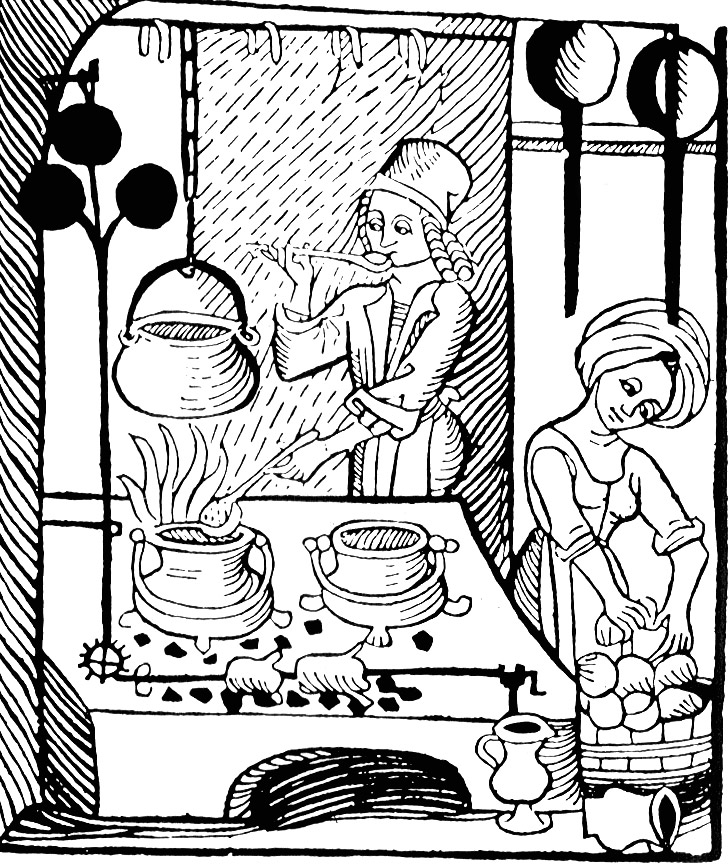
Fortunatus imagined helping Radegund in the kitchen

In the sixth century, Radegund of Thuringia, a princess and queen, left her life of royal privilege to serve humbly her religious sisters in the Abbey of the Holy Cross at Poitiers. Her friend Venantius Fortunatus recognized her humble, arduous work in the kitchen. While kitchen help isn’t the most important gift men can offer women, Fortunatus at least imagined helping Radegund in the kitchen.

medieval kitchen work

After Radegund died, Fortunatus memorialized her life, including her kitchen service. In order that her loved ones could enjoy bountiful meals, Radegund worked assiduously:

How can anyone explain her excited fervor as she ran into the kitchen to do her week of chores? None of the nuns except she would carry as much wood as was needed in a bundle from the back gate. She drew water from the well and poured it into basins. She scrubbed vegetables, washed legumes, and revived the hearth by blowing so that she could cook the food. She busied herself while pots were boiling. She took the vessels from the hearth, washing and laying out the dishes. Then, when the meal was finished, she rinsed the small vessels. She scrubbed the kitchen till it shone, and did the same for whatever was filthy. She carried out what was scrubbed away.

{ Illud quoque quis explicet, quanto fervore excitata ad coquinam concursitabat suam faciens septimanam? Denique nulla monacharum nisi ipsa de posticio, quantum ligni opus erat, sola ferebat in sarcina. Aquam de puteo trahebat et dispensabat per vascula. Holus purgans, legumen lavans, flatu focum vivificans, et ut decoqueret escas, satagebat exaestuans. Vasa de foco ipsa levans, discos lavans et inferens. Hinc, consummatis conviviis, ipsa vascula diluens, purgans nitide coquina, quidquid erat lutulentum, ferebat ima purgamina. }[1]

That’s not the sort of work privileged women typically did in the sixth century. Privileged women today might just order take-out from a restaurant. Nonetheless, while laboring in obscurity, many men and women today do kitchen work on behalf of others.

Since Radegund lived in an institution that restricted men’s access, Fortunatus couldn’t simply go to Radegund to help her in the kitchen. But he acknowledged her work and prayed for her:

Sweet, bountiful, and worthy woman, for whom is such labor’s care
so that would come to you a great harvest from a few seeds,
you now willingly weary your limbs as time flees.
With Christ you will be given perpetual rest.
Your right hand, truly sweating as you prepare meals for the sisters,
now burns from waves of flames and numbs in cold.
With constant prayers I roll among your arms
and the burden you bear oppresses my spirit.
Now you hasten back to make the fire and cook the meal.
Since inactive, I have no value in helping mother.

{ Dulcis opima decens, cui tanta est cura laboris,
ut tibi sit modico semine magna seges,
quae modo membra libens fugitivo tempore lassas,
cum Christo dabitur perpetuanda quies.
Dextra ubi nempe paras sudando sororibus escas,
undis et flammis hinc riget, inde calet.
Assiduis votis inter tua bracchia volvor
atque meos animos sarcina vestra terit.
Nunc faciendo focos epulasque coquendo recurris,
nec valeo matrem quippe iuvare piger. }[2]

As a religious woman and the founding mother of a convent, Radegund surely understood that stillness in prayer has value. But it doesn’t have value in preparing ordinary food. Fortunatus imagined himself actually helping Radegund in the kitchen:

If I cannot pay tribute to you at your side, I pay in my absence
so that it would prove my devotion, my beloved mother.
If I were not absent, I would do whatever you ordered.
Perhaps an unskillful man would please with small submissions.
With devoted heart but rustic tongue I would offer
by shepherd’s pipe music in mother’s ear.
Attending your commands every day I would wear out my limbs —
they would serve with my neck bowed to its lady-lord.
My fingers would refuse nothing, and the hand
that wrote this would lift forth waters from a deep well,
pull out vines and set up cuttings in gardens,
willingly plant and cultivate sweet vegetables.
A splendor it would be to burn my limbs with you in the kitchen
and to wash blackened pots in a basin of pure water.

{ Si nequeo praesens, absens tibi solvo tributum,
ut probet affectum, mater amata, meum.
Si non essem absens, facerem quodcumque iuberes:
obsequiis parvis forte placeret iners.
Pectore devoto set rustica lingua dedisset
pastoris calamo matris in aure sonum.
Imperiis famulans tererem mea membra diurnis,
servirent dominae subdita colla suae.
Nulla recusarent digiti, puteoque profundo
quae manus hoc scripsit prompta levaret aquas,
protraheret vites et surcula figeret hortis,
plantaret, coleret dulce libenter holus.
Splendor erat tecum mea membra ardere coquina
et nigra de puro vasa lavare lacu. }[3]

What more could Fortunatus do? He also urged Radegund to “drink a little soothing wine, for you are over-weary {ut lassata nimis vina benigna bibas}.”[4] That’s authoritative Christian advice to those whose burdens are heavy.

Women are celebrated for competing with their beloved men in their men’s chosen fields. For example, Heloise of the Paraclete ardently loved Peter Abelard. He was renowned as an extraordinarily learned scholar and an outstanding poet. While she preferred not to burden him with marriage, they felt compelled to marry. Heloise herself came to be regarded as a great scholar. A medieval epitaph for her declares:

Heloise, beauty and glory of the womanly sex,
is enclosed before her time beneath this mass of stones.
She matched her Peter in perception, inclination, and skill.
She knew all literature unlike anyone else.
Speech and goodness made her figure and fame. With splendor and worth,
she was a rare one who to him continued perpetually sufficient.

{ Feminei sexus decor et decus hec Heloyssa
Mole sub hac lapidum clauditur ante dies.
Illa suo Petro par sensu, moribus, arte,
Scripturas omnes noverat absque pare.
Os, virtus, formam, famam, fulgore, valore,
Que sunt rara satis perpetuavit ei. }[5]

Heloise didn’t eternally promise Abelard that epitaph writers wouldn’t praise her above him in scholarly knowledge. Even as a highly learned woman, she probably perceived no reason to make that impossible promise.

Meninist literary criticism highlights important insights from great medieval women writers. Learn from what happened to Heloise. Men, don’t insist on helping your wives or girlfriends in the kitchen. Respect women. Your beloved women might prefer to prepare gifts for you independently and non-competitively.

work in restaurant kitchen

* * * * *

Read more:

Notes:

[1] Venantius Fortunatus, The Life of Holy Radegund {De vita sanctae Radegundis} para. 24, Latin text from Leo (1881), English translation (modified) from McNamara & Halborg (1992). Here’s the Latin edition of Migne (1849).

[2] Fortunatus, Carmina Appendix 28, vv. 1-10, Latin text from Roberts (2017), my English translation, benefiting from those of id. and Pucci (2010). Subsequent quotes above from Fortunatus’s poems are similarly sourced. Leo (1881) provides a freely available Latin edition of Fortunatus’s poems. Leo’s Latin edition differs little from Roberts’s Latin edition.

[3] Fortunatus, Carmina Appendix 22, vv. 1-14.

[4] Fortunatus, Carmina 11.4, v. 4. Cf. 1 Timothy 5:23.

[5] Epitaph for Heloise, vv. 1-6, Latin text from Dronke (1976) p. 49, , my English translation, benefiting from that of Dronke (1965) vol. 2, p. 469 (which inadvertently omitted the fifth verse). Cf. 2 Corinthians 12:9. This epitaph survives only in a fifteenth-century manuscript: Bern 211, fol. 160v. Id. This epitaph is 453 in Barrow, Burnett & Luscombe (1986) and 6418 in Walther (1963-1969).

Dronke commented “perpetuare — in the sense of ‘to promise lastingly’” and translated Que sunt rara satis perpetuavit ei as “she made to him an eternal promise of the rarest kind.” Dronke (1965) vol. 2, pp. 469-70. Dronke had outstanding knowledge of medieval Latin. Nonetheless, his translation of this verse seems to me inaccurate and tendentious. Similarly tendentious is Dronke’s claim, “what is unusual here is the sense of two lovers perfectly matched.” Donke (1976) p. 22.

Clanchy, in contrast, declared that verse 4 of this epitaph “looks like a riposte to Peter the Venerable’s epitaph which had declared Abelard to be ‘without an equal, without a better, the world’s acknowledged prince of studies {aut par, aut melior, studiorum cognitus orbi princeps}.'” Clanchy (2003) p. v (footnoted Latin included in quote). Peter the Venerable was a knowledgeable contemporary of Heloise and Abelard. Apparently dismissing Peter the Venerable’s claim, Clanchy declared:

The epitaph for Heloise asserts that she had been Abelard’s equal in sensibilities and his superior in learning. Because he is now so much better documented than she is (his main academic works survive, whereas she is known only through letters and charters), modern scholars have tended to see her as his intellectual and artistic dependent. Even her best biographer, Enid McLeod, takes this patriarchal line….

Id. Praise Clanchy for bravely denouncing patriarchy!

Men and women delight in aggrandizing women, and men ardently desire to be champions for women. For example, about the year 1100, Hildebert of Lavardin, then the forty-five-year-old bishop of Le Mans, praised poems that he had received from the nun Muriel of Wilton. Hildebert declared to her:

Former times boasted of ten sibyls,
and great was the glory of your sex.
The present age rejoices in just one genius,
and does not totally lack a young woman prophet.
Between humans and gods now exist certain communications,
which I think, if I’m not deceived, are uttered through a young woman’s voice.
The gods have placed in your mind their awesome inner workings
and have appointed your sacred voice as their prophet.
Whatever flows from your voice transcends the vigils of the ancients
and is inferior solely to the gods.
Whatever you exhale is immortal, and
the world adores your work as if it were divine.
By your genius you dethrone prophets and celebrated poets,
and both sexes are stunned by your eloquence.
The songs you have sent me I have considered and pondered ten times.
I marvel and deem them to have come from far away.
Such sacred works cannot be human,
nor do I believe you speak, but celestial beings speak through you.
The weight of your words, their deep meaning, their beautiful order,
have the face of making divinely.

{ Tempora prisca decem se iactavere sibillis,
et vestri sexus gloria multa fuit.
unius ingenio presentia secula gaudent,
et non ex toto virgine vate carent.
nunc quoque sunt homini quedam commercia divum,
quos puto, nec fallor, virginis ore loqui.
mente tua posuere dei penetrale verendum,
osque sacrum vatem constituere suum.
ore tuo quecumque fluunt vigilata priorum
transcendunt, solis inferiora deis.
quicquid enim spiras est immortale, tuumque
tanquam divinum mundus adorat opus.
deprimis ingenio vates celebresque poetas,
et stupet eloquio sexus uterque tuo.
carmina missa mihi decies spectata revolvens
miror, et ex aditis illa venire reor.
non est humanum tam sacros posse labores,
nec te, sed per te numina credo loqui.
pondera verborum, sensus gravis, ordo venustus
vultum divine condicionis habent. }

Hildebert of Le Mans, Carmen 26, Latin text of Scott (1969) pp. 17-8 via Epistolae: Medieval Women’s Latin Letters, my English translation, benefiting from that at Epistolae and Jaeger (2022) pp. 440-1 (Excursus 2). Here’s an Italian translation. If Hildebert actually admired Muriel of Wilton’s poetry so highly, he might have preserved it. None of her poetry has survived.

Despite being a bishop, Hildebert in praising Muriel of Wilton engaged in classical gyno-idolatry. His rhetoric implies that he experienced the sublime in reading Muriel’s poetry. Jaeger declared:

Hildebert, along with writers and audiences who shared his culture, understood that the aesthetic effect of Muriel’s poetry was more prophetic than mimetic; more like that of the Virgin Mary magnifying the lord than that of a sober observer exaggerating the virtues of an ordinary person. Both the mother of Jesus and Hildebert were raising the subject of their praise into the sublime.

Jaeger (2022) Excursus 2. This claim elides differences between “the aesthetic effect of Muriel’s poetry” and Muriel’s status as a person. Hildebert was praising Muriel as a god just as the mother of Jesus magnified the lord as god. In practice, men’s gyno-idolatry is commonplace. It has even been exhibited in the British Museum.

Not gyno-idolators, nuns of the Paraclete perceived their abbess Heloise to be a saint. Their epitaph for her emphasizes her closeness to them:

The prudent Heloise, our abbess, lies in this tomb.
Founder of the Paraclete, she rests with the Paraclete.
High above the poles, she shares the joys of the saints.
She lifts us from the depths by her merits and her prayers.

{ Hoc tumulo abbatissa iacet prudens Heloysa.
Paraclitum statuit, cum Paraclito requiescit.
Gaudia sanctorum sua sunt super alta polorum.
nos meritis precibusque suis exaltet ab imis. }

Latin text from Dronke (1976) p. 50, English translation (modified slightly) from McLaughlin & Wheeler (2009) (Letter 20). This epitaph is 454 in Barrow, Burnett & Luscombe (1986) and 8365 in Walther (1963-1969). It apparently comes from a manuscript from the Paraclete. It survives in two fifteenth-century sources and in a thirteenth-century manuscript: Troyes, Médiathèque du Grand Troyes (olim Bibliothèque Municipale), Fonds ancien 802 I, f. 102v. Fortunatus similarly regarded Radegund as a saint and wanted to be close to her in an ordinary way, i.e. working in the kitchen.

[images] (1) Medieval kitchen work. Woodcut by Johannes Fischauer in the Augsburg (1505) edition of Kuchenmaistrey {Kitchen Knowledge}. Peter Wagner first published this book in 1485. It’s the first printed cookbook in German. Via Wikimedia Commons. (2) Commercial work in a restaurant kitchen. Source image generously shared on flickr by Dr. Matthias Ripp under a Creative Commons By 2.0 license.

References:

Barrow Julia, Charles Burnett, and David Luscombe. 1986. “A Checklist of the Manuscripts Containing the Writings of Peter Abelard and Heloise and Other Works Closely Associated with Abelard and His School.” Revue d’Histoire des Textes. 14-15: 183-302.

Clanchy, Michael. 2003. “Forward.” Pp. v-viii in Stewart, Marc, and David Wulstan. 2003. The Poetic and Musical Legacy of Heloise and Abelard: An Anthology of Essays by Various Authors. Ottawa, Canada; Westhumble, Surrey: Institute of Mediaeval Music and Plainsong and Mediaeval Music Society.

Dronke, Peter. 1965. Medieval Latin and the Rise of European Love-Lyric. 2 vols. Vol. 1Vol. 2. Oxford: Clarendon Press.

Dronke, Peter. 1976. Abelard and Heloise in Medieval Testimonies: the twenty-sixth W.P. Ker Memorial Lecture delivered in the University of Glasgow 29th October, 1976. Glasgow: University of Glasgow Press. Reprinted as Chapter 9 (pp. 247-294) in Dronke, Peter. 1992. Intellectuals and Poets in Medieval Europe. Roma: Edizioni di Storia e Letteratura.

Jaeger, C. Stephen. 2022. The Sense of the Sublime in the Middle Ages. Online.

Leo, Friedrich, ed. 1881. Venanti Fortunati Opera Poetica (Pars Prior), Venanti Fortunati Opera Pedestria (Pars Posterior). Monumenta Germaniae Historica, Auctores Antiquissimi IV. Berlin: Weidmann. Another copy.

McLaughlin, Mary, and Bonnie Wheeler, trans. 2009. The Letters of Heloise and Abelard. New York: Palgrave Macmillan.

McNamara, Jo Ann, and John E. Halborg, ed. and trans., with E. Gordon Whatley. 1992. Sainted Women of the Dark Ages. Durham, NC: Duke University Press.

Pucci, Michael, trans. 2010. Poems to Friends: Venantius Fortunatus. Indianapolis, IN: Hackett Publishing Co.

Roberts, Michael, ed and trans. 2017. Venantius Fortunatus. Poems. Dumbarton Oaks Medieval Library 46. Cambridge, MA: Harvard University Press. Reviews by Hope Williard and by Lionel Yaceczko.

Scott, A. Brian. 1969. Hildeberti Cenomannensis Episcopi, Carmina Minora. Leipzig: Teubner.

Walther, Hans. 1963-1969. Proverbia sententiaeque latinitatis Medii Aevi: lateinische Sprichwörter und Sentenzen des Mittelalters in alphabetischer Anordnung. Göttingen: Vandenhoeck & Ruprecht.

Sidonius’s myth and philosophy in marriage of Araneola & Polemius

In mid-fifth-century Gaul, Araneola and Polemius planned to marry. Araneola was a strong, independent woman descended from leading Roman officials. Polemius, a descendant of the eminent Roman historian Tacitus, was a Platonic philosopher. Polemius asked his friend Sidonius Apollinaris, a noted poet, to provide a wedding song (epithalamium). The eminent church father Jerome under the name of Aristotle’s most-favored student Theophrastus had urged women to recognize men’s difficulties in marriage. With classical myth and philosophy, Sidonius playfully amplified Theophrastus’s teachings to warn Polemius about marrying Araneola.

Sidonius associated marriage with bodily pleasure and procreation. He wrote to a bishop about a young man, apparently a priest, who had lived with a sexually attractive slave-woman. According to Sidonius, “the extravagant costliness of that domestic Charybdis {sumptuositas domesticae Charybdis}” had swallowed the young man’s modest inheritance and reduced him to indigence.[1] The young man finally came to good sense. He ended his relationship with the sexually attractive slave-woman and married a wealthy woman of good character and birth. That wasn’t a pleasureless marriage. Sidonius declares:

It would indeed be glorious if he had renounced his life of pleasure so completely as to not even have a wife. But while one might perhaps move from error to a good way of life, few begin by moving to the best. For most, who have long indulged themselves in all pleasures with women, it’s impossible to eliminate all immediately and simultaneously.

{ haec quidem gloria, si voluptates sic reliquisset, ut nec uxori coniugaretur; sed, etsi forte contingat ad bonos mores ab errore migrare, paucorum est incipere de maxumis, et eos, qui diu totum indulserint sibi, protinus totum et pariter incidere. }

Sidonius thus urges the bishop to pray that this young priest follow a moderate way:

Therefore your duty is by sedulous prayer to obtain for the couple as soon as possible the hope of children, such that after a son or two being born (and I have said too much) he who has presumed to do what is unlawful will abstain from what is lawful.

{ quocirca vestrum est copulatis obtinere quam primum prece sedula spem liberorum; consequens erit, ut filio uno alterove susceptis (et nimis dixi) abstineat de cetero licitis, qui inlicita praesumpsit. }

Sidonius, himself a married bishop, recognized the joy of sex and the blessing of children. But he evidently thought it best for priests to abstain from sex and focus on other forms of Christian service.

Like the disconsolate Boethius, Sidonius privileged above marriage public service to the Roman Empire. He castigates his friend and relative Eutropius for being happy at home, plowing and seeding:

Granted, your vats will foam from your multiple vineyards, barns will be given innumerous piles of collected crops until bursting, and your well-fed shepherd will drive a crowded flock with full udders to the milking-pail through the odorous entrances of your sheep-folds. Yet what use is it to have increased your inheritance by so dirty an economy and at the same time to have remained in obscurity, not only amid such surroundings, but even more shamefully, for the sake of them?

{ esto, multiplicatis tibi spumabunt musta vinetis, innumeros quoque cumulos frugibus rupta congestis horrea dabunt, densum pecus gravidis uberibus in mulctram per antra olida caularum pinguis tibi pastor includet: quo spectat tam faeculento patrimonium promovisse compendio et non solum inter ista sed, quod est turpius, propter ista latuisse? }[2]

While Eutropius engages in sensuous, earthly cultivating, he also studies the philosophy of Plotinus and his school of third-century Platonists. Sidonius wants Eutropius to travel to Rome and take up public office. Sidonius bluntly concludes his letter by threatening Eutropius about following Epicurus’s doctrines:

Well, what more? If you submit to these exhortations, I’m ready to be your comrade and helper, a guide and partner of your efforts. But if you let yourself be entangled in the tempting snares of luxury so, as they say, to be coupled with the dogmas of Epicurus, who has admitted virtue’s rejection and defines the supreme good in terms of bodily pleasure alone, then here and now I call our ancestors and our posterity to witness that I have nothing to do with such wickedness. Farewell.

{ sed quid plura? si pateris hortantem, conatuum tuorum socius adiutor, praevius particeps ero, sin autem inlecebrosis deliciarum cassibus involutus mavis, ut aiunt, Epicuri dogmatibus copulari, qui iactura virtutis admissa summum bonum sola corporis voluptate determinat, testor ecce maiores, testor posteros nostros huic me noxae non esse confinem. vale. }

The philosophy of Plotinus differs considerably from that of Epicurus. Sidonius’s point is merely to browbeat Eutropius into leaving his farm in Gaul and traveling to Rome to acquire a public office. Eutropius evidently did that. He became Praetorian Prefect of Gaul about 470.

In writing an epithalamium for the Platonist Polemius, Sidonius more comprehensively mocks philosophy. He explains to Polemius:

More influential on me has been the system of your learning than the occasion of your marriage. I have omitted therefore the tenderness of epithalamium and pulled my pen over the most bitter and rough teachings of philosophy.

{ valet magis me doctrinae quam causae tuae habuisse rationem. omissa itaque epithalamii teneritudine per asperrimas philosophiae et salebrosissimas regulas stilum traxi }[3]

Polemius apparently honors the traditional Roman gods. Sidonius, who is a Christian, twists Polemius’s non-Christian learning back at him:

Since my attention to your love-endeavor has led me, a man of Gaul, to introduce matter of a sophisticated school into your epithalamium, I require from you prayerful intercession for my deed. Let Venus and all the false colorings of love be bestowed on one who would lack the ability to be so lauded. Farewell.

{ quoniam tui amoris studio inductus homo Gallus scholae sophisticae intromisi materiam, vel te potissimum facti mei deprecatorem requiro. illi Venus vel Amorum commenticia pigmenta tribuantur cui defuerit sic posse laudari, vale. }[4]

Christians favor in marriage fleshly love like that which the Roman love-goddess Venus promotes. Sidonius, however, torments Polemius with the classical myth and philosophy that Martianus Capella had used to delay interminably the fleshly marriage of Philology and Mercury.

Cassandra at the altar of Athena

Sidonius begins his epithalamium for Araneola and Polemius atypically. He begins with the Roman goddess Athena’s revenge on the Greek warrior Ajax for raping the Trojan prophetess Casandra after the Greeks destroyed Troy. Cassandra received her prophetic powers from the god Apollo. Apollo offered to give her the gift of prophecy if she would have sex with him. When Cassandra accepted Apollo’s proposal and gift, but then reneged on her promise to have sex with him, he was enraged. He cursed Cassandra’s prophecies so that, although true, they would not be believed. Cassandra subsequently prophesied that if Paris were to elope with Helen, the Greeks would destroy Troy. Cassandra was ignored. Paris married Helen, and the Greeks sacked Troy. Amid that horror, Cassandra sought refuge in the temple of Athena. Locrian Ajax desecrated Athena’s temple in raping Cassandra. Athena in revenge hurled a thunderbolt at Ajax’s ship heading home from Troy. He drowned in the wreckage. Horrific violence ensuing from true prophecy not believed is a shocking beginning to Sidonius’s very unusual wedding song.[5]

Continuing his epithalamium, Sidonius describes Athena from her head downwards. That’s the classical pattern for describing a beautiful young woman (descriptio puellae). In the most important mythic beauty pageant, Athena lost to Venus. Athena’s loss surely is at least partly attributable to her propensity to adorn her chest with a Gorgon’s head. In fact, in describing Athena, Sidonius describes at length her chest adornment:

A Gorgon covers the middle of her chest, acting in beholding
without delays, though beheaded. Proudly shines that dangerous
image. Its loveliness lives with its spirit perishing.
The gloomy head makes fierce its piles of horn-headed vipers
with towering spirals. The biting hair twists its spotted
coils and its angry locks utter horrible hisses.

{ Gorgo tenet pectus medium, factura videnti
et truncata moras; nitet insidiosa superbum
effigies vivitque anima pereunte venustas;
alta cerastarum spiris caput asperat atrum
congeries, torquet maculosa volumina mordax
crinis, et irati dant sibila taetra capilli }[6]

What man would want to marry such a woman, or even merely direct his male gaze toward Athena? Athena herself is warrior-woman. She wears steel armor, carries a spear in her right hand, and a shield in her left. Her shield is decorated with scenes as tumultuous as a field of volcanoes. The giant Enceladus, who fought at length against Athena, launches to the heavens a spiny Pindus mountain like a giant spear. Typhoeus hurls the high mountain Ossa like a missile. Athena throws a spear at her name-matched Pallas, a giant. He’s petrified by her Gorgoneion before her spear strikes his body. Within the fray Briareus is fighting with all his hands. Athena’s shield thus depicts a panorama of brutality like a nightmare marriage.

After introducing Athena into his epithalamium, Sidonius depicts two temples: one for weaving speculative thoughts in philosophy and another for weaving useful clothes. The temple of philosophy contains only men. The temple of weaving contains only women. The woman-goddess Athena, with whom the epithalamium begins, is known for both wisdom and weaving. Athena symbolizes the gynocentric order that encompasses both women and men and all aspects of human life.

Within the temple of philosopy reside the “seven sages {septem sapientes}.” According to Sidonius, those seven sages are “the origins of innumerous philosophers {innumerabilium primordia philosophorum}.” He gives the names of the seven sages and popular slogans associated with them. That’s far from serious philosophy. In fact, by Sidonius’s day the seven sages had long been the subject of latrine humor.

Sidonius then discusses at length the teachings of Samian Pythagoras on music and astrology. He discusses at length the teachings of Thales of Miletus, one of the seven sages that he had previously cited. He traces Thales’s students across seven generations to the Socratic school of Plato. Sidonius credits Plato with being the first to establish by how much “the first essence would be distant / from the highest and sixth good {prima essentia distet / a summo sextoque bono}.” That’s pseudo-philosophical blather. Nonetheless, Sidonius pretends to explain it at length.

Sidonius concludes his pompous and ridiculous discussion of philosophy with a mock-laudatory invocation of Polemius. Polemius, unlike Christians, denies truth in his school of philosophy:

In this school, science cultivates the life
of Polemius and fosters him attached to her Plato.
Although the Academy opposes all sects
and denies truth, it adorns him with true lauds.

{ hoc in gymnasio Polemi sapientia vitam
excolit adiunctumque suo fovet ipsa Platoni;
obviet et quamquam totis Academia sectis
atque neget verum, veris hunc laudibus ornat. }[7]

Sidonius surely means for the phrase “true lauds” to ring ironically. He also notes, “As for the Epicureans, virtue ejects them from every part of the temple {ast Epicureos eliminat undique Virtus}.”[8] In Sidonius’s writings, Epicureans are associated with bodily pleasure, including sexual pleasure. Polemius apparently should not think that he would have bodily pleasure in his marriage to Araneola.

Glaucus importuning Scylla

The temple for weaving clothes provides an equally daunting perspective on marriage. The robe of Jupiter, the leading god in cuckolding husbands, was woven there. Another of its garments displays the likeness of Glaucus, who disastrously fell in love with Scylla, a woman just as perilous as Charybdis. A third garment depicts Amphitryon’s putative son Hercules unknowingly killing two serpents with his strong grip. Jupiter cuckolded Amphitryon to engender Hercules with Amphitryon’s wife Alcmene. Jupiter’s wife Juno, furious at her husband’s philandering, had sent those two serpents to kill Hercules.

Araneola herself is working in the temple of weaving. She is weaving an imperial robe for her father. He has risen to be a Roman consul like her grandfather and her great-grandfather.[9] She had already woven a robe for her father to use in touring the cities of Spain when he was appointed Praetorian Prefect of Gaul. Would Polemius measure up to his wife’s father, grandfather, and great-grandfather? Athena attempts to compete with Araneola in weaving and then resigns in defeat. Polemius likewise probably couldn’t successfully compete with his wife or his wife’s family.

High up on her father’s consular robe Araneola embroidered famous marriages from ancient times. She depicted Penelope duping her suitors by weaving and unweaving a burial shroud as her husband Odysseus delayed in returning home. She also depicted Orpheus. Lacking trust that his wife Eurydice was following him out of Hell, he lost her to Hell again. Even more chillingly, she in addition depicted the Danaids. Among those fifty young women, forty-nine slaughtered their sleeping husbands. She wove in Jupiter having sex with Mnemosyne, Europa, Semele, Leda, and Cynosura by transforming himself into a serpent, bull, lightning, swan, and nymph, respectively. What husband could be safe from such a god?

Araneola sees Athena looking with more pleasure upon the temple of philosophy than upon the temple of weaving. Araneola responds defiantly, just as did Arachne to claims of Athena’s superior weaving skill. Araneola recalcitrantly weaves the courtesan Lais dominating the philosopher Diogenes the Cynic:

Araneola began to depict Lais, the philosopher’s vanquisher,
who over the chin and neck of the boorish Cynic
severed his smelly beard with her fragrant scissors.

{ pingere philosophi victricem Laida coepit,
quae Cynici per menta feri rugosaque colla
rupit odoratam redolenti forcipe barbam }

Like Aristotle in relation to Phyllis, Diogenes wasn’t cynical enough about women to ward off his own humiliation at a woman’s hands. Araneola wouldn’t yield to the goddess Athena. Surely she would also dominate the philosopher Polemius in her marriage with him.[10]

metamorphosis of Arachne into a spider

Sidonius imagines that Polemius, a rational thinker, is hesitant to marry. Athena urges Araneola and Polemius to move forward with their marriage

No more shall you laugh at our dogmas, you young woman
who shall marry my philosopher. Put on your bridal veil.
Allow a mother to weave this work. Rise, Polemius,
distinguished ornament of sages, and now finally your Stoic
frown dismiss. And imitating Cynics as lovers,
undertake to make for me a second little Plato.

{ non nostra ulterius ridebis dogmata, virgo
philosopho nuptura meo; mage flammea sumens
hoc mater sine texat opus. consurge, sophorum
egregium Polemi decus, ac nunc Stoica tandem
pone supercilia et Cynicos imitatus amantes
incipies iterum parvum mihi ferre Platona }

Polemius hesitates, perhaps not wanting to find himself like Diogenes the Cynic in love with Lais. Then Polemius hears the words of his master Plato:

Press on willingly! You could not possibly reject marriage,
which our old teacher Socrates commands. Not reluctant, he drank
poison while contemplating gods, with Anytus his executioner turning pale.

{ perge libens, neu tu damnes fortasse iugari,
quod noster iubet ille senex qui non piger hausit
numina contemplans Anyto pallente venenum. }

Socrates was married to the harridan Xanthippe. He had good reason to drink poison willingly. One might hope that a wedding song would sing not about drinking poison, but about performing the rites “of the love-goddesses {Venerum}.” Alas for the meter, not so went Sidonius’s epithalamium for Polemius and Araneola.

The marriage ceremony moves forward. Polemius modestly removes his threadbare philosopher’s cloak and consigns it to Plato. Athena ties an olive branch, a symbol of peace, onto each of the spouses’ heads. She joins their right hands. Then their golden life-threads are woven together. Perhaps Araneola herself had spun those threads.

Sidonius didn’t actually regard serious study of philosophy and literature as inconsistent with marriage. In a letter to a young literary friend, Sidonius declares:

That you would be able to read more easily and more pleasurably, it is necessary that you read without faking and without limit to your reading. Don’t tolerate the thought that you will soon be at home happily married to deflect you from this proposition. Always fully remember that time when Marcia, Terentia, Calpurnia, Pudentilla, and Rusticiana held candles and candelabra while their husbands, respectfully Hortensius, Tullius, Pliny, Apuleius, and Symmachus, were reading and thinking. Certainly, moreover, if you are complaining that your oratory and poetical skill, and the edge of your tongue, sharpened with the whetstone of frequent study, are blunted by a houseful of women, remember that Corinna often helped her Naso to complete a verse, and so it was with Lesbia and Catullus, Caesennia and Gaetulicus, Argentaria and Lucan, Cynthia and Propertius, and Delia and Tibullus. Hence one should have clarity that the studious perceive marriage to bestow opportunity, while idlers perceive it as an excuse.

{ quoque id facilius possis voluptuosiusque, opus est ut sine dissimulatione lectites, sine fine lecturias; neque patiaris ut te ab hoc proposito propediem coniunx domum feliciter ducenda deflectat, sisque oppido meminens quod olim Marcia Hortensio, Terentia Tullio, Calpurnia Plinio, Pudentilla Apuleio, Rusticiana Symmacho legentibus meditantibusque candelas et candelabra tenuerunt. certe si praeter oratoriam contubernio feminarum poeticum ingenium et oris tui limam frequentium studiorum cotibus expolitam querens obtundi, reminiscere quod saepe versum Corinna cum suo Nasone complevit, Lesbia cum Catullo, Caesennia cum Gaetulico, Argentaria cum Lucano, Cynthia cum Propertio, Delia cum Tibullo. proinde liquido daret studentibus discendi per nuptias occasionem tribui, desidibus excusationem }[11]

Sidonius perceived Polemius’s marriage as an occasion for mocking philosophy and humorously invoking themes from literature of men’s sexed protest. While filled with classical learning, Sidonius’s epithalamium for Araneola and Polemius isn’t meant to be taken seriously.

Sidonius wryly indicated that Polemius resented this epithalamium. Measuring up to Araneola’s forefathers, Polemius became Praetorian Prefect of Gaul about 471. Sidonius included in his disseminated letter-collection a letter that he wrote to Polemius about two years later.[12] In that letter, Sidonius hints that he has repented of a crime he committed against Polemius and complains that Polemius has long ignored him. Perhaps that crime was his epithalamium. Sidonius begs to receive a letter from his long-time friend Polemius. Sidonius also suggests that high office, not marriage, has blunted Polemius’s appreciation for philosophy. That’s an important insight. Nominally leading men in gynocentric society tend to be the ones most offended by frankly comical depictions of gender relations.

* * * * *

Read more:

Notes:

[1] Sidonius Apollinaris, Letter {Epistola} 9.6, “Sidonius to the Lord Bishop Ambrosius, greetings {Sidonius Domino Papae Ambrosio salutem},” Latin text from Anderson (1965), my English translation, benefiting from that of id. The subsequent two quotes above are similarly from Epistola 9.6. Attractive women threatening men as do Scylla and Charybdis is a motif in men’s sexed protest.

[2] Sidonius, Epistola 1.6, “Sidonius to his friend Eutropius, greetings {Sidonius Eutropio suo salutem},” Latin text from Anderson (1936), my English translation, benefiting from that of id. The subsequent quote above is similarly from Epistola 1.6.

In Epistola 3.6 to Eutropius, Sidonius congratulates Eutropius on his recent elevation (c. 470) to Praetorian Prefect of Gaul. Sidonius also refers to “your master Plotinus {vester Plotinus}” and associates Eutropius with the “school of Platonists {palaestra Platonicorum}.” Plotinus lived from 204 to 270 GC. He was an influential philosopher now regarded as the leading Neoplatonist.

Sidonius’s disparagement of Epicurean pleasure contrasts sharply with Epicurus in the earlier but related work of Martianus Capella. Martianus placed Epicurus among immortals and declared: “Epicurus indeed was carrying violets and roses mixed with all allurements of pleasure {Epicurus vero mixtas violis rosas et totas apportabat illecebras voluptatum}.” Martianus Capella, About the Marriage of Philology and Mercury {De nuptiis Philologiae et Mercurii} 213 (from Book 2), Latin text from Willis (1983), my English translation. Martianus apparently wrote De nuptiis Philologiae et Mercurii early in the fifth century (before 439). On Martianus’s view of Epicurus, Brown (1982).

[3] Sidonius, Song {Carmen} 14, “Sidonius to his friend Polemius, greetings {Sidonius Polemio suo salutem},” Latin text from Anderson (1936), my English translation, benefiting from that of id. The subsequent quote above is similarly from Carmen 14. Carmina 14 and 15 seem to date to “461, or else very soon after.” Kelly (2020) p. 172. For a commentary (not available to me) on these works, Ravenna (1990).

Carmen 14 isn’t actually a poem, but a prose letter. It precedes Sidonius’s epithalamium for Araneola and Polemius among Sidonius’s poems in the manuscript tradition. Kelly (2021).

[4] Sidonius seems to be taunting Polemius as a follower of traditional Roman gods and goddesses. Traditional Roman religion didn’t regard Venus as a false coloring of love. Sidonius implies that Polemius regards philosophers as gods. Christians, in contrast, pray to Christian saints for help.

[5] The name Polemius suggests the ancient Greek word “war {πόλεμος}.” Polemius’s name thus resonates with the violent beginning of the epithalamium for him. Roberts (1989) p. 342. On knowledge of Greek in fifth-century Gaul, John (2020).

War is institutionally structured as violence against men. Sidonius, however, like Prudentius, seems to have deliberately reversed the gender polarity of war. The goddess Athena represents war, while Polemius is a hesitant, modest, and unwarlike man.

The name Polemius is elsewhere attested by Polemius Silvius, a fifth-century Christian imperial official. Polemius Silvius devised a calendar integrating traditional Roman festivals with Christian holy days.

[6] Sidonius Carmen 15, “Epithalamium of Sidonius spoken to Polemius and Araneola {Sidonii epithalamium dictum Polemio et Araneolae},” vv. 7-12, Latin text from Anderson (1936), my English translation, benefiting from that of id. The epithalamium title used here is from Kelly (2021). Roberts noted that except for the last six verses of this epithalamium, it contains “little of the conventional epithalamium.” Roberts (1989) p. 341.

Subsequent quotes above from Carmen 15 are similarly sourced. They are vv. 42 (seven sages), 43 (the origins of innumerous philosophers), 102-3 (the first essence would be…), 117-21 (In this school, science cultivates the life…), 125 (As for the Epicureans…), 182-4 (Araneola began to depict Lais…), 186-91 (No more shall you laugh at our dogmas…), 193-5 (Press on willingly! …).

[7] In the verse Carmen 15.121, the pronoun “him {hunc}” is probably best interpreted to refer to Polemius. Early Christians distinguished themselves from others, whom they came to call pagans, in insisting on the absolute truth of Christianity. On that distinctive Christian epistemological stance, O’Donnell (1979).

Sidonius credited his friend Bishop Faustus with having Christianized philosophy. Jerome interpreted the captive maiden of Deuteronomy as modeling Christianization of Greco-Roman classics. Through Jerome’s figure of the captive maiden, Sidonius elaborately represented both his own action and Bishop Faustus’s learning . With respect to Bishop Faustus, Sidonius declared:

An artist then endowed with all these intellectual and literary excellences, you have joined to yourself a beautiful woman. She has married you in the ritual prescribed by Deuteronomy, my Lord Bishop. You had seen her, while still in your youth, among the hordes of the enemy. There in the midst of the hostile ranks you fell in love with her and, defying the attempts of the opposing warriors to drive you back, you carried her off with the conquering arm of desire. Her name was Philosophy. Rescued by force from the crowd of blasphemous sciences, she shaved off the locks that betokened false religion. She shaved off the disdainful eyebrows of worldly knowledge and cut away the folds of her old former raiment — and by folds I mean the twists and turns of sinister dialectic screening wrong and unlawful behavior. Then, when cleansed in every part, she united herself with you in a mystic embrace.

She has long been your attendant, even from your early years. She is your inseparable companion whether you are exercising yourself in the hard school of the city or wearing yourself out in hidden solitudes. She is your partner in the Athenaeum and in the monastery. With you she renounces worldly studies, and with you she proclaims heavenly doctrine. If anyone assails you now that you are wed to this spiritual bride, he will learn that Plato’s Academy is now enlisted in the cause of Christ’s church and that you practice philosophy in a nobler sense.

{ artifex igitur his animi litterarumque dotibus praeditus mulierem pulchram sed illam deuternomio astipulante nubentem, domine papa, tibi iugasti; quam tu adhuc iuvenis inter hostiles conspicatus catervas, atque illic in acie contrariae partis adamatam, nil per obstantes repulsus proeliatores, desiderii brachio vincente rapuisti, philosophiam scilicet, quae violenter e numero sacrilegarum artium exempta raso capillo superfluae religionis ac supercilio scientiae saecularis amputatisque pervetustarum vestium rugis, id est tristis dialecticae flexibus falsa morum et illicita velantibus, mystico amplexu iam defaecata tecum membra coniunxit.

haec ab annis vestra iamdudum pedisequa primoribus, haec tuo lateri comes inseparabilis, sive in palaestris exerceris urbanis sive in abstrusis macerare solitudinibus, haec Athenaei consors, haec monasterii, tecum mundanas abdicat, tecum supernas praedicat disciplinas. huic copulatum te matrimonio qui lacessiverit, sentiet ecclesiae Christi Platonis Academiam militare teque nobilius philosophari }

Sidonius, Epistola 9.9.12-3, “Sidonius to the Lord Bishop Faustus, greetings {Sidonius Domino Papae Fausto salutem},” Latin text and English translation (modified slightly) from Anderson (1965). For an alternate perspective on the classical heritage in fifth-century Gaul, Stevens (1933) pp. 15-8; John (2021).

[8] Sidonius evocatively refers to paintings on the Areopagus in Athens that show “Epicurus with unwrinkled skin {Epicurus cute distenta}.” Sidonius, Epistola 9.9.14, “Sidonius to the Lord Bishop Faustus, greetings {Sidonius Domino Papae Fausto salutem},” Latin text and English translation from Anderson (1965). Bishop Faustus became Bishop of Riez about 460. See Epistola 9.3.

[9] Araneola’s grandfather was Flavius Constantinus Felix, Consul of Rome in 428. Her father was the eminent Gallo-Roman noble Flavius Magnus of Narbonne. He was a Roman senator. Emperor Majorian appointed him Magister Officiorum, Consul of Rome in 460, and Praetorian Prefect of Gaul in 469. Araneola’s brother was Magnus Felix. He rose to be Praetorian Praefect of Gaul and Patrician. He was Sidonius’s schoolfriend. On this and other aristocratic Gallo-Roman families, Mathisen (2003).

[10] The unusual name Araneola is a diminutive of the Latin word “spider {aranea},” from the ancient Greek ἀράχνη. According to Ovid, the young woman Arachne of Maeonia, an outstanding weaver, would not acknowledge Athena as preeminent weaver. Ovid, Metamorphoses 6.5-7. After Athena challenged Arachne to a weaving contest and lost, Athena transformed Arachne into a spider. In Sidonius’s revision of that myth, Athena challenges Araneola to a weaving contest and Araneola wins. Then Araneola asserts the superiority of women’s beauty and guile (Lais) over men’s thinking (the philosopher Diogenes). On Sidonius’s recasting of the myth of Arachne competing with Athena, Rosati (2004).

According to Roberts, Sidonius through Araneola indicates “scepticism about the superiority of male virtus.” Araneola undercuts “the male perspective” in her weaving of mythic scenes. Araneola’s depictions of Penelope, who deceived her suitors; Alcestis, for whom Admestus was required to undertake a deadly quest; and Hypermestra, sister to the husband-killing Danaids, “suggest some criticism of the comparative value of male and female worlds.” Moreover, “Orpheus seems entirely ineffectual by comparison with the heroic female figures with whom he’s surrounded.” In addition, “Araneola’s irreverence makes a charming contrast” with the self-important posing of academicians. The mythic end of this epithalamium is “the sublation of the opposition between male and female in an image of equality.” Roberts (1989) pp. 342-3. Indeed, could academics today read this epithalamium in any other way?

[11] Sidonius, Epistola 2.10, “Sidonius to his friend Hesperius, greetings {Sidonius Hesperio suo salutem},” Latin text from Anderson (1936), my English translation, benefiting from that of id.

[12] Sidonius, Epistola 4.14, “Sidonius to his friend Polemius, greetings {Sidonius Polemio suo salutem}.” In this letter, Sidonius also refers to Tacitus as being Polemius’s ancestor. Sidonius again positions Polemius as not being a Christian:

I would like that you would know that being before the forum’s high priest is not like being before the judge of the world. For you, the man who doesn’t keep silent about his disgraces is damned, yet for us one who makes confession of them to God is absolved.

{ noveris volo non, ut est apud praesulem fori, sic esse apud iudicem mundi, namque ut is, qui propria vobis non tacuerit flagitia, damnatur, ita nobiscum qui eadem deo fuerit confessus absolvitur. }

Sidonius seems to mock Roman religious belief as well as Roman marriage. Inter-personal forgiveness is a central value in Christian societies.

Mratschek interprets Epistola 4.14 more narrowly as expressing Sidonius’s pain for Polemius’s silence across two years. She observed:

In his letter (Ep. 4.14.1), the bishop {Sidonius} reproduced almost word for word the speech attributed in Tacitus’ Histories (5.26.2) to the rebel leader Iulius Civilis, who stayed true to his friendship with Vespasian even during the Batavian war, in which the two fought on opposite sides.

Mratschek (2020 p. 245. Polemius might have felt that Sidonius didn’t stay true to their friendship in his epithalamium. In any case, this letter is the only letter to Polemius (other than Carmen 14) that Sidonius included in his collection. That suggests that it was included for its poignancy (whether real or contrived) in relation to Carmen 15.

[images] (1) Cassandra imploring Athena for vengeance after Ajax desecrated Athena’s temple and raped Cassandra. Painted by Jérôme-Martin Langlois in 1810. Via Wikimedia Commons. (2) Glaucus importuning Scylla. Painted by Bartholomeus Spranger between 1580 and 1582. Preserved as accession # GG_2615 in the Kunsthistorisches Museum (Vienna, Austria). Via Wikimedia Commons. (3) Metamorphosis of Arachne into a spider. From an instance of the Ovide moralisé, illustrated by the Master of Fauvel about 1330. From folio 78r of Paris, Arsenal, Ms-5069 réserve. Also available via BnF Mandragore and Wikimedia Commons.

References:

Anderson, W.B, ed. and trans. 1936 / 1965. Sidonius. Poems and Letters. With an English translation, introduction, and notes. 2 vols. Loeb Classical Library 296 and 420. Cambridge, MA: Harvard University Press. Vol. 1, Vol. 2.

Brown, Emerson. 1982. “Epicurus and Voluptas in Late Antiquity: The Curious Testimony of Martianus Capella.” Traditio. 38: 75–106.

John, Alison. 2020. “Learning Greek in Late Antique Gaul.” Classical Quarterly. 70 (2): 846-864.

John, Alison. 2021. “Cultural Memory and Classical Education in Late Antique Gaul.” In Martine De Marre and Rajiv K. Bhola, eds. Making and Unmaking Ancient Memory. London: Routledge.

Kelly, Gavin. 2020. “Dating the Works of Sidonius.” Chapter 3 (pp. 166-194) in Kelly & van Waarden (2020).

Kelly, Gavin. 2021. “An Edition of the Paratexts of Sidonius’ Poems.” Posted online March 27, 2021 at sidonapl.org.

Kelly, Gavin, and Joop van Waarden. 2020. The Edinburgh Companion to Sidonius Apollinaris. Edinburgh: Edinburgh University Press. Reviews by Tabea L. Meurer and by Lena Walhgren-Smith.

Mathisen, Ralph W. 2003. ‘“Qui Genus Unde Patres?” the Case of Arcadius Placidus Magnus Felix.Medieval Prosopography. 24 (1): 55–71.

Mratschek, Sigrid. 2020. “Creating Culture and Presenting the Self in Sidonius.” Chapter 6 (pp. 237-260) in Kelly & van Waarden (2020).

O’Donnell, James J. 1979. “The Demise of Paganism.” Traditio. 35: 45–88.

Ravenna, Giovanni. 1990. Le Nozze di Polemio e Araneola: Sidonio Apollinare Carmina XIV-XV. Bologna: Pàtron.

Roberts, Michael. 1989. “The Use of Myth in Latin Epithalamia from Statius to Venantius Fortunatus.” Transactions of the American Philological Association. 119: 321–348.

Rosati, Gianpiero. 2004. “La strategia del ragno, ovvero la rivincita di Aracne. Fortuna tardo-antica (Sidonio Apollinare, Claudiano) di un mito Ovidiano.” Dictynna. 1: 1-14. Online at https://doi.org/10.4000/dictynna.174

Stevens, Courtenay Edward. 1933. Sidonius Apollinaris and His Age. Oxford: Clarendon Press.

Willis, James, ed. 1983. Martianus Capella. Leipzig: B.G. Teubner Verlagsgesellschaft.

sharing food indicates love in Fortunatus’s poetry

The sixth-century poet and public figure Venantius Fortunatus delighted in sharing food and eating. To his dear friends Radegund of Thuringia and Agnes of the Holy Cross, Fortunatus sent a gift:

As son to mother, as likewise brother to sister,
I bear small gifts with a devoted heart.
Joined to you, one-third of three, I offer three gifts to you two:
sugared fruits fitting for souls so sweet.
But forgive me for the sort of wrapper they’ve got:
let these gifts be carried in a basket of words.

{ Matri natus ego, frater simul ipse sorori
Pectore devoto parvula dona fero.
Tertius unitus tria munera porto duabus:
Tam dulces animas dulcia poma decent.
Sed date nunc veniam mihi quod fano talis habetur:
Munera quae portet, charta canister erit. }[1]

Fortunatus’s gift evidently consisted of three sugared fruits wrapped in paper upon which he wrote this poem. Fortunatus regarded Radegund, the founder of the Abbey of the Holy Cross at Poitiers, to be like his mother. He regarded Agnes, abbess of that abbey, to be like his sister. The three fruits poignantly represent the sweetness of all three of them being together. The words of Fortunatus’s poem, literally holding tangible fruit, bring them together. Those words are meant to be as humble and love-incarnating as a manger.

Food can of course create personal difficulties. When Fortunatus visited the eminent Frankish noble Mummolenus, he knew Mummolenus to have admirable character:

He therefore satisfies with a rich banquet whoever comes to him.
Just the sight of him was for me as good as a meal.

{ Huc ergo adveniens epulis expletus opimis:
Quem vidisse mihi constitit esse cibum. }[2]

That meal was like a holiday feast:

Large platters were piled high with generous helpings,
and a dish was laden and piled up like a hillside.
On every side reared a mountain, with a sort of valley in between,
a convenient space for a fish to pursue its course.
It swam in a world where oil was water, the dish a grassy
field, and the table took the place of the sea.
Before everything else I was given a delicate fruit
that is called “Persian” in common talk.
He grew weary of giving, but I didn’t grow weary of eating,
as he urged me on with his words, as he pressed on me more food.
Soon my belly suddenly grew large as if I were about to give birth.
I marveled that my stomach had so swelled.
Inside thunderclaps rumbled with varied reports.
East and South winds were churning my belly into turmoil.
Not so is the sand stirred up by the storms of Aeolus,
nor a ship driven adrift on the sea so shivered,
not so inflated by blast of winds are bellows,
instruments the fire-scorched smith uses to service hammers.
One food discharged belches, conflicting with another’s mass,
and within me outside of my will was an uncivil battle.

{ Fercula magna quidem dapibus cumulata benignis,
Ac si colle tumens discus onustus erat.
Undique montis opus, medium quasi vallis habebat,
Quo meliore via piscis agebat iter.
Ille natans oleum pro undis, pro caespite discum
Incoluit, cui pro gurgite mensa fuit.
Attamen ante aliud data sunt mihi mitia poma,
Persica quae vulgi nomine dicta sonant.
Lassavit dando (sed non ego lassor edendo),
Vocibus hinc cogens, hinc tribuendo dapes.
Mox quasi parturiens subito me ventre tetendi,
Admirans uterum sic tumuisse meum.
Intus enim tonitrus vario rumore fremebat;
Viscera conturbans Eurus et Auster erat.
Non sic Aeoliis turbatur harena procellis
Nec vaga per pelagus puppis adacta tremit,
Nec sic inflantur ventorum turbine folles,
Malleolis famulos quos faber ustus habet.
Alter in alterius ructabat mole susurros
Et sine me mecum pugna superba fuit. }

In such a situation, one might hope for the gift of farting. That gift, like the resurrection of Lazarus, should smell of God’s grace.

second-century mosaic of Roman food

One enjoys in food, like in life, godly abundance. Fortunatus recounted:

From all sides a flood of food rushes out.
I can’t go wrong — what first to try?
Silver plate bears a mound of meat,
thick gravy where vegetables are swimming,
marble dish deposits a garden’s brood,
honeyed taste flows over my lips,
saucer-glass swells with the burden of chicken —
removing feathers doesn’t lighten it.
Apples in abundance rush from colorful wicket,
their fragrance, pleasant-flowing, sate me.
An indigo jar gives snowy cups of milk,
so stately come. It knew it was set to please.
Lady and mother, and her child: let the third one,
your servant, speak of these gifts, joined by a godly love.

{ Multiplices epulae concurrunt undique fusae;
Quid prius excipiam, me bonus error habet.
Carnea dona tumens argentea gavata perfert,
Quo nimium pingui iure natabat holus.
Marmoreus defert discus quod gignitur hortis,
Quo mihi mellitus fluxit in ore sapor.
Intumuit pullis vitreo scutella rotatu,
Subductis pinnis quam grave pondus habens!
Plurima de pictis concurrunt poma canistris,
Quorum blandifluus me saturavit odor.
Olla nigella nimis dat candida pocula lactis
Atque superba venit quae placitura fuit.
Haec dominae matri famulans, haec munera natae
Iunctus amore pio tertius ipse loquar. }[3]

Fortunatus relished gifts of food that he received from Radegund and Agnes:

All around me, delicacies raised on grass
fatten me. Eggs appear, and then prunes —
pallid, dark gifts offered in tandem provide
so varied a meal that I worry my gut won’t keep peace.
Too late you ordered me to eat two eggs.
I sucked down four — I wouldn’t lie to you.
May my soul be privileged for all my days
to obey you as I obeyed my gut just now.

{ Hinc me deliciis, illinc me pascitis herbis;
Hinc ova occurrunt, hinc mihi pruna datur.
Candida dona simul praebentur et inde nigella.
Ventre utinam pax sit sic variante cibo!
Me geminis ovis iussistis sero cibari,
Vobis vera loquor, quattuor ipse bibi.
Atque utinam merear cunctis parere diebus
Sic animo, ceu nunc hoc gula iussa facit. }

Radegund and Agnes were leading women religious. Fortunatus aspired to his soul obeying them naturally. In contrast, humans don’t need teaching in the spirit of eating:

I spread myself over jumbled delights that gorged my belly
as I gulped it all down: milk, vegetables, eggs, butter.
Now platters fitted out with new dishes appear,
a polyglot meal, more sweetly pleasant.
Butter was served to me with milk;
its fat recalls where it once had been.

{ Deliciis variis tumido me ventre tetendi,
Omnia sumendo, lac, holus, ova, butur.
Nunc instructa novis epulis mihi fercula dantur,
Et permixta simul dulcius esca placet.
Nam cum lacte mihi posuerunt inde buturum;
Unde prius fuerat, huc revocatur adeps. }

In his fatness Fortunatus would have remembered banquets that his beloved Radegund and Agnes provided. That’s not like being fat from eating bags of Doritos by yourself while watching the news on TV. Fortunatus got fat in a godly way. If you get fat, you should get fat in a godly way, too.

Christian love (agape) feast. Fresco from the early Christian Catacombs of Domitilla

Eating isn’t just about food. It’s about sharing with others. Fotunatus sought to have both food and words with Radegund and Agnes:

By piety’s duty, by the holy one who rules from the stars,
by all that mother loves, your brother himself desires
that when I take food, you say some words.
If you do, I shall be twice satisfied.

{ Per pietatis opus, per qui pius imperat astris,
Per quod mater amat, frater et ipse cupit
Ut, dum nos escam capimus, quodcumque loquaris:
Quod si tu facias, bis satiabor ego. }[4]

Words shared at table need not be serious:

A charming teacher refreshes her friend with words and food
and satisfies him with various delicious jokes.

{ Blanda magistra suum verbis recreavit et escis
Et satiat vario deliciante ioco. }

One seldom chews on words shared at a good meal. Table fellowship increases appetite. Table fellowship is the fundamental fellowship.

Extravagant food isn’t necessary for the joy of sharing a meal. Perhaps because Fortunatus overindulged in food, a doctor ordered him to fast. Radegund and Agnes supported the doctor’s order:

Amid countless feasts you send a fast
and so burn my soul gazing at mounded meals
that the eye covets, but the doctor forbids.
My purring gut is muzzled by his hand on my mouth.
Still, when you offer creamy milk to my lips,
it’s a present that any king would prefer.
I pray now, sister, with good mother, be happy,
for a bounteous table of joy holds us.

{ Inter multiplices epulas ieiunia mittis
Atque meos animos plura videndo cremas.
Respiciunt oculi medicus quod non iubet uti,
Et manus illa vetat quod gula nostra rogat.
Attamen ante aliud cum lactis opima ministras,
Muneribus vincis regia dona tuis.
Nunc cum matre pia gaudens soror esto, precamur,
Nam nos laetitiae mensa benigna tenet. }[5]

A friend and creamy milk is enough for a bounteous table of joy. As Fortunatus believed, “abundant love is seen in a small gift {munus in angustum cernitur amplus amor}.”[6]

A person should not glory in the shame of gluttony, nor make one’s stomach into a god. While Fortunatus greatly loved Radegund and Agnes and the food they gave him, he didn’t literally idolize them.[7] No Epicurean, Fortunatus believed in the soul’s immortality and blessing in bodily penetration. Whatever one believes, sharing food, however much or little, can strengthen human relationships. Sharing food has done so since the beginning of humanity.

group enjoying dinner in Bali, Indonesia

* * * * *

Read more:

Notes:

[1] Venantius Fortunatus, Carmina Appendix 26, Latin text from Roberts (2017), English translation (modified) from Pucci (2010) p. 119. Leo (1881) provides a freely available Latin edition differing little from Roberts’s Latin edition.

[2] Fortunatus, Carmina 7.14, incipit “While I was wearily making my way almost in the darkness of night {Dum mihi fessus iter gradior prope noctis in umbra},” vv. 15-6, Latin text and English translation (modified) from Roberts (2017). Pucci (2010) doesn’t include this poem. The subsequent quote above is similarly sourced from Carmina 7.14, vv. 17-36.

The delicate fruit called “Persian” is a peach. Roberts (2017) p. 870, notes to vv. 23-4. Gowers (1993), which discusses food in classical Latin literature, offers nothing about Fortunatus.

Fortunatus associated with the elite of Gaul. Mummolenus, a native of Soissons in present-day northern France, became an important figure in the court of Sigibert I, the Frankish king of Austrasia. Radegund was a Germanic princess and queen of Thuringia.

[3] Fortunatus, Carmina 11.10, Latin text from Roberts (2017), English translation (modified) from Pucci (2010). Carmina 11.9, incipit “With attentive devotion you bid me always to inform you {Sollicita pietate iubes cognoscere semper},” describes another lavish meal that Fortunatus received, apparently from Agnes. The subsequent two quotes above are Carmina 11.20 and 11.22a, similarly sourced.

[4] Fortunatus, Carmina 11.22, Latin text from Roberts (2017), my English translation. Here I’ve preferred to follow the Latin more closely than the translation in Pucci (2010). The subsequent quote above is similarly from Carmina 11.23a.

[5] Fortunatus, Carmina 11.19, Latin text from Roberts (2017), English translation (modified) from Pucci (2010).

[6] Fortunatus, Carmina 11.24, incipit “If you have not completed what here is called compline {Si non complestis quod hic completa vocatur},” v. 4, Latin text from Roberts (2017), my English translation.

Late in the eighth century, the Anglo-Saxon nun Berhtgyth went with her mother Cynehild to Thuringia to proclaim Christianity among non-Christian Germans. Berhtgyth deeply missed the presence of her brother Balthard. She sent him a gift of a ribbon and a short poem. Paralleling Fortunatus, she declared them to be “a little present, although small, still loaded with great love {munuscula, quamvis parva, tamen cum maxima caritate honerata}.” Berhtgyth to Balthard, Latin text and English translation from Maude (2017) p. 20. This letter has survived in Vienna, National Austrian Library, MS. Manuscript 751 (Vienna Codex), written in the middle of the ninth century.

[7] Cf. Philippians 3:18-9. Medieval men were prone to the related failing of gyno-idolatry.

[images] (1) Ancient Roman food. Second-century mosaic from a villa at Tor Marancia, near the Catacombs of Domitilla in Rome. Source photo thanks to Jastrow (2006) and Wikimedia Commons. (2) Christian love (agape) feast. Fresco from the early Christian Catacombs of Domitilla. Photo via Wikimedia Commons. (3) Group enjoying dinner in Bali, Indonesia on February 26, 2016. Photo thanks to Withlocals and Wikimedia Commons.

References:

Gowers, Emily. 1993. The Loaded Table: Representations of Food in Roman Literature. Oxford: Clarendon Press. Review by Phyllis Bober.

Leo, Friedrich, ed. 1881. Venanti Fortunati Opera Poetica (Pars Prior), Venanti Fortunati Opera Pedestria (Pars Posterior). Monumenta Germaniae Historica, Auctores Antiquissimi IV. Berlin: Weidmann. Another copy. Web-native presentation.

Maude, Kathryn. 2017. “Berhtgyth’s Letters to Balthard.” Medieval Feminist Forum. Subsidia Series no. 7. Medieval Texts in Translation 4. 53 (3): 1-24.

Pucci, Michael, trans. 2010. Poems to Friends: Venantius Fortunatus. Indianapolis, IN: Hackett Publishing Co.

Roberts, Michael, ed and trans. 2017. Venantius Fortunatus. Poems. Dumbarton Oaks Medieval Library 46. Cambridge, MA: Harvard University Press. Reviews by Hope Williard and by Lionel Yaceczko.

Guillaume de Palerne’s medieval dream of gender equality in love

In the late-twelfth-century Old French adventure romance William of Palermo {Guillaume de Palerne}, Queen Felise and King Embron are relaxing in a garden in Palermo with their four-year-old son Guillaume. The king’s brother had conspired with nursemaids to have both the king and his son killed so that the brother could inherit the realm. But that day, a werewolf jumps into the garden, seizes Guillaume in his mouth, and runs away. It’s a male werewolf like the male dog Saint Guinefort. Guillaume de Palerne fundamentally challenges disparagement of males and men’s gender subordination in love.

Queen Felise is a traditional woman similar to the mother of the Arthurian hero Percival. Grief-stricken that a werewolf has seized her son, she screams over and over:

Help! Help! Holy Mary!
Household of the king, what are you doing?
I will kill myself now, if Guillaume isn’t rescued.

{ Aidiés, aidiés, sainte Marie
Maisnie au roi, que faites vous?
Ja me morrai, s’il n’est rescous. }[1]

Facing such emotional coercion, the king and many other men mount their horses and chase after the werewolf. Chasing werewolves is a dangerous job. The medieval Viking woman Svanhvita didn’t push onto men difficulty, dangerous jobs. Women today should reject sexist military conscription and insist that men be saved first from sinking ships.

Not regarding males as solely instrumental, Queen Felise appreciates male beauty. She laments:

Son, where are your beautiful eyes now,
so beautiful, gentle, and without pride,
your noble brow and your beautiful hair
that all seemed to be made of fine gold,
your tender face and your bright countenance?
Oh heart, why do you not go out from me?
Son, what has become of your beauty,
your noble body and your radiance,
your nose, your mouth, and your chin,
and your figure and your appearance,
your beautiful arms and white hands,
and your beautiful loins and hips,
your beautiful legs and your feet?
Woe is me, what grief and what failure.
Already you should have been made to be
for pleasure and for desire.
Now you are food for a werewolf!

{ Fix, ou sont ore ti bel oeil,
Li bel, li simple, sans orguel,
Tes frons li gens, et ti bel crin
Qui tuit sambloient fait d’or fin,
Ta tandre face et tes clers vis?
Ha! cuers, por coi ne me partis?
Qu’est devenue ta biautés
Et tes gens cors et ta clartés,
Tes nés, ta bouche et tes mentons
Et la figure et ta façons,
Et ti bel brac et tes mains blanches
Et tes rains beles et tes hanches,
Tes beles jambes et ti pié?
Lasse, quel duel et quel pechié!
Ja dévoies tu estre fais
Por devises et por souhais,
Or es a leu garoul peuture }[2]

In literary history, the “description of a beautiful young woman {descriptio puella}” is much more common that a description of a beautiful young man. But cherishing men’s physical being can help to end epic violence against men. Cherishing men’s physical being should be done more frequently.

Trojan Dolon wearing a wolf skin to spy on the Greeks at Troy

The male werewolf engages in typical paternal care for a child. He carries the child gently and ensures that the child is happy and fed. After running deeply into a forest, the male werewolf digs a den, lines it with grass and ferns and reeds, and places the child gently within. He embraces the child. But like fathers compelled to earn money outside the home to support their families, the male werewolf has to leave the child to search for food.

When the child hears a dog barking, he is afraid and cries out loudly. A cowherd hears the child crying and runs to him. He finds the child alone. Like the male werewolf, the male cowherd engaged in typical paternal care:

He bends down toward the child and calls to him.
He much cajoles and caresses him.
So sweetly does he appeal to him
that away he went with the king’s son.
The cowherd picks him up in his arms
and then he leaves quickly.
To his house he returned.

{ Vers lui s’abaisse et si l’apele;
Mult le blandist et afavele.
Tant doucement l’atrait a soi
C’o lui s’en vait li fix le roi.
Et cil entre ses bras le prent.
A tant s’en vait isnelement,
A sa maison est revenus }

The cowherd and his wife didn’t have any children. They are delighted to adopt the little boy Guillaume.

When the male werewolf returns with meat for the child, he finds the den empty. The werewolf shrieks and howls like a father deprived of custody of his children through family-court discrimination against fathers. Enraged, he assiduously sniffs and searches and follows the child’s scent. He finds Guillaume in the house of the cowherd and his wife. They are caring for the child lovingly. The male werewolf selflessly prefers for Guillaume to have a father and mother rather than a single father who is a werewolf. Oh how great is fathers’ love for their children!

ferocious werewolf

Under the cowherds’ care, Guillaume grows virtuous and tall, noble and beautiful. His foster-father loves him and teaches him how to herd animals and hunt with bow and arrow. One day, the Roman Emperor Nathaniel is hunting in the woods. He sees the werewolf chasing a stag, just as Aeneas’s son Iulus did. Then Emperor Nathaniel comes across Guillaume in the woods. He marvels at the boy’s noble appearance. After Nathaniel swears that he means to do no harm to Guillaume’s father, Guillaume brings the cowherd to him. The cowherd explains the boy’s history. Emperor Nathaniel wants to take the boy with him. The cowherd grieves and cries, but he has to acquiesce to the Emperor’s request. Guillaume thus goes from the household of cowherds to the palace of the Roman Emperor.

Emperor Nathaniel initially uses Guillaume like a hunting prize. As fathers commonly do, Nathaniel seeks to please his daughter:

The emperor has a daughter
who is called Melior.
Never before was anyone born of woman
more beautiful or more wise.
She is about the same age
as Guillaume might well be.
She is very courtly and honest,
full of generosity and honor.
So you see the emperor
gives the child to her as a present.

{ L’emperere une fille avoit
Qui Meliors fu apelee;
Mais ainc ne fu de mere nee
Nule plus bele ne plus sage.
Et meisme de tel aage
Com Guillaumes pooit bien estre;
Mult par fu cortoise et honeste,
Plaine de francise et d’ounor.
A tant es vos l’empereor
Qui de l’enfant li fait present }[3]

Melior is delighted with this gift:

Then she takes the child and leads him
into her own personal chamber.
She has some garments brought to her
and has him dressed and outfitted.
When he is appareled in clothing
and garbed in shoes and hose to her liking,
now so courtly and very handsome
and savvy is the young man
that one would not find his equal
in beauty or appearance
under the brightness of the sun.

{ Puis prent l’enfant et si l’enmaine
En la soie chambre demaine;
Uns dras li a fait aporter,
Sel fait vestir et conreer.
Quant des dras fu apareilliés
Et a sa guise fu chauciés.
Or fu si gens et si trés biax
Et si apers li damoisiax
C’on ne recovrast son pareil
Desos la clarté du soleil
De sa biauté, de sa samblance. }

Melior and Guillaume are about eleven years old. A real, live eleven-year-old boy is a far better present for a girl than any doll. Nonetheless, men and boys should not be given to woman and girls as presents like inanimate things — like marvelous pens or balls. In the late-twelfth-century Old French romance Partonopeu of Blois, Melior is a Byzantine Empress who set up the boy Partonopeu to rape her and become her husband. This Melior treats Guillaume better than that Melior.[4]

Guillaume serves Melior superbly as a personal attendant. By age fourteen, he has become renowned for his character and skills:

The young man grows well and
becomes strong and very handsome,
and robust and well-formed and beautiful.
In the chamber he is marvelously good.
Because of his nobility and his valor,
the young women above all others
bestow on him much very great honor.

{ Forment crut et bien embarni
Et devint gens li damoisiax.
Et fors et aformés et biax.
De la chambre est merveilles bien;
Les puceles sor tote rien,
Por sa franchise et sa valor
Li portent mult trés grant honor. }

Melior falls in love with Guillaume even though he is merely her outstanding servant. What woman wouldn’t? Yet like many women, Melior is reluctant to take the initiative to tell her beloved of her love for him. Men throughout history have been gender-burdened with soliciting amorous relationships. To promote gender equality, women must take the initiative in loving men.

Like many men today, Guillaume de Palerne dreams of true gender equality in love. He sees in his dream a beautiful young woman come to him. She is sad and tearful. She says to him:

Beloved, beloved, look at me.
Here I have come before you.
Open your arms, receive my body.
I am the beautiful Melior
who is pleading for your mercy and begging
that you make me your beloved.
To your nobility I wholly abandon
my body for your service and mine.
Receive my love without opposition,
because otherwise without long delay
I will die, for I won’t be able to live
if I don’t have your love, and you don’t have mine.

{ Amis, amis, regarde moi.
Ci sui venue devant toi:
Oevre tes bras, reçoif mon cors;
Je sui la bêle Meliors
Qui merci te requiert et prie
Que tu de moi faces t’amie,
Tôt t’abandon en ta francise
Mon cors au tien et mon servise.
Reçoif m’amor sans contredit,
Car autrement sans lonc respit
Morrai, que vivre ne porroie,
Se n’ai t’amoret tu la moie. }

He kisses her mouth, nose, eyes and face, and her neck and her breasts. He presses his naked flesh to her naked flesh. Men tend to be romantically simple. Guillaume is embracing his pillow. He has a dream. How long, oh proponents of social justice? Men cry for gender equality, but you do not listen. Yet the dream still has its time. It presses on to fulfillment and will not disappoint, if humanity is to endure.

When he realizes that he’s been merely dreaming, Guillaume feels great despair. He’s like a despairing meninist literary critic that anti-meninist haters seek to kill:

Thus he makes a comparison of himself
and says: “I resemble the wild boar.
When he sees the lance turn toward him,
he heads straight that way.
So he hurls himself onto the spit,
as does one who doesn’t fear death.
The lance completely pierces his entrails
and separates his heart from his chest,
and he drops dead elsewhere.
It’s just the same with me.
Onto the lance and onto the spit,
so I have killed myself for sure.

{ Ains fait de soi comparison
Et dist: “Je semble le sengler:
Quant voit l’espiel vers lui torner,
Droit cele part aqeut sa voie;
Si se fiert dedens et embroie,
Si comme cil qui mort ne doute,
Que l’entraille li perce toute
Et le cuer del ventre li part,
Que mors trebuche d’autre part.
Tot autresi est il de moi:
En l’espiel sui et el embroi;
Si m’oci tôt a essient.” }

Guillaume in this metaphor is as foolish as Suero de Quinones or Don Quixote. The great ninth-century gardener Walahfrid Strabo envisioned the beauty and fruitfulness of love. Men’s love for women should not drive them to suicide. Despair loses.

Every day Guillaume sits hidden under an apple tree in a garden below the window of Melior’s bedchamber. For fifteen days he languishes there in lovesickness. Then Melior, suffering from lovesickness herself, seeks comfort in her garden. She goes there with her most trusted and most wise servant-woman Alixandrine. Alixandrine spots Guillaume hidden under the apple tree. Both Alixandrine and Melior go to him. Melior greets him, “God bless you, sweet beloved {Diex vox beneie, amis dous}.” Guillaume hears Melior calling him “beloved {amis}.” That word can also mean merely “friend.” He’s puzzled. Alixandrine speaks to him and discerns his lovesickness for Melior. She begs Melior to be kind to Guillaume and save his life.

Melior evidently believes that men’s lives matter. Moreover, she is lovesick for Guillaume. So she does as more women should do, except that she first addresses Alixandrine as if it weren’t more fitting for her to speak directly to Guillaume:

She looks at him sweetly
and says: “Lovely woman, as God is watching me,
I would not want to be
the murderer of him or any other,
nor a sinner in such a manner.
Because of you and because of your prayer
and for him whom I see in such peril,
before he dies for me in this way,
I grant him all my love and myself.
Let this never again be in doubt.”
And she says to him: “Beloved, come forward,
for I am yours from this moment forward.
I am entirely yours and want to be,
without seigniorial authority and without pride.”

{ Cele li fait un douc regart
Et dist: “Bele, se Diex me gart,
Je ne voudroie pas de lui
Estre homecide ne d’autrui
Ne pecheresse en tel maniere;
Por vos et por vostre proiere
Et por lui qu’en tel péril voi
N’ains qu’il ensi muire por moi,
Moi et m’amor li otroi toute;
Ja mar en sera mais en doute.”
Et dist: “Amis, venés avant,
Car vostre sui d’ore en avant;
Vostre sui toute et estre vuel,
Sans signorie et sans orguel.” }

Guillaume is delighted that Melior loves him and doesn’t expect him to be subordinate to her in love. More men deserve such love.[5]

The werewolf, who acted as a caring father to Guillaume and later a loyal friend to him and Melior, appreciates Guillaume’s dream of gender equality in love. After prevailing in horrific violence against men, Guillaume marries Melior. He also learns that the werewolf is Alphonse, the son of the king of Spain. Alphonse’s stepmother Queen Brande had turned him into a werewolf to prevent him from inheriting his father’s realm. Guillaume threatens Brande with brutal death if she doesn’t turn Alphonse back into a man. She thus does. Alphonse then marries Guillaume’s sister Florence “as equal, as wife, and as companion {a per, a feme et a compaigne}.” As that marriage vow indicates, Alphonse also aspires to Guillaume’s dream of gender equality in love.

The medieval adventure romance Guillaume de Palerne shows the ideal of gender equality in love carried forward from ancient Greek novels such as Daphnis and Chloe to medieval works such as Floire and Blancheflor. However, even in the relatively enlightened medieval period, the ideal of gender equality in love wasn’t fully realized. Elite medieval men suffered a nine-year life expectancy shortfall relative to elite medieval women. Medieval men lacked the parental knowledge that medieval women naturally had. Medieval men were thus susceptible to being involuntarily cuckolded. Since police states were not yet developed, medieval men effectively had some reproductive rights. However, they could still be burdened with state-enforced involuntary fatherhood. Men endure even more oppressive gender inequality today. True gender equality in love remains a dream.

* * * * *

Read more:

Notes:

[1] William of Palermo {Guillaume de Palerne}, vv. 96-8, Old French text from Michelant (1876), English translation (modified slightly) from Sconduto (2004). Guillaume de Palerne probably was composed between 1194 and 1197. Id. p. 4. Sconduto’s translation, which is quite faithful, is based mainly on Micha (1990). Micha’s edition doesn’t differ substantively from Michelant (1876) in the passages quoted in this post. Wilmot-Buxton (1910), pp. 56-75, provides excerpts from Guillaume de Palerne in loose English prose paraphrase. Those excerpts don’t convey the romance’s concern for gender equality in love.

Guillaume de Palerne survives in one thirteenth-century manuscript: Paris, Bibliothèque nationale de France, Arsenal, 6565, folios 77-157. That manuscript also contains the only surviving text of Jean Renart’s Romance of the Kite {Li roumans de l’escouffle}, composed about 1200. The kite is a bird of prey. Despite Guillaume de Palerne itself surviving in only one manuscript, McKeehan (1926) characterizes this romance as a medieval “best seller.”

In the thirteenth century, an unknown poet made a Middle English alliterative verse translation of Guillaume de Palerne. That translation is known as William of Palerne. For an edition, Skeat (1876). The Old French Guillaume de Palerne includes graphic representations of brutal violence against men:

The {men} warriors hew and slice each other apart; they pierce each other’s flesh and expose and remove internal organs so that

Brains, entrails, and intestines
are spread all over the meadow.

{ Cerviax, entrailles et boieles
Espandent par la praerie. }(Guillaume de Palerne, vv. 1908-9)

The {men} warriors mar each other to the point that individuals {individual men} become unrecognizable corpses lost in a mélange of blood and guts.

Ward (2015) p. 472 (modified non-substantially). The Middle English verse translation eliminated such graphic representations. The Middle English poet apparently translated Guillaume de Palerne to cater to the social and political interests of this translation’s patron, Humphrey IX de Bohun, sixth Earl of Hereford and eleventh Earl of Essex. Id. pp. 471-2. Social and political interests commonly efface men’s gender in violence against men.

Guillaume de Palerne has also survived in a variety of other adaptations. Four editions of Pierre Durand’s Middle French prose adaptation, composed in the first half of the sixteenth century, were published in the sixteenth and seventeenth centuries. Sconduto (2004) p. 2.

Subsequent quotes from Guillaume de Palerne are similarly sourced. Those above are vv. 135-51 (Son, where are your beautiful eyes now…), 209-15 (He bends down toward the child…), 648-57 (The emperor has a daughter…), 703-13 (Then she takes the child and leads him…), 810-16 (The young man grows well…), 1133-44 (Beloved, beloved, look at me…), 1254-65 (Thus he makes a comparison of himself…), 1464 (God bless you, sweet beloved), 1689-1702 (She looks at him sweetly…), 8770 (as equal, as wife, and as companion).

[2] This description of a young boy’s beauty begins with what’s known as the “where are {ubi sunt}” motif. That motif typically concerns the transience of life. An influential early medieval instance is “Ubi nunc fidelis ossa Fabricii manent {Where now does the bone of faithful Fabricius abide}?” From Boethius, The Consolation of Philosophy {De consolatione philosophiae} 2.M7, incipit “The one who seeks precipitously only / for glory, believing in his heart it to be highest {quicumque solam mente praecipiti petit / summumque credit gloriam},” v. 15, Latin text of O’Donnell via Perseus, my English translation. For further classical examples of the “ubi sunt” formula, Bright (1893).

A penitential hymn dating to no later than the mid-thirteenth century transmited the “ubi sunt” motif to what has become a common commencement song. The relevant stanza from a Parisian manuscript begins, “Where are those who came before us in this world {Ubi sunt qui ante nos in hoc mundo fuerer}?” Randolph (1912) p. 296. That stanza was incorporated into the song now known as “Let us rejoice {Gaudeamus igitur}” or “On the brevity of life {De brevitate vitae}.”

Guillaume’s beauty is understood as indicating his noble origins even thought he worked as a cowherd. The narrator declares, “Nature proves itself in certain persons {auques se prueve nature}.” Guillaume de Palerne, v. 731. That’s a theme of the romance:

In the debate in medieval literature between nature and nurture, the poet clearly positions himself on the side of the former and agrees with the proverb, “Meulz vaut nature que nurreture” (“Nature takes precedence over upbringing”).

Sconduto (2004) p. 30, n. 16, citing proverb 1273 in Morawski (1925). Cf. the twelfth-century Old French Roman de Silence.

[3] Cf. Luke 7:28, Matthew 11:11 (“among those born of women” there is no one greater than John the Baptist).

[4] On the “intertextual game of romance” in Guillaume de Palerne, Hodgson (2015).

[5] Guillaume de Palerne shows more concern about one woman being forced to marry against her will than many men being killed. Alphonse, the King of Spain, sought to marry Guillaume’s sister Florence. When Florence and her mother Queen Felise of Sicily refused that marriage proposal, King Alphonse invaded Sicily. Under Guillaume’s leadership, the Sicilian men defeated the Spanish men. Many men were killed in this war. In seeking peace, King Alphonse declared:

We have made ourselves a gift to her,
so she can do with us all she pleases.
Cursed be he who takes a wife
when he takes her against her will!
When one takes her by her desire
and by the approval of other people,
and he does for her as best her can,
then has he not done all that is necessary?

{ De nos li avons fait douaire,
Si em puet tot son plaisir faire.
Moilliers’a prendre ait mal dehé
C’on prent outre sa volenté!
Quant on par son voloir la prent
Et par le los de l’autre gent,
Et on li fait au mix c’on puet,
N’en a on pas ce qu’en estuet. }

Guillaume de Palerne, vv. 7173-80. Wives should also do for husbands as best they can. It is also necessary that women and men to speak out vigorously against epic violence against men.

King Alphonse’s son, also named Alphonse, said nothing about the massive violence against men that his father instigated. The son, however, castigated his father for seeking a bride against her will:

You did a very great wrong
when by force you wanted to have
the young woman against her will.

{ Mult fu grande la desraisons
Quant par force voliés avoir
La pucele outre son voloir. }

Guillaume de Palerne, vv. 8056-8. Massive violence against men must be recognized as a very great wrong.

[images] (1) The Trojan Dolon wearing a wolf skin to spy on the Greeks at Troy. Painting on Attic red-figure lekythos made in 460 BGC. Preserved as accession # CA 1802 in the Louvre Museum (Paris, France). Source image thanks to Marie-Lan Nguyen (2011) and Wikimedia Commons. Odysseus and Diomedes discovered and killed Dolon. In contrast, Melior and Guillaume put on bear skins and deer skins in successfully eloping from Rome. On animal skins in Guillaume de Palerne, McCracken (2012). (2) Ferocious werewolf. Drawing thanks to LadyofHats and Wikimedia Commons.

References:

Bright, James W. 1893. “The ‘Ubi Sunt’ Formula.” Modern Language Notes. 8 (3): 187-188.

Hodgson, Eleanor. 2015. Reflections of Writing Rewriting and Reading in Twelfth-Century French Literature: A Study of Guillaume De Palerne As a Self-Reflexive Romance. Ph.D. Thesis, University of Sheffield, UK.

McCracken, Peggy. 2012. “Skin and sovereignty in Guillaume de Palerne.” Cahiers de recherches médiévales et humanistes. 24: 361-375.

McKeehan, Irene Pettit. 1926. “Guillaume de Palerne: A Medieval ‘Best Seller.’PMLA. 41 (4): 785–809.

Micha, Alexandre, ed. 1990. Guillaume de Palerne: Roman du XIIIe Siècle. Genève: Droz.

Michelant, Henri Victor, ed. 1876. Guillaume de Palerne: Publié d’après le Manuscrit de la Bibliothèque de L’arsenal à Paris. Paris: Firmin-Didot.

Morawski, Joseph, ed. 1925. Proverbes Français Antérieurs au XVe Siècle. Paris: É. Champion.

Randolph, Charles B. 1912. “Three Latin Students’ Songs.” The Classical Journal. 7 (7): 291–305.

Sconduto, Leslie A. 2004. Guillaume de Palerne: An English Translation of the 12th Century French Verse Romance. Jefferson, N.C: McFarland.

Skeat, Walter W., ed. 1867. The Romance of William of Palerne (Otherwise Known as the Romance of “William and the Werwolf”). London: Pub. for the Early English Text Society by N. Trübner.

Ward, Renée. 2015. “Politics of Translation: Sanitizing Violence in William of Palerne.” Studies in Philology. 112 (3): 469-489.

Wilmot-Buxton, E. M. 1910. Stories from Old French Romance. New York: F.A. Stokes.