Penal systems predominately punish persons with penises. That punishing inequality is a gross social injustice built upon the social construction of the penis as a criminal sign. Wholly apart from impartial criminal justice, penal punishing is an extension of castration culture. Rabelais recognized that reality. Penal systems must be reformed to be without sex bias, not just to conserve semen, as Panurge proposed, but to support more generally an eternal spring for humanity.
Castration historically has been associated with brutality and punishment. In an ancient Viking story, vicious courtiers tormented others:
They heaved some men high with ropes and then batted their dangling bodies in the manner of playing ball. They laid goat-skins before the advancing steps of others. When the others tottered on the slippery surface, the courtiers pulled on hidden cords and toppled them over unexpectedly. Other men were stripped of their clothes and flayed with various tormenting lashes. They inflicted on some mock-hanging by fixing them with nails in the form of a noose. Some had their beards and hair set alight with candles. Other men had their genitals and pubic hair submitted to fire and burned.
{ Quosdam enim restibus in sublime pertractos more agitabilis pilae pendula corporum impulsione vexabant; aliis haedinum incedentibus corium substernentes lubrici tergoris offendiculo per occultum funis raptum incautos subegere gressus; alios veste nudatos variis verberum suppliciis lacerabant; alios clavis affixos laquei more suspensionis multavere ludibrio; quorundam barbae et verticis pilos faculis torruerunt; aliis pubem atque inguina subiecto torre cremabant. }[1]
If anyone dared to seek defilement of a virgin by force, the offender would be washed clean by having those parts of his body cut off. Otherwise, the man who had sex compensates for his wrongdoing with a thousand talents.
{ si quis virginis stuprum vi petere ausus esset, supplicia abscisis corporis partibus lueret, alioqui mille talentis concubitus iniuriam pensaturus. }
Few men would have that large amount of money. Moreover, few men would seek to rape a woman. Hence such a law could exist without causing a large share of men to be castrated. Mass incarceration of men in sex-segregated prisons effectively castrates men in relation to women in much larger numbers.
Rabelais’s Panurge narrowly sought to reform penal punishing to support the seminal blessing. Panurge put forward a highly specific policy proposal:
My counsel is that from henceforth, in all my lands of Salmagundi, whenever one wishes according to justice to execute a malefactor, a day or two beforehand he will made to bang like a pelican so thoroughly that there will be not enough left in his seminal tools to write a Greek letter Y. A substance so precious must not be foolishly lost. Perhaps he will engender a man. And so he would die without regret, leaving a man for a man.
{ suys d’advis que dorenavant en tout mon Salmigondinoys, quand on vouldra par iustice executer quelque malfaicteur, un iour ou deux davant on le face brisgoutter en Onocrotale, si bien que en tous ses vases spermaticques ne reste de quoy protraire un Y Gregoys. Chose si precieuse ne doibt estre follement perdue. Par adventure engendrera il un home. Ainsi mourra il sans regret, laissant home pour home. }[2]
While this policy proposal at least squarely recognizes the gendered nature of capital punishment, it has obvious shortcomings. Without effectively implementing the wise lawgiver Solon’s proposal for sexual welfare, men facing execution without wives or girlfriends wouldn’t have the opportunity to negotiate such seminal emptying. Moreover, the seminal blessing involves continual replenishing. A man’s seminal blessing is much more fruitful than merely making a man for a man. Most importantly, as meninist literary criticism emphasizes, men should not be reduced to sperm suppliers or wallets.
[1] Saxo Grammaticus, Deeds of the Danes {Gesta Danorum} 5.1.11.3, Latin text from Olrik & Raeder (1931), English translation (modified) from Davidson & Fisher (1979-80). The context of this quote indicates that the persons being tormented are men. The text subsequently addresses the abuse of young women (virgins) and married women. The subsequent quote above is similarly from Gesta Danorum 5.8.3.2.
[2] François Rabelais, The Life of Gargantua and of Pantagruel, The Third Book of Pantagruel {La vie de Gargantua et de Pantagruel, Le tiers livre de Pantagruel}, Chapter 26, Middle French text from Bon (1992-3), English translation (modified) from Screech (2006).
Unlike donkeys, pelicans haven’t been historically regarded as randy. The pelican in medieval Europe was a symbol of sacrificial love. “A pelican in her piety” was a phrase associated with a pelican feeding her young with her own blood. Rabelais seems to have recast the sacrificial love of a pelican as the working penis of a man soon to be executed.
Salmagundi is a fictive castleship that Pantagruel gave to Panurge. The Greek letter Y (upsilon) is a geometrically appropriate letter for a man’s genitals to attempt to write.
Davidson, Hilda Ellis, commentary, and Peter Fisher, trans. 1979-80. Saxo Grammaticus. History of the Danes. Vol. 1 (English translation). Vol. 2 (commentary). Cambridge, GB: D.S. Brewer.
Olrik, Jørgen and Hans Raeder, eds. 1931. Saxo Grammaticus. Gesta danorum. Hauniae, Levin & Munksgaard.
Screech, M.A., trans. 2006. François Rabelais. Gargantua and Pantagruel. Penguin Classics. London: Penguin Books. (review by Barbara Bowen)
In ancient Viking myth, the Swedish queen Thorild hated her stepsons Regner and Thorald. She appointed them as royal herdsmen to kill them at night in the countryside. However, the Danish princess Svanhvita saved these men with her “womanly talent {muliebre ingenium}.” Men have long appreciated women’s distinctive gift of adaptability and guile. Women today should follow the example of Svanhvita in using their womanly talent to save men’s lives.
Men throughout history have faced many dangers. Consider, for example, the wedding-feast debacle of Ruta and Agner in Viking myth. During their wedding feast, the bridegroom Agner and other men playfully took up “knobby bones {nodosa ossa}” from the feast table and hurled them at the man Hialti. One bone-throw missed Hialti and struck the man Biarki in the head. Enraged, Biarki hurled the bone back into the thrower’s face.
The bridegroom Agner naturally was angry that Biarki had ruined their bone-throwing fun at his wedding feast. Apparently with his bride Ruta’s approval, Agner challenged Biarki to a traditional Viking sword-duel. That meant that each man would alternately strike the other with a sword. The bridegroom Agner struck first. His sword-swing split Biarki’s helmet and tore into his scalp. Biarki in turn braced his foot on a log and strongly thrust his sword straight through Agner’s stomach. Agner fell dead.
A brawl then ensued. Many men-guests at the wedding feast were killed. Biarki, however, survived the brawl. Agner’s bride Ruta subsequently married him. A woman should not marry a man who disrupted playful bone-throwing at her wedding feast and who then killed her bridegroom and caused a brawl. That’s just not right. Women should better appreciate men’s lives.
Compared to playful bone-throwing at a wedding feast, evil stepmothers typically are more dangerous to men. To save Regner and Thorald from their evil stepmother Thorild, Princess Svanhvita journeyed into the countryside with her sisters. They saw Regner and Thorald guarding oxen at night while monsters surrounded them. Svanhvita gazed upon Regner with her female gaze and admired his handsome features:
“You are the progeny of kings,” she said, “not of slaves. The shimmering glow of your eyes so pronounces. Your shapeliness reveals your lineage, and in your glittering eyes nature’s loveliness shines. Your sharp sight displays the excellence of your birth, and no humble birthplace is indicated, for the beauty that commends you certainly indicates your nobility. The outward keenness of your pupils reveals a splendid character within. Your face shows your true family, and in your gleaming countenance may be observed the magnificence of your ancestors. Your gracious, aristocratic appearance could not come from an ignoble foundation. The glory of your blood bathes your brow with related glory, and the mirror of your face reflects your native rank. Not in the least therefore did an obscure maker complete such an inspired image of engraving.”
{ “Regibus te,” inquit, “non servis editum praeradians luminum vibratus eloquitur. Forma prosapiam pandit, et in oculorum micatu naturae venustas elucet. Acritas visus ortus excellentiam praefert, nec humili loco natum liquet, quem certissima nobilitatis index pulchritudo commendat. Exterior pupillarum alacritas interni fulgoris genium confitetur. Facies fidem generi facit, et in luculentia vultus maiorum claritudo respicitur. Neque enim tam comis tamque ingenua species ab ignobili potuit auctore profundi. Sanguinis decus cognato frontem decore perfundit, et in oris speculo condicio nativa resultat. Minime ergo tam spectati caelaminis simulacrum obscurus opifex absolvit. }
Recognizing the danger to them, Svanhvita told Regner and Thorald what to do. Her concern wasn’t to have them do valiant deeds. She sought to save their lives:
You must now swiftly turn and depart frequently from the road to avoid the attacking assemblies of monsters. Your most elegant bodies must not become prey and food for those most foul troops.
{ Nunc itaque celerrima declinatione crebros viae excessus petentes monstrigenos vitate concursus, ne elegantissimorum corporum praeda sordidissimis pastum agminibus praebeatis. }
Women often give men advice. No self-abasing woman-server, Regner was a man with an independent sense of self. He asserted his sense of self even to Princess Svanhvita:
Those with manly chests should not fear demons of such horrible, livid foulness — apparitions marked by a false pallor whose momentary corporeal substance was borrowed from insubstantial air. Svanhvita therefore was mistaken to try to soften their tough virility with womanliness and fill with effeminate fright men who are unaccustomed to defeat.
{ neque larvas livido tantum squalore terribiles a masculis debere pectoribus formidari, quarum effigies adulterino distincta pallore momentaneum corporis habitum ab aeris teneritudine mutuari consueverit. Falli igitur Suanhuitam, quae solidum virorum robur muliebriter emollire viresque vinci insolitas effeminato pavore perfundere conetur. }
This man’s sense of manliness in relation to femininity didn’t offend Svanhvita. Impressed with Regner’s firm sense of himself as a man, she showed him her bare limbs. They then agreed to marry. Appreciating his gift of his manly self to her, she gave him a highly capable sword.
No complacent woman of privilege, Svanhvita didn’t leave to her husband the brutal work of fighting monsters. She took on the job herself:
She fought through the night against the most repulsive hordes of monstrosities. Light returned to reveal demons of various forms and weirdly formed phantoms lying dead in the fields. One knows that among them was seen the image of Thorild herself, covered densely with wounds.
{ adversum obscenissimas portentorum catervas noctem dimicando permensa, luce reddita varias larvarum formas et inusitata specierum figmenta passim arvis incidisse cognoscit, inter quas et ipsius Thorildae crebris offusa vulneribus effigies visebatur. }
Men warmly appreciate women who fight evil stepmothers and other monsters to help men.
Princess Svanhvita loved her husband and had children with him. She loved him dearly right up to his death, which she undoubtedly didn’t cause:
Regner of Sweden died. His wife Svanhvita very soon afterwards herself contracted a disease from her sadness and died. She by destiny followed her husband, from whom she had never been able to bear separation during his life. Indeed it often happens that when the living has lavished affection on one whom has departed, the living struggle to accompany the deceased in death.
{ Regnero apud Suetiam defuncto, coniunx eius Suanhuita parvo post et ipsa morbo ex maestitia contracto decedit, fato virum insecuta, a quo vita distrahi passa non fuerat. Fieri namque solet, ut quidam ob eximiam caritatem, quam vivis impenderant, etiam vita excedentes comitari contendant. }
If bone-throwing occurred at Svanhvita and Regner’s wedding feast, Svanhvita almost surely didn’t allow it to lead to men’s deaths. Men’s lives mattered to her. Princess Svanhvita, a slayer of an evil stepmother and other monsters, provides a glorious model for women everywhere today.
The story of Ruta and Agner’s wedding is from Saxo Grammaticus, Deeds of the Danes {Gesta Danorum} 2.6.9. The story of Svenhvita and Regner is from Gesta Danorum 2.2.1-9 and 2.5.5. The quotes above use the Latin text of Olrik & Raeder (1931). The English translation is that of Davidson & Fisher (1979-80), modified to follow the Latin more closely. For a freely available, online English translation, Elton (1894). Saxo Grammaticus wrote his Gesta Danorum late in the twelfth century.
Throwing food at a feast has the cachet of being classical Greek activity. In the Odyssey, suitors were feasting at Penelope’s home while Odysseus was thought to be dead or gone forever. The suitor Ctesippus contemptuously hurled a roasted ox foot at a beggar being treated as a guest. Odyssey 20.299-300. That beggar was Odysseus in disguise. Odysseus, Telemachus, and their friends subsequently slaughtered Ctesippus and the other suitors.
Svanhvít means “swan-white” in Old Norse. Nothing more is known about Svanhvita than what Saxo Grammaticus wrote. The Old Norse Poetic Edda poem Völundarkviða includes a valkyrie named Hlaðguðr svanhvít.
Men throughout history have tended to be dehumanized through being valued instrumentally. Men typically were so valued in the ancient Viking world: “Young women did not so much admire young men’s shapeliness as the splendid deeds that they had performed {puellae quoque non tam procantium se formas quam edita speciose facinora mirabantur}.” Gesta Danorum 5.1.7.12. Svanhvita’s appreciation for Regner’s beauty is thus particularly praiseworthy.
Davidson, Hilda Ellis, commentary, and Peter Fisher, trans. 1979-80. Saxo Grammaticus. History of the Danes. Vol. 1 (English translation). Vol. 2 (commentary). Cambridge, GB: D.S. Brewer.
An income-seeking self-promoter, Christine de Pizan produced voluminous, tedious, and incoherent works. Nonetheless, according to her methods of literary analysis, she was deceitful and misandristic in a juvenile, but not Juvenal, way. For example, she wrote:
And now, talking about deceptiveness, I can’t imagine nor yet comprehend how a woman might deceive a man. She doesn’t go pursuing him, nor calls or asks for him at home, nor thinks of him incessantly, since the man comes around to tempt her and deceive her. How does he tempt her? You see, by such a manner that there isn’t any suffering that isn’t for him light to endure and easy to bear. No other recreation does he seek except his striving toward deceiving her, for which he uses all his heart, body, and wealth.
{ Et a parler quant au decevement, Je ne sçay pas penser ne concevoir Comment femme puist homme decevoir: Ne le va pas ne cerchier ne querir, Ne sus son lieu prier ne requerir, Ne pense a lui, ne ne lui en souvient Quant decevoir l’omme et tempter la vient. Tempter comment? Voire par tel maniere Qu’il n’est peine qui ne lui soit legiere A endurer et faissel a porter. A aultre riens ne se veult deporter Fors a pener a elles decevoir, Pour y mettre cuer et corps et avoir. }[1]
Matheolus, an eminent figure in medieval men’s sexed protest, described with great wit women’s deceits. Not dogmatic or robotic, Matheolus occasionally omitted the implied formalism NAWALT (Not All Women Are Like That).[2] Christine de Pizan read Matheolus. She thus certainly knew of women’s deceits such as cuckolding. Today the cuckolding of men is institutionalized in deceitful paternity determinations that control massive financial penalties (“child support”) imposed for nothing more than men having sex of reproductive type. Along with her deceitful denial of women’s deceits, Christine de Pizan condemned all men as deceitful. That’s misandristic.
Christine de Pizan approved of brutal sexual violence against Ovid because his learned, sophisticated poetry, which she interpreted to describe his actual behavior, offended her. Ovid loved women. He loved all women. Ovid’s apparent willingness to offer freely his sexuality offended Christine:
He dissipated his body in every vanity and pleasure of the flesh, and not just in love for one woman. He gave himself to all the women that he could. He didn’t show restraint or loyalty, not holding to one woman. And such a life he had in his youth as much as he could, for which in the end he received the pay that such a case assures: that is to have dishonor and loss of his possessions and genitals. For his extreme wantonness, and so through his own acts and with words advising others to lead a life like the one that he led, he was finally sent into exile.
{ son corps laissa couler en toute vanité et delit de char, non mie en une seule amour mais abandonné a toutes femmes, se il peust, ne il n’y garda mesure ne loyauté, ne tenoit a nulle. Et tant comme it pot en sa jeunesce hanta celle vie, de laquel chose a la parfin en ot le guerdon et la paye qui a tel cas affiert: c’est assavoir deffame et perte de biens et de membres, car pour sa grant lubrieté, tant de fait en luy meismes comme de parolle en conseillant aux autres mener semblable vie quie it menoit, il en fu mené en exil. }[3]
Ovid returned to Rome after, by the favor of some young, powerful Romans, his supporters, he was called back from exile. Because he didn’t refrain from the misdeeds for which his guilt had already chastised him, he was for his faults punished and deprived of his genitals.
{ comme il avenist aprés que par faveur d’aucuns jeunes poissans Rommains, ses aderans, il fust rappellés de l’exil, et ne se gardast mie d’encheoir aprés ou meffiat dont la coulpe l’avoit ja aucunement pugnis, fu par ses demerites chastiez et diffourmez de ses membres. }
Nothing that Christine de Pizan wrote about Ovid is credible. But her justification for castrating Ovid exemplifies her vicious penal attacks on men.
Christine de Pizan defamed men in ways that have promoted the vastly gender-disproportionate incarceration of men. She associated men speaking about women in ways that offended her with a man brutally beating a woman physically:
Are they courtly or shameful men, those who speak so vilely about women, as they might say, the most despicable commoner in the Empire? What do I say, they say? But they mean nothing to anyone, since they do too much evil. I attest to one man, whom I do not know, but he beat, about three months ago, a women on top of a bridge in Paris. He thus acted very wrongly. And he is a man of renown. so it’s said, although I don’t know his name. There to his satisfaction he beat her with a stick and with his palm, before everyone, because she wouldn’t do for him, what is not fitting to do by any proper women, yet he has no reputation for defamation.
{ Sont ilz courtois ou gent honnie Ceulx qui tant dient villenie A femmes, comme pourroit dire Le plus ort vilain de l’Empire? Que dis je, dient? mes leur font Les aucuns, dont trop se mesfont. Tesmoing d’un, que je ne cognoiz, Mes il bati, n’a pas .III. mois, Une femme, dessus le pont De Paris, dont il meprist moult; Et si est homme de renom, Ce dist on, je ne sçay son nom. La son saoul la bati d’un aulne, Devant chacun, et de la paume, Pour ce que elle ne vouloit, Pour lui, faire ce qu’il ne loit Faire a quelconques preude femme, Et si n’a renom de diffame. }[4]
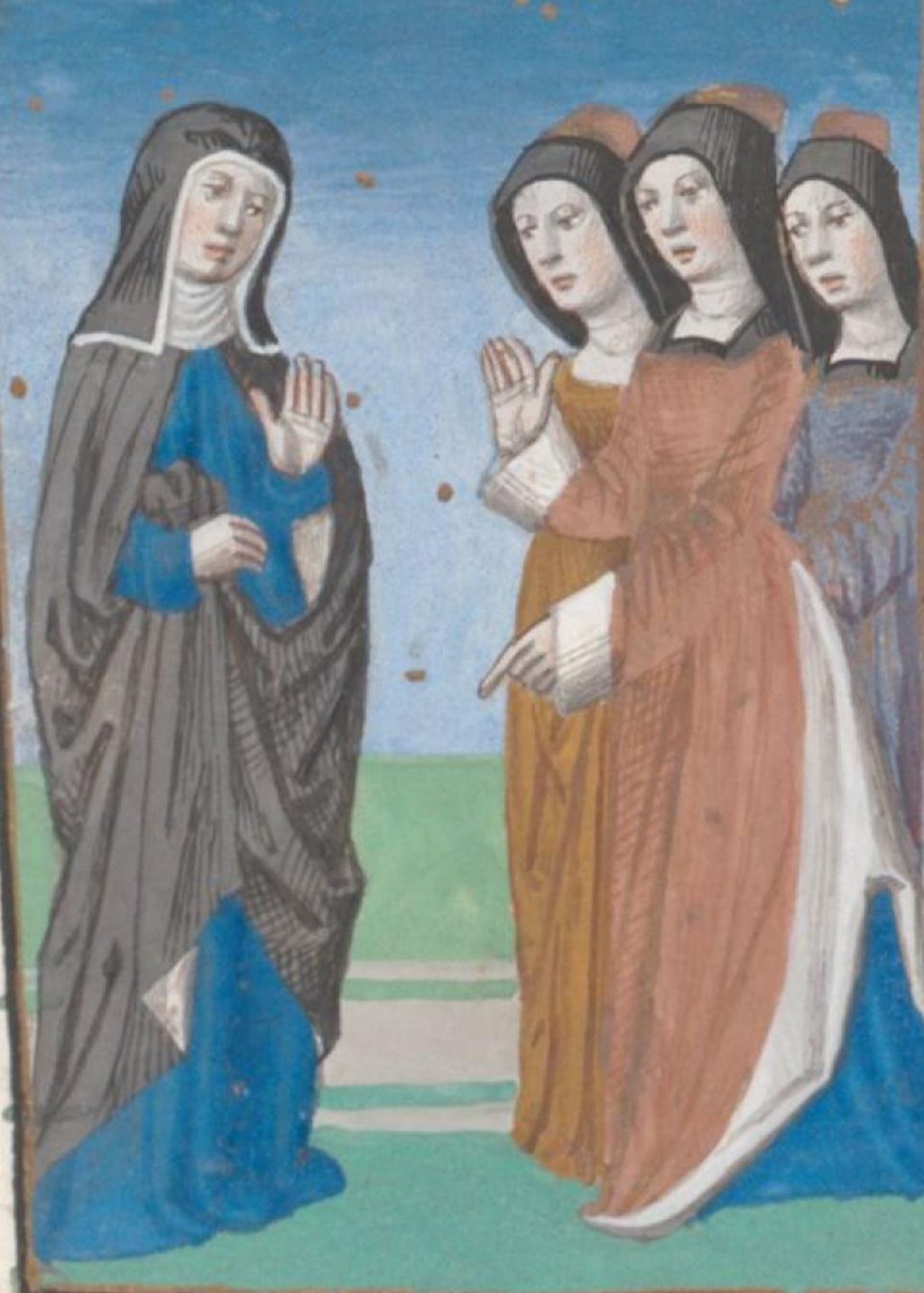
Despite widely disseminated myths within the misandristic tradition, what that unnamed man allegedly did was a serious crime under medieval French law.[5] A man merely attempting to “seduce” a woman with words remains a criminal offense in some U.S. jurisdictions today. Medieval French romances celebrate men engaging in brutal violence against men to earn women’s favor. It’s wholly implausible that among all the persons witnessing this crime against an innocent woman, none sought to bring the evil man-perpetrator to justice. Christine herself apparently did nothing to help the woman being beaten. Three months later, she didn’t even reveal the name of the man who alleged committed this horrific crime. Read sensitively, Christine depicted herself as morally grotesque. She obtusely defamed herself in representing a crime that she most probably fabricated to defame men.
Christine de Pizan wasn’t satisfied with merely defaming men. She called for burning the medieval literary masterpiece Romance of the Rose {Roman de la Rose}:
And the Romance of the Rose, pleasing to the curious — such books should be burned! But for these words now they strike at my eyes. One is often beaten for saying the truth.
{ Et le Romant, plaisant aux curieux, De la Rose, que l’en devroit ardoir! Mais pour ce mot maint me sauldroit aux yeux On est souvent batu pour dire voir. }[6]
Christine de Pizan wasn’t beaten for defaming Jean de Meun and advocating book-burning. Her outrageous claims made her famous, strengthened her claims to literary patronage, and made her a heroine to mis-educated literature students right up to the present. Not limiting herself to promoting book-burning, Christine de Pizan cited with approval the early-fourteenth-century Italian free-thinking professor Cecco d’Ascoli being burned at the stake because he allegedly “spoke badly about all women {dist mal de toutes femmes}.”[7] Advocating such brutal punishment for impersonal speech aligns Christine de Pizan with the most repressive totalitarians across history.
Modern professionals have embraced Christine de Pizan’s model of defamation and deceit. Analyzing the use of the words “cock {vis}” and “balls {couilles}” in the Romance of the Rose, a literary professor in a book published in 1995 solemnly and tendentiously declared:
Speaking the words for genitalia is not shameful. Rather, what is shameful is the fact that their articulation in this particular society can realize a symbolic form of violence against women. More often than not, these words signify damagingly for them. Furthermore, this pattern of signification is linked to irresponsible and harmful behavior, “goliardises et deshonnestetés {dissolute and dishonest}.” Unleashing such language publicly can act as a trigger mechanism for abusive conduct. The use of such words in what are habitual, sexualized slurs about women can often culminate in physical aggression. Under these circumstances, female shame is less symptomatic of excessive modesty than it is of the anxiety about verbal violence — about defamation — and its carnal counterpart. [8]
Scholarly deceit about Christine de Pizan disgraces modern literary studies. For example, a scholar tendentiously and uncritically characterized Christian de Pizan as embracing “socially profitable language”:
We have here the virtues that distinguish Christine’s way: Minervan wisdom and Roman eloquence define her writing as a powerful ethicopolitical medium for women and men in the community. As the very antithesis of the defamatory, it offers a socially responsible discourse. Her eloquent sapiential writing dismantles the symbolic domination of women maintained so effectively by the masterly clerical tradition. [9]
Are student being taught to discern nonsense? Christine “praises her corrupt and fratricidal patrons as the most benign and humane nobility in the world.”[10] With obvious interest in promoting herself, Christine instigated controversy over the Romance of the Rose:
Christine’s role in the Roman debate shows her once again less the friend of woman than of the powers that be, at their most oppressive: a position no more inevitable in her time than in ours. If Christine stood in advance of her day, it was in anticipating the prudish moralism of nineteenth- and twentieth-century literary censorship. … In fact it was Christine’s opponents, the defenders of the Roman — male, clerical, arrogant and patronizing though they were — who made the arguments that today permit us to read some of the most interesting writers, male and female, of our own time.
Many medieval writers, including medieval women writers, are far more learned, perceptive, and creative than Christine de Pizan. A scholar who studied Christine de Pizan extensively reported:
I have been charmed by some of her lyrics, impressed by her determination to educate herself and above all by her will to write. Yet I have also been terminally bored by the tedious, mind-numbing bureaucratic prose of Cité des Dames, imitated from the style of royal notaries and civil servants. I have been angered by Christine’s self-righteousness, her prudery, and the intensely self-serving narrowness of her views. I have been repulsed by the backwardness of her social attitudes, attitudes already obsolescent in the early fifteenth century when she lived and wrote. [11]
Christine described her father as an extremely wealthy man with wondrous celestial knowledge like the Christian God the Father. She described her mother as surpassing her father and reigning in gentle majesty like the Christian mother of God. She described herself as Christ plus the letters I-N-E, thus spelling Christine.[12] In contrast to her sense of being a divine savior, most of Christine de Pizan’s voluminous writings are narrowly predictable and uninspiring. So too is much modern literary scholarship about Christine de Pizan.
At the end of 1916, Mary Morton Wood completed her doctoral dissertation entitled The Spirit of Protest in Old French literature. This dissertation, completed within the Department of Romance Languages and Literatures at Columbia University in New York City, was printed in New York as a book in early 1917. Chapter 7 of Wood’s book is entitled “Protest against Sex-Discrimination.” That chapter begins with a straight-forward declaration:
Today the most insistent revolt against social tyranny is feminism.[13]
Wood associated a “low moral standard” with “the great mass of misogynist literature with which the Middle Ages were afflicted,” apparently meaning “the long discussions of female depravity with which medieval literature abounds.” Under the moral standard of Christine de Pizan and Wood, only male depravity can licitly be discussed. That’s sex discrimination and social tyranny.[14]
Christine de Pizan and the misandristic tradition have deeply corroded public discourse. Defamers claim to be defamed, and deceivers cry of deceit. Amid the ruins of shared, objective public reason, social power and verbal posing, not the truth, drive punishment. Penal justice systems that punish about fifteen times more persons with penises than with vaginas indicate the social reality of systemic sexism in its most personally damaging effects. To improve public welfare amid this disaster of public reason, more persons should extensively study and discuss medieval literature, including insightful medieval literature of men’s sexed protest.
[1] Christine de Pizan, Letter of the God of Love {Epistre au Dieu d’Amours} vv. 349-60, Middle French text and English translation (modified) from Erler & Fenster (1990). Fenster’s translation is reprinted in Willard (1993). Blumenfeld-Kosinski (1997) has Kevin Brownlee’s translation of the edition of Roy (1886-96).
[2] Matheolus has been harshly defamed within the misandristic tradition. No one who has perceptively read Matheolus would believe that “his entire text … is nothing but one unmitigated attack on women.” Blumenfeld-Kosinski (1997) p. 304. Christine de Pizan apparently didn’t read Matheolus himself, but read the century-later adaptation of Matheolus by Jehan Le Fèvre. Jehan Le Fèvre sought women’s patronage with his women-flattering The Book of Gladness {Le livre de Leesce}.
And one sees everywhere such old men speaking obscenely and dishonestly, just as you can fully see with Matheolus, who himself confesses that he was an old man, filled with desire and no potency.
{ Et voit on communement telz viellars parler lubrement et deshonnestement, ainsi que tu le peuz veoir proprement de Matheolus, qui confesse lui meismes que il estoit viellart, plaine de voulenté et non puissance. }
Christine de Pizan, The Book of the City of Ladies {Le Livre de la Cité des Dames} 1.8.5, Middle French text from Curnow (1975), English translation (modified) from Richards (1982).
Interpreting Matheolus’s brilliantly satirical book biographically, a scholar opined:
Christine did not go into any detail about Matheolus but her choice of an example of misogyny seems uncannily perceptive if, as may be the case, the impulse toward misogyny arises from the inability of men to come to terms with their own sexuality.
[3] Christine de Pizan, The Book of the City of Ladies {Le Livre de la Cité des Dames} 1.9.2, Middle French text from Curnow (1975), English translation (modified) from Richards (1982). The subsequent quote above is similarly sourced from Cité des Dames 1.9.2.
In disparaging Ovid, Christine distinguished between “honorable women {femmes honorables}” and “the worthless ones {les non valables}”:
Ovid has said, in a book that he made, much evil about women, which I hold that he did wrong. He gave his book the name the Remedy for Love, and there he attributes to women nasty ways — repulsive, sordid ways, filled with wickedness. That women have such vices I deny. I take my weapons up in defense of them, against all who would throw a challenge down. Of course I mean honorable women. I’m not concerned with the worthless ones.
{ Ovide en dit, en un livre qu’il fist, Assez de maulx, dont je tiens qu’il meffist, Qu’il appella le Remede d’Amours, Ou leur met sus de moult villaines mours, Ordes, laides, pleines de villenie. Que tieulz vices ayent je le lui nie; Au deffendre de bataille je gage Contre tous ceulx qui getter vouldront gage. Voire, j’entens des femmes honorables; En mes comptes ne mes les non valables. }
Epistre au Dieu d’Amours vv. 281-90, sourced as previously.
[4] Christine de Pizan, The Book of the Transformation of Fortune {Le Livre de la Mutacion de Fortune} vv. 5353-70, Middle French text of Solente (1959-66) via Solterer (1995) pp. 157, English translation (modified) from id. p. 158. Id. omits vv. 5357-8, which I’ve included from Wood (1917) p. 197. A variety of other sources also quote this grotesque anecdote, e.g. Paris (1842) p. 142.
[6] Christine de Pizan, Other Ballads {Autres balades} 37, vv. 24-7, Middle French text from Roy (1886-96) vol. 1, p. 250, my English translation. For an English translation of the full ballad, Corbett (2016).
Christine de Pizan seemed to delight in the thought of administering punishment to men. In her view, men’s crimes ranged even wider than criminalized seduction:
For this reason I conclude with the sentence that punishment be dealt to the wrongdoers, those who blame, defame, and accuse women, and who use false and treacherous appearances in order to deceive them. So let all of them from our court be chased out, banished, destroyed, and prohibited and excommunicated.
{ Pour ce conclus en diffinicion Que des mauvais soit fait punicion, Qui les blasment, diffament et accusent Et qui de faulx desloyaulx semblans usent Pour decevoir elles. Si soient tuit De nostre court chacié, bani, destruit, Et entredis et escommenïé. }
Christine de Pizan, Epistre au Dieu d’Amours vv. 771-7, sourced as previously.
[7] Christine de Pizan, The Book of the City of Ladies {Le Livre de la Cité des Dames} 1.9.2, Middle French text from Curnow (1975), English translation (modified) from Richards (1982). Cecco d’Ascoli, the popular name for Francesco degli Stabili, was an Italian natural scientist and poet who lived from 1257 to 1327.
[8] Solterer (1995) p. 157.
[9] Solterer (1995) p. 175. For “socially profitable language,” id. p. 169.
[10] Delany (1987) p. 320, citing Christine de Pizan, The Book of the Body Politic {Livre du Corps de Policie}.
[11] Delany (1987) pp. 315-6. The previous quote above is from id. p. 326. On the intellectual history and reception of Delany (1987), see Akbari (2006) pp. 5-9. According to Akbari:
Delany’s reading of Christine de Pizan} is undeniably angry and, I think, deliberately provocative. Responses to the undeniably inflammatory nature of Delany’s essay were, predictably, severe. … Delany’s essay … provided a bracing corrective to the predominant trend in reading that had, for a time, stifled critical enquiry.
Akbari (2006) pp. 7, 8. Denouncing bigotry to a circle of bigots could be called “undeniably inflammatory” and “deliberately provocative.” Such labeling merely supports unwarranted complacency and moral obtuseness. Moreover, I deny that Delany’s scholarly reading, which Akbari labels “undeniably angry,” is in fact “angry.” I find it to be vigorous and courageous. Scholars should respond vigorously and courageously, even angrily, to the stifling of critical enquiry and to self-serving, bigoted scholarly work.
The receptions of Delany (1987) and Solterer (1995) differ starkly. The highly speculative claims about injury to women in Solterer (1995) weren’t called “undeniably inflammatory” or “deliberately provocative.” Without providing any statistical analysis and documentation of direct effects, Solterer claimed, “More often than not, these words {words for men’s genitals} signify damagingly for them {women}.” Is this really a “carefully conceptualized and meticulously argued study,” as a scholarly reviewer characterized it? McCracken (1998) p. 516. Solterer claimed, “Unleashing such language publicly can act as a trigger mechanism for abusive conduct.” Is that really an “elegantly conceived ethical critique,” as another reviewer characterized Solterer’s work? Biddick (1996) p. 1193. Is such a claim “judicious and well supported by the evidence,” as yet another review characterized Solterer’s study? Cusack (1996) p. 290. Despite Solterer viciously charging many medieval masters with broad injury to women, reviewers didn’t describe Solterer as making an angry reading of medieval literature. The starkly differing receptions of Delany (1986) and Solterer (1995) suggest that medieval scholars are more interested in defaming men than in fairly evaluating Christine de Pizan’s works.
[12] Christine de Pizan, The Book of the Transformation of Fortune {Le Livre de la Mutacion de Fortune} vv. 157-338 (her father), 339-67 (her mother), and 372-8 (Christine’s name), English trans. Willard (1993) pp. 113-6. Here’s how Christine presented her name:
Whether or not you truly yearn To know my name, of which part one Bears the name of Our Lord’s Son, The most perfect man there ever was, Adding to it I N E does Provide you with my name, No extra letters does it claim.
Mutacion de Fortune, English translation from Willard (1993) p. 116.
Christine de Pizan identified as a man in her Mutacion de Fortune. See e.g. vv. 142-53, English trans. in Willard (1993) p. 112. On Christine as a transman, Gutt (2020). Gutt described Mutacion de Fortune as “incandescently trans.” Id. p. 453. Christine declared, “it would please me much more to be a woman.” Mutacion de Fortune, vv. 1395ff, trans. Blumenfeld-Kosinski (1997) p. 107. That’s not surprising, given women’s privileges. Nonetheless, transmen have historically experienced less animosity and less adverse discrimination than transwomen have.
Discussing Christine de Pizan’s The Book of the Path of Long Study {Le livre du chemin de long estude}, a scholar working diligently to magnify Christine declared:
The configuration of her learning experience is extremely complex, containing echoes of both Virgil’s Aeneid and Dante’s Commedia: by being guided by the Sibyl, Christine posits herself as another Aeneas and by writing about it as another Virgil. At the same time, her journey to the celestial spheres likens her to Dante who was guided there not by Virgil (as in the Inferno and the Purgatorio), but by Beatric and Saint Bernand. The Sibyl, an extremely important figure throughout Christine’s works, is thus “contaminated” by these two saintly figures, while Christine herself follows in Dante’s footsteps. Her attitude towards her auctores is not exactly modest ….
Blumenfeld-Kosinski (1990) p. 301. In contrast to this extravagant claim of Christine de Pizan’s literary sophistication, there’s no clear evidence that Christine de Pizan could read Latin. She never referred to the great medieval writers Hrotsvitha of Gandersheim and Hildegard of Bingen. She apparently knew Heloise of the Paraclite only though the writings of others. Christine’s only reference to Heloise is Heloise’s declaration that she would prefer to be Peter Abelard’s whore than his wife. See Christine in the debate about the Romance of the Rose in Blumenfeld-Kosinski (1997) p. 43. Perhaps Peter Dronke ended his Women Writers of the Middle Ages at Marguerite Porete to avoid the painfulness of discussing Christine de Pizan.
[13] Wood (1917) p. 176. The subsequent three short quotes are from id. pp. 196, 176. Voluminous medieval literature presents courtly love in which men serve woman as feudal serfs. That literature, according to Wood, suffers from the general medieval assumption that “privileged individuals have the right to bestow happiness on others.” Id. p. 185. She didn’t identify those privileged individuals as women. Like Christine de Pizan, Wood worked within the misandristic tradition of ignoring injustices against men and defaming men’s sexed protests as misogyny.
From her perspective early in the twentieth century, Wood documented leading ninteenth-century French scholarly works trivializing medieval men’s sexed protest and lamenting disparaging representations of women, but not disparaging representations of men. See Wood (1917) pp. 196-7, which supplies the following scholarly quotations. Leading nineteenth-century French scholar Gaston Paris, who stimulated enormous, morally obtuse scholarship on men-abasing medieval courtly love, lamented “the often crude relentlessness with which women are denigrated there {souvent grossier avec lequel les femmes y sont dénigrées}.” A courtly man never sees any evil in a woman. Ferdinand Brunetière, another leading French scholar, declared:
Women in the bourgeois world of the Middle Ages seem to have bowed their heads as low as at any time or place on earth under the law of force and brutality. … Such a conception of woman is the dishonor of a literature.
{ Les femmes dans le monde bourgeois du moyen age semblent avoir courbé la tête aussi bas qu’en aucun temps et qu’en aucun lieu de la terre sous la loi de la force et de la brutalité. … Une telle conception de la femme est le déshonneur d’une littérature. }
That’s Lancelot-like honor posing. Charles-Victor Langlois described women in the fabliaux as “barbaric dolls {poupées barbares}.” He declared, “The women in the fabliaux do not belong to our Western and Christian humanity {Les femmes dans les fableaux n’appartiennent point a notre humanité occidentale et chrétienne}.” The brutish men of the fableaux, in contrast, are apparently what all men are like. Modern philology has a penis problem. In addition to overcoming that failing, scholars should at least tolerate literary representations of women in their full, sometimes despicable, humanity.
[14] Solterer cites mythic Roman history according to the aristocratic, repressive Cicero to support broad punishment for defamation. Solterer (1995) p. 153. However, “poetic/verbal abuse was a well-attested phenomenon in ancient Rome.” Compton (2006) Part III, Chapter 20. Persons in ancient Greece, imperial Rome, and medieval Europe had more extensive freedom of speech in practice than do persons today in many high-income countries with broad European cultural heritage. A scholar poignantly declared:
We can take some comfort in the expectation that truth-seeking poets, novelists, and journalists today will be remembered and honored as they were in archaic Greece, Rome, and Europe; and that the brutality of repressive politicians will continue to contribute to the honor of the men and women they have killed, imprisoned, tortured, or exiled.
Biddick, Kathleen. 1996. “Book Review: The Master and Minerva: Disputing Women in French Medieval Culture. Helen Solterer. Berkeley and Los Angeles: University of California Press, 1995.” The American Historical Review. 101 (4): 1193-1194.
Blumenfeld-Kosinski, Renate. 1990. “Christine de Pizan and the Misogynistic Tradition.” Romanic Review. 81 (3): 297-311. Reprinted in Blumenfeld-Kosinski (1997), to which my page citations refer.
Corbett, Maryann. 2016. “Christine de Pizan: Ballade 37 from Other Ballades.” Able Muse: A Review of Poewtry, Prose & Art. 22. Online.
Curnow, Maureen Cheney. 1975. The Livre de la cité des dames of Christine de Pisan: a critical edition. Ph.D. Thesis. Nashville, Tenn: Vanderbilt University. Available via Proquest Dissertations.
Delany, Sheila. 1987. ‘”Mothers to Think Back Through”: Who Are They? The Ambiguous Example of Christine de Pizan.” Pp. 177-197 in Laurie A. Finke and Martin B. Shichtman, eds. Medieval Texts and Contemporary Readers. Ithaca, NY: Cornell University Press. Reprinted in Blumenfeld-Kosinski (1997), to which my page citations refer.
Erler, Mary Carpenter and Thelma S. Fenster, ed. and trans. 1990. Poems of Cupid, God of Love: Christine de Pizan’s Epistre au dieu d’amours and Dit de la rose, Thomas Hoccleve’s The Letter of Cupid: editions and translations, with George Sewell’s The Proclamation of Cupid. Leiden: Brill.
Gottlieb, Beatrice. 1985. “The Problem of Feminism in the Fifteenth Century.” Pp. 337-364 in Julius Kirshner and Suzanne F. Wemple, eds. Women of the Medieval World: Essays in Honor of John H. Mundy. Oxford: Basil Blackwell. Reprinted in Blumenfeld-Kosinski (1997), to which my page citations refer.
Gutt, Blake. 2020. “Transgender mutation and the canon: Christine de Pizan’s Livre de la Mutacion de Fortune.” postmedieval. 11: 451-458.
Kelly, Henry Ansgar. 1994. “‘Rule of Thumb’ and the Folklaw of the Husband’s Stick.” Journal of Legal Education. 44 (3): 341-65.
McCracken, Peggy. 1998. “Book Review: Gender and Genre in Medieval French Literature. Simon Gaunt. Cambridge: Cambridge University Press, 1995. The Master and Minerva: Disputing Women in French Medieval Culture. Helen Solterer. Berkeley and Los Angeles: University of California Press, 1995.” Modern Philology. 94 (4): 513-19.
Roy, Maurice, ed. 1886-96. Œuvres poétiques de Christine de Pisan. Paris: Firmin Didot pour la Société des anciens textes français. Vol. 1. Vol. 2. Vol. 3.
Solente, Suzanne, ed. 1959-66. Christine de Pizan. Le Livre De La Mutacion De Fortune. Paris: A. et J. Picard.
In sixth-century Italy, the young woman Aquilina suffered beatings from her mother for her love for the young man Maximianus. Perhaps Aquilina’s mother felt that love with Maximianus wouldn’t be sufficiently lucrative. In any case, Aquilina’s mother sought to treat her daughter’s love-wounded heart with anger-driven, punishing wounds. Initially Aquilina and Maximianus had a secret love affair:
Yet not for long! Her mother sensed our secret love and, getting set to treat wounds with wounds,
she nagged and slapped. The blaze was kindled by her slaps like tinder tossed on pyres to stoke the flames.
{ nec longum genetrix furtivum sensit amorem et medicare parans vulnera vulneribus
She’s shameless — rolling back blood-stained clothes to recall. Joyfully she even credits them to me.
She says, “I’m glad to suffer pains endured for you. You’ll be the sweet return on so much blood.
Just let your faith be certain and your will unbroken. Passion that ruined nothing never was.”
{ nec memorare pudet turpesque revolvere vestes immo etiam gaudens imputat illa mihi
pro te susceptos iuvat inquit ferre dolores tu pretium tanti dulce cruoris eris
sit modo certa fides atque inconcussa voluntas quae nihil imminuit passio nulla fuit }
A parodic figure of the great philosopher then bought off Aquilina’s mother. But Maximianus no longer burned to have sex with Aquilina. The brutality of her mother combined with the crassness of the philosopher ruined the love affair:
We split up, equally resentful and unhappy. The reason for the split was chaste living.
{ ingrati tristes pariter discedimus ambo discidii ratio tota pudica fuit }
Paying to whore differs from receiving sacrificial love. Insufficient appreciation for men’s love deadens it. Violence against women who love men hurts men and women by wrongly founding sacrificial love.
In ancient Greece, Acontius loved Cydippe with the abject subservience that encourages women to abuse men who love them. Not a passive recipient of abuse, Acontius actively sought Cydippe’s love. He engaged in a challenging love quest of the sort with which men historically have been gender-burdened. His approach was ingenious: when Cydippe was in the temple of Artemis, he rolled at her feet a golden apple. A golden apple had prompted the goddesses Juno, Minerva, and Venus to compete to be declared the most beautiful. Acontius, however, regarded Cydippe as the most beautiful. He had inscribed on the apple, “By Artemis, I shall marry Acontius {μὰ τὴν Ἄρτεμιν Ἀκοντίῳ γαμοῦμαι}.”[2]
Cydippe picked up the golden apple and read it aloud in the temple of Artemis. She thus formally, unintentionally vowed to marry Acontius. She, however, was already preparing to marry someone else. Just before the wedding ceremony she became mortally ill. The marriage was postponed, and she recovered. Just before the postponed marriage ceremony, she again fell mortally ill. The marriage again was postponed, and she recovered. The same sequence of events occurred a third time. Her father then inquired of Apollo at the oracle in Delphi. Apollo explained that Cydippe must fulfill her vow to Artemis. Acontius thus gained Cydippe’s hand in marriage without any great hardship or great risk to his life.
But Acontius invited Cydippe to abuse him as Cynthia abused Propertius. He accepted her anger at his ingenious marriage ploy. He promised to serve her as a slave even in her anger:
You may chide me and, if you wish, be angry, if only while you are angry you let me enjoy you. I who caused it will likewise sooth the anger, if you allow me a small opportunity to please you. Permit me to stand weeping before your face, and permit me to add words that suit my tears, and let me, like a slave in fear of savage lashes, stretch out submissive hands to touch your feet. You ignore your rights. Call me! Why accuse me in absence? In the manner of a woman-lord, order me to come immediately. With your own ruling hand you may tear my hair, and make my face bruise-colored with your fingers. I will endure all. I fear only that perhaps your hand might be hurt in hitting my body. But do not chain me with shackles or fetters. I shall be kept bound in firm love for you. When your anger has been fully satisfied as much as you wish, you will say to yourself, “How patiently he loves!” You will say to yourself, when you have seen me bearing all, “He who serves so well, let him always serve me!”
{ Quamlibet accuses et sis irata licebit, Irata liceat dum mihi posse frui. Idem, qui facimus, factam tenuabimus iram, Copia placandi sit modo parva tui. Ante tuos liceat flentem consistere vultus Et liceat lacrimis addere verba suis, Utque solent famuli, cum verbera saeva verentur, Tendere submissas ad tua crura manus! Ignoras tua iura; voca! cur arguor absens? Iamdudum dominae more venire iube. Ipsa meos scindas licet imperiosa capillos, Oraque sint digitis livida nostra tuis. Omnia perpetiar; tantum fortasse timebo, Corpore laedatur ne manus ista meo. Sed neque conpedibus nec me conpesce catenis — Servabor firmo vinctus amore tui! Cum bene se quantumque voles satiaverit ira, Ipsa tibi dices: “quam patienter amat!” Ipsa tibi dices, ubi videris omnia ferri: “Tam bene qui servit, serviat iste mihi!” }[3]
Cydippe should have been angry at the goddess Artemis. That goddess, not Acontius, forced Cydippe to marry him. With the wife given license to assault her husband and treat him as her slave, their marriage doesn’t represent true love. In the sixth century, an idealistic author recounted men’s enduring dream of love in marriage with a woman:
The two of them, their eyes shining like stars, reflected back the other’s light with yet greater brightness and so rejoiced in their mutual radiance.
Women must address women’s violence against men, children, and other women throughout history. Break the silence about women’s violence! Break the silence about women’s violence until the violence ends! Meninism, which is the radical notion that men are human beings, makes words clear. Women abusing men, children, and women isn’t the same as loving them.
[1] Maximianus, Elegies 3.29-32, Latin text and English translation from Juster (2018). An earlier edition of the Latin text is freely available online. The subsequent two quotes above are similarly from Maximianus, Elegies 3.37-42 (She’s shameless…) and 3.93-4 (We split up…). The great philosopher is named Boethius.
[2] Aristaenetus, Letters {Epistolae} 1.10, ancient Greek text and English translation (modified) from Bing & Höschele (2014). The earliest source for this story is Callimachus, Aetia frs. 67-75 (ed. Pfeiffer). Kelly, Sheridan, and Halhed (1854) provides a freely available, loose English translation of Aristaenetus’s letters.
An apple is an ancient love token. For references, Rynearson (2009) p. 342, n. 3. In medieval European understanding, Eve and Adam ate an apple in the garden of Eden.
[3] Ovid, Heroides 20 (Acontius to Cydippe {Acontius Cydippae}) vv. 71-90, Latin text of Ehwald (1907) Teubner via Perseus, English translation (modified) of Showerman (1914). The English translations of Kline (2001) and Hunter (2013) are freely available online. Here’s a commentary.
Rosenmeyer ignores the violence that Acontius invites Cydippe to inflict on him. She instead focuses on the sensational abstraction of “textual violence”:
Acontius’ scripts have all entailed violence against his reader: she is coerced, deceived, entrapped, and finally here erased.
[4] Aristaenetus, Letters {Epistolae} 1.10, concluding sentence, ancient Greek text and English translation from Bing & Höschele (2014). Stephens (2015) provides the ancient Greek text with an English translation.
Bing, Peter, and Regina Höschele, ed. and trans. 2014. Aristaenetus. Erotic Letters. Atlanta, GA: Society of Biblical Literature. Introduction. Review by Anna Tiziana Drago.
Juster, A. M., ed. and trans, with introduction by Michael Roberts. 2018. The Elegies of Maximianus. Philadelphia, PA: University of Pennsylvania Press. Reviews by Douglas Galbi and by Dennis Trout.
Showerman, Grant, ed. and trans., revised by G. P. Goold. 1914. Ovid. Heroides. Amores. Loeb Classical Library 41. Cambridge, MA: Harvard University Press.
Lady, so great you are, such strength you bring, who does not run to you, yet looks for grace, his wish would seek to fly without a wing.
Not only does your kindness come to brace our courage when we beg; often your free favor arrives before our prayer’s race.
In you is mercy, in you is piety, in you magnificence, in you the sum of excellence in all things that come to be.
{ Donna, se’ tanto grande e tanto vali, che qual vuol grazia e a te non ricorre, sua disïanza vuol volar sanz’ ali.
La tua benignità non pur soccorre a chi domanda, ma molte fïate liberamente al dimandar precorre.
In te misericordia, in te pietate, in te magnificenza, in te s’aduna quantunque in creatura è di bontate. }[1]
Mary, the mother of Jesus, was the most powerful person in medieval Europe. She wasn’t understood to be merely a fully divine mortal woman who loves her children, meaning all Christians. In medieval Christian understanding, Mary is also the greatest lawyer. She is a merciful, unfailing advocate for desperate petitioners and those facing dire judgment.
Héloïse of the Paraclete’s husband Peter wrote learned and eloquent hymns to Mary. Drawing upon the appeal to Mary as advocate in the eleventh-century Marian antiphon “Hail, Queen {Salve Regina},” Peter Abelard emphasized Mary’s importance:
The prayers of the faithful seek you, the hearts of all sigh to you. You, after God our unique hope, have been appointed advocate for us.
To the mother of the Judge they flee for refuge, those who from the wrath of the Judge run. She is logically compelled to plead for them, for she is formed to be mother for sinners.
{ Te requirunt vota fidelium, Ad te corda suspirant omnium, Tu spes nostra post Deum unica, Advocata nobis es posita.
Ad judicis matrem confugiunt, Qui judicis iram effugiunt, Quae praecari pro eis cogitur, Quae pro reis mater efficitur. }[2]
Unique mother, because ever virgin, mother of God in that way, the guilty cry to you.
To you we cry and to you we sigh. In strained cases you aid us as an advocate.
Help in this specific way you owe to the whole world when as if by right we plead to you.
This is your honor. You were born for us, so that you might be the gate of life as Eve was the gate of death.
For this you were created, for this, predestined. Know the cause and fulfill the effect.
You owe help to the world. The world owes praise to you, our hope after God. You please God for us.
{ Singularis mater. quia virgo semper. mater et hac dei. ad te clamant rei.
Ad te nos clamantes. et te suspirantes in districta causa iuves aduocata.
Opem quodam modo toti debes mundo. quam velud ex iure postulamus a te
Totum id honoris nata es pro nobis. ut sis vite porta sicute mortis eva.
Ad hoc es creata. ad hoc preelecta; causam recognosce et effectum comple.
Mundo debes opem. mundus tibi laudem; spes post deum nostra. nobis deum placa. }[3]
Peter Abelard was a leading twelfth-century philosopher and logician. He didn’t understand imploring Mary for help as a folk practice or as pious comfort. According to Abelard, the logical structure of the cosmos and the Christian order of human salvation entailed Mary advocating for sinful humans. Of course, humans now without sin now believe otherwise.
In medieval Europe, Mary successfully advocated for those devoted to her despite their wide-ranging behavioral failures. For example, a thief who prayed to Mary for protection whenever he went thieving was caught and hung for his crimes. Mary supported his body for three days so that he didn’t suffocate and die in the noose. Having observed this holy miracle, justice officials pardoned the thief. In another case, a nun left her convent for years of debauchery, yet she still prayed every day to the Virgin Mary. Mary acted in the nun’s place in her absence so that none of her sisters knew that she had left. In addition, Mary mended the hair-shirt that the Archbishop of Canterbury Thomas à Becket secretly wore late in the twelfth century. She did that needlework to coerce the Archbishop into forgiving an irresponsible priest who nonetheless was devoted to her.[4]
Mary wasn’t afraid to confront authorities directly on behalf of desperate petitioners. For example, a corrupt priest praised Mary and sought to serve her. Since he did wrong, obviously he didn’t serve Mary rightly. Nonetheless, after the Bishop ejected the priest from his chaplaincy, Mary confronted the Bishop with an ultimatum:
Know this for certain — if tomorrow morning very early you don’t call my chaplain back to his service and his honorable status, your soul to shame within thirty days will depart and suffer in the flames of Hell!
{ Ce saches tu certainement Se tu li matinet bien main Ne rapeles mon chapelain A son servise et a s’enor, L’ame de toi a desenor Ains trente jors departira Et es dolors d’infer ira. }[5]
Fearing Mary’s ultimatum, the Bishop restored the chaplain to his former position.
Among the medieval clergy of the eminent Marian cathedral at Chartres, a vicious, proud, and irresponsible cleric died. In general agreement about the cleric’s lack of worth, the clergy threw his dead body into a ditch. But the cleric had been devoted to praising and honoring Mary. In defense of her dead beloved, Mary dared to assail the Bishop of Chartres:
So do you think that it doesn’t annoy me when you have turned your back on him, that you have thrown him into a ditch? I command that you pull him out! Say to the clergy that I order that! It can never be made up to me unless this morning without delay in great honor my beloved is buried in the most beautiful place near the church.
{ Cuidies vos donc qu’il ne m’enuit Quant vos l’aves si adosse Que mis l’aves en un fosse? Metes l’en fors je le comant! Di le clergie que je li mant! Ne me puet mi repaier Se le matin sans delayer A grant heneur n’est mis amis Ou plus beau leu de l’aitre mis. }[6]
Not understanding the Christian way, devils delighted in Mary turning the world upside-down in providing mercy to lowly outcasts. One devil exulted:
To Heaven above God leads more peasants with white capes, widowed women, aged crones, the sick, the crippled, the bent, the maimed, and hunchbacks, than ones who look like beautiful gentlemen. The silly, the chivalrous, the beautiful gentlemen, all the beautiful ladies of great worth who walk trailing white and grey fur, kings, queens, dukes, and countesses, come to Hell in great crowds. But to Heaven go nearly all the crippled, hunchbacks, and maimed. To Heaven goes all the riffraff. We get the grain and God the chaff!
{ Plus maine Dex ou ciel lassus Des vilains aus blanches chapètes, De veuves fames, de viellètes, De mesiaus, de tors, de croçus, De contrefaiz et de boçuz, Qu’il ne face de bele gent. Li fol, li preu, li bel gent, Les beles dames de grant pris Qui traynant vont ver et gris, Roys, roynes, dus et contesses, En enfer viènent à granz presses; Mais ou ciel vont près tout à fait Tort et boçu et contrefait. Ou ciel va toute la ringaille; Le grain avons et Diex la paille. }[7]
Rich persons going to Hell benefits devils who get to share in the worldly riches they bring — the furs and the grain. Heaven, in contrast, frees persons from their bodily infirmities.
One day in the court of the ultimate judge Jesus, Satan attempted to claim all of humanity. From a medieval Christian perspective, all humans other than Mary inherit the sin of Eve and Adam. Satan thus claimed the right to hold in Hell all of sinful humanity. Mary rose to advocate vigorously on behalf of fallen humanity. She declared to the most august judge:
Ah, lovely sweet son, I am your mother who carried you nine full months. You should be willing to listen to me. I gave you birth in poverty and brought you up very sweetly. Your mother I am, mother you call me. Lovely son, look at the breasts with which I used to feed you, and these hands, with which I knew how to handle you and gently rock you. My heart was pierced because of you when you suffered the agony of death. My whole heart breaks and is torn apart every time I remember it, but I must endure it.
{ Ha, beau douz filz, je suy ta mère, qui te portey .IX. mois entiers: tu me dois oïr volentiers. Je t’enffantey mout pouvrement et te nourri mout doucement. Ta mère suy, mère m’apèles. Beau filz, regarde les mamèles de quoy aleitier te souloie, et ces mains, dont bien te savoie souef remuer et berchier. Tu me feis le cuer perchier quant tu souffris de mort l’angoisse. Tout le cuer me ront et défroisse toutes les foiz qu’il m’en souvient; mèz endurer le me convient. }[8]
What man wouldn’t pity the poor dear, his very own mother? To the final judge Jesus, Mary even invoked the mortal motherly ploy:
I request that justice be done, you having heard his arguments and mine. If you love Satan more than me, that would be completely against nature! I only request from you to do justice. I have never wronged anyone. If you listen more to the devil than to your mother or to her client, then take me out of the Book of Life!
{ je requier que droit soit rendu, oÿ ses rèsons et les moies. Se Sathan miex que moy amoies, se se[r]oit bien contre nature! Je ne te requier que droiture: onques à nul tort ne feis. S’au Déable plus obéis qu’à ta mère, n’à sa partie, oste moy du livre de vie! }
What son could endure causing the death of his mother? Satan knew that his case was hopeless. He bitterly castigated the Virgin Mary:
You quarrel and say your reproaches, you weep and moan and sigh, you sob, and you rip your clothes. You show your son your belly, and such pity enters his heart that you by force soften him up! He accepts willingly your follies when you show him your breast. You so put him on your leash that he doesn’t have the power to contradict you. When you laugh, it’s necessary for him to laugh. When you cry, he wants to cry. He wants too much to honor you!
{ tu tenches et dis ces reprouches; tu pleures et plains et souspires, tu sanglotes, tu te dessires; tu montres à ton fiz ton ventre, et tel pitié u cuer li entre que tu par force l’amolies! Il prent à bon gré tes folies; quant tu li monstres ta mamèle, tu le treiz si à ta cordèle qu’il ne t’a pover d’escondire! Quant tu ris, il le convient rire; quant tu pleures, il veut pleurer; il te par veut trop hennourer! }
The judge Jesus rendered the obviously correct judgment:
All those of the human lineage who have in devotion repented and confessed and died in contrition will remain with us forever. Let no one make further arguments. very well has pleaded the Advocate, the Virgin Mary, my mother.
{ que touz ceulz de l’Umain Lignage qui auront par dévocïon repentance et confessïon et en contrictïon mourront, devers nous sans fin demouront. Nul n’i ait qui plus s’en débate; mout a [bien] plèdié l’Advocate, la Virge Marie, ma mère. }
Satan thus lost her Hellish claim to all those souls. In this medieval French court of law, Mary the mother of God walked all over Satan.[9]
Whether Peter Abelard, Dante Alighieri, or a thief facing execution, many throughout history have believed in Mary’s pervasive skills as an advocate in the supreme court. Men’s hope that a woman will save them surely contributed to pervasive, ardent Marian devotion in medieval Europe. The worldly component of Marian devotion still hasn’t been adequately realized. This failing is especially damaging in regard to penal justice systems that vastly gender-disproporationately incarcerate persons with penises. Women must do more to fulfill men’s hope in them.
Remember, O most gracious Virgin Mary, that never was it heard that anyone who ran to your protection, implored your help, or sought your intercession was left unaided. Inspired with this confidence, to you I run, O Virgin of virgins, my Mother, to you I come. Before you as a groaning sinner I place myself. O Mother of the Word Incarnate, despise not my words, but in your mercy hear and answer me.
{ Memorare, O piissima Virgo Maria, non esse auditum a saeculo, quemquam ad tua currentem praesidia, tua implorantem auxilia, tua petentem suffragia, esse derelictum. Ego tali animatus confidentia, ad te, Virgo Virginum, Mater, curro, ad te venio, coram te gemens peccator assisto. Noli, Mater Verbi, verba mea despicere; sed audi propitia et exaudi. }[10]
[1] Dante Alighieri, Divine Comedy {Comedia}, Paradise {Paradiso} 33.13-21, medieval Italian text of Giorgio Petrocchi via Dartmouth’s Dante Lab, English translation (with minor modifications) from Esolen (2004). Robert Hollander has noted that vv. 19-20 echo Virgil’s Georgics IV.465-466. See the Princeton Dante Project. On this prayer in the context of ancient literature, Auerbach (1949).
Dante puts this Marian prayer in the mouth of Saint Bernard of Clairvaux. Ardently devoted to Mary, Saint Bernard declared: “God wills that we should have nothing that does not pass through Mary’s hands {Nihil nos Deus habere voluit, quod per Mariae manus non transiret}.” Bernard, Sermons for the Calendar {Sermones de tempore}, “For the vigil of the birth of the Lord {In vigilia nativitatis Domini}” III, 10, Latin text and English translation from Hollander’s commentary on Paradiso 33.14-5, via Dante Lab.
[2] Peter Abelard, Hymnal of the Paraclete {Hymnarius Paraclitensis}, Book 2, Festival Hymns {Hymni festorum}, “For the birth of the Lord {In Nativitate Domini}” 33 (For Lauds and Vespers {Ad laudes et ad vesperas}), stanzas 3-4, Latin text and English translation (modified) from Woods (1992) p. 59. Id., pp. 60-7, provides a detailed commentary on this hymn and explicates its sophisticated literary structure.
[4] The first two of these stories of miracles of the Virgin Mary exist in the collection of Gautier de Coinci, while the third is from Jacobus de Voragine’s Golden Legend {Legenda aurea}. For a brief review of these stories, Adams (1904) pp. 258-60. The above stories aren’t unusual:
There is a whole class of miracles, known as the Rosary series, which were almost exclusively in favour of ignorant or immoral clerks.
Swinton Bland (1928) p. xxv. Id. and Underhill (1906) provide later collections of the miracles of the Virgin.
[5] Gautier de Coincy, The Miracles of Our Lady {Les miracles de Nostre Dame}, “About the priest whom the Blessed Virgin defended from injury {De presbitero quem beata Virgo defendit ab injuria}” / “About the priest that Our Lady defended from the injury that his bishop wanted to do him because he could only sing a mass of Our Lady {du prestre que nostre dame deffendi de l’injure que son evesque lui vouloit faire por ce que il ne savoit chanter que une messe de nostre dame},” Old French text from Bartsch & Horning (1887) cols. 365-6, English translation (modified) from Adams (1904) p. 263. Poquet (1889) cols. 323-6 is an inferior edition. Koenig (1961-66) is currently the best edition. Here’s a crosswalk for the miracles in Poquet and Koenig.
[6] Gautier de Coincy, The Miracles of Our Lady {Les miracles de Nostre Dame}, “About the cleric devoted to the Holy Virgin, in whose mouth when dead a flower was found {De Clerico Sancte Virgini devoto, in cuius iam mortui ore flos inuentus est},” Old French text from Bartsch & Horning (1887) col. 370, English translation (modified) from Adams (1904) pp. 264-5.
Mary, an ultimate authority in equity, was above normal authorities:
Mary’s wish was absolute law, on earth as in heaven. For her, other laws were not made. Intensely human, but always Queen, she upset, at her pleasure, the decisions of every court and the orders of every authority, human or divine
Adams (1904) p. 265.
[7] Gautier de Coincy, The Miracles of Our Lady {Les miracles de Nostre Dame},”About the peasant who with great effort learned half of his Hail Mary prayer {Du vilain qui à grant poine savoit la moitié de son Ave Maria},” vv. 206-19, Old French text from Poquet (1889) col. 622, English translation (modified) from Wood (1917) p. 173, n. 14, and Adams (1904) p. 276.
[8] The Advocacy of Our Lady {L’Advocacie Nostre Dame} vv. 1458-72, Middle French text and English translation (modified slightly) from Davis, Akehurst & Gérard (2011). For a freely available Middle French text, Montaiglon & Raynaud (1896).
L’Advocacie Nostre Dame is an Anglo-Norman poem of 2498 octosyllabic verses written between 1321 and 1324. Its anonymous author was probably a canon lawyer attached to the episcopal court of Bayeux. It survives in four manuscripts, the earliest of which was written in the first half of the fourteenth century. The author of L’Advocacie Nostre Dame apparently also wrote the similarly dated lawsuit poem, The Benefice of Our Lady’s Chapel in Bayeux {La Chapelerie Nostre-Dame de Baiex}. L’Advocacie Nostre Dame concludes with a version of the “Salve Regina” prayer. Davis, Akehurst & Gérard (2011) pp. xiii-xviii. For additional study of this text, Gros (1979) and Rao (2022).
L’Advocacie Nostre Dame is grouped with texts loosely called Satan’s Lawsuit {Processus Sathanae} or the Devil’s Lawsuit {Processus Belial}. The earliest known text of that broad type is the mid-twelfth-century legal case between Christ and the Devil, The Dispute between God and the Devil {Conflictus inter Deum et Diabolum}. A Dutch Processus Belial incuded in Jacob van Maerlant’s thirteenth-century Merlijn has similar plot elements to L’Advocacie Nostre Dame. Mary acts as advocate in Guido de Colmedio (Gui de Colle di Mezzo)’s The Advocacy of the Blessed Virgin Mary against the Devil on behalf of the Human Race {Advocacia beate Marie virginis contra demonem pro genere humano}. Davis, Akehurst & Gérard (2011) pp. xxviii-xxx. For more on the Processus Sathanae, Shoemaker (2011) and Hansen (2016) pp. 22-5.
Subsequent quotes above from L’Advocacie Nostre Dame are sourced as previously. Those quotes are vv. 1496-1504 (I request that justice be done…), 2256-68 (You quarrel and say your reproaches…), 2416-23 (All those of the human lineage…).
[9] Cf. Genesis 3:15, Romans 16:19-20. Recent decades of legal scholarship have engaged deceitfully with legal performance:
Most of all, these entertaining performances reminded audiences, as they remind us, that law was an artificial and ever-changing construct.
Skoda (2012) p. 306 (concluding sentence of the this article). Skoda isn’t referring to the performances of contemporary legal scholars. Those performances typically aren’t at all entertaining. She’s describing legal performance in medieval France such as those represented in miracles of the Virgin Mary and instances of Processus Sathanae.
Medieval European law was anchored in Roman law, God’s law, and the Virgin Mary acting in equity. Medieval law was less artificial and readily changeable than law in high-income western countries today. While legal scholars today regard law as “an artificial and ever-changing construct,” they show no concern about penal justices systems that vastly disproportionately incarcerate persons with penises. The legal academy today is arguably more disfunctional and less amusing than the basoche (guild of law clerks) in medieval France.
[10] This is the Marian prayer known as the “Memorore.” It was originally part of a late-fifteenth-century prayer, “At your feet of holiness, most sweet Virgin Mary {Ad sanctitatis tuae pedes, dulcissima Virgo Maria}.” The specific words of the “Memorore” stabilized only in the nineteenth century. So as to follow the Latin text more closely, I’ve slightly changed the most common English translation of this prayer.
[images] (1) The Virgin Mary commanding the Bishop of Chartres to bury in honor an irresponsible cleric devoted to her. Illumination from folio 209v of the Queen Mary Psalter. Made in England between 1310 and 1320. Preserved as British Library Royal MS 2 B VII. (2) The Virgin Mary supporting a thief being executed. Illumination from folio 206r of the Queen Mary Psalter. (3) Wilfridus dialogue between the Soul, Death, the Devil, an Angel, Mary, Christ, and God the Father. Illumination on folio 19r of British Library MS Additional 37049, a Carthusian miscellany made in England between 1460 and 1500. For modernized English for the middle English dialogue scolls in this painting, Hansen (2016) p. 18. The Wilfridus dialogue is an instance of the iconographic type that Ilko identified as the Ladder of Salvation {Scala Salutis}. The earliest known instance of the Scala Salutis iconography is a wall painting in the Saint James Church in Želiezovce, Slovakia. For thorough analysis, Ilko (2015).
Davis, Judith M. and F. R. P Akehurst, trans. and Gérard Gros, ed. 2011. Our Lady’s Lawsuits in L’advocacie Nostre Dame (Our Lady’s Advocacy); and La Chapelerie Nostre Dame De Baiex (the Benefice of Our Lady’s Chapel in Bayeux). Tempe, AZ: ACMRS (Arizona Center for Medieval and Renaissance Studies).
Esolen, Anthony M., trans. 2004. Dante Alighieri. Paradise. New York: Modern Library.
Skoda, Hannah. 2012. “Legal Performances in Late Medieval France.” Ch. 9 (pp. 279-306) in Paul Dresch and Hannah Skoda, eds. Legalism: Anthropology and History. Oxford, UK: Oxford University Press.
Swinton Bland, C. C., trans. 1928. Miracles of the Blessed Virgin Mary by Johannes Herolt, called Discipulus (1435-1440); translated from the Latin, with a preface and notes by C.C. Swinton Bland and an introduction by Eileen Power. London: Routledge.





.svg)

