De amore & Gesta Romanorum revised Seneca’s Controversiae

Seneca

Seneca the Elder’s Controversies {Controversiae} documents ancient Roman orators developing attention-grabbing stories like those of the Greek and Roman novels. One of the most important of these stories tells of a strong, independent woman rescuing a man from incarceration. Since Rome’s founding men married Sabine wives, Rome and subsequent civilizations have suffered under the disproportionate criminalization and incarceration of men characteristic of gynocentric society. Andreas Capellanus’s late-twelfth-century About Love {De amore} incorporated only the sophistic form of Seneca’s Controversiae. The mid-thirteenth-century sermon story-collection Deeds of the Romans {Gesta Romanorum} directly incorporated Seneca’s story of the woman freeing a man from incarceration. Gesta Romanorum depicted the woman’s keen intelligence, celebrated her compassion for the man, and interpreted her as representing Christ.

Seneca’s Controversiae presents stories for orators simply as factual narratives. The story about the woman rescuing the man from incarceration lacks any moral consciousness of the social devaluation of men’s lives:

A man captured by pirates wrote to his father about a ransom. He was not ransomed. The daughter of the pirate chief forced him to swear to marry her if he were let go. He swore. She left her father and followed the young man. He returned to his father, and married the girl. An orphan appeared on the scene; the father ordered his son to divorce the daughter of the pirate chief and marry the orphan. He refused. His father disinherited him.

{ Captus a piratis scripsit patri de redemptione; non redimebatur. Archipiratae filia iurare eum coegit ut duceret se uxorem si dimissus esset; iuravit. Relicto patre secuta est adulescentem. Redit ad patrem, duxit illam. Orba incidit. Pater imperat ut archipiratae filiam dimittat et orbam ducat. Nolentem abdicat. }[1]

The story begins with reference to a backstory of violence against men. Being captured rather than killed commonly characterizes female privilege. Yet as a captive, the man apparently had the socially disposable status of men in general (his father didn’t ransom him). The man traded freedom from imprisonment for the prison of marriage. In Chaucer’s The Franklin’s Tale, a woman’s oath has great social importance. In this case, the father without concern ordered his son to break a sworn oath and marry a different woman. When the son refused to break his oath to the woman who rescued him from impersonal incarceration, his father disinherited him.

Seneca records orators speaking on behalf of different parties in the story. One orator cruelly ridiculed the woman as a daughter of a pirate:

She should be banned from dry land.

{ Prohibeo domo terra prohibendam. }[2]

He also ironically suggested that she hated her father, a bad omen for a wife’s relationship with her husband and with her father-in-law:

Here is a promising wife, a promising daughter-in-law — she can love even a prisoner, hate even her father.

{ Bonae spei uxor, bonae spei nurus, quae amare potest vel captivum, odisse vel patrem. }

Defending the daughter, another orator speculated that her mother was a victim of the pirate father. The orator praised her mother and declared the daughter was nothing like her father:

She is called the daughter of a pirate chief, but her mother, I think, was some captive. Certainly her character set her apart from her father. She showed compassion, she made intercession, she wept, and she was moved by everyone’s perils. There was nothing of the pirate detectable in her.

{ Archipiratae filia vocatur, puto ex aliqua nata captiva; certe animum eius natura a patre abduxerat: misericors erat, deprecabatur, flebat, movebatur periculis omnium; nihil in illa deprehendi poterat piraticum. }

Pirates weren’t regarded as being noble. The orator, however, pointed out that if you look far enough back in the family of any noble person, the family was once not recognized to be noble. Moreover, if a man shrewdly marries a rich woman (the orphan was assumed to be rich from money she inherited from her father), she may leave him and take her wealth away from him (divorce courts catered to women even in ancient Rome). This is all typical sophistic word play. The orators showed no deep compassion for imprisoned men.

Andreas Capellanus’s twelfth-century work De amore reflects the spirit of Seneca’s Controversiae and similar texts of the Second Sophistic. It explicitly includes sophistical cases:

A certain lady had a lover who stayed away on an expedition overseas. She had no expectation of his early return — in fact everyone despaired of his return — and she sought another lover. Now a confidential aide of her first lover was quite indignant at the women’s changed loyalty, and opposed her new love. The woman was reluctant to accede to his advice, and put forward the following defense of her conduct. She said that if a woman widowed by the death of a lover can seek a fresh lover after a period of two years, this concession ought to be granted all the more to a woman bereft of a living lover, a woman who had not been given the pleasure of the arrival of a messenger or a letter sent by her lover since he departed — especially as there was no shortage of messengers.

{ Quaedam domina, quum suus in ultramarina coamans expeditione maneret, nec de propinqua ipsius reditione confideret, immo quasi ab omnibus eius desperaretur adventus, alium sibi quaerit amantem. Quidam vero secretarius prioris amantis nimium condolens de mulieris fide mutata novum sibi contradicit amorem. Cuius mulier nolens assentire consilio tali se defensione tuetur. Ait enim si feminae, quae morte viduatur amantis, licet post biennii metas alium sibi amatorem appetere, multo magis ei debet mulieri licere, quae vivo [et ultra] viduatur amante et quae nullius nuntii vel litterae ab amante transmissae potuit a praefato tempore visitatione gaudere, maxime ubi non deerat copia nuntiorum. }[3]

The lover who fails to return timely from a long voyage is a conventional topos of romance. The case moves from serious issues of mourning norms to the common complaint about a distant friend, “Why haven’t you written me?” The trailing note about “no shortage of messengers” is a wry, rhetorical flourish. Another case:

A certain young man adorned with no honesty of character and a mature knight pleasantly endowed with every moral attribute sought the love of the same woman. The young man’s counter-argument was that he should be preferred to the mature man, because if he obtained the love he sought he could thereby gain worthy manners, and the woman would win outstanding praise if through her his wickedness was transformed into sterling worth.

{ Iuvenis quidam nulla probitate decorus et miles adultus omni probitate iucundus amorem ab eadem muliere deposcunt. Contradicit quidem iuvenis se praeferendum adulto quia, si postulatum fuerit consecutus amorem, ex tali posset igitur morum probitatem assumere, et si per eam ad morum probitatem improbitas reducatur, laus esset mulieri non modica. }

This case contrasts personal, passionate love with more abstract ideas of virtuous love and love as seeking the other’s good. Women’s typical passionate preference for a young man over a “mature” man and a jerk boy over a nice guy adds emotional color to the case. While Seneca’s cases invoke agonistic oratory among men, Andreas Capellanus connected the cases directly to gynocentrism by having one woman-judge render the decision for each case. In this case, the woman judge concluded with an epigram alluding to sexual intercourse and raising children:

the mere casting of seed does not always harvest breed

{ non semper iactata producunt semina fructum }

That sort of epigram has been updated into wisdom for ambitious career woman today: have sex with the bad boys, but marry the dull beta man who will support you by vacuuming and dusting.

The mid-thirteenth-century Latin sermon story-collection Gesta Romanorum re-interpreted Seneca’s case in accordance with the medieval idealization of women. As in the story in Seneca’s Controversiae, pirates captured a man. The man’s father refused to ransom his son. But the ideal woman intervened:

Now, the pirate chief who detained him in chains had a daughter of great beauty and virtue. She was at this time in her twentieth year, and frequently visited the young man with the hope of alleviating his grief.

{ Ille, qui eum in vinculis habebat, quandam pulchram filiam ac oculis hominum gratiosam genuerat, que nutrita in domo erat quousque viginti annos in etate sua compleverat, quae sepius incarceratum visitatum ivit ac consolabatur. }[4]

The captured man refused consolation from the woman. He instead asked her to set him free. She promised to do so if he would marry her. He agreed. She then freed him, and they both fled back to the man’s country.

Back in his home country, the man introduced his woman-savior, his betrothed, to his father. The father told his son that if he went through with the marriage, he would lose his inheritance. That threat echoes the outcome of Seneca’s case. The father also warned that the woman had deceived her father, and that she sought marriage only to gratify her lust. Those are claims brought up in the discussion of the case in Seneca. Hearing those claims, the woman argued against them with impeccable medieval scholastic reasoning:

To your first objection, that I deceived my own parent, I reply that it is not true. He deceives who takes away or diminishes a certain good. But my father is so rich that he doesn’t need any addition. When, therefore, I had maturely weighed this matter, I procured the young man’s freedom. And if my father had received a ransom from him he would have been only a little richer, while you would have been utterly impoverished. Now, in acting thus, I have served you, who refused the ransom, and have not injured my parent. As for your last objection that an unworthy passion urged me to do this, I assert that is false. Feelings of such nature arise either from great personal beauty, or from wealth or honors; or finally, from robust appearance. None of these qualities your son possessed. For imprisonment had destroyed his beauty, and he wasn’t sufficiently wealthy even to liberate himself. Moreover, much anxiety had worn away his strength and left him emaciated and sickly. Therefore compassion was what persuaded me to free him.

{ Ad primam respondeo, quando dicis, quod ego decepi patrem meum proprium, quod non est verum. Ille decipitur, qui in aliquo bono diminuitur. Sed pater meus tam locuples est, quod alicujus auxilio non indiget. Cum hoc perpendi, juvenem istum a carcere liberavi, et si pater meus pro eo redempcionem accepisset, non multum propter hoc dicior fuisset, et tu per redempcionem depauperatus esses. Ergo in isto actu te salvavi, quod redempcionem non dedisti, et patri meo nullam injuriam feci. Ad aliam racionem, quando dicis, quod ego ex libidine hoc feci, respondeo: hoc nullo modo potest fieri, quia libido aut est propter pulchritudinem aut propter divicias aut propter fortitudinem. Sed filius tuus nullum istorum habuit, quia pulchritudo ejus per carcerem erat annichilata; nec dives fuit, quia non habuit unde se ipsum redimeret; nec fortis, quia fortitudinem perdidit per carceris maceracionem. Ergo sola pietas me movebat, quod ipsum liberavi. }

The father yielded to the woman’s well-reasoned argument. She and his son had a fancy wedding and lived the rest of their lives peacefully together.

The moralization of the story in Gesta Romanorum identifies the woman with Christ. It explains:

The daughter who visited him in prison is the divinity united to the soul, who sympathized with the human species. After His passion, He descended into Hell and freed us from the chains of the devil. … Christ, moved with compassion, came down from Heaven to visit us, and took upon Himself our form, and required no more for our redemption than to be united in the closest bonds with humanity.

{ Filia, que eum in carcere visitavit, est divinitas anime conjuncta, que humano generi compaciebatur, que post passionem suam ad infernum descendit et hominem a vinculis diaboli liberavit. … Ideo Christus motus pietate ad nos de celis descendit, nos visitavit, quando carnem nostram assumpsit, et tamen nichil aliud peciit pro nostra redempcione, nisi quod sit homini desponsatus }

The moral with the woman as Christ sympathizing with the man has continuing relevance today. Men are now vastly disproportionately incarcerated. In a major effort to exacerbate further that fundamental social injustice, colleges and universities are now spearheading efforts to criminalize men for ordinary sexual behavior. Women today should act in the person of Christ as the medieval woman did to liberate the man from incarceration.

*  *  *  *  *

Read more:

Notes:

[1] Seneca the Elder, Controversiae 1.6, “The Pirate Chief’s Daughter {Archipiratae Filia},” from Latin text and English translation from Winterbottom (1974). I’ve changed some verbs in the historical present tense to the past tense for consistency in modern English. Latin text is available online.

Seneca the Elder (Lucius Annaeus Seneca) was a Spaniard from Cordoba. He lived from about 55 BGC to 40 GC. His son, Seneca the Younger, was a well-known philosopher and playwright. Laird (2008), pp. 212-3, notes the close thematic connections between the Controversiae and ancient romance.

[2] Seneca, Controversiae 1.6, similarly from Winterbottom (1974), as are the subsequent two quotes from Controversiae 1.6 above.

[3] Andreas Capellanus, De amore 2.7.14, Latin text and English translation from Walsh (1982) pp. 262-3. The subsequent two quotes are from De amore 2.7.6, trans. id. pp. 255, 257. The second of those quotes is an epigram probably adapted from Ovid’s Art of Love {Ars Amatoria} 2.513.

[4] Gesta Romanorum, Moralized Story {Exemplum} 5 (“About pursuing with faithfulness {De sectanda fidelitate}”), Latin text from Oesterley (1872), Latin translation from Swan & Hooper (1876) p. 8, with my changes to follow the Latin more closely and to be more easily readable. The subsequent two quotes are from id, pp. 9-11. A new English translation is forthcoming in Stace (2016). In the Anglo-Latin Gesta Romanorum of Bright (2019), this is Exemplum 87 (“Pirate’s Daughter”). See also Additional Exempla, Exemplum 10 (“Pirate’s Daughter (Variant Version)”) in id.

An English Franciscan probably compiled Gesta Romanorum shortly before 1274. Harris (1995), p. 169. Some scholars regard it as from the early fourteenth century. Gesta Romanorum was a highly popular and influential medieval work.

Gesta Romanorum includes eleven exempla apparently taken from Seneca’s Controversiae. Cited as Controversiae citation -> Gesta Romanorum exeplum number, these are  1.1 -> 2; 1.3 -> 3; 1.4 -> 100; 1.5 -> 4; 1.6 -> 5; 2.2 -> 6; 2.4 -> 7; 3.1 -> 73; 4.4 -> 134; 6.3 -> 90; 7.4 -> 14.  Friedlaender (1909) p. 297 (I’ve corrected one mis-citation). In addition, Gesta Romanorum story 266 (in printed Latin edition) is apparently from Seneca, De ira 3.39. Herrtage (1879) p. 539.

Other than his Epistles, Seneca the Younger’s works attracted substantial attention in medieval Europe only from the early-twelfth century. In the Middle Ages, the Controversiae were known as a work of Seneca the Younger. Mayer (2015) pp. 277-8.

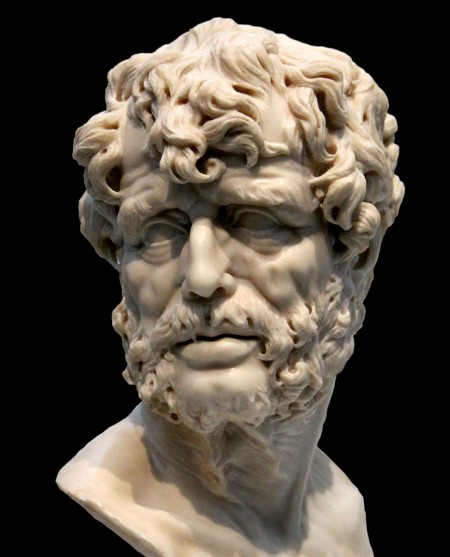
[image] Bust of Seneca the Younger. Anonymous, 17th century. Item Cat. E144 in the Museo del Prado in Madrid. Thanks to Jean-Pol Grandmont and Wikimedia Commons.

References:

Bright, Philippa, ed. and trans. 2019. The Anglo-Latin Gesta Romanorum: from Oxford, Bodleian Library, Douce MS 310. Oxford Medieval Texts. Oxford: Oxford University Press.

Friedlaender, Ludwig, trans. by Alfred Bradly Gough. 1909. “Appendix LV: Borrowing from the Controversiae of the Elder Seneca in the Gesta Romanorum.” Roman life and manners under the early empire. London: Routledge.

Harris, Nigel. 1995. “Review of Brigitte Weiske, Gesta Romanorum, 2 vols, Fortuna Vitrea 3-4 (Tübingen: Max Niemeyer, 1992).” Medium Aevum. 64 (1): 168.

Herrtage, Sidney J. H. 1879. The early English versions of the Gesta Romanorum. London: Pub. for the Early English Text Society, by N. Trübner & Co.

Laird, Andrew. 2008. “Approaching Style and rhetoric.” Ch. 12 (pp. 201-17) in Whitmarsh, Tim, ed. The Cambridge companion to the Greek and Roman novel. Cambridge, UK: Cambridge University Press.

Mayer, Roland. 2015. “Seneca Redivivus: Seneca in the Medieval and Renaissance World.” Ch. 21 (pp. 277-88) in Bartsch, Shadi, and Alessandro Schiesaro, eds. 2015. The Cambridge companion to Seneca. Cambridge: Cambridge University Press.

Oesterley, Hermann, ed. 1872. Gesta Romanorum. Berlin: Weidmann. Alternate textual presentation.

Stace, Christopher, trans. and Harris, Nigel, intro. 2016. Gesta Romanorum. Manchester Univ Press: Manchester.

Swan, Charles, and Wynnard Hooper, trans. 1876. Gesta romanorum: entertaining moral stories. New York: Dover Publications Inc. (reprint edition of 1969).

Walsh, P.G., trans. 1982. Andreas Capellanus on love {De amore}. London: Duckworth.

Winterbottom, Michael, trans. 1974. Seneca the Elder. Declamations, Volume I: Controversiae, Books 1-6. Loeb Classical Library 463. Cambridge, MA: Harvard University Press.


crapping crows, laying eggs & medieval masculine difference

medieval Viking excrement

Excrement and sex are fundamental aspects of human bodies. The recent, acclaimed scholarly book Excrement in the Late Middle Ages: Sacred Filth and Chaucer’s Fecopoetics explains:

There is one thing that all medieval bodies have in common — the male body, the female body, the transgendered body, the eunuch body, the bisexual body, the feminized body, the masculinized body, the sodomized body, the sodomizing body, the chaste body, the celibate body, the married body, the lecherous body, the heretical body, the devout body, the Christian body, the Jewish body, the Saracen body, the visionary body, the lay body: they all defecate. This is not to say that these bodies may not defecate in different socially constructed ways. … Defecation as a ritual is a process of relations that constructs a series of tensions. If, every time we defecate, what we produce is utilized on a dunghill, our excrement is validated; if it is hidden in a cesspit and regarded as the source of filth, pollution, and horror, our bodies disgust and alienate us. [1]

Like humans and human work generally, excrement is produced in a particular time, place, and culture. A medieval Latin story of men’s sexed protest invoked crapping crows. A later, closely related medieval French story replaced the masculine figure of crapping crows with a more feminine one of laying eggs. As that literary development suggests, cultural space for recalcitrant masculine voices is tenuous within the development of gynocentric human society.

The medieval Latin story of crapping crows expresses concern about wives betraying their husbands’ secrets. The social process of evaluating offenses is gender-biased toward punishing men. That makes men particularly concerned about keeping secrets.[2] The Latin story comes from a mid-thirteenth-century collection of stories apparently designed to provide material for sermons. According to the story, a husband resolved to test experimentally the maxim that wives divulge their husbands’ secrets. The husband said one night to his wife:

My dear wife, I have a secret to communicate to you, if I were certain that you wouldn’t reveal it to anyone. If you should divulge it, that would cause me the greatest uneasiness and vexation. [3]

The wife responded:

My lord, fear not; we are one body, and your advantage is mine. In like manner, your injury must deeply affect me.

Accepting his wife’s assurance, the husband then told her:

Well, then, know that my bowels being oppressed to an extraordinary degree, I fell very sick. Having gone to the privy to perform a call of nature, I defecated a crow. It flew away and left me in the greatest trepidation and confusion of mind.

A crow has coloring like feces and the size of an impressive pile. To the husband’s outrageous story of his bowel movement, the wife responded:

Is it possible? But, husband, why should this trouble you? You ought rather to rejoice that you are freed from such a pestilent tenant.

The next morning the wife hurried off to talk with a neighboring woman. She secured a promise of secrecy from her and then told her:

a marvelous thing has happened to my poor husband. Being last night extremely sick, he voided two prodigious crows, feathers and all, which immediately flew away. I am much concerned.

That neighboring woman then told another neighbor that the man had set three crows to flight from his posterior. That neighbor told another that it was four. The story spread “until it was very credibly reported that sixty crows had been evacuated by one unfortunate young man.” The husband gathered his neighbors He explained that he hadn’t actually crapped crows, but had merely validated wisdom about husbands revealing secrets to their wives.

A treatise compiled in French about a century after the Latin collection included a rewritten version of the story about crapping crows. The French story, like the earlier Latin one, addressed wives betraying their husbands’ secrets.[4] But for the empirical test of wisdom about telling wives secrets, the French version has the husband tell his wife that he laid two eggs. The wife then tells that secret to a neighbor, who tells another neighbor, and so on. In the French version, what the whole country came to know was the husband laid five eggs.

Gender apparently shaped the evolution of these stories of wives disclosing husbands’ secrets. Laying eggs is distinctly feminine action. Masculine stories favor crudeness, singularity (“lone ranger”), and extremes. That’s reflected in crapping a crow, a single crow, that is then gossiped into a massive pile of sixty crows. Feminine story-telling tends to be more social and more respectful of conventional behavior. That’s reflected in the husband claiming to have laid two eggs, and the two eggs becoming only five. In short, a masculine story of men’s sexed protest became more feminine in its vernacular translation. Not surprisingly, women’s social dominance shaped Latin culture less strongly than it did vernacular culture.

Cultural development has largely determined the collective intelligence of human societies. Men being imprisoned without the benefit of counsel merely for having sex of reproductive type and being too poor to pay the subsequent state-imposed financial extractions is a gynocentric culture development. Within the context of existing mass incarceration, strong efforts to punish and criminalize men for a wide range of ordinary human sexual interactions is a gynocentric cultural development. So too is elite prioritization of violence against women in the context of much more frequent and harmful violence against men. Historically, medieval Latin literature of men’s sexed protest has been one of the most vibrant intellectual currents contrary to gynocentric culture. Even with respect to fundamental aspects of human bodies such as excrement and sex, recalcitrant masculine voices are crucial for questioning social-intellectual idiocy and promoting collective intelligence.[5]

*  *  *  *  *

Read more:

Notes:

[1] Morrison (2008) pp. 2, 7. Morrison explains:

Fecal discourse can be read as a culturally coded and determined event. We might say we are exploring the ideology or metaphysics of excrement.

Id. p. 7. The rest of Morrison’s paragraph quotes Andrew Shail, Gillian Howie, Elizabeth Grosz, Judith Butler, and Jonathan Dollimore. A subsequent section of her book invokes Bataille, Freud, Deleuze and Guattari, Kristeva and Mary Douglas among academic cult figures, as well as quoting many others with more obscure positions in academic status citation networks. Morrison is Professor of English, Texas State University-San Marcos. She authored Women Pilgrims in Late Medieval England: Private Piety as Public Performance.

Among blurb statements for Morrison’s book:

  • “In this fine and comprehensive study of that which we mark off as different from us, excrement become the necessary stuff for understanding identity, desire, and history.” Michael Uebell, author of Ecstatic Transformation: On the Uses of Alterity in the Middle Ages and co-editor of The Middle Ages at Work.
  • “In a truly fearless and foundational work, wide-ranging and adventurous in scope, Morrison draws from new and pertinent critical approaches (ecocriticsm, waste studies, green studies) and some of their source disciplines (psychology, anthropology, sociology) to invent, define, illustrate and examine the practice of fecopoetics – the ‘cultural poetics of excrement.'” Jeff Persels, French Department and Director of European Studies, University of South Carolina and co-editor of Fecal Matters in Early Modern Literature and Art.
  • “Morrison schools us in the nuanced meaning of medieval excrement, whose position in medieval culture was in fact ambivalent and various.” Kathy Lavezzo, English Department, University of Iowa.
  • “Susan Signe Morrison makes the case that we cheat both the authors and ourselves if we fail to look at the full range of medieval poetic expression. After this rigorous, astute, and insightful book, no one should doubt her. Using both theory and close textual analysis, Morrison has produced a persuasive argument for the fact that we should take these matters as seriously as Chaucer did. This book will turn thought about medieval vulgarity on its end.” Martha Bayless, English Department, University of Oregon and author of Parody in the Middle Ages.

Morrison’s book is part of The New Middle Ages book series. That series has “particular emphasis on recuperating women’s history and on feminist and gender analyses.” The New Middle Ages book series “has become notorious for offering little copyediting or proofreading.” Bildhauer (2010) p. 389.

[2] Stories of men’s concern about women betraying men’s secrets existed in ancient Roman. In a story attributed to Cato the Elder, Papirius Praetextatus revealed to his mother that the Roman Senate was considering allowing one man to have two wives or one woman to have two husbands. Papirius’s mother told that secret to many other women and caused an uproar. Aulus Gellius, Attic Nights 1.23. That story was widely disseminated in medieval Europe as Tale 126 of Gesta Romanorum, from Latin trans. Swan & Hooper (1876) pp. 227-8.

Men’s concern about women betraying secrets is expressed three times in Book 3 of Andreas Capellanus, De amore (written c. 1180): para. 70, 87-8, 102-3. The final instance states:

no woman can keep a secret. The more she is bidden to keep something in confidence, the more eagerly she strains to tell it to everybody. No woman to this day has been found to keep any secret undivulged, no matter how important or even likely to cause someone’s death. Any secret confided to a woman’s trust seems to burn her up inside if she does not first expose the confidences so disastrously reposed in her. You could not prevent women acting like this by bidding them to do the opposite, the rule of thumb which I stated earlier, because all women take the greatest pleasure in gossiping about something new. So be sure to keep your secret from every woman.

De amore 3.102-3, from Latin trans. Walsh (1982) pp. 317, 319. Book 3 of De amore is a subtle dialogical manipulation of men’s sexed protest.

Men’s protest of  women divulging men’s secrets exists in many subsequent medieval works of men’s sexed protest. Leading works are Jean de Meun’s Romance of the Rose and Liber lamentationum Matheoluli. See notes [3] and [5] in my post on Marie de France’s Bisclavret. Marie de France’s Bisclavret is itself an poignant and powerful work underscoring the importance of respecting men’s secrets. In Chaucer, Wife of Bath’s Prologue, the wife states about her close friend:

To her I revealed all my secrets.
For had my husband pissed on a wall,
Or done a thing that should have cost his life,
To her, and to another worthy wife,
And to my niece, whom I loved well,
I would have told every one of his secrets.
And so I did very often, God knows it,
That made his face often red and hot
For true shame, and blamed himself because he
Had told to me so great a secret.

ll. 533-42, modernized by Larry Benson at his Harvard Geoffrey Chaucer site. See also the Wife of Bath’s retelling of Ovid’s tale of Midas and his donkey ears, id. ll. 945-82.

Sexual betrayal has particular significance to men and is commonly addressed in medieval literature of men’s sexed protest.

[3] Gesta Romanorum, Tale 125, from Latin trans. Swan & Hooper (1876) pp. 226-7. I’ve made some minor modernization to the translation. Id. translated paraphrastically the Latin text:

Cum ad privata accessissem ut opus naturae facerem, corvus ingerrimus a parte posterorii evolabat.

I’ve included above a more direct translation of that Latin text. All the subsequent quotes above are from id.

[4] The French version of the crapping crows story is from Livre pour l’enseignement de ses filles du Chevalier de La Tour (Book of the Knight of Tour Landry) Ch. 74. Geoffroy IV de la Tour Landry, a knight, compiled that book about 1372. An English translation of that text, written in the mid-fifteenth century, is available online in Wright (1868), pp. 96-7. A modernized English version of the translation that Caxton printed is available in Gregg (1997) p. 119 (W9). The story is no. 1359 in Tubach (1969).

[5] On the importance of culture to humans’ capabilities, Henrich (2015).

[image] The Lloyds Bank coprolite: a nine-inch (23 cm) long stool that a Viking defecated at Jorvik (present-day York, England) early in the tenth century. Image thanks to Linda Spashett and Wikimedia Commons. Here’s more information about Vikings living in tenth-century Jorvik. Most men are much stronger than almost all women:

In terms of upper body muscle mass there’s less than a 10% overlap between the two distributions. The vast majority of men have more muscle mass than all women. 99.9% of females have less upper body muscle mass than the average male. The 61% greater average muscle mass in male upper bodies translates into 90% greater average strength (the respective values for the lower body are 50% and 61%).

However, Michael Gilleland at Laudator Temporis Acti insightfully reported the nickname of a Penobscot Indian women in colonial America:

Mali me’sadwədjan, “Mary big-faeces” (identity omitted), derived from advertising her ability to surpass the tribal cannon {an old iron cannon that the Penobscot Indians acquired} in capacity of discharge.

Despite men generally being much stronger than women, one should not assume that a man produced the massive Lloyds Bank coprolite.

References:

Bildhauer, Bettina. 2010. “On Farting: Language and Laughter in the Middle Ages, and: Excrement in the Late Middle Ages: Sacred Filth and Chaucer’s Fecopoetics (review).” Studies in the Age of Chaucer. 32 (1): 386-389.

Gregg, Joan Young. 1997. Devils, women, and Jews: reflections of the other in medieval sermon stories. Albany: State University of New York Press.

Henrich, Joseph Patrick. 2015. The secret of our success: how culture is driving human evolution, domesticating our species, and making us smarter. Princeton: Princeton University Press

Morrison, Susan Signe. 2008. Excrement in the late Middle Ages: sacred filth and Chaucer’s fecopoetics. New York: Palgrave Macmillan.

Swan, Charles, and Wynnard Hooper, trans. 1876. Gesta romanorum: entertaining moral stories. New York: Dover Publications Inc. (reprint edition of 1969).

Tubach, Frederic C. 1969. Index exemplorum; a handbook of medieval religious tales. Helsinki: Suomalainen Tiedeakatemia.

Walsh, P.G., trans. 1982. Andreas Capellanus on love {De amore}. London: Duckworth.

Wright, Thomas. 1868. Geoffroy de La Tour Landry. The book of the Knight of La Tour-Landry, compiled for the instruction of his daughters. London: Pub. for the Early English Text Society, by N. Trübner & Co.

internal monologues of Chrétien de Troyes and Walter Map

Medieval romance flourished in the twelfth century through elite interests in propagating ideology of men being ennobled through brutal suffering in servitude to women (“courtly love”).[1] The most widely read source of Arthurian romance in the twelfth century was Geoffrey of Monmouth’s Latin tale of British kings. However, to reach a broad readership and audience, romances were most frequently written in the natively spoken languages of medieval Europe.[2] Latin, in contrast, was the learned, pan-European language that generated the most subversive, satirical, irreverent, bawdy, and funny literature.

Chrétien de Troyes and Walter Map wrote romances in Old French and Latin, respectively. Both were brilliant twelfth-century European authors learned in Latin and familiar with tales of ladies and knights in local languages. The subversive potential of Chrétien de Troyes’s Old French work is concealed beneath a smooth surface. Walter Map, in contrast, wrote an obviously raucous and disorderly Latin text. Close comparison of internal monologues in Chrétien’s Lancelot and Walter’s tale of Sadius and Galo shows knightly romance in Latin outrageously capping knightly romance in Old French.

Arthurian monologues upon Latin romance

Although Chrétien de Troyes knew well subversive Latin literature, he chose to serve elite power. Chrétien translated from Latin into Old French Ovid’s Art of Love and Ovid’s Metamorphoses.[3] Ovid, the great teacher of love, was regarded as so threatening that he was exiled, castrated, and called a misogynist for defying the goddess Cybele. Chrétien sensibly turned his literary skills to less dangerous work. He superficially presented in French romances the subjects and interpretations that gynocentrism desired. For example, Chrétien took up an assignment from Countess Marie de Champagne, the oldest daughter of Eleanor of Aquitaine and nominal King Louis VII. In the prologue to Chrétien’s Lancelot, The Knight of the Cart, Chrétien explained:

Because my lady of Champagne
Wants me to start a new
Romance, I’ll gladly begin one,
For I’m completely her servant
In whatever she wants me to do [4]

Chrétien then signaled his sophistication by flattering Marie de Champagne with the rhetorical figure of apophasis. He added:

What I have to say is that this
Story has been better polished
By her work and wisdom than by mine.

Chrétien understood gynocentric values (“All my success is due to my wife“). Like a good bureaucrat, he fulfilled his job assignments with modesty and cheerfulness. He could have written a Latin romance about a new civilization overcoming the disastrous destruction of men’s lives in a foolish war over Helen. He could have written a Latin romance of men’s friendship and solidarity in the face of oppressive control by the church and women. But such subjects are risky and dangerous to address, in medieval times and even more so in our day, especially in common language that unsophisticated persons think they understand.

In Chrétien’s time, monologues were a well-established literary practice particularly associated with women. In Ovid’s Metamorphoses, the Colchian princess Medea discussed with herself leaving her father and her father’s kingdom to elope with the Greek foreigner Jason:

Will I betray the kingdom of my father,
only to have the stranger whom I save
set sail without me for another’s bed,
leaving Medea to her punishment?
If he could do that, leave me for another,
let the ingrate die!
But no: that isn’t in him,
not in his face, not in his noble spirit,
not in a man as beautiful as he,
that I should fear duplicity from him,
or his neglecting what I am deserved.
Besides, he’ll give his word to me beforehand,
and I will call the gods as witnesses
of our compact. Why fear, when all is safe?
Prepare for action now, without delay;
you will have Jason’s gratitude forever,
he’ll join himself to you with solemn vows,
and you’ll be praised as his deliverer
by throngs of women throughout all of Greece!
So shall I then sail off, abandoning
my sister, brother, father, gods, and homeland?
My father is cruel and my homeland crude;
my brother is no more than a mere child,
and my sister sides with me in this affair.
Within my breast the greatest of all gods
has found his residence! I do not leave
greatness, but elope with him to seek it! [5]

The Old French Roman d’Enéas, written about 1160, includes twenty-two monologues, twelve of which are about feelings of love. Women speak almost all the monologues about love. Chrétien followed the use of monologues in the Roman d’Enéas, but turned them inward. In Chrétien first romance Erec and Enide, written about 1170, all eight of the monologues the woman Enide speaks to herself.[6]

Chrétien’s subsequent romance Lancelot, The Knight of the Cart thoroughly developed the courtly ideal of men’s subordination to women, while subtly, too subtly, ridiculing the manlet Lancelot. Consider one of Lancelot’s internal monologues:

I should have killed myself
The moment my lady the queen
Showed how deeply she hates me.
There’s got to be some reason;
She wouldn’t have done it for nothing —
And yet I can’t understand.
For had I known what was wrong
I’d have moved heaven and earth
To amend it, however she liked [7]

In medieval Christian understanding, killing oneself is wrong. Suicide was a mortal sin. Today, husbands contemplate suicide and wonder what they did wrong when their wives unilaterally file for divorce. Even the loss of custody of a father’s children and his financial devastation in deeply gender-biased family courts wouldn’t justify a man’s suicide in medieval Christian understanding. Yet men’s suicides generate relatively little social concern. Despite its medieval Christian context, Lancelot has been interpreted as an admirable hero of courtly love.

Lancelot’s beloved Queen Guinevere similarly has a subtle, too subtle, internal monologue. After Lancelot had suffered brutal bodily wounds in successfully rescuing Guinevere, she walked away from him without a word of thanks. Speaking to herself later, she lamented her appalling behavior:

To deny him every attention
Was absolutely mad!
Mad? Better, by God,
To call me cruel, and a traitress.
It was only a joke, a whim,
But he took it deeply to heart
And never forgave me. I know it,
It was I who killed him, who gave him
The mortal blow: I know it!

Could I have dealt him a blow
More mortal? Denying him even
A word was like cutting out
His heart and killing him, then
and there. And so I killed him:
Why hunt for other assassins?
Oh God! Can I ever redeem
This murder, this mortal sin? [8]

Anything is possible with God. Yet if the gynocentric cultural complex didn’t rule medieval Christian society, Guinevere would be remembered only among non-believers and tax collectors. Displaying women’s freedom and license within medieval Christianity, Guinevere, who was married to King Arthur, then relished thoughts of adultery with Lancelot and rationalized not committing suicide:

Lord,
How good it would be, once —
Just once — before I die,
Were he wrapped in my arms again!
How? Why, both of us naked;
That’s when I’d be the happiest.
But since he’s dead, to go on
Living would simply be wicked.
And why? To be alive
After he’s dead: would that
Injure my beloved — nothing
To delight in except my sorrow?
And yet how sweet that sorrow
Would be, had he been able
To see it when he was alive.
Would it not be wicked
To prefer death to such suffering?
Living as long as I can,
And enduring this pain, will be pleasure
Enough: I should live and suffer,
Not die and be at peace. [9]

Chrétien lacked the freedom to write like Juvenal and retain his commission in the court of Marie de Champagne. He had a job to do for the dominant ideology. Yet he was no mere literary apparatchik-scholar. The wit and subtlety of Chrétien’s monologues can’t be fully appreciated within the elite purpose for the new, vernacular Arthurian romances, nor within the associated dominant ideology of men’s subservience to women.

The long-established, subversive Latin tradition of romance provides necessary context for appreciating Chrétien’s monologues. The story of Apollonius of Tyre, known in Latin probably from no later than the sixth century, included a young man doctor resurrecting a beautiful young woman through erotic treatment. In the middle of the eleventh century, a Germanic poet writing in Latin created Ruodlieb. That courageous, transgressive, and entertaining work explicitly described the workings of gynocentrism and strongly challenged the well-established Greek novel’s sexual symmetry. Close to the time and place of Chrétien de Troyes, Andreas Capellanus writing in Latin outrageously described natural dread game as superior to supernatural dread game and questioned the new understanding of chivalric love in framing a mock-Arthurian romance. Andreas Capellanus also daringly challenged suppression of men’s sexed protest, as did in different ways leading women writers of the Middle Ages. Much of the most outrageous Latin story-telling from the early Middle Ages undoubtedly has been lost. But the diversity and creativity of medieval Latin literature should not be doubted.[10]

Walter Map provides an important, under-appreciated Latin internal monologue for literary comparison with Chrétien de Troyes’s monologues. Walter visited Marie de Champagne’s court at Troyes about the time that Chrétien is thought to have written Lancelot. Walter, who apparently lived on the border of England and Wales, probably knew Celtic legends that went into Arthurian tales. Two poems in the French Lancelot prose cycle were attributed to Walter. He may have written further popular French verse. In any case, several stories in the Latin De nugis curialum, which is securely attributed to Walter, are thematically in the mainstream of Arthurian legends.[11]

Walter’s Arthurian Latin romance of Sadius and Galo includes an internal monologue that outrageously caps Queen Guinevere’s internal monologue on her relationship with Lancelot. In Walter’s story, the queen fell madly in love with the foreign knight Galo. From her position of authority, she pressured him for sex. Galo suffered at length from the queen’s sexual harassment. Desperately seeking to be free from the queen’s sexual harassment of him, Galo conspired that his friend Sadius try to convince the queen that Galo was impotent. The queen resolved to put the matter to a sexual test with a beautiful court girl. After ordering the court girl to pursue the affair, the queen was tormented with jealousy and conflicting thoughts. She threw herself on a bed and said to herself:

Sadius is faithful and truthful: he lost his genitals. The more fool is he, to conceal his disgrace from me, that he cannot be touched, to spurn me that I might not spurn him in return! Truly if he had favored me, I would have been his most closely joined and clinging friend, and if there were a delay in discovering him, a hand could stray that certainly would be able to detect whether he is female or male or neuter.

O, it is not as I believed! Sadius lies, he is a man, the signs are certain that he is a man, intact, without defect. O what a wretch and fool I am to have sent the cleverest of girls on my own errand! … I do not believe, I do not think, I am sure and without doubt, that already she is where I should have been, but for the consecration of my head, but for my being a spouse: but there was his loyalty to keep him back. With her, where is the obstacle? What of this concerns her? Nothing. The damage is done. …

But can Sadius have spoken the truth? No, no! There is nothing in it. It’s obvious that he is potent, or she would have returned long ago. All the good signs are clear: that charming downy growth upon his cheeks, no flabbiness of limb, no jaundiced eye or coward heart. Could an effeminate man have pierced through so many armed phalanxes, outshined the glories of all men, raised his own repute to such a pinnacle of praise? I am sure that Sadius lies. [13]

Compared to Chrétien’s French monologue of the queen, Walter’s Latin monologue of the queen has greater psychological depth and more personal specificity. Chrétien’s monologues generally are closer to a figured conflict between abstract ideas. Walter’s monologue is more realistic and novelistic, more bawdy and transgressive. Given that Chrétien figured Lancelot as a manlet, Walter’s theme of impotence can fairly be interpreted as a wicked Latin capping of Chrétien’s monologue in the French Lancelot.

Vernacular Arthurian romance widely disseminated in late twelfth-century Europe contributed significantly to institutionalizing and naturalizing men’s servitude to women in love. Vernacular Arthurian romance built upon a rich, diverse inheritance of medieval Latin romance. But vernacular literature was more closely tied to socially dominant gynocentric interests. Vernacular literature lacked the diversity and freedom of expression possible in Latin. Emancipating men and women from gynocentrism requires bringing into vernacular romance marginalized medieval Latin literature. Welcoming into vernacular literature scintillating medieval Latin work such as Solomon and Marcolf and Lamentationes Matheoluli is a path to social, cultural, and sexual renewal.

*  *  *  *  *

Read more:

Notes:

[1] C. Stephen Jaeger has thoroughly developed this terrible idea. See, e.g. Jaeger (1985) and Jaeger (1999). Here’s a critique of Jaeger’s thinking with respect to Marbod of Rennes’s Liber Decem Capitulorum.

[2] Geoffrey of Monmouth wrote his Historia regum Britannie (History of the Kings of Britain) about 1138. Its prologue declared that it was a historia (history) based on a book in a British tongue. The prologue also warned about other, non-bookish tales of British kings. Latin, the language in which Geoffrey wrote, was the language of learned books. Echard (2011) pp. 1-2. Geoffrey’s Latin Arthurian tale “was an immediate best-seller; it survives in over 250 copies, and was translated and adapted throughout the Middle Ages.” Archibald (2011) p. 132.

Chrétien de Troyes made a similar assertion in the prologue to his Old French Arthurian romance Cliges:

The story I wish to recount to you, we find written down in one of the books in the library of Saint Peter’s Cathedral in Beauvais. The fact that the tale was taken from there is evidence of the truth of the account. Hence its greater credibility.

From French trans. Staines (1990) p. 87. A book from the library of Saint Peter’s Cathedral suggests a book written in Latin, the language of church bureaucrats (clerics). While Chrétien claimed Latin authority, he actually wrote in the commonly spoken language French. Writing in French better served the interests of his royal patrons in broad dissemination.

[3] Chrétien de Troyes stated these facts in his preface to Cliges. He probably translated both Ovid’s Ars Amatoria (Art of Love) and Ovid’s Remedia Amoris (Remedies for Love), as well as several stories from Ovid’s Metamorphoses (Transformations). Staines (1990), Introduction, p. xii.

[4] Chrétien de Troyes, Lancelot, the knight of the cart ll. 1-5, from Old French trans. Raffel (1997) p. 1. The subsequent quote is from id. Countess Marie de Champagne apparently had difficult reading even the Bible in Latin:

Unlike her husband, Marie apparently did not read Latin well and preferred texts in the vernacular. Her requests for biblical translations are among the earliest in French.

McCash (2005) p. 16.

[5] Ovid, Metamorphoses, Bk. 7, ll. 1-73 (Medea’s monologue), excerpt from Latin trans. Martin (2004) p. 225. Tony Kline has generously made his translation freely available online.

[6] Duggan (2001) pp. 140-50.

[7] Chrétien de Troyes, Lancelot ll. 4343-53, from Old French trans. Raffel (1997) p. 137.

[8] Chrétien, Lancelot ll. 4208-16, 4221-28, trans. id. p. 133. The subsequent quote is from ll. 4231-51, trans. id. p. 133-4.

[9] The queen instructed the courtly girl to embrace nakedly Galo. Andreas Capellanus, De amore 1.6.471, advocated chaste contact of that sort. For discussion, see note [3] in my post on Sadius and Galo.

[10] Brooke (2004) and McCash (2005) pp. 20-1 discuss Walter Map’s activities. McCash states:

Walter’s name has long been associated with the prose cycle of the Lancelot, which claims to be ‘translations of a Latin original preserved at the abbey of Salisbury, made “by Walter Map at the request of King Henry his lord”’. Some scholars argue that Walter had little interest in these matters and that it was merely customary for authors to claim such sources. However, given the persistence with which Walter’s name was associated with these materials from the thirteenth through the nineteenth centuries, coupled with the known interest of the Plantagenet court in Arthurian legends, it is logical that Walter may indeed have collected such tales for the court. Whether he ever wrote them down is another matter, but, as a well-known teller of tales, he may have been partly responsible for their dissemination.

Id. p. 20. See also Webster (1940). Archibald, however, states:

It seems particularly ironic that Map was named as the author of parts of the French Vulgate Cycle, an early thirteenth-century compilation that tells the story of the Arthurian world in a way that does not suggest parody or the need for deep interpretation. No modern critic accepts this attribution, which recurs at the end of the Queste del Saint Graal and the beginning and end of the Mort Artu.

Archibald (2015) p. 185. Walter is more plausible as the author of the prose Lancelot cycle than Mary Shelley is as the author of Frankenstein. Walter’s securely attributed Arthurian tales from De nugis curialum are, in addition to the story of Sadius and Galo, the story of Resus and the story of Raso.

[11] Archibald (2011) and Archibald (2015) discuss the literary history of Latin romance and its contribution to Arthurian romance. Archibald’s useful studies, however, work within the dominant gynocentric ideology that has devalued and suppressed men’s literature of sexed protest under the disparaging label “misogyny.” Field insightfully queried:

Why are we so dismissive of clerical culture? … by comparison with the interest lavished on audiences, patrons and women, the clerical writers as a group seem to suffer from the Victorian disapproval of ‘monkish writers’.

Field (2011) pp. 187-8. If the dominant gynocentric ideology weren’t so dismissive of clerical culture (“monkish misogyny”), it would have to recognize scintillating medieval Latin clerical literature of men’s sexed protest.

[12] Walter Map, De nugis curialium 3.2, trans James (1983) pp. 217, 219. I’ve made some changes to the translation to make it more literal and explicit.

[image] Illumination on folio 40v, Yale Beinecke MS.229 Arthurian Romances. Made in France, 1275-1300. Thanks to Manuscript Miniatures (Yale manuscript viewer defunct / useless).

References:

Archibald, Elizabeth. 2011.  “Arthurian Latin Romance.” Ch. 7 (pp. 132-45) in Echard (2011).

Archibald, Elizabeth. 2015. “Ruodlieb and Romance in Latin: Audience and Authorship.” Ch. 12 (pp. 171-86) in Duys, Kathryn A., Elizabeth Emery, and Laurie Postlewate. 2015. Telling the story in the Middle Ages: essays in honor of Evelyn Birge Vitz. Cambridge: D.S. Brewer.

Brooke, C. N. L. 2004. “Map, Walter (d. 1209/10).” Oxford Dictionary of National Biography. Oxford University Press.

Duggan, Joseph J. 2001. The romances of Chrétien de Troyes. New Haven: Yale University Press.

Echard, Siân. 2011. “Introduction: The Arthur of Medieval Latin Literature.” Pp. 1-5 in Echard (2011).

Echard, Siân, ed. 2011. The Arthur of medieval Latin literature: the development and dissemination of the Arthurian legend in medieval Latin. Cardiff: University of Wales Press.

Field, Rosalind. 2011. “‘Pur les francs homes amender’: Clerical Authors and the Thirteenth Century.” Ch. 13 (pp. 175-88) in Rhiannon Purdie and Michael Cichon, eds. Medieval romance, medieval contexts. Cambridge: D.S. Brewer.

Jaeger, C. Stephen. 1985. The origins of courtliness: civilizing trends and the formation of courtly ideals, 939-1210. Philadelphia: University of Pennsylvania Press.

Jaeger, C. Stephen. 1999. Ennobling love: in search of a lost sensibility. Philadelphia: University of Pennsylvania Press.

James, M. R. trans., C. N. L. Brooke, and R. A. B. Mynors, eds. 1983. Walter Map. De nugis curialium {Courtiers’ trifles}. Oxford, Oxfordshire: Clarendon Press.

Martin, Charles, trans. 2004. Ovid. Metamorphoses. New York: W.W. Norton & Co.

McCash, June Hall. 2005. “Chrétien’s Patrons.” Ch. 2 (pp. 15-25) in Lacy, Norris J., and Joan T. Grimbert, eds. 2005. A companion to Chrétien de Troyes. Cambridge: D.S. Brewer.

Raffel, Burton, trans. 1997. Chrétien de Troyes. Lancelot, the knight of the cart. New Haven: Yale University Press.

Staines, David, trans. 1990. The complete romances of Chrétien de Troyes. Bloomington: Indiana University Press.

Webster, K. G. T. 1940. “Walter Map’s French Things” Speculum. 15 (3): 272-279.

Andreas Capellanus depicted shifting meaning of chivalric love

chivalric love, manlet tests

In twelfth-century Europe, understanding of chivalric love shifted from sexual readiness to manlet tests. Andreas Capellanus, writing about 1180, depicted this shift in an Latin Arthurian romance occurring in his work now sometimes ironically called On the Art of loving with dignity {De arte honeste amandi}. The new understanding of chivalric love placed men in abject love servitude to women. Andreas’s Latin Arthurian romance reveals his contempt for the new understanding of chivalric love.

The new understanding of chivalric love required men to follow rules of love. Andreas’s Arthurian Latin romance explains how thirty-one rules of love were established. Rules for love function as manlet tests, more popularly known as shit tests. The original understanding of chivalric love required only sexual readiness. That’s natural to manly horsemen, just as farmers must plow to plant seeds.

The beginning of Andreas’s Arthurian Latin romance immediately associates King Arthur with a peculiar womanly action. Consider that unusual element in the context of typical Arthurian motifs:

A certain British knight was roaming alone through the royal forest hoping to see Arthur. When he had been drawn to the interior of the forest, a girl endowed with wondrous beauty, seated on a caparisoned horse and binding up her hair, suddenly met him.

{ Nam quidam Britanniae miles dum solus causa videndi Arturum silvam regiam peragraret et ad eiusdem [domini] silvae fuisset interiora deductus, iuvencula quaedam mira pulchritudine decorata, ornato residens in equo in capillorum ligatura inopinate sibi occurrit }

Why was the woman binding up her hair? In the original understanding of chivalric love, a woman binding up her hair indicates she no longer feels passionate sexual desire.

The beautiful girl who no longer felt passionate sexual desire administered manlet tests to the British knight. She explained to the knight:

When you were seeking the love of a certain British lady, she told you that you could never win it unless you first brought her the victorious sparrowhawk which is said to sit on a golden perch in Arthur’s court.

{ Cuiusdam Britanniae dominae dum postulares amorem, ipsa dixit tibi quod eius nunquam posses amorem lucrari, nisi ei primitus victoriosum reportares accipitrem, qui in Arturi curia super aurea dicitur pertica residere. }

The knight confirmed her assertion. When his beloved lady said she wanted the victorious sparrowhawk sitting on a golden perch in Arthur’s court, the knight went in search of Arthur and his court. He should have offered her the medieval version of skittles.

The beautiful girl then piled on the manlet tests. She declared:

You could not take the sparrowhawk you seek without first proving by combat in Arthur’s palace that you rejoice in the love of a lady more beautiful than any possessed by those who dwell at Arthur’s court. Moreover, you could not enter the palace without first showing to the guards the gauntlet for the sparrowhawk. That guantlet you cannot get without winning it by engaging two of the bravest knights in a double contest.

{ Accipitrem quem quaeris habere non posses, nisi primitus in Arturi palatio proeliando convincas quod dominae gaudes pulchrioris amore quam eorum aliquis qui in curia demorantur Arturi; palatium vero intrare non posses, nisi primo custodibus chirothecam demonstrares accipitris. Sed chirothecam non est habere possibile, nisi contra duos milites pugnando fortissimos in duplicis pugnae agone obtineas. }

Those are tasks of violence. Such tasks explain why medieval men had much shorter life expectancy than did medieval women. The gendered pattern of violence continues to be ignorantly misunderstood: violence kills more than four times more men than women. Keep repeating that fact until the violence stops, or at least until the vagina monologues stop.

As a benighted knight, the man put himself under the direction of the girl. The knight declared to the girl:

I realize that I cannot succeed in this hard task if you do not offer me the help of your hand.

{ Cognosco me in hoc labore non posse proficere, nisi mihi vestrae manus auxilia porrigatis. }

Only obtuse readers don’t perceive witty mocking in the knight seeking the help of the girl’s hand in succeeding in tasks of violence. The knight earnestly expressed his desire for the girl’s direction:

I wish to subject myself to your direction, and ask you humbly to give me your help in this task. Grant me your consent, that under your directing eye, I may boldly claim for myself the love of a lady more beautiful than all others.

{ Ideoque me vestro dominatui volo subiicere, supplici a vobis orationis affatu deposcens ut vestra in hoc facto mihi iuvamina porrigatis, et ut de vestro mihi concedatis assensu, quatenus vestrae dominationis intuitu licenter valeam amorem mihi dominae pulchrioris adscribere. }

Most men are easily made subordinate to a beautiful girl. Men, of course, naturally seek sex with beautiful young women. But the behavior of a manlet drys up a girl’s sexual desire. The beautiful girl gave the knight the kiss of love. That, like the kiss of peace, was meant to be purely without lust. She then gave him her horse to lead him. Only a man who’s a poor rider would literally ride such a horse, instead of the girl herself.

The knight then rode off and accomplished his woman-directed manlet tasks of violence against men and acquisition. Just as in the story of the manlet Lancelot, a bridge-keeper sought to keep the knight from crossing a bridge. They then fought. The knight seriously injured the bridge-keeper, suffered a serious bodily wound himself, but managed to cross the bridge. On the other side of the bridge, the knight killed a man who had attempted to drown him. Seeking food, the knight fought a palace guard, of course also a man. The knight suffered huge blows while the guard lost his hand. To get the sparrowhawk, the knight engaged in a brutal fight with another man. As a result of all this violence against men, the knight secured the sparrowhawk that his beloved lady desired. With the sparrowhawk came a scroll containing rules of love. Men fighting men is inevitably a losing activity for men.

The knight missed an opportunity for love with a beautiful girl because he failed to understand the game. When the beautiful girl gave the knight his manlet tests, she said:

If your heart proves so bold that you don’t fear to seek out the things I mentioned, you could obtain from me what you propose.

{ Si tanta tibi esset cordis audacia ut ea, quae diximus, non timeas perscrutari, posses a nobis quod postulas impetrare. }

The knight returned to the girl to show that he had done what she required. She responded joyfully. She flirtingly said to him:

You have my permission to depart, dearest one, because sweet Britain demands you. But I beg you not to accept your departure reluctantly, because whenever you wish to approach this region alone, you will always find me here.

{ De licentia mea recede, carissime, quia dulcis te Britannia quaerit. Rogo tamen ne gravis tibi videatur abscessus, quia quandocunque ad haec volueris solus accedere loca, me semper poteris habere praesentem. }

Societies have long demanded men’s bodies. Men, in contrast, have been reluctant to demand their entitlement to love. The beautiful girl said that she would be there for the knight. She right then was there for the knight. He happily left to fulfill the demands of sweet Britain and help to instruct all men in the rules of love. Benighted, sexually deprived men have been following oppressive, brutalizing rules of love ever since.

*  *  *  *  *

Read more:

Notes:

The quotes above are from Andreas Capellanus, De amore / De arte honeste amandi, Book 2, Chapter 8, Latin text and English translation from Walsh (1982) pp. 271-85. That chapter, entitled “The Rules for Love {De regulis amoris},” begins with the Latin Arthurian romance above, commonly called the Sparrowhawk episode.

I’ve made some minor changes to Walsh’s translation, mainly to track the Latin more closely. For in capillorum ligatura inopinate sibi occurrit, Walsh has “binding her hair, suddenly confronted him.” Recognizing the context of this gesture and the non-confrontational context, I translated the Latin as “binding up her hair, suddenly met him.” The sparrowhawk (accipiter) Walsh translates as “hawk.”

In her reading of the Sparrowhawk episode, Echard perceives two competing systems of conduct: courtly behavior and fairy romance. Echard also recognizes the importance of Book 3 of De amore for interpreting the Sparrowhawk episode, which comprises most of the last chapter of Book 2. Echard (1998), pp. 112-21. Book 3 of De amore develops men’s sexed protest dialogically. The purgatory of cruel beauties in De amore similarly exists in relation to an alternate presentation of natural dread game. Andreas commonly developed themes with thematic contrasts.

[image] Knights (men) engaged in violence against each other. Illumination on folio 339r, Yale Beinecke MS.229 Arthurian Romances. Made in France, 1275-1300. Thanks to Manuscript Miniatures.

References:

Echard, Siân. 1998. Arthurian Narrative in the Latin Tradition. Cambridge: Cambridge University Press.

Walsh, P.G., trans. 1982. Andreas Capellanus on Love {De amore}. London: Duckworth.