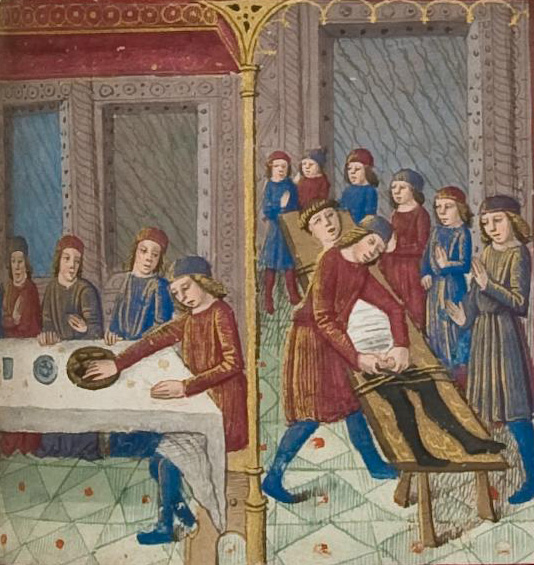
imagine more men students happily attending college

A medieval student of Venus, delighting in ardent love with his girlfriend Flora, worried about rivals. He worried that the ultimate alpha man Jupiter, head god in charge of the cosmos, would become Flora’s lover:

Oh, if Jupiter
might see her,
I fear with equal passion
he would warm
and return to his deceits:
either rain as Danaë’s gold
and soothe her with his sweet shower,
or transform into Europa’s bull,
or gleam white again
as Leda’s swan.

{ O, si forte Iupiter
hanc videat,
timeo, ne pariter
incaleat
et ad fraudes redeat,
si vel Danes pluens aurum
imbre dulci mulceat,
vel Europes intret taurum,
vel Ledaeo candeat
rursus in olore. }[1]

Men compete extensively with other men for women’s love. Losing in love hurts, even when one loses to gods. Imagine a woman saying to a man who loves her, “Leave me to the gods {Mi lassa dis}!”[2]

Even worse than losing in love to another man is losing in love for lack of love. That’s the more common situation. Men who endure amorous rejection after amorous rejection don’t perceive that they are losing to other men. They perceive that they are unloved. That’s cold and harsh.[3]

A man student studying in medieval France intended in despair to leave his studies and go back to his home country. He explained:

I’m sad because for too long
I’ve endured exile.
To hell with this studying!
Yes, I’m getting out of here
if she doesn’t grant me the joy
for which I yearn so much.

Oh, what am I to do?
For what did I know France?
Am I to lose the love
of this noble woman?
Am I to flee, heartbroken,
from this country?

Day, night — everything
is against me.
Young women chatting
brings tears to my eyes.
I often hear them sigh. More
reminding makes me tremble.

{ Doleo quod nimium
patior exilium.
Pereat hoc studium!
Si m’en iré,
si non reddit gaudium,
cui tant abé.

Proh dolor, quid faciam?
Ut quid novi Franciam?
Perdo amicitiam
de la gentil?
Miser corde fugiam
de cest pays?

Dies, nox et omnia
mihi sunt contraria.
Virginum colloquia
me fay planszer.
Oy suvenz suspirer plu
me fay temer. }

Among students enrolled in U.S. colleges today, women outnumber men by 42%.[4] Colleges must do more to encourage men students to remain in school, if only out of concern for women students’ share of available men. One cannot expect college administrators, if they were concerned for men’s welfare, to be as wise as the ancient lawmaker Solon. But college leaders could at least provide classes in medieval Latin literature so that men students could learn that men were once allowed to express what they feel:

My companions, enjoy yourself!
You who know, recite poems,
but spare me in my grieving.
I feel great anguish.
But you — have regard
for your own honor.

Beloved, for love of you
I’m saddened, sigh, and weep.
Throughout my body I feel great
anguish from love.
I leave now, companions,
let me go.

{ O sodales, ludite!
Vos qui scitis, dicite;
michi mesto parcite.
Grand ey dolur!
Attamen consulite
per vostre honur!

Amia, pro vostre amur
doleo, suspir, et plur.
Per tut semplant ey dolur
grande d’amer.
Fugio nunc, socii,
lassé m’aler. }

More assistant deans, outreach programs, and college task forces might not be enough to keep men students in school. This medieval student clearly specified what he needed:

Your beautiful face
with your heart of ice
makes me weep a thousand tears.
To make amends
you would instantly restore me to life
with a kiss.

{ Tua pulchra facies
pectus habet glacies
me fey planser milies.
A remender
statim vivus fierem
per un baser. }

Colleges must foster and encourage women’s love for men. Much work remains to be done.

Systemically making love misery is a social injustice. Another man student planned to leave study in his home country and go into exile because of that social injustice:

Sweet land of my father’s birth,
home filled with joy, pleasant bedroom —
I’ll be leaving you either tomorrow or today,
doomed to perish in love’s madness as an exile.

Farewell, my homeland, farewell, my comrades,
you whose friendship I’ve affectionately cultivated,
Weep for me, deprived of sweet hours of study with you.
I am lost to you because of fire.

Love’s fire newly wounds my
heart, which earlier didn’t know such.
It confesses now that the proverb is true:
“Where love is, there is deep unhappiness.”

{ Dulce solum natalis patriae,
domus ioci, thalamus gratiae,
vos relinquam aut cras aut hodie,
periturus amoris rabie exul.

Vale, tellus, valete, socii,
quos benigno favore colui,
et me dulcis consortem studii
deplangite, qui vobis perii igne.

Igne novo Veneris saucia
mens, quae prius non novit talia,
nunc fatetur vera proverbia:
“Ubi amor, ibi miseria gravis.” }[5]

Love has turned a joyful home and sweet studies into deep unhappiness. That terrible outcome, which prompts the man student to drop out of school, accords with the established wisdom of a proverb. That proverb indicates a systemic problem.

“Where love is, there is deep unhappiness {Ubi amor, ibi miseria gravis}” isn’t eternal, proverbial truth. That proverb parodically revised a liturgical antiphon established by the end of the eleventh century: “Where charity and love is, God is there {Ubi caritas et amor, ibi Deus est}.” That antiphon slightly revised the antiphon in Paulinus of Aquileia’s eighth-century hymn for Holy Thursday: “Where charity is true, God is there {Ubi caritas est vera, Deus ibi est}.” Paulinus’s hymn begins with this stanza about love:

Christ’s love has brought us together as one.
Let us rejoice and be delighted in him.
Let us revere and love the living God,
and with a sincere heart love each other.

{ Congregavit nos in unum Christi amor;
Exsultemus et in ipso iucundemur.
Timeamus et amemus Deum vivum
Et ex corde diligamus nos sincero. }[6]

Colleges today teach rape-culture culture. They should instead teach all to love each other with a sincere heart. What does love mean? What does sincerity entail? Those are complicated questions. They demand much study and discussion. Yet why complacently accept the status quo of deep unhappiness?

Imagine all the men students, and women students too, living in hope of love. Imagine all the student couples faithfully seeking to live to a ripe old age together, perhaps enjoying then their children’s children. Even if the world can’t live as one, two persons might hope to be together forever, sharing all the world and living life in peace. You may say I’m a dreamer, but I’m just reading medieval literature.[7]

* * * * *

Read more:

Notes:

[1] Carmina Burana 83, Peter of Blois, “Savagely the wind’s breath bites {Saevit aurae spiritus / Sevit aure spiritus},” stanza 7 (of 7), Latin text and English translation (modified) from Traill (2018).

[2] Carmina Burana 118, “I’m sad because for too long {Doleo quod nimium},” 3.3 (phrase from macaronic Latin-Old French poem), Old French text and English translation (modified) from Traill (2018). The subsequent three quotes are similarly from the Latin / French text of this song. Those quotes are stanzas 1,2, 4 ( I’m sad because for too long…), 5, 6 (My companions, enjoy yourself…), and 7 (of 7) (Your beautiful face …).

The text of “Doleo quod nimium” evidently has been corrupted. Editorial attempts at corrections have produced text varying across editions. Here’s an English translation of “Doleo quod nimium” from a different editing of the text with different stanza ordering. Here’s the Boston Camerata (directed by Joel Cohen) performing this song on its album Carmina Burana (1996).

[3] Institutionalized scholars serving gynocentrism show contempt for men’s lives in considering men’s sexual deprivations. One such scholar, flogging his related scholarly article and forthcoming book, began a promotional magazine article thus:

Of the 50 plus shades of online anger, one fascinates me more than the rest: the anger of the Incel. Beneath the euphemistic portmanteau of “involuntary” and “celibate” lurks a sinister mass of self-loathing men. They know they are unattractive, and in online forums they blame women.

Brooks (2022). This scholar’s apparently misplaced allusion to 50 Shades of Grey perhaps reflects his frustration with his gender self-abasement. His essentializing claim about the others’ knowledge, “they know they are unattractive,” ignores modern social sciences’ obsession with social construction. Social-construction theory should encompass the social construction of unattractiveness. The article’s conclusion shows a gynocentric apparatchik with no consciousness of his own ridiculousness:

Incels, and people concerned about them, would do well to recognise the value of gender equality and the deep societal burden that misogyny and violence impose, and then to find better outlets for their frustration.

Instead of tediously supporting dominant gynocentric ideology, striver academics, and people supporting them, would do well to recognize the value of gender equality and the deep societal burden that misandry and violence against men impose, and then learn to use their minds to do critical intellectual work. The related scholarly work, Brooks, Russo-Batterham & Blake (2022), reports the astonishing result that in sexual markets in which men are more disadvantaged, more men are sexually deprived.

[4] U.S National Center for Education Statistics (NCES), Enrollment and Employees in Postsecondary Institutions, Fall 2020, findings from the Integrated Postsecondary Education Data System (IPEDS) spring 2021 data collection (publication # NCES 2021100REV). Figures calculated from Table 1. Number and percentage distribution of students enrolled at Title IV institutions, by control of institution, student level, level of institution, enrollment status, and other selected characteristics: United States, fall 2020. The number of women and men enrolled were 11,351,113 and 8,004,698, respectively.

[5] Carmina Burana 119, “Sweet land of my father’s birth {Dulce solum natalis patriae / Dulce solum natalis patrie},” stanzas 1-3(of 5), Latin text and English translation (modified) from Traill (2018).

This song is found in four manuscripts in addition to the Carmina Burana. The two-syllable words that end each stanza are found only in the Carmina Burana and Chartres manuscripts. Those words are written at the margin. Carol Anne Perry Lageman’s English translations of “Dulce solum natalis patrie” emphasize that textual feature. See also the Texas Early Music Project’s 2014 performance, The Original Carmina Burana: Unplugged & Organic, program notes, which mistakenly describe the student as studying in Paris away from home.

[6] Paulinus of Aquileia is thought to have written this hymn for a synod in 796. Here’s a online review of its history, and the full Latin text. The Latin text in Raby (1959), pp. 102-3 (poem 76), has the updated antiphon. On the evolution of Paulinus’s antiphon / hymn, Ropa (2011), Barezzsani (2011) and Moeller (1999).

[7] I’m also remembering John Lennon’s song “Imagine” from his 1971 album, Imagine.

[image] Carmina Burana 119, “Dulce solum natalis patrie,” performed by the Clemencic Consort on its 1974. album, Carmina Burana: Version Originale & Integrale. Volume 1, Carmina Amoris Infelicis {Songs of Unhappy Love}. Via YouTube. Here’s a recording by Ensemble für frühe Musik Augsburg from its 2020 album, Songs & Dances of the Middle Ages.

References:

Barezzani, Maria Teresa Rosa. 2011. ‘“Ubi caritas”: postille e note sulla liturgia bresciana.Brixia Sacra: Memorie Storiche della Diocesi di Brescia. 16 (1-2): 39-60.

Brooks, Robert C. 2022. “Involuntarily Celibate: Explanations and Practical Solutions to a Dangerous Phenomenon.” Quillette. Online 20 January 2022.

Brooks, Robert C., Daniel Russo-Batterham, and Khandis R. Blake. 2022. “Incel Activity on Social Media Linked to Local Mating Ecology.” Psychological Science. January 2022, online, selling for $35 {sic}.

Moeller, Eugène. 1999. “Paulin II d’Aquilée (756-802) et l’hymne ‘Ubi caritas’ du mandatum du Jeudi-saint.” Questions Liturgiques / Studies in Liturgy. 80 (3-4): 295-301.

Raby, Frederic James Edward, ed. 1959. The Oxford Book of Medieval Latin Verse. Oxford: Clarendon Press.

Ropa, Giampaolo. 2011. ‘L’inno “Ubi caritas” di Paolino d’Aquileia. Esegesi e storia di un messaggio.’ Brixia Sacra: Memorie Storiche della Diocesi di Brescia. 16 (1-2): 7-37.

Traill, David A. 2018, ed. and trans. Carmina Burana. Dumbarton Oaks Medieval Library, 48-49. Cambridge, Massachusetts: Harvard University Press.
learn from Clinschor & Anfortas: ask the Holy Grail question

In ancient times, Ibert, the King of Sicily, had a lovely wife named Iblis. She had a sexual affair with Duke Clinschor of Capua. King Ibert caught the couple:

By a single cut Clinschor
was made into a capon.

{ zeim kapûn mit eime snite
wart Clinschor gemachet. }[1]

Upon hearing this story from King Arthur’s mother Arnive, Gawan responded immediately:

At these words Lord Gawan
burst out laughing.

{ des wart aldâ gelachet
von Gâwâne sêre. }

Gawan responded heartlessly. Laughing at castration, especially given entrenched anti-men gender-bias in punishment for adultery, shows no compassion for men.[2] Gawan masochistically courted the vicious Orgeluse, Duchess of Logroys. By courting her Gawan showed that he had no compassion for himself. Gawan, not surprisingly, was unable to find and honor the Holy Grail.

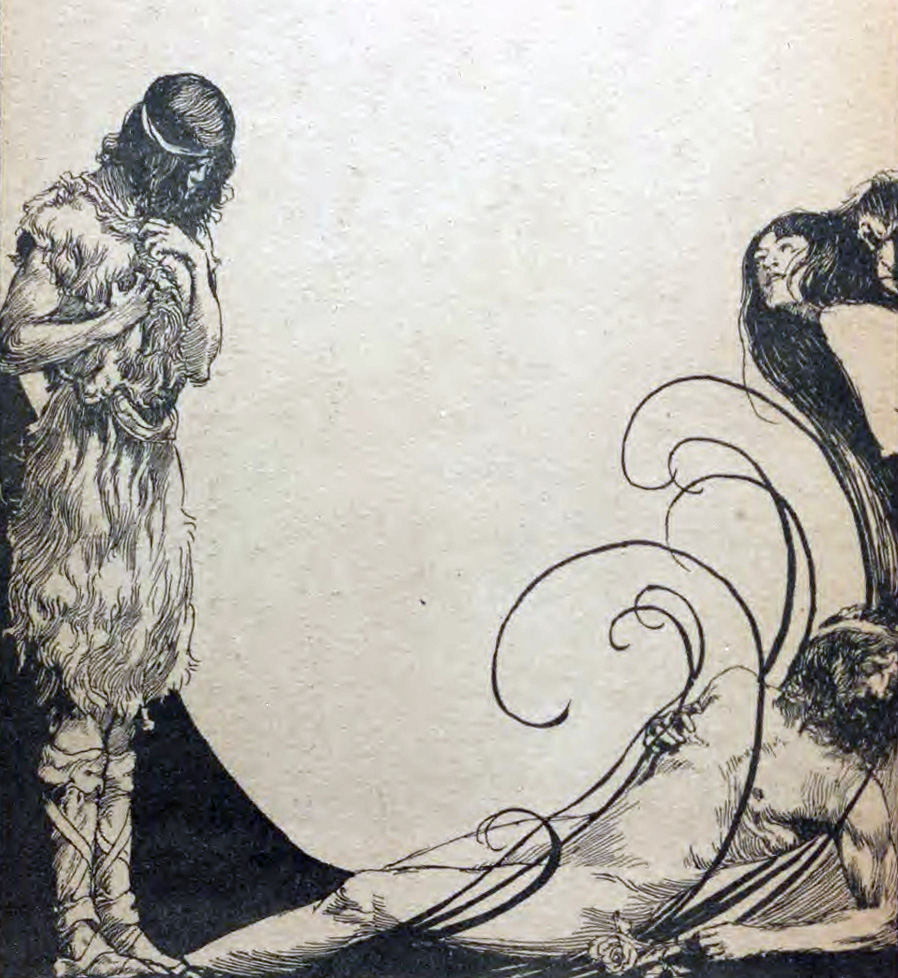
Parzival sees the genital wound of Grail King Anfortas

At first Parzival similarly lacked compassion for the suffering of Anfortas, the King of the Holy Grail. Violence against men often targets men’s testicles and penises. Anfortas’s brother the hermit Trevrizent explained to Parzival:

By a poisonous spear
Anfortas was wounded in a joust
so that he never regained his health.
That was your noble uncle —
pierced through his testicles.

{ mit einem gelupten sper
wart er ze tjostieren wunt,
sô daz er nimmer mêr gesunt
wart, der süeze œheim dîn,
durch die heidruose sîn. }[3]

A doctor removed the iron spearhead and a splinter of cane from Anfortas’s genital wound. Nonetheless, Anfortas remained in great pain. His wound festered like that of a college student falsely accused of raping a woman. Many herbs and ointments applied to the wound failed to ease Anfortas’s distress.[4]

A Holy Grain inscription told that if a certain man asked a question, Anfortas would be cured. All that was needed to heal the Grail King’s genital wound was for Parzival to ask, “Uncle, what afflicts you {œheim, waz wirret dier}?”[5] Despite seeing Anfortas’s great suffering, Parzival initially failed to ask such a question. Lack of compassion for men perpetuates men’s suffering under castration culture. Simply asking a question about a man’s suffering can have great effects.

Realizing the Holy Grail of a bountiful, healthful human society requires appreciating men’s penises and having compassion for men. Parzival, who became the next King of the Holy Grail, entered the world with a broad understanding of men’s gender:

Once the Queen was herself again
and took the babe, she saw plain
the dear penis between his legs and
admired him, as did every lady,
on seeing his members formed like a man.
In time he’d wield with his hand,
as a blacksmith, many a blade,
for his heart too was bravely made.
From many a helm sparks soon flew.
The Queen would kiss him tenderly,
saying, “bon fîz, cher fîz, bêâ fîz,”
“dear, fine, lovely boy,” and then
would take one red nipple again
and into his little mouth place it.
She had borne him. It was most fit
that she herself should nurse him now.
Her sex’s failings she’d disavow
and rear her child at the breast,
and this she did. As for the rest,
it was as though her prayer was met
and in her arms lay her Gahmuret.

{ dô diu küngîn sich versan
und ir kindel wider zir gewan,
si und ander frouwen
begunde betalle schouwen
zwischen beinn sîn visellîn.
er muose vil getriutet sîn,
do er hete manlîchiu lit.
er wart mit swerten sît ein smit,
vil fiwers er von helmen sluoc:
sîn herze manlîch ellen truoc.
die küngîn des geluste
daz sin vil dicke kuste.
si sprach hinz im in allen flîz
«bon fîz, scher fîz, bêâ fîz.»
Diu küngîn nam dô sunder twâl
diu rôten välwelohten mâl:
ich meine ir tüttels gränsel:
daz schoup sim in sîn vlänsel.
selbe was sîn amme
diu in truoc in ir wamme:
an ir brüste si in zôch,
die wîbes missewende vlôch.
si dûht, si hete Gahmureten
wider an ir arm erbeten. }[6]

Queen Herzeloyde longingly remembered intimate embraces with her dead husband Gahmuret, Parzival’s father. She held in her arms a child resulting from that intimate relationship. He was literally dear to her, for she had nearly died in birthing him, “who had such large limbs {der sölher lide was}.”

The description of the baby Parzival subtly emphasizes his penis. While it couldn’t be elsewhere, his penis is explicitly specified as being between his “legs {bein}.” After just one more verse, Parzival is described as having manly “limbs {lit}.” In medieval Latin, membra means limbs, including a penis. The baby Parzival is explicitly described as having large “limbs {lide}.” The word for his penis is visellîn, a diminutive of visel. That diminutive has been translated as “little penis.”[7] But Parzival has large, manly limbs. The diminutive visellîn is better translated in context as an endearing diminutive, with a bawdy allusion to penis size. This description of the baby Parzival almost surely was intended to have an erotic subtext.[8] Women delight in a man’s penis, both for the pleasure it provides and its essential role in creating children.

Long before this description of the baby Parzival, the penis commonly figured as a sword. Brutalizing representations of the penis as a weapon are deeply entrenched in literary history. Such representations have an objective correlate. In all of world literary history, the vast majority of persons killed have been persons with penises. In the medieval romance of Parzival, all the persons killed are persons with penises. Parzival, the future King of the Holy Grail, was destined to strike many blows on men’s helmeted heads. Brutalizing men’s sexuality is a symbolic counterpart to castrating men. Caring persons must ask the question: “How can we end violence against men?”

Don’t be afraid. Don’t be shamed into silence. Ask this new Holy Grail question with compassion for men.

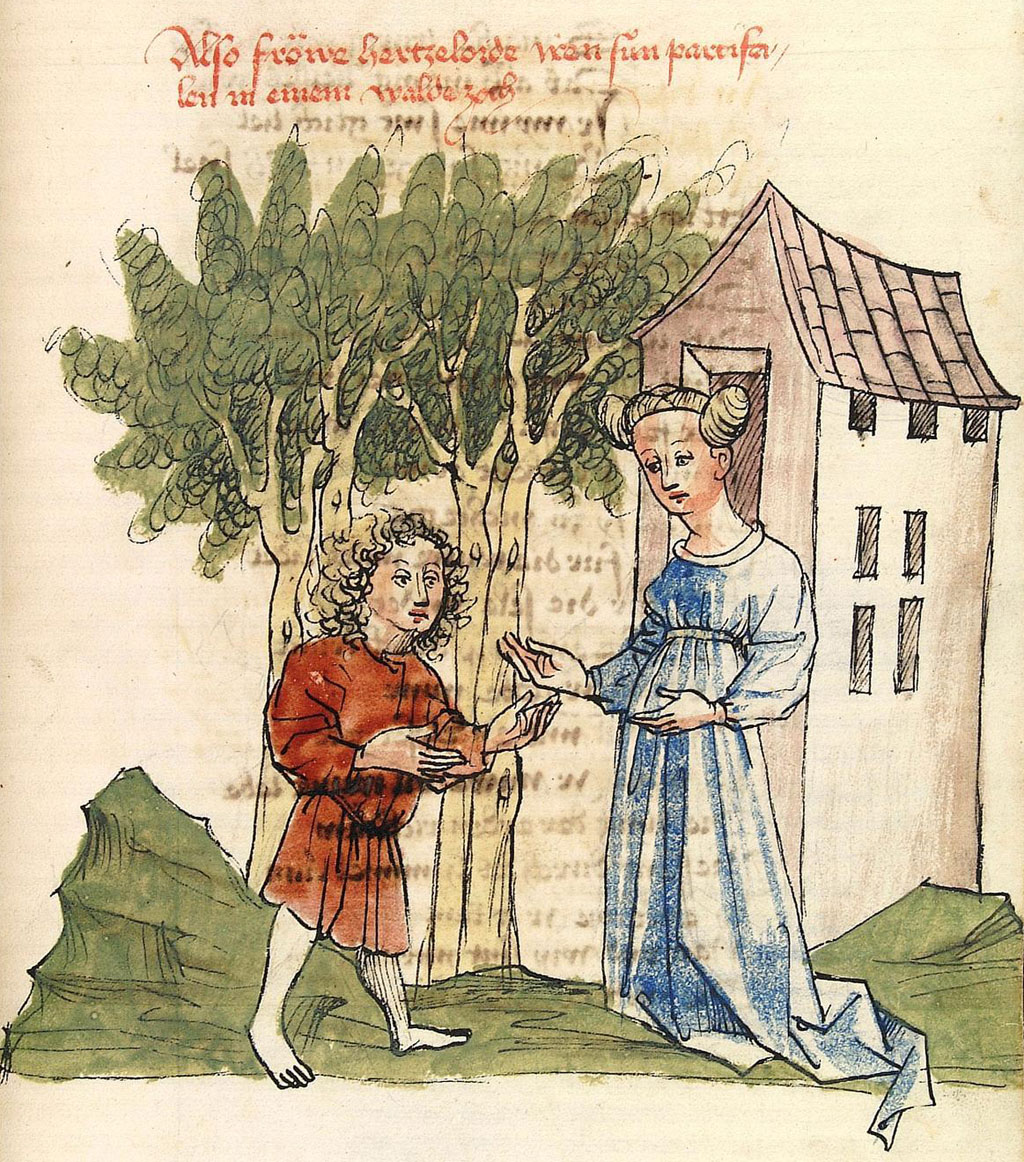
young Parzival leaves him mother Herzeloyde

* * * * *

Read more:

Notes:

[1] Wolfram von Eschenbach, Parzival 657.8-9 (Bk. 13), Middle High German text from Lachmann (1833 / 1891), English translation (modified) from Edwards (2004). Subsequent quotes from Parzival are similarly sourced, unless otherwise noted. Lachmann organized Parzival into 827 sections of 30 verses, as well as into sixteen books. I specify passages as section.verse (book). The subsequent quote above is Parzival 657.10-11 (Bk. 13)

King Arthur’s mother Arnive emphasized the castration of Clinschor by describing it three times. Here are the subsequent two descriptions:

By the King’s hand Clinschor
was trimmed between his legs.
To the host it seemed that was right.
He cut him about his person
such that he was without use
in giving any woman pleasure.

{ er wart mit küneges henden
zwischenn beinn gemachet sleht.
des dûhte den wirt, ez wær sîn reht.
der besneit in an dem lîbe,
daz er decheinem wîbe
mac ze schimpfe niht gefrumn. }

Parzival 657.20-5 (Bk. 13).

For Parzival English translations freely available online, Kline (2020), Zeydel & Morgan (1951) (some passages omitted), and Weston (1894). Laura Freeburn provided a comparative Parzival translation review for Mustard & Passage (1961), Hatto (1980), and Edwards (2004), and then Kline (2020) and Weston (1894). Freely available are also a comprehensive Middle High German dictionary and a Middle High German to English dictionary.

Wolfram von Eschenbach probably wrote Parzival in the first decade of the thirteenth century. He drew extensively on Chrétien de Troyes’s late twelfth-century Old French verse romance Perceval or the Story of the Grail {Perceval ou le Conte du Graal}. Parzival became a widely known and influential work. At least eighty manuscripts of it have survived. Frescoes illustrating scenes from Parzival were made between the fourteenth and sixteenth centuries in the Distaff-House {Haus zur Kunkel} in Constance {Konstanz} on the western end of Lake Constance in southern Germany.

[2] Wynn referred to the castration of Clinschor as a “phallic joke” and declared:

He {Wolfram} breaks into the gloom with the one type of joke that virtually never fails to raise a laugh, with a phallic joke. Young and old, male and female, the primitive and the sophisticated will laugh at it.

Wynn (1980) p. 64. Superbowl commercials have featured violence directed at men’s genitals. Violence against men’s genitals shouldn’t be socially constructed as a joke.

[3] Parzival 479.8-12 (Bk. 9). Anfortas, the Grail King, is a character type known more generally as the Fisher King.

[4] When his father Frimutel died, Anfortas at a young age became the Grail King. When he entered puberty, he foolishly began serving in love an unnamed lady by engaging in violence against men: “Love was his battle cry {Amor was sîn krîe}.” Parzival 478.30.

Anfortas suffered his genital wound before he married or had children. The unsuccessful treatments of his genital wound drew upon extensive knowledge of medieval medicine. Groos (1995), Ch. 6.

[5] Parzival 795.29 (Bk. 16).

[6] Parzival 112.21 – 113.14 (Bk. 2), with English translation (modified) from Kline (2020). The subsequent short quote above (“who had such large limbs”) is 112.7 (Bk. 2). This baby scene has no precedent in Chrétien de Troyes’s Perceval. It’s apparently Wolfram’s creation.

[7] The Middle High German word visel means “fiber, thin thread” in addition to “penis.” English translations of the diminutive visellîn, as Wolfram used it, are “thing,” “little penis”, “little penis,” “pizzle,” “little piddler,” and “tiny pizzle” in respectively Kline (2020) p. 105, p. Malczyk (2013) p. 138, Schultz (2006) p. 4, Edwards (2006) p. 48, Hatto (1980) p. 66, and Mustard & Passage (1961) p. 63.

Zeydel & Morgan avoided specifying the penis via periphrasis:

She and other women there
Surveyed his body everywhere
To see he really was a boy.
They fondled him with double joy
Because a little man was he.

Zeydel & Morgan (1951) p. 55.

Weston avoided specifying the penis with a general reference to “limbs”:

When the queen found sight and hearing she was fain on her child to look,
And her maidens they bore him to her and the babe in her arms she took;
And she saw his limbs soft rounded, and she knew she had born a son,
And her maidens with her were joyful that the earth had a man-child won.

Weston (1894) p. 62.

[8] On Wolfram’s bawdy scenes, Marchand (1977). Schultz truncated the context of Herzeloyde and other ladies fondly gazing upon Parzival’s penis. He tendentiously declared that Parzival’s penis lacks erotic significance in that scene:

a careful reading of Wolfram’s text shows that the penis elicits no reaction from those present at Parzival’s birth, that the caresses are unrelated to the penis, and that the “manly limbs” are part of a carefully staged argument that links the infant’s size at birth to his heroic prowess as an adult.
Parzival’s penis is not an erotic object but a rhetorical flourish. … Just a few lines after he mentions the penis, he tells us that Parzival’s mother nursed her child herself.

Schultz (2006) p. 5. Schultz, like many other scholars today, seems oblivious to the biological reality of how children are made. When Parzival’s mother Herzeloyde holds Parzival in her arms, she imagines that she has called back her husband Gahmuret into her arms. The wordplay with limbs and the explicit representations of naked female breasts underscore the erotic context.

While not criticizing Schultz’s misinterpretation, Malczyk footnoted a contrasting, much better interpretation of the scene:

This birth and breastfeeding scene, Wolfram’s own invention, proves that Herzeloyde considers Parzival to be much more than a son. Parzival is not responsible for the fact that his departure devastates her to the point of death, a reaction that suggests an abandoned lover much more than a mother.

Malczyk (2013) p. 140, n. 11.

Perhaps Schultz had imbibed too much of the nonsensical gender ideology that has plagued intellectual life in recent decades. He declared:

One hundred years after Freud we know {emphasis in original} what the penis means. But it is precisely this sort of knowingness that will get us into trouble. It causes us to eroticize the scene of Parzival’s birth because we know {emphasize in original} penises mean sex. It causes otherwise scrupulous scholars to mistranslate lines because they know {emphasize in original} that penises provoke caresses.

Schultz (2006) p. 8. In academia today, penises typically provoke hostile, pompous rhetoric such as “rule of the phallus” or “phallic hegemony.” Not to know the “rule of the phallus” or “patriarchy” is to be unclubbably ignorant. In reality, those innocent of Freud’s thinking are capable of knowing what a penis means. It’s scarcely possible, however, to utter what most persons know: penises provide pleasure and also have had an essential role in creating new human beings.

Schultz’s book testifies to Montaigne’s observation that human reason is “a vacant and rambling instrument {un instrument libre et vague}.” Only in an imaginary world could thinkers reason in the way that Schultz did:

the idea that men and women are two mutually exclusive categories is not a fact of nature. It is a cultural artifact. There is no reason, logical or evidentiary, why our sexually dimorphic bodies need to be taken as the standard against which we judge the Middle Ages. And there are good reasons to believe that the Middle Ages considered male and female bodies essentially the same.

Schultz (2006) p. 45. One might argue that these words are merely rhetorical flourishes to prompt academic amen choruses. But as rhetoric, Schultz is crudely word-working with a nature / culture ideological binary. In reality, if the Middle Ages considered male and female bodies essentially the same, why did almost all the bodies killed in battle have penises? Why was fundamental gender inequality in paternal knowledge commonly communicated in medieval stories of cuckolding? Why did elite medieval men have expected lifespans nearly ten years shorter than medieval women?

[images] (1) Parzival looking upon Anfortas’s genital wound. Illustration (detail, color modified) by Willy Pogány from Rolleston & Pogány (1912), p. 10. Alternate image. (2) Parzival leaving his mother Herzeloyde in the forest of Soltane. Image made in 1443-1446 in Diebold Lauber’s workshop in Hagenau near the German border of present-day France. Detail from folio 87r in Universitätsbibliothek Heidelberg, Cod. Pal. germ. 339 (part 1, part 2).

References:

Edwards, Cyril W., trans. 2004. Wolfram von Eschenbach. Parzival and Titurel. Oxford World’s Classics (2006 edition). Oxford, UK: Oxford University Press.

Groos, Arthur. 1995. Romancing the Grail: genre, science, and quest in Wolfram’s Parzival. Ithaca, N.Y.: Cornell University Press.

Hatto, A. T., trans. 1980. Wolfram von Eschenbach. Parzival. Harmondsworth, UK: Penguin Books.

Kline, A. S., trans. 2020. Wolfram von Eschenbach. Parzival. Poetry in Translation. Online.

Lachmann, Karl, ed. 1833. Wolfram von Eschenbach. Lieder, Parzival, Titurel, Willehalm. Berlin: G. Reimer. 5th edition (1891); alternate presentation.

Malczyk, Kathryn Ann. 2013. “A Lock upon All Conduct:” Modesty in German Courtly Literature (c. 1175-1220). Ph.D. Thesis, Germanic Languages and Literature, University of Pennsylvania. Paper 667 on the University of Pennsylvania ScholarlyCommon.

Marchand, James W. 1977. “Wolfram’s bawdy.” Monatshefte Für Deutschen Unterricht, Deutsche Sprache Und Literatur. 69 (2): 131-149.

Mustard, Helen M. and Charles E. Passage, trans. 1961. Wolfram von Eschenbach. Parzival: A Romance of the Middle Ages. New York: Vintage Books.

Rolleston, T.W., and Willy Pogány. 1912. Parsifal: or the legend of the holy grail retold from ancient sources: with acknowledgement to the “Parsifal” of Richard Wagner. London: Harrap.

Schultz, James A. 2006. Courtly Love, the Love of Courtliness, and the History of Sexuality. Chicago: University of Chicago Press. Reviews by William C. Crossgrove, by Alison More, and by Jan-Dirk Müller.

Weston, Jessie L., trans. 1894. Wolfram von Eschenbach. Parzival: A Knightly Epic. 2 vol. London: D. Nutt. Vol. 1. Vol. 2.

Wynn, Marianne. 1980. “Book 1 Of Wolfram Von Eschenbach’s Willehalm And Its Conclusion.” Medium Ævum. 49 (1): 57-65.

Zeydel, Edwin H., with Bayard Quincy Morgan, trans. 1951. The Parzival of Wolfram von Eschenbach: Translated into English Verse with Introduction, Notes, Connecting Summaries. Chapel Hill: University of North Carolina Press. Alternate online presentation.

snakes in the lush spring of love

Do you fear a snake in the garden? You shouldn’t. Imagine a season of new life, an oasis in a parched land, a lush spring. A cleric-poet in medieval Europe wrote:

Desired spring returns
with joy,
decorated with crimson
flowers.
Birds are singing
so sweetly!
The woods turn green again,
the fields are delightful,
entirely.

{ Ver redit optatum
cum gaudio,
flore decoratum
purpureo.
Aves edunt cantus
quam dulciter!
Revirescit nemus,
campus est amoenus
totaliter. }[1]

In this lush spring, flowers and love go together:

Young men, so as to take
flowers
and with their fragrance
refresh themselves,
should quickly accept young women
and go into the fields
adorned with flowers
together.

{ Iuvenes, ut flores
accipiant
et se per odores
reficiant,
virgines assumant alacriter
et eant in prata
floribus ornata
communiter. }

For these men, women are like flowers. Who doesn’t know the rest about birds and bees, before male worker bees were disparaged as mere drones?

phoenix rising

Some medieval men regarded themselves as superior to animals such as dogs or pigs. The season didn’t determine their love. They loved in season and out of season:

Savagely the wind’s breath bites,
and the trees’
foliage waves deeply
from weight of frosts.
Songs in groves cease.
Love now sleeps among the herds,
fervent only in spring.
Always loving, I refuse to follow
new turns of season
as is animals’ custom.

How sweet are
the rewards
and happy
the joys
of the time
with my flower Flora!

{ Saevit aurae spiritus,
et arborum
comae fluunt penitus
vi frigorum.
Silent cantus nemorum.
Nunc torpescit vere solo
fervens, amor pecorum.
Semper amans sequi nolo
novas vices temporum
bestiali more.

Quam dulcia
stipendia
et gaudia
felicia
sunt haec horae
nostrae Flore! }[2]

What man lacks spring’s flowers when he has his own beloved woman Flora?

With their deep study of Genesis and classical disparagement of men’s penises, medieval clerics recognized the vital importance of redeeming snakes. One thus wrote of snakes in spring:

The time is already spring,
the land is green with fresh growth,
and the sun is newly radiant.
Trees spread branches,
lilies shine white,
everything flowers.

Now snakes abound
as the rivers overflow.
The gods’ mountain opens waterfalls,
and life-giving rain
irrigates the earth to its depths.
Balsam and cinnamon
emit their fragrances.
Violet, rose, and sage
vigorously sprout.
Animals are mating.

{ Iam vernali tempore
terra viret germine,
sol novo cum iubare.
Frondent nemora,
candent lilia,
florent omnia.

Nunc dracones fluminum
scatent emanantium;
imber saluberrimus
irrigat terram funditus;
cataractas reserat Olimpus.
redolent aromata,
cum cinnamomo balsama.
virent viola,
rosa et ambrosia.
coeunt animalia. }[3]

Humans can choose not to act like other animals. But when you think of humans mating, think of lilies and snakes in the life-creating joy of spring.

phoenix representing the salvation of Jesus Christ

* * * * *

Read more:

Notes:

[1] Carmina Burana 137, “Desired spring returns {Ver redit optatum},” stanza 1, Latin text and English translation (modified) from Traill (2018). The subsequent quote above is similarly stanza 2 (of 2) from “Ver redit optatum.” Here’s a recording of this song by Svend S. Schultz / Aarhus Koncertkor.

[2] Carmina Burana 83, Peter of Blois, “Savagely the wind’s breath bites {Saevit aurae spiritus / Sevit aure spiritus},” stanza 1 and refrain, Latin text and English translation (modified) from Traill (2018).

[3] Carmina Burana 132, “The time is already spring {Iam vernali tempore},” stanzas 1a and 5b (ending with 5b), Latin text and English translation (modified) from Traill (2018). This poem represents the sounds of sixty animals, most of which are birds. Then it declares that their melodies are surpassed by the phoenix. The poem significantly doesn’t represent the song of the phoenix:

These are the sounds of the flying animals
and of the four-legged ones too,
but their melodies are surpassed
by the phoenix, a unique bird,
whose resting place lies
within the confines of paradise.

{ Hae sunt voces volucrum
necnon quadrupedum,
quorum modulamina
vincit phoenix unica,
in cuius confinio
est paradisi mansio. }

“Iam vernali tempore,” stanza 4, sourced as previously.

In Christian thought, the phoenix was associated with Jesus Christ and eternal life. Possibly the earliest Christian poem about the phoenix is that of Lactantius (Lucius Caecilius Firmianus, lived about 250-325 GC), About the bird the phoenix {De ave phoenice}. For Latin text, English translation, and extensive commentary, Harris (1978). Here are Latin reading notes and an alternate translation of vv. 31-50. The ninth-century Old English poem The Phoenix translates and expands Lactantius’s poem. For a modern English translation, Cook & Tinker (1902) Ch. 6. Here are some notes on the poem and a verse interpretation of vv. 1-49.

While the phoenix is an exotic bird, Jesus in his humanity is like an ordinary man. In classical usage, the Latin word for snake, draco, used in “Iam vernali tempore” typically refers to a large, exotic snake / serpent. But this poem’s snakes, associated through chiasmus with animals’ mating, are ordinary snakes. The poem thus evokes the sense of male penises as being both ordinary and extraordinary.

[images] (1) Phoenix rising. Illumination on folio 56r of the twelfth-century Aberdeen Bestiary (Aberdeen University Library, Univ Lib. MS 24). Via Wikimedia Commons and Aberdeen University. (2) Phoenix and roses, perhaps representing Christ risen from the dead. Mosaic made in the second half of the third century GC near Antioch-on-the-Orontes in present-day Turkey. Preserved as accession # Ma 3462 (MND 1953) in the Louvre Museum (Paris, France). Image thanks to Clio20 and Wikimedia Commons.

References:

Cook, Albert S., and Chauncey Brewster Tinker. 1902. Select translations from Old English poetry, edited with prefatory notes and indexes. Boston, MA: Athenaeum Press, Ginn & Company.

Harris, Keith N. 1978. The De ave Phoenice of Lactantius: a commentary and introduction. M. A. Thesis, University of British Columbia, Vancouver, British Columbia, Canada.

Traill, David A. 2018, ed. and trans. Carmina Burana. Dumbarton Oaks Medieval Library, 48-49. Cambridge, Massachusetts: Harvard University Press.

work for social justice: castration no joking matter

In medieval London, a hard-working young clerk served a lawyer, and served the lawyer’s wife as well. The latter work was dangerous, particularly because men have always been punished relatively severely for illicit sex. This clerk, showing superior guile though of the inferior gender, shed tears and revealed his secret to his lawyer-master:

“My very good master, it’s true that, I know that, many people, and you too, might imagine that I’m a natural man like any other, capable of having intercourse with a woman and creating progeny. But to you I affirm and show that I am not such in that, alas, to my great sorrow.” And with these words he very assuredly pulled out his pole-like penis and showed him his scrotum. He had with much time and trouble pushed up his testicles towards his lower belly and hid them so well that it seemed as though he had none.

{ “Mon très bon maistre, il est vray que, jà soit ce que plusieurs gens et vous aussi pourroient penser que je feusse homme naturel comme ung autre, ayant puissance d’avoir compaignie avec femme, et de faire lignée, vous oseray bien dire et monstrer que point je ne suis tel, dont helas! trop je me deul.” Et, à ces parolles, trop asseurement tira son membre à perche et lui fist monstre de la peau où les coulons se logent, lesquelz il avoit par industrie fait monter en bault, vers son petit ventre, et si bien les avoit cachiez, qu’il sembloit qu’il n’en eust nulz. }[1]

The clerk declared that as an impotent man, he wanted to spend the rest of his life in a monastery.

to have affair with master's wife, clerk fakes castration

Because of the clerk’s diligence and effort with his pen, the lawyer-master didn’t want to lose him. The master told his clerk about the privations and hardships of religious life and the impropriety of becoming a monk out of grief for impotence. The clerk, feigning reluctance, agreed to stay in the master’s home. Then the master revealed his own secret to the clerk:

My son, I’m not glad to hear of your misfortune. But in the end God orders all things for the best and knows what is most suitable for us and wants the best. You can in the future serve me very well and merit all that is in my power to do for you. I have a young wife, who is light-hearted and flighty, and I am, as you also see, already old and staid. That might give occasion for, of all such, some dishonor to me and also to her, if she should prove other than chaste, and become for me a matter for jealousy and many other things. I entrust her to you so that you may watch over her, and I beg you to keep her close at hand so that I may have no reason to find in her any matter for jealousy.

{ Mon filz, de vostre infortune ne suis-je point joyeux, mais, au fort, Dieu, qui fait tout pour le mieulx, scait ce qui nous duyt et vault mieulx: vous me pourrez doresenavant très bien servir, et à mon povoir, vous le meriteray: j’ay jeune femme assez legiere et volaige, et suis, ainsi comme vous veez, desja ancien et sur aage: qui aucunement peut estre occasion à plusieurs de la requerre de déshonneur; et à elle aussi, s’elle estoit autre que bonne, me bailler matière de jalousie, et plusieurs aultres choses. Je la vous baille et donne en garde, et si vous en prie que tenez à ce la main, que je n’aye cause d’en elle trouver nulle matière de jalousie. }

The master seems not to have had recent knowledge of his wife’s matter for jealousy. The clerk praised her beauty and goodness and eagerly served the “good husband {bon mary}”:

For as much as the clerk and his good lady dared, they didn’t spare the members that will decay in earthly life, and they never failed to make a great feast of sex.

{ le plus longuement que luy et sa dame bien osèrent, n’espargnerent pas les membres qui en terre pourriront; et ne firent jamais plus grant feste }

As strange and unreal as it seems to indoctrinated women and men today, medieval women and men had joy in sex. Medieval Christianity taught that even eunuchs could realize the complete joy that Christ promised. The guileful clerk who faked that he lacked testicles provided as much joy to his master’s wife as did the classical eunuch Bromium for his lady-lord. As study of classics decreases, cuckolding increases. They have no joy. Jesus help them!

Faking castration can be a risky business. Consider the late medieval case of a priest from Onzain near Amboise in central France. He was having a sexual affair with his landlady. To lessen her husband’s suspicion, she proposed that the priest take dramatic action:

He agreed to have himself castrated, or to speak more modestly, emasculated. And so he placed himself at the mercy of a man named mister Master Peter of the Snakes, a native of Low-Cave in Berry.

{ se fit châtrer (qu’on dit plus honnêtement tailler); et se mit en la miséricorde d’un nommé monsieur maître Pierre des Serpents, natif de Vilantrois en Berri }[2]

While telling all his relatives and friends that he was getting himself castrated, the priest gave Master Peter four crowns to fake the castration. The operation turned out badly:

Master Peter, persuaded by the husband and holding the poor priest in his power, tied him down by hand and foot, and then really performed his business and did it. Then he explained his reason. He wasn’t at all accustomed to mocking his job, and if he would as much as a single time mock it, his trade would mock him.

{ maître Pierre, persuadé par le mari, et tenant le pauvre curé en sa puissance, après l’avoir bien attaché, lié et garrotté, exécuta son office réalement et de fait; et puis le paya de cette raison, qu’il n’avoit point accoutumé se moquer de son métier; et que, s’il s’en étoit une seule fois moqué, son métier se moqueroit de lui. }

The husband had paid Master Peter twice as much to do his job as the priest had paid him not to do it. Women should not encourage their lovers to be castrated or even to pretend to be castrated. It’s just too risky.

Castration is no joking matter. In medieval France, a priest was very fond of “confessing” his women parishioners. His fame spread across all of France. One day when he was having dinner at a parishioner’s inn, a man professionally named Ball-Cutter came to the inn. Ball-Cutter worked as a gelder. The priest asked the gelder many questions about gelding. Then the priest, unobserved, turned to the host and proposed playing a trick on Ball-Cutter:

I’ll pretend to have a major pain in my testicle, and then I’ll bargain with him to cut it away. I’ll be placed on the table all ready as if to have it cut off. And when he comes near and would like to see what it is and begin his work, I’ll turn and show him my ass.

{ je faindray avoir grant mal en ung coillon, et puis je marchanderay à luy de le me oster, et me mettray sus la table et tout en point, comme pour le trenchier. Et quant il viendra près et il voudra veoir que c’est et ouvrer de son mestier, je luy montreray le derrière. }[3]

In medieval literature, women sometimes save beloved men from castration by pretending to be them. The priest intended to play a variation on that trick.

The unknowing Ball-Cutter agreed to remove the priest’s testicle. The host then betrayed the priest and said to the gelder:

Take care, whatever the priest might say to you, when you grab it in your hands in order to work on his testicles, that you cut both of them off, completely and cleanly. Take care that you don’t fail, if you love dearly your own body.

{ Garde bien, quelque chose que ce prestre te dye, quant tu le tiendras en tes mains, pour ouvrer à ses coillons, que tu luy trenches tous deux rasibus, et garde bien que tu n’y failles point, si chier que tu aymes ton corps. }

What the priest meant to be a joke became a horror story:

The host and also his servants together held the condemned priest tightly there. They took care that he wouldn’t escape, not neglecting any way that there was. And in order to be the most sure, they bound him him very well and tightly. They told him that was to make better and more hidden their joke and that when he wished, they would let him go. Like a fool he believed them. Now the valiant Ball-Cutter came, carrying his little razor in his hand. He immediately began to take in his hand the priest’s testicles. “Hey!” said mister priest, “Do it straight and well! Feel them as sweetly as you can, and then afterwards, I’ll tell you which I want to have cut off.” “Very well,” said the gelder. And then he lifted up the gown of the master priest and grabbed the priest’s mistresses’s testicles. They were big and heavy. Without further inquiry, suddenly, like an eclipse of a celestial orb, he cut the two from him with a single stroke. The good priest began to yell and raise more living hell than any man ever did.

{ L’oste aussi et pareillement les serviteurs de leans dévoient tenir damp curé: qui n’avoient garde de le laisser eschapper, ne remuer en quelque maniere que ce feust. Et, affin d’estre plus seur, le lierent trop bien et estroit, et luy disoient que c’estoit pour mieux et plus couvertement faire la farce, et quant il voudroit, ilz le laisseroyent aller; il les creut comme fol. Or vint ce vaillant trenchecoille, garny en sa cornette de son petit rasoir, et incontinent commença à vouloir mettre les mains aux coilles de monseigneur le curé: “A!” dist monseigneur le curé, “faictes à trait et tout beau! Tastez-les le plus doulcement que vous pourrez, et puis après, je vous diray lequel je vueil avoir osté.” “Et bien!” dist le trenchecoille. Et lors tout souef lieve la chemise du maistre curé, et prent ses maistresses coilles, grosses et quarrées, et sans plus enquerir, subitement, comme l’eclipse, les luy trencha tous deux d’ung seul coup. Et bon curé de crier, et de faire la plus male vie que jamais fist homme. }

His work finished, Ball-Cutter promptly left. Bandaging and comforting the priest, the host of the inn pretended not to have been part of the castration conspiracy.

castrating priest in joke transformed

News of the horrible injury to the priest quickly spread. Reactions varied:

It isn’t necessary to say that not a few young women were very despondent to have lost the instruments of mister priest. But on the other hand, the suffering husbands were so joyful that I couldn’t know how to tithe to you in telling or writing one tenth of their happiness.

{ ne fault pas dire que aucunes damoiselles n’en fussent bien marries d’avoir perdu les instrumens de monseigneur le curé; mais, aussi, d’aultre part, les dolen marys en furent tant joyeux qu’on ne vous scauroye dire, ne escripre la dixiesme partie de leur lyesse. }

Women have long opposed castration culture more than have men. Men must show more love and compassion for men.

Erasing castration culture should be a social-justice priority. Literary history is filled with horrific stories of castration going all the way back to Chronos / Saturn castrating Uranus / Caelus in Hesiod’s Theogony. Despite violent injury to a man’s testicles being played as a joke in a Super Bowl commercial, castration is no joking matter.

* * * * *

Read more:

Notes:

[1] Antoine de la Sale, The Hundred New Novels {Les Cent nouvelles nouvelles}, nouvelle 13, The castrated clerk {Le clerc chastré}, Middle French text from Lacroix (1884), my English translation, benefiting from that of Douglas (1899). The subsequent two quotes above are similarly from this nouvelle (story). The titles of the nouvelles are not in the original manuscript. They are from early eighteenth-century editions and vary. An alternate title for this story is The eunuch clerk. For an alternate English translations, Robbins (1960) and Diner (1990).

Les Cent nouvelles nouvelles exists in a manuscript written in 1462. It was published in print for the first time in 1485. It reportedly consists of stories told in the court of Philip III, Duke of Burgundy, probably from 1456 to 1461. Les Cent nouvelles nouvelles is a framed story collection similar to Boccaccio’s Decameron.

[2] Bonaventure des Périers, Novel Pastimes and Merry Tales {Nouvelles récréations et joyeux devis}, Tale 113, “About the priest from Onzain, near Amboise, who was persuaded by his landlady to have himself castgrated {Du curé d’Onzain, prés d’Amboyse, qui se feit chastrer à la persuasion de son hostesse},” Midde French text from Lacour (1874) vol. 2, pp. 158-9, English translation (modified) from La Charité & La Charité (1972). The subsequent quote above is similarly from this tale.

Bonaventure des Périers was a Frenchman who lived from about 1500 to 1544. His story collection Nouvelles récréations et joyeux devis was printed with his collected works in 1544 and on a stand-alone basis in 1558. Tale 113 probably came from the same medieval strand that includes nouvelle 64 of Antoine de la Sale’s Les Cent nouvelles nouvelles.

[3] Antoine de la Sale, Les Cent nouvelles nouvelles, nouvelle 64, The priest who was too cunning {Le curé trop respectueux}, Middle French text from Lacroix (1884), my English translation, benefiting from that of Douglas (1899). The subsequent three quotes above are similarly from this nouvelle.

The thirteenth-century Old French fabliau “About Connebert / The priest who lost his balls / The priest crucified {De Connebert / Li prestre ki perdi les colles / Le Prêtre crucifié}” is a similar story. For brief discussion, see note 7 and associated text in my post on violence against men in fabliaux and reality.

[images] (1) Illustration for nouvelle 13 (to have an affair with his master’s wife, a clerk fakes castration) in Antoine de la Sale’s Les Cent nouvelles nouvelles. Detail from folio 27v of Glasgow, University Library, GB 247 MS Hunter 252 (U.4.10). Here are the illustrations for each nouvelle. (2) Illustration for nouvelle 64 (a priest’s castration joke gets him castrated) in Les Cent nouvelles nouvelles. Detail from folio 143r of Glasgow, University Library, GB 247 MS Hunter 252 (U.4.10). (3) Illustration for nouvelle 13 (a clerk shows his lack of testicles to his master) in Douglas (1899).

clerk shows his lack of testicles to his master

References:

Diner, Judith Bruskin, trans. 1990. Antoine de la Sale. The One Hundred New Tales = Les cent nouvelles nouvelles. New York: Garland.

Douglas, Robert B., trans. 1899. Antoine de la Sale. One hundred merrie and delightsome stories: right pleasaunte to relate in all goodly companie by joyance and jollity: les cent nouvelles nouvelles. Paris: Charles Carrington.

Lacour, Louis, ed. 1874. Nouvelles récréations et joyeux devis de B. des Periers ; suivi du Cymbalum mundi. Paris: Librairie des bibliophiles. Vol. 1. Vol. 2. Alternate presentation.

Lacroix, Paul, ed. 1884. Les Cent nouvelles nouvelles: dites les Cent nouvelles du roi Louis XI; éd. rev. sur l’édition originale, avec des notes et une introduction. Paris: Charpentier.

La Charité, Raymond C. and Virginia A. La Charité, trans. 1972. Bonaventure des Périers’s Novel Pastimes and Merry Tales. Lexington, KY: The Univ. Press of Kentucky.

Robbins, Rossell Hope, trans. 1960. The Hundred Tales (Les cent nouvelles nouvelles). Illustrated by Alexander Dobkin. New York: Bonanza Books.

true hero Malgherita Spolatina swam sea to Teodoro, her Leander

The “lovely and graceful {vaga e leggiadra}” woman-hero Malgherita Spolatina lived early in the sixteenth century on Midway Island off the coast of Ragusa. One day Malgherita noticed the hermit Teodoro begging for bread. The name Teodoro was from the Greek words “God’s gift {Θεόδωρος}.” Teodoro was a low-status man in the eyes of many and thus quite unlike the mythic Leander. Nonetheless, looking upon Teodoro with her female gaze, Malgherita saw that he was “beautiful and outstanding {bello e riguardevole}.” She gave him alms while burning in love for him.

Men historically have carried the gender burden of soliciting amorous relationship and enduring amorous rejection. With admirable concern for social justice, the strong, independent woman Malgherita Spolatina spoke boldly:

“Teodoro, brother and sole comfort of my soul, such is the passion that torments me that if you don’t help me, you’ll soon see me lifeless. Inflamed with love for you, no longer can I resist those amorous flames. So that you may not be the cause of my death, help me at once.” Having said these words, she began to weep intensely.

{ “Teodoro fratello, e solo refrigerio dell’anima mia, tanta è la passione che mi tormenta, che se voi non mi prestate aiuto, presto mi vederete di vita priva. Io, infiammata del vostro amore, non posso più resistere all’amorose fiamme. Ed acciò che voi di mia morte non siate cagione, mi prestarete subito soccorso”; e queste parole dette, si mise fortemente a piagnere. }[1]

Her behavior astonished the hermit Teodoro. Leaving aside “celestial things {cose celesti},” he conversed with her compassionately. They discussed love and agreed to engage in the act that perpetuates life.

Teodoro didn’t know how to arrange securely an affair. Malgherita thoughtfully proposed a plan:

My love, don’t worry. I’ll show you the way we must take. The way will be this. You this evening at ten o’clock at night will put a burning lamp in the window of your hut. Seeing it, I’ll immediately come to you.

{ Amor mio, non dubitate; che io vi dimostrerò il modo che avremo a tenere. Il modo sarà questo. Voi in questa sera a quattro ore di notte porrete un lume acceso alla finestra della capanna vostra; ed io, quello veduto, immantenenti verrommi a voi. }

The chastelaine de Vergi summoned her lover, belittled and dehumanized, by having a little dog run through her garden. Malgherita, in contrast, invited herself over to her man’s hut at a mutually agreed time. Moreover, with her plan she made reparations for the historical gender injustice long perpetrated in repeated retellings of the myth of Hero and Leander. Strong, independent women today have much to learn from Malgherita Spolatina.

Teodoro perceived a problem: the sea. His hut was on a rock protruding above the waves midway between Midway Island and Ragusa. Teodoro worried about his beloved Malgherita:

Ah! How will you manage, my little child, to cross the sea? You know that neither you nor I have a boat to ferry you across. To entrust yourself to the hands of another would be dangerous to the honor and life of us both.

{ Deh! come farai tu, figliuola mia, a passar il mare? Tu sai che nè io nè tu avemo navicella da traghiettare; e mettersi nell’altrui mani sarebbe molto pericoloso all’onore e alla vita d’ambiduo. }

She comforted him in his worry:

Don’t worry at all. Leave the burden to me, because I have found a way to come to you without danger to life or honor. Seeing the burning lamp, I will come to you by swimming. No one will know of our doings.

{ Non dubitate punto; lasciate il carico a me, perciò che io trovai la via di venire a voi senza pericolo di morte e di onore. Io, veduto il lume acceso, me ne verrò a voi nuotando; nè alcuno saprà i fatti nostri. }

Teodor was afraid for Malgherita:

There’s danger of you drowning in the sea, because you are young and have little endurance, and the way is long, and you could easily lose your breath and go under.

{ Egli è pericolo che non ti attuffi nel mare; perciò che tu sei giovanetta e di poca lena, e il viaggio è lungo, e ti potrebbe agevolmente mancare il fiato, e sommergerti. }

Malgherita was a hero confident in her ability and unafraid to take on what was Leander’s labor:

“I’m not afraid of maintaining my endurance,” replied the young woman. “I could swim in competition against a fish.”

{ Non temo, rispose la giovane, di non mantener la lena; perciò che io nuoterei a gara d’un pesce. }

Perceiving her strong will, Teodoro agreed to her plan.

Night came. In the dark Malgherita saw Teodoro’s burning lamp shining out in the sea. She rejoiced and went to the shore. There she took off all her clothes. She swept her hair to the top of her head and wrapped it in her slip. Then she pushed out into the water and swam strongly. In less than fifteen minutes she reached the hermit’s rock. He was there waiting for her. He took her by her hand and led her into his humble hut. He dried her all over with a towel as white as snow. They lay down together on his small bed and enjoyed “the ultimate fruits of love {ultimi frutti d’amore}.” After two hours of sweet conversations and embraces, she arranged to return to him and then swam home. Guided by the Teodoro’s lamp, Malgherita subsequently made many swims to be with him.

Malgherita and Teodoro embrace

One foggy night, fishermen saw a fish that they had never seen before. Eventually they recognized that the fish was a woman. They saw her get out of the water onto the rock and go into a hut. Intrigued, they rowed to the rock and hid there. After a long time they saw the young woman emerge from the hut and swim away. After observing several such nocturnal trips the fishermen recognized Malgherita, the signal of Teodoro’s burning lamp, and their love affair. Fearing that she might drown or bring dishonor to her family, the fishermen told Malgherita’s brothers everything.

Malgherita’s brothers internalized the misandry that drives today’s college sex police. They resolved that their sister must be killed for loving a man. The youngest brother went to Teodoro’s hut and asked for shelter for the night:

The hermit, who knew that it was Malgherita’s brother, kindly welcomed him and treated him affectionately. All that night Teodoro spent with him in varied conversation, declaring to him the miseries of this world and the grave sins that kill the soul and enslave it to the devil.

{ Il calogero, che conosceva lui esser fratello di Malgherita, benignamente il ricevette e carecciollo; e tutta quella notte stette seco in varii ragionamenti, dichiarandogli le miserie mondane ed e peccati gravi che mortificano l’anima e fannola serva del diavolo. }

Malgherita’s brother thus ensured that Teodoro didn’t hang his lamp to invite Malgherita to spend the night with him. Other of her brothers meanwhile went out in a boat with a pole and a lamp. When they were next to Teodoro’s rock, they set the lamp burning and hoisted it on the pole.

Malgherita saw that light and with delight jumped into the sea to swim to Teodoro. But her brothers gradually moved the light away from Teodoro’s rock. In the dark night Malgherita swam strongly, following the light. When the brothers had taken it out into the open sea and Malgherita had come near, they extinguished the burning lamp. Malgherita, tired from her long swim, was bewildered: “she gave herself up completely and like a broken ship, was swallowed by the sea {s’abbandonò del tutto, e, come rotta nave, fu ingiottita dal mare}.” The brothers left their downing sister in the middle of the sea and went home. They treated their sister’s life with the contempt that many men have felt for their own lives.

Three days later, Malgherita’s dead body washed up onto Teodoro’s rock. Recognizing it, Teodoro nearly killed himself in grief. But death isn’t the Christian triumph over death. This earthy hermit, undergoing conversion like the holy harlots of Christian history, cared for Malgherita’s dead body:

Taking her by an arm, with no one noticing, he dragged her out of the water and carried her into his house. Throwing himself upon her dead face, for a long time he wept and flooded her white breast with abundant tears, and many times called her in vain. But after he wept, he thought to give her a worthy burial and to help her soul with prayers, with fasts, and with other good deeds. And taking the spade with which he sometimes dug his little vegetable patch, he made a grave inside his little church. With many tears he closed her eyes and mouth. Making her a garland of roses and violets, he set it on her head. Then giving her a blessing and kissing her, he put her in the grave and covered her with earth.

{ presolo per un braccio, niuno però avedendosi, lo trasse fuori dell’onde, e portollo dentro in casa; e gettatosi sopra il morto viso, per lungo spazio lo pianse, e di abbondantissime lagrime il bianco petto coperse, assai volte in vano chiamandola. Ma poscia che ei ebbe pianto, pensò di darle degna sepoltura, ed aiutare con orazioni, con digiuni e con altri beni l’anima sua. E presa la vanga, con cui alle volte vangava il suo orticello, fece una fossa nella chiesetta sua, e con molte lagrime le chiuse gli occhi e la bocca: e fattale una ghirlanda di rose e viole, gliela pose in capo; indi datale la benedizione e basciatala, dentro la fossa la mise e con la terra la coperse. }

Malgherita died while defying the oppressive gender norms inculcated through the myth of Hero and Leander. Malgherita, a true hero, received a loving burial. She will be with her beloved Teodoro for the rest of his life.

Teodoro discovering his beloved Malgherita Spolatina dead on the seashore (Hero and Leander, gender-reversed)

Forget the myth of Hero and Leander. Tell and retell forever the story of Malgherita and Teodoro.

* * * * *

Read more:

Notes:

The above story is that of Giovanni (Zoan) Francesco Straparola, The Pleasant Nights {Le Piacevoli Notti}, Night 7, Story 2, told by the lady Fiordiana. The setting is factual. Ragusa is present-day Dubrovnik in Croatia, Midway Island is present-day Lopud (Middle Isle), and the hermit’s rocky island is called Skupielli or Donzella in Italian. The hermit’s island is about 800 meters south-east of Lopud.

Waters declared Straparola’s story of Malgherita and Teodoro to be “the finest of the whole collection”:

It is rarely one meets with anything told which such force and sincerity; yet, in placing before his readers this vivid picture of volcanic passion and ruthless revenge, Straparola uses the simplest treatment and succeeds à merveille.

Waters (1894) vol. 1, p. xxi. Both “volcanic passion” and “ruthless revenge” seem to me exaggerated characterizations that obscure the wry humor of this story.

The gender reversal in this story relative to the myth of Hero and Leander isn’t just a matter of the gender of the lover who swims and dies. The dialog between Malgherita and Teodoro also includes gender-reversed characterization. That suggests a literary work responding in a gender-transgressive way to the widely distributed myth of Hero and Leander. The specific setting provides a motive for a love swim like that of Leander. The inserted matter of family honor and somewhat implausible fraternal treachery might be understood as poor-dearism included to increase the story’s popular appeal. With respect to Straparola responding to the myth of Hero and Leander, Beecher unconvincingly declared:

Such a means of genesis appears remote. Thus, without a literary source or comparative folk versions, the story must be granted local currency in a form only to be imagined from the present tale. … But the story is so finely conceived that it becomes implausible that its author left no more in kind. Inclination thus favours a tragic legend collectively generated that Straparola first and alone captured for posterity, or a contemporary bit of Venetian colonial news that caught his imagination and died with the following few imitators.

Beecher (2012) vol. 2, p. 99. Beecher thus classified the story as “oral / popular” and declared, “perhaps a local legend gave rise to the present work.” Beecher (2012) vol. 1, p. 88, vol. 2, p. 100. The myth of Hero and Leander seems to me more probable than Beecher’s unattested, perhaps legend.

On the myth of Hero and Leander, Montiglio (2017) and Murdoch (2019). Both Montiglio and Murdoch mention Straparola’s tale. Murdoch observed, “the reversal of gender-roles and the sexually aggressive Malgherita are surprising.” Id. p. 79. Literary scholars seem unwilling to appreciate stories fundamentally challenging their dominant master narratives.

Straparola, who was born in Caravaggio, Italy, lived from about 1480 to 1558. His two-volume Le Piacevoli Notti was originally published in Venice in 1550 (vol. 1) and 1553 (vol. 2). Recounted under the rule of a lady (Signora), it contains 73 stories told over thirteen nights among ladies and gentlemen gathered at the Venetian palace of Ottaviano Maria Sforza. They took refuge there from political turmoil in Milan. Straparola’s story collection thus has a form similar to Boccaccio’s Decameron. With respect to some of Straparola’s stories, Bottigheimer credits him with creating the “modern fairy tale.” Bottigheimer (2002). For a critique of Bottigheimer’s argument, Ziolkowski (2010).

Straparola’s Le Piacevoli Notti has been extensively distributed. Fifteen editions of the Italian text were produced by 1570, and twenty-four editions by 1610. A French translation appeared in 1572, a German translation in 1575, and a Spanish translation in 1578. Smarr (1983) p. 158, Beecher (2012) vol. 1, p. 80.

The quotes above are from Le Piacevoli Notti 7.2, Italian text from Rua (1899) vol. 2, pp. 48-54, English translation (modified slightly) from Smarr (1983) pp. 189-93. For a freely available English translation, Waters (1894). Beecher (2012) is revised version of Water’s translation, along with an extensive introduction, notes, and commentary for each story.

[image] (1) Malgherita and Teodoro embrace on the shore of his rocky island. Illustration by Jules Arsene Garnier in Waters (1901) vol. 3, between pp. 28-9. This illustration isn’t included in Waters (1994). (2) Malgherita Spolatina dead on the shore of her beloved hermit Teodoro’s rocky island. Illustration by E. R. Hughes in Waters (1894), vol. 2, between pp. 54-5.

References:

Beecher, Donald and W. G. Waters, trans. 2012. Giovanni Francesco Straparola. The Pleasant Nights. 2 vols. Toronto: University of Toronto Press.

Bottigheimer, Ruth B. 2002. Fairy Godfather: Straparola, Venice, and the fairy tale tradition. Philadelphia, PA: University of Pennsylvania.

Montiglio, Silvia. 2017. The Myth of Hero and Leander: the history and reception of an enduring Greek legend. London: I.B. Tauris. (Hardin’s review)

Murdoch, Brian. 2019. The Reception of the Legend of Hero and Leander. Brill’s Companions to Classical Reception, volume 19. Leiden: Brill.

Rua, Giuseppe. 1899. Le piacevoli notti di M. Giovanfrancesco Straparola da Caravaggio nelle quali si contengono le favole con i loro enimmi da dieci donne e duo giovani raccontate. 2 vols. Bologna: Romagnoli-Dall’ Acqua. Alternate presentation of 1927 edition.

Smarr, Janet Levarie, trans.. 1983. Italian Renaissance Tales: Selected and Translated, with an Introduction. Rochester, MI: Solaris Press.

Waters, W.G., trans. 1894. Giovanni Francesco Straparola. The Nights. Vol. 1. Vol. 2. London: Lawrence and Bullen. Alternate presentation: vol. 1, vol. 2.

Waters, W. G., trans. 1901. The Italian Novelists. 7 vols. Vols. 1-4, The Facetious Nights of Straparola. Vols. 5-7, The Pecorone of Ser Giovanni. Vols. 1, 2, 3, 4, 5, 6, 7. London: Privately printed for members of the Society of Bibliophiles.

Ziolkowski, Jan M. 2010. “Straparola and the fairy tale: between literary and oral traditions.” Journal of American FolkLore. 123 (490): 377-397.