overcoming disparagement of men’s sexuality in ancient Greek poetry

Men have long been disparaged as being sexually like dogs. In ancient Greece, men’s sexuality was disparaged and harshly regulated. Yet across about 500 years — from an epigram of Dioscorides in the third-century BGC to a short, popular poem in the second or third century GC — ancient Greek culture shows a peculiar reversal in representing men’s sexuality. The overall historical trend from Milesian tales to the Brothers Grimm is undoubtedly grim. Nonetheless, scarcely recognized ancient Greek poetry shows the possibility of improving men’s sexual status.

In the third-century BGC, Dioscorides wrote an epigram in which a man describes his insane love for a woman. Dioscorides’s poem testifies to the wretched status of men as distinctively gendered, sexual persons:

I go mad for her rosy, soul-melting, story-telling
lips, the portals of her ambrosial mouth,
and for her eyes that flash under thick eyebrows,
nets and snares for my heart,
and for her milky breasts — well-mated, enticing,
well-formed, more delightful than any flower.
But why am I pointing out bones to dogs?
Midas’s reeds bear witness to unrestrained speech.

{ Ἐκμαίνει χείλη με ῥοδόχροα, ποικιλόμυθα,
ψυχοτακῆ, στόματος νεκταρέου πρόθυρα,
καὶ γλῆναι λασίαισιν ὑπ᾽ ὀφρύσιν ἀστράπτουσαι,
σπλάγχνων ἡμετέρων δίκτυα καὶ παγίδες,
καὶ μαζοὶ γλαγόεντες, ἐΰζυγες, ἱμερόεντες,
εὐφυέες, πάσης τερπνότεροι κάλυκος.
ἀλλὰ τί μηνύω κυσὶν ὀστέα; μάρτυρές εἰσι
τῆς ἀθυροστομίης οἱ Μίδεω κάλαμοι. }[1]

“Dogs” in the penultimate verse refers to men, and “bones” to beautiful physical aspects of a woman. Men are thus dehumanized as dogs. Their love for women is figured as dogs gnawing on bones. Moreover, while the man admires his beloved woman’s “story-telling lips,” he himself feels the need to restrain his speech, lest he be shamed as King Midas was for his donkey-sized ears. In context, the reference to a donkey’s shameful physical attribute evokes the male donkey’s large penis and vigorous sexuality. Dioscorides’s rhetorically elaborate poem plausibly draws upon Sapphic odes and Homeric hymns. Its disparagement of men’s sexually occurs squarely within ancient Greek elite literary tradition.[2]

A Greek poem that circulated widely in the Roman Empire during the second or third century emphatically challenges disparaging men’s sexuality. While the genders of the speaker and addressee aren’t syntactically marked, the poem plausibly represents a man speaking to his beloved woman:

They say
what they wish.
Let them say it.
I don’t care.
Go on, be an intimate friend to me.
That does you good.

{ Λέγουσιν
ἃ θέλουσιν
λεγέτωσαν
οὐ μέλι μοι
σὺ φίλι με
συνφέρι σοι }[3]

In Discorides’s epigram, the man fears social harm from speaking of his delight in gazing upon his beloved woman. In this later poem, the man doesn’t care what others say about his relation to his beloved woman. Not caring what others say was a common ancient philosophical pose. But a man not caring what others say about his relationship to a woman is far from abstractions of philosophy. Under gynocentrism, relations of men to women carry an intense social charge. Moreover, men typically don’t relate to women as dogs do to bones. Men’s intimate relations with women typically do both of them good. As scarcely possible as it is to believe today, the goodness of men’s sexual relations with women was popularly asserted in the second or third century Roman Empire.

Some women throughout history have gratefully appreciated men’s sexuality. In late-thirteenth-century Galicia, a woman in a worldly wise song recognized her boyfriend’s steadfast love of her:

I see all the things of this world
stop being what they used to be,
and I see the people stop doing
well as they used to. That’s how the times are.
But it’s not possible to stop the heart
of my boyfriend from loving me.

Although a man can tear his heart away
from the things he loves in good faith,
and tear himself from the land where he is,
and tear himself from the riches he has,
it’s impossible to tear the heart
of my boyfriend from loving me.

I see all things change.
Times change, and the rest changes to,
people change in doing well or doing ill,
the winds change, and every other thing changes.
But it’s impossible to change the heart
of my boyfriend from loving me.

{ Todalas cousas eu vejo partir
do mund’ en como soían seer,
e vej’ as gentes partir de fazer
ben que soían, tal tempo vos ven,
mais non se pod’ o coraçon partir
do meu amigo de mi querer ben

Pero que ome part’ o coraçon
das cousas que ama, per bõa fe,
e parte s’ ome da terra ond’ é
e parte s’ ome du gran prol ten,
non se pode parti-lo coraçon
do meu amigo de mi

Todalas cousas eu vejo mudar,
mudan s’ os tempos e muda s’ o al,
muda s’ a gente en fazer ben ou mal,
mudan s’ os ventos e tod’ outra ren,
mais non se pod’ o coraçon mudar
do meu amigo de mi querer ben }[4]

Men’s love for women has endured and prevailed despite a changing world. Men now lack reproductive rights and suffer under penal justice systems that vastly disproportionately incarcerate persons with penises. Nonetheless, men need not only suffer, endure, and prevail over such injustices in their love for women. In the history of ancient Greek poetry, a popular poem eventually emerged to reverse Dioscorides’s epigram disparaging men’s sexuality. Improving men’s sexual status can happen when enough women appreciate men.

* * * * *

Read more:

Notes:

[1] Greek Anthology {Anthologia Graeca} / Palatine Anthology {Anthologia Palatina} 5.56, Dioscorides {Διοσκουρίδης}, epigram, ancient Greek text and English translation (modified) from Paton & Tueller (2014). In another epigram Dioscorides depicted men as sexually indiscriminate and not caring to inquire about their wives’ sexual preferences:

Never lay a pregnant woman on your bed face-to-face
and enjoy her in procreative sex.
Between you will be a large swell and much work for you both —
her being rowed, and you being rocked.
Turn yourself instead to her backside and enjoy her rosy buttocks,
using your bed-mate according to the custom of boy-sex.

{ Μήποτε γαστροβαρῆ πρὸς σὸν λέχος ἀντιπρόσωπον
παιδογόνῳ κλίνῃς Κύπριδι τερπόμενος.
μεσσόθι γὰρ μέγα κῦμα καὶ οὐκ ὀλίγος πόνος ἔσται
τῆς μὲν ἐρεσσομένης σοῦ δὲ σαλευομένου.
ἀλλὰ πάλιν στρέψας ῥοδοειδέϊ τέρπεο πυγῇ
τὴν ἄλοχον, νομίσας ἀρσενόπαιδα Κύπριν. }

Greek Anthology 5.54, sourced as previously. Not all men are like that. A medieval scholium characterized this poem as “Nonsense directed at men like himself: how to sleep with a pregnant woman {φλυαρία πρὸς ὁμοίους αὐτοῦ· πῶς δεῖ μετὰ γυναικὸς ἐγκύμονος συγκαθεύδειν}.”

[2] Acosta-Hughes (2010) p. 90 (Sappho), Di Castri (1997) pp. 57-9 (Homeric Hymns, Pindar, and others).

[3] Greek text and English translation (modified) from Whitmarsh (2021) p. 136. The poem probably was composed in the first or second century GC. Id. p. 137.

Whitmarsh’s translation:

They say
What they like
Let them say it
I don’t care
Go on, love me
It does you good

Id. Different translations of the imperative verb φίλι are possible. In modern English, the verb “love” has a wide range of meanings. Ancient Greek has a variety of terms that fall within that range of meanings. On differences between φιλία and ἔρος and related terms in archaic Greece, Konstan (1996), Ch. 2. For an example of distinguishing between φιλέω and ἀγαπάω, John 21:15-17.

[4] Johan / João Airas de Santiago 0, Song about a beloved man {Cantiga de amigo}, “I see all the things of this world {Todalas cousas eu vejo partir}” (B 963, V 550), Galician-Portuguese text (editorial marks eliminated) from Cohen (2003), English translation (modified slightly) from Cohen (2010). Here’s this song at Universo Cantigas and at Galician-Portuguese Medieval Songs.

[image] Helena de Alfonso singing Johan Airas’s Tôdalas Cousas on Barahúnda’s album Múdanse Os Ventos (2015). Via YouTube.

References:

Acosta-Hughes, Benjamin. 2010. Arion’s Lyre: archaic lyric into Hellenistic poetry. Princeton: Princeton University Press.

Cohen, Rip. 2003. 500 Cantigas d’Amigo. Porto: Campo das Letras.

Cohen, Rip. 2010. The Cantigas d’Amigo: An English Translation. Online. Quotes are based on the 2016 edition.

Di Castri, Maria Beatrice. 1997. “Tra sfoggio erudito e fantasia descrittivariaa: un profilo letterario e stilistico di Dioscoride epigrammatista. 3 – Epigrammi erotici e scoptici.” Atene e Roma. 42 (2/3): 51-73.

Konstan, David. 1996. Friendship in the Classical World. Cambridge: Cambridge University Press.

Paton, W.R., ed and trans, rev. by Michael A. Tueller. 2014. The Greek Anthology with an English Translation. Original (1916-18) printed London: William Heinemann (vol. I, bks. 1-6; vol. II, bks. 7-8; vol. III, bk. 9; vol IV, bks. 10-12; vol. V, bks. 13-16).

Whitmarsh, Tim. 2021. “Less Care, More Stress: A Rhythmic Poem from the Roman Empire.” The Cambridge Classical Journal. 67: 135-163. Corrigendum. Associated press release from St John’s College, University of Cambridge.

Lucretius’s atomic theory lacks bodily penetration & immortality

With his atomic understanding of human bodies, the classical Roman poet-philosopher Lucretius regarded sexual reproduction abstractly. He also argued that the soul expired with the body’s death. Given his view of sex, Lucretius might as well have depicted soulless humans dissolving into extinction. Other poets, in contrast, have long recognized that bodily penetration provides pleasure, human souls strive for unity, and humanity becomes immortal through fruitful love.

Lucretius’s atomic theory associated bodily contact with destruction. A body can be immortal only if there are no other “bodies that can fall on it and destruct it with strong banging {corpora sunt quae possint incidere et valida dissolvere plaga}.” After referring to snakes and dismemberment, Lucretius asserted mortal implications of bodily penetration:

Moreover, all things that endure forever must
either, through having a solid body, repel impacts
and not suffer anything to penetrate them that might
separate their tight-fitting parts from within, such as the bodily
atoms whose nature we proved earlier;
or be able to endure through all time
because they are free from blows, like a void,
which remains untouched and is quite unaffected by impact;
or again because there is no place around them
such that they could disperse and disintegrate.

{ Praeterea quaecumque manent aeterna necessest
aut, quia sunt solido cum corpore, respuere ictus
nec penetrare pati sibi quicquam quod queat artas
dissociare intus partis, ut materiai
corpora sunt quorum naturam ostendimus ante;
aut ideo durare aetatem posse per omnem,
plagarum quia sunt expertia, sicut inanest,
quod manet intactum neque ab ictu fungitur hilum;
aut etiam quia nulla loci sit copia circum,
quo quasi res possint discedere dissolvique }[1]

Lucretius’s rejection of species-specific creative work through banging is consistent with deeply entrenched historical disparagement of men’s sexuality. Nonetheless, bodily penetration and banging has extended the lineage of human beings from its beginning to the present day. Without that bodily action, humans would not now exist.

censored poem in the medieval Cambridge Songs

In contrast to Lucretius, other poets have dared to recognize the eternal importance of bodily penetration. A medieval poem from no later than the eleventh century describes a man seducing a nun. The poem ends with appreciation for penetration:

Praise be to Love that he is converting her whom he will
penetrate like the sun, since now she is eager to love.

{ Laus sit Amori thaz her si bekere,
Quam penetrabit ut sol, also si minnen gerno nu sal. }[2]

The sun is a life-giving orb. So too, with doubled form, are men’s testicles. This fine, learned poem was nearly obliterated. Castration culture must be decisively rejected.

A loving soul isn’t confined to its body. Expressing classical understanding of friendship, Ambrose, the fourth-century Bishop of Milan, declared:

What specifically is a friend, if not a consort in love, to whom you can join and attach your soul, mingling it so that out of two you would become one. A friend is one to whom you entrust yourself as to another self, from whom you fear nothing, from whom you yourself seek nothing dishonorable for reason of advantage. Friendship is not calculating, but full of beauty, full of grace.

{ Quid est enim amicus, nisi consors amoris, ad quem animum tuum adiungas atque applices, et ita misceas, ut unum velis fieri ex duobus, cui te tamquam alteri tibi committas, a quo nihil timeas, nihil ipse commodi tui causa inhonestum petas? Non enim vectigalis amicitia est, sed plena decoris, plena gratiae. }[3]

Two persons in love must be friends. Just as parts of their bodies encompass and penetrate each other, their souls also mingle. Meleager of Gadara in the first century BGC spoke of his beloved Heliodora:

Eros himself, within my very heart, has fashioned
Heliodora, sweetly speaking, as soul of my soul.

{ ἐντὸς ἐμῆς κραδίης τὴν εὔλαλον Ἡλιοδώραν
ψυχὴν τῆς ψυχῆς αὐτὸς ἔπλασσεν Ἔρως. }[4]

In counterpoint to absorbing a beloved’s soul, a woman in a kharja from about the twelfth century complained of losing her soul in love:

He is taking from me my soul —
for what shall I long, my soul?

{ Quitad me ma alma —
que queray, ma alma? }[5]

A medieval Anglo-Norman poem from no latter than the twelfth century associated life after death with the exchange of souls in loving penetration:

They exchange souls, entangled bodies made into one
body. By their spirits their hearts are made penetrable.
Slow, easy transfusion of spirits brings back their bodies,
and each dying to oneself lives in the other partner.

{ Alternant animas, laqueataque corpus in unum
Corpora spiritibus pervia corda parant.
Corpora spirituum transfusio languida reddit,
Dumque sibi moritur vivit uterque pari. }[6]

From Aristophanes in Plato’s Symposium to sensitive lovers today, persons have sought soulmates in love. Having a soulmate makes no sense to atomic individuals.

At least from a Christian perspective, love gives the soul eternal life. A medieval man exclaimed:

I step beyond humanity
and there above
glory in being elevated
to the gods
when I touch her tender bosom.
My hand happily follows
its roaming course and
having roamed through the region of breasts,
moves down to the womb
with a lighter touch.

{ Hominem transgredior
et superum
sublimari glorior
ad numerum,
sinum tractans tenerum
cursu vago dum beata
manus it et uberum
regionem pervagata
descendit ad uterum
tactu leviore. }[7]

While ornamented as traditional Greco-Roman polytheism, the connection between immortal gods and penetrating a woman’s womb is profoundly Christian. It’s Mary’s fleshly incarnation of God that offers everlasting life in Christian belief. In the third century BGC, Dioscorides prefigured this Christian way:

I spread Doris with her rosy buttocks on my bed
and amid her dewy flowers I felt immortal.
She bestrode my groin with her magnificent legs
and finished Aphrodite’s long course without swerving,
gazing at me with languorous eyes. Like leaves in the wind
her crimson parts quivered while she bounced astride me,
until the white strength spilled out of us both,
and Doris lay splayed out with limbs all slack.

{ Δωρίδα τὴν ῥοδόπυγον ὑπὲρ λεχέων διατείνας
ἄνθεσιν ἐν χλοεροῖς ἀθάνατος γέγονα.
ἡ γὰρ ὑπερφυέεσσι μέσον διαβᾶσά με ποσσὶν
ἤνυσεν ἀκλινέως τὸν Κύπριδος δόλιχον,
ὄμμασι νωθρὰ βλέπουσα· τὰ δ᾽, ἠΰτε πνεύματι φύλλα,
ἀμφισαλευομένης ἔτρεμε πορφύρεα,
μέχρις ἀπεσπείσθη λευκὸν μένος ἀμφοτέροισιν,
καὶ Δωρὶς παρέτοις ἐξεχύθη μέλεσι. }[8]

That’s how human life is perpetuated. From a Christian perspective, that’s also how human beings participate in the divine work of creating immortal souls. One might question Christian belief in the immortal soul. On the other hand, in our intolerant and repressive age, many refuse to recognize the biological facts of sexual reproduction. Their delusion regrettably has roots in Lucretius’s representation of penetration and banging as destroying bodies.

In material reality, old age, not penetration and banging, destroys bodies. A fourteenth-century English poem described surgery and medicine as powerless against old age. Old age chases after life:

And Old Age came after him and went over my head,
and made me both bald in front and bare on the crown.
So hard he went over my head it will always be evident.
“Mister bad-mannered Age,” I said, “may mischief go with you!
Since when did the way go over men’s heads?
If you had any courtesy,” I said, “you would have asked for leave.”
“What leave, lazy loafer?” he said and laid on me with age
and hit me under the ear. I can hardly hear.
He buffeted me about the mouth and beat out my molars
and fettered me with fits of gout. I’m not free to go far.
And for the woe that I had, my wife pitied me
and wished most warmly that I were in Heaven.
The limb that she so loved and liked to feel
notably at night when we were naked in bed,
I might by no means make it do her will,
for Old Age with her aid had beaten it down.

{ And Elde anoon after hym, and over myn heed yede,
And made me balled bifore and bare on the croune:
So harde he yede over myn heed it wol be sene evere.
“Sire yvele ytaught Elde!’ quod I, “unhende go with the!
Sith whanne was the wey over menne heddes?
Haddestow be hende,’ quod I, “thow woldest have asked leeve!’
“Ye–leve, lurdeyn?’ quod he, and leyde on me with age,
And hitte me under the ere–unnethe may ich here.
Helbuffetted me aboute the mouth and bette out my wangteeth,
And gyved me in goutes–I may noght goon at large.
And of the wo that I was inne my wif hadde ruthe,
And wisshed wel witterly that I were in hevene.
For the lyme that she loved me fore, and leef was to feele–
On nyghtes, namely, whan we naked weere–
I ne myghte in no manere maken it at hir wille,
So Elde and he[o] hadden it forbeten. }[9]

This wife, like many medieval women, appreciated and enjoyed her husband’s erection labor and him penetrating her. Humorously conflating effects of old age and marital sexual relations, the final verse above obliterates the vital distinction between impotence and detumescence. The poem as a whole ends with a quest to find Piers the Plowman. He’s associated with “heart and health {hap and heele}.” As medieval poets understood, penetration of bodies fosters personal affiliation and perpetuates humanity.

Love obliterates the meaninglessness of death. Drawing upon the philosophical posing of Socrates, Epicureans in the ancient world proclaimed, “Death is nothing to us {ὁ θάνατος οὐδὲν πρὸς ἡμᾶς}.” Epitaphs in the Roman Empire declared, “I did not exist. I existed. I am not. I do not care {Non fui. Fui. Non sum. Non curo}.”[10] In contrast, many a man cares greatly if he becomes dead to a beloved woman.

Humanity is immortal, not because humans alone among creatures will roar in alleging that they are being silenced, but because humans have a soul, a spirit capable of love and heterosexual relations of reproductive type. The duty of poets and bloggers is to write about these things. It is their privilege to help humans endure by penetrating their hearts, by reminding them of the courage and honor and hope and pride and compassion and pity and sacrifice that have been the glory of their past. The poet’s voice need not merely record genderless humans and atomic individuals. It can be a firm rod thrusting forward with meninist literary criticism to help humans joyfully reproduce and endure.[11]

* * * * *

Read more:

Notes:

[1] Lucretius, On the nature of things {De rerum natura} 3.806-15, Latin text from Rouse & Smith (2002), my English translation, benefiting from those of id. and Esolen (1995). The previous short quote is similarly from 3.817-8. De rerum natura 3.806-18 is repeated at 5.351-63 in the context of arguing that the chief elements of the world are mortal.

[2] Cambridge Songs {Carmina cantabrigiensia} 28 (University of Cambridge, MS Gg. 5.35, folios 438v-9r), “Sweetest nun {Suavissima nunna},” vv. 21-2, reconstructed Latin text and English translation (modified slightly) from Dronke (1965) vol. 2, pp. 354-5. This macaronic Latin / German poem has been called “The Clerk and the Nun {clericus et nunna / Kleriker und Nonne},” but the poem contains no indication that the man is a clerk. Here’s a recording of the whole reconstructed poem.

A censor, perhaps literally a Puritan, effaced much of this poem because of its amorously explicit content. Dronke studied the manuscript repeatedly under ultraviolet light and was able to add readings, including penetrabit, to Strecker’s edition (Berlin 1926). Dronke’s diplomatic Latin text for vv. 21-2:

[Laus] ……… thaz her s[i]be
ker[e] …. [penetrabit] ….. also
s….[e]ger…..s[a]l

Dronke (1965) vol. 2, p. 354.

Interpretations of the poem have varied. Scholars have implausibly characterized the poem as “a prayer to a female saint” and “a hymn to the virgin Mary.” Those claims an inconsistent with it being censored. That the poem describes a man seducing a nun “has a certain plausibility.” Ziolkowski (1994) p. 261.

[3] Ambrose of Milan, On the Duties of Ministers {De officiis ministrorum} 133, Latin text from Patrologia Latina 16.182, English translation (modified) from Dronke (1965) vol. 1, p. 194. Here’s additional context from De officiis ministrorum, with parallel Latin text and English translation. Ambrose here drew upon Cicero, Laelius on love {Laelius de Amicitia} 21.80 and 15.51. But Ambrose also alluded to Mary and the incarnation of Christ with his phrase “full of grace {plena gratiae}.” Cf. Luke 1:28. On Christian understanding of friendship in the fourth century, Konstan (1996) Ch. 5.

[4] Greek Anthology {Anthologia Graeca} / Palatine Anthology {Anthologia Palatina} 5.155, Meleager of Gadara, Epigram, ancient Greek text and English translation (modified) from Paton (1916). Meleager wrote a series of epigram to Heliodora, whom he ardently loved. Höschele (2009).

In another epigram, Meleager imagined the transfer of his soul in love:

The wine-cup feels sweet joy and tells me how it touches
the talkative mouth of Zenophila, the friend of love.
Happy cup! I wish she would set her lips to mine
and drink up my soul in one swallow.

{ τὸ σκύφος ἁδὺ γέγηθε, λέγει δ᾽ ὅτι τᾶς φιλέρωτος
Ζηνοφίλας ψαύει τοῦ λαλιοῦ στόματος.
ὄλβιον εἴθ᾽ ὑπ᾽ ἐμοῖς νῦν χείλεσι χείλεα θεῖσα
ἀπνευστὶ ψυχὰν τὰν ἐν ἐμοὶ προπίοι. }

Greek Anthology 5.171, sourced as previously.

[5] Anonymous Arabic kharja, Old Spanish text derived from the Arabic and English translation (modified) from Dronke (1965) vol. 1, p. 32. An alternate, literal translation: “How is he tearing my soul [to pieces], how is he slashing it!” Kharja A16 in Corriente (2009) p. 122. A more poetic translation:

The one who robs me of my soul,
is the one who enraptures my soul.

DenBoer (2010) p. 71 (no. 56).

Another kharja indicates medieval women’s appreciation for men’s sexual vigor. A literal translation: “I shall not even try it unless you [make love to me and] raise my anklets up to my earrings.” A9 in Corriente (2009) p. 121. A more poetic translation:

I won’t make love to you
except on one condition:
that you lift my ankle-bracelets
to my earrings!

DenBoer (2010) p. 67 (no. 52). The origin and textual interpretation of kharjas, which are written in Arabic or Hebrew, are a matter of considerable scholarly controversy. Corriente (2009).

[6] “Behold, beauty and the pleasing delight of love return {Ecce redit species et amoris grata voluptas},” vv. 18-21 (of 21), Latin text from Dronke (1965) vol. 2, p. 449, English translation (modified) from id. p. 450. This poem, apparently composed by an Anglo-Norman poet, survives in Roma, Vatican MS Reg. lat. 585, folio 4v (written in the twelfth century) and Escorial, MS. O. III. 2, folio 98r-v (written in the fourteenth century).

[7] Carmina Burana 83, Peter of Blois, “Savagely the wind’s breath bites {Saevit aurae spiritus / Sevit aure spiritus},” stanza 4 (of 7), Latin text and English translation (modified) from Traill (2018).

[8] Greek Anthology {Anthologia Graeca} / Palatine Anthology {Anthologia Palatina} 5.55, Dioscorides, Elegy, ancient Greek text and English translation (modified) from Paton (1916). Here’s an alternate English translation.

Appreciation for vigorous heterosexual relations continued from the classical world into medieval Europe. In the thirteenth-century Old French farce The Young Man and the Blind Man {Le garçon et l’aveugle}, the blind man said to the young man:

I don’t want you to talk to me
about having women. I’ve a lovely one!
And when I turn her on her back,
then you’ll come to plug her for me,
such that one could very well throw
on the souls of her feet three dice.

{ Je ne veull pas que tu me dis
d’avoir garce, que bele l’ai;
et, quant je le pourqulerai,
tu le me venras estuper
c’on li porra tresbien jeter
seur les plantes des piés trois des. }

Le garçon et l’aveugle, vv. 135-40, Old French text from Roques (1921), my English translation, benefiting from that of Axton & Stevens (1971) p. 201.

[9] William Langland, Piers Plowman 20.183-98, Middle English text (B version) from Schmidt (1978) via Corpus of Middle English Prose and Verse, English modernization (modified) from Donaldson, Kirk & Anderson (1990). Here’s a more diplomatic edition of those verses:

And elde anone after [hym] · and ouer myne heed ȝede
And made me balled bifore · and bare on þe croune
So harde he ȝede ouer myn hed · it wil be seen eure
¶ Sire euel ytauȝte elde quod I · vnhende go with the
Sith whanne was þe way · ouer men hedes
Haddestow be hende quod I · þow woldest haue asked leue
¶ Ȝe leue lordeyne quod he · and leyde on me with age
And hitte me vnder þe ere · vnethe may ich here
He buffeted me aboute þe mouthe · & bett out my [wange-]tethe
And gyued me in goutes · I may nouȝte go at large
And of þe wo þat I was in · my wyf had reuthe
And wisshed [wel] witterly · þat I were in heuene
For þe lyme þat she loued me fore · and leef was to fele
On nyȝtes namely · whan we naked were
I ne myght in no manere · maken it at hir wille
So elde and [he] · [it hadden] forbeten

From Burrow & Turville-Petre (2014). These verses include “genuinely affectionate, nostalgic terms, albeit with strong overtones of humorous self-deprecation.” Tavormina (1995) p. 179. The subsequent short quote, “heart and health {hap and heele / happe and hele},” is similarly from Piers Plowman 20.385.

Piers Plowman shows keen appreciation for the bodily reality of Christ’s incarnation and for sexual love between spouses:

the body of Christ is central to the poem’s theology of redemption. … Human work — both labor and married sexual love — are like God’s work, and bodily sufferings and “freletee {frailty}” call forth divine “confort {comfort}.”

Davlin (2011) p. 165, with added glosses. On marriage and family in Piers Plowman, Tavormina (1995).

Here’s a brief overview of Piers Plowman and English modernizations of the prologue and steps {passus) 1-7 and 17. On the complex textual history of Piers Plowman, Werner (2014).

[10] The Epicurian quote is from what’s called Epicurus’s Principle Doctrine 2. For more on the Latin quote, see Ciceronianus’s blog. Similar inscriptions exist in ancient Greek.

[11] Adapted from the speech that William Faulkner, after receiving the Nobel Prize in Literature, delivered at the Nobel Banquet in Stockholm on December 10, 1950.

[images] (1) Carmina cantabrigiensia (CC) 28, “Sweetest nun {Suavissima nunna}” / “The Clerk and the Nun {Clericus et nunna}” as censored in University of Cambridge, MS Gg. 5.35, folio 438v. An earlier hand, thought with little justification to be medieval, attempted to erase the poem, then a modern authority, eager to read it fully, further obscured the text with a chemical treatment meant to aid discerning it. The preceding poems in this manuscript folio are CC 27, “Come soon, sweet beloved {Iam, dulcis amica, venito}” (also censored, but readable), and CC 26, “O with such great devotion does Saint Cecilia stand out {Emicat o quanta pietate Cecilia sancta}” (not censored). (2) Epitaph for Donnia Italia. Made in the second half of the second century GC within the Roman Empire in southern France. Via Petrae: ILA, Lectoure, 32 (16/1/17/32), Épitaphe de Donnia Italia. The inscription is “To the gods, underworld spirits: I did not exist. I existed. I remember. I do not exist. I don’t care. I, Donnia Italia, twenty years old, rest here. Sminthius and Donnia Calliste to their very loyal freedwoman {D(is) I(nferis) M(anibus), non fui fui memini non sum non curo Donnia Italia, annnorum XX, hic qui esco Sm[in]t(h)ius et Donnia Calliste, l(ibertae) piissimae}.”

References:

Axton, Richard, and John E. Stevens, trans. 1971. Medieval French Plays. New York: Barnes & Noble.

Burrow, John, and Thorlac Turville-Petre, eds. 2014. The Piers Plowman Electronic Archive, Vol. 9: The B-Version Archetype. SEENET Series A.12. Online.

Corriente, Federico. 2009. “The kharjas: An Updated Survey of Theories, Texts, and Their Interpretation.” Romance Philology. 63 (1): 109-129.

Davlin, Mary Clemente. 2011. “God and the Human Body in Piers Plowman.” The Chaucer Review. 46 (1-2): 147-165.

DenBoer, James. 2010. String of Pearls: Sixty-Four “Romance” Kharjas from Arabic and Hebrew Muwashshaḥāt of the Eleventh-Thirteenth Centuries. eHumanista Monograph Series 6. Online.

Donaldson, E. Talbot, trans., Elisabeth D. Kirk, and Judith H. Anderson, eds. 1990. William Langland. Will’s vision of Piers Plowman. New York: W.W. Norton.

Dronke, Peter. 1965. Medieval Latin and the Rise of European Love-Lyric. 2 vols. Vol. 1Vol. 2. Oxford: Clarendon Press.

Esolen, Anthony M., trans. 1995. Lucretius. On the Nature of Things: De rerum natura. Baltimore: Johns Hopkins University Press.

Höschele, Regina. 2009. “Meleager and Heliodora: A Love Story in Bits and Pieces?” Ch. 6 (pp. 99-134) in Nilsson, Ingela, and Emmanuel C. Bourbouhakis, eds. Plotting with Eros: essays on the poetics of love and the erotics of reading. Copenhagen: Museum Tusculanum.

Konstan, David. 1996. Friendship in the Classical World. Cambridge: University Press.

Paton, W.R., ed and trans. 1916-18. The Greek Anthology with an English Translation. London: William Heinemann (vol. I, bks. 1-6; vol. II, bks. 7-8; vol. III, bk. 9; vol IV, bks. 10-12; vol. V, bks. 13-16).

Roques, Mario. 1921. Le Garçon et L’Aveugle: jeu du XIIIe siècle. 2nd ed, revised. Paris: Champion.

Rouse, W. H. D. , and Martin Ferguson Smith, ed. and trans. 2002. Lucretius. De rerum natura. Loeb Classical Library 181. Cambridge, Mass: Harvard University Press.

Schmidt, A. V. C., ed. 1978. William Langland. The Vision of Piers Plowman: a critical edition. London: J.M. Dent.

Tavormina, M. Teresa. 1995. Kindly Similitude: marriage and family in Piers Plowman. Cambridge: D.S. Brewer.

Traill, David A. 2018, ed. and trans. Carmina Burana. Dumbarton Oaks Medieval Library, 48-49. Cambridge, Massachusetts: Harvard University Press.

Werner, Lawrence. 2014. The Myth of Piers Plowman: Constructing a Medieval Literary Archive. Cambridge Studies in Medieval Literature, 89. Cambridge, UK: Cambridge University Press.

Ziolkowski, Jan M. 1994. The Cambridge Songs (Carmina Cantabrigiensia). New York: Garland. Introduction.

medieval romance: Melior led Partonopeu into rape and marriage

Urgently seeking a husband to solidify her rule, the Byzantine Empress Melior traveled to France. She loved Partonopeu of Blois merely from reports of his charm and worth. He, a nephew of King Clovis of medieval France, was only thirteen. She was about twenty. Under medieval canon law, males couldn’t legally marry until they were fourteen.[1]

A strong, independent, and crafty woman, Melior arranged for Partonopeu to have sex with her forcibly. Throughout history, rape of woman, but not rape of men, has been regarded as a grave wrong. Nonetheless, Melior and Partonopeu loved each other. They frequently had consensual sex and eventually married. Melior wasn’t punished for statutory rape, and Partonopeu wasn’t punished for forcible rape. In the context of penal justice systems that vastly disproportionately punish persons with penises, that’s an astonishing medieval romance of gender equity.

Extraordinary events led Partonopeu into sexual danger. One day he was hunting with King Clovis. Eagerly chasing a boar, Partonopeu with reckless boyish passion got lost in the woods. He then came upon a ornate magical ship that transported him to Chef d’Oire in Byzantium. There he entered a magnificent castle. Invisible hands served him a lavish dinner. Torches subsequently led him to a luxurious bedroom. There invisible hands undressed him and helped him into bed. Suddenly all the lights went out:

The room becomes very dark.
The boy-child doesn’t feel safe at all.
He doesn’t have any ability to fall asleep.
Instead, fear keeps him awake.

{ La cambre devient molt oscure,
Li enfes point ne s’aseure,
N’a nul talent de somellier.
Peors l’atorne al vellier. }[2]

He worried “that an evil force would charge upon him {que vif maufé li corent sore}.” Then he heard ominous sounds:

On one side something approached the bed.
It came from outside with small steps.
He feared that it would be evil,
and he said that it was a bad hour to have been born.

{ A une part se traist del lit,
Defors soi en laisse petit.
Il crient que ce ne soit maufés,
Et dist que male eure fu nés }

It wasn’t actually a demon, but as the narrator understood, the boy still had reason to fear:

But it was a young woman.
Which would she be: ugly or beautiful?

{ Mais ce est une damoisele,
Quels qu’ele soit, u laide u bele }

Feminine beauty is important to men, especially in bed. The boy, however, still didn’t know what sort of being had gotten into bed with him and what it would do to him:

The blanket was raised as
if she was going to do sexual battle with the boy-child,
but she didn’t say a word that she was there
because she hadn’t yet seen him,
nor yet have any sense of him.
And so it was that much peace was maintained,
and in peace they are there, neither making a big move.
He was so afraid he didn’t dare to speak.

{ Le covertor soslieve atant
Si va gesir joste l’enfant
Mais el ne set mot que i soit
Car el nel ot ne ne li voit
N’encore ne l’a pas sentu
Et cil s’est molt en pais tenu;
En pais se sont geu grant pose
Il le crient tant que parler n’ose. }

A woman shouldn’t frighten a thirteen-year-old boy in this way. Think of the children!

The situation in bed soon took a turn for the worse. Melior pretended to discover that another human being was in bed with her:

The young woman so stretched herself
that she felt the touch of his foot.
When she felt it, she jumped away
and cried out in a very loud voice:
“What is this?” she says, “who are
you, who took a place in my bed?
Virgin Mary, what is all this?
Who is here? Am I betrayed?
And you, who are here, are you crazy?
This realm is entirely mine.
How dare you without my permission
put your foot into my city,
into the city and into the castle,
without my permission, without me calling you,
and into my bed most of all?
Certainly I’m very upset about this.”

{ La damoisele atant s’estent,
Et de son pie le tousel sent,
Et quant l’a sentu si tressaut,
Et s’escria a vois molt haut:
“Comment!” fait ele, “qui es tu?
Qui t’a en mon lit enbatu?
Iço que est, virgene Marie?
Qui est ici? Sui jo traïe?
Et tu qui iés, va, fole riens?
Cis roiames est trestos miens.
Comment ossas sains mon congié
En ma cité metre ton pié,
En la cité ne el castel,
Sains mon congié, sains mon apel,
Et em mon lit ensorquetout?
Certes, j’en sui marie mout.” }

Partonopeu didn’t enter Melior’s realm without her permission. As she subsequently explained to him, she with her knowledge of magic inspired King Clovis to got hunting. She set out the boar that Partonopeu chased. She provided the magic ship that brought him to her shore. She made invisible the servants who served him dinner in her castle and undressed him and put him naked into her bed. In short, she set the boy up to be naked in bed with her.

A boy in bed with a beautiful, naked woman can easily become afraid or confused. Melior’s pretense of being very upset barely registered with Partonopeu:

The boy-child fears for himself,
but he’s a little reassured
to have heard the name of the Virgin Mary.
He knows now that he’s not dealing with a demon
but with a lady or a young woman.
He well imagines her to be very beautiful.
Her words seem most pleasing to him,
and he almost kisses her,
but he refrains from it,
because he believes it would be badly received.

{ Li enfes a peor de soi;
Mais ce li tolt auques l’esfroi
Qu’il ot nomer sainte Marie,
C’or set que maufés n’est ce mie
Et que c’est dame u damoisele,
Et cuide bien que molt est bele.
Molt li est vis que bel parole ;
A paine lait que ne l’acole,
Mais il s’en est por ço tenus
Qu’il i cuide estre mal venus. }

Unaware that the Empress had set him up, he pleaded for understanding and compassion:

“My lady,” he said, “please, in the name of God!
With great difficulty I arrived here.
Crossing the Ardennes, a vast, desolate land,
I had severe difficulty and harsh suffering
before entering the beautiful ship
that brought me here with full sails.
Then I entered this city,
of which you claim to be hereditary ruler.
Yet I was unable, despite my search,
to find a living soul here.
In the absence of any prohibition,
who could I have asked whether or not
I could sleep in this bed?”

{ “Dame,” fait-il, “por Deu merci,
A grant ahan sui venus ci,
Car en Ardene, es grans desers,
Ai griés ahans et durs sofers,
Quant entrai en le bele nef
Qui ça m’a conduit a plain tref;
Puis vinç parmi ceste cité
Cui vos clamés en ireté.
Ainc tant n’i soi aller querant
Que g’i trovaisce rien vivant;
N’onques dusque ci en cest lit
N’i trovai rien contredit
Ne a cui demander congié?” }

Who could he have asked? Good question! Boys and men deserve compassion and understanding. Instead, they are vastly disproportionately charged with criminal offenses. Partonopeu pleaded with Empress Melior for mercy:

Lady, by God, have mercy!
I’m dead if you throw me out of here.
Lady, where will I go in this dark night?
By God, have mercy on me.
Lady, I don’t know where to go
if you make me leave from here.
Lady, I will be your prisoner here.
You will decide whether I live or die.

{ Dame, por Deu, vos cri merci:
Mors sui se me jetes de ci.
Dame, u irai quant jo ni voi?
Por Deu, aies merci de moi.
Dame, ne sai quel part aler
Se de ci me faites lever.
Dame, ci sui vostre caitis:
Par vos serai u mors u vis. }

The boy’s double invocation of God and quadruple invocation of lady underscores his desperation and her power over him. Ladies who brings boys into their beds should have mercy on them.

Empress Melior initially treated harshly the boy Partonopeu. Despite the dark night and he having nowhere to go, she told him to get out of her bed or she would have him expelled by force. She reminded him that as a highly privileged woman, she had many servants and knights who would do whatever she commanded. Partonopeu recognized the existence of highly privileged women and understood that Melior was one of them. He feared that she would have him torn to pieces or killed. Partonopeu surrendered his life to Melior. He explicitly acknowledged that she was free to harm him grievously or even put him to death with impunity. Many men throughout history have been in that situation in relation to a woman. Partonopeu sighed and moaned in despair.

Perhaps aware of the long history of anti-men gender injustices, Empress Melior regretted her cruelty toward the boy Partonopeu:

She had very great regret
that she had so strongly rejected the boy-child.
She almost asks him for forgiveness
for having done him a wrong.
With hot tears, tenderly,
she begins to cry, and sigh, and repent of what she had done.

{ Del enfant a molt grant pitié
Qu’ele a tant fort contralié;
Por poi ne li crie merci
De co qu’à tort l’avoit laidi:
A caudes larmies, tenrement,
Plore et sospire, et s’en repent. }

Crying, sighing, and repenting isn’t enough. Women should explicitly ask boys and men for forgiveness for the gender injustices in which women are complicit. Boys and men will readily forgive women, especially young, attractive women in bed with them. So Partonopeu did:

The boy-child lays motionless for a long time
and fears that he do anything bad
while she is holding herself motionless.
He turns toward her, not moving himself,
then towards her he advances and puts his hand
on her waist, soft and smooth.
He finds it so smooth and plump
that he cannot remove anything from it.
So soft and plump he found it
that all his senses were disturbed.
When the lady felt his hand,
she regretfully pushes it away from her.
Very softly she removes it
and turns herself toward the boy-child.

{ Li enfes gist grant piece en pais
Et crient que nel tiegne a malvais,
Quant ele s’est en pais tenue,
Se il vers li ne se remue.
Vers li se traist, et mist se main
Sor son costé, soef et plain.
Tant l’a trové plain et craset,
Por poi que trestos n’en remet.
Tant l’a soef a cras trové
Que tot en a le sens torblé.
Quant la dame a se main sentue,
Od repentaille le remue.
Tot soavet en estraignant
L’a reboutee sor l’enfant. }

She sternly told him to stop. He extended his hand toward her. She again said stop. Even children should understand that stop means stop![3] Defying the power differential between them, the boy-child Partonopeu continued:

And he holds her by the waist,
and she keeps her thighs tightly closed,
and he throws himself into her embrace.
“You are acting badly, sir,” she said.
But he pulls her toward himself and holds her.
“Don’t do it, sir,” said the beautiful one,
and she presses her whole body against his.
“Let it be, sir,” she said. “Stop!”
He attempts to open her thighs.
“Now is a bad time,” she said, “for sure.”
And he opens her legs,
and when he had put his own there,
he takes her flowers of virginity.
His flowers he gave her and her flowers he took.
Never before had he experienced such delight,
nor such suffering, nor would anything make
again for him this much pleasure.
How much she suffers she let be unsaid.
She says nothing, or speaks only in a whisper.
She feels her heart moving much and fluttering.
“Alas,” she says, “I have been so weak.
If I had the strength, by my rights,
I would have broken all your fingers.
But you well felt that I am weak,
and so have done me this wrong.
Now you have what you desired.
Are you better off?”

{ Et il l’estrainst par les costés
Et ele ferm ses gambes lace,
Et il estroit a soi l’embrace.
“Mar le faites,” dist ele, “sire,”
Et il vers soi le trait et tire.
“Ne faites, sire,” fait la bele,
Et il vers li tot s’achantele.
“Laissiés, sire,” fait ele, “ester”
Il entent as genols sevrer.
“Or est anuis,” fait ele, “a certes.”
Et li a les cuisses overtes,
Et quant les soies i a mises,
Les flors del pucelage a prises.
Flors i dona et flors i prist,
Car ainc mais tel deduit ne fist,
Nel n’ot sofert ne il n’ot fait
Onques encor rien d’itel plait.
Trestot le soefre en pais la lasse;
S’ele rien dist, c’est a vois basse.
Li cuers li muet molt et volete.
“Lasse,” fait el, “tant sui feblete!
Se force eüsce, par mes lois,
Ja vos froissasce tos ces dois;
Mais bien sentés que feble sui;
Por ço me faites cest anui.
Or avés fais tos vos talens,
Est ce vos nus amendemens?” }[4]

Partonopeu is now subject to being charged with the very serious crime of rape. He’s much worse off. But he’s so foolish that he didn’t understand the crime, as even most non-human primates do. To Melior’s odd question of whether he’s better off, he responded:

“Yes, lady,” he said, “so much so
that all my days I will be happy.”

{ “Oïl, dame,” fait il, “si grant
Que tos jors mais serai joiant.” }

His days would be cut very short if he were executed for rape. He wouldn’t be happy if he were wise about the penal justice system.

Melior in fact loved Partonopeu and would be glad for his happiness. Yet she also expressed an anti-meninist view in response to his claim of being happy:

“By God,” she replies, “I don’t believe it,
because you men are lacking in sincerity,
for when you have achieved your aims,
you leave us women as laughing-stocks.
But I don’t want to be mocked
because I am in love with you,
nor should any bad come to me because of this.”

{ “Par Deu,” fait ele, “nel croi pas;
Car vos gens savés tant de gas,
Que quant vos avés fait vos ses
Al departir nos en gabes
Mais jo nen doi estre gabée
Se jo de vos sui alumée,
N’a moi n’en doit nus mals venir.” }

Not all men are like that. Partonopeu, a foolish boy, by no means intended to mock Empress Melior. She continued:

Since I have done your pleasure,
don’t turn me into a fool.
I have given myself to you,
not that I have come to love you quickly,
nor should I be regarded as raped.
And I will well tell you why.
Now listen, beloved, to me.

{ Se jo ai fait vostre plaisir
Nel m’atornés pas a folie
Se je sui a vos otroie
Ne por ço se tost sui vencue,
N’en doi estre pas viols tenue,
Et si vos dirai bien por coi:
Or entendés, amis, à moi. }

Melior then explained how she had essentially abducted Partonopeu from his homeland, transported him to her realm, and captured him in her castle. She had intended to make him her husband. She promised to sleep with him “every night, fully in pleasure {cascune nuit, tot à loisir}.” That sounds appealing, but the narrative background is troubling. Teach women not to abduct boys that they love!

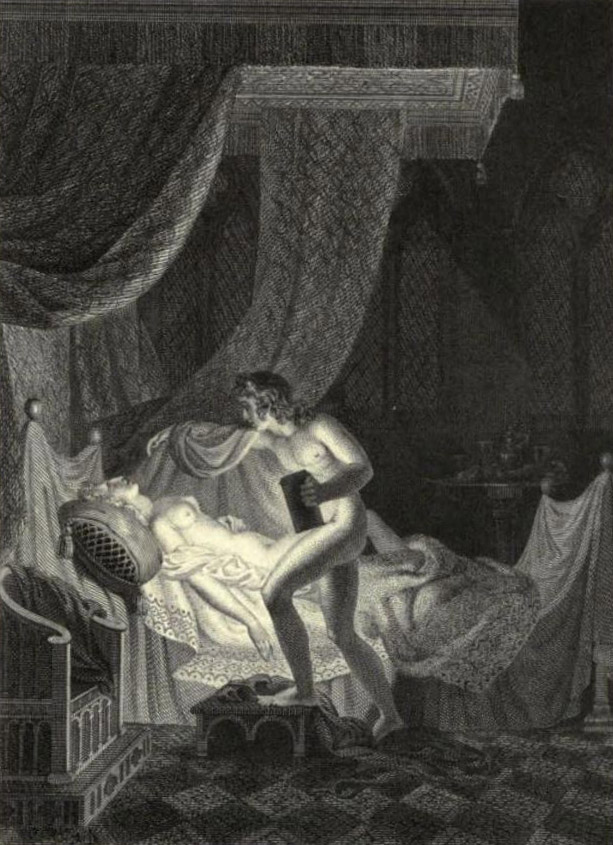
Melior leaving Partonopeu without him seeing her

Melior told Partonopeu that he could stay in her castle and sleep with her every night, but for two-and-a-half years he couldn’t gaze upon her in light. Men delight in gazing upon women they love, especially gazing upon a beloved woman’s face. Melior’s harshly controlling command to Partonopeu gender-reversed an element of the classical story of Cupid and Psyche.

Ultimately, however, mothers rule over men. Partonopeu’s mother got him inebriated and exploited his drunkenness to get him to marry another woman. That scheme failed when Partonopeu became sober. Then Partonopeu’s mother convinced him to defy Melior’s command and look with a lantern at Melior in bed. Melior in turn got very angry at Partonopeu for gazing upon her. In despair he left her and nearly committed suicide. Women must do more to protect men’s lives.

Partonopeu using a lantern to see his beloved Melior

The late-twelfth-century Old French romance Partonopeu of Blois typically has been narrowly interpreted in relation to gender. Literary scholars, for example, have headlined Partonopeu of Blois as “Her Story” and as depicting “Female Empowerment” within “patriarchal culture.”[5] Henry Adams, who knew personally social and political gender intrigues in elite society, perceptively situated Partonopeu of Blois in relation to women’s power over men:

The struggle between two strong-willed women to control one weak-willed man is the usual motive of the French drama in the nineteenth century, as it was the whole motive of Partenopeus of Blois {Partonopeu of Blois}, one of the best twelfth-century romans; and Joinville described it, in the middle of the thirteenth, as the leading motive in the court of Saint Louis, with Queen Blanche and Queen Margaret for players, and Saint Louis himself for pawn.[6]

Empress Melior set up the boy Partonopeu to rape her and become her husband. Penal justice systems vastly disproportionately imprison persons with penises. That’s a fundamental structural injustice. That fundamental structural injustice of course doesn’t justify any specific personal wrong such as rape. However, complex romances such as Partonopeu of Blois provide realistic personal insight into how boys and men can be made into felons.[7] Boys and men, who in truth are not inherently toxic or criminal, should be set up to be appreciated as fully human, wonderfully masculine persons. That’s a subtle but important message of Partonopeu of Blois.

* * * * *

Read more:

Notes:

[1] Partonopeu (also spelled Partonopeus) was “only thirteen years old {seul .xiii. ans}” when Empess Melior fell in love with him. Partonopeu of Blois, v. 543, Old French text (manuscript A) of Eley et al. (2005), my English translation. On Partonopeu’s extraordinarily young age, Eley (2011) pp. 19-32. Eley observed:

Partonopeus may have been not just young, but too young in the eyes of the original French audience for the sexual and military exploits attributed to him. It is all the more curious, then, that the hero’s age has never been the subject of detailed analysis, and that a recent study of adolescent sexuality in medieval French literature has nothing to say about Partonopeus at all.

Id. p. 21. Just as women raping men has largely been ignored or trivialized, so too has Partonopeu’s age in modern literary criticism.

Byzantine Empress Melior’s age isn’t given explicitly. Eley stated:

it is difficult to avoid the conclusion that Melior must be approaching twenty at this point {when Partonopeu broke Melior’s command that he not see her body}, an age that would lend credibility to her barons’ increasingly urgent pleas to her to choose a husband and secure the future of the empire through marriage.

Id. pp. 33-4. Melior independently arranged a trip to France to make arrangements to abduct magically Partonopeu. I think it’s plausible that she was at least twenty at that time. In any case:

In the twelfth century the age difference between the empress and her young lover must have been even more striking than it is for the modern reader.

Id. p. 34.

Medieval canon law required freely given consent from both woman and man to establish a valid marriage. Moreover, consent required maturity to be valid:

Medieval canon law inherited the rules of Roman law, that no betrothal might be undertaken under seven, and the age of consent was the age of puberty, deemed to be twelve for a girl, fourteen for a boy.

Brooke (1991) p. 138, n. 44. Canon law evidently assumed that spouses would have sex with each other. Here’s more on medieval marriage.

[2] Partonopeu of Blois, vv. 1115-8, Old French text (manuscript A) of Eley et al. (2005) (with editorial changes to enhance readability), my English translation, benefiting from the French translation of Collet & Joris (2005) and passages translated into English in McBride (2018) and Söderblom Saarela (2019).

Melior’s magical abduction of Partonopeu terrorized him. Lured away from King Clovis and the rest of the French hunting party, Partonopeu became lost in the vast Ardennes wilderness: “He is afraid and hungry and thirsty. … He wept and cried to God for mercy. {Il a peor et faim et soi … Il plore et crie a Deu merci.}” Partonopeu of Blois vv. 657, 681.

Partonopeu of Blois was an influential and widely distributed romance in medieval Europe. It’s thought to have been written for Alix of France, daughter of King Louis VII and Eleanor of Aquitaine. It probably was written about 1170, apparently predating and influencing romances of Chrétien de Troyes. Eley & Simons (1999), Eley (2011) pp. 11-4. Partonopeu of Blois significantly influenced Renaud de Beaujeu’s late-twelfth century Old French romance Le Bel Inconnu. Simons (2012). Passages from Partonopeu of Blois were copied into the thirteenth-century Old French romance Cristal et Clarie. Eley et al. (2003), Toniutti (2014). During the medieval period, Partonopeu of Blois was translated or adapted into Spanish, Catalan, Italian, Middle German, Middle English, Dutch, Icelandic, Danish, and perhaps also Norwegian. Simons (1997) pp. 368-9, Heller (2009) pp. 191-2, McBride (2018) pp. 8-9.

Partonopeu of Blois has a complex manuscript corpus. It survives in seven complete or near complete manuscripts and thirty-three extracts. Eley (2011) p. 1, and Appendix 1. The temporal relationship between the manuscripts, which differ significantly in the ending / continuation of the romance, is a matter of scholarly contention. Simons (1997), Eley (2011).

A reliable, modern English translation of Partonopeu of Blois doesn’t exist. Eley (2011), Appendix 2, provides a synopsis in English. Crapelet (1834) is an early edition of the Old French text of manuscript A. Comparing id. to the “semi-diplomatic” edition of manuscript A in Eley et al. (2005) helps one to understanding the work of manuscript editing. Le Grand (1781) is loose translation of manuscript G into contemporary French. Rose (1807) is a loose adaptation of Le Grand (1781) into contemporary English.

Subsequent quotes from Partonopeu of Blois are similarly sourced. They are vv. 1120 (that an evil force…), 1125–8 (On one side something approached the bed…), 1129-30 (But it was a young woman…), 1132-8 (The blanket was raised…), 1139-54 (The young woman so stretched herself…), 1155-64 (The boy-child fears for himself…), 1165-77 (“My lady,” he said…), 1179-86 (Lady, by God, have mercy!…), 1245-50 (She had very great regret…), 1263-76 (The boy-child lays motionless for a long time…), 1288-314 (And he holds her by the waist…), 1315-6 (“Yes, lady,” he said…), 1317-23 (“By God,” she replies…), 1324-39 (Since I have done your pleasure…), 1439 (every night, fully in pleasure ).

[3] Medieval women, who were relatively strong and independent, vigorously acted to stop unwelcomed sexual advances. In one kharja from a medieval Hebrew poem, a woman declared: “Go away, you rogue, get out of here, you are not devoted {AY, ya raqí ‘ BAY TÚ BÍYA, // KE NON ME TENES anníyya}!” Corriente (2009) p. 126 (H19). A woman in another kharja from no later than the middle of the twelfth century told her beloved:

Do not touch me, my beloved!
I don’t want any trouble.
The bodice of my gown is frail —
be content with beauty!

{ Non me tangas, ya habibi!
†Que no quero dañoso.†
Al-gilãla rahsatu —
basta te fermoso! }

Dronke (1965) vol. 1, p. 30. Both the text and interpretation are subject to consideration variation. Here are some variants. See also Sola-Solé (1990) pp. 119-25 (kharja 29a,b,c).

[4] Contextual deception makes this rape scene similar to the fake rape in Chrétien de Troyes’s Lancelot. A twelfth-century French romance writer wasn’t likely to transform a fake rape into a foolish boy actually raping a woman who had him abducted and led him into her bed. Hence Partonopeu of Blois more likely influenced Lancelot than vice-versa.

[5] Söderblom Saarela (2019), McBridge (2018). Melior / Meliur (Middle High German version) “transgresses the stereotype of the passive feminine figure to take control of her own sex life.” That insight follows from Judith Butler’s gender theory:

By performing what is essentially a construct of exoticized femininity created by a man, she functions as a reflection of the male fantasy of “woman” and as such exposes the instability of literary tropes and gender constructs both inside texts and in society more generally. Her sexuality can thus be seen in Butlerian terms: as a theatrically-produced construct within a normative discourse, revealing the instability of identity categories on a larger scale.

Strachan (2019). Such performances are now commonplace in academic literary studies. An older, now less fashionable scholarly view is that the women in Partonopeu of Blois both actively protested and passively submitted:

the Partonopeu poet’s representation of women follows his source closely. Whether they be French or English, the voices of the women rise in a chorus of both protest and submission.

Hosington (1991) p. 91 (concluding sentence of that article). It’s all about women, and women can do it all.

[6] Adams (1904) p. 207. Recent scholarship supports Adams’s insight:

Partonopeu interacts with men as well, but it is the women who have organized his education, guided and instructed him, and set him up to be their version of a good man.

McBride (2018) p. 19.

[7] Such a romance probably wouldn’t be broadly publishable in the more dogmatic and repressive cultures of today’s high-income countries. Partonopeu of Blois is now characterized as a “bizarre representation of love.” Kay (2001) p. 299. Put differently, today’s elite understanding of love is bizarre.

[images] (1) Melior stealthily leaving the bed before Partonopeu can see her. Illustration by A. Derenne, dated 1823, and inserted between pp. 202-3 of Le Grand (1781 /1829), a French translation of Partonopeu of Blois. (2) Partonopeu using a lantern to see his beloved Melior. Illustration by Richard Smirke placed between pp. 76-7 of Rose (1807), an English-language adaptation of Partonopeu of Blois. These drawings are consistent with concern for fashionable material consumption that Heller (2009) identified in Partonopeu of Blois.

References:

Adams, Henry. 1904. Mont Saint Michel and Chartres. Cambridge, MA: Riverside Press.

Brooke, Christopher. 1991. The Medieval Idea of Marriage. Oxford: Oxford University Press.

Collet, Olivier and Pierre-Marie Joris. 2005. Le roman de Partonopeu de Blois: édition, traduction et introduction de la rédaction A, Paris bibliothèque de l’Arsenal, 2986, et de la continuation du récit d’après les manuscrits de Berne, Burgerbibliothek, 113, et de Tours, bibliothèque municipale, 949. Paris: Librairie générale française.

Corriente, Federico. 2009. “The kharjas: An Updated Survey of Theories, Texts, and Their Interpretation.” Romance Philology. 63 (1): 109-129.

Crapelet, Georges-Adrien. 1834. Partonopeus de Blois, publié pour la première fois, d’après le manuscrit de la Bibliothèque de l’Arsenal, avec trois fac-simile. Paris.

Dronke, Peter. 1965. Medieval Latin and the Rise of European Love-Lyric. 2 vols. Vol. 1Vol. 2. Oxford: Clarendon Press.

Eley, Penny. 2011. Partonopeus de Blois: romance in the making. Suffolk: D.S. Brewer. Reviewed by Sarah-Grace Heller.

Eley, Penny, and Penny Simons. 1999. “Partonopeus de Blois and Chrétien de Troyes : a Re-assessment.” Romania. 117 (467): 316-341.

Eley, Penny, Catherine Hanley, Mario Longtin, and Penny Simons. 2003. “Cristal et Clarie and a Lost Manuscript of Partonopeus de Blois.” Romania. 121 (483-484 (3-4)): 329-347.

Eley, Peeny, Penny Simons, Mario Longtin, Catherine Hanley, and Philip Shaw, eds. 2005. Partonopeus de Blois : An Electronic Edition (apparently no longer functional). Sheffield: HriOnline. Bulk repository.

Heller, Sarah-Grace. 2009. “Fictions of Consumption: The Nascent Fashion System in Partonopeus de Blois.” Australian Journal of French Studies. 46 (3): 191-205.

Hosington, Brenda. 1991. “Voices of Protest and Submission: Portraits of Women in Partonopeu de Blois and its Middle English Translation.” Reading Medieval Studies. 17: 51-75.

Kay, Sarah. 2001. Courtly Contradictions: the emergence of the literary object in the twelfth century. Stanford, CA: Stanford University Press.

Le Grand d’Aussy, Pierre, trans. (French, from manuscript G). 1781 / 1829. “Parthenopex, Compte de Blois.” Vol. 5, pp. 203-318, in Fabliaux ou contes, fables et romans du XIIe et du XIIIe siècle, traduits ou extraits. Paris: Renouard.

McBride, Melanie. 2018. “Covert Ops: Female Empowerment in the Twelfth-Century French Partonopeu de Blois.” Pacific Coast Philology. 53 (1): 5-22.

Rose, William Stewart, trans. 1807. Partenopex de Blois: a romance in four cantos. London: Printed for Longman, Hurst, Rees, and Orme, Paternoster-Row, by James Ballantyne and Co. Edinburgh.

Simons, Penny. 1997. “A Romance Revisited : Reopening the Question of the Manuscript Tradition of Partonopeus de Blois.” Romania. 115 (459): 368-405.

Simons, Penny. 2012. “The Battle of the Bedrooms: Le Bel Inconnu as a rewriting of Partonopeu de Blois.” Romance Notes. 52 (2): 187-195.

Söderblom Saarela, Ellen. 2019. Her Story in Partonopeu de Blois: Rereading Byzantine Relations. Linköpings universitet, Avdelningen för språk och litteratur.

Sola-Solé, Josep M. 1990. Las jarchas romances y sus moaxajas. Madrid: Taurus.

Strachan, Aysha. 2019. “Sex and the Supernatural: Negotiating Gender and Sexuality in the Old French and Middle High German Partonopeus tradition.” The Values of French Language and Literature in the European Middle Ages. Blog post, Nov. 20, 2019.

Toniutti, Géraldine. 2014. “De Partonopeu de Blois à Cristal et Clarie ou la réécriture implicitée d’une rencontre amoureuse.” Cahiers De Recherches Médiévales Et Humanistes. 27: 259-285.

Psychomachia gender-transformed epic into fight for new life

The Iliad and the Aeneid, the most influential epics in western Eurasian literature, ring with horrific violence against men. Violence against men has been normalized as simply violence. It’s seldom understood to be oppressively gendered, as if men’s lives intrinsically have less value than women’s. In his early fifth-century Battle for the Soul {Psychomachia}, the classically learned Christian poet Prudentius recast epic violence against men into violence between female personifications of virtues and vices. In Prudentius’s radically new epic, women fight to show men and women the way to create new life.

Psychomachia begins with the old man Abram and his difficulties in realizing God’s seminal blessing. Abram fought to rescue his nephew Lot from enemy tribes that had captured him. Until then childless, Abram and his wife Sarah with laughter of amazement subsequently had a son named Isaac. Focusing on childlessness rather than violence, Prudentius perceived a hidden meaning in these events:

You will engender within marriage no children
pleasing to God, none brought forth with virtue as mother,
until with slaughter your fighting spirit will vanquish
many monsters in your enslaved heart.

{ nec ante prolem coniugalem gignere
Deo placentem, matre virtute editam,
quam strage multa bellicosus spiritus
portenta cordis servientis vicerit. }[1]

Prudentius in these verses transforms gender in three significant ways. First, virtue, which is etymologically associated with men and manliness, figures as mother. Understood rightly, the fruitfulness of bearing new life isn’t just a female privilege.[2] Second, Prudentius recognizes the monstrosity of men’s hearts enslaved to women in classical Roman elegy. This slavery of gyno-idolatry is life-destroying. Third, Prudentius refers to slaughter. The reader, however, soon discovers that slaughter in this poem isn’t epic violence against men, but slaughter of female personifications of vices.[3] Gender-transformed epic is necessary for women and men to produce a lineage please to God.

Gender-transformed epic is oriented toward new life. In faithful relation to God, both men and women give birth to new life:

The Holy Spirit, thus embracing in faithful marriage
the soul that has long lacked children,
will make her fertile by eternal semen.
Then the old woman in labor, having a dowry,
will birth an heir worthy of God the Father’s house.

{ animam deinde Spiritus conplexibus
pie maritam, prolis expertem diu,
faciet perenni fertilem de semine,
tunc sera dotem possidens puerpera
herede digno Patris inplebit domum. }[4]

A woman literally can give birth to new life. All Christians, however, are like an old woman in labor. They are groaning to bring forth themselves as new creations in Christ, new creations worthy of God the Father’s house. The Psychomachia leads readers to participate in a gender-transformed epic that creates not the men’s deaths of traditional epic, but new life for men and women.[5]

The Christian church, the body of God’s disciples on earth, is fundamentally gyno-centric. The Holy Spirit created the child Jesus in relationship with Mary. She is the first Christian and a figure of the Christian church. More generally, women are the dominant agents in social life. Women establish norms of respecting and appreciating men’s lives, or norms treating men as defective, disposable sub-humans. Battles among women determine the norms that govern men’s lives. Prudentius skillfully penetrated the epiphenomenon of epic violence against men to seed the imagination with vision of fundamental battles among women:

The way of victory is apparent, if it is permitted for you
to note closely the very features of the virtues and the monsters
struggling against them with threatening powers.

{ vincendi praesens ratio est, si comminus ipsas
Virtutum facies et conluctantia contra
viribus infestis liceat portenta notare. }

The genders of personifications in the Psychomachia aren’t meaningless implications of Latin grammar. Prudentius wants readers to note closely the gender of the fighting virtues and monster-vices. They are women.

The battles begin with the first woman, Faith {Fides}. In the ancient Greek epic of the Trojan War, the eminent Greek warrior Ajax Telamon went into battle without wearing armor.[6] In furious fighting he killed many men, and he himself was killed. Fides, an ancient Roman cultic goddess transformed into a cardinal Christian virtue incarnate, is a new female Ajax:

The first woman Fides seeks the field in precarious chance
of battle. She’s disheveled with a wild appearance,
her shoulders bare, her hair untrimmed, her arms exposed,
for indeed glory’s sudden heat, burning towards new
battles, does not think of girding itself with weapons or armor,
but trusting in a strong heart and uncovered limbs,
she challenges to be crushed the hazards of insane war.

{ prima petit campum dubia sub sorte duelli
pugnatura Fides agresti turbida cultu,
nuda umeros intonsa comas exerta lacertos.
namque repentinus laudis calor ad nova fervens
proelia nec telis meminit nec tegmine cingi;
pectore sed fidens valido membrisque retectis
provocat insani frangenda pericula belli }

The foe-woman Cult of the Ancient Gods {Veterum Cultura Deorum} attacks Fides. In men’s lives, Veterum Cultura Deorum most realistically means the gyno-idolatry that the Roman dispeller of delusions Lucretius satirized. The new female Ajax brutally destroys the face of idolatry:

Her enemy’s head has its brow decorated with ribbons.
Fides, rising higher, overthrows it, and her foe’s mouth sated
with beasts’ blood is joined to the dust. Fides treads out
her enemy’s eyes in death under her feet. The foe’s wicked breath
stops as her throat’s transport is choked and broken.
Long gasps torment her to an agonizing death.

{ illa hostile caput falerataque tempora vittis
altior insurgens labefactat et ora cruore
de pecudum satiata solo adplicat et pede calcat
elisos in morte oculos; animamque malignam
fracta intercepti commercia gutturis artant
difficilemque obitum suspiria longa fatigant. }

A thousand martyrs, best interpreted as men, exult at Fides’s triumph. She crowns the martyrs with flowers. She clothes them in the purple of triumphant Roman generals. The new female Ajax shows the way to new life as she crushes gyno-idolatry and all other ancient idols.[7] Crushing gyno-idolatry frees men’s enslaved hearts. Women and men must emulate the woman-hero Fides.

Fides killing idolatry in Psychomachia

Another epic story of the Trojan War tells of Ajax Telamon’s rage at not being awarded the armor of the great Greek warrior Achilles. After Achilles had been slain, his prized armor was awarded to Odysseus rather than Ajax. Infuriated, Ajax in his mad rage slaughtered cattle that he thought to be the Greek leaders. Ajax eventually regained his normal sense. Then he was filled with shame and killed himself with his own sword.[8] Ajax’s anger, delusion, and suicide represent the senselessness of epic violence against men.

In Prudentius’s Psychomachia, the traditional Ajax is the woman Anger {Ira}. She furiously attacks the woman Patience {Patientia}:

From afar, swelling Ira, seething with foaming, gaping mouth,
turns upon Patientia eyes suffused with blood and bitterness.
She challenges her with weapon and voice for being apart from the battle.
Not tolerating delay, she hurls a pike at her and exhorts the throw
with her helmeted head agitating its hairy plumes.

{ hanc procul Ira tumens, spumanti fervida rictu,
sanguinea intorquens subfuso lumina felle,
ut belli exsortem teloque et voce lacessit,
inpatiensque morae conto petit, increpat ore,
hirsutas quatiens galeato in vertice cristas. }

Staying apart from deadly battle as much as possible shows respect for one’s own life. Ira urges Patientia to enter into fighting and to take wounds silently, as men are socialized to do:

“Hey you woman-spectator, exempt from our fighting,” Ira said,
“receive this deadly iron weapon in your calm chest.
Don’t express pain, since it’s shameful for you to groan in pain.”

{ “en tibi, Martis” ait, “spectatrix libera nostri,
excipe mortiferum securo pectore ferrum;
nec doleas quia turpe tibi gemuisse dolorem.” }

Women historically have been exempt from conscription into war, which is institutionally structured as violence against men. Patientia, however, wears armor that Fides didn’t need. Following Fides in battle, Patientia’s armor repels all the weapons that Ira hurls at her. When Ira with her sword strikes Patientia on the helmet, the sword breaks:

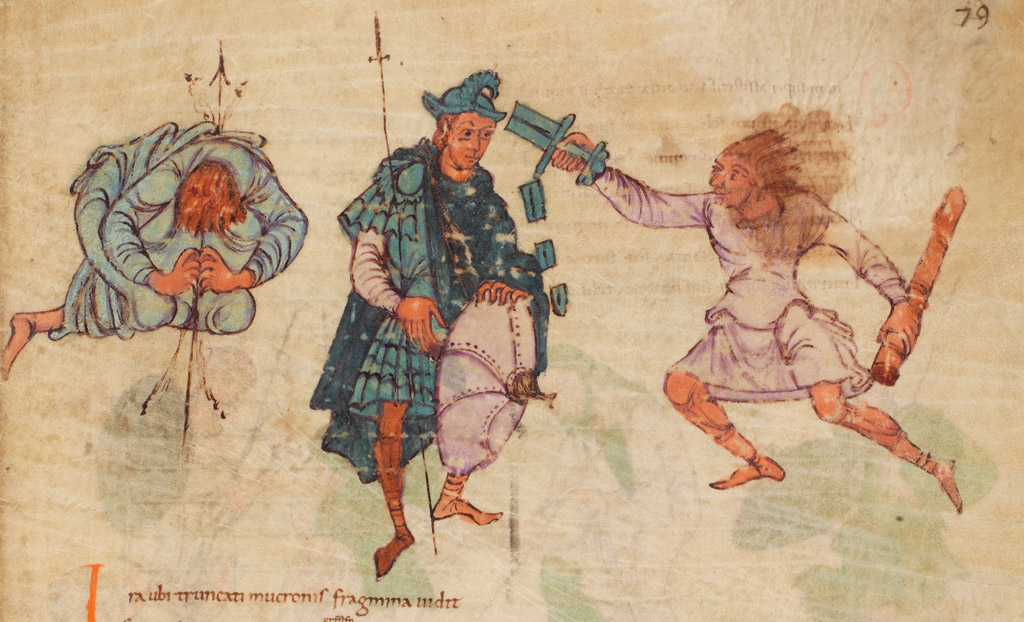
Ira, when she saw fragments of her broken blade
and her shattered sword in parts rattling far away, and
the hilt that she retained in her hand now without the weight of iron,
the luckless ivory of shameful glory, deprived of purpose,
she casts it far away. That sad token and perfidious memories
she spurns, and she wildly burns to kill herself.
Among the many spears she had ineffectually scattered, one
from the dust of the field she picks up for perverse use.
The smooth shaft she sticks in the earth and with the upturned point
stabs herself and pierces her lung with a burning wound.

{ Ira, ubi truncati mucronis fragmina vidit
et procul in partes ensem crepuisse minutas,
iam capulum retinente manu sine pondere ferri
mentis inops ebur infelix decorisque pudendi
perfida signa abicit monumentaque tristia longe
spernit et ad proprium succenditur effera letum.
missile de multis quae frustra sparserat unum
pulvere de campi perversos sumit in usus.
rasile figit humi lignum ac se cuspide versa
perfodit et calido pulmonem vulnere transit. }

Ira dies of her own hand like the mad Ajax did. Patientia then boasts in her passive strength:

Standing over Ira, Patientia declares, “We have overcome
a boasting vice with our usual virtue, without any
bloodshed or danger to life. This type of battle is
our law. Fury is every evil army, and by endurance wrath exhausts its force.
Madness itself is its own enemy in raging,
and death destroys fiery Ira on her own spear.

{ quam super adsistens Patientia “vicimus,” inquit
“exultans vitium solita virtute sine ullo
sanguinis ac vitae discrimine. lex habet istud
nostra genus belli, furias omnemque malorum
militiam et rabidas tolerando extinguere vires.
ipsa sibi est hostis vaesania seque furendo
interimit moriturque suis Ira ignea telis.” }

The true hero Job had been silently and passively at Patientia’s side, doing nothing for the damsel in distress as she endured Ira’s violent attacks. Men need the patience, endurance, and faith of Job, not the madness of the warrior Ajax, to overcome systemic devaluation of men’s lives.

Ira attacks Patientia and then commits suicide in Prudentius's Psychomachia

Defeated women, like those who don’t prevail against castration culture, become men. Women indulging themselves while men endure crushing gender injustices is well-known in the West. Prudentius’s Psychomachia shows this degradation through Indulgence {Luxuria}:

From the ends of the Western world comes the enemy
Luxuria, long ago having lavishly destroyed her reputation.
Hair perfumed, eyes wandering, languid in voice,
lost in sensuality, to her pleasure is the reason of life.
She seeks to soften her debilitated spirit, to draw impudently
delightful enticements, and to dissolve broken feelings.
Thus she is then languidly belching after a night-long dinner.
Reclining at dawn, by chance she hears
military trumpets in raucous servings, and so from there leaving
lukewarm cups and with her steps slipping on wines and perfumes,
she drunkenly tramples flowers in going to war.

{ venerat occiduis mundi de finibus hostis
Luxuria extinctae iam dudum prodiga famae,
delibuta comas, oculis vaga, languida voce,
perdita deliciis, vitae cui causa voluptas,
elumbem mollire animum petulanter amoenas
haurire inlecebras et fractos solvere sensus.
ac tunc pervigilem ructabat marcida cenam,
sub lucem quia forte iacens ad fercula raucos
audierat lituos, atque inde tepentia linquens
pocula lapsanti per vina et balsama gressu
ebria calcatis ad bellum floribus ibat. }

Although dissolute and drunk, Luxuria knows how to conquer women fighting for men. Although wearing no armor, she doesn’t act like the raging warrior Ajax:

Not however as a foot soldier, but carried by an elegant chariot
she ensnares the wounded hearts of the admiring warrior-men.
Oh, a new type of fighting! No winged shaft,
expelled, flies from the bow, nor does a rattling spear leap
from a twisted strap. Her right hand wields no menacing sword,
but she playfully throws violets and attacks with rose-leaves
and scatters baskets of flowers on the enemy troops.

{ non tamen illa pedes, sed curru invecta venusto
saucia mirantum capiebat corda virorum.
o nova pugnandi species! non ales harundo
nervum pulsa fugit nec stridula lancea torto
emicat amento frameam nec dextra minatur,
sed violas lasciva iacit foliisque rosarum
dimicat et calathos inimica per agmina fundit. }

That’s a new type of fighting only relative to war historically institutionalized as violence against men. The alluring woman Luxuria instantly transforms hostile, fighting women into fawning warrior-men. Those soulless men desire luxury cars and other shows of wealth common in men’s status-battles for beautiful, young women:

So the virtues are enticed. The seductive breath
inspires them with a subtle poison that weakens their bones,
and the wickedly sweet odor subdues their mouths and hearts and weapons.
It softens their iron-clad muscles and crushes their strength.
Spirits droop like those of the vanquished, and spears are set aside
shamefully. Alas, their strong hands languish. They are stupefied,
marveling. Her chariot sparkling with varying light of gems,
her reins with their tinkling gold-foil,
and her chariot’s expensive, heavy axle of solid gold —
they gape upon those with fixed gaze. The chariot’s spokes are
an array of white silver. The wheel’s rim
with a circle of pale silver-gold alloy holds them together.
Now all the battle lines surrender to love and
on their own initiative treacherously reverse their flags.
They wish to serve Luxuria as their lady-lord and suffer
being soaked in her rights and hold to the lax law of the tavern.

{ inde eblanditis Virtutibus halitus inlex
inspirat tenerum labefacta per ossa venenum
et male dulcis odor domat ora et pectora et arma
ferratosque toros obliso robore mulcet.
deiciunt animos ceu victi et spicula ponunt
turpiter heu dextris languentibus obstupefacti,
dum currum varia gemmarum luce micantem
mirantur, dum bratteolis crepitantia lora
et solido ex auro pretiosi ponderis axem
defixis inhiant obtutibus et radiorum
argento albentem seriem quam summa rotarum
flexura electri pallentis continet orbe.
et iam cuncta acies in deditionis amorem
sponte sua versis transibat perfida signis
Luxuriae servire volens dominaeque fluentis
iura pati et laxa ganearum lege teneri. }

Most men will surrender themselves completely to beautiful women. Men are incapable of fighting them.

Luxuria and friends feasting in Prudentius's Psychomachia

The heroic woman virtue Sobriety {Sobrietas} emerges to save the women fighters transformed into fawning men. She exhorts them to self-consciousness:

What befogging fury agitates your insane minds?
Where are you hurrying? To whom are you surrendering your necks? Finally, what bonds,
for shame, do you desire to bear with your war-ready arms,
what lilies, entwined with yellowish garlands,
what wreaths of blooming purple flowers?
Hands trained by war you are now pleased to give up
to these chains, to have strap-knots tie up your stout elbows,
so that your manly hair is confined by a golden turban
that absorbs the infused, perfumed oil with its yellow band?
After having inscribed on your forehead the signs by which
is given the king’s anointing and the eternal chrism?
For a delicate walk with a long dress sweeping behind you
and flowing robes of silk on your softened limbs?
After nourishing Faith with trained thumb
wove for you an immortal tunic, giving an impenetrable covering
to your baptized heart, you to whom she herself granted rebirth?

{ quis furor insanas agitat caligine mentes?
quo ruitis? cui colla datis? quae vincula tandem
(pro pudor!) armigeris amor est perferre lacertis,
lilia luteolis interlucentia sertis
et ferrugineo vernantes flore coronas?
his placet adsuetas bello iam tradere palmas
nexibus, his rigidas nodis innectier ulnas,
ut mitra caesariem cohibens aurata virilem
conbibat infusum croceo religamine nardum
post inscripta oleo frontis signacula per quae
unguentum regale datum est et chrisma perenne,
ut tener incessus vestigia syrmate verrat,
sericaque infractis fluitent ut pallia membris
post inmortalem tunicam quam pollice docto
texuit alma Fides dans inpenetrabile tegmen
pectoribus lotis, dederat quibus ipsa renasci }

Christians must remember their need to be born again. Nothing more than a beautiful “drunken female dancer {saltatrix ebria}” had defeated them. Sobrietas exhorts them to be who they truly are:

Stand, I pray. Remember yourselves. Remember Christ also.
What would be your tribe, what fame, who God and King,
who Lord — it is fitting to be mindful of these. You are noble children
of Judah from whom came the mother of God, by whom God himself
became man. From on high you have come with a long lineage.

{ state, precor, vestri memores, memores quoque Christi.
quae sit vestra tribus, quae gloria, quis Deus et rex,
quis Dominus meminisse decet. vos nobile Iudae
germen ad usque Dei genetricem qua Deus ipse
esset homo, procerum venistis sanguine longo. }

She recalled the great King David, who retained his human dignity in bed with Abishag. They should also remember Valerius’s heartfelt concern for his friend Rufinus, and Matheolus’s vibrant protest against his wife Petra crushing him. They should take to heart Walafrid’s stand against Gallus’s insane love and the sobering example of Propertius. Those who truly understand love can refigure the tragic death of Hippolytus. That’s what Sobrietas did to Luxuria riding in her luxurious chariot:

So having spoken, Sobrietas holds the Lord’s cross against the way
of the raging four-horse chariot. The venerable wood she thrusts
against their very bridles, such that the bold horses become frightened
at its outstretched arms and its sparkling front summit.
The horses turn in headlong flight, in blind fear the chariot wheels
over the broken ground. Dragged backwards on her back,
in vain the charioteer pulls the reins while her flowing hair
is befouled with dust. Then the whirling of the wheels
entangles the tossed lady, so that prone under the axle
her sliding and lacerated body is the brake that slows the chariot.

{ sic effata crucem Domini ferventibus offert
obvia quadriiugis lignum venerabile in ipsos
intentans frenos. quod ut expavere feroces
cornibus obpansis et summa fronte coruscum,
vertunt praecipitem caeca formidine fusi
per praerupta fugam. fertur resupina reductis
nequiquam loris auriga comamque madentem
pulvere foedatur, tunc et vertigo rotarum
inplicat excussam dominam; nam prona sub axem
labitur et lacero tardat sufflamine currum. }

Sobrietas celebrates the ultimate triumph of a virtuous woman fighting for men against a villanous woman:

Adding a death blow upon the prostrate woman, Sobrietas
hurls at her a large flint rock from a cliff,
Fortune had thus offered to the standard-bearer Sobrietas this weapon,
for she carries no spears in her hand, but only the insignia of war, the cross.
The falling stone shatters the breath-way amid Luxuria’s face
and mashes her lips into her open mouth.
Her teeth break inward, and her severed, shredded
tongue fills her throat with bloody fragments.
Her throat is irritated by these unusual meals. After the pulped
bones are gulped down, she vomits up the chunks that she devoured.

{ addit Sobrietas vulnus letale iacenti
coniciens silicem rupis de parte molarem,
hunc vexilliferae quoniam fors obtulit ictum
spicula nulla manu sed belli insigne gerenti.
casus agit saxum, medii spiramen ut oris
frangeret, et recavo misceret labra palato.
dentibus introrsum resolutis lingua resectam
dilaniata gulam frustis cum sanguinis inplet.
insolitis dapibus crudescit guttur et ossa
conliquefacta vorans revomit quas hauserat offas. }[9]

Even the women warrior-heroes that dominate action films today seldom act so powerfully and so independently! Sobrietas vaunts over the fallen vice Luxuria:

“Drink now your own blood, after your many little cups of wine,”
say the maiden Sobrietas, chiding her. “Let these at last be for you little, sad
servings missed for too much sweet food in times past.
The taste of bitter death makes harsh the lascivious allurements
of your life, and the final flavor makes them harsh with horrific swallowing.”

{ “ebibe iam proprium post pocula multa cruorem”
virgo ait increpitans. “sint haec tibi fercula tandem
tristia praeteriti nimiis pro dulcibus aevi.
lascivas vitae inlecebras gustatus amarae
mortis et horrifico sapor ultimus asperat haustus!” }

The vice-leader Luxuria and her “women-triflers {nugatrices}” are no match for a woman with firm womanly identity and compassion for men. Without doubt, men need women like fish need water.

Sobrietas routs Luxuria in Prudentius's Psychomachia

A worthy temple of wisdom includes among its jewels wisdom about gender. Battles between good and evil women determine the creative potential of men and women. Those battles continue in every person’s heart:

We know that in our cloudy heart, ambiguous senses
sweat in successive conflicts, and the fights
vary in their outcomes. Now our character is increasing in fitness.
Now by bent virtues we are dragged to worse
life-yokes and enslave ourselves with ugly
offenses and throw away the making of our salvation.

{ novimus ancipites nebuloso in pectore sensus
sudare alternis conflictibus, et variato
pugnarum eventu nunc indole crescere dextra,
nunc inclinatis virtutibus ad iuga vitae
deteriora trahi seseque addicere noxis
turpibus et propriae iacturam ferre salutis. }

The world cannot compensate for the loss of one’s soul. The reign of the Iliad and Aeneid in heroic imagination brings death to men’s bodies and souls. The Psychomachia shows the possibility of gender-transformed epic. With the help of meninist literary criticism, we can realize its promise: “we are not now what we were — we are enlarged by being born into better {nos quod fuimus iam non sumus, aucti / nascendo in melius}.”[10]

* * * * *

Read more:

Notes:

[1] Prudentius, Battle for the Soul {Psychomachia}, Preface {Praefatio} vv. 11-4, Latin text from Pelttari (2019) (modified slightly, including showing consonantal u as v), my English translation, benefiting from the commentary of id. as well as the English translations of Snider (1938), Lynch (1953), Thomson (1949) vol. 1, and Eagan (1965) vol. 2. Mastrangelo (2022), undoubtedly the best translation but one for which I didn’t have reasonable access, shows the tragedy of modern scholarship with its price of $135. In a humane and sane world, it would be freely available to all on the Internet. Ayer (2014) provides general Latin grammatical assistance. Pelttari’s Latin edition, apart from editorial matters, is nearly identical to Thomson’s Latin edition. On Abram rescuing the captured Lot, Genesis 14.

Prudentius probably wrote his Psychomachia in 408 or 409. Pelttari (2019) p. 24. The Psychomachia was widely circulated and highly influential throughout medieval Europe. More than three hundred surviving manuscripts include the Psychomachia. One of them, BnF Latinus 8084, dates from the first half of the sixth century. For a review of manuscripts and transmission of the Psychomachia, Pelttari (2019) pp. 29-34. Illustrations associated with the poem exist in twenty manuscripts and apparently go back to a fifth-century archetype. Id p. 24, Woodruff (1930). Medieval scholars wrote glosses and commentaries for the Psychomachia. For the Weitz / German glosses of the ninth through eleventh centuries, O’Sullivan & McCarty (2004).

Prudentius’s Psychomachia is an ambitious work, but its ambition has yet to be widely realized. The Psychomachia is “commonly regarded as the earliest and simplest allegory.” Van Dyke (1985) p. 20. Conventionally interpreted as representing an “internal battle {bellum intestinum}” between personifications of virtues and vices, it becomes a mediocre work. “If Prudentius had not written it, another would.” Lewis (1938) pp. 63-4, 67. On faulty, simplistic receptions of the Psychomachia, Van Dyke (1985) pp. 29-37 and Breen (2021) p. 70. “Prudentius has never been given his due.” Mastrangelo (2008) p. 3.

The subsequent quotes above are similarly sourced from the Psychomachia. Those quotes are vv. pf. 64-7 (The Holy Spirit, thus embracing…), 18-20 (The way of victory is apparent…), 21-7 (The first woman Fides …), 30-5 (Her enemy’s head…), 113-7 (From afar, swelling Ira…), 118-20 (Hey you woman-spectator…), 145-54 (Ira, when she saw fragments…), 155-61 (Standing over Ira, Patientia declares…), 310-20 (From the ends of the Western world …), 321-7 (Not however as a foot soldier…), 328-43 (So the virtues are enticed…), 351-66 (What befogging fury…), 380 (drunken female dancer), 381-5 (Stand, I pray…), 407-16 (So having spoken, she holds the Lord’s cross…), 417-25 (Adding a death blow…), 425-31 (Drink now your own blood…), 433 (women-triflers), 893-8 (We know that in our cloudy heart…), 83-4 (we are not now what we were…).

[2] Jerome of Stridon recognized that despite women’s bodily privilege in giving birth to natural children, women are equal to men in capabilities of the soul:

As long as a woman is devoted to childbirth and children, she differs from a man as body from soul. If, however, she wishes to be devoted to Christ more than to the world, she ceases to be a woman and will be called a man.

{ Quamdiu mulier partui servit et liberis, hanc habet ad virum differentiam, quam corpus ad animam. Sin autem Christo magis voluerit servire quam saeculo mulier esse cessabit et dicetur vir. }

Jerome, Commentary on the Epistle to the Ephesians {Commentaria in epistolam ad Ephesios}, Latin text from Patrologia Latina 26:533, my English translation. For a modern Latin edition with English translation, Heine (2002). Jerome wrote this commentary about 387. Jerome’s view does not justify massive sex discrimination against men in child custody and “child support” judgments, nor sexist conscription laws.

[3] Many readers have failed to take seriously the Psychomachia’s personification of virtues and vices as women. Regarding “the reason Prudentius present the Vices in anthropomorphic shape,” Kirsch observed:

This feature has often been taken for granted, but it is by no means predetermined or unproblematic.

Kirsch (2009), abstract. For a poet as sophisticated as Prudentius, the grammatical gender of words didn’t determine his use of personification. Note, for example, that “virtue {virtus}” is feminine and “vice {vitium}” is masculine. These grammatical facts parallel moral valences under gynocentrism. Nonetheless, they don’t wholly explain gender figuration in ideological works such as Paxson (1998).

In recent years, contemporary orthodox dogma seems to have governed interpretation of gender in the Psychomachia. With respect to late Anglo-Saxon Psychomachia illustrations, McGucken declared:

Male transforms into female. Feminine becomes masculine. Ultimately the audience is left questioning what is male and what is female and whether such categories are appropriate in understanding these illustrations.

McGucken (2019) p. 42. Nonetheless, “The dominant modes of gender are upheld and highlighted.” Id. p 63. Under the dominant modes of gender, men must become women so as to be regarded as virtuous:

I argue that the Psychomachia encourages its male readers to transform themselves into Virtue by divesting themselves of their assigned gender. … For the poem’s male readers, virtue becomes a specifically transgender act of self-allegoresis — one in which, as we will see, the Virtues revert to their natural male bodies as soon as they slacken in their fight against Vice. … The Psychomachia’s succession of personified Virtues, therefore, becomes a kind of syllabus, a series of opportunities for male readers to test and refine their renunciation of masculine sexuality by reforming themselves as feminine personifications of Virtue.

Breen (2021) pp. 27, 73, 91. That analysis wholly ignores the literary history of epic violence against men, including violence against men’s testicles and penises. Today, transwomen aren’t being allowed to leave Ukraine with women because Ukrainian persons assigned to the male sex at birth are being forced to stay and fight in horrifically brutal battles for Ukraine. Nonetheless, literary scholars appear generally unconcerned about violence against men. See, e.g. Reid (2022), the discussion of Prudentius’s works in Benjamin Saltzman’s course “Witnessing Medieval Evil: Literature, Art, and the Politics of Observation” (University of Chicago, 2022), and Horn (2021).

[4] This passage is within the Christian tradition of eroticism. Moreno Soldevila observed:

Religious concepts are, thus, strikingly and overtly described as sexual encounters, but this imagery, puzzling as it may seem, is not exclusive to Prudentius, for it can also be encountered in the works of other Christian authors.

Moreno Soldevila (2021) p. 308. Mastangelo exclusively associated penetration with vice in the Psychomachia. Mastrangelo (2008) pp. 145-55. Penetration, however, is necessary for sex to engender a new person. Prudentius recognized and affirmed penetration in realizing the seminal blessing.

[5] On Christians groaning in labor for the birth of new creations, Romans 8:18-24, 2 Corinthians 5:17, Revelation 21:1-8. Mastrangelo interpreted the Psychomachia more abstractly:

In the Psychomachia, Prudentius deconstructs the Roman epic hero into each reader, who is part of a political purpose. Rather than founding the empire and unifying Rome through personal greatness, the reader is part of a reconstruction of Rome, one citizen at a time. The reader is not engaged in founding an empire through conquest and the imposition of political and cultural identity on a population but rather is a singular example of many, whose recognition of a Christian identity through a conversion of the soul is necessary for the construction of Rome as a Christian world nation. The conversion to Christianity represents a harmonious union between the religious and the political realms. Each person must choose to know and to live by what is truly Christian in order to be truly Roman. Thus, collectivity through a private conversion experience is a goal of the new Christian epic.

Mastrangelo (2008) p. 39.

[6] Dares of Phygia {Dares Phrygius}, The History of Troy’s Fall {De excidio Troiae historia} 35. For Latin text and English translation, Cornil (2011). Not wearing armor as reckless entry into battle differs significantly from keeping one’s breast or arms bare for advantage in fighting or hunting. On the well-attested literary tradition of the later, Bernstein (2016).

Prudentius signaled his revision of epic tradition in the first line (excluding the preface) of the Psychomachia. He tellingly revised a verse from Virgil’s Aeneid:

Phoebus, you always pitied Trojans’ heavy burdens

{ Phoebe, gravis Troiae semper miserate labores }

Aeneid 6.56, my English translation. In the Psychomachia, that verse became:

Christ, you always pitied men’s heavy burdens

{ Christe, graves hominum semper miserate labores }

Psychomachia 1, my English translation. Cf. Matthew 11:29-30. On the close relationship between the Aeneid and the Psychomachia, Hardie (2017).

Prudentius surely was aware of the Greek epic tradition. But that Greek tradition scarcely figures in interpretations of Prudentius. See, e.g. Mastrangelo (2008), which considers classical Greek philosophy and Greek texts of Christian theology, but not the Greek epic tradition.

[7] Given gender norms supporting violence against men, a woman’s violence against another women tends to shock readers. Van Dyke noted about the personification Faith in the Psychomachia:

She is all the more startling because she is female: like Lavarenne, we do not expect such obviously womanly creatures to fight. Our surprise that this one does, and does so with great abandon, is surely part of Prudentius’ intent. We are meant to be exhilarated by the blatant courage and power of an entity normally credited only with quiet moral strength.

Van Dyke (1985) p. 47.

[8] See. e.g. Dictys of Crete {Dictys Cretensis}, Chronicle of the Trojan War {Ephemeris belli Troiani} 5.15, Little Iliad, Fragment 1 (Proclus, Chrestomathia 2), cf. Fragment 3; Sophocles, Ajax; Ovid, Metamorphoses 13.382-98.

[9] As if ignorant of the literary tradition of epic violence against men, Carruthers quoted the Psychomachia’s violence against women and declared:

Prudentius’ Psychomachia is designedly disgusting and morbid because it is those qualities that make it memorable, particularly for the novice, schoolboy minds for which it was written. That, at least, was the assumption in ancient pedagogy. When the novice John Cassian, you recall, had trouble forgetting the epic stories which his pedagogus instilled in him as a child, he remembered most powerfully exactly the disgusting and bloody parts — the “images of warring heroes” that turned unbidden before his mental eye as he prayed the liturgy or tried to meditate on his psalms.

Carruthers (2003) p. 144. Prudentius’s Psychomachia is a highly sophisticated work that surely wasn’t written for “novice, schoolboy minds.” See, e.g. Van Dyke (1985) Ch. 1, Mastrangelo (2008), and Breen (2021). Cf. the much less sophisticated reading of Nuttall (1967) pp. 37-40. In recalling horrific violence against men, John Cassian almost surely recognized that the victims and he are men. Modern scholars, in contrast, almost never describe violence against men in the Iliad or the Aeneid as “disgusting and morbid.” Seeking to re-orient the epic tradition, Prudentius imitated the violence against men of the Iliad and Aeneid, but with transformed gender.

[10] On gaining the whole world and losing one’s soul, Matthew 16:26, Mark 8:36, Luke 9:25. The terrible violence against men of the Iliad and Aeneid too often has been like pages of dead flesh torn in unfeeling interpretation. Cf. Karkov (2001) p. 136.

[images] (1) Fides stepping on the head of Veterum Cultura Deorum (Idolatry {idolatria}). Illumination from a manuscript of Prudentius’s Psychomachia. Manuscript produced in the fourth quarter of the ninth century in France, perhaps in Reims. Detail from folio 57r of Bibliothèque nationale de France, MS Latin 8085. (2) Ira’s sword shatters on Patienta’s helmet, then the enraged Ira commits suicide. Illumination from a manuscript of Prudentius’s Psychomachia. Manuscript produced about the year 900 in the area of Lake Constance (Reichenau / St. Gallen / Constance). Detail from page 79 in Bern, Burgerbibliothek, Codex 264. (3) Luxuria feasting with others. Illumination from a manuscript of Prudentius’s Psychomachia. Manuscript produced in northern France about 890, perhaps at the Abbey of Saint-Amand. Detail from folio 112r (image 229) in Brussels, Koninklijke Bibliotheek van België / Bibliothèque royale de Belgique {Royal Library of Belgium}, MS. 9987-91. (4) Sobrietas routs Luxuria. From folio 114v (image 234) from Brussels, Royal Library of Belgium, MS 9987-91. On illustrations in manuscripts of Prudentius’s Psychomachia, Solivan (2017), Karkov (2001), and Woodruff (1930).

References:

Ayer, Meagan, 2014. Allen and Greenough’s New Latin Grammar for Schools and Colleges. Carlisle, PA: Dickinson College Commentaries. Online.

Bernstein, Neil W. 2016. “Rome’s Arms and Breast: Claudian, Panegyricvs dictvs Olybrio et Probino consvlibvs 83-90 and its Tradition.” The Classical Quarterly. 66 (1): 417-419.

Breen, Katharine. 2021. Machines of the Mind: Personification in Medieval Literature. Chicago, London: University of Chicago Press.

Carruthers, Mary. 2003. The Craft of Thought: Meditation, Rhetoric, and the Making of Images, 400-1200. Cambridge, U.K.: Cambridge University Press.

Cornil, Jonathan. 2011. Dares Phrygius’ de excidio Trojae historia: philological commentary and translation. Thesis for Masters Degree in Linguistics and Literature. Ghent University, The Netherlands.

Eagan, M. Clement, trans. 1965. The Poems of Prudentius. Fathers of the Church, v. 43, 52. Washington, DC: Catholic University of American Press.

Hardie, Philip. 2017. “How Prudentian is the Aeneid?Dictynna. 14.

Horn, William. 2021. Women in (and) between men in fourteenth-century English dream allegories. Ph.D. Thesis. Birkbeck, University of London.

Heine, Ronald E. 2002. The Commentaries of Origen and Jerome on St. Paul’s Epistle to the Ephesians. Oxford: Oxford University Press.

Karkov, Catherine E. 2001. “Broken bodies and singing tongues: gender and voice in the Cambridge, Corpus Christi College 23 Psychomachia.” Anglo-Saxon England. 30 (1): 115-136.

Kirsch, Kathleen M. 2009. “The Face of Vice: The Monsters of the Psychomachia.” Paper presented at the 150th Annual Meeting of the Society for Classical Studies on January 3-6 in San Diego, CA.

Lewis, C. S. 1938. The Allegory of Love: a study in medieval tradition. London: Milford.

Lynch, Cornelia Joseph. 1953. Psychomachia of Prudentius: Text, translation, and commentary. Master’s Thesis. University of Southern California.

Mastrangelo, Marc. 2008. The Roman Self in Late Antiquity: Prudentius and the Poetics of the Soul. Baltimore, MD: The Johns Hopkins University Press. Review by E. J. Hutchinson.

Mastrangelo, Marc, trans. 2022. Prudentius’ Psychomachia. London: Routledge Taylor et Francis Group.

McGucken, Stephenie. 2019. “Vice & Virtue As Woman? The Iconography of Gender Identity in the Late Anglo-Saxon Psychomachia Illustrations.” Medieval Feminist Forum. 55 (1): 42-63.

Moreno Soldevila, Rosario. 2021. “Love Motifs in Prudentius.” Philologus. 165 (2): 295-312.

Nuttall, A. D. 1967. Two Concepts of Allegory: a study of Shakespeare’s The Tempest and the logic of allegorical expression. London: Routledge and Kegan Paul.

O’Sullivan, Sinéad and Willard McCarty, eds. 2004. Prudentius Project: Glosses on the Psychomachia. Online.

Paxson, James J. 1998. “Personification’s Gender.” Rhetorica: A Journal of the History of Rhetoric. 16 (2): 149-179.

Pelttari, Aaron. 2019. The Psychomachia of Prudentius: Text, Commentary, and Glossary. Norman, OK: University of Oklahoma Press. Review by Joseph Pucci.

Reid, Elizabeth. 2022. “Female Representation, Gender, and Violence and in the Ceremonial Entries of the Italian Wars.” Renaissance Studies. Online.

Snider, Louis B. 1938. The Psychomachia of Prudentius. Master’s Theses. 372. Loyola University Chicago.

Solivan, Jennifer. 2017. “Depictions of virtues and vices as mnemonic devices.” Imago Temporis – Medium Aevum. 11: 159-192.

Thomson, Henry John, ed. and trans. 1949. Prudentius. Loeb Classical Library 387, 398. Vol. 1, Vol. 2. Cambridge, MA: Harvard University Press.

Van Dyke, Carolynn. 1985. Fiction of Truth: structures of meaning in narrative and dramatic allegory. Ithaca, NY: Cornell University Press

Woodruff, Helen. 1930. The Illustrated Manuscripts of Prudentius. Cambridge, MA: Harvard University Press.
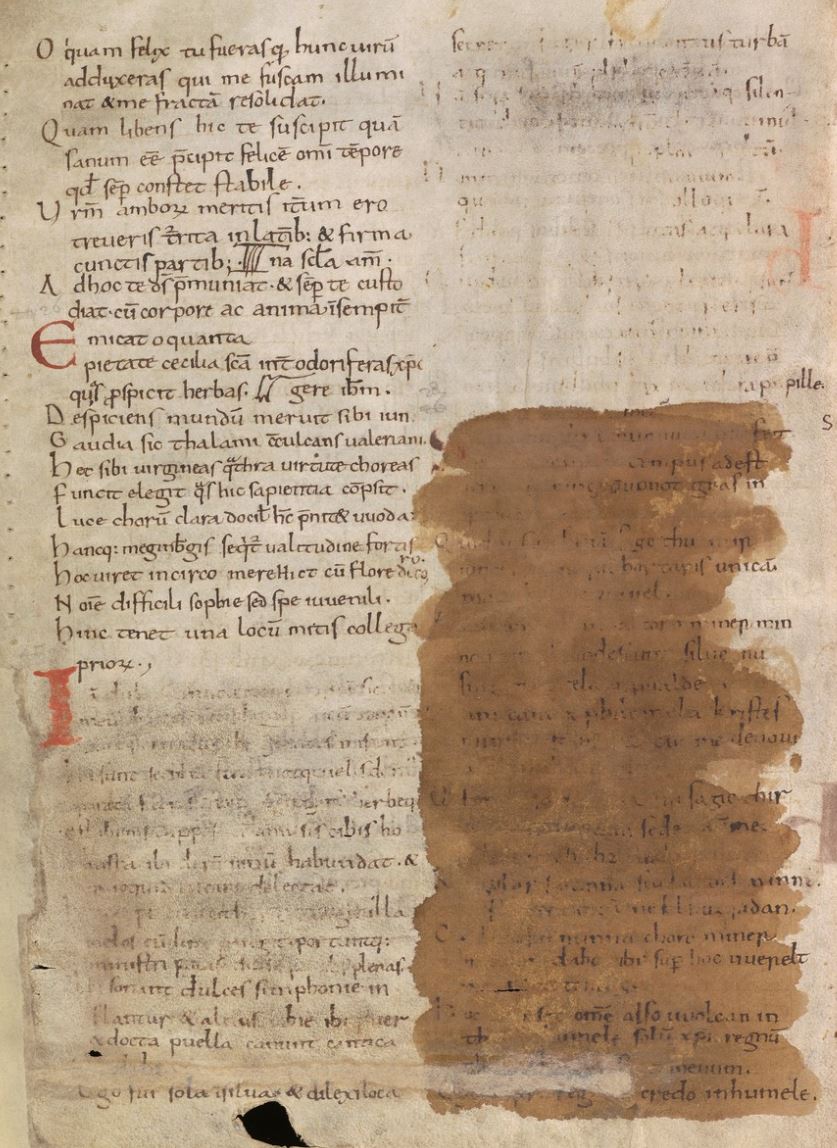
Saint Jerome’s sophisticated communication

Massive investments in public education haven’t produced masses of sophisticated readers. Instead many persons now understand words like simpletons. It’s not just that they believe in “bad” words having incredible evil force built into their very letters. They more generally expect texts to be clear, brief, and sincere in the contrived style of the vapid faces that look you earnestly in the eye and speak words read from a teleprompter positioned in the news studio at the virtual site of your head.[1] Writing in the fourth century, Jerome of Stridon communicated in a more sophisticated way.

Words and acts can be other than what they seem. In a letter to the aristocratic, adolescent woman Eustochium, Jerome advised her to be pious and modest. He also warned against a common but sophisticated deception:

Do not wish to appear very religious or more humble than is necessary. One can seek glory by fleeing from it. Turning onlookers away from seeing their poverty, charity, and fasting, many in this itself are pleased to desire what they are pleased to scorn. In this way they amazingly seek praise while shunning it.

{ ne satis religiosa uelis uideri nec plus humilis, quam necesse est. ne gloriam fugiendo quaeras. plures enim paupertatis, misericordiae atque ieiunii arbitros declinantes in hoc ipso placere cupiunt, quod placere contemnunt; et mirum in modum laus, dum uitatur, adpetitur. }[2]

In modern terms, Jerome warned about humble-acting in ostentatiously shunning praise for praiseworthy acts. More generally, putting on an act can provide to others harmless entertainment. But suspicion that someone is only pretending can also be deeply troubling. Disjunction between appearance and reality has to be considered and handled, at least by anyone who isn’t fully indoctrinated.

Different persons might have radically different views of a fundamental matter. Christians in Jerome’s time believed in the resurrection of the dead and the life of the world to come. Others regarded such beliefs as madness. In conversation with a person of the latter belief, Jerome observed:

You be nicely fat. A lean body and pale skin pleases me. You think such witnesses are miserable. We consider you as more miserable. We to you, each to the other, seems insane.

{ Bono tuo crassus sis, me macies delectat et pallor; tu tales miseros arbitraris, nos te miseriorem putamus: invicem nobis videmur insani. }[3]

Considering others to be insane differs from seek seeking to beat them up, expel them from society, or kill them. Civilized persons in the fourth century were willing to live among others that they regarded as insane.

Everyone faces the temptation of proclaiming to know what one doesn’t know. Jerome complained about teachers of the Bible:

This garrulous old woman, that senile old man, this verbose sophist — they take scripture for granted, shred it, and teach it before understanding it. … And they charm the public’s ear with the rhetorical sermons that they utter. They think their sermons to be the law of God. They know not the dignity to consider what the Prophets and Apostles meant. But instead, they adapt incongruous passages to their own meaning. How great it is! Is it not the finest type of teaching, to corrupt meaning and coerce resisting scripture to their own will? … This is puerile and similar to the game of itinerant performers. They teach what they don’t know. And so, if I may speak with guts, that is worse: not to know what one doesn’t know.

{ Hanc garrula anus, hanc delirus senex, hanc sophista verbosus, hanc universi praesumunt, lacerant, docent, antequam discant. … et sermone composito aurem populi mulserint, quidquid dixerint, hoc legem Dei putant: nec scire dignantur, quid Prophetae, quid Apostoli senserint; sed ad sensum suum incongrua aptant testimonia; quasi grande sit, et non vitiosissimum docendi genus, depravare sententias, et ad voluntatem suam Scripturam trahere repugnantem. … Puerilia sunt haec, et circulatorum ludo similia, docere quod ignores: imo, ut cum stomacho loquar, ne hoc quidem scire quod nescias. }[4]

Unfortunately, one can never be completely certain about what one knows. Moreover, professing knowledge of one’s own ignorance is a conceptual regression going all the way back to Socrates. Jerome advocated and practiced faithful translation of the Bible. Like a faithful translator, a good teacher recognizes and communicates knowledge or expertise not confined to her own preferences.

Saint Jerome the scholar

Sophisticated communication involves conscious shaping of form and substance. Jerome chided his friend the monk Chrysogonus for not writing to him:

Yet perhaps negligence is always with a related excuse. You might claim that you had nothing to write. If it was this, you should have written that you have nothing to write.

{ Nisi forte negligentiae semper excusatione socia, asseras te non habuisse quod scriberes: cum hoc ipsum debueris scribere, te non habuisse quod scriberes. }[5]

Telling someone that one has nothing to say to her could harshly terminate a relationship. But a letter of that form is different. It would show that a person was in one’s mind and that one sought to remain in communication with him. That surely was the sense in which Jerome sought at least a letter of no substance from his friend Chrysogonus.

Within the highly sophisticated culture of the late Roman Empire, Jerome recognized an extraordinary act of communication: the word of God made flesh in Jesus Christ. From a Christian perspective, God became a human being to be with his people face to face and to redeem them from their sins. The Biblical context, the real form, and the divine ideal are all significant in Christian understanding of Jesus Christ. All that was folly to many in Jerome’s time. Jerome had to be sophisticated to communicate what he believed and understood.

* * * * *

Read more:

Notes:

[1] On limitations of the C-B-S (clear, brief, sincere) style, Lanham (2003) pp. 1-10.

[2] Jerome, Letters 22, Jerome to Eustochium, section 27, Latin text from Hilberg (1910-18), my English translation, benefiting from those of Carroll (1956), Wright (1933), and Freemantle (1892). Jerome wrote this letter in Rome in 384 GC. Here’s an appreciation of Jerome.

[3] Jerome, Letters 45, Jerome to Asella, section 5, Latin text from Hilberg (1910-18), my English translation, benefiting from those of Carroll (1956), Wright (1933), and Freemantle (1892). Jerome wrote this letter in 385 GC.

[4] Jerome, Letters 53, Jerome to Paulinus, section 7, Latin text from Hilberg (1910-18), my English translation, benefiting from those of Carroll (1956) and Freemantle (1892). Jerome wrote this letter in 394 GC to Paulinus, who was Bishop of Nola. Hilberg emended stomacho to Clitomacho. Clitomachus was a philosopher in Athens in the second century BGC.

Jerome was keenly aware of deception, including self-deception. Recognized a merit of Prudentius, Lewis declared:

we must remember how rarely we find in classical literature any adequate recognition of the great fact of self-deception.

Lewis (1938) p. 71. Jerome, like Prudentius, deeply understood human psychology and human relations.

[5] Jerome, Letters 9, Jerome to Chrysogonus, Latin text from Hilberg (1910-18), my English translation, benefiting from those of Carroll (1956) and Freemantle (1892). Jerome wrote this letter in 374 GC.

[image] Saint Jerome. Painting by El Greco about 1610. Preserved as accession # 1975.1.148 in the Metropolitan Museum (New York, USA). Credit Line: Robert Lehman Collection, 1975.

References:

Carroll, Paul, trans. 1956. The Satirical letters of St. Jerome. Chicago: Gateway Editions, distributed by H. Regnery Co.

Freemantle, William Henry, trans. 1892.  The Principal Works of St. Jerome.  Philip Schaff, ed. Nicene and Post-Nicene Fathers, 2nd Series, vol. 6. Oxford: Parker.

Hilberg, Isidorus, ed. 1910-1918. Sancti Eusebii Hieronymi Epistulae {Letters of Saint Eusebius Hieronymus (Jerome)}. Vindobonae: Tempsky. Corpus Scriptorum Ecclesiasticorum Latinorum (CSEL) 54 (Epistulae 1-70), 55 (Epistulae 71-120), and 56 (Epistulae 120-154).

Lanham, Richard A. 2003. Analyzing prose. London: Continuum.

Lewis, C. S. 1938. The Allegory of Love: a study in medieval tradition. London: Milford.

Wright, F. A., ed. and trans. 1933. Select Letters of St. Jerome. Loeb Classical Library, no. 262. Cambridge, Mass: Harvard University Press.