the marriage of Socrates, friendship, and life and death of the sole

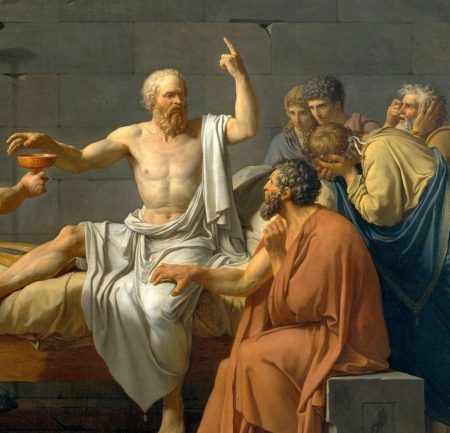
death of Socrates

You yourself, Aristomenes, were you there on the day that Socrates married?

Yes, I was, and it makes me tremble to recall the strange mix of pleasure and pain with which we, his friends, saw him led to the altar. We gathered at the Cock & Bull for his bachelor party. No topless serving girls jiggling with trays, no pole-dancing beauties with marvelous twists and turns caressing poles — Socrates desired only to sit and drink and talk with his friends.

So, what did the man say before getting married? How did he prepare himself to meet that end? We all crowded around to learn how Fate had struck. Socrates insisted that before any talk we make a toast to marriage drained to the dregs. Then he spoke.

Elated that the Redskins had defeated the Cowboys, from RFK Stadium I walked home talking to myself. Can we say that Bigness and Smallness are both in the Redskins? Can we say that the Redskins are better than the Cowboys, because the Redskins are bigger than the Cowboys? Or is it because of the color of their skins? How much redder would the Cowboys’ skins be if the Redskins could skin skin?

Socrates, please, tell us how it happened!

Along with many others, I was laid off from my job as an adjunct professor at the Frederick Douglass Community College. Some proposed a hunger strike in protest. But my unemployment benefits were higher than the meager wage the college paid to its slave-like adjuncts. I was already nearly starving. My belly ached with the ache that has gnawed at thinkers and writers since Hesiod lamented the rocky soil that he worked. So I bought a delicious double quarter-pounder with cheese, a hamburger to truly honor the hungry. At MacDonald’s, that’s cheaper than a half-pounder.

A week later I was evicted from my studio apartment. I could pay the rent with my unemployment check, but they refused to renew a lease to the jobless. Shaken to the essence of my being, I checked into a cheap inn that had at its front desk a hostess named Xanthippe. She was an old woman, but still somehow had a sexy look in the joyfully expanding wrinkles around her eyes. I told her that I had extensively studied philosophy, that I had been abruptly laid off as an adjunct professor, and that I could no longer explore being with students. She invited me to her bed. With one single act of sex, and with knowledge of how law imposes forced financial fatherhood on men, I had no better choice than to accept a decrepit and pestilential Xanthippe as my future wife.

At the Cock & Bull, all Socrates’s friends were distraught. Peter Dronke wept. He said, “Socrates, I’ve come to recognize you as the noblest and gentlest and best man among all who have drank at this bar. How could the best man get married?” Dronke spasmodically sobbed, turned, and walked away without paying his bar tab. But R. Howard Bloch, more a hanger-on than a friend, told Socrates, “You valorize in imputation all the impassioned violence of men for your acts of writing with a pen. You hate women because you choose the voluputations of Venus and a hoary whore so as to gain a patriarchal position in the home.” Socrates, with a look of befuddlement on his face, said nothing in response.

I put two fingers to my mouth. Pushing my lips gently through them, I told Bloch, “Don’t disparage that other-worldly woman, or she will do us grave harm. She is a witch. She can cause the sky to fall or the earth to heave into the air; she can solidify gushing fountains, dissolve mountains, call up daemons and bring down gods, extinguish stars and light up Hell.” Bloch scoffed and said, “Take away that tragic curtain, fold up these linguistic constructions, and set it out in ordinary language.” With a heavy heart I responded, “She has turned you into a chased beaver. You’re obscuring your transformation by the fuliginous fabric of your pants. She forced a man to make monthly payments to a woman who raped him. She could turn me into a frog.” I’d rather be turned into a donkey, which is well-hung, I thought.

Fearing that Xanthippe might sniff even from a great distance word of what was said and that doing so might spur her to abuse Socrates further, I coaxed him to come with me to my apartment. Having made many strong toasts to marriage, he was weary and quite drunk. Soon he was snoring on my bed even as I spoke learnedly of contraries, hoping he would understand their relevance to the merits of marriage. What if Xanthippe stormed into the room in search of Socrates? I put my cot across the door to be sure that I could insist that he wasn’t here and call for help before she could break in.

After much restless worry I finally fell asleep. Then suddenly the door was smashed in. It tumbled over my cot, overturning it and pressing me underneath like a turtle with a cot shell. I kept my body hidden within my shell and, raising the lid of one eye, warily scanned the room. Two old women, one with a bare sword and another with a lighted lantern, menacingly surrounded the sleeping Socrates. The one with the sword said:

This one, sister Panthia, is the dear Endymion, this one is my Catamite, who for days and nights made fun of my tender age, this is the one who poured disdain on my love and not only maligned me with slanders, but also arranged his escape. But I, deserted, to be sure, through the cunning of an Odysseus, will weep, Calypso-like, for my eternal loneliness.

Then she pointed to me:

He’s watching us, he who led my fiancé to the Cock & Bull bachelor party where unkind words were said about me. Later, no soon, no right now, he’ll feel pain for his past pleasantries and present watchfulness.

Panthia proposed tearing my limbs off in a Bacchic frenzy, or at least tying me up and castrating me. I quaked with fear, causing the cot on top of me to jiggle and dance. Xanthippe said no, let him live to see his friend Socrates led to the altar. Then she plunged her sword into the left side of Socrates’s neck and thrust it in to the hilt. After carefully collecting in a leather bottle blood gushing from the wound, she stuck her right hand into the wound and reached down into Socrates’s innards. Grasping his heart, she pulled it out as he rasped forth a moan. She took a wooden box from her satchel, placed his heart into it, and returned the box to her satchel. Then she staunched his throat wound with a sponge.

The old women-witches came toward me. They pulled away my protective cot shell, squatted over my face, and emptied their bladders. I was soaked in their urine. With wetted, stinging eyes I watched them walk out of the room. Then the door suddenly pulled back from the floor onto its hinges as if it had never been smashed in. I felt as if I had experienced a bad, wet dream that had left me extensively soiled. How could I attend my dead friend Socrates’s wedding?

I knew it was impossible. I couldn’t live to do it. I addressed my cot as a death-bringing savior:

Now is the time, my cot, most dear to my heart, you who have suffered together with me so many trials and tribulations as my accomplice and spectator of what happened this night. You, whom alone I can summon as witness for how I was soiled, now that my life promises to lead me to see my dead friend married, supply the saving weapon to me and send me to the Underworld where the blessed dead don’t live to be married.

After this solemn oration I unraveled the rope that held together the cot’s frame. I tossed one end of the rope over a beam near the window and tied the other end into a noose. I climbed up onto the remains of the cot and fitted the noose around my neck. I pushed away the cot’s remains. so that my body would drop, the noose would tighten around my neck, and my inspiration would end. Instead the rope, old and worn, broke. I tumbled to the floor atop the inert body of my beloved friend Socrates.

At that very moment the porter burst into the room. The dead Socrates got up and walked toward him. Socrates spoke to him of his rudeness in waking us from our pleasurable sleep. I was filled with astonishment and joy. Socrates lives! I embraced him and began kissing him passionately as the porter looked at us knowingly. Socrates pushed me away, saying, “You stink like the bottom of a latrine.” Indeed I did, and he began to enquire why. I improvised an absurd joke to shift the direction of the dialogue. Then I took his hand and proposed, “Let’s enjoy the charms of an early-morning stroll.”

Walking through a meadow in the radiant light of morning, I kept studying the spot on Socrates’s throat where Xanthippe had thrust her sword. I said to myself:

You are mad, you were buried in your cups of wine and had merely a bad nightmare! Look, Socrates is untouched, healthy and unhurt. Where is the wound, where is the sponge? Where, finally, is that scar so deep, so fresh?

I said to Socrates:

It’s not without reason that trustworthy doctors maintain that people swollen with food and spirited drinks have vicious and oppressive dreams. Take me, for instance. Because last evening I did not sufficiently restrain myself from the marriage toasts, a rough night brought me dire and wild visions, so that I still believe that I have been splattered and polluted with human blood.

Socrates smirked at this and responded:

You were not doused in blood, but in piss. But I myself had a dream, too, that I had my throat cut. For I felt pain in my throat, right here, and believed that my heart itself was torn out of me. Even now I am out of breath, my knees shaking when I walk, and I crave some drink to warm my spirits again.

Without understanding, I asked Socrates if he, the most blessed and happy of men, still intended to marry Xanthippe. Isn’t getting married an injustice against those who love you? Doesn’t your body rebel in fear at the horror of sexless marriage? How can you endure the idea that marriage is meant to last forever, despite better and worse opportunities for escape, even through sickness and death?

Socrates explained that, for men, marriage is the practice of dying and being dead. Love, he explained, is a prison from which men find release in marriage. If you embrace misology and misandry, you find no reason to fear death, and you understand that marriage is purification that brings men to ennobling love. Moreover, in truth, under long-established paternity law, sexless marriage doesn’t impede a husband from being credited with many children. Many persons’ beliefs about paternity are merely shadows and lies.

I sank to the ground in aporia.

Two weeks later, with his friends watching in silence, Socrates was led to the altar to marry Xanthippe. His friends never saw him again.

death of Socrates

*  *  *  *  *

Read more:

Notes:

The above story is adapted from Apuleius’s Metamorphoses 1.6-19 (Aristomenes’s story about Socrates and Meroe), and more distantly, from Plato’s Phaedo. Scholars haven’t adequately appreciated the relation of Aristomenes’s story about Socrates and Meroe to literature of men’s sexed protest. The above adaptation is intended to advance scholarly inquiry into this important topic.

Several quotations above are closely adapted from the English translation of May (2013). They are (cited by book.chapter.section in Metamorphoses and page in id.): 1.12.4–6, p. 77 (This one, sister Panthia…); 1.16.2-3 (Now is the time, my cot…); 1.18.2-3, p. 83; 1.18.4-5, p. 83 (It’s not without reason…); 1.18.6-7, p. 83 (You were not doused in blood…). The incident of the two women pissing on Socrates is lightly adapted from Metamorphoses 1.13.8. For a close reading of that incident, Watson (2004).

The Metamorphoses emphasizes negative possibilities for marriage. It presents “marriage as undependable, sexual trust as unimaginable, and conjugality as a likely source of humiliation and amusement for others.” Lateiner (2000) p. 316. “The general idea of marriage in Apuleius is that there is an ultimate breakdown of affection.” May (2005) p. 148. In the Metamorphoses, the sexual relation of Photis and Lucius, however, is extraordinarily warm and generous. On optimistic views of marriage in the Metamorphoses, McNamara (2003).

The recovery of the lost third book of Apuleius’s De Platone et eius Dogmate should increase interest in Aristomenes’s story about Socrates and Meroe. In his summary of Phaedo, Apuleius observed:

the origins of things and their ends come about from their opposites.

{origines rerum et interitus ex contrariis fieri putat.}

Stover (2016) pp. 108-9. At the same time, Apuleius emphasized the prohibition on suicide that Plato sets out in the Phaedo:

he speaks both about dreams and about the providence of the gods, which forbids one to depart from life † … † and he does not think it right to undergo voluntary death, if no reason requires it.

{aeque de somniis loquitur tanquam de providentia deorum vetante excedere †autem† vita; et voluntaria morte obire nulla ratione dictante non iudicat.}

Id. Stover observed:

{Apuleis} takes such pains to emphasize the prohibition on suicide in the Phaedo because of the widely disseminated stories of people killing themselves after reading the dialogue.

Id. p. 154. Lucius himself considers suicide, without negative moral coloring, three times in the Metamorphoses: 4.2.17-22 (by eating poisonous laurel-roses), 7.24.4-5 (by hunger strike or jumping from a cliff), and 10.29.3-6 (by a sword). For discussion, Michalopoulos (2002). The marriage of Socrates, and the more general issue of men marrying, provides an additional, rich context for considering Apuleius’s reading of the Phaedo, Aristomenes’s story about Socrates and Meroe, and suicide.

[images] (1) Death of Socrates. By Jacques-Louis David, 1787 (oil on canvas). Held in Metropolitan Museum of Art, New York, Gallery 601, accession #31.45. Credit to Catharine Lorillard Wolfe Collection, Wolfe Fund, 1931. Image thanks to the Met and Wikimedia Commons. (2) Death of Socrates. By Mark Antokolsky, 1875 (detail of sculpture). Image thanks to Alex Bakharev and Wikimedia Commons.

References:

Lateiner, Donald. 2000. “Marriage and the Return of Spouses in Apuleius’ Metamorphoses.” The Classical Journal. 95 (4): 313-332.

May, Regine. 2005. “Chaste Artemis and Lusty Aphrodite: The Portrait of Women and Marriage in the Greek and Latin Novels.” Ch. 7 (pp. 129-153) in Smith, Warren S., ed. Satiric Advice on Women and Marriage. Ann Arbor, MI: University of Michigan Press.

May, Regine, ed. and trans. 2013. Apuleius’ Metamorphoses or the Golden Ass: Book 1. Oxford: Oxbow Books.

McNamara, Joanne. 2004. ‘The only wife worth having’? Marriage and Storytelling in Apuleius’ Metamorphoses.” Ancient Narrative. 3: 106-128.

Michalopoulos, Andreas N. 2002. “Lucius’ Suicide Attempts in Apuleius’ Metamorphoses.” The Classical Quarterly. 52 (2): 538-548.

Stover, Justin A. 2016. A new work by Apuleius: the lost third book of the De Platone. Oxford: Oxford University Press.

Watson, Lindsay. 2004. “Making water not love: Apuleius, Metamorphoses 1.13–14.” The Classical Quarterly. 54 (2): 651-655.

Procopius to Sardou: gender in demonization of Justinian & Theodora

St. Marina of Antioch beating the devil

A mass-market book, co-authored by an eminent anthropologist and published in 1996, demonized males. While demonizing and pathologizing men signals social virtue today, demonizing women would probably be regarded as a hate crime. That wasn’t the case in more liberal and tolerant Byzantine society. In his Secret History, the leading sixth-century Byzantine historian Procopius demonized both Empress Theodora and Emperor Justinian. Yet, revealing a deep pattern of gynocentric society, Procopius demonized Justinian much more extensively than he did Theodora. More than a millennium later, Victorien Sardou’s play Théodora was a smash-hit in Paris. That play makes clear that convincingly demonizing a woman is scarcely feasible in a broadly popular work.

According to Procopius, Theodora and Justinian were demons. The two of them together were demons:

both to me and also to many of us these two never seemed to be human beings at all but rather murderous demons of some kind, or as the poets would say, “a baneful pair they were for all mortal humans,” who conspired together for the purpose of destroying all the nations and the works of men as efficiently and quickly as possible. They put on a human form, thereby becoming human-demons, and in this way demolished the entire world. … {“these two people”} devastated all of humankind and visited disaster upon the entire inhabited world, no one being able to accomplish this except for these two people. … they worked this evil through a power that was not human, for it had a different source. [1]

Men are no more inherently evil than are women. In eleventh-century Byzantium, leading public intellectual Michael Psellos asserted the moral and intellectual equality of women and men. That idea of gender equality commands widespread public assent around the world today. Regarding Theodora and Justinian as equally demonic rightly suggests that evil has no particular gender.

In practice, men are demonized much more extensively than women are. After describing both Theodora and Justinian as demons, Procopius elaborated upon the demonic character of only Justinian. Procopius reported that a demonic creature was thought to have cuckolded Justinian’s father and was thought to be Justinian’s actual, biological father. Some persons reportedly saw Justinian walking headless about the imperial palace. On one occasion, a courtier looked upon the seated Justinian and said that he saw:

his face suddenly became like shapeless flesh: there were neither eyebrows nor eyes in the places where those things should have been, nor did his face show any other features at all. In time, however, he saw the shape of his face return. [2]

Men historically have been regarded as the generic human being “man.” Men in their sexual distinctiveness have thus been historically diminished. Procopius depicted Justinian as a person who could instantly lose his head or his face. That demonizes the already dehumanized-demasculinized man.

Although Procopius extensively characterized Theodora as a woman, he didn’t thoroughly demonize her. She would “slip into the bed with the Lord of Demons” and so become only his wife. After recounting massive deaths in publicly institutionalized men-on-men violence (war), Procopius declared:

That, then, was what befell the whole of humanity while this demon held human form, and he caused all of it, as he was emperor. I will now relate all the evils that he inflicted on humankind through his occult power and demonic nature. [3]

Despite women’s central role in causing and sustaining wars, Procopius blamed only Justinian for the wars of Byzantium. Procopius attributed floods, earthquakes, and plagues to the occult and demonic nature of only Justinian. With respect to Theodora, Procopius reported:

It is said, moreover, that she had managed to subdue Justinian to her will not by fawning on him but by the coercive power of demons. … given he was so vulnerable to witchcraft, as I just said, Theodora easily put him under her thumb.

The Emperor Justinian was under the thumb of the Empress Theodora. Credit for his successes belongs to his wife. But Justinian alone is  responsible for all evil. In similar thinking, the disproportionate share of men among privileged elites results from odious discrimination, but the much more disproportionate share of men among incarcerated persons is no cause for concern.

Sarah Bernhardt as Theodora in bed

In Paris in 1884, the demonic Theodora was the star of Victorien Sardou’s play Théodora. Amid grand stage-sets depicting the imperial Byzantine palace, Theodora wore many custom-made, lavishly bejeweled costumes. One of her dresses was made from:

bleu de ciel {sky-blue} satin, with a train four yards long, covered with embroidered peacocks with ruby eyes and feathers of emeralds and sapphires. It was the work of the most cunning embroiderers in Paris, and was a perfect mosaic of precious stones. [4]

Yearning for freedom in her oppressive position as Empress, the Theodora of this play would sneak out of the palace at night in disguise to mix with gladiators and chariot-riders and to enjoy a passionate extra-marital sexual affair. She of course despised her husband the Emperor Justinian, who was depicted as “not terribly bright.”[5] But she was intensely loyal to her non-royal lover. When a captured conspirator might have revealed her affair, she killed him by stabbing him in the heart with one of her gold hair-pins. After her lover died of poison that she accidentally gave him and her husband discovered her infidelity, she was condemned to death among public chaos. Like many women, she nobly submitted to having a court eunuch strangle her with a red silk cord as Constantinople went up in flames.[6]

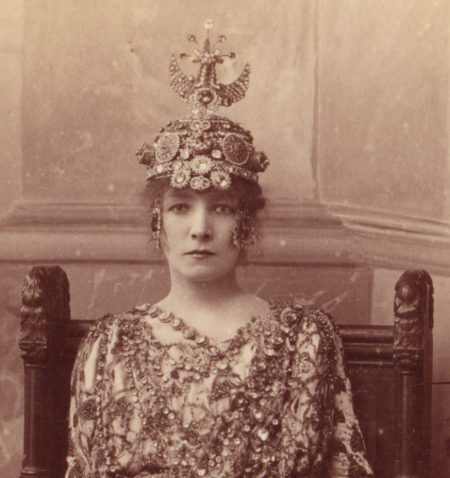
The Theodora of Sardou’s Théodora was massively attractive to women and men. Sarah Bernhardt, a famous actress who herself was the daughter of a prostitute, starred as Theodora. The play ran in Paris for an unprecedented 257 consecutive showings at high ticket prices and generated enormous revenue. The play then went on a world tour, with Sarah Bernhardt appearing as Theodora nearly nine hundred times.[7] For a 1888 adaption presented in the Gilliss Opera House in Kansas City, Lilian Olcott “purchased in Paris exact duplicates of the costumes, properties and all other material, as the French express it, as used in the original production.”[8] Théodora was revived in Paris at the Sarah-Bernhardt Theatre in 1902 and was even more successful than at its premiere. Théodora was made into multiple silent films between 1900 and 1930. The most successful silent film was the Italian Cinematographic Union’s 1922 Theodora. That high-budget film, which included thousands of extras, was touted as “Sardou’s Famous and Sensational Love Romance” and “The Greatest Screen Spectacle the World Has Ever Known.”[9]

Sarah Bernhardt as Empress Theodora

While men are readily demonized, demonizing women is scarcely feasible. Procopius elaborated upon the demonic character of Justinian, but he didn’t characterize Theodora as the “Lady of Demons.” As a scholar recently commented, “we all get the Theodora we deserve.”[10] Because most men act like Justinian’s General Belisarius and most women are obsessed with their own oppressed wonderfulness, we have as our woman-hero the Theodora of Victorien Sardou’s Théodora.

*  *  *  *  *

Read more:

Notes:

[1] Procopius of Caesarea, Secret History 12.14,16,17, from Greek trans. Kaldellis (2010) p. 58, with some changes. Kaldellis translated ἀνθρωποδαίμονες as “man-demons.” The translation of Dewing (1935) and the translation of Atwater (1927) made the same gendered choice. The Greek ἀνθρωπο can mean either male human beings or human beings in general. In context, “man-demons” characterizes “they,” meaning Justinian and Theodora. Hence “human-demons” is a better translation. That’s what I’ve used above. In Kaldellis’s translation, I’ve also changed “mortal men” to “mortal humans” and “mankind” to “humankind” to better translate the gendered context. Jeffreys’s translation of Digenis Akritis made a similar mistake in translating an important passage. See note [3] in my post on Byzantine matriarchy devaluing men’s lives. Kaldellis and Jeffreys are leading translators of Byzantine texts. Their translation failings show the pressing need for more concern for men among Byzantine scholars.

[2] Procopius, Secret History 12.23, trans. Kaldellis (2010) p. 59. Justinian being a product of demonic cuckolding and Justinian walking around the palace without his head are described in Secret History 12.18-9 and 12.21-2.

[3] Secret History 18.36, trans. id. p. 85. I subsequently cite Secret History by chapter.section and page in id.). That Theodora would “slip into the bed with the Lord of Demons,” 12.32, p. 61. On the evils that he inflicted through floods, earthquakes, and plagues, 18.37-45, pp. 85-6. Procopius reported that a monk called Justinian the “Lord of Demons.” 12.26, p. 60. The subsequent quote is from 22.28, 32, p. 100.

[4] Hart (1913) p. 268. Boeck (2015), p. 119, quotes Richardson (1977), which reproduces verbatim part of Hart’s text above. Théodora opened at the Porte Saint-Martin theatre of Paris, under manager Felix Duquesnel, on December 26, 1884. Here’s some additional information about the production.

[5] Boeck (2015) p. 109.

[6] Hart (1913), pp. 265-9, and Boeck (2015) pp. 109-10, provide summaries of the plot of Théodora.

[7] Boeck (2015) p. 103, Hart (1913) pp. 95, 265. Théodora, “a brilliant success,” had receipts of 1,654,000 francs. Ticket prices were “as high as 60 francs.” Id. Assuming an average ticket price of 30 francs implies a total Parisian audience of about 50,000.

[8] Boeck (2015) p. 115, quoting from Souvenir Program, “Lilian Olcott in Sardou’s Theodora,” 7–8. The Harry Ransom Center of the University of Texas, Austin. Bernhardt Collection, Box 4.8.

Sardou brought real lions onto the stage for Théodora at the Porte Saint-Martin in Paris. The performance at the Gilliss in Kansas City originally had a papier-mâché lion. However, the drama editor for the Kansas City Times, David Austin Latchaw, suggested that his friend’s Great Dane might pass for a mountain lion and be an improvement. That dog was thus engaged for the remaining performances. He became a noted member of the cast:

At the Wednesday matinee, the dog prowled the cage convincingly until Olcott’s entrance. Having become fond of her, the dog easily got out of the cage that had been constructed for the inanimate lion. When Olcott sat down on a tree stump, the Great Dane crossed to “put his weighty head into her lap and refused to budge.” She stood and “abandoned her lines and business long enough to make the dog leave her; whereupon he walked over to the stump, turned around for a time or two and let himself drop against the unrooted remnant of a forest tree. But the stump resented the intimacy and moved away. The amusement ‘out front’ had been well restrained up to the point, but here it gave way to hilarious merriment. Miss Olcott joining in the laughter.

Londré (2007) p. 147.

Other adaptations of Sardou’s Théodora were produced. Those included one by Robert Buchanan at the Theatre Royal, Brighton. Buchanan’s production opened on November 18, 1889. Hart (1913) p. 96.

[9] See, e.g. an advertisement in the Magazine Theatre Program (New York) in 1922. This advertisement and another similar advertisement are on display in the Dumbarton Oaks Museum (Washington, DC), Imagining the Empress: Theodora in Popular Culture, 1882–1922. Curatorial material for that exhibit states Sardou’s Théodora inspired multiple silent films from 1900 to 1930. The exhibit includes late-nineteenth-century cameo-bearing buttons of Theodora and Justinian. Those buttons were “designed as party-going accessories that were meant to be affixed to a sash” (from Dumbarton Oaks newsletter).

[10] Boeck (2015) p. 132. Working about 1900, the French painters Jean-Joseph Benjamin-Constant and Georges Clairin painted portraits of Theodora. Lady Randolph Churchill, Winston Churchill’s mother, in 1897 attended a fancy ball dressed as the Theodora of Sardou and Bernhardt. Sigmund Freud kept in his office a photo of Bernhardt in the role of Theodora. Id. p. 131.

[images] (1) Saint Marina of Antioch beating the devil. Icon by Lazaros, 1857. Held in the Byzantine Museum, Athens. (2) Sara Bernhardt playing Theodora, in bed. Detail from painting by Georges Jules Victor Clairin, 1902. Thanks to Wikimedia Commons. (3) Sarah Bernhardt as the Empress Theodora in Sardou’s Théodora. Detail from Albumen silver print by W. & D. Downey. Held in the J. Paul Getty Museum. Other images of Bernhardt playing Theodora are viewable online: her standing, her against a palace door, perhaps her in disguise, and her looking sullen.

References:

Boeck, Elena N. 2015. “Archaeology of decadence: uncovering Byzantium in Victorien Sardou’s Theodora.” Ch. 4 (pp. 102-132) in Betancourt, Roland, and Maria Taroutina, eds. Byzantium / modernism: the Byzantine as method in modernity. Leiden, Netherlands: Brill.

Hart, Jerome Alfred. 1913. Sardou and the Sardou plays. Philadelphia: Lippincott.

Kaldellis, Anthony. 2010. Prokopios. The secret history: with related texts. Indianapolis: Hackett.

Londré, Felicia Hardison. 2007. The enchanted years of the stage: Kansas City at the crossroads of American theater, 1870-1930. Columbia: University of Missouri Press.

Richardson, Joanna. 1977. Sarah Bernhardt and her world. New York: Putnam.

Nikephoros Gregoras to husband being cuckolded by beautiful wife

lioness maulting martyr Basil of Ancyra

In fourteenth-century Constantinople, the eminent intellectual Nikephoros Gregoras wrote an eloquent letter in Greek to an unnamed friend. Gregoras’s friend had a beautiful wife. She began cuckolding him only a few days after their marriage. She apparently was also falsely accusing him of sexual improprieties. While expressing outrage and sympathy, Gregoras urged his friend to accept his marital fate as the natural order in marrying a beautiful woman.

Gregoras’s letter begins with a vague declaration, “I know it very well.” The letter then immediately shifts to intimate, second-personal address. “I know it very well” seems to refer to being cuckolded. Gregoras’s letter shows that he understands cuckolding through examples in classical literature. But his introductory declaration seems personal. It suggests that Gregoras too has been cuckolded.

Gregoras also refers to an unnamed “excellent man” who has informed him yesterday about the addressee’s situation. Gregoras praises the unnamed, excellent man with lofty epithets. That praise lacks motivation. Within the overall context of the letter, the unnamed excellent man plausibly is an alternative rhetorical figure for the addressee of the letter.[1] That alternate addressee re-enforces the the letter’s constructed contrast between the majesty of learning and the disgrace of being cuckolded.

Gregoras playfully chides his learned friend for betraying learning about women. Byzantine scholars knew that Phaedre falsely accused her stepson Hippolytus of raping her after he rebuffed her amorous advances. They knew that Euripides was wrongly tarred with hating women. They knew that the Athenian orator Lycurgus was wrongly impugned for wronging women when he forbid rich women to ride to Eluesis in coaches (carpenta) so as not to shame poor women who lacked coaches.[2] Recognizing Xanthippe’s domestic violence against Socrates enabled Byzantines to have a more truthful understanding of domestic violence than many persons have today. Misandry that went even to the extreme of androcide was never forgotten with remembrance of the Lemnian deeds. Most importantly, women’s great power to promote war was freely and openly recognized in recalling the horrors of the Trojan War.

That some men get cuckolded was no secret in Byzantium. Learned Byzantines knew that the yes-dearing Hephaistos, who at the behest of his wife Aphrodite dutifully made a shield for Achilles, was cuckolded by Ares. Zeus, who had deposed Chronus, the father of castration culture, avoided only through a cloud an affair between his jealous wife Hera and the King of the Lapiths Ixion. Zeus himself, taking the form of a swan, had sex with Leda, the wife of the Spartan King Tyndareus. And of course Philip of Macedonia, nominally the father of Alexander the Great, had been cuckolded by the Egyptian magician Ammon (Nectanebo), the true biological father of Alexander. In recognition of the serious public problem of false paternity beliefs, the great Byzantine leader Constantine the Great erected a statue of Aphrodite to help husbands learn whether they had been cuckolded.

Gregoras’s letter concludes with unconsoling wisdom. If a man wishes most easily to pass through the alternations of happiness and misfortune that pattern human life, he should either not marry or marry an unattractive woman. Most men would find the second option less attractive. As for his married friend being cuckolded, Gregoras advised him to endure his misfortune with courage and philosophy. By philosophy he seemed to mean classic stories of women wronging men.

—————-

Gregoras’s letter, in translation from the original fourteenth-century Byzantine Greek, is given in full below.[3] One of the most poignant, eloquent, and influential works of men’s sexed protest is the medieval Latin letter Dissuasio Valerii ad Rufinum. In that letter, Valerius attempts to dissuade his friend Rufinus from getting married. Gregoras’s letter to his married friend being cuckolded is a worthy complement to Dissuasio Valerii ad Rufinum.

Gregoras’s full letter to his married friend being cuckolded:

I know it very well. You understand, my dearest, the affection I have long had for you. You have been able, I believe, to guess what grief I have felt, needless to say, at the news of the misfortune which has just washed over you. I questioned yesterday on this subject that excellent man, “the springtime of eloquence, the joy of the learned, the dear, the amiable, the laudable man.” He told me everything in detail. What he informed me is that you have united yourself to a woman remarkable for her beauty as well as her birth, young, but of deplorable conduct. She has disgraced your bed a few days after your marriage. She was sober-minded, but her conduct today insults you, and worst of all, in spite of all this, she bad-mouths you. As the proverb says, those who wear horns deserve blows.

Hearing this story, I hid myself with shame, by Athena, by Hermes, by the Muses, and I wished to see the earth open under my feet. It is a disgrace, a shameful disgrace to your friends, to learning itself. What an unforeseen misfortune! What an insult! What outrage to the majesty of learning! What evil genius has pushed her to wish to behave against you thus? Do you not know, having heard them yourself, of so many stories, that a reasonable man, who knows how to be wise, doesn’t find agreeable a woman adorned with impudence? No single anchor could restrain her, as one restrains a boat. But the boat that she is breaks its moorings many times and seeks shelter in another port. Do you not know that Solomon says that three things shake the earth and that a fourth it cannot bear: that is a prostitute who meets an honest man or who, after her adventures, washes herself and say she hasn’t done anything extraordinary. Nothing is so inconstant as the mind of the unchaste woman, nothing is more inclined to weave insinuating calumnies and false accusations, and to turn back her own faults upon innocent men. If she has superior social-standing and birth, things that easily toss like dice the evidence on which accusations are based, then one must have the goodness of God and the depth of the sea to be cleansed of insults and slander from the tongue of the perverse one. Do you not know the attitude of Phaedre, the wife of Theseus, to the wise Hippolytus, and how much her calumnies have been stronger than the truth? Do you not know how much the learned Euripides, as well as the orator Lycurgus, suffered from the tales of women, said to be as acrid as smoke, as dirty as dust? Do not you know with what disturbances Xanthippe filled the house of Socrates? Are not the evils of Lemnos due to women? Is it not the same with the evils of the Trojan war?

What good is it to enumerate in detail, what is the use of telling a man who knows all these things? It was inevitable, it could be said; beauty doesn’t endure through time, free from jealousy. But I let myself be carried away unconsciously by the pain and I let myself be led to talk about things, somewhat beside my subject. I had to console a man gnawed by grief. I do the opposite, I think. I irritate his grief with what I tell him. But you’re a learned man. You know more than anyone else about consoling others who are in the same situation. You will undoubtedly apply the logical remedies suited to the present case. You remember, if the pain has not clouded your memory, that Hephaistos suffered this misfortune from Ares, Zeus from Ixion, the Spartan Tyndareus from the swan, Philip of Macedonia from the Egyptian Ammon. Your suffering therefore has nothing strange to the natural order. Misfortune generally follows happiness. There can be no existence without sorrow. If you personally wished to run the double course of life with the least possible difficulty, you would need to do one of two things: either do not marry, or do not marry a pretty woman so that you won’t have to share your wife with the whole world.

May I see you, a young married man, in good health, and enduring your misfortunes with as much courage as philosophy, so that I am not obliged to plait in your honor tragic chants instead of a wedding song.

*  *  *  *  *

Read more:

Notes:

[1] In the penultimate paragraph of his letter, Gregoras clearly refers to his friend in the third person as “a man gnawed by grief.”

[2] See Pseudo-Plutarch, Lives of the Ten Orators, Lycurgus.

[3] Nikephoros Gregoras, Letter 129 (written 1330-1340), original Greek with French translation in Giulland (1927) pp. 220-5. The above English translation is mine. A more recent Greek text for the letter is Letter 123 in Leone (1982) vol. 2, pp. 318-20. Garland (1996), p. 15, declares that Gregoras “is here conforming to the misogynistic outlook typical of Byzantine theology.” Littlewood (1999), p. 33 n. 67, describes the letter as “tongue in cheek.” Neither of those scholarly judgments seem to me to do justice to Gregoras’s letter or to the reality of men’s lives. For a general review of Gregora’s life, intellectual interests, and letters,  Manolova (2014) Part I. On the prior Byzantine tradition of letters of consolation, Littlewood (1999).

[image] Lioness mauling martyr Basil of Ancyra. Illumination (detail) from the Menologion of Basil II, Vatican Library, Ms. Vat. gr. 1613, f. 63. Thanks to Wikimedia Commons.

References:

Garland, Lynda. 1996. “‘How Different, How Very Different from the Home Life of Our Own Dear Queen,’ Sexual Morality at the Late Byzantine Court with Especial Reference to the 11th and 12th Centuries.” Byzantine Studies / Études Byzantines 1–2: 1–62.

Giulland, Rodolphe, ed. and trans into French. 1927. Correspondance de Nicéphore Grégoras. Paris: Les belles lettres.

Leone, Pietro Luigi M., ed. 1982. Nicephori Gregorae epistulae.  Two vols. Matino: Tip. di Matino.

Littlewood, A. R. 1999. “The Byzantine Letter of Consolation in the Macedonian and Komnenian Periods.” Dumbarton Oaks Papers. 53: 19-41.

Manolova, Divna. 2014. Discourses of Science and Philosophy in the Letters of Nikephoros Gregoras. Ph.D. Thesis. Medieval Studies Department and the Doctoral School of History, Central European University of Budapest.

Empress Theodora, a woman leader with strong, independent sexuality

While men throughout history have appreciated the beauty of women’s genitals, few have credited women with strong, independent sexuality and full commitment to a career. That’s in part because gynocentrism demands adherence to the myth of women’s innate virtue and the myth of women’s natural moral superiority to men. The sixth-century Byzantine historian Procopius of Caesarea, however, had both an extraordinary concern for historical accuracy and prudent regard for the danger of truth-telling. In his Secret History, Procopius thoroughly recorded the sixth-century Byzantine Empress Theodora’s strong, independent sexuality and her full commitment to her career.

Byzantine Empress Theodora and her court

Before she reached puberty, Theodora worked outside the home as a sex worker in the Byzantine capital Constantinople. Her father was the keeper of bears for the popular spectacles held in that city. Theodora thus grew up with appreciation for the fundamentals of animal behavior, life and death, and performance. As a young girl, Theodora was remarkably beautiful. Her older sister, also quite beautiful, worked as an exotic dancer and call girl. To help her older sister, Theodora carried around the stand upon which her older sister danced. Theodora herself provided special service to the under-served: she served homosexual men, including slaves, who wanted anal sex.[1] In accordance with hetero-normative ideology, market incentives, and personal preferences and comfort, most women prostitutes historically have focused their practice on heterosexual men. Theodora, in contrast, reached out to serve sexually marginalized men.

Theodora worked hard and was dedicated to her career. She unfortunately lacked natural talent in singing and dancing. Not letting that discourage her, she took up work providing background sexual displays in mime shows:

There was no shame at all in her, and no one ever saw her embarrassed. …. Often she would take her clothes off and stand in the middle of the stage by the mimes, alternately bending backwards or drawing attention to her rear, advertising her special brand of gymnastics both to those who had more intimate knowledge of it and to those who did not — yet. Thus did she abuse her own body licentiously, making it seem that she had genitals not in the place where nature ordained for all other women, but in her face. [2]

As a sex worker, Theodora worked long hours to serve many customers. Moreover, she didn’t provide merely perfunctory service:

She would joke with her lovers lying around in a bed with them, and by toying with new sexual techniques, constantly managed to arouse the souls of those who were debauched. Nor did she wait for her customers to make the first pass at her; quite the contrary, she herself tempted all who came along, flirting and suggestively shaking her hips, especially if they were beardless youths. … She often went to the potluck dinner parties in the company of ten young escorts, or even more than that, all at the peak of their physical prowess and skilled at screwing, and she would bed down with her fellow diners in groups all night long. And when all were exhausted from doing this, she would turn to their servants, all thirty of them if that’s how many there were, and couple with them separately [3]

Theodora resented the biological reality of female human nature and strove to overcome it:

Even though she put three of her orifices to work she would impatiently reproach Nature for not making the holes in her nipples bigger than they were so that she could devise additional sexual positions involving them as well. She was often pregnant, but by using almost all known techniques she could induce immediate abortions. [4]

Advancing to a high position in any career requires hard work, dedication, and sacrifices. Theodora clearly was determined to succeed in her career and show the world what a woman could do.

While some women tend toward modesty and lack assertiveness, Theodora assertively placed herself in positions attracting massive public attention. Performing in Constantinople’s amphitheater, Theodora, wearing only a loincloth, would stand at the center of attention. Then she would lie down and spread her legs. Circus hands would come out and sprinkle barley grains underneath her loincloth and onto her genitals. Trained geese then would come out and peck and eat the grains off her genitals.[5] The geese stretching their long, muscular necks into her groin surely thrilled crowds. Theodora provided theater-goers with unforgettable, transgressive performances worthy of modern pop stars such as Madonna and Lady Gaga. Those performances undoubtedly helped to boost her career.

Zeus in form of swan has sex with Leda

Given Theodora’s career success, she not surprisingly had a great marriage. An eminent Byzantine official named Justinian became infatuated with her. Under Byzantine law, such officials were not allowed to marry prostitutes. Justinian thus at first took Theodora as his mistress. Eager to marry her, he convinced Emperor Justin to annul the law against high officials marrying prostitutes. Justinian then married Theodora. Procopius observed:

It was possible for Justinian to have selected a spouse from the whole of the Roman Empire, to have married a woman who was the most well-born among all women and had been raised outside the public gaze, who had learned ways of modesty and lived discreetly; moreover, she could have been exceedingly beautiful and still a virgin and even, as they say, with perky breasts.

As many young women today understand, career success is what men value most in a woman. Byzantines, from Senators to soldiers, dutifully acclaimed the Emperor’s wife and prostrated themselves in service to her.[6]

Theodora went on to enjoy a gender-egalitarian marriage. The Empress Theodora and the Emperor Justinian “did nothing independently of each other.” In a letter to a high Persian official, Empress Theodora wrote that her husband “does nothing without my consent.” Anyone who administered an imperial order for which Empress Theodora hadn’t been consulted would be put to death:

Were the emperor to delegate a certain matter to a person without first asking her opinion, the fortunes of that person would soon afterwards know such a reversal that his position of honor would be removed in a most insulting way and he would die a most disgraceful death.

To avoid being killed, courtiers assiduously sought to consult with the Empress on all matters of state. Theodora and Justinian thus achieved the ideal gender-egalitarian marriage toward which well-educated couples today still struggle.

Theodora ensured that government policies favored women. She strengthened support for wives’ sexual freedom:

They were given full license to cheat on their husbands and no risk or harm could come to them because of their behavior. Even those convicted of adultery remained unpunished, because they would go straight to the empress and turn the tables by hauling their husbands into court through a countersuit, despite the fact the men had been charged with no crime. All the men could do, even though they had not been convicted of anything, was to pay back to their wives the dowries that they had received, only twofold, to be whipped and then, for the most of them, led off to prison. After this, they had to look on again as these adultresses preened and lusted after their seducers, only more flagrantly this time. … From then on most men were only too happy to endure without protest the unholy deeds of their wives. So long as they were not being whipped, they gave their wives the freedom to do whatever they wished by pretending not to know what was going on.

At the same time, to limit husbands’ sexual opportunities, Theodora forcibly removed women prostitutes from Constantinople. Under gynocentrism, men are reluctant to marry. Theodora forced men into marriage:

All of a sudden each man would find that he had a wife, not because this pleased him, which is how these things are done even among the barbarians, but because it had been decide by Theodora. [7]

She even forced men to marry a different woman from the one that they were already engaged to marry. For example, Theodora forced a man to marry a prostitute rather than his well-born, virgin fiancée. After consummating his Theodora-arranged marriage to the prostitute, he told a friend that his new wife hadn’t been a virgin. For that offense, Theodora had the man punished severely:

She ordered her servants to lift him up the way one does schoolchildren and give his back a good long whacking for showing off and boasting about things to which he had no rights. She then told him not to run his mouth off again. [8]

Fears of similar punishment might help to explain why few persons today discuss men being forced into financial fatherhood.

Empress Theodora was a woman who had it all. She held the highest political office as co-ruler of Byzantium. She also enjoyed a leisurely, luxurious life:

She would rush to her bath first thing in the morning but would tarry there for a long while. Having bathed so sumptuously, she went to breakfast. After breakfast she rested. At lunch and dinner she like to taste every variety of food and drink. Sleep always took hold of her for long stretches, her daytime naps lasting until night set on and she slept again at night until the sun rose.

Theodora’s hard work, dedication, and sacrifices to get ahead in her career paid off in the wonderful life she had. Theodora is an inspiring model of success for women and girls around the world today.

*  *  *  *  *

Read more:

Notes:

[1] Procopius of Caesarea, Secret History 9.8-10 (all the details in the above paragraph). Kaldellis (2010) provides the most accurate English translation of the text. Bill Thayer has made conveniently available online the English translation of Henry Bronson Dewing for the Loeb Classical Library (1935). Richard Atwater’s English translation (1927) is also freely available online. Correctly transliterated from the Greek, the author of the Secret History is Prokopios. I’ve used the more common form Procopius to be more accessible to readers.

Theodora was the Byzantine Empress from 527 to 548, when she died. Procopius apparently finished writing his Secret History in 550/551. Kaldellis (2010) p. lxiv. The Byzantine bureaucrat John Lydus was probably a close friend to Procopius and probably read his Secret History. Kaldellis (2003) p. 134. The Secret History became widely distributed only after a manuscript of it was discovered in the Vatican Library in 1623. Id. p. ix. For a review and bibliography of scholarship on Procopius from 2003 to 2014, Greatrex (2014).

[2] Secret History 9.14, 23-4, Greek translation (modified insubstantially) from Kaldellis (2010) pp. 41, 43. While naked, Theodora apparently bent over and put her face between her legs.

Subsequent quotes above from the Secret History (cited by section.subsection and page in Kaldellis translation): 9.15-6, pp. 42-3 (She would joke…); 9.18-9, p. 42 (Even though she put three…); 10.2, p. 47 (it was possible for him…); 10.13, p. 48 (did nothing independently…); 2.35, p. 14 (does nothing without my consent); 15.10, p. 68 (Were the emperor…); 17.24-6, p. 78 (they were given full license…); 17.29, pp. 78-9 (All of a sudden…);  17.37, p. 79 (she ordered her servants…); 15.7-8, p. 68 (she would rush to her bath…).

[3] The Christian saint Mary of Egypt was also highly capable sexually. In Mazaris’ Journey to Hades, an early fifteenth-century Byzantine text, Holobolos tells that he fell in love again with “a nun, who had slept with a thousand men, an old flame of mine.” Mazaris’ Journey 128.5, from Greek trans. Seminar (1975) p. 21. An early-fifteenth-century Arabic text tells of men who performed even more extraordinary sexual feats.

With lack of appreciation for women’s strong, independent sexuality, historians have wrongly interpreted Procopius as providing gossip, lies, and rhetoric lacking in truth value. For example, Brubaker refers to “the prurient sexual slander that Prokopios layers on Theodora and her friends (so at odds with our general notions of Byzantine life).” Brubaker (2004) p. 84. That Byzantines engaged in a variety of sexual practices isn’t at odds with an informed notion of Byzantium and of human history generally. For relevant insights, see Garland (1996) and the twelfth-century Byzantine novel Hysmine and Hysminias.

Projecting the marginalization of women onto Theodora in Procopius’s Secret History is silly. Voluminous scholarship celebrates the power of Theodora as a woman ruler. See, e.g. Diehl (1904), Evans (2002), Evans (2011). Nonetheless, Brubaker declares:

Theodora’s main role in the Secret History is to support Prokopios’ condemnation of Justinian

Brubaker (2004) p. 100. Women should not be merely confined to supporting roles. Strong, independent women have existed throughout history. Modern scholars should recognize that truth, especially with respect to Byzantine gynocentric society.

Procopius’s Secret History is an extremely valuable resource for understanding the truth about Theodora. Procopius was a well-informed, well-connected person writing about events of his own time:

Procopius should not be regarded as an outsider, either in terms of genres, or as someone isolated from contemporary opinion. He worked within the conventions of classicizing historiography and, as a well-born and successful official, had good connections to the upper échelons of the empire.

Greatrex (2000) p. 227. The Secret History makes many specific references to persons, places, and events. It is closely linked to the history in Procopius’s Wars. Kaldellis (2010) pp. xxvi-viii. Procopius repeatedly, explicitly indicated his concern to make known facts. Secret History 1.1-5, 4.32, 5.27, 5.38, 8.22, 9.1, 10.12, 15.39, etc. Cf. Brubaker (2004) p. 84. Moreover, many of the facts in the Secret History can be corroborated with other, credible sources. The sixth-century Monophysite writer Yuhannan of Amida (John of Ephesos) lauded Theodora. He also casually refers to “Theodora who came from the brothel.” Yuhannan of Amida, Lives of the Saints 13, from Syriac trans. Ernest Walter Brooks, in Kaldellis (2010) p. 146. The Secret History is “our most reliable source” about Theodora. Kaldellis (2010) pp. lii, liii.

Scholarly disparagement of the truth value of the Secret History is best understood with respect to current difficulties with truth. Consider, for example, this claim:

The Secret History is a successful piece of fiction, a brilliant parody on the imperial panegyric. It tells us next to nothing about Justinian and Theodora.

Brubaker (2004) p. 101. That’s as factually correct as current mainstream media claims about rape, or gender-biased accounts of domestic violence. It obscures truth to the same gynocentric end as does refusal to address forced financial fatherhood. Brubaker’s claim about the Secret History “does the work a serious disservice and flies in the face of scholarship that has established the well-founded nature of the criticisms expressed.” Greatrex (2014) p. 101.

[4] The figure of using multiple orifices for sex was well-established in ancient literature. For some analysis, Kaldellis (2010) p. liv. Catallus’s poems, the erotic wall paintings at Pompeii, and many epigrams in the Greek Anthology refer to sex acts using a variety of orifices. On the latter, see, e.g. a Greek epigram on the riddle of two plus two equals three. The existence of those literary figures undoubtedly coexisted with similar practices in actual life. Merely on the basis of literary sexual references, a scholar declared:

it seems beyond doubt that the sex life of Theodora owes more to male fantasy and literary tradition than reality.

Baldwin (1987) p. 151. That view lacks respect for female fantasy and female action.

[5] Secret History 15.20-1.

[6] Procopius observed:

Nor, indeed, did a single member of the Senate, seeing the state tying itself to this smear of a woman, decide to disapprove the action and denounce it, though all of them would be prostrating themselves before her as if she were a goddess. Nor did any priest make known his displeasure, despite the fact that they would all be addressing her as Mistress. And the populace, who used to be her audience, immediately now and with upturned hands as though in prayer disgracefully demanded both to be in fact, and to be called, her slave. Nor did any soldier rise up in fury now that he would have to be enduring the dangers of campaigning — on behalf of the interests of Theodora. Nor did any other person challenge her; rather, all of them passively let this pollution happen in the belief, I suppose, that it was simply their ordained fate

Secret History 10.6-9, trans. Kaldellis (2010) p. 47. Christian allusions in this rhetoric express Procopius’s contempt for tyranny. Kaldellis (2004) pp. 138-40. See also Secret History 9.25 (“touch a corner of that person’s clothes”). Cf. Mark 5:25–34, Matthew 9:20–22, Luke 8:43–48. The society-wide reaction to modern officials adopting tyrannical, anti-men laws and procedures has been similar to the society-wide response to Theodora, as Procopius described it.

Writing in 1904 after having studied Procopius’s Secret History, Charles Diehl, a respected French scholar and a leading Byzantine historian, found reason to follow the public response to Theodora that Procopius recounted. Diehl declared:

this truly superior woman, who, after having charmed an entire public, was able to conquer {sic} Justinian and to reign over a whole nation for twenty years, deserves to be known otherwise and better than only through the gossiping of a sour pamphleteer or questionable legends inspired by her scandalous celebrity.

Diehl (1904) p. 5. Diehl included a chapter entitled “Theodora’s Feminism” (Ch. 15) in which he praised Theodora for harshly suppressing men’s extra-marital sexual opportunities by suppressing women prostitutes and praised Theodora for lessening punishment of women for adultery.

Evans (2002) and Evans (2011) provides more sophisticated scholarly history of Theodora within dominant gynocentric ideology. Theodora thus “championed the rights of women.” Evans (2011) p. xiv. Theodora and Antonina, wife of the eminent general Belisarios, were naturally transgressive women struggling against male domination and seeking to show that women could excel in politics as well as men could. Theodora and Antonina were thus:

two women who knew how to use political power to advance their interests, lead lives outside contemporary social norms and influence the workings of the government. They lived in a period when most women lived lives circumscribed by social convention, and their example shows that women — even if they were born into the lowest ranks of society — could play the power games as well as men.

Id. p. xi. That’s history worthy of a apparatchik under a totalitarian regime.

At a more popular level, a Smithsonian Magazine article (Dash (2012)) described Theodora as “exceptionally beautiful and unusually intelligent.” She, of course, “refused to play the subordinate role normally expected of a Byzantine empress.” The article celebrated Theodora shaming Justinian and other men into participating in violence against men. That’s a prevalent form of gynocentric coercion of men. The Smithsonian Magazine is part of “the Smithsonian Institution, America’s national educational facility.”

With much more insightful analysis that fully engages with historical reality and with the deep meaning of Procopius’s works, Kaldellis recognized Procopius’s fundamental concern with political tyranny. Kaldellis recognized that Theodora was:

a woman who had no conception of the dignity of political life. To have lived under her power must have been unbearably degrading.

Kaldellis (2004) p. 130. Theodora sought “to destroy all masculine virtues.” Id. p. 145.

[7] Theodora also persecuted men for having sex with men. For example, she falsely accused Basianos of sodomy. Despite his innocence and his high social status, she had him severely punished. He was castrated, then killed, and all his property was confiscated. Secret History 16.18-21. Theodora also falsely accused Diogenes of sex with men, but judges refused to convict him. Secret History 16.23-8. Underscoring her delight in her ruling power, she humiliated a elderly, pleading patrician by responding mockingly and having a chorus of eunuchs repeatedly sing out to him, “That’s a big hernia that you have!” Secret History 15.24-35, pp. 70-1.

[8] In Procopius in Wars 7.31.14 observed of Empress Theodora, “it was her nature to side with women in distress.” Trans. Kaldellis (2010) p. 174. Judges in family courts today typically behave likewise.

[image] (1) Mosaic of Byzantine Empress Theodora and her court in the Basilica of San Vitale in Ravenna, Italy. Probably created shortly before 547 GC. Thanks to Petar Milošević and Wikimedia Commons. (2) Zeus in the form of swan has sex with Leda. Copy of a lost painting of Michelangelo, made after 1530. Preserved as acccession # NG1868 in the National Gallery of Art (London, UK). Via Wikimedia Commons. Here’s a more explicit painting of the swan coupling with Leda. It makes clear the iconography of Empress Theodora’s performance.

References:

Baldwin, Barry. 1987. “Sexual Rhetoric in Procopius.” Mnemosyne. 40 (1): 150-152.

Brubaker, Leslie. 2004. “Sex, Lies and Textuality: The Secret History of Prokopios and the Rhetoric of Gender in Sixth-Century Byzantium.” Leslie Brubaker and Julia M. H. Smith, eds. Gender in the Early Medieval World: East and West, 300–900. Cambridge: Cambridge University Press.

Dash, Mike. 2012. “Blue versus Green: Rocking the Byzantine Empire.” Smithsonian Magazine, March 2, freely available online.

Diehl, Charles. 1904. Théodora, Impératrice de Byzance. Paris: E. Rey. Quoted in the English translation of Samuel R. Rosenbaum. 1972. Theodora: Empress of Byzantium. New York: F. Ungar.

Evans, James Allen. 2004. The empress Theodora: partner of Justinian. Austin: University of Texas Press.

Evans, James Allen. 2011. The power game in Byzantium: Antonina and the Empress Theodora. London: Continuum.

Garland, Lynda. 1996. “‘How Different, How Very Different from the Home Life of Our Own Dear Queen,’ Sexual Morality at the Late Byzantine Court with Especial Reference to the 11th and 12th Centuries.” Byzantine Studies / Études Byzantines 1–2: 1–62.

Greatrex, Geoffrey. 2000. “Procopius the Outsider?” Ch. 16 (pp. 215-28) in Smythe, Dion C. & Rowena Loverance, eds. 2000. Strangers to Themselves: Papers from the Thirty-Second Spring Symposium of Byzantine Studies, University of Sussex, Brighton, March 1998. Florence: Taylor and Francis.

Greatrex, Geoffrey. 2014. “Perceptions of Procopius in Recent Scholarship.” Histos 8: 76-121.

Kaldellis, Anthony. 2004. Procopius of Caesarea: Tyranny, history and philosophy at the end of the antiquity. Philadelphia, PA: University of Pennsylvania Press.

Kaldellis, Anthony. 2010. Prokopios. The secret history: with related texts. Indianapolis: Hackett.

Seminar, Classics 600 at SUNY Buffalo. 1975. Mazaris’ Journey to Hades or interview with dead men about certain officials of the imperial court. Buffalo: Arethusa.