Guibert of Nogent in Heloise’s light: dark nights of internalized misandry

Guibert presents to Christ his commentary

In France early in the twelfth century, Heloise of the Paraclete became a famous author and religious leader. Guibert of Nogent lived and died there and then as an obscure abbot. Those who dare to defy orthodoxy readily recognize that gynocentrism has privileged women throughout history. Yet Guibert’s lack of recognition relative to Heloise doesn’t simply reflect structural gender oppression. Guibert himself internalized misandry. In his despair, he failed to appreciate his own being.

Even when the eminent twelfth-century abbot Peter the Venerable was a youth, the fame of Heloise’s “distinguished and praiseworthy studies {honesta et laudabilia studia}” were known to him. Many years later Peter the Venerable wrote to Heloise:

I heard then that a woman, though still not freed from worldly ties, was deeply devoted to literary studies, which is most unusual, and to the pursuit of wisdom, albeit wisdom of the world. I heard that she could not be prevented by worldly pleasures, frivolities, and delights from the useful purpose of learning the arts. In a time when detestable laziness keeps almost everyone from these studies, and when the progress of wisdom can come to a standstill — I do not say among women, by whom it is entirely rejected, but it can hardly find virile minds among men — you, through your praiseworthy zeal, have completely excelled all women, and surpassed almost all men.

{ Audiebam tunc temporis, mulierem licet necdum saeculi nexibus expeditam, litteratoriae scientiae quod perrarum est, et studio licet saecularis sapientiae, summam operam dare, nec mundi voluptatibus, nugis, vel deliciis, ab hoc utili discendarum artium proposito retrahi posse. Cumque ab his exercitiis detestanda desidia totus pene torpeat mundus, et ubi subsistere possit pes sapientiae, non dicam apud sexum femineum a quo ex toto explosus est, sed vix apud ipsos viriles animos invenire valeat, tu illo efferendo studio tuo, et mulieres omnes evicisti, et pene viros universos superasti. } [1]

Men love to praise women. Some men even experience a certain pleasure from imagining women beating men. In contrast, men compete aggressively with other men. Guibert recounted his own experience of religious study in a monastery:

While some in my monastery once saw me as far beneath them in age and education as well as influence and understanding, they realized now that the gift of Him alone, who is the key of all knowledge, had instilled into my senses an appetite for learning, and that I had begun to equal them, or, if I may say so, completely surpass them. Their scornful wickedness flared up against me with great fury, and I grew exhausted from the constant debates and controversies. I wished I had never seen literature, much less learned any of it. They made every effort to disrupt my studies. Many times, seizing on an opportunity from the literature itself, they would stir up quarrels through constant questioning. It seemed that the only purpose behind their exertions was to make me shrink away from my eagerness in this study and to shackle my talents.

{ Nam nostratium aliqui, cum me olim longe infra se aetate ac literis, potentia et cognitione vidissent, et, solius ejus dono ipso discendi appetitum meis sensibus instinguente, qui totius est clavis scientiae, me sibi exaequari, aut omnino, si dici fas est, excellere persensissent, tanto furore adversum me eorum indignabunda excanduit nequitia, ut me, frequentibus controversiis et simultatibus fatigatum, multoiens et vidisse et scisse literas poeniteret. Studium plane meum ab eis tantopere turbabatur, ac tot, de ipsis literis sumpta occasione, per continuas quaestiones jurgia motabantur, ut ad hoc solum, quatinus ab ea cura mea resiliret intentio meumque praepediretur ingenium, eniti viderentur. } [2]

Guibert lacked encouragement and support for his learning. His fellow monks’ attacks on him, however, spurred Guibert to more intensive learning:

But just as oil poured on a fire intensifies the flames it seems to extinguish, so in the same way the more my enthusiasm was gripped in this difficult work, the more it heated up as in an oven, and the better it functioned. Questions in which I was judged to be dull served only to sharpen my mind. The difficulties contained in their objections forced me to ponder assiduously about hypotheses. I perused books of all kinds to comprehend the multiple meanings of words and to find adequate answers. This behavior of mine made them hate me even more. But you know, O Lord, that I did little if anything to return their hate.

{ Sed, sicut oleum camino additum, unde putatur extinguere, inde flamma vivaciore proserpit, eo instar clibani quo amplius mea super eo labore solertia premebatur, tanto suis reddita valentior aestibus in melius agebatur. Quaestiones, quibus aestimabar obtundi, intelligentiae plurimam mihi acrimoniam ministrabant, et objectionum difficultates crebra conjecturarum mearum ruminatione et diversorum versatione voluminum, multiplicitatem sensuum et respondendi mihi efficaciam pariebant. Hoc itaque modo, etsi gravissime eis invidiosus eram, tu tamen nosti, Domine, quam parum aut nihil tali bus invidebam } [3]

Overcoming the hostile environment that he experienced, Guibert surpassed nearly all women and men in learning. Moreover, he was from a noble family, and he had a handsome appearance. Yet Guibert became much less famous than Heloise.

Peter the Venerable praised Heloise for her worldly literary studies and for her pursuit of worldly wisdom. Perhaps hoping to gain more appreciation from his peers, Guibert turned to study of worldly poetry:

I left aside all the seriousness of scared Scripture for this vain and ludicrous activity. Sustained by my folly, I had reached a point where I was competing with Ovid and the pastoral poets by striving to achieve an amorous charm in well-crafted epistles and in the way of arranging images. Forgetting the proper rigor of the monastic calling and casting away its modesty, my mind became so enraptured by the seductions of this contagious indulgence that I valued one thing only: that what I was writing in a courtly manner might be attribute to some poet.

{ ut universa a divinae paginae seria pro tam ridicula vanitate seponerem, ad hoc ipsum, duce mea levitate, jam veneram, ut Ovidiana et Bucolicorum dicta praesumerem, et lepores amatorios in specierum distributionibus epistolisque nexilibus affectarem. Oblita igitur mens debiti rigoris, et professionis monasticae pudore rejecto, talibus virulentae hujus licentiae lenociniis lactabatur, hoc solum trutinans, si poetae cuipiam comportari poterat quod curialiter dicebatur } [4]

Writing courtly love poetry is an activity for ignorant, desperate men living in fantasies. Guibert both read courtly love poetry and produced it himself. His body relished this imaginative action:

I was being seized from both directions. The sweet-sounding words that I took in from the poets, and then spewed forth myself ensnared me in their wanton frivolity. Since I kept coming back to them and things like them, immodest stirrings of my flesh all too frequently held me captive.

{ Cujus nimirum utrobique raptabar, dum non solum verborum dulcium, quae a poetis acceperam, sed et quae ego profuderam lasciviis irretirer, verum etiam per horum et his similium revolutiones immodica aliquotiens carnis meae titillatione tenerer } [5]

Heloise delighted in remembering her actual sexual intercourse with Abelard. Guibert engaged only with amorous words and himself.

One night, Guibert’s tutor had a holy vision of an old man with white hair. The old man indicated that Guibert, with understanding of God’s judgment of him, would turn away from secular love poetry. Guibert nonetheless felt for some time what he described as “inner madness {interior rabies}.” He longed for love and praise:

And yet you know, Lord, and I confess it, that at that time neither fear of you, nor shame at myself, nor respect for this holy vision made me behave with any more self-restraint. Indeed, I did not refrain at all in my inner life from the scandalous indecencies of my trifling compositions. In secret I composed the same poems, not daring to show them to any, or scarcely any, of my companions, and yet I often recited them to whom I could, under the name of a false author. I took joy in the praise they received from those who shared religious vows with me. I thought it would be inappropriate to admit that the poems were mine. Since their author could not profit from the fruits of their praise, all that was left to rejoice in were the fruits — or rather the disgrace — of sin.

{ Et tu nosti tamen, Domine, et ego confiteor, quia tunc temporis nec tuo timore, nec meo pudore, nec sacrae hujus visionis honore castigatiora peregerim: et nempe irreverentia , quia interius me habebam, et scriptorum nugantium nequaquam scurrilitatibus temperabam. Latenter quippe cum eadem carmina cuderem, et nemini aut vix omnino meis consimilibus illa prodere auderem, saepius tamen mentito auctore, ipsa quibus poteram recitabam, et laetabar ea a voti mei consortibus collaudari: quae mea fore rebar prorsus inconveniens profiteri, et quod ad fructum ullius auctori suo non proderat laudis, solo restabat fructu, immo turpitudine gaudere peccati. }

As a Christian man, Guibert should have understood that in God he lived, and moved, and had his being. He should have understood that he was a child of God. Guibert and all men, who are God’s creation, are very good.[6] God loves men. Men living under gynocentrism and internalizing misandry often don’t love men. The relatively hostile environment in which he strove to acquiring learning wasn’t the worst social injustice that Guibert experienced. Worst of all, Guibert was deprived of love for himself.[7]

While Guibert condemned himself merely for studying and writing secular love poetry, the eminent twelfth-century abbot Peter the Venerable didn’t condemn Heloise for having sex with Abelard before their marriage. Peter wrote to Heloise to console her after Abelard’s death:

Now, venerable and dearest sister in the Lord, this man to whom you were bound first first by the ties of the flesh and later by the stronger and better bond of divine love, with whom and under whom you have long served the Lord — this man, I say, in your place and as another you, the Lord cherishes in his own embrace. At the coming of the Lord, when He descends from heaven with the singing of archangels and the sound of the trumpet, the Lord, who holds him, will restore him to you by His grace.

{ Hunc ergo venerabilis et carissima in domino soror, cui post carnalem copulam tanto validiore, quanto meliore divinae caritatis vinculo adhesisti, cum quo et sub quo diu domino deservisti, hunc inquam loco tui, vel ut te alteram in gremio suo confovet, et in adventu domini, in voce archangeli, et in tuba dei descendentis de caelo, tibi per ipsius gratiam restituendum reservat. } [8]

A scholar perceptively noted:

The great abbot of Cluny {Peter the Venerable} does not shun a language rich in erotic connotations. At this solemn moment he uses sexual expressions consciously and daringly: in the compass of a single sentence, the words carnalis copula, vinculum, adherere, gremium, confovere all serve to establish a perspective which is both human and divine, and which brings with it profound optimism: the lovers Abelard and Heloise will be reunited in heaven as lovers. The heavenly bond of caritas is stronger and finer (validior, melior) than the physical bond (carnalis copula) — yet Peter feels no need to disparage that bond. Not a word about their being washed clean of the foulness of earthly lust [9]

Heloise didn’t even have to shed tears to have Peter the Venerable overlook her sexual sin. Disparagement of human sexuality throughout history has overwhelmingly been disparagement of men’s sexuality. Peter Abelard himself addressed such gender injustice in his Planctus Dine filie Iacob. Yet from Abelard’s time to our own time, persecution of men’s sexuality has expanded to an absurdly irrational extent.

Both women and men must address reasonably the reality of gynocentrism. An influential work on marriage in medieval France ended with these sentences:

It is necessary nonetheless, amid all these men who alone, shouting, proclaimed what they had done or what they aspired to do, not to forget the women. We personally have talked a lot about them. What do we know about them? [10]

Women and men continually strive to uphold women’s interests. Lucretius long ago pointed out that many husbands don’t even know the truth about their own wives. That’s not from lack of attention to them. In contrast, despite the relatively prolific output of men writers throughout history, men’s writers are virtually unknown. The few that have arisen have been treated mainly with ignorant, hateful name-calling. We know less about men, as distinctively gendered persons, than we know about women. To build a more humane and gender-egalitarian future, students should study Guibert of Nogent’s memoirs and other vital works of medieval Latin literature.

*  *  *  *  *

Read more:

Notes:

[1] Peter the Venerable, letter to Heloise of the Paraclete, Latin text from Constable (1967) 1.303-8, via Heloïsa und Abaelard; English trans. (adapted slightly) from McLaughlin & Wheeler (2009) pp. 293-8. Abelard died in 1142. Peter the Venerable probably wrote this letter in 1143. Id. p. 293.

Peter the Venerable served as abbot of the large, rich, and important Benedictine abbey at Cluny. The Cluny Abbey had a basilica larger than that in Rome and one of the largest libraries in Europe. Guibert became the abbot of a small, poor abbey at Nogent.

[2] Guibert of Nogent, Monodiae {Songs of Self} 2.16, Latin text from Bourgin (1907), English trans. from McAlhany & Rubenstein (2011) (adapted slightly). In subsequent quotes from the Monodiae, the Latin text is always from Bourgin (1907).

[3] Guibert, Monodiae 2.16, English trans. from Archambault (1986) (adapted slightly). Cf. Matthew 5:44, Luke 6:27-8. Guibert became a monk in the monastery at Saint-Germer de Fly. That monastery was a place “where a multitude of literary scholars flourished {ibi literatorum floreat multitudo}.” Monodiae 2.5.

Men are generally viewed less favorably than women. That effect extends to children. A recent econometric study found that in French middle schools, teachers grade girls higher than boys. Terrier (2016). Despite popular media myth-making, that finding is consistent with a variety of other empirical findings. The tremendous gender disparity among elementary school teachers attracts shamefully little concern among those purporting to be concerned about gender equality.

When Guibert entered the monastery at Saint-Germer, he eagerly sought learning:

Henceforth a strong desire for learning filled my spirit, and only this matter alone I sought to inhale, and I considered a day wasted if I did not accomplish any learning. O how often I was thought to be asleep, keeping my fragile body warm under its sheet, when really my spirit was concentrating on reciting texts or else, fearing the complaints of others, I was reading under my blanket. And you, dear Jesus, knew my intention as I did these things. I sought to garner as much praise as possible and to acquire the greatest possible honor in this world.

{ Praeterea tanto discendi affectu repente sum animatus, ut huic soli rei unice inhiarem, et incassum me vivere aestimarem, si diem sine tali quolibet actu transigerem. O quotiens dormire putabar, et corpus sub pannulo fovere tenellulum, et spiritus meus aut dictaturiens arctabatur, aut quippiam objecta lodice, dum judicia vereor aliena, legebam. Et tu, Jesu pie, non nesciebas qua intentione id facerem, conquirendae utique gratia laudis, et ut praesentis saeculi honorificentia major occurreret. }

Monodiae 2.15, English trans. from Archambault (1986) (adapted). Guibert deeply regretted having those worldly motivations.

[4] Guibert, Monodiae 2.17, English trans. from Archambault (1986) (adapted slightly). The pastoral poets surely would have included Virgil’s Eclogues. The well-crafted epistles were probably imitations of Ovid’s Heroides. The arranging of images may have been composing a descriptio puellae {description of a young woman}.

Guibert wrote his Monodiae about 1115. The men-abasing ideology of courtly love was then gaining force. Courtly love was exemplified later in the twelfth century in Chrétien de Troyes’s manlet Lancelot. Boncompagno da Signa’s early-thirtheenth-century debunking of courtly love has had regrettably little influence.

[5] Guibert, Monodiae 2.17, English trans. from McAlhany & Rubenstein (2011) (adapted slightly). The subsequent quote above has the same source.

[6] Acts 17:28, Genesis 1:26-31.

[7] Archambault stated:

Even in an age when it was common to present a dramatically heightened picture of one’s sinfulness, Guibert seems harsh on himself compared to famous contemporaries like Bernard of Clairvaux, Abbot Sugar, Anselm of Canterbury, or Abelard. These religious personalities might have discerned in his hyperbolic professions of abjectness a subtle, familiar form of monastic hubris. What is unmistakeable about Guibert’s confession is that, whatever else his early life might have taught him, it never taught him to love himself.

Archambault (1986) p. xxiv. Guibert didn’t achieve the fame of those famous men contemporaries, or the fame of his famous woman contemporary Heloise. Men raised under gynocentrism have long been taught that achievement is central to their worth as men — their virtue. Guibert suffered from gynocentric society refusing to recognize that men have intrinsic virture. Men are intrinsically good and worthy of love.

[8] Peter the Venerable, letter to Heloise of the Paraclete, Latin text from Constable (1967) 1.303-8, via Heloïsa und Abaelard; English trans. (adapted slightly) from McLaughlin & Wheeler (2009) pp. 293-8.

Heloise herself showed considerable concern about sin and sexual sin in the forty-two exegetical questions she posed for Abelard in a work known as Heloise’s Questions {Problemata Heloissae}. See, e.g. question 8, concerning the woman caught in adultery (John 8:1-11); question 11, concerning the extent of the Lord’s joy over a sinner repenting (Luke 15:7); question 16, concerning how love is the fulfillment of God’s law (Romans 13:9); question 19, concerning judging others (Matthew 7:1-2); question 42, “whether anyone can sin in doing what the Lord has permitted or even commanded.” Cf. Genesis 1:28. For an English translation of Problemata Heloissae, McLaughlin & Wheeler (2009) 213-67.

[9] Dronke (1992) p. 267. Epitaphs apparently written in the twelfth century celebrated Heloise and Abelard’s sexual unity of persons:

This is sufficient as an epitaph: here lies Peter Abelard,
his beloved Heloise held at his side.

One now in the tomb, as before one in the marriage bed,
one in declaring professions of monastic life.
One is their eternal life at home in the stars above. Amen.

{ Est satis in titulo: petrus his iacet Habaelardus,
Dilectumque tenens huic Heloisa latus.

Unus nunc tumulus, sicut et ante thorus,
Unum propositum viteque professio sacre,
Una perennis eis sit super astra domus. Amen. }

Est satis in titulo: petrus his iacet Habaelardus, Latin text from Dronke (1992) p. 285, my English translation. The epitaph survives in whole only in MS Zürich, Zentralbibliothek C 58/275, s. XII, f. 5va. Another epitaph similarly celebrates Heloise and Abelard’s sexual unity of persons:

One was their flesh, one is the tomb that contains them,
the spirits of both were no less the spirit of one.
Now together they are given a common marital bed of good earth.
Here is Abelard; here also Heloise is there:
in the depths both to be known by your Christ. Amen.

{ Una fuere caro, tumulus quos continet unus,
Nec minus amborum spiritus unus erat.
Nunc quoque communem dat bene terra thorum.
Habelardus his est; hec illius est Heloysa:
Imo utrosque tuos, Christe, fuisse scias. Amen. }

Epitaph of Peter Abelard that he himself composed {Epitaphium Petri Baiolardi a semet conpositum}, incipit Servi animam servans, ancillis redde cadaver, Latin text from Dronke (1992) p. 285, my English translation.

Some epitaphs of Heloise and Abelard concern them only as individuals. One is a couplet which, compared to the first epitaph above, differs only in its second verse:

This is sufficient as an epitaph: here lies Peter Abelard,
to whom alone was evident whatever was knowable.

{ Est satis in titulo, Petrus hic jacet Abaelardus,
Cui soli patuit scibile quidquid erat. }

Latin text from the epitaph page of Heloïsa und Abaelard, my English translation. For additional individualistic medieval epitaphs of Abelard and Heloise in English translation, McLaughlin & Wheeler (2009) pp. 305-7.

[10] Duby (1981) p. 304, my English translation of the French:

Il faudrait toutefois ne pas oublier parmi tous ces hommes qui seuls, vociférant, clamaient ce qu’ils avaient fait ou ce qu’ils rêvaient de faire, les femmes. On en parle beaucoup. Que sait-on d’elles?

Barbara Bray’s translation softens the anti-men rhetoric:

But amid the clamor of all these men asserting what they had done or wanted to do, we must not forget the women. Much has already been said about them. But how much do we really know?

Duby (1983) p. 284. This claim evidently was so attractive that it was included in the marketing blurb for the book and on the back cover of the book in a laudatory quote from Ken Turan of the popular magazine Time.

Not surprisingly, Duby interpreted “the rules of courtly love” as being usefully “designed to impose a degree of discipline” on unruly young men. Id. That sexist view is associated with the idea that women are necessary to “civilize” men and that men servilely abasing themselves to women “ennobles” men.

[image] Christ receiving from Guibert his commentary on the biblical books Hosea, Jeremiah, and Amos. The figure labeled Abbot Guibert (lower left) in a black monk’s robe raises his book to the central figure of Christ. On the lower right the prophet Hosea holds a scroll. St. Jerome, the figure on the upper left, may be figuratively feeding the Holy Spirit with scripture. Illumination from folio 1, MS Paris, Bibliothèque Nationale, lat. 2502. This manuscript, which comes from Guibert’s abbey at Nogent, is a unicum for Gilbert’s commentary. Guibert’s Monodiae has survived in full in only a seventeenth-century transcription, MS Paris Bibliothèque Nationale, Baluze 42.

References:

Archambault, Paul J., trans. 1996. A Monk’s Confession: the memoirs of Guibert of Nogent. University Park, PA: The Pennsylvania State University Press.

Bourgin, George, ed. 1907. Guibert of Nogent. Histoire de sa vie: 1053-1124. Paris: Picard.

Constable, Giles, ed. 1967. The Letters of Peter the Venerable. Harvard Historical Studies, v. 78. Cambridge: Harvard University Press.

Dronke, Peter. 1992. Intellectuals and poets in Medieval Europe. Roma: Edizioni di storia e letteratura. Ch. 9 (pp. 247-294) reprints Dronke, Peter. 1976. Abelard and Heloise in Medieval testimonies: the twenty-six W.P. Ker Memorial Lecture delivered in the University of Glasgow 29th October, 1976. Glasgow: University of Glasgow Press.

Duby, Georges. 1981. Le chevalier, la femme et le prêtre: le mariage dans la France féodale. Paris: France Loisirs.

Duby, Georges. 1983. The knight, the lady and the priest: the making of modern marriage in medieval France. New York: Pantheon Books.

McAlhany, Joseph, and Jay Rubenstein, trans. 2011. Guibert of Nogent. Monodies and the Relics of Saints: the autobiography and a manifesto of a French monk from the time of the crusades. New York, NY: Penguin Books. (review by Scott G. Bruce, review by Bruce L. Venarde)

McLaughlin, Mary Martin, and Bonnie Wheeler, trans. 2009. The Letters of Heloise and Abelard. New York: Palgrave Macmillan.

Terrier, Camille. 2016. “Boys Lag Behind: How Teachers’ Gender Biases Affect Student Achievement.” MIT Department of Economics, School Effectiveness & Inequality Initiative (SEII) Discussion Paper #2016.07. (related studies)

torturing the penis: enlightened philology’s failure to represent

Amid horrific violence against men throughout history, if justice cannot be achieved, one might at least aspire to understanding accurately the meaning of words. Guibert of Nogent was a learned monk in northern France early in the twelfth century. In his memoirs Monodiae {Songs of Self}, Guibert described vicious violence against men by Thomas de Marle, Lord of Coucy:

When he held any captives for ransom, he would hang them, sometimes with his own hand, by their testicles, and when these were torn away from their bodies, as happened frequently, their vital organs would burst out at almost the same time. Others he would hang by the thumbs or by the penis itself, then place a stone over their shoulders to weigh them down

{ Cum enim captos ad redemptionem quoslibiet cogeret, hos testiculis appendebat propria aliquotiens manu, quibus saepe corporea mole abruptis, eruptio pariter vitalium non tardabat; alteri suspenso per pollices aut per ipsa pudenda, saxo etiam superposito humeros comprimebat } [1]

Guibert wrote the medieval Latin text provided in braces above. The Latin word he used for testicles — testiculis, the dative plural for testiculus — makes clear that men were being brutally hung by their testicles. The Latin word translated as penis is pudenda, the ablative singular for pudendus. Pudendus is literally a circumlocution. It means “that of which one is to be ashamed.” Relatively to women’s vaginas, men’s penises have been much more disparagingly represented in literature. Yet that gender bias isn’t sufficient to narrow the meaning of pudendus above.

Careful analysis of Guibert’s description of torture indicates that he used pundendus to mean penis. Brutal violence is highly disproportionately directed against men. The description of hanging captives by their testicles makes clear that the violence is being directed at men. It also provides a context of sexual violence. The alternate form of hanging puts in parallel thumbs and the pudenda itself. The penis has a shape similar to a thumb. It thus forms a sensible parallel to thumb, as underscored by the term “itself {ipse}” that characterizes pudenda. Hence “penis” is the best translation of pudenda in Guibert’s description of torturing men. Multiple men were probably hung by each one’s (singular) penis and each one’s one or two thumbs.[2]

McAlhany and Rubenstein’s translation of Guibert’s Monodiae obscures the torturing of the penis. That translation, McAlhany & Rubeinstein (2011), was printed under the popular Penguin imprint. For “per pollices aut per ipsa pudenda,” it lamentably has “by the thumbs or genitals.” Genitals is a non-gendered term that can refer either to male or female genitalia. But women weren’t hung by their thumbs or their vaginas. Men were hung by their testicles, their thumbs, or their very penises. Genitals is a poor translation for the penis itself.

Archambault’s earlier translation is little better for the passage of concern. That translation, Archambault (1996), was published by a university press. It has a popular orientation, yet more detailed footnotes than McAlhany & Rubeinstein (2011). For “per pollices aut per ipsa pudenda,” Archambault (1996) regrettably has “by the organ itself or by the thumbs.” That translation conveys the emphasis of ipse directly and by putting its containing phrase first. Yet “organ” is far too broad of a translation of pudenda here. An organ isn’t necessarily sexual, and an organ isn’t a distinctive part of males. The “organ itself” is stilted language. It’s a poor translation for the penis itself.

Moving backward in time, Benton’s translation for the passage of concern is only slightly better than Archambault’s. Benton (1970) was published in the Harper Torchbooks imprint of Harper & Row. It has an introduction that hazards a distinctive scholarly interpretation of Guibert’s Monodiae and has even more extensive footnotes than Archambault (1996). For “per pollices aut per ipsa pudenda,” Benton (1970) unacceptably has “by their thumbs or by the male organ itself.” Males have a variety of organs, includes more than one that are distinctive to males. The phrase “the male organ itself” characterizes masculine being far too narrowly. Moreover, it doesn’t specifically refer to the penis, a wonderful male organ. The “male organ itself” is a poor translation for the penis itself.

Swinton Bland’s earlier translation is worse in all respects. Swinton Bland (1925) was published in London and in New York in the “Broadway Translations” series. The elite moralist-medievalist George G. Coulton provided an introduction to this most unscholarly translation.[3] For “per pollices aut per ipsa pudenda,” Swinton Bland (1925) misleadingly has “by their thumbs or even their private parts.” Guibert didn’t merely indicate the extent of brutally in torturing men. He emphatically specified the extent itself. The phrase “private parts” is an archaic term for organs that can unite men and women to generate new human being. From a social and evolutionary perspective, nothing is more publicly important than sex. The phrase “even their private parts” is a poor translation for the penis itself.

Guizot’s early-nineteenth-century French translation uses a circumlocution similar to that of the medieval Latin text. Guizot (1825) is scholarly work supporting a larger project of documenting French history. For “per pollices aut per ipsa pudenda,” Guizot (1825) uses “par les pouces ou même par les parties que la pudeur défend de nommer {by the thumbs or even by the parts that propriety forbids naming}.” The shift in the concept for circumlocution from shameful {pudenda} to propriety reflects the Enlightenment’s style of moralizing. The substantive issue remains. Men have played an important role in French history. The penis is a central, vitally important part of a man’s body. Not specifying the penis is a historical injustice.

Scholars should accurately and fully acknowledge this scholarly gender trouble and the torturing of the penis. Winthrop Wetherbee is an eminent scholar and translator of medieval Latin literature. The Dumbarton Oaks Medieval Library is the most important series of medieval works being published today. Yet the Dumbarton Oaks Medieval Library’s edition of Bernardus Silvestris’s twelfth-century masterpiece Cosmographia, with English translation by Winthrop Wetherbee, has mentula translated as “phallus” in a literary context referring to the specific, physical terms blood, brain, loins, and sperm. In that context, mentula should be translated as penis.[4]

This phallus mistake at the pinnacle of modern medieval scholarship isn’t an isolated failing. Wetherbee’s English translation of the Johannes de Hauvilla’s twelfth-century masterpiece Architrenius failed to specify castration in translating vidui castracio lecti.[5] The currently leading Latin text of Nigellus Wireker’s profoundly important twelfth-century Speculum stultorum omits a couplet, present in at least two manuscripts, that brilliantly associates an abbot’s infula with a mule’s testicles.[6] After Chaucer, Chrétien de Troyes is probably the most widely studied medieval author for undergraduates in English-speaking educational institutions. Yet leading English translations of Cligès misrepresent a critically important gender reversal.[7] Medieval studies must become more welcoming and inclusive of men in their full bodily reality.

Like punctuation, philology matters. Bad philology has cast on long shadow on vital ancient and medieval literature. Philology that refuses to represent openly torturing the penis cannot be relevant to today’s major concerns of social justice.

man castrated and disemboweled

*  *  *  *  *

Read more:

Notes:

[1] Guibert of Nogent, Monodiae {Songs of Self} 3.11, Latin text from Bourgin (1907), English trans. from McAlhany & Rubenstein (2011) (adapted slightly as described subsequently above). In Guizot (1825), this text is in 3.12.

[2] A man’s penis alone probably could not support the weight of his body for any time. Guibert’s subsequent text indicates that the men would remain hanging for some time as Thomas walked around them and beat them with sticks. The men who were hung by their testicles probably were tortured with hooks that went through their testicles and well into their groins.

[3] Swinton Bland (1925) is “both inaccurate and stylistically awkward, to the point of impenetrability.” McAlhany & Rubeinstein (2011), p. 11. Pantin declared:

To put a translation like this into the hands of people who, presumably not having access to the original, are at the mercy of the translator and editor, is not merely useless but dangerous: the reader will be tempted to think that he has here an inexhaustible mine of generalisations about the psychology, morality, etc., of Guibert’s time. But there is no such royal road to a knowledge of medieval history.

Pantin (1927) p. 346.

On George G. Coulton’s elite moralizing, see notes [4] and [5] in my post on si non caste, tamen caute. Coulton apparently was a scholar in the moral tradition of William W. Sanger, a late-nineteenth-century civic leader and pioneering social scientist.

[4] For the relevant medieval Latin text, Wetherbee’s translation, and critical analysis, see note [3] and associated text in my post on the Cosmographia.

[5] For the relevant medieval Latin text, Wetherbee’s translation, and critical analysis, see note [11] and associated text in my post on the Architrenius.

[6] For the missing medieval Latin couplet, with English translation and analysis, see note [4] in my post on horse vs. mule in the Speculum stultorum.

[7] For the relevant Old French text and a review of published English translations, see note [4] in my post on gender justice in Cligès.

[images] (1) A man (the traitor Ganelon) being drawn and quartered; depicted dorsally. Illumination from folio 216r of an instance of Jacob van Maerlant’s Spieghel Historiael. Made in West Flanders, c. 1325-1335. Preserved as The Hague, Koninklijke Bibliotheek {National Library of the Netherlands}, MS KA 20. (2) Hugh the Younger Despenser castrated and disemboweled in the course of his execution. Illumination made by Loyset Liédet in the 1470s. On folio 11r of the Froissart Manuscript, Paris, Bibliotheque Nationale MS Fr. 2643, via Wikimedia Commons. On Hugh’s remains, Lewis (2008).

References:

Archambault, Paul J., trans. 1996. A Monk’s Confession: the memoirs of Guibert of Nogent. University Park, PA: The Pennsylvania State University Press.

Benton, John F., trans. 1970. Self and society in Medieval France: the memoirs of Abbot Guibert of Nogent. New York, NY: Harper & Row.

Bourgin, George, ed. 1907. Guibert of Nogent. Histoire de sa vie: 1053-1124. Paris: Picard.

Guizot, François, trans. 1825. Suite de la Vie de Guibert de Nogent, par lui-même. Collection des mémoires relatifs à l’histoire de France, 10. Paris: Brière.

Lewis, Mary E. 2008. “A traitor’s death? The identity of a drawn, hanged and quartered man from Hulton Abbey, Staffordshire.” Antiquity. 82 (315): 113.

McAlhany, Joseph, and Jay Rubenstein, trans. 2011. Guibert of Nogent. Monodies and the Relics of Saints: the autobiography and a manifesto of a French monk from the time of the crusades. New York, NY: Penguin Books. (review by Scott G. Bruce, review by Bruce L. Venarde)

Pantin, W. A. 1927. “Book Review: The Autobiography of Guibert, abbot of Nogent-sous-Coucy.” History. 11 (44): 344-346.

Swinton Bland, C. C., trans. 1925. The Autobiography of Guibert, Abbot of Nogent-sous-Coucy; with an introduction by G.G. Coulton. London: G. Routledge & Sons; New York: E.P. Dutton & Co.

understanding violence against men: testicles & penis often targeted

man being decapitated

Around the world and throughout history, violence has been predominately violence against men. Communally organized war has long been structured as men killing other men. In the U.S. today, about four times more men than women suffer death from violence. That’s not simply because gynocentric society teaches that women’s safety is more important than men’s safety. Violence against men often specifically targets men’s sexuality.

Consider a fifteenth-century French farce. A married man joyfully, but discretely, sings of his consensual sexual affair with a young woman. His wife jealously suspects her husband’s infidelity. With her neighbor Colette, a sexually promiscuous mother of a daughter, she arranges to trick her husband into confessing his sexual affair. Colette disguises herself as a priest. The wife coerces her husband into going to confession with the “priest” Colette. He eventually confesses to the priest that he is having sex with the daughter of his neighbor. That neighbor is Colette. She, outraged, runs to tell the wife.

Colette and the wife plan to beat the husband sexually and violently. Colette declares that, acting as the priest, she will command the husband to submit to the following penance:

That all naked,
down on his hands and knees,
he’ll beg you for mercy and then we
two will each have in our hands
a big stick or at least
a branch with very good prickers.
Then from his head to the soles
of his feet we’ll beat him up very well.

{ Que tout nu
A jointes mains et à genoux
Te crira mercy et puis nous
Deux aurons chacun en noz mains
Ung bon baston ou au moins
Unes verges tres bien poignantes.
Depuis la teste jusques aux plantes
Des piedz sera tresbien gallé. } [1]

That violent attack surely didn’t spare his genitals. After they had beaten him in this way, the husband cried out, “I’m broken everywhere {Je suis tout cassé}.” Colette responded:

You’ve chased very well
my daughter high and low, all in all,
and have made your dick very fat
with her; here’s a flailing to your health!

{ Vous y avez très bien chassé,
En tout, ma fille hault et bas,
Et avez fait voz choux bien gras
Avecques elle, en malle santé.  }

Colette implicitly figures the husband as growing healthy (engorged / fat) with his vigorous thrusting (flailing) against her daughter. She in response satirically gives him a flailing that greatly harms his health. The wife picks up on the sexual innuendo and approvingly declares:

That wasn’t done for nothing.
At least he was rubbed up
and his back was well scratched.

{ Il n’y a pas pour neant esté,
Au moins il a esté froté
Et son dos est bien gallez. } [2]

Women usually commit violence against men, including violence to control men sexually, through having men act as women’s agents of violence. The play of the farce gives the wife and Colette the liberty to enact personally their violence against the husband.

Sexual violence against men doesn’t occur only in imaginative plays. A chronicler described horrific violence against men in thirteenth-century Italy:

Some men had cords tied around their heads and pulled so tightly that their eyes pushed out from the sockets and fell down on their cheeks. Other men were tied up solely by the thumb of the right hand to the left and their bodies thus totally suspended above the ground. And others were tied up and suspended by their testicles.

{ Aliquibus vero ligaverunt capita cum strictorio fortiter perstringendo, quousque egressi sunt oculi de sedibus suis et morabantur in genis; aliquos vero ligabant solummodo per pollicem manus dextre sive sinistre et totaliter totum corpus hominis suspendebant a terra. Et aliquos etiam ligando testiculos suspendebant. } [3]

Similar sexual violence against men occurred in northern France early in the twelfth century:

When he held any captives for ransom, he would hang them, sometimes with his own hand, by their testicles, and when these were torn away from their bodies, as happened frequently, their vital organs would burst out at almost the same time. Others he would hang by the thumbs or by the penis itself, then place a stone over their shoulders to weigh them down

{ Cum enim captos ad redemptionem quoslibiet cogeret, hos testiculis appendebat propria aliquotiens manu, quibus saepe corporea mole abruptis, eruptio pariter vitalium non tardabat; alteri suspenso per pollices aut per ipsa pudenda, saxo etiam superposito humeros comprimebat } [4]

Violence applied directly to men’s testicles and penises emphasizes the gender of the victims. Historians and literary scholars have tended to treat violence against men as normal — merely “violence.” That’s ideological blindness. Violence is applied and reported with acute sex discrimination among persons.

The fourth-century hermit Ammonas of Tunah understood social persecution of men for their sexuality. The sayings of the Christian desert fathers record a heart-warming story about Ammonas:

Once Abba Ammonas went somewhere to eat. A monk there had a bad reputation. A woman happened to come. She went into the cell of the brother who had the bad reputation. Those who were living in that place were troubled when they learned of it. They got together to drive him out of his cell. Knowing that Bishop Ammonas was at that place, they went and asked him to go along with them. When the brother became aware of this, he took the woman and concealed her in a large barrel. When the crowd arrived, Abba Ammonas realized what had happened. He covered up the matter for the love of God. In particular, he came in, sat down on the barrel and ordered the cell to be searched. When they had searched diligently and not found the woman, Abba Ammonas said to them: “What is this? God will forgive you,” and offering a prayer, he obliged them all to withdraw. Then, taking the brother’s hand, he said to him, “Pay attention to yourself,” and so saying, he went away. [5]

Ammonas surely didn’t approve of the monk having sex with a woman. Yet Ammonas, with keen understanding of gynocentrically distorted justice, refused to participate in mob action against the monk for sexual sin. Crude vigilante justice and mob persecution of men for sexual sins is a terrible problem. A chronicler writing in the thirteenth century reported that Ammonas took decisive action to protect himself:

this holy man did as does a beaver or similar animal, who knows that hunters seek to kill him for his testicles. He saves himself by sacrificing part. He castrates himself with his teeth and gives up his testicles and thus they allow him to escape.

{ iste sanctus homo fecit sicut facit fibus sive castor, qui cognoscens, quod venatores persecuntur eum propter testiculos eius habendos, redimit se a parte. Dentibus enim evellit sibi testiculos et dimittit eis, et sic permittunt eum evadere. } [6]

Mob action against men for their sexuality is far worse today than it was in the time of Ammonas the hermit. Many men today effectively castrate themselves to escape mobs that attack and persecute men with testicles. Such self-castration is horrible, but reasonable under the circumstances.

An enlightened commitment to truth and good reason offers the best hope for lessening violence against men. Given the actual facts about violence, ensuring men’s safety and combating persecuting of men’s sexuality should be preeminent social concerns. Even those who don’t regard men as fully human beings should understand that promoting men’s safety helps to advance women’s safety. We must make the world safe for men.

*  *  *  *  *

Read more:

Notes:

[1] Farce de celuy qui se confesse à sa voisine ll. 505-13, French text from Cohen (1949) pp. 9-20, my English translation. Enders (2013) Ch. 3 provides a much looser English translation. Enders suggests that such treatment of the husband wasn’t unusual:

the physical violence of a folk vengeance that appears to have struck as odd no one at all. The Husband’s “penance” is to stand there and take it as his Wife and Colette beat the crap out of him.

Id. pp. 108-9.

Farce de celuy qui se confesse à sa voisine is a fifteenth-century play consisting of 616 lines, most of which are octosyllabic verse. According to Enders:

The linguistic highpoint of this play is its unabashed, macaronic, grammatically incorrect, and some might say sacrilegious and even blasphemous borrowing of the Latin language of the confessional.

Enders (2013) p. 110. Medieval Christian doctrine declared that marriage is a conjugal partnership established by the free consent of both parties. Medieval Latin literature of men’s sexed protest provided a critical perspective on medieval gynocentrism. Medieval vernacular literature tended to be more gynocentric than medieval Latin literature. These historical realities give piquancy to the farce.

The subsequent three quotes from Farce de celuy qui se confesse à sa voisine are (cited by line in Cohen’s edition): 577 (Je suis tout cassé), 578-81 (Vous y avez très bien chassé…), 582-4 (Il n’y a pas pour neant esté…).

[2] Enders describes the husband as having “deflowered” Colette’s daughter. Enders (2013) pp. 108, 136. The term “deflower” is associated with the brutalization of men’s sexuality.

[3] Salimbene de Adam, Cronica {Chronicle}, Latin text from Holder-Egger (1905) p. 645, my English translation, benefiting from that of Baird, Baglivi & Kane (1986) p. 651. These were acts of freebooters from Liguria, living in Gesso in north-western Italy.

[4] Guibert of Nogent, Monodiae {Songs of Self} 3.11, Latin text from Bourgin (1907), English trans. from McAlhany & Rubenstein (2011) (adapted slightly). The person administering the vicious violence against men was Thomas de Marle, Lord of Coucy. He was thought to be the son of Enguerrand of Coucy.

Violence against men’s genitals exists in some of the earliest literature. Hesiod’s Theogony attests to castration culture. In Hebrew Scripture, the massacre of men at Schechem involved prior wounding of the men’s genitals (Genesis 34), and the killing of Abner came about through a wound to Abner’s abdomen (2 Samuel 3:27).

[5] Apophthegmata patrum, collection alphabetica, Ammonas 10, from Greek trans. Wortley (2014) p. 63 (with my insubstantial adaptations for readability). The main underlying Greek source is Patrilogia Graeca (PG) 65: 71-440. Ammonas’s only words to the monk, “Pay attention to yourself,” are a variant of the Socratic saying “know yourself.” They poignantly call the monk back to his Christian vocation. For an alternate English translation made from a French translation of the ancient Greek, Ward (1984) p. 28, specific text available here.

[6] Salimbene de Adam, Cronica, Latin text from Holder-Egger (1905) p. 142, my English translation, benefiting from that of Baird, Baglivi & Kane (1986) p. 129. The underlying claim that a male beaver chews off its testicles is from Isidore of Seville’s early-seventh-century Etymologiae 12.2.31.

[image] Man being decapitated. Image (colors digitally enhanced) from manuscript of the Shāhnāmah of Firdawsi. Manuscript made in 1618. Image 34 from digital reproduction of book preserved in the Library of Congress (Washington, DC) at call number PK6455.A2

References:

Baird, Joseph L., Giuseppe Baglivi, and John Robert Kane. 1986. The Chronicle of Salimbene de Adam. Binghamton, N.Y.: Center for Medieval and Early Renaissance Studies.

Bourgin, George, ed. 1907. Guibert of Nogent. Histoire de sa vie: 1053-1124. Paris: Picard.

Cohen, Gustave, ed. 1949. Recueil de farces francaises inedites du XVe siecle. Cambridge, MA: Mediaeval Academy of America.

Enders, Jody. 2013. “The Farce of the Fart” and Other Ribaldries: twelve medieval French plays in modern English. Philadelphia, PA: University of Pennsylvania Press.

Holder-Egger, Oswald. 1905-1913. Cronica Fratris Salimbene de Adam. Monumenta Germaniae Historica 32. Hannoverae et Lipsiae: Impr. bibliopolii Hahniani.

McAlhany, Joseph, and Jay Rubenstein, trans. 2011. Guibert of Nogent. Monodies and the Relics of Saints: the autobiography and a manifesto of a French monk from the time of the crusades. New York, NY: Penguin Books. (review by Scott G. Bruce, review by Bruce L. Venarde)

Ward, Benedicta. 1984. The Sayings of the Desert Fathers: the alphabetical collection. Rev. ed. Kalamazoo, Mich: Cistercian Publications.

Wortley, John, trans. 2014. Give Me a Word: the alphabetical sayings of the fathers. St. Vladimir’s Seminary Press Popular Patristics Series, no. 52. Yonkers, NY: St. Vladimir’s Seminary Press.

Abelard rejected gender injustice in planctus on Dinah and Shechem

massacre of the men of Shechem

As a result of his consensual sexual affair and marriage to Heloise in twelfth-century France, Peter Abelard was castrated. Heloise suffered no punitive violence. She in fact declared herself “wholly innocent” in their affair. The gender injustice of Abelard’s castration seems to have motivated him to provide in his Planctus a critical perspective on what has been wrongly called “the rape of Dinah.”

The biblical story of the massacre of men at Shechem (“the rape of Dinah”) exemplifies deeply rooted gender bias against men. Careful scholarly analysis of the biblical text points to a specific problem:

The widespread opinion that the verb ‘innâ in the Pi’el {story of the massacre at Shechem} refers to “rape” or “sexual abuse” is not acceptable. It suffers from a lack of analysis of all the biblical material and of the distribution of ‘innâ with a female object in the Hebrew Bible. … ‘innâ in Gen. xxxiv 2 does not describe Shechem’s rape or sexual abuse of Dinah, but evaluates Shechem’s previously described actions (“take” and “sleep with”) as a debasement of Dinah from a social-juridical point of view. [1]

Interpreting a man having sex with a virgin woman as debasing her — “deflowering” her — is a social construction that Ausonius trenchantly parodied in the fourth century.  Anti-men bias goes further in the gynocentric tendency to criminalize men’s heterosexuality. Moreover, men’s lives are socially devalued relative to women’s lives. Violence against men is normalized as merely violence and commonly passes without particular notice. That has occurred in the historical reception of the biblical story of the massacre of men at Shechem.

A perceptive philosopher and a highly skilled poet, Peter Abelard wrote an astonishing planctus concerning the massacre of men at Shechem. Abelard entitled it The Lament of Dinah, the Daughter of Jacob {Planctus Dine filie Iacob}. He wrote this poem in the voice of Dinah. That’s a poetic choice consistent with gynocentrism. The poem begins with a conventional lament demonizing the heterosexuality of an unnamed man:

Descendant of Abraham, daughter of Israel,
bright with the blood of the patriarchs:
of an uncircumcised man I was made the plunder,
of an unclean man the prey;
the greatest stain upon a holy race,
mocked as the sport of an enemy people.

{ Abrahe proples, Israel nata,
patriarchum sanguine clara:
incircumcisi uiri rapina,
hominis spurci facta sum preda;
generis sancti macula summa,
plebis aduerse ludis illusa. } [2]

This beginning is thematically similar to women’s incitement of their tribal men to kill men of another tribe (tahrid) in classical Arabic poetry. Yet the concluding Latin phrase ludis illusa emphasizes sport and play. Sports are social constructions typically at considerable distance from mundane reality. The following verse is a jarring refrain:

Woe to wretched me, by myself betrayed!

{ Ve michi misere, per memet prodite! }

Abelard gives Dinah astonishing self-consciousness.[3] Abelard’s Dinah recognizes that femininity was both the reason for Shechem’s desire for her and the basis for the gynocentrism that motivated the massacre of the men at Shechem. Femininity betrays itself in hostility to men’s heterosexuality.

In the subsequent stanza, Abelard’s Dinah underscores her own culpability. She declares:

What did it aid me to behold the foreign women?
How evilly am I known, wanting to know them!
Woe to wretched me, by myself betrayed!

{ Quid alienigenas iuuabat me cornere?
Quam male sum cognita, uolens has cognoscere.
Ve michi misere, per memet prodite! }

Within the tribal societies of the time, the young woman Dinah going by herself to mingle with foreign women would be regarded as outrageously promiscuous behavior. Abelard adds an allusion to female same-sex desire with Dinah wanting to “know” the foreign woman.[4] Planctus Dine filie Iacob doesn’t directly refer to the concluding complaint of Simeon and Levi:

Should our sister be treated like a whore?

{ הכזונה יעשה את־אחותנו } [5]

Abelard’s implicit response within the logic of intention would be that if Dinah acts like a whore, men should treat her like a whore. Men typically don’t want to marry a whore. Within the biblical text, Prince Shechem wanted to marry Dinah. Despite her behavior, he didn’t treat her like a whore in ordinary understanding apart from gynocentric idolization of women. Abelard’s Dinah rejects gynocentric idolization of herself.

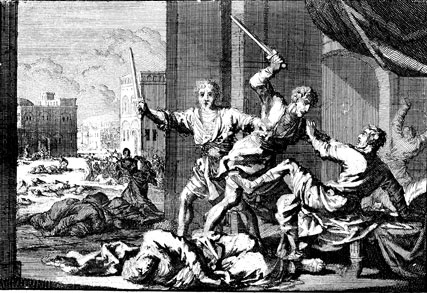
Abelard’s Dinah even more daringly expresses sympathy for Shechem in the context of him being persecuted for sexually desiring her. In order for Shechem to be allowed to marry Dinah, Jacob’s sons, speaking on behalf of their father, required Shechem and all the men of his tribe to mutilate their genitals (be circumcised). At the infatuated Shechem’s urging, his men mutilated their genitals. Then, with all the men of Shechem in pain from having mutilated their genitals, Jacob’s sons Simeon and Levi attacked the city of Shechem. They killed all the men and took all the women captive. Dinah humanely lamented:

Shechem, born to the ruin of your race,
made an everlasting disgrace for our descendants.
Woe to wretched you, by yourself destroyed!

In vain did circumcision make you a Jewish proselyte,
for you couldn’t remove the foreskin of shame.
Woe to wretched you, by yourself destroyed!

{ Sichem, in exicium nate tui generis,
nostris in obprobrium perpes facte posteris.
Ve tibe misero, per temet perdito!

Frustra circumcisio fecit te proselitum,
non ualens infamie tollere prepucium.
Ve tibi misero, per temet perdito! } [6]

Dinah places in parallel her feminine self and Shechem’s masculine self. His masculine desire for the feminine Dinah was natural. It was something that could be predicted from his birth. Yet gynocentric persecution of men’s heterosexual desire was also a structure at Shechem’s birth. In the clash between men’s natural heterosexual desire and gynocentric persecution of men, the latter disastrously prevailed. Thus Shechem was killed and his tribe ruined. To underscore the disaster, Abelard recast the biblical story to give Dinah and Shechem children (“our descendants”). Their descendants received the social curse of everlasting disgrace.

Dinah lamented that Shechem was persecuted as a man even as he sought to change his social identity. So that he could marry Dinah, Shechem sought to become a Jew. So that he could marry Dinah, Shechem mutilated his own genitals and had the men of his tribe do likewise. A man can remove the foreskin of his penis or cut off his testicles. But he individually is powerless to remove the shame and persecution that gynocentric society imposes on men’s heterosexuality.[7] Woe to wretched men, socially set up to be shamed and destroyed by their own heterosexuality.

Dinah compassionately gives reasons by which Shechem should have been treated with mercy. Genesis’s account of the massacre of men at Shechem describes Shechem’s soul being drawn to Dinah. It declares that he loved her, longed for her, and spoke tenderly to her. Yet Dinah’s thoughts and feelings aren’t reported. Planctus Dine filie Iacob reciprocally doesn’t report Shechem’s feelings.[8] Abelard’s Dinah establishes the formal poetic reciprocity lacking in the Genesis account:

Forced to seize me,
seized by my beauty,
before no judge of any kind
would you have been deprived of mercy

The incitement of love,
satisfaction for the crime:
in any sentence these are
a mitigation of the crime.

{ Coactus me rapere,
mea raptus spetie,
quouis expers uenie
non fuisses iudice.

Amoris impulsio,
culpe satisfactio:
quouis sunt iudicio
culpe diminutio. }

Both of these stanzas have the same semantic structure: two verses of reciprocal action, followed by two verses arguing for mitigation of the wrong. Both stanzas present a juridical framework as if a crime had been committed. The Vulgate was the dominant text of the Bible in medieval Europe. Misrepresenting the Hebrew, the Vulgate declared that Shechem “seized the girl and lay with her by force {rapuit et dormivit cum illa vi opprimens virginem}.” That’s rape. Rape and false accusations of rape were regarded as serious crimes in the ancient and medieval world. Abelard seems to have sensed the falseness of the Vulgate’s representation of what Shechem did with Dinah.[9] Abelard’s Dinah questions gynocentric persecution of a reciprocal heterosexual love affair satisfactorily ending in marriage.

Abelard’s Dinah directly challenges the men who are the penal administrators of gynocentric persecution of men. Like the father Jacob, gynocentrism is an absent authority. The penal administrators are the brothers Simeon and Levi:

You did not think rightly, my brothers Simeon and Levi,
in this deed both too cruel and too dutiful:
in your punishment you make the innocent equal with the guilty,
and truly you dishonor our father, cursed be for this!

A man light-hearted and youthful, less wise,
ought to have borne from the wise lesser punishment.

The wrath of my brothers should have been softened by the honor
he did them: a prince of the land, leading forth a foreign bride.

{ Non sic, fratres, censuistis, Symeon et Leui,
in eodem facto nimis crudeles et pii:
innocentes coequastis in pena nocenti,
quin et patrem perturbastis, ob hoc execrandi!

Leuis etas iuuenilis minusque discreta
ferre minus a discretis debuit in pena.

Ira featrum ex honore fuit lenienda
quem his fecit: princeps terre, ducta peregrina. } [10]

Perhaps Abelard understood that Shechem was innocent of raping Dinah. In any case, the other men of Shechem’s city were innocent of any wrong. Jewish law reveres justice and mercy. Simeon and Levi, brothers of Dinah, sons of Jacob, acted with neither justice nor mercy. They were “too dutiful” to non-Jewish gynocentric imperatives. They thus dishonored their father Jacob and deserved to be cursed.

Abelard’s Planctus Dine filie Iacob ends in despair. Dinah laments:

Woe to me, woe to you, young man to be pitied,
in the general massacre of your great race you fall.

{ Vi michi, ue tibi, miserande iuuenis:
in stragem communem gentis tante concidis. } [11]

Scholars have debated at length whether the post-castration Abelard sought to remasculinize himself rhetorically. Scholars have debated at length whether being castrated served Abelard’s desired identity.[12] Those are narrow, self-interested concerns. The lament of Abelard’s Dinah extends to all of humane civilization. Drawing upon his own horrific experience, Abelard sought to warn all women and men about gynocentric persecution of men’s sexuality. Listen to him!

Simeon and Levi slaughter men of Shechem

*  *  *  *  *

Read more:

Notes:

[1] Wolde (2002) pp. 543-4. Similarly, Joseph (2016). The biblical story is Genesis 34. Shechem is also commonly spelled Sechem and Sichem. Dinah similarly is also common spelled Dina. On ancient and medieval interpretations of the massacre of men at Shechem, Thibodeau (1990) Kugel (2006) Ch. 3. On recent interpretations, Musija (2014).

Kugel addressed with astonishing disingenuousness Shechem’s actions toward Dinah. Kugel (2006), Ch. 3, has the running title “The Rape of Dinah.” In addition, Kugel gratuitously uses the word “rapist.” Chapter 1 of that book summarizes narrative action using the word “rapist” rather than Shechem’s name:

When Jacob’s only daughter ends up being raped, her brothers respond by invading the rapist’s town and killing every man in it.

Id. p. 2. In the beginning of Chapter 3, Kugel again substituted rapist for the name Shechem:

The rapist’s father, Hamor, does indeed approach Jacob and seek to contract a marriage

Id. p. 36. Kugel subsequently breezily notes, “the city of Shechem (same name as the rapist).” Id. p. 37. Despite this brutal and gratuitous diction, the first endnote to Chapter 3 observes:

Most commentators and translators have assumed that the text refers to forced, non-consensual intercourse, although the sequence of verbs in Hebrew … is open to various interpretations.

Id. p. 231. Id. doesn’t cite Wolde (2002) pp. 543-4 and couldn’t benefit from Joseph (2016). Kugel, however, certainly possess the necessarily linguistic expertise to understand the matter in its specific textual complexity. Moreover, Kugel (2006), and much of Kugel’s biblical study generally, has been concerned with how a single word could prompt an ancient biblical interpretation recasting the biblical text. Yet with respect to the deeply serious question of rape, Kugel declares in this endnote:

This question, while intriguing, is not directly related to our study, which is concerned principally with the reaction of Dinah’s brothers to what they clearly consider an “outrage” (Gen. 34:7).

Id. p. 231. That’s a grotesque intellectual fake. To a claim that a woman was raped, men commonly react with outrage rather than questioning. An astonishing aspect of that outrage is its gender-structure: women raping men, although about as prevalent as men raping women, generates very little outrage or even attention. What the words of text actually mean is highly relevant to interpreting the “outrage” of Dinah’s brothers and their subsequent violence against men.

Other scholars have dealt with the question of rape with similar lack of integrity. Musija refuses to “rule out” that Shechem raped Dinah:

even if it is difficult according to Genesis 34 to conclude that Dinah was really raped, it is quite clear that Shechem has done something to Dinah very evil in the eyes of the narrator. … it seems to me that it is more likely that Shechem, a young man, seduced Dinah, a girl under age and had a sexual relationship with her. Because such act is today considered as something very bad, even culpable, I suppose that it was at least so wrongful at ancient time. That can be the reason why Jacob’s sons were so eager to punish Shechem but not Dinah. … according to the text it is not appropriate to imply so convincingly either that Dinah was raped, or that Dinah was not raped. According to the text it is clear that Shechem has done something very bad to Dinah in the eyes of the narrator. In my opinion, the text speaks about seduction of a girl under age, but rape also remains one of the possibilities.

Musija (2014) pp. 6-7 (internal note omitted). That’s vicious rhetoric. One can’t rule out the possibility that Musija or any other person is a rapist. That’s not a fair basis for suggesting that a person is a rapist, even if another person believes that she has “done something very evil.” The gender injustice of vicious rhetoric is magnified when grotesquely misleading claims about men raping women are disseminated in widely read media, when men are vastly disproportionately represented among persons under criminal justice control, and when incarceration of men is at extraordinarily high levels.

[2] Peter Abeland, Planctus Dine filie Iacob ll. 1-6, Latin text and English translation (adapted slightly) from Ruys (2014) pp. 245-6, 257-8. For illusa, Ruys translated “abused.” Mocked is closer to the Latin root meaning and seems to me more appropriate in context.

Abelard’s Planctus is a quite unusual work in literary history. Ruys (2014) pp. 61-2. All six Planctus that Abelard wrote are preserved in only one manuscript, Vatican, Biblioteca Apostolica, Reg. Latin. 288, dated to the late twelfth century. Abelard apparently wrote the Planctus in the mid-1130s. Id. pp. 8, 65.

All subsequent quotes from the Planctus are sourced as above and are, with the exception of one stanza, in the order of the poem’s lines. Paul Zumthor’s Latin text and French translation (1992) of the Planctus is freely available online.

[3] Ruys finds it perplexing that Dinah would declare that she was betrayed by herself. She also finds Abelard’s Dinah to be “strident and unconvincing in terms of a lament in the feminine voice.” Ruys (2014) pp. 82, 71. Sweeney, in contrast, states:

Abelard’s Dinah is far more real than the Dinah of scripture; we are touched by her suffering and edified by the insight borne of that suffering. Her significance is not just as a cog in the wheel of providence or as an allegorical figure embodying some virtue or vice to Abelard; nonetheless, his focus on imagining her concrete individuality, paradoxically, manages to increase her ethical and religious significance rather than the contrary.

Sweeney (2016) p. 110. Thibodeau similarly appreciates the personal depth of Abelard’s Dinah. Abelard depicts her consciousness “with its full depth of reflection and its full range of emotion.” Abelard’s Planctus represents “the searing personal anguish of Dinah in the face of Shechem’s downfall and death”; Abelard’s Dinah displays “very human suffering.” Thibodeau (1990) pp. 241-2. Part of the problem is that scholars today seem unable to fathom medieval women’s loving concern for men.

[4] E.g Genesis 4:1, in the Vulgate, “Adam vero cognovit Havam uxorem suam {And Adam knew his wife Eve}.” Similarly, Genesis 19:8, “habeo duas filias quae necdum cognoverunt virum {I have two daughters who have never known a man}.”

[5] Genesis 34:31. Ruys comments:

This defense clearly recalls what Abelard has described as Fulbert’s justification for commissioning his castration, namely, the belief that Abelard had used and then put aside his niece to the lasting shame of the family. Not surprisingly, in a lament in which Sechem is intended to appear undeserving of his fate, this consideration has to be excised.

Ruys (2014) p. 82. Ruys apparently assumes that Shechem actually did treat Dinah as a whore, and Abelard similarly treated Heloise. I think neither are true. Abelard’s Dinah seems to me to make a compelling critique of the claim that Shechem treated her as a whore.

[6] I’ve inserted “Jewish,” which isn’t in the Latin, in front of “proselyte” for clarity. Ruys has for the subsequent verse, “incapable of removing the foreskin of shame.” Above I’ve rephrased that line to clarifying that being a proselyte isn’t related to being incapable of removing the shame of being falsely charged with raping Dinah.

[7] According to Ruys:

Abelard has Dinah enunciate in the Planctus Dine a doctrinal discussion of the Old Testament covenant of circumcision and its efficacy. Her lament revealed the failure of circumcision as a means of salvation, as she regretted that in Sechem’s case, it proved ineffective in preventing his death

Ruys (214) pp. 85. That seems to me a cramped and wooden reading of Planctus Dine filie Iacob. Woe to wretched men, so badly understood.

[8] Ruys argues that Abelard elides Shechem’s love for Dinah because “mutual love plays no part in the lament that Abelard’s Dinah speaks.” Ruys (2014) p. 81. Abelard’s Planctus seems to me best understood as an addition to the biblical account. Its reciprocity works as part of an over-all poetic form that includes Genesis 34 and Abelard’s Planctus.

[9] Abelard may have known Hebrew or had access to teaching from a learned Jew. Thibodeau (1990) pp. 245-7. Abelard thus may have had access to a more accurate translation of Genesis 34 than the Vulgate provides. From another perspective, Abelard might have meant the juridical framework in Dinah’s exoneration of Shechem to be interpreted ironically. That’s more plausible than Abelard using irony in the ending of his Planctus Israel super Sanson. Cf. Dronke (1970) pp. 137-45.

[10] In the first line quoted above, for sic Ruys translated “so.” I’ve changed that to “rightly.” The latter word brings in a broader interpretative context that’s helpful for understanding the line.

For the second stanza quoted above, Ruys translates:

An age light and youthful, less wise,
ought to have borne less punishment from the wise.

“Leuis etas iuuenilis” seems to me not an abstract reference to “an age,” but a specific reference to “a man” (Shechem). The Latin lines end in “wise” and “punishment.” I think that’s a significant poetic structure. I’ve preserved it above.

[11] Ruys translation has “youth to be pitied.” The Latin text more specifically refers to one young man (Shechem). Thus above I’ve used “young man.” Ruys’ translates strages as “slaughter.” Animals are slaughtered for their meat. I’ve used the word “massacre” to emphasize that men are human beings.

Dronke perceptively interpreted Planctus Dine filie Iacob, but didn’t quite go far enough:

The almost identical refrain, sung first for herself {Dinah} and then for him {Shechem}, reinforces the bond between them. Through this she reveals to herself her true feelings for him, feelings that begin in pity but reach out into love. They express themselves first in anger: his fate is unjust — the fault was small, the punishment far too great. Her own brothers are hateful, their righteousness having been only a pretext for their base cruelty. Then her thoughts move to love: if a true impulse of love was there, as she knows it was, can even the violation of a young girl be judged a grievous fault? Her brothers talked of family honour — was it not an honour too that he, a prince, should have wanted her so much as not only to possess her but to ask his kindred’s leave “to marry an alien”? Suddenly, with this thought, her love and admiration for him blossom so much that her final words extend this love and admiration to his whole people (gens tanta), to those whom her family had taught her to regard as “the enemy race” (plebs adversa).

Dronke (1970) pp. 114-5. Shechem’s “whole people” and “the enemy race” are Abelard’s astonishingly insightful metaphors for men as gynocentrism represents men to women.

[12] Irvine (1997) argues that Abelard “engaged in a project of remasculinization” for himself. Wheeler (1997), reversing her claims about remasculinization, argues that despite being punitively castrated, Abelard remained as oppressive as men have always been. Abelard was no vicious, jealous eunuch of the sort so prevalent under castration culture. Abelard sought to overturn castration culture for the benefit of all women and men. In her analysis, Ruys concludes that Planctus Dine reflects the voice of Abelard, “a man with particular axes to grind and some things he would rather hide.” Ruys (2014) p. 83. In reality, much scholarly study of Abelard in recent decades has borne axes to grind and things to hide.

Ferroul (1997) rightly points out the castration of Abelard probably meant excising only his testicles. If Abelard’s penis had also been cut off, he probably would have died from complications associated with urination and infection. Men who have their testicles excised in adulthood remain capable of engaging in erection labor. Moreover, in having sex of reproductive type, such men don’t risk contributing to a pregnancy. Ferroul goes on to argue:

His blissful castration enabled Abelard to become what he really wanted to be: a paragon of a Christian and the greatest of philosophers

Ferroul (1997) p. 144. That’s absurd. Like other forms of male genital mutilation, castration hurts men. Some men who aren’t castrated become malicious gynocentric apparachiki. Despite his castration, Abelard was no despicable eunuch. Even as a castrated man, he was an admirable Christian, a great philosopher, and an under-appreciated advocate for gender justice.

Irvine (1997), Wheeler (1997), and Ferroul (1997) were all published in a book entitled Becoming Male in the Middle Ages. That book and its contents should be understood with respect to a peculiar social construction of scholarly merit in the humanities. Willful ignorance of biology and non-empirical beliefs about the population evolution of reproducing organisms contribute to prestige within that peculiar social construction of scholarly merit. Of course, men who act like eunuchs can choose to act like men in their middle ages or even as old men.

[images] (1) The massacre of the men of Shechem. Copper engraving (excerpt) made by Caspar Luyken in the Netherlands about 1700, perhaps for his Historiae celebriores Veteris Testamenti Iconibus representatae. Preserved in Phillip Medhurst Picture Torah 172, via Wikimedia Commons. (2) The massacre of the men of Shechem. Image in book by Flavius Josephus, published in 1704. Via Pitts Theology Library. (3) The massacre of the men of Shechem. Image in book by Nicolas Fontaine, L’histoire dv Vieux et dv Nouveau Testament : representée avec des figvres & des explications édifiantes, tirées des SS. PP. pour regler les moeurs dans toute sorte de conditions, published in Paris in 1670. Via Pitts Theology Library.

References:

Cohen, Jeffrey Jerome, and Bonnie Wheeler, eds. 1997. Becoming Male in the Middle Ages. New York: Garland Publishing.

Dronke, Peter. 1970. Poetic Individuality in the Middle Ages: New departures in poetry 1000-1150. Oxford: Clarendon Press.

Ferroul, Yves. 1997. “Abelard’s Blissful Castration.” Pp. 129-150 in Cohen & Wheeler (1997).

Irvine, Martin. 1997. “Abelard and (Re)Writing the Male Body: Castration, Identity, and Remasculinization.” Pp. 87-106 in Cohen & Wheeler (1997).

Joseph, Alison L. 2016. “Understanding Genesis 34:2: ‘Innâ.” Vetus Testamentum. 66 (4): 663-668.

Kugel, James L. 2006. The Ladder of Jacob: ancient interpretations of the biblical story of Jacob and his children. Princeton, NJ: Princeton University Press.

Musija, Zlatko. 2014. “The Function and Meaning of Genesis 34 — The Story of Dinah in its Context.” In Bruinsma, Reinder, ed. Faith in search of depth and relevancy: festschrift in honour of Dr Bertil Wiklander. St. Albans, UK: Trans-European Division of Seventh-day Adventists.

Ruys, Juanita Feros. 2014. The Repentant Abelard: family, gender and ethics in Peter Abelard’s Carmen ad Astralabium and Planctus. New York, N.Y.: Palgrave Macmsillan.

Sweeney, Eileen. 2016. “Abelard’s Christian Socratism.” Pp. 101-121 in Bequette, John P., ed. A Companion to Medieval Christian Humanism: essays on principal thinkers. Leiden: Brill.

Thibodeau, Lucille Claire. 1990. The relation of Peter Abelard’s Planctus Dinae to biblical sources and exegetic tradition: a historical and textual study. Ph.D. Thesis. Harvard University.

Wheeler, Bonnie. 1997. “Origenary Fantasies: Abelard’s Castration and Confession.” Pp. 107-128 in Cohen & Wheeler (1997).

Wolde, Ellen van. 2002. “Does innâ denote rape?: a semantic analysis of a controversial word.” Vetus Testamentum. 52 (4): 528-544.

Simeon and Levi slaughter men of Shechem