swan-song of Rome: Rutilius, On returning home / De reditu suo

Visigoth Alaric sacks Rome in 410

In 410, Alaric, King of the Visigoths, culminated his third siege of Rome by sacking the city for three days. About seven years later, Rutilius Namatianus, a former head governor of Rome, returned from Rome to his native home in southern France. Gothic invaders had also devastated southern France. Rutilius was deeply invested in Roman tradition and gynocentric society. His poetic account of his journey home, On returning home {De reditu suo}, is filled with tense oppositions.[1] Rutilius’s inability to integrate his experience of collapsing gynocentric society shows in his sharp criticism of hated others.

Rutilius revered the traditional Roman society mythically supported by the Sabine women’s victory. On departing from Rome, Rutilius lauded his beloved city:

Hear, O queen, O fairest of your universe,
O Rome, received among the starry skies,
of humans and gods alike the mother, hear my prayer,
for your temples grant proximity to heaven.

We sing of you and always will, while fate allows —
everyone alive remembers you!
Accursed oblivion will hide the sun before
the honor that I owe you leaves my heart,

for you extend your gifts just as the sun its rays
where all-embracing Ocean ebbs and flows.
The Sun, who holds all things in place, revolves for you:
its steeds both rise and set in your domain.

{ exaudi, regina tui pulcherrima mundi,
inter sidereos Roma recepta polos,
exaudi, genetrix hominum genetrixque deorum,
non procul a caelo per tua templa sumus:

te canimus semperque, sinent dum fata, canemus:
sospes nemo potest immemor esse tui.
obruerint citius scelerata oblivia solem,
quam tuus ex nostro corde recedat honos.

nam solis radiis aequalia munera tendis,
qua circumfusus fluctuat Oceanus.
volvitur ipse tibi, qui continet omnia, Phoebus
eque tuis ortos in tua condit equos. } [2]

Rome is the beautiful queen, the mother. Men revere their mothers. They desire beautiful women. They delight in women ruling over them. No one can imagine that gynocentric society could collapse. The Roman Empire did collapse.

Some Roman men rebelled against gynocentrism. Briefly recounting that “a citizen was lost to living death {perditus hic vivo funere civis erat}” by going to live in a cave on a cliff, Rutilius heaped scorn on Men Going Their Own Way (MGTOW):

Not long ago, our friend, a youth of noble birth,
appropriately wed, with ample means,
went mad, abandoning the world and the human race
for exile in this filthy den, the fool!

This wretch believes divinity can feed on filth.
He does himself more harm than the gods he spurned.
Is not this sect, I ask you, worse that Circe’s drugs?
While she changed human bodies, they change minds.

{ noster enim nuper iuvenis maioribus amplis,
nec censu inferior coniugiove minor,
impulsus furiis homines terrasque reliquit
et turpem latebram credulus exsul adit.

infelix putat illuvie caelestia pasci
seque premit laesis saevior ipse deis.
num, rogo, deterior Circaeis secta venenis?
tunc mutabuntur corpora, nunc animi. } [3]

This young man spurned the traditional elite Roman married man’s life and became a Christian ascetic. Why would a wealthy noble man abandon his wife and go to live in rags and filth on a cliff? Perhaps he felt that his marital life was lacking in some way. Circe changed men into happy pigs. Christianity offered an alternate lifestyle. Many men are foolishly committed to traditional gynocentrism. They, like Rutilius, castigate men who repudiate everyday gynocentrism and the gender inequalities of ordinary life.

Rutilius viciously disparaged Jewish men merely because they rest one day a week. On his way home, Rutilius stopped at Falesia in southern Greece. He complained about the Jewish innkeeper of a pleasant country inn:

He’s an animal, cut off from human food,
who charges us for breaking shrubs and hitting seaweed,
and begrudges us the water we have drunk!

We pay him back with all the scorn that’s owed a filthy
and disgraceful race that circumcises.
The root of foolishness! They love their chilly Sabbath,
but their hearts are colder than their creed.

Every seventh day is damned to lazy sloth,
a feeble image of its tired god!

{ humanis animal dissociale cibis:
vexatos frutices, pulsatas imputat algas
damnaque libatae grandia clamat aquae.

reddimus obscaenae convicia debita genti
quae genitale caput propudiosa metit:
radix stultitiae, cui frigida sabbata cordi,
sed cor frigidius religione sua.

septima quaeque dies turpi damnata veterno,
tamquam lassati mollis imago dei. } [4]

Men typically bear a triple burden of work. Most men work outside the home for money. Men also often engage in gender-unequal unpaid work around the home, such as establishing, reviewing, and maintaining household sports-entertainment subscriptions, repairing household motorcycles, cleaning and lubricating household guns, provisioning, storing, and rotating the household cigar stock, roughhousing with the kids, etc. Above and beyond that gender double burden, men have the additional gender burden of performing unpaid erection labor. Under Roman gynocentrism, Roman men didn’t even have one well-established rest day a week. Roman men were expected to be like worker-gods who never tire while still maintaining a hotly passionate heart. Roman men resented the modest Sabbath protection from gynocentric exploitation that Jewish and Christian men enjoyed.

Rutilius also disparaged Jewish men because he attributed to them vibrant, dynamic sexuality. Romans believed that circumcision enhanced men’s sexual performance. Romans thus stereotyped Jewish men as having strong, independent sexuality — being “prone to sexual excess.”[5] However, circumcision, a form of male genital mutilation, actually reduces the sensitivity of the penis. Circumcision thus diminishes men’s sexuality. That’s consistent with historical suppression of men’s sexuality and current unreasonably gender-biased regulation of reproductive rights. Rutilius badly misrepresented the gender structure of circumcision.

Rutilius hated the leading Roman general Stilicho even more than he hated Jewish men and ascetic Christian men. The son of a provincial Roman woman and a Vandal soldier, Stilicho, by serving in war’s horrible violence against men, rose to become the most powerful man next to his wife in the Roman Empire. Stilicho had his forces fight alongside Visigoth King Alaric I against the western Roman emperor-claimant Eugenius. Stilicho burned Sibylline books sacred to traditional Roman religion. In 408, Stilicho persuaded the Roman Senate to agree to pay Alaric a large ransom not to invade Italy. After a political reversal later that year, Stilicho was executed for treason. Alaric went on to sack Rome in 410. Rutilius declared:

How much more bitter was the crime of Stilicho,
the cruel betrayer of the empire’s heart?
As he struggled to outlast the Roman race,
his bloody madness overturned our world,

and while he feared the very Goths who made him feared,
he sent barbarian arms for Latium’s death
and plunged an armed foe into her naked vitals —
an even bolder trick that brought disaster.

And Rome herself, exposed to skin-clad troops,
was captive even before she could be captured.
It wasn’t only Gothic arms the traitor used:
he burned the books that brought the Sibyl’s aid.

We hate Althaea for the deadly torch she burned;
the bird, they say, still mourns for Nisus’ lock,
but Stilicho threw away the empire’s pledges
and Fate’s spindles, full of destiny.

Let Nero be released from all of Hades’ torments,
let hellish torches burn a grimmer ghost,
for Nero killed a mortal, but Stilicho a goddess:
one murdered his mother, the other the world’s mother.

{ quo magis est facinus diri Stilichonis acerbum,
proditor arcani quod fuit imperii.
Romano generi dum nititur esse superstes,
crudelis summis miscuit ima furor;

dumque timet quicquid se fecerat ipse timeri,
immisit Latiae barbara tela neci:
visceribus nudis armatum condidit hostem,
illatae cladis liberiore dolo.

ipsa satellitibus pellitis Roma patebat
et captiva prius quam caperetur erat.
nec tantum Geticis grassatus proditor armis:
ante Sibyllinae fata cremavit opis.

odimus Althaeam consumpti funere torris;
Nisaeum crinem flere putantur avis.
at Stilicho aeterni fatalia pignora regni
et plenas voluit praecipitare colos.

omnia Tartarei cessent tormenta Neronis;
consumat Stygias tristior umbra faces.
hic immortalem, mortalem perculit ille,
hic mundi matrem perculit, ille suam. } [6]

Rutilius figured Stilicho as promoting violence against a woman, Rome. Threats of violence against women incite men to violence against men. Violence against men is normative violence. Thus Rutilius without any marking of gender associates Stilicho with Althaea killing her son and Nisus physically assaulting her father. Within traditional Roman gynocentrism, the worst offense is doing harm to the highest mother — the goddess Rome, mother of the world.

Mired in traditional Roman gynocentrism, Rutilius struggled to understand how barbarians could have sacked sacred mother Rome. He hated those whom he perceived to be Rome’s internal enemies. While misconceiving them, Rutilius at least recognized the importance of internal enemies. For both women and men, we have met the enemy, and she is us.

saving sacred vessels in Alaric's sack of Rome

*  *  *  *  *

Read more:

Notes:

[1] Verbaal observed of Rutilius’s De reditu suo:

Even when the poet alludes only slightly to the acute problems of his day (the collapse of Roman power in the West, the decline of central government, the ravaged provinces and sacked towns), a tension is felt in every episode and each observation he makes. … The seemingly loosely connected episodes are kept together by an all-pervading opposition of stability and impermanence, of decay and lasting fame, of human mortality and the eternity of Roma.

Verbaal (2006) p. 158. Unity in opposition is roughly equivalent to inability to integrate.

[2] Rutilius Namatianus, On returning home {De reditu suo} vv. 1.47-58, Latin text from Duff & Duff (1935) v. 2, pp. 753‑829, via LacusCurtius, English translation (modified slightly) from Malamud (2018) p. 44. Subsequent quotes from De reditu suo are similarly sourced. I’ve modified Malamud’s translation to use gender-neutral terms except where the Latin clearly specifies the semantic gender. The critical edition Vessereau (1904) is freely available online.

Duff & Duff refer to Rutilius as  the “last of the classical Latin poets” and De reditu suo as the “swan-song of Rome.” Duff & Duff (1935) v. 2, p. 753.

[3] De reditu suo vv. 1.519-6. The previous short quote is 1.518. Rutilius harshly disparaged ascetic Christian monks:

As we proceed by the sea, Capraria rears itself:
the island reeks with men who shun the light.
They are called monachoi — the name is Greek — because
they want to live alone, without a witness.

They fear both Fortune’s gifts and Fortune’s punishments:
they hug the very misery they dread.
What stupid madness of a perverse mind is this,
to fear that happiness will cause them harm?

Prisoners seeking punishment for crimes, perhaps,
or grim hearts swelling with the blackest bile
(as Homer thought the worries of Bellerophon
came from an illness caused by excess bile,

for pierced by savage grief, the story goes, the lad
conceived a hatred of the human race).

{ processu pelagi iam se Capraria tollit;
squalet lucifugis insula plena viris.
ipsi se monachos Graio cognomine dicunt,
quod soli nullo vivere teste volunt.

munera Fortunae metuunt, dum damna verentur:
quisquam sponte miser, ne miser esse queat.
quaenam perversi rabies tam stulta cerebri,
dum mala formides, nec bona posse pati?

sive suas repetunt factorum ergastula poenas,
tristia seu nigro viscera felle tument,
sic nimiae bilis morbum assignavit Homerus
Bellerophonteis sollicitudinibus:

nam iuveni offenso saevi post tela doloris
dicitur humanum displicuisse genus. }

De reditu suo vv. 1.439-52. Rutilius’s description of Bellerophon is characteristically prejudicial. Bellerophon overcame a devastating false accusation of rape. Under gynocentrism, the serious problem of false accusations of rape tends to be trivialized.

Rutilius tolerated Christianity as long as Christianity subordinated itself to Roman gynocentrism. As a traditionalist, Rutilius supported traditional gender roles and gynocentric bureaucracy:

Apparently Rutilius considers Christianity to be a dangerous enemy of this mythologized Roman bureaucracy, especially in its more radical forms as incorporated by the monks and hermits. For this reason, his poem is a much stronger attack on Christianity than it has been considered until now. …
Yet this conclusion must be qualified. The poet is not such an enemy of Christianity that he cannot bring himself to close the poem with the eulogy on the Christian {Consul of Rome} Constantius. He attacks Christianity only in so far as it prevents people from facing up to their responsibilities. As soon as Christians show themselves in their acts to be good Romans, i. e. adherents of Rutilius’ ‘cult’ of Roma, their religious background becomes less important. According to our poet, a man has to be first of all a Roman citizen. His other convictions, what ever they may be, are of little account.

Verbaal (2006) pp. 170-1. On Constantius, De reditu suo, fragment B, available in English translation in Malamud (2018) p. 79.

Men must follow the life path that mother Rome sets out for men:

Roma is the mother of men and gods. She can give mortal man a nearly divine status if he only wants to serve her, i. e. if he does not refuse the responsibilities of the cursus honorum, which allows him to approach mythical greatness and which assures him eternal glory and divine adoration after his death.

Id. p. 170.

[4] De reditu suo vv. 1.384-92. Just as for Christians, some Jews were Roman citizens: “a not inconsiderable number of Jews in Rome had become cives Romani by the time of Augustus.” Rutgers (1994). With the “root of foolishness {radix stultitiae},” Rutilius refers to Judaism’s status as the root of Christianity. Christians identify themselves as fools. 1 Corinthians 1:18-21, 4:10.

In the above passage, Rutilius also refers to God resting on the seventh day in Genesis’s account of creation. Genesis 1:27, 2:2-3. Rutilius used the term imago in a thematically coherent way across De reditu suo. Verbaal (2006) pp. 165-7.

[5] Malamud (2018) supplies the phrase “prone to sexual excess.” See id. pp. 24-6 for insightful, close reading of Rutilius’s description of the Jewish inn-keeper.

[6] De reditu suo vv. 2.41-60. The skin-clad troups were Visigoths under Aleric I. Rutulius’s compared Stilicho burning the Sibylline books to women killing close male relatives:

Althaea caused the death of her son Meleager by burning the magical firebrand on which his life depended. … Scylla caused the death of her father Nisus by depriving him of the purple lock on which his life depended.

Duff & Duff (1935) notes 149-150. See id. for references to the relevant ancient source literature. Men’s deaths, as well as men’s lifespan shortfall, has no gender significance under gynocentrism.

The Latin text for De reditu suo 2.47-8 is awkward. A proposed solution is to emend:

Visceribus nudis armatum condidit hostem
Illatae cladis liberiore dolo.

{ plunged an armed foe into her naked vitals —
an even bolder trick that brought disaster. }

to:

Visceribus nudis armatum condidit hostem
Illiacae cladis deteriore dolo.

{ plunged an armed foe into her naked vitals —
a wile more wicked than that which brought disaster on Troy. }

Reid (1887).

[images] (1) Alaric’s sacking of Rome in 410. Anachronistic fifteenth-century French miniature. Via Wikimedia Commons. If you have a more accurate citation for this image, please supply it in the comments below. (2) Romans seeking to preserve sacred vessels during Alaric’s sacking of Rome. Illumination from instance of Augustine, La Cité de Dieu, translated from the Latin by Raoul de Presles. On folio 9v in MS. The Hague, MMW, 10 A 11. Via the National Library of the Netherlands.

References:

Duff, John Wight, and Arnold Mackay Duff, ed. and trans. 1935. Loeb Classical Library, 284. Minor Latin poets. Rutilius Namatianus. Revised Edition. London: Heinemann

Malamud, Martha A., trans. 2018. Rutilius Namatianus’ Going Home: De reditu suo. London: Routledge.

Reid, J. S. 1887. “Rutilius Claudius Namatianus, II. 47, 8.” The Classical Review. 1 (2-3): 78. (available here)

Rutgers, Leonard. 1994. “Roman policy towards the Jews: expulsions from the city of Rome during the first century C.E.” Classical Antiquity. 13 (1): 56-74.

Verbaal, Wim. 2006. “A Man and his Gods. Religion in the De reditu suo of Rutilius Claudius Namatianus.” Wiener Studien. 119: 157-171.

Vessereau, Jules, ed. and trans. (French). 1904. Cl. Rutilius Namatianus. Paris: A. Fontemoing.

Contra plagam & other medieval prayers against plague

burying plague dead in Tournai about 1353

In the mid-ninth-century Carolingian empire, the eminent Irish scholar-cleric Sedulius Scottus urged God to spare the people from plague. He prayed to God with a poem entitled “Against the plague {Contra plagam}”:

Would not your people have to drink
now the cup of your anger, deserved wrath.
May you shine upon us your former compassion;
we beg you, you hear us.

Destroy our evil deeds, we pray;
save us, blessed prince.
Disperse dark shadows covering our minds,
faithful light of the world.

Holy of Holies, Lord of kings,
may your right hand be with your lowly ones,
may your serene face look upon us,
or else we perish.

{ Non propinetur populo tuoque
nunc calix irae, meriti furoris.
clareant priscae miserationes;
quaesumus, audi.

Deleas nostrum facinus, precamur;
nosque conserva, benedicte princeps.
mentium furvas supera tenebras,
lux pia mundi.

Sancte sanctorum, dominusque regum,
visitet plebem tua sancta dextra,
nos tuo vultu videas serenus,
ne pereamus. } [1]

Sedulius’s prayer in humility acknowledges the wrongs that he along with the people have done. They don’t even count on their own strength to repent. He prays that God will “destroy our evil deeds {deleas nostrum facinus}.” As a matter of justice, Sedulius recognizes that they deserve to be punished by God. Yet “we beg you, you hear us {quaesumus, audi}.” God in Hebrew scripture again and again in various contexts declares:

If he cries to me, I will hear, for I am compassionate.

In distress you called, and I rescued you. I answered you in the secret place of thunder. [2]

{ צְעַק אֵלַי וְשָׁמַעְתִּי כִּֽי־חַנּוּן אָֽנִי

בַּצָּרָה קָרָאתָ וָאֲחַלְּצֶךָּ אֶעֶנְךָ בְּסֵתֶר רַעַם }

In biblical understanding, God is by nature compassionate and merciful. The people experienced God’s compassion in the past. They cry out to God to experience that compassion again. The right hand of God represents the strength of God. The serene face of God represents the people seeing God blessing them. If God, the light of the world, doesn’t dispel the fear of the plague, the shadows covering their minds, they will perish.

The Great Plague that struck Europe in the middle of the fourteenth century killed roughly half of Europe’s population. Devastating plagues continued to strike European cities periodically up to the eighteenth century. A medieval prayer against the plague appealed to Mary, the mother of Jesus, with explicit reference to the plague:

Star of Heaven,
who nourished the Lord
and rooted up the plague of death
which the first parents of humankind planted;
may this star now deign
to hold in check the constellations
whose strife grants the people
the ulcers of a terrible death.
O glorious star of the sea,
save us from the plague.
Hear us: for your Son
who honors you denies you nothing.
Save us, you to whom
the Virgin Mother prays.

{ Stella celi extirpavit
que lactavit Dominum
mortis pestem, quam plantavit
primus parens hominum.
Ipsa stella nunc dignetur
sydera compescere;
quorum bella plebem cedunt
dire mortis ulcere.
O gloriosa stella maris,
a peste succurre nobis.
Audi nos: nam Filius tuus
nihil negans te honorat.
Salva nos, Jesu, pro quibus Jesus,
virgo mater te orat. } [3]

This prayer depicts Mary as a star restraining the effects of a pestilent constellation of stars. That’s a learned figure. Ancient Indian, Persian, Greek, and Egyptian thinkers described astrological effects on human health. Asaph’s Book of Medicines exemplifies the reception of that learning in medieval Europe.[4] This prayer thus draws upon highly respected, ancient non-Christian knowledge.

A Christian believer unaware of its non-Christian intellectual context could still appreciate this prayer. It invokes the Virgin Mary to intercede with Christ on behalf of her imploring Christian children. Intense devotion to the Virgin Mary was prevalent across all strata of medieval European society. Moreover, a Franciscan friar probably composed this prayer to fit a popular melody. Persons differing widely in social status and learning read and sung this prayer across Europe in the fifteenth and sixteenth centuries.[5]

In mid-fourteenth-century Italy, a priest wrote a relatively unsophisticated prayer for popular use against the plague. According to liturgical instructions that accompany this prayer against the plague, the dawn Christmas Mass was to be said at dawn on three consecutive days. All the people were to attend, including “babies sucking at their mothers’ breasts {enfans tetans sian a las messas}.” The people were to hold candles in their hands during the Mass. During those three days, they should make a general confession and fast. At a certain point in the Mass, all the people were to recite together this prayer:

Lord God, Jesus Christ, merciful redeemer, have mercy on me, a sinner. Lord, you hold me in this tribulation, but you have said, “I do not want the death of the sinner, but that one convert and live and confess and make amends for all one’s sins.” I beg you for mercy, Lord. By the love you have for the Virgin Mary, your blessed mother, and by the merits of the blessed martyrs, Saint Sebastian, all the other martyrs, and the virgin Saint Anastasia, save me from this epidemic. Amen.

{ Senher Dieu Jhesu Christ redemptor misericordios, aias merce a mi peccador, que mi tenes en aquesta tribulation, senher, que tu as dich, “Non vuelh la mort del peccador, mas que si convertisqua e viva e que si confesse e si esmende de thozs sos peccazs.” Clami ti merce, senher, que per aquella amor que tu as a la verges Mari, mayre tieua benaurada, e per los meritis dels benaurazs martirs, sant Cebastian e per tozs los autres martirs e per la verges sancta Anastasia, mi vulhas gardar d’aquesta epidimia. Amen. } [6]

This prayer begs for God’s mercy. It cites Ezekiel 33:11 to affirm the possibility of such mercy. The prayer directly and specifically states the urgent need: “save me from this epidemic.”

Saint Anastasia of Sirmium

Christians fearing the epidemic allied themselves with revered Christian foremothers and forefathers. Medieval Christians understood the Virgin Mary to be both the blessed mother of Christ and the mother of all Christians. As Christ’s mother, Mary was thought able to influence Christ more than could any anyone else. Yet dire times require marshaling all important spiritual resources. The eighth-century historian and monk Paul the Deacon {Paulus Diaconus} recorded that prayers to the deceased Saint Sebastian had in 680 freed Rome from a raging pestilence. Saint Sebastian thus became known in medieval Europe as a saint with special power to protect persons from pestilence and plague. Moreover, within the liturgical calendar, the dawn Mass of Christmas Day was extraordinary in commemorating Saint Anastasia of Sirmium. She was born in the second century in what today is Serbia. Her name associates her with Christ’s resurrection. From early medieval centuries she has been venerated as “Medicine for Poisons {Φαρμακολύτρια}.” Calling on all Christian martyrs for additional help implicitly suggests concern to ward off the people themselves becoming martyrs, dying faithfully from the plague.

To pray to God for deliverance from a plague, a person doesn’t need to be extraordinarily holy or pious. A learned Epicurean might reason that praying wouldn’t hurt. In the ninth century, Sedulius Scottus himself followed Epicurus in appreciating the pleasures of eating and drinking. Subtly consistent with his “Contra plagam,” Sedulius in another poem expressed earthy awareness of his own contradictory humanity and implored God for mercy:

I read and write, teach and study wisdom;
night and day I beseech God the High-Throned One.
I eat and drink gladly, I invoke Muses in verse;
as I sleep, I snore; waking, I pray to God.
My mind, conscious of misdeeds, weeps for sins of my life.
O Christ and Mary, have mercy on your wretched man.

{ Aut lego vel scribo, doceo scrutorve sophian;
obsecro celsithronum nocte dieque meum.
Vescor, poto libens; rithmizans invoco musas;
dormisco stertens; oro deum vigilans.
Conscia mens scelerum deflet peccamina vitae:
parcite vos misero, Christe, Maria, viro. } [7]

In this poem, “wretched” in the last line seems to function as a Janus word, an enantiosemic term. Is this man miserable, or not? Deciding that question ultimately doesn’t matter. The point of the poem seems to be that all need God’s mercy.

A plague functions in part as a selection mechanism. Those with stronger immune systems are more likely to survive. Gratitude for life as it is, hope that the future will be better, and trust to the end will boost your immune system. Do whatever, in your best informed judgment, is wise to prevent illness.[8] Then, even if you don’t believe in God, with reason against reason, pray to be spared from a plague.

*  *  *  *  *

Read more:

Notes:

[1] Sedulius Scottus, “Against the plague {Contra plagam},” incipit “Set free the lowly ones who serve you {Libera plebem tibi servientem},” st. 3-6 (of 6), Latin text (with my minor changes to the editorial punctuation) from Ludwig Traube, Poetae Latini aevi Carolini (1886) vol. 3, part 2, p. 46, via Waddell (1948) p. 124, my English translation benefiting from that of id., p. 125, and the partial English translation by G. Hunter. Here’s the full Latin text.

“Contra plagam” is written in classical Sapphic stanzas. Sapphic stanzas are now most prominently associated with Horace’s Odes. On the prevalence of Sapphics in early medieval poetry, Daintree (2000).

Sedulius Scottus was an Irish monk living in mid-ninth-century Iceland when invading Norse Viking drove him and his compatriots to continental Europe. Sedulius probably was in Liège when a plague struck that city. In pleading for patronage to Hartgar, Bishop of Liège, Sedulius described himself and two fellow Irish scholars as “learned grammarians and pious priests {doctos grammaticos presbiterosque pios}.” See “Gusts of the north wind are blowing and there are signs of snow {Flamina nos Boreae niveo canentia vultu}” v. 14, Latin text and English trans. from Godman (1984) pp. 286-7. In a Christmas poem written in Liège about 850, Sedulius likened himself and his fellow Irish scholars to the Wise Men of the Gospel:

Out of the east came the Magi bearing gifts, hastening in their journey to the Christ child; but now Irish scholars arrive from western lands, bringing their precious gifts of learning

Trans. Doyle (1983). pp. 112-3, via Anglandicus. For notes and corrections to Doyle’s translations, Ziolkowski (1986) and Lofstedt (2001).

Sedulius Scottus’s works survive in very little more than just one manuscript, Brussels, Bibliothèque royale, MS 1061. Modern philologists have scrutinized that text with pain-staking concern for accurately transmitting to the present Sedulius’s precious, ancient intellectual work. See, e.g. Ziolkowski (1986). Shanzer (1994), and Lofstedt (2001).

[2] Exodus 22:27, Psalm 81:7, Hebrew text from the Leningrad Codex via Blue Letter Bible. On God hearing the cry of the victim, Kugel (2003) Ch. 5. Kugel himself has failed to hear the cry of the massacred men of Shechem.

[3] “Star of Heaven who rooted out {Stella celi extirpavit},” Latin text from the York Book of Hours {Horae Eboracenses} of the early-sixteenth century, via Macklin (2010) p. 4, English translation (with my modifications) from Horrax (1994) p. 124. For manuscript witnesses from the fifteenth and sixteenth centuries, Macklin (2010) Appendix, pp. 27-31.

In fifteenth-century England, John Lydgate reworked “Stella celi extirpavit” in his poem “Thou heavenly Queen of grace our lodestar {Thow hevenly quene of grace owre loodesterre},” and perhaps also in a variant, “O blessed Queen about the starred heaven {O blissid queen a bove sterrid heuene}.” Lydgate also wrote another poem against the plague, “O Heavenly Star most comfortable of light {O hevynly sterre most Comfortable of lyght},” also known as “On Holy Mary against the pestilence {De sancta Maria contra pestilenciam}.”

[4] The medieval medical doctor Simon de Covino of Liège wrote a lengthy allegorical poem concerning the plague. It’s entitled On the Judgment of the Sun at the Feasts of Saturn {De judicio Solis in conviviis Saturni}. Simon’s poem uses traditional Greco-Roman deities to explain the plague. Written in hexameters, Simon’s poem witnesses to the eagerness of many medieval scholars to display their classical learning. Simon explained the meaning of his poem in a lengthy prose prologue:

In case the material in this little book should seem too burdensome, I here explain it in four parts. — In the first I describe, in the manner and fashion of poets, how Saturn prepared a great feast in his own house and invited all the other gods. This description signifies how all the planets were in conjunction with Saturn in his own house of the Zodiac, that is Aquarius, in the three months of 1345 — January, February, and March. That is not to say that all the planets were in conjunction with Saturn at once, but one after on various days in those three months. My main intention is to describe the great conjunction of Jupiter and Saturn, which only happens in Aquarius every ninety years; a conjunction which, according to philosophers, signifies great and amazing upheavals. Aristotle in his book on the properties of the elements says that because of the conjunction of Saturn and Jupiter in Aquarius kingdoms have been emptied and the earth depopulated. … In the fourth part I deal with the remedies given against such mortality {mortality from death-bearing plague (“pestis mortifera”)}. And the poem treats of the three fatal goddesses — Clotho, Lachesis, and Atropos. Clotho, who holds the distaff of life, represents generation; Lachesis, who draws out the thread of life, represents the span of human life from birth to death; Atropos, who breaks the thread of life, signifies corruption and death. And therefore I treat of remedies in this fashion, putting them poetically into the mouth of Lachesis, who represents the lengthening of life and the means whereby that can be achieved. And she seeks these remedies to prolong life in opposition to her sister, Atropos, who represents decay. And although doctors arm her with remedies to fight against her sister, those arms, that is the remedies of doctors, are of little worth to her.

{ Ne materia libelli videatur onerosa, ipsam declaro divisam per quatuor partes. — In prima quidem, secundum morem et ritum poetarum describo Saturnum magnum convivium fecisse in sua propria domo, et omnes deos ad suum convivium invitasse. Et ista descriptio significat omnes planetas fuisse conjunctos Saturno in propria domo Saturni, quae est Aquarius anno Domini millesimo CCCXLV, in tribus mensibus, scilicit januario, februario, et martio; non tamen quod simul fuerint conjuncti Saturno, sed unus post alium in diversis diebus illorum trium mensium. Et maxime in ea intentio est describere magnam conjunctionem Jovis et Saturni, quae non evenit in Aquario in nongentis annis nisi semel. Et ista conjunctio habet significare magnas et mirabilies mutationes rerum secundum dicta philosophorum. Unde Aristotiles in libro de proprietatibus elementorum dicit quod propter conjunctionem Jovis et Saturni in Aquario, regno vacua facta sunt et terrae depopulatae. … In quarta parte tracto de remediis datis contra hujusmodi mortalitatem. Et primo quia apud inferos poetae descripserunt tres deas fatales esse, scilicet Clotho, Lachesis et Atropos; ita quod Clotho, quae portat colum vitae, significat generationem; Lachesis, quae trahi fila vitae, significat productionem vitae humanae a principio usque ad mortem; Atropos vero, quaa rampit fila vitae, significant corruptionem et mortem, idcirco tracto de hujusmodi remedis, et hoc poetice sub nomine Lachesis quae dicitur productio vitae et quae habet producere vitam. Et ista querit remedia ad prolongationem vitae contra sororem suam, scilicet Atropos, quae dicitur corruptio; et qualiter medici armaverunt eam suis remediis ad pugnandum contra sororem suam, et qualiter ill arma id est remedia medicorum parum valuerint ei. }

Latin text from Littré (1841) pp. 206-8, English translation from Horrax (1994) pp. 163-7. Geoffrey de Meaux, a former court official apparently writing at medieval Oxford, similarly emphasized the effects of the stars and focused even more on classical authorities. For some analysis, Johnson (2009) pp. 11-2. On these authors in relation to “Stella celi extirpavit,” Macklin (2012) p. 21.

Concern for the stars in explaining the plague wasn’t only a tendency of medieval scholars with a classical orientation. The medical faculty of the University of Paris in October, 1348, issued a lengthy, scholarly report on the plague. This report declared in its first chapter:

We declare that the distant and first cause of this pestilence was and is the configuration of the heavens.

{ ‘Dicamus igitur quod remota et primeua causa istius pestilentie fuit et est aliqua constellatio celestis.}

Latin text from Hoeniger (1882) p. 153, English translation (modified slightly) from Horrax (1994) p. 159. In her book on the fourteenth-century plague in Europe, Horrax put this report first in a chapter entitled “Scientific explanations.” Her explanatory preface observed:

This is the most authoritative contemporary statement of the nature of the plague and therefore forms an appropriate introduction to this section.

Id. p. 158. In today’s scientific perspective, that day’s scientific perspective has a mythic character similar to medieval Christian beliefs about the plague.

[5] This poem appears frequently in late medieval English Books of Hours. It also exists in the “Adoration of the Shepherds” play in the N-Town mystery cycle and in fully notated polyphonic collections of pre-Reformation English vocal music. Macklin (2010) pp. 5-6. “Stella celi extirpavit” probably was circulating some time before its earliest surviving written record, dating to the period 1415 to 1430. Id. p. 12. On Franciscan friars composing such a hymn as a contrafactum, id. pp. 13-21. Here’s a performance of “Stella celi extirpavit” by the Binchois Consort (Andrew Kirkman, director).

[6] Old Occitan text and English translation (with my modifications) from Paden (2014) pp. 677-8. Paden presents evidence that versions of this prayer were known at Piacenza in northern Italy in 1348, at the prior of Jenza in Auvergne in south-central France in the fourteenth century, at Toulon in Occitania in the third quarter of the fourteenth century, at Saint-Antonin-Noble-Val in Occitania in the fifteenth century, and at Tarragona in Catalonia in the sixteenth century.

Facing the horror of a plague, medieval Christians most often prayed to the Virgin Mary. Saint Sebastian followed in popularity for help against a plague. From the fifteenth century, Saint Roch also became prominent in appeals. On medieval saints called upon to prevent or lift plagues, Ortega (2012) and the U.S. National Library of Medicine. Saint Anastasia was not distinctively associated with relief from plagues.

Church officials established special liturgical events to address plagues. See, for example, the directive of William Zouche, Archbishop of York, calling for special public processions in 1348. Here’s a prayer book from about 1500 with specific prayers for use against plague.

[7] Sedulius Scottus, “I read and write {Aug lego vel scribo},” full poem quoted, Latin text from Traube, Poetae, via Godman (1985) p. 282, my English translation, benefiting from those of id. p. 283, Waddell (1948) p. 123, the Lion of Chaeronea, and Alistair Ian Blyth at Dialogue on the Threshold {Диалог на пороге}.

[8] I regard the U.S. Centers for Disease Control and Prevention, an agency of the U.S. federal government, as the most authoritative U.S. source for information about COVID-19 and associated mitigation strategies. However, relevant reality should be recognized. Leading public health authorities, including the U.S. Surgeon General, have performed disastrously badly in communicating basic facts about domestic violence. In response to prevailing political sentiment, they have propagated grotesquely false and hugely damaging myths about domestic violence. Truth thus isn’t necessarily what leading authorities proclaim. Commitment to honoring truth is a tenuous social norm. Everyone has responsibility for earnestly and sincerely seeking to know the truth. Doing so builds up social respect for truth.

[images] (1) Burying the dead from a plague in Tournai (in present-day Belgium) in 1349. Illumination by Piérart dou Tielt in a chronicle of Gilles li Muisis. Made about 1351. On folio 24v of Bibliothèque Royale de Belgique MS. 13076-13077, via BALaT of the Belgian Royal Institute for Cultural Heritage {Koninklijk Instituut voor het Kunstpatrimonium / Institut Royal du Patrimoine Artistique}. (2) Icon of Saint Anastasia of Sirmium. Made between the end of the 13th century and the first half of the 15th century. Preserved as catalog # 94.С.254 in the Hermitage Museum (St. Petersburg, Russia). Via Wikimedia Commons. (3) The Virgin Mary, Saint Sebastian, and Saint Roch beg the angy God the Father to stop a plague. Two wings from a plague alterpiece from the Augustianian Monastery at Wenden (Ulm, Germany). Made by Martin Schaffner, 1513/14. Preserved as item Gm1103 in the Germanisches Nationalmuseum (Nuremberg, Germany).

References:

Daintree, David. 2000. “Non omnis moriar: the Re-emergence of the Horatian Lyrical Tradition in the Early Middle Ages.” Latomus. 59 (4): 889-902.

Doyle, Edward. 1983. Sedulius Scottus. On Christian Rulers and The Poems. Medieval & Renaissance Texts & Studies, Vol. 17. Binghamton, NY: State University of New York.

Godman, Peter. 1985. Poetry of the Carolingian Renaissance. London: Duckworth.

Hoeniger, Robert. 1882. Der schwarze Tod in Deutschland; in Beitrag zur Gesch. des vierzehnten Jahrh. Berlin: Grosser.

Horrox, Rosemary, ed. and trans. 1994. The Black Death. Manchester: Manchester University Press.

Johnson, Rebecca. 2009. “From Sin to Science: Astrological Exlanations for the Black Death, 1347-1350.” Ex Post Facto (Journal of the History Students at San Francisco State University). 18: 1-16.

Kugel, James L. 2003. The God of Old: inside the lost world of the Bible. New York: Free Press.

Littré, Emile. 1841. “Opuscule relatif à la peste de 1348, composé par un contemporain.” Bibliothèque De L’école Des Chartes. 2 (1): 201-243.

Lofstedt, Bengt. 2001. “Notes on Doyle’s translation of Sedulius Scottus.” Acta Antiqua Academiae Scientiarum Hungaricae. 41-4 (3): 413-415.

Macklin, Christopher. 2010. “Plague, Performance and the Elusive History of the Stella celi extirpavit.” Early Music History. 29: 1-31.

Ortega, Jessica. 2012. Pestilence and Prayer: Saints and the Art of the Plague in Italy from 1370 – 1600. B.A. Honors Thesis. University of Central Florica. HIM 1990-2015. 1367.

Paden, William D. 2014. “An Occitan Prayer against the Plague and Its Tradition in Italy, France, and Catalonia.” Speculum. 89 (3): 670-692.

Shanzer, Danuta. 1994. “A New Edition of Sedulius Scottus’ Carmina.” Medium Ævum. 63 (1): 104-117.

Waddell, Helen. 1948. Mediaeval Latin Lyrics. New York: Henry Holt.

Ziolkowski, Jan. 1986. “Review: On Christian Rulers, and The Poems, by Edward Gerard Doyle.” Speculum. 61 (2): 465-466.

Virgin Mary, Saint Sebastian & Saint Roch plead to God to stop plague

holy mother Rachel weeping for the massacre of innocents: boys

massacre of innocents - boys, from Codex Egberti

About two millennia ago, the tyrant Herod heard that a boy had been born who would overthrow tyranny’s reign. Herod’s primitive surveillance method wisely didn’t reveal the boy’s location. The learned Roman poet Prudentius four centuries later wrote:

Crazed at the news, the tyrant shouts:
“My successor looms, I’m thrown out —
guards, go, take your swords,
drench the cradles in blood!

Every male infant shall die:
search the nurses’ bosoms,
and at his mother’s breast,
redden your sword with boy’s blood.

I suspect all who have given birth
in Bethlehem. They’re traitors,
underhand, ready to smuggle
their baby boys to safety.”

{ exclamat amens nuntio,
“successor instat, pellimur:
satelles, i, ferrum rape,
perfunde cunas sanguine!

mas omnis infans occidat,
scrutare nutricum sinus
interque materna ubera
ensem cruentet pusio.

suspecta per Bethlem mihi
puerperarum est omnium
fraus, ne qua furtim subtrahat
prolem virilis indolis.” }[1]

Women in the ancient world strove to save the boys. They failed:

Therefore the executioner,
crazed, sword drawn,
stabs the new-born bodies,
gashes the baby lives.

The killer can hardly find
space in the tiny limbs
for the cutting stab to penetrate,
the dagger is bigger than the throat.

O savage sight! A head
dashed on the stones
scatters the milk-white brains,
vomits the eyes from the wound.

Or a quivering infant is thrown
into the depths of the stream,
down there, his tiny throat gasps,
water with breath chokes him.

{ Transfigit ergo carnifex
mucrone destricto furens
effusa nuper corpora,
animasque rimatur novas.

Locum minutis artubus
vix interemptor invenit,
quo plaga descendat patens
iuguloque maior pugio est.

O barbarum spectaculum!
inlisa cervix cautibus
spargit cerebrum lacteum
oculosque per vulnus vomit.

Aut in profundum palpitans
mersatur infans gurgitem,
cui subter artis faucibus
singultat unda et halitus. }

A few decades later, the learned Roman poet Sedulius, writing in epic meter, invoked a simile before going on to describe the slaughter of boys and their mothers’ grief:

Groaning over the criminal deed snatched from him, like a voracious lion
from whose mouth a tender lamb suddenly slips free,
and who then launches an assault on the entire flock and mauls and rends
the soft animals, as the new mothers all trembling call for
their offspring in vain and fill the empty breezes with their bleatings,
even so Herod was provoked because Christ had been taken away from him,
and he kept on dashing to the ground and slaying masses of infants,
fierce in his unwarranted murder. …
Killing them at their first cries and daring to
perpetrate wickedness beyond number, he slaughtered boys
by the thousands and give a single lament to many mothers.
This one tore out her mangled hair from her bare scalp,
that one scored her cheeks. Another beat her bared breast with fists.
One unhappy mother, now a mother no longer,
bereft, pressed her breast to her son’s cold mouth — in vain.

{ Ereptumque gemens facinus sibi, ceu leo frendens,
Cuius ab ore tener subito cum labitur agnus,
In totum movet arma gregem manditque trahitque
Molle pecus — trepidaeque vocant sua pignera fetae
Nequiquam et vacuas implent balatibus auras —
Haut secus Herodes Christo stimulatus adempto
Sternere conlisas paruorum strage catervas
Inmerito non cessat atrox. …
primosque necans vagitus et audens
Innumerum patrare nefas puerilia mactat
Milia plangoremque dedit tot matribus unum.
Haec laceros crines nudato vertice rupit,
Illa genas secuit, nudum ferit altera pugnis
Pectus et infelix mater (nec iam modo mater)
Orba super gelidum frustra premit ubera natum. }[2]

This massacre was a brutal gendercide of boys. Like calling the massacre of the men of Shechem “the rape of Dinah,” calling Herod’s massacre of innocent boys “the Massacre of the Innocents” misrepresents the actual gender structure of violence.

horse's ass and soldier pissing

In 1611, the enormously influential King James translation of the Gospel of Matthew obscured gender in this massacre of innocent boys. The King James Bible told of Herod ordering the massacre of “children”:

Then Herod, when he saw that he was mocked of the wise men, was exceeding wroth, and sent forth, and slew all the children that were in Bethlehem, and in all the coasts thereof, from two years old and under, according to the time which he had diligently enquired of the wise men.

{ tunc Herodes videns quoniam inlusus esset a magis iratus est valde et mittens occidit omnes pueros qui erant in Bethleem et in omnibus finibus eius a bimatu et infra secundum tempus quod exquisierat a magis

τότε Ἡρῴδης ἰδὼν ὅτι ἐνεπαίχθη ὑπὸ τῶν μάγων ἐθυμώθη λίαν καὶ ἀποστείλας ἀνεῖλεν πάντας τοὺς παῖδας τοὺς ἐν Βηθλέεμ καὶ ἐν πᾶσι τοῖς ὁρίοις αὐτῆς ἀπὸ διετοῦς καὶ κατωτέρω κατὰ τὸν χρόνον ὃν ἠκρίβωσεν παρὰ τῶν μάγων }[3]

The underlying Greek word for those killed is the accusative plural for the substantive παῖς, which is cognate with the Latin puer. Both those words predominately imply “boy.” Moreover, Matthew almost surely was addressed to Jews pondering the significance of Jesus. A genealogy begins Matthew and roots Jesus in Jewish history. That genealogy lists Jacob as the father of Joseph, the husband of Mary, the mother of Jesus. Joseph led Jesus and Mary into Egypt to save Jesus from Herod’s massacre. For Jews, Herod’s massacre and Joseph going to Egypt would have evoked the Pharaoh’s government and the Pharaoh’s order to the Hebrew midwives and then to all his people to kill all newly born Hebrew boys:

When you serve as midwife to the Hebrew women, and see them upon the birthstool, if it is a son, you shall kill him; but if it is a daughter, she shall live.

Every son that is born to the Hebrews you shall cast into the Nile, but you shall let every daughter live. [4]

{ וַיֹּאמֶר בְּיַלֶּדְכֶן אֶת־הָֽעִבְרִיֹּות וּרְאִיתֶן
עַל־הָאָבְנָיִם אִם־בֵּן הוּא וַהֲמִתֶּן אֹתֹו
וְאִם־בַּת הִיא וָחָֽיָה

וַיְצַ֣ו פַּרְעֹ֔ה לְכָל־עַמֹּ֖ו לֵאמֹ֑ר כָּל־הַבֵּ֣ן הַיִּלֹּ֗וד הַיְאֹ֨רָה֙
תַּשְׁלִיכֻ֔הוּ וְכָל־הַבַּ֖ת תְּחַיּֽוּן׃ ס }

A Jewish Christian writing Matthew would regard Jesus as the fulfillment of Hebrew scripture. Joseph taking Jesus into Egypt to escape Herod’s massacre would have been understood as paralleling Moses escape from the Pharaoh’s massacre of Hebrew boys and the Jewish people’s flight from Egypt. The learned Roman authors Prudentius, Sedulius, and Macrobius understood Herod’s massacre to have targeted boys.[5] Both linguistic and contextual evidence convincingly indicates that Matthew described Herod ordering gendercide. According to the best reading of Matthew, Herod ordered a massacre of innocent boys.[6]

Prior to the more repressive gynocentrism of the modern era, medieval authorities openly acknowledged the gynocentrism of Christian society. Writing about 885, Notker of St. Gall composed a poignant interior monologue for the eminent Jewish woman Rachel. She was the beloved wife of Jacob (Israel) and the mother of Joseph and Benjamin. Notker apparently thought deeply about Matthew’s description of Herod’s massacre of innocent boys:

Then was fulfilled what had been spoken through the prophet Jeremiah: “A voice was heard in Ramah, wailing and loud lamentation, Rachel weeping for her children; she refused to be consoled, because they were no more.”

{ τότε ἐπληρώθη τὸ ῥηθὲν διὰ Ἰερεμίου τοῦ προφήτου λέγοντος: φωνὴ ἐν Ῥαμὰ ἠκούσθη κλαυθμὸς καὶ ὀδυρμὸς πολύς Ῥαχὴλ κλαίουσα τὰ τέκνα αὐτῆς καὶ οὐκ ἤθελεν παρακληθῆναι ὅτι οὐκ εἰσίν }[7]

Here Rachel is weeping for “children,” as represented by the accusative plural for the substantive τέκνον. The central meaning of that word is child, irrespective of sex. Rachel herself, however, didn’t give birth to any female children. The prophet Jeremiah, whom Matthew cited, invoked Rachel more abstractly as the mother of the children of Israel. Jeremiah chided Rachel for her weeping. He prophesied that a day would come when a woman would protect a man:

How long will you waver, O faithless daughter? For the Lord has created a new thing on the earth: woman protects man. [8]

{ עַד־מָתַי֙ תִּתְחַמָּקִ֔ין הַבַּ֖ת הַשֹּֽׁובֵבָ֑ה כִּֽי־בָרָ֨א יְהוָ֤ה
חֲדָשָׁה֙ בָּאָ֔רֶץ נְקֵבָ֖ה תְּסֹ֥ובֵֽב גָּֽבֶר׃ ס }

Women must not merely weep in sorrow for themselves. Women must do more to save men’s lives and to prevent wars.

In his sequence entitled “A virgin crying about a martyr {De uno martyre virgo plorans},” Notker depicted Rachel’s extraordinary concern for miserable men. Notker’s sequence begins:

Why do you, virgin

mother, cry,
lovely Rachel
whose face
delights Jacob?

As if your little sister’s
moistened eyes would please him!

Wipe dry, mother,
your flowing eyes.
How could be worthy of you
water-cracked cheeks?

{ Quid tu, virgo

mater, ploras,
Rachel formosa,
Cuius vultus
Jacob delectat?

Ceu sororis aniculae
Lippitudo eum iuvet!

Terge, mater,
fluentes oculos.
Quam te decent
genarum rimulae? }[9]

The reference to Rachel as a virgin mother associates her across time with the Virgin Mary, mother of Jesus. Rachel competed successfully with her sister Leah for Jacob’s heart-felt love. Yet in this sequence, Rachel displays the insecurity of a woman appreciating the importance of woman’s beauty to men. So incomprehensible in today’s thinking, Rachel sought to please her man’s gaze, and she was concerned to retain his affection.

Another voice within Rachel’s self-consciousness speaks differently. That voice laments to herself:

Alas, alas, alas,
why do you accuse me
of having shed tears in vain?
Now I am without
my son, who in my poverty
alone would have cared for me.

He would not yield to the enemy
the paltry territory
which for me
Jacob had acquired.
His stupid brothers —
the many, sad to say,
that I have brought forth —
he would have helped.

{ Heu, heu, heu,
quid me incusatis fletus
incassum fudisse.
Cum sim orbata
nato, paupertatem meam
qui solus curaret,

Qui non hostibus cederet
angustos terminos,
quos mihi
Jacob adquisivit;
Quique stolidis fratribus,
quos multos, pro dolor,
extuli,
esset profuturus. }[10]

The son that Rachel has lost could be literally only Joseph. His brothers faked his death and sold him into slavery. Joseph’s father Jacob mourned Joseph’s apparent death for many days. Rachel herself died in giving birth to Benjamin. Just as Rachel being virgin mother collapses time and person, so too does Rachel lamenting the loss of her son.[11] Christians interpreted Rachel’s son Joseph as a figure of Jesus. They understood Rachel as a figure of the Christian church. In Christian understanding, the Christian church possesses the heritage of Jacob and the Jews. Joseph’s stupid brothers are both those who sold him into slavery and mass of men in the Christian church.

In Notker’s Rachel sequence, why are most Christian men represented as stupid? Many Christian men and women throughout history haven’t recognized that the Christian church is female as a figure and gynocentric in its pragmatic orientation. Men must actively affirm the goodness of their masculinity and cherish their masculine fruitfulness. Passive and apathetic in relation to women’s dominance, most men today don’t even question current female supremacist dogma that the future is female. These men are stupid. Men throughout history have been stupid in similar ways.

Another voice within Rachel’s self-consciousness recognizes Jesus’s love and concern for men. Rachel laments the loss of her son in part out of typical womanly self-concern: what man will provide me with money? But she also recognizes men’s need for help. She questions herself:

Are tears to be shed for him
who possesses the heavenly kingdom,
who with frequent prayers
for his miserable brothers
intercedes before God?

{ Numquid flendus est iste,
qui regnum possedit caeleste
quique prece frequenti
miseris fratribus
apud deum auxiliatur? }[12]

Rachel understood the misery of men enduring earthly gynocentrism. Yet miserable men have reason for hope. Rachel as the virgin mother Mary, and Rachel as the church, both have as son Jesus. Jesus loves men as well as women. The fully masculine man Jesus brings miserable men’s plight before God in heaven. Men need only wonder: how long, Lord, how long?

Like the Massacre of the Innocent Boys, deaths of boys and men typically pass without particular notice. The issue isn’t just modern philology’s gender trouble. The lives of boys and men are gynocentrically devalued. Like earlier poetry, Notker of St. Gall’s brilliant ninth-century Rachel sequence, “De uno martyre virgo plorans,” recognized that the Massacre of the Innocents was the massacre of innocent boys. Moreover, Notker’s Rachel shows that Christian gynocentrism can encompass concern for miserable men. Women and men today must develop this medieval Rachel’s breadth of emotional life.

Sedulius, Massacre of the Innocents - Boys

Alas, tender, newly born boys, we see how your limbs have been mangled!
Alas, sweet young boys, murdered in a single frenzied attack!
Alas, one whom neither piety nor your early age restrained.
Alas, wretched mothers, we who are compelled to see this.
Alas, what do we do now, why do we not submit to these deeds?
Alas, because no joys can ease our memories and sorrow,
for our sweet little boys are gone!

{ Heu, teneri partus, laceros quos cernimus artus!
Heu, dulces nati, sola rabie jugulati!
Heu, quem nec pietas nec vestra coercuit aetas.
Heu, matres miserae, quae cogimur ista videre.
Heu, quid nunc agimus cur non haec facta subimus?
Heu, quia memores nostrosque levare dolores
Gaudia non possunt, nam dulcia pinora desunt! }[13]

*  *  *  *  *

Read more:

Notes:

[1] Prudentius, Book of the Daily Round {Liber Cathemerinon}, 12 “Hymn for Epiphany {Hymnus epiphaniae},” vv. 97-108 (st. 25-7), Latin text and English translation (adapted slightly) from O’Daly (2012) pp. 357-60. The subsequent quote above is similarly from “Hymnus epiphaniae” vv. 109-24 (st. 28-31). Here are Latin reading notes for these passages. Here’s the translation of these passages from Thomson (1949) vol. 1. Both Pope (1905) and Thomson (1949), vol. 1, provide freely accessible text and translation of Liber Cathemerinon.

Prudentius lived on the Iberian Pennisula and worked as a Roman government official until about 390 GC. He then retired and began writing poetry. He distributed his collected poems in 405. Prudentius wrote in the high tradition of Augustan Latin poetry, yet recast his sources to reflect a “cosmic Christian vision.” McKelvie (2010).

A few decades later, Caelius Sedulius may have responded to the fear of Prudentius’s Herod:

Impious Herod, stranger,
what is to fear with Christ to come?
He takes away no earthly realms,
he who gives the heavenly crown.

{ Hostis Herodes impie,
Christum venire quid times?
Non eripit mortalia,
Qui regna dat celestia. }

Sedulius, “From the pivot of the sun’s rising {A solis ortus cardine},” vv. 29-32, Latin text from the Latin Library, my English translation. These verses now begin a portion of Sedulius’s poem used at Vespers for Epiphany. Michael Martin’s Treasury of Latin Prayers {Thesaurus Precum Latinarum} provides for Hostis Herodes impie a Latin text and an English translation by J.M. Neale, and similarly for an truncated version of A solis ortus cardine.”

[2] Caelius Sedulius, Easter Song {Carmen paschale} 2.110-17, 120-26, Latin text and English translation (modified slightly) from Springer (2013) pp. 52-3. Sedulius (not to be confused with the ninth-century Latin poet Sedulius Scottus) apparently wrote Carmen paschale between 425 and 450 GC. On Latin biblical epics, Green (2006) and McBrine (2017).

[3] Matthew 2:16. The biblical texts are via Blue Letter Bible. Subsequent biblical texts are similarly sourced. The Greek text is from the Morphological Greek New Testament (MGNT). The Latin text is from Jerome’s Vulgate. Herod’s massacre is widely called the “Massacre / Slaughter of the Innocents” or the “Massacre / Slaughter of the Holy Innocents.” Even as learned a philologist as Jan Ziolkowski wrote:

the event in the Gospel that instigates it {the citation of Jeremiah 31:15} is the Slaughter of the Innocents (Matthew 2. 16) — the killing, at Herod’s order, of all children in the environs of Bethlehem who were two years or younger. … Herod decided to execute the infants of Bethlehem directly as a result of the Adoration of the Magi (Matthew 2. 16–18) … Christian responses to the Massacre of the Innocents reflect the Christian ambivalence about the death of children.

Ziolkowski (2010) pp. 94-5.

[4] Exodus 1:16, 22. The Hebrew text is from the Westminster Leningrad Codex.

[5] On Prudentius and Sedulius, see quotes previously above. Writing about 400 GC, Macrobius Ambrosius Theodosius (Macrobius) reported:

When he {Emperor Augustus} heard that among the boys in Syria under two years old who Herod, king of the Jews, had ordered to be killed, Herod’s own son was also killed, Augustus said: “It is better to be Herod’s pig than his son.”

{ Cum audisset inter pueros quos in Syria Herodes rex Iudaeorum intra bimatum iussit interfici filium quoque eius occisum, ait: Melius est Herodis porcum esse quam filium. }

Macrobius, Saturnalia 2.4.11, Latin text of Ludwig von Jan (1852) via LacusCurtius, my English translation, benefiting from various publicly available ones. Jewish law regards pigs as unclean animals. Jews therefore shouldn’t slaughter a pig. MGV Hoffman notes that the jest encodes a pun in Greek: “hus / ὑς means pig and huios / υἱος means son.”

Jests are commonly attributed falsely to prominent figures. Emperor Augustus probably never uttered this jest. Moreover, he almost surely didn’t know Greek. Given the jest’s significant Greek pun, most likely it was originally formulated in Greek. It evidently circulated broadly enough to cross into Latin. While a matter of contentious argument, in my view no convincing evidence has been put forward to establish whether the jest independently attests to Herod’s massacre of innocent boys.

[6] Most modern biblical translations of Matthew 2:16 into English represent Herod ordering a massacre of “male children.”  See here a variety of translations. The New Revised Standard Version, first published in 1990, retains the gender-obscuring translation “children.” In a preface to the Catholic version of the New Revised Standard Version, Alexander A. Di Lella, Professor of Biblical Studies at The Catholic University of America, stated that this translation “offers the fruits of the best biblical scholarship in the idiom of today while being sensitive to the contemporary concern for inclusive language when referring to human beings.” Biblical scholarship must honestly address contemporary gender trouble.

Medieval drama more clearly indicated that the slaughtered persons were all boys. The Fleury Playbook, written c. 1200, titles the relevant drama For the slaughter of the boys {Ad interfectionem puerorum}. Herod’s “man-at-arms {armiger}” proposed:

Determine, my lord to vindicate your wrath, and with sword’s point unsheathed, order that the boys be slain. Perhaps among the slain Christ himself will be killed.

{ Discerne, Domine, vindicare iram tuam et stricto mucrone jube occidi pueros; forte inter occisos occidetur et Christus. }

Herod responded:

My excellent man-at-arms, cause the boys to perish by the sword.

{ Armiger eximie, pueros fac ense perire. }

Ad interfectionem puerorum, ll. 14-5, Latin text and English translation from Bevington (1975) p. 69.

[7] Matthew 2:18, which quotes Jeremiah 31:15. After the Babylonians destroyed Jerusalem, Jewish captives were transported to Ramah on their way to exile in Babylon. Jeremiah 40:1. Rachel was the foremother of the Jewish tribe of Benjamin, as well as of Ephraim and Manasseh of the house of Joseph.

[8] Jeremiah 31:22. Philologists are uncertain about the meaning of the concluding clause. Among a variety of English translations is “a woman shall encompass a man.” That translation can also be interpreted as a woman protecting a man. The New American Bible, Revised Edition (released in 2011) comments:

No satisfactory explanation has been given for this text. Jerome, for example, saw the image as a reference to the infant Jesus enclosed in Mary’s womb. Since Jeremiah often uses marital imagery in his description of a restored Israel, the phrase may refer to a wedding custom, perhaps women circling the groom in a dance. It may also be a metaphor describing the security of a new Israel, a security so complete that it defies the imagination and must be expressed as hyperbolic role reversal: any danger will be so insignificant that women can protect their men.

The concluding reference to insignificant danger shows sexist ignorance. Men and women currently face very significant danger. Women could play a vital role in protecting men from society-destroying gynocentric oppression and contempt for men.

[9] Notker of St. Gall, also know as Notker the Stammerer {Notcerus Balbulus}, “A virgin crying about a martyr {De uno martyre virgo plorans},” Latin text from Godman (1985) pp. 320-3 (with some minor changes to the editorial punctuation), my English translation, benefiting from those of id. and Dronke (1994) p. xxix. Subsequent quotes from “De uno martyre virgo ploransare similarly sourced and cover all of this sequence. Godman described this sequence as a “dramatic interior monologue.” Godman (1985) p. 68. I follow that interpretation above.

Notker wrote this sequence about 885 and included it in his Liber ymnorum {Book of Hymns}. It has survived in 35 manuscripts. For a manuscript list, Yearley (1983) vol. 2, pp. 44-5 (lyric L134). Notker composed “De uno martyre virgo plorans” to the melody (he wrote it as a contrafactum) for his earlier Easter sequence “This is the holy solemnity of solemnities {Haec est sancta solemnitas solemnitatum}.” That melody was re-used in many subsequent songs and became known as the “virgin weeps {virgo plorans}” melody. On the musical characteristics of Notker’s lament and subsequent laments of Rachel, Yearley (1983) vol. 1, pp. 94-5, 269-75, and Stevens (1986) pp. 351ff.

A performance of “De uno martyre virgo plorans” by Gérard Le Vot et al. from the album Ultima Lacrima, Sacred Chants of the Middle Ages 9th-13th centuries (Studio S.M., 1997) is freely available on YouTube. This sequence seems to me quite difficult to perform well. Here’s a rather different performance of Haec est sancta solemnitas directed by Jón Stefánsson in 2015.

Notker’s Rachel sequence contributed to early liturgical drama. Ordo Rachelis, a late-eleventh-century play in a lectionary from the cathedral of Freising (Munich, Staatsbibl. MS S Lat. 6264) incorporated Notker’s “Quid tu virgo” as concluding dialogue between Rachel and a consoler. The late-twelfth-century Fleury Playbook (Orléans, Bibliothèque Municipale MS. 201) similarly incorporates “Quid tu virgo” in its play Interfectio Puerorum {The Massacre of the Boys}. With respect to the Freising and Fleury Rachel laments, Boynton observed:

“Quid tu virgo” is the structural basis of the lament, providing typological, allegorical, and tropological readings of Rachel that are complemented by the literal interpretation in leonine hexameters added before the sequence.

Boynton (2004) p. 326. Other dramatic Rachel laments are the eleventh-century Lamentatio Rachelis from Saint-Martial at Limoges (Paris, BnF lat. 1139), a lengthy part of a twelfth-century Epiphany play from the cathedral at Laon (in troper Laon 263), and Rachel’s dramatic lament incorporated into a twelfth-century Magi play (Paris, Bibliothèque Mazarine, 1712). For relevant discussion, id. pp. 320-7. On laments for lost children in Latin generally, Ziolkowski (2010).

[10] Notker wrote “De uno martyre virgo plorans” for the feast day of a martyr. For the Feast of the Holy Innocent Boys, Notker wrote the sequence “Praise to you Christ, who tastes goodness {Laus tibi Christe cui sapit}.” The speaking voice of that sequence triumphantly declares:

The fresh and tender
warriors,
slaughtered
by Herod’s sword, preached
you today.

{ Recentes atque teneri
milites,
Herodiano ense
trucidati, te hodie
praedicaverunt }

St. 3a, Latin text and English translation from Kovács (2017) p. 203*.

[11] Notker’s sense of time’s unity is similar to that which Prudentius presents in Christ:

Born of the Father’s life before the world began,
called Alpha and Ω, the source and the ending
of everything that is, and was, and shall be in the future.

{ corde natus ex parentis ante mundi exordium,
alfa et Ω cognominatus, ipse fons et clausula
omnium quae sunt, fuerunt, quaeque post futura sunt. }

Prudentius, Book of the Daily Round {Liber Cathemerinon}, 9 “Hymn for Every Hour {Hymnus omnis horae},” vv. 12-14 (st.4), Latin text and English translation from O’Daly (2012) pp. 252-3. Cf. Revelation 1:8, 21:6; Virgil, Georgics 4.392-3; Homer, Iliad 1.70. This poem ends:

Let the flowing river waters, the seashores,
rain, heat, snow, frost, wood and wind, night and day,
praise you, all together, for ever and ever!

{ fluminum lapsus et undae, littorum crepidines,
imber, aestus, nix, pruina, silva et aura, nox, dies,
omnibus te concelebrent saeculorum saeculis. }

Id. vv. 111-3 (st. 38), sourced as previously. The modern hymn “Of the Father’s Heart Begotten {Corde natus ex parentis}” is based on Prudentius’s “Hymnus omnis horae.” O’Daly explains that, in context, “life” is a better translation of corde than is “heart.” Id. p. 264.

[12] The martyr who possesses the heavenly kingdom seems to be Joseph / Christ. In “Laus tibi Christe cui sapit,” that Notker wrote for the Feast of the Holy Innocent Boys, the boys together pray to Christ:

Dear little sons,
sweet little boys,
help us with your prayers,
which may Christ gently listen to,
feeling pity for your
innocent death hastened
for his own sake;
may he deem us worthy of his kingdom.

{ Clari filioli,
dulces pusioli,
Nos iuvate precibus,
Quas Christus, innocentem
mortem vestram miserans
Pro sese maturatam,
placidus exaudiens
Nos regno suo dignetur. }

St. 7b-10, Latin text and English translation from Kovács (2017) p. 204. This sequence doesn’t represent the men of the church as being stupid. Scholars regard Notker’s Rachel sequence as poetically superior to this sequence.

[13] Fleury Playbook, For the slaughter of the boys {Ad interfectionem puerorum}, ll. 21-6, Latin text and English translation (modified) from Bevington (1975) pp. 69-70.

[images] (1) The Massacre of the Innocent Boys. Illumination from Codex Egberti, Fol 15v. The Codex Egberti was produced in the Reichenau Monastery for Egbert, who was Bishop of Trier from 980 to 993. Preserved at Stadtbibliothek Trier, Germany. Source image via Wikimedia Commons. (2) Horse’s ass and soldier pissing. Detail from painting of the Massacre of the Innocent Boys by Pieter Bruegel the Elder. Painted between 1565 and 1567. Preserved as accession # RCIN 405787 in Royal Collection, Windsor Castle, London. Via Wikimedia Commons. Sometime between 1604 and 1621, parts of the painting were painted over to make the painting depict a general scene of plunder, rather than a massacre of innocent boys. At the far left in the doorway of the brick house, the child being dragged away is clearly a boy. (3) Illumination (color enhanced) of the Massacre of the Holy Innocent Boys in Sedulius’s Carmen paschale. From folio 16r of a manuscript made in 860 in a Liège scriptorium. Preserved in Antwerp, Belgium, as Museum Plantin-Moretus  M 17.4. This manuscript apparently is a copy of a manuscript made for Cuthwine, Bishop of Dunwich (in Suffolk, England), sometime between 716 and 731.

References:

Bevington, David M. 1975. Medieval Drama. Boston: Houghton Mifflin.

Boynton, Susan. 2004. “From the Lament of Rachel to the Lament of Mary: A Transformation in the History of Drama and Spirituality.” Pp. 319-40 in Petersen, Nils Holger. Signs of Change: transformations of Christian traditions and their representation in the arts, 1000-2000. Amsterdam: Rodopi.

Dronke, Peter. 1994. Nine Medieval Latin Plays. Cambridge Medieval Classics, 1. Cambridge: Cambridge University Press. (review by James Whitta)

Godman, Peter. 1985. Poetry of the Carolingian Renaissance. London: Duckworth.

Green, Roger P. H. 2006. Latin Epics of the New Testament: Juvencus, Sedulius, Arator. Oxford: Oxford University Press.

Kovács, Andrea. 2017. Monuments of Medieval Liturgical Poetry in Hungary: sequences; critical edition of melodies. Musica sacra Hungarica (English ed.), 1. Budapest: Argumentum Publishing House.

McBrine, Patrick. 2017. Biblical Epics in Late Antiquity and Anglo-Saxon England: divina in laude voluntas. Toronto Anglo-Saxon series, 27. Toronto: University of Toronto Press.

McKelvie, Christopher Gordon. 2010. The Cosmic Christian Vision of Prudentius’ Liber Cathemerinon, and the Inculturation of Augustan Vatic Poetry. M.A. Thesis. Halifax: Dalhousie University.

O’Daly, Gerard J. P. 2012. Days Linked by Song: Prudentius’ Cathemerinon. Oxford: Oxford University Press.

Pope, R. Matin, trans. 1895. The Hymns of Prudentius. London: J.M. Dent.

Springer, Carl P. E., ed. and trans. 2013. Sedulius. The Paschal Song and Hymns. Writings from the Greco-Roman world, v. 35. Atlanta: Society of Biblical Literature.

Stevens, John E. 1986. Words and Music in the Middle Ages: song, narrative, dance and drama, 1050-1350. Cambridge: Cambridge University Press. (review by Hans Tischler)

Thomson, Henry John, ed. and trans. 1949. Prudentius. Loeb Classical Library 387, 398. Vol. 1, Vol. 2. Cambridge, Mass: Harvard University Press.

Yearley, Janthia. 1983. The Medieval Latin Planctus as a Genre. Ph.D. Thesis. University of York.

Ziolkoswki, Jan M. 2010. “Laments for Lost Children: Latin Traditions.” Pp. 81-107 in Tolmie, Jane and M. J. Toswell, M. J., eds. Laments for the Lost in Medieval Literature. Turnhout: Brepols.

aspects of women’s privilege in the Old French jeu-parti

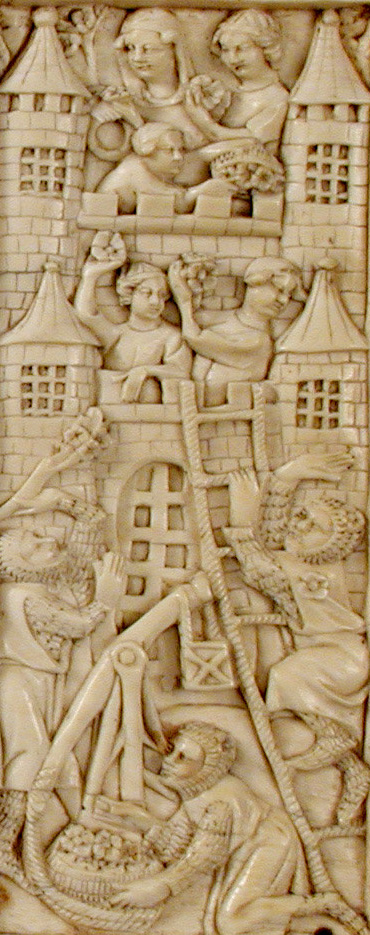
battle at medieval castle of love

In northern France in the thirteenth and early fourteenth centuries, men and women poet-singers known as trouvères composed lyric debates. This type of song, called the jeu-parti, involved two voices defending in alternate stanzas alternate responses to a question set out for debate in the first stanza.[1] Jeux-partis involving women trouvères depict significant aspects of women’s privilege in medieval France.

Like most women today, women trouvères in medieval France rarely assumed the emotional risk of soliciting an amorous relationship. A jeu-parti between Dame Margot and Dame Marote debates a case involving a woman and man who love each other dearly. The man dares not declare his desire to the women. The debate question is whether the woman should assume a man’s typical burden and declare her love to him. Dame Margot argues against the woman taking the initiative to establish an amorous relationship. Dame Marote argues for the woman taking the initiative.

In their arguments, both Dame Margot and Dame Marote recognize women’s privilege in relation to men. Dame Marote declares that “she should not be proud {pas ne doit cele estre fiere},” as if a woman telling a man that she loves him in some way injures her pride and lowers her worth. Dame Margot counters Dame Marote’s position, but confirms women’s privilege:

You are not heading the right way,
Dame Marote, I believe.
A lady makes a grave mistake in courting
her beloved first. Why
should she thus demean herself?
If he lacks courage,
I do not think it proper
that she should then solicit his love.
She should rather conceal her feelings
and suffer love’s pains
without ever disclosing them,
because a woman should have such high merit
that no word would come from her
that could diminish her worth.

{ Vous n’ales pa droite voie,
Dame Marote, je croi.
Trop mesprent dame ki proie
Son ami avant. Pour koi
S’aveilleroit elle si?
Se cil a le cuer falli,
Ne di jou pas k’il afiere
Por ce k’ele le reqiere,
Ains s’en doit chovrir
Et les fais d’Amours soufrir
Sans ja fiare percevoir;
Kar feme doit tant valoir
Que n’en doit parole issir
Ki son pris puist amenrir. } [2]

Underscoring that women equally sharing men’s burdens is inconceivable to gynocentric reason, Dame Marote argues that true love should make a woman act insane. While a sane woman would retain women’s privilege, a woman insane with love would take the initiative to solicit an amorous relationship. Dame Marote concludes:

Better it is to live in joy
for having pleaded than now to languish
for having been silent and then die.

{ Miex vient en joie manoir
Par proier q’adés langir
Par trop taire et puis morir. }

Dame Marote’s point seems indisputable. Yet many women today would rather be coerced into a having an abortion or even die rather than relinquish their gynocentric privilege.

Another jeu-parti between two women trouvères debates women’s preference regarding how men bear the burden of soliciting an amorous relationship. In this case, two knights both love one woman. One knight seeks to communicate his love through the woman’s friends. The other declares his love to her directly. According to women’s preference, which knight behaves better? One woman trouvère argues that a man who directly declares his love to her would make her seem shameful and weak. The other woman trouvère disputes that claim:

Sister, you are in error,
of that I do not doubt in the least.
When this one tenderly
humbles himself before you
and requests your loyalty,
you feel contempt for him.

{ Suer, vous estes en errout,
Je ne m’an dout mie.
Cant celui par sa dousor
Ver vous s’umelie
Et vos requiert loialteit,
Vos lou teneis an vitei. } [3]

As if that would justify him soliciting her love, the man humbles himself before the woman. In actuality, if he approached her as an arrogant jerk, she would more likely feel her loins tingle. Men must be learned enough to reject women’s privilege in prescribing how men should behave.

Women’s privilege prompts women to look down on men as if men were inferior human beings afflicted with “toxic masculinity.” A jeu-parti between two women trouvères debates whether a woman should allow a man to declare his love to her. One woman trouvère proposes listening to the man. College administrators evaluating sexual assault charges today generally reject the practice of listening to an accused man. But this medieval woman argues:

By listening to him you will be able to decide
if it pleases you to accept him or refuse him,
and you will know if he speaks wisely or foolishly.

{ Qu’en lui oiant porrez vous bien eslire
Se il vous plaist l’otroi ou le desdire,
Et si savrez s’il dist sens our folour. } [4]

What could be wrong with listening to a man? At least with respect to men, everyone isn’t required to listen and believe. Yet the other woman trouvère vehemently argues against even just listening to a man:

a woman should really not
listen to a man; she should rather fear
being seduced by the words she hears.
For men are consummate flatterers
and their arguments they so beautifully describe
that simply by listening to them she could well agree
to something that would quickly dishonor her.

{ fame ne doit mie
Home escouter, ains doit avoit paour
Qu’ele ne soit a l’oir engignie,
Quar home sont trop grant losengeour
Et leur raisons sevent tant bel descrire
Qu’en eulz oiant puet a cele souffire
Chose dont tost cherroit en deshonour. }

For women’s safety men must not be allowed to speak. That such ridiculous claims about women’s safety are taken seriously exemplifies women’s privilege.

Medieval scholars have recognized that these women-exclusive jeux-partis closely engage relational reality. One eminent medieval scholar observed:

it is the practical, level-headed outlook of both {women} speakers, calculating the respective roles of the emotions and social niceties, which is notable. Even if these debates are about questions of love, they are not romantic, or erotic, lyrics. … The jeux-partis were among the games devised for that {mixed-sex castle} hall, diverstissements of a society that thought such topics up in order to amuse as well as wittily to provoke. Yet the range and subtlety of emotion and argument that we glimpse in some of the debates involving women suggest something more. Here were poets who, even if they lived lightly — at least in the imagination — could also reflect searchingly. [5]

One doesn’t need to reflect searchingly to recognize women’s privilege in the jeux-partis involving women. Two knights seek one woman’s love. One is rich and worthy, the other is wise and worthy. Which man should the woman choose? A woman again has the choice of two knights. One extensively offers his warrior skills in knightly combat. The other generously shares his money and goods. Which man should the woman choose? Between an arrogant knight and a quarrelsome knight, which man should a woman choose?[6] Men’s choices are much more narrow than women’s choices. Men are burdened with responsibilities while women are privileged with choices.

At least medieval women recognized women’s privilege and men’s hardships. Regarding men’s sexual labor for women, one woman trouvère frankly observes:

You know full well that back pain sets in
that keeps old men from laboring as long.
Beyond the age of forty, he does nothing but decline;
he is then hardly suited to partake in pleasure.

{ You saveis bien ke li maus tient en rains,
Dont li vielars an sont ovriers dou moins;
Puis .xl. ans ne fait hons fors c’aleir,
Pou vaut on puis por deduit demeneir. } [7]

Men’s sexual service to women is a matter of life and death, yet it’s often undervalued, disparaged, and criminalized. Men deserve more choices in how they sexually serve women. Men deserve reproductive freedom. Women’s special privilege must end. Women and men must share equally privileges and hardships.[8]

*  *  *  *  *

Read more:

Notes:

[1] Jeux-parti typically have six stanzas. The final stanza often appeals to an external judge for a decision regarding the winning position. For extensive discussion of the historical definition of jeu-parti, Mason (2018) Ch. 1. Debate poems in Old Occitan are known as tensos or partimens.

Trouvères composed and performed jeux-partis primarily in Arras in northern France in the thirteenth century. Arras was a center of commercial trade and artistic activity. The trouvères of Arras were associated with the literary academia Puy d’Arras. On Arras in relation to jeux-partis, Barker (2013) pp. 6-9, 52. About 175 jeux-partis have survived, 60% of which come from Arras. Doss-Quinby et al. (2001) p. 73  (total number 182), Barker (2013) p. 4 (total number 170), p. 52, n. 92 (Arras share 60%, citing Symes estimate).

Most surviving jeux-partis involve only men trouvères. Mason (2018) p. 298. Jeux-partis in which women trouvères participate as debaters have survived mainly in the Oxford Chansonnier (Oxford, Bodleian Library, MS Douce 308), known by the siglum I.

Jeux-partis could be aggressive contests, but such symbolic violence has far different effects on human lives than does actual violence. In medieval Europe, elite men had a life expectancy nine years less than that of women. Medieval literature depicts horrific violence against men. The enormous masculine gender protrusion in suffering violent injury and death reflects in part women’s privilege.

Literary scholars have tended to ignore and trivialize the reality of violence against men. Mason’s thesis, for example, shows no awareness of the actual gendered facts about violent victimization. In accordance with prevailing academic fashion, Mason suggests violence against men is about misogyny and the exclusion of women:

In applying the metaphor of single combat to the jeu-parti, Jeanroy, Fiset and Nicod invoked the homosociality of combat prevalent in Europe before the First World War. The paradigm of the duel is demonstrably at work in the ‘footnote quarrels’ of German and French musicologists at the start of the twentieth century, whose blows and counterblows in their retaliatory publications and footnotes are reminiscent of verbal sparring. Jeanroy, Fiset and Nicod defined the jeu-parti as a combative, robustly masculine genre, in which poetic skill could be equated with bravura and violence. The misogyny of late romantic duellers could map neatly onto the subject of many dilemma questions in jeux-partis: how best to please one’s Lady. In defining the genre in this way, women were excluded as possible interlocutors and, as a result, the genre has since been treated as principally masculine.

Mason (2018) p. 54. Women, including during the First World War, have played a important role in promoting violence against men. Men and women scholars should show more love for men and less eagerness to please “the Lady.”

[2] Dame Margot & Dame Maroie, Jeu-parti, “I entreat you, Lady Maroie {Je vous pri, dame Maroie}” st. 3 (vv. 29-42), Old French text (Picard dialect) and English translation (with my modifications to follow the Old French more closely) from Doss-Quinby et al. (2001) p. 76. Within this jeu-parti, Dame Maroie is subsequently called Dame Marote. I use the latter name consistently above. The previous short quote above is similarly from v. 22; the subsequent quote above is vv. 82-4 (ending stanza 6 of 6). Here’s a performance of “Je vous pri, dame Maroie” by Musiktheater Dingo (2012).

Many women today have never contacted an man, expressed amorous interest in him, and invited him to dinner and evening entertainment, with the clear understanding that she would pay for the cost of the whole evening. Of course the man for a variety of reason might reject the woman’s proposal. Most men have many times had the experience of paying for dates and being romantically rejected. Today is long past the time for women to share that experience equally.

[3] Lorete & Suer, Jeu-parti, “Lorete, sister, in the name of love {Lorete, suer, par amor}” vv. 57-62 (from st. 5 of 5), Old French text (Lorraine dialect) and English translation (with my modifications) from Doss-Quinby et al. (2001) p. 80. This jeu-parti survives only in the Oxford Chansonnier. The 26 jeux-partis in that chansonnier have been dated to 1310. Barker (2013) p. 43.

[4] Sainte des Prez & Dame de la Chaucie, Jeu-parti, “What shall I do, Lady of Chaucie {Que ferai je, dame de la Chaucie},” vv. 12-4 (from st. 2 of 5), Old French text (Lorraine dialect) and English translation (with my modifications) from Doss-Quinby et al. (2001) p. 81. The subsequent quote above is similarly from id. vv. 15-21 (in st. 3).

The woman trouvère who opposes the man making known his love through the woman’s friends figures a man acting that way as being like Renart the Fox:

he is Renart the Fox,
who pursues his intrigue until he has seized his prey.

{ s’est Renars li Werpis,
Ke quiert ses tors tant ke il soit saixis. }

Id. vv. 64-5. The man trobairitz Pèire de Bossinhac in his song “Quan lo dous temps d’abril” uses Renart as a figure of being shrewdly vengeful. See note [7] in my post on medieval women’s strong, independent sexuality.

[5] Dronke (2007) pp. 330, 335. Dronke concludes with flattery for gynocentric authority:

And it certainly looks as if some of these poets — perhaps indeed, the most perceptive of them — were themselves women.

Id. p. 335. Similarly conforming to academic orthodoxy, Barker concludes her chapter on women’s desire with gynocentric panegyric: “these feminine voices are able to carve out space in which they resist the pressure to conform.” Barker (2013) p. 313.

[6] The four jeux-parti described in the above paragraph (in order of description above, with page citations in Quinby et al. (2001) are: Dame & Rolant de Reims, “Advise me, Rolant, I entreat you {Concilliés moi, Rolan, je vous an pri},” pp. 87-8; Dame & Rolant de Reims, “Dear lady, do respond {Douce dame, respondex},” pp. 89-1; Dame & Rolant de Reims, “Dear lady, I would gladly {Douce dame, volantiers},” pp. 92-4; and Dame & Perrot de Beaumarchais, “Dear lady, let this one be your call {Douce dame, ce soit en vos nomer},” pp. 97-8.

[7] Dame & Sire, Jeu-parti, “Tell me, lady, who has better discharged his debt {Dites, dame, li keilz s’aquitait muelz},” vv. 29-32 (from st. 4 of 5), Old French text (Lorraine dialect) and English translation (with my modifications) from Doss-Quinby et al. (2001) p. 104.

[8] The term “women’s privilege is preferable to “female privilege.” Infants in laughing, crying, pooping, sleeping, etc., typically do not act with gender privilege. Gender privilege emerges through human development. Brothers and sisters as children, however, can experience analogues of women’s privilege. Consider, for example, the childhood experience of U.S. politician Joe Biden:

According to Biden’s own words his sister regularly beat him in his childhood and adolescence. “And I have the bruises to prove it,” he said, at a senate hearing on violence against women, December 11, 1990. To make sure the audience knew this wasn’t a joke, he added, “I mean that sincerely. I am not exaggerating when I say that.”

In Biden’s brief tell-all, he acknowledged that the beatings he received were condoned and sanctioned by his parents, and that he was prevented from defending himself; That he was literally, in fact, powerless to make the abuse stop.

“In my house,” he stated, “being raised with a sister and three brothers, there was an absolute. It was a nuclear sanction, if under any circumstances, for any reason –even self defense– you ever touched your sister, not figuratively, literally.”

“My sister, who is my best friend, my campaign manager, my confidante,” he continued, “grew up with absolute impunity in our household.”

From Elam (2010). While such behavior should be a matter of serious social concern, “women’s privilege” seems to me nonetheless a more reasonable term than “female privilege.”

[image] Women occupying the castle of love from above assail men confined outside the castle and besieging it. Excerpt from design on a side panel of an elephant ivory coffret made in Paris between 1310 and 1330. Preserved as accession # 17.190.173a, b; 1988.16 in The Metropolitan Museum of Art (New York City, USA). Gift of J. Pierpont Morgan, 1917; The Cloisters Collection, 1988. Image derived from an image that the Metropolitan Museum has made available under a public spirited public domain dedication (CCO license).

References:

Barker, Camilla. 2013. Dialogue and Dialectic in Twelfth- and Thirteenth-Century Occitan and Old French Courtly Lyric and Narrative. Ph.D. Thesis, King’s College, London.

Doss-Quinby, Eglal, Joan Tasker Grimbert, Wendy Pfeffer, and Elizabeth Aubery. 2001. Songs of the Women Trouvères. New Haven: Yale University Press. (review by Carol Symes)

Dronke, Peter. 2007. “Women’s Debates in Medieval French Lyric.” Ch. 18 (pp. 323-336) in Dronke, Peter. Forms and Imaginings: from antiquity to the fifteenth century. Roma: Edizioni di Storia e Letteratura.

Elam, Paul. 2010. “VAWA — Corrupt Law and Joe Biden’s Abusive Sister.” A Voice For Men. Online.

Mason, Joseph W. 2018. Melodic Exchange and Musical Violence in the Thirteenth-Century jeu-parti. D. Phil. Thesis, Faculty of Music Lincoln College, Oxford.