trobairitz poetry shows gender bias in social construction of crimes

mean red cat

Modern public discussion of rape has overwhelmingly ignored rape of men and propagated ignorance and anti-men gender bigotry. The underlying problem is as grotesque as the mass imprisonment of men under carceral anti-meninism and as subtle as medieval trobairitz poetry setting men up to be criminals. Since persons today are thoroughly trained to ignore the obvious, let’s begin reconstructing criminal justice and romance between women and men through analysis of trobairitz poetry.

The thirteenth-century trobairitz Domna H. presented a sexual scenario to the man trobairitz Rofin. She asked:

Rofin, you’re an expert in these matters,
so tell me right away, which one did better:
suppose a lady who is noble and well born
and has two lovers
wants them both to swear an oath
before she is willing to sleep with them:
they must promise to do no more
than hug and kiss. And one makes haste
to make that oath and breaks his word.
But the other simply doesn’t dare.

{ Rofin, digatz m’ades de quors,
cals fetz meills, car etz conoissens:
c’una domna coinda e valens
que ieu sai ha dos amadors,
e vol q’uesqecs iur e pliva
enans que·ls voilla ab si colgar,
que plus mas tener e baisar
no·ill faran, e l’uns s’abriva
e·l fag, qe sagramen no·ill te,
l’autres no·l ausa far per re. } [1]

A woman who makes her lover promise to sleep with her, but do no more than hug and kiss her, is heartless and cruel at best. Most men are romantically simple and quite excitable. Christian men pray to God to lead them not into temptation.[2] Women who care for men should respect that manly prayer. Women who care for men shouldn’t taunt prudent men that they lack daring. Prudent men know what they have and how they can be exploited.

Most men have contempt for a man who would force a woman to have sex. Males raping females is quite rare across all primate species, and all but one of those species have no formal police forces and no institutions of penal incarceration. Like most men would, Rofin denounced the man-lover who in the hypothetical scenario raped his beloved lady. To hold that position, he had to resist the lady seeking to seduce men into becoming felons:

Lady, folly overcame the one
who was disobedient
toward his lady, for is it not evident
that a lover, when love drives him on,
should never defy his lady’s words
and willfully compel her.
So I say the one who broke his faith
should lose the high joy of his lady
without reprieve,
and the other man find mercy.

A true lover will not feel such fear,
Rofin, that he won’t take his pleasure,
for his desire and overwhelming urge
drive him so hard that he can’t stop
or control himself
despite the clamor of his famous lady.
For if love is earnest, lounging about
and gazing heats him up
so much that he cannot hear or see
or know if he does bad or good.

Lady, I think it is a great mistake
in a lover who loves from the heart,
if any pleasure brings him joy
that does not honor his lady.
For he should not even avoid
pain if it lets him honor her,
nor should anything please him
unless it pleases her.
A lover who does not behave this way
should lose his lady and his life!

{ Domna, d’aitan sobret follors
cel que fon deshobediens
ves sidons, que non es parvens
q’amans, puois lo destreing amors,
deia ab voluntat forciva
los ditz de sa domna passar.
Per q’eu dic qe senes cobrar
deu perdre la ioia autiva
de sidons cel qui frais sa fe
e l’autres deu trobar merce.

A fin amic non tol paors,
Rofin, de penre iauzimens,
qe·l desirs e·l sobretalens
lo destreing tant qe per clamors
de sidons nominativa
noi·s pot soffrir ni capdellar;
c’ab iazer et ab remirar
l’amors corals reccaliva tant
fort que non au ni non ve
ni conois qan fai mal o be.

Domna, ben mi par grans errors
d’amic, puois ama coralmens,
que nuills gaugz li sia plazens
q’a sa domna non sia honors,
car no·ill deu esser esqiva
pena per sa domna onrar,
ni·l deu res per dreg agradar
s’a leis non es agradiva,
e drutz q’enaissi no·s capte
deu perdre sa domna e se. }

Throughout history the death penalty has been grossly gender-biased against men. That alone is moral reason enough to reject completely the death penalty. The man broke his promise that he would sleep with his beloved lady, but only hug and kiss her. For that, like any other convicted felon, he should’t be killed under gender-biased penal law. Erase the gender-biased death penalty from penal law!

Men shouldn’t put themselves in a position where they might commit a horrible crime. A woman who knowingly goads a man into putting himself into such a position is no better than an accomplice to rape. She is deliberately inciting men to do evil. She does that in part through the vicious female practice of sexual disparaging and shaming men:

Rofin, the cowardly invader
is shameful, soft, and shrinking.
Know that he was a shameful swine
when he lost himself mid-course.
But the ardent one, in whom merit lives,
knew how to advance his cause
when he seized what he held most dear
while his beloved was near.
A lady who distrusts a lover like him
trusts wrongly one who shrinks from her.

{ Rofin, dels crois envazidors
aunitz e flacs e recrezens,
sapchatz qe fon l’aunitz dolens
qe se perdet en mieg dels cors,
mas l’arditz on pretz s’aviva
saup gen sa valor enansar
qant pres tot so qe·ill fon plus car
mentre·il fon l’amors aiziva
e domna q’aital drut mescre
mal creira cel qui s’en recre. }

Because Rofin spoke out strongly against forcing a woman to have sex, Domna H. turned on him and disparaged his masculinity:

Now I know how it really goes,
Rofin, since I hear you blame
the true man and defend the loser.
You yourself would do feeble work
at it.

{ Oimais conosc ben cossi va,
Rofin, puois que·us aug encolpar
lo fin e·l caitiu razonar:
q’eissamens obra caitiva
faria }

In Chrétien de Troyes’s Lancelot, a wicked woman arranged a fake rape scene to test Lancelot’s courage and spur his passion. Men are eager to help women in distress. Men should be more aware of how women like Domna H. manipulate them and set them up to be charged with felony crimes.[3]

Trivializing women’s sexual assaults against men contributes to the gender protrusion among prisoners. Consider the case of an eager lover of women in early twelfth-century southern France, the man trobairitz Guilhem IX of Aquitaine, also known as Guillem de Peiteus. One day while walking in the sunshine and coyly looking for women to love, he encountered the wives of Sir Guarin and Sir Bernard. Those women greeted him courteously, but they warily observed that many fools wander about the world.

Learned lovers know the effective seduction tactic “agree and amplify.” Guilhem responded to the wives in a language that might have been Arabic, a prestigious, classical language of great lovers.[4] But whatever he said was gibberish to them. That intrigued the women:

So Agnes said to Ermaline,
“Let’s take him home, quick; don’t waste time.
He’s just the thing we hoped to find:
mute as a stone.
No matter what we’ve got in mind,
it won’t get known.”

Under her cloak, one let me hide;
we slipped up to her room’s fireside.
By now, I thought one could abide
to play this role —
right willingly I warmed myself
at their live coals.

They served fat capons for our fare —
I didn’t stop at just one pair;
we had no cook or cook’s boy there,
but just us three.
The bread was white, the pepper hot,
the wine flowed freely.

{ So diz n’Agnes a n’Ermessen:
“Trobat avem que anam queren.
Sor, per amor Deu, l’alberguem,
qe ben es mutz,
e ja per lui nostre conselh
non er saubutz.”

La una·m pres sotz son mantel,
menet m’en cambra, al fornel.
Sapchatz qu’a mi fo bon e bel,
e·l focs fo bos,
et eu calfei me volentiers
als gros carbos.

A manjar mi deron capos,
e sapchatz agui mais de dos,
e no·i ac cog ni cogastros,
mas sol nos tres,
e·l pans fo blancs e·l vins fo bos
e·l pebr’ espes. } [5]

A capon is a rooster castrated to make for better eating. It’s an element of castration culture. It’s an ominous sign for any man. But Guilhem didn’t understand.

Taught to be suspicious of men, the women resolved to test him. They wanted to be sure that he wouldn’t be able to reveal the evil that they would do:

“Wait, sister, this guy’s full of fakes,
his babble — an act for our sake?
See if our big red cat’s awake
and fetch him, quick.
Right here’s one silence we should break
if it’s a trick.”

So Agnes brought that wicked beast,
mustachioed, huge, and full of yeast;
to see him sitting at our feast —
seemed less than good;
I very nearly lost my nerve
and hardihood.

We’d had our fill of drink and food,
so I undressed, as they thought good.
They brought that vile cat where I stood —
my back was turned —
and then they raked him down my side
from stem to stern.

And all at once, they yanked his tail
to make him dig in, tooth and nail.
I got a hundred scars, wholesale,
right then and there.
They could have flayed me, though, before
I’d budge one hair.

{ “Sor, aquest hom es enginhos,
e laissa lo parler per nos:
nos aportem nostre gat ros
de mantement,
qe·l fara parlar az estros,
si de re·nz ment.”

N’Agnes anet per l’enujos,
e fo granz et ac loncz guinhos:
e eu, can lo vi entre nos,
aig n’espavent,
qu’a pauc non perdei la valor
e l’ardiment.

Quant aguem begut a manjat,
eu mi despoillei a lor grat.
Detras m’aporteron lo gat
mal e felon;
la una·l tira del costat
tro al tallon.

Per la coa de mantenen
tira·l gat et el escoissen:
plajas mi feron mais de cen
aqella ves;
mas eu no·m mogra ges enguers,
qui m’ausizes. }

The red cat is male, signifying men’s mistreatment of men and men’s complicity in women’s mistreatment of men. But men naturalize their own oppression. They simply accept whatever abuse they suffer. Guilhem said not a word in response to the brutal physical abuse that he endured.

Men’s willingness to suffer allows women to exploit them. So it was for Guilhem:

So Agnes said to Ermaline,
“He’s mute for sure, sister; that’s fine.
Let’s take a nice warm bath, unwind,
then take things slow.”
I stayed inside their oven there
eight days or so.

I fucked them, fairly to relate,
a full one hundred eighty eight.
My breech-strap near broke at that rate,
also my reins.
I can’t recount all my distress
or half my pains.

No; I can’t tell all my distress
or half my pains.

{ “Sor, diz n’Agnes a n’Ermessen,
mutz es, qe ben es conoissen;
Sor, del banh nos apareillem
e del sojorn.”
Ueit jorns ez encar mais estei
en aquel forn.

Tant las fotei com auzirets:
cen e quatre vint et ueit vetz,
q’a pauc no·i rompei mos coretz
e mos arnes;
e no·us pues dir lo malaveg,
tan gran m’en pres.

Ges no·us sai dir lo malaveg,
tan gran m’en pres. }

All his erection labor left Guilhem broken and in pain. Men should be adequately compensated for their erection labor. Instead, Guilhem was first scourged and bloodied with a red cat’s claws and fangs. An alternate version of the song concludes with Guilhem sending a message to Agnes and Ermaline to kill that red cat for love of him. They owe him much more than that.[6] In a society whose penal institutions weren’t deeply biased toward punishing men, both wives would be arraigned for aggravated assault with a dangerous weapon.

*  *  *  *  *

Read more:

Notes:

[1] Domna H. and Rofin, “Rofin, digatz m’ades de quors,” st. 1, Occitan text from Bruckner, Shepard & White (1995) p. 78, English translation (modified slightly) from Paden & Paden (2007) p. 180. All subsequent quotes from this song are similarly sourced. This poem is classed as a partimen, a type of tenso (debate poem). A partimen sets forth in its first stanza a topic for the two parties to debate. Domna H. and Rofin were probably an Italian lady and a joglar (itinerant entertainer), respectively. Id.

Bernart Marti thought that a woman having two lovers in addition to her husband was unfaithful and disgraceful:

A lady toward her lover is perfidious
when she gives her love to three:
beyond lawful
is three,
but apart from her husband
I’ll allow her one pleading lover,
and if she seeks out more,
she’s a disgrace
and a proven whore.

{ Dona es vas drut trefana
De s’amor, pos tres n’apana:
Estra lei
N’i son trei,
Mas ab son marit l’autrei
Un amic cortes prezant.
E si plus n’i vai sercant
Es desleialada
E puta provada. }

Bernart Marti, “Bel m’es lai latz la fontana” st. 2, Occitan text and English translation (modified slightly) from Léglu (1999) p. 53. Here’s the full Occitan text of this song. Medieval European literature warned men against having more than one wife.

[2] Matthew 6:13, Luke 11:4, i.e. a petition in the prayer commonly know as “Our Father {Pater noster}.”

[3] In recent decades, carceral anti-meninism has flourished in elite literary scholarship. For example, Puckett expands and celebrates Domna H.’s anti-meninism:

Domna H attacks the entire spectrum of male heterosexual sexuality, presenting all male desire and sexuality as out of control; those who are not “shameful, soft and cowardly” turn out to be rapists, unable to control their excessive sexual desires, while those who do not force their beloved are motivated more by concerns for their own potential sexual lack, by their inability to control their own bodies, than by abstract questions of mutuality or morality.

Puckett (2012) p. 13.

[4] On Guilhem’s possible contact with Arabic speakers, Beech (1992). Fourteenth-century lyric song in the Spanish masterpiece Libro de buen amor clearly shows the influence of Arabic.

[5] Guilhem IX of Aquitaine {Guillaume IX / William IX, Duke of Aquitain}, “Farai un vers, pos mi somelh,” st. 6, Occitan text and English trans. (by Snodgrass, modified slightly) from Kehew (2005) pp. 30-1. For simplicity I refer to the poetic narrator as Guilhem. However, the song-author Guilhem IX of Aquitaine surely was poetically sophisticated enough to create a narrator’s voice different from his own real-life self. Subsequent quotes are similarly from id. Paten & Paten (2007) pp. 26-7 provides another translation. Freely available online are alternate translations by James H. Donalson, Leonard Cottrell, and trobar. Ensemble für Frühe Musik Augsburg, Camino de Santiago {Ensemble for Music on the Pilgrimage Route to St. James} has recorded this song with the melody “In laudes innocentium.” That melody is preserved in the St. Martial manuscripts, ca. 1099.

Guilhem IX of Aquitaine, who lived from 1071 to 1126, is the first man trobairitz whose name is known. He is also apparently identified in manuscripts as “Count of Poitou {Coms de Peitieus}.” He was one of the wealthiest and most politically powerful men in Europe of that time. The medieval chronicler Geoffroy de Vigeois characterize him as “a vigorous lover of women {vehemens amator foeminarum}.” His Old Occitan vida calls him “one of the greatest deceivers of women {dels majors trichadors de dompnas}.” Kehew (2005) p 20.

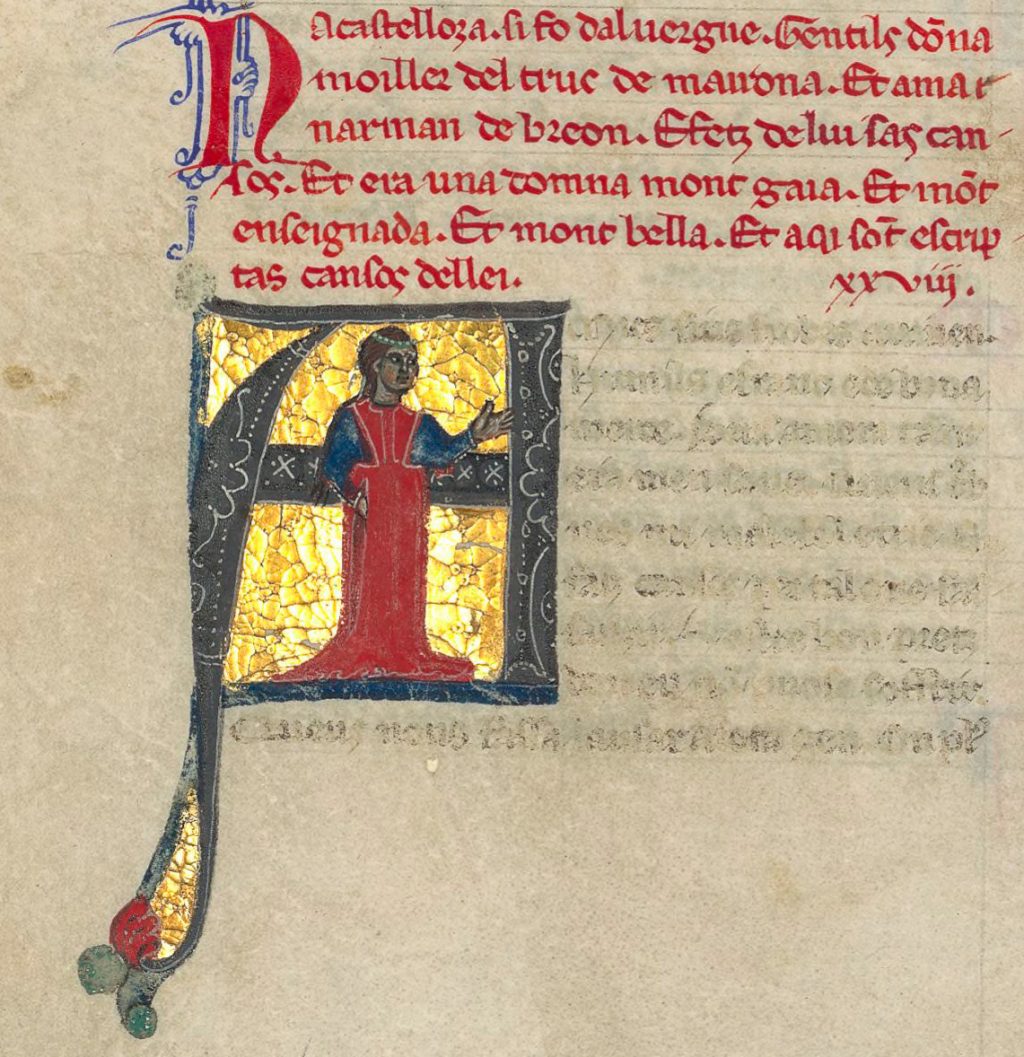
[6] In writing a late-thirteenth-century songbook (chansonnier), the scribe apparently recognized the significance of Guilhem’s red-cat song to the trobairitz songs of Na Castelloza. In that chansonnier, a song sequence begins and ends with five of Guilhem’s songs that frame six trobairitz songs. Four of those six trobairitz songs are those of Na Castelloza. She sung against men being distinctively positioned as a gender subject to sexual feudalism. In depicting personally sexual abuse of a man, Guilhem’s red-cat song provocatively frames Castelloza’s critique of gynocentric oppression. See Chansonnier provençal, Pierpont Morgan Library, MS M.819, folios 228-236 (written in Venice or Padua, c. 1285-1300). Cf. Nichols (1999) pp. 79-81.

[image] Mean red cat. Image from Grumpy Alice via Wikimedia Commons.

References:

Beech, George T. 1992. “Troubadour Contacts with Muslim Spain and Knowledge of Arabic : New Evidence Concerning William IX of Aquitaine.” Romania. 113 (449): 14-42.

Bruckner, Matilda Tomaryn, Laurie Shepard, and Sarah White, eds. and trans. 1995. Songs of the Women Troubadours. New York: Garland.

Kehew, Robert, ed. 2005. Lark in the Morning: the Verses of the Troubadours: a bilingual edition. Chicago, Ill: University of Chicago Press.

Léglu, Catherine. 1999. “Moral and satirical poetry.” Ch. 3 (pp. 47-65) in Gaunt, Simon, and Sarah Kay, eds. The Troubadours: an introduction. Cambridge: Cambridge University Press.

Nichols, Stephen G. 1999. “The early troubadours: Guilhem IX to Bernart de Ventadorn.” Ch. 4 (pp. 66-82) in Gaunt, Simon, and Sarah Kay, eds. The Troubadours: an introduction. Cambridge: Cambridge University Press.

Paden, William D., and Frances Freeman Paden, trans. 2007. Troubadour Poems from the South of France. Cambridge: D. S. Brewer.

Puckett, Jennifer. 2012. “When a Woman Says ‘Yes,’ She Really Means ‘No’: The Subversive Rape Rhetoric of Domna H.” Tenso. 27 (1-2): 1-24.

trobairitz Castelloza against sexual feudalism & gender inequality

Good lady, you may burn or hang him
or do anything you happen to desire,
for there’s nothing that he can refuse you,
as such you have him without any limits.

{ Bona domna, ardre.l podetz o pendre,
o far tot so que.us vengua a talen,
que res non es qu’el vos puesca defendre,
aysi l’avetz ses tot retenemen. } [1]

trobairitz Na Castelloza

Men have long been sexually disadvantaged. While men’s structural disadvantages are scarcely acknowledged within gynocentric society, a small number of medieval women writers courageously advocated for men. In Occitania early in the thirteenth century, the extraordinary trobairitz Lady Castelloza spoke out boldly against gender inequality in love and men having the status of serfs in sexual feudalism.

And if she tells you a high mountain is a plain,
agree with her,
and be content with both the good and ill she sends;
that way you’ll be loved.

{ e s’ela.us ditz d’aut puoig que sia landa,
vos l’an crezatz,
e plassa vos lo bes e.l mals q’il manda,
c’aissi seretz amatz. } [2]

Just as is the case for many women today, many medieval women didn’t adequately support and defend men. When Giraut de Bornelh asked his lovely friend Alamanda about his love difficulties, she advised him to be totally subservient to his lady. Alamanda was a maiden to that lady. Lord Giraut apparently had lost his lady’s love by seeking sex with a woman who was not her equal, probably none other than her maiden Alamanda. But what had that lady done to him? She had lied to him at least five times before! When women speak, men should not just listen and believe. Unwillingness to question a woman led a Harvard Law professor to personal disaster. Men should not act as doormats for women or as women’s kitchen servants.

The trobairitz Maria de Ventadorn insisted to Gui d’Ussel that a woman should retain her superior position even in a love relationship with a man. Gui felt that men and women in love should be equals. But Maria wanted men to fulfill all the pleas and commands of their lady-lovers. That’s the pernicious doctrine of yes-dearism. Just say no to female supremacists!

Lady {Maria de Ventadorn}, among us they say
that when a lady wants to love,
she should honor her love on equal terms
because they are equally in love.

Gui d’Ussel, at the beginning lovers
say no such thing;
instead, each one, when he wants to court,
says, with hands joined and on his knees:
“Lady, permit me to serve you honestly
as your servant man” and that’s the way she takes him.
I rightly consider him a traitor if, having given
himself as a servant, he makes himself an equal.

{ Dompna, sai dizon de mest nos
Que, pois que dompna vol amar,
Engalmen deu son drut onrar,
Pois engalmen son amoros!

Gui d’Uissel, ges d’aitals razos
Non son li drut al comenssar,
Anz ditz chascus, qan vol prejar,
Mans jointas e de genolos:
Dompna, voillatz qe-us serva franchamen
Cum lo vostr’om! et ella enaissi-l pren!
Eu vo-l jutge per dreich a trahitor
Si-s rend pariers e-s det per servidor. } [3]

immixtio manuum: feudal homage

Because of their great love for women, men are reluctant to demand that women treat them with equal human respect and dignity. Men tend toward gyno-idolatry. The man on his knees before a woman, with his hands clasped, is making a gesture of faithful subordination. She then puts her hands around his hands to complete this feudal gesture known as the immixtio mannum {intermingling of hands}. A man today who goes down on his knee to ask a woman for her hand in marriage is preparing to be a vassal to his woman-lord midons. That’s folly. That’s fine preparation for a sexless marriage. From studying Ovid the great teacher of love to modern empirical work on sexual selection, men should know that self-abasement is a losing love strategy.

Oh Love, what shall I do?
Shall we two live in strife?
The griefs that must ensue
would surely end my life.
Unless my Lady might
receive me in that place
she lies in, to embrace
and press against me tight
her body, smooth and white.

Good Lady, thank you for
your love so true and fine;
I swear I love you more
than all past loves of mine.
I bow and join my hands
yielding myself to you;
the one thing you might do
is give me one sweet glance
if sometime you’ve the chance.

{ Amors, e que.m farai?
Si garrai ja ab te?
Ara cuit qu’e.n morrai
Del dezirer que.m ve,
Si.lh bela lai on jai
No m’aizis pres de se,
Qu’eu la manei e bai
Et estrenha vas me
So cors blanc, gras e le.

Bona domna, merce
Del vostre fin aman!
Qu’e.us pliu per bona fe
C’anc re non amei tan.
Mas jonchas, ab col cle,
Vos m’autrei e.m coman;
E si locs s’esdeve,
Vos me fatz bel semblan,
Que molt n’ai gran talan! } [4]

The medieval trobairitz Castelloza sympathized with men’s subordination in love. She loved a man who didn’t love her. A woman today in such a situation might open a dating app and enjoy a huge number of solicitations from men. Then, if necessary to boost her self-esteem, she might go for sexual flings with a few, or at least exploit traditional anti-men gender dating roles to get some free dinners. With a keen sense for social justice, Castelloza refused to live according to such female privilege:

I certainly know that it pleases me,
even though people say it’s not right
for a lady to plead her own cause with a knight,
and make long speeches all the time to him.
But whoever says this doesn’t know
that I want to implore before dying,
since in imploring I find sweet healing,
so I plead to him who gives me grave trouble.

{ Eu sai ben qu’a mi esta gen,
Si ben dison tuig que mout descove
Que dompna prec ja cavalier de se,
Ni que l tenga totz temps tam lonc pressic,
Mas cil c’o diz non sap gez ben chausir.
Qu’ieu vueil preiar ennanz que.m lais morir,
Qu’el preiar ai maing douz revenimen,
Can prec sellui don ai greu pessamen. } [5]

Castelloza recognized that, in pleading with a man for love, she was transgressing the norms of men-oppressing courtly love. When women treat men merely as dogs, women don’t experience the full gift of men’s tonic masculinity. The master dehumanizes herself in dehumanizing her man-slaves. Castelloza, in contrast, understood that a man’s love can ennoble a woman. She understood that a man can offer much to even the most privileged woman.

I’m setting a bad pattern
for other loving women,
since it’s usually men who send
messages of well-chosen words.
Yet I consider myself cured,
friend, when I implore you.
for keeping faith is how I woo.
A noble women would grow richer
if you graced her with the gift
of your embrace or your kiss.

{ Mout aurei mes mal usatge
A las autras amairitz,
C’hom sol trametre mesatge,
E motz triaz e chauzitz.
Es ieu tenc me per gerida,
Amics, a la mia fe,
Can vos prec — c’aissi.m conve;
Que plus pros n’es enriquida
S’a de vos calqu’aondansa
De baisar o de coindansa. } [6]

Men’s lack of imagination and unwillingness to protest helps to keep them in their gender prison of gynocentrism. Men rightly appreciate, admire, and love courageous, transgressive women like the trobairitz Castelloza. But men must take responsibility for winning their own liberation. A man showing loving concern about his close friend getting married isn’t enough. Men should be more daring and, like Matheolus, raise stirring voices of men’s sexed protest. Men Going Their Own Way (MGTOWs) struggled against misandry and castration culture even in the Middle Ages, and they continue to do so today. MGTOW is merely prudent personal action. To dismantle gynocentric oppression, men must recover, create, and disseminate protest poetry as potent as the medieval troubadours’ feudal songs of men’s love serfdom.

Peire, if spanning two or three years
the world were run as would please me,
I’ll tell you how with women it would be:
they would never be courted with tears,
rather, they would suffer such love-fears
that they would honor us,
and court us, rather than we, them.

{ Peire, si fos dos ans o tres
Lo segles faihz al meu plazer,
De domnas vos dic eu lo ver:
Non foran mais preyadas ges,
Ans sostengran tan greu pena
Qu’elas nos feiran tan d’onor
C’ans nos prejaran que nos lor. } [7]

*  *  *  *  *

Read more:

Notes:

[1] Domna and Donzela, “Bona domna, tan vos ay fin coratge” ll. 17-20, Occitan text and English translation (modified insubstantially) from Bruckner, Shepard & White (1995) pp. 92-3. Here’s some meta-data about this trobairitz song. It’s a debate poem (tenso). The currently best critical edition of trobairitz / troubadour tensos is Harvey, Paterson & Radaelli (2010), but it’s expensive and not widely available. For analysis of the genre of tenso, McQueen (2015).

[2] Alamanda and Giraut de Bornelh, “S’ie.us qier conseill, bella amia Alamanda” ll. 13-16, Occitan text and English translation from Bruckner, Shepard & White (1995) pp. 42-3.

[3] Maria de Ventadorn and Gui d’Ussel, “Gui d’Ussel be.m pesa” ll. 25-8, 33-40, Occitan text and English translation (modified insubstantially) from Bruckner, Shepard & White (1995) pp. 38-41. This poem is also available in translation in Paden & Paden (2007). The immixtio manuum isn’t attested prior to 1100. West (2013) p. 211.

[4] Bernart de Ventadorn, “Pois preyatz me, senhor” ll. stanzas 4 & 6, Occitan text and English translation by W.D. Snodgrass from Kehew (2005) pp. 84-5. The Poemist offers online the full text and English translation.

Men’s abasement in sexual feudalism is pervasive in trobairitz song. Men engage in gyno-idolatry and imagine that they will die without a woman’s love:

I bow down to you, whom I love and adore,
and I am your liegeman and your household servant.
I yield myself up to you, who are the noblest
and the best being that was ever born of a mother.
And since I cannot help but love you,
for mercy’s sake, I beg you, don’t let me die.

{ Sopley vas vos, cuy yeu am et azor,
E suy vostres liges e domesgiers.
A vos m’autrey, qar etz la genser res
E la mielhers qu’anc de maire nasques.
E, quar no.m puesc de vos amar suffrir,
Per merce.us prec que no.m layssetz morir. }

Peire Bremont Ricas Novas, “Us covinens gentils cors plazentiers,” 3.3-8, Occitan text and English translation (modified) from Kay (1999) p. 217. Peire Bremont Ricas Novas was active in Province from about 1230 to 1241.

[5] Na {Lady} Castelloza, “Amics, s’ie.us trobes avinen” ll. 17-24 (stanza 3), Occitan text from Paden (1981), English trans. (modified) from Paden & Paden (2007). Bruckner, Shepard & White (1995) provides a slightly different Occitan text and English translation of all of Castelloza’s songs. Butterfly Crossings provides an online Occitan text and English translation of the full song, with commentary. Her commentary puts forward orthodox myth in service of gynocentrism:

by virtue of being a woman she is below him socially, thus rendering her statement simultaneously true and drawing attention to the place of women in society as opposed to the artificial pedestal they sit upon in traditional Troubadour poems. Regardless of her title, class, or wealth, in love, much like in life, the woman is beneath the man and must beg his favor like Castelloza here does.

Yup, so Anne of France was beneath day-laboring men gathering stones in fields.

Much influential recent scholarship on trobairitz has been based on dominant gender delusions. A relevant critique:

Gravdal’s argument here is based on her assumption that, for the men, powerlessness is a pose, a rhetorical strategy; the male speaker adopts an abased position only to use it as a springboard to higher status and sociopolitical clout. That Castelloza’s speaker does this as well is frequently overlooked, because it is assumed that for the women, powerlessness is a reality. This assumption is not supported by the evidence for noblewomen’s sociopolitical situation in Occitania during the time of the trobairitz.

Langdon (2001) p. 40.

[6] Castelloza, “Mout avetz faich lonc estatge” ll. 21-30 (stanza 3), Occitan text from Paden (1981), English trans. (modified) from Paden & Paden (2007). Butterfly Crossings again offers the full song, along with commentary. The commentary shows orthodox academic failure of self-consciousness:

Almost smirkingly Castelloza acknowledges that her behavior sets a terrible example for all other female lovers while synchronously encouraging them to do the same. She is not apologizing as much as drawing attention to the solidarity between women who will now partake in this perhaps liberating behavior and act upon their desires as opposed to remaining within the confined roles of passive love interests.

Women unite in liberating behavior: ask men out and buy men dinner!

In Castelloza’s songs, the man she loves has neither voice nor activity. Siskin & Storme (1989) pp. 119-20. Self-centeredness is a common characteristic of women’s writing, particularly in the last few decades of literary scholarship.

[7] Peire d’Alvrnha (possibly) and Bernart de Ventadorn, “Amics Bernartz de Ventadorn,” stanza 4, Occitan text from Trobar, my English translation benefiting from that of Rosenberg, Switten & Le Vot (1998). James H. Donalson provides an online Occitan text and English translation for the full song.

Bernart de Ventadorn was one of the greatest troubadour love poets. His desire for women to experience men’s subordinate position in love is coupled with appreciation for gender equality and reciprocity in love:

The love of two good lovers lies
in pleasing and in yearning’s thrill
from which no good thing will arise
unless they match each other’s will.
The man was born an imbecile
who scolds her for her preference
or bids her do what she resents.

{ En agradar et en voler
es l’amors de dos fiṉs amants;
nulha res no·i pòt proṉ tener
se·l volontatz non es egals.
E cell es beṉ fols naturals
qui de çò que vòl la reprend
e·ilh lauza çò qu no·ilh es gent }

“Chantars no pot gaire valer,” Occitan text and English trans. (modified insubstantially) from A.Z. Foreman. For an alternate English translation, Paden & Paden (2007) pp. 74-5. While Bernart here unequally criticizes men, in an earlier stanza her criticized women whoring in loving men.

[images] (1) Na Castelloza. Illuminated initial in manuscript Chansonnier provençal (Chansonnier K). Created in the second half of the thirteenth century. Folio 110v in Bibliothèque nationale de France (BnF) MS. 12473. (2) Immixtio manuum: Feudal tenant show faithful subordination to a procurator of King James II of Majorca in Tautaval. Illumination made in 1293. Preserved as Archives Départementales de Pyrénées-Orientales 1B31.

References:

Bruckner, Matilda Tomaryn, Laurie Shepard, and Sarah White, eds. and trans. 1995. Songs of the Women Troubadours. New York: Garland.

Harvey, Ruth, Linda M. Paterson, and Anna Radaelli. 2010. The Troubadour Tensos and Partimens: a critical edition. Cambridge: Brewer.

Kay, Sarah. 1999. “Desire and Subjectivity.” Ch. 13 (pp. 212-227) in Simon Gaunt and Sarah Kay, eds. The Troubadours: an introduction. Cambridge: Cambridge University Press.

Kehew, Robert, ed. 2005. Lark in the Morning: the Verses of the Troubadours: a bilingual edition. Chicago, Ill: University of Chicago Press.

Langdon, Alison. 2001. “‘Pois dompna s’ave/d’amar’: Na Castellosa’s Cansos and Medieval Feminist Scholarship.” Medieval Feminist Forum 32: 32-42.

McQueen, Kelli. 2015. That’s Debatable!: Genre Issues in Troubadour Tensos and Partimens. Thesis for Degree of Master of Music. Theses and Dissertations. Paper 819. The University of Wisconsin-Milwaukee.

Paden, William D. 1981. “The Poems of the Trobairitz Na Castelloza.” Romance Philology. 35 (1): 158-182.

Paden, William D., and Frances Freeman Paden, trans. 2007. Troubadour Poems from the South of France. Cambridge: D. S. Brewer.

Rosenberg, Samuel N., Margaret Louise Switten, and Gérard Le Vot. 1998. Songs of the Troubadours and Trouvères: an anthology of poems and melodies. New York: Garland Pub.

Siskin, H. Jay and Julie A. Storme. 1989. “Suffering Love: The Reversed Order in the Poetry of Na Castelloza.” Ch. 6 (pp. 113-127) in Paden, William D., ed. The Voice of the Trobairitz: perspectives on the women troubadours. Philadelphia: University of Pennsylvania.

West, Charles. 2013. Reframing the Feudal Revolution: political and social transformation between Marne and Moselle, c. 800 – c. 1100. Cambridge: Cambridge Univ. Press.

Ospirin, Hiltgunt & Walter of Aquitaine: medieval wives & husbands

Attila the Hun re-creation

When Attila the Hun’s wife Ospirin heard that his adopted son Prince Hagen had fled back to his native kingdom, she told Attila what to do. He should arrange for his other adopted son, Prince Walter of Aquitaine, to have his choice of a bride from among the Hun young women. He should also enrich this new couple with lands and goods. These actions, according to Ospirin, would prevent Walter from fleeing back to his native home as Prince Hagen had done. Attila dutifully sought to follow his wife’s advice.

While Attila the Hun was a fierce ruler who ruled much of fifth-century Europe and terrorized the Roman Empire, his wife had considerable control over him. Wives commonly have compelling sexual power over their husbands. Wives also typically have de facto control over their husbands’ financial assets and living conditions. For example, Ospirin adopted the foreign princess Hiltgunt as her daughter. Hiltgunt herself came to control Attila’s assets:

The maiden {Hiltgunt}, although captive, by the grace of the highest God, relaxed the queen’s doubting face and increased her love, for the girl abundantly displayed her outstanding character and the industry of her works. At last she was made the steward to watch over all the king’s treasure. She was but little short of herself ruling the kingdom, for whatever she wanted to do, she actually did.

{ Virgo etiam captiva deo praestante supremo
Reginae vultum placavit et auxit amorem,
Moribus eximiis operumque industria habundans.
Postremum custos thesauris provida cunctis
Efficitur, modicumque deest, quin regnet et ipsa;
Nam quicquid voluit de rebus, fecit et actis. } [1]

Ospirin evidently had been in charge of the king’s treasure and had effectively ruled over the kingdom. She then deputized the Princess Hiltgunt to have those same powers. Don’t be fooled by ideology and formalities: women in fact rule.

A man’s wife, not his king, primarily rules over him. When Attila the Hun offered Walter the proposal that Ospirin had advised, Walter explained:

If I receive a wife in accordance with my lord’s commands, I shall be bound in utmost care and love to a young woman and be generally retarded from my service to the king. I shall be driven to build homes and attend to the cultivation of my fields, and this will delay me from being in my lord’s presence and from rendering the usual devotion to the Hunnish kingdom.

{ Si nuptam accipiam domini praecepta secundum,
Vinciar inprimis curis et amore puellae
Atque a servitio regis plerumque retardor,
Aedificare domos cultumque intendere ruris
Cogor, et hoc oculis senioris adesse moratur
Et solitam regno Hunorum impendere curam. }

Husbands served their wives long before men-degrading chivalry was celebrating in twelfth-century trobairitz poetry. No man can serve two masters effectively. Walter thus urged King Attila not to compel him to marry:

Nothing is so sweet to me as to be faithfully obedient to my lord. Therefore, I beg you that you allow me now to conduct my life without a conjugal bond. If in the late or middle part of the night you give me your command, I shall go, free of other concerns and prepared for whatever mission you order. In wars, no anxieties will persuade me to yield — neither sons nor wife will draw me back and urge me to flee.  I beg you, best father, by your life and by the yet unconquered race of the Huns that you stop compelling me to take up the marriage torch.

{ Nil tam dulce mihi, quam semper inesse fideli
Obsequio domini; quare, precor, absque iugali
Me vinclo permitte meam iam ducere vitam.
Si sero aut medio noctis mihi tempore mandas,
Ad quaecumque iubes, securus et ibo paratus.
In bellis nullae persuadent cedere curae,
Nec nati aut coniunx retrahentque fugamque movebunt.
Testor per propriam temet, pater optime, vitam
Atque per invictam nunc gentem Pannoniarum,
Ut non ulterius me cogas sumere taedas. }

Heloise urged Abelard not to marry her, but to keep her as his mistress. Valerius urged his friend to Rufinus to stay with him rather than marry. But men eager to marry, as Abelard and Rufinus were, are impervious to reason. Attila the Hun, a shrewd warrior, was more reasonable about marriage. Although Walter would have little chance of prevailing in fights with his wife, he was the most important warrior to Attila in fighting against foreign enemies. Daring to exercise judgment independent of his wife, Attila reasonably stopped pushing Walter to marry.

Walter was then able to act. Unknown to Attila the Hun, Hiltgunt and Walter had been betrothed in childhood. They planned to flee together. In the traditional bridal-quest narrative, the bride willingly and enthusiastically flees with the groom, who has to engage in battle to retain his bride. In other words, the man has to fight for love. The woman benefits from the man’s struggle.[2] It’s a woman’s world. In this instance, Hiltgunt filled two coffers with gold and secretly took other treasures under her control. Hiltgunt and Walter then arranged a lavish banquet for the royal household. They fled with their loot when the king and his people were incapacitated after the banquet’s copious food and drink.

As in most stories transmitted through gynocentric history, the wife turns out to be right. Attila the Hun thus had to endure his wife’s I-told-you-so:

O detestable food that we ate yesterday! O wine that has destroyed all the Huns! I, in my foreknowledge, warned our lord some time ago of the day that has come. Now we can do nothing about it. Behold! Today the pillar of your empire has clearly fallen. Behold! Your strength and famous courage have gone far from here. Walter, light of the Hunnish land, has departed from here, and my dear child Hiltgunt too. He took her with him.

{ O detestandas, quas heri sumpsimus, escas!
O vinum, quod Pannonias destruxerat omnes!
Quod domino regi iam dudum praescia dixi,
Approbat iste dies, quem nos superare nequimus.
En hodie imperii vestri cecidisse columna
Noscitur, en robur procul ivit et inclita virtus:
Waltharius, lux Pannoniae, discesserat inde,
Hiltgundem quoque mi caram deduxit alumnam. }

Attila the Hun was wild with rage. Losing Walter and Hiltgunt hurt him badly, and his wife’s disparagement of his judgment only made him feel worse. Attila tore the royal cloak off his shoulders, made faces changing rapidly with his inner torment, and refused food and drink throughout the day. That night he could not sleep. He acted like a traumatized boy-child within a cold, belittling gynocentric world.

*  *  *  *  *

Read more:

Notes:

[1] Waltharius, ll. 110-15, Latin text and English translation (modified slightly) from Ring (2016). Subsequent quotes are similarly from id., which is currently the best critical edition. I made minor, typically insubstantial changes in the translation to improve readability for the general reader. In making those changes, I benefited from also studying the translation of Kratz (1984). For the quotes above, the Latin text does not differ at all from this online Latin text of Waltharius. Hiltgund is commonly rendered in English as Hildegund. I preserve the literal Latin form.

Walther himself noted of Hiltgund: “Public authority has truly made you guardian over the realm’s affairs {Publica custodem rebus te nempe potestas / fecerat}.” Waltharius ll. 261-2.

The date Waltharius was written and its author aren’t certain. Some have attributed this epic poem to Ekkehard I, a monk of St. Gall, writing about 930 GC. Others place the poem in the ninth-century Carolingian empire. It most likely was written some time between 840 and 965 in a Germanic area. The story of Waltharius apparently has roots in a Germanic saga. For associated literature, Learned (1892). Like many medieval writers, the author of Waltharius was well-versed in classical literature and alludes to Virgil, Ovid, Horace, Statius, and Lucan, and the Christian poets Juvencus, Prudentius, Sedulius, and Venantius Fortunatus, among others. See Ring (2016), intro.

Two of Attila the Hun’s wives (women consorts) are known by name: Kreka (also called Hereka or Helche) and Ildico. Waltharus refers to Attila’s wife by the name Ospirin. That name, a Germanic form meaning “divine bear,” isn’t otherwise attested. Helike in ancient Greek means “great bear,” ursa maior in Latin. Ospirin may be a translation of the name of Attila’s wife Kreka / Hereka into a Germanic-Latin form. Ring (216) p. 169, n. 44.

The subsequent quotes above are from Waltharius ll. 150-5 (If I receive a wife…), 158-67 (Nothing is so sweet…), 372-79 (O detestable food…), with citations by line numbers in the edition of Ring (2016).

[2] Waltharius apparently was built upon a bridal-quest narrative. Bornholdt (2005) Ch. 3. Mothers typically controlled their sons’ marriages in medieval Germany, as well as in Byzantium.

[image] Life-like representation of Attila the Hun in a museum in Hungary in 2005. Image thanks to A. Berger, via Wikimedia Commons.

References:

Bornholdt, Claudia. 2005. Engaging Moments: the origins of medieval bridal-quest narrative. Berlin: De Gruyter.

Kratz, Dennis M., ed. and trans. 1984. Waltharius, and Ruodlieb. New York: Garland Pub.

Learned, Marion Dexter. 1892. The Saga of Walther of Aquitaine. Baltimore: Mod. Lang. Assoc. of America.

Ring, Abram, ed. and trans. 2016. Waltharius. Dallas Medieval Texts and Translations 22. Leuven: Peeters. (A. M. Juster’s review)

misdirected chivalry in Guillelma de Rosers & Lanfranc Cigala’s tenso

chivalry: Guillaume IX d'Aquitaine on horse

The traditional understanding of chivalry centered on a man sexually serving his wife or some other attractive woman with great generosity and dedication. However, an oppressive, men-degrading understanding of chivalrous treatment of women gained influence in twelfth-century France. That effect is clearly apparent in a thirteenth-century debate poem (tenso) between the trobairitz Guillelma de Rosers and the man trobairitz (troubadour) Lanfranc Cigala. They considered a case concerning the proper direction for chivalry. Guillelma prevailed in their debate. She asserted the traditional understanding of chivalry, but at the same time disparaged men and figured men’s sexual service to women as an assault on women.

The traditional understanding of chivalry expresses the relative importance of women’s and men’s needs. In the late-eighth-century Arabic text Bilauhar and Budasaf, a powerful warrior-hero had a beautiful wife. One day an enemy attacked their village. In their traditional gender role as persons who fight and die to defend women and children, the men of the village prepared to confront the enemy. They called on the hero to join with them. Unlike Achilles, enraged and sulking on the Trojan shore because his mistress had been taken from him, this hero had with him his beautiful wife. She wanted to have sex. The hero turned to have sex with his wife before helping the men of the village fight off an enemy force. In the traditional understanding of chivalry, men’s sexual service to their wives is more important than men helping their fellow men in battle.[1]

Guillelma de Rosers and Lanfranc Cigala’s tenso presents a similar case. Men needed help from other men:

Lady Guillelma, a band of weary knights
abroad in the dark, in most dismal weather,
wished aloud in their own tongues that they might
find shelter. Two lovers happened to over-
hear while on their way to their ladies who
lived close to there; one of them turned back to
help the knights, the other went to his lady.
Which of the two behaved most fittingly?

{ Na Guilielma, maint cavalier arratge
anan de nueg per mal temps qe fazia
si plaignian d’alberc en lur lengatge.
Auziron dui bar qe per drudaria
se’n anavan vas lur donas non len.
L’us se’n tornet per servir sella gen,
l’autre·s n’anet vas sa domna corren.
Qals d’aqels dos fes miels zo qe·il taignia? }

In the traditional understanding of chivalry, men’s love for women outweighs men’s concern for other men. At the same time, women recognized men’s love for them, appreciated men’s love for them, and were grateful for men’s love.

In response to Lanfranc’s statement of the case to be debated, Guillelma affirmed gynocentrically the traditional understanding of chivalry. She responded:

Friend Lanfranc, I think that he did best
who continued on to see his lady.
The other also did well. However, his
loved one couldn’t observe in the same way
what the other could see with her own eyes,
that her man had keep his promise to her.
I like a man better who does what he says,
than another whose heart changes his way.

{ Amics Lafranc, miels complic son viatge,
al mieu semblan, sel qi tenc vas s’amia;
e l’autre fes ben, mas son fin coratge
non poc tam be saber si donz a tria
con cil qe·l vic devant sos oils presen,
q’atendut l’a sos cavaliers coven;
q’eu pres truep mais qi zo qe diz aten,
qe qi en als son coratge cambia. }

Women are socially positioned as judges of men’s worth. Meeting him in person, a lady could judge her lover through direct observation. In Guillelma’s thinking, men helping other men has no value in itself. The lady would like to see her lover helping desperate men because that would affirm to her that her man was better than those other men. Within this gynocentric ideology, a man’s good works are worth nothing unless a woman observes him doing them.

Lanfranc himself valued men’s lives, but credited the woman for that result. He responded:

Pardon, lady, but that brave knightly man
who saved the rest from death and harm was moved
by affection: there will never appear
a chivalry that doesn’t spring from love.
Thus in my opinion, a hundredfold
she ought to thank him, as though she had beheld
the deed in person, for out of love for her
that knight saved them from what might have occurred.

{ Domna, si·us plaz, tot qan fes d’agradatge
lo cavalliers qe per sa galiardia
garda·ls autres de mort e de dampnatge,
li mouc d’amor, qar ges de cortezia
non ha nuls hom si d’amor no·il dessen;
per q’el si donz deu grazir per un cen
qar desliuret, per s’amor, de turmen
tanz cavalier qe se vista l’avia. }

Today, to hearty applause, men commonly proclaim that they owe all their worldly success to their wives. Love for the lady accordingly saved the men’s lives.

Guillelma vehemently rejected the worth of saving men’s lives. She responded:

Lanfranc, you never spoke more foolishly
than you did in what you said just now,
for as you know well, his deed was heinous.
Since loving service guided his doing,
why not go to serve his lady first?
He would have seen her gratitude and joy,
and he would have served her in many good
places with his love, not lacking as a man-toy.

{ Lafranc, ja mais non razones muzatge
tan gran co fes cel qe non tenc sa via,
qe, sapchatz be, mout i fes gran ultratge:
pueis bel-servirs tan de cor li movia,
qar non servic si donz premeiramen?
Et agra·n grat de leis e jauzimen,
pueis, per s’amor, pogra servir soven
e maintz bos luecs qe faillir no·il podia. }

Women must be served first, even if men are dying. When a ship is sinking, women must be saved first. Dominant myths to the contrary, social life has long been gynocentric. The traditional understanding of chivalry reflects that reality.

trobairitz La comtesa de Dia

The medieval intensification of chivalric gynocentrism centered on devaluing and disparaging men’s sexuality. Lanfranc connected gynocentrism to sexual abuse of men:

Lady, forgive me for uttering foolishness,
I see that my suspicions all were true.
You, jealous, cannot be content unless
all your lovers’ pilgrimages lead to you.
But when you train a horse to joust, you should
guide it with care, bearing in mind what’s good
for it. You drive your lovers so hard that they
are left debilitated, and you enraged.

{ Domna, perdon vos qier s’ieu dic folatge,
qu’oi mais vei zo qe de donas crezia:
qe no vos platz q’autre pelegrinatge
fassan li drut mas ves vos tota via.
Pero cavals c’om vol qi baürt gen
deu hom menar ab mesur’et ab sen;
mas car los drutz cochatz tan malamen
lur faill poders, don vos sobra feunia. }

Men deserve humane working conditions and adequate compensation for their erection labor. Women should love men with care for men and concern for what’s good for men. Instead, men are being raped and being falsely accused of rape with almost no public concern. The horror of rape-culture culture arose from the intensification of gynocentrism.

Lanfranc, I say that on that very day
that knight should have changed his way;
for a woman who has high forefathers,
who is beautiful and noble, should have power
to command her men’s generous service,
even when her lover is away! But each man practices
excuses because, as I know, his hardness
goes lacking when he is most required.

{ Lafranc, eu dic qe son malvatz usatge
degra laissar en aqel meteis dia
le cavalliers qe domna d’aut paratge
bella e pros deu aver en bailia,
q’en son alberc servis hom largamen
ja el no·i fos; mas chascus razon pren
qar sai qe ha tan de recrezemen
q’al maior ops poders li failliria. }

Men are human. Not all men are sexual superheroes. Men’s sexual limitations, and even their failings, should be accepted sympathetically. Women, like men, should feel entitled to sexual fulfillment as human beings in a humane society. But no woman should feel entitled to command sexual service from servant men of her household, even if her lover is away. Men should be respected as fully human beings, not treated as sexual servants that women employ at their whim.

Men must insist that women respect them. Lanfranc instead surrendered himself to Guillelma:

Lady, I have hardness and ardor,
but not against you ladies, who in bed conquer.
As I was with words foolish to have contended,
so I prefer you to encompass me if you can.

{ Domna, poder ai eu et ardimen
non contra vos, qe·us venzes en jazen,
per q’eu sui fols car ab vos pris conten;
mas vencut voil qe m’aiatz, con qe sia. }

Despite Lanfranc’s abject surrender, Guillelma in response echoed the historically entrenched disparagement of men’s sexuality as a violent attack:

Lanfranc, I give you my promise and consent,
for I feel within myself such heart and boldness
that with such cunning ladies use in defense
I will defend myself against the boldest of men.

{ Lafranc, aitan vos autrei e·us consen
qe tant mi sen de cor e d’ardimen
c’ab aital gien con domna si defen
mi defendri’al plus ardit qe sia. }

Unionality, a theory that meninists have recently developed, asserts that one plus one is more than two. Unions produce a surplus of benefit. Historically, penises have been represented very negatively, while vaginas have been represented highly positively. That structural gender disparity supports a division of union surplus that greatly disfavors men. Not surprisingly, Guillelma here figures men’s sexuality as a negative force to be repelled. At the same time, the repetitions of the syllable “con” in the last two stanzas underscore that “gien con” could be translated not only as “with such cunning,” but also as “with the prettiest cunt.”[3] Thus to the traditional understanding of chivalry the trobairitz Guillelma adds gender ideology that works to deprive men of an equal share in union surplus.

Trobairitz (including men trobairitz) singing in Provençal courts in the twelfth and thirteenth century significantly changed the meaning of chivalry and love in subsequent European and world history. The enormity of that cultural development has scarcely been recognized. For men to achieve gender equality with women, trobairitz chivalry must be decisively rejected.

*  *  *  *  *

Read more:

Notes:

[1] Arabic literature significantly influenced trobairitz song. Examples of such Arabic literature are Nazhun’s muwashshah, udhri love poetry, and love laments such as that of ibn al-Rumi. On Arabic literature’s influence on the trobairitz more generally, Sanaullah (2010).

[2] Guillelma de Rosers and Lanfranc Cigala, “Na Guilielma, maint cavalier arratge,” stanza 1. In this and the subsequent stanzas cited seriatim from that tenso (more precisely categorized as a partimen), the Occitan text is from Harvey, Paterson & Radaelli (2010) v. 2, pp. 902-12, and the English translation is my adaption drawing on the translations of Bruckner, Shepard & White (1995) pp. 74-7, Kehew (2005) pp. 302-5, Paden & Paden (2007) pp. 192-3, and Harvey, Paterson & Radaelli (2010) v. 2, pp. 902-12. Here’s a less authoritative Occitan text.

Lanfranc Cigala served as a judge from 1235 to 1257 in Genoa. Paden & Paden (2007) p. 192. Born of a prominent Genoese family, Lanfranc was a Genoese ambassador to Provence in 1241. Thirty-two of Lanfranc’s poems have survived. Bruckner, Shepard & White (1995) pp. 171-2.

Guilhelma apparently was from Rogier in Provence in southeastern France. Rogier was probably Rougiers, which is in the department of Var. Paden & Paden (2007) p. 192. Guilhelma apparently made a long visit to Genoa. Kehew (2005) p. 300.

Emphasizing the continuing significance of trobairitz chivalry, Guillelma de Rosers’s name is typically listed before Lanfranc Cigala’s, even though in the tenso Lanfranc speaks before Guillelma. Paden & Paden (2007), however, admirable heads the poem “Lanfranc Cigala and Guilhelma de Rosers.” As is apparent, the spelling of Guilielma varies.

[3] Paden & Paden (2007) p. 193, n. 2. Modern scholars who don’t understand gender in their own contemporary societies have superficially analyzed trobairitz wordplay:

The Provençal tenso develops as a series of responses to a statement of love. The genre depicts adversarial male and female personae who dispute various aspects of love. Invariably the woman is in a position of resisting the man’s onslaught. The tenso between Guillelma de Rosers and Lanfranc Cigala exemplifies this dynamic … Guillelma and Lanfranc’s tenso dramatizes the formidable power of a prevailing symbolic language.

Solterer (1995) p. 7.

[images] (1) Chivalry: man trobairitz Guillaume IX d’Aquitaine on his horse. Illuminated initial from Recueil des poésies des troubadours, contenant leurs vies. Manuscript made in the thirteenth century. Preserved as Bibliothèque nationale de France (BnF). Département des manuscrits. Français 854, folio 142v. (2) (2) trobairitz La Comtesa de Dia gestures with her hand. Illuminated initial, from id. BnF Français 854, folio 141r.

References:

Bruckner, Matilda Tomaryn, Laurie Shepard, and Sarah White, eds. and trans. 1995. Songs of the Women Troubadours. New York: Garland.

Harvey, Ruth, Linda M. Paterson, and Anna Radaelli. 2010. The Troubadour Tensos and Partimens: a critical edition. Cambridge: Brewer.

Kehew, Robert, ed. 2005. Lark in the Morning: the Verses of the Troubadours: a bilingual edition. Chicago, Ill: University of Chicago Press.

Paden, William D., and Frances Freeman Paden, trans. 2007. Troubadour Poems from the South of France. Cambridge: D. S. Brewer.

Sanaullah, Muhammad. 2010. “Symbolic Islamo-European Encounter in Prosody: Muwashshaḥāt, Azjāl and the Catalan Troubadours.” Islamic Studies. 49 (3): 357-400.

Solterer, Helen. 1995. The Master and Minerva: disputing women in French medieval culture. Berkeley: Univ. of California Press.