unpleasant truth: some persons prefer jerks in love

The authoritative ruling of the medieval council at Remiremont established that clerics are better lovers than knights. Nonetheless, a poor medieval merchant protested knights’ success with women. He complained in a mid-thirteenth-century text:

A woman is better acquainted than any blacksmith
with all those knights who go wandering about the world.
Praise, honor, and renown they go seeking and questing
wherever in the world they know a place of combat.

They talk like them: “This one’s good, this one’s handsome,
that one’s shield is painted, that one’s shield is banded,
this one jousts better than anyone, that one seizes boroughs and castles,
this one is best in fighting, that one is a good jouster.”

Similarly they say about women, straight and to the point,
by castles, cities, towns, and boroughs,
“This one’s name is Jeannette, that one’s name is Eranbourg,
this one has blond hair hanging down, that one has it pulled back.

This one is born in Paris, that one is born in Vernon,
that other one now lives in Chartres, that one in Épernon,
that one was born in Rouen, the other in Gallardon.”
All they do with women, I think, is entice them.

{ Feme a plus d’acointance que mareschal qui ferre
A toz ces chevaliers qui vont errant par terre:
Pris, hennor et renom vont porchaçant et querre
Par toz les leus du mont ou sevent point de guerre.

Ausi conme l’en dit: “Cist est bon, cist est beax,
Cil porte l’escu point, cil le porte à labeax,
Cist joste mielz que nus, cist prent bors et chasteax,
Cist est li plus proisiez, cist fait les bons cenbeax.”

Ausi dit l’on de femes orendroit tout a cors,
Par chasteax, par citez, par viles et par bors:
Ceste a nom Joenneste, ceste a nom Eranbors;
Ceste a blonz crins pendanz, ceste les a rebors ;

Ceste est de Paris nee, ceste est de Vernon,
Cel’autre maint a Chartres et cele a Esparnon,
Cel’est de Roam nee, cel’est de Galardon.”
L’en ne fait mais de femes, ce truis, se gaber non. }[1]

Historically in the literary brutalization of men’s sexuality, the hammering of blacksmiths, sword-fighting, and jousting have been used as metaphors for masculine sexual effort. This merchant imagines women talking with the combat sense of knights. The knights, in contrast, discuss women in terms of appearance and social place (birthplace) from Rouen to Paris on the Seine River and the nearby places of Vernon, Épernon, Gallardon, and Chartres. These common topics of conversation bring knights and women together as narrow-hearted, promiscuous lovers from the merchant’s perspective.

The merchant-narrator bitterly protested women preferring jerks. He declared:

A woman will never love and marry, so help me God,
the man who laments and sighs and weeps for her love.
But the man who batters her and who devours her wealth,
him she loves and values, him she holds dear and honors.

A woman has a bad character and a bad nature
when she has no thought and no care for the man who loves her,
but the man who treats her with crudeness and foulness,
in him she places her heart and effort and care.

{ Feme n’amera ia si m’aist Diex et sequeure,
Celui qui por s’amor plaint et soupire et pleure,
Mais cil qui bien la bat et qui en li deveure,
Celui aime ele et prise et tient chier et honneure.

Feme est de mal atret et de male nature,
Quant a celui qui l’aime ne pensse ne n’a cure,
Mais celui qui li fait vilennie et laidure,
En celui met son cuer et sa peine et sa cure. }[2]

Women singers in northern France in the twelfth and thirteenth century poignantly lamented their love for jerks. Digenis in the twelfth-century Byzantine epic Digenis Akritis regretted being a bigger jerk in response to a beautiful woman loving a jerk. Some medieval men dying in lovesickness loved women who urged them to die more quickly. Those men loved jerks. As bizarre as it seems, some persons prefer to love jerks.

woman flaying the skin off a man's back

The twelfth-century poet Serlo of Wilton recognized with acute self-consciousness the problem of loving jerks. He summarized his own love masochism:

When I’m spurned, I love. Being loved, I spurn. Women that court me
I hate. Nonetheless, I desire to court every one of them.

{ Diligo dum spernor, dilectus sperno; faventes
Odi dum cupiam quamque favere tamen. }[3]

Serlo associated Fortune, personified as a woman, with the well-known prostitute Thais:

If anyone doesn’t know Fortune, let him know Thais.
Like her, she comes when spurned and being sought, flees.
Therefore if you are wise, then when to you it’s bliss to have her,
pretend to be less interested, and she’ll give more.

{ Quisquis Fortunam non novit, Thaida noscat:
Eius more venit spreta, rogata fugit.
Si satis ergo sapis, cum te delectet habere.
Parcius affecta, largius illa dabit. }

The central tenet of the martial art of jujitsu is to use an opponent’s force against her or him. That principle can also be applied to win with Fortune and Love.

Medieval literature of men’s sexed protest provides insight into gender injustices. Laws and norms that magnify gender inequality in parental knowledge and devalue men’s lives represent gender injustices. Yet not all the hurt that men feel in relation to women comes from gender injustice. More tortuous than anything is the human heart, beyond remedy. Both men and women have such human hearts.[4] Men complaining about wounds that they and their fellow men have suffered deserve a compassionate hearing. But no amount of protesting can change human nature or the vicissitudes of life.

* * * * *

Read more:

Notes:

[1] Guide for fools {Chastie musart / Chastiemusart} from BnF Fr. 19152, stanzas 43-46 (vv. 169-184), Old French text and English translation (modified) from Psaki (2016). For a freely accessible edition of the Chastie musart from BnF Fr. 19152, Jubinal (1839) vol. 2, pp. 478-89.

[2] Chastie musart from BnF Fr. 19152, stanzas 16-17 (vv. 61-68), Old French text and English translation (modified) from Psaki (2016). Another thirteenth-century poem of men’s sexed protest makes a similar point:

The attractive and beautiful woman acts similarly,
she who many noble men ask to serve in love.
She could, at her command, have whichever one she wished.
Instead a mangy man comes and mounts her saddle.

{ Lo simele fài la femena q’è avinent e bela,
ke molti nobeli omini de drueria l’apela,
e poria al so comando aver qual voles’ ella:
avanti un fel rognoso se mete sula sela. }

Proverbs that speak about the nature of women {Proverbia que dicuntur super natura feminarum}, stanza 189 (vv. 753-756),  Old Italian text from Meneghetti & Tagliani (2019) pp. 125-6, my English translation, benefiting from the Italian translation of Bonghi & Mangieri (2003). Proverbia que dicuntur super natura feminarum drew upon the Chastie musart. Psaki (2019).

[3] Serlo of Wilton, “Ovid was inclined to love, but I am more inclined {Pronus erat Veneri Naso, sed ego mage pronus}, vv. 17-8, Latin text from Dronke (1965), vol. 2, p. 504, my English translation, benefiting from that of id. The subsequent quote is from Serlo of Wilton, “If you would rather be lost by wealth than lose it {Si mavis perdi lucro quam perdere lucrum},” vv. 9-12, sourced similarly from id. p. 497. Men who act like feudal serfs in seeking women’s love or who subserviently lick women’s feet are more accurately regarded as fools than jerks.

[4] The learned in medieval Europe recognized human perversity (e.g. Jeremiah 17:9) as well as human gender similarity. Psaki recognized in Proverbia que dicuntur super natura feminarum the peculiar theme “women are alien to men in their nature”:

God, what a strange nature I find in women!

Women’s wisdom is very different from ours.

Oh God, what bizarre minds women have!

{ Deu, con’ strania natura en le femene truovo!

Lo seno de le femene da lo nostro è deviso

Eh Dieu, como le femene porta strania rasone }

Proverbia que dicuntur super natura feminarum, vv. 577, 701, 713, Old Italian text from Meneghetti & Tagliani (2019), English translation from Psaki (2019) pp. 131-2. Psaki perceptively noted:

The irony that the Narrator misses is that he has portrayed women’s thinking as identical to that of men, even in the lamentable scenarios that he stages: if women despise and abuse the men who love them, then their abusive men also scorn and abuse the women who love them; if women love those men who despise and abuse them, then so do lovesick men love those women who despise and abuse them. In other words, there is nothing specifically female about this perverse behaviour at all. All the alleged irrationality of women (‘fole’) is balanced by the demonstrated irrationality of the men who pursue them, both groups marked insistently by the same term, ‘fol’.

Id. p. 132. Throughout history, neither misogyny nor misandry is truly relevant for understanding almost all literature concerning gender relations.

[image] Woman flaying the skin off a man’s back. Illumination for stanza 10 from folio 98v (stanzas 7-11) of Proverbia que dicuntur super natura feminarum in MS. Berlin, Staatsbibliothek und Preussischer Kulturbesitz, Saibante-Hamilton 390

References:

Bonghi, Giuseppe, and Cono A. Mangieri, trans. (Italian) with notes. 2003. Proverbia que dicuntur super natura feminarum. Biblioteca dei Classici Italiani. Online. Alternate source.

Dronke, Peter. 1965. Medieval Latin and the Rise of European Love-Lyric. 2 vols. Vol. 1, Vol. 2. Oxford: Clarendon Press.

Jubinal, Achille. 1839. Oeuvres complètes de Rutebeuf, trouvère du XIII siècle. Vol. 1Vol. 2. Paris: Pannier.

Meneghetti, Maria Luisa and Roberto Tagliani. 2019. Il Manoscritto Saibante-Hamilton 390: Edizione CriticaImages. Roma: Salerno Editrice.

Psaki, F. Regina. 2016. “The Guide for Fools: The Chastiemusart in BnF Fr. 19152.” Pp. 231-263 in Philip E. Bennett, Leslie Zarker Morgan, and F. Regina Psaki, eds. 2016. The Epic Imagination in Medieval Literature: Essays in Honor of Alice M. Colby-Hall. Romance Monographs S-5. University of Mississippi.

Psaki, F. Regina. 2019. “Medieval misogyny and the French of Italy: the Chastiemusart and the Proverbia que dicuntur super natura feminarum.” Pp. 101-140 in Nicola Morato et Dirk Schoenaers, eds. Medieval Francophone Literary Culture Outside France: Studies in the Moving Word. Medieval Texts and Cultures of Northern Europe, 28. Turnhout: Brepols.

lovesick medieval man would rise like a cedar of Lebanon

In medieval Europe, men suffered terribly from lovesickness. Lovesickness was like a plague that never ended. Men’s deaths from lovesickness weren’t continually aggregated and reported, but few would doubt that men were dying from lovesickness. Medical knowledge from the relatively advanced Muslim world offered detailed prescriptions for treating lovesickness. However, medieval healthcare for men could be unobtainably expensive. Desperately working their minds, some medieval men turned to poetry in the hope of soliciting a cure.

One spring, a medieval man became lovesick for a lovely, sophisticated blond woman named Phyllis. He explained:

A fiery spark
flew down from her,
whom I love more
that all others known.
It inflamed my heart,
a heart that is becoming ash!
If Venus’s servant-woman
doesn’t care for me,
the fire will endure,
and I, one who lives, will die.
Thus make it so, kindly Phyllis,
that I would enjoy quiet time
with you, lip joined to lip and chest to breasts.

{ Ardoris scintilla
devolans ab illa,
quam prae totis
amo notis,
cor meum ignivit,
quod cor fit favilla.
Veneris ancilla
si non curat,
ardor durat,
moritur qui vivit.
Ergo fac, benigna Phyllis,
ut iocunder in tranquillis,
dum os ori iungitur et pectora mamillis! }[1]

A warm-hearted medieval woman saved a dying, lovesick man. Phyllis might have likewise rescued this man from death. Medieval women loved men. Men’s lives mattered then.

Love relationships are complicated and can cause their own wounds. One has to choose the best among less than ideal options. Another medieval man declared:

I ask from one, whose kiss
can save me from death, that she grant me only this:
I long to be bound to her by a bond of love.
Sweet is my desire to wounded by this spear!

I make one judgment about myself that I hold to be true:
unless she that I choose is granted to me, I will die.

{ Unam quidem postulo tantum michi dari,
cuius quidem osculo potest mors vitari:
huic amoris vinculo cupio ligari.
Dulce est hoc iaculo velle vulnerari.

Unum de me iudico, quod verum habetur:
morior, quam eligo nisi michi detur. }[2]

Surely it’s better to be imprisoned than to die. However, men are vastly disproportionately imprisoned relative to women. Men also have a shorter expected lifespan than women. As a matter of gender justice, women should have compassion for men.

In medieval Europe, men languishing in lovesickness sought understanding and comfort from God. The God of the Bible, after all, had a rather tumultuous love affair with his people. In the medieval poem “If I were to speak in the tongues of men and angels {Si linguis angelicis loquar et humanis},” a Christian man cried out:

I have always carried love’s arrow buried in my heart.
Thousands and thousands of times so I sigh,
saying, “Creator of all, how have I sinned against you?”
I have borne the burdens of all lovers.

Drink, food, and sleep escape from me.
I can find no medicine for my misfortunes.
Christ, do no allow me to perish like this,
but fittingly provide a wretch the help he deserves.

These privations and many more have I endured.
No consolation fortifies me against my cares,
except repeatedly in the darkness of night
I am with you in forms shaped by dreaming imagination.

{ Telum semper pectore clausum portitavi,
milies et milies inde suspiravi,
dicens: “rerum conditor, quid in te peccavi?”
Omnium amantium pondera portavi.

Fugit a me bibere, cibus et dormire,
medicinam nequeo malis invenire.
Christe, non me desinas taliter perire,
sed dignare misero digne subvenire!

Has et plures numero pertuli iacturas,
nec ullum solacium munit meas curas,
ni quod sepe sepius per noctes obscuras
per imaginarias tecum sum figuras. }[3]

This man’s dreams seem to have been not of God, but of his beloved woman. Gyno-idolatry is a grave risk for men. This man addressed his beloved woman:

My rose, seeing how I have been wounded,
the number and magnitude of torments I have endured for you,
now, if you will, make me such that I would be healed,
unharmed, and restored to life through you.

If you do this, I will rejoice in you,
I will flourish and rise up like a cedar of Lebanon.
But if, though I do not fear it, I am deceived in you,
I will suffer shipwreck and mortal peril.

{ Rosa, videns igitur, quam sim vulneratus,
quot et quantos tulerim per te cruciatus,
nunc, si placet, itaque fac, ut sim sanatus,
per te sim incolumis et vivificatus.

Quod quidem si feceris, in te gloriabor,
tamquam cedrus Libani florens exaltabor.
Sed si, quod non vereor, in te defraudabor,
patiar naufragium et periclitabor. }

Rose was a term of praise for the Virgin Mary. The man’s reference to “torments {cruciatus}” and being restored to life allude to Jesus’s crucifixion and resurrection. In Romans, Paul declared that Christ died for the ungodly, and we will “rejoice in God {gloriamur in Deo}.”[4] This medieval man hoped to rejoice in his beloved woman.

Insistently connecting Heaven and earth in godly appreciation for men’s sexuality, the medieval man of “Si linguis angelicis loquar et humanis” declared that if his beloved woman would be receptive to healing his lovesickness, he would rise like a cedar of Lebanon. In Sirach / Ecclesiasticus, wisdom proclaims:

I grew tall like a cedar of Lebanon,
and like a cypress on the heights of Hermon.

{ Quasi cedrus exaltata sum in Libano,
et quasi cypressus in monte Sion. }[5]

This figure of the cedar of Lebanon was applied to the Virgin Mary in the Christian liturgy. Moreover, early Christian church leaders (the church fathers) regularly used the lofty, strong cedars of Lebanon as a figure for outstanding manliness (virtue).[6] However, the psalmist more moralistically declared:

I have seen a wicked man overbearing
and towering like a cedar of Lebanon.
Then he passed away, and behold, he was no more.
I searched for him, but he could not be found.

{ εἶδον ἀσεβῆ ὑπερυψούμενον
καὶ ἐπαιρόμενον ὡς τὰς κέδρους τοῦ Λιβάνου
καὶ παρῆλθον καὶ ἰδοὺ οὐκ ἦν
καὶ ἐζήτησα αὐτόν καὶ οὐχ εὑρέθη ὁ τόπος αὐτοῦ

רָאִיתִי רָשָׁע עָרִיץ וּמִתְעָרֶה כְּאֶזְרָח רַעֲנָן׃
וַיַּעֲבֹר וְהִנֵּה אֵינֶנּוּ וָאֲבַקְשֵׁהוּ וְלֹא נִמְצָא׃ }

In “Si linguis angelicis loquar et humanis,” rising like a cedar of Lebanon figures the man’s erection labor. The context in the psalm underscores that life is transient. So too is a man’s sexual effort if it doesn’t contribute to a chain of fruitful human beings. In a detailed analysis of “Si linguis angelicis loquar et humanis,” a learned literary scholar archly remarked:

Needless to say, the remedy our lover desires will not make him either wise or in any way like the Virgin. [7]

Trees are an ancient symbol of men’s sexuality. The poet of “Si linguis angelicis loquar et humanis” was wise and like God in envisioning a fleshly cure for the man’s lovesickness.

tree trunk: strong wood

Respecting lovesick men’s potential to rise like cedars of Lebanon respects God’s creation and men’s nature. A medieval proverb declared:

Even if a dog were to go to church
a thousand times a day, it would still be a dog.

{ Gienge ein hunt des tages tûsent stunt
ze kirchen, er ist doch ein hunt. }[8]

Men have long been disparaged as dogs. Men in fact are fully human beings. In medieval Christian understanding, going to church wasn’t meant to make men into something less than fully human beings. The medieval Christian church was able to imagine healing of a lovesick man such that he virtuously rose like a cedar of Lebanon. That’s godly poetry.

* * * * *

Read more:

Notes:

[1]  Carmina Burana 156, “Greetings, long-desired spring {Salve, ver optatum},” stanza 5 (of 5), Latin text and English translation (modified) from Traill (2018). Phyllis and Flora weighed the relative merits of clerics and knights as lovers.

[2] Carmina Burana 139, “The awful time of winter’s cold has passed {Tempus transit horridum, frigus hiemale},” stanzas 4, 6.1-2. Here’s Maximilian Nicolai’s instrumental rendition of this song.

The lovesick man warns her beloved woman about regrets in old age:

If I laugh after being wounded, the injury is sweet.
If I weep after the laughter, such is nature’s course.
But when the harsh time of her old age comes,
let her lament what she did in that future punishment.

{ Si post vulnus risero, dulcis est laesura.
Si post risum flevero, talis est natura.
Sed cum aetas venerit senectutis dura,
lugeat quod fecerit pro poena futura. }

“Tempus transit horridum, frigus hiemale,” stanza 5 (of 6), sourced as previously.

[3] Carmina Burana 77, “If I were to speak in the tongues of men and angels {Si linguis angelicis loquar et humanis},” stanzas 19-21, Latin text and English translation (modified) from Traill (2018). The subsequent quote above is similarly from this song, stanzas 22-3 (of 33). The title of the poem echoes 1 Corinthians 13:1, a verse that begins a passage praising love.

[4] The rosary, which involves repetitions of “Hail Mary” prayers, in name comes from rosarium, a Latin term for rose-garden. In Dante’s Commedia, Beatrice invites Dante to gaze upon the Virgin Mary in a heavenly garden that Christ’s radiance lights:

There is the rose in which the Word of God
was turned to flesh. There are the lilies
for whose fragrance the right way was chosen.

{ Quivi è la rosa in che ‘l verbo divino
carne si fece; quivi son li gigli
al cui odor si prese il buon cammino. }

Paradiso 23:73-5, Italian text and English translation from the Princeton Dante Project. The thirteenth-century Romance of the Rose outrageously represented a sense of an incarnate rose. On rejoicing in God, Romans 5:11.

[5] Sirach / Ecclesiasticus 23:13 (23:17 in the Vulgate verse numbering). Sirach was originally written in Hebrew, but only about two-thirds of the Hebrew text survives. Jewish and most Protestant Christian authorities do not regard Sirach as part of the Bible of divine teachings.

The subsequent quote above is Psalms 37:35-6. The Hebrew text of Psalms 37:35 is difficult to understand. The Vulgate version of this verse (numbered as Psalms 36:35) attempted to translate the Hebrew. The King James Version followed the Vulgate:

I have seen the wicked in great power, and spreading himself like a green bay tree.

{ res vidi impium robustum et fortissimum sicut indigenam virentem }

Biblical texts via Blue Letter Bible.

[6] Robertson (1976) p. 148, Walsh (1993) p. 71.

[7] Robertson (1976) p. 148. Medieval literature dared to parody divine liturgy and even women. For further commentary on this poem, see my post on courtly love ideology, notes 2-6 and associated text.

Horace, who was well-known in medieval Europe, used extensively the tree as a symbol of the sexual active penis. A scholar expounding sexual symbolism in Horace’s love odes observed:

The chief symbols are three: tree, water, and wind. Tree and water are at once the more important and complex of the three, the former showing numerous extensions and analogues, while water as a symbol is perhaps more accurately subordinated to the liquid principal in general. The tree, of course, signifies the phallus, water the female genitalia and wind sexual passion. None of this is Horace’s invention. Doubtless all three are immemorially ancient religious-fertility symbols; as literary symbols, perhaps all, and certainly tree and water, trace back to Homer himself.

Minadeo (1975) p. 392. The tree as a symbol of the freely active penis occurs in Homer with Odysseus riding a log after a destructive storm shipwrecked him in sailing away from Calypso.

[8] Carmina Burana, Add. 17, “The gnat has to make a mighty effort {Diu mucke muoz sich sêre müejen / Diu mukke můz sich sere muen},” vv. 3-4, Middle High German text and English translation from Traill (2018). This text comes from Freidank’s early thirteenth-century collection of short proverbial sayings written in Middle High German verse and called Discernment {Bescheidenheit}.

[image] Photo of a tree trunk. By Douglas Galbi.

References:

Minadeo, Richard. 1975. “Sexual Symbolism in Horace’s Love Odes.” Latomus. 34 (2): 392-424.

Robertson, D. W. 1976/1980. “Two Poems from the Carmina Burana.” American Benedictine Review 27 (1): 36-59, reprinted pp. 131-50 in Robertson, D. W. 1980. Essays in medieval culture. Princeton, N.J.: Princeton University Press (cited to  pages in 1980 reprint).

Traill, David A. 2018, ed. and trans. Carmina Burana. Dumbarton Oaks Medieval Library, 48-49. Cambridge, Massachusetts: Harvard University Press.

Walsh, Patrick Gerard. 1993. Love lyrics from the Carmina Burana. Chapel Hill: University of North Carolina Press. Review by Richard Whitaker.

why the world is sinking: a medieval view

In Europe in the twelfth century, an author lamented the state of the world. His particular concern was “the narrow paths of generosity {largitatis semitas}”:

The old ways have passed, traditional values are perishing.
Values more wretched and wicked have grown.
No one is my friend, everyone is her own friend.
Not Saturn rules now, but Louis VII.

Thus the world is sinking. No one sustains it.
It runs, it falls, it collapses. Who defends it?
No one now frequents the narrow paths of generosity.
No one represents the demanding role of a generous man.

I see, however, one form of generosity
that you clerics especially pour out in sacrifice.
I will proclaim it candidly, if you remain silent,
if with patience you will sustain my speech.

{ Transierunt vetera, perit mos antiquus;
inolevit nequior mos et plus iniquus.
Nemo meus, quilibet suus est amicus;
non Saturnus regnat nunc, immo Ludowicus.

Mundus ergo labitur, nullus hunc sustentat.
Currit, cadit, corruit, quis eum retentat?
Largitatis semitas nemo iam frequentat.
Actus largi strenuos nemo representat.

Unam tamen video formam largitatis,
quam vos specialiter, clerici, libatis.
Hanc edicam nudius, si vos sileatis,
si cum patientia me sustineatis. }[1]

Back in medieval times, everyone didn’t cower in fear of offensive speech. Candid words were often eagerly sought. Someone wanted to hear why the world is sinking:

Someone will say: “Tell all! What is it that you are saying?”
I will say: “Your Thais receives your generous gifts,
the Thais famous at the baths at Cumae and at Baiae,
the plague of Troy and the bane of the Greeks.

When naked, coupling with a naked partner for a gift,
with hand, tongue, and lips she strokes, licks, and anoints,
so that Venus rubs, tickles, and nips him all over.
Thais so drains her Pamphilus twice.

There is, however, a man who hates Thais like a corpse,
who warily shields himself from her as from a wild beast,
but while this Ganymede-lover plows his boy,
his penis with equal prong gnaws at his purse.”

{ Dicet quis: “Enuclea! Quid est hoc, quod ais?”
Dicam: “Larga munera vestra sentit Thais,
Thais illa celebris thermis, Cumis, Baiis,
illa Troiae pestilens et damnosa Grais.

Haec dum nudo nudam se propter hoc iniungit,
manu, lingua, labiis palpat, lingit, ungit;
at Venus medullitus scalpit, prurit, pungit:
Pamphilum dupliciter sic Thais emungit.

Tamen est, qui Thaidem ut cadaver odit,
ab hac ut a bestia cavens se custodit;
sed dum Ganymedicus pusionem fodit,
inguen ei loculos pari dente rodit.” }

In short, the world is sinking because sex is being commercialized. Jews, Christians, and Muslims traditionally have understood God’s blessing to be seminal generosity and fruitfulness in a relationship of love.[2] That’s not like sex with a prostitute.

In the mundane world, economics affects everything. An unmarried American man confronted with unplanned parenthood potentially faces at least eighteen years of giving up about one-third of his pre-tax income in “child support” payments. Some men in such circumstances urgently seek to persuade their girlfriends to have abortions. That’s horrible, but economically understandable.

Consider another case of sex economics. A medieval woman accused her boyfriend of dishonoring her. He vehemently asserted a limit to what he would do for money:

Why does my mistress hold me as suspect?
Why are the looks she directs at me so grim?
I testify before heaven and its heavenly beings
that of the crimes she fears I have no knowledge.
My lady is wrong toward me!

Sooner will the sky gleam white with crops,
the air bear elms loaded with vines,
the sea provide wild animals for the hunt,
than will I join the citizens of Sodom.
My lady is wrong toward me!

Though a tyrant may make me many promises,
and grave poverty oppress me,
I am nonetheless not the kind to prefer
what is profitable to what is right.
My lady is wrong toward me!

Happy with natural sex,
I didn’t learn the passive role, but the active one.
I prefer to live clean and poor
than to exist defiled and rich.
My lady is wrong toward me!

{ Cur suspectum me tenet domina?
Cur tam torva sunt in me lumina?
Testor caelum caelique numina:
quae veretur, non novi crimina.
Tort a vers mei ma dama!

Caelum prius candebit messibus,
feret aer ulmos cum vitibus,
dabit mare feras venantibus,
quam Sodomae me iungam civibus.
Tort a vers mei ma dama!

Licet multa tyrannus spondeat
et me gravis paupertas urgeat,
non sum tamen, cui plus placeat
id, quod prosit, quam quod conveniat.
Tort a vers mei ma dama!

Naturali contentus Venere
non didici pati, sed agere.
Malo mundus et pauper vivere
quam pollutus dives existere.
Tort a vers mei ma dama! }[3]

In short, the boyfriend declared that he wouldn’t work as a male prostitute serving men. Not all persons have the all-encompassing sex-work ethic of Empress Theodora. Nonetheless, economic incentives for men to have sex with men rightly raise women’s suspicions.

world sinking into darkness

Today, some think that the world is sinking because of intensifying, elite status competition and ordinary persons’ demoralization and declining willingness to work. Suppose that everyone — from a religiously New Yorker reading elite Iowa woman to a Hispanic trash-collecting man in Manhattan — most fundamentally seek to love and be loved through the specific circumstances of their mundane lives. Under that assumption, propitious circumstances for meaningful sacrifice and loving generosity keep the world afloat.

* * * * *

Read more:

Notes:

[1] Carmina Burana 226, “The world has often undergone various changes {Mundus est in varium saepe variatus / Mundus est in varium sepe variatus},” stanzas 2, 5, and 6, Latin text and English translation (modified) from Traill (2018). Immediately preceding this poem is the rubric: “The state of the world {De mundi statu}.” The subsequent quote above is similarly stanzas 7-9.

Louis VII was King of the Franks from 1138 to 1180. Traill suggests that Louis VII is the ruler referenced only as “Louis {Ludowicus}” in stanza 2. Id. vol. 2, p. 711, note to 2.4. I’ve included the specification “VII” to make clearer the specificity of the reference.

[2] See, e.g. Genesis 22:15-8, Isaiah 54:5, Ezekiel 16:8-14.

[3] Carmina Burana 95, “Why does my mistress hold me as suspect {Cur suspectum me tenet domina}?” stanzas 1-4, Latin text and English translation (modified) from Traill (2018).

[image] Earth sinking into darkness. Detail of photo called Earthrise. Source photo taken on December 24, 1968 by William Anders from lunar orbit during the NASA Apollo 8 mission. Via Wikimedia Commons.

Reference:

Traill, David A. 2018, ed. and trans. Carmina Burana. Dumbarton Oaks Medieval Library, 48-49. Cambridge, Massachusetts: Harvard University Press.

Bene versus Orgeluse: Gawan preferred abuse and pain in love

The ferryman Plippalinot told his daughter Bene to serve well their honored guest, the battle-weary Gawan. She led him to a bedroom and helped him to take off his armor. He thanked the sweet young woman for serving him as her father had commanded. She responded:

For your favor,
sir, I serve you more
than for any other reason.

{ ich diene iu mêre,
hêr, nâch iweren hulden
dan von andern schulden. }[1]

In medieval courtly culture, men were socially constructed as feudal serfs in relation to women. Bene, in contrast, transgressively and warmly engaged in love-service for Gawan.

Bene and Gawan expressed their willingness to do anything for each other. Gawan asked her to remain with him for his meal before sleeping. She asked him to send to her mother one of the three crested larks he was eating. He did so:

He said to the well-favored maiden
that he would do gladly as she wished,
be it in this or any other request.

{ er sprach zer meide wol gevar,
daz er gern ir willen tæte
dar an ode swes si bæte. }

After that sumptuous bedroom meal, the evening lengthened into night:

Gawan all alone, I am told,
remained there with the maiden.
If he had asked anything of her,
I believe she would have granted it to him.
He must indeed sleep, if he can.

{ Gâwân al eine, ist mir gesagt,
beleip aldâ, mit im diu magt.
het er iht hin zir gegert,
ich wæn si hetes in gewert.
er sol ouch slâfen, ob er mac. }

Gawan slept that night under Bene’s cloak. She had given it to him to help keep him warm.

Embraced by the maiden’s cloak, Gawan slept into the early morning. Wolfram von Eschenbach marveled at Bene’s womanly courage early that morning:

The maiden did not neglect her service.
On the carpet before Gawan’s bed sat
that lustrous young woman.
As for me, I seldom see, neither
in the evening nor early in the morning,
such an adventure creeping to my side.

{ Diu magt ir diens niht vergaz:
fürz bette ûfen teppech saz
diu clâre juncfrouwe.
bî mir ich selten schouwe
daz mir âbents oder fruo
sölch âventiure slîche zuo. }

Gawan was still asleep. When he awoke, he saw Bene sitting next to him. He thanked her for her service and said that he was undeserving of her favor. She responded:

I want none of your service.
I don’t desire anything but your favor.
Lord, command me.
Whatever you command, I will undertake.

{ iwers diens wil ich enbern:
ich ensol niwan hulde gern.
hêrre, gebietet über mich:
swaz ir gebiet, daz leist ich. }

The greatest commandment in Christian understanding is to love.[2] Parzival had failed to inquire compassionately about the suffering of the castrated Grail King Anfortas. Renowned as a lover, Gawan inquired to Bene about love. He inquired about the many lovely ladies glumly sitting high above him in the great hall of the “Castle of Marvels {Schastel Marveile}.” That’s not what lovely Bene wanted to hear. She begged him not to ask such questions, for they would lead him to grief. She wept in fear for him. Her loving concern for Gawan was real and right.

Love often entails forgiveness. Bene’s father Plippalinot was willing to grant Gawan extraordinary forgiveness:

It was still very early in the morning
when into the bedroom came Bene’s father.
He would not have been at all annoyed
if his well-favored maiden
had been forced to do anything there,
or if any wrestling had taken place.
She acted as if something such had happened,
that maiden rich in courtesy,
for she was sitting close to the bed.
Her father had no objection.
He said to her, “Daughter, don’t weep.
if something like this happens in jest,
if at first it provokes anger,
it is soon forgiven afterwards.”

{ dennoch was ez harte fruo:
innen des gienc ir vater zuo.
der liezez âne zürnen gar,
ob diu maget wol gevar
ihts dâ wære betwungen,
und ob dâ was gerungen:
dem gebârt se gelîche,
diu maget zühte rîche,
wand si dem bette nâhe saz.
daz liez ir vater âne haz.
dô sprach er “tohter, wein et niht.
swaz in schimpfe alsus geschiht,
ob daz von êrste bringet zorn,
der ist schier dâ nâch verkorn.” }

Those are outrageous words. Men historically have been castrated for consensual but illicit sexual affairs. Even a false accusation of rape would put a man in serious danger. Gawan quickly attempted to clarify the situation:

Gawan said, “Nothing’s happened here,
except what we would gladly tell you.
I put a few questions to this maiden.
She thought that boded ill for me
and asked me to desist.”

{ Gâwân sprach “hiest niht geschehn,
wan des wir vor iu wellen jehn.
ich vrâgte dise magt ein teil:
daz dûhte si mîn unheil,
und bat mich daz ichz lieze.” }

He asked, and when she said stop, he stopped.[3] Gawan then started asking her father about the maidens in the great hall. Anticipating Gawan’s response, as Bene had, Plippalinot reluctantly explained that they were damsels in distress. Gawan resolved to rescue those damsels in distress with much pain to himself. As Gawan armed and left, Bene lamented greatly Gawan’s foolish chivalry.[4]

Disappointing the warmly receptive and generous young Bene, Gawan loved the viciously abusive and selfishly manipulative Orgeluse. One day Gawan saw her sitting outside the Schastel Marveile:

Gawan offered her his greeting.
He said, “If I may dismount
by your good favor, lady,
if I see you disposed to accept my company,
great grief will desert me,
leaving me in joy.
Never would a knight be so happy.
May I be destined to die
if ever a woman pleased me better.

{ Gâwân bôt ir sînen gruoz.
er sprach “ob ich erbeizen muoz
mit iweren hulden, frouwe,
ob ich iuch des willen schouwe
daz ir mich gerne bî iu hât,
grôz riwe mich bî freuden lât:
sone wart nie rîter mêr sô frô.
mîn lîp muoz ersterben sô
daz mir nimmer wîp gevellet baz.” }[5]

Orgeluse, with a name derived from the Old French word for “proud,” disparaged Gawan for extravagantly praising her:

You are in the presence of my heart,
but far outside it, not within.
If you desire my love,
how have you earned love from me?
Many a man hurls his eyes
such that he might project them
with a gentler trajectory on a catapult,
if he were to avoid such looking
as wounds his heart.
Let your feeble desire trundle
in search of other love than mine.
If your hand serves for love,
if such adventure has sent you in
search of chivalrous deeds for love,
you will obtain no such reward from me.
Indeed you may well win disgrace here,
if I am to tell you the truth.

{ ir sît mînem herzen bî,
verre ûzerhalp, niht drinne.
gert ir mîner minne,
Wie habt ir minne an mich erholt?
maneger sîniu ougen bolt,
er möhts ûf einer slingen
ze senfterm wurfe bringen,
ob er sehen niht vermîdet
daz im sîn herze snîdet.
lât walzen iwer kranken gir
ûf ander minne dan ze mir.
dient nâch minne iwer hant,
hât iuch âventiure gesant
nâch minne ûf rîterlîche tât,
des lônes ir an mir niht hât:
ir mugt wol laster hie bejagn,
muoz ich iu die wârheit sagn. }

Men should not have to earn women’s love. Men are intrinsically worthy of women’s love. Gawan should have gotten back on his horse and left without saying another word to the haughty, ogre-like Orgeluse.

Gawan lacked self-respect in relation to beautiful women. He told Orgeluse that she had taken him prisoner by her looks. He put himself at her mercy. He declared himself unworthy of freely given love:

What man can have love unearned?
If I may say so to you,
such a man carries it off with sin.
If a man hastens after worthy love,
he must serve, both before and after.

{ wer mac minne ungedienet hân?
muoz ich iu daz künden,
der treit si hin mit sünden.
swem ist ze werder minne gâch,
dâ hœret dienst vor unde nâch. }

Bene would have loved Gawan without he offering her any service other than his love. The idea that men must earn women’s love is a plague causing enormous damage to society. Everyone has responsibility for ending that plague. Women and men must insist on men’s entitlement to love as human beings.[6]

Gawan instead allowed Orgeluse to use him and abuse him. She told him to go fetch her horse. When Gawan returned with her horse, she chided him, “Welcome back, you goose {west willekomn, ir gans}!” Gawan offered to help her get onto her horse. She refused to allow Gawan to touch her. She refused even to touch the reigns where Gawan had touched them, as if he spread toxin through his masculinity. When Orgeluse and her squire scornfully addressed Gawan, he beat the squire for both the squire’s and Orgeluse’s offenses. After Orgeluse had led Gawan into a dangerous duel with the fearsome knight Lischoys Gwelljus, Gawan declared:

She who has commanded this hardship of me —
she knows well how to turn sweetness sour
and make a man’s heart rare in joy
and very rich in sorrow.

{ diu mir diz ungemach gebôt,
diu kan wol süeze siuren
unt dem herzen freude tiuren
unt der sorgen machen rîche }

If a woman commands a man unjustly to endure a hardship, he should just say no. If she makes him rare in joy and rich in sorrow, he should have as little to do with her as possible. These are elementary lessons that men-abasing culture doesn’t teach men.

Gawan entered Orgeluse’s Schastel Marveile to save the damsels in distress. He walked into a chamber and saw the “Bed of Marvels {Lit Marveile}.” The floor was slippery and the bed was moving around the room. Gawan leaped onto it. The bed then repeatedly charged into the walls of the room. Gawan pulled his shield over himself and remained in the bed. How much more comfortable Gawan must have been sleeping under Bene’s cloak!

The bed eventually stopped in the middle of room. Then five hundred slings hurled stones at Gawan. After that, five hundred crossbows fired bolts at him. Gawan was grievously wounded. Then a huge lion charged at him. After a brutal fight, Gawan drove his sword deeply into the lion’s chest. The bedroom floor was covered in blood. Gawan collapsed onto the lion’s carcass. Lit Marveile represented the torments of Orgeluse’s relationship with Gawan.

Gawan wounded in bed; Arnive and maiden care for him

Damsels imprisoned in the Schastel Marveile nursed Gawan back to health. They regarded him as a hero for having endured the Lit Marveile. No other man had been able to do so. Why would any man want to do so? While caring, compassionate women tended his wounds, Gawan longed for the vicious, abusive Orgeluse.

Gawan saw within a lustrous pillar in the Schastel Marveile Orgeluse coming to the castle with the mighty knight Turkoyte. Although still suffering from his wounds, Gawan insisted on fighting Turkoyte. Gawan in the joust somehow managed to knock Turkoyte off his horse and gain his surrender. The ladies watching from the great hall were impressed with Gawan’s prowess. Orgeluse, full of malice, wasn’t:

For the present you doubtless
would like to flee hardship.
Take that! I tweak your nose.
Ride back up to the ladies.
Would you dare to behold
such a battle as I would procure,
if your heart desired
to serve me for love?

{ an disen zîten ungemach
muget ir gerne vliehen:
lât iu den vinger ziehen.
rîtet wider ûf zen frouwen.
wie getörstet ir geschouwen
strît, den ich werben solde,
ob iwer herze wolde
mir dienen nâch minne. }

Gawan grovelled to please Orgeluse:

Lady, if I have wounds,
they have found help here.
If it is suitable for your help
to deign to accept my service,
then never was such a harsh peril known
that I shall not face it to serve you.

{ frouwe, hân ich wunden,
die hânt hie helfe funden.
ob iwer helfe kan gezemn
daz ir mîn dienst ruochet nemn,
sô wart nie nôt sô hert erkant,
ine sî ze dienste iu dar benant. }

Men’s wounds should matter. But Gawan’s wounds didn’t matter to Orgeluse. She ordered him to cross “The Perilous Ford {Li Gweiz Prelljus}” and bring back to her a garland from a tree that King Gramoflanz protected. She was setting him up to do battle with Gramoflanz.

Gawan jousting with Turkoyte in Parzival

Orgeluse was closely associated with castration culture. Gramoflanz had killed Orgeluse’s first husband Cidegast, the Duke of Logroys. Orgeluse then directed the Grail King Anfortas to kill Gramoflanz for love of her. Anfortas, however, suffered a debilitating genital wound in another battle. Orgeluse then abandoned him as a potential lover. She lived as the lady of the Schastel Marveile. The lord of that castle, the castrated knight Clinschor, kept lovely young ladies imprisoned there away from their men. Wise men avoid women closely associated with castration culture.

Gawan was a chivalrous fool. After enduring much abuse from Orgeluse, he finally said to her:

You must never again offer such dishonor
to any knight inspired
by your radiant complexion.
If your scorn were to be my fate,
I’d rather be without love.

{ ir sult durch iwer varwe glanz
neheime rîter mêre
erbieten solh unêre
solt iwer spot wesen mîn,
ich wolt ê âne minne sîn. }

Then Gawan agreed to marry Orgeluse. He was never sane. Gawan was willing to suffer egregious wounds for no good reason.[7]

Too many women and men today have as cultural role models Orgeluse and Gawan. Why must an Obilot grow up to be an Orgeluse? Bene and the knight-husband in the eighth-century Bilauhar and Budasaf show a more humane, loving way to live. In our cold and lonely age, we must thus strive to imagine better.

* * * * *

Read more:

Notes:

[1] Wolfram von Eschenbach, Parzival 549.20-2 in Bk. 10, Middle High German text from Lachmann (1833 / 1891), English translation (modified) from Edwards (2004). For Parzival English translations freely available online, Kline (2020), Zeydel & Morgan (1951) (some passages omitted), and Weston (1894). The character of Bene is original to Wolfram. She doesn’t exist in Chrétien de Troyes’s earlier Perceval. Gawan (Gawain) is an eminent lover-knight of King Arthur’s court.

Subsequent quotes from Parzival are similarly sourced, unless otherwise noted. Those above are, cited by section.verse, 551.12-4 in Bk. 10 (He said to the well-favored maiden…), 552.25-9 in Bk. 10 (Gawan all alone, I am told…), 554.1-6 in Bk. 11 (The maiden did not neglect her service…), 554.15-8 in Bk. 11 (I want none of your service…), 555.17-30 in Bk. 11 (It was still very early in the morning…), 556.1-5 in Bk. 11 (Gawan said, “Nothing’s happened here…), 509.1-9 in Bk. 10 (Gawan offered her his greeting…), 509.28-30, 510.1-14 in Bk. 10 (You are in the presence of my heart…), 511.12-6 in Bk. 10 (What man can have love unearned?…), 515.13 in Bk. 10 (Welcome back, you goose!), 511.12-6 in Bk. 10 (She who has commanded this hardship of me…), 599.6-13 in Bk. 12 (For the present you doubtless…), 599.15-20 in Bk. 12 (Lady, if I have wounds…), 612.16-20 in Bk. 12 (You must never again offer such dishonor…).

[2] Matthew 22:34-40, Mark 12:28-31.

[3] In a scholarly article entitled, “A Little Acknowledged Theme in the Courtly Romance: Rape,” Meister concluded:

Minnedienst — winning a lady’s love by submitting entirely to her will — is the acknowledged key to the Arthurian romance. In Wolfram’s Parzival and Hartmann’s Erec, this melody in the treble clef is usually accompanied by unacknowledged discord in the bass: rape — winning a lady’s love {sic} by forcing her to submit to the knight’s will. The plots in other examples of the genre may well be similarly out of tune.

Meister (1991) p. 34. In Parcival, Urjans, Prince of Punturtoys, is explicitly charged with rape before the court of King Arthur and nearly executed for that serious offense. Westphal-Wihl concludes her analysis of the trial of Urjans for rape with the statement, “sexual assault harms all women as members of a gendered collectivity.” Westphal-Wihl (2010) p. 101. Sexual assault on men has probably been historically equally or more prevalent than sexual assault on women. Nonetheless, just as for violence against men generally, scholars silently normalize victimization of men. On rape in medieval scholarship, see note 2 in my post on Lancelot as tool for the amorous girl’s fantasy. Here’s data on the statistical incidence of women raping men in the U.S.

The key to Arthurian romance, “Minnedienst — winning a lady’s love by submitting entirely to her will,” is a central aspect of medieval gynocentrism. Despite all the evidence, scholars are reluctant to acknowledge medieval gynocentrism. Moreover, minnedienst is grossly discordant with ideals of gender equality. Too many modern scholars seem deaf to that discord. They are more foolish than Ulrich von Liechtenstein.

[4] Gawan’s failure to receive generously Bene’s love has been interpreted moralistically / romantically. According to one scholar, that action shows “the importance of Gawan’s attachment to his future wife {Orgeluse}.” Greenfield (1999) p. 146. Gawan at that point didn’t know that Orgeluse would become his wife. More importantly, Gawan would have enjoyed better love if he had attached himself to Bene rather than to Orgeluse.

[5] Orgeluse was the Duchess of Logroys. She was the widow of Cidegast, the Duke of Logroys. Here’s some analysis of Orgeluse in relation to myth. Smith (ND) is a rare work that states the obvious: Orgeluse is an “abusive woman” and “relentlessly abusive of her adoring suitor.”

[6] Clifton-Everest argued that Parzival and Gawan in Wolfram’s Parzival “are closely bound by the reciprocal themes of knightly service and rape.” He defined knightly service as the opposite of rape, where rape is men receiving anything unearned:

it {rape} includes the ample instances in the text of violence used against ladies with sexual intent, but is not limited to them. In fact it denotes the seizure or attempted seizure of anything at all without service. It is in this sense that the two terms {knightly service and rape} may be understood as virtual opposites.

Clifton-Everest (1990) pp. 290-1. This categorization conceptually forces men into self-abasing knightly service to women and ignores women raping men.

[7] Drawing upon deeply entrenched anti-meninism, medieval scholarship has lamented “the male-female dichotomy” without acknowledging the oppressive gender position of men under gynocentrism. Consider such a scholarly declaration:

the male-female dichotomy may be seen as an archetypal representation of the very basis of society, whose history is that of opposites and adversarial relationships: good and bad, joy and sorrow, peace and war, and, perhaps most unfortunately, male and female. The dichotomy between man and woman, manifesting itself not simply in biological differences, but also in a theologically-rooted hierarchy, was established early in Christian tradition and, despite notable exceptions, readily adopted by the predominating patriarchal societies.

McConnell (1992) p. 28. Such ideology obscures that Orgeluse was a vicious, abusive woman. It also more generally obscures gender injustices against men:

Nonetheless, without Gawan’s liberation of the women (and men) of Schastel marveile, the reintegration of the feminine element within courtly society could scarcely have taken place. At the conclusion of Parzival, the accent is on union and reunion, wholeness, the reconciliation of opposites, and of paramount significance in this regard is the reintegration of the feminine element into society as underscored by both the individual marriages and the collective return of the prisoners of Clinschor’s castle.

Id. 37. At the end of Parzival, Gawan is enchained as husband to the abusive Orgeluse. Moreover, men-abasing courtly love, violence against men, and castration culture continue without serious questioning.

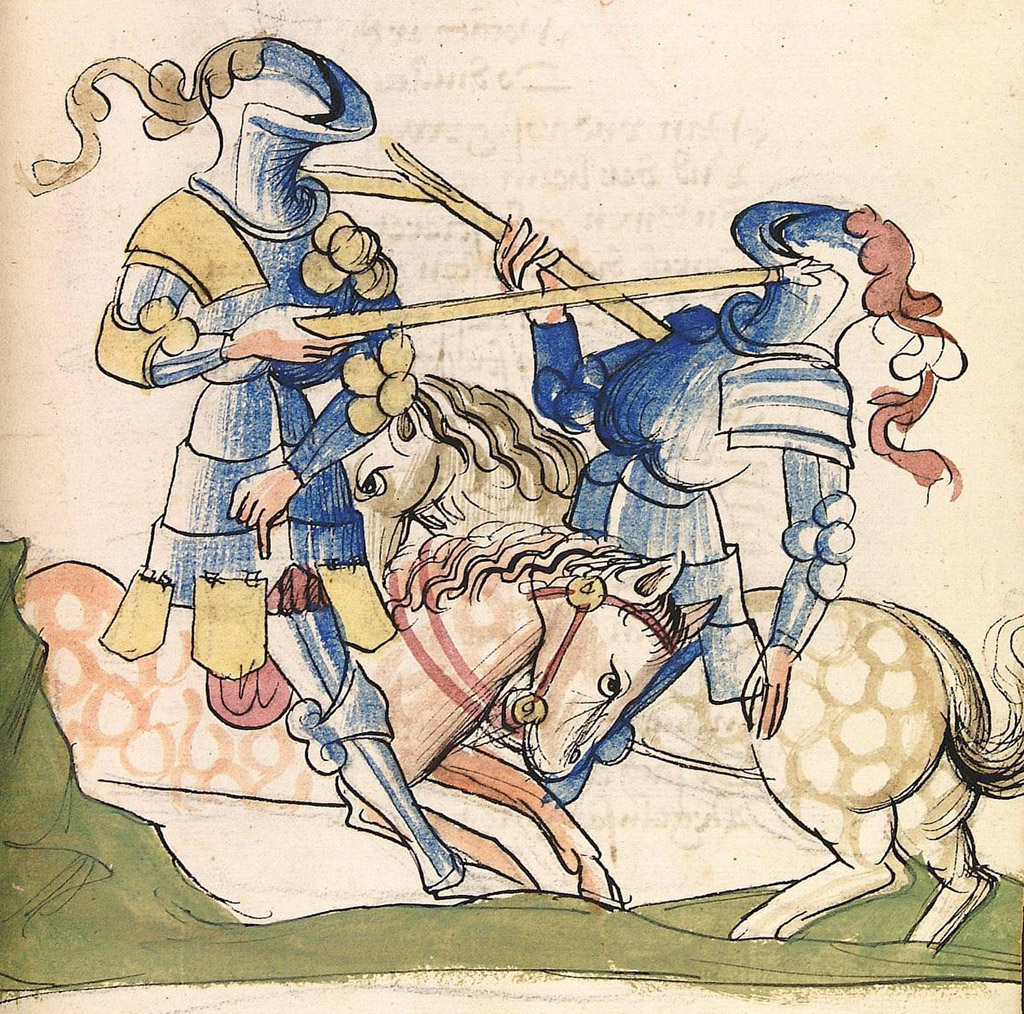
[images] (1) Gawan lies in bed gravely wounded from his ordeal on the “Bed of Marvels {Lit Marveile}.” Queen Arnive and a maiden tend to him. Manuscript illumination for Parzival. Painting made in 1443-1446 in Diebold Lauber’s workshop in Hagenau near the German border of present-day France. Detail from folio 425v in Universitätsbibliothek Heidelberg, Cod. Pal. germ. 339 (part 1, part 2). (2) Gawan knocking Turkoyte off his horse in a joust. Manuscript illumination for Parzival. Detail from folio 436r similarly in Universitätsbibliothek Heidelberg, Cod. Pal. germ. 339.

References:

Clifton-Everest, John M. 1990. “Knights-Servitor and Rapist Knights. A Contribution to the Parzival / Gawan Question.” Zeitschrift Für Deutsches Altertum Und Deutsche Literatur. 119 (3): 290-317.

Edwards, Cyril W., trans. 2004. Wolfram von Eschenbach. Parzival and Titurel. Oxford World’s Classics (2006 edition). Oxford, UK: Oxford University Press.

Greenfield, John. 1999. “Gawan’s Token of Loyalty: the Gawan – Bene Relationship in Wolfram’s Parzival.” Estudos – Studien – Studies. 1: 141-148.

Kline, A. S., trans. 2020. Wolfram von Eschenbach. Parzival. Poetry in Translation. Online.

Lachmann, Karl, ed. 1833. Wolfram von Eschenbach. Lieder, Parzival, Titurel, Willehalm. Berlin: G. Reimer. 5th edition (1891); alternate presentation.

McConnell, Winder. 1992. “The Denial of the Anima in Parzival.” Quondam Et Futurus. 2 (2): 28-40.

Meister, Peter. 1991. “A Little Acknowledged Theme in the Courtly Romance: Rape.” Quondam Et Futurus. 1 (4): 23-35.

Smith, Lans. ND. “Wolfram von Eschenbach’s Parzival: Gawain and Orgeluse.” JungPlatform. Online.

Weston, Jessie L., trans. 1894. Wolfram von Eschenbach. Parzival: A Knightly Epic. 2 vol. London: D. Nutt. Vol. 1. Vol. 2.

Westphal-Wihl, Sarah. 2010. “Orgeluse and the Trial for Rape at the Court of King Arthur: Parzival 521, 19 to 529, 16.” Arthuriana. 20 (3): 81-109.

Zeydel, Edwin H., with Bayard Quincy Morgan, trans. 1951. The Parzival of Wolfram von Eschenbach: Translated into English Verse with Introduction, Notes, Connecting Summaries. Chapel Hill: University of North Carolina Press. Alternate online presentation.

diverse tactics for lessening risk in criticizing women

Men often act like idiots in criticizing women. For example, the thirteenth-century Guide for fools {Chastie musart} criticizes rich women greedily exploiting female sexual privilege. A later hand writing in the manuscript’s bottom margin declares:

He who speaks evil of women is crude by nature.
May God curse all such men!

{ Seli qui dit mal de fame est villain de nature
dieu les maudie tous }[1]

The Chastie musart itself declares in closing:

But I tell you now at the end of my tale,
you who know what is good and what honor means,
as I find it and as to me it has been told,
he is more than shamed who shames a woman.

{ Mais itant vos vueil dire en la fin de mon conte,
Vos qui savez qu’est bien ne que a hennor monte,
Si conme ge le trueve et com l’en le me conte,
Qui plus est que honiz qui a feme fait honte. }[2]

Criticizing shameful tendencies of women in a particular time and place is the mobbing-worthy crime of misogyny. Medieval men committed that crime. Men are such misogynists!

When criticizing women, one must always carefully qualify, “not all women are like that.” Some scholars, drawing upon the rich and diverse intellectual tradition of Muslim theologians, always write or say NAWALT immediately after they write or say “women” in any context that could be construed as criticizing women or not presenting women in a positive light. NAWALT stands for “Not All Women Are Like That.” The thirteenth-century Chastie musart, which strongly criticizes women, in only one verse declares:

They’re not all like that, no need to think so.

{ Ne sont pas totes teles, ne il n’est pas mestiers }

Petrus Alphonsi, a Spanish Jew who converted to Christianity in 1106, had considerable knowledge of Islamic literature. Nonetheless, Petrus’s influential book Training Manual for Clergy {Disciplina Clericalis}, which tells tales of women’s superiority in guile, invokes NAWALT only once:

You must not believe that all women are like that. In many women is found much chastity and much goodness, and you should know that in a good woman can be found good companionship. A good woman is a faithful parent and good family.

{ Non debes credere omnes mulieres esse tales, quoniam magna castitas atque magna bonitas in multis reperitur mulieribus, et scias in bona muliere bonam societatem reperiri posse, bonaque mulier fidelis custos est et bona domus. }[3]

When criticizing women, NAWALT should be used religiously. Such a practice, however, isn’t sufficient to save a man from being damned as a women-hater, an angry, frustrated, involuntarily celibate who lives in his mother’s basement and plays video games all the time, and a likely mass-murderer. In order to lessen the grave risk in criticizing women, men must be even more rhetorically sophisticated.

The thirteenth-century Italian poem Proverbs that speak about the nature of women {Proverbia que dicuntur super natura feminarum} models diverse tactics for lessening risk in criticizing women. One is an opening effort known as “winning of goodwill {captatio benevolentiae}.” The eminent man troubairitz Guillaume de Poitiers (William IX, Duke of Aquitaine) about 1100 began one of his famous Occitan love songs thus:

With the sweetness of the new season
woods take leaf and birds begin
each in peculiar tongue to sing
the phrases of a new refrain.
Then also is a man’s desiring,
even as these, made new again.

{ Ab la dolchor del temps novel
foillo li bosc, e li auchel
chanton, chascus en lor lati,
segon lo vers del novel chan;
adonc esta ben c’om s’aisi
d’acho don hom a plus talan. }[4]

Proverbia que dicuntur super natura feminarum adapted and incorporated this spring opening:

This work occurred in the month of March, when flowering trees
and green grasses appear in orchards and meadows.
Summer is approaching and the temperature is soothing,
and the nights are shortening and the days growing longer.

One morning I got up with a very early star.
I entered a garden that was beside a river
and was filled with flowers more fragrant than spices.
I lay myself down on flowers near a fountain.

God, how filled with great splendor was this garden,
with beautiful, fragrant grasses and hawthorn flowers
and nightingales singing in their particular tongue!
A blackbird and a thrush sang on a pine tree.

{ Çò fo êl mes de março quando i albri florise,
per prati e per verçeri le verd’ erbe parese;
aprosema la estate e lo temp’ adolzise,
e scurtase le note e li çorni se crese.

Levaime una maitina ala stela diana:
entrai en un çardino q’era su ’na flumana,
et era plen de flore aulente plui de grana;
colgaime sule flore aprés una fontana.

Dieu, com’ de grande gloria era plen ’sto çardino,
de bele erbe aulente e de flore de spino,
e de rosignoli qe berna en so latino!
Lo merlo e lo tordo cantava sopra ’l pino. }[5]

Within this spring setting, a reader expects a love poem. Proverbia que dicuntur super natura feminarum then strongly criticizes women:

As I rested among the fragrant flowers,
a thought occurred to me that disturbed my mind:
how the love of women is fraudulent,
how they make men wretched when men trust in them,

and how false they are, full of betrayal,
and never hold back from doing an evil thing.
Now I will say something about their wickedness,
so that men can guard themselves from their deceptions.

{ Sì com’ eu repausavame sovra le flor aulente,
uno pensero veneme qe me torbà la mente:
de l’amor dele femene, com’ este fraudolente,
quand l’om en elle enfiase como ’l mena reamente;

e como son falsiseme, plene de felonia,
et unqa mai no dotano far caosa qe rea sia;
or dirai qualqe caosa dela ler malvasia,
ond se varde li omini dela soa triçaria. }

Sometimes the truth hurts. If one intends to tell a painful truth, one best does so in a setting of love. As medieval Christians believed, speak the truth in love.[6]

Citing science also helps to lessen risk in criticizing women. Today government officials and journalists authoritatively proclaim the science creed that one must believe to be a faithful, science-believing person. In medieval Europe, “science {scientia}” meant what was written in ancient, highly respected books. Proverbia que dicuntur super natura feminarum declares:

Gentlemen, if you will listen to me, I will give you a lecture.
If you wish to listen to it and understand its reasoning,
you will find many examples similar to those from Cato,
Ovid, Pamphilus, and Tullius Cicero.

In ancient books that the poets wrote,
I have found and learned all these parables.
Whoever has studied in school, if he shows and tells learning to others,
neither commoner nor noble can reproach him for doing that.

{ Segnori, s’entendeteme: diraive un sermone,
se lo volé enprender et entender la rasone;
molti ne trovarete deli ’sempli Catone,
d’Ovidio e de Panfilo, de Tulio e Cicerone.

En libri anciani, qe li poeti fese,
stratute ’ste paravole ò trovate et entese;
cui à enpreso en scola, se ad altri mostra e dise,
no li pò dar reproço vilano ni cortese. }[7]

No matter how high and mighty they are, those who don’t have faith in science, whether in medieval Europe or today, will likely find themselves in Hell:

The Queen of France along with Henry Plantagenet
are known throughout the world for she having made him a laughing-stock.
That which to all is filthy, to her was good and beautiful.
She placed a cuckold’s horn under the hat of the King.

And about the Holy Roman Empress I will tell you:
she made a Burgundian knight her lover
and then fled with him. Thus it’s true I tell you:
she placed a cuckold’s horn on the Holy Roman Emperor Frederick.

Yet another fact I have remembered:
the high Marquise of Monferrato
who often played false dice with her husband,
placed more than twelve cuckold’s horns on him.

And the Sicilian Queen Margaret
with Admiral Maio led a very dishonest life.
So he had a horn-like sword placed firmly on his head.
With it Matthew Bonellus took Maio’s life.

For the Byzantine Emperor, known as Stammerer,
the Empress put together much evil.
Under his hat she placed two cuckold’s horns so branched
that he felt them resound in Greece and France.

{ La raina de França con Rigo Curt Mantelo,
per questo mondo sonase qual ela fé çanbelo:
a cuiqe fose laido, a liei fo bon e belo,
q’ela plantà le corne al re soto ’l capelo.

E dela enperatrice questo ensteso ve dico,
ke se fé un cavalier borgoignon per amico
e poi fuçì com elo: questo vero ve dico
q’ela plantà le corne a l’enperer Ferico.

Ancor d’un altro fato eu me son recordato,
de l’alta marqesana qe fo de Monferato:
çugav’ alo marì spesor con falso dato;
con plu de set’ e cinque le corne i à plantato.

E la ceciliana raina Margarita
con Maio l’amiraio molto menà rea vita,
on’ el av’ enla testa fort’ una spaa fita:
Matheu Bonel com essa li·nde tolé la vita.

A l’enperer de Grecia c’om dis Banbacoradi,
la enperatrice feceli molti mali mercadi:
soto ’l capel li pose doi corni sì ramadi
qe per França e per Grecia ben sono resonadi. }[8]

Unlike men, women cannot be cuckolded. Gender inequality in parental knowledge is a fundamental gender inequality. Men must be taught that simple biological fact.

illustrated quatrains on folio 103v of Proverbia que dicuntur super natura feminarum

In addition to an opening captatio benevolentiae and invoking science, risk in criticizing women can also be lessened with categorical construction. Categorical construction works to make objection unpalatable. Proverbia que dicuntur super natura feminarum begins:

Good people, hear why I made this book.
For wicked women I composed it in rhyme,
for those who don’t keep their established agreements with men.
The more a man serves her, the more she holds him foolish and mad.

Know that these charges aren’t spoken for every woman.
I believe that these writings will not please many.
The good ones will rejoice in these righteous rhymes,
and the wicked ones, when they hear them, will be pained and sad.

Never by a good woman — wise, pure, and courteous —
will these truthful rhymes be rebuked.
If good women listen to them, once they have understood them,
they will without doubt praise the man who composed and wrote them.

{ Bona çent’ entendetelo perqué ’sto libro ài fato:
per le malvasie femene l’aio en rime trovato,
quele qe ver’ li omini no tien complito pato:
cui plui ad elle serveno, plui lo tien fol e mato.

Saçai, per ogna femena ’ste cause no vien dite
k’asai creço qe sea·nde cui no plas queste scrite:
le bone se ’n alegra de queste rime drete,
e le rei, quando le aude, stane dolente e triste.

Unca per bona femena saça, pura e cortese
queste verasie rime cà no serà represe:
se le bone le ’scoltano, quando l’avrà entese
laodarà sença falo qi le trovà e fese. }

By its first word, Proverbia que dicuntur super natura feminarum constructs its readers as good. Good women will rejoice in its rhymes and praise this work’s author. Women who don’t rejoice in this work are wicked women. That’s like declaring that men who won’t acknowledge that they are misogynists prove in that way that they are the worst misogynists. Both are categorical constructions for coercing consent. Such construction might be necessary to limit risk in criticizing women.

To avoid a future of female supremacism (“The future is female!”), ways must be found to criticize women doing wrong, if women were ever to do wrong. The difficulty is enormous. Nonetheless, ingenious medieval writers such as the author of the medieval Proverbia que dicuntur super natura feminarum rose to that supreme challenge.[9] We must learn from them.

* * * * *

Read more:

Notes:

[1] Guide for fools {Chastie musart / Chastiemusart} from BnF Fr. 19152 folios f. 105ra-107va, marginal note at the bottom of folio 106r about v. 140. Old French text and English translation (modified) from Psaki (2016) p. 247, n. 13. Here’s the relevant folio 106r (monochrome version). For a freely accessible edition of the Chastie musart from BnF Fr. 19152, Jubinal (1839) vol. 2, pp. 478-89.

The subsequent two quotes above are similarly sourced from Chastie musart. These quotes are vv. 321-4, stanza 81 (But I tell you now at the end of my tale…) and v. 309, from stanza 78 ( They’re not all like that, no need to think so).

[2] Christine de Pizan’s Letter of the God of Love {Epistre au Dieu d’Amours}, vv. 723-4, echoes Chastie musart, v 324. On the former, see note 3 on my post on scholarly anti-meninism. Moralizations counseling men against criticizing women support women’s social privilege.

[3] Petrus Alphonsi, Training Manual for Clergy {Disciplina Clericalis}, section 14, “Exemplum about the well {Exemplum de puteo},” Latin text from Hilka (1911), my English translation, benefiting from that of Hermes & Quarrie (1977), as cited by Psaki (2016) p. 114, n. 44.

[4] Guillaume de Poitiers (William IX, Duke of Aquitaine), “With the sweet beauty of the new season {Ab la dolchor del temps novel},” st. 1, Old Occitan text and English translation (capitalization modified) from Merwin (1955). For other English translations, see note 8 in my post on Bernart de Ventadorn and the season for love. Medieval love poems commonly begin, like this one does, with an invocation of springtime.

[5] Proverbs that speak about the nature of women {Proverbia que dicuntur super natura feminarum}, stanzas 13-15, Old Italian text from Meneghetti & Tagliani (2019) pp. 125-6, my English translation, benefiting from the Italian translation of Bonghi & Mangieri (2003) and the English translations of some stanzas in Psaki (2019). On the dense literary references in these stanzas, Meneghetti & Tagliani (2019) pp. 388-9. The influence of spring openings in medieval Latin love songs seems under-appreciated.

Proverbia que dicuntur super natura feminarum has survived in only one manuscript: MS. Berlin, Staatsbibliothek und Preussischer Kulturbesitz, Saibante-Hamilton 390, 98r-113v. Tobler (1886) was the pioneering critical edition. Here’s the subsequent edition of Gianfranco Contini (1960). The best edition is now Meneghetti & Tagliani (2019).

Subsequent quotes from Proverbia que dicuntur super natura feminarum are similarly sourced. They are stanzas 16-7 (As I rested among the fragrant flowers…), 18, 69 (Gentlemen, if you will listen to me…), 51-5 (The Queen of France along with Henry Plantagenet…), 1-3 (Good people, hear why I made this book…).

[6] Cf. Ephesians 4:15.

[7] Ovid is explicitly cited as a source in recounting the story of Myrrha and that of a queen (“raina Triesta”) who killed her son. Proverbia que dicuntur super natura feminarum v. 170 and v. 162, respectively. The queen hasn’t been clearly identified. Meneghetti & Tagliani (2019) pp. 397-8. The story of Tiresias is sourced as “in the books {en le geste}.” Proverbia, v. 347.

The references to Ovid and other authorities in Latin literature underscore the contribution of Latin literature to this early Italian text. Play across high and low culture is particularly a sensibility of learned medieval Christian authors. For analysis of Ovid in Proverbia que dicuntur super natura feminarum, Premi (2018). On Ovid in medieval Italian texts more generally, Van Peteghem (2013).

[8] Henry Plantagenet (Henry II) was King of England from 1154 to 1189. The Queen of France, Eleanor of Aquitaine, became Henry II’s wife in 1152. Eleanor supported a revolt of their eldest son Henry against her husband.

Frederick I (Frederick Barbarossa) was Holy Roman Emperor from 1155 to 1190. Frederick divorced his wife Adelheid of Vohburg in 1153. Some sources indicate that Adelheid committed adultery.

Margaret of Navarre was Queen of Sicily with King William I from 1154 to 1166. Maio of Bari was a Sicilian admiral who worked closely with Queen Margaret. Matthew Bonnellus murdered Maio in 1160.

Alexius I Comnenus “the Stutterer {Bambacorax}” was Byzantine Emperor from 1081 to 1118. His wife was the Empress Irene Doukaina. She fought bitterly with Emperor Alexius’s mother, Anna Dalassene.

[9] Writing within the context of ridiculous medieval scholarship on “misogyny,” Psaki calls the narrator of Proverbia que dicuntur super natura feminarum “a buffoon and a jaundiced informant.” He is “unable to reason his way out of a paper bag.” Psaki (2019) pp. 136, 134. The Proverbia’s author, however, is “exceptionally clever and deft.” Id. p. 135. That distinction seems to me to miss the narrator participating in clever rhetorical strategies for lessening risk in criticizing women.

[image] Folio 103v (stanzas 67-72) of Proverbia que dicuntur super natura feminarum in MS. Berlin, Staatsbibliothek und Preussischer Kulturbesitz, Saibante-Hamilton 390. Psaki observed:

five of the six quatrain illustrations on folio 103v depict the Narrator at work, not only in composing the book but sharing it: in the first two he responds to two men who criticize him and a woman who reproaches him; in the third he instructs two pupils; in the fourth he is blamed by a woman; and in the fifth he writes into his book what he sees in observing a couple.

Psaki (2019) p. 126. Four of the illustrations explicitly depict the book Proverbia que dicuntur super natura feminarum. Every quatrain of Proverbia is illustrated with attention to the text. Other illustrations also depict the book itself. Meneghetti & Tagliani (2019) provides a brief description / interpretation of each illustration.

References:

Bonghi, Giuseppe, and Cono A. Mangieri, trans. (Italian) with notes. 2003. Proverbia que dicuntur super natura feminarum. Biblioteca dei Classici Italiani. Online. Alternate source.

Hermes, Eberhard and P. R. Quarrie, ed. and trans. 1977. Petrus Alfonsi. The Disciplina Clericalis of Petrus Alfonsi. Berkeley: University of California Press.

Hilka, Alfons. 1911. Die Disciplina clericalis des Petrus Alfonsi (das älteste Novellenbuch des Mittelalters). Heidelberg: Carl Winter. Alternate presentation.

Jubinal, Achille. 1839. Oeuvres complètes de Rutebeuf, trouvère du XIII siècle. Vol. 1. Vol. 2. Paris: Pannier.

Meneghetti, Maria Luisa and Roberto Tagliani. 2019. Il Manoscritto Saibante-Hamilton 390: Edizione Critica. Images. Roma: Salerno Editrice.

Merwin, W. S. 1955. “Two Provençal Poems.” The Hudson Review. 8 (2): 208-211.

Premi, Nicolò. 2018. “Filigrane ovidiane nei Proverbia que dicuntur super natura feminarum.” Medioevi. 4: 27-53.

Psaki, F. Regina. 2016. “The Guide for Fools: The Chastiemusart in BnF Fr. 19152.” Pp. 231-263 in Philip E. Bennett, Leslie Zarker Morgan, and F. Regina Psaki, eds. 2016. The Epic Imagination in Medieval Literature: Essays in Honor of Alice M. Colby-Hall. Romance Monographs S-5. University of Mississippi.

Psaki, F. Regina. 2019. “Medieval misogyny and the French of Italy: the Chastiemusart and the Proverbia que dicuntur super natura feminarum.” Pp. 101-140 in Nicola Morato et Dirk Schoenaers, eds. Medieval Francophone Literary Culture Outside France: Studies in the Moving Word. Medieval Texts and Cultures of Northern Europe, 28. Turnhout: Brepols.

Tobler, Adolf. 1886. “Proverbia que dicuntur super natura feminarum.” Zeitschrift Für Romanische Philologie. 9 (1-4): 287-331. Alternate presentation of edited text.

Van Peteghem, Julie. 2013. Italian Readers of Ovid: From the Origins to Dante. Ph.D. Thesis, Columbia University, New York City, USA.