Semele incinerated after wanting it all from Jupiter

Why can’t women have it all? This question attracts enormous public concern, much more so than why men can’t have it all. Difficulties with women having it all have been addressed in literary history going back to Greek and Latin classics. According to this relevant, extensive record of human culture, the reason women can’t have it all isn’t simply that no one can have it all in relation to all of human desires. The issue is gendered. Men hesitate to give it all to women because they are afraid that women will be hurt.

Vitally important classics, both Greek and Latin, provide enduring insight into the universal human gender condition. In classics, the relevant situation is represented by a man, transformed into a donkey, enticed into having sex with a woman:

She took off her clothes and standing stark naked in front of the light, poured out some perfume from an alabaster vase and rubbed it on herself. She rubbed ointment from the vase over me as well, smearing it particularly thickly over my nose. Then she kissed me, and spoke to me as if I were her beloved and a human being. She took me by the halter and dragged me onto the bed. I needed no urging. I was already tipsy from much good wine, and the perfume on our skins had me wild with desire. I saw that she was a beautiful young woman in every way. I lay down, but I had no idea about how to mount her. I hadn’t had sex once since I had become an ass. I had no experience doing it donkey style, nor had I ever mounted a female ass. Moreover, I was terribly afraid that she would be too small for me and that I would split her in half and have a severe penalty to pay as her murderer.

{ ἀποδυσαμένη παρέστη τῷ λύχνῳ γυμνὴ ὅλη καὶ μύρον ἔκ τινος ἀλαβάστρου προχεαμένη τούτῳ ἀλείφεται, κἀμὲ δὲ μυρίζει ἔνθεν, μάλιστα τὴν ῥῖνά μου μύρων ἐνέπλησεν, εἶτά με καὶ ἐφίλησε καὶ οἷα πρὸς αὐτῆς ἐρώμενον καὶ ἄνθρωπον διελέγετο καί με ἐκ τῆς φορβειᾶς λαβομένη ἐπὶ τὸ χαμεύνιον εἷλκεν· κἀγὼ οὐδέν τι του παρακαλέσαντος εἰς τοῦτο δεόμενος καὶ οἴνῳ δὲ παλαιῷ πολλῷ ὑποβεβρεγμένος καὶ τῷ χρίσματι τοῦ μύρου οἰστρημένος καὶ τὴν παιδίσκην δὲ ὁρῶν πάντα καλὴν κλίνομαι, καὶ σφόδρα ἠπόρουν ὅπως ἀναβήσομαι τὴν ἄνθρωπον· καὶ γὰρ ἐξ ὅτου ἐγεγόνειν ὄνος, συνουσίας ἀλλ᾿ οὐδὲ τῆς ὄνοις συνήθους ἔτυχον ἁψάμενος οὐδὲ γυναικὶ ἐχρησάμην ὄνῳ· καὶ μὴν καὶ τοῦτό μ᾿ εἰς δέος οὐχὶ μέτριον ἦγε, μὴ οὐ χωρήσασα ἡ γυνὴ διασπασθείη, κἀγὼ ὥσπερ ἀνδροφόνος καλὴν δώσω δίκην. }[1]

The woman insistently wanted it all. The donkey actually didn’t have to fear:

I hadn’t realized that all my fears were groundless. She encouraged me with many kisses — passionate ones in fact. When she saw that I couldn’t hold myself back, she lay down beside me just as if I were a man. She embraced me, lifted me in, and received the full extent of my penis. I, poor coward, was still afraid. I was gently pulling myself away, but she clung to my penis, so that it could not withdraw and her hips followed it as it retreated. Once I was absolutely convinced that I needed to do something more to ensure her pleasure and enjoyment, I served her for the rest of the time without fear.

{ ἠγνόουν δὲ οὐκ εἰς δέον δεδιώς. ἡ γὰρ γυνὴ πολλοῖς τοῖς φιλήμασι, καὶ τούτοις ἐρωτικοῖς, προσκαλουμένη ὡς εἶδεν οὐ κατέχοντα, ὥσπερ ἀνδρὶ παρακειμένη περιβάλλεταί με καὶ ἄρασα εἴσω ὅλον παρεδέξατο. κἀγὼ μὲν ὁ δειλὸς ἐδεδοίκειν ἔτι καὶ ὀπίσω ἀπῆγον ἐμαυτὸν ἀτρέμα, ἡ δὲ τῆς τε ὀσφύος τῆς ἐμῆς εἴχετο, ὥστε μὴ ὑποχωρεῖν, καὶ αὐτὴ εἵπετο τὸ φεῦγον. ἐπεὶ δὲ ἀκριβῶς ἐπείσθην ἔτι μοι καὶ προσδεῖν πρὸς τὴν τῆς γυναικὸς ἡδονήν τε καὶ τέρψιν, ἀδεῶς λοιπὸν ὑπηρέτουν }

Just like this man turned into a donkey, many men are afraid to do more for women. If women want it all, women must do more to encourage and support men.

The medieval trobairitz debate poem, “I have heard a lady who complained {Una dona ai auzit que s’es clamada}” depicts a wife failing to encourage her husband. She complained that he was giving her less than it all. He explained that he didn’t want to hurt her. She then disparaged him for idle boasting. She accused him of being sexually inadequate. After enduring that emotional abuse, the husband did as his wife instructed. Nonetheless, she still didn’t have it all. She didn’t have a happy husband feeling his wife’s loving gratitude for his hard work.

Women must recognize their limitations. Ovid, celebrated in medieval Europe as a preeminent teacher of love, taught women the importance of humility in love. Ovid recounted in his Metamorphoses the story of Semele and Jove, also known as Jupiter. Lacking sufficient pleasure under his domineering and hateful wife Juno, the nominal head god in charge of the cosmos Jove frequently had extramarital affairs with mortal women. One of his mistresses was the mortal woman Semele. Juno burned with animosity toward her husband’s strong, independent sexuality:

Behold, a new grievance was added
to her prior ones: Semele was pregnant with the seed
of the mighty Jove. Juno loosened her tongue to make complaints,
but then she said to herself, “What have I ever gained from so many complaints?
She herself I must attack, if Juno the most great
I’m to be solemnly called. I must destroy her if the jeweled scepter
properly I hold in my strong right hand, and if I am queen and Jove’s
sister and wife, or sister at least.”

{ Subit ecce priori
causa recens, gravidamque dolet de semine magni
esse Iovis Semelen. Dum linguam ad iurgia solvit,
“profeci quid enim totiens per iurgia?” dixit:
“ipsa petenda mihi est, ipsam, si maxima Iuno
rite vocor, perdam, si me gemmantia dextra
sceptra tenere decet, si sum regina Iovisque
et soror et coniunx, certe soror.” }[2]

Juno and Jove’s sexless marriage clearly didn’t come from him being sexual impotent. In addition to Juno potentially being deprived of about a third of Jove’s income through mandated “child support” payments to Semele, Semele’s pregnancy also publicly embarrassed Juno:

I think that with this stolen love she is
content, and the injury to our marriage bed is brief.
But what was lacking, now is — she has conceived! Her crime is displayed
with her full womb. It’s motherhood, which I have barely obtained.
She wants to be the mother of Jove’s child. Such is her trust in her beauty.
I’ll make that trust false. I’m not Saturn’s daughter if
she isn’t plunged by Jove himself into the Stygian waters.

{ puto, furto est
contenta, et thalami brevis est iniuria nostri:
concipit, id deerat! manifestaque crimina pleno
fert utero, et mater, quod vix mihi contigit uno
de Iove vult fieri: tanta est fiducia formae.
Fallat eam faxo; nec sum Saturnia, si non
ab Iove mersa suo Stygias penetrabit in undas. }[3]

Juno thus resolved to kill Semele through gender-distinctive proxy violence.

Disguised as Semele’s old woman nurse Beroë, Juno visited Semele. They chatted and gossipped. Semele mentioned her affair with Jove, called Jupiter with reference to his seminal potency in being a father. Juno as Beroë sighed and wondered about the father of Semele’s pregancy:

“I hope
he really is Jupiter,” she said. “I mistrust all such things. Many men,
pretending to the name of gods, have entered chaste women’s beds.
And it’s not enough for him to be Jove. Make him prove his love
if it’s really him. In the form and size that on high
Juno receives him, request that in just the same way
he give you his embrace after taking up his distinguishing powers.”

{ “opto,
Iuppiter ut sit” ait: “metuo tamen omnia: multi
nomine divorum thalamos iniere pudicos.
Nec tamen esse Iovem satis est: det pignus amoris,
si modo verus is est, quantusque et qualis ab alta
Iunone excipitur, tantus talisque, rogato,
det tibi complexus suaque ante insignia sumat.” }

Jove was the highest ranking man-god. He was well-known for his sexual vigor with both women and boys. When Jove’s distinguishing powers were on high in form and size for sexual relations, he probably had a more impressive masculine love organ than does a donkey. The potential danger to a woman would thus be even greater than with a donkey.

Like King Herod, Jove foolish promised a lovely woman that he would do whatever she requested. Jove’s unlimited promise of performance to Semele allowed her to destroy herself:

Happy with too much evil and able to be doomed by her lover’s
obsequiousness, Semele said, “Such as Juno
is accustomed to you embracing her in having sexual intercourse,
give yourself to me in the same way.”

{ Laeta malo nimiumque potens perituraque amantis
obsequio Semele “qualem Saturnia” dixit
“te solet amplecti, Veneris cum foedus initis,
da mihi te talem.” }

Jove knew himself. He didn’t want Semele to have it all because he feared that would be too much for her. But Semele wanted it all. Jove couldn’t renege upon his promise to fulfill her request.[4]

Jupiter goes to have sex with Semele

Before having sex again with Semele, Jove sought to reduce his potency. He drew to himself mists and clouds and stirred up a storm. He apparently hoped that immersing himself in a cold shower would help to protect Semele. He strove to lessen the flame of his passion and reduce the force of his earth-moving thunder. Jove’s efforts at self-diminishment were in vain:

Her mortal body could not endure
the celestial banging and was incinerated with his sexual gifts.

{ corpus mortale tumultus
non tulit aetherios donisque iugalibus arsit. }

Semele shouldn’t have yearned to have it all. Even women not having sex with a god should learn from Semele’s disastrous desire.

Study of classics must continue because that contributes to women’s safety. Yet men suffer about four times as much lethal violence as do women. Men endure rape libel while men being raped is largely ignored. Men’s sexuality has long been oppressively criminalized. Criminal justice systems, which worldwide confine behind bars fifteen times more men than women, essentially function as penal punishment systems applied with harsh discrimination to persons with penises. Men with good reason have fear in relation to women. Men have no just responsibility to ensure that women have it all. Most importantly, no one can have it all, nor can social justice be achieved, unless classics are appreciated in a way barely conceivable today.

Jupiter:
Ah, take heed what you press,
for, beyond all redress,
should I grant your request, I shall harm you.

Semele:
No, no, I’ll take no less,
than all in full excess!
Your oath it may alarm you,
yet haste and prepare,
for I’ll know what you are,
with all your powers arm you.[5]

*  *  *  *  *

Read more:

Notes:

[1] Lucius or the Ass {Λουκιοσ η Ονοσ}, also known as The Ass {Ονοσ / Onos / Asinus}, 51 (excerpt), ancient Greek text and English translation (modified) from MacLeod (1967). For a Greek reader for this text, Hayes & Nimis (2012). Casson (1962) provides an alternate English translation. The subsequent quote above is similarly from Onos 51.

This story, which apparently is from the second century GC, has traditional been attributed to Lucian of Samosata, but that attribution is disputed. Lucius or the Ass is closely related to the Metamorphoses of Apuleius. Both seemed to be based on an early Greek work in which the first-person narrator was named Lukios of Patrae. On the various versions of the story, Mason (1994).

[2] Ovid, Metamorphoses 3.257-64, Latin text of Magnus (1892) via Perseus, my English translation, benefiting from those of Lombardo (2010), Kline (2000), and Miller (1916). Subsequent quotes are sourced similarly and serially from the story of Semele and Jupiter in Ovid’s Metamorphoses 3.253-315. Knight’s Fabulae provides some Latin reading notes for this passage. Pseudo-Hyginus, Fabulae 167 and 179 also recount a similar story. For a compilation of ancient sources, see Theoi’s Semele Thyone entry.

Juno describes herself as “sister and wife, or sister at least {soror et coniunx, certe soror}” of Jove. That description playfully highlights her marital difficulties. It also shows Ovid having Juno qualify her claim in Aeneid 1.47: “I who march forward as queen of the gods, no less than sister and wife of Jove {ego, quae diuum incedo regina Iouisque / et soror et coniunx }.” Ovid thus underscores Juno’s deception in feigning reconciliation with Jove after withdrawing her support for Juturna in Aeneid 12. Prauscello (2008). See also Hardie (1990) pp. 231-5.

[3] Ovid’s elegiac predecessor Propertius also referred to Semele’s beauty. He told his beloved Cynthia when she was deathly ill:

Tell Semele what peril exits with her beauty.
She will believe you, that young woman taught through destruction.

{ Narrabis Semelae, quo sis formosa periclo,
credet et illa, suo docta puella malo }

Propertius, Elegies 2.28.27-28, Latin text from Goold (1990), my English translation. For a freely available text and translation of Propertius, Holcombe (2009).

[4] On King Herod’s similar folly, Mark 6:22-3. Jove made to the mortal woman Semele a promise without limit. She in turn desired it all.

[5] Airs from Act 4, Scene 4 of Handel’s Semele. This opera was first performed in London’s Covent Garden Theatre in 1744. The English playwright William Congreve wrote the libretto for this opera about 1705. Congreve wrote sexual comedy of manners such as Love for Love (1695) and The Way of the World (1700). For a review of Handel’s Semele, Uzzell (2011).

[images] (1) Jupiter and Semele, attributed to Jacopo Tintoretto. Painted c. 1545. Preserved as NG1476 in the National Gallery (London, UK). Via Wikimedia Commons. (2) Jupiter (John Mark Ainsley) attempts to protect Semele (Rosemary Joshua), but she wants is all and will have no less. Scene from the performance in 1997 of Handel’s Semele by the English National Opera, conducted by Harry Bicket. Via YouTube. Here’s a performance (2007) with Cecilia Bartoli as Semele. Kathleen Battle sang Handel’s “No, no, I’ll take no less!” at Carnegie Hall in 1985.

References:

Casson, Lionel, trans. 1962. Selected satires of Lucian. New York: W.W. Norton & Co.

Goold, G. P., ed and trans. 1990. Propertius. Elegies. Loeb Classical Library 18. Cambridge, MA: Harvard University Press.

Hardie, Philip. 1990. “Ovid’s Theban History: The First ‘Anti-Aeneid’?” The Classical Quarterly. 40 (1): 224-235.

Hayes, Evan and Stephen Nimis, eds. 2012. Lucian’s The Ass: An Intermediate Greek Reader. Greek text with running vocabulary and commentary. Oxford, OH: Faenum Publishing.

Holcombe, Colin John, trans. 2009. Sextus Propertius Elegies. Latin text and English translation. Ocaso Press.

Kline, A. S., trans. 2000. Ovid. Metamorphoses. Poetry in Translation. Online.

Lombardo, Stanley, trans. 2010. Ovid. Metamorphoses. Indianapolis, IN: Hackett Pub. Co.

MacLeod, M. D., ed. and trans. 1967. Soloecista. Lucius or The Ass. Amores. Halcyon. Demosthenes. Podagra. Ocypus. Cyniscus. Philopatris. Charidemus. Nero. Loeb Classical Library 432. Cambridge, MA: Harvard University Press.

Magnus, Hugo. 1892. Die Metamorphosen des P. Ovidius Naso: für den Schulgebrauch erklärt. Gotha: F.A. Perthes.

Mason, Hugh J. 1994. “Greek and Latin Versions of the Ass-Story.” ANRW (Aufstieg und Niedergang der Römische Welt). II 34(2): 1665-1707.

Miller, Frank Justus, revised by G. P. Goold. 1916. Ovid. Metamorphoses. Vol 1: Books 1-8. Loeb Classical Library 42. Cambridge, MA: Harvard University Press.

Prauscello, Lucia. 2008. “Juno’s Wrath Again: Some Virgilian Echoes in Ovid, Met. 3. 253-315.” Classical Quarterly. 58 (2): 565-570.

Uzzell, Rupert. 2011. “Ovid’s Semele – In Music and Art.” Higher Revelations. Online, Sept. 10, 2011.
Juturna’s love for her brother Turnus no match for Juno’s hate

In the ending book of Virgil’s epic Aeneid, Turnus proposed to engage in single combat against Aeneas rather than many men dying in mass fighting between the Italian and Trojan men. Both Turnus and Aeneas foolishly strove to marry the Italian princess Lavinia. Her mother contemptuously regarded Aeneas as a lover of boys. Nonetheless, Aeneas was a fierce warrior drawing upon the help of his mother Venus. The Trojans were on the verge of defeating the Italians. The upcoming battle would be decisive.

Turnus understood that the impending violence against men fundamentally concerned gender relations. He scorned Aeneas’s gender-transgressive masculinity and prayed to humiliate him:

Grant that I strike down his body and,
with my strong hand, strip and lacerate the breast armor
of that Trojan half-man and defile in dust his hair
that’s curled with a heated iron and drenched in perfume.

{ da sternere corpus
loricamque manu ualida lacerare reuulsam
semiuiri Phrygis et foedare in puluere crinis
uibratos calido ferro murraque madentis. }

Powerful women shaped the destinies of men fighting and dying. Turnus thought that Aeneas would fight without the help of his goddess-mother:

Far from him will be his goddess-mother, who with woman’s mystification
covers the fleet dodger and conceals the enemy in empty shadows.

{ longe illi dea mater erit, quae nube fugacem
feminea tegat et uanis sese occulat umbris. }

Men are both romantically simple and pugnaciously simple. Women fight through skillful subterfuge and manipulation. Turnus hoped that he could fight only Aeneas, not Aeneas under the guidance of his goddess-mother.

Juno, wife of the nominal head god in charge of the cosmos Jove, conspired to destroy the single-combat agreement between the Trojan and Italian men. In her hate, she sought to provoke massive violence against men. Juno worked through Turnus’s sister Juturna. Juno implied that Turnus would die in the single combat. She urged Juturna:

“This is no time for tears,” said Saturnian Juno.
“Hurry and, if there’s some way, snatch your brother from death,
or stir up war, aborting the treaty they’ve conceived.
I teach you daring.” Thus having exhorted Juturna, Juno left her
doubtful and disturbed, with a sadly wounded heart.

{ “non lacrimis hoc tempus” ait Saturnia Iuno:
“accelera et fratrem, si quis modus, eripe morti;
aut tu bella cie conceptumque excute foedus.
auctor ego audendi.” sic exhortata reliquit
incertam et tristi turbatam uulnere mentis. }

Juno’s father Saturn (Chronos) initiated castration culture. War is another form of violence against men.

To instigate war according to Juno’s teaching, Juturna went disguised as a revered Italian soldier into the center of the Italian lines. She sowed rumors and misinformation. She spurred the Italians to break their agreement with the Trojans:

Are you not ashamed, O Rutulians, for so many men
to endanger a single man? In number and might are
we not equal? Here are all the Trojans and Arcadians
and Etrurians, led by fate’s hand and hostile to Turnus.
If every other of us would fight, scarcely an enemy each would have.

{ Non pudet, O Rutuli, pro cunctis talibus unam
obiectare animam? Numerone an viribus aequi
non sumus? En omnes et Troes et Arcades hi sunt
fatalesque manus, infensa Etruria Turno:
vix hostem, alterni si congrediamur, habemus. }

After spreading these incoherent claims, Juturna displayed in the sky a fake omen of Jove’s golden eagle. Then an Italian threw a spear at the Trojans, and a mass of Italians charged at the Trojans. Aeneas yelled for the Trojans to restrain their anger. Juturna then covertly hurled a spear at Aeneas and wounded him. Chaos ensued. From its origin in Juno’s hateful scheming, a men-slaughtering battle had begun.

Trojans battle Rutulians in Aeneid

With no concern for all the other men dying, Juturna struggled only to save the life of her brother Turnus. She knocked Turnus’s chariot-driver from his place and, assuming his form, carefully drove Turnus about the battlefield. She displayed him fighting, but kept him away from Aeneas. Unable to engage with Turnus, Aeneas turned to lead the Trojans to besiege the Italian capital. Juturna directed Turnus away from that disaster:

This way, Turnus, let’s chase
the trailing Trojans, where victory offers the first way to us.
There are others whose hands can defend the city’s homes.
Aeneas is attacking the Italians and stirring up fights.
Let our hands similarly give savage death to Trojans.
Neither in kills nor in honor of battle will you withdraw inferior.

{ Hac, Turne, sequamur
Troiugenas, qua prima viam victoria pandit;
sunt alii, qui tecta manu defendere possint.
Ingruit Aeneas Italis et proelia miscet:
et nos saeva manu mittamus funera Teucris.
Nec numero inferior pugnae nec honore recedes. }

Turnus perceived his sister directing his chariot. He heavy-heartedly rejected this violence against men serving merely for claiming merit:

O sister, in fact long ago I recognized you, when first you guilefully
destroyed the agreement and dedicated yourself to this war,
and now for nothing you falsify your divinity. But who on Olympus
willed that you be sent down to do such work?
Was it so that you would see your miserable brother’s violent death?
For what thus do I go on? What fortune now can offer me deliverance?
I have seen before my very own eyes his voice calling out to me,
Murranus — no other more dear to me had remained.
He perished, a mighty one victim of a mighty wound.
Unlucky Ufens fell so that our dishonor
he would not see. The Trojans seized his corpse and his armor.
The destruction of our home (that is the one thing no yet done)
shall I endure? Not refute Drances’s taunts with my right arm?
Shall I turn my back and this country see Turnus flee?
Go so far that dying is misery? You O spirits of the dead, to me
be good, for the gods above have turned their faces against me!
My sacred soul, that one knowing no fault, to you
will descend, never unworthy of my great predecessors.

{ O soror, et dudum adgnovi, cum prima per artem
foedera turbasti teque haec in bella dedisti,
et nunc nequiquam fallis dea. Sed quis Olympo
demissam tantos voluit te ferre labores?
An fratris miseri letum ut crudele videres?
Nam quid ago? Aut quae iam spondet Fortuna salutem?
Vidi oculos ante ipse meos me voce vocantem
Murranum, quo non superat mihi carior alter,
oppetere ingentem atque ingenti volnere victum.
Occidit infelix nostrum ne dedecus Ufens
adspiceret; Teucri potiuntur corpore et armis.
Exscindine domos (id rebus defuit unum)
perpetiar, dextra nec Drancis dicta refellam?
Terga dabo et Turnum fugientem haec terra videbit?
Usque adeone mori miserum est? Vos O mihi Manes
este boni, quoniam superis aversa voluntas!
Sancta ad vos anima atque istius nescia culpae
descendam, magnorum haud umquam indignus avorum. }

A messenger then informed Turnus that the city was besieged and on fire. He leaped from his chariot, charged through the enemy lines, and demanded to face Aeneas in single combat.

Both sides cleared the field as Aeneas and Turnus charged at one another. Brutal fighting led to Turnus, his sword broken, fleeing Aenaes. When Aeneas sought to retrieve his spear stuck in a tree, Juturna rushed in and gave her brother Turnus another sword. Then Venus stepped in, pulled the spear from the tree, and give it to her son Aeneas. Those women-goddesses thus contributed to more brutal violence against men.

Meanwhile in the heavens, Jove finally stood up to Juno. He declared to her:

It has come to the limit. To harass across land and sea
the Trojans, ignite unspeakable war,
degrade a royal house, and mix a wedding hymn with grieving —
you have had power to do. I forbid you to attempt more.

{ ventum ad supremum est. Terris agitare vel undis
Troianos potuisti, infandum adcendere bellum,
deformare domum et luctu miscere hymenaeos:
ulterius temptare veto. }

Juno pretended to be contrite and subservient. After swearing by the waters of the Styx that she hadn’t told Juturna to wound Aeneas, Juno yielded to allow the Italians’ war against the Trojans to end. Juno then prompted Jove to have the Trojans assimilate with the Italians. Juno knew that her Carthaginians were already sworn to endless war against the Trojans. She thus both wiped out the Trojans as a distinct people and transferred the curse of endless war to the Italians. Aeneas and his descendants wouldn’t enjoy the love that Juno lacked in her marriage with Jove.

Fooled into thinking that Juno was enabling peace, Jove spurred despair and further rage on earth. He sent a Fury to cross Juturna’s path as a bad omen. Turned into a bird, the Fury beat its wings on Turnus’s shield. It terrorized him into perceiving Jove to be his mortal foe. Juturna recognized that Turnus would soon be killed:

What now, Turnus, can your sister do to help you?
What remains for me to suffer? With what art can I
prolong your life? How can I oppose such a portent?

Immortal, am I? Yet can anything of mine be sweet to me
without you, my brother? O what land can gape sufficiently deep
to send me a goddess down to the deepest dead souls!

{ Quid nunc te tua, Turne, potest germana iuvare?
Aut quid iam durae superat mihi? Qua tibi lucem
arte morer? Talin possum me opponere monstro?

Immortalis ego? Aut quicquam mihi dulce meorum
te sine, frater, erit? O quae satis ima dehiscet
terra mihi Manisque deam demittet ad imos? }

In grief Juturna dove into a stream dedicated to her. Confused and demoralized, Turnus fell to Aeneas’s spear-throw. Aeneas, enraged at seeing Turnus wearing Pallas’s belt featuring the husband-killing Danaids, slaughtered the helpless, supplicating Turnus.

Violence against men cannot be understood apart from women. Men fight other men for women. Women incite men to violence against men and manipulate men’s passions. In the Aeneid, Juturna loved her brother Turnus. But she didn’t perceive the ruling goddess Juno’s vengeful hate. Juturna didn’t value the lives of all men and seek to lessen violence against men. She didn’t understand systemic sexism. In their love for their husbands and brothers and sons and fathers, women today must act with more understanding of gender and systemic sexism.

*  *  *  *  *

Read more:

Notes:

Turnus in the Aeneid is a highly passionate character. His foolish insistence on marrying Lavinia produced massive violence against Italian and Trojan men. Turnus’s gyno-idolatry with respect to Lavinia parallels that of Menelaus with respect to Helen and the disastrous Trojan War.

The Aeneid has been described as “the ‘epic of love,’ for its deepest tragedy is that its people ‘loved too much.'” Pöschel (1950 / 1962) p. 15. Both women and men can be highly passionate, but their passions tend to be expressed differently. Without any analysis of men’s gender position and violence against men, West (1979) analyzes the “passionate and tragic loves” of Anna, sister of Dido, and Juturna, sister of Turnus. She interprets the loves of Anna and Juturna as similar to “the disastrous loves of the more prominent characters.” West (1979) p. 17. The most prominent characters are not necessarily the most important characters. Love in the Aeneid is inextricably intertwined with gender. Turnus’s passion doesn’t align him “firmly with femininity.” Cf. Teasza (2011). Turnus’s gyno-idolatry and his experience of a woman manipulating him are common experiences of men.

The quotes above are from the Aeneid, Book 12, Latin text of Greenough (1900), with my English translations, benefiting from those Fagles (2006), Fairclough (1999), and Kline (2002), and the commentary of Francese & Reedy (2016). The quotes are Aeneid, Book 12, vv. 97-100 (Grant that I strike…), 53-4 (Far from him will be his goddess-mother…), 156-60 (“This is no time for tears,”…), 229-33 (Are you not ashamed…), 625-30 (This way, Turnus, let’s chase…), 632-49 (O sister, in fact long ago I recognized you…), 803-6 (It has come to the limit…), 872-4, 882-4 (What now, Turnus, can your sister do…).

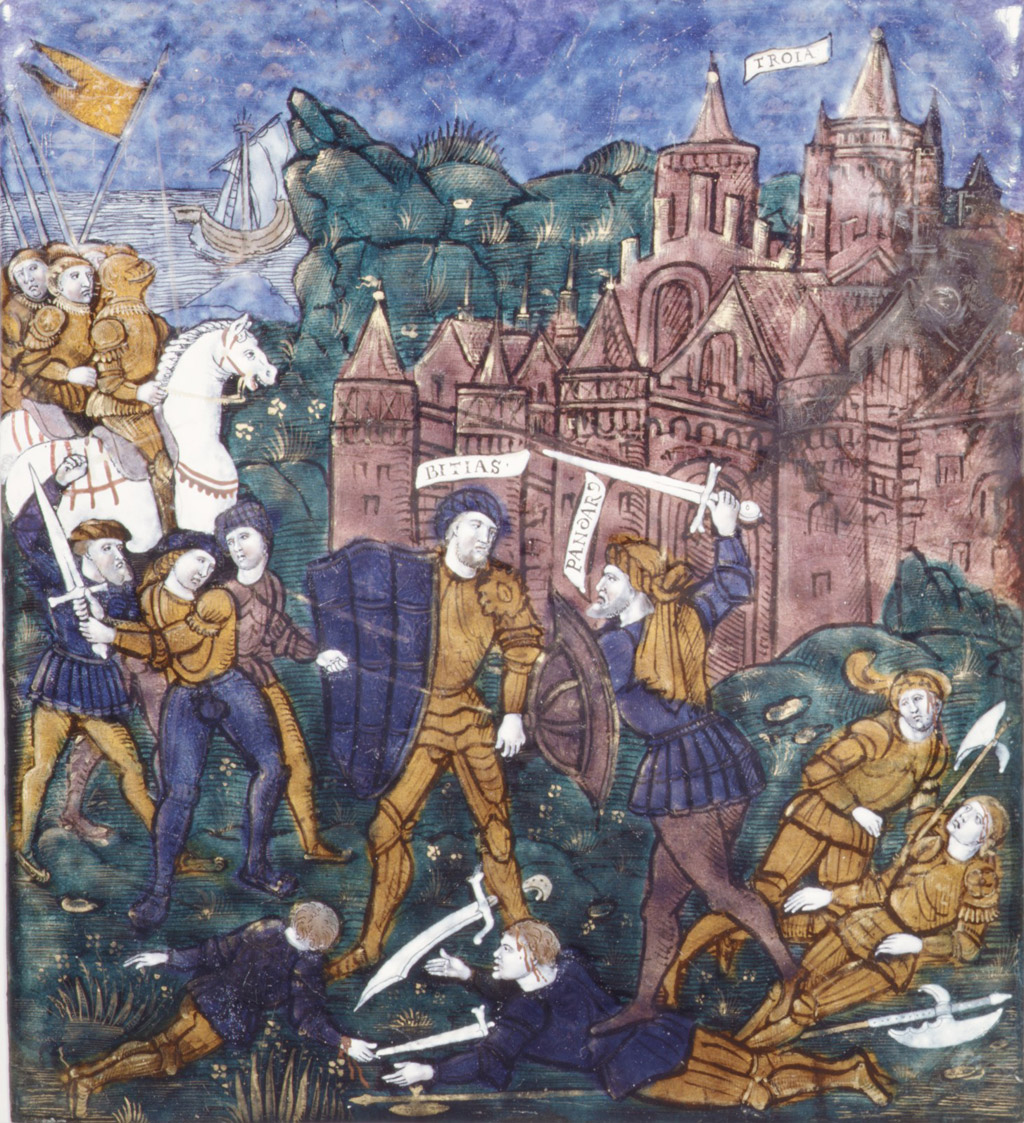
[image] Trojans Pandarus and Bitias in battle with Turnus’s Rutulians in Aeneid, Book IX. From image of painted enamel on copper. Made by Master of the Aeneid, c. 1530-5. Preserved as accession # 45.60.4 in the Metropolitan Museum (New York City, USA). Credit: Fletcher Fund, 1945.

References:

Fagles, Robert, trans. 2006. Virgil. The Aeneid. New York: Viking.

Fairclough, H. Rushton, revised by G. P. Goold. 1999. Virgil. Eclogues. Georgics. Aeneid: Books 1-6. Loeb Classical Library 63. Cambridge, MA: Harvard University Press.

Francese, Christopher and Meghan Reedy. 2016. Vergil: Aeneid Selections. Carlisle, Pennsylvania: Dickinson College Commentaries.

Greenough, J. B., ed. and trans. 1900. The Bucolics, Aeneid, and Georgics of Virgil. Boston: Ginn.

Kline, A. S, trans. 2002. Virgil. The Aeneid. Poetry in Translation, freely available online.

Pöschel, Viktor, trans. Gerda M. Seligson. 1950 / 1962. The Art of Vergil: Image and symbol in the Aeneid {Die Dichtkunst Virgils: Bild und Symbol in der Âneis}. University of Michigan Press: Ann Arbor.

West, Grace Starry. 1979. “Vergil’s Helpful Sisters: Anna and Juturna in the Aeneid.” Vergilius. 25: 10-19.

Teasza. 2011. Chaotic Passion: Turnus & Femininity in the Aeneid. Undergraduate dissertation. Online.

Lombard risked life against wife’s advice for epic victory over snail

Walking around the field that he had assiduously cultivated and plowed, a Lombard joyfully observed his abundant crops. Then, unexpectedly, a snail appeared. The Lombard didn’t know what it was. Paralyzed with fear, he nearly died.

When the Lombard finally regained his ability to think, he thought to himself:

What I see is terrible — my last day has come.
This isn’t a wolf, a bear, or a snake. I don’t know what it is,
but I know that whatever it is, it prepares to do battle with me.
Its shield is a sign of war; its horns are a sign of war.

{ Quod video scelus est: haec mihi summa dies.
Non lupus hoc, ursus, vel vipera: nescio quod sit;
sed scio, quicquid sit, quod mihi bella parat.
Est clipeus signum, signum sunt cornua belli }[1]

At least since the Spartan mothers taught their sons to triumph in battle or die fighting, men hesitate to retreat from a fight. Roman men in ancient times gained respect by displaying war wound on their chests. What would this Lombard husbandry man do?

medieval knight on horseback attacks snail

Rejecting the oppressive classical legacy of celebrating epic violence against men, the Lombard husband humanely refused the social construction of manly thinking. He considered what his wife and children would do, and what was fair to him as a man:

It isn’t human to die in this way.
If my wife and all my children saw this,
at the sight alone they would have already turned their backs.
Moreover, this battle wouldn’t seem fair to anyone,
for my enemy is armed; I am unarmed.

{ Humanum non est hoc periisse modo.
Hoc mea si coniunx et proles tota videret
pro solo visu iam sibi terga darent.
Insuper haec pugna non aequa videbitur ulli;
nam meus armatus hostis, inermis ego. }

Men must insist on fairness and equality for themselves as a gender. Men must reject gender-discriminatory selective military service and institutionalized violence against men. Men should regard their lives as having the same value as those of fully human beings.[2]

This medieval Lombard man hadn’t yet fully developed meninist consciousness. He hesitated. Fear and shame wrestled within him. He thus consulted with his higher powers: the gods and his wife. The gods declared that he would be victorious in battle. His wife, well-studied in the horrible epic tradition of violence against men, was more concerned about her husband’s safety:

What wars please you? Just let the monsters perish.
Set aside your anger. Spare me, have pity!
Spare your children, if you have no concern to spare yourself!
This day will see us separated in anguish.
Neither daring Hector, nor Achilles would have dared this.
The lofty manliness of Hercules would fail here.

{ Quae tibi bella placent? Tandem sine monstra perire!
Pone tuos animos! Parce mihi misere,
parce tuis natis, si non tibi parcere curas!
Pro dolor, externos viderit ista dies!
Non audax Hector, non hoc auderet Achilles,
Herculis hic virtus ardua deficeret. }[3]

That’s solid advice from a loving wife. Men should just let the monsters alone to die on their own.

The specifics of this woman’s advice show her loving care for her husband. In advising him to spare his children if he has no concern to spare himself, she implicitly joins herself to him. She doesn’t want to be separated from him. Her concern highlights the Biblical ideal of heterosexual unity in love. Both Hector, a Trojan, and Achilles, a Greek, died in the terrible violence against men of the Trojan War. Achilles’s mother tried to save him by putting him in women’s privileged clothing. The Lombard’s wife similarly sought to protect her husband from violence. Moreover, the wife’s reference to lofty manliness and Hercules supports her husband’s sexual self-esteem. Men fixated on their physical capabilities tend to admire Hercules even though he failed to stand up to his woman-master Omphale.

medieval knight battles snail

Suffering from internalized misandry, the Lombard turned away from his wife’s loving prayers. He ranked the gods as a higher authority than his wife:

“Set a limit to your prayers, dearest wife,” he said.
“A daring mind isn’t swayed by prayer or tears.
The gods today shall give me fame without end.
Now I pray that you be strong and the boys be strong.”

{ “Pone modum precibus,” inquit, “carissima coniunx,
non prece mens audax flectitur aut lacrimis;
di mihi sunt hodie nomen sine fine daturi.
Iam precor ut valeas et valeant pueri.” }

The Lombard is badly confused. In traditional Greco-Roman morality, pious men tended to spare those who supplicated them with prayer and tears. As a classical epic hero, the Lombard should be swayed by prayer and tears. Moreover, he urges his wife to be moderate, a central medieval Christian value. Nonetheless, he himself seeks fame without end. Most importantly, the gynocentric social devaluation of men’s lives as instrumental inculcates physical strength and emotional constrains in men. That social construction means nothing to women and young boys.

Ignorant of the deeply entrenched gender oppression of men, the Lombard acted like an epic hero and engaged the snail. It was another brutal battle to death:

He thus returned to the battlefield. Here and there he quickly marched,
circling the great beast, sufficiently threatening it:
“O beast whose nature has never before been similarly created,
monster of monsters, pernicious plague,
your horns that you now brandish at me don’t frighten me,
nor does the shell under which for protective covering you remain.
Today you will die by this strong right hand, and no longer
will I endure you befouling my fields.”
And balancing his spear, he looked for points that were
closest to causing death and vigorously pursued victory.

{ Ut stetit in campo, velox huc tendit et illuc
circumdatqueferam magna satis minitans:
“O fera cui numquam similem natura creavit,
monstrum monstrorum, perniciosa lues,
quae mihi nunc pandis non me tua cornua terrent,
testaque sub cuius tegmine tuta manes.
Hac hodie dextra forti moriere nec ultra
te patiar segetes commaculare meas.”
Et vibrans telum quae sint loca proxima morti
prospicit et palmam strenuus exequitur. }

The snail, undoubtedly a male snail, thus suffered defeat and death.[4] He was killed merely for his frightening appearance. He had caused no one harm.

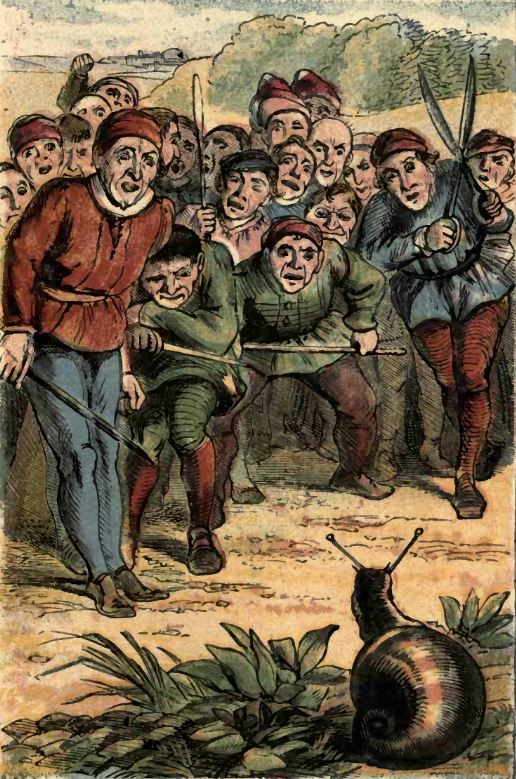
24 tailors confront snail

The social construction of gender even directs men into battles other than those of physical violence. The medieval epic On the Lombard and the Snail {De Lombardo et lumaca} concludes:

For such a deed, what will be a worthy prize to give?
That’s no small matter. Let the lawyers come forward.

{ Pro tanto facto quae premia digna dabuntur?
Non est res parva: causidici veniant. }

Lawyers follow the epic tradition of vicious, fruitless fighting. Rather than being warriors or lawyers, men should stay at home and enjoy cooking, gardening, woodworking, or studying classical and medieval literature.

*  *  *  *  *

Read more:

Notes:

[1] On the Lombard and the Snail {De Lombardo et lumaca} vv. 8-11, Latin text and English translation (modified) from Hexter, Pfuntner & Haynes (2020) pp. 100-1. De Lombardo et lumaca probably was composed late in the twelfth century in Italy. It survives in twenty-five manuscripts. The earliest of those manuscripts was written in the thirteenth century. Randall (1962) pp. 363-4, Cardelle (2013) pp. 25, 35-6. For a freely available, early critical edition, Novati (1893). For a recent edition of the Latin, with commentary and an Italian translation, Voce (2009). For a freely accessible review of medieval pseudo-Ovidian literature, Kretschmer (2013). On medieval beast poetry, Ziolkowski (1993). Id., Appendix 22 also offers an English translation of De Lombardo et lumaca.

Comic epic goes back at least to the Battle of the Frogs and Mice {Batrachomyomachia / Βατραχομυομαχία}. That work was attributed to Homer,  but it was probably written about the fourth century BGC. Some pictorial evidence from the second and third centuries GC suggests a snail as a figure in a battle. Cardelle (2013) p. 28. From the middle of the twelfth century, Lombards were associated with non-chivalrous behavior. Randall (1962) p. 363. That characterization probably built upon the Lombards fleeing from Charlemagne in battle in 772. Id. p. 364.

[2] In a related popular nursery rhyme, children are inured to a female snail threatening to massacre many men:

Four and twenty tailors went to kill a snail.
The best man amongst them durst not touch her tail.
She put out her horns, like a little Kyloe cow,
run, tailors, run, or she’ll kill you all just now.

From Gilbert (1877) p. 148. A Kyloe (Scottish West Highland) cow is relatively small and has long hair. A little Kyloe cow looks cuddly, not frightening.

Kyloe cow looks cuddly

This nursery rhyme also exists in Anonymous (c. 1870). The preface to that work declares:

The Publishers offer in this little volume well known and long loved stories to their young readers. The tales which have delighted the children of many generations will, they feel assured, be equally welcome in the nurseries of the present day….

A closely related version with weavers rather than tailors is attested about 1831 in “the cloth districts of Gloucestershire,” England. J. (1871). A variant was published in 1784. Opie & Opie (1977) p. 401 (no. 496).

[3] My translation of misere in Parce mihi misere is questionable. Hexter, Pfuntner & Haynes (2020), p. 103, has “Spare me in my misery”; Ziolkowski (1993), p. 292, has “Spare me, wretch that I am.” In contrast, I’ve translated misere as the second-person active imperative of misereo. Hexter, Pfuntner & Haynes translated misere as an adverbial form of the deponent misereor. The second-person active imperative of misereor is miserere. A leading authority on medieval Latin philology has noted that while both verbs existed in classical Latin, medieval Latin gravitated toward the deponent. Thus the deponent form would provide the best translation in a normal medieval Latin text using misere.

De Lombardo et lumaca, however, imitates and parodies classical Latin. Stenuit declared that De Lombardo et lumaca illustrates “the influence of the classical tradition on the twelfth century: a beautiful lesson for our age {le rayonnement au XIIe s. de la tradition classique: belle leçon pour notre époque}.” Stenuit (2015) p. 881. Cardelle observed of this work:

It’s especially in parodic relation with the Latin epic tradition that the comic unfolds. Numerous lexical borrowings from Virgil, Statius and Ovid’s Metamorphoses evoke the epic style. They are most often isolated words or groups of words too short to be able to speak of “quotations” that would evoke concrete scenes from the ancient texts.

{ C’est surtout dans la relation parodique avec la tradition épique latine que le comique se déploie. De nom breux emprunts lexicaux à Virgile, à Stace et à l’Ovide des Méta morphoses évoquent le style épique. Il s’agit le plus souvent de mots isolés ou de groupes de mots trop brefs pour pouvoir parler de citations qui évoqueraient des scènes concrètes des textes anciens. }

Cardelle (2013) p. 26. Using the classical Latin verb misereo is consistent with that pattern of imitation. Moreover, two Latin expressions well-known in medieval Europe are “Miserere mei Deus {Have mercy on me, God}” (Psalm 51:1) and “Parce Domine populo tuo {Spare your people, Lord}” (Joel 2:17). Using the classical form misereo would heighten the classical imitation in a verse specifically contrasting with two expressions regularly used in medieval European liturgy.

Grammatical imitation crossing linguistic corpora appears in De Lombardo et lumaca v. with the superlative “monster of monsters {monstrum monstrorum}.” That’s a ancient Mesopotamian form of intensification conveyed into Greek in Timothy 6:15 and Revelation 17:14, 19:16. “Amen” was conveyed into ancient Greek in both translated and transliterated forms. Medieval Latin followed those Greek forms for “amen.” The superlative form “monster of monsters {monstrum monstrorum}” probably came similarly through ancient Greek into medieval Latin.

In addition to its linguistic availability, the verb misereo also seems to me to make better sense in its specific context in De Lombardo et lumaca. The wife is tearful and fearful, but not miserable. She enjoys having her husband with her now. Her husband dying in a future battle with the snail would make her miserable then. She’s a happy, truly loving wife concerned to protect her husband from violence.

[4] Medieval depictions of human engaging with snails encompass a wide range of gender configurations. In one medieval manuscript, a woman implores a knight in relation to a snail. Whether she seeks him to fight the snail to protect her or seeks to dissuade him from fighting the snail isn’t clear. Folio 15v of BnF Latin 14284 (Book of Hours made in France (Picard) about 1280). In other medieval manuscripts, a naked woman battles a snail. Folio 98v of Morgan Library MS M.358 (Book of Hours made in southern France ca. 1440-1450). A naked man riding a snail attacks a naked woman. Folio 184v of Morgan Library MS M.358. A knight,  apparently defeated, supplicates a snail. Folio 162v and Folio 213v of British Library Add MS 49622 (Gorleston Psalter made in England (Suffolk) between 1310-1324).

[images] (1) Medieval knight on horseback charges a snail. Illumination in margin of folio 65r (relevant detail) of Brunetto Latini’s Li Livres dou Tresor. Manuscript made in France (Picardy), c. 1315-1325. Preserved as British Library, Yates Thompson MS 19. (2) Medieval knight on foot battles snail. Illumination in margin of folio 193v of Gorleston Psalter. Made in England (Suffolk), 1310-1324. Preserved as British Library, Add MS 49622. For more on medieval images of snails and knights battling snails, see Randall (1962), Cranga & Cranga (1997), the Manuscript Miniatures collection, and Biggs (2013). (3) Twenty-four tailors went to kill a snail. Illumination for nursery rhyme “Four-and-twenty tailors went to kill a snail” in Anonymous (1865) p. 489. Thanks to Mama Lisa’s World for displaying this image and citing its source. Here’s the illustration from Gilbert (1877). (4) West Highland (Kyloe) two-month-old calf. Source image thanks to Stephencdickson and Wikimedia Commons.

References:

Anonymous. c. 1870. The National Nursery Book. London: Frederick Warne and Co., Bedford Street, Covent Garden.

Biggs, Sarah J. 2013. “Knight v Snail.” British Library Medieval manuscripts blog. 26 September 2013.

Cardelle de Hartmann, Carmen. 2013. “De lombardo et lumaca et la Plurivocité du Procédé Parodique.” Pp. 19-40 in Johannes Bartuschat and Carmen Cardelle de Hartmann, eds. 2013. Formes et Fonctions de la Parodie dans les Littératures Médiévales: Actes du Colloque International, Zurich, 9-10 Decembre 2010. Firenze: Edizioni del Galluzzo per la Fondazione Ezio Franceschini.

Cranga, Yves, and Françoise Cranga. 1997. “L’ escargot dans le midi de la France: approche iconographique.” Mémoires De La Société Archéologique Du Midi De La France / Société Archéologique Du Midi De La France. 57: 71-90.

Gilbert, John et al. 1877. Mother Goose’s Nursery Rhymes and Fairy Tales. London: George Routledge and Sons.

Hexter, Ralph J., Laura Pfuntner, and Justin Haynes, ed. and trans. 2020. Appendix Ovidiana: Latin poems ascribed to Ovid in the Middle Ages. Dumbarton Oaks Medieval Library, 62. Cambridge, MA: Harvard University Press.

J. (1871). “The Prancing Tailor.” Notes and Queries. 4th Series, Volume 8, Sept 2, 1871: 231.

Kretschmer, Marek Thue. 2013. “The love elegy in medieval Latin literature (pseudo-Ovidiana and Ovidian imitations).” Ch. 17 (pp. 271-289) in Thorsen, Thea S., ed. The Cambridge Companion to Latin Love Elegy. Cambridge: Cambridge University Press.

Novati, Francesco. 1893. “Il Lombardo e la Lumaca.” Giornale Storico della Letteratura Italiana. 22 (66): 335-353.

Opie, Iona, and Peter Opie. 1977. The Oxford Dictionary of Nursery Rhymes. Oxford: Clarendon.

Randall, Lilian M. C. 1962. “The Snail in Gothic Marginal Warfare.” Speculum. 37 (3): 358-367.

Stenuit, Bernard. 2015. “Book Review: Il De Lombardo et Lumaca: fonti e modelli (Studi di filologia antica e moderna, 20).” Latomus. 74 (3): 881.

Voce, Stefania. 2009. Il De Lombardo et lumaca: fonti e modelli. Soveria Mannelli: Rubbettino.

Ziolkowski, Jan M. 1993. Talking Animals: medieval Latin beast poetry, 750-1150. Philadelphia: University of Pennsylvania Press.

Sir Gawain’s courtly manners & sexual dynamism transcend gyno-idolatry

Men tend to idolize women. So it was for Sir Gawain and Sir Kay when they, along with Bishop Baldwin, found themselves spending a cold, rainy night in the Carle of Carlisle’s castle in Inglewood Forest. Both Kay and Gawain ardently desired the Carle’s beautiful wife. The Carle didn’t regard either man as a true friend. But Gawain’s sexual dynamism served redemption through enabling an intimate relationship with the Carle’s lovely daughter.

Dinner in the Carle’s castle began awkwardly. The Carle was a gigantic man with a fearsome reputation and a wild appearance. He kept a bull, a boar, a lion, and a bear as house pets. Before the meal began, he drank wine from a nine-gallon golden goblet. At the Carle’s table, Bishop Baldwin ate ravenously. Sir Kay’s focus went elsewhere:

Sir Kay sat on the other side
opposite the Carle’s wife, so full of grandeur.
She was so fair and white,
her arms small, her waist elegant,
her eyes green, her brows bent,
in courtesy she was perfect.
Her complexion was red, her cheeks rosy —
a fairer woman might not exist on earth,
nor one lovelier in appearance.
She was so glorious and so festive
I cannot describe her clothing,
because she was so festively attired.

{ Syr Key was sett on the tother syde
Agenst the Carllus wyfe so full of pryde,
That was so feyr and whytte:
Her armus small, her mydyll gent,
Her yghen grey, her browus bente;
Of curttessy sche was perfette.
Her roode was reede, her chekus rounde,
A feyrror myght not goo on grounde,
Ne lovelyur of syghte.
Sche was so gloryis and soo gay:
I can not rekon her araye,
Sche was so gayly dyghte. }[1]

Kay found himself idolizing her:

“Alas,” thought Kay, “for you noble lady,
that you should be so lost
with such a foul man!”

{ “Alas,” thought Key, “thou Lady fre,
That thou schuldyst this ipereschde be
Wytt seche a foulle weghtht!” }

Though lacking in courtly manners, the Carle was personally perceptive. He turned to Kay:

“Sit still,” said the Carle, “and eat your meat.
You think more than you dare speak,
surely I affirm to you.

{ “Sytt styll,” quod the Carl, “and eete thy mette;
Thow thinkost mor then thou darst speke,
Sertten, I the hyght.” }

After that implicit threat, Kay prudently stopped gazing at the Carle’s wife and started eating.

Known for his courtly manners, Gawain hadn’t even sat at the table. He was standing in the hall waiting for the host to invite him to table. Rather than invite Gawain to table, the Carle commanded him to throw a spear at his face. The Carle assured him that he wouldn’t be hurt. As a courteous guest, Gawain did as his host bade. He hurled a large spear with all his might at the Carle’s face. The spear shattered against the wall behind the Carle and didn’t harm him.

Then the Carle took Gawain by the hand and sat him at the dinner table next to the Carle’s wife. She captivated Gawain:

So much was his love fixed on her,
that during the dinner he wasn’t able
either to drink or to eat.

{ So moche his love was on her lyght,
Of all the soper he ne myght
Nodyr drynke nor ette. }

The Carle perceived Gawain infatuation:

The Carle said, “Gawain, comfort yourself,
for sin is sweet, and that I see.
Surely I affirm to you:
she is mine though you wish she were yours.
Leave such thoughts and drink your wine,
for you shall not have her.”

{ The Carle sayde, “Gawen, comfort the,
For synn ys swete, and that I se.
Serten, I the hete,
Sche ys myn thou woldyst wer thynn.
Leve seche thoghttus and drenke the wynne,
For her thou schalt nott geytt.” }[2]

Gawain felt ashamed of himself. Courtly manners compel men to feel ashamed for appreciating a woman’s beauty as Bishop Nonnus did.

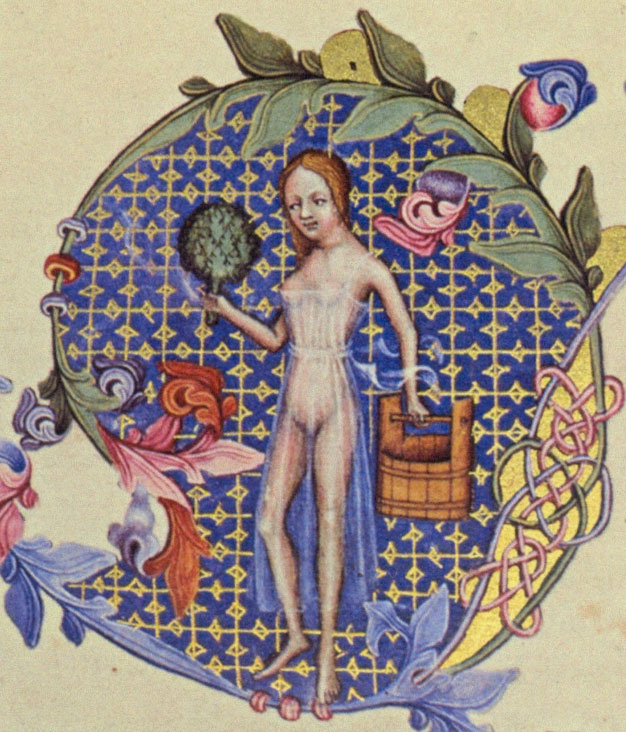
medieval bath attendant / young woman

The Carle’s beautiful, golden-haired daughter came and played on a harp for the guests. She sang songs about the interrelation of love and King Arthur’s armed deeds. The food and her songs made them happy. Men have long foolishly associated love and war. Love should be a freely given gift, not a battle.

After dinner, the Carle led Gawain to his bed. It was a bed covered with a golden bed-spread. It was the bed of the Carle and his wife:

When the bed was made with joy,
the Carle bade his own lady to get in,
that lady of lovely appearance.
A squire came for a private deed,
and he unarmed Gawain there.
Duly he was undressed.
The Carle said, “Sir Gawain,
go take my wife in your two arms
and kiss her in my sight.”

{ When the bede was made wytt wynn,
The Carle bade his oun Lady go in,
That lovfesom was of syghte.
A squyer came wytt a prevey far
And he unarmyde Gawen ther;
Schaply he was undyght.
The Carle seyde, “Syr Gawene,
Go take my wyfe in thi armus tweyne
And kys her in my syghte.” }

To this extraordinary request of him as a guest, Gawain responded with courtly manners:

Sir Gawain answered him at once,
“Sir, your bidding shall be done,
certainly indeed,
or kill or slay or knock me down.”
To the bed he very soon went,
fast and with good vigor,
for the softness of that lady’s side
made Gawain do his will at that time.
When Gawain would have done the private deed,
then Gawain took the Carle’s good heed,
for then the Carle said, “Whoa there!
That love-play for you I forbid.”

{ Syr Gawen ansswerde hyme anon,
“Syr, thi byddynge schall be doune,
Sertaynly in dede,
Kyll or sley, or laye adoune.”
To the bede he went full sone,
Fast and that good spede,
For softnis of that Ladys syde
Made Gawen do his wyll that tyde;
Therof Gawen toke the Carle goode hede.
When Gawen wolde have doun the prevey far,
Then seyd the Carle, “Whoo ther!
That game I the forbede.” }

Courtly love typically isn’t a winning amorous strategy. But Gawain’s courtly manners won favor from the uncourteous Carle:

“But Gawain, seeing that you have done my bidding,
some kindness I must show you in some thing,
insofar as I may.
You shall have one just as bright
who shall play with you all this night
til tomorrow’s day.”
To his daughter’s chamber he went just then,
and bade her arise and go to the knight,
and not hinder him from love-play.
She dared not against his bidding do,
but to Gawain she came very soon
and softly beside him lay.

{ “But, Gawen, sethe thou hast do my byddynge,
Som kyndnis I most schewe the in anny thinge,
As ferforthe as I maye.
Thow schalt have wonn to so bryght
Schall play wytt the all this nyghte
Tyll tomorrowe daye.”
To his doughtter chambur he went full ryght,
And bade her aryse and go to the knyght,
And wern hyme nott to playe.
Sche dorst not agenst his byddynge doun,
But to Gawen sche cam full sone
And style doun be hyme laye. }

Since no later than the reception of Virgil’s account of Dido and Aeneas, women have been credited with being dynamic and always adapting to circumstances. Gawain here showed that men can be just as adaptable as women are. He enjoyed a long night of love-play with the Carle’s daughter.

Was the Carle putting his daughter in bed with Gawain an instance of oppressive patriarchal pandering? No, no it wasn’t. Just as the Carle perceived the unspoken desires of Kay and Gawain, so too he perceived the unspoken desire of his daughter and her need for encouragement after disappointing experiences with so many men:

“Mary, mercy,” thought that lady bright,
“Here has never come such a knight
of all that have been here.”

{ “Mary, mercy,” thought that Lady bryghte,
“Her come never suche a knyght
Of all that her hathe benne.” }[3]

Late the next day Gawain left the Carle’s daughter in bed and went to Mass. She lamented:

“Mary, mercy,” said that lady bright,
“Where shall I see any more this knight
who has laid my body so tightly?”

{ “Maré, marcé,” seyde that Lady bryght,
“Wher I schall se enny mor this knyght
That hathe ley my body so ner?” }

Men have long been disparaged sexually for being like dogs. But Gawain’s sexual dynamism brought joy to the Carle’s daughter, saved Gawain and his companions from being killed, and led to a redemptive end.

The Carle had been killing all the men who visited his castle. The Carle’s violence against men represents the horrible medieval reconception of chivalry as men enduring lethal danger. Gawain’s courtly manners and sexual dynamism prompted the Carle to renounce his domestic killing of men.[4] The Carle had a great abbey constructed in Carlisle where grey monks continually chanted and prayed for all the men the Carle had killed. Gawain and the Carle’s daughter wed.

Completing the story of Sir Gawain and The Carle of Carlisle is left to the world. Gawain had the Carle dubbed a knight of King Arthur’s Round Table. What sort of horseman was he? The story doesn’t say.

Why do I scatter lascivious poems in all my little books,
you ask? I ward off the insipid grammarians!
Were I to sing of the courageous arms of the noble emperor,
or of the religious deeds of godly men,
how many of your wretched censurings would I receive, suffering corrections!
To how many young boys would I become a torment?
But now, since moist kisses dictate my poems
and much penis tingles in my verse,
let read me a young man about to please an unwed girlfriend,
and a sweet young woman about to please a new man,
and whoever from the band of pleasant poets
likes to play away leisure time with lively delights.
From these joyful games go far away, savage
grammarians, and stay your unjust hands,
lest a young man, beaten and crying because of their soft charms,
strongly desires rough earth be heaped upon my bones.

{ Carmina cur spargam cunctis lasciva libellis,
Quaeritis? insulsos arceo Grammaticos.
Fortia magnanimi canerem si Caesaris arma,
Factave divorum religiosa virum,
Quot miser exciperemque notas, patererque lituras!
Quot fierem teneris supplicium pueris!
At nunc uda mihi cum dictent quum basia carmen,
Pruriat et versu mentula multa meo,
Me legat innuptae iuvenis placiturus amicae,
Et placitura novo blanda puella viro,
Et quemcumque iuvat lepidorum de grege vatum
Otia festivis ludere deliciis.
Lusibus at laetis procul hinc absistite, saevi
Grammatici, iniustas et cohibete manus;
Ne puer ob molles caesus lacrymansque lepores,
Duram forte meis ossibus optet humum. }[5]

*  *  *  *  *

Read more:

Notes:

[1] Sir Gawain and The Carle of Carlisle vv. 361-72, Middle English text from Hahn (1995), my English modernization. For an alternate text, Sands (1966). For a modernization of the whole romance, Scott-Robinson (2008). Sir Gawain and The Carle of Carlisle has survived only in Aberystwyth, National Library of Wales, MS Brogyntyn MS ii.1 (formerly Porkington 10) (folio: 12r-26v), written c. 1460. The story itself appears to date from c. 1400. The Carle of Carlisle is a related text surviving in the mid-seventeenth-century manuscript British Library Additional MS 27879 (The Percy Folio), pp. 448-55.

The romance begins with a laudatory characterization of Sir Gawain. Among his plaudits:

He was as meek as a maid in a bower
and also stiff in every battle.

{ He was as meke as mayde in bour
And therto styfe in every stour }

Sir Gawain and The Carle of Carlisle vv. 4-5. These verses plausibly characterize Gawain as being like the knight who endured sexual coercion through the justice system in The Wife of Bath’s Tale. These verses also suggest that Gawain handled well men’s sexual burden of performance. Cf. Pollack (2009) pp. 21-2.

The Middle English word carl / carle is cognate with churl and indicates a crude, physically violent man. The Carle of Carlisle is rich and lives in a castle. That associates him with nobility. But he explicitly declares himself to be without courtesy. Others also note his lack of courtesy. The meaning of courtesy and courtly manners are a central issue in this romance.

Subsequent quotes from Sir Gawain and The Carle of Carlisle are similarly sourced. They are vv. 373-5 (“Alas,” thought Kay…), 376-8, (“Sit still,” said the Carle…), 406-8 (So much was his love…), 409-14 (The Carle said, “Gawain, comfort yourself….”), 448-56 (When the bed was made…), 457-68 (Sir Gawain answered him…), 469-80 (But Gawain, seeing that…), 493-5 (“Mary, mercy,” thought that lady bright…), 507-10 (Mary, mercy,” said that lady bright…).

[2] The Carle’s responses to Kay and Gawain gazing at his wife invoke medieval proverbs: “you think more than you dare speak”; “sin is sweet”.

[3] The Carle’s daughter refers to Mary, the mother of Jesus. The romance ends with a Christian prayer:

Jesus Christ, bring us to your bliss
above in heaven, on your throne.
Amen.

{ Jesu Cryste, brynge us to Thy blis
Above in hevyn, yn Thy see.
Amen. }

Sir Gawain and The Carle of Carlisle, vv. 659-61. Compared to the U.S. today, medieval Europe was relatively liberal and tolerant of different moral perspectives.

Speculating significantly, Pollack declared:

The central question of The Wife of Bath’s Tale and The Wedding of Gawain, ‘what do women most desire,’ never occurs to the Carl of Carlisle.

Pollack (2009) p. 19. The Carle correctly perceived Kay’s and Gawain’s unspoken desire for his wife and his daughter’s unspoken desire for Gawain. Under gynocentrism, men and women are acutely concerned about “what women most desire.” In that sense, that question probably occurred to the Carle, just as it did to Pollack.

Discounting medieval women’s desire and agency to support modern gynocentric mythology, Brandsen declared that the Carle’s wife and daughter are “apparently without a will of their own” and that “the two women are essentially the same person.” Brandsen (1997) p. 303. These are ludicrous claims. Moreover, at a rhetorical level, one might recognize that the Carle’s highly privileged wife and daughter live in a castle. They surely enjoy many more rooms of their own than did all laboring English men.

[4] Lindsay (2012), Ch. 3, discusses how Sir Gawain and The Carle of Carlisle questions chivalry’s support for violence (violence against men).

[5] Janus Secundus, Epigrams 1.58, Latin text and English translation (modified) from Price (1996) p. 89. This poem has echoes of Catullus, Martial, and Horace. Secundus was born in The Hague, Netherlands. He florished as a writer from 1528 to 1536, when he died. He became a well-known author in the sixteenth through eighteenth centuries. For a freely available Latin text of all of Secundus’s works, Burmannus & Bosscha (1821).

[image] Young woman bathhouse attendant. From the Bible of Wenceslas IV {Wenzelsbibel / Bible Václava IV}, created about 1400, Österreichische Nationalbibliothek Codex Vindobonensis 2759-2764. Via Wikimedia Commons.

References:

Brandsen, Taco. 1997. “Sir Gawain and the Carl of Carlisle.” Neophilologus. 81 (2): 299-307.

Burmannus, Petrus, and Petrus Bosscha, eds. 1821. Ioannis Nicolaii Secundi Hagani Opera omnia. Vol. 1. Vol. 2. Lugduni Batavorum: Apud S. et J. Luchtmans.

Hahn, Thomas, ed. 1995. Sir Gawain: Eleven Romances and Tales. Kalamazoo, Mich: Published for TEAMS in association with the University of Rochester by Medieval Institute Publications, Western Michigan University.

Lindsay, Sarah Rae. 2012. Questioning Chivalry in the Middle English Gawain Romances. Ph.D. Thesis. College of Arts and Sciences, Department of English and Comparative Literature. University of North Carolina at Chapel Hill.

Pollack, Sean. 2009. “Border States: Parody, Sovereignty, and Hybrid Identity in The Carl of Carlisle.” Arthuriana. 19 (2): 10-26.

Price, David. 1996. Janus Secundus. Tempe, Arizona: Medieval & Renaissance Texts & Studies.

Sands, Donald B., ed. 1966. Middle English Verse Romances. New York: Holt, Rinehart and Winston.

Scott-Robinson, Richard. 2008. “Sir Gawain and the Carle of Carlisle: translated and retold in Modern English prose.” From The Blue Book of Wellow. Eleusinianm. Online.