Marie de France depicted medieval women’s generous love for men

In her twelfth-century lai Guildeluëc and Guilliadun, or Eliduc {Guildeluëc et Guilliadun, ou Eliduc}, the great medieval writer Marie de France has the woman Guilliadun angrily declare to the woman Guildeluëc:

She is very foolish who believes a man!

{ Mut est fole que humme creit! }[1]

Medieval women undoubtedly expressed such categorical condemnations of men at times. Today such condemnations, if noticed, could be called misandristic or anti-meninist. Such condemnations in their reverse-gender form evoke censure and censorship.[2] Marie de France, however, appreciated the psychological complexity of human behavior. Overall, her lais show medieval women’s deep and generous love for men.

The happily married Guildeluëc and Eliduc loyally loved each other. Then false accusations caused Eliduc to lose his king’s patronage. Eliduc had to voyage from his home in Brittany across the sea to England to work as a soldier. There he served in brutal violence against men for an English king. Men deserve more humane work than soldiering in brutal violence against men.

The English king’s lovely daughter Guilliadun heard about Eliduc’s victorious violence against men in service to her father. She asked for him to come to her. He of course obeyed her summons. They sat together on her bed and talked for a long time. After he departed, she couldn’t rest or sleep. She was madly in love with him. She told her chamberlain:

If he wishes to love me as a lover
and pledge his body to me,
I will do all his pleasure.
If so, from such great good can come to him:
he will be king of this land.
So very wise and courtly is he
that, if he doesn’t love me as a lover,
I will necessarily die in great sorrow.

{ Si par amur me veut amer
E de sun cors asseurer,
Jeo ferai trestut sun pleisir,
si l’en peot grant bien avenir:
De ceste tere serat reis.
Tant par est sages e curteis,
Que, s’il ne m’aime par amur,
Murir m’estuet a grant dolur. }

Admirably disregarding men’s conventional gender burden of soliciting amorous relationships, her chamberlain advised her to send love-tokens to Eliduc. She took that initiative without inquiring whether Eliduc was married.

Alexandre Cabanel's portrait of a Mesopotamian courtesan Albaydé

While taking the initiative in love involves risks that men have traditionally borne, in this case Eliduc didn’t reject Guilliadun’s love initiative. He himself felt amorously attracted to Guilliadun. However, he had pledged fidelity to his wife before traveling overseas to work as a soldier. Like many men, even sexually deprived soldiers in armies exploiting only men, Eliduc sought to uphold his pledge to his wife. He resolved to visit and talk with Guilliadun, and kiss and embrace her, but not have sex with her. He felt great love anguish as he mounted his horse to visit her.

Guilliadun was delighted that Eliduc had come to see her. When her father the king praised Eliduc as the best among five hundred men, she felt her passion validated. She summoned Eliduc to a private conversation with her. They both hesitated to speak. Then Eliduc thanked her for her gift of love-tokens to him. Appreciating his receptivity, she pressed forward:

She replies to the knight
that with this she is delighted,
and for this she sent the ring
and the belt as well,
because she has given him her body.
She loves him with such love
that she wishes to make him her lord.
And if she cannot have him,
never will she have any living man.
Now let him in return tell his desire!

{ Ele respunt al chevalier
Que de ceo li esteit mut bel,
E pur ceo l’enveat l’anel
E la ceinture autresi,
Que de sun cors l’aveit seisi;
Ele l’amat de tel amur,
De lui volt faire sun seignur.
E si ele ne peot lui aveir,
Une chose sace de veir:
Jamés n’avera humme vivant.
Ore li redie sum talant! }

Guilliadun was fighting strongly and aggressively for love. Eliduc meekly thanked her. He explained that he was contracted to fight for a year as a soldier for her father in brutal violence against men. After that term, he would leave their country and return home. She appreciated his forthrightness about his intentions. She didn’t ask if he was married.

Guilliadun and Eliduc subsequently enjoyed flirtatious love-play, but nothing more. After some time Eliduc received a message that his king in Brittany urgently needed his service as a soldier. Distraught, Eliduc nonetheless recognized his feudal obligation. He requested leave from both the English king and Guilliadun to return to serve his own king. They both reluctantly let him return.

Guilliadun threatened to kill herself if Eliduc didn’t take her with him. But if he took her with him, that would violate his feudal obligation of loyalty to her father. Moreover, he was married and had pledged faithfulness to his wife. Like Aeneas with respect to Dido, Eliduc has no obligation to Guilliadun. But he loved her and didn’t want her to commit suicide. Under her love coercion, Eliduc promised to return to her after his term of obligation to her father had expired. Then he would take her away. To what he would take her wasn’t clear to anyone, including apparently Eliduc himself. Facing a love dilemma impossible to resolve rightly, a man can only seek time and hope for a loving way forward.

When Eliduc returned home, his wife Guildeluëc rejoiced. He, however, was morose and withdrawn. Described as a good, beautiful, wise, and worthy wife, she didn’t become resentful. She asked if anyone had told him that she had betrayed him. She offered to make amends for any such claims. That wasn’t it, he explained. His concern was that he had to return to the English kingdom and would suffer greatly before he could return to her. What exactly he meant isn’t clear, but certainly he was in a difficult love situation.

At the time Guilliadun had appointed, Eliduc returned to her in England. He arranged for her to leave her castle secretly and join him on a boat sailing back to Brittany. As if by divine vengeance like that against Jonah, a fierce storm enveloped the ship near the Brittany shore. A sailor blamed Eliduc for bringing a woman who wasn’t his wife on ship with him. That’s when Guilliadun learned that Eliduc was married. She fainted from that news and apparently died. Eliduc then killed the sailor who had blamed him for agreeing to Guilliadun’s request. Men’s lives count for little relative to women’s lives.

The anguished Eliduc managed to steer the boat to shore. He sought to bury Guilliadun with honor in a sacred place. He took her to a chapel in the woods near to his home and laid her on a bed before the altar. He left to make plans to bury her. He also planned to become a monk who would constantly cry out to God in grief for Guilliadun’s death and pray for her soul.

On the next two days the grief-stricken Eliduc came to the chapel to grieve and pray over Guilliadun’s body. His wife Guildeluëc noticed his grief and his absences. She had one of her servants follow him. The servant discovered Eliduc visiting the chapel. When Eliduc was at an audience with the king, Guildeluëc with her servant came to the chapel. She saw the body of the beautiful young woman lying before the altar. She then understood her husband’s grief:

“Do you see,” she says, “this woman,
who resembles a gem in her beauty?
This is my lord’s lover,
on whose account he shows such sorrow.
In faith, I do not wonder at that,
when such a beautiful woman has died.
So much by pity, so much by love,
never will I have joy on any further day.”

{ “Veiz tu,” fet ele, “ceste femme,
Que de beuté resemble gemme?
Ceo est l’amie mun seignur,
Pur quei il meine tel dolur.
Par fei, jeo ne me merveil mie,
Quant si bele femme est perie.
Tant par pité, tant par amur,
Jamés n’averai joie nul jur.” }

In implicit sympathy with her husband’s grief, Guildeluëc wept and lamented the young woman’s death.

A weasel ran out from under the altar and scampered across Guilliadun’s body. The servant struck the weasel with his staff and apparently killed it. Another weasel saw its dead friend and seemed to be filled with sorrow. It went into the woods and returned with a red flower that it put into the mouth of its companion. The apparently dead weasel immediately returned to life.

Guildeluëc noticed the weasel’s action and its effect. With a characteristic act of women’s aggression, she ordered her man-servant to strike the weasel so as to get the flower from it. The servant did as his lady instructed.[3] The wounded weasel dropped the red flower. Guildeluëc then placed it in Guilliadun’s mouth. Like the apparently dead weasel, Guilliadun immediately returned to life.

Guildeluëc resurrected an apparently dead, beautiful young woman that her husband loved. Her love and generosity toward her husband went even further. She told Guilliadun:

What great joy I have that you are alive.
I will take you along with me
and return you to your lover.
I wish to make him entirely free of our marriage,
and I will take a nun’s veil.

{ Que vive estes, grant joie en ai;
Ensemble od mei vus enmerrai
E a vostre ami vus rendrai.
Del tut le voil quite clamer,
E si ferai mun chef veler. }

When she thought that Guilliadun was dead, Guildeluëc said that she would never again have joy. Guildeluëc felt joy again when she succeeded in bringing back to life a beautiful young woman whom her husband loved. Moreover, she then gave her husband to Guilliadun. While Jesus was a fully masculine man, Guildeluëc as a woman was fully able to embody the perfect, salvific love of Jesus in Christian understanding. No man could have a more wonderfully loving wife than Guildeluëc.[4]

medieval lady by Alexandre Cabanel

Guildeluëc wasn’t an exception among medieval women. In Marie de France’s lai Le Fresne, an orphan given to a convent grew up to be a beautiful woman called Le Fresne. She and Gurun, a knight owning much land, became lovers. Worried that she might become pregnant, he urged her to run away with him. So she did. They then married and lived happily. But she never got pregnant.

Other knights who held land from Gurun were upset that he didn’t have an heir. They wanted to be sure that their land holdings would continue when he died. They thus coerced him into divorcing Le Fresne and taking another woman named Le Codre as his new wife. All of people of his household were extremely upset at losing Le Fresne as their lady. But Le Fresne didn’t get upset or resentful. She apparently understood the bad circumstances and didn’t blame her husband.

Le Fresne displayed her generous love for her then ex-husband on the day of his new wedding. She instructed servants to prepare the marital bed for Gurun and his new bride Le Codre as she knew he liked it:

When the bed was made ready,
they threw a coverlet over it.
The material was an old woven silk.
The young lady saw it —
it didn’t seem right to her.
It pressed down on her heart.
She opened a chest, took out her cloth,
and put it on the bed of her lord.
She did it to honor him.

{ Quant le lit fu apresté,
Un covertur unt sus jeté;
Li dras esteit d’un viel bofu.
La dameisele l’ad veü;
N’ert mie bons, ceo li sembla;
En sun courage li pesa.
Un cofre overi, sun pali prist,
Sur le lit sun seignur li mist.
Pur lui honuere le feseit }[5]

Her cloth was the lovely silk that had wrapped her as a baby when she had been abandoned at the convent. She didn’t mean to signify her husband’s abandonment of her. Her life as an orphan had gone well, except for her husband being forced to divorce her. She simply wanted to make the marital bed more beautiful for her ex-husband and his new wife. That’s a wonderfully generous act of love.

Le Codre’s mother led her to that marital bed. The mother recognized the beautiful silk coverlet as the cloth in which she had wrapped her twin daughter that she had abandoned. She called for Le Fresne and embraced her daughter. She explained to everyone that Le Codre was Le Fresne’s twin sister. The mother profusely apologized to her husband for secretly abandoning one of their twin daughters. He forgave her and rejoiced in recovering his lost daughter. For Gurun, divorcing one twin and marrying another made no sense. The archbishop agreed to annul the wedding and cancel the divorce. Le Fresne and Gurun joyfully became spouses again.

Le Fresne’s generous act of love for her ex-husband Gurun eliminated all worldly concerns. Gurun’s scheming knight-tenants aren’t mentioned again. Whether Le Fresne and Gurun subsequently had children isn’t mentioned either. Le Fresne’s generous love for Gurun clearly was fruitful. That’s all that ultimately mattered.

Men today urgently need the generous love from women that Marie de France depicted. Woman today can be just as generously loving to men as medieval women were. The great medieval woman writer Marie de France provides woman and men today inspiring examples of wonderful women.

*  *  *  *  *

Read more:

Notes:

[1] Marie de France, Guildeluëc and Guilliadun, or Eliduc {Guildeluëc et Guilliadun, ou Eliduc} v. 1084, Old French text and English translation (modified) from Waters (2018). For a freely available, online Old French text, Warnke & Köhler (1900) pp. 186-224. For another modern English translation, Fowles (1974) pp. 109-126, available here. Freely available translations into slightly dated English are those of Mason (1911) and Rickert (1901).

The subsequent quotes above from Guildeluëc et Guilliadun, ou Eliduc are similarly sourced. They are vv. 343-50 (If he wishes to love me…), 508-18 (She replies to the knight…), 1021-8 (“Do you see,” she says…), 1098-1102 (What great joy I have…).

[2] While strictly policing what’s labeled misogyny or anti-feminism, modern literary scholarship has long been inclusive and tolerant of misandry and anti-meninism. In 1977, a well-regarded academic literary scholar referred to Guilliadun’s categorical condemnation of men as “her own all too correct pronouncement that women should not trust men.” Hieatt (1977) p. 355. Hieatt further claims that “idiotic and heedless men abound” in Marie de France’s work:

The most typical characters in her lays are women victimized by men, either oppressive and cruel men or weaklings like Eliduc, and women whose native intelligence and/or humane compassion saves the day — or would, if the men would only listen to them.

Id. p. 356. Apparently projecting her own animosity toward men upon Marie de France, Hieatt grossly mischaracterized Marie de France as “a writer of distinctly feminist tone.” Id. p. 357.

[3] Lauding men-abasing courtly love, Fowles described it as an important context for Guildeluëc et Guilliadun, ou Eliduc:

It is hardly a fashionable idea in the twentieth century; but amour courtois was a desperately needed attempt to bring more civilization (more female intelligence) into a brutal society, and all civilization is based on agreed codes and symbols of mutual trust.

Fowles (1974) p. 107. In fact, courtly love {amour courtois} was been a quite fashionable idea since late in the nineteenth century. Showing the narrow contours that have long governed elite gender debate, Hieatt countered:

These and others of Marie’s lays show a good deal more concern with the poor behaviour of the male and the superior wisdom and humanity of the female than they do with the romantic aspects of “courtly love.”

Hieatt (1977) p. 356. The ideology of female supremacism has grown terribly in influence and viciousness since 1977.

[4] Regarding Guildeluëc’s generous love for her husband Eliduc, Hieatt commented:

A self-respecting modern wife faced with the prospect of being discarded for a younger woman generally expresses her indignation quite firmly and demands reprisals in the form of alimony and other perquisites before she will offer any cooperation at all to an errant spouse.

Hieatt (1977) p. 352. Not all women are like that.

[5] Marie de France, The Ash Tree {Le Fresne} vv. 397-405, Old French text and English translation (modified) from Waters (2018). The name of the lai is also the name of its woman-hero. The name of her twin sister Le Condre in English means “the hazel tree.” Following Waters, I’ve retained the French forms of the twins’ names. For a freely available, online Old French text of Le Fresne, Warnke & Köhler (1900). For freely available translations, Mason (1911) and Shoaf (1996).

[images] (1) Portrait of Mesopotamian courtesan Albaydé, as described in Victor Hugo’s poem “Fragments of a Serpent” in Les Orientales. Oil on canvas painting that Alexandre Cabanel made in 1848. Preserved in Musée Fabre (Monpellier, France). Via Wikimedia Commons. On this work, Moussa (2011). Ralph Hancock has observed that Albaydé is holding bindweed / morning glory {convolvulus}. Bindweed / morning glory is an invasive, climbing perennial that wraps itself around other plants and can kill them. Getting rid of it is very difficult.  (2) Medieval lady. Watercolor and gouache on paper. Painted by Alexandre Cabanel. Preserved in Mariano Procópio Museum (Juiz de Fora, Minas Gerais, Brazil). Via Wikimedia Commons. Here’s detailed information on the artistic career of the nineteenth-century French academic painter Alexandre Cabanel.

References:

Fowles, John. 1974. The Ebony Tower. Boston: Little, Brown and Company.

Hieatt, Constance B. 1977. “Eliduc Revisited: John Fowles and Marie De France.” ESC: English Studies in Canada. 3 (3): 351-358.

Mason, Eugene, trans. 1911. French Mediaeval Romances from the Lays of Marie de France. London: J.M. Dent & Sons.

Moussa, Sarga. 2011. “Imaginary Hybridities: Geographic, Religioius and Poetic Crossovers in Victor Hugo’s Les Orientales.” Ch. 25 (pp. 280-290) in Guignery, Vanessa, Catherine Pesso-Miquel, and François Specq. Hybridity: forms and figures in literature and the visual arts. Newcastle upon Tyne, UK: Cambridge Scholars Pub.

Rickert, Edith, trans. 1901. Marie de France. Seven of her lays done into English. With designs by Caroline Watts. David Nutt: London.

Shoaf, Judith P. 1996. “Le Fresne: Marie de France, translated.” Online.

Warnke, Karl, and Reinhold Köhler, eds. 1900. Die Lais der Marie de France. Halle: M. Niemeyer.

Waters, Claire M. 2018. The Lais of Marie de France: Text and Translation. Peterborough, Ontario: Broadview Press.
medieval literature describes men’s passionate desire for many women

Agents of ignorance and bigotry have created a myth of medieval European sexual repression, and even worse, misogyny. In fact, medieval literature describes men’s passionate desire for women and the joy of heterosexual intercourse. Medieval men’s ardent desire for women led some of them into servitude to women and effectively sexual feudalism. Medieval men could buy sex from a variety of women. Some clerics advocated for clergy having multiple concubines. Nonetheless, popular medieval wisdom, without referring directly to Christian teaching, taught men to settle for having sexual relations with just one woman.

Some medieval clergy advocated strongly for women. One clerical text declared:

In human affairs no other matter is such as this:
if there is a young woman beautiful in all ways,
she makes herself pleasing so that many men compete to obtain her.
If she perishes, what will there be that any man wishes to love?
Neither gold nor gemstones will please, royal purple cloth will fade,
a man will even be despised and will regard himself as shameful.
She gives value to the things we hold in esteem:
she herself pleases, and nothing else pleases from its own merit.

{ Rebus in humanis non est res altera talis:
si fuerit totis pulchra puella modis,
haec facit ut placeat quam plures quaerere certant.
Si perit haec, quid erit quod quis amare velit?
Non aurum, non gemma placet, rubra purpura pallet,
vir quoque sordebit et sibi turpis erit.
Haec pretium rebus dat quas in honore tenemus,
haec placet — e relinquis nulla suis meritis. }[1]

Men typically buy expensive jewelry, seek high-status positions, and engage in violence against men in large part to impress women or to please women. The aggressive, laborious, and dangerous masculine drive to be a “big man” has evolutionary roots in men’s desire to obtain women’s favor. Such reality can scarcely be described in our repressive and doctrinaire age.

The clerical text praising women introduced a special clerical claim to women. According to this text, the goddess Venus gave all the beautiful women to the clergy, regarded as men worthy in appreciating divine gifts. She gave merchants and soldiers no woman — nothing but the worldly evils associated with their professions. She told monks to keep chanting “Lord have mercy {kyrie eleison}” and to enjoy nothing but salty beans. Like men deprived of mercy from women, the monks wept inside their cloisters. If you believe in the goddess Venus, the clergy having all the beautiful women was the divinely ordained medieval distribution of women.

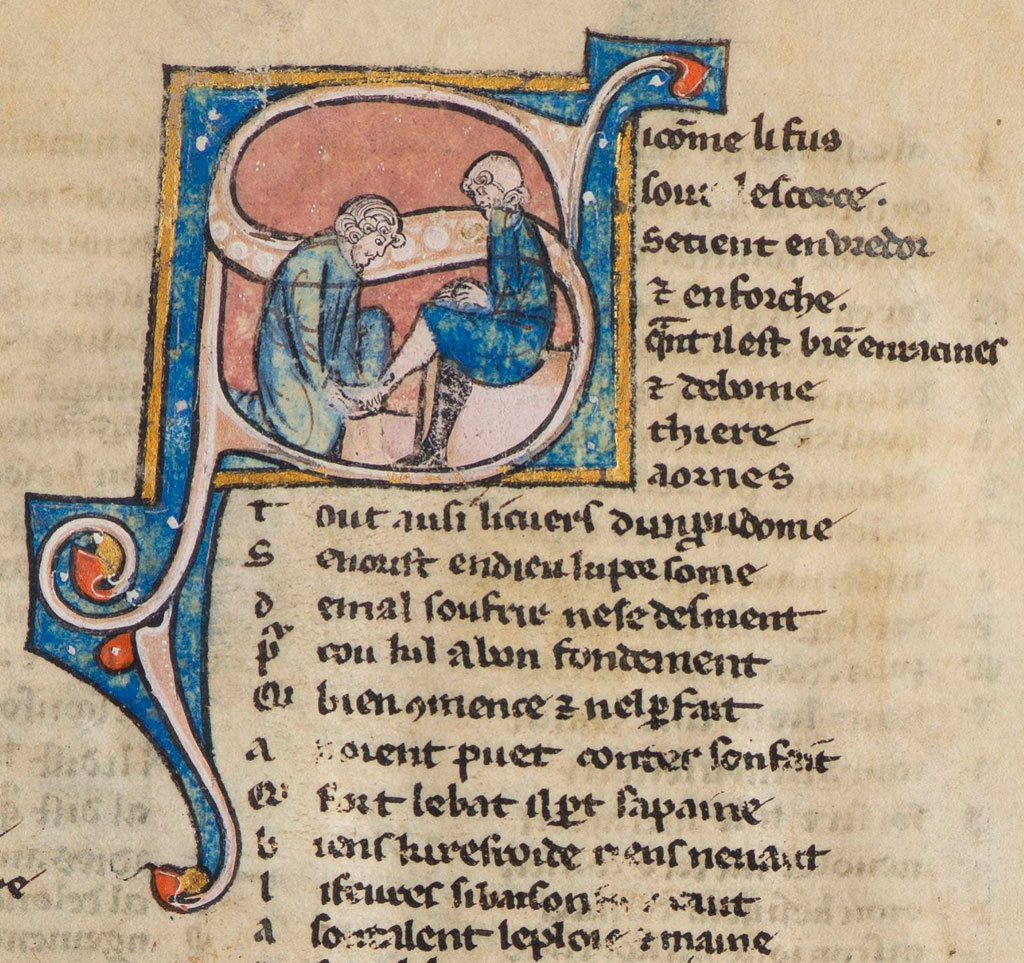
man putting slipper on woman's foot

Lacking a divine gift of women, ordinary men relied on their own efforts. Their efforts tended to position them as abject women-servers:

Bright shining star, with beautifully radiant face,
here I am. Suffer your servant to speak.
If your nobility, probity, and beautiful figure
are rightly praised, nothing remains like you.
You exceed in your outstanding figure all young women,
and you would conquer Venus, if she weren’t a goddess.

When I don’t see you, I pine and long to be seen by you.
Contemplating you, I die, for my love burns so fiercely.
I’m already your servant. If you please, I will give myself
to you and do what you alone command me to do.
If you should look at me or stoop to love me,
I would rejoice more than if kingdoms were given to me.
I pray only for this: that you acknowledge your servant worthy of your love,
so that through you he may live, you who are my life and my salvation!

{ Stella serena nitens, facie rutilante decora,
ecce tuum famulum nunc patiare loqui.
Si tua nobilitas, probitas et forma decora
laudetur velut est, par tibi nulla manet.
Tu superas cunctas forma praestante puellas
et vincis Venerem, ni foret ipsa dea.

Cum te non video, pereo cupioque videre;
inspiciens morior, nam nimis urit amor.
Iam tibi sum famulus; tibi, si placet, exhibeo me
et semper faciam, quae mihi sola iubes.
Si me conspicies vel me digneris amare,
gaudeo plus quam si quis mihi regna daret.
Deprecor hoc tantum: famulum fatearis amandum,
ut per te vivat, vita salusque mea! }[2]

Women typically don’t amorously desire men-servants. Moreover, men striving to be women’s servants perpetuates gender inequality and gynocentrism. Men with their seminal blessing can fruitfully love many women. Crushing financial penalties authoritatively imposed on men’s reproductive choice is unnatural — a socially constructed sexual constraint within gynocentric society. Men need to gain enough critical insight to recognize that they are not naturally sexually inferior to women.

bathhouse woman from Wenceslas Biblebathhouse women serving man in Wenceslas Bible

bathhouse woman from Wenceslas Bible

Medieval literature recognized men’s interest in having more than one woman. In the Old French Romance of the Count of Poitiers {Roman du comte de Poitiers}, composed about the year 1240, a king had a beauty show in which thirty young beautiful women stripped naked for his judgment. The king concluded that he would like to have all thirty as wives and lovers.[3] The Old French lay Ignaure, from perhaps a few decades earlier, describes Ignaure carrying on simultaneous love affairs with twelve noble women living in one castle. The thirteenth-century fabliau About the young man of the twelve wives {Du vallet aus douze fames} describes a man wanting to have twelve wives. Libro de buen amor from the fourteenth century recounts how a lusty young miller aspired to three wives. The miller came to realize that he was barely strong enough to satisfy one wife. He evidently was no sexual superhero like Charlemagne’s peer Oliver.

Popular medieval wisdom with good reason instructed men to limit themselves to just one woman for intimate relations. A medieval biographical fictionalization of the classical poet Ovid began, “Oh, how dear to me and how desirable was the female sex {O quam carus erat mihi quamque optabilis ille femineus sexus}!” Nonetheless Ovid, regarded in medieval Europe as a great teacher of love, declared:

In truth, as the popular saying holds,
having a hundred young woman is like having none,
and likewise having one counts as having a hundred,
since you will be no one’s while none claims possession of you,
and one will be as sufficient as if you alone had a hundred.
Everyone chooses for himself what he prefers, and what
doesn’t please him, he refuses. As for myself, I know that
I would want one young woman more than none, and an agreeable one
more than many young women, one of whom might slander me.

{ Nam sicut vulgare solet paradigma tenere,
sicut habens centum nullam reputatur habere
sic et habens unam pro centum computat illum,
nam nullius eris, dum te non vendicet una,
unaque sufficiet quasi centum solus haberes.
Unusquisque sibi quod mavult eligit, et quod
non placet, hoc renuit. De me scio, quod magis unam
vellem quam nullam, quod concordem magis unam
quam multas, quarum mihi contradiceret una. }[4]

Ovid’s morality is based on individual choice (what one prefers) in relation to consequences (risk of slander). The popular saying makes no explicit reference to Christian morality. It’s historically appropriate for Ovid living at a time before Jesus.

The popular saying implicitly supports Christian morality of love. In Christian understanding, love is a complete, freely given gift of self to the beloved. A complete gift of self can be to only one person. Moreover, Christian spouses owed each other unlimited acts of sexual intercourse within the context of loving care for each other. In the narrow sense of sexual opportunities, one Christian spouse is as sufficient as a hundred.

Medieval men passionately desired many women. In actual love practice, medieval men often made themselves subservient to just one woman. Men’s burden of subservience to women deterred men from having multiple concurrent amorous relationships. Men’s risks in love with women and Christian moral teaching also steered men away from having multiple ongoing sexual relationships with women. Popular medieval wisdom that having one woman was better than having a hundred shows ordinary reason enlightening medieval men’s desire.

*  *  *  *  *

Read more:

Notes:

[1] On the Distribution of Women {De distributione mulierum} vv. 1-8, Latin text and English translation (modified) from Hexter, Pfuntner & Haynes (2020) pp. 330-1. This poem survives only in the manuscript Vatican City, Biblioteca apostilica, Vat. Lat. 1602, fol. 49r-v. That manuscript was written late in the fourteenth century. Id. p. 434.

[2] On love {De amore} vv. 79-84, 105-12, Latin text and English translation (modified) from Hexter, Pfuntner & Haynes (2020) pp. 352-5. This poem is an extract from the twelfth-century poem known as Facetus: Moribus et vita or the Facetus of Aurigena. At the University of Krakow in medieval Poland, this text was used to teach Latin grammar and the art of composing letters {ars dictandi}. Jegorow (2018).

[3] The Romance of the Count of Poitiers {Le Roman du comte de Poitiers} vv. 1469-76, Old French text in Michel (1831) p. 61. This romance has survived only in one fourteenth-century manuscript, Bibliothèque nationale de France. Bibliothèque de l’Arsenal. Ms-3527. For study of Le Roman du comte de Poitiers, Fahlin (1940), Durling (2000), and Grodet (2006).

[4] About the Old Woman {De vetula}, 1.10-18, Latin text and English translation (modified) from Hexter, Pfuntner & Haynes (2020) pp. 138-9. The previous short quote is from De vetula 1.1-2.

Ovid earlier held a rather different view on the merits of having many women:

Fair ones capture me: I’m captured by young blonde women,
but Venus is still pleasing with dusk-colored ones.
If dark tresses hang on a snowy neck,
then Leda was famed for her black hair.
If they’re blonde, Aurora’s saffron hair pleases.
My desire adapts itself to all the stories.
Young girls entice me, older ones move me —
she pleases with her body’s looks, she with its form.
In brief, whichever young women one might commend in the city,
my desire has ambitions on them all.

{ Candida me capiet, capiet me flava puella,
Est etiam in fusco grata colore Venus.
Seu pendent nivea pulli cervice capilli,
Leda fuit nigra conspicienda coma;
Seu flavent, placuit croceis Aurora capillis.
Omnibus historiis se meus aptat amor.
Me nova sollicitat, me tangit serior aetas;
Haec melior, specie corporis illa placet.
Denique quas tota quisquam probet urbe puellas,
Noster in has omnis ambitiosus amor. }

Ovid, Amores 2.4.39-48, Latin text from Ehwald’s Teubner edition (1907) via Perseus, English translation (modified slightly) from A. S. Kline. De vetula helps to explain why Ovid was castrated.

[image] (1) Man putting a slipper on a woman’s foot. Illumination from instance of Recueil d’anciennes poésies françaises. Folio 18r of manuscript Bibliothèque nationale de France. Bibliothèque de l’Arsenal. Ms-3527. (2-4) Images of bathhouse women from Bible of Wenceslas IV {Wenzelsbibel / Bible Václava IV}, created about 1400. From Österreichische Nationalbibliothek Codex Vindobonensis 2759-2764. Wenceslas / Wenceslaus IV, of the House of Luxembourg, was King of Bohemia from 1378 until his death in 1419. The Bible of Wenceslas IV contains the Biblical text in German and is one of the earliest German-language bibles. Here’s some information about Wenceslas and his beloved bath attendant Susanne.

References:

Durling, Nancy Vine. 2000. “Women’s visible honor in medieval romance: the example of the Old French Roman du Comte de Poitiers.” Pp. 117-132 in Blumenfeld-Kosinski, Renate, ed. 2000. Translatio studii: essays by his students in honor of Karl D. Uitti for his sixty-fifth birthday. Amsterdam: Rodopi.

Fahlin, Carin. 1940. “Les sources et la date du Roman du comte de poitiers.” Studia Neophilologica. 13 (2): 181-225.

Grodet, Mathilde. 2006. “Croire, mescroire, recroire. Le procès de la comtesse de Poitiers injustement accusée d’adultère.” Questes. 10: 21-30.

Hexter, Ralph J., Laura Pfuntner, and Justin Haynes, ed. and trans. 2020. Appendix Ovidiana: Latin poems ascribed to Ovid in the Middle Ages. Dumbarton Oaks Medieval Library, 62. Cambridge, MA: Harvard University Press.

Jegorow, Adam. 2018. “Ars amandi, ars dictandi – średniowieczna Pseudo-Ars amatoria i jej funkcje dydaktyczne w Akademii Krakowskiej.” Terminus. 20 (3): 283-311.

Michel, Francisque, ed. 1831. Roman du comte de Poitiers. Paris: Silvestre.

lai of Argentille & Haveloc protested gender in medieval marriage

Political scheming caused Princess Argentille to be married to the kitchen scullion Haveloc in the Anglo-Norman lai Haveloc written about the year 1200. Like the seventh-century English nobles Æthelthryth and Tondberht and many American couples today, Argentille and Haveloc seemed to be destined for sexless marriage:

When they were both brought to bed,
she was greatly ashamed of him,
and he even more so for her sake.

{ Quant coché furent amdui,
Cele ot grant hunte de lui
E il assez greinur de lui. }[1]

Fear and wariness in the marital bed fosters neither joy nor sleep. However, personal conversation overcame the apparent gulf of social class between them. It also prompted physical intimacy:

But later they became so trusting of each other,
both in their words and their expressions,
that he loved her and lay with her
as was his duty to do with his wife.
On the night he first had sexual congress with her,
he had such joy from it and loved her so much
that afterwards he fell asleep and became oblivious.

{ Mais pus se assurerent itant,
E de parole e de semblant,
Ke il l’ama e od lui just
Cum il od sun espuse dust.
La nuit qu’il primes i parla
Tel joie en out e tant l’ama
Ke il s’endormi e oblia. }

In these verses, the Anglo-Norman word for sexual congress is a form of the verb parler. That Anglo-Norman verb most commonly means “to have conversation.” But as the greatest scholars of lais recognized, the fitting meaning here is “to have sexual congress.”[2] That meaning re-enforces the communicative development in Argentille and Haveloc’s relationship depicted in the prior four verses. Their relationship in words became a relationship in flesh. That’s fundamentally a Christian understanding of love.

Although primarily interpreted as political history, the lai Haveloc offers keen psychological insight into medieval marriage. Wives and husbands in Haveloc consciously treat each other with sensitivity for their relationship.[3] For example, a hermit told Argentille that Haveloc was born of a royal lineage. That’s an extraordinary claim about a man working as a kitchen scullion. Argentille addressed the situation with psychological sophistication:

She returned to her husband.
In private and lovingly,
she asked him where he was born
and where his family were.

{ Ele s’en vait a sun seignur.
Privement e par amur
Li demande dunt il ert nez
[E ou] esteit sis parentez. }

Argentille took care to show that her love for her husband didn’t depend on whether the hermit’s claim was true. She also took care not to expose her husband to public ridicule.

Haveloc believed that he was the son of Grim the fisherman and his wife Sebur. That elderly couple lived in the small Lincolnshire town called Grimsby. Unhappy under her current circumstances, Argentille wanted she and Haveloc to go to live with his parents. Haveloc readily agreed.[4] When they arrived in Grimsby, only Grim and Sebur’s daughter Kelloc, married to a merchant, remained alive. Kelloc asked Haveloc about the beautiful woman with him. He explained that she was his wife and a princess who had been robbed of her heritage. Recognizing the astonishing circumstances, Kelloc, who had grown up with him, pondered what to do:

She summoned her husband.
Following his advice, she asked Haveloc
whose son he was, if he knew,
and if he recognized his parents.

{ Sun seignur avant apella,
Par sun conseil li demanda
Ki fiz il fu, s’il le saveit,
Si sun parenté conusseit. }

Medieval women respected their husbands. In a complicated situation, a medieval woman might summon her husband for advice and occasionally even follow his advice.[5] Haveloc declared that Grim was his father and she his sister. Kelloc then revealed Haveloc’s true parentage: he was actually the son of Gunter, King of the Danes. Grim and Sebur had served as Haveloc’s guardians after King Gunter had been treacherously killed. Argentille and Haveloc were thus actually a royal couple.

medieval woman warrior sits on seashore

Through victory in brutal violence against men, Haveloc became the new Danish king. Argentille became the queen of the Danes. After King Haveloc had ruled Denmark very successfully for three years, Argentille advised him to engage in further violence against men:

Argentille advised him
to cross to England
in order to conquer her heritage
from which her uncles had ejected her
and with great wrong disinherited her.
The King said that he would do
whatever she advised him.

{ Argentile li conseilla
Q’il passast en Engletere,
Pur sun heritage conquere
Dunt ses uncles [l]’aveit jeté
E a grant tort desherité.
Li reis li dit qu’il fera
Quanqu’ele li conseilera. }

The medieval ideal of marriage was conjugal partnership. But medieval marriage often devalued husbands relative to their wives. Women, for example, typically didn’t serve as men’s equal partners in brutal warfare. More significantly, norms of gynocentrism instruct husbands to do whatever their wives advise them to do.

Deborah directs Barak's men to kill Sisera's men

In Haveloc, the dominant woman Argentille shows little concern for men’s suffering. The first day of battle for the lands of Argentille’s heritage caused massive harm to men:

The combat between the sides was fierce,
lasting until five in the evening.
Many of the Danes were killed
and among the survivors many were badly wounded.
The Danes were nearly unable to suffer more
when the darkness made them part.
Haveloc was very angry
because of the men he had lost.
With the Danes he would have retreated
and returned to his ship
if the Queen would have suffered that.

{ Entre eus fu dure la meslee
De ci que vint a la vespree.
Mut i out Daneis oscis
E des altres assez malmis;
Il nel poient mes suffrir
Quant la nuit les fait partir.
Aveloc fu mult irascuz
Pur les homes qu’il ot perduz.
Od ses Daneis s’en fu[s]t alez
E a sa navie returnez,
Si la reïne li suffrit. }

Queen Argentille suffered none of the war’s violence. Her suffering was the thought of not regaining her inheritance through men’s brutal suffering in battle. Greatly devaluing men’s suffering relative to her interest, Argentille refused to allow her husband and his surviving men to retreat. The author of Haveloc understood and attempted to communicate gynocentric devaluation of men’s lives. Literary scholars have still largely failed to recognize that historical reality.

Charlemagne mourns Roland and other dead men warriors

From her position of female privilege, Argentille advised her husband King Haveloc even with respect to tactics of warfare. She advised manipulating the bodies of the dead Danish men:

Because of a ruse that she promised would work,
by which he could conquer his enemy,
the King remained, so trusting her.
All night long he had limbs cut
and at both ends sharpened.
They staked up the dead men;
among the living they positioned them.
They were arranged into two echelons,
with axes raised above their shoulders.

{ Par un engin que li pramist,
Dunt il veincerei sun enemi,
Remist li reis, si la creï.
Tute la nuit fit peus trencher
E de dous parz aguiser.
Les morz homes i ficherent;
Entre les vifs les drecerent,
Dous escheles en unt rengez,
Les haches sur les cous drecez. }

Medieval literature recognized that women’s guile readily defeats men. Haveloc ironically trusted in his wife’s guile. Via stakes driven into the ground and at the other end into their bodies, dead men were grotesquely resurrected according to Argentille’s instructions. Dead men thus rose to be mixed among living men, all prepared to do further violence against men. With this highly imaginative scene, Haveloc poignantly depicts the horror of men’s subordination to women and men’s suffering as a gender.[6]

Men’s inhumane status as a gender is readily ignored or forgotten under gynocentrism. Staked-up dead men positioned among living men served Argentille’s interest. Because so many men have been killed on both sides, the opposing king perceived his side to be out-manned seven to one. He thus made peace. He pledged loyalty to Haveloc and surrendered all of Argentille’s lands. That’s what historical accounts concerning Argentille and Haveloc have memorialized.[7] The subtle men’s sexed protest of the lai Haveloc apparently hasn’t been noticed until now.

To serve social justice, study of medieval literature must be welcoming and inclusive of meninist literary criticism. Dominant anti-meninist ideology has marginalized transgressive, wildly imaginative medieval works and supported continuing devaluation of men’s lives.[8] Women and men today must strive to realize the medieval ideal of equal conjugal partnership. A way forward starts with much greater appreciation for the Anglo-Norman lai Haveloc.

*  *  *  *  *

Read more:

Notes:

[1] Haveloc, vv. 377-9, Anglo-Norman text (manuscript P) from Burgess & Brook (2015), English translation (modified) from Burgess & Brook (2016). Haveloc was written by an unknown author in Lincolnshire, England, probably between 1190 and 1220. This lai survives in two manuscripts denoted P and H. They are P: Cologny-Genève, Bibliotheca Bodmeriana, Codex Bodmer 82; and H: London, College of Arms, Arundel XIV. Burgess & Brook (2015) provides a critical edition of both P and H and a verse-by-verse English translation of H. Burgess & Brook (2016) offers a prose translation of P. For an earlier edition of P that’s freely available online, Bell (1925). For an earlier, freely available text of H with English translation, Hardy (1888).

The political scheme that engulfed Argentille and Haveloc involved familial betrayal. King Edelsi promised his neighboring brother-in-law King Achebit to protect his daughter Argentille after his death and to have her married to the strongest man in the land. King Achebit subsequently died. King Edelsi then arranged for Princess Argentille to marry the kitchen scullion Haveloc, the physically strongest man in the land. By that deliberate misinterpretation of his promise, King Edelsi appropriated the kingdom that Argentille inherited from her father. The marriage of Argentille and Haveloc, who went by the name Cuarant as a kitchen scullion, was arranged without the consent of either.

An earlier Anglo-Norman verse account of Argentille and Haveloc exists within Geoffrey Gaimar’s History of the English {Estoire des Engleis}. Gaimar wrote Estoire des Engleis in the 1130s in Lincolnshire for Constance, wife of Ralf Fitzgilbert. She was much more privileged than almost all medieval men. For a critical edition and English translation of Estoire des Engleis, Short (2009). For an earlier, freely available edition, Hardy (1888). Burgess & Brook (2015), Appendix II, provides an English translation of Gaimar’s Haveloc.

The story of Haveloc was written in Middle English as a romance between 1295 and 1310. Called Havelok the Dane, it depicts Haveloc as an ideal king from the perspective of laborers and peasants. Staines (1976), which compares Havelok the Dane to Gaimar’s Haveloc and the lai Haveloc. In Havelok the Dane, the character of Argentille is named Goldeboru. For a glossed Middle English text, Herzman, Drake & Salisbury (1999). Here’s a modern English translation of Havelok the Dane.

Burgess & Brook (2015) provides the most comprehensive coverage of medieval accounts concerning Haveloc. It provides text and English translations for many short versions:

The foregoing short versions of the Havelok story, five in French, eight in English and five in Latin, are mainly found in chronicles of the history of England. They testify to the widespread awareness and popularity of the legend in the later Middle Ages and into the sixteenth and seventeenth centuries, particularly in the East-Anglian region. But these chroniclers did not just record a good story. They were interested in the political and social history of England, and for the most part they clearly regarded Havelok as an important figure in the chain of royal successions in both England and Denmark.

Burgess & Brook (2015) p. 207. Fahnestock (1915) provides some detailed textual comparisons among long versions. Weiss called Havelok the Dane “the most literary treatment.” Weiss (1969) p. 247. Havelok the Dane is the most conventional literary treatment. On Haveloc’s development into a conventional man-hero in the literary history of the story, Staines (1976). For a more nuanced perspective, Couch (2008). With respect to Argentille and Haveloc’s marital relationship, the Anglo-Norman lai Haveloc is far more critically perceptive and sophisticated than the Middle English Havelok the Dane.

Subsequent quotes above are similarly sourced from Haveloc (manuscript P) verses 383-9 (But later they became so trusting…), 531-4 (She returned to her husband…), 579-82 (She summoned her husband…), 970-6 (Argentille advised him…), 1035-45 (The combat between the sides was fierce…), 1046-54 (Because of a ruse that she promised would work…).

[2] Burgess & Brook (2016) translated parla in v. 387 as “had relations with.” The corresponding verse in manuscript H is “La nuit qe primes enparla” (v. 391). Burgess & Brook (2015) similarly translated enparla as “had relations with.” Sayers objected, asserting “Anglo-French enparler seems to have been read as emparer.” Sayers (2017) p. 1164, which translated enparla as “conversed with.” Parla in fact is attested in Anglo-Norman to mean sexual intercourse. See Espervier vv. 93, 99, and 144, and note to v. 93 in Burgess (2012); Wace’s Conception Nostre Dame, vv. 827-8: “How can a woman bear a child / if she has not had sex with a man {Feme, coment enfantera / Qui a home parlé nen a}?”; and Wace’s Roman de Brut, v. 117: “He had sex with her and she conceived {Od li parla, cele conçut}.” For texts, Blacker, Burgess & Ogden (2013) and Arnold (1938-1940). In addition, as argued above, the meaning “had sex” makes much better sense in the broader context of the relevant verse in Haveloc.

[3] Modern literary scholars have largely interpreted medieval marriage to buttress anti-meninist myths:

Medieval romance heroines, just as women in the real medieval world, are prohibited from participating in military combat, but they take an active role in personal relationships in these narratives. This may be in part because the relatively new concept of romantic love in companionate marriage was making its way into popular culture. Marriage was slowly moving away from being mostly an exchange of property (the woman and her dowry being the items of exchange) and towards a loving if not always socially equal partnership.

Herzman, Drake & Salisbury (1999), Introduction. The thirteenth-century men’s sexed protest of Matheolus provides much better insight into medieval marriage.

[4] Haveloc responded to Argentille’s request with prompt subservience:

My lady, we will be there very soon.
I will gladly take you with me.
Let’s go and take leave of the King.

{ Dame, tost i serum venu;
Volunters vus merrai od mei.
Alums prendre cungé al rei. }

Haveloc (manuscript P) vv. 546-8. In this interaction, Gaimar’s Haveloc displays full-blown gyno-idolatry toward Argentille:

My love,
be it wisdom or be it folly,
I will do what you wish.
I will take you there if you think fit.

{ La maie amie,
U seit saver, u seit folie,
Jo ferai co ke vus volez.
La vus merrai si vus me loez. }

Haveloc (Gaimar’s version) vv. 315-8, Anglo-Norman text from Hardy (1888) v. 1, p. 15, English translation from id. v. 2, p. 10.

[5] The scribe of manuscript H apparently couldn’t imagine Kelloc seeking advice from her husband. The H manuscript thus reads:

She summoned Haveloc
and in private asked him
whose son he was, if he knew,
and if he recognized his parents.

{ Haveloc avant appella,
Et a consail li demanda
Qui fiz il ert, s’il le savoit,
Si son parenté conoissoit. }

Haveloc (manuscript H) vv. 583-6, Anglo-Norman text from Burgess & Brook (2015), English translation (modified) from id. A strong, independent women like many medieval women, Kelloc took the initiative to arrange Argentille and Haveloc’s return to Denmark.

[6] Unlike Argentille, Haveloc showed extensive, meaningful concern for men’s lives. In overthrowing the evil Danish King Odulf, Haveloc put his own life at risk to avoid the deaths of many other men. In particular, Haveloc challenged King Odulf to a man-to-man fight in place of battle between their respective forces. In that brutal fight, Haveloc killed King Odulf. Haveloc then pardoned all of King Odulf’s men. Peace was thus established without further loss of men’s lives.

Haveloc engaged in violence against men only when he had no alternative. For example, when a gang of young Danish men grabbed Argentille, apparently intending to rape her, Haveloc killed five of them. Townsfolk then attacked him and Argentille. Haveloc in response killed many more persons. These actions were defensive violence when Haveloc had no reasonable alternative.

Weiss uncritically described Haveloc as passive and subordinate to his wife Argentille:

Naive, sexually ignorant (Estoire 175-178), strong but curiously passive, Haveloc often takes second place to his wife Argentille, who initiates action, makes decisions, and gives proof of much more resource.

Weiss (1969) p. 252. Haveloc, like many men today, passively accepted his wife’s authority over him and didn’t challenge men-oppressing gender norms.

[7] Burgess & Brook stated:

Haveloc is far more concerned with social and political issues than it is with chivalric activities and amorous relationships. Indeed, even the more literary incarnations of the Haveloc story read more like a work of history than a work of entertainment.

Burgess & Brook (2015) p. 19. On the political context of Haveloc, Kleinman (2003), Battles (2012), and Murtaugh (2016). Gender concerns amorous relationships, men-abasing constructions of chivalry, as well as social and political issues.

[8] With respect to medieval Anglo-Norman lais / romances, Weiss asserted:

That the romances retain interest for us today is in large part due to their creation of these female characters, who challenge the stereotypes of their period and, in so doing, come alive.

Weiss (1993) p. 19. The “stereotypes of their period” are stereotypes that our period has projected onto them. That modern work of stereotyping medieval women and men serves to buttress the gynocentric ideology that continues to oppress men today. Medieval literary studies must do more to be welcoming to men as a gender.

[images] (1) Britomart: medieval woman warrior gazes longingly across the sea. Britomart is the heroine of Book III of Edmund Spenser’s allegorical epic The Faerie Queene (1590). Watercolor painting by Walter Crane, made in 1900. Preserved in Bibliotheque des Arts Decoratifs (Paris, France). Via Wikimedia Commons. (2) The prophetess Deborah directs Barak and his men warriors to attack Sisera and his men warriors. Cf. Judges 4:8-16. From folio 12r of the Morgan Picture Bible (The Pierpont Morgan Library, New York, Ms M. 638), created in Paris c. 1245. (3) King Charlemagne mourning Roland and other men warriors who died in the Battle of Roncevaux Pass in 778. Fourteenth-century illustration via Wikimedia Commons.

References:

Arnold, Ivor D. O., ed. 1938-1940. Le roman de Brut de Wace. 2 vols. Paris: Société des Anciens Textes Français.

Battles, Dominique. 2012. “Reconquering England for the English in Havelok the Dane.” The Chaucer Review. 47 (2): 187-205.

Bell, Alexander, ed. 1925. Le Lai d’Haveloc and Gaimar’s Haveloc Episode. Publications of the University of Manchester, French series 171, no. 4. Manchester: Manchester University Press.

Blacker, Jean, Glyn S. Burgess, and Amy V. Ogden, eds. and trans. 2013. Wace, The Hagiographical Works: The Conception Nostre Dame and the Lives of St Margaret and St Nicholas. Leiden: Brill.

Burgess, Glyn S., ed. 2012. “The Lay of Espervier.” Pp. 17-47 in Gaffney, Phyllis, and Jean-Michel Picard, eds. The Medieval Imagination: Mirabile Dictu. Essays in Honour of Yolande De Pontfarcy Sexton. Dublin: Four Courts Press.

Burgess, Glyn S., and Leslie C. Brook. 2015. The Anglo-Norman Lay of Haveloc: text and translation. Cambridge: D.S. Brewer.

Burgess, Glyn S., and Leslie C. Brook, trans. 2016. Twenty-Four Lays from the French Middle Ages. Liverpool: Liverpool University Press.

Couch, Julie Nelson. 2008. “The Vulnerable Hero: Havelok and the Revision of Romance.” The Chaucer Review. 42 (3): 330-352.

Fahnestock, Edith. 1915. A Study of the Sources and Composition of the Old French Lai d’Haveloc. Jamaica: The Marion Press.

Hardy, Thomas Duffus, ed. and trans. 1888. Lestorie des Engles: solum la translacion Maistre Geffrei Gaimar. 2 volumes. Vol. 1, text. Vol. 2, translation. London: Eyre and Spottiswoode.

Herzman, Ronald B., Graham Drake, and Eve Salisbury. 1999. Four Romances of England. Kalamazoo, Mich: Published for TEAMS (the Consortium for the Teaching of the Middle Ages) in association with the University of Rochester by Medieval Institute Publications, Western Michigan University.

Kleinman, Scott. 2003. “The Legend of Havelok the Dane and the Historiography of East Anglia.” Studies in Philology. 100 (3): 245-277.

Murtaugh, Daniel M. 2016. “Havelok the Dane: Kingship, Hunger, and Purveyance.” Neophilologus: An International Journal of Modern and Mediaeval Language and Literature. 100 (3): 477-488.

Sayers, William. 2017. “Book Review: The Anglo-Norman Lay of Haveloc: Text and Translation. (Gallica 37).” Speculum. 92 (4): 1163-1164.

Short, Ian, ed. and trans. 2009. Geffrei Gaimar. Estoire des Engleis: History of the English. Oxford: Oxford University Press.

Staines, David. 1976. “Havelok the Dane: A Thirteenth-Century Handbook for Princes.” Speculum. 51 (4): 602-623.

Weiss, Judith. 1969. “Structure and Characterisation in Havelok the Dane.” Speculum. 44 (2): 247-257.

Weiss, Judith. 1993. “The Power and the Weakness of Women in Anglo-Norman Romance.” Pp. 7-23 in Carol M. Meale, ed. Women and Literature in Britain, 1150–1500. Cambridge: Cambridge University Press.

Machaut’s Jugement dou Roy de Navarre: farce of gendered justice

Guillaume de Machaut’s poem The Judgement of the King of Navarre {Le Jugement dou Roy de Navarre}, which he probably wrote shortly after the terrible plague of 1349, depicts a farce of gendered justice. A lady brought Machaut before the King of Navarre on the charge: “you have committed crime against women {vers les dames estes forfais}.” Specifically, Machaut had offended women with poetry he had written about women and men. Led by his allegorical-women advisors, the King of Navarre convicted Machaut and sentenced him to write more poetry to please women.

In medieval Europe, just as today, men faced harsh punishment for not pleasing women. Anyone writing anything critical of women runs the risk of being labeled a misogynist, or even worse, an anti-feminist. Machaut was afraid:

Not because of any misdeed
I myself had supposedly committed;
rather because I feared those gossip-mongers
who are at times harmful
because of their falseness and envy
to good people who lead decent lives.
And so I dreaded this turn of events.
Yet I was certain I had done
no harm in my whole life
to any woman whomsoever.

{ Nom pas pour cause de meffait
Qu’endroit de moy heüsse fait;
Mais je doubtay pour mesdisans
Qui sont aucunes fois nuisans
Par fausseté et par envie
Aus bons qui mainnent bonne vie.
Si doubtay si faite aventure.
Mais seürs fui qu’enforfaiture
N’avoie fait en ma vie onques
Envers nulles dames quelsquonques. }[1]

But women felt that he had harmed them. Many persons would just listen and believe such a claim. They would then cause him grave harm.

At first the lady said merely that Machaut’s wrong was something that he had written. But he had written much. He asked to be told exactly what he had written wrongly. She then explained that he had said that a man whose beloved woman left him suffered more than a woman whose beloved man died:

And how did you dare say this
or write it down in your book?

{ Et comment l’osastes vous dire,
Ne dedens vos livres escrire? }[2]

Machaut had failed to have the Paragon-Guardian Content Tribunal review and approve his poem before he published it. He didn’t understand how society is actually governed.

Considered gender-neutrally, the charge against Machaut could easily be dismissed. Which woman suffers more: a woman whose beloved man leaves her for another, or a woman whose beloved man dies? The pregnant Dido killed herself because Aeneas left her. Public policy accordingly indicates that women suffer greatly from men betraying them. Specifically, a man who has sex with a woman cannot freely leave her with an unintended pregnancy. A huge state penal apparatus deprives men of reproductive choice by forcing financial fatherhood on men who sought just to have sex. Such public policy goes unquestioned even amid much public concern for reproductive choice. The underlying belief seems to be that women suffer greatly from men betraying them.

Compared to men betraying women, men dying is a relatively insignificant public concern. Women, including Spartan mothers, have long encouraged beloved men to undertake dangerous jobs and dangerous violence against men. Women in practice are willing to accept men’s deaths with relatively little concern. Women aren’t clamoring to have sexist draft registration repealed because it puts men at greater risk of death. Women aren’t urgently seeking to overcome systemic sexism by promoting the norm of men and children first off sinking ships. Women lament the deaths of men they love, but men’s deaths prompt relatively little public concern.

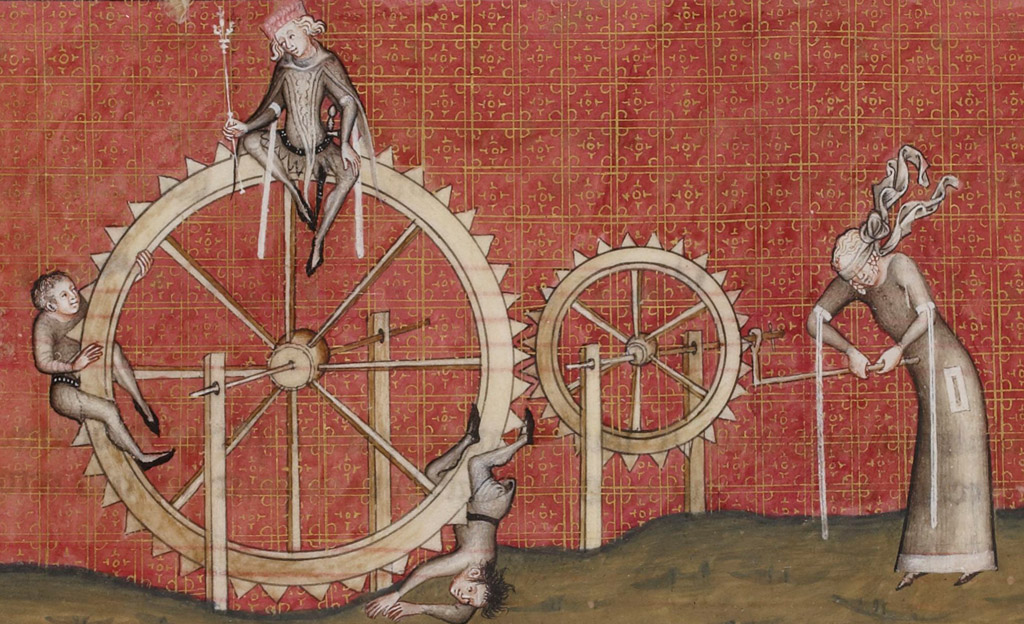
blindfolded woman turning wheels of justice and fortune

At his trial for crime against women, Machaut adduced the story of a lady, a knight, and a ring. The lady was married. The knight became her extra-marital lover. She apparently was concerned about his fidelity to her:

She gave him a ring that was
quite beautiful (it was neither cheap nor ugly),
on the condition he always wear it
and never remove it
from his finger unless she did.
And the knight, who was
hers completely, promised this in good faith,
and then the lady put it on his finger.

{ Si li donna .i. anelet
Trop gent (ne fu villein ne let),
Par si qu’adés le porteroit
Et que jamais ne l’osteroit
De son doy s’elle ne l’ostoit.
Et li chevaliers, qui estoit
Tous siens, bonnement li promist,
Et la dame en son doy le mist. }

About 1400 years earlier, Ovid in his Amores 2.15 had indelibly given a ring and a finger a sexual charge. In medieval Europe, keeping a man’s finger in a woman’s ring became known as a technique for a man to prevent a beloved woman from having sex with another man.[3]

One day the lady’s husband, apparently suspicious, asked for the ring. The lady was thus in a bind:

The lady said she had it,
but where, she didn’t really know.
So she made a show of going to look for it
and, opening a drawer,
like a cunning and smart woman
spoke this secret message to a servant:
“Go directly to my lover
and tell him I am in for a bad time
unless he sends my ring back.
And do not delay along the way,
for my lord wishes to have it
without hearing excuses.
Make clear he shouldn’t fail me.
For if he does, I am shamed
and in danger of losing my honor
and the favor of my lord.”

{ La dame dist qu’elle l’avoit,
Mais ou, pas bien ne le savoit.
Si fist samblant de l’aler querre
Et, en deffermant une serre,
Comme dame avisee et sage,
Dist a un sien privé message:
‘Va sans arrest a mon ami
Et se li di que mal pour my
Se mon anel ne me renvoie.
Et ne demeure pas seur voie,
Car mon signeur le vuet avoir
Sans nul essoinne recevoir.
Di li bien qu’il n’en faille mie.
Car s’il en faut, je sui honnie
Et en peril de perdre honneur
Et la grace de mon signeur.’ }

When he heard of his lady’s difficulty, the knight was heart-broken with fear for her. He had promised that only she could remove her ring from his finger:

So he said: “Friend, by the faith I owe her,
she will have my finger along with the ring,
for I will not remove it.”
So then he took out a knife,
cut off his finger, and sent it to her
along with the ring she had put there.

{ Si dist: ‘Amis, foy que li doy,
Avuec l’anel ara mon doy,
Car ja par moy n’en partira.’
Si que lors .i. coutel tira,
Son doi copa, et li tramist
Aveques l’anel qu’elle y mist. }

The knight’s brutal action alludes to castration culture. Men are praised for upholding castration culture, despite its great harm to them and to women. Perhaps ironically, Machaut declared:

Could anyone do anything more loyal
than this, or more loving?
Surely, not at all. Such is my view.

{ Puet on faire plus loiaument
Riens, ne plus amoureusement?
Certes, nennil! Ce m’est avis. }

Men suffer greatly through their love for women. That shouldn’t be celebrated. Men’s suffering must end.

Women tend to consider men’s suffering in terms of women’s interests. In response to the man cutting off his ringed finger, the allegorical woman Prudence declared:

He struck an unfortunate blow in truth.
For Guillaume, whatever anyone might say,
I consider his action greatly foolish
and intend to argue a little against it.
There were three or four
paths that should have sufficed,
but he chose the worst of all.
And furthermore I believe fully
that the woman who was his beloved,
if the love she felt had been faithful,
would have preferred the risky business
of her husband and his anger,
even if it meant the vow ought to have been
broken between those two right at that moment,
rather than depriving her lover of a finger
so he would always be disfigured,
less esteemed, and quite impaired.

{ Vraiement fait .i. lait cop a.
Car Guillaume, quoy que nuls die,
Je le tien a grant cornardie,
Si m’en pense po a debatre.
Car il y avoit .iij. ou .iiij.
Voies qui deüssent souffire,
Et il prist de toutes la pire.
Et d’autre part, je ne croy mie
Que celle qui estoit s’amie,
S’elle l’amoit d’amour seüre,
N’eüst trop plus chier l’aventure
De son mari et son courrous,
Et deüst estre entre’eaus .ij. rous
Li festus jusqu’a une piece,
Qu’oster de son ami tel piece,
Qu’a tous jours fu desfigurez,
Meins prisiés, et plus empirez. }

Prudence considered only the immediate facts of the matter. She didn’t consider why the man had so little regard for his own body in relation to his beloved woman. She ignored systemic devaluation of men’s bodies. To her, the issue turned on what the lady would have preferred.

With similar gynocentrism, the allegorical woman Moderation {Mesure} interpreted the harm as damage to the woman’s property. She opined:

And concerning the knight who in his anguish
so as not to violate his pledge
cut off his finger with the ring still on it:
he erected in her honor a monument
full of shame and madness
when in a fit of great craziness
he sent that to his lady.
For I certainly believe she found it troubling,
or at least it should have troubled her
to have sent her such a thing as a present.
For when a lady loves her lover,
by the law of Love she claims him as her own
and has the right to claim an injury, so I think.
Now let us consider how in regard
to this principle the knight erred.
The thing she loved he harmed,
what was hers by the law of Love.

{ Et dou chevalier qui par ire
Pour ce qu’il ne se volt desdire
Copa son doi a tout l’anel,
Il fist en s’onneur .i. crenel
De honte pleinne de sotie
Avec tres grant forcenerie
Quant a sa dame l’envoia.
Car bien croy qu’il li enuya;
Au mains li dut il ennuier
D’un si fait present envoier.
Car quant dame son amy aimme,
Dou droit d’Amours pour sien le claimme
Et puet clamer, ce m’est avis.
Or resgardons sus ce devis
Comment li chevaliers meffist:
Ce qu’elle amoit, il le deffist,
Q’estoit sien dou droit d’Amour }

Both women and men are much more concerned about women than men. The woman suffered harm to her property — her beloved man’s body. Men’s suffering counts for little relative to women’s suffering.

Guillaume’s trial before the King of Navarre illustrates the absurdity of gynocentric justice that imprisons about fifteen times more men than women worldwide. The charges against Guillaume originally arose from him not paying enough attention to the lady. Before bringing him to trial, she declared:

You have become, I think,
too wise or too backward,
inattentive and disagreeable,
eager for your sport,
or else you value ladies too little.
When I climbed the ground over there
on that highest rise,
I took the path on the right
and looked toward the left.
Quite clearly I saw you riding,
whistling up and calling your hounds.
I heard you doing this
and likewise saw
you and your goings-on.
So I believe quite surely,
Guillaume, you must have seen us.
And why, then, when hearing
our horses pass by and whinny,
did you not deign to come forward
until I gave you the order,
just as if I had made it a command?

{ Je croy que vous estes trop sages
Devenuz, ou trop alentis,
Mausoingneus, et mautalentis,
De vos deduis apetisiez,
Ou trop po les dames prisiez.
Quant je fu la dessus montee
En celle plus haute montee
Mon chemin tenoie sus destre,
Et je regardai vers senestre,
Tout de plain vous vi chevauchier,
Vos levriers siffler et huchier.
Tels ouevres faire vous ooie
Tout aussi bien com je veoie
Vous et vostre contenement.
Dont je croy bien certeinnement,
Guillaume, que vous nous veïtes.
Et pour quoy dont, quant vous oïtes
Nos chevaus passer et hennir,
Et se ne daigniés venir,
Jusqu’a tant que je vous manday
Einsi com je le commanday? }

Men don’t owe attention to ladies. Men should value their own bodies and their own interests more relative to serving women. Guillaume, engaged in the sport of hunting, should have ignored the lady’s order to come forward, even if she issued it as a command.[4] Men shouldn’t accept being treated as women’s dogs.

Some plagues come, cause readily apparent mass suffering and death, and then end. The plague of men’s subservience to women has historically been expressed in false forms of love.[5] Love in which men don’t dare to trouble women or dispute with them is a plague causing massive, hidden harm. This plague won’t end until men stop writing false poems to please women. Men must start writing true poetry of love for women and men.

*  *  *  *  *

Read more:

Notes:

[1] Guillaume de Machaut, The Judgement of the King of Navarre {Le Jugement dou Roy de Navarre} vv. 829-38, Old French text and English translation (modified slightly) from Palmer et al. (2016). The previous short quote is id., v. 811 (you have committed crime against women).

Subsequent quotes from Le Jugement dou Roy de Navarre are similarly sourced. The quotes above are from vv. 1027-8 (And how did you dare say this…), 2853-60 (She gave him a ring…), 2868-84 (The lady said she had it…), 2893-8 (So he said…), 2899-901 (Could anyone do anything more loyal…), 2992-3008 (He struck an unfortunate blow…), 3679-95 (And concerning the knight…), 764-84 (You have become…).

[2] Machaut concluded that the betrayed man suffered more in his poem The Judgement of the King of Bohemia {Le Jugement dou Roy de Behaingne}. Modern authorities lack sympathy for Machaut’s action:

Headstrong and self-righteous, Guillaume refuses to apologize and retract what he maintains in the earlier work because he believes he has spoken the truth.

Palmer & Plumley, “Introduction” to Palmer et al. (2016). If women claim that they are offended, prudent practice today is to apologize profusely without any regard for the truth. On the development of such judgments after Machaut’s work, Palmer & Kimmelman (2017).

In Le Jugement dou Roy de Navarre, Guillaume attempted to engage in vigorous public debate oriented toward the truth:

But I believe I speak the truth,
however much you would like to dispute it.
So I am quite badly treated here
if for speaking the truth I am beaten down.

{ Mais je cuide verité dire,
Comment que m’en vueilliez desdire;
Si me sui ci mal embatus
Se pour voir dire sui batus. }

Machaut, Le Jugement dou Roy de Navarre, vv. 3125-8. Speaking the truth, as one understands the truth, is more risky today than in relatively tolerant medieval Europe.

Modern scholars have judged Machaut, a leading medieval exponent of men-abasing courtly love, to be guilty of misogyny because of what he wrote in Le Jugement dou Roy de Navarre. Calin (1971) p. 295; Huot (2002) pp. 184, 195. Modern scholars have also judged Machaut guilty of anti-feminism:

Navarre offers a lively, occasionally raucous debate that raises the issue of anti-feminism. … {Guillaume} actually winds up mouthing unquestionably anti-feminist sentiments that clinch the case for the opposition.

Palmer & Plumley, “Introduction” to Palmer et al. (2016). Cf. Le Jugement dou Roy de Navarre vv. 3009–70 and Virgil’s influential account of Dido and Aeneas, particularly the advice of Jove’s messenger to Aeneas in Carthage.

If modern scholars engaged in literary criticism with a true commitment to gender equality, they would also find the allegorical woman Frankness {Franchise} guilty of misandry and anti-meninism. She declared:

It has been seen generally
and always with respect to true loving
that women have conducted themselves better
and have remained more faithful in it
than men everywhere.

And so, Guillaume, that is the gist.
Loyalty as great as that of women
cannot be found in any man,
nor would men ever be as deeply
inflamed by the spark of love
as a worthy lady would.

{ On a veu generaument
Toudis en amer loiaument
Que les dames se sont portees
Miex et plus loiaument gardees
Que les hommes en tous endrois.

Si que, Guillaume, c’est la somme:
On ne porroit trouver en homme
Si grant loyauté comme en femme,
Ne jamais d’amoureuse flame
Ne seroient si fort espris
Comme seroit dame de pris. }

Machaut, Le Jugement dou Roy de Navarre, vv. 2699-703, 2809-14. On the other hand, literary scholars’ practice of name-calling has contributed nothing to addressing fundamental gender injustices. That practice has also impeded humanistic appreciation of brilliant medieval literature.

[3] This technique, well known in many languages by the end of the European Middle Ages, is commonly known in English as “The Ring of Hans Carvel.” Men’s concern for women’s sexual fidelity has deep roots in fundamental gender inequality in parental knowledge. Modern DNA testing could eliminate this fundamental gender inequality, but societies has tended to suppress efforts of men to acquire true paternity knowledge and thus to achieve gender equality in this fundamental matter.

[4] Le Jugement dou Roy de Navarre echoes themes of the Biblical book of Ecclesiastes. Ehrhart (1980). But Guillaume isn’t immoderate for being engrossed in hunting rabbits rather than paying attention to a lady. Cf. id. pp. 324-5. He’s immoderate in his gender-abasing subservience to women. Men’s subservience in love to women doesn’t promote enduring happiness for men or women.

[5] Huot associated both Boethius’s Consolation of Philosophy and Machaut’s poetry with privileged realization of the self through poetry:

The mad theatricality of the Muses that is condemned so strikingly by Philosophy is thus associated with an imprisonment in the body, a confusion of the body with the self, whereby the miserable victim of Desire can only act out, through bodily symptoms, the condition of impotence and loss. Machaut, in a similar vein, posits in the Jugement de Navarre an opposition between (feminine) bodily death and (masculine) symbolic death as responses to pain; he then implicitly equates these forms of behavior, both of which are still ultimately grounded in desire and expressed through the body, and contrasts them with the truly salvific symbolization of the self through poetic language.

Huot (2002) p. 193. Huot’s reading of Boethius, though conventional, seems to me wrong. Boethius’s Consolation is best understood as representing false loves for both theatrical whores and public reason. Boethius’s true love is Lady Philosophy, unmasked as his wife.

[image] Blindfolded woman turning wheel of justice and fortune. Illumination in Guillaume de Machaut’s The Remedy for Fortune {Le remède de fortune}. Created between 1350 and 1355. On folio 30v in Guillaume de Machaut, Poésies: Bibliothèque nationale de France, Département des Manuscrits, Français 1586.

References:

Calin, William. 1971. “A Reading of Machaut’s Jugement dou Roy de Navarre.” The Modern Language Review. 66 (2): 294-297.

Ehrhart, Margaret J. 1980. “Machaut’s Jugement dou Roy de Navarre and the book of Ecclesiastes.” Neuphilologische Mitteilungen. 81 (3): 318-325.

Huot, Sylvia. 2002. “Guillaume de Machaut and the Consolation of Poetry.” Modern Philology. 100 (2): 169-195.

Palmer, R. Barton, Yolanda Plumley, Domenic Leo, and Uri Smilansky, ed. and trans. 2016. Guillaume de Machaut, the Complete Poetry and Music. Volume 1, The Debate Poems: Le Jugement dou Roy de Behaigne, Le Jugement dou Roy de Navarre, Le Lay de Plour. Kalamazoo, MI: Published for TEAMS (Teaching Association for Medieval Studies) in association with the University of Rochester by Medieval Institute Publications.

Palmer, R. Barton, and Burt Kimmelman, eds. 2017. Machaut’s Legacy: the judgment poetry tradition in the later middle ages and beyond. Gainesville, FL: University Press of Florida.