gendered love-quests contradict classical symmetry of Aristaenetus

If a man desires a woman’s love, he has long been required to seek it and win it. This love-quest pattern has been elaborated in countless romances from medieval times to our more repressive age. Classical literature, including the scarcely known epistles of the poet Aristaenetus, depict in contrast gender symmetry in soliciting amorous relationships. While such symmetry isn’t sufficient to establish gender welfare equality in love, classics indicate the possibility for amorous relations that better respect men and women’s equal human dignity.

Marie de France’s Old French lay Two Lovers {Deus Amanz} narrates a regrettably common pattern for love-quests. A king had a beautiful, courteous daughter. He declared that anyone seeking to marry her must, without resting, carry her in his arms from the bottom to the top of a lofty mountain just outside their city. Many men attempted this feat of strength. None succeeded. Despite some pushing themselves severely, none got more than half-way up.

Eros on ancient Greek bobbin

A handsome young man, the son of a count, loved the king’s daughter, and she loved him. They carried on their love affair secretly. Implicitly thinking that he couldn’t carry her to the top of the mountain, he begged her to run away with him. She decisively rejected his proposal with a painfully frank appraisal of the situation:

“Beloved,” she says, “I know well
you couldn’t carry me by any means.
You aren’t so strong.
If I go away with you,
my father would be sad and angry —
he wouldn’t live without torment.
Truly, I love him very much and he’s so dear to me,
I wouldn’t wish for him to grow angry.
You must follow another plan,
for I don’t want to hear about this one.”

{ “Amis”, fait ele, “jeo sai bien,
ne me porteriez pur rien:
n’estes mie si vertuus.
Si jo m’en vois ensemble od vus,
mis pere avreit e doel e ire,
ne vivreit mie sanz martire.
Certes, tant l’eim e si l’ai chier,
jeo nel vodreie curucier.
Altre cunseil vus estuet prendre,
kar cest ne voil jeo pas entendre.” }[1]

No man enjoys hearing his beloved woman tell him that he lacks sufficient strength. Yet most men understand that when a woman forcefully says no to his proposal, no means no.

The woman urged upon her beloved another course. She had a rich, elderly aunt who had long practiced medicine in Salerno, a southern Italian city known for its leading medical knowledge. She instructed her beloved to make the long journey to this woman doctor and seek a medical potion to give him sufficient strength to carry her to the top of the mountain. The young man didn’t reject her proposal. He didn’t question her proposal. He simply did what she instructed him to do, despite its extreme and unrealistic nature. Carrying letters of reference and the written request from her, he traveled to her doctor-aunt in Salerno. There he received from her a bottle of strength potion specially formulated for him.

The king along with a large crowd came to watch the young man attempt to carry the young woman to the top of the mountain. She took action to help her beloved:

The young woman prepared herself:
much she deprived herself and much fasted
at her meals so as to grow lighter,
because she wished to marry her beloved.

{ La dameisele s’aturna;
mult se destreint e mut jeüna
a sun manger pur alegier,
que od sun ami voleit aler. }

On the testing day, she wore nothing but a light undergarment. He gave her the bottle of strength potion to hold for him. Then he picked her up and climbed swiftly up the mountain to midway.

Joyfully carrying his nearly naked woman in his arms and believing that he would be able to marry her, the young man forgot about his strength potion. He continued on his arduous task. She felt him growing weaker:

“Beloved,” she said, “now drink!
I know well that you are tiring,
so recover your strength!”

{ “Amis,” fet ele, “kar bevez!
Jeo sai bien que vus alassez.
Si recuvrez vostre vertu!” }

Usually men don’t need to be encouraged to drink, yet men typically are reluctant to acknowledge weakness. This man thus responded:

Beautiful one, I feel my heart fully strong.
I would not for anything stop
long enough that I could drink,
for that I could go three steps further.
These people would cry out to us —
from their noise I would be disturbed,
and soon I would be upset.
I don’t want to stop here.

{ Bele, jo sent tut fort mun quer:
Ne m’arestereie a nul fuer
si lungement que jeo beusse,
pur quei treis pas aler peusse.
Ceste genz nus escriereient,
de lur noise m’esturdireient;
tost me purreient desturber.
Jo ne vueil pas ci arester. }[2]

Two-thirds of the way up the mountain, the man carrying the woman could barely keep from collapsing. She urged him, “Beloved, drink your medicine {Amis, bevez vostre mescine}!” He didn’t want the help of any stinking medicine. With his own natural strength he sought to carry the woman he loved to the top of the mountain.

With an enormous, painful effort, the young man protruded to the summit. Then he fell to the ground and died. She lay down beside him. She embraced him and kissed his eyes and mouth. Then her heart gave out. She too died on the mountaintop.

Requiring men to compete for a woman’s love sometimes creates even more suffering. In Marie de France’s Old French lay The Wretched One, or Four Sorrows {Le Chaitivel, ou Quatre Dols}, four beautiful, young, bold, valiant, courteous, and free-spending knights loved one very lovely lady. She is explicitly described as learned, while they are implicitly represented as ignorant. The lady couldn’t decide which to love. So she strung along all four. She exchanged texts with each, each she encouraged, and to each she gave love-tokens.

When time came for a major knightly tournament, the four knights in love with the lady sought to demonstrate their prowess. With their beloved lady watching and judging them, the four engaged in brutal violence against men:

Before the gate many times
that day the battle was joined.
Her four lovers were doing well,
so that they were most praised of all,
until night began to fall
when they were supposed to withdraw.
Very foolishly they put themselves in jeopardy
far from their men, and they paid for that.
Three of them were killed,
and the fourth wounded and injured
through the thigh and into his trunk
so that the lance protruded outside.

{ Devant la porte meintefeiz
fu le jur mellé li turneiz.
Si quatre dru bien le feseient,
si ke de tuz le pris aveient,
tant ke ceo vient a l’avesprer
qu’il deveient desevrer.
Trop folement s’abaundonerent
luinz de lur gent, sil cumparerent;
kar li treis furent ocis
e li quart nafrez e malmis
parmi la quisse e enz al cors
si que la lance parut defors. }[3]

Thigh here might be a euphemism for penis. Even if it isn’t, the lance apparently traversed the man’s genitals.

The lady was utterly distraught. To memorialize her suffering, she proposed to write a lay entitled Four Sorrows {Quatre Dols}. But her surviving lover told her to call her lay The Wretched One {Le Chaitivel}. He explained:

The others are long dead,
and all the time were accustomed
to the great pain that they suffered
from love they had for you.
But I who have escaped alive,
all lost and all wretched —
her whom most of all in the world I love
I see often coming and going,
speaking with me in the morning and evening.
I cannot have any joy in it,
neither kisses nor embraces
nor any other good beyond talking.
Such a hundred ills you make me suffer.
I would be better off if I were dead.

{ Li autre sunt pieça finé,
e tut le secle unt usé,
la grant peine k’il en suffreient
de l’amur qu’il vers vus aveient;
mes jo ki sui eschapé vif,
tut esgaré e tut cheitif,
ceo que al secle puis plus amer
vei sovent venir e aler,
parler od mei matin e seir
si n’en puis nule joie aveir
ne de baisier ne d’acoler
ne d’autre bien fors de parler.
Teus cent maus me fetes suffrir,
meuz me vaudreit la mort tenir. }

Because men’s lives matter, men are never better off dead. Yet in reality, impotent men in love might suffer more than if they were fully dead. Violence against men, especially violence against men genitals, must end.[4] For violence against men to end, men must be freed from gender-distinctive love-quests.

three graces fresco buried in ancient Pompeii

Although the horrible classic epic tradition emphasizes violence against men and men’s needless suffering, classics also offer a more beautiful and true vision of realizing human dignity. Classical Greek romance and classical New Comedy depict gender symmetry in amorous relations. In Greek romance and New Comedy, women don’t have categorically superior sexual value relative to men. Men don’t have a gender-distinctive burden of proving themselves worthy of a woman’s love. Love-quests aren’t gender-structured so as to put men’s lives at heightened risk.[5]

This inspiring classical vision of gender symmetry doesn’t seem to be a selection artifact among on the small number of Greek romances and New Comedy plays that have survived. The large, explicitly delimited epistle collection of Aristaenetus, which he apparently wrote in decades about the year 500 GC, also shows gender symmetry in soliciting amorous relations. Among relevant letters of Aristaenetus, thirteen depict prevailing female sexual initiative, six reciprocal effort, and thirteen prevailing male sexual initiative.[6]

One of Aristaenetus’s letters poignantly indicates difficulties in supporting gender symmetry in soliciting amorous relationships. The terrible violence against men of the Trojan War originated in Paris’s sensible choice of Venus as a more beautiful goddess than either Juno or Athena. That beauty competition emphasized superiority in relation to men’s sexual desire. Aristaenetus recorded his much different, more realistic experience:

Yesterday evening, as I was singing in an alleyway, two young women came up to me. They had the grace of Eros in their looks and smiles. They were inferior to the Graces only in being two rather than three. Openly competing with each other and totally frank, the young women asked me, “Singing your beautiful songs, you have struck us with the frightful arrows of the Erotes by the sweetness of your music. Since you have filled not only the ears of us both but also our hearts, inspiring them with passion, tell us — to which one of us do you sing your love song? Each of us thinks she is the one you love. We are already jealous of one another. Because of you, we are often at each other’s throat and hair in ardent rivalry.”

{ Ἑσπέρᾳ τῇ προτεραίᾳ μελῳδοῦντί μοι κατά τινα στενωπὸν δύο κόραι προσῆλθον ἀναβλέπουσαι χάριν Ἔρωτος μειδιῶσαι καὶ μόνῳ γε τῷ ἀριθμῷ λειπόμεναι τῶν Χαρίτων. κάμὲ διηρώτων αἱ μείρακες ἁμιλλώμεναι πρὸς ἀλλήλας ἀδόλως καὶ ἦθος οὐ πεπλασμένον ἐμφαίνουσαι. “ἐπειδὴ μέλη προσᾴδων καλὰ τὰ δεινὰ τῶν Έρώτων ἡμῖν ἐμβέβληκας βέλη, λέγε προς τῆς σῆς εὐμουσίας, ἧς ἐρωτικῶς πρὸς τοῖς ὠσὶ καὶ τὴν ψυχὴν ἐμπέπληκας ἑκατέρας ἀμφοτέρων ἡμῶν, τίνος ἕνεκε μελῳδεῖς; ἑκατέρα γὰρ ἑαυτὴν ἐρᾶσθαί φησι. καὶ ζηλοτυποῦμεν ἤδη καὶ διὰ σὲ φιλονείκως καὶ μέχρι τριχῶν συμπλεκόμεθα πολλάκις ἀλλήλαις.” }[7]

Because persons’ safety is the highest priority, men should exercise caution in singing love songs in alleyways. In this dangerous situation, Aristaenetus prudently sought to quell the risk of further violence:

“You are,” I answered, “both equally beautiful. But I desire neither of you. So go away, young women, stop quarreling and put an end to your strife. I love someone else, and I am going to her.”

{ “ἀμφότεραι μὲν ὁμοίως,” εἶπον, “καλαί, πλὴν οὐδετέραν ποθῶ. ἄπιτε οὖν, ὦ νεάνιδες, ἀπόθεσθε τὴν ἕριν, παύσασθε ζυγομαχίας. ἄλλης ἐρῶ, πρὸς αὐτὴν βαδιοῦμαι.” }

For a man, “equally beautiful” is a prudent answer like “no, you don’t look fat.”

While Aristaenetus indicated that he wouldn’t welcome further communication with them, these young women persisted. They taunted him:

“There is,” they reply, “no beautiful girl in the neighborhood, and you claim to love another? That is clearly a lie. Swear that you desire neither one of us!”

{ “κόρη,” φασίν, “ἐκ γειτόνων οὐκ ἔστιν ἐνταῦθα καλή, καὶ φὴς ἄλλης ἐρᾶν; ψεύδη προφανῶς, ὄμoσον ὡς ἡμῶν οὐδετέραν ποθεῖς.” }

Women shouldn’t feel entitled to demand oaths from men. Nonetheless, Aristaenetus didn’t report this incident to the governing authorities, who in any case are relatively unconcerned about women’s offenses. He took with good humor what the women said:

That made me laugh, and I exclaimed: “If I don’t want to, what will you do, force me to swear?” They responded, “It was hard for us to find the right moment and to grab the chance to come down to you. You just stand here making fun of us. No, we won’t let you go and deprive us of our fondest hope.” Speaking thus, they pulled me toward them, and somehow sweetly I was forced to comply.

{ προσεγέλασα τηνικαῦτα βοῶν ὡς “εἰ μὴ θέλω, πρὸς ἀνάγκης ἐπάγετέ μοι τὸν ὅρκον;” “μόλις,” ἔφησαν, “κατέβημεν καιρὸν εὔκαιρον ευρoῦσαι λαβοῦσαι, καὶ παρίστασαι διαπαίζων ἡμᾶς. οὐκ ἀφετέος εἶ, οὐδὲ καταβαλεῖς ἡμᾶς ἀπ’ ἐλπίδος μεγάλης.” καὶ ἅμα λέγουσαι προσεῖλκον, ἐγὼ δέ πως ἡδέως ἠναγκαζόμην. }

In short, the two women raped Aristaenetus, who was forced to have sex with both of them.[8] While seldom acknowledged under the systemic injustice of penal systems that vastly disproportionately incarcerate men, women rape men about as frequently as men rape women. Aristaenetus realistically depicted gender symmetry in sexual criminality.

Raphael, Three Graces

Classical literature depicting gender symmetry in soliciting amorous relationships challenges mendacity in addressing women’s sexual crimes. Imaginative literature helps to convey real-life human complexity across millennia. Authoritative assertions of ridiculous truth-claims and patently absurd representations about gender equality endure only along with literary obtuseness. Recognizing possibilities beyond gendered love-quests is a step toward overcoming literary obtuseness. Don’t remain stuck with simple, stupid stories.

*  *  *  *  *

Read more:

Notes:

[1] Marie de France, Two Lovers {Deus Amanz} vv. 85-94, Old French text and English translation (modified) from Waters (2018). Waters’s Old French text is from the thirteenth-century manuscript London, British Library, Harley MS 978. That’s the only surviving manuscript containing all twelve lays {lais} traditionally attributed to Marie de France. English translations of Deus Amanz are freely available online through the generosity of translators A. S. Kline and Jane Tozer.

Subsequent quotes from Deus Amanz are similarly sourced. They are vv. 163-6 (The young woman prepared herself…), 185-7 (“Beloved,” she said…), 189-96 (Beautiful one, I feel my heart fully strong…), 200 (Beloved, drink your medicine).

[2] The young man delighted in carrying his beloved, nearly naked young woman up the mountain:

From the joy he had in her,
he did not remember about his drink.

{ Pur la joie qu’il ot de li
de sun beivre ne li membra. }

Deus Amanz, vv. 182-3. Rothschild observed:

This is the first and only instance in our lay of the term joie; cf. the Provençal use of joie, which is practically always synonymous with “love,” with, mainly, sensuous connotations.

There surely must be an erotic context to the use of joie in Les Deus Amanz, for the boy is holding his sweetheart in his arms. Note, too, that she has nothing on but her chemise (cf. 173), although we are not reminded of that detail in line 182. The awaking of the boy in sensuous love is very delicately presented in 182-3.

Rothschild (1974) p. 158, n. 71. With admirable sense of men’s sexuality vitality, Rothschild commented on the man’s address to his beloved while he was carrying her (vv. 189-96): “surely he is erotically excited. This is probably the longest time he has ever held her in his arms.” Id. p. 160. Being erotically excited is physically draining for men. That physiological reality contrasts with the man’s astonishing physical feat.

[3] Marie de France, The Wretched One, or Four Sorrows {Le Chaitivel, ou Quatre Dols} vv. 113-24, Old French text and English translation (modified) from Waters (2018). The subsequent quote above is similarly from Chaitivel vv. 211-24. This freely available, online Old French text of Chaitivel is close to Waters’s Harley MS 978, while this one has many small differences. English translations of Chaitivel are freely available online from A. S. Kline and from Judy Shoaf.

The beloved lady of Chaitivel is explicitly described as learned:

In Brittany at Nantes there lived
a lady who was of great worth
in beauty and learning
and in every good behavior.

{ En Bretaine a Nantes maneit
une dame que mut valeit
de beauté e d’enseignement
e de tut bon affeitement. }

Chaitivel vv. 9-12, sourced as above. None of the four knights are described as learned.

The name of the lay {lai} itself indicates that the one knight who survived the battle (the wretched one) suffered castration from it:

Since the lai’s name is the noun “Chaitivel” (“the miserable one” or “the prisoner” — but close to châtré, “castrated”) which the castrated suitor applies both to it and to himself, there is a painful ambiguity.

Shoaf (1996) p. 1, n. 1.

The early fifteenth-century Middle English romance The Tournament of Tottenham burlesques men fighting to win the favor of a prized woman. In this romance, rustics armed with farm implements brawl to win the love of a town official’s beautiful daughter Tyb. Dressed in borrowed finery, she sat on a grey mare with a hen in her lap to watch the men fight:

When jolly Gyb saw her there,
he spurred so his gray mare
that she did a fart send
from her rear-end.

{ When joly Gyb saw hur thare,
He gyrd so hys gray mere
That sche lete a faucon fare
At the rereward. }

The Tournament of Tottenham vv. 87-90, Middle English text from Kooper (2006), my modernization.

[4] Like most scholars, Shoaf shows no concern for violence against men or castration culture:

In Chaitivel, lovers risk death for their beloved, and in fact their risk seems to be what gives her pleasure; but the survivor cannot enjoy any special benefits, and is merely frustrated by verbal attention from the beloved, and by seeing her every day. In Laustic, the lover is symbolically castrated by his beloved’s husband, who kills the lover’s bird surrogate; in Chaitivel, the lover is actually castrated, and his fellow lovers die, during the heroics enforced by his darling.

Shoaf (1996) p. 2, n. 2.

[5] On gender symmetry in ancient Greek romance and New Comedy, Konstan (1994).

[6] Hajdarević (2018) pp. 9-14. Aristaenetus was deeply engaged with his literary predecessors. Höschele (2012). He might have found gender symmetry in soliciting amorous relationships within a much broader corpus of ancient Greek romance and New Comedy than has survived to the present, i.e. those reviewed in Konstan (1994).

Within broad gender symmetry in soliciting amorous relationships, sex differences in behavior remain in Aristaenetus’s Letters:

Men are more open and verbally more direct but also pretty unsuccessful; they are refused bluntly in I.7, II.2, II.17 and II.20. On the other hand, women are more prone to games and hoaxes; they test men’s affection by rousing jealousy (I.22), they provoke (I.27) and withhold sexual contacts in order to keep the men interested (I.21 and II.20). A difficult character and behavioural inconsistencies (sometimes deliberate) mostly additionally rouse men’s interest (an exception: an unsatisfied husband in II.12). Unlike men, women often get what they desire or we have a feeling their goal can be reached because of their elaborate and ingenious plan.

Id. p. 20.

[7] Aristaenetus, Erotic Letters 1.2, ancient Greek text and English translation (modified slightly for ease of reading) from Bing & Höschele (2014). Subsequent quotes above are sourced similarly and are serially from Letters 1.2. Prior to the twentieth century, Aristaenetus was relatively well-known through Halhed & Sheridan (1771) and subsequent reprintings, as well as in translations into languages other than English. The highly privileged American woman Isabella Stewart Gardner, born in 1840, held in her library Aristaenetus’s letters in French translation in a reprinting of Foucault (1597).

Aristaenetus’s collection of fifty love letters survives only in the manuscript Vindobonensis philologicus graecus 310, written in the twelfth or thirteenth century. An ancient Greek text of Aristaenetus, with Latin translation, is freely available online in Hercher & Boissonade (1873) pp. 132-171. For an earlier English translation of Aristaenetus’s Book 1 (of 2), Halhed & Sheridan (1771), available in Kelly, Sheridan, and Halhed (1854). The most recent complete translation into English prior to Bing & Höschele (2014) was Anonymous (1715).

[8] Aristaenetus Letters 1.2 concludes (cf. Ovid, Amores 1.5.25: “who wouldn’t know what followed {cetera quis nescit}?”):

So far my story is appropriate for anyone’s ear — but what follows, let me just sum it up and say that I found a rough-and-ready chamber fitting the need and did not disappoint either one.

{ μέχρι μὲν οὖν δεῦρο τοῦ λόγου καλῶς ἂν ἔχοι καὶ πρὸς ὁντιναοῦν, τὸ δὲ ἐντεῦθεν ἐν κεφαλαίῳ τοσοῦτον λεκτέον, ὡς οὐδεμίαν λελύπηκα, θάλαμον αὐτοσχέδιον εὑρὼν ἀρκοῦντα τῇ χρείᾳ. }

Aristaenetus shows a man who, even when gang-raped, takes pride in having pleased women. That’s oppressively internalized gynocentrism.

The verse translation of Halhed & Sheridan (1771) deplorably constructed the rape victim as directly taking pleasure in being raped:

Thus spoken, to keep me between ’em they tried;
’Twas a pleasing constraint, and I gladly complied.
If I struggled, ’twas to make ’em imprison me more,
And strove — but for shackles more tight than before;
But think not I’ll tell how the minutes were spent;
You may think what you please — but they both were content.

Via Kelly, Sheridan, and Halhed (1854) p. 440. While men typically enjoy women who are warmly receptive and actively engaged in sexual intercourse with them, men don’t usually like women sexually forcing them. In any case, the latter is a crime.

Hajdarević observed, “I.2 seems like an act of sexual violence.” But she noted: “It is not the case of an actual rape; terminology of violence was chosen to produce a comical effect.” Hajdarević (2018) p. 16. That’s not how literary scholars in recent decades have typically described literary representations of men raping women, or men not actually raping women.

[images] (1) Eros on Attic red-figure bobbin. Painted c. 470-450 BGC by Painter of London D 12. Preserved as accession # CA 1798 in the Louvre Museum (Paris, France). Source image thanks to Jastrow / Marie-Lan Nguyen and Wikimedia Commons. (2) Fresco of the three Graces. House of Titus Dentatius Panthera, south wall, tablinum of IX.2.16. Buried in Pompeii in the eruption of Mount Vesuvius in 79 GC. Preserved as inventory # 9236 in the Naples National Archaeological Museum. Via Wikimedia Commons. (3) The three Graces. Oil on panel painting that Raphael painted between 1504 and 1505. Preserved in the Condé Museum (Chantilly, France). Via Wikimedia Commons.

References:

Anonymous. 1715. Letters of love and gallantry: Written in Greek by Aristaenetus. London: printed for Bernard Lintot.

Bing, Peter, and Regina Höschele, ed. and trans. 2014. Aristaenetus. Erotic Letters. Atlanta, GA: Society of Biblical Literature. (introduction) (review by Anna Tiziana Drago)

Foucault, Cyre, trans. 1597. Aristaenetus. Les Epistres amoureuses d’Aristenet, tournees de grec en françois. Par Cyre Foucault, Sieur de la Coudriere. Avec l’image du vray amant, discours tiré de Platon. R. du Petit Val: Rouen. (1876 Isidore Liseux edition, Paris)

Hajdarević, Sabira. 2018. “Sexual Initiative in Aristaenetus’ Erotic Letters.” Systasis 32: 1-24.

Halhed, Nathaniel Brassey, and Richard Brinsley Sheridan. 1771. The Love Epistles of Aristænetus: translated from the Greek into English metre. London: J. Wilkie.

Hercher, Rudolf, and Jean François Boissonade, eds. 1873. Epistolográphoi ellēnikoí = Epistolographi Graeci. Parisiis: Editore Ambrosio Firmin-Didot.

Höschele, Regina. 2012. “From Hellas with Love: The Aesthetics of Imitation in Aristaenetus’s Epistles.” Transactions of the American Philological Association. 142 (1): 157-186.

Kelly, Walter Keating, Richard Brinsley Sheridan, Nathaniel Brassey Halhed, trans. 1854. Erotica. The elegies of Propertius, the Satyricon of Petronius and the Kisses of Johannes Secundus. Literally translated and accompanied by poetical versions from various sources. To which are added, the love epistles of Aristaenetus. London: H.G. Bohn. (alternate online presentations)

Konstan, David. 1994. Sexual Symmetry: love in the ancient novel and related genres. Princeton, N.J.: Princeton University Press.

Kooper, Erik. 2006. Sentimental and Humorous Romances: Floris and Blancheflour, Sir Degrevant, The Squire of Low Degree, The Tournament of Tottenham, and the Feast of Tottenham. Kalamazoo, Mich: Medieval Institute Publications.

Rothschild, Judith Rice. 1974. Narrative Technique in the Lais of Marie de France: themes and variations. Chapel Hill, NC: University of North Carolina Department of Romance Languages.

Shoaf, Judith P. 1996. “Chaitivel: Marie de France, translated.” Online.

Waters, Claire M. 2018. The Lais of Marie de France: Text and Translation. Peterborough, Ontario: Broadview Press.

Ovid as walnut tree: men’s despair supports castration culture

Men today are attacked for having testicles — nuts containing “toxic masculinity.” Appreciation for men’s seminal fruitfulness can help to raise men’s status. Nonetheless, more than two millennia ago, the poetically fruitful Ovid, like a walnut tree, was subject to violent attacks aimed at his fruits. In despair as a man, Ovid yearned to be castrated and made unproductive. Just so many men feel today.

Medieval Latin literature acknowledged the importance of men’s sexuality. A mid-thirteenth-century poem On the Old Woman {De vetula} declared that the “vigor of the loving part {vires partis amicae}” provides vital means:

through which the god-like species is preserved despite being
composed of mortal individuals. This particular organ is given so,
not returning love into himself, despite seeing himself reflected in other men,
a man continues the forward movement of procreation.
This particular organ makes the female receiver fruitful. In a fixed time
she by her own means brings forth children as her sweetest offering,
which to humanity is more pleasing than anything else.

{ per quam salvatur species divina, licet sit
ex individuis mortalibus. Ipsa dat, unde
non in se rediens, licet in se visa reflecti,
sed processive generatio continuetur.
Ipsa receptricem fecundat tempore certo
sponte refusuram dulcissima pignora natos,
quo nihil est homini coniunctus. }[1]

Women and men in conjugal partnership can create and nurture children. But just as historically the penis has been disparaged relative to the vagina, men have been socially constructed as persons who have to prove themselves worthy of being regarded as virtuous. Under gynocentrism, men’s worth fundamentally depends on how well they serve women. Men’s service to women has even developed to the extent of sexual feudalism.

Women’s appreciation for men’s sexuality helps to lessen men’s subservience to women. The author of De vetula, writing for his fellow men, declared:

This particular organ serves the woman
such that the proud partner of his bed gladly and willingly
puts herself under her man’s direction — an amazing submission,
since we are women’s servants!

{ Ipsa ministrat
unde superba tori consors se grata libensque
supponat maris imperio — subiectio mira,
nam famulamur eis! }[2]

The ancient prophet Tiresias recognized that women get more pleasure from sex with men than men do from sex with women. Back in the days when women were grateful for men’s sexual labor, women were less imperious toward men who sexually served them and were more willing to accept men’s direction in their shared endeavors.

hunted beaver castrating itself

Instead of appreciating men’s sexuality, women now throw rocks at men. Men’s seminal blessing is now regarded as a curse:

Now fruit doesn’t continually grow every year,
and damaged grapes and bruised berries come into the home.
Now women who want to seem beautiful harm their wombs.
Rarely in this age does anyone wish to be a parent.

If the vine should know this, it will suppress birthing grapes.
The olive tree, if it should know this, will be barren.
Should this come to notice of apple and pear,
both will deprive their orchards of fruit.
Should the cherry hear this, it will forbid sprouting buds.
Should the fig hear this, its branch will be empty.

{ Nunc neque continuous nascuntur poma per annos,
uvaque laesa domum laesaque baca venit;
nunc uterum vitiat quae vult formosa videri,
raraque in hoc aevo est quae velit esse parens.

Si sciat hoc vitis, nascentes supprimer uvas,
orbaque, si sciat hoc, Palladis arbor erit.
Hoc in notitiam veniat maloque piroque,
destituent silvas utraque poma suas.
Audiat hoc cerasus, bacas exire vetabit:
audiat hoc ficus, stipes inanis erit. }[3]

In such circumstances, walnut trees, other fruiting trees, and many men in despair yearn for the benefits of castration:

O, when I have grown weary with my long life,
how often have I wished to dry up and die!
How often have I wished to be uprooted by a blind whirlwind,
or struck by the powerful fire of a hurled thunderbolt!
Indeed, I wish that a sudden gale would snatch away my fruit,
or I myself could shake off my nuts!
Just as once you have cut off the cause of your peril,
you keep safe, Pontic beaver, what remains.

{ O, ego, cum longae venerunt taedia vitae,
optavi quotiens arida facta mori!
Optavi quotiens aut caeco turbine verti
aut valido missi fulminis igne peti!
Atque utiname subitae raperent mea poma procellae,
vel possem fructus excutere isa meos!
Sic, ubi detracta est a te tibi causa pericli,
quod superest, tutum, Pontice castor, habes. }

Hunters sought to kill the Pontic beaver so as to extract his testicles. That beaver was thought to chew off his own testicles to ensure his safety.[4] In this poem, the wish to dry up and for the wind to overturn the firm, erect wood of the walnut tree also figure castration culture. Yearning for impotence and castration is men’s ultimate cry of despair.

gathering nuts from tree

Ovid refused to accept men’s subservience to women. He taught men the art of love in order to help them overcome women’s advantage in guile. Not surprisingly, Ovid was persecuted within gynocentric society for his progressive poetic productivity. In despair, he apparently yearned to be castrated. A medieval author poetically conceived that blow against Ovid:

For the true story is
that he had both his balls cut off.
With pieces of flax and soft eggs
they were bandaged and healed.
Then he lived for many years
and was sent into exile
and transported overseas.

{ Car on reconte en verité
Qu’on lui coupa ambdeux les couilles;
Aux estoupes et aux oeufs douilles
Furent restraintes et sanées;
Puis vesqui par pluseurs années
Et en exil fu envoyés
Et oultre la mer convoyés. }[5]

Violence against men’s genitals has been a prevalent form of gendered punishment throughout history. Persecuting men for their genitals and punishing men’s genitals serves to uphold the gynocentric order.

three boys attack tree

Ovid’s despair offers men lessons as important as his art of love for women. Despite society’s hostile toward men, men must strive to cherish their own gendered being. The ancient transgressive scholar Lucian depicted men enjoying sexual windsurfing. That’s possible but not necessary. More importantly, men must conceptually reject the history of man or the future of mankind. Within historical gender obliviousness, men — distinctly gendered, fully human beings — have been marginalized in the history of man. Despite current female supremacist claims that the future is female, if humankind has a future, in it men will be a distinctive, self-respecting group.

*  *  *  *  *

Read more:

Notes:

[1] On the Old Woman {De vetula} 1.40-6, Latin text and English translation (modified slightly) from Hexter, Pfuntner & Haynes (2020) pp. 140-1. The subsequent quotes from De vetula are similarly sourced. The subsequent quote above is De vetula 1.46-9.

De vetula features three prefaces in an elaborate para-textual beginning. The first preface begins:

Introduction to the work of Ovid Naso of the Paeligni, On the Old Woman, published by Leo, protonotary of the holy palace of Byzantium, who was then keeper of the letter case of Vatatzes and his record keeper.

{ Introitus in librum Ovidii Nasonis Paelignensis De vetula promulgatum a Leone protonotario sacri palatii Byzanteri, qui tunc erat scriniarius Vathachii et eius a commentarius. }

Id. pp. 134-5. This preface goes on to declare that the King of Colchis found this work in a coffin in a cemetery in Dioscurias, the capital of Colchis. The King of Colchis sent the manuscript to Constantinople. In Constantinople, Leo the protonotary received the manuscript and added the second preface. The third preface, purportedly by Ovid himself, then leads into the work. The elaborate fictions of the prefaces underscore the contrasting reality that the work isn’t actually Ovid’s.

[2] Despite the importance of men’s genitals, gender-discriminatory punishment for adultery historically targeted men’s genitals:

or those who have been accustomed to violate chaste beds
after being caught in adultery having their genitals
violently cut off by the hand of an angry husband.

{ sive quibus solitis thalamos violare pudicos
deprensis in adulterio genitalia membra
iracunda manus sponsi violenter ademit }

De vetula 2.10-2. In addition to the brutal bodily injury, men castrated for adultery endured additional verbal abuse from others:

If the husband prevails,
by chance coming upon the lover whom he catches and mutilates,
avenging the adultery, there will be commotion and laughter
from the people. No one will feel compassion for him
for the castration he has suffered, nor will any judge hear his case.

{ … Qui, si praepossit, amanti
forte superveniens deprensoque et mutilato
purget adulterium, fiet commotio, risus
in populo, nec erit, qui compatiatur eidem
damna sui passo, nec iudex audiet ipsum. }

De vetula 1.154-8. Peter Abelard understood well this hateful reality of castration culture.

[3] The Walnut Tree {Nux} vv. 21-4, 27-32, Latin text and English translation (modified slightly) from Hexter, Pfuntner & Haynes (2020) pp. 32-5. Subsequent quotes from Nux are similarly sourced. The next quote above is Nux vv. 159-66.

Nux became known in Europe late in the eleventh century. Id. p. xiv. Exemplifying the learned tradition of the great Byzantine classicist John Tzetzes, scholars have argued vociferously about whether Nux is Ovid’s work. See Reeve (1987). Ovid’s contemporary Antipater of Thessalonica composed a thematically similar epigram about a walnut tree:

They planted me, a walnut tree, by the roadside to amuse passing boys, as a mark for their well-aimed stones. And all my twigs and flourishing shoots are broken, hit as I am by showers of pebbles. It is no advantage for trees to be fruitful. I indeed, poor tree, bore fruit only for my own undoing.

{ Εἰνοδίην καρύην με παρερχομένοις ἐφύτευσαν
παισὶ λιθοβλήτου παίγνιον εὐστοχίης.
πάντας δ᾿ ἀκρεμόνας τε καὶ εὐθαλέας ὀροδάμνους
κέκλασμαι, πυκιναῖς χερμάσι βαλλομένη.
δένδρεσιν εὐκάρποις οὐδὲν πλέον· ἦ γὰρ ἔγωγε
δυσδαίμων ἐς ἐμὴν ὕβριν ἐκαρποφόρουν. }

Greek Anthology 9.3, Antipater, by some attributed to Plato {Αντιπατρου, οἱ δὲ Πλατωνοσ}, ancient Greek text and English translation from Paton (1917).

two men attack a tree

While drawing upon an established poetic tradition, Nux resonates allegorically with Ovid’s life. Beck aptly commented:

Starting from the coincidence that a poem ascribed to Ovid should allegorize so neatly the plight of the poet ruined by the fruits of his own genius, the Nux can be seen to carry the parallelism of the situation deeper into the details of Ovid’s exile. … Alone the allegory cannot decide the problem of authorship, but at least it shows that if Ovid did not write the Nux, then the man who did had a remarkably skilful and sympathetic insight into the predicament of the exiled poet.

Beck (1965) p. 152.

[4] This belief about the Pontic beaver goes back at least to Cicero. See note [2] in my post on Sincopus. The fourth-century hermit Ammonas of Tunah drew insight from the self-castrating behavior of the Pontic beaver.

Describing a time when “there was competition in fertility {certamen fertilitatis erat}” (v. 8), the walnut tree declared:

Indeed, following our example, women gave birth;
in those times no woman was not a mother.

{ Quin etiam exemplo pariebat femina nostro,
nullaque non illo tempore mater erat. }

Nux v. 15-6. Erasmus commented:

Among the Hebrews sterility was considered very shameful. In antiquity the production of many offspring was regarded as a fine thing. It was a sign of good fortune to earn the epithet “well-childed,” and conversely, to be called “childless” was shameful. This is why the poets write about the daughters of Danaus and Belus, and about Priam and Hecuba, and Niobe, and so on. Historians commemorate those blessed with copious progeny. In those days, the object of matrimony was offspring. Nowadays most take a wife for pleasure, and a woman who produces many children is called a sow. The ancients used drugs to induce fertility, but now, alas, drugs to induce abortions are more well-known.

{ Apud Hebraeos summi probri loco ducebatur sterilitas. Apud priscos etiam gloriosum erat numerosam aedidisse prolem, et εὔπαιδος, meruisse nomen felicitati tribuebatur. Contra ἄπαιδα dici inglorium erat. Hinc argumenta poetarum de Danaidibus et Beli filiis, de Priamo et Hecuba, de Niobe caeterisque. Quin et apud historicos celebrantur copiosa prole felices. Tum ex matrimonio quaerebatur proles; nunc a plerisque vxor habetur libidini, et scrophae vocantur quae numerose pariunt. Apud veteres etiam medicamentis prouocabatur foecunditas. Nunc, proh scelus, notiora sunt pharmaca quibus accersitur abortus. }

Desiderius Erasamus, Commentary on the Nux of Ovid {Commentarius In Nucem Ovidii}, source text from Mynors (1969), English translation (modified slightly) from Fantham & Rummel (1989) p. 139. Erasmus wrote this work in 1523. Mynors (1969) pp. 140-1. On Erasmus’s commentary, McGowan (2020).

[5] Jehan Le Fèvre, Le Livre de Leesce ll. 2710-6, Old French text and English translation from Burke (2013) p. 97.

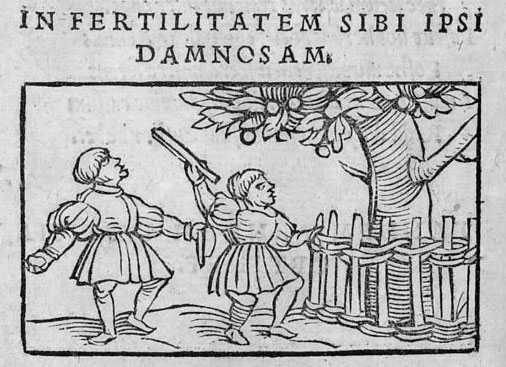
[images] (1) Hunted beaver biting off its testicles. Bestiary / Anonymous Book on four-legged animals, birds, and fish {Anonymi tractatus de quadrupedibus, de avibus et de piscibus}. From folio 5v (hunt of the beaver {chasse au castor}) of Bibliothèque nationale de France, Latin 6838 B. (2) Rustics knocking down nuts from a tree. Motto {inscriptio}: “Fertility brings harm to oneself {De fertilité à soy dommageable}.” Prosopopoeie / prosopopoeia is personification of an abstraction. Emblem from Andrea Alciato’s Emblemes (1549), Lyons. Via Alciato at Glasgow. (3) Three boys attacking a walnut tree. Inscriptio: “In fruitfulness is one’s very own destruction {In fertilitatem sibi ipsi damnosam}.” Emblem from Andrea Alciato’s Les Emblemes (1539), Paris. Via Alciato at Glasgow. (4) Two men attacking a tree across a fence from them. Inscriptio: “In fruitfulness is one’s very own destruction {In fertilitatem sibi ipsi damnosam}.” Emblem from Andrea Alciato’s Emblematum liber (28th February, 1531), Augsburg. Via Alciato at Glasgow. Here’s an informative presentation on emblems in literary history.

References:

Beck, Roger. 1965. “Ovid, Augustus, and a Nut Tree.” Phoenix. 19 (2): 146-152.

Burke, Linda, ed. and trans. 2013. Jehan Le Fèvre. The Book of Gladness / Le Livre de Leesce: a 14th-century defense of women, in English and French. Jefferson, North Carolina: McFarland & Company, Inc.

Fantham, Elaine, and Erika Rummel, trans. 1989. Collected works of Erasmus. Vol. 29, Literary and educational writings. 7: De virtute, Oratio funebris, Encomium medicinae, De puero, Tyrannicida, Ovid, Prudentius, Galen, Lingua. Toronto: University of Toronto Press.

Hexter, Ralph J., Laura Pfuntner, and Justin Haynes, ed. and trans. 2020. Appendix Ovidiana: Latin poems ascribed to Ovid in the Middle Ages. Dumbarton Oaks Medieval Library, 62. Cambridge, MA: Harvard University Press.

McGowan, Matthew. 2020. “Nux attributed to Ovid and its Renaissance readers: the case of Erasmus.” Ch. 16 (pp. 262-274) in Franklinos, T. E., and Laurel Fulkerson. 2020. Constructing Authors and Readers in the Appendices Vergiliana, Tibulliana, and Ouidiana. Oxford, UK: Oxford University Press.

Mynors, R. A. B., ed. 1969. “Commentarius In Nucem Ovidii.” Pp. 139-174 in Kumaniecki, K., R. A. B. Mynors, C. Robinson, and J. H. Waszink. Desiderius Erasmus. Opera omnia Desiderii Erasmi: Ordinis primi tomus primus. Amsterdam: Huygens Instituut / Brill.

Paton, W. R., ed. and trans. 1917. The Greek Anthology, Volume III: Book 9: The Declamatory Epigrams. Loeb Classical Library 84. Cambridge, MA: Harvard University Press.

Reeve, M. D. 1987. “Ovid or an Imitator? – Review of M. Pulbrook: Ovid, Nux. Pp. 124. Maynooth University Press, 1985. Paper, £5.” The Classical Review. 37 (1): 19-21.

medieval insight: what prevents hate amid gender injustices

With worldly authorities coldly indifferent to men’s sufferings, men endure harsh gender injustices of love and hate. These gender injustices might drive men themselves to hate. Yet men express relatively little hate. Medieval literature shows ways in which men are saved from hate.

Consider the example of the medieval man Spurinna, who longed to have children with his wife. He didn’t assume that his wife was infertile and divorce her. Instead, following a common medieval European practice, he went on a Christian pilgrimage:

Since Spurinna desires to rear children,
he climbs the summit of the high Pyrenees
to offer his prayers to Saint James,
then passes over the snowy Alps
to visit the shrines of Peter and Paul.
And soon, having doubled back to the Adriatic,
with trembling he prays to the goddess of Loreto.
Then passing through dangers on the deep sea,
arriving at holy Palestine,
he heads for the holy sepulcher of the Lord.
Not content with this, he traverses
the dry sands of Arabia, land of thieves,
on the hump of a camel,
hastens to the lofty Sinai
and to the sacred summit of Saint Catherine.
What resulted from this effort, you ask?
When he returned home, he found three children.

{ Tollendae cupidus Spurinna prolis
Altae dum superat iugum Pyrenes,
Divo porrigat ut preces Iacobo,
Inde Alpes quoque praeterit nivosas,
Petri ut limina visat atque Pauli:
Et mox Hadriacum in sinum reflexus
Laureti attonitus deam precatur:
Inde per medii maris pericla
Sacram perveniens ad usque Idumen,
Sacratum Domini petit sepulchrum.
Nec contentus adhuc, latrocinantum
Arenas Arabum siticulosas
Gibbo permeat insidens cameli,
Sublimem properans ad usque Sinam,
Et divae iuga sacra Catharinae.
Quid profecerit hoc labore quaeris?
Tres natos reperit domum reversus. }[1]

Spurinna didn’t place his wife under guard while he was gone. He didn’t encourage his wife to work as a prostitute so as to produce children for him. Like Joseph, the husband of Mary, the mother of Jesus, Spurinna accepted the children he found upon returning home as fruits of the Holy Spirit working during his pilgrimage. He showed no concern for his wife’s disrespect for his biological interests and for institutionally supported cuckolding of men. In Spurinna’s understanding, God had provided children for him.

Understanding of Holy Scripture prompted another medieval man to have scorn for his ex-girlfriend’s love. This man complained that his sweet, chaste girlfriend, perhaps bored with him, had left him to become a prostitute:

A palace of chastity
now is open for all as a brothel.
The virgin lily withers
at the touch of the vulgar throng
in shameful commerce.

{ Patet lupanar omnium
pudoris in palatium,
nam virginale lilium
marcet a tactu vilium
commercio probroso. }[2]

He satirically advised his ex-girlfriend:

Be more careful in your loving,
for fear that it be discovered.
What you do, do in darkness,
far from the eyes of Rumor.
Love, with its sweet enticements
and playful murmurings,
takes joy in hidden places.

{ Cautius ama,
ne comperiatur!
Quod agis, age tenebris
procul a Famae palpebris!
Laetatur amor latebris
et dulcibus illecbris
cum murmure iocoso. }

This man apparently deliberately reversed a Biblical exhortation:

Once you were darkness, but now you are light in the Lord. Walk as children of light, for the fruit of light is found in all that is good and right and true. Try to discern what is pleasing to the Lord. Take no part in the unfruitful works of darkness, but instead expose them. For it is shameful even to speak of the things that they do in secret.

{ ἦτε γάρ ποτε σκότος νῦν δὲ φῶς ἐν κυρίῳ ὡς τέκνα φωτὸς περιπατεῖτε ὁ γὰρ καρπὸς τοῦ φωτὸς ἐν πάσῃ ἀγαθωσύνῃ καὶ δικαιοσύνῃ καὶ ἀληθείᾳ δοκιμάζοντες τί ἐστιν εὐάρεστον τῷ κυρίῳ καὶ μὴ συγκοινωνεῖτε τοῖς ἔργοις τοῖς ἀκάρποις τοῦ σκότους μᾶλλον δὲ καὶ ἐλέγχετε τὰ γὰρ κρυφῇ γινόμενα ὑπ᾽ αὐτῶν αἰσχρόν ἐστιν καὶ λέγειν }[3]

With another Biblical inversion, the man further castigated his ex-girlfriend:

Men who merely ask for your love
you dismiss with angry words;
those who offer gifts
you warmly embrace in bed.
Men from whom you get nothing
you tell to go away.
You receive the blind and the lame;
illustrious men you deceive
with your envenomed honey.

{ Verbo rogantes
removes hostili,
munera dantes
foves in cubili.
Illos abire praecipis
a quibus nihil accipis.
Caecos claudosque recipis,
viros illustres decipis
cum melle venenoso. }

The Gospel of Matthew described Jesus cleansing commerce from the temple of God. Jesus within the temple healed at no cost:

The blind and the lame came to Jesus in the temple, and he healed them.

{ προσῆλθον αὐτῷ τυφλοὶ καὶ χωλοὶ ἐν τῷ ἱερῷ καὶ ἐθεράπευσεν αὐτούς }[4]

Medieval literature tells of warm-hearted women saving men from death from lovesickness with mercy for them, not to gain gifts. This man’s ex-girlfriend, in contrast, accepted men into her body, her temple of the Holy Spirit, for material gain. At least blind men correctly perceived her relationship with them. Betrayed by his ex-girlfriend, the man who wrote this poem doesn’t hate her in opposition to the love he had for her. With keen Christian understanding wrapped in scorn, he regards her as having made God’s freely given love irrelevant to loving her.

A Galician-Portuguese poem from the middle of the thirteenth century more explicitly depicts a man who doesn’t hate a woman. The man laments:

If I could only learn to hate
the one who’s always hated me!
If I could only make her hurt
for all the ways that she’s hurt me!
I would have revenge at least
if I could pay back part of the grief
to the heart that so grieved me.

But I can’t even learn to fool
my very own heart. It fooled me
by making me completely fall
for one who’d never fall for me.
And this is why I never sleep:
I try but can’t repay the grief
to the heart that so grieved me.

{ Se eu podesse desamar
a quem me sempre desamou
e podess’algum mal buscar
a quem me sempre mal buscou!
Assi me vingaria eu,
se eu pudesse coita dar
a quem me sempre coita deu.

Mais sol nom poss’eu enganar
meu coraçom que m’enganou,
per quanto mi fez desejar
a quem me nunca desejou.
E por esto nom dórmio eu,
porque nom poss’eu coita dar
a quem me sempre coita deu. }[5]

Medieval men’s sense of women’s disloyalty to them prompted vibrant poetry of men’s sexed protest. But this man felt that he couldn’t repay hate for hate, hurt for hurt, grief for grief. He turned to God for help:

I pray that God will yet reject
the one who always rejected me,
or that I’ll make her feel upset
for all the times she’s upset me.
Then I’d finally sleep in peace
if I could pay back part of the grief
to the heart that so grieved me.

Or that I’ll bring myself to ask
the one who never once asked me,
why I’ve always thought of her,
though she’s never thought of me.
And this is why I’m suffering:
I try but can’t repay the grief
to the heart that so grieved me.

{ Mais rog’a Deus que desampar
a quem m’assi desamparou,
ou que podess’eu destorvar
a quem me sempre destorvou.
E logo dormiria eu,
se eu podesse coita dar
a quem me sempre coita deu.

Vel que ousass’en preguntar
a quem me nunca preguntou,
por que me fez em si cuidar,
pois ela nunca em mi cuidou;
e por esto lazeiro eu:
porque nom posso coita dar
a quem me sempre coita deu. }

In medieval Christian understanding, God offers peace beyond all understanding. Yet this man has no peace. He suffers because he cannot hate her, even for his own sake.

Christian understanding of love built upon earlier Aristotelian understanding of  love. More than three centuries before Jesus was born, Aristotle influentially declared:

Let being loving be defined as wishing for someone what one thinks to be good for that person, not what one thinks benefits oneself, and procuring good for that person as much as one can. A friend is one who loves and is loved in return, and those who think their relationship is of this character consider themselves friends.

{ ἔστω δὴ τὸ φιλεῖν τὸ βούλεσθαί τινι ἃ οἴεται ἀγαθά, ἐκείνου ἕνεκα ἀλλὰ μὴ αὑτοῦ, καὶ τὸ κατὰ δύναμιν πρακτικὸν εἶναι τούτων. φίλος δέ ἐστιν ὁ φιλῶν καὶ ἀντιφιλούμενος. οἴονται δὲ φίλοι εἶναι οἱ οὕτως ἔχειν οἰόμενοι πρὸς ἀλλήλους. }[6]

The man yearns to ask the woman why he has always thought of her. Asking her would compel her to think about him and his love for her. In Aristotelian understanding, love means both altruism and reciprocal altruism. Hate similarly involves the wish that the other perish.[7] The man’s beloved woman doesn’t love him or hate him. In reality, as the concluding stanza makes clear, she has never given him a thought.

Christians are commanded to love everyone, even their enemies. Within finite possibilities for real personal relationships and weaknesses of fully human beings, a Christian man might strive not to love a woman who doesn’t love him. But to hate a woman who actually hasn’t even thought of him — that is much more difficult.

*  *  *  *  *

Read more:

Notes:

[1] Théodore de Bèze, Iuvenilia (first edition, 1548), Epigrams 87, “About Spurinna {In Spurinnam},” Latin text and English translation (modified) from Summers (2001) pp. 296-7. Here’s a translation into Dutch. In 1564, Théodore de Bèze succeeded John Calvin as the spiritual leader of the Calvinists.

Other medieval husbands responded to such situations differently. A Swabian wife told her husband that, as a result of eating snow she had a child (a “snow child”) while he was absent. Five years later the husband sold the child to a trader and told his wife that the child had melted in the sun.

[2] Carmina Burana 120: “A deadly rumor {Rumor letalis}” 2.13-17, Latin text and English translation (modified) from Traill (2018) v. 2. Subsequent quotes from this poem are similarly from 1.11-17 (Be more careful in your loving…) and 3.11-17 (Men who merely ask for your love…).

Peter Dronke, an influential exponent of men-abasing courtly love, interpreted this poem as “the savage song of a jealous lover”:

This astonishing fantasy of love and hate conjoined is unlike anything else in the love-lyrics of the age. I would see it as a dramatic creation, depicting the progression of the disappointed lover into delusion, hysteria, and paranoia.

Dronke (2000 / 2007) pp. 263, 264. That wild hyperbole reflects the anti-meninism that has made literary studies unwelcoming to men students.

[3] Ephesians 5:8-12. Similarly, Matthew 5:14-16, 10:27, Romans 13:12-14. Prudentius’s Book of the Daily Round {Liber Cathemerinon}, written about 400 GC, emphatically links the darkness of night with evil:

Wily, crafty crime likes
the protection of darkness,
the undercover lover favors
the night, it suits his dirty deeds.

{ Versuta fraus et callida
amat tenebris obtegi,
aptamque noctem turpibus
adulter occultus fovet. }

Cathemerinon 2.6, Latin text and English translation from O’Daly (2012). Cathemerinon associates the light of day with God:

What a worthy thing, God, your flock offers you
at the beginning of dewy night —
light, your most previous gift,
light, by which we see all else that you have granted.

{ O res digna, Pater, quam tibi roscidae
noctis principio grex tuus offerat,
lucem, qua tribuis nil pretiosius,
lucem, qua reliqua praemia cernimus. }

Cathemerinon 5.38, sourced as above.

[4] Matthew 21:14. Similarly, Matthew 11:4-5. On the body as the temple of the Holy Spirit, 1 Corinthians 6:19. “Rumor letalis” laments the woman’s heart changing:

Now I weep for …
the dove-like
sweetness of your heart then,
its serpentine
venon now.

{ Nunc plango …
tunc columbinam
mentis dulcedinem
nunc serpentinam
amaritudinem. }

“Rumor letalis” 3.1, 5-8, Latin text and English translation (modified) from Traill (2018) v. 2. Matthew, in contrast, advises Christians facing persecution to be like both doves and serpents, but in different ways: “wise as serpents, innocent as doves {φρόνιμοι ὡς οἱ ὄφεις καὶ ἀκέραιοι ὡς αἱ περιστεραί}.” Matthew 10:16.

[5] Pero da Ponte, love song {cantiga d’amor}, “Song of a Lover Who Would Hate” / “If I could only learn to hate {Se Eu Podesse Desamar},” Galician-Portuguese text and English translation (by Richard Zenith) from Cantigas Medievais Galego-Portuguesas. Zenith (1995), pp. 44-5 (song 21) has nearly the same translation, but is slightly looser at a few points. The subsequent quote above is the second half of this song, which has an alternating refrain. Here’s a spoken recording of this song by Nuno Miguel Henrique (1995).

Apparently alluding to oppressive regulation of men’s sexuality, the Galician word “grief {coita}” is close to the Latin word “sexual intercourse {coitus}.” The great early-seventh-century Spanish scholar Isidore of Seville surely would have understood this issue.

Writing in the first century BGC, Catullus both hated and loved:

I hate and I love. Why I do this, perhaps you ask?
I don’t know, but I feel it happens and am tortured.

{ Odi et amo. Quare id faciam, fortasse requiris.
Nescio, sed fieri sentio et excrucior. }

Catullus 85, Latin text of Merrill (1893) via Perseus, English translated (modified slightly) of Smithers (1894) via Perseus. Here’s William Harris’s insightful analysis.

Ovid expressed a similar problem:

I struggle with my flighty heart pulling in contrary directions,
now love, now hate, but, I think love is winning.
I will hate, if I’m able. If not, I’ll love unwillingly.

{ Luctantur pectusque leve in contraria tendunt
hac amor hac odium, sed, puto, vincit amor.
odero, si potero; si non, invitus amabo.}

Ovid, Amores 3.11.33-5. In this poem, the woman’s beauty forces the man to love her despite her treating him badly. Similarly, Carmina Burana 113, “The snow and ice have slipped away {Transit nix et glacies},” stanza 4. Christian poets, writing after Catullus and Ovid, generally had more difficulty hating.

[6] Aristotle, Rhetoric {Ῥητορική} 2.4.2 (1380b–1381a), ancient Greek text and English translation (modified) from Freese & Striker (2020). Here’s an English translation by Kennedy (2007).

[7] After careful study, Konstan concluded:

Philia, then, has two uses. In one sense, it coincides with philein and refers to an altruistic wish for the good of the other; in another, it names the state of affairs that obtains between philoi, which requires that each philos have the corresponding wish for the other.

Konstan (2008) p. 212. On hate, Aristotle, Rhetoric 2.4 and Spatharas (2013). On the Christian command to love one’s enemies, Matthew 5:44.

[image] Recording of “If I could only learn to hate {Se Eu Podesse Desamar}” by Pedro Barroso, published on his album Pedro Barroso (1988). Via YouTube.

References:

Dronke, Peter. 2000 / 2007. “Latin Songs in the Carmina Burana.” Pp. 26-40 in Jones, Martin H., ed. 2000. The Carmina Burana: four essays. London: King’s College, London, Centre for Late Antique & Medieval Studies. Reprinted as pp. 257-270 in Dronke, Peter. 2007. Forms and Imaginings: from antiquity to the fifteenth century. Roma: Edizioni di Storia e Letteratura.

Freese, J. H., trans., revised by Gisela Striker. 2020. Aristotle. Art of Rhetoric. Loeb Classical Library 193. Cambridge, MA: Harvard University Press.

Konstan, David. 2008. “Aristotle on Love and Friendship.” Schole {Σχολη}. 2 (2): 207-212.

O’Daly, Gerard J. P. 2012. Days Linked by Song: Prudentius’ Cathemerinon. Oxford: Oxford University Press. (review by Catherine Conybeare)

Spatharas, Dimos. 2013. “Plutarch’s De invidia et odio and Aristotle’s Rhetoric.” Pp. 411-422 in Volpe Cacciatore, Paola, and Giovanna Pace, eds. Gli scritti di Plutarco: tradizione, traduzione, ricezione, commento: Atti del 9. convegno internazionale della International Plutarch Society. Ravello, Auditorium Oscar Niemeyer 29 Settembre – 1 Ottobre 2011 = Plutarch’s writings: transmission, translation, reception, commentary: Proceedings of the 9th International Conference of the International Plutarch Society. Ravello, Auditorium Oscar Niemeyer september 29 – October 1, 2011. Napoli: D’Auria.

Summers, Kirk M., ed. and trans. 2001. A View from the Palatine: the Iuvenilia of Théodore de Bèze. Medieval & Renaissance Texts & Studies, v. 237. Tempe, AZ: Arizona Center for Medieval and Renaissance Studies.

Traill, David A. 2018, ed. and trans. Carmina Burana. Dumbarton Oaks Medieval Library, 48-49. Cambridge, Massachusetts: Harvard University Press.

Zenith, Richard, trans. 1995. 113 Galician-Portuguese Troubadour Poems. Manchester: Carcanet, in association with Calouste Gulbenkian Foundation, Instituto Camões.

Amours & Machaut’s Voir Dit: failed medieval gender revolution

Marginalized medieval French literature depicts strong, independent women who initiated amorous relationships with men. These weren’t unattractive, self-centered women merely seeking someone, anyone who would talk with them and spend time with them. The French lay Loves {Amours}, written roughly about the year 1200, and Guillaume de Machaut’s True Poem {Voir Dit}, probably written about 1365, both depict beautiful, generous women who joyously desired and deeply appreciated men’s sexuality and men’s gender-distinctive human being. But their beloved men focused on arranging letters rather than providing masculine fleshly presence. Amours and Voir Dit represent men’s failure to support a gender revolution affirming the value of men’s persons.

In the French lay Amours, an “eminent man {haut home}” met at a conference an “eminent, very noble woman {haute dame molt noble}.” Conferences in relatively liberal and tolerant medieval Europe didn’t impose highly repressive codes of conduct. The male gaze wasn’t pathologized and criminalized, and neither was the female gaze:

As soon as they saw each other,
they set their hearts and bodies and eyes
to gazing, and thus they stared at each other.
But in the looks they bestowed on each other
love struck, and the fire of love
was kindled, which burns and ignites
hearts and bodies, and it captivated them.
And love, which has seized many persons,
pursued them, stuck them, and harried them.
Each looked at the other and became bound to the other.

{ Aussi tost comme il s’entrevirent
Les cuers, les cors, o les elz mirent
Por esgarder, si s’entresgardent;
Mes en l’esgart qu’il se regardent
S’i fiert Amors, et li feus prent
D’amors qui alume et esprent
Lor cuers, lor cors, et a sorpris.
Et amors, qui mains en a pris
Les chace et fiert et les destraint.
Chascuns se regarde et estraint }[1]

The woman recognized women’s privilege in requiring men to solicit amorous relationships:

She thought and said: “O God! What would I say?
I would be going against all other women.
I shall not speak to him; I must remain silent.”

{ Pense et dit: “Dex! Que diroie?
Contre toutes dames feroie.
Nu dirai pas ; tere m’estuet.” }

But the woman ultimately rebelled against that gynocentric imperative. Not knowing whether her amorous advance would be welcomed or unwelcomed, she went up to the man and said:

My lord, be fully aware, without any doubt
that in this land I should like to have
your love and your friendship,
if it pleases you, and be truly aware
that I am yours — do not doubt it.

{ Sire, sachiez bien sanz doutance
Vostre amor et vostre acointance
En cest païs voudroie avoir,
S’il vos plet, et sachiez de voir
Que vostre sui, n’en doutez point. }

The man didn’t report to conference organizers that a creepy woman was weirdly harassing him. However, there was some misunderstanding between the two:

He thanked her tenderly for her words,
then replied: “My lady, without hesitation
my friendship and my love
I grant you, for I would do
for you whatever I could.”
She replied immediately:
“What I am thinking, you are not thinking the same?
Understand the situation is this —  I am telling you
that I love you passionately with my whole body.”
“Passionately?” he said. “Yes, indeed,” she said.

{ Del dit doucement la mercie,
Puis respont: “Dame,sanz demor
De moi l’acointance et l’amor
Vos otroi ge, car je feroie
Por vos qanque fere porroie.”
Ele respont isnel le pas:
“Ce que pens, n’i pensez vos pas?
Einz est einsint, que tot a cors
Vos di que je vos aing d’amors.”
“D’amors?” fet il. “Voire,” fet ele, }

Modern applied theorists of amorous relationships would classify the women’s words as an “apocalypse opener.”

The man responded receptively. He explained that he wanted to say what she said, but didn’t dare. As has been all too common throughout history, the man then foolishly expressed his willingness to be the woman’s servant, apparently in the expectation that she would then have sex with him:

Entirely and without reservation
I give myself to you, at your command.
I ask God as a reward
that he grant me such a noble gift
over time to show gratitude for it,
for that is the thing I most desire.

{ Tot entiers sanz nul contredit
M’otroi a vos, a vos commant.
A Dieu en guerredon demant
Que il me doint de si haut don
En tens rendre le guerredon.
Que c’est la riens que plus desir. }

Men shouldn’t exchange servitude to women for sex. Fortunately, that wasn’t this man’s destiny. News came that he needed to return home immediately on an urgent matter. He explained to her that he needed to depart immediately. The woman was filled with sorrow, but she didn’t rave violently like Dido.

medieval author Machaut writing

The man and woman’s love affair subsequently was only the exchange of love letters. They seemed to have become a book:

The eminent man summoned
his clerk to write the letter
and he put his whole heart into describing
the looks, the laments, the words
point by point, just as I have told them;
with the letter he put them into the book.

{ Li hauz hom a fet demander
Son clerc por le salu escrire,
Qui tot son cuer mist el descrire
Les regarz, les plaintes, les diz,
Point a point, si con jes ai diz;
O le salu les mist el livre. }[2]

The narrator is Girart, the eminent man’s clerk. Girart insists that the tale of the woman and man’s love depends on their letters:

I shall not continue this tale,
whatever may happen,
until the messenger returns.
I have refrained from speaking
until the return of the messenger
bringing me the material
I need to speak new words.
What does the messenger say? Now let it be heard.

{ De cest conte plus ne diroie,
Par aventure qui aviengne,
De si la que li mes reviengne.
Je me sui de dire tenuz
Tant que li mes est revenuz
Qui m’en aporte la matire
Dont il m’estuet noveaus moz dire.
Que dit li mes? Or soit oi. }

The woman wrote back declaring that the man’s letter filled her with great joy. But she sought love words enacted in the flesh:

I would like nothing better,
fair lover, than to be in your arms
to bring about joy and solace.
One whole night I would hold you,
naked flesh against naked flesh, so to feel
your body, your sweet breath,
the sweet, the pure, the wholesome,
which I desire to experience so much.
And God be willing to consent
that in my arms, as my heart drives me to do,
I could embrace for comfort
your body, the most beautiful in the world.
My lord, to bring about such joy,
come and visit without delay
her who in sweet hope
is awaiting your sweet arrival.

{ Rien ne vodroie avoir,
Biaus amis, qu’estre entre vos braz
Por joie fere et por solaz.
Une seule nuit vos tenisse
Si nu a nu que je sentisse
Vostre cors, vostre douce alainne,
La doce, la fine, la sainne,
Que je tant désir a sentir,
Et que Diex vosist consentir
Qu’a mes braz, dont cuers me semont,
Vostre cors, le plus biau du mont,
Estrainsisse por conforter.
Sire, por tel joie aporter,
Venez veoir sans demorance
Cele qui en douce esperance
Vostre douce venue atent. }

Her lover responded with a letter filled with abstract fawning over her and academic reasoning about love. He didn’t promptly visit her in person. She apparently never sent a letter in response.[3]

medieval author Machaut writing for woman

Like Amours, Guillaume de Machaut’s Voir Dit centers an exchange of love letters. In Amours, the clerk Girart presents himself as a loyal writer-servant for the eminent man in love. In Voir Dit, Machaut himself takes over the role of Girart. Machaut makes a book from love letters and poems he exchanges with the beautiful, young woman Peronne:

Woman beautiful, good, and charming,
pleasant and sweet beyond compare,
I cannot overpraise you.
My heart grants you without reserve
its song in your honor,
woman beautiful, good, and charming,
pleasant and sweet beyond compare,
and if with a lover’s heart
you ever deign call me darling,
I would ask no more of you.
Woman beautiful, good, and charming,
pleasant and sweet beyond compare,
I cannot overpraise you.

{ Bele bonne et envoisie
Plaisant et douce sans per
Je ne vous puis trop loer
Mes cuers tous a vous sottrie
Son chant pour vous honnourer
Bele bonne et envoisie
Plaisant et douce sans per
Et se amy de cuer damie
Me daingniez iamais clamer
Je ne vous weil plus rouver
Bele bonne et envoisie
Plaisant et douce sans per
Je ne vous puis trop loer }[4]

Machaut justifies compiling this and much other literary work through a compelling argument within gynocentric society:

And if anyone should reproach me
or consider to be ill-served
that I record here our messages,
the pleasant ones as well as the bitter,
which one ought rightly call letters
— that’s their true name and correct title —
I respond thus to them all:
it is at the sweet command
of my lady, who gives the order.

{ Et sil est nuls qui me repregne
Ou qui mal a paiez se teingne
De mettre cy nos escriptures
Autant les douces que les sures
Que len doit appeller Epistres
Cest leurs drois noms et leurs drois titres
Je respons a tous telement
Que cest au dous commandement
De ma dame qui le commande }

Machaut declares that he must “make this book for her love {faire pour samour ce livre}.” Men have often failed to understand the worth, not of their doing, but of their very being.

Peronne herself spurred Machaut’s literary and musical composing. She asked him to write poems and music for her. She sent him her own poems and asked him to help her with writing them and to set them to music. She corrected Machaut’s work on Voir Dit, which he frequently called “her book”:

You may be pleased to learn that I have been very occupied with composing your book and am still … I will send along quite soon what has been completed of your book and your rondel as well. Now I beg you by the affection you have for me not to show the book to anyone who isn’t close to your heart. And if anything therein needs correcting, please note it. For you have been pleased that I put there everything pertaining to our affair, and I don’t know if I’ve included too much or too little.

{ Plaise vous savoir que iay este si embesongniez de faire vostre
livre, et sui encores … ie vous envoieray bien tost et par certein message ce qui est fait de vostre livre, et vostre Rondel aussi, Mais ie vous pri si chier que vous mavez que vous ne moustrez le livre que a gens qui soient trop bien de vostre cuer, Et sil y a aucune chose a corrigier que vous y faites enseingnes, Car il vous a pleue que ie y mette tout nostre fait, si ne say se ie y met ou trop ou po }[5]

A literary relationship isn’t what Peronne most ardently sought.[6] The first news of this beautiful, young woman’s love for Machaut urgently conveyed her request that he abide with her:

And she has never in all her life seen you,
but this is her very great desire.
And, sweet lord, were it possible
for you to go where she is,
she would offer you a welcome
so full of love and sincere affection
that it should very nicely satisfy
the greatest lord in the empire.

{ Et se ne vous vit en sa vie
Mais elle en a trop grant envie
Et dous sires sil pooit estre
Que vous venissiez en son estre
Elle vous feroit tele chiere 165
Si amoureuse et si entiere
Quelle devroit tresbien souffire
Au plus grant signeur de lempire }

Like the eminent man in Amours, Machaut didn’t understand the answer to the question, “What are you seeking {quid quaeritis}?” Machaut constantly had excuses for not being with Peronne and was timid in physically expressing love for her. But he worked strenuously on producing her book, The Book of the True Poem {Le Livre dou Voir Dit}.[7]

Machaut and Peronne in bed

Words of love aren’t the same as love made in flesh. The sexual feudalism of men-abasing courtly love isn’t the love of embracing another human being like oneself. These false understandings of love have supported gender inequality, misandry, and anti-meninism. With enough study of medieval literature, we shall overcome some day.

*  *  *  *  *

Read more:

Notes:

[1] Old French lay Loves {Amours} vv. 59-68, Old French text and English translation (modified slightly) from Burgess & Brook (2010). A prose translation, without the Old French source, is available in Burgess & Brook (2016). Paris (1878) provides a freely accessible, quite good Old French text. Amours has survived in only one manuscript, Paris, Bibliothèque nationale de France, nouvelles acquisitions françaises 1104, f. 66rb-69va. This lay “was probably composed in the late twelfth or the first half of the thirteenth century.” Burgess & Brook (2010) p. 199.

The man is called an “eminent man {haut home}” thirteen times in Amours, with the first such reference in v. 10. The lady is called an “eminent, very noble woman {haute dame molt noble}” in v. 31. Those different referents suggest that the man is a prosperous merchant, while the woman has the higher status of noble birth. Poe (2011) p. 366. The woman thus transgresses gender norms not only in initiating an amorous relationship, but also by engaging in a non-hypergamous relationship while treating the man as personally equal to her.

Unlike other lays, Amours has realistic circumstances throughout and a temporal setting in the here and now. Poe (2011) pp. 365-6, Beston (2015) pp. 7, 15. That distintive literary feature of Amours suggests that its love letters represent an alternate, unrealized version of the present world.

Subsequent quotes from Amours are sourced as above. Those quotes above are from vv. 115-7 (She thought and said…), 127-31 (My lord, be fully aware…), 136-45 (He thanked her tenderly…), 152-7 (Entirely and without reservation…), 282-7 (The eminent man summoned…), 290-7 (I shall not continue this tale…), 338-53 (I would like nothing better…).

[2] Love letters as literature weren’t an innovation in Amours. In Ovid’s Metamorphoses, Byblis wrote a love letter to her brother Caunus. Metamorphoses 9.530-63. Ovid’s Heroides consists of women’s letters concerning love. Lavinia sent a love letter to Aeneas in the twelfth-century Roman d’Eneas. Love letters are central to Marie de France’s lay Milun. On Milun and the literary history of love letters, Poe (2006). In Milun, like in Amours and Voir Dit, the lady initiates the amorous relationship with Milun.

In Amours, like in Voir Dit, love letters {saluts d’amour} dominate the poem. Poe observed:

In devising a narrative to tell the story surrounding an exhange of saluts d’amour, Girart was doing nothing new. What is unique about this exchange of saluts is that it is not just one episode among many. It is the main event, indeed the only event. The narrative exists for the sake of the saluts d’amour, not the other way around.

Burgess & Brook (2010) p. 203. Elizabeth W. Poe wrote most of the introduction to Amours in id. See id. p. 202, n. 3.

[3] In Amours, “Particularly notable are the forthrightness of the lady and the comparative timidity of the nobleman.” Burgess & Brook (2016) pp. 244-5. “The essential character that Girart creates is of a man who wants the lady, but is too indecisive to advance their relationship.” Beston (2015) p. 10.

Beston asserts that Amours ends unresolved: “The most enduring appeal of the story, however, is the fact that the love story is unresolved.” Id. p. 15. In fact, Amours hasn’t had much enduring appeal. Scholars have written little on it. Poe at Burgess & Brook (2010) p. 202. Most persons have never heard of Amours.

Amours seems to me best interpreted as resolved through the woman’s frustration and resulting apathy. The lay ends after the man sent her his love letter replying to her love letter replying to his love letter. The last verses of the lay:

The messenger who journeyed to her
departed, and this tale comes to an end
until the time when necessity brings back
the messenger who took the letter.
If he returns and brings him
news that differs from before,
Girart will tell more of the lays.

{ Li mes s’en va qui s’avoia
A li, et cis contes remaint,
Jusqu’a tant que besoinz ramaint
Le mesage qui l’escrit porte;
Car s’il revient et il aporte
Autres noveles que devant,
Girarz dira des lais avant. }

Amours, vv. 512-8. That no more was written suggests that the love affair ended through lack of contact. Writing about love, or talking about love, is no substitute for incarnating love.

[4] Guillaume de Machaut, The Book of the True Poem {Le Livre dou Voir Dit} vv. 536-50 (a rondel), Old French text and English trans. (with minor changes) from Leech-Wilkinson & Palmer (1998). Kline (2020) provides a freely accessible English translation of Voir Dit.

Voir Dit includes intimate details of Machaut’s relationship with Peronne. Leech-Wilkinson observed:

the lover is hesitant, even fearful about including so much improper detail; he provides every 2000 lines or so a disclaimer that he does so only at her explicit command (lines 490-517, 2158, 4262-73, letter 33).

Id. p. xxxviii. On the historicity of Voir Dit, see note [2] in my post on Abishag and David. Huot attributes to Voir Dit “fictionality.” Huot (1987) p. 286. Fictionality is consistent with Voir Dit being based on an actual romantic relationship and with Voir Dit containing historical documents of that relationship.

Subsequent quotes from Voir Dit are sourced as above. They are from vv. 490-8 (And if anyone should reproach me…), v. 1681 (must make a book for her love), L33 after v. 6281 (You may be pleased to learn…), vv. 161-8 (And she has never in all her life seen you…).

[5] In his literary work on Voir Dit, the eminent Machaut strove to please the beautiful, young Peronne:

My sweet heart, my dear sister, and my very sweet love, I beg you to guard my book well and show it to as few people as you can. And if there is anything in it that displeases you or seems to you that it might be improved, make a mark near that passage, which I will remove and then make what improvements I can.

{ Mon dous cuer, ma chiere suer et ma tresdouce amour Je vous pri que vous gardez bien mon livre, et que vous le monstrez a meins de gens que vous porrez, Et se il y a aucune chose qui vous desplaise, ou qui vous samble qui ne soit mie bien, si y faites .j. signet, et ie losteray et amenderay a mon pooir }

Voir Dit, L37 after v. 6541.

[6] Machaut’s Voir Dit is similar to the thirteenth-century Old Occitan romance Flamenca in emphasizing exchange of literary words in establishing a love affair. Another commonality is the use of irony and satire. In Flamenca, Guillem outrageously misconceives words of Psalm 116:1: Dilexi quoniam. In Voir Dit, Machaut outrageously misconceives the kiss of peace within the Mass:

But a very happy chance befell me
when the “Agnus Dei” was being said.
By the faith I owe St. Caprais,
she sweetly gave me the kiss of peace
between two pillars of the church.
And this I needed very much
because my lover’s heart became
troubled when she departed so soon afterward.

{ Mais trop richement me chei
Que quant on dist agnus dei
Foy que ie doy a saint crapais
Doucement me donna la pais
Entre .ij. pilers dou moustier
Et ien avoie bien mestier
Car mes cuers amoureus estoit
Troubles, quant si tost se partoit }

Voir Dit, vv. 2947-54. Both Flamenca and Voir Dit lightly satirize the men-abasing cult of courtly love.

[7] At the end of his Lay de Plour, Machaut has a woman in love declare:

But before I do die,
my heart humbly begs
the true God to look upon us
with such a loving countenance
that in a book we’ll find life.

{ Mais einsois que je devie,
Humblement mes cuers supplie
Au vray Dieu qu’il nous regart
De si amoureux regart
Qu’en livre soiens de vie. }

Machaut, Lay de Plour vv. 207-10 Old French text and English translation from Palmer et al. (2016). With the hope, “in a book we’ll find life {en livre soiens de vie},” Machaut ironically refers to a book of love poetry, not the Bible. That’s not the Biblical idea of love. Huot astutely observed:

Machaut’s sublimation of love — what we might call “love for love’s sake” — is an essential quality of his poetic oeuvre and is related to the primacy of writing in Machaut’s concept of poetic process. … Within the Voir Dit, Guillaume’s difficulties as lover are associated not only — perhaps not even primarily — with his old age and his nonnoble status but with his identity as writer. … What Guillaume discovers is that writing does not reenact or enable lovemaking but, rather, replaces it entirely.

Huot (1987) pp. 237, 284, 285.

Men authors tend to be delusional about the importance of their literary work for their personal relationships. The man trobairitz Bernart de Ventadorn wrote:

But there’s one thing that comforts me:
that she knows letters and them understands,
and I’m pleased to write the wording
so if she finds all this pleasing,
she can read it for my deliverance.

{ mais d’una re me conort be:
ela sap letras et enten,
et agrada·m qu’eu escria
los motz, e s’a leis plazia,
legis los al meu sauvamen. }

Bernart de Ventadorn, “In care and in dismay {En cossirer et en esmai}” vv. 52-6 (from stanze 7), Old Occitan text from Corpus des Troubadours, English translation (modified) by James H. Donalson. Here’s a performance of “En cossirer et en esmai” by Véronique Chalot. Bernart’s song almost surely didn’t deliver the woman to him.

[images] (1) Guillaume de Machaut writing. Illumination from Machaut’s Poésies, a compilation of his work made between 1372 and 1377, possibly under Machaut’s direction. Detail from folio Fv in MS. Bibliotheque Nationale de France, Français 1584. On this compilation, Huot (1987) Ch. 9. On its illuminations, Leo (2016). (2) Machaut writing for Peronne. Illumination for Voir Dit on folio 242r in MS. Français 1584. (3) Machaut in bed with Peronne under the auspices of the goddess Venus. Illumination for Voir Dit on folio 255r in MS. Français 1584.

References:

Beston, John. 2015. “The Role of the Secretary Girart in the Old French Lay of Amours.” Le Cygne. 2: 7-16.

Burgess, Glyn S., and Leslie C. Brook, eds. 2010. The Old French Lays of Ignaure, Oiselet and Amours. Gallica 18. Cambridge: D.S. Brewer.

Burgess, Glyn S., and Leslie C. Brook, trans. 2016. Twenty-Four Lays from the French Middle Ages. Liverpool: Liverpool University Press.

Huot, Sylvia. 1987. From Song to Book: the Poetics of Writing in Old French Lyric and Lyrical Narrative Poetry. Ithaca, NY: Cornell University Press.

Kline, A. S., trans. 2020. Guillaume de Machaut: The Book of the True Poem (Le Livre dou Voir Dit). Poetry in Translation. Online.

Leech-Wilkinson, Daniel, ed. and R. Barton Palmer, trans. 1998. Guillaume de Machaut. Le Livre dou Voir Dit / The Book of the True Poem. New York: Garland Publishing.

Leo, Domenic. 2016. “BnF, fr. 1584: An Art Historical Overview.” In Palmer et al. (2016).

Palmer, R. Barton, Yolanda Plumley, Domenic Leo, and Uri Smilansky, ed. and trans. 2016. Guillaume de Machaut, the Complete Poetry and Music. Volume 1, The Debate Poems: Le Jugement dou Roy de Behaigne, Le Jugement dou Roy de Navarre, Le Lay de Plour. Kalamazoo, MI: Published for TEAMS (Teaching Association for Medieval Studies) in association with the University of Rochester by Medieval Institute Publications.

Paris, Gaston. 1878. “Un lai d’amours.” Romania. 7 (27): 407-415.

Poe, Elizabeth W. 2006. “Marie de France and the Salut d’amour.” Romania. 124 (495-496 (3-4)): 301-323.

Poe, Elizabeth W. 2011. “Lai d’Amours as Lai.” Pp. 357-368 in Catherine M. Jones, and Logan E. Whalen, eds. “Li premerains vers”: essays in honor of Keith Busby. Amsterdam: Rodopi.