medieval warning to men about sexual effects of cold baths

Men in medieval Europe loved women even more than did the classical lover Ovid. They especially delighted in the lovely, warmly receptive women of the Italian city Pavia. The early church father Jerome understood well men’s ardent desire for women. He and other Christian leaders recognized dangers of gyno-idolatry. To avoid terrible hardships like the Archpoet endured, medieval men needed inspiring examples of heroic chastity. Apparently attempting to meet that need, the twelfth-century cleric Jocelin of Furness described how cold baths affected Saint Kentigern’s sexual desire for women.

By Jocelin’s time, the seventh-century abbot and bishop Aldhelm of Malmesbury was renowned for his feats of chastity. Gerald of Wales, who was a near-contemporary of Jocelin, counseled men against trying to imitate the example of Saint Aldhelm:

He spent every night between two young women, one on his one side, the other on his other side, and so was slandered by men. But he is described as lying prostrate to God, by whom the conscience of this very man was truly recognized, and his continence would be more abundantly rewarded in the future.

{ qui inter duas puellas, unam ab uno latere alteram ab altero, singulis noctibus, ut ab hominibus diffamaretur, a Deo vero cui nota fuerat conscientia ipsius et continentia copiosius in futurum remuneraretur, jacuisse describitur }[1]

Suspicious of Aldhelm’s practice of sleeping with young women, some slandered him for it.[2] Gerald and others, however, insisted on Aldhelm’s continence. The classical philosopher Xenocrates stolidly slept with the lovely courtesan Phryne. King David chastely warmed himself in bed with the beautiful Abishag the Shunammite. Why couldn’t Aldhelm behave similarly?

Aldhelm reportedly developed his strong sexual restraint with a rigorous practice of bathing. The twelfth-century historian William of Malmesbury described Aldhelm’s practice:

So as to overcome the force of bodily rebellion, he immersed himself up to his shoulders in the spring that was next to his monastery. There, not caring for the icy rigor in winter, nor for the fragrant mists running from marshy places in summer, he lasted nights unharmed. The limit of his Psalter, having been sung through, simply established the end of his labor.

{ ut vim rebelli corpori concisceret, fonti qui proximus monasterio se humerotenus immergebat. Ibi nec glatialem in hieme rigorem, nec aestate nebulas ex locis palustribus halantes curans, noctes durabat inoffensus. Finis duntaxat percantati Psalterii terminum imponebat labori. }[3]

Aldhelm understood that men who don’t take such cold baths readily fall into fornication. He warned one of his students to stay away from prostitutes and brothels. He also advised against leading oneself into temptation:

He admonished a student not to read the lascivious poems of the classical poets, nor to spend time in the company of courtesans, nor to emasculate his mind’s vigor with the allurement of voluptuous clothing.

{ discipulum monuerit ne lasciva poetarum carmina legat, ne meretricularum consortio inhereat, ne delicatarum lenocinio vestium vigorem mentis effeminet. }[4]

Aldhelm didn’t advise men students to take cold baths to quell their sexual urges. Was Aldhelm keeping from his students how they could sleep chastely with two young women simultaneously? A good teacher shouldn’t deprive students of useful knowledge.

Saint Aldhelm of Malmesbury in stained glass

In his life of Saint Kentigern, Jocelin of Furness depicted Kentigern as having realized Aldhelm’s method of heroic chastity. The early church father Jerome urged Christians to “nakedly follow the naked Christ {nudus nudum Christum sequi}.”[5] According to Jocelin, Kentigern did so while imitating Aldhelm’s bathing practice:

He customarily stripped off his clothing and nakedly following the naked Christ, yielded himself himself naked and uncovered, and immersed himself in rapidly flowing cold water. Then surely as the stag desires springs of water, so too his spirit longed for God, the living fountain. There in cold and nakedness, with his eyes and hands fixed on Heaven, with a devout heart and voice he would sing the entire Psalter.

{ expoliare se vestimentis suis solebat et nudus, nudum Christum sequens, nudum et exertum se reddens, aquis vehementibus et frigidis se inmergebat. Tunc plane quemadmodum desiderat cervus ad fontes aquarum, ita anima ejus desiderabat, ad Deum fontem vivum; ibique in frigore et nuditate oculis ac manibus celo infixus, corde et ore devoto, totum ex integro decantabat psalterium. }[6]

Like Aldhelm, Kentigern reportedly became heroically chaste:

Therefore by the daily use of this beneficial bath, as if in a new Jordan, his flesh was restored to the flesh of a little boy. Because sin’s rule that wars in the genitals was in him so weakened and the fire of lust so deadened and extinguished, no corruption of his tingling flesh, neither awake nor even sleeping, polluted or discolored the lily of his snow-white chastity. He did not directly sense his flesh’s movement to sow and thrive. So cooperating with Christ’s grace in this innocence of childlike purity, his flesh blossomed with its pricks sleeping. And indeed this just man, like an unwithering lily, germinated in the Lord’s sight. Concerning that, he also professed frankly to his followers on a certain occasion that he was no more pricked at the sight or touch of a most beautiful young woman than at that of the hardest flint.

{ Ex diutino ergo usu hujus salutaris lavacri, quasi Jordanis novi, restituta est caro ejus quasi caro pueri parvuli; quia lex peccati que in membris pudendis militat, ita in ipso debilitata est, et ignis libidinis emortuus, et extinctus, ut nulla carnis prurientis putredo in vigilando, vel etiam dormiendo, lilium sui nivei pudoris pollueret, vel decoloraret. Nec etiam simplicem motum in se sevire, vel vigere sentiret. Cooperante namque gratia Christi in cujusdam puerilis puritatis innocentiam, sopitis stimulis caro ejus effloruit. Et imo justus iste, sicut inmarcessibile lilium, ante Dominum germinavit. Unde etiam quadam vice discipulis suis simpliciter profitebatur, quod non magis ad speciosissime puelle visum, aut tactum, quam ad durissimi scilicis, stimularetur. }

Men have always striven to serve women. If women, even beautiful, young, warmly receptive women, were to need comfort and company in bed, Saint Kentigern was prepared to serve them chastely. Saintly men serve God and neighbor in ways that other men can’t.

Just as some had suspicions about Aldhelm sleeping with women, Jocelin’s text provides reason to doubt the claimed sexual effects of cold baths. Consider closely the peculiar claim that Kentigern was “no more pricked at the sight or touch of a most beautiful young woman than at that of the hardest flint {non magis ad speciosissime puelle visum, aut tactum, quam ad durissimi scilicis, stimularetur}.” Medieval men tended to imagine beautiful women as being soft and warm. The hardest flint, in contrast, is explicitly hard. Moreover, stone lacks the warmth of living flesh. The sight or touch of a hard, cold woman, to say nothing of an obtusely anti-meninist woman, wouldn’t arouse most men. In that sense, the most beautiful young woman and the hardest flint have opposite sexual effects on men.

However, the most beautiful young woman and the hardest flint can have similar effects in pricking men’s senses. Flint tends to be sharp. Touching it can wound like the wounding of lovesickness. In human history, flint-like stone commonly has been used for arrowheads. The sight of an arrowhead directed at a man might cause him to tremble. Moreover, the classical love god Cupid shoots arrows at men to make them madly in love. Being pricked by the most beautiful woman in that sense is similar to being pricked by the hardest flint.

Men taking cold baths to inure themselves against women’s sexual allure isn’t generally supported in medieval literature. Medieval literature celebrates seminal blessing. Such a blessing depends on women’s attractiveness to men. Bishop Nonnus delighted in the sight of the beautiful, semi-naked actress Pelagia. She inspired him to love God more ardently. Saint John Climacus followed Bishop Nonnus in understanding bodily beauty as orienting men to God. Moreover, Saint Agnes redeemed men gazing upon women. Only persons ignorant of vital thrusts in medieval literature would believe that medieval men generally sought to deaden their senses with cold baths.

In our dour and dogmatic age, women and men together must ponder how best to put the Devil back into Hell. One way is cold baths, castration culture, more pervasive penal punishment, and other means to deaden men’s sexuality. A more excellent way celebrates the story of Sarah and Tobias, hope for the resurrection of the flesh, and medieval “laughter of Easter {risus paschalis}.”

* * * * *

Read more:

Notes:

[1] Gerald of Wales {Giraldus Cambrensis}, Jewel of the Church {Gemma ecclesiastica}, Division {Distinctio} 2, Chapter {Caput} 15, “About acknowledgments that cohabiting chastely with women is very much to be avoided {De mulierum cohabitatione continentiam professis summopere vitanda},” Latin text from Brewer (1862) pp. 236-7, my English translation. The English translation of Hagen (1979) isn’t readily available to me. For a brief survey of Gerald’s life and works, Skeel (1918), introduction. For a detailed review, Henley & McMullen (2018).

Gerald of Wales further stated:

The privileges of individuals do not constitute a common law, nor are graces given singularly to some granted in common to all. If by fleeing we could triumph over such an enemy, rather than be pushed forward by our own fires, then we might not be burned by arrogantly attempting to triumph. To do otherwise is indeed like testing God. Jerome did not attempt this. He taught not to attempt it. So we read in the Epistles of Jerome’s same book, a certain monk, socializing in the city, came to Jerome who was dwelling in solitude. The monk asked Jerome whether it is more glorious and worthy of a greater crown to lead an angelic life among men or to live far from them. Jerome himself answered: “It is among men.” And the monk said to him, “Then what are you seeking in the desert?” To him Jerome responded, “That I may not see you, that I may not hear you, that I may not be corrupted by your conversation.” But the monk said to him, “This is to flee, not to fight.” To whom Jerome said, “I confess my weakness. I prefer to flee than to fight and be conquered.” For Jerome knew that both the world and woman are better conquered by fleeing than by resisting.

{ Privilegia namque singulorum communem legem non faciunt, nec gratiae quibusdam singulariter datae communiter omnibus sunt concessae. Utinam enim fugiendo potius de hoste hujusmodi triumphare possimus, quam ignibus sponte admoti ut non ardeamus triumphum arroganter attemptare. Hoc enim quasi Deum temptare est. Non hoc Jeronymus attemptavit; non attemptandum docuit. Sicut enim in Epistolari ejusdem libro legitur, monachus quidam in urbe conversans, accessit ad eum in solitudine commorantem, quaerens ab eo utrum gloriosius esset majorique dignum corona vitam angelicam inter homines ducere an procul ab ipsis. Cui ipse respondit: “Quod inter homines.” Et monachus illi: “Quid ergo quaeris in heremo?” Cui Jeronymus: “Ut te non videam, te non audiam, tuo non corrumpar colloquio.” At monachus illi: “Hoc est fugere non pugnare.” Cui Jeronymus: “Fateor imbecillitatem meam; malo fugere quam pugnare et vinci.” Sciebat quippe quia et mundus et mulier melius fugiendo vincitur quam resistendo }

Gemma ecclesiastica 2.15, sourced as previously. Gerald cited here a letter falsely attributed to Jerome: Letter to Occeanus {Epistula ad Occeanum}, incipit “To Occeanus about the life of clergy {Ad Occeanum de vita clericorum},” Latin text available in Patrologia Latina 30.288B-292A (letter 42). In reality, Jerome closely associated with women, although he probably didn’t sleep with women.

[2] Like Gerald of Wales, William of Malmesbury also acknowledged doubts about Aldhelm:

It is truly not right to believe that the holy man acted differently than he taught and that he lived differently than he said.

{ Neque enim fas est credi sanctum virum aliter fecisse quam docuit, aliter vixisse quam dixit. }

William of Malmesbury {Willelmus Malmesbiriensis}, Deeds of the English Bishops {Gesta pontificum Anglorum} 213 (Book 5), Latin text from Hamilton (1870), my English translation, benefitting from that of Winterbottom & Thomson (2007) vol. 1.

[3] William of Malmesbury, Gesta pontificum Anglorum 213, Latin text from Hamilton (1870), my English translation, benefitting from that of Winterbottom & Thomson (2007) vol. 1. The subsequent quote above is similarly from Gesta pontificum Anglorum 213.

William added:

I should be almost shy to dwell at this point on the saint’s remarkable continence, were it not that it gave rise to a glorious victory. If he felt the prick of the flesh, he did not merely do nothing to satisfy it. He also won a triumph over it of a most unusual kind. For he would not at such moments avoid feminine society, as others do who fear the possibility of a lapse. Rather, he would sit or lie while keeping some woman by him, until his flesh cooled and he could go off in a quiet and calm state of mind. The Devil realized that he was being mocked when seeing Aldhelm close by a woman and his mind elsewhere, intent on singing the Psalter. Aldhelm would say farewell to the woman with modesty and chastity unimpaired. The disquiet of his flesh died down, but the evil spirit grieved about the disturbing mockery.

{ Inter haec preclaram hominis continentiam describere pene uerecundaretur oratio, nisi esset in facto gloriosae uictorie occasio. Siquando enim stimulo corporis ammoneretur, non solum illecebre denegabat effectum, sed alias insolitum reportabat triumphum. Neque tunc consortium feminarum repudiabat, ut caeteri qui ex oportunitate timent prolabi. Immo uero uel assidens uel cubitans aliquam detinebat, quoad, carnis tepescente lubrico, quieto et immoto discederet animo. Derideri se uidebat diabolus, cernens adherentem feminam uirumque, alias auocato animo, insistentem cantando psalterio. Valefatiebat ille mulieri saluo pudore, illesa castitate. Residebat carnis incommodum; dolebat nequam spiritus de se agitari ludibrium. }

Gesta pontificum Anglorum 213, Latin text and English translation (modified slightly) from Winterbottom & Thomson (2007) vol. 1.

[4] William of Malmesbury, Gesta pontificum Anglorum 213, Latin text from Hamilton (1870), my English translation, benefitting from that of Winterbottom & Thomson (2007) vol. 1.

The student that William warned against prostitutes and brothels was Wihtfrith. This student was traveling to Ireland for further study. William declared to Wihtfrith:

As one bent low with flexed knees and bent legs, driven to that by filthy report, I further beg you, my pupil, not to allow that pimp, riotous living, to lead you into houses of prostitutes and brothels, where prostitutes lurk to show off their wares, decked out with gleaming gold anklets and delicate bracelets, like chariot horses in their proud trappings.

{ Porro tuum discipulatum, ceu cernuus arcuatis poblitibus flexisque suffraginibus, feculenta fama compulsus, posco, ut nequaquam prostibula uel lupanarum nugas, in quis pompulentae prostitutae delitescunt, lenocinante luxu adeas, quae obrizo rutilante periscelidis armillaque lacertorum tereti, utpote faleris falerati curules, comuntur }

Gesta pontificum Anglorum 214, Latin text and English translation (modified slightly) from Winterbottom & Thomson (2007) vol. 1.

[5] Jerome declared, “Nakedly follow a naked Christ {nudum Christum nudus sequere}” as the penultimate sentence (para. 20) is his Letter 125, To the monk Rusticus {Ad Rusticum Monachum}, incipit “No one is happier than the Christian {Nihil Christiano felicius},” Latin text and English translation in Wright (1933). Closely similar phrases were widely used in twelfth-century Europe. Constable (1979).

The phrase “nudus nudum Christum sequi” became a motto of the Fransciscans, an order of monks formed in the thirteenth century. A versified life of Saint Francis that Henry of Avranches {Henri d’Avranches} wrote between 1232 and 1239 celebrates the naked Saint Francis:

His clothes, he lays them down, including his trousers.
Without a stitch, stark naked he stands, for all the world like Adam.
But he differs from Adam in this: he suffers freely what Adam
was forced to endure. He suffers by merit what Adam endured for sin,
and yet he is penalized as Adam was — though in a different way.
Exposed was the shamefulness of Adam, while no shame
is discovered in him. Where is the shame in a naked body
when the vesture of its soul is honor? Wherein did this
manliness lie? In scorning the world, in making himself disdained
by the world, in caring not a whit for his property or person.

{ Exutus vestes etiam femoralia ponit.
Stat sine veste palam nudoque simillimus Adae;
In causa tantum distat status huius et eius:
Suffert iste libens, quod sustulit ille coactus;
Suffert hic propter meritum, quod sustulit ille
Propter delictum; tamen hic punitur ut ille.
Sed secus: eius enim patuere pudenda, sed huius
Nulla pudenda patent. Quid enim caro nuda pudendum
Offerret, cuius animam vestivit honestas?
Quae fuit haec virtus? Mundum contemnere, mundo
Reddere se contemptibilem, rerumque suarum
Personaeque suae nullis insistere curis. }

Henri d’Avranches, The Versified Life of Saint Francis {Legenda Sancti Francisci Versificata}, vv. 175-187, Latin text of Menestò & Brufani (1995), English translation (modified slightly) from Armstong, Wayne Hellmann & Short (1999-2001).

[6] Jocelin of Furness, Life of Saint Kentigern, Bishop and Confessor {Vita Sancti Kentigerni Episcopi et Confessoris}, chapter 14, “About the godly bed of Saint Kentigern, and his vigils, and his bath in cold water {De lectisternio Sancti Kentegerni; et vigilis, et balneo in aquis frigidis},” Latin text from Forbes (1874), my English translation, benefitting from those of id., Green (1998), and help from an expert Latinist. On the stag desiring springs of water, cf. Psalm 42:1. The subsequent quote above is similarly from Chapter 14 of Jocelin’s Vita Sancti Kentigerni.

The twelfth-century English anchorite Wulfric of Haselbury also reportedly spent nights submerged in a cold bath while reading through the entire Psalter. Green (1998), The Life of Kentigern (Mungo), note 127, refering to Chapter 5 of John of Ford, About the Life of Blessed Wulfric, anchorite of Haselbury {De vita beati Wulfrici anachorete Haselberie}. For Latin text, Bell (1933), with a new edition forthcoming in Corpus Christianorum Continuatio Mediaevalis; for an English translation, Matarasso (2011).

[image] Saint Aldhelm of Malmesbury in a stained-glass window installed at Malmesbury Abbey, England, in 1928. Source image thanks to Adrian Pingstone and Wikimedia Commons.

References:

Armstrong, Regis J. J. A. Wayne Hellmann, and William J. Short. 1999-2001. Francis of Assisi: Early Documents. Hyde Park NY: New City Press. Commission on the Franciscan Intellectual Tradition online edition, including Latin of Menestò & Brufani (1995).

Bell, Maurice, ed. 1933. Wulfric of Haselbury, by John, abbot of Ford. Edited, with introduction and notes. Somerset Record Society XLVII. Printed for Subscribers Only.

Brewer, J. S., ed. 1862. Giraldi Cambrensis Opera. Volume 2 of 8. Chronicles and Memorials of Great Britain and Ireland during the Middle Ages {Rerum Britannicarum Medii Aevi Scriptores}. London: Longman. Description of volumes. Volume 1, Volume 2, Volume 5. Alternate source.

Constable, Giles. 1979. “Nudus nudum Christum sequi and parallel formulas in the twelfth century.” Pp. 83-91 in Williams, George Huntston, F. Forrester Church, and Timothy George, eds. Continuity and Discontinuity in Church History: essays presented to George Huntston Williams on the occasion of his 65th birthday. Leiden: Brill.

Forbes, Alexander Penrose, ed. and trans. 1874. Lives of S. Ninian and S. Kentigern. Compiled in the Twelfth Century. Edinburgh: Edmonston and Douglas.

Green, Cynthia Whidden. 1998. Saint Kentigern, Apostle to Strathclyde: A critical analysis of a northern saint. M.A. Thesis, Department of English, University of Houston. With English translation Jocelyn, a monk of Furness: The Life of Kentigern (Mungo). Alternate source.

Hagen, John J., trans. 1979. Gerald of Wales. The Jewel of the Church. Lugduni Batavorum: Brill.

Hamilton, N. E. S. A., ed. 1870. Willelmis Malmesbiriensis Monachi. De Gestis Pontificum Anglorum. London: Longman & Co. Alternate source.

Henley, Georgia and A. Joseph McMullen, eds. 2018. Gerald of Wales: New Perspectives on a Medieval Writer and Critic. Cardiff: University of Wales Press.

Matarasso, Pauline Maud, trans. 2011. John of Forde, The Life of Wulfric of Haselbury. Collegeville, MN: Cisterican Publications. Review by Philip F. O’Mara.

Menestò, Enrico, and Stefano Brufani, eds. 1995. Fontes Franciscani. Assisi, Italy: Porziuncola.

Skeel, Caroline A. J. 1918. Selections from Giraldus Cambrensis. Text for Students. No. 2. London: Society for Promoting Christian Knowledge.

Winterbottom, Michael and Rodney Malcolm Thomson, ed. and trans. 2007. William of Malmesbury: Gesta Pontificum Anglorum, The History of the English Bishops. Oxford Medieval Texts. Volume I: Text and English translation. Volume II: Introduction and Commentary. Oxford: Oxford University Press.

Wright, F. A., ed. and trans. 1933. Select Letters of St. Jerome. Loeb Classical Library, no. 262. Cambridge, Mass: Harvard University Press. Alternate presentation.

Ermengard fought for her son William against King Louis

The epic hero Count William of Orange {Guillaume d’Orange}, son of Countess Ermengard and Count Aimeri, prevented another noble from usurping the throne of Charlemagne’s young son Louis. Years later, when the pagans inflicted a terrible defeat on William’s Frankish force at Aliscans, William came to King Louis to seek help in defending the city of Orange. Without his mother’s strong support in the royal court, William wouldn’t have received any help. Mothers acting courageously help men to receive justice.

King Louis initially refused to meet Count William. William had arrived dirty and in tattered clothes at the royal court at Laon. Louis apparently had heard about William’s disaster at Aliscans. He no longer wanted to associate with William. Rather than personally greeting William, Louis told his messenger Sanson:

Go, and you make it known
that he will never be received by me.
May the living devils themselves command his body,
such trouble and pain he has brought us.
He isn’t a man, but a living demon.
May he be cursed in his neck and in his nose.
Whatever comes to him, that is good!

{ … Alés, si vos saés,
Ke ja par moi ne sera ravisés.
As vis deables s’est ses cors commandés.
Tant nous avra travelliés et penés;
Ce n’est pas homs, ains est un vis maufés.
Maudehait ait et el col et el nes
Qui il est bei ke chi est arrivés! }

William was known for his short nose. His nose had been partially cut off in furious combat with a giant. Louis thus ridiculed and cursed his loyal supporter William. Gender equality will never be achieved while men treat other men so badly.

King Charles the Bald from the Vivian Bible

The lords at Louis’s court treated William no better than did Louis. William pleaded:

Lords, you do me great wrong.
I have nourished and advanced all of you.
Many times I have given my goods to you.
I have presented you with money and robes and horses.
If now I cannot give to you, I should not be blamed,
because at Archant I was completely beaten.
My men are dead. From much of mine little is left!

{ … Signeur, grant tort avés.
Je vos ai tos noris et alevés,
Mes biax avoirs par maintes fois donés,
Deniers et robes et chevax presentés;
S’or ne vos doing, n’en doi estre blasmés,
Car en l’Areant fui tos desbaretés.
Mort sont mi homme, molt m’en est poi remés! }

Men and women care much more about women’s welfare than men’s welfare. William knowingly concluded his plea with his most persuasive appeal:

Lady Guiborc, who has loved you so much,
sent me to ask you that you would help her.
By God, lords, take pity on her!
Help us! That would be great charity.

{ Dame Guibors, ki tant vos a amés,
Par moi vos mande ke vos le secorés.
Por dieu, signeur, prenge vos ent pité!
Secorés nos, grant aumosne ferés. }

The lords said nothing. They walked away from William.

Enraged, William resolved that, at court the next day, he would behead the king and kill as many lords as he could. Blanchefor, William’s sister, was then to be crowned as Louis’s queen. William arrived for the ceremony amid the noble, lavishly dressed court:

The count William was well recognized,
but badly he was received among them,
because he was so poorly dressed.
There was not one among them who would turn to greet him,
not even the queen, who had seen him well enough.
She is his sister, who should love him most.
By all in all he was disrespected.
William saw it and was burning in anger.
Upon a bench he went to seat himself, fully silent.
Under his cloak he held his sword fully bared.
Little more is needed. Certain is his anger toward them.

{ Li quens Guillames fu bien recounetis,
Mais malement fu entr’aus recletis.
Por ce k’il ert si povrement vestus,
N’i ot un seul ki li desist salus,
Nis la roïne, dont assés fu vetis;
Ki ert sa suer, amer le detist plus.
De tout en tout i fu mescounetis.
Voit le Guillames, forment fu irascus;
Deseur un banc s’ala seoir tous mus.
Sous son mantel tenoit son branc tout nus.
Petit s’en faut, seure lor est corus. }

Suddenly William’s father Aimeri appeared with one hundred and forty knights. More importantly, William’s mother Ermengard appeared:

Great was the noise and the cries and the shouts.
The Franks were excited. All at the court jumped up.
Facing Aimeri, the king also rose to meet him.
Now William’s increased his power and his strength.
If Ermengard can, she will help him well.

{ Grans fu la noise et li cris et li hus,
Franc s’estormisent, es les vos sailli sus.
Contre Aimeri s’en est li rois issus.
Or croist Guillaume sa force et sa vertus:
S’Ermengart puet bien sera recoruz. }

The king and the lords greeted Ermengard and Aimeri. William leaped to his feet. He was determined to display his courage in front of his parents. He approached King Louis and declared:

Jesus of Glory, the King of Paradise,
preserve her, of whom I was born,
and my dear father, by whom I was engendered,
and all my brothers and my other friends,
and destroy this evil and cowardly king,
and my sister, the whore, the courtesan,
by whom I was so basely received
and in whose court I was ridiculed and shamed.
When I dismounted beneath the olive branches,
then not one of his men, neither big nor little,
came to me to hold my Arabian warhorse.
But, by all the saints whom God has blessed,
were it not for my father, who sits beside the king,
I would split his head with my sword.

{ Jhesu de gloire, li rois de paradis
Save celi, de qui je sui nasquis,
Et mon chier pere, dont fui engenuis
Et tos mes freres et mes autres amis,
Et il confonde cel mavais roi faillis
Et ma serour, la putain, la mautris,
Par qui je fui si vieument recuellis
Et en sa cor gabés et escarnis.
Quant descendi sous l’olivier foillis,
Ainc de ses hommes n’i ot grant ne petis,
Ki me tenist mon destrier Arabis.
Mais, par les sains ke diex a beneis,
N’iert por mon pere, ki les lui est assis,
Je le fendroie del branc si qu’el cervis. }

King Louis and Queen Blanchefor were terrified. But Ermengard and Aimeri immediately recognized William and embraced him. So too did four of his brothers, who had traveled there with his parents.

The crowd at court was silent, uneasy, and unsure. Two of William’s brothers wept for close men relatives they had lost in the violence of William’s defeat. One noble softly said to another:

What living devils could endure so much?
Never did so many valiant knights go there,
who were never to return to France.
For evil we met William and his pride.
He left Orange. Let the infidels have command of it!
He can have Vermendois up to the port of Vuisart.

{ Quex vis deables porroient soffrir tant?
Ainc n’i alerent tant chevalier vaillant,
C’onques en France fuisent puis repairant.
Mar acointames Guillame et son beubant;
Car laist Orenge, as maufés le commant!
S’ait Vermendois jusqu’au port de Vuisant. }

No one came forward to offer William help. Then his mother Ermengard stood and proclaimed in a loud, clear voice:

By God, you Franks, you are all cowards.
Sir Aimeri, now your heart is going lacking.
Beautiful son William, you shouldn’t be distressing,
for by the apostles whom penitents seek,
I have yet a treasury so very large
that twenty oxen couldn’t carry it.
All of it I will give, not having a coin left,
to the soldiers who are willing to fight.
And I myself will be riding there,
wearing hauberk and shining helmet laced on,
shield at my neck, sword at my side,
lance in my fist, going in the first rank in front.
Even though I have hair old and white,
I have a heart bold and completely joyful,
so I will help my child, so please God.
For by the apostles whom penitents seek,
when I will be armed on my warhorse,
there’s no pagan, Saracen, or Persian,
that if I can reach him with my cutting sword,
will not at the battleground fall from his warhorse!

{ Par dieu, Francois, tout estes recreant.
Aimeris sire, or te va cuers faillant.
Biaus fiex Guillames, ne te va esmaiant;
Car, par l’apostle que quirent peneant,
Encor ai jo un tresor si tres grant,
Ne le menroient .xx. bués en cariant;
Tout le donrai, ja n’i lairai besant,
As saudoiers, ki s’iront combatant,
Et je meïsmes i serai cevauchant,
L’aubere vestu, lacié l’elme luisant,
L’escu au col et au costé le brant,
La lance el poing, el prumier cief devant.
Por ce se j’ai le poil cenu et blanc,
S’ai je le cuer hardi et tot joiant,
Si aiderai, se dieu plaist, mon enfant.
Car, par l’apostle ke quirent peneant,
Puis ke serai armé en l’auferrant,
N’i a paien, Sarrasin ne Persant,
Se le consieu de mon espié trenchant,
Ne le convigne chaoir de l’auferrant! }

Ermengard standing up for her son William was the turning point in his request for help. Men’s welfare depends on women’s decisive action. If a woman supports a man, men and women will rally behind her and support him, too.

Ermengard, Countess of Rietberg, 1562 to 1584

Men betraying men, as King Louis did to his loyal friend William, isn’t sufficient to perpetuate gender injustice. Women ultimately control men and effectively rule society under gynocentrism. Massively gender-disproportionate slaughter of men in war and in other forms of violence occurs only with women’s complicity. If she were for him, the world would be more just and more humane, and one could truly imagine gender equality.

* * * * *

Read more:

Notes:

The above story of Countess Ermengard and her son William of Orange is from Aliscans, a twelfth-century “song of deeds {chanson de geste}.” It’s part of the Old French epic cycle known as the Deeds of Garin de Monglane {Geste de Garin de Monglane} or the Cycle of William of Orange {Cycle de Guillaume d’Orange}. Another chanson de geste in that cycle is The Monastic Life of William {Le Moniage Guillaume}. Aliscans, the place where the Saracens devastatingly defeated William and his Franks, is also called Archamps or Archant. It might be the place now known as Alyscamps in Arles.

Notice that when William’s mother and father arrive at King Louis’s court at Laon, William first thinks of his mother Ermengard, not his father Aimeri, helping him (Aliscans, v. 2594). In William’s defiant “Jesus of Glory” speech, he mentions his mother first (id., v. 2640). Ermengard also comes before Aimeri in recognizing William (id. v. 2658). Ermengard speaks first in support of William, and she even chides her husband Aimeri for not more strongly supporting their son William (id., v. 2710).

Ermengard was a well-known name in medieval Europe. It’s a Germanic name arising from the German words “ermen/irmin,” meaning “whole, universal” and “gard” meaning “enclosure, protection.”

Women have been powerful figures historically. Ferrante noted of Countess Ermengard:

Some of the traits attributed to this attractive character may well be based on a contemporary figure, Ermengard the Countess of Narbonne. She inherited her father’s lands in 1134 and ruled them, despite attempts by the Count of Toulouse and others to take them from her, until 1192, when she abdicated in favor of her nephew. While she ruled, she led her own troops and she exercised all the powers of a ruler, even judicial.

Ferrante (1974) p. 58, n. 44.

King Louis, the son of the first Holy Roman Emperor Charlemagne, is known historically as King Louis the Pious. King Louis historically was the husband of Ermengarde of Hesbaye. She had six children with him. The depiction in Aliscans of Ermengard dominating King Louis in support of her son William may reflect historical sense of Queen Ermengarde of Hesbaye’s marital relationship with King Louis.

In a related cyclical chanson de geste, The Crowning of Louis {Le Couronnement de Louis}, Guy of Alemagne challenged the young, weak King Louis to single combat to determine the fate of Rome. No Frankish baron was willing to accept that challenge on behalf of King Louis. Louis was sighing and weeping bitterly when William entered the royal tent on the battlefield outside Rome. William responded with motherly compassion and motherly aggression to Louis’s plight:

When he sees Louis, he was not a little enraged.
Then he shouts, so that all the barons can hear:
“Ah! Poor king, may only the body of God make you grieve!
Why do you cry? Who has done you harm?”
And Louis answered, he who was defenseless:
“In the name of God, sire, I know not to conceal it from you.
Guy of Alemagne has demanded of me a great outrage.
By my sweet body he orders me to fight.
There isn’t a Frank who will appear in my place,
and I am a young man, and small in age,
so I can’t endure well such barons.
“King,” said William, “may only the body of God make you grieve!
For your love I have done twenty-four challenges.
Do you think for this I would now fail you?
Not at all, by God! I will carry this fight.
All your Franks aren’t worth half a coin.”

{ Quant il le veit, a pou que il n’enrage.
Lors li escrie, oiant tot le barnage:
“Hé! povres reis, li cors Deu mal te face!
Por quel plorez? Qui vos a fait damage?”
Et Looïs respondi, que n’i targe:
“En nom Deu, sire, ne sai que vos celasse:
Gui d’Alemaigne m’a mandé grant oltrage.
Par noz dous cors me requiert la bataille,
N’i a Franceis qui por mon cors le face
Et je sui jovenes, et de petit eage,
Si ne puis pas bien sofrir tel barnage.
“Reis,” dist Guillelmes, “li cors Deu mal te face!
Por vostre amor en ai fait vint et quatre:
Cuidiez vos donc que por ceste vos faille?
Nenil, par Deu! Je ferai la bataille.
Tuit vo Franceis ne valent pas meaille.” }

Le Couronnement de Louis, vv. 2418-34, Old French text from Langlois (1920), my English translation, benefiting from that of Ferrante (1974). Le Couronnement de Louis is thought to have been composed before Aliscans. Ferrante (1974) pp. 10-2. Ermengard’s subsequent courageous action shows that William had his mother’s character.

The above quotes from Aliscans use Old French text from Wienbeck, Hartnacke & Rasch (1903) and English translation (modified) from Ferrante (1974). Those quotes are Aliscans vv. 2394-2400 (Go, and you make it known…), 2418-24 (Lords, you do me great wrong…), 2435-8 (Lady Guiborc, who has loved you so much…), 2576-86 (The count William was well recognized…), 2590-4 (Great was the noise and the cries and the shouts…), 2638-51 (Jesus of Glory, the King of Paradise…), 2695-700 (What living devils could endure so much…), 2709-28 (By God, you Franks, you are all cowards…).

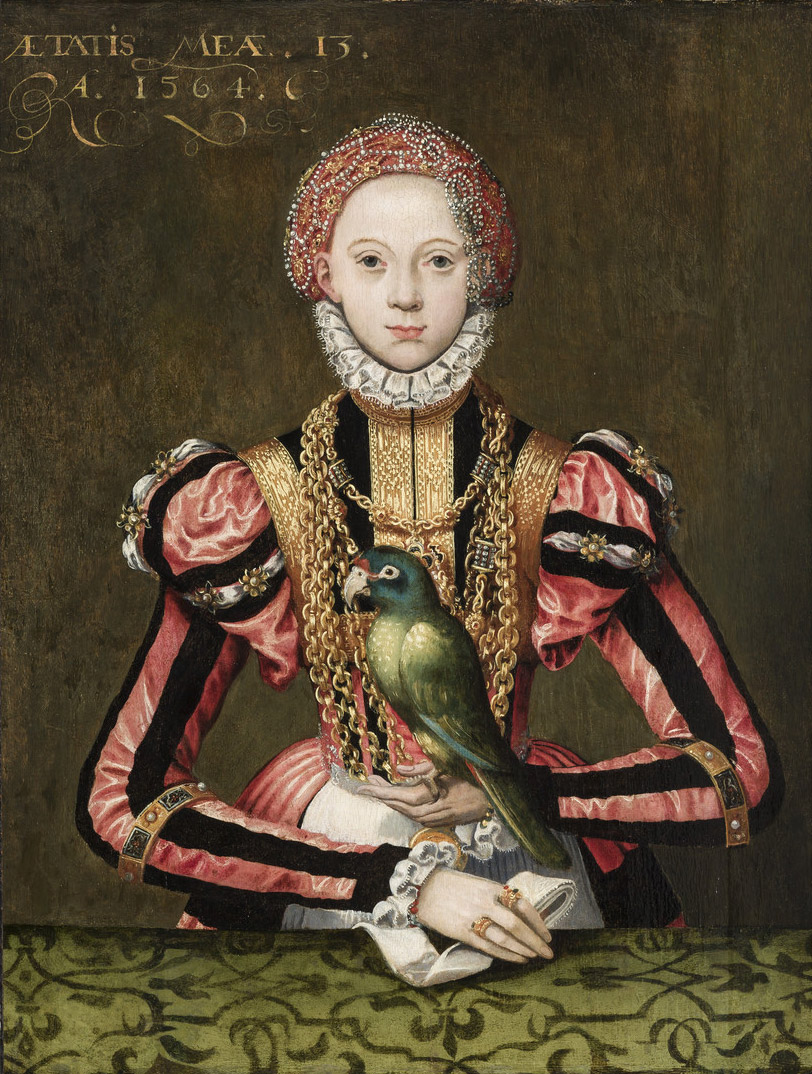
[images] (1) King Charles the Bald on his throne. Charles the Bald {Charles le Chauve} was the son of King Louis the Pious and became King of West Francia in 843. The image is a detail from an illustration of the Vivian Bible being presented to King Charles. This illustration was made by monks of the Abbey of Saint Martin of Tours about 846. From folio 423r of the Vivian Bible {Bible de Vivien}. The Vivian Bible is a bible that Count Vivian gave to Charles the Bald in 846. Preserved as MS. Bibliothèque nationale de France, Lat. 1. (2) Ermengard, Countess of Rietberg from 1562 to 1584. Portrait painted by Hermann Tom Ring in 1564. Preserved in Collection Fritz Thomée. Source image via Wikimedia Commons and Bildindex der Kunst und Architektur. Here’s a family portrait that includes Ermengard of Rietberg.

References:

Ferrante, Joan M., trans. 1974. Guillaume d’Orange: Four Twelfth-Century Epics. New York: Columbia University Press. Review by Diana Teresa Mériz.

Langlois, Ernest. 1920. Le Couronnement de Louis, chanson de geste du XIIe siècle. Les classiques français du Moyen Âge, 22. Paris: Champion. Alternate presentation.

Wienbeck, Erich, Wilhelm Hartnacke, and Paul Rasch, eds. 1903. Aliscans. Kritischer Text. Halle A.D.S: Verlag Von Max Niemeyer.

did Guiborc offend her husband William of Orange?

According to the twelfth-century epic cycle known as William of Orange {Guillaume d’Orange}, Guiborc and the Frankish count William enjoyed married life together for more than a hundred years. Guiborc was formerly known as Orable, queen to the mighty king Tiebaut, a bitter foe of the Franks. Throughout the difficulties of her second marriage, Guiborc experienced the fullness of life:

She had much pain and suffering
and many joys — that was the truth.

{ Mout ot ëu et paines et lasté
Et mainte joie, che fu la verité. }[1]

As an old woman, Guiborc became mortally ill. She then acted in a way nearly inconceivable today:

The lady-lord commanded Sir William to come,
and he came to her. He didn’t wish to refuse her.
“What would please you, lady-lord, for holy charity?”
“I will tell you,” said the lady-lord, “in God’s name.
I am very sick. I cannot escape it.
We have often joked and laughed together.
Now I beg you, for holy charity,
if I have ever offended you, in word or in thought,
by God I pray that you forgive me my offense.”
And William said, “As you wish!
By God and by me to you let all be forgiven.
Little will I have joy when you depart from me.
It troubles me to lose you so soon.”

{ La dame a fait dant Guillaume mander,
Et il i vint, ne le vaut refuser.
“Que vous plaist, dame, por sainte charité?”
“Jel vos dirai,” dist la dame, “en non Dé.
Malage ai grant, jou n’en puis escaper.
Par maintes fois avons ris et gabé:
Or vous pri jou, pour sainte charité,
S’ainc vos mesfis en dit ne en pensé,
Pour Dieu vos pri que le me pardonés.”
Et dist Guillaume: “A vostre volenté!
De Dieu, de moi vos soit tout pardoné.
Poi avrai joie quant de moi partirés;
Che poise moi quant si tost me falés.” }

Why would a privileged women, as most women have always been relative to men, ask her husband for forgiveness?

As a young man, William, known more fully as William Fierebrace {William Fierce-Arm}, enjoyed having sex with many young women. In fact, one spring in Nîmes, the young, unmarried William lamented that he and his knights lacked “young ladies to delight our bodies {damoisele por noz cors deporter}.” He said to his nephews Guielin and Bertrand:

Listen to me, worthy valiant knights,
from France we came not very long ago.
If only now we had a thousand young women
so that our barons might be delighted,
and I too might go to frolic with them.
That activity appeals to my desire.

{ Entendez moi, franc chevalier vaillant.
De France issimes il n’a mie lonc tens;
S’éussons ore mil puceles ceanz,
De ceus de France, as genz cors avenanz,
Si s’i alassent cist baron deportant,
Et ge meïsmes allasse donoiant,
Icele chose me venist a talant. }[2]

William had strong, independent sexuality. While wives with this characteristic now garner much public praise, such husbands often are required to apologize to their wives. Nonetheless, Guiborc on her deathbed didn’t ask William to apologize to her for his ardent love for women.

William with apparently narrow desire fell ardently in love with Orable. Gilbert, who escaped captivity in the Saracen city of Orange, told William about its queen Orable:

There you might recognize the lady-lord Orable.
She is the wife of Sir Tiebaut the Slav.
There is no one so beautiful in all of Christendom,
nor in pagandom wherever you would know to seek.
She is lovely in body, slender and soft,
are her eyes are gray-blue like those of a molting falcon.
How wicked it is for her to know great beauty
when she does not believe in God and his goodness!
A noble man could delight in her.
She could be saved if she wished to believe.

{ La porrïez dame Orable aviser,
Ce est la feme a dant Tiebaut l’Escler;
Il n’a si bêle en la crestïenté,
N’en paienie qu’en i sache trover:
Bel a le cors, eschevi et mollé,
Et vairs les eulz comme faucon müé.
Tant mar i fu la seue grant beauté,
Quant Deu ne croit et la seue bonté!
Uns gentils homs s’en peüst deporter;
Bien i fust sauve sel vosist créanter. }

God promised seminal blessing to his people. William vowed to win the African-Persian-Slavic-Turkish queen Orable and her enemy city. He was almost surely thinking only of his own passionate desire.[3]

Just as many men died in the horrific war over Helen of Troy, many men died in William’s attempt to win Orable and Orange. Gilbert warned William against the attempt:

If you had a hundred thousand men with swords,
with beautiful armaments and golden shields,
and you wished to begin the battle,
if there had been no water or obstacle,
before you had even entered the large gates,
there would be a thousand blows of the sword,
many belts torn, many shields pierced
and many fine barons killed in the street.
Let it be. It’s madness to consider.

{ S’estïez ore .c.m. as espees,
A beles armes et a targes dorees,
Et vosissiez commencier la mellee,
N’i eüst eve ne nulle destornee;
Ainz qu’eüssiez es granz portes l’entree,
I auroit il feru .m. cops d’espee,
Tant cengles routes, tantes targes troees,
Et tant baron abatu par l’estree!
Lessiez ester, folie avez pensee. }

William’s nephew Bertrand, who appreciated beautiful young women, nonetheless also urged William not to be insane:

If you were now in the palace of the city
and you could see those Saracen people,
you would be known by your nose-bump and your laugh.
So they would know well that you are a spy.
And then, I fear, you would be brought to Persia.
They would feed you without bread and without flour.
They would not wait long before they killed you.

If by love you were to come to judgment,
the people of your empire would say
that you saw evil through Orable the queen.

{ S’estïez ore el palés de la vile
Et veïssiez cele gent sarrazine,
Connaistront vos a la boce et au rire,
Si savront bien que vos estes espie.
Et lors, espoir, vos menront en Persie;
Mengeront vos sanz pain et sanz farine,
Ne targeront que il ne vos ocïent.

Se por amor estes mis a joïse
Dont porra dire la gent de vostre empire
Que mar veïstes Orable la roïne. }

With the insane love that the foolish Roman general Gallus championed, William insisted on seeing Orable:

I would much prefer to die and have lost my life
than that I eat bread made from flour,
or eat salted fish or drink fermented wine.
Instead, I will see how Orange is seated
and the palace Gloriete with its marble tower
and lady-lord Orable, the courtly queen.
Love for her torments and governs me.
A man who loves is full of insanity.

{ Mielz voil morir et a perdre la vie
Que je menjuce de pain fet de farine,
De char salee ne de vin viez sor lie,
Einçois verrai comme Orenge est asise
Et Glorïete, celé tor marberine,
Et dame Orable, la cortoise roïne.
La seue amor me destraint et jostise;
Home qui aime est plains de desverie. }

William had never even met Orable. Why wasn’t he satisifed with having a thousand young women from France?

William, Gilbert, and the loyal knight Guielin disguised themselves as Turkish interpreters from Africa and entered Orange. There they met King Aragon, the son of the African-Persian-Slavic-Turkish king Tiebaut. They asked to see King Tiebaut’s wife Orable. Aragon lamented that his father was an old man with a snow-white beard and a young, beautiful wife. Aragon declared that it would be better for his father to love Soribant of Venice, a pleasure-loving young man with his first beard. Aragon observed:

Much too much foolish is an old man who loves a young woman.
Soon he is cuckolded and driven into folly.

{ Trop par est fox vielz homs qu’aime meschine,
Tost en est cous et tornez a folie. }

William shrewdly suspected heterosexual jealousy. He asked Aragon whether he loved his father’s wife. Aragon insisted that he did not.

William and his companions visited Orable in her lavish palace called Gloriete. It had marble walls and windows sculpted from fine silver. Pine trees and other fragrant plants grew within the palace. Most beautiful of all was Orable:

There sits Orable, the African lady-lord.
She is dressed in Persian ceremonial cloth,
tightly laced on her noble body,
with rich silk sewn on the sides.
Rosiane, the niece of Rubiant,
makes a breeze for her with a fan of silver.
She is more white than snow that shines
and more red than the fragrant rose.

{ La sist Orable, la dame d’Aufriquant;
Ele ot vestu un paile escarinant,
Estroit lacié par le cors qu’ele ot gent.
De riche soie cousue par les pans.
Et Rosiane, la niece Rubiant,
Le vent li fist a un platel d’argent.
Ele est plus blanche que la noif qui resplent
Et plus vermeille que la rose flerant. }[4]

Orable sat the men next to her on a silver and gold bench. William’s body trembled in awe. He declared that this place was Paradise. Orable asked them why they had come to Orange. They said that they were carrying a message under duress. William Fierebrace had captured them, they claimed, and freed them only under oath that they would convey to the leaders of Orange that all must flee the city immediately, for William will come to attack it. Orable asked:

What sort of man is Sir William Fierebrace,
he who has taken Nîmes, the palace and the halls,
and killed my men and is still threatening me?

{ Quiex hom est dont Guillaumes Fierebrace,
Qui a pris Nymes, le palés et les sales,
Et mort mes homes et encor me menace? }

William answered:

“You see,” said the count, “he has a very fierce heart,
and his fists are huge and his arm marvelous.
There is no man so great from here to Arabia,
who if William strikes him with his sword that wounds,
would not have all his body and arms cut apart.
From here straight to the earth cuts his sword that wounds.”

{ Voir, dit li cuens, moult a fier le corage,
Et gros les poinz et merveilleuse brace.
N’a si grant home desi que en Arabe,
Se il le fiert de l’espee qui taille,
Que ne li tranche tot le cors et les armes;
Desi en terre cort l’espee qui taille. }

Upon hearing of William’s impressive sword, Orable responded with mixed emotions:

“You see,” said the lady-lord, “this is a very great injury!
By Mohammed, he should hold well domains.
Happy the lady who has his heart.”

{ Voir, dist la dame, ce est moult grant damaige!
Par Mahomet, il doit bien tenir marche;
Liee est la dame en cui est son coraige. }

Orable was attracted to William just as William was attracted to her. Medieval literature doesn’t typically gender-demonize men’s impulsive desire.

Armed pagans began massing outside Gloriete. With the help of an informer, the Saracens had identified the disguised William and his companions. The trio fought strongly against the pagans attempting to capture them. They seemed certain to be killed. Then the Persians would attack Nîmes for further revenge. Guielin taunted William for his madness:

Because of love you came here.
There is Orable, the lady-lord of Africa.
There is none so beautiful living in this age.
Go sit beside her on that bench,
throw both your arms around her sides,
and don’t be slow to kiss her.
For by the apostle that penitents seek,
never will we have the value of that kiss
unless it’s worth twenty thousand silver marks
and much suffering in sadness to our families.

{ Par amistiez entrastes vos ceanz;
Vez la Orable, la dame d’Aufriquant,
Il n’a si bele en cest siecle vivant;
Alez seoir delez li sor cel banc,
Endeus vos braz li lanciez par les flans
Ne de besier ne soiez mie lenz;
Que, par l’apostre que quierent peneant,
Ja n’en avrons del besier le vaillant
Qui ne nos cost .xx.m. mars d’argent,
A grant martire a trestoz noz parenz. }

Without being asked for her advice, Orable urged William and his companions to surrender. She said that if they didn’t surrender, they would be killed. Men are commonly averse to receiving unsolicited advice from women who love them. Yet Orable’s advice had much merit. Her giving unsolicited advice to William probably wasn’t an offense for which she sought forgiveness on her deathbed.[5]

William didn’t follow Orable’s advice to surrender. She wasn’t offended. He urgently asked her to give him weapons and armor. She gave him her husband Tiebaut’s bejeweled golden helmet, his golden mail, his magnificent sword, and other armor and weapons. She also provided William’s companions with armor and weapons. So equipped, they killed many pagans and drove the rest of the Persians out of the palace. Then they secured the palace gates. The Saracens, however, entered via a secret passage. After a horrific battle, the Slavs captured the Franks. That wasn’t Orable’s fault.

The pagans intended to place the captive William and his companions into a ditch and burn them alive. Queen Orable, however, requested custody of the captives. King Aragon refused her request and blamed her for arming them. The king apparently forgot who actually rules:

The lady-lord hears him, and no more enraged could she be made.
“Wickedly you thought of this, you son of a whore, you pig!
By Mohammad, whom I praise and adore,
if it weren’t improper now by these other barons,
I would strike you on the nose with my fist.
Get out of my tower quickly!
If you stay longer here you will never regret it more.”

{ La dame l’ot, a pou d’ire ne font.
“Mal le pensastes, filz a putain, gloton!
Par Mahomet qui ge pri et aor,
Ne m’estoit ore por cez autres barons,
Ge vos dorroie sor le nes de mon poing.
Isnelement issez hors de la tor!
Ja plus ceanz mar seroiz a sejor.” }

King Aragon wisely accepted Oracle’s command.

Orable visited the Franks held in the city’s dungeon. She said that if William promised to marry her, she would become Christian and free them from the dungeon. William immediately, enthusiastically agreed. Some might judge that Orable coerced William into marrying her. That’s vain judging. William didn’t feel wronged, and Orable on her deathbed didn’t seek forgiveness for the way she married William.

After Orable and William married, she became a Christian and changed her name to Guiborc. King Tiebaut subsequently waged war against William and the Franks in order to recover Guiborc and Orange. William’s Franks suffered a terrible defeat at Aliscans. Then the pagans surrounded Orange. Guiborc urged William to summon help from his brother-in-law King Louis, Charlemagne’s son. Nonetheless, she was concerned about the danger involved in William journeying to Louis’s court:

There you will see many well-colored young women
and many lady-lords adorned with nobility.
I know very well that soon you will forget me.
Then your love will turn to another there.

{ Mainte pucele i verés couloree
Et mainte dame par noblece acesmee.
Je sai tres bien, tost m’avrés obliëe,
Lués i sera vostre amors atornee. }[6]

William looked at Guiborc and began to weep:

He embraced Guiborc so that she was comforted.
Much and often he has kissed and caressed her.
The count said: “Lady-lord, don’t be upset.
You have my oath that I swear to you:
I will not have this shirt removed,
nor my pants or hose removed, nor my head washed;
I will not eat meat or taste pepper,
I will not drink wine nor any spiced drink
from a wooden cup or a golden goblet,
except water, which should be allowed to me;
I will not eat kneaded hearth-cakes,
only the coarse bread where the chaff is found;
I will not rest on a feathered mattress;
I will not have my linen and embroidered cloth,
only the felt that covers my saddle
and that robe that I will be wearing there.
Never will my lips be touched to any other person’s,
until they have kissed and savored your lips
in this palace, where the hallway is paved.”

{ Guiborc enbrace, si l’a reconfortee;
Molt l’a sovent basie et aeolee.
Dist li quens: “Dame, ne soiés trespensee;
Tenés ma foi, ja vos ert afiëe,
Ke je n’avrai cemise remuëe,
Braies ne cauces, ne ma teste lavee,
Ne mangerai de char ne de pevree,
Ne bevrai vin ni espesce colee
A maserin ne a coupe doree,
Se aige non, icele m’ert privee;
Ne mangerai fouace buletee,
Fors le gros pain ou la paille ert trovee;
Ne ne girrai desor coute enplumee,
N’avrai sor moi linéuel, cortine ovree,
Fors la suaire de ma sele afeutree
Et tele robe, que j’i avrai portee.
Ne ja ma bouce n’ert a autre adesee,
S’iert de la vostre basie et savoree
En cest palais, dont li aitre est pavee.” }

By promising to become a dirty, stinky man during his stay at Louis’s royal court, William added credibility to his vow of faithfulness. William strove to assure Guiborc of his steadfast love for her. On her deathbed, Guiborc didn’t need to seek forgiveness for her concern to keep her husband William’s love.

Guiborc, however, had good reason to seek forgiveness from her husband. When William, chased hotly by enemy troops, had returned to Orange, the city gates were locked. He pleaded to Guiborc to let him in. She delayed because she wasn’t able to distinguish her husband from other men:

I will not order the gate or postern opened
until I have seen your head uncovered
and examined the bump on your nose with my eyes,
because many men resemble each other in their talking.
I am here alone. No one should blame me.

{ Ne ferai porte ne guichet desfermer,
Des ke je voie vostre cief desarmer
Et sor le nes la bouce as iex mirer,
Car plusors homes se semblent au parler.
Chaiens sui seule, ne m’en doit on blasmer. }[7]

Guiborc’s claim that many men talk similarly carries a whiff of anti-meninism. Nonetheless, William didn’t denounce his wife for sexism. He lowered his visor so that she could see his nose.

Just then a hundred pagans were crossing the field outside Orange. They led two hundred captive Frankish men and thirty captive Frankish women. Men suffer more than women in war. Guiborc said to William that if he were William, he would rescue those captives. Women should not goad men into dangerous feats. William responded to Guiborc’s incitement as men have throughout history:

“God,” said the count, “now it is wished for me to prove myself!
But by the one who has saved all,
I will not stop for my head being cut off,
even if I must be all dismembered alive.
In front of her I will go now to fight.
For her love it is required from me that I greatly endanger myself.
In order that God’s law is exalted and lifted up,
I must suffer and be tortured in my body.”

{ “Dex”, dist li quens, “or me velt esprover!
Mes par celui, qui tot a a sauver,
Je nel leroie por la teste a coper,
Se m’en devoit trestoz vis desmembrer,
Que devant lui ne vois ore joster.
Por soe amor me doi je bien grever;
Por la loi deu essaucier et monter
Doi je mon cors traveillier et pener.” }[8]

God’s law doesn’t require men to suffer violence against men. Neither should women require men to engage in violence against men in order to earn their love. Lacking meninist learning, William quickly killed four men. The rest of the enemy men fled. Guiborc then called out to William:

Come back, beautiful lord, now you may enter here.

{ Venez, biau sire, or i poez entrer. }Al, 1715

Guiborc on her deathbed needed forgiveness from William for her actions that encouraged and promoted violence against men.

Unlike many women today, Guiborc didn’t use men only for violence against men. She declared that when William left to get help from King Louis, she and other ladies would fight for Orange:

I will remain in Orange the Great
with the lady-lords, of whom so many are here.
Each one will have an Algerian hauberk
and on her head a shining green helmet
and at her side she will have girded a good sword,
at her neck a shield, and a sharp spear in her fist.
Also here are knights, I don’t know how many,
whom you rescued from the non-believing people.
We will climb onto these walls in the front
and defend them well, if the Turks are attacking.
I will be armed according to the norm of combat.
By Saint Denis, whom I take as surety,
there will not be a pagan, Saracen, nor Persian
who if I can reach him by throwing a stone,
will not have his body knocked off his charger.

{ Je remanrai en Orenge le grant,
Aveuc les dames, dont il a caiens tant.
Cascune avra le hauberc jaserant
Et en son cief le vert elme luisant
Et au costé avra chaint le bon branc,
Au col l’escu, el poing l’espil trenchant.
Si sont caiens Chevalier, ne sai quant,
Ke delivrastes de la gent mescreant.
Deseur ces murs monterons la devant,
Bien desfendrons, se Turc sont assaillant.
Jou ere armee a loi de combatant.
Par Saint Denis, que je trai a garant,
N’i a paien, Sarrasin ne Persant,
Se je l’ataing d’une piere en ruant,
Ne le convingne chaiir de l’aufferrant. }[9]

While Guiborc probably shouldn’t be regarded as a proto-meninist, she certainly had some sense of women’s obligations within authentic gender equality. William surely credited Guiborc on her deathbed for her proto-meninist sentiment.[10]

On her deathbed, Guiborc rightly asked for forgiveness from her husband William of Orange. She sought forgiveness for her offenses in word or thought. That specification implicitly encompasses any intentional action. Forgiveness is to be sought not only from God.[11] All spouses should ask each other for forgiveness — and not just on their deathbeds.

* * * * *

Read more:

Notes:

[1] The Monastic Life of William {Le Moniage Guillaume} (short version / version I) vv. 9-10, Old French text from Cloetta (1906-11) vol. 1, English translation (modified) from Ferrante (1974). The subsequent quote above is similarly from Le Moniage Guillaume, vv. 24-36.

Here’s more on the epic hero William as a monk. Before Guiborc died and William became a monk, William and Guiborc had at least three children together: the counts Bertrand, Gerard, and Anseis. Aliscans vv. 8391-2.

Le Moniage Guillaume is a “song of deeds {chanson de geste}” within the major Old French epic cycle known as the Deeds of Garin de Monglane {Geste de Garin de Monglane} or Cycle of William of Orange {Cycle de Guillaume d’Orange}. The Crowning of Louis {Le Couronnement de Louis}, The Taking of Orange {La Prise d’Orange}, and Aliscans are also chansons de geste in that cycle. Many other chansons de geste exist.

[2] The Taking of Orange {La Prise d’Orange} (redaction AB), vv. 85-91, Old French text from Régnier (1977), English translation (modified) from Ferrante (1974).

When fierce Saracen enemies besieged Rome, the Pope urgently sought William to fight them. If he did, the Pope offered William an amorous indulgence. He could henceforth “have as many women as your heart desires {feme prendre tant come il t’iert corages}.” Le Couronnement de Louis, v. 391, Old French text from Langlois (1920), my English translation.

While humans are entitled to love by their human dignity, men’s entitlement to love tends to be socially devalued. Prise d’Orange features in William an epic hero more fully human than the warrior-man driven to engage in violence against men. “William’s preference for amorous pleasures over heroic pursuits … becomes in fact the motivating force of the entire epic.” Kibler (1974) p. 12. Critics have difficulty understanding men escaping from gender constraints:

Consistently comedic on both a stylistic and a situational level, pointedly irreverent in its treatment of conventional epic motifs, narrative patterns, and characters, and self-consciously given to sidelining heroic military exploits and the stern warrior ethos affirmed by their narration so as to make room for erotic desire and burlesque episodes, the Prise has tempted critics to emphasize its scandalous infidelity — whether symptomatic of generic “decadence” or “renewal” — to traditional or canonical models of the chanson de geste.

Wood (2021) para. 1. Wood, however, failed to move beyond a conservative reading of La Prise d’Orange, and instead concluded with military language: tactical resources, arsenal, maneuvers, and operations. Id. para. 31.

Other quotes from La Prise d’Orange are similarly sourced. The previous short quote above, “young ladies to delight our bodies,” is Prise d’Orange, v. 57. Subsequent quotes above are Prise d’Orange vv. 252-61 (There you might recognize the lady-lord Orable…), 308-16 (If you had a hundred thousand men…), 336-42, 348-50 (If you were now in the palace…), 353-60 (I would much prefer to die…), 628-9 (Much too much foolish is an old man…), 660-7 (There sits Orable…), 722-4 (What sort of man is Sir William Fierebrace…), 725-30 (“You see,” said the count, “he has a very fierce heart…”), 725-30 (“You see,” said the lady-lord, “this is a very great injury…”), 911-20 (Because of love you came here…), 1237-43 (The lady-lord hears him, and no more enraged…).

[3] Love between a Frankish hero and a Saracen princess or queen is a motif in Old French romance and epic. Kinoshita smothers the love of Orable and William {Guillaume} in ideologically satisfying invocations of colonialism and the dominant gender narrative:

Guillaume’s infatuation with and seduction of the foreign and female Other constitute a quintessential scenario of desire, crusade, and conquest. … the key to this ideologically satisfying gendered representation of medieval colonialism is the conversion of Orable, whose seduction makes standard tales of courtly love seem like stylized, depoliticized repetitions. … By gendering its politics of conquest, La Prise d’Orange anticipates the strategy of later colonial administrations that sought to collaborate with the women under the pretext of liberating them from oppression by their own men.

Kinoshita (2006) pp. 48, 72. The claim that women need to be liberated from their own men’s oppression has long been part of oppressive, imperialist gender projects. Unlike Kinoshita, La Prise d’Orange uses African, pagan, Persian, Saracen, Slav, and Turk capriciously to highlight a distinctive sense of Frankish identity.

[4] When Orable was thrown into the dungeon with William and Guielin, Orable lamented being punished “as if it were for whoring {comme fust par putage}.” Guielin responded sarcastically that she at least now was with William. William then furiously threatened Guielin. Guielin told him not to be foolish and declared:

Once you were called William the Fierce-Arm,
now you will be called William the Lover.

{ L’en soloit dire Guillelme Fierebrace,
Or dira l’en Guillelme l’Amïable. }

Prise d’Orange, vv. 1552p, 1162-3.

[5] When William was in despair at the destruction of Orange, Guiborc assertively told him:

Good counsel, when given, should be followed,
and I am one who will give you good counsel.
Rebuild Orange! It will regain its glory.

{ Le bon conseil, se li done, crera,
Et je sui cele qui bon le vos donra:
Refai Orenge! A grant pris tornera. }

Aliscans, vv. 8411-3,Old French text from Wienbeck, Hartnacke & Rasch (1903), English translation (modified) from Ferrante (1974). Even if medieval men resented women’s privilege, sometimes they recognized good counsel.

[6] Aliscans, vv. 1974-7, Old French text from Wienbeck, Hartnacke & Rasch (1903), English translation (modified) from Ferrante (1974). Here are citations to manuscripts of Aliscans.

Engaged in fighting for Rome, William had nearly married the daughter of King Gualifier. “Quickly he seemed to have forgotten Orable {Trestot aveit entroblïé Orable}.” Le Couronnement de Louis, v. 1433, Old French text from Langlois (1920), my English translation. William rushed away from that marriage ceremony only because messengers announced that Charlemagne had died and his son and heir Louis needed William’s help. Le Couronnement de Louis, laisses 32-34.

Subsequent quotes from Aliscans are similarly sourced. Those above are Aliscans vv. 1985-2003 (He embraced Guiborc…), 1656-60 (I will not order the gate or postern opened…), 1681-88 (“God,” said the count…), 1715 (Come back, beautiful lord…), 1948-62 (I will remain in Orange the Great…).

[7] William was known for his distinctively shaped nose. His nose was shaped through a blow from the Saracen giant Corsolt:

He struck William with a blow so fierce
he tore the helmet, the nasal was pierced.
He cracked the hood of the hauberk that gleamed,
and crushed the hair on his forehead lean,
cut the end of his nose with his sharp steel,
for which the count would much ridicule hear.

{ Et fiert Guillelme par tel devision
Que le nasel et l’elme li desront.
Trenche la coife de l’alberc fremillon.
Et les chevels li trenche sorle front,
Et de son nés abat le someron.
Maint reprovier en ot puis li frans om. }

The Crowning of Louis {Le Couronnement de Louis}, vv. 1037-42, Old French text from Langlois (1920), English translation from Ferrante (1974). William later remarked that he suffered little:

Only the nose is shorter on my face,
but I am sure that will lengthen my name.

{ Mais que mon nés ai un pou acorcié;
Bien sai mes nons en sera alongiez. }

Le couronnement de Louis, vv. 1159-60, sourced as previously. William came to be called William with the Short Nose {Guillelme au cort nes}.

[8] With respect to La Prise d’Orange, Kibler declared:

The martial values which created a Roland or an Isembart, or even the earlier William of Orange, have ceded their place to the amorous values of romance. William, the epic hero in love, can only appear ridiculous.

Kibler (1974) p. 25. Kay (1995) perceptively challenged the successionist view of chansons de geste yielding to romance. From a humane perspective, the epic hero is always ridiculous. That’s presented clearly in Aliscans, vv. 1681-8.

[9] Guiborc and the ladies of Orange actually did fight against besieging Saracens. Aliscans, vv. 3978-86. Here’s some discussions of Alvild and other medieval Viking women-warriors.

Guiborc showed admirable love for William in other ways. For example, William led the Frankish force in the arduous journey back to the besieged city of Orange. Guiborc honored her husband’s difficult and dangerous work:

Before brave William had come to the palace,
Guiborc has dinner prepared.

{ Ains qu’el palais fust Guillames li ber,
Ot fait Guibourc le mangier aprester. }

Aliscans, vv. 7502-3. Guiborc transgressively challenged other privileged women’s value as wives.

[10] As Kay (1995) makes clear, meninism is part of the political unconscious, the non-dit, of status-seeking academic discourse. Meninism challenges the dominant relations of academic production in which patriarchy functions as an obscuring myth for the unspeakable desires and interests of gynocentrism.

[11] Asking for forgiveness (“I confess {Confiteor}“) was incorporated into the medieval Christian Mass. That Mass element includes confession of having sinned “in thought, word, and deed {cogitatione, verbo et opere}” (in the Sarum rite, “cogitatione, locutione et opere”). This became a common template of confession, e.g. “through work or through word or will of my heart {þorugh werke or þorugh worde or wille of myn herte}.” Piers Plowman, B.14.14.

[images] (1) “La Chanson de Guillaume.” Musical recording by Diabolus in Musica, Antoine Guerber, director. Via YouTube. (2) “Chanson pour Guillaume.” Avalon Jazz Band, featuring Tatiana Eva-Marie. Song released in 2019. Via YouTube.

References:

Cloetta, Wilhelm, ed. 1906-11. Les Deux Rédactions en Vers du Moniage Guillaume; chansons de geste du XIIe siècle, publiées d’après tous les manuscrits connus. 2 vols. Paris: Firmin-Didot pour la Société des Anciens Textes Français. Vol. 1 (editions). Vol. 2 (commentary and supporting matter).

Ferrante, Joan M., trans. 1974. Guillaume d’Orange: Four Twelfth-Century Epics. New York: Columbia University Press. Review by Diana Teresa Mériz.

Jonckbloet, W.J.A., ed. 1854. Guillaume d’Orange. Chansons de geste des XIe et XIIe siècles publiées pour la première fois. La Haye: Martinus Nyhoff.

Kay, Sarah. 1995. The Chansons de geste in the Age of Romance: Political Fictions. Oxford: Clarendon Press.

Kibler, William W. 1974. “Humor in the Prise d’Orange.” Studi di Letteratura Francese. 3: 5–25.

Kinoshita, Sharon. 1995. “The Politics of Courtly Love: La Prise d’Orange and the Conversion of the Saracen Queen.” Romanic Review. 86 (2): 265-87.

Kinoshita, Sharon. 2006. Medieval Boundaries: Rethinking Difference in Old French Literature. Philadelphia, PA: University of Pennsylvania Press. Chapter 2 (pp. 45-73) is a revised version of Kinoshita (1995).

Langlois, Ernest. 1920. Le Couronnement de Louis, chanson de geste du XIIe siècle. Les classiques français du Moyen Âge, 22. Paris: Champion. Alternate presentation.

Régnier, Claude, ed. 1977. La Prise d’Orange: Chanson de geste de la fin du XIIe siecle. Fifth edition. Paris: Editions Klincksieck. Rédaction AB.

Wienbeck, Erich, Wilhelm Hartnacke, and Paul Rasch, eds. 1903. Aliscans. Kritischer Text. Halle A.D.S: Verlag Von Max Niemeyer.

Wood, Lucas. 2021. ‘Reading “Guillelme l’Amïable”: Hypertextuality and La Prise d’Orange.’ Perspectives médiévales. 42. Online.

Saint Kentigern’s reported virgin birth rationalized with rape

In twelfth-century Glasgow, ordinary persons regarded the great Scottish saint Kentigern, affectionately known as Mungo, to have been born of a virgin mother named Taneu. In Christian understanding, the young woman Mary conceived of the Holy Spirit and as a virgin gave birth to Jesus. Clerics regarded belief that Taneu similarly birthed Saint Kentigern to have arisen among “foolish and stupid people living in Saint Kentigern’s diocese {populus stultus et insipiens in diocesi Sancti Kentigern degens}.”[1] Two clerics authoritatively constructed Kentigern’s reported virgin birth to have resulted from a man raping Kentigern’s virgin mother. Under Christian doctrine, rape cannot deprive a woman of her virginity. A literary construction of rape thus rationalized popular belief in Kentigern’s virgin birth. In deploying rape for rationalizing, medieval clerics shrewdly drew upon deeply entrenched suspicion of men’s sexuality.

According the mid-twelfth-century Herbertian Life of Kentigern, Kentigern’s mother Taneu was the daughter of King Leudonus. That king ruled the province of Leudonia in northern Britannia. King Leudonus was only “semi-pagan {semipaganus}.” Moreover, Taneu was born of a “stepmother {noverca}.” This pedigree opened the possibility for Taneu to have Christian heritage despite her father:

Indeed this young women nonetheless had Christian faith. After the voice of apostolic doctrine was breathed into her ears, she re-oriented herself to learn most devoutly what she could about Christian rites.

{ Hec quippe puella, fide tamen Christiana postquam apostolice sonus doctrine in auribus ejus ventilabatur, Christianis se ritibus quos discere potuit devotissime mancipavit. }[2]

Christians regard Christ as their model. Mary was the first Christian and the preeminent disciple of Christ. Taneu sought to imitate Mary:

She constantly meditated upon the virginal honor and also upon the maternal blessedness of the most holy Virgin Mary, mother of our lord Jesus Christ. Pondering them in her heart, she said simply, “O how glorious is the name of this excellent virgin, and how gloriously her name is celebrated by all people throughout the four regions that constitute the world. I wish that I could be made similar to her in virginity and in birthing for the honor and salvation of my people in these northern parts.”

{ De virginali etiam honore et de materna beatudine sanctissime Virginis Marie, matris Domini Nostri Jesu Christi, iugiter meditabatur, et in corde suo revolvens simpliciter dicebat: O quam gloriosum nomen hujus virginis generose, et quam gloriose celebratur ab omni populo per iiijor climata mundi constituta. Utinam in virginitate et in partu, ad honorem et salutem gentis mee in partibus saltem aquilonalibus, illi possem assimilari. }[3]

Jesus’s disciples James and John wanted to sit at Jesus’s right and left hands in his glory. That’s a prideful desire. Taneu, in contrast, sought the honor and salvation of the non-Christian Leudonians. Perhaps she also desired to have her name honored and celebrated like that of the Virgin Mary.[4] In any case, popular belief celebrated Taneu as a virgin who gave birth to Saint Kentigern.

O Virgin of virgins,
how shall this be?
For neither before thee
was there any like thee,
nor shall there be after.

Daughters of Jerusalem,
why marvel you at me?
The thing that you behold
is a divine mystery.

{ O Virgo virginum,
quomodo fiet istud?
Quia nec primam
similem visa es,
nec habere sequentem.

Filiae Jerusalem,
quid me admiramini?
Divinum est mysterium
hoc quod cernitis. }[5]

Learned clerics insisted that Taneu could not be like the Virgin Mary in giving birth as a virgin. The Herbertian Life of Kentigern perceived Taneu to be challenging the divine order:

Her life could not be as she wished. Moreover, it was imposed because of her mind’s presumption and the impudence of her vainly sought glory that she endure large and dreadful torments.

{ volebat sicut fieri non potuit. Ob mentis autem imposte presumptionem, vaneque glorie petulanciam, tormenta dira et magna sustinuit. }

The Herbertian Life of Kentigern designed those torments to come from the “most elegant {elegantissimus}” young man Ewen, “sprung from the most noble lineage of the Britons {nobilissima Brittonum prosapia ortus}.”[6] The Herbertian Life of Kentigern made this Ewen rape Taneu. It thus taught that even an apparently very admirable man could be a rapist.

Ewen didn’t initially act like a violent man. He was ardently in love with Taneu. He spoke to her words of love and lovingly gave her gifts. He sought to marry her. Moreover, he gained her father’s support for marrying her. Nonetheless, because she wanted to be like the Virgin Mary, Taneu resolutely rejected Ewen’s marriage proposal. She radically misunderstood the glory of human love in Christianity.

Like most fathers throughout history, Taneu’s father wanted the best for his daughter. Daughters sometimes reject their fathers’ pleas without regard for their father being nominally a king, merely a household servant, or even a person academically defined as the pater familias. Mis-educated about father-daughter relational reality, Taneu’s father became furious and acted cruelly toward her:

The king, the father of the young woman, after many sweet words and flattering speeches that he thought would change her mind to love the young man, was seeing himself to be toiling in vain. He then spoke to her shamelessly: “Either you will be handed over to the care of a swineherd, or you will keep warm in marriage to this young man. Therefore, from these two decrees now choose what you wish.” The king indeed said this, aiming to provoke by any means the young woman’s spirit to love for the young man.

{ Cum autem Rex pater puelle, post multa verba dulcia et sermones blandos, quibus animum ejus juvenis amori putabat posse converti, se incassum laborasse conspiceret, illi procaciter intulit: Aut cure subulci traderis aut adolescentis hujus connubio perfoueris: ex his igitur binis decretis nunc elige quod vis. Hoc quippe rex dixit, estimans animum puelle in juvenis amorem quoquomodo provocare. }

The prodigal daughter Taneu preferred to serve a swineherd as a virgin than to abide in the warmth of marital love. Indignant at her choice, Taneu’s father cast her out. That’s the biblical story of the prodigal son, reversed. Taneu’s father was an ungodly father.[7]

The cruel behavior of Taneu’s father saddened Ewen. He regarded his love for her as the cause of her father’s outrage. Ewen also pitied Taneu for her wretched living circumstances. He therefore hired a woman go-between to try persuade Taneu to leave the swineherd to enjoy his love. After many visits in which the go-between reminded Taneu that she could have a much more comfortable life with Ewen, the go-between gave up. She complained to Ewen:

It would be easier to convert rocks into wood and wood into stones than to recall this virgin’s mind from the folly she has begun.

{ Facilius possunt saxa in ligna et ligna in lapides converti, quam hujus virginis animus ab incepta stulticia revocari. }

If a woman prefers to live with a swineherd as a virgin rather than marry a most elegant and most noble young man, that’s her choice.[8] At least she didn’t coerce him into a sexless marriage. Ewen should have found a cure for his lovesickness. Many men throughout history have suffered love rejection and gotten over it successfully.

To have Taneu conceive a child while remaining a virgin, Ewen became a rapist. According to the Herbertian Life of Kentigern, Ewen gained Taneu’s confidence by disguising himself as a female farm servant and helping her to feed the swine. One day Taneu was alone, washing herself at a stream near a forest. Ewen in his female disguise came to her and tenderly implored her for help in carrying wood:

The young woman was influenced by the gentle speech that she heard from the mouth of the young man. He excessively desired to obtain her. She innocently believed all his words. She simply followed the crafty young man immediately wherever he happily wished.

{ Mitis igitur puella orationis effectu quam ab ore juvenis audivit nimis potiri desiderans, quoniam innocens credit omni verbo, mox juvenem feliciter subdolum simpliciter quo voluit sequebatur. }

Everyone shouldn’t merely listen and believe women. Even a gender bigot should stop and consider whether to disbelieve a woman, for a woman might actually be a man in disguise. Taneu’s innocence and Ewen’s wickedness produced a terrible wrong:

When they came to a place suitable to the young man’s inclination, he suddenly seized the young woman as if for sex-play. He impregnated her with a thrust forward and then leaping back like an echo. She resisted being raped with all her strength and exertions.

{ Cumque pervenissent ad locum juvenis voluntati competentem, arripuit repente juvenis puellam quasi ludendo, et velut in eccho resultu ab ictu fecundavit vi oppressam totis nisibus reluctantem. }[9]

Ewen having raped Taneu provided a rational explanation for her conceiving a child. Moreover, from a Christian perspective, rape doesn’t deprive a woman of her virginity.[10] The Herbertian Life of Kentigern thus rationally explained Taneu’s virgin birth.

The Herbertian Life of Kentigern also had to rationalize Taneu’s belief that she never had sex with a man. Moreover, it had to get Ewen out of his beloved Taneu’s life. To serve these goals, Ewen was made to act and speak bizarrely after raping her:

Promptly rising, the youth appraised her, whom he had thought to be a virgin, to have been the swineherd’s concubine. Therefore the young man’s love cooled. He said to the young woman, who wasn’t able to speak because of her tears and sobbing, “Don’t weep, my dear, because I have not known you as a man would usually know a virgin. Am I not a woman like you? To lament for sex-play is therefore wickedness. Go in peace, and it is for you by your choice either to weep or to be silent.”

{ Puer autem statim consurgens, quam putavit fuisse virginem, estimavit subulci esse concubinam. Tepescente igitur juvenis amore, dixit ad puellam pro lacrimis singultivis loqui non valentem, Noli flere, soror mea, quoniam non novi te ut homo virginem nosse solet. Nonne mulier sum ego sicut et tu? Improbitatis est ergo pro ludo lugere: vade in pace, et in tuo sit arbitrio vel flere vel tacere. }

Taneu was a virgin. Yet Ewen in having sex with her wrongly sensed that she had considerable sexual experience as the swineherd’s concubine. He then suggested that he, disguised as a woman, had raped her in a lesbian way. Moreover, he called her lamenting having been raped in a lesbian way to be wickedness. That’s absurd. Taneu reasonably would be confused. That’s the purportedly rational explanation for why she claimed that she never had sex with a man.[11]

Because the Herbertian and other accounts of the life of Kentigern were regarded as unsatisfactory, late in the twelfth century the Bishop of Glasgow requested the Cistercian monk Jocelin of Furness to write another life of Kentigern. After recognizing popular belief that Taneu never had sex with a man, Jocelin declared:

By no means however should the truth of the matter be lost in the mind of anyone who is discerning.

{ nequaquam tamen rei Veritas perire debet in animo cujuslibet discreti }[12]

Jocelin pointed out how Lot’s daughters raped him:

Going to the sacred volumes, we read in the book Genesis that Lot’s daughters not only furtively seized for themselves their father’s sexual embrace when he was drunk and wholly ignorant of the deed, but also both daughters became pregnant.

{ ad sacra volumina accedentes, in libro Genesis filius Loth non solum paternos complexus furtim sibi surripuisse, sed etiam ab eodem inebriato et rei penitus ignaro, utramque concepisse legimus. }

Without mentioning Ewen, Jocelin suggested that Taneu was raped in a similar way:

Many have taken the drink of oblivion that physicians call lethargy to fall asleep. They have endured incisions in their limbs and sometimes burning and abrasions in their vital parts without feeling anything at all. After being shaken out of sleep, there are ignorant about these activities. We frequently hear of fortune-teller’s tricks overthrowing a young woman’s chastity and the very one deflowered knowing little of her deflowerer. Something of this kind may have happened to this young woman by the secret judgment of God, and so she had no sense of sexual intercourse, and now she was impregnated yet understood herself to be undiminished.

{ multos sumpto potu oblivionis quem fisici letargion vocant, obdormisse; et in membris incisionem, et aliquociens adustionem, et in vitalibus abrasionem perpessos, minime sensisse: post sompni excussionem, que erga sese actitata fuerant ignorasse. Audivimus frequenter sortilegorum prestigiis puellarem pudicitiam expugnatam esse, ipsamque defloratam defloratorem sui minime nosse. Potuit aliquid hujusmodi huic puelle accidisse, occulto Dei judicio, et ut commixtionem sexuum non sentiret, ac per hoc jam inpregnata se illibatam intelligeret. }

The verb “deflower {deflorare}” encodes disparagement of men’s sexuality, as does the assumption that pregnancy diminishes a woman. If a woman has sex while drunk, she may not remember having sex. If her husband or boyfriend was drunk after they consensually arranged to get drunk and have sex, then she raped him as much as he raped her. In practice, the crime of rape is judged with grotesque penal discrimination against men. Jocelin’s rationalization of Kentigern’s virgin birth is drenched in anti-men gender bigotry.

Jocelin seems to have internalized the anti-meninism that has long been an aspect of gynocentric culture. While implying that a man raped Kentigern’s mother, Jocelin asserted that Kentigern “nonetheless came forth just like a rose from a thorn {velud rosa tamen de spina … processit}.” The figure of a “thorn {spina}” has long been used in disparaging men’s sexually active penises. Consider moreover how Jocelin lamented the deplorable state of sexual morality in twelfth-century Britain:

Behold, all sexes and all statuses of person, all plunge into a slough of carnal filth, almost as impudently as cheerfully for lack of punishment. And not only the most vile commoners are polluted with such contagion, but also indeed those who are sustained with ecclesiastical benefices and attached to divine offices. As much as they are polluted they judge themselves to be that much happy. But now the hammerer of the entire earth, namely the spirit of fornication, passes through them.

{ Ecce omnis sexus, omnisque conditio, in omne volutabrum carnalis colluvionis, pene tam licenter quam libenter, quia impune, immergitur; et non solum vilissimum vulgus tali contagio polluitur, verum hii qui ecclesiasticis beneficiis sustentati, et divinis officiis applicati, quanto sunt fediores, tanto sese feliciores esse arbitrantur. Sed nunc illos pertransit ille malleator universe terre, spiritus scilicet fornicationis. }

Today the oppressive dogma of rape-culture culture has helped to quell the spirit of fornication. But the hammerer, who engages in banging, remains as a crude figure for men performing sexual labor. Like far too many persons right up to our time, Jocelin had little respect for men’s work:

Surely it is absurd to explore further and concerning this matter judge who was the sower and how he plowed and sowed the earth when, with the Lord giving favor, this earth brought forth the best, most abundant fruit.

{ Sane absurdum, et ab re arbitramur, diutius indagare quis quomodo sator terram araverit vel severit; cum, Domino dante benignitatem, terra ista fructum optimum et opimum protulerit. }

In a common sexual figure, the man-farmer plows the woman-earth. Here Jocelin gave the woman-earth all the credit for the fruit that was the life of Saint Kentigern. Such erasure of men’s seminal gifts contributes to the crisis of men’s self-esteem and supports massive gender discrimination against fathers in family courts.

In the miraculous context of a saint’s life, various means are possible for a virgin birth. Consider, for example, Jocelin’s story of Queen Languoreth having an adulterous affair with a soldier much subordinate to her.[13] She give him a jeweled golden ring in appreciation for his sexual service to her. Her husband, the Cambrian king Rederech, heard through an informer of his wife’s adultery. He secretly took from his wife’s soldier-lover that jeweled golden ring and hurled it into the river Clyde. When King Rederech returned home, he demanded that his wife return the ring he had given her. She urgently, secretly messaged the soldier to return it to her. She learned in despair that he had lost the ring.

Queen Languoreth confessed her sin to Kentigern. She pleaded to him for help. He instructed a man to fish in the Clyde and return with the first fish that he caught. Kentigern cut open that fish. Within it he found the ring. He had it secretly returned to the queen, who returned it to the king. The king then profusely apologized to the queen for suspecting her of adultery. Kentigern mercifully and confidentially told the queen to repent of her adultery and sin no more against her marriage.

Jocelin had Saint Kentigern find a lost ring in a fish’s belly in order to conceal a queen’s adultery. A story no less implausible and no more salacious could have rationalized Kentigern’s virgin birth. According to the Alphabet of Ben Sira (Pseudo-Sirach), written in Hebrew about 900 GC, Ben Sira was born of a virgin. Ben Sira’s mother had conceived him by bathing in water into which the prophet Jeremiah had been forced to masturbate. Similar events could have accounted for Kentigern’s virgin birth. For example, perhaps Ewen dreamed passionately of his imagined wedding night with Taneu and ejaculated into his underwear. Ashamed, he then went and washed his underwear in a spring near the palace in which Taneu lived. Taneu soon afterwards bathed in that spring. While remaining a virgin, she thus conceived from Ewen’s spring-born semen. Medieval authors familiar with saints’ lives surely could have imagined such a story explaining Kentigern’s virgin birth.[14]

Hail joy of women through the triumph of glory,
the most noble of virgins across every corner of the earth
that sea-dwelling men have ever heard spoken of —
relate to us the mysteries which came to you from the heavens,
how you ever took on your increasing, through the birthing of a child,
never knowing any kind of coupling that the minds of men
would understand. Truly we have never learned
of anything like this happening in the days gone by,
that you should take hold of this in your unique grace,
nor need we look for that event occurring any time ahead.

{ Eala wifa wynn geond wuldres þrym,
fæmne freolicast ofer ealne foldan sceat
þæs þe æfre sundbuend secgan hyrdon,
arece us þæt geryne þæt þe of roderum cwom,
hu þu eacnunge æfre onfenge
bearnes þurh gebyrde, ond þone gebedscipe
æfter monwisan mod ne cuðes.
Ne we soðlice swylc ne gefrugnan
in ærdagum æfre gelimpan,
þæt ðu in sundurgiefe swylce befenge,
ne we þære wyrde wenan þurfon
toweard in tide. }[15]

Writing lives of Saint Kentigern in the twelfth century, clerics rationalized popular belief in Kentigern’s virgin birth via stories of a man raping Kentigern’s mother without her knowing it. Modern scholars have unpoetically naturalized these stories.[16] Yet in the miraculous context of a saint’s life, rape is a vicious, men-disparaging means for bringing about a virgin birth. Believing an ancient holy woman’s claim that she as a virgin gave birth to a saint should be regarded as more reasonable than believing that a man raped her without her knowing it.

Either of those beliefs is more reasonable than believing the recent newspaper headline, “Nearly quarter of men in Asia-Pacific admit to committing rape.”

Saint Kentigern (Mungo) stained glass window

* * * * *

Read more:

Notes:

[1] Jocelin of Furness, Life of Saint Kentigern, Bishop and Confessor {Vita Sancti Kentigerni Episcopi et Confessoris}, chapter 1, Latin text from Forbes (1874), my English translation, benefitting from those of id. and Green (1998). Subsequent quotes from Jocelin’s Vita Sancti Kentigerni are similarly sourced.

According to traditional understanding, Saint Kentigern was born in Scotland in the sixth century. He learned Christianity under the Scottish saint Serf (Servanus). Kentigern evangelized the Scottish Kingdom of Strathclyde and became the first Bishop of Glasgow. He died in 614 GC. For a critical account suggesting that Kentigern was Gonothigernus, bishop of Senlis near Paris, Gough-Cooper (2003).

Jocelin was a Cistercian monk from Furness, a part of Cumbria in northwest England. He wrote his Life of Saint Kentigern for Jocelin, the bishop of Glasgow from 1175 to 1199. Jocelin of Furness most likely wrote Life of Saint Kentigern in the late 1180s or early 1190s. Birkett (2010) pp. 11-2.

Jocelin named Kentigern’s mother Taneu for the first time in chapter 4 of his Life of Saint Kentigern. In the Herbertian Life of Kentigern, she is named Thaney. On other names associated with Kentigern’s mother, Forbes (1874) pp. 326-7. Taneu is honored as a saint in Catholic, Orthodox, and Anglican Christian churches.

[2] Herbertian Life of Kentigern, chapter 1, Latin text from Forbes (1874), my English translation, benefitting from that of id. An unknown cleric wrote the Herbertian Life of Kentigern for Herbert, Bishop of Glasgow.

Subsequent quotes from the Herbertian Life of Kentigern are similarly sourced. The two previous short quotes, “semi-pagan” and “stepmother,” are from the Herbertian Life of Kentigern, chapter 1. The subsequent nine quotes above are seriatum from chapter 1 (“She constantly meditated upon the virginal honor…”; “Her life could not be as she wished…”; “most elegant”; “sprung from the most noble”; “The king, the father of the young woman…”; “It would be easier to convert rocks into wood…”) and chapter 2 (“The young woman was influenced by the gentle speech…”; “When they came to a place suitable…”; “Promptly rising, the youth appraised her…”).

[3] The Herbertian Life of Kentigern here deploys a biblical allusion to Mary. Meditating upon Mary’s virginal honor and maternal blessedness, Taneu was “pondering them in her heart {in corde suo revolvens}.” After shepherds visit the holy family in the manger and tell of an angelic greeting, Mary kept their words, “pondering them in her heart {conferens in corde suo}.” Luke 2:19, with Vulgate text to show the Latin parallel. Jocelin’s Life of Saint Kentigern features other parallels to Mary giving birth to Jesus. Cowan (2017) p. 574.

[4] On James and John seeking to be seated next to Jesus in glory, Mark 10:35-45 and Matthew 20:20-23. When being hurled from a precipice in punishment for her suspected extramarital sexual activity, Taneu acknowledged her folly in a prayer to the Virgin Mary:

O most holy Virgin Mary, because I desired what one cannot do, that is to be comparable to you, you who are the first seen, and no similar existing nor following, I consider this judgement, predestined for me, to be merited.

{ O sanctissima virgo Maria, quia quod nullatenus potest fieri hoc insipienter desideravi, tibi videlicet comparari, que nec primam similem visa es habere nec sequentem, hoc mihi reor periculum merito esse predestinatum. }

Herbertian Life of Kentigern, chapter 4. Taneu here quotes the Gregorian O antiphon “O Virgin of virgins {O Virgo virginum},” vv. 3-5.

[5] O antiphon “O Virgin of virgins {O Virgo virginum},” Latin text from Campbell (1959) p. 53, English translation (modified slightly) from Neale (1851) p. 209. The Herbertian Life of Kentigern, chapter 4, quotes vv. 3-5 of this antiphon.

The O antiphon “O Virgo virginum” goes back at least to the Book of Responses {Liber Responsalis}, dating from about 600 GC and attributed to Pope Gregory the Great. The Frankish liturgist Amalarius indicated use of “O Virgo virginum” in the ninth century. Campbell (1959) pp. 6-8. In England this antiphon came to be used on December 23 (two days before Christmas in the Gregorian calendar). It remains in liturgical use, along with other O antiphons.

Neale (1851) provides musical notation from the Salisbury Antiphonary {Antiphonale Sarisburiense} / Sarum Antiphoner. Cambridge, University Library, Mm.ii.9 is a Sarum Antiphoner from the second quarter of the thirteenth century. Fere (1901-25) is a facsimile of a Sarum Antiphoner from the early thirteenth century. The 1519 Sarum Antiphoner is freely available online.

In an antiphoner from Marseille cathedral (Antiphonarium Massiliense) written between 1190 and 1200, an O antiphon similarly declares:

O surpassingly glorious lady beyond the stars, you who were the first seen, and no similar existing nor following, alone without a precedent, you are a virgin who pleased Christ.

{ O gloriosa domina excelsa super sidera quae nec primam similem visa est nec habere sequentem sola sine exemplo placuit virgo Christo }

Latin text from folio 204v of Paris, Bibliothèque nationale de France, Département des Manuscrits, Latin 1090 via Cantus, my English translation. Similar praise of the Virgin Mary was incorporated into the Book of Hours (use of Utrecht).

[6] According to the Herbertian Life of Kentigern, Ewen was the son of Erwegende. But the Life reports another parentage: “in the Deeds of the Historical Accounts he is called Ewen, son of King Ulien {In gestis historiarum vocatur Ewen filius regis Ulien}.” Id., Chapter 1. These details indicate that Ewen was a known historical figure.

In fact, Ewen in the Herbertian Life of Kentigern apparently refers to a figure called Yvain / Ewen / Owain / Owein. This Ewen, a prince, was “one of the most famous characters in the medieval Welsh traditions about the Britons of the North.” His father Ulien about 600 GC was the King of Reget somewhere in south-west Scotland or north-west England. Jackson (1958) pp. 283-4. Prince Ewen was a plausible figure for a mythic story:

Incidentally it should be noted that this son of Urien was a popular figure in Welsh (and evidently Cumbric) story who attracted all kinds of tales and legends to himself, and that there is no positive reason to think that he was really the father of Kentigern. A saint had to have a royal father, and ‘Euen son of Uruegen’ would be an obvious candidate in the eyes of a Cumbric compiler of a Life. Indeed it would be absurd chronologically, since Kentigern, who died in 612 according to the Annales Cambriae, would presumably have been born about 540 or 550, which would make Urien’s son a younger contemporary of the man whose father he was reputed to be.

Id. p. 286.

The mythic story of Ewen raping Taneu has similarities with the mythic story of the Viking chief god Odin raping the Ruthenian princess Rindr. Hill (1986). But Odin raping Rindr didn’t arise from the need to rationalize a virgin birth.

[7] As Jephthah also experienced, daughters can act strongly and independently relative to their fathers. Unknown to Taneu’s father, the swineherd was secretly a Christian. He respected Taneu’s chastity and taught her what he had learned of Christian faith and doctrine.

[8] In praying to the Virgin Mary and apparently speaking on behalf of all Christian virgin women consecrated to Christ, Taneu with sensual figures described Jesus’s incarnation in the Virgin Mary:

He, the flower of the angelic mounds, without injury to your snow-white chastity, in your humble valley, fertile of all virtues, was deigned to be made. He is the lily of our ravines.

{ ille flos angelicorum montium, sine lesura tui nivei pudoris, in te valle humili, omnium virtutum fertili, effici dignatus est nostrarum lilium convallium }

Jocelin of Furness, Life of Saint Kentigern, Chapter 3. While men tend to view themselves as merely instruments, women typically appreciate more their own distinctive sexual being. In Christianity, women are much better positioned than men to imagine themselves as the spouse of Christ.

[9] Kentigern “though conceived through rape, is not fathered by a wicked, lustful monster but by a desperate, love-sick swain.” Marshall (2013) p. 72. Before he raped Taneu, Ewen apparently aspired to stimulating Taneu sexually in order to induce her to marry him:

On hearing this {the go-between’s exasperation}, the young man inflamed with the fire of natural love in his heart, with anxious sighs said, “If by chance I could touch the node of this young woman’s virginity, perhaps afterwards she would consent to me.”

{ Hoc juvenis audito naturalis amoris igne inflammatus in corde suo cum anxiis dixit suspiriis: Si fortuitu hujus puelle nodum virginitatis tangere valerem, forsitan mihi postea consenciet. }

Herbertian Life of Kentigern, chapter 2. By “node of this young woman’s virginity {hujus puelle nodus virginitatis},” Ewen was plausibly referring to Taneu’s clitoris. Gardner (1998) p. 117. Men of course should not touch a woman’s clitoris without a warm invitation to do so.

Ewen also rationalized his deceptive request that Taneu follow him:

This the young man said, estimating that by chaste intercourse he could pull her up from cultivating swine to a royal palace, and from a keeper of swine make her a lady ruling over knights.

{ Hoc autem dixit juvenis, estimans illam per castum coitum de ara suili attrahere ad regale palacium, et de custode suium dominam facere militum. }

Herbertian Life of Kentigern, chapter 2. Men commonly seek to raise women’s status. Rape, however, is in no way “chaste intercourse {castus coitus}.” It’s also a wrong way to seek to improve a woman’s welfare.

[10] The Herbertian Life of Kentigern explicitly states that rape cannot deprive a woman of her virginity:

Virginity is after all not lacking there where the integrity of holy devotion remains. Furthermore, under law she who did not assent to her corruptor is not repudiated as corrupted, but thus is acknowledged as a virgin. Therefore when a virgin of Christ suffers violation of her body, she does not lose the reward of virginity, but that is esteemed to her reward, as Lucy said to Paschatius, “If you make me violated against my will, chastity has for me doubled my crown.”

{ Ibi quippe non deest virginitas ubi sancte devotionis permanet integritas. In lege etiam quasi corrupta non repudiatur que assensum corruptori non prebuit, sed ut virgo suscipitur. Cum ergo quelibet Christi virgo violentiam patitur carnis, non amittit virginitatis lucrum, sed deputatur illi ad premium, dicente Lucia ad Paschasium, Si invitam me feceris violare, castitas mihi duplicabitur ad coronam. }

Herbertian Life of Kentigern, chapter 8. Saint Lucy asserted that a virgin who is raped acquires, in addition to the Christian crown of virginity, the Christian crown of martyrdom. Apart from such Christian belief, all women and men of good will today should assert that a man who has consensual sex with a woman should not be smeared as a corruptor, nor should he be martyred.

Regarding rationalization of Kentigern’s virgin birth in the surviving twelfth-century lives of Kentigern, Cowan declared:

Whether the sexual encounter in either case would have been perceived as rape by Jocelin’s contemporaries is unclear.

Cowan (2017) p. 583. The Herbertian Life of Kentigern clearly describes Ewen as raping Taneu, as Cowan subsequently makes clear. Id. Cowan goes on to quote Kathryn Gravdal, “in hagiography, no rape is ever completed.” Id. p. 584. In recent decades of medieval literary scholarship, no demonization of men is ever completed.

[11] The Herbertian Life of Kentigern provides a physiological explanation for Taneu’s confusion about what happened:

The virgin remained most wretched and sorrowful, doubting whether or not she was diminished, since from the young man, whom she considered to be a woman, she heard that she had not been touched in the way that a man touches a woman. In addition, because of the signs of the feminine sex, as in all women during the age of conceiving children, were in her beginning to abound, the sure sign of corruption could not be known, although it would have spread fleshly pain. Since during all the time of menstruation, the vaginal entrance naturally has a loosened structure in virgins as well as in non-virginal women, the opening is always accessible for entrance.

{ virgo squalidissima et mesta remansit, hesitans utrum esset libata vel non: quoniam a juvene, quem mulierem esse rebatur, se non tangi audierat quemadmodum virgo tangitur a viro, et precipue quia sexus femineus, sicut in omni muliere tempore prolis conceptionis, in ipsa tunc florere incipiebat: signum agnosci non potuit certum corruptionis, licet dolorem passa sit carnis. Omni namque tempore menstruo, dissolutis naturaliter membrorum compagibus tam in virginis quam in femine janua, patulus patet semper introitus. }

Herbertian Life of Kentigern, chapter 2. The point seems to be that Ewen alleged raped her when she was menstruating. Neither Taneu nor Ewen would then have been able to distinguish the small flow of blood sometimes associated with a woman’s first sexual intercourse of reproductive type. In addition, the text implies that during menstruation a woman’s vagina is looser. Taneu was thus less able to sense Ewen’s penis penetrating her vagina.

Gardner apparently relied excessively on Forbes’s inexact translation concerning Taneu’s emotional, cognitive, and vaginal circumstances. Here is Forbes’s translation:

the virgin remained wretched and sorrowful, in doubt whether she was defiled or no; since she had heard from the youth, whom she thought to be a woman, that she had not been touched as a virgin is touched by a man, and chiefly because the tokens of her sex were then beginning to appear in her as in every woman at the conception of a child, so that she could not discern the certain sign of corruption, although she had suffered from pain in the flesh. For at such times the membranous structures are naturally relaxed, as well in virgins as in those bearing children, and thus the means of defilement always lie more nearly within reach.

Forbes (1874) pp. 127-8. Garner interpreted that passage with relevant expertise:

What ‘signs of corruption’ would she look for? Surely a little bleeding associated with the tearing of the hymen. She obviously did not find any, as on my reading of the ‘case-history’ (as it were) it was not torn, although the tender vulvar mucosa may well have been abraded and thus caused some pain. However, the writer appears to imply that the issue was confused by those ‘tokens of her sex’ which he believed to be normally associated with conception. This probably refers to the flow of clear cervical mucus which is one of the signs of ovulation which we teach women whose complaint is infertility to look for as an aid to timing profitable coitus. As Thaney conceived she must have been at this stage in her cycle.

Gardner (1998) p. 119. Gardner had “a full career as a consultant obstetrician and gynaecologist for the NHS {U.K. National Health Service}.” Id. p. 126. That makes Gardner an expert in the female reproductive system, as well as in sexual intercourse in relation to conception. Such expertise in no substitute for knowledge of medieval Latin philology. Gardner seems not to have appreciated the value of medieval Latin philology. He complained:

Bishop Forbes then adds a bizarre gloss (at 128): ‘and thus the means of defilement always lie more nearly within reach.’ (A modern glossator might prefer: ‘and thus encourage the successful migration of sperm up the female genital tract’.)

Id. p. 119, n. 20. For the Latin text “patulus patet semper introitus,” Forbes’s translation (“bizarre gloss”) is better than that of Garder’s imagined “modern glossator.” Modern philology has served women better than men. At least Thomas D. Hill, a medievalist with considerable philological expertise, interpreted this passage correctly. Hill (1986) p. 231.

[12] Jocelin of Furness, Life of Saint Kentigern, Prologue. With verbal parallels to Luke’s account of Jesus’s birth and reception by shepherds and a holy man (Simeon for Jesus, Saint Serf for Kentigern), Jocelin nonetheless associated Taneu giving birth to Kentigern with the Virgin Mary giving birth to Jesus. Cowan (2017) p. 574. Cf. “Jocelin does not explicitly note any parallel with the nativity scene in Bethlehem.” Birkett (2010) p. 87.

Subsequent quotes above are from Jocelin’s Life of Saint Kentigern, Prologue (“Going to the sacred volumes…”; “Many have taken the drink of oblivion…”), Chapter 2 (“Behold, all sexes and all statuses of person…”), and Prologue (“Surely it is absurd to explore further…”).

[13] Jocelin of Furness, Life of Saint Kentigern, Chapter 36 (“How the Saint wondrously restored to the queen a ring that the queen had indecently gifted and that for this reason was thrown into the river Clyde by the king himself {Quomodo sanctus anulum a regina indecenter datum, et ab ipso rege in flumine Clud projectum, mirabiliter regine restituit}”). This story is an instance of a story type called the Ring of Polycrates (Aarne–Thompson–Uther tale type ATU 736A), after the earliest known instance in Herodotus, Histories 3.40-42.

King Rederech (Rhydderch of Strathclyde) was the King of Alt Clut in the Old North {Hen Ogledd} about the year 600. His wife Queen Languoreth had been barren, but with the blessing and intercession of Kentigern she gave birth to a son. Life of Saint Kentigern, Chapter 33.

[14] Hagiographers have preferred to construct virgin births through rape. The Welsh saints Saint Cadoc, Saint David (Dewi), and Saint Dubricius (Dyfrig) were reportedly born of virgin mothers through rape. Green (1998), n. 161, and associated main text. The wizard Merlin had a quasi-virgin conception through the apparently consensual action of a daemon-incubus. Kentigern’s teacher Saint Servanus reportedly was conceived miraculously. Marshall (2013) p. 73, n. 26.

[15] “Christ A” / “Christ 1,” vv. 71-82p (poem 4, vv. 1-12p), Old English text (alternate source) from Exeter Book (Exeter Cathedral Library MS 3501) folio 9r-9v via Campbell (1959) p. 53, modern English translation (slightly modified) from Aaron K. Hostetter, “Advent Lyrics (Christ I).” The Exeter Book was written late in the tenth century. Here’s a digital representation of the Old English letter-forms. Some thoughts on this poem.

Gardner noted:

David Farmer (whose Oxford Dictionary of Saints, 1978, is a standard work) assures me: ‘To the best of my knowledge and belief, orthodoxy of the 11th-12th century was that the Virgin Birth was a quite unique event without any parallel’ (personal communication).

Gardner (1998) p. 120, n. 23. The issue seems to have been more precisely the influence of the O antiphon “O Virgo virginum.” Texts now regarded as non-musical were associated with medieval singing.

Mary has long been a dominant figure in Christianity. The “Christ A” Old English interpretation of the O antiphon “O Virgo virginum” modified its Latin source to include sons of Jerusalem along with daughters of Jerusalem. Daughters, however, occupy the final, more poetically important position in the verse. Nonetheless, in the context of deeply entrenched anti-meninism, the male-inclusive gesture of the Old English poem should be applauded. Cf. Reider (2019) para. 13.

[16] Scholars seem not to have considered any alternate means for rationalizing Kentigern’s virgin birth. One scholar lamented that the two surviving twelfth-century lives of Kentigern contain “men that only cross-dress in order to sexually assault a woman.” Bull (2019) p. 51. That short article contains 39 instances of the word “rape” as well as “rapist” in its title. Another scholar put forward a modern form of literalism-fundamentalism concerning Kentigern’s mother Taneu (Thenew):

St Thenew is actually Scotland’s first recorded rape victim, battered woman and unmarried mother. From the time of her death in the seventh century until the present day, there is a discernable trail of oppression and violence against women.

From promotional blurb for King (1993). The trail of oppression and violence against men since the seventh century has been much less commonly recognized. The story of Kentigern’s virgin birth “is still quietly insisting on its presence.” Cowan (2017) p. 589. Naturalization of men raping women is an even more insistent presence. “Vita Kentegerni was a text written with a contemporary audience firmly in mind.” Birkett (2010) p. 113. Criminalizing men for allegedly “corrupting” women continues to appeal to the public right up to this day.

[images] (1) Verbum Gloriae performing “O Virgo virginum & Magnificat,” Gregorian chant O Antiphon in honor of the Blessed Virgin Mary. Via YouTube. Here’s a recording of “O Virgo virginum” by Gabriel Jackson and The Oxford Choir in 2019. (2) Saint Kengtigern (Saint Mungo) stained glass window by Douglas Strachan in Bute Hall, University of Glasgow. Installed in 1909. Source image thanks to Vysotsky and Wikimedia Commons.

References:

Birkett, Helen. 2010. The Saints’ Lives of Jocelin of Furness: Hagiography, Patronage ,and Ecclesiastical Politics. Woodbridge, Suffolk: York Medieval Press with Boydell & Brewer.

Bull, Andrew. 2019. ‘“Am I Not a Woman Like Thyself?” -The Transvestite Male Rapist Narratives of Óðinn and Rindr, and Ewen and Thaney.’ Kyngervi. 1: 36-56. Alternate source.

Campbell, Jackson Justice. 1959. The Advent Lyrics of the Exeter Book. Princeton N.J: Princeton University Press.

Cowan, Mairi. 2017. “A Contested Conception: Jocelin of Furness and St Kentigern in Twelfth-Century Glasgow.” Pp. 571-589 in Tristan Sharp, ed. From Learning to Love: Schools, Law, and Pastoral Care in the Middle Ages. Essays in Honour of Joseph W. Goering. Toronto, Ontario, Canada: Pontifical Institute of Mediaeval Studies.

Frere, W. H. 1901-25. Antiphonale Sarisburiense. A reproduction in facsimile from early manuscripts of the 13th century, with a dissertation and analytical index. London, UK: Plainsong and Mediæval Music Society, Gregg Press.

Forbes, Alexander Penrose, ed. and trans. 1874. Lives of S. Ninian and S. Kentigern. Compiled in the Twelfth Century. Edinburgh: Edmonston and Douglas.

Gardner, Rex. 1998. “’Something Contrary to Sound Doctrine and to Catholic Faith’: A New Look at the Herbertian Fragment of the Life of Kentigern.” Innes Review. 49 (2): 115–26.

Gough-Cooper, Henry. 2003. “Kentigern and Gonothigernus: A Scottish saint and a Gaulish bishop identified.” The Heroic Age: A Journal of Early Medieval Northwestern Europe. Issue 6. Online.

Green, Cynthia Whidden. 1998. Saint Kentigern, Apostle to Strathclyde: A critical analysis of a northern saint. M.A. Thesis, Department of English, University of Houston. With English translation Jocelyn, a monk of Furness: The Life of Kentigern (Mungo). Alternate source.

Hill, Thomas D. 1986. “Odin, Rinda, and Thaney, the Mother of St Kentigern.” Medium Ævum. 55 (2): 230–37.

Jackson, Kenneth Hurlstone. 1958. “Sources for the life of Kentigern.” Chapter 6 (pp. 273-357) in Nora K. Chadwick, ed. Studies in the Early British Church. Cambridge, UK: Cambridge University Press.

King, Elspeth. 1993. The Hidden History of Glasgow’s Women: The Thenew Factor. Edinburgh, Scotland: Mainstream Pub.

Marshall, Susan. 2013. “Illegitimacy and Sanctity in the Twelfth-Century Lives of St. Kentigern”. Pp. 67-90 in Clare Downham, ed. Jocelin of Furness: Essays from the 2011 Conference. Donington, UK: Shaun Tyas. Volume review by Julie Kerr.

Neale, John Mason. 1851. Hymnal Noted Parts I & II. London & New York: Novello, Ewer and Company, J. Masters & Company.

Reider, Alexandra. 2019. “Ic ane geseah idese sittan: The Woman and Women Apart in Old English Poetry.” The Heroic Age: A Journal of Early Medieval Northwestern Europe. Issue 19. Online.

Fresne & Fleurie: Galeran’s twin trouble in love

In Jean Renaut’s early thirteenth-century romance Galeran of Brittany {Galeran de Bretagne}, Galeran had grown to love deeply his childhood friend Fresne. She loved him equally. Events, however, separated them as young adults. Galeran, who became Count of Brittany, lost contact with Fresne. He didn’t even know whether she was still alive.

The eminent castle-holder Brundoré invited Galeran to stay with him for a week at his castle in la Roche-Guyon. Brundoré’s wife Gente warmly welcomed Galeran:

She took Galeran by the hand
into the room, after she had greeted him,
and entertained him for a long time there,
along with Fleurie, who sat at her side.
Then Gente begged him to excuse her
as she went to her husband.
“Lovely daughter, do honor,”
she said, “to my lord the count.”

{ Galeren par la main en maine
En chambres, quant salué l’a,
Longuement l’a festoié la,
Et Fleurie qui lez li siet.
Or li prie que ne li griet
Gente, qui va a son seigneur:
“Belle fille, faictes hounour,
Fait elle, a mon seigneur le conte.” }

Gente apparently positioned her daughter Fleurie to gain Galeran as a husband. Fleurie was a confident, courteous, and beautiful young woman. She conversed warmly with Galeran.

chocolate-serving hostess (Liotard's "Chocolate girl")

Fleurie’s beauty bewildered Galeran. She seemed to him as beautiful as his beloved, lost Fresne. Fleurie was wearing a wimple that covered her golden hair. Galeran was lost in thought:

He said, “Beautiful one, do not be offended.
Remove the wimple from your head,
because I want to see you openly.”
“Sir, that should sit well with me
if that suits you, so I want well to do so.”
She does that, while not displaying any pride.

{ Si dist: “Belle, ne vous soit grief,
Ostés la guimple de vo chief,
Qu’apertement vous vueil veoir.”
“Sire, ce me doit bien seoir,
Puis que vous siet, et bien le vueil.”
Fait celle, ou il n’a point d’orgueil. }

Sight of the bare-headed Fleurie was too much for Galeran:

She has removed it. When he sees her,
such has his heart become without sense and without defense
that it doesn’t heed reason or division.
Into his arms he immediately took her,
so to embrace her and kiss her twenty times,
whether to anyone that would be ugly or that would please.

{ Ostée l’a. Quant cil l’esgarde,
S’a le cuer sans sens et sans garde,
N’i entent raison ne devise.
Entre ses braz l’a tantost prise,
Si l’acole et vingt foiz la baise,
Cui qu’il soit lait ou cui qu’il plaise }

Persons in medieval Europe weren’t required to secure affirmative consent prior to each and every embrace or kiss. Nonetheless, Galeran embracing and kissing Fleurie twenty times was a grievous wrong under medieval norms:

And Fleurie didn’t know what to think,
she who against him couldn’t defend herself
and wondered to herself how this had happened.
So she said to him: “How does this happen,
lovely sir, that such a brave man
as you are, would be one so overcome
by great folly and great madness?
When you meet a woman whom in your whole life
you have never seen before, nor she you,
you would like to play with her like a husband
would play with his wife? That is ugly work.
Foolish is a lover who doesn’t restrain himself
until he has helped her to explore if an attempt would be suitable.
If you had sought to request my love,
before you had used me so,
you would have sought it with greater honor,
and I would have granted it.
Little can you be proud of
amusing yourself thus, if I didn’t assent to it,
so it seems to me and so I understand it,
because to entertain one in this way bears honor
only when lovers carry themselves entirely
in each other’s delight and make two hearts into one.”

{ Et Flourie n’y scet qu’entendre,
Qui ne s’en puetvers li deffendre,
Si se merveille dont ce vient;
Si li a dit: “Comment advient,
Biau sire, de si vaillant homme
Com vous estes, qui si s’asomme
De grant folie et de grant rage?
Quant une fame en vostre aage
N’avez veüe n’ele vous,
S’i vourrez jouer come espoux
Joue a espouse? C’est laide euvre.
Fouls est amans qui ne se cuevre,
Jusques i l’ait a essay mise.
Si d’amours m’eüssiez requise,
Ainçoys que vous me baillissiez,
Greigneur hounour y eüssiez,
Et je le voulsisse octroyer:
Pou pouez voustre esbanoier,
Si com moy semble et je le sens,
Loer, si je ne m’y assens;
Car li deduis si s’onor porte
Quant entierement se deporte
Le paire et met deux cuers en un.” }

Medieval women were confident enough to speak assertively for themselves. Medieval women were strong enough to insist that men cease improper behavior. Galeran was ashamed at what he had done to Fleurie. He promptly left her.

Betraying with Fleurie his love for Fresne upset Galeran most of all. Humans, however, are rationalizing animals. Galeran justified to himself his wrongful behavior:

I dishonor my love? I have certainly not done so,
because I didn’t do it for myself,
and she isn’t angry about it.
If I kiss the likeness of my beloved,
have I actually done such a large outrage?
Do I not often kiss the image
that she has portrayed of herself on the sleeve?
What reason have I drawn before?
Fresne has embroidered the sleeve with her hands,
so as to have made there not more nor less
than what she had in her, so it resembles her.
By my faith, it seems to me better reason
to have the young women right here,
than to have the image, which is nothing
compared to her. She presents to me
Fresne, such is her beauty and her nobility,
and I want to love her for Fresne.
She bears the likeness of Fresne in her eyes,
her nose, her mouth, and her face,
her head, her arms, and her figure,
and in her many other aspects.
When I have this reminder of her,
if she is to me dead or lost,
she isn’t totally taken from me,
and for me that is necessary to endure the loss.
In her I see such an opening
by which I can recover her.
God! How well nature knows to work
so as to make for me Fresne revived!
And since this one would make living to me
what I have lost for so long,
if she would like it or she would accept it,
I do not repent that I kissed her.

{ J’abays m’amour? Certes non faz,
Ne de moy pour ce ne le faz
N’ele ne s’en courroucie mie.
Si je bays le semblant m’amie,
Ay je dont fait si grant oultrage?
Enne bays je souvent s’ymage
Qu’elle a en sa manche pourtraicte?
Quelle raison ay avant traite?
Fresne l’a tyssue a ses mains,
S’en y a fait ne plus ne mains
Qu’il a en li, si la ressemble.
Par foy, greindre resons me semble
A la pucelle de ceens
Qu’a l’ymage, qui est nïens
Envers li, qu’elle me presente
Fresnain, tant est et belle et gente,
Et pour Fresnain amer la vueil.
Le semblant Fresnain porte en l’ueil,
En nes, en bouche et en visage,
En chief, en braz et en coursage,
Et en mainte autre contenance:
Quant j’en ay ceste congnoissance,
S’elle m’est ou morte ou faillie,
Ne m’est pour ce toute tollie,
Si m’en estuet souffrir la perte.
En ceste la voy si apperte
Que par li la puis recovrer.
Dieu! com scet bien Nature ovrer,
Qu’ainsi me fait Fresnein revivre!
Et puis que ceste en soy me livre
Ce que j’ay perdu si grant piece,
Ou li soit bel ou il li siesse,
Ne m’en repens de li baisier }

Fleurie loved Galeran. But she didn’t like or accept him kissing her improperly. Moreover, kissing one woman because she looks like another woman is shallow and cruel.

Fleurie’s ardent love for Galeran made the matter worse. She blamed herself for speaking harshly to him about him suddenly kissing her twenty times. With the bold initiative more characteristic of medieval women than women today, Fleurie went to Galeran and sat beside him:

The conversation she now renewed,
and she said to him: “Sir, forgive me!
I do not want to leave from here
if I would not be reconciled with you.
Much you have looked at me this day,
and you have displayed great pleasure in me.
One whom Love takes in its bond
cannot well control himself.
You should not have fear of me.
I will not speak wickedly to you again.
Since you play without baseness,
I want to endure the play again.
I have come to offer myself to you,
which I have done at my mother’s command,
who said that I should be bright for you
and make for you honor and festivity.”

{ La parolle ra maintenue,
Si li a dit: “Sire, mercy!
Je ne me vueil partir de cy,
Si me soie a vous racordee.
Moult m’avez or huy regardee,
Si m’avez moustré grant soulaz;
Cil cui Amours prent a son laz
Ne se puet mie bien donter;
Ne vous estuet de moy doubler,
Ne vous diray mais felenie.
Quant vous jouez sans villanie
Je vueil ausques d’un jeu souffrir.
A vous me suis venue offrir,
Que je l’ay du commant ma mere,
Qui dit que je vous fusse clere
Et vous feïsse hounour et feste.” }

Mothers ruled in medieval Europe. But Fleurie’s insinuation that her mother had made her go to Galeran and pardon him surely wasn’t true. One shouldn’t condemn absolutely non-hurtful deception in love. Women commonly use cosmetics today.

young woman with nosegay in 16th century

Galeran similarly spoke misleadingly. Galeran responded to Fleurie’s apology with longing for Fresne:

He looked at her face, her head,
her throat, her neck, her arms, her body.
So he saw her as Fresne on the outside
and nearly went so far as to believe she was.
After he had taken such a long study of her,
he said to her: “My young lady,
the heart of one who loves flies in many places,
in many places thinks, in many places goes.
If my having pleasure today grieved you,
I pray that you don’t blame me,
but you blame that on my beloved,
who has made me do this outrage.”

{ Cil la regarde en vis, en teste,
En gorge, en coul, en braz, en corps,
Si la voit Fresnein par dehors
Et prez va qu’en li ne la cuide.
Quant tant y a mise s’estuide,
Si li a dit: “Ma damoiselle,
Cuers qui aime en maint lieu oysele,
En maint lieu pence, en maint lieu va.
Se mes deduiz huy vous greva,
A moy ne vous en prenez mie,
Mais prenez vous en a m’amie,
Qui m’a fait cest oultrage faire.” }

In medieval Europe, a male gazing upon a woman wasn’t regarded as a grave offense. Fleurie thought that Galeran loved her. He actually loved her long-lost twin sister Fresne.

Just as many men have been throughout history, Galeran was pressed into marriage. His companion Brun noticed his lovesickness for a long-lost woman. Brun advised a well-established cure for lovesick men: find another woman, or many other women. Brun insisted that Galeran should have a child-heir. Over time Brun pointed out ten or twelve noble young women who would make a suitable wife for Galeran. Ultimately he insisted that Galeran name a woman that he would marry:

And Galeran responded: “I do not love her,
yet she bears the resemblance of my beloved.
I desire her more than to have
a woman of greater authority.
She is the daughter of Brundoré.”

{ Et cil respont: “Je ne l’aim mie,
Ainz porte le semblant m’amie;
Si la desir plus a avoir
Que fame de greigneur pouoir:
Ce est la fille Brundoré.” }

Fleurie was delighted to marry Galeran. Her father Brundoré happily approved their marriage. Fleurie didn’t know that Galeran was marrying her mainly for her looks. Wrongly marrying a woman is much worse than wrongly kissing her twenty times.

Medieval literature represents men acting despicably. Representations of women acting despicably are commonly called misogyny, particularly if those representations don’t prominently highlight the disclaimer: “Not All Women Are Like That (NAWALT).” Meninist literary criticism thus insists on noting that not all men are like that. Not all men are like Galeran. Not all men are so superficial as to marry a women because they love her identical twin. Even dogs don’t typically love like that.

* * * * *

Read more:

Notes:

This story is from Jean Renaut’s medieval romance Galeran de Bretagne. Regarded as a relatively realistic writer, Jean Renaut had keen insight into human nature and gender. For information about how the story ends, see my post on women’s relational aggression in Galeran de Bretagne.

All the quotes above are from Galeran de Bretagne, with the Old French text of Foulet (1925) and my English translations, benefiting from that of Beston (2008). The quotes are Galeran de Bretagne vv. 5206-13 (She took Galeran by the hand…), 5227-32 (He said, “Beautiful one,”…), 5233-8 (She has removed it…), 5239-61 (And Fleurie didn’t know what to think…), 5289-5321 (I dishonor my love?…), 5340-55 (The conversation she now renewed…), 5356-67 (He looked at her face, her head…), 6419-23 (And Galeran responded…).

[images] (1) Chocolate-serving hostess (Liotard’s “Chocolate girl {Schokoladenmädchen}”). Painted by Jean-Étienne Liotard about 1744. Preserved as assession # Gal.-Nr. P 161 in Staatliche Kunstsammlungen Dresden (Germany). Via Wikimedia Commons. (2) Portrait of a young woman with a nosegay. Painted by Francesco Ubertini, called Bacchiacca, about 1525. Preserved as accession # P15e13 in the Isabella Stewart Gardner Museum (Boston, USA). Via Wikimedia Commons.

References:

Beston, John, trans. 2008. An English Translation of Jean Renaut’s Galeran de Bretagne, a Thirteenth-Century French Romance. Lewiston, NY: Edwin Mellen Press.

Foulet, Lucien, ed. 1925. Jean Renaut. Galeran de Bretagne: Roman du XIIIe Siècle. Paris: É. Champion. Alternate source.