Paris, the very beautiful son of the Trojan king, set out to abduct the most valued person in Sparta. That person was Helen, a very beautiful woman and the wife of the Spartan king Menelaus. While men’s physical beauty is much less commonly acknowledged than women’s, Helen appreciated Paris’s beauty. She enthusiastically eloped with him and passionately had sex with him. She pressed down on him, holding him in gynocentric sexual subordination. According to the traditional, twelfth-century account of Joseph of Exeter, Helen and Paris’s sexual encounter produced merely stained sheets. That foreshadowed the senseless destruction of men’s lives in the brutal violence against men of the Trojan War.
Helen knew what she wanted and moved to engage with unknown men. Helen had come to the island of Cythera to serve the love goddess Venus at her temple there. When she heard that Paris’s ship had landed on the island, she went to him:
So through Cythera’s cities rumor swiftly spread
that Paris, Priam’s son, had come. Persons from everywhere
filled the port to meet him. Helen, the mighty-faced Laconian woman,
directed her steps to the shore to see the unknown men,
and is brought to Helea overlooking the sea.
{ ergo Citheriacas preceps it fama per urbes
priamiden venisse Parim, plebs undique portus
occursu complet. At pollens ore Lacena
ignotos visura viros ad litora gressus
dirigit acclinemque freto defertur Heleam. } [1]
A beautiful woman with her mighty face could easily overwhelm even a strong warrior-man. But Paris, too, wielded the weapon of physical beauty:
After Paris became aware of Helen’s presence, his armed men
he left behind, trusting in beauty and conscious of his face.
Here, there, his steps cover wherever Tyndareus’s daughter Helen goes,
tirelessly wandering in a leisurely walk.
He incites her to look and feeds her fire.
In a short time he captures and gains her love.
Indeed, moving on his course neither too fast nor too slow,
to balance his beauty his poise helps, with his broad shoulders
and head held high. He walks lightly on the sand,
eyeing the Laconian woman Helen with a wondering look,
forgetting to continue his steps. Fearing to be
acting suspiciously, he quickly transfers his gaze elsewhere,
as though amazed at what he sees.
{ postquam Helenes Paridi patuit presentia, classem
deserit ac forme fidens et conscius oris
huc illuc gressum librans, qua Tindaris ibat,
indefessa vagis incessibus ocia texit
certantesque offert vultus, incendia nutrit
mutua captatumque brevi lucratur amorem.
quippe nec ad cursum preceps nec segnior equo
librato gestu formam iuvat, auctus in armos,
in caput erectus. tenero delibat harenam
incessu figitque oculo mirante Lacenam
oblitosque gradus sistit; suspectus haberi
mox metuens transfert celeres ad cetera visus,
ceu stupeat, quicquid spectat. }
Paris didn’t plead his love to Helen and beg to serve her as a self-abasing courtly lover. He allowed her to see his magnificent masculinity and looked for her to respond with interest. She responded with self-restraint:
More modestly she
looks at him obliquely and doesn’t smile fully.
She would like to uncover totally her face, display her cheeks
and her naked breasts, but a sense of modesty
reproves and represses these piled-up excesses, which mixed with
fear make her heart beat unevenly.
{ moderantius illa
obliquos vultus et non ridentia plene
ora gerit totasque velit cum pectore nudo
ostentare genas, sed castigator adultos
comprimit excessus animi pudor, egraque mixtus
pulsat corda metus. }
Men, in their romantic simplicity, generally want an interested woman to show them at least her naked breasts. Women tend to care more about wealth in addition to fleshly beauty:
As soon as Helen had drawn in the sight of charming, non-Tyndarean foreign gold and the ship with purple sails,
she hesitates, unsure of what to do. She would provide
her hand, if asked, but she wants to be forced.
{ ut vero explicitas peregrini Tindaris auri
blandicias hausit complutaque murice vela
conspexit, quid agat, heret, prebere rogatas
prompta manus cogique volens. }
A beautiful girl in Chrétien de Troyes’s late-twelfth-century Arthurian romance Lancelot arranged a fake rape to stimulate Lancelot. Like most men, Lancelot didn’t find that event sexually stimulating. Men should just say no to women’s rape fantasies, or least insist on a written, legally binding contract with hefty payment for the repugnant sexual service that the woman wants.
The foolish Paris resolved to abduct Helen without even receiving payment for her desired sexual service. Under the cover of darkness he entered Venus’s temple. A “frail crowd {debile vulgus}” of women was there celebrating the festival with Helen.[2] The intrusion of the armed men turned Venus’s temple into a wild uproar:
The Laconian woman Helen
was reaching out to him and calling to him with a happy expression —
the Trojan Paris thus abducts her, or rather she abducts him.
{ rapit ergo Lacenam
tendentemque manus et leta fronte vocantem
dardanus aut rapitur potius. }
Joseph of Exeter bluntly described to the gyno-idolator Paris the horror and folly of his action:
Enjoy the spoils,
plunderer, and recognize your gods! After many hardships
you leave with the reward of annihilation and carry back to your mother
fiery ruin she didn’t want to engender. Alas, you are doomed. You know not
what calamity, what violence you carry back with your
fleeing fleet.
{ gratare tropheis,
predo, tuis, agnosce deos! post aspera multa
excidium lucratus abis revehisque parenti,
quas nollet peperisse, faces. heu, perdite, nescis,
quas tecum clades, quantos fugiente tumultus
classe refers. }
Throughout the ages, nothing could be worse than a son doing what his mother didn’t want him to do. That’s what Paris did. Ensuring that modern scholars would call him names like “misogynist,” Joseph of Exeter even dared to criticize a woman:
And you Helen, daughter of Leda, more foul than the marsh Hercules drained, more blazing than the fire breathed on Bellerophon, leave the marriage bed of spouses and once again be sought out by the husband you despise.
You were never abducted, but are running away. }
{ tuque, Herculea corruptior unda,
Bellorophonteo flagrantior igne, sereno
certa minus, thalamos linquis, Ledea, iugales
et spreto tociens iterum querenda marito
numquam rapta fugis. }
Most mothers wouldn’t want their son to marry a woman like Helen of Troy, or even to become involved with such a woman. Nonetheless, Helen fell far short of being a truly strong, independent woman like the sixth-century Byzantine Empress Theodora.
Despite his great masculine beauty, Paris had to provide Helen with expensive gifts in order to secure her love. After Paris brought Helen home, she began to lose interest in him. He had to act to supplement men’s socially constructed, inferior gender value:
The skillful adulterer
secures the dynamic seducer-woman’s favor.
Soothing her imagined fears, he heaps up Indian ivory,
Arabian incense, Midas’s rivers of gold, and Chinese silk.
And the world’s greatest riches, whatever draws out the sky’s
delight, and the sea’s clarity along with the earth’s fertility —
all these bought an easy bedding, overcame resistance to his
embraces, established her fidelity.
{ gnarus adulter
pollicitis fluxum meche sancire favorem
et fictos lenire metus, ebur aggerat Indum,
thura Sabea, Mide fluvios et vellera Serum.
ac mundi maioris opes, quodque educat aer
iocundum, pontus clarum vel fertile tellus,
hec faciles emere thoros, domuere rebelles
amplexus, pepigere fidem. } [3]
In romantic gift-giving across history, men have given women far more expensive material gifts than women have given men. Gender equality cannot be achieved until women compensate men for this historical gender imbalance. Men must receive adequate payment for their erection labor.
Helen and Paris’s encounter was a sexual failure. With Helen pressing down on him from her position of gynocentric domination, Paris was unable to fulfill men’s burden of performance:
Helen, not holding back for him to kiss her,
not holding back when he kisses her, with her full chest
lies on him, spreads her lap, presses him with her mouth,
and plunders his hidden love. As his love-force expires,
the purple bed-sheet witnesses to knowing his hidden dew.
{ non iam oscula reddit,
non reddenda negat Helene, sed pectore toto
incumbens gremium solvit, premit ore, latentem
furatur Venerem, iamque exspirante Dyone
conscia secretos testatur purpura rores. } [4]
In short, Paris’s life-enhancing semen spilled onto the bed-sheet. Modern literary criticism implies that Helen raped Paris, except most modern literary critics through willful ignorance and bigotry don’t recognize that women rape men. Within a more historically sensitive, common-sense literary reading, Helen and Paris’s sexual encounter wasn’t fulfilling.
Joseph of Exeter’s traditional thought represents a Helen of Troy worth serious study today. With Helen and Paris’s affair, Joseph shows critically the social devaluation of masculine beauty and the social construction of men’s inferior gender value. In providing poetic details of Helen and Paris’s sexual encounter, Joseph teaches that gynocentric domination hinders sexual fulfillment and fertility. Most importantly, Helen and Paris’s affair led to horrendous violence against men. Helen’s life was valued more than many thousands of men being killed. Modern classical scholars have scarcely acknowledge that reality.[5] The deep classical learning of medieval Latin scholars such as Joseph of Exeter can help to overturn gynocentrism and raise the social value of men’s lives.
* * * * *
Read more:
Notes:
[1] Joseph of Exeter, De Bello Trojano {About the Trojan War}, also known as Ylias Daretis Phrygii {Iliad of Dares Phrygius} 3.218-22, Latin text from Bate (1986), my English translation drawing on that of id. and Rigg (2005). Subsequent quotes above are (cited by Latin line number in Book 3): 223-35 (After Paris became aware…), 235-40 (More modestly she…), 245-8 (As soon as she…), 282-4 (The Laconian woman…), 284-9 (Enjoy the spoils…), 289-93 (And you {Helen}…), 322-9 (the skillful adulterer…), 329-33 (Helen, not holding back…). A reasonably good Latin text for the De Bello Trojano’s passages on Helen of Troy is available online.
Helen of Troy was from Laconia (also know as Lacedaemonia). That’s an ancient Greek region for which Sparta is the dominant city. The epithet “of Troy” is a modern description. It obscures Helen’s marriage with King Menelaus of Sparta, Helen’s adultery with Prince Paris of Troy, and the brutal violence against men of the Trojan War. Helen might be better called “Helen of Many Men’s Deaths.”
Along with the Byzantine scholar John Tzetzes, Joseph of Exeter rightfully ranks among the greatest classical scholars of all time.
[2] The phrase “debile vulgus {frail crowd}” is from De Bello Trojano 3.276. Bate (1986), p. 139, translated that phrase as “the gentle sex.” Bate described Joseph of Exeter’s phrase as:
not a very elegant way of describing the gentle sex. Another example of Joseph’s anti-feminism.
Id. p. 190, note to 3.276. In modern scholarly usage, “anti-feminism” means not pedestalizing women.
[3] Both adulter and meche are associated with gender-biased punishment of men for sexual crimes. Meche (classical Latin spelling of dative moechae, with nominative moecha) comes from the ancient Greek μοιχός, derived from the Greek for urinate, ὀμεíχω. The Latin adulter similarly has sexually disparaging connotations from its roots in adultero, meaning “corrupt.” Adams (1983) p. 351. Consistent with constructing adultery as the crime of men seducing innocent wives, moecha is attested much later than moechus. The earliest attested use of moecha is in the outrageously literary Catallus 42. Id.
Classical philologists have implicitly recognized the structural gender inequality in sexuality:
There is often no distinction made in a language between adultery (illicit intercourse which necessarily violates a marriage bond) and fornication (illicit intercourse which does not necessarily violate a marriage, and in which the female participant takes money) and also between adulterers and fornicators on the one hand, and adulteresses and whores on the other.
Adams (1983) pp. 351-2. Despite this linguistic structure, men, if they are guileful, can have illicit sex with a woman without having to pay her. Getting women to pay men for sex is a more difficult social-justice challenge.
Joseph of Exeter strongly condemned Helen’s sexual exploitation of Paris and the structural gender inequality of women expecting men to transfer resources to them:
What evil! Worst of women, were you able with vows
to buy a fond delay for your pleasure?
O what marvelous power of the delicate sex!
Woman suspends her urgent lust to gain advantage,
and does not deign to give joy unless her smile is purchased.
{ Proh scelus! an tantis potuisti, pessima, votis
indulsisse moras exspectabatque voluptas
emptorem? o teneri miranda potentia sexus!
precipitem in lucrum suspendit femina luxum
nec nisi conducto dignatur gaudia risu. }
De Bello Trojano 3.334-8.
[4] Students today are taught an utterly fanciful version of Helen and Paris’s sexual encounter:
The consummation stuns the imagination. What a sublime moment for Paris, who now lay with the most desired woman in the entire world. Undoubtedly his passion was heightened by Aphrodite, who must have considered this her most inspired achievement. As for Helen, there could have been a bittersweet response to the great moment. Until then she had experienced sex with only the aging Theseus and the prosaic Menelaus. This virile young man must have given her bliss she had not imagined, but certainly the shadow of her infidelity and the abandonment of her children must have cast itself across the love couch.
Bell (1991) p. 226. Notice that roughly four lines of this description concern Paris, and six lines, Helen. The implied gynocentrism index of 1.5 (6 lines about the woman / 4 lines about the man) is actually quite low by present-day standards. See, e.g. Blondell (2013).
Helen had only one child. That was Hermione, whom Helen had with her cuckolded husband Menelaus. Hermione in turn apparently was barren of children. Byzantine poets poignantly wrote of barrenness as making beauty a loss.
[5] A classical scholar’s recent, book-length treatment of Helen of Troy addressed on its first page beauty in classical thought:
As the manifestation of bodily excellence it {beauty} betokens women’s readiness for marriage and men’s for its male equivalent — the battlefield.
Blondell (2013) p. 1. Learned literature has long warned men of the horrors of marriage. But battlefields characteristically involve massive violence against men. Marriage is equivalent to a battlefield only in a hyperbolic metaphor that obscures the real, biased gender structure of violence and the extreme violence against men of war. For a less anti-meninist treatment of beauty in classical thought, Konstan (2015).
Modern classical scholarship is tragically clogged with abstract, tendentious ideology and threadbare anti-meninist clichés. Consider:
The female voice is especially loaded as a site of power and control. … Any speech aimed at an audience — that is to say, nearly all speech — is an attempt to exert power of some kind over another person. Women’s voices were therefore strictly policed, and silence deemed central to the female virtue of sōphrosunē, or self-restraint. … A woman’s mouth is an analogue for her sexual organs — a dangerous aperture that should preferably be kept closed.
Blondell (2013) p. 23. The phrase “power and control” is prominent in the deeply gender-bigoted Duluth Model of domestic violence. The gender bigotry and narrow self-interests of institutionally established “experts” has supported the Duluth Model for decades against marginalized voices. The claim that women’s voices were “strictly policed” is ridiculous. Scholars in more enlightened medieval Europe understood well the extensiveness of women’s speech. For an indication of the depth of the problem in classical scholarship, Wilson (2014).
Medieval scholasticism was never as divorced from reality as is modern literary study. Consider this pronouncement:
The anxiety surrounding female adornment is a transparent expression of the male fear — and expectation — that beautiful women will take advantage of their power over men in order to pursue their own desires.
Blondell (2013) p. 10. In literary criticism, “anxiety” and “male fear” are vacuous, pseudo-psychologizing abstractions. The adjective “transparent” pinned before “expression” is an intellectually belligerent attempt to shut down discussion of the matter. Yet woe be to the husband who doesn’t notice and praise his wife’s new dress or new necklace! Beautiful women, as well as ugly, old, bitter women, have used their power over men to impede progress in addressing social injustices such as men lacking lifespan equality with women, men being vastly disproportionately incarcerated relative to women, men lacking any reproductive rights, and men facing acute sex discrimination in child custody and “child support” rulings.
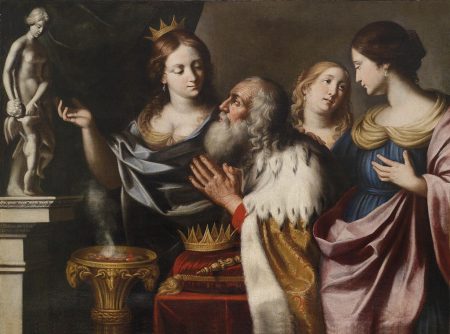
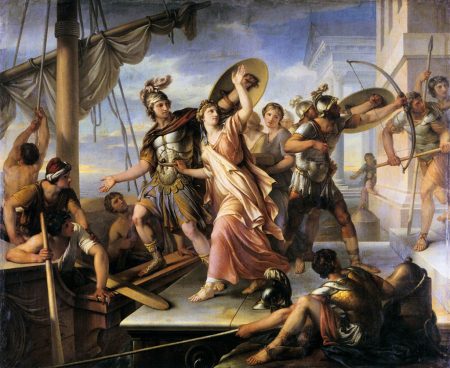
[images] (image 1) “The Persuasion of Helen” (Paris persuading Helen with the help of goddesses). Neo-Attic marble relief made probably in the first century GC. Engraved names (other than for Eros) identify the figures. From left to right they are: Pitho (Peitho, the goddess of Persuasion; sitting atop the pillar), Helen, Aphrodite (goddess of love), Eros (the Latin form of Aphrodite’s son Cupid), and Alexandros (Paris). The marble relief is preserved in Naples Museo Archeologico (inv. #6682). (image 2) “The Abduction of Helen” {sic}, oil on canvas painting by Gavin Hamilton in 1784. Both images are used under the fair-use provisions of U.S. copyright law.
References:
Adams, J. N. 1983. “Words for ‘prostitute’ in Latin.” Rheinisches Museum Für Philologie. 126 (3-4): 321-358.
Bate, Alan K., ed. and trans. 1986. Joseph of Exeter. Trojan war I-III. Oxford: Aris & Phillips.
Bell, Robert E. 1991. Women of Classical Mythology: A Biographical Dictionary. Third Printing. 1993. New York: Oxford University Press.
Blondell, Ruby. 2013. Helen of Troy: Beauty, Myth, Devastation. Oxford: Oxford University Press.
Konstan, David. 2015. Beauty: The Fortunes of an Ancient Greek Idea. New York: Oxford University Press.
Rigg, A. G., trans. 2005. Joseph of Exeter: Iliad (Josephus Iscanus: Daretis Phrygii Ilias). Centre for Medieval Studies, University of Toronto.
Wilson, Emily. 2014. “Slut-Shaming Helen of Troy.” The New Republic. Apr. 26. Online.