Achilles, bathed in tears, stood before Chiron as before a father,
weaping as he would for his biological father Peleus if he were dying.
Often he caressed Chiron’s feeble hands with his own loving hands.
The character that the teacher had molded rewarded him.
Achilles often kissed him and often said to him as he lay there:
“Live, I pray, don’t leave me, dear father!”
{ stabat, ut ante patrem, lacrimis perfusus Achilles
sic flendus Peleus, si moreretur, erat
saepe manus aegras manibus fingebat amicis
morum, quos fecit, praemia doctor
oscula saepe dedit, dixit quoque saepe iacenti
“Vive, precor, nec me, care, relinque, pater!” }[1]
Achilles’ biological parents Thetis and Peleus had a tense relationship. The top gods had arranged for their marriage. Thetis was a sea-goddess. Peleus was a mortal king. She resented her husband’s lowly status as merely a mortal. When he embraced her, he felt as if she transformed herself into a lioness or a serpent. They somehow managed to have seven children. Thetis burned some of their children to death and killed others with boiling water.[2]
While Peleus deserves blame for agreeing to marry Thetis, he at least saved the life of one of his children, his son Achilles. Thetis was obsessively and bizarrely torturing the baby Achilles just as she had done to their other children:
She would always singe his mortal flesh in the flames of a fire in the middle of the night, and then, during the day, would anoint his tender body with ambrosia. This was to make him immortal and to keep hateful old age from his body. But Peleus leapt from his bed and saw his dear son convulsing in the flames and let out a horrible yell at the sight. It was a foolish thing to do. When she heard it, she grabbed the baby and threw him screaming to the ground. Then she, light as a dream and like a breeze, swiftly went out of the palace. She leaped into the sea in anger. She never came back again.
{ ἡ μὲν γὰρ βροτέας αἰεὶ περὶ σάρκας ἔδαιεν
νύκτα διὰ μέσσην φλογμῷ πυρός· ἤματα δ᾿ αὖτε
ἀμβροσίῃ χρίεσκε τέρεν δέμας, ὄφρα πέλοιτο
ἀθάνατος καί οἱ στυγερὸν χροῒ γῆρας ἀλάλκοι.
αὐτὰρ ὅ γ᾿ ἐξ εὐνῆς ἀναπάλμενος εἰσενόησεν
παῖδα φίλον σπαίροντα διὰ φλογός· ἧκε δ᾿ ἀυτὴν
σμερδαλέην ἐσιδών, μέγα νήπιος· ἡ δ᾿ ἀίουσα
τὸν μὲν ἄρ᾿ ἁρπάγδην χαμάδις βάλε κεκληγῶτα,
αὐτὴ δὲ πνοιῇ ἰκέλη δέμας, ἠύτ᾿ ὄνειρος,
βῆ ῥ᾿ ἴμεν ἐκ μεγάροιο θοῶς, καὶ ἐσήλατο πόντον
χωσαμένη· μετὰ δ᾿ οὔ τι παλίσσυτος ἵκετ᾿ ὀπίσσω. }[3]
Good riddance to that horrible mother, one might hope. Yet these events aren’t part of the mythic patriarchy about which scholars have spewed clouds of ink. These events are nearly inexpressible reality. The great goddess that maintains gynocentrism ensures that mothers like Thetis and Josephine Crabtree get custody of children, rather than children being placed in custody of their deserving fathers.
By the time Statius wrote his Achilleid late in the first century, Achilles’s father Peleus was almost totally absent, and his mother Thetis was controlling his life. Perhaps busy with her affairs at sea, she choose not to raise her son herself. Achilles described himself as:
the son whom my mother, the sea-goddess,
almost bore to Jupiter and sent to be reared in woods and snows
of Thessaly.
{ genitum quem caerula mater
paene Iovi silvis nivibusque inmisit alendum
Thessalicis. }[4]
Achilles explained that his mother sent him away “in my tender years, while I was still crawling {in teneris et adhuc reptantibus annis}.” Achilles had no contact with his biological father and mother throughout the rest of his childhood.
Thetis gave the infant Achilles to be reared by the half-man, half-horse Chiron. This centaur lived in a cave on Mount Pelion’s ridge in the woods and snows of Thessaly. A poor dwelling, Chiron’s cave was an old geological formation that had been extended by hand. Achilles as an infant living in these harsh conditions didn’t eat brand-name baby food and didn’t drink expensive, certified-organic infant formula:
I took no ordinary food nor from nourishing
breast sated my hunger, but tore at tough lion
innards and sucked marrow from half-alive she-wolves.
{ non ullos ex more cibos hausisse nec almis
uberibus satiasse famem, sed spissa leonum
viscera semianimisque lupae traxisse medullas. }[5]
Thetis felt guilty about what she had done to her son. At one point she exclaimed:
Why did I designate Pelion and the cave of its stern taskmaster as the cradle for my little boy?
{ quid enim cunabula parvo Pelion et torvi commisimus antra magistri? }[6]
Harsh living conditions hurt a boy much less than the absence of a father. A half-man who cares about a boy is better than no man. The centaur Chiron helped the young boys Aristaeus, Actaeon, Asclepius, and Jason became eminent mythic figures. Despite his failures, Chiron was a good foster-father for Achilles.

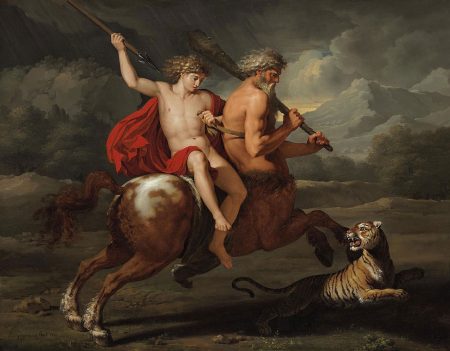

Like a good father, Chiron engaged Achilles in vigorous physical activity, taught him a wide range of knowledge, and provided him with emotional support. He also challenged him to overcome trying circumstances. Achilles recounted:
It wasn’t long before
he taught me to go with him through the trackless lands,
drawing me on with his longer stride, and to laugh
when I saw wild animals, and not be afraid of rocks
shattered by cataracts, or the vast forest silences.
…
When I was just twelve,
a raw youth, he had me sprinting faster than deer
and Lapith horses, and outrunning thrown spears.
Chiron himself, when he was still fast, would chase me
at full gallop all over the plains, and then,
when I was exhausted from all my running around
he would joyfully praise me and lift me up to his back.
{ mox ire per invia secum
lustra gradu maiore trahens visisque docebat
arridere feris nec fracta ruentibus undis
saxa nec ad vastae trepidare silentia silvae.
…
vix mihi bissenos annorum torserat orbes
vita rudis, volucris cum iam praevertere cervos
et Lapithas cogebat equos praemissaque cursu
tela sequi; saepe ipse gradu me praepete Chiron,
dum velox aetas, campis admissus agebat
omnibus, exhaustumque vago per gramina passu
laudabat gaudens atque in sua terga levabat. }[7]
Chiron directed Achilles to arduous tasks:
Chiron would never let me chase
unwarlike deer through Ossa’s wilds, or bring down
timid lynxes with my spear. No, I had to rouse
grim bears from their dens, boars like thunderbolts,
or maybe a ferocious tiger, or some lioness
with her cubs in a hidden mountainside cavern.
And he would sit in his vast cave awaiting my exploits,
waiting to see if I came back spattered with black blood.
And he wouldn’t kiss me before inspecting my weapons.
…
He would teach me to jump wide ditches, to scale
mountain peaks as if striding on level ground,
to take flying boulders on my shield in mock battle,
to enter burning huts, and to stop chariots on foot.
I remember when the Spercheius was flowing
fast as can be, fed by constant rain and melting snow,
churning uprooted trees and rocks along. Chiron
tells me to get in where the current is strongest
and stand against it, repelling swollen waves
that he himself would have had trouble holding off
even with his strong footwork. I stood in it,
but the raging river with its wall of dark spume
kept pushing me back. Chiron came down on me hard,
threatening, scolding, appealing to my sense of shame.
I did not get out until ordered, so driven was I
by exalted glory.
{ numquam ille inbelles Ossaea per avia dammas
sectari aut timidas passus me cuspide lyncas
sternere, sed tristes turbare cubilibus ursos
fulmineosque sues, et sicubi maxima tigris
aut seducta iugis fetae spelunca leaenae.
ipse sedens vasto facta exspectabat in antro,
si sparsus nigro remearem sanguine; nec me
ante nisi inspectis admisit ad oscula telis.
…
nunc docet ingentes saltu me iungere fossas,
nunc caput aerii scandentem prendere montis,
quo fugitur per plana gradu, simulacraque pugnae:
excipere immissos curvato umbone molares
ardentesque intrare casas peditemque volantis
sistere quadriiugos. memini, rapidissimus ibat
imbribus assiduis pastus nivibusque solutis
Sperchios vivasque trabes et saxa ferebat,
cum me ille immissum, qua saevior impetus undae,
stare iubet contra tumidosque repellere fluctus,
quos vix ipse gradu totiens obstante tulisset.
stabam equidem, sed me referebat concitus amnis
et latae caligo fugae; ferus ille minari
desuper incumbens verbisque urgere pudorem.
nec nisi iussus abi: sic me sublimis agebat
gloria, nec duri tanto sub teste labores. }
Chiron also taught Achilles to wrestle, box, and hurl the discus. Added to such lessons in physical prowess were many other fields of instruction. Chiron taught Achilles music and ancient literature, herbal medicine, and principles of sacred justice. Most importantly, Chiron stayed close to his son. They slept together on a boulder. Even when Achilles’s biological mother visited their man-cave, the young Achilles preferred to sleep with his foster-father:
Night draws them on to slumber. The huge Centaur
collapses onto stone, and Achilles snuggles
into his shaggy shoulders and arms, preferring,
though his faithful mother is there, that familiar chest.
{ nox trahit in somnos; saxo collabitur ingens
Centaurus blandusque umeris se innectit Achilles,
quamquam ibi fida parens, assuetaque pectora mavult. }
Many fathers today are reduced to legally specified, but not legally required, “visitation time” with their children. How many boys today would be delighted to have a half-man, foster-father like Chiron?[8]
Thetis came to the man-cave and took Achilles away from Chiron. She implied that Chiron wasn’t taking good care of Achilles, told a bizarre, fictive story about the necessity of her performing magic rites for the boy, and demanded, “Just give him to me {trade magis}.” Foolishly trusting her story, Chiron obeyed the mother’s order. The next morning, she carried off the sleeping Achilles. Chiron, brushing tears from his eyes, followed them to the shore. He begged her to bring back Achilles soon. He watched as she summoned and bridled a team of dolphins. They pulled her and the still-sleeping Achilles over the sea’s horizon. Chiron then could no longer see him.
Thetis believed that Achilles, without her help, would die in the brutal, men-on-men violence of the Trojan War. She thought it would be safest to disguise him as a girl and hide him in the household of King Lycomedes among the King’s many daughters and no sons. Thetis accordingly brought the sleeping Achilles to King Lycomedes’s island of Scyros.[9] Achilles woke up on the seashore of Scyros with no idea of where he was and why he was no longer in Chiron’s cave on Pelion’s ridge. Although a defiant boy whose heart never trembled, he was frightened. Thetis caressed him, disparaged his biological father, and urged him to wear women’s clothing.
Chiron’s teaching hadn’t prepared his foster-son Achilles for such bewildering circumstances. Thetis recounted to Achilles how Hercules had served Omphale, how Jupiter had transformed himself into Diana to seduce Callisto, that the great drinker Bacchus wore robes, and that Caeneus, the hero of the centaurs’ long-time enemy the Lapiths, was born a female. Achilles had learned from Chiron the stories of the great Greek heroes. Thetis’s mythical references appalled him. With further words, Thetis promised to return him soon to Chiron, reminded him of all the hardships she had endured because of him, told him that she sought what was best for him, and urged him to put on women’s clothing. Of course all men would be better off as women, given the oppressive force of gynocentrism. Yet Achilles was reluctant to renounce his sex. Thetis implored him:
“Why are you looking away?
What are you thinking? Are you ashamed to be soft
in this dress? I swear, dear child, by the sea I was born in,
Chiron will never know.”
So she worked on his rough heart, coaxing in vain.
{ “cur ora reducis
quidve parant oculi? pudet hoc mitescere cultu?
per te, care puer, cognata per aequora iuro,
nesciet hoc Chiron.” sic horrida pectora tractat
nequiquam mulcens }
Achilles didn’t harshly rebuke his mother for attempting to totally transform his life without even consulting him. Yet he at least passively resisted her when awake. Fathers must not fail to teach their sons about how to prevent their mothers, and women generally, from dominating them.[10]
Even more importantly, fathers must teach their sons about satisfying their sexual desire. While Achilles was passively resisting his mother’s domination, the daughters of Lycomedes come out to the seashore and began dancing a springtime festival in honor of the goddess Athena:
All were surpassingly beautiful, all dressed alike,
all just at the peak of tender modesty, their virginity
and swelling years ripe for the marriage bed.
{ omnibus eximium formae decus, omnibus idem
cultus et expleto teneri iam fine pudoris
virginitas matura toris annique tumentes. }
Achilles gazed upon them.[11] Ovid would have wanted them all. But Achilles was more discriminating:
Just as Venus overwhelms the emerald sea-nymphs
when she joins them, just as Diana towers over
the Naiads, so too does Deidamia,
queen of that fair choir, eclipse her lovely sisters.
Her roseate face inflames her scarlet robe,
her gems have more luster, her gold more allure,
and she would compare in beauty with Athena herself
if the deity would lay aside the snakes in her bosom,
take off her helmet, and assume a tranquil expression.
{ sed quantum virides pelagi Venus addita Nymphas
obruit, aut umeris quantum Diana relinquit
Naidas, effulget tantum regina decori
Deidamia chori pulchrisque sororibus obstat.
illius et roseo flammatur purpura vultu
et gemmis lux maior inest et blandius aurum:
atque ipsi par forma deaest, si pectoris angues
ponat et exempta pacetur casside vultus. }
A mean heart and a truculent manner can obliterate any woman’s beauty.[12] Deidamia projected kindness and receptivity. Achilles was inflamed with desire for her:
When the defiant boy, whose heart had never trembled,
saw this girl at the head of her troop of companions,
he stiffened, and every bone in his body
absorbed liquid fire. Nor did this passion stay hidden;
no, the torch pulsing in his marrow goes to his face,
tingeing his bright cheeks and glazing them with sweat.
As when the Massagetae darken their milk with blood
or when ivory is stained with crimson dye,
so too this sudden flame shows itself, reddening
his checks’ pallor. He would have run forward wildly
and disrupted his hosts’ rituals, oblivious
of the crowd and his age, had he not been held back
by a sense of shame and reverence for his hovering mother.
{ hanc ubi ducentem longe socia agmina vidit,
trux puer et nullo temeratus pectora motu
deriguit totisque novum bibit ossibus ignem.
nec latet haustus amor, sed fax vibrata medullis
in vultus atque ora redit lucemque genarum
tinguit et inpulsam tenui sudore pererrat.
lactea Massagetae veluti cum pocula fuscant
sanguine puniceo vel ebur corrumpitur ostro,
sic variis manifesta notis palletque rubetque
flamma repens. eat atque ultro ferus hospita sacra
disiciat turbae securus et inmemor aevi,
ni pudor et iunctae teneat reverentia matris. }
In the presence of stunning feminine beauty, even the bravest of unlearned men can be petrified with thoughts of his mother’s admonitions and a sense of shame. Achilles’s mother exploited his lack of learning about how to approach beautiful women. She pleaded to him to make her a grandmother by any means necessary:
Is it so difficult to play holding hands, my son,
or to imitate these dance-steps? Is there anything like this
beneath chilly Ossa or on Pelion’s ridges?
Oh, if only another heart beat now with mine
and I held to my bosom another Achilles!
{ Hasne inter simulare choros et bracchia ludo
nectere, nate, grave est? gelida quid tale sub Ossa
Peliacisque iugis? o si mihi iungere curas
atque alium portare sinu contingat Achillem! }
Some means of having sex with woman are morally wrong. Yet his mother’s pleading focused Achilles on scoring that goal:
He begins to soften and blushes for joy,
casting bold sideways glances and relaxing the hand
that rejects the garments. His mother sees him waffling,
sees he wants to be forced, and drapes the dress on him.
Then she massages his neck, drops his heavy shoulders,
smooths out his strong arms, arranges his unkempt hair,
and transfers her necklace to that beloved neck.
Next, confining his steps with an embroidered hem,
she teaches him how to walk and move and speak
with modesty. Just as an artist whose thumb molds
heated wax to a new shape and brings it to life,
so did the goddess transform her son.
{ mulcetur laetumque rubet visusque protervos
obliquat vestesque manu leviore repellit.
aspicit ambiguum genetrix cogique volentem
iniecitque sinus; tum colla rigentia mollit
submittitque graves umeros et fortia laxat
bracchia et inpexos certo domat ordine crines
ac sua dilecta cervice monilia transfert;
et picturato cohibens vestigia limbo
incessum motumque docet fandique pudorem.
qualiter artifici victurae pollice cerae
accipiunt formas ignemque manumque sequuntur,
talis erat divae natum mutantis imago. }
Achilles did not affirmatively consent to his mother’s physical manipulations of him. She should not have forced him, even if she thought he wanted it.[13] Tragically, rape of men remains trivialized through to the present day.
Archilles’s mother made all the arrangements for the deception. Repeatedly touching and trimming him, she cautioned him to mimic diligently the behavior of girls. Pledging sincerity upon holy altars, she presented Achilles to King Lycomedes and declared:
I present to you, lord, my Achilles’s sister
(and doesn’t she look just like her fierce brother?)
for your safekeeping. Spirited as she is, she has sought
to carry a bow and shun wedlock like an Amazon.
But I have enough worries with my male offspring.
Let her carry baskets in processions. Keep her in line,
the indocile girl, until she is old enough to marry
and lose her virginity. Don’t let her exercise naked
in the gymnasium or wander in the woods.
{ “Hanc tibi” ait “nostri germanam, rector, Achillis
(nonne vides ut torva genas aequandaque fratri?)
tradimus. arma umeris arcumque animosa petebat
ferre et Amazonio conubia pellere ritu.
sed mihi curarum satis est pro stirpe virili;
haec calathos et sacra ferat, tu frange regendo
indocilem sexuque tene, dum nubilis aetas
solvendusque pudor; neve exercere protervas
gymnadas aut lustris nemorum concede vagari.” }
No more could Achilles enjoy masculine life as he did with Chiron on Pelion’s ridge. King Lycomedes venerated Thetis for the honor of being given custody of her daughter. Lycomedes’s daughters stared at this new girl, who was a head taller than any of them and had an extraordinarily firm chest.
While Achilles showed considerable natural ability, he ultimately lacked sufficient self-confidence. In seeking to seduce Deidamia, he employed the now well-established seduction techniques of acting like a jerk, using pull-push emotional dynamics, and seeking physical contact:
The rogue chases her, crowds her, makes eyes at her
over and over, sticks too close to her side,
and she makes no effort to avoid him.
Now he pelts her with flowers, or with baskets spilled
on purpose, or taps her with a thyrsus. Now he shows her
the sweet strings of the lyre he knows so well,
the subtle measures of Chiron’s songs, guiding her hand
and making her fingers pluck the chords; and now
he takes hold of her mouth as she sings, entwines her
with embraces, and praises her with a thousand kisses.
She is all too glad to learn which peak is Pelion,
who Aeacides is; wonders as she hears the boy’s name
and exploits, and sings of Achilles there before her.
{ blandeque novas nil tale timenti
admovet insidias: illam sequiturque premitque
improbus, illam oculis iterumque iterumque resumit.
nunc nimius lateri non evitantis inhaeret,
nunc levibus sertis, lapsis nunc sponte canistris,
nunc thyrso parcente ferit, modo dulcia notae
fila lyrae tenuesque modos et carmina monstrat
Chironis ducitque manum digitosque sonanti
infringit citharae, nunc occupat ora canentis
et ligat amplexus et mille per oscula laudat.
illa libens discit, quo vertice Pelion, et quis
Aeacides, puerique auditum nomen et actus
adsidue stupet et praesentem cantat Achillem. }[14]
On the appointed day in a high grove deep in Scyros’s forest, the girls, including Achilles, engaged in strictly men-exclusive orgiastic rites. They danced and offered to Bacchus dismembered bodies of cattle and tree trunks torn from the ground. While reveling in female gender privilege, Achilles was unsatisfied as a man. Achilles said to himself:
How long will you endure
your fearful mother’s schemes and waste the prime
of your life in unmanly captivity?
…
And what’s more, you hide your passion for your beloved girl —
your chosen one, your coeval flame — imprisoned
by day and by night. How long will you suppress
the wound that burns in your heart, or fail to prove,
even in love (O the shame!), that you are a man?
{ Quonam timidae commenta parentis
usque feres? primumque imbelli carcere perdes
florem animi?
…
quin etiam dilectae virginis ignem
aequaevamque facem captus noctesque diesque
dissimulas. quonam usque premes urentia pectus
vulnera? teque marem (pudet heu!) nec amore probabis? }
Rooted in the ancient concept of virtue is the men-disparaging belief that a man must prove his worth as a man. Without appreciating his inherent goodness, without confidence in his own seductive allure, and following his mother’s example, Achilles used force to have sex with a girl whom he thought wanted it.
He gets his way by force, putting all his heart
into authentic embraces. The whole choir of stars
watched from above, and the slender Moon blushed.
{ vi potitur votis et toto pectore veros
admovet amplexus; vidit chorus omnis ab alto
astrorum et tenerae rubuerunt cornua Lunae. }
Use of physical force represents moral and intellectual weakness. Women are naturally superior to men in guile, and reportedly as well in the skills necessary to succeed in the twenty-first century economy. Fathers should teach their sons guile and other vital seductive techniques. More importantly, fathers should teach their sons their intrinsic worth as male human beings. Like many good fathers, Achilles’s foster-father Chiron failed to teach him well that fundamental lesson. Readers of the Iliad know the rest.[15]
Mothers disguising their sons as girls won’t save them from the epic devaluation of men’s lives. In the Trojan War, a huge number of men, including Achilles, died brutal deaths fighting over one, adulterous woman. The toll of men’s deaths increased significantly as a result of Achilles’s bitter conflict with Agamemnon over sexual access to the beautiful, blonde-haired, blue-eyed Briseis. Wise leaders would make public provision for men’s sexual welfare. Yet most leaders are not wise, but ignorantly gynocentric. In such oppressive circumstances, the most important lesson for fathers to teach their sons is simple. A man does not need to prove that he is a man, not in battle, not with women. If Achilles and other men understood their intrinsic virtue, they wouldn’t seek glory in battle, nor rage about being deprived of a woman.
* * * * *
Read more:
Notes:
[1] Ovid, Fasti 5.407-12, Latin text and English translation (adapted slightly) from Frazer & Goold (2014).
[2] On Thetis changing form in Peleus’s embrace, see, e.g. Pausanias, Geography 5.18.5, Appollodorus, Library 3.13.5 (including note 261). For early Greek accounts of Thetis abusing children she had with Peleus, Ashton (2009) para. 48-9, Burgess (2009) pp. 10-11. The tradition of Thetis dipping Achilles in the Styx while holding his heal came later. Burgess observed:
The later Roman story of Achilles’ heel does correspond thematically to the earlier Greek traditions, however. Once again, an infant is dipped into a destructive element. The Styx was considered extremely cold, poisonous, or fiery, qualities comparable to the fire and boiling water of the early traditions.
Id. p. 11.
[3] Apollonius of Rhodes, Argonautica 4.868-79, Greek text and English translation (adapted slightly) from Race (2009). Another account describes Thetis as testing her children, even after younger ones had fatally failed her test:
Thetis cast her children by Peleus into a cauldron of water, wanting to know whether they were mortal […] and when many had in fact died, Peleus grew angry and prevented Achilles from being flung into the cauldron.
{ ἡ Θέτις εἰς λέβητα ὕδατος ἔβαλλεν τοὺν ἐκ Πηλέως γεννωμένους, γνῶναι βουλομένη εἰ θνητοί εἰσιν [ … ] καὶ δὴ πολλῶν διαφθαρέντων ἀγανακτῆσαι τὸν Πηλέα καὶ κωλῦσαι τὸν ᾿Αχιλλέα ἐμβληθῆναι εἰς λέβητα. }
Scholiast on Apollonius of Rhodes, Argonautica 4.868-79, cited with this Greek text and English translation in Aston (2009) para. 48.
Thetis and Chiron were associated in ancient myth and cult. Both were associated with Thessaly and related thematically, including through Achilles’s life. Chiron was a culture hero. Thetis, honored more broadly than Chiron, had a more ambiguous character. They weren’t paired simply as the evil Thetis and the good Chiron:
there is a symbolic dimension to this contrast which goes beyond the immediate contrast between the elusive, unreliable, destructive Thetis and the steadfast, healing Cheiron. Another, more profound point of divergence relates to failed and successful transitions. Thetis cannot leave her children as they are: she is compelled to attempt to usher them across the divide between mortality and divinity, an attempt which never succeeds, proving the immutability of the separation between gods and mortals.
Aston (2009) para. 55. The Achilleid presents a less abstract and more socially engaged contrast between Thetis and Chiron.
[4] Statius, Achilleid 1.650–2, Latin text and English translation (adapted slightly) from Shackleton Bailey (2003). The subsequent quote is similarly from Achilleid 2.96. In all subsequent quotes from the Achilleid, the Latin is from id., and the English translation is from Lombardo (2009), except where otherwise noted. In some instances I’ve adapted slightly the English translations to follow the Latin words and lines more closely. A Latin text of the Achilleid is available online at the Latin Library.
In the Middle Ages, western Europe — the region that had been the western part of the Roman Empire — lacked knowledge of Homer’s epics and all the rest of ancient Greek literature. The Achilleid thus largely influenced perception of Achilles:
for many centuries the most complete and compelling portrait of the great Achilles available to Western Europe was as the hero of a transvestite sex-farce.
Heslin (2003) p. xii. The Achilleid was widely read. It was one of the six texts {Sex auctores} that dominated the thirteenth-century European school curriculum. The Eclogue of Theodulus, which like the Achilleid provides subtle but trenchant gender critique, was another of the Sex auctores. Ziolkowski (2007) p. 114. The Achilleid can be read simplistically:
It is easy to see the qualities that must have recommended it to medieval teachers: it is a brief and lighthearted text by a major author, which introduces students to an important idiom and meter along with some major characters from mythology; it also describes the exemplary education of the young Achilles, his affection for his teacher, Chiron, and his obedience to his mother.
Heslin (2003) p. xiii. Unlike most modern scholars, medieval readers were sophisticated enough to enjoy transgressive works like Lamentationes Matheoluli. Whether medieval readers appreciated the Achilleid’s concern for the epic devaluation of men’s lives isn’t clear. A monumental review of medieval manuscripts of Statius considered why the Achilleid had been so popular:
The question is very difficult to answer, since the manuscripts afford us very little evidence.
Anderson (2009) v. 3, p. 124.
In earlier Greek myth, Peleus commonly had custody of Achilles after he and Thetis separated. That custodial arrangement changed with Roman imperial gynocentrism:
The centrality that Statius gives to Thetis in Achilles’ infancy is generally reflected in subsequent Roman art. In contradistinction to classical Greek representations of the handover of Achilles, where Peleus is the dominant figure, in the few surviving monuments of Roman art he never appears. The cause of Thetis supplanting Peleus as the dominant parent is surely the Achilleid itself, which intensified the focus on Thetis already begun by Homer to such a degree that Peleus all but vanishes.
Heslin (2003) p. 172.
[5] Achilleid 2.98-100. Heslin (2003), pp. 173-5, discusses the extraordinary act of eating half-alive animals. Chiron was apologetic toward Thetis about his poor dwelling in a cave:
{Chiron} leads her to his poor dwelling, reminding her that it is only a cave.
{ in armos pauperibus tectis inducit et admonet antri. }
Achilleid 1.126. Chiron’s cave was “part excavated by hand, part by geologic age {pars exhausta manu, partem sua ruperat aetas}.” Achilleid 1.108.
[6] Achilleid 1.38-9. The subject could be translated as “I” or “we”. On that ambiguity, Heslin (2003) pp. 171-2. Both Shackleton Bailey and Lombardo translate the subject as “I”.
[7] Achilleid 2.102-5, 110-16. Subsequent quotes are (cited by book.line in the Latin text of the Achilleid): 2.121-8, 138-53 (Chiron would never let me…), 1.195-7 (Night draws…), 1.141 (Just give him to me), 1.271-5 (Why are you looking away…), 1.290-2 (All were surpassingly beautiful…), 1.292-300 (Just as Venus overwhelms…), 1.301-12 (When the defiant boy…), 1.319-22 (Is it so difficult…), 1.323-34 (He begins to soften…), 1.350-8 (I present to you…), 1.567-79 (The rogue chases her…), 1.624-6, 636-9 (How much longer…), 1.642-4 (he gets his way…).
[8] Traveling to Chiron’s cave to take Achilles, Thetis speculated, “he already measures himself with his father’s {Chiron’s} sword {patria iam se metitur in hasta}.” Achilleid 1.41. Achilles himself referred to Chiron as “that father {ille pater} of mine.” Achilleid 2.102. Concluding her extraordinarily good article on teachers and surrogate fathers in Statius’s writings, Fantham perceptively observed about the ending of Silvae 5:
It was, he claims, Statius who gave the newborn the life-giving blow that activated his lungs. Indeed the last fractured lines recall his attempts to comfort the baby, and help him learn to walk and talk; here we come closest to the reality of fatherhood. For Statius the fondest relationship he knew, and could evoke, was that of surrogate or foster father, the role that he had seen his own father perform – the role of a Chiron.
Fantham (1999) pp. 69-70. The legal meaning of fatherhood in current U.S. family law centers on having provided semen and paying a court-ordered monthly dollar amount.
Within ancient myth, Chiron is associated with absence. Within ancient cult, he apparently had “no single site of strong personal residency.” Aston (2006) pp. 355, 361. Aston observed:
He is not a monster, but he resembles one. I think this tells us a great deal
about the perceived reason for his departure and absence: despite being a god, he is not enough of a god, at least in appearance, to be preserved.
Id. p. 362. Chiron provides a poignant figure of fathers in high-income societies today.
[9] Thetis deserves credit for not taking Achilles to Lemnos. She regarded Lemnos as “not providing justice to men {non aequa viris}.” Achilleid 1.206. That’s an understatement. The Lemnian women killed all the men on Lemnos.
[10] Thetis implored Neptune to blow up a storm to destroy the Trojan fleet. Using a tactic that vanquishes most men, she approached him “with bared breast {pectore nudo}.” Achilleid 1.77. Neptune drew upon the force of mythic historical necessity to stand up to Thetis.
[11] Feeney argued for the importance of the male gaze in the Achilleid:
Statius is principally concerned, however, with the male gaze, and especially with the scrutiny of Ulysses. Identifying with Ulysses, and gazing through his eyes as he attempts to spot the difference between Achilles and the ‘other’ girls, is a revealing, disquieting, and rather revolting experience.
Feeney (2004) p. 95. Gazing through Ulysses’s eyes is less revolting than the fate of “Peeping Tom”. Moreover, Statius seems to me more concerned with the epic devaluation of men’s lives than with the male gaze.
Apuleius’s treatment of Socrates is similar to Statius’s treatment of Achilles. Both authors had a keen sense of absurdity and offered critical insight into men’s social position.
[12] With keen feminine sensibility, the girls sought to beautify Athena: “to tie foliage to her severe tresses and scatter flowers upon her spear {severas fronde ligare comas et spargere floribus hastam}.” Achilleid 1.288-9. Men tend to regard as less attractive women who look severe and carry spears.
[13] Ulysses taunted Achilles about Thetis raping him:
Did your crafty mother violate you with women’s clothing?
{ callida femineo genetrix violavit amictu }
Achilleid 2.35. Ovid, writing before Statius, seems to have provided the conceptual language for Statius’s account of Thetis raping Achilles:
the phrase cogique uolentem (“willing to be forced”) … is most striking. It reminds us, of course, of the Ovidian teacher’s comment on Achilles’ rape of Deidamia (sed uoluit uinci uiribus illa tamen, “but she wanted to be overcome by strength,” Ars Am. 1.700).
Davis (2015) p. 172. Thetis raping Achilles powerfully transformed him. Nonetheless, McAuley laments women’s limited power:
{the Achilleid draws} its affective power from the idea of mothers in epic as the recipients of a powerful knowledge, yet whose power to act on that knowledge is painfully circumscribed. … A mother’s knowledge may be epic knowledge, but it does not always bring epic power.
McAuley (2015) pp. 353, 355. Even if they were able to overcome scholarly misandry and truly sought social justice, women alone would lack sufficient power to eliminate the epic devaluation of men’s lives. Men’s participation is essential for freeing them from their oppressive social position.
[14] Lombardo’s translation renders non evitantis in 1.570 as merely the adjective “unflinching” in “{Achilles} sticks too close to her unflinching side.” Given the sordid history of criminalizing men seducing women, the trend toward totalitarian regulation of sexual interaction, and the vastly gender-disproportionate incarceration of men, non evitantis should be translated clearly. I’ve done so above, using essentially the translation of Shackleton Bailey. Such text helps to contextualize men’s behavior under men’s disproportionate gender burden of soliciting amorous relationships. On Achilles’s tactics in attempting to seduce Deidamia, Sanna (2007).
[15] Ulysses craftily urged Achilles to seize weapons:
Why do you hesitate? … You are the foster-son of the half-beast Chiron, you are the grandson of sky and sea.
{ Quid haeres?
…tu semiferi Chironis alumnus,
tu caeli pelagique nepos }
Achilleid 1.867-9. Achilles seized the weapons and went off to fight and die in the Trojan War. Heslin commented:
The problem of Achilles’ ontology – his position as not quite a son of Zeus on the one hand and not quite a son of Chiron on the other – is not merely his own; it is an encapsulation of the human {sic} condition considered as a state of being lying uneasily between the divine and the bestial.
Achilles finally becomes a man under the tutelage of Ulysses…. This is yet another clear illustration of the near-total absence of Peleus from the epic. In default of a real father to guide him, Achilles looks to Zeus, who almost was his father, and to Chiron, who has been his foster-father. The problem is that neither of these examples can teach Achilles how to behave as a man. Thetis steps into the resulting vacuum and creates an Achilles in her own image, an image that endures until the arrival of Ulysses finally brings a role model who can guide Achilles to his destiny.
Heslin (2003) p. 191. Men’s destiny isn’t necessarily to suffer violent death. Both Zeus and Chiron could teach that men do not need to seek glory or women to prove that they are men. Both Zeus and Chiron could teach that men’s lives have irreplaceable value and that men’s lives shouldn’t be wasted in foolish wars or in degrading servitude to women. Zeus and Chiron didn’t teach Achilles these lessons, nor did Ulysses.
Scholars are recognizing the importance in the Achilleid of the meaning of being a man. Looking beyond Achilles to the (eastern) Greeks compared to the (western) Romans, Moul argues:
the Achilleid implicitly explores what it is for the Asians of Troy to become convincing manly Romans by imagining, in contrast, the process by which the Greeks of the Iliad behave like girls.
Moul (2012) p. 300. However, lacking true understanding of men’s social position, Heslin (2003), Moul (2012), Davis (2015), McNelis (2015), and much other work on the Achilleid misses its central, tragic-comic point: the epic devaluation of men’s lives.
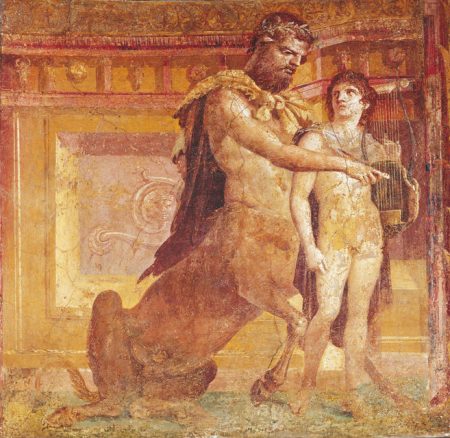
[images] Image 1: The centaur Chiron teaching Achilles how to play the lyre. Roman fresco from Herculaneum, first-century GC. Held in the National Archaeological Museum of Naples. Via Wikimedia Commons. Here’s a thematically similar carving on a third-century sarcophagus. Image 2: Chiron teaching Hercules to hunt. Detail from the Achilles plate, a fourth-century Roman work from Pausylypos in Thessaloniki. It shows eleven scenes from the life of Achilles. Six of those scenes include Chiron: (a) Thetis gives Achilles to Chiron, (b) Chiron feeds the toddler Achilles with animal entrails, (c) Achilles rides on Chiron back to learn to hunt, (d) Chiron provides instruction in reading for Achilles, (e) Chiron instructs Achilles to play the lyre, and (f) Chiron relinquishes custody of Achilles to Thetis. Via sketch on Wikimedia Commons, showing scene more clearly than photo of the Achilles plate on Wikimedia Commons. Image 3: Chiron mentoring Achilles in hunting. The Education of Achilles. Oil on convas painting by Bénigne Gagneraux, 1785. Via Wikimedia Commons. Image 4: Chiron provides instruction in reading for Achilles. From Achilles plate, as for Image 2.
References:
Anderson, Harald. 2009. The manuscripts of Statius. Arlington, VA: Creative Space Pub. (online review)
Aston, Emma. 2006. “The Absence of Chiron.” The Classical Quarterly. 56 (2): 349-362.
Aston, Emma. 2009. “Thetis and Cheiron in Thessaly.” Kernos 22, online.
Burgess, Jonathan S. 2009. The death and afterlife of Achilles. Baltimore: Johns Hopkins University Press. (online review)
Davis, Peter J. 2015. “Statius’ Achilleid: The Paradoxical Epic.” Ch. 9 (pp. 157-172) in Dominik, William J., Kyle Gervais, and Carole E. Newlands, eds. Brill’s Companion to Statius. Leiden: Brill.
Fantham, Elaine. 1999. “Chironis exemplum: on teachers and surrogate fathers in Achilleid and Silvae.” Hermathena. 167: 59-70.
Feeney, Denis. 2004. “Tenui … Latens Discrimine: Spotting the Differences in Statius’ Achilleid.” Materiali E Discussioni Per L’analisi Dei Testi Classici. 52: 85-105.
Frazer, James George and George Patrick Goold, ed. and trans. 2014. Ovid. Fasti. Loeb Classical Library, 253. Cambridge, MA: Harvard University Press.
Heslin, Peter J. 2009. The transvestite Achilles: gender and genre in Statius’ Achilleid. Cambridge: Cambridge University Press.
Lombardo, Stanley, trans. 2015. Statius. Achilleid. Indianapolis, IN: Hackett Publishing. (online review)
McAuley, Mairéad. 2015. Reproducing Rome: Motherhood in Virgil, Ovid, Seneca, and Statius. Oxford: Oxford University Press. (online review)
McNelis, Charles. 2015. “Similes and Gender in the Achilleid.” Ch. 11 (pp. 189-204) in Dominik, William J., Kyle Gervais, and Carole E. Newlands, eds. Brill’s Companion to Statius. Leiden: Brill.
Moul, Victoria. 2012. “Quo rapis? Tone and allusion at Aulis in Statius’ Achilleid.” Classical Quarterly. 62 (1): 286-300.
Race, William H., ed. and trans. 2009. Apollonius Rhodius. Argonautica. Loeb Classical Library 1. Cambridge, MA: Harvard University Press, 2009. (Seaton’s 1912 edition online)
Sanna, Lorenzo. 2007. “Achilles, the wise lover and his seductive strategies (Statius, Achilleid 1.560-92).” Classical Quarterly. 57 (1): 207-215.
Shackleton Bailey, D. R., ed. and trans. 2003. Statius. Thebaid, Books VIII-XII; Achilleid. Loeb Classical Library 498. Cambridge, MA: Harvard University Press.
Ziolkowski, Jan M. 2007. “Mastering Authors and Authorizing Masters in the Long Twelfth Century.” Ch. 6 (pp. 93-188) in Verbaal, Wim, Yanick Maes, and Jan Papy, eds. Latinitas perennis. Vol. 1. Leiden: Brill.


.jpg)
