Tyolet and Tydorel underscore Perceval’s devastating father-death

Both Perceval in Chrétien de Troyes’s late-twelfth-century French romance Perceval and Tyolet in an early thirteenth-century lai Tyolet grew up in the woods with their mothers after their fathers died. Neither Perceval nor Tyolet knew a father’s love. A father’s death or absence from his son’s life tends to re-orient his son’s seminal blessing toward death-seeking.[1] Perceval and Tyolet experienced men’s loyalty and devotion to other men as knights engaged in the death-seeking of brutal violence against men. In the lai Tydorel from about the same time, Tydorel ardent desire to know his father similarly prompted him to die to this world in departing to another world.

Men deeply need fellowship with other men. Consider, for example, Tyolet’s encounter with men “knight-beasts {chevaliers bestes}.” A stag that Tyolet was hunting crossed a river. It then metamorphosed:

It assumed the appearance of a knight.
The knight was fully armed at the water’s edge
and, mounted on a horse with flowing mane,
he sat just like an armed knight.
The youth observed him.
He had never seen the like.
He looked upon him in amazement
and gazed at him for a long time.
He wondered at such a thing,
for he had never before seen its like.
He stared at him intently.

{ Et .I. chevalier resembloit;
Tot armé sor l’eve s’estoit,
Sor .I. cheval detriés comé,
S’estoit com chevalier armé.
Le vallet l’a aparceü;
Onques mes tel n’avoit veü.
A merveilles l’a esgardé
Et longuement l’a avisé.
De tel chose se merveilloit,
Car onques mes veü n’avoit;
Ententivement l’avisa. }[2]

The knight pleasantly greeted Tyolet. When Tyolet inquired “what kind of beast a knight was {quel beste chevalier estoit},” the knight explained:

It’s a beast which is much dreaded.
It captures and eats other beasts.
Much of the time it dwells in the woods,
but it dwells as well on open land.

{ C’est une beste molt cremue;
Autres bestes prent et menjue,
El bois converse molt souvent
Et a plainne terre ensement. }

Tyolet hunted in the woods, capturing and eating various beasts. But he had never before encountered a beast like a knight. He asked about the knight’s helmet, shield, hauberk, greaves, sword, and lance. Tyolet, who hunted with whistling and a knife, envied the knight’s elaborate equipment, but he also sought companions:

Would to God, who never lied,
that I might have such equipment
as you have, so fine and handsome,
that I had such a coat, such a cloak,
as you have, and such a head-piece.
Now tell me, knight-beast,
in God’s name and his holy festival,
if there are any other beasts like you
or any as beautiful as you are.

{ Car pleüst Dieu qui ne menti
Que j’eüsse tiex garnemenz
Con vos avez, si biaus, si genz,
Tel cote eüsse, et tel mantel
Con vos avez, et tel chapel.
Or me dites, chevalier beste,
Por Deu, et por la seue feste,
Se il est auques de tiex bestes
Ne de si beles con vos estes. }

The knight pointed out many other men knight-beasts:

Two hundred armed knights
were making their way across a meadow.
They came from the king’s court and
had been carrying out his orders.
They had captured a fortress,
set fire to it, and reduced it to ashes.
They were returning fully armed
in three squadrons in close array.

{ Que .II. cenz chevaliers armez
Erroient tres par mi uns prez,
Qui de la cort au roi venoient.
Son commandement fet avoient;
Une fort meson orent prise
Et en feu et en charbon mise,
Si s’en repairent tuit armé,
En .III. eschieles bien serré. }

Marveling at them, Tyolet wanted to become one of them:

Would to God on his holy festival
that I were a knight-beast.

{ Car pleüst or Dieu a sa feste
Que je fusse chevalier beste. }

Men, all wearing similar equipment, working together on a common mission — that’s an ideal of masculine fellowship. That their mission is killing and burning matters little relative to the good of masculine fellowship. Tyolet was a young man living in the woods with only his mother. Men will become beasts to be part of a group with other men.

Islamic Republic of Iran Army soldiers marching

Tyolet became a knight-beast against his mother’s wishes. She didn’t want her son to become a beast that captures and devours others, where the others were not the deer and wild game that Tyolet hunted for food, but human beings like him.[3] Tyolet insisted. Then his mother brought him his father’s armor:

All the arms she had
she quickly brought him.
The arms had belonged to her husband.
She armed her son with them splendidly,
and when he had mounted his horse,
he looked just like a knight-beast.
“Do you know, fair son, what you will do now?
You will go straight to King Arthur,
and I shall tell you all you need to know.
Do not associate with any man,
nor pay court to any woman,
who is of ill-repute.”

{ Totes les armes qu’ele a
Isnelement li aporta,
Qui son seignor orent esté.
Molt en a bien son f[i]lz armé.
Et quant el cheval fu monté(z)
Chevalier beste a bien semblé.
‘Sez or, biauz filz, que tu feras?
Tot droit au roi Artur iras
Et de ce te dirai la somme:
Ne t’acompaingnes a nul homme,
Ne a fame ne donoier
Qui commune soit de mestier.’ }

The mother directed her son into a quest for social status. Seeking social status is different from seeking masculine fellowship.

Tyolet took up the quest that his mother set for him. He went to King Arthur’s court. There he sought to learn about good breeding, wisdom, courtliness, knighthood, and gift-giving. These are qualities associated with knightly status.

Tyolet also sought to gain status through marriage. The daughter of the King of Logres arrived at King Arthur’s court. She ominously was described as being as beautiful as Dido or Helen of Troy. She established a challenge for a man to become her husband: the man must cut off the white foot of a stag guarded by seven lions and living across a menacing river. Many knights attempted the challenge, but turned back at the river. Tyolet, however, plunged into river, risking his life. He made it across. He found the stag and cut off its white foot. Then the seven lions attacked him. The lions mauled him badly before he managed to kill them. Then another knight deceived Tyolet and sought to kill him. Ultimately, the badly wounded Tyolet got back to Arthur’s court, prevailed over the deceptive knight, and earned the hand of the daughter of the King of Logres.

The lai ends with Tyolet withdrawing from King Arthur’s court. The daughter of the King of Logres led the badly wounded Tyolet away:

Then she took him to her land.
He was king and she was queen.
Here ends the lai of Tyolet.

{ En son païs donc le mena;
Rois fu et ele fu roïne.
De Tyolet le lai ci fine. }

Marrying the daughter of the King of Logres great increased Tyolet’s social status, land-holdings, and other wealth. That’s beneficial, but gender-atypical. A man executive might marry a low-status woman secretary. In contrast, a woman executive might have an affair with a low-status man manual laborer, but she’s unlikely to marry him. Much more than men, women commonly seek to marry up (hypergamy). Marrying up can lead to passionless, unsatisfying marital life. Because masculine fellowship largely motivated Tyolet to become a knight, the ending of the lai Tyolet should imply troubling thoughts about the mauled Tyolet’s future.[4]

The lai Tydorel has a more obviously troubling conclusion. Tydorel’s parents, the queen and king of Brittany, had been married for ten years without producing any children. One day when the queen was relaxing in a garden, a handsome knight proposed a sexual affair with her. She quickly fell passionately in love with him and consented to an affair, provided he told her his name and where he was from. That at least shows some interest in the man beyond his sexual allure. He mysteriously showed her that he came to her from passing through the bottom of a deep lake. This knight was an unworldly man.

As the knight predicted, the queen soon became pregnant. The king was overjoyed to have a forthcoming heir, but in fact the child wasn’t of his lineage:

He didn’t know the true state of affairs.
The peasant says to his neighbor,
in a spiteful saying in his own language:
“A man thinks he’s bringing up his own child
when it does not belong to him at all.”
This is what happened to the king in this case.
The child was not his, but someone else’s.

{ Mes ne sot pas tout le covine.
Li vilains dit a son voisin
Par mal respit en son latin:
‘Tex cuide norrir son enfant
Ne li partient ne tant ne qant’.
Issi fist li rois de cestui;
N’iert mie siens, ainz est autrui. }[5]

Gender asymmetry in parental knowledge is a fundamental gender inequality. It could easily be eliminated with modern DNA testing, but under gynocentrism, that fundamental gender inequality is of relatively little public concern. Gender asymmetry in parental knowledge has enormous implications for men and women.

After the queen’s husband died and Tydorel had reigned as king for ten years, he learned that his father wasn’t the queen’s husband. Tydorel was furious about this deception:

He arose swiftly,
took his sword from his bedside
and went into his mother’s chamber.
He came to her bed and woke her up.
When she saw him, she sat up,
reclining on her elbow.
“Son,” she said, “have mercy, in God’s name!
What is this? What do you want here?”
“By God!” he said, “you shall die.
You will never escape my hands,
unless you tell me the truth,
whose son I am, I want to know.”

{ Il s’est levez hastivement,
Soz son chevez s’espee prent,
En la chambre sa mere entra;
A son lit vint, si l’esveilla.
Qant el(e) le vit, si s’est drecie,
Sor son coute s’est apuïe.
‘Filz’, fet ele, ‘por Deu merci!
Qu’es[t] ce? Que querez vos ici?’
‘Par Deu!’ fet il, ‘toute i morrez,
Ja de mes mains n’eschaperez,
Se vos ne me dites le voir
Qui filz je sui, je veil savoir.’ }

Children deserve to know the truth about who their biological fathers are. Tydorel’s mother told him the truth that he wasn’t her husband’s son. She told him that his father was a knight who came to her from the deepest part of a deep lake.

Tydorel immediately resolved to go to his father’s place. The lai Tydorel ends with Tydorel’s dramatic journey:

When Tydorel heard this,
he left his mother.
He returned to his chamber,
woke his chamberlains,
and gave orders for his arms to be brought
and his good horse to be fetched.
They did what he commanded,
and he armed himself at once.
As soon as he was armed,
he mounted his horse.
Spurring it, he came to the lake
and plunged straight into the deepest part.
There he remained, in this way,
and never came back.
This tale is held to be true
by the Bretons who composed the lai.

{ Qant Tydorel a tot oï,
De sa mere se departi;
En ses chambres est reperiez,
Ses chambellans a esveilliez,
Ses armes rova aporter
E son bon cheval amener.
Cil ont fet son conmandement,
Et il s’arma delivrement.
Sitost conme il se fu armez,
Sor son cheval estoit montez;
Poignant en est au lai venuz,
El plus parfont s’est enz feruz.
Illec remest, en tel maniere,
Que puis ne retorna ariere.
Cest conte tienent a verai
Li Breton qui firent le lai. }[6]

Perhaps Tydorel downed in the lake. But the lai Tydorel is filled with supernatural elements. Tydorel is better understood to have gone to his father and remained with his father. Persons today, living among pervasive falsehoods, should be able to understand ardently seeking to go to one’s true father.

The death or absence of a father inflicts terrible pain on children. Medieval literature recognized this human reality in various ways. Perceval’s comically absurd behavior in Chrétien de Troyes’s Perceval is one example. Tyolet’s burning desire to become a “knight-beast {chevalier beste}” like other men and Tydorel’s plunge into the depths of a deep lake are both directly connected to their lacking a true father. Children, especially young men, need fathers.

* * * * *

Read more:

Notes:

[1] In recent decades, academics have invented the denial of reality. Following this invention with little additional creativity, Braet (1981) considers the “invention of the father” in Tyolet and Perceval. In fact, organisms have been sexually reproducing on earth for at least 1.2 billion years. Denying the reality of fatherhood supports sex discrimination against men in child custody and child support rulings.

[2] Tyolet, vv. 109-19, Old French text and English translation (modified slightly) from Burgess & Brook (2007). Burgess & Brook (2005), freely available online, provides a similar Old French edition and English translation. For earlier Old French editions, Tobin (1976b) and Paris (1879). For earlier English translations, Donnelly (1998) and Weston (1900). For a freely available Spanish translation, Cobos (1985). The lai (lay) Tyolet survives in only one manuscript, MS S: Paris, Bibliothèque nationale de France, nouvelles acquisitions françaises, 1104, f. 15v-20r.

Subsequent quotes from Tyolet are similarly sourced. Those above are vv. 137 (what kind of beast a knight was), 141-4 (It’s a beast which is much dreaded…), 184-92 (Would to God, who never lied…), 197-204 (Two hundred armed knights…), 217-8 (Would to God on his holy festival…), 263-74 (All the arms she had…), 702-4 (Then she took him to her land…).

[3] Tyolet consistently describes knights as engaged in vicious violence. The knight that Tyolet first encountered himself described a knight as a beast “that deceives and kills others {que autre engingne et autre tue}.” Tyolet, v. 236.

[4] The academic Arthur regarded as problematic that all men’s achievements, including those of Tyolet, aren’t fully and clearly credited to women. In his view, Breton lais, apparently including the lais of Marie de France, represent a conversation among an anachronistic “class” of men:

These texts are the record of an oft-repeated conversation between the members of a historically-defined class of men, some of whom fought battles, some of whom wrote poems, some of whom, for that matter, wrote philosophy and delivered sermons.

Arthur (1992) p. 71. In contrast, medieval women themselves regarded knights and clerics as distinctive classes of lovers. Medieval estate satire such as Richeut assumed that knights and clerics belong to different estates. Arthur’s intellectual contortions in his interpretation of Tyolet apparently were directed toward a concluding flourish of poor-dearism:

This romantic text, and all the others which share its concerns, says, repeatedly, “We may be in a situation of powerlessness, in which all that we do, from writing poetry through to risking our lives in battle, is done for the benefit of a master. But it could be worse. We could be isolated from each other, with no sense of a community and no governing providential plan to ensure our escape. We could be stuck here permanently. We could be women.”

Id. p. 72. With such a poignant conclusion, Arthur could hope to be recognized as a good man within gynocentric academia. However, medieval women weren’t isolated from one another. Women were at the center of medieval communities. What it means to have a providential plan to escape from “here” isn’t clear. Death might be regarded as an escape. Largely as a result of pervasive violence against men, medieval men had a life expectancy about nine years less than that of medieval women.

[5] Tydorel, vv. 164-70, Old French text and English translation (modified slightly) from Burgess & Brook (2007). Burgess & Brook (2016) includes a similar English translation not presented by corresponding Old French verse. For earlier Old French editions freely available online, Tobin (1976a) and Paris (1879). Donnelly (1998) provides a freely available English translation of Tydorel.

Subsequent quotes from Tydorel are similarly sourced. Those above are vv. 339-50 (He arose swiftly…) and 475-90 (When Tydorel heard this…).

[6] The eminent nineteenth-century medievalist Gaston Paris described Tydorel as a “beautiful lai {beau lai}.” Paris (1879) p. 66.

[image] Soldiers of the Islamic Republic of Iran Army. Image thanks to Reza Dehshiri and Wikimedia Commons.

References:

Arthur, Ross G. 1992. “Tyolet and the Marginalization of the Romance Feminine.” LittéRéalité. 4 (2): 65-72.

Braet, Herman. 1981. “Tyolet/Perceval: l’invention du père.” Incidences, Médiévalités. Nouv. Série, 5 (1): 71-77. Translated into English as “Tyolet/Perceval: The Father Quest,” in Varty, Kenneth, and Lewis Thorpe, eds. 1981. An Arthurian Tapestry: essays in memory of Lewis Thorpe. Glasgow: British branch of the International Arthurian Society.

Burgess, Glyn S., Leslie C. Brook, ed. and trans. 2005. Doon And Tyolet: Two Old French Narrative Lays. Liverpool Online Series, 9. Liverpool: University of Liverpool, Department of Modern Languages and Cultures.

Burgess, Glyn S., Leslie C. Brook, ed. and trans. 2007. French Arthurian Literature. Volume IV: Eleven Old French Narrative Lays. Cambridge, UK: D.S. Brewer.

Burgess, Glyn S., and Leslie C. Brook, trans. 2016. Twenty-Four Lays from the French Middle Ages. Liverpool: Liverpool University Press.

Cobos Castro, Esperanza. 1985. “Tyolet lay anonimo Francés del siglo XIII.” Alfinge. 3: 283-294.

Donnelly, Linda Marie Asfodel. 1998. The Anonymous Fairy-Knight Lays: Tydorel, Tyolet, Doon and Espine. M.A. Thesis, University of Alberta.

Paris, Gaston. 1879. “Lais inédits de Tyolet, de Guingamor, de Doon, du Lecheor et de Tydorel.” Romania. 8 (29): 29-72.

Tobin, Prudence Mary O’Hara, ed. 1976a. Tydorel. Genève: Droz. Publié en ligne par l’ENS de Lyon dans la Base de Français Médiéval, dernière révision le 19-6-2016.

Tobin, Prudence Mary O’Hara, ed. 1976b. Tyolet. Genève: Droz. Publié en ligne par l’ENS de Lyon dans la Base de Français Médiéval, dernière révision le 19-6-2016.

Weston, Jessie L., trans. 1900. Guingamor, Lanval, Tyolet, Bisclaveret: Four Lais Rendered Into English Prose From the French of Marie De France and Others. With Designs by Caroline Watts. London: David Nutt. Alternate textual presentation.

De uxore cerdonis depicts beautiful & violent medieval woman

Medieval women tend to be romantically imagined as damsels in distress or ladies cheering on knights as they engage in brutal violence against men. Most medieval women, however, engaged in the rough and tumble of household subsistence tasks and in functional interactions with persons from other households. The thirteenth-century Latin comedy About the wife of the workman {De uxore cerdonis} replots a typical story of priestly lechery to give the workman’s wife a complex character. Playing across literary convention and ordinary reality, De uxore cerdonis combines a typical rhetorical portrait of a beautiful young woman with her realistic threat of personal violence against another non-elite woman.

De uxore cerdonis begins like a moralized romance. While men must earn virtue through their deeds, women’s worth tends to be signaled through their appearance. So it was with the wife of an impoverished workman:

Once upon a time the wife of an impoverished workman was
exceedingly beautiful. No other was more beautiful.
Her face was lustrous like the sun, and
her eyes glistened just as bright stars.
The soft central parts of her cheeks were red like strawberries.
Her eyebrows were black, and her brow itself was high.
Her nose and lips were slipping into red; her teeth,
closely ordered, lacked others’ filth.
Her hair became red and yellow like reddish-yellow gold.
Her neck was long and whiter than snow,
and the straight position of its slim grace
in no way exceeded either limit.
Her hands were white, and all her other limbs beautified her.
They enriched her very appearance, and her speech was gentle.

{ Uxor erat quedam cerdonis pauperis olim
Pulchra nimis, qua non pulchrior ulla fuit.
Huius erat facies solis splendoris ad instar,
Fulgebant oculi sidera clara velut.
Parte gene media molles ut fraga rubebant.
Nigra supercilia, frons erat alta sibi.
Labilis est nasus et labra rubentia, dentes,
Compositi dense, sorde carent aliqua
Flavescitque coma fulvo rutilantior auro,
Ardua sunt colla, candidiora nive
Et status illius rectus gracilisque decoris
Non excedebat prorsus utrumque modum.
Atque manus nivee, que cetera membra venustant,
Augent et formam; sermoque mitis erat. }[1]

An old and ugly priest burned in love for the workman’s wife. He turned to an old-woman go-between to plead his debilitating love-wound to the wife. For a high fee, the go-between went and urged the wife to accept the priest as a lover. The wife responded with a vibrant physical threat:

It’s not proper to propose this death-bringing practice.
It’s suitable always to pray to God to live to an old age.
If another woman had said this to me, her teeth
would have all been knocked out of her mouth. Let it not be discussed!

{ Non decet hanc artem morituram sollicitare;
Convenit annosis sepe rogare Deum.
Altera si mulier dixisset, dentibus eius
Ora forent vacua: non loqueretur ita! }[2]

This threat comically implies that the old-woman go-between has already lost all her teeth. But the threat is also realistic. The ancient Roman historian Orosius documented that women could be ferocious and brutal fighters. Women sometimes literally castrated men. The wife of a medieval workman might indeed knock all the teeth out of another woman’s mouth.

weeping medieval women observe battle

The go-between subsequently returned to implore the wife again on behalf of the priest. This time the go-between gave her lavish gifts. The go-between warned the wife that she would be responsible for the priest’s death is she didn’t have sex with him. The wife finally agreed to the affair.

The wife told her husband all about the proposition. The greedy husband envisioned the possibility for large financial gain from pimping his wife to the priest. She reluctantly agreed to a plan to trap and extort further payment from the priest under the threat of exposing him. But that plan failed when the priest simply refused to open the door to let the husband back into his house, and the wife didn’t act to let him in, either. She enjoyed having sex with the priest:

Although she desired to escape from him, she nevertheless wasn’t able.
She struggled, drawing long breaths,
panting and being pleased with being inflamed like an old woman.
One is made to do what one doesn’t understand; one does what one is endowed to do.
She moans and is unwilling to push away this man.

{ Qui cupit effugere, non tamen ipse potest.
Illa reluctatur ducens suspiria longa,
Anxiat et vellet usta quod esset anus.
Quid faciat nescit, facit illud quod valet ipsa;
Ingemit et nollet hec retulisse viro. }

Apparently the wife experienced the priest to be a better lover than her greedy and ugly husband. This beautiful young woman of gentle speech was a complex, passionate, and potentially violent human being.

Medieval literature recognized that women are complete human beings and thus are capable of all patterns of human behavior. Medieval Christian society celebrated motherhood as the means by which Mary the mother of Jesus brought God into the world as a fully male baby. Yet mothers could be violent toward their children. In the twelfth-century seduction epic About the Shrewd Envoy {De nuntio sagaci}, a young woman contemplating a sexual affair worried that her mother would react violently:

It’s a serious matter that you seek. You seem to want to ruin me.
If my mother knew, she would tear me apart with her hands,
and moreover I fear disgracing my beloved blood-relations.

{ Est grave quod quaeris; me perdere velle videris.
Si mater sciret, manibus lacerata perirem
nec non cognatos timeo mihi perdere gratos. }[3]

In Eumathios Makrembolites’s twelfth-century Byzantine novel Hysmine and Hysminias, Hysmine’s mother reacted violently to Hysminias’s love for her daughter. Mother’s violence toward their daughters, like mothers encouraging their daughters to be sex-workers, doesn’t mean that mothers don’t love their daughters. Human beings aren’t born into a moral binary of good and bad persons.

After enjoying a night of having sex with the workman’s wife, the priest ironically thanked the workman. The workman spent the night locked out of his own home. Heading out of the workman’s home, the priest said to that cuckolded husband:

Good days be with you! For me you had a distressing
night among many. With your grace it was.
Your honor’s kindness has done much for me.
I return thanks to you, sweet friend. Be well!

{ Sit tibi grata dies! Pro me mala sustinuisti
Nocte quidem multa: gratia vestra fuit.
Multum vestra michi bonitas modo fecit honoris:
Grates reddo tibi, dulcis amice; vale! }

The thirteenth-century Italian judge {iudex} Iacopo da Benevento {Iacobus Beneventanus} authored De uxore cerdonis. He concluded this comedy not by condemning the priest’s lechery, but by condemning the workman’s greed:

Iacopo has presented this work in verse so that all
who read it may learn to spurn despicable greed.

{ Iacobus istud opus metrice conscripsit ut omnis
qui leget hic, discat spernere vile lucrum. }

Medieval Europe embraced moral complexity, transgressive play, and dissenting voices. The Christian comic sense involves the sacred entering into the mud from which human beings are made. Medieval parodies encompassed sacred Christian liturgy and even women, the most privileged subject under gynocentrism.

Comedy is a buttress against moral absolutism and totalitarianism. Some claim that wokism, the elite religion of our age, follows a Christian pattern. Wokism, however, lacks the comic sense of medieval Christianity. You might in despair feel that you can do nothing as the world careens towards horrors. But you can do something. You can learn the importance of laughter in Christianity. You can laugh and humanize the dominant ideology of our day.

* * * * *

Read more:

Notes:

[1] Iacopo da Benevento {Iacobus Beneventanus}, About the wife of the workman {De uxore cerdonis}, vv. 1-13, Latin text from Bertini (1998), my English translation. Bertini’s Latin edition is freely available online at ALIM (Archivio della Latinità Italiana del Medioevo): vv. 1-122, 123-226, 227-366, and 367-436. For an earlier critical edition, Niewöhner (1928). Haskins refers to De uxore cerdonis as De cerdone and wrongly states that it consists of 416 verses. Haskins (1928) p. 147. De uxore cerdonis in fact consists of 436 elegiac verses. The workman {cerdo} is usually thought to be a shoemaker, although he might be a tanner.

De uxore cerdonis has survived in three complete manuscripts and an additional fragment. The oldest manuscript, from the end of the thirteenth century, is MS P: University Library of Pavia, MS. Fondo Aldini 42, folios 1r-5v. On the manuscript witnesses, Bertini (2004).

Iacobus Beneventanus, an Italian jurist who also authored Carmina moralia, is thought to have written De uxore cerdonis in the second half of the thirteenth century. On the author and date, Bertini (1984).

The plot of De uxore cerdonis reserves those of fabliaux in which the lecherous priest is beaten and humiliated. Wailes (1974) pp. 645-8. De uxore cerdonis includes references to Ovid and to a twelfth-century work of Henry of Settimello {Henricus Septimellensis} in elegiac couplets, On varying fortunes and the consolation of philosophy {De diversitate fortunae et philosophiae consolatione}. Bisanti (1999-2000). De uxore cerdonis apparently connects twelfth-century Latin comedy to later vernacular comedy, including to Gian Giorgio Alione’s fifteenth-century Farsa de Zohan Zavatino. Id., Bertini (2004), and Bertini (2011).

Subsequent quotes above from De uxore cerdonis are similarly sourced. They are vv. 125-8 (It’s not proper to propose…), 378-82 (Although she desired to escape…), 407-10 (Good days be with you…), 435-6 (Iacopo has presented…).

[2] When the go-between reported back to the priest, she explained that her mission went badly: “She wanted to break all my teeth {mihi dentes voluit confringere cuncto}.” De uxore cerdonis, v. 177.

[3] About the Shrewd Envoy {De nuntio sagaci}, vv. 165-7, Latin text from Rossetti (1980) via Hexter, Pfuntner & Haynes (2020), my English translation, benefiting from that of id.

Another young, unmarried medieval woman lamented becoming pregnant with her beloved man:

For this my mother beats me,
for this my father reproaches me,
both treat me harshly.

{ Hinc mater me verberat,
hinc pater improperat,
ambo tractant aspere. }

Carmina Burana 126, “Ah, how unlucky I am! Until now {Huc usque — me miseram!},” stanza 3, Latin text and English translation (modified) from Traill (2018). After a man raped her, a young medieval woman lamented:

If my father finds out about it,
or Martin, my older brother,
it will be a dismal day for me.
Or if my mother should come to know —
she is four times worse than a snake —
I’ll be beaten with rods!

{ Si senserit meus pater
vel Martinus maior frater,
erit mihi dies ater;
vel si sciret mea mater,
cum sit angue peior quater,
virgis sum tributa! }

Carmina Burana 158, “In sweet midspring {Vere dulci mediante},” stanza 6, sourced as previously. As these poems suggest, mothers probably were more physically violent toward daughters than were fathers.

[image] Weeping and distraught medieval women observe men engaged in violence against men. Illustration from Codex Manesse, Zurich, made between 1305 and 1315. Manuscript preserved as UB Heidelberg, Cod. Pal. germ. 848, fol. 42r. Thanks to University of Hiedelberg and Wikimedia Commons.

References:

Bertini, Ferruccio. 1984. “Il De uxore cerdonis, commedia latina del XIII secolo.” Schede medievali. 6/7: 9-18.

Bertini, Ferrucio, ed. and trans. (into Italian). 1998. “Iacobus Beneventanus, De uxore cerdonis.” Pp. 429-503 in vol. 6 of Ferrucio Bertini, ed. Commedie Latine del XII e XIII secolo. Genova: Università di Genova, Dipartimento di Archeologia, Filologia Classica, e Loro Tradizioni.

Bertini, Ferruccio. 2004. Entry for “Jacopo da Benevento” in Dizionario Biografico degli Italiani, Vol. LXII. Istituto dell’Enciclopedia Italiana Treccani. Similarly Bertini’s entry for Jacopo da Benevento in Federiciana (2005).

Bertini, Ferruccio. 2011. “Il realismo nel De uxore cerdonis.” MAIA-Rivista Di Letterature Classiche. 63 (3): 455-459.

Bisanti, Armando. 1999-2000. “A proposito del De uxore cerdonis di Iacopo da Benevento.” Filologia Mediolatina. 6-7: 295-309.

Haskins, Charles Homer. 1928. “Latin Literature under Frederick II.” Speculum. 3 (2): 129-151.

Hexter, Ralph J., Laura Pfuntner, and Justin Haynes, ed. and trans. 2020. Appendix Ovidiana: Latin poems ascribed to Ovid in the Middle Ages. Dumbarton Oaks Medieval Library, 62. Cambridge, MA: Harvard University Press.

Niewöhner, Heinrich. 1928. “De uxore cerdonis.” Zeitschrift Für Deutsches Altertum Und Deutsche Literatur. 65 (1-2): 65-92.

Rossetti, Gabriella, ed. and trans. (Italian). 1980. “De nuntio sagaci.” Pp. 11-128 in Ferrucio Bertini, ed. Commedie Latine del XII e XIII Secolo. Vol. 2. Pubblicazioni dell’Istituto di Filologia Classica e Medioevale, 61. Genova, Italy: Istituto di Filologia Classica e Medioevale.

Traill, David A. 2018, ed. and trans. Carmina Burana. Dumbarton Oaks Medieval Library, 48-49. Cambridge, Massachusetts: Harvard University Press.

Wailes, Stephen L. 1974. “Role-Playing in Medieval Comediae and Fabliaux.” Neuphilologische Mitteilungen. 75 (4): 640-649.

faithful, baby-saving dog Saint Guinefort was male

Throughout the written record of Eurasia, one of the most pervasive stories is that of a faithful animal who saves a baby, yet is unjustly punished for that action. The earliest evidence of this story comes from about two millennia ago in a Sanskrit fable collection known as the Panchatantra or from Pausanias’s Description of Greece. This story exists in an ancient Chinese redaction of the Buddhist scripture Vinaya Pitaka and in both the eastern and western branches of the medieval Sindibad / Seven Sages corpus.[1] In the medieval European tradition, the faithful, baby-saving animal is a dog. One such dog became venerated as Saint Guinefort. Most scholars have ignored that in Virgil’s Aeneid, Juno used female dogs to incite horrific violence between Italian and Trojan men. Most scholars have similarly ignored that the faithful, baby-saving dog honored as Saint Guinefort is male. The dog Saint Guinefort aptly figures men’s vitally important, socially devalued love for their children.

The original Saint Guinefort unquestionably was male. Two medieval manuscripts testify to “The Passion of Saint Guinefort {Passio Sancti Guiniforti}” and “The Miracles of Saint Guinefort {“Miracula Sancti Guniforti}.” They describe a man named Guinefort. He courageously preached Christianity about the year 300 near Pavia in Italy. The Roman Emperors Diocletian and Maximian martyred Guinefort. He then became venerated as a saint. By the twelfth century, Saint Guinefort was being honored at the Cluny Abbey in east-central France.[2]

A greyhound became honored as Saint Guinefort in thirteenth-century southern France. About 1261, the Dominican cleric Stephen of Bourbon {Stephanus de Borbone / Étienne de Bourbon} recorded:

Recently in the diocese of Lyons where I preached against the reading of oracles, an offensive superstition was made apparent. When I was hearing confessions, numerous women confessed that they had taken their children to Saint Guinefort. Since I thought that this was some holy person, I continued inquiring. I finally learned that this Guinefort was actually a dog, a greyhound. The dog had been killed in the way described below.

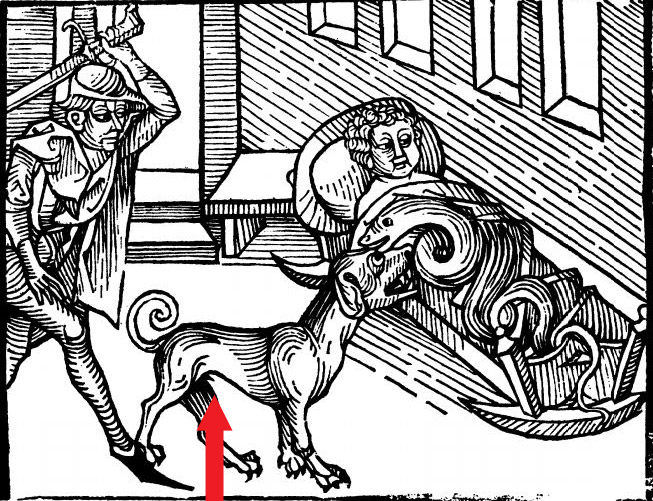
In the diocese of Lyons, near the enclosed nuns’ village called Neuville, on the estate of the Lord of Villars, was a castle. The lord of that castle and his wife had a baby boy. One day, when the lord and lady had gone out of the house and the nurse had done likewise, the baby was alone in a cradle. A huge serpent entered the house and approached the baby’s cradle. Seeing this, the greyhound, which had remained behind, chased the serpent. Attacking it beneath the cradle, it upset the cradle and bit the serpent all over. The serpent defended itself, biting the dog equally severely. Finally, the dog killed the serpent and threw it far from the cradle.

The cradle, the floor, and the dog’s mouth and head were all drenched in the serpent’s blood. Although the serpent had badly hurt it, the dog remained on guard beside the cradle. When the nurse came back and saw all this blood, she thought that the dog had devoured the child. She let out a scream of misery. Hearing it, the child’s mother also ran up, looked, thought the same thing, and screamed too. The knight, when he arrived, thought likewise. He drew his sword and killed the dog. Then, when they went closer to the baby, they found it safe and sound, sleeping peacefully. Casting around for some explanation, they discovered the serpent, torn to pieces by the dog’s bites, and now dead. …

By divine will, the castle was destroyed. The land, reduced to a desert, was abandoned by its inhabitants. But the peasants heard of the dog’s conduct. They heard how it had been killed, although innocent, for a praiseworthy deed. They visited the place, honored the dog as a martyr, and prayed to it when they were sick or in need of something.

{ Sic faciebant nuper in diocesi Lugdunensi, ubi, cum ego predicarem contra sortilegia et confessiones audirem, multe mulieres confitebantur portasse se pueros suos apud sanctum Guinefortem. Et cum crederem esse sanctum aliquem, inquisivi, et audivi ad ultimum quod esset canis quidam leporarius, occisus per huc modum.

In diocesi Lugdunensi, prope villam monialium qui dicitur Noville, in terra domini de Vilario, fuit quoddam castrum cujus dominus puerum parvulum habebat de uxore sua. Cum autem exivissent dominus et domina a domo et nutrix similiter, dimisso puero solo in cunabulis, serpens maximus intravit domum, tendens ad cunabula pueri; quod videns leporarius, qui ibi remanserat, eum velociter insequens et persequens sub cunabulo, evertit cunabula, morsibus serpentem invadens, defendentem se et canem similiter mordentem; quem ad ultimum canis occidit et a cunabulis pueri longe projecit,

reliquens cunabula dicta cruentata, et terram et os suum et caput, serpentis sanguine, stans prope cunabula, male a serpente tractatus. Cum autem intrasset nutrix et hec videret, puerum credens occisum et devoratum a cane, clamavit cum maximo ejulatu; quod audiens, mater pueri similiter accurrit, idem vidit et credidit, et clamavit similiter. Similiter et miles, adveniens ibi, idem credidit, et, extrahens spatam, canem occidit. Tunc, accedentes ad puerum, invenerunt eum illesum, suaviter dormientem; inquirentes, inveniunt serpentem canis morsibus laceratum et occisum .…

Castro autem divina voluntate destructo, et terra in desertum redacta est, ab habitatore relicta. Homines autem rusticani audientes nobile factum canis, et quomodo innocenter mortuus est pro eo de quo debuit reportare bonum, locum visitaverunt, et canem tanquam martyrem honoraverunt et pro suis infirmitatibus et neccessitatibus rogaverunt }[3]

Peasants of thirteenth-century France better appreciated men’s love for children than do most persons today. These thirteenth-century French peasants honored this male dog as a saint and a martyr. In our more ignorant and bigoted age, men are simply expected to be the last off sinking ships. Woe to men today if they show righteous regard for their own lives and gender equality!

faithful, baby-saving male dog Saint Guinefort

The male dog Saint Guinefort fought courageously to save a baby from a vicious serpent. He suffered serious wounds from his heroic deed. Saint Guinefort is like divorced fathers who fight valiantly to remain in their children’s lives as fathers, not just as wallets. Like men victims of domestic violence, Saint Guinefort’s wounds were horrifically misunderstood. Like an eighteen-year-old man who merely had consensual hetero-sex and then suffered repeated jailing for being unable to pay state-mandated “child-support” for unplanned parenthood, Saint Guinefort endured terrible injustice. Modern scholars haven’t forthrightly recognized the gender of the dog Saint Guinefort.[4] With the benefit of meninist literary criticism, you now know more of the truth: the faithful, baby-saving dog Saint Guinefort was male.

* * * * *

Read more:

Notes:

[1] The faithful-dog tale (Aarne-Thompson-Uther folktale type 178A) has long been traced back to the Panchatantra. In the Panchatantra, the story is known as “The Brahmin and the Mongoose.” Redondo (2011) and Redondo (2013) root at least the version in Syntipas to Pausanias, Description of Greece 10.33. On the diffusion of the faithful-dog tale, Blackburn (1996) p. 495, Rist (2019) pp. 8-10. The faithful-dog tale is usually included in the Gesta Romanorum. See, e.g. story 32 (“Dog and Serpent”) in Bright (2019) pp. 196-7. On an instance reported in south Indian in 1937, Emeneau (1940). Here are English translations of a range of instances. The weeping-dog tale is another example of a story included in the Panchatantra and widely diffused throughout medieval Europe.

In the Sindibad / Seven Sages corpus (which includes Syntipas and the Hebrew Sendebar) the faithful-dog tale is known as Canis. For some instances, Redondo (2013) pp. 56-7. In the The Book of the Wiles and Fabrications of Women {El Libro de los Engaños e los Asayamientos de las Mugeres}, the king’s fifth counselor tells the story. See, e.g. Keller (1956) p. 33. Another story included in both the eastern and western branches of the Sindibad / Seven Sages corpus is Tentamina.

In its medieval literary contexts, the faithful-dog tale is typically associated with warning against making hasty judgments. In some instances, it portrays a woman as acting less than wonderfully: “misogyny can be described as a secondary element in the tale of the faithful dog.” Redondo (2013) p. 65. Under dominant academic gynocentrism, all literature from all places and all times must exclusively present women’s all-encompassing virtue, in contrast to men’s “toxic masculinity.” Any text that violates this moral commandment must be labeled as misogyny.

[2] Rist (2019) p. 10. On the manuscripts, Dubois (1980) pp. 145-6.

[3] Stephen of Bourbon, A Treatise on Various Preachable Matters {Tractatus de diversis materiis predicabilibus}, also known as On the Seven Gifts of the Holy Spirit {De septem donis Spiritus Sancti}, gift “fortitude {fortitudo},” “About superstition {De Supersticione}” 370, Latin text from Lecoy de la Marche (1877) pp. 325-6, English translation (with my modifications) from Schmitt (1983) pp. 4-5 (alternate English translation). Stephen of Bourbon died about 1262, shortly after recording this story.

The honoring of Saint Guinefort unfortunately developed into a cult that threatened the lives of infants. Rist observed:

What is also very clear is that the cult described is a peculiarly female rite where the mother has the final say as to whether or not to accept the child as hers. This reflects the fact that in the medieval period, as in many historical eras, the paternity of a child could not always easily be proved, but the identity of the mother could be established with certainty.

Rist (2019). That fundamental gender inequality has enormous significance. Legal paternity establishment procedures explicitly embrace fiction in law and legal rulings. Given the precarious social position of fathers and a long history of disparaging men as dogs, depicting the male dog Guinefort saving a children becomes particularly important.

[4] See, e.g. Schmitt (1979 / 1983), Blackburn (1996), Dickey (2013), Rist (2019). That the faithful, baby-saving dog was male has been implicitly recognized:

in many Tamil texts, in fact, the parents believe that the birth of their human son is a reward for their love of their animal son.

Blackburn (1996) p. 499, which is discussed in Dickey (2013) (‘In most versions of the story, the animal is the “first-born son.”’).

A late-eighteenth Welsh businessman apparently recognized the important of the faithful, baby-saving dog being male. David Pritchard in 1793 became the landlord of the Royal Goat Inn in Beddgelert, Wales. To encourage visits to his inn, he invented such a story. This new, Welsh story featured Prince Llywelyn the Great, an alleged thirteenth-century royal who allegedly had a palace at Beddgelert (meaning “the death of Gelert”). The savior of Prince Llywelyn the Great’s son was his favorite dog Gelert. That name apparently came from the late-seventh-century Saint Gelert. He was a hermit-man who lived near Llandysul in the county of Ceredigion, Wales. Pritchard created a megalith (“a slab lying on its side, and two upright stones”) to mark Gelert’s grave. For the quote, Borrow (1862). The faithful, baby-saving dog Saint Gelert was thus also male.

[image] Woodblock print for Canis, the story of the faithful, baby-saving dog, in a 1489 printing of John of Capua {Johannes de Capua}, The Guide of Human Life, or Proverbs of the Ancient Sages {Directorium humanae vitae, alias parabolae antiquorum sapientium}. John of Capua wrote Directorium humanae vitae by translating Rabbi Joel’s Hebrew version of Kalilah wa-Dimnah into Latin between 1263 and 1278. The image is from Blackburn (1996) p. 499, which sourced it from a book held in the British Library. Here’s another image of the Canis woodcut in its page context.

Here’s a lovely modern prayer card for the dog Saint Guinefort. This modern prayer card regrettably obscures Saint Guinefort’s masculinity. Perhaps that’s an effect of modern selective prudishness. Medieval paintings made clear that Jesus was a fully masculine man.

References:

Blackburn, Stuart. 1996. “The Brahmin and the Mongoose: The Narrative Context of a Well-Travelled Tale.” Bulletin of the School of Oriental and African Studies, University of London. 59 (3): 494-507.

Borrow, George. 1862. Wild Wales: its people, language, and scenery. 3 vols. London: John Murray.

Bright, Philippa, ed. and trans. 2019. The Anglo-Latin Gesta Romanorum: from Oxford, Bodleian Library, Douce MS 310. Oxford Medieval Texts. Oxford: Oxford University Press.

Dickey, Colin. 2013. “A Faithful Hound: How a dog came to be recognized as a saint.” Lapham’s Quarterly. Posted online June 18, 2013.

Dubois, Jacques. 1980. “Saint Guinefort vénéré en Dombes: comment un martyr inconnu fut substitué à un chien-martyr.” Journal Des Savants. 141-155.

Emeneau, M. B. 1940. “A Classical Indian Folk-Tale as a Reported Modern Event: The Brahman and the Mongoose.” Proceedings of the American Philosophical Society. 83 (3): 503-513.

Keller, John Esten, trans. 1956. The Book of the Wiles of Women. Chapel Hill: University of North Carolina Press.

Lecoy de la Marche, Albert, ed. 1877. Stephen of Bourbon. Anecdotes historiques, légendes et apologues tirés du recueil inédit d’Etienne de Bourbon, Dominicain du XIIIe siècle. Paris: Renouard.

Redondo, Jordi. 2011. “Is really Syntipas a translation? The case of The faithful dog.” Graeco-Latina Brunensia. 16: 49-59.

Redondo, Jordi. 2013. “The Faithful Dog: The Place of the Book of Syntipas in its Transmission.” Revue Des Etudes Byzantines. 71: 39-65.

Rist, Rebecca. 2019. “The papacy, Inquisition and Saint Guinefort the Holy Greyhound.” Reinardus. 30 (1): 190-211. Cited by pages in online verse. Here’s a streamlined version)

Schmitt, Jean-Claude. 1979. Le Saint Lévrier: Guinefort, guérisseur d’enfants depuis le XIIIe siècle. Paris: Flammarion.

Schmitt, Jean-Claude, trans. into English by Martin Thom. 1983. The Holy Greyhound: Guinefort, healer of children since the thirteenth century. Cambridge: Cambridge University Press. The original is Schmitt (1979).

Baucis et Traso: can’t make a whore into a virgin

Men tend to be romantically simple. Many men just want to have sex with a woman thrilled with the joy of her first experience of the masculine sexual gift. Unfortunately, sophisticated women can easily exploit naive, trusting men. That’s what happened to Traso in the twelfth-century Latin comedy Baucis and Traso {Baucis et Traso}.

Baucis was a corrupt, vicious old bawd. Historically, mothers eager for financial gain have prostituted their daughters. Baucis pandered the aging prostitute Glycerium. Baucis gave Glycerium many different fabricated names as she repeatedly sold her as a virgin:

She promises friendships, joys, wines, and meals.
Theirs would be the virgin’s conversation, caressing, kisses, and the deed.
She recounts the virgin’s ancestor to be Jove.
She commends her, she promises her to anyone, to those giving gifts she gives
the virginal glory, first sexual intercourses:
first to this man, first to that man. What more should I report?
She promises firsts to all who themselves make gifts.

{ Spondet amicicias, gaudia, uina, cibos,
Virginis alloquium, contactus, oscula, factum.
Narrat progeniem uirginis esse Iouem.
Hanc probat, hanc cuivis spondet, dat dantibus huius
Primos concubitus uirgineumque decus:
Huic primos, illi primos, quid plura referrem?
Tot spondet primos, quot sibi dona ferunt. }[1]

Popular media today promotes and celebrates firsts, e.g. the first obese female fox with grey hair appointed to lead a liberal arts college for vixens. In more sophisticated medieval Europe, thinkers distinguished between significant firsts and insignificant firsts. Consider the first time a man has sexual intercourse with a particular woman and the first time a woman has sexual intercourse with any man. For a man having sex with a prostitute, the former first would be regarded as insignificant within relatively well-developed medieval public reason. Nonetheless, naive persons who accept any first as significant have existed throughout history. Baucis exploited such naive persons in pimping Glycerium.

Traso was a soldier indoctrinated with the ideals of courtly love. He apparently used his mind little: “his glory is drinking, / his stomach is his god, and the sex goddess his ready companion {cui gloria potus, / Cui venter deus est, cui Venus apta comes}.”[2] When Traso came to Baucis’s house, she regarded him as easy-pickings:

Coming to him, she says: “O soldier, child of love,
you soldier, officer of love, you are my way’s reason.
What does your heart itself want? Where are you marching? What fires do you nurture?
If a virgin is your need, I have a virgin in my house,
a virgin, yet a young shoot, a flower, love’s fruit.
She shines virginal brightness in elegant beauty.

{ Accedens ait hec: “O miles, Amoris alumpne,
Miles, Amoris honos, tu mihi causa uie.
Quid sibi uult tua mens? quo tendis? quos alis ignes?
Virgine si sit opus, est mihi uirgo domi.
Virgo, set uirga, set flos, set fructus amoris,
Lumen uirgineum forma decore nitens.” }

That mendacious description of Glycerium was enough to make Traso burn in love for her, sight unseen. Extensively experienced women prostitutes such the soldadeira Balteira worked soldiers’ camps in medieval Europe. Traso probably had never had sex with a virgin. Baucis characterized Glycerium as the opposite of a hard-working sex-worker:

Baucis said to him: “She sleeps, and it’s not permitted to wake her.
She’s soft, and long periods of sleep comfort a soft woman.
If she stays awake too much, she’s sick. If she sleeps badly,
she’s weak. If she’s cold, she fears to be feverish.
If she has to fast too much against her will, she ignores food.
If she’s not given drink when she wants it, she spurns it.”

{ Baucis ad hec: “Dormit nec eam licet euigilare.
Est mollis, mollem sompnia longa fouent.
Si nimium uigilet, egrotat: si male stertit,
Languet; si friget, febricitare timet;
Si nimis inuita ieiunet, negligit escas;
Ni des, cum uoluit, pocula, spernit ea.” }

In short, Glycerium was a highly privileged, high-maintenance woman. Deluded courtly lovers and masochistic men seek out highly privileged, high-maintenance women. That’s what Traso did.

Baucis exploited Traso’s burning love for Glycerium. Although a soldier, Traso acted like a courtly lover:

The new love inflames Traso. The new suffering grabs him.
He thinks about sex, and while meditating on it, he feeds his desire.
He is destitute of reason. An immoderate love presses on him,
a love whose customary measure is to wish to lack any limit.
He returns to his reasoning and finally breaks his silence.
He repeats his groans and reiterates his prayers.
He pulls a gold ring from his finger and gives that gift to Baucis.

{ Trasonem nouus urit amor, noua poena cohercet;
Cogitat et Venerem, dum meditatur, alit.
Stat rationis inops, premit hunc Venus immoderata,
Qua solet esse modus, uelle carere modo.
Ad mentem rediit rupitque silentia tandem,
Ingeminat gemitus exiterando preces.
Arreptum digitis aurum dat munera Bauci. }

Baucis told Traso that Glycerium would be sweeter towards him because of his generosity. Then she took him to the marketplace. There she bought all that she wanted and had Traso pay for her purchases. She subsequently disappeared into the crowd. With his dreams broken, Traso sadly returned home.

Men, who are human beings with feelings, understandably get upset and angry when they are exploited and abused. Grieving Traso in emotional turmoil condemned women in general:

Woman, wicked flame, intimate grief, enemy that I befriend!
Woman is the highest evil, woman is worthy of death.
Woman offers seeds of rot, woman offers death.
Woman, what have I done? She has seized me from under myself.
O whore! You have the face of a monster and the image of a Chimera!
Why has your guile deceived me and how?

{ Femina flamma nocens, dolor intimus, hostis amico;
Femina summa mali, femina digna mori;
Femina fetoris dat semina, femina mortem;
Femina, quid feci? me mihi subripuit.
O meretrix! monstri facies et imago Chimare!
Cur me decepit fraus tua quoue modo? }

Traso here refers to Eve leading Adam to expulsion from eternal life in the Garden of Eden. He also refers to a man being deprived of the unity of heterosexual intercourse. In biblical understanding, women, like men, are made in the image of god.[3] Yet in Traso’s eyes, woman became an image of a Chimera.

Traso’s slave Davus understood the problem more precisely. According to Davus, a woman could scarcely do more evil that Baucis did in trafficking in women sex-workers to exploit men:

Baucis alone rejoices in injuring loving with damages.
If she injures, she rejoices. If she cannot do thus, she grieves.
She is grief. She is fraud and the origin of fraud in loving.
She in her very self, so I think, was born to deceive.

{ Baucis sola nocens dampnis letatur amantis;
Si noceat, gaudet; si nequit, inde dolet.
Hec dolor est, hec fraus el origo fraudis amantum,
Hec hec, ut credo, fallere nata fuit. }[4]

Davus consoled Traso, who didn’t implacably hate all women. Then Davus set off to settle the matter with Baucis.

At Baucis’s house, Davus became part of Baucis’s abusive family. They both viciously abused each other verbally. Then, like an abused wife lashing out in self-defense, Davus started slapping Baucis and pulling her hair. Glycerium came out and threatened Davus. With Glycerium’s intervention, Baucis and Davus reconciled. They agreed to work together to deceive and exploit Traso.

That evening, Davus took Traso to Baucis’s house. Outside the house, Davus instructed Traso to hide in a hole. Then Davus went inside to make further arrangements. The enemy pimp Byrrhia saw Traso hiding. At first Byrrhia planned to throw rocks at Traso. Then he decided on a safer and more insulting action: “he would really piss all over him {permingatur enim}.” To Traso, it was like rain:

He sticks his head out of the hole, checking if it’s raining.
When he looks up, a stream of piss-water fills his mouth.
He spits it out. He doesn’t yet sense it to be a deception.
Admiring the rain, in order not to spoil his robe,
he takes it off. What more? The playing with him is finished.

{ Extulit os antro, si pluat experiens.
Riuus aque saliens os implet suspicientis;
Expuit hos nec adhuc sensit adesse dolos.
Admirans pluuiam, pallam ne deterioret
Vertit. Quid plura? luditur hic et ita. }

Medieval Latin literature has an earthy, comic sense of life scarcely conceivable today. Unable to distinguish between rain and piss, Traso was the sort of man who also would be unable to distinguish between a virgin and a whore. When Davus came out of Baucis’s house to summon Traso, Davus saw Byrrhia pissing on him. Davus chased Byrrhia, caught him, and beat him extensively. Then Davus took Traso into the house to have sex with Glycerium. Traso must have smelled like a latrine.[5]

Even after being exploited by Baucis and drenched in piss, Traso was thrilled to meet Glycerium. As soon as he saw her, he rose in excitement and went to her:

Coming to her, Traso rises up. He undertakes
her mouth, her hand. Happily he honors her with gifts.
Testing approaches, he insists on love with loving words.

{ Assurgit Traso uenienti, suscipit illam
Ore, manu; donis letus honorat eam.
Pretemptans aditum uerbis insistit amantum. }

Glycerium feigned innocence. She said she was a virgin and didn’t know anything about love. She said she was afraid of sex. She told him to go find some other woman to sate his ardor.

Traso faltered, but the thought of having sex with a virgin inspired him to new amorous efforts. Baucis urged Glycerium: “What love is, you should learn! You shouldn’t want to be uncultivated {Quid sit amor, discas nec rudis esse uelis}.” Traso then gave Baucis money and promised to give her more. She in turn set an appointment for Traso to have sex with Glycerium the next evening.

To support her deception of Traso, Baucis recreated Glycerium’s virginity. Only a fool would believe that she was successful:

Trying to renew virginal modesty, Baucis
collects the auspiciously suitable items for that proposed deed.
These are herbs, unguents, drink, medicines, incantations —
these are desirable for me to enumerate briefly to you:
whiteness of a raven, smoke, three gusts of wind,
the light of a certain benighted one, a bird of the night,
hairs from the brow of a bald man and a eunuch’s penis,
the hearing of a deaf man, words from one lacking speaking ability,
ice vomiting fire and the heat of the dead,
the sense of the insane with the reason of a cow,
the softness of a hard rock with the murmuring of standing water,
oak trees bearing apples, willows full with pears;
in addition, a child’s wrinkles, an old woman’s beard,
and the venom of Cerberus. These she seeks so as to add to those.
With all the means combined, she makes a virgin from a whore.

{ Baucis uirgineum temptans reuocare pudorem
Prouida proposite colligit apta rei:
Herbas, unguenta, potus, medicamina, cantus,
Que uobis breuiter enumerare libet.
Corui candorem, fumum, tria flamina uenti,
Ceci cuiusdam lumina, noctis auem;
A calui fronte crines membrumque spadonis;
Auditum surdi, uerba carentis eis;
Igniuomam glaciem defunctorumque calorem;
Insani sensum cum ratione bouis;
Duri molliciem lapidis cum murmure stagni;
Quercus pomiferas, uimina plena piris;
Praeterea rugas pueri, barbas uetularum;
Virus Cebereum querit, ut addat eis.
His sibi confectis facit ex meretrice puellam. }

The medieval Latin author here uses the well-established rhetorical figure of impossibility (adynaton {ἀδύνατον}). This sense of the impossibility of turning a whore into a virgin perhaps influenced the widely known rap wisdom: “can’t turn a ho into a housewife.”[6]

The next evening, Traso gave all his promised gifts to Baucis. He thus gained the opportunity to have sex with Glycerium. The final verse of Baucis et Traso is shockingly abrupt: “He enjoyed Glycerium, and having obtained her, he departed {Glicerio fruitur atque potitus abit}.” Traso may have wrongly believed that Glycerium was a virgin. However, in his relation to her, he treated her like a whore.

Baucis et Traso shows the diversity and inclusiveness of medieval European culture. That culture revered the Virgin Mary. It also promoted the ideal of a wife and husband’s conjugal partnership. In addition, medieval European culture celebrated Mary Magdalene and other holy whores. But like leading modern rap artists, medieval European culture vigorously affirmed that whores who don’t seek holiness remain merely whores despite mendacious claims otherwise. Diversity and inclusiveness doesn’t necessarily imply rejecting truth.

* * * * *

Read more:

Notes:

[1] Baucis and Traso {Baucis et Traso}, vv. 12-18, Latin text from Mouton (1931), my English translation, benefiting from the French translation of id. and the English translation of Crawford (1977), pp. 141-55. For a freely available Latin text that’s quite good, Hagen (1868). Currently the best critical edition is Orlandi (1980).

An unknown author composed Baucis et Traso probably between 1150 and 1175. It survives in only one manuscript: Bern, Universitätsbibliothek. Burgerbibliothek (Bibliotheca Bongarsiana), 568.

The names of the characters in Baucis et Traso have classical referents. In Ovid’s Metamorphoses 8.612-727 (Baucis and Philemon), Baucis is a kind, old woman who provides warm hospitality to guests who turn out to be the gods Jupiter and Mercury. The Baucis of Baucis et Traso transgressively inverts the moral characteristics of Ovid’s Baucis. Glycerium, Davus, and Byrrhia are a beloved young woman, a slave, and another slave, respectively, in Terence’s Andria. Thraso is a braggart soldier in Terence’s Eunuchus.

Baucis et Traso hasn’t been adequately appreciated. It has been interpreted narrowly:

This short poem, despite its abundance of platitudes, awkward expressions, and pointless developments, nevertheless presents a certain literary interest. It is above all a school exercise. The author is a scholar who, having practiced Latin poetry, ultimately assimilated certain phrasing from it. We will sometimes see him borrow certain details from the Virgilian or Ovidian style.

{ Ce court poème, malgré l’abondance des platitudes, des gaucheries et des développements inutiles, présente cependant un certain intérêt littéraire. C’est avant tout an exercice d’école. L’auteur est un érudit qui, ayant pratiqué la poésie latine, a fini par s’en assimilier quelques tournures; on le verra parfois emprunter certains détails du style virgilien ou ovidien. }

Mouton (1931) p. 67 (my translation from the French). It’s been interpreted as being unsophisticated and derivative:

The story lacks the sophisticated humour of the other comediae and is to some extent a pastiche of traditional comic elements.

Rigg (1992) p. 114. Baucis et Traso transgressively reinterprets Ovid’s Baucis and presents an outrageous parody of courtly love and gyno-idolatry. Most importantly, Baucis et Traso memorably represents an old women’s sex-trafficking and exploitation of men.

In Baucis et Traso, v. 13, the phrase “conversation, caressing, kisses, and the deed {alloquium, contactus, oscula, factum}” refers to four “stages of love {gradus amoris},” where “the deed {factum}” refers to sexual intercourse. These stages are metaphorically prefigured in v. 12: “she promises friendships, joys, wines, and meals {Spondet amicicias, gaudia, uina, cibos}.” The association of meals with sexual intercourse evokes medieval understanding of Eucharist and Incarnation (love made in human flesh) as the ultimate expression of love.

Medieval literature explored extensively stages of love. The medieval Latin comedy About the Shrewd Envoy {De nuncio sagaci}, vv. 117-245, includes lengthy play with five stages of love. The first stage in De nuncio sagaci is “sight {visum}.” Another poem from no later than early in the thirteenth century similarly describes five stages of love:

There are five stages by which we become linked in love.
Sight, conversing, touching, and an equal mingling
of the nectar of each other’s lips leads easily to the end.
Venus silently squeezes out the fifth act in bed.

{ Quod sunt quinque modi quibus associamur amori:
visus, colloquium, tactus, compar labiorum
nectaris alterni permixtio commoda fini;
in lecto quintum tacite Venus exprimit actum. }

Carmina Burana 154, “Love is a winged and fickle boy equipped with a quiver {Est Amor alatus puer et levis, est pharetratus},” vv. 7-10, Latin text and English translation (modified) from Traill (2018). Matthew of Vendôme’s Art of poetry-making {Ars versificatoria} describes six stages of love. The topos of stages of love was transmitted from antiquity to medieval Europe via the works of Horace. Friedman (1965). On five stages of love in Polish Baroque romance, Woron-Trojanowska (2016). Medieval sermons described ten stages of love for God. Janz-Wenig (2017).

Subsequent quotes from Baucis et Traso are similarly sourced. Those above are vv. 29-30 (his glory is drinking…), 45-50 (Baucis said to him…), 53-9 (The new love inflames Traso…), 89-94 (Woman, wicked flame…), 103-6 (Baucis alone rejoices…), 242-6 (He sticks his head out of the hole…), 269-71 (Coming to her, Traso rises up…), 290 (What love is, you should learn…), 307-21 (Trying to renew virginal modesty…), 324 (He enjoyed Glycerium…).

[2] Baucis et Traso, vv. 29-30. Cf. Philippians 3:19.

[3] Genesis 1:27, 9:6.

[4] Modern scholarship on old women in medieval literature tends to be moralistic and misandristic. Men tend to regard young, beautiful women as considerably more sexually attractive than old, ugly women. Many men rightly despise old women who attempt to deceive them and exploit them. That reality doesn’t mean that men don’t love dearly old women who are their loving wives, mothers, sisters, and friends. A categorical assertion of “male revulsion at old female bodies” is mindless academic cant. See. e.g. Mieszkowski (2007) p. 319. It gets worse:

The hateful {sic} old women in these major medieval works are no oddity, no accident. They speak from the heart of medieval culture and its beliefs about old women.

Id. Such ridiculous, totalitarian poor-dearism has been remarkably successful in promoting simplistic, dualistic gender history and buttressing gynocentric oppression of men. Men in fact show remarkably little hate in relation to hateful old women.

[5] While scholars tend to treat violence against men as normal, horrendous abuse of men deserves notice. Violence against men commonly targets men’s penises and testicles. King Gulinus brutally tortured a knight’s penis in St. Patrick’s Purgatory. Long subject to oppressive regulation, men’s sexuality continues to be more harshly regulated than women sexuality.

Echoing motifs in Baucis et Traso, a fabliau from the first quarter of the thirteenth century also narrates exploitation and abuse of a man. Alexander, the rich chaplain of Saint-Cyr just west of Paris, urgently desired the merchant lady Mahauz’s young, beautiful daughter Marian. Mahauz’s refused Alexander’s request to give Marian to him for a night in return for financial and material “gifts.” But then, seeing the opportunity for profit, Mahauz’s accepted the pandering opportunity.

Mahauz arranged to substitute secretly the highly experienced whore Alison for her daughter Marian. Mahauz thoroughly bathed Alison and declared, “I’ll sell you as a virgin {senprés te vendrai por pucele}.” To make matters worse, Mahauz and her servant-girl Hercelot arranged for the chaplain to be exposed in bed with Alison. Alexander had sex nine times with the young woman he thought was Marian. Then Hercelot deliberately ignited a fire in the room to reveal the woman to be Alison and to expose Alexander to neighbors coming to help extinguish the fire. In modern terms, the chaplain Alexander was raped by deception. In addition, the neighbors quickly arriving on the scene viciously beat him:

The blows of those heavy sticks
left marks you could see on his back
and ribs and flanks. They beat him
black-and-blue and put him through the mill.
He took off for home running, still
trembling like a leaf on a tree.

{ les cous li parent par le dos,
par les costez & par les flans
des bastons, qui furent pesanz,
molt fu laidengiez & batuz.
It est en maison enbatuz,
tranblant com une fuille d’arber. }

Guillaume le Normand, “The Priest and Alison {Le Prestre et Alison},” vv. 432-7. Old French text and English translation (modified slightly) from Dubin (2013) pp. 46-7. Mahauz’s boast to the whore Alison that she’d sell her as a virgin is similarly sourced from “Le Prestre et Alison,” v. 163. Medieval literature doesn’t celebrate men’s strong, independent sexuality like modern authorities celebrate women’s strong, independent sexuality.

[6] The phrase “can’t turn a ho into a housewife” occurs in the song “Housewife” on American rapper Dr. Dre’s 1999 studio album The Chronic 2001. That song drew upon Kurupt’s “Ho’s a Housewife” from his 1998 studio double album Kuruption! Ludacris also used the phrase “can’t turn a ho into a housewife” in his song “Ho” on his 2001 album Back for the First Time. Ludacris’s natal name is Christopher Brian Bridges. Attesting to the influence of Latin, Ludacris apparently comes from “ludicrous,” which comes from the Latin adjective ludicrus, which is from the Latin verb ludo, meaning “to play.”

Dr. Dre’s aphorism goes back at least to a thirteenth-century Old Italian poem of men’s sexed protest. The poem advises a man not to give a promiscuous woman the key to his house, “because you can’t put a whore into a good house {ké çamai la puitana meter no pòi en bon domo}.” Verse 556 in Proverbs that discuss the nature of women {Proverbia que dicuntur super natura feminarum}, Old Italian text of Gianfranco Contini via Bonghi & Mangieri (2003), my English translation, benefiting from the modern Italian translation of id. In short, you can’t turn a whore into a housewife.

The understanding that a whore won’t become a housewife is expressed metaphorically in a twelfth-century Latin poem. Walter of Châtillon, St-Omer 22, “As I seek a cure for myself {Dum queritur michi remedium},” stanza 4. For text and English translation, see my post on an impious medieval man’s response to gender injustice.

Early in the eleventh century, Egbert of Liège in his schoolbook The Well-Laden Ship {Fecunda ratis} provided related wisdom: “A fallen virgin will not afterward restore her ruin {Lapsa suam non post solidabit virgo ruinam}.” Fecunda ratis 1.299, Latin text and English translation (modified slightly) from Babcock (2013). An eleventh-century gloss to this verse in the one surviving manuscript explains: “After a virgin has fallen, she cannot be a virgin {Virgo postquam lapsa fuerit, virgo esse non poterit}.” Babcock (2013) p. 299, note for Fecunda ratis 1.299.

For a medieval poem on a beloved woman who apparently became a whore, Carmina Burana 120: “A deadly rumor {Rumor letalis}.” Here’s some analysis of that poem. For a medieval poem on a beloved woman thought to be chaste, but not, Carmina Burana 121, “Strum the lyre, please, with happy hands {Tange, sodes, citharam manu letiore}.”

About 2500 years ago, young women in the ancient Greek empire of Lydia reportedly followed a career progression from whore to wife. A Greek historian reported in the fifth century BGC:

All the daughters of the Lydian people in fact work as prostitutes until they marry. They gather dowries for themselves by doing this. Then they themselves contract marriages for themselves.

{ τοῦ γὰρ δὴ Λυδῶν δήμου αἱ θυγατέρες πορνεύονται πᾶσαι, συλλέγουσαι σφίσι φερνάς, ἐς ὃ ἂν συνοικήσωσι τοῦτο ποιέουσαι· ἐκδιδοῦσι δὲ αὐταὶ ἑωυτάς. }

Herodotus, Persian Wars / Histories {Ἱστορίαι} 1.93.4, ancient Greek text and English translation (modified) from Godley (1920). According to Herodotus, women prostitutes made the largest contribution to constructing the massive tomb of Alyattes, son of Croesus, in Lydia. Id. That’s not necessarily fanciful. Zalin (2016) p. 88, n. 52.

[image] (1) The old woman Baucis and her husband Philemon providing generous hospitality to the disguised Jupiter and Mercury in accordance with the tale in Ovid’s Metamorphoses 8.612-727. Oil on canvas painting from the workshop of Peter Paul Rubens. Painted c. 1620-1625. Preserved as accession # GG 806 in the Kunsthistorisches Museum (Vienna, Austria). Via Georges Jansoone and Wikimedia Commons. (2) Video recording of Ludacris’s song “Ho” from his 2001 album Back for the First Time. Via YouTube.

References:

Babcock, Robert Gary, ed. and trans. 2013. Egbert of Liège. The Well-Laden Ship {Fecunda ratis}. Dumbarton Oaks Medieval Library, 25. Cambridge, MA: Harvard University Press.

Bonghi, Giuseppe, and Cono A. Mangieri, trans. (Italian) with notes. 2003. Proverbia que dicuntur super natura feminarum. Biblioteca dei Classici Italiani. Online. Alternate source.

Crawford, James Martin. 1977. The Secular Latin Comedies of Twelfth Century France. Ph.D. Thesis. Indiana University, USA.

Dubin, Nathaniel. 2013. The Fabliaux. New York: Liveright.

Friedman, Lionel J. 1965. “Gradus Amoris.” Romance Philology. 19 (2): 167-177.

Godley, A. D., ed. and trans. 1920. Herodotus. The Persian Wars. Loeb Classical Library 117-120. Cambridge, MA: Harvard University Press.

Hagen, Hermann. 1868. “Eine antike Komödie in distichischer Nachbildung.” Jahrbücher für classische Philologie. 14: 711-729.

Janz-Wenig, Katrin. 2017. Decem gradus amoris deutsch: Entstehung, Überlieferung und volkssprachliche Rezeption einer lateinischen Predigt: Untersuchung und Edition. Berlin: Erich Schmidt Verlag.

Mieszkowski, Gretchen. 2007. “Old Age and Medieval Misogyny.” Pp. 299-320 in Classen, Albrecht, ed. Old Age in the Middle Ages and the Renaissance: Interdisciplinary Approaches to a Neglected Topic. Berlin, Boston: De Gruyter.

Mouton, Jean, ed. and trans. (into French). 1931. “Baucis et Traso.” Ch. VIII (pp. 61-83) in vol. 2 of Cohen, Gustave, ed. La “Comédie” Latine en France au XIIe Siècle. Paris: Les Belles-Lettres.

Orlandi, Giovanni, ed. and trans. (into Italian). 1980. “Baucis et Traso.” Pp. 245-303 in Bertini, Furruccio, ed. Commedie Latine del XII e XIII Secolo. Vol. 3, Pamphilus, Geta, Baucis et Traso, De mercatore. Genova: Università di Genova, Facoltà di Lettere. (review by Roland Crahay)

Rigg, A. G. 1992. A History of Anglo-Latin Literature, 1066-1422. Cambridge: Cambridge University Press.

Traill, David A. 2018, ed. and trans. Carmina Burana. Dumbarton Oaks Medieval Library, 48-49. Cambridge, Massachusetts: Harvard University Press.

Woron-Trojanowska, Joanna. 2016. ‘Topos “quinque gradus amoris” w polskim romansie barokowym.’ Meluzyna: Dawna Literatura i Kultura. 23-34.

Zalin, Mackenzie Steele. 2016. Studies in Aetiology and Historical Methodology in Herodotus. Ph.D. Dissertation, Duke University.

sanctifying Desiré’s sexual relationship with a fairy

In a lai from thirteenth-century France, Desiré was a young, handsome, passionate knight. He was the son of the King of Scotland and lived in Calder. To demonstrated his worth, for seven years he engaged in violence against men in Normandy. He won renown for his bravery and prowess. One early summer day in Calder, with the trees in flower and the birds singing, he went riding for pleasure on his magnificent horse. He was mysteriously prompted mid-ride to visit a holy man who had a hermitage-chapel in the Blanche Lande.

On his way to the holy man’s chapel, Desiré came across a beautiful, scantily dressed young woman. She was shapely and noble-looking. Desiré dismounted and greeted her. He then took hold of her and laid her down on the fresh grass. As is typical for the pastoral genre, he sought to make her his beloved. The young woman cried out for mercy while showing respect for Desiré’s strong sexual passion:

Knight, away with you from here!
You will hardly gain
if you dishonor my body.
Don’t commit any evil act.
Let me be, for your own advantage.
I’m the servant of a maiden, and
in all the world there is none more beautiful.
I will let you see her shortly,
and if you are able,
make sure she doesn’t escape from you,
whatever I tell you.
If you are well-loved by her,
you will not go astray for any reason.
You will have an abundance of gold and silver
entirely at your disposal.
Don’t think that I’m lying to you,
and if she’s not to your liking,
you cannot fail with me.
I will do whatever you wish.
Put your trust in me completely.
I give you my word.
I will help you in your time of need,
whether it be near or far.

{ Chevalier, tolez vos de ci.
Ne serez gueres avanciez,
Se de mon cors me honnissiez.
Ne fetes nule mesprison,
Lessiez m’estre pur guerredon.
Je sui ja une damoisele,
El siecle n’a nule plus bele;
Je la vos ferai ja veoir;
Se vos estes de tel pooir,
Gardez que ne vos eschap mie,
Por nule rien que je vos die.
Se de li estes bien amez,
Por nïent seriez esgarez.
Assez avrez or e argent
Tot a vostre comamndement.
Ne cuidiez pas que je vos mente,
Et s’ele ne vos atalente,
A moi ne pouez vos faillir;
Je feré tout vostre plesir.
Tout asseür soiez de moi;
Je vos afi la moie foi,
Aiderai vos a grant besoing,
Ou soit de pres, ou soit de loing. }[1]

What an extraordinarily generous young woman! She obviously didn’t want to increase the number of men imprisoned for serious crimes such as rape. After her words, Desiré retained enough reason to realize that he shouldn’t rape this women just because he passionately desired her.

The young woman then took Desiré to her mistress. The mistress was extremely beautiful. Apparently ready to welcome a man, she had prepared a luxurious bed. The young woman urged Desiré to go to her mistress. However, when Desiré went to her, she fled. Desiré chased after her and grabbed her by her right hand. That’s a gesture of leading a woman to marriage. He spoke agreeably to her:

“Beautiful one,” he said, “speak to me!”
Why are you fleeing so fearfully?
I am a knight from this land.
I will be your vassal-servant and your lover.
In order to have your loyal love,
I’ll serve you as best as I can.”

{ ‘Bele,’ fet il, ‘parlez a moi;
Por qoi fuiez a tel desroi?
Chevaliers sui de cest païs,
Vostre hon serai et vostre amis;
Por vostre druerie avoir
Vos servirai a mon pooir.’ }

Men should not offer to be women’s servants. Desiré was deluded with men-oppressing ideals of courtly love. The woman assented to this all-too-common love relationship. Then they had sex.

Desiré spent a long time with the woman. He was very unwilling to leave her. But women dominated men in medieval Europe just as women do today. She told him to leave her. She insisted that he follow prescribed morality and urged him to continue to engage in violence against men:

“Beloved,” she said, “Desiré,
you will go to Calder.
I shall give you a ring made of gold
and I tell you one thing:
if you are striving to love well,
take care you do not transgress.
If you transgress in any way,
you will lose the ring at once.
And if that happens to you,
that you have lost the ring,
you will have lost me forever,
without any chance of getting me back or seeing me.
Take care that you act correctly.
Don’t let me become a hindrance to you.
I have no regard for a knight
who doesn’t attend tournaments frequently.
A knight who has a beloved
must certainly perform deeds of valor,
spend very lavishly,
and continually keep good lodgings.
Before you had my love,
you were a man of very great valor.
It’s not right for a knight
to deteriorate because of love.”

{ ‘Amis,’ fet elle, ‘Desirrez,
A Calatir vos en irez;
.I. anel d’or vos baillerai,
Et une chose vos dirai:
Or vos gardez de meserrer,
Si vos penez de bien amer.
Se vos mesfetes de noient,
L’anel perdrez hastivement;
Et se ce vos soit avenu
Que vos l’anel aiez perdu,
A toz jors mes m’avrez [perdue],
Sanz recovrer et sanz veüe.
Gardez que molt la faciez bien,
Ne nos chargiez por moi de rien.
Je ne pris noient chevalier
Qui sovent ne vait tornoier,
Car chevalier qui a amie
Doit bien fere chevalerie,
Et despendre bien largement,
Et bons ostex tenir sovent.
Ainz que vos eussiez m’amor,
Fustes vos molt de grant valor;
N’est mie droiz a chevalier
Que por amor doie empirier.’ }

In controlling Desiré, the woman instructed him “not to transgress” and to “act correctly.” What exactly these instructions mean isn’t clear.[2] Modern academics celebrate alleged “transgressing,” yet they’re also typically keen to act correctly according to dominant academic ideology. The woman explicitly urged Desiré to continue to maintain relationships with his fellow knights while engaging in risky acts of violence against men. That seems to be an implicit comment on Erec’s retirement from chivalry after marrying Enide in Chrétien de Troyes’s well-known twelfth-century romance Erec et Enide.[3]

Desiré did as his beloved instructed him. He spent lavishly, gave many gifts, and performed many deeds of violence against men. He would return occasionally to his beloved and stay briefly with her. She had a son and daughter with him, but she never told him of the existence of these children. Fathers typically love their children dearly and want to have a meaningful relationship with them. Modern “child support” laws often reduce fathers to wallets in relation to their children. At least Desiré’s beloved didn’t send the child-support police after Desiré while denying him access to his children.

Nicholas Poussin, Sacrament of Penance

One day while heading to visit his beloved in the Blanche Lande, Desiré came upon the hermitage where a holy man lived. Desiré decided to confess his sins to him. Among other sins, he confessed to having sex outside of marriage with his beloved woman.[4] The holy man gave Desiré advice, imposed a penance, and absolved and blessed him. When Desiré mounted his horse to leave, he looked at his finger and realized that the ring his beloved had given him was gone. He was filled with sorrow and fear.

Desiré rushed to visit his beloved. But he couldn’t find her. Desiré’s beloved was a fairy-woman. She had magically taken her gold ring back from him. Desiré lamented:

I shall never again have joy or pleasure.
Alas, unhappy one, what have I done wrong?
I love you above all.
You are certainly not acting properly.
The hermit gave me confession.
He never spoke ill of you.
I asked for pardon from him for my sins.
If I haven’t done anything unreasonable,
beautiful one, don’t get angry.

{ Jamés n’avré [joie] ne hait;
Hai las! chaitif! qu’ai je mesfait?
Ja vos ain ge sor toute rien;
Certes ne fetes mie bin.
Li hermites me confessa;
Onques de vos n’i mesparla.
De mes pechiez li quis pardon;
Se je n’ai fet (a)autre reson
Bele, ne vos en courouciez }

Desiré and his beloved sinned by having sex outside of marriage. He knew this. The hermit, of course, didn’t blame her for their sexual relationship. But Desiré’s sin went beyond illicit sex. He declared to his beloved woman, “I love you above all {Ja vos ain ge sor toute rien}.” That’s a sin against love for God. Like so many men, Desiré had fallen into gyno-idolatry. He went so far as to declare to his beloved fairy-goddess:

Impose my penance on me.
What the hermit told me
and the fasting in which he instructed me,
at your pleasure I shall abandon them
and do your bidding.

{ Ma penitance m’enchargiez.
Ce que li hermites me dit,
Et les junes que li aprist,
A vostre plaisir les lairai,
Et vos commandemenz ferai. }

That’s like the Hebrews casting and worshiping a golden calf in the desert after God had led them out of slavery.[5] Men throughout history have been prone to gyno-idolatry. If a woman or a fairy-woman gets angry at a man for confessing to a priest his sexual sin with her, then she has no understanding of Moses’s fury and God’s mercy. Desiré’s sacrilege was even worse:

His heart was filled with sorrow,
and he roundly cursed the hermitage,
and likewise the hermit himself
he cursed repeatedly.
And the horse that had carried him there,
and himself for ever having spoken to him.
He cursed himself a great deal in a short time, saying
more than a hundred times that he should not remain there.
He lamented very greatly
and prayed more than a hundred times
that the whole place should be shamed
and consumed by hell-fire,
along with the hermit who lived there,
and the mouth with which he spoke,
and all those who had confessed to him
or who would ever speak to him.

{ Molt ert dolenz en son corage,
Durement maudit l’ermitage,
Et l’ermite tout ensement
Remaudit it assez sovent,
Et le cheval qui l’i parta,
Et soi quant onques i parla;
Molt se maudit em petit d’eure
Plus de .C. foiz qui’il n’i demeure.
Molt durement s’est dementé,
Et plus de .C. foiz a oré
Que trestot le lieu fust honniz,
Et que mau feus l’eüst bruïz,
Et l’ermite qu’il i trova,
Et la bouche dont il parla,
Toz ceus qui consenti li ont,
Ne qui jamés i parleront. }[6]

In short, Desiré became furiously, blasphemously insane. He returned to his home in Calder. There he languished seriously ill for more than a year. Everyone thought that he would die. The righteous God that most medieval Europeans worshiped might well have struck him down for his blasphemy.

One day while Desiré was in bed, his beloved came to him. She declared that she had hated him for a long time for his lack of discretion. She rationalized their sexual relationship:

It was not such a great sin.
I have never been married,
or engaged or promised,
and you have never had a wife.
I think you will regret this.
When you sought out confession,
I well knew that you would be losing me.
What use is it to confess a sin
if one cannot abandon it?

{ Ce ne fu pas si granz pechiez.
Je ne fui onques esousee,
Ne fianciee, ne juree.
Ne fame esplusee n’en as;
Je croi tu t’en repntiras.
Quant tu confession queroies,
Bien sai que do moi partiroies.
Que li pechiezvaut au gehir,
Que ne se puet mie partir? }

Human beings are rationalizing animals. In Christian understanding, sincerely intending to sin no more is sufficient to receive absolution in confession. Many persons confess the same sins over and over again. Christians must believe that with God all things are possible, including abandoning any sin.

In fact, Desiré was compelled to abandon his sexual sin. When his beloved fairy-woman took away her gold ring from him and disappeared, he couldn’t have sex with her. When she reappeared, she refused to have sex with him:

You have wronged me greatly,
but because I loved you so much,
I want to give you another chance.
You can see me each day,
laughing and sporting with you.
Renounce your grief!
But you certainly won’t have any more from me,
nor will you ever seek out confession.

{ Molt avez vers moi meserré;
Por ce que tant vos ai amé,
Vos veil fere tant de retor.
Veoir me porrez chascun jor
Ensemble o vos rire et joer.
Lessiez vostre dolor ester,
Mes ja certes plus n’i avrez,
Ne confession n’i querrez. }

Desiré was immediately restored to good health. He thanked her and kissed her. Then she departed. Although the fairy-woman apparently never confessed her sexual sin, she joined Desiré in church and took Eucharist with him. In the teaching of the medieval Christian church, her action probably wasn’t licit. At the level of everyday life, medieval Christians weren’t enmeshed in logic-chopping.

One day the fairy-woman arrived at the King of Scotland’s court. She brought with her Desiré’s son and daughter. She requested that the King make their son a knight and find a suitable spouse for their daughter. She also requested that she be married to her beloved Desiré. The King fulfilled all her requests. He himself married their daughter, despite the near consanguinity. Then Desiré and the fairy-woman departed to her fairy land. Apparently giving up fellowship with his knight-friends and the violence against men of chivalry, Desiré never returned to his father’s court.

The early thirteenth-century lai Desiré shows the sophistication and intricacy of medieval thinking about men’s gender position. While men are not merely dogs, men tend to be romantically simple. Men readily fall into gyno-idolatry. From a Christian perspective, gyno-idolatry is a more grievous sin than illicit sexual activity among never-married persons. After Desiré confessed his sexual sin, his beloved fairy-woman ensured that he sinned no more in that way. She, however, had tempted him to gyno-idolatry in his desperate attempt to regain her. Moreover, she led him away as a married man to her fairy land. Meninist literary critics find in that ending troubling questions.[7] So too should all readers with sensitivity to men’s lived experiences in relation to women.

* * * * *

Read more:

Notes:

[1] Desiré, vv. 148-72, Old French text and English translation (modified slightly) from Burgess & Brook (2007). Burgess & Brook (2016) includes nearly the same faithful translation, but without the lineation and the corresponding Old French text.

The lai (lay) Desiré survives in two manuscripts. Burgess & Brook’s text and translation are based on MS S: Paris, Bibliothèque nationale de France, nouvelles acquisitions françaises, 1104, f. 72rb-77ra. Tobin (1976) is based on MS P: Cologny (Genève), Fondation Martin Bodmer, 82, f. 7vb-12va. “Dialect apart, the two versions are not greatly dissimilar.” Burgess & Brook (2007) p. 15. MS S is 48 verses longer. For a detailed analysis of the manuscript differences, id. pp. 14-6.

In the lais Graelent, Guingamor, Desiré, and Marie de France’s Lanval, a knight falls in love with a fairy. Desiré is the most structurally complex of these lais and is the one most implicated with Christianity. Smithers (1953) provides extensive, deadening structural analysis. Burgess & Brook (2007) pp. 13-4 provides a useful structural summary.

The supernatural women of the lais have been variously called a fay, fée, enchantress, and fairy mistress. Burgess and Brook, the leading authorities on lais, prefer the terms fée or fairy mistress. Burgess & Brook (2007) p. 17. I use the term fairy above for simplicity for a non-scholarly audience. The point at which Desiré realizes his beloved is a fairy isn’t clear.

Subsequent quotes above from Desiré are similarly sourced. They are from vv. 213-8 (“Beautiful one,” he said…), 231-55 (“Beloved,” she said…), 351-9 (I shall never again have joy…), 360-4 (Impose my penance on me…), 367-82 (His heart was filled with sorrow…), 420-8 (It was not such a great sin…), 437-44 (You have wronged me greatly…).

[2] The woman’s vagueness in commanding Desiré isn’t incidental. It’s “structurally crucial.” Burgess & Brook (2007) p. 28.

[3] Scholars have pointed to links between Desiré and Chrétien de Troyes’s Yvain. For a review, Burgess & Brook (2007) p. 19. Perhaps the link to Chrétien de Troyes’s Erec et Enide has been too obvious for scholars to mention.

[4] A public ceremony and a priestly blessing wasn’t necessary to enact a Christian marriage in medieval Europe. A lavish special-day wedding banquet wasn’t required either. Pope Alexander III in 1181 declared that freely given, explicit consent and sexual intercourse established a marriage. However, Pope Innocent III early in the thirteenth-century made consent the only relevant factor. Trafford (1999) pp. 15-6. Cf. Burgess & Brook (2007) p. 37, n. 62. In practice, parents, particularly mothers, often had decisive influence. Desiré and his beloved fairy-woman agreed to be lovers, not spouses.

[5] Exodus 32.

[6] “One wonders if such an attack could have been written by a cleric.” Burgess & Brook (2007) p. 35. Medieval clerics effectively had much greater freedom of expression than do most scholars today. With respect to this specific lai, Desiré’s vicious rant against the hermit and against sacramental confession emphasizes his fall into gyno-idolatry.

[7] The story of the sinful woman of Luke 7:36-50 can raise troubling questions. Interpreted superficially, Jesus’s teaching there might be thought to mean that sinning more implies loving more, or that loving and sinning are equivalent. Christians throughout history surely wouldn’t regard such an interpretation as the best interpretation with respect to overall understanding of Jesus’s teachings. The interpretive difficulties of Luke 7:36-50 seem to me included in Desiré. That lai has sexual desire, sexual sin, and forgiveness as central, but not exclusive, themes.

[image] Jesus forgiving the sinful woman: Luke 7:36-50. Painting by Nicholas Poussin in 1647 for his Seven Sacraments series as the Sacrament of Penance. Preserved in the National Gallery of Scotland. Image via Web Gallery of Art.

References:

Burgess, Glyn S., Leslie C. Brook, ed. and trans. 2007. French Arthurian Literature. Volume IV: Eleven Old French Narrative Lays. Cambridge, UK: D.S. Brewer.

Burgess, Glyn S., and Leslie C. Brook, trans. 2016. Twenty-Four Lays from the French Middle Ages. Liverpool: Liverpool University Press.

Smithers, Geoffrey V. 1953. “Story-Patterns in some Breton Lays.” Medium Ævum. 22 (2): 61-92.

Tobin, Prudence Mary O’Hara, ed. 1976. Desiré. Genève: Droz. Publié en ligne par l’ENS de Lyon dans la Base de français médiéval, dernière révision le 20-6-2016.

Trafford, Claire de. 1999. The Contract of Marriage: the maritagium from the eleventh to the thirteenth century. Ph.D. Thesis, School of History. University of Leeds.