Greek Diomedes madly loved Trojan Briseida during Trojan War

The ruthless Greek warrior Diomedes, King of Argos, didn’t seem like the sort of man who would suffer lovesickness. Yet he fell madly in love with the beautiful Trojan woman Briseida during the brutal violence against men of the Trojan War. Like a foolish courtly lover, he made himself completely subservient to her. She initially refused his love. He, begging her for mercy, nearly died in despair. Men must beware of their emotional weakness in relation to women.

What is offered me
causes me great fear.
What is denied me,
that I crave
passionately.

If she yields to me,
I am wary of her.
If she doesn’t do what I ask,
I favor her,
and I’m truly

wretched, whether she would destroy me,
or give me relief with herself.
She who desires me I flee;
she who flees from me, I desire.

The more I turn from what I ought to do,
the more I’m attracted to what’s forbidden.
The more what I dislike is allowed;
the more I like what isn’t allowed.

{ Quod michi datur
expaveo,
quodque negatur,
hoc aveo
mente severa.

Quae michi cedit,
hanc caveo.
Quae non oboedit,
huic faveo,
sumque revera

infelix, seu peream,
seu relever per eam.
Quae cupit, hanc fugio,
quae fugit, hanc cupio.

Plus renuo debitum,
plus feror in vetitum;
plus licet illibitum,
plus libet illicitum. }[1]

Greek warrior Diomedes, King of Argos

Diomedes didn’t seem like a weak-kneed, self-abasing woman-wooer. He was a skillful, treacherous, violent warrior:

Diomedes was very strong,
big and square-shouldered and rather tall.
He had a treacherous look about him.
He made many false promises.
He was very bold, very troublesome,
and very skillful in armed conflict.
His speech was very violent and slanderous,
and he was very much feared.
Very difficult it was to be able to find
anyone willing to be against him,
for nothing was able to make him hold his peace.

{ Forz refu mout Diomedès,
Gros e quarrez e granz adès;
La chiere aveit mout felenesse:
Cist fist mainte fausse pramesse.
Mout fu hardiz, mout fu noisos,
E mout fu d’armes engeignos;
Mout fu estouz e sorparlez,
E mout par fu sis cors dotez.
A grant peine poëit trover
Qui contre lui vousist ester:
Rien nel poëit en pais tenir }[2]

Diomedes was regarded as “more ruthless and more brutal than any other {sor toz en est fel e engrès}.” Yet Diomedes was also loyal to friends. In Homer’s Iliad, Diomedes put down him arms when he discovered that the Trojan warrior he was fighting was Glaucus, a friend from his youth.

The beautiful, young Briseida was expelled from Troy. She was the daughter of the Trojan turncoat-soothsayer Calcas. The oracle of Apollo at Delphi had ordered Calcas to go over to the Greek side and help the Greeks destroy Troy.[3] Like Aeneas in the Aeneid, Calcas placed duty to the gods above his own personal desire. After Calcas’s change of worldly allegiance, Briseida was expelled from Troy at the Greeks’ request in conjunction with a prisoner exchange. The Trojan warrior Troilus loved her. Both Briseida and Troilus mourned bitterly her departure from Troy.

Diomedes conducting Briseida from Troy to the Greek camp

Diomedes was in the group of Greek nobles who took Briseida back to the Greek camp. She was a classic damsel in distress:

The young woman was sobbing strongly.
No one could give her comfort.
She was suffering greatly because of Troilus,
who was receding farther and farther from her love.

{ La dameisele plore fort;
Rien ne li puet doner confort:
De Troïlusa grant dolor,
Qui si s’esloigne de s’amor. }

Diomedes immediately sought to offer himself to save Briseida’s heart. Despite never before having seen Briseida or spoken to her, he spoke to her at length:

“Beautiful lady,” he said, “he who has won
your love is rightly pleased with himself.
Your heart and your soul
I would like to have by covenant
that I would be yours as long as I live.
If it were not too soon
and we were not near the Greek army,
and because I see you distressed,
downcast and fearful and angry,
I would beg for great mercy,
to be your knight and your beloved,
that you would receive me so entirely.
Because of this, I would rather suffer great pain
if it pleases you, than fail in my appeal.
But I am very fearful and very anxious
that your heart may harbor hatred
toward me and toward those on our side.
Toward the people who have nurtured you
I know that you will always have love.
No one should ever blame you for that.
But I have heard it said
that persons who have never seen,
become acquainted, or known one another
can love one another very much. This happens often.”

{ “Bele,” fait il, “a dreit se prise
Qui de vostre amor est saisiz:
Le cuer de vos e les periz
Voudreie aveir par covenant
Que vostre fusse a mon vivant.
Se por ço non que trop est tost
E que si somes près de l’ost,
E que jo vos vei deshaitiee,
Pensive e dotose e iriee,
Jos criasse mout grant merci,
Qu’a chevalier e a ami
Me receüssiez tot demeine.
Ainz en voudrai sofrir grant peine
Que, se vos plaist, a ço n’en vienge;
Mais mout me dot e mout me criem ge
Que vostre cuers seit haïnos
Vers mei e vers ceus devers nos.
A la gent qui vos ont norrie
Sai que sereiz toz jorz amie:
De ço nos deit om ja blasmer.
Mais j’ai oî assez parler
Que gent qu’onc ne s’erent veü
Ne acointié ne coneü
S’amoënt mout, ç’avient adès.” }

Diomedes was already married to a woman named Egial.[4] Nonetheless, he instantly proposed essentially a Christian covenantal marriage to Briseida, the damsel in distress that he had just met. That’s insane. Before Briseida said anything, the ruthless, crafty warrior Diomedes, acting like a naive, awestruck schoolboy, said much more:

“Beautiful lady,” continued Diomedes,
“I have never entered into a love affair,
nor had a beloved nor been a beloved.”

{ “Bele,” fait sei Diomedès,
“Onques d’amer ne m’entremis,
N’amie n’oi ne fui amis.” }

Hey Diomedes, tell that to your wife Egial! Ignoring this heckling from millennia later, Diomedes earnestly continued on and on:

Now I feel love drawing me towards you.
One who gazes on your great beauty
is inflamed in love for you. That is no wonder.
You may know for very certain
that I’m placing all my good hopes in you.
I do not ever wish to have great joy
until I have assurance
of having your love without doubt,
and that I have your solace
such that with you in my arms,
I can kiss your eyes and mouth and face.
Sweet beloved, may you not be displeased
by anything that I ask of you or say to you,
nor should you consider it base.
You will be courted and asked
for love in may ways. That I know.
Here are all the world’s most renowned men,
and here are the noblest men,
and the most beautiful and the finest.
They will ask you for your love.
But mark well, beautiful lady, what I say to you.
If you make me your beloved,
you will gain nothing but honor from doing so.
He should be esteemed and greatly renowned
who possesses your love.
Beautiful lady, if I have offered myself to you,
do not refuse my homage.
Have the heart and the desire
to take me as your knight.
A loyal and true lover
you will thus know from now through
all the days that I live.
Many young women have I seen
and many ladies have I known.
Never did I ask any one of them
to love me in this manner.
You are the first
and you will be the last.
If I fail to win you, may God not grant
that I ever strive to win another.
I shall not do so, that I know for certain,
and if I can gain your love,
I shall keep it without doing any wrong.
You will never hear anything about me
that might displease you for even a day.
Heavy sighs and great tears
I see have overburden you in full.
I will put my heart to great effort
so that you can be happy
with my embraces and kisses.
I will give such comfort to you
that your body will again be joyful.
To your service I abandon myself.
From now on I’m ready for this.
God grant that you do not turn me down!
He who loves, begs, and serves
she who hates him — all his pains are wasted.

{ Or sent qu’Amors vers vos me tire.
Qui vostre grant beauté remire,
N’est merveille se il esprent.
Tant sacheiz bien certainement
Qu’en vos metrai mon bon espeir:
Ja ne quier mais grant joie aveir
Desci que j’aie seürance
D’aveir vostre amor senz dotance,
E que j’aie vostre solaz
Si faitement qu’entre mes braz
Vos bais e ieuz e boche e face.
Douce amie, ne vos desplace
Rien que vos pri ne que vos die,
Ne nel tengiez a vilanie.
Preiee sereiz e requise
D’amer, ço sai, en mainte guise,
Ci sont tuit li preisié del mont
E li plus riche qui i sont,
E li plus bel e li meillor,
Qui vos requerront vostre amor.
Mais sacheiz, bele, bien vos di,
Se de mei faites vostre ami,
Vos n’i avreiz se honor non.
Preisiez deit estre e de grant non
Qui de vostre amor est saisiz:
Bele, s’a vos me sui ofriz,
Ne refusez le mien homage.
Tel cuer prenez e tel corage
Que mei prengiez a chevalier:
Leial ami e dreiturier
Vos serai mais d’ore en avant
A toz les jorz de mon vivant.
Mainte pucele avrai veüe
E mainte dame coneüe:
Onc mais a rien ne fis preiere
De mei amer en tel maniere.
Vos en estes la premeraine,
Si sereiz vos la dereraine.
Ja Deu ne place, s’a vos fail,
Que mais por autre me travail:
Non ferai jo, ço sai de veir,
E se vostre amor puis aveir,
Guarderai le senz rien mesfaire;
N’orreiz de mei chose retraire
Que vos desplace a nes un jor.
Des granz sospirs e del grant plor
Dont vos vei mout chargiee e pleine,
Metrai mon cors en mout grant peine
Com vos en puisse esleecier
O acoler e o baisier;
Si metrai tel confort en vos
Dont vostre cors sera joios.
Al servir sui abandonez:
Dès ore en sui apareilliez:
Deus doint ne m’en faceiz deviez!
Quar qui ço aime e prie e sert
Quil het, tote sa peine pert. }

Briseida, a “wise and honorable {sage e proz}” woman, didn’t cry out to Diomedes to stop pleading on and on to her, a weeping Trojan woman that he had just met. Instead, she sympathetically issued a long, evasive speech that began:

“My lord,” she said, “at a time like this
it’s neither good, reasonable, nor right
that I speak to you of love.
A very flighty and very foolish woman
you might then take me for all my days.”

{ “Sire,” fait ele, “a ceste feiz
Nen est biens ne reisons ne dreiz
Que d’amer vos donge parole:
Por trop legiere e por trop fole
M’en porriëz toz jorz tenir.” }

She then went on to speak at length about love without mentioning her lover Troilus, whom she had just left weeping in Troy. The speeches that Diomedes and Briseida exchanged at their first meeting established that they deserve each other.[5]

Amid the vicious violence against men of the Trojan War, the warrior Diomedes feared most what the unarmed Briseida would do to him. Without using physical strength or arms, women can destroy men:

He was very fearful: nothing but a thread
it was, he thought, that he would come to have her.
In the daughter of Calcas of Troy
was his hope for bliss.
He feared that he would never lie with her
beneath a quilt, whether by night or by day.
For this he would make much effort,
to this all his thoughts turned.
But if she never gave him her consent,
he would be dead, without any hope of recovering.

{ Paor a grant: n’est mie fiz
Que il ja seit de li saisiz.
En la fille Calcas de Troie
Est l’esperance de sa joie;
Crient sei que ja soz covertor
Ne gise o li ne nuit ne jor:
De ço se voudreit mout pener,
A ço tornent tuit si penser.
Se ele ensi ne li consent,
Morz est, senz nul recovrement. }

Diomedes in Homer’s Iliad warred against the goddess of love Aphrodite herself and injured her. Here he surrenders himself completely to mad love.

Just as Diomedes was treacherous and skillful in fighting with men in war, so too was Briseida in fighting with men in love. She waged love as war:

Diomedes visited her frequently,
but Briseida was very clever.
She knew well by his sighs
that he was totally smitten with her.
For that reason she was three times harsher with him.

{ Par maintes feiz la vait veeir,
Mais cele est trop de grant saveir:
Mout le conoist bien as sospirs,
Qu’a li est del tot ententis;
Por ço l’en est treis tanz plus dure. }

Like other knowledgeable medieval men, the author Benoît de Sainte-Maure recognized this pattern. Medieval freedom of speech somehow allowed him to state what he knew:

A woman’s nature is always this way.
If she recognizes that you love her
and that you are distraught on her account,
she will always treat you with arrogance.
She will rarely cast her eyes on you
except to show her dominance and cruelty.
Very dearly you will have paid before
she deigns to grant you any favor.

{ Toz jors a femme tel nature:
S’ele aparceit que vos l’ameiz
E que por li seiez destreiz,
Sempres vos fera ses orguieuz;
Poi vos tornera puis ses ieuz
Que n’i ait dangier ne fierté.
Mout avreiz ainz chier comparé
Le bien qu’ele le vos deint faire. }

So it was for Briseida in relation to Diomedes. The Trojan prisoner-of-war Briseida held the Greek Diomedes as her prisoner in the Greek camp during the Trojan War.

On the battlefield of the Trojan War, men continued to engage in brutal violence against men. A massive number of ordinary men were killed without notice. Among the notable men, Briseida’s former lover Troilus thrust a lance through Diomedes’s side. Troilus then taunted him that his lover Briseida would also have other men for brief visits, because she was a whorish woman.[6] Diomedes was carried off the battlefield, placed in bed, and presumed to be soon dead.

Briseida tending the wounded Diomedes

By getting himself nearly killed in battle, Diomedes gained Briseida’s love. She found the gravely wounded Diomedes to be irresistibly attractive:

When Diomedes was wounded
and the daughter of Calcas learned of it,
she consoled herself as best as she could.
But she wasn’t able to conceal her heart
that prompted weeping, tears, and sighs.
Those hidden feelings went out from her.
It was made obvious from her heart
that she loved him more than anyone living.
Never had she made a great show,
up to that day, of her love for him.
But from then she couldn’t keep it secret.
She felt great sorrow and profound grief.
Not caring about gossip,
she frequently went to his tent.
To him she devoted from then on all her attention,
from then all her love, from then she clung to him,
but she feared deeply that she might lose him,
because his wound was very dangerous.

{ Quant Diomedès fu navrez
E la fille Calcas le sot,
Conforta s’en tant com plus pot,
Mais n’en pot pas son cuer covrir
Que plor e lermes e sospir
N’issent de li a nes un fuer.
Semblant fait bien que de son cuer
L’aime sor tote rien vivant:
Nen aveit onc fait grant semblant,
Jusqu’a cel jor, de lui amer,
Mais lores ne s’en pot celer;
Mout a grant duel e grant pesance.
Ne laisse par por reparlance
Qu’el nel veie dedenz sa tente:
Dès ore est tote en lui s’entente,
Dès or l’aime, dès or l’en tient,
Mais de lui perdre mout se crient.
Mout fu perillose la plaie }

Briseida spoke at length to herself about her love for Diomedes. She recognized that her love for him was foolish and wrong. She knew that she would be disparaged and scorned for loving Diomedes. Her lengthy soliloquy appropriately ended on a note of self-centeredness: “May God grant me joy and contentment {Deus m’en doint joie e bien aveir}!”[7] Diomedes remained in pain with a dangerous wound. That wound was in part from love for Briseida — insane love that Gallus pioneered in classical Latin elegy.[8]

During the Trojan War, the Greek warrior Diomedes fell in love with the Trojan woman Briseida and pledged subservience to her. Diomedes nearly died in lovesickness for Briseida. That’s not an isolated incident. The Greek warrior Achilles fell in love with the Trojan princess Polyxena, pledged subservience to her, and abandoned his fellow men for her. These stories of men’s subservience to women in love undoubtedly appealed to women, who surely made up an important part of the medieval audience for tales of the Trojan War. Men, who as human beings have hearts crooked beyond all things, are prone to gyno-idolatry.[9] Men too find a thrill in men’s subservience to women, even to women plausibly regarded as enemies.

* * * * *

Read more:

Notes:

[1] Carmina Burana 71, “Phoebus in his golden chariot {Axe Phoebus aureo}” st. 5a-6b, Latin text and English translation (modified slightly) from Traill (2018).

[2] Benoît de Sainte-Maure, Roman de Troie, vv. 5211-21, Old French text from Constans (1904), English translation (modified slightly) from Burgess & Kelly (2017). In Homer’s Iliad, Bk. 5, Diomedes even fought against the gods. He wounded Aphrodite in the hand and speared Ares in the bowels.

Subsequent quotes from Benoît’s Roman de Troie are similarly sourced. Those above are vv. 24452 (more ruthless and brutal…), 13524-6 (The young woman was sobbing strongly…), 13532-55 (“Beautiful lady,” he said…), 13556-8 (“Beautiful lady,” continued Diomedes…), 13559-616 (Now I feel love drawing me…), 13617 (wise and honorable), 13619-23 (“My lord,” she said…), 15023-32 (He was very fearful…), 15033-7 (Diomedes visited her frequently…), 15038-45 (A woman’s nature is always this way…), 20202-19 (When Diomedes was wounded…), 20340 (May God grant me joy and contentment).

[3] On Calcas switching worldly allegience, Roman de Troie vv. 5817-920. The story of Briseida in the matter of Troy appeared first in Benoît’s Roman de Troie. Within Benoît’s primary source, Dares of Phrygia’s The History of Troy’s Fall {De excidio Troiae historia}, Briseida was merely a sole woman’s name in the catalog of Greeks participating in the second Greek expedition to Troy. On Benoît’s invention of “Briseida’s story,” Kelly (1995).

[4] Diomedes’s wife Egial (Aegialia) was the elder daughter of King Adrastus’s daughter Polynice. The eminent King Adrastus was King of Argos. Before Diomedes had returned to his home in Argos, King Nauplus’s son Oeaus told Egial that Diomedes was bringing home a woman who would be his only love and who would rule over the household. Oceaus told Egial that Diomedes threatened her ominously. Egial then arranged to have Diomedes banished from Argos before he even arrived and before she had even spoken with him. Roman de Troie vv. 27932-94. Men are readily banished from their homes without being able to respond to claims against them.

Diomedes subsequently went to the aid of the besieged Trojan traitor Eneas (Aeneas). Diomedes fought valiantly for five days to defeat Eneas’s foes. That feat prompted Egial to offer peace and reconciliation to Diomedes. He accepted her offer. Briseida at this time was apparently gone. She may have drowned in the Greeks’ perilous homeward journey. Roman de Troie vv. 28208-76.

[5] Benoît presented the love affair of Briseida, Troilus, and Diomedes “in an extremely skilful and sensitive fashion.” Benoît “provides for speculation concerning the psychological development of the three characters.” Lumiansky (1954) p. 733. In Lumiansky’s gynocentric view, the most psychologically intriguing character is Briseida:

the choice topic for psychological speculation in Benoit’s version of this love story is of course Briseida, who in her long soliloquy and elsewhere exhibits her complex mixture of down-to-earth realism and evasive rationalization.

Id. For elaboration in that gynocentric direction, Kelly (1995). Diomedes seems to me a much more psychologically perverse character than Briseida and a character meriting much more attention. Scholars lacking the benefit of meninist literary criticism have difficulty recognizing men’s perverse self-abasement to women. The medieval author Guido delle Colonne at least showed appropriate outrage at how many men died in the Trojan War over one woman, Helen of Troy.

[6] Troilus was understandably bitter at Briseida’s betrayal of their love:

Afterwards Troilus complained bitterly
about his beloved Briseida, who abandoned him
and now loved his enemy.
He claimed that ladies are treacherous
and young women mendacious.
He said it’s wrong to trust them,
because there are very few among them
who are faithful beloveds,
without deceit and without betrayal.
“Whoever enjoys them, I’m not one,
because the daughter of Calcas has betrayed me.”

{ Après s’est assez escharniz
De s’amie qui l’a guerpi
E a amé son enemi.
Les dames claime trichereces;
E les puceles mentereces,
Dit mal fiër se fait en eles,
Quar mout en i a poi de celes
Que leiaument seient amies
Senz fauseté e senz boisdies:
“Qui que s’en jot, ne m’en jo pas:
Trichié m’a la fille Calcas.” }

Roman de Troie vv. 20666-76. Troilus subsequently died in the violence against men of the Trojan War. The difficulties of medieval men’s lives help to explain why elite medieval men suffered more than a nine-year lifespan shortfall relative to elite medieval women. Scholar’s today typically ignore or obfuscate violence against men and men’s life-expectancy shortfall relative to women.

[7] Of course, according to today’s dominant dogma under gynocentrism, Benoît offered a “misogynistic evaluation of Briseida” because he criticized Briseida and women. See Kelly (1995) p. 234.

[8] After Briseida publicly showed her love to the grievously wounded Diomedes, Diomedes next appeared fighting with his men in the brutal violence against men of the Trojan War. Roman de Troie v. 20548. That evokes the fantasy of Lancelot strengthened with the view of his lady. Diomedes at least deserves credit for fighting hard against the men-hating Amazons. Roman de Troie v. 23625-74.

[9] Jeremiah 17:9.

[images] (1) “Munich Diomedes”: Roman copy after a Greek original from c. 440–430 BGC. Original attributed to Greek sculptor Kresilas. Preserved as accession # Inv. 304 in Glyptothek (Munich, Germany). Credit: Albani Collection, 1815. Source image thanks to Bibi Saint-Pol and Wikimedia Commons. (2) Diomedes conducting Briseida from Troy to the Greek camp. Illumination made in 1340s for an instance of Benoît de Sainte-Maure’s Roman de Troie. From folio 104r of MS. Biblioteca Apostolica Vaticana Reg.lat 1505. (3) Briseida attending the gravely wounded Diomedes. Similarly from folio 154r of MS. Biblioteca Apostolica Vaticana Reg.lat 1505.

References:

Burgess, Glyn S., and Douglas Kelly. 2017. The Roman de Troie by Benoît de Sainte-Mauré: a translation. Gallica, 41. Cambridge: D.S. Brewer. Review by Sylvia Federico and by Cristian Bratu.

Constans, Léopold, ed. 1904-12. Le roman de Troie, par Benoît de Sainte-Maure, publié d’après tous les manuscrits connus. Société des Aanciens Textes Français. Paris: F. Didot. Vols. 1, 2, 3, 4, 5, 6.

Kelly, Douglas. 1995. “The invention of Briseida’s story in Benoît de Sainte-Maure’s Troie.” Romance Philology. 48 (3): 221-241.

Lumiansky, R. M. 1954. “The Story of Troilus and Briseida according to Benoit and Guido.” Speculum. 29 (4): 727-733.

Traill, David A. 2018, ed. and trans. Carmina Burana. Dumbarton Oaks Medieval Library, 48-49. Cambridge, Massachusetts: Harvard University Press.
bawdy medieval version of The Merchant of Venice’s pound of flesh

In William Shakespeare’s The Merchant of Venice, the Venetian merchant Antonio borrowed a large amount of money from the moneylender Shylock. Under the terms of the loan, Shylock was entitled in default to a pound of Antonio’s flesh. Shakespeare composed The Merchant of Venice about 1597. Its pound-of-flesh motif, however, is from no later than 1190.[1] A version from the Acts of the Romans {Gesta Romanorum}, a work probably dating to the early fourteenth century, shows medieval sexual earthiness within a Christian moralized tale.

O you, whose loveliness
surpasses the face
of beautiful Absalom,
it cannot be such
that you are a mortal
being.

In my loneliness,
lady, don’t
be dismissive of me.
The end I seek
is to be released
from my despair.

{ O decora
super ora
belli Absalonis,
et non talis,
ut mortalis
sis conditionis.

Michi soli,
virgo, noli
esse refragata!
Quaeso finem,
ut reclinem
a re desperata. }[2]

Celestine, the ruler of Rome, had a beautiful daughter. A knight burned in love for her. Men will do almost anything in their love for women:

The knight thought to himself: “I’m certain that the emperor will never allow me to marry his daughter, because I am not worthy of this. Nonetheless, if by some other means I could obtain the young woman’s love, that would be sufficient for me.” And at every opportunity he hurried to the young woman and earnestly inquired about her willingness. But she said, “You are laboring in vain. Do you think that you will beguile me by your flattering, silly, and deceitful words? That will not be for my heart!”

{ intra se cogitabat: “Michi non est dubium quin imperator nunquam filiam suam michi dabit in uxorem, quia ad hoc non sum dignus. Verumptamen, si per aliquam uiam possem amorem puelle adquirere, michi sufficit.” Et omni tempore perrexit ad puellam et de eius uoluntate diligenter inquirebat. At illa: “Incassum laboras. Credis tu quod me decipies per uerba tua blanda, friuola, et deceptoria? Non fiet ita in anima mea!” }[3]

Experienced in the ways of the world, the knight offered the young woman an alternate proposition:

He said, “Since I’m not be able to have you as my wife, what can I give you so that you will lie with me for one night?” She replied, “If you give me one hundred marks in florins, you may lie beside me the entire night.” The knight said, “Your wish will be fulfilled.” Immediately he provided himself with that much money and gave it to the young woman.

{ Ait ille: “Cum ergo te no poetero haber in uxorem, Quid dabo tibi ut una nocte mecum iaceas?” At ill: “Si michi dederis centum marcas de forenis, iuxta me tota nocte iacebis.” Ait miles: “Implebitur uoluntas tua.” Statimque prouidit sibi de tanta pecunia et puelle tradidit. }

Men tend to be romantically simple. Men seek to marry women who are beautiful and warmly receptive, rather than pursuing their economic interest in marrying high-earning women. If men can’t marry beautiful, warmly receptive women, they’ll settle for just having sex with them.

She again acts as a true magnet,
a young woman of marvelous perfection.
She frequently overwhelms me by
the attractiveness of her unaffected grace.

{ Magnetem verum iterat
virgo mire perfecta,
attractu crebro superat
me gratia directa. }

The knight’s attempt to buy sex turned into an epic disaster. The b…beautiful young woman set him up:

When night came, the knight entered into the young woman’s bed. He immediately fell asleep. Then the young woman took off her clothes and lay down beside the knight. He in this situation lay in sleep the whole night. When it was the next morning, the young woman got up and put on her clothes and washed her hands. The knight was then awakened from his sleep by the young woman. After he had awakened, he said to the young woman, “Come to me so that I will be able to fulfill my desire with you.” But she said, “By my father’s health, I will do no such thing. Beloved, I’m doing you no wrong. Didn’t you come to an agreement with me that you would lie with me for one night? And so it was. You, however, for one whole night slept and didn’t offer me any solace. Therefore blame yourself and not me.”

{ Cum autem nox adest, miles lectum puelle intrauit. Statim dormiuit. Puella uestimenta deposuit et iuxta militem se collocauit. Miles uero per totam noctem sic in dormiendo iacuit. Mane autem facto, puella surrexit et uestimentis suis se induit, manus lauit, et miles per puellam a sompno excitatus est. Cum autem fuisset excitatus, ait puelle: “Veni ad me ut uoluntatem meam tecum potero adimplere.” At illa: “Per salutem patris mei non faciam hanc rem! Amice, non facio tibi iniuriam. Nonne mecum conuenisti ut una nocte mecum iaceres? Et sic factum est. Tu autem per unam noctem totaliter dormisti et nullum solacium michi optulisti. Imputes ergo tibiipsi et non michi.” }

The young woman had carefully prevented the knight from even seeing her naked. She washed her hands after sleeping next to him as if he were emitting dirty thoughts while he was sleeping. She obviously knew in advance that the knight would fall asleep and not have sex with her; in other words, not offer her any solace. She took money for sex under false pretenses. If he were a she, surely he would be guilty of raping her by deception.

If I were flourishing, financial ruin
would not upset me,
but my thoughts become more fearful
the longer the joys of sex are delayed:
what am I to do?

{ Florenti desolatio
non esset conturbatio,
sed eo plus tremit ratio,
quo Dionaea sit dilatio:
quid facio? }

The knight, despondent, had only one concern. He asked her how much he would have to pay to sleep with her for another night. Despite his lack of satisfaction on the prior night, she offered him no discount. Her price was the same as before. The knight sold all his movable goods to raise the money. He again paid her to go to bed with her. But his second night with the young woman went just as before.

This fate of mine is grim.
Not even death is harsher.
My life’s destiny
isn’t on a happy course.
She whom I compare to the sun
resists her young admirer.

{ Istaec est dira sors,
nec durior est mors.
Non meae vitae fors
stat ritu prospero.
Quam soli confero,
repugnat tenero. }

The knight was still desperate to have sex with the young woman. He asked her for her price for a third night. Again the young woman offered no discount to the unsatisfied knight. Having exhausted all his money and goods in paying for the previous two nights, the knight traveled to distant lands to try to raise money for a third night with her. A merchant offered to lend him the money on the condition that if he did not repay on the designated day, the merchant could cut off all the flesh on the knight’s body. The knight desired the young woman so much that he consented to such a loan.

She whom I obey beyond all other young women
can sustain me even in the gloom of death,
if the intimate, most important distinction
she favors to have.

{ Cui pre cunctis virginum oboedio,
me potest alere vel mortis taedio.
si decus intimum
mavult potissimum. }

Fortunately, before returning to sleep again with the young woman, the knight met Master Virgil {Magister Virgilius}, the author of the keenly gender-perceptive Aeneid. The knight explained to Master Virgil his intense desire for this young woman, his difficulties in the two previous nights he spent in bed with her, and his third, desperate attempt using a death-threatening loan. Master Virgil, a writer of immense power, told the young man that text placed between the sheet and cover of her bed made anyone who got into her bed fall asleep until roused by her. Virgil advised him to find that text and throw it far from the bed. The knight would then be able to enjoy the young woman and sleep only when he sought to sleep.

You who are grace itself,
grant solace
to my languishing heart —
you my treasure,
my choicest love,
good-natured and life-filled!

{ Gratia,
solacia
donato menti languide,
mea dos,
amorum flos,
morigerata vivide! }

The knight, by following Virgil’s advice, initiated an enduring love affair with the young woman. After paying the woman to sleep with her, he matched her sexual deception with his own:

When night came, the knight entered the young woman’s bedroom. He secretly placed his hand between the bed’s sheet and cover and found the text. Having found it, he threw it far from himself. He then entered the bed and pretended to sleep. The young woman, thinking him to be asleep as before, took off her clothes and got into bed. The knight immediately placed his hand on her. The young woman, stunned by this, said, “Have pity on me and do not deprive me of my virginity. I will double for you all the money you have given me.”

{ Cum autem nox adest, miles cameram puelle intrauit et priuate inter linthiamen et cooportorium manum ponebat et literam inuenit, quam, inuentam, longe a se proiecit, et lectum intrauit et finxit se dormire. Puella uero, putans eum dormire sicut ante, uestimenta deposuit et lectum intrauit. Statim miles manum ad eam posuit. Puella, ex hoc stupefacta, ait: “Miseremini mei et nolite uirginitatem meam deflorare et duplicabo tibi omnem pecuniam quam michi dedisti.” }

The soporific text that prevented sex was perhaps just another academic work characterizing men as misogynists. In any case, the young woman found herself in the position of Antonio, the merchant of Venice. She sought to buy herself out of a contract with unexpected implications. Like Shylock, the knight refused to settle for money. He wanted sex with this woman:

The knight replied, “You speak in vain. That for which I have long striven, I will now accomplish.” He then knew the young woman sexually. After doing that, he loved her exceedingly, so much so that he remained with her two weeks beyond the term set between himself and the moneylender.

{ At ille: “In uanum loqueris. Circa quid diu laboraui, iam implebo. Puellam cognouit et post hoc miro modo ipsam dilexit in tantum quod cum ipsa associatus est ultra quindenam termini sui inter ipsum et mercatorem. }

After having sex with the young women, the knight didn’t want to leave her. Many men are like that. Many men delight in intimate relations with women.

Winter’s desolation has seen its end.
As flowers bloom, those who know the Love Goddess
rejoice from the bottom of their hearts
and applaud her.

{ Terminum vidit brume desolatio;
gaudent funditus in florum exordio,
qui norunt Cypridem,
plaudentes eidem. }

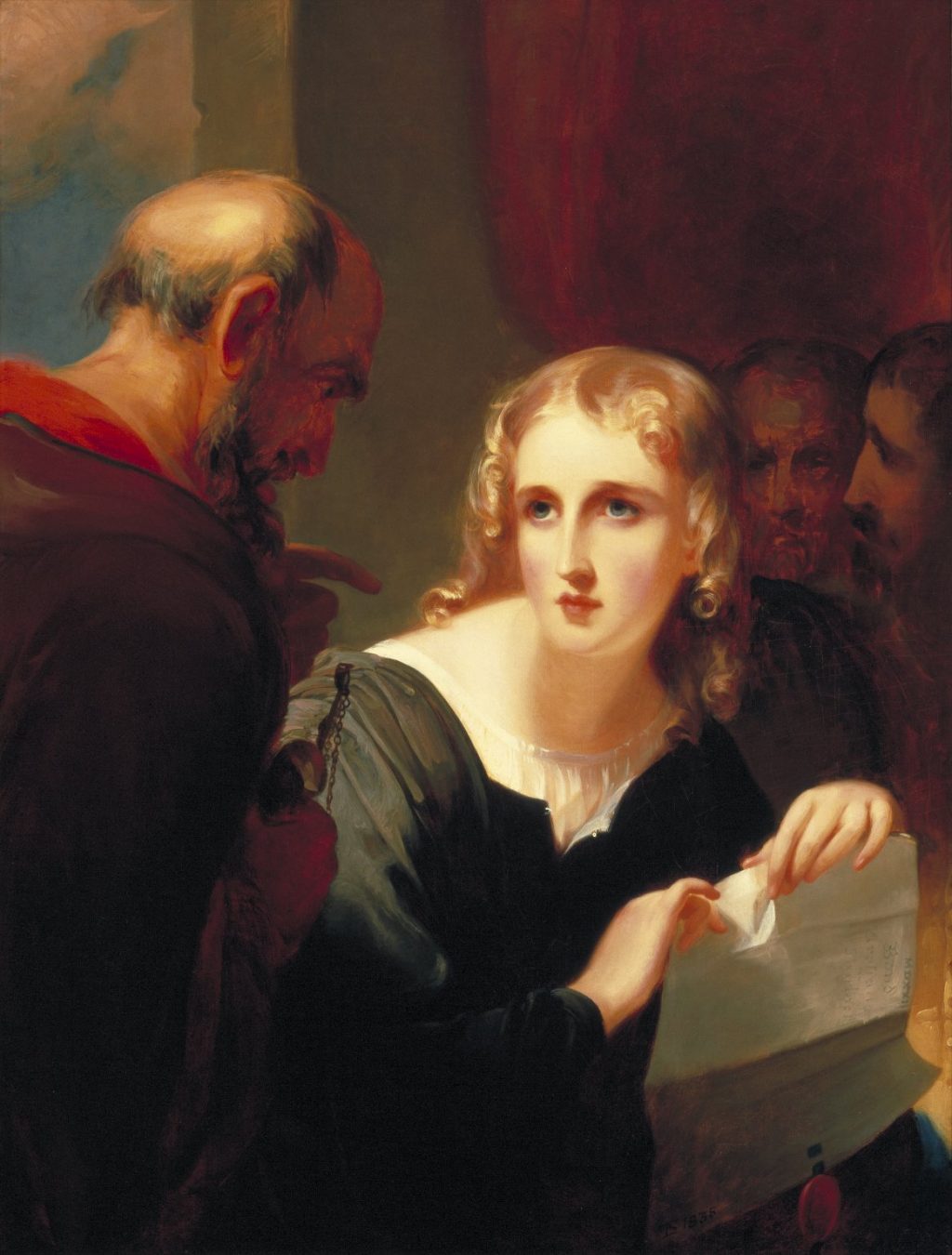
Shylock and Portia in Shakespeare's The Merchant of Venice

The knight’s attachment to the woman after having sex with her caused him to default on the loan he had taken to pay her. The money-lending merchant thus gained the right to cut all the flesh from his body. The young woman, who apparently came to love the knight through his loving work, advised him:

Don’t grieve excessively. Go to the merchant and double his money for him, and if he is not willing to accept, ask how much he wants and I will give it to you.

{ Nolite nimis dolere. Ite ad mercatorem et duplicate ei pecuniam suam, et, si noluerit accipere, petat quantum uoluerit et dabo tibi. }

Apparently drawing upon her study of Cicero and other classics, this woman offered the knight classical advice on grief. She also offered to support him financially. That’s a good woman.

She whose shining presence,
marvelous kindness,
and endless generosity
always and everywhere
smile without fail,
she is the one I desire.

{ Cui tanta claritas
ac mira caritas,
fecunda largitas
semper et undique
arrident utique —
hanc opto denique. }

This good woman even took on the masculine gender in her love for the knight. When the knight in court sought to buy himself out of the merchant’s loan, the merchant refused any amount of money. He wanted to kill the knight by cutting away his flesh. The woman had persons reporting to her about the proceeding. When she heard that the merchant was preparing to cut from her knight’s beloved body, she dressed as a knight and rode to the place where her beloved knight was to receive his death sentence. She declared to the judge trying the loan-default case:

I am a knight from distant lands. By chance I was riding my horse through this city. Reports reached me that a certain knight here among you was about to be sentenced to death on account of the binding promise that he made to a merchant. I came here therefore in order to save the knight from death.

{ Miles sum de partibus longinquis et a casu per istam ciuitatem equitabam, rumoresque ad me uenerunt quod quidam miles inter uos hic existens ad mortum iudicari deberet propter quoddam obligatorium quid uni mercatori fecerat, et ideo huc ueni ut militem a morte liberarem. }

Women must act to make men’s lives matter. The woman-knight turned to the merchant and asked him to take financial compensation rather than the man-knight’s life. The merchant refused. Assuming the role of a lawyer, the woman-knight then made a sophisticated legal argument:

My lord judge, give a just verdict on what I shall say to you. You have heard how much I have offered the merchant for the knight’s life. He refused all, but seeks his right under law. This is very pleasing to me in every way. Therefore listen to me, all of you. Lords, you know that the knight never bound himself to anything by his contract other than that the merchant had the right to cut his flesh from his bones. About the flow of blood no word was specified in advance. If the merchant is truly able to cut the flesh without a flow of blood, let him lay his hand on the knight at once. If in fact he spills blood, the king will have a lawsuit against him.

{ Domine mi iudex, da rectum iudicium super hiis qui uobis dixero. Vos audistis quantum mercatori optuli pro uita militis et omnino renuit, sed beneficium legis querit. Michi per omnia bene placet. Audite ergo me omnes. Satrape, uos scitis quid miles nunquam se obligabat ad aliud per literam nisi quod mercator potestatem habebat carnes ab ossibus scindere, sed de sanguinis effusione nunquam erat uerbum prelocutum. Si poterit uero carnes scindere sine sanguinis effusione, statim manum mittat in eum. Si uero sanguinem effuderit, rex contra eum accionem habebit. }

Stunned, the merchant immediately offered to drop his lawsuit in exchange for payment. The women-knight, turning the tables on the merchant, refused to pay. She insisted he fulfill the contract, if he dared to try. The merchant realized that he was defeated. He left without receiving any payment.

The woman-knight quickly returned home and dressed again as a woman. When her beloved knight returned to her, she disingenuously inquired how he had escaped death. The knight explained that a handsome knight had saved him with a highly intelligent legal argument. The woman asked if he would recognize that knight if he saw him again. The knight declared that he would. She then again dressed as that knight and came to her beloved knight. He wept and embraced her with joy. He was extremely grateful that he had sought to buy sex from her: “Blessed be the hour in which I made an agreement with you {Benedicatur hora in qua tecum conueni}!” They then married and lived happily ever after as pious souls dedicated to God.

Let none marvel at such a leader’s
impressiveness,
for with her outstanding power
she makes me more learned than before
by infusing her generous gifts.

{ Ne miretur ducis tantae
quis sublimitatem,
quae me sibi vi praestante
doctum reddit plus quam ante,
stillans largitatem! }

The Gesta Romanorum’s moral range is evident in comparing it with Shakespeare’s The Merchant of Venice. The Gesta Romanorum contains a more bawdy version of the pound-of-flesh motif than does Shakespeare’s The Merchant of Venice. The Gesta Romanorum also contains the three-caskets motif of The Merchant of Venice, but with a woman rather than a man making the choice among the caskets.[4] Having a woman actively demonstrate to a man her worthiness for love is a highly unusual pattern in European culture relative to a man striving to show his worthiness to a woman.

Portia with casket in Shakespeare's The Merchant of Venice

Unlike much writing today, medieval Latin literature went beyond narrow, unimaginative, careerist work upholding the orthodox beliefs of its time. Medieval Latin literature encompassed outrageous generic mixtures, parodies of divine liturgy and even of women, and deeply humane engagements with earthly life. The medieval songbook known as the Carmina Burana tends to be associated with a distinctive class of young, bohemian clerics (Goliards). The Gesta Romanorum, which provides a Christian moralization for each of its many prose tales, has in contrast been called a product of the “monkish” imagination. Yet the Carmina Burana and the Gesta Romanorum share sexual frankness and extensive cultural mixing. Both the Carmina Burana and the Gesta Romanorum are part of the cultural stream that fed Shakespeare’s expansive imagination.

* * * * *

Read more:

Notes:

[1] The earliest known instance of the pound-of-flesh motif is the story of the fourth sage in Johannes de Alta Silva’s Dolopathos, or, The King and the Seven Wise Men {Dolopathos sive de Rege et Septem Sapientibus}, written about 1190. For Latin text, HIlka (1913); for an English translation, Gilleland (1976) or Gilleland (1981). Dolopathos is part of the Sindibad / Seven Sages corpus. Dolopathos itself is the name of a legendary king of Sicily. That name means “one who suffers treachery or grief.” Gilleland (1976) p. 99. On the history of the pound-of-flesh motif, Cardozo(1925), Ch. 8. The Gesta Romanorum‘s story “no doubt descends” from Dolopathos. Id. p. 281.

Absalom was the most beautiful person in all of Israel. 2 Samuel 14:25. That’s particularly remarkable given that men’s beauty tends to be under-appreciated relative to women’s beauty.

[2] Carmina Burana 61, “If the assembly of Muses has enriched someone {Siquem Pieridum ditavit contio},” st. 4a-b, Latin text and English translation (adapted slightly) from Traill (2018). Subsequent quotes of Latin verse are similarly from “Siquem Pieridum ditavit contio.”

[3] Anglo-Latin (Bodleian Library, Douce MS 310) Gesta Romanorum 48 (“Pound of Flesh”), Latin text and English translation (adapted slightly) from Bright (2019). Cf. 2 Corinthians 12:9: “My grace is sufficient for you {Vulgate: sufficit tibi gratia mea}.” Subsquent quotes of Latin prose are similarly from Gesta Romanorum 48.

[4] Gesta Romanorum 84 (“Whale, Three Caskets”) in Bright (2019). The three-caskets motif probably originated in India. It’s found in manuscripts of the Barlaam and Ioasaph corpus.

The Gesta Romanorum also includes a version of the story of King Lear from Geoffrey of Monmouth’s The History of the Kings of Britain {Historia regum Britanniae}. In the Gesta Romanorum, the sincerely loving daughter tells her father that she loves him “as much as you are worth and neither more nor less {tantum sicut tu uales et non plus neque minus}.” See Gesta Romanorum 21 (“Lear”) in Bright (2019).

[images] (1) Shylock and Portia discussing the contract in William Shakespeare’s The Merchant of Venice. Painting by Thomas Sully in 1835. Preserved as accession # FPa78 in the Folger Shakespeare Library (Washington, DC; USA). (2) Portia with gold casket and key in Shakespeare’s The Merchant of Venice. Painting by Joseph Severn in 1840. Via Sofi on flickr.

References:

Bright, Philippa, ed. and trans. 2019. The Anglo-Latin Gesta Romanorum: from Oxford, Bodleian Library, Douce MS 310. Oxford Medieval Texts. Oxford: Oxford University Press.

Cardozo, Jacob Lopes. 1925. The Contemporary Jew in the Elizabethan Drama. University of Amsterdam, Dissertation. New York: Burt Franklin.

Gilleland, Brady B. 1976. “Three Stories from the Dolopathos of Johannes de Alta Silva.” Allegorica. 2: 99–117.

Gilleland, Brady B. 1981. Johannes de Alta Silva. Dolopathos, or, The king and the seven wise men. Binghamton, N.Y.: Center for Medieval & Early Renaissance Studies.

Hilka, Alfons, ed. 1913. Historia septem sapientum. II. Johannis de Alta Silva Dolopathos, sive De rege et septem sapientibus. Heidelberg: C. Winter.

Traill, David A. 2018, ed. and trans. Carmina Burana. Dumbarton Oaks Medieval Library, 48-49. Cambridge, Massachusetts: Harvard University Press.

Jason’s impotence in love with Medea in Benoît’s Roman de Troie

Benoît de Sainte-Maure’s influential Romance of Troy {Roman de Troie}, from about 1165, describes Medea and Jason consummating their clandestine marriage. The relevant verses are coy and intricate:

Then all night long they lay together,
just as I found in the book,
naked body to naked body and arm in arm.
I hide from you nothing else.
If Jason wasn’t impotent,
that night he had her virginity.
Because if he desired this, she too did just as much.

{ Tote la nuit se jurent puis,
Ensi com jo el Livre truis,
Tot nu a nu e braz a braz.
Autre celee ne vos faz:
Se il en Jason ne pecha,
Cele nuit la despucela;
Quar, s’il le voust, ele autretant. }[1]

While the general nuptial direction is obvious, these verses have puzzling elements. They subtly concern major themes of the Roman de Troie as a whole.

Roman de Troie explicitly reports its primary source to be Dares of Phrygia’s The History of Troy’s Fall {De excidio Troiae historia}. According to Benoît, Homer lived a hundred years after the Trojan War. Dares of Phrygia, in contrast, claimed to be an eye-witness to the Trojan War. Benoît regarded Dares’s Latin account of the Trojan War to be more credible than Homer’s famed Iliad. Benoît pledged to follow Dares:

Here I shall begin the account.
The Latin version I will follow faithfully.
I would like to add nothing to it,
but write only what is written there.
I will include some fine sayings
of my own, if I am able to do so,
but I will follow my source material.

{ Ci vueil l’estoire comencier:
Le latin sivrai e la letre,
Nule autre rien n’i voudrai metre,
S’ensi non com jol truis escrit.
Ne di mie qu’aucun bon dit
N’i mete, se faire le sai,
Mais la matire en ensivrai. }

In his description of Medea and Jason in bed on their wedding night, Benoît’s attribution “just as I found in the book {ensi com jo el Livre truis}” plausibly refers to Dares’s De excidio Troiae. But Dares’s history doesn’t mention Medea and Jason at all.[2] Benoît may be ironically signaling his own important contribution to the history of Troy’s fall.

After describing Jason and Medea intertwined naked in bed, Benoît declared, “I hide from you nothing else {autre celee ne vos faz}.” The typical behavior of a newly married couple naked in bed is well-known. What is Benoît hiding in relation to “nothing else”? Benoît stated that Jason might have been impotent. Hidden from the reader is whether Medea and Jason actually had sex that night. The larger issue is men’s hidden weakness.

The possibility of Jason being impotent contrasts sharply with Medea’s powers and initiative. Medea was the daughter of Aeetes, King of Colchis. After briefly describing Medea’s familial position and her beauty, Benoît elaborated extensively upon Medea’s capabilities:

She was his daughter
and she was a very great beauty.
He didn’t have any other child or heir.
She had great knowledge,
with much skill and mastery
concerning conjuring and sorcery.
She had applied herself to these arts so intently
that she was extremely wise and learned.
Astronomy and necromancy
she had all learned by heart as a child.
About magical arts and conjuring she knew so much
that a bright day she could turn into a dark night.
If she wished so, it would appear
that you were flying through the air.
She made rivers flow upstream.
Her knowledge had great range.

{ C’est une fille qu’il aveit,
Que de mout grant beauté esteit;
Il n’aveit plus enfant ne heir.
Trop ert cele de grant saveir:
Mout sot d’engin e de maistrie,
De conjure e de sorcerie;
Es arz ot tant s’entente mise
Que trop par ert sage e aprise;
Astronomie e nigromance
Sot tote par cuer des enfance;
D’arz saveit tant e de conjure,
De cler jor felïst nuit oscure;
S’ele vousist, co fust viaire
Que volisseiz par mi cel aire;
Les eves faiseit corre ariere;
Scientose ert de grant maniere. }

Medea inquired about the Greek visitors, identified Jason, and gazed upon him:

She well inquired and asked
from where these men were and of what kingdom.
When she knew for certain
that Jason was there, she was very pleased.
She had heard much talk of him
and much was he praised far and wide.
She became very fond of him in her heart
and wasn’t able in any way
to take her eyes off him.
He seemed to her to have a very noble bearing.
She examined the form of his body,
his golden, curly hair
and beautiful eyes and lovely face.
Already I fear she will find him too attractive!
He had a lovely mouth and a tender look,
a lovely chin, a lovely body, and beautiful arms;
large and broad were his hips.
He spoke very demurely,
and was wise and well-mannered.
Many times she gazed upon his face,
many times Medea directed her eyes at him,
tenderly, openly, honestly, without contempt.
Many times she tenderly looked at him.

{ Bien ot enquis e demandé
Dont cil erent, de quel regné.
Quant ele certainement sot
Que c’ert Jason, meut par li plot:
Moot en aveit oï parler
E mout l’aveit oï loër.
Mout l’aama enz en son cuer:
Ne poëit pas a nesun fuer
Tenir ses ieuz se a lui non;
Mout li ert de gente façon.
La forme esguarde de son cors:
Cheveus recercelez e sors
A e beaus ieuz e bele face
Dès or criem que trop ne li place; —
Bele boche a e dous reguarz,
Bel menton, bel cors e beaus braz;
Large e grant a la forcheure,
Si a mout simple parleure,
Sage est e de bone maniere.
Mout le reguarde en mi la chiere.
Mout i a Medea ses ieuz
Douz, frans e simples, senz orguieuz;
Mout le remire doucement }

Men typically don’t get offended by the female gaze. In contrast to the usual instrumental view of men, women appreciating men’s objective physical beauty can provide welcome relief from the gender oppression that men endure.[3] Medea became madly in love with Jason. She wanted to have sex with him right away and wanted to marry him. For a whole week she considered and plotted how she could have complete joy in an affair with him.

Medea soon found an opportunity to proposition Jason. One day after a meal, King Aeetes urged Medea to make pleasant conversation with Jason and Hercules. Medea approached them and urbanely introduced herself. Jason appreciated Medea’s initiative:

I thank you beyond anything
that you have seen fit to talk to me
and to address me first.
What you have done shows good breeding,
and since it pleased you to act in this way,
know that all the days of my life
for this I shall be grateful to you.

{ Merci vos rent sor tote rien
Dont il vos plot qu’a mei parlastes
E que première m’areisnastes.
Fait i avez que de bon aire,
E quant tant vos en plot a faire,
A toz les jorz de mon aé
Sacheiz vos en savrai mais gré. }

To this day men continue to bear a vastly gender-disproportionate burden of soliciting amorous relationships, to say nothing of paying for dinners. Unlike far too many women today, Medea took the initiative to speak first to a man in whom she had a love interest.

As a confident, knowledgeable woman, Medea strongly advised Jason not to seek the Golden Fleece. She explained that many men had died in seeking the Golden Fleece. Men’s lives, especially Jason’s, mattered to Medea. She explained in detail the mortal dangers that he would encounter if he sought the Golden Fleece. She declared that he would never succeed on his own in acquiring the Golden Fleece. Instead, he was sure to die like so many other men had.

With the lack of self-appreciation typical among men under gynocentrism, Jason brushed off Medea’s concern for his life. He declared:

“Lady,” he said, “don’t alarm me.
I didn’t come here in order to turn back
like someone who has lost heart.
I prefer to die rather than not to try
to see if I can somehow get hold of it.
If I cannot take it away with me,
I don’t wish to go back home.
If I did that, I would be shamed forever,
and would never recover my honor.
I must carry out this task as planned.
I have done so much that I cannot change.
Whatever comes as my fate, be it bad or good,
I cannot change course now.”

{ “Dame,” fait il, “ne m’esmaiez:
Ne sui mie por ço venuz
Que m’en torge come esperduz;
Mieuz vueil morir que jo n’essai
S’en nul sen aveir le porrai.
Se mei ne l’en puis porter,
Ja mais ne m’en quier retorner;
Quar a toz jorz honiz sereie,
Si que ja mais honor n’avreie.
Par ci m’en covient a passer:
Tant en ai fait nel puis muer;
Seit maus, seit biens, que que m’en vienge,
Ne puet estre que jo m’en tienge.” }

Jason valued shame and honor attributed to him under gynocentrism above his own survival. That’s pure folly. That’s the same folly that Benoît repeatedly attributed to the Greeks as they allowed the Trojan War’s brutal violence against men to continue for ten horrific years.

Medea heroically intervened to save Jason’s life. She proposed to help him if he would marry her:

But if I could be sure
of having your love,
that you would take me as your wife,
and would never abandon me
when you return to your homeland,
and so you wouldn’t leave me in this place
but remain faithful to me,
I would skillfully devise a plan
by which you could achieve your goal,
without incurring death or grave harm.
Only I and no other could help,
guide and counsel you.
Indeed, I know so much necromancy
that I have learned from my youth
that, when I wish something to be, I can do it.
I won’t have any difficulty or impediment.
However arduous the task, all is easy for me.
I shall not find any obstacles to doing it.
Now consider how you will respond,
whether you will accept what I offer.
Tell me your heart, without deceiving me.
All that you intend I wish to know.

{ Mais se de ço seüre fusse
Que jo t’amor aveir poüsse,
Qu’a femme espose me preisses,
Si que ja mais ne me guerpisses,
Quant en ta terre retornasses,
Qu’en cest pais ne me laissasses,
E me portasses leial fei,
Engin prendreie e bon conrei
Com ceste chose parfereies,
Que mort ne mahaing n’i prendreies.
Fors mei ne t’en puet rien aidier
Ne aveier ne conseillier.
Mais jo sai tant de nigromance,
Que j’ai aprise dès m’enfance,
Que, quant que jo vueil, tot puis faire:
Ja ne m’iert peine ne contraire.
Quant que est grief, tot m’est legier:
Ja n’i troverai encombrier.
Or esguarde que tun feras,
Saveir se tu[l] m’otreieras:
Ton cuer m’en di senz deceveir,
Tot ton corage en vueil saveir. }[4]

Jason needed Medea’s sorcery in order to avoid dying in attempting to retrieve the Golden Fleece. He accepted her marriage proposition. He swore to be faithful to her and to love her more than anyone else.

Medea and Jason in the Roman de Troie

In fact, Medea and Jason’s marriage was based on deception. Gynocentrism deceives men into thinking that they must subordinate themselves to women in order to be worthy of women’s love. Jason promised to subordinate himself to Medea as his wife:

You will be my lady and my beloved, and
you will have lordship over me.
I will devote myself to your service such
that I will do whatever pleases you.

I have consented to be your prisoner.

{ Ma dame sereiz e m’amie,
De mei avreiz la seignorie:
Tant emendrai a vos servir
Que tot ferai vostre plaisir.

S’en vostre prison me sui mis }

Men held as women’s prisoners cannot truly love women. Jason surrendered himself in abject service to his wife Medea:

My lady, he who is your knight
will be totally and completely yours
all the days of his life.
He beseeches you and humbly requests
that you receive him as your feudal subordinate
under the condition that he will never do anything
that causes you grief or otherwise displeases you.

{ Dame, li vostre chevaliers,
Icil qui quites senz partie
Sera toz les jorz de sa vie,
Vos prie e requiert doucement
Quel receveiz si ligement,
Qu’a nul jor mais chose ne face
Que vos griet ne que vos desplace. }

Jason’s proclaimed subordination to his wife Medea is a repugnant travesty of the medieval ideal of a conjugal partnership. The quagmire of men’s subordination to women is a perilous foundation for marriage. Not surprisingly, Medea and Jason’s marriage ended in epic disaster — betrayal and horrific violence, just like the Trojan War.[5]

Jason gets the Golden Fleece in the Roman de Troie

Men’s impotence leads inexorably to epic disaster. Of course men occasionally experience sexual incapability. That’s not a social-systemic problem. Castration culture is the social-systemic problem corresponding to men’s impotence. Castration culture can function indirectly under figures brutalizing men’s sexuality. Men’s internalization of a distorted, violent honor-shame complex prevents them from striving to preserve the seminal blessing that men carry. That’s why Jason didn’t turn away from his quest for the Golden Fleece, nor the Greek men turn away from their quest to ravage Troy.

* * * * *

Read more:

Notes:

[1] Benoît de Sainte-Maure, Roman de Troie, vv. 1643-9, Old French text from Constans (1904) vol. 1, English translation (modified slightly) from Burgess & Kelly (2017). For v. 1647, “Se il en Jason ne pecha,” translations differ: “Unless Jason experienced any impotence,” “Jason did not sin therein,” and “if nothing was lacking in Jason,” in Burgess & Kelly (2017) p. 65, O’Callaghan (1995) p. 38, and Feimer (1983) p. 174. With regard to Jason’s performance in bed with Medea, De Santis observed:

and yet it is surprising that even this evidence is called into doubt by the author with an allusion to a possible failure by the hero

{ eppure è sorprendente che anche questa evidenza venga revocata in dubbio dall’autore con l’allusione a una possibile defaillance da parte dell’eroe }

De Santis (2016) p. 32. Above I’ve followed Burgess & Kelly’s translation, which seems to me best in context.

Benoît’s massive 30,316-verse Roman de Troie has survived in 58 manuscripts, 30 of which are complete. That’s far more than any medieval Old French Arthurian romance, including those of Chrétien de Troyes. Id. pp. 1-3. Guido delle Colonne’s History of Troy’s Destruction {Historia Destructionis Troiae} drew largely upon Benoît’s Roman de Troie.

The Roman de Troie is one of three twelfth-century Old French “romances about antiquity {romans d’antiquité}.” The other two are the Roman de Thèbes and the Roman d’Eneas.

In his account of Jason and Medea, Benoît condemned Jason for betraying his vows to Medea. Roman de Troie vv. 1635-8; for discussion, Nickolaus (2002) p. 72. Benoît focused on Medea’s experience of love and ignored Medea’s familial crimes. De Santis (2016). Modern scholarly study of the love relationship between Medea and Jason has similarly focused on Medea, with solicitousness toward the woman and righteous claims of misogyny. See, e.g. McElduff (2012), Morse (1996). While the myth of Medea provides a representation of women’s violence, women’s violence in ordinary life is well-known in actual experience.

Subsequent quotes from Roman de Troie are similarly sourced. They are vv. 138-44 (Here I shall begin the account…), 1213-28 (She was his daughter…), 1255-77 (She well inquired and asked…), 1322-8 (I thank you beyond anything…), 1388-1400 (“Lady,” he said…), 1407-28 (But if I could be sure…), 1435-8, 1597 (You will be my lady and my beloved…), 1602-8 (My lady, he who is your knight…).

[2] Feimer (1983) p. 153. Nonetheless, Burgess & Kelly (2017) has “in Dares’s book” in its translation of v. 1644. Benoît drew upon Ovid’s account of Medea and Jason, but added much more than “fine sayings {bons dits}.” Unlike in Ovid, Benoît’s Medea doesn’t agonize over the conflict between modesty and love passion. Feimer (1983) p. 161.

[3] Apparently striving to preserve the poor-dearing literary ideology of the “male gaze,” O’Callaghan declared:

Medea is, in fact, made passive by her gaze. Her look lacks aggression and, therefore, does not objectify Jason. … Love has effectively transformed Medea from mighty sorceress to submissive woman, for she cannot restrain her feelings for Jason … Thus she is torn between the passivity which accompanies her initial visual perception of Jason and an overwhelming and aggressive determination to possess him. This seeming dichotomy serves to heighten the sense of Medea’s inner turmoil for the reader.

O’Callaghan (1995) pp. 19, 24. 47. Jason, in contrast, is so passive that Medea has to send a serving-woman to bring him to her bedroom. Roman de Troie vv. 1521-84. For relevant discussion, De Santis (2016) pp. 31-2.

[4] Medea’s boast, “when I wish something to be, I can do it” shows no self-consciousness of her need to bargain with Jason to gain his love. Despite all her powers, Medea cannot just make Jason love her in the way she apparently seeks to be loved.

In the only surviving fragment of Ovid’s Medea, Medea declares to Jason:

I had the power to save you. You question whether I have the power to destroy you?

{ servare potui: perdere an possim rogas? }

Quoted in Quintilian, The Orator’s Education {Institutio Oratoria} 8.5.6. Power to destroy doesn’t imply ability to compel love. Women have great power to destroy. But women, for all their power, cannot force men to love them.

Modern female supremacists extensively expand Medea’s lack of self-consciousness. Consider, for example, a vision obviously meant to be exhilarating for courageous, progressive thinkers:

Women who do not marry, who choose, limit, and control the time and place of their sexual encounters, who use sex as either an end in itself or a means to reproduce, who choose the children they will keep and raise, who in some versions kill their partners or their male children — such women, depending on our own attitudes towards women’s sexuality, can seem either terrifying or exhilarating.

Carl (1998) p. 114. In this fantasy of female totalitarianism, when a woman declares to a man the time and place for a sexual encounter, he submissively complies. Men have no reproductive rights and no rights to custody of their children. Women’s lethal domestic violence against men and male children is socially approved. This “exhilarating” vision of female supremacism surely cannot include men loving women as persons like themselves.

[5] Gynocentrism, women-are-wonderful myth, and anti-meninism have led to scholarly absurdities such as the claim: “Refined, humanistic, and feminine values enter the European stage around 1100.” Cormier (2004) p. 67. Writing in early-ninth-century Europe, Walahfrid Strabo was more refined and more humanistic, as well as less ignorant and less sexist, than many modern scholars.

[image] (1) Medea and Jason. Painting by John William Waterhouse in 1907. Via Wikimedia Commons. (2) Jason getting the Golden Fleece. Illumination made in 1340s for an instance of Benoît de Sainte-Maure’s Roman de Troie. From folio 14r of MS. Biblioteca Apostolica Vaticana Reg.lat 1505.

References:

Burgess, Glyn S., and Douglas Kelly. 2017. The Roman de Troie by Benoît de Sainte-Mauré: a translation. Gallica, 41. Cambridge: D.S. Brewer. Review by Sylvia Federico and by Cristian Bratu.

Carl, Glenda Warren. 1998. “Tu cuides que nos seions taus / come autres femes comunaus: the sexually confident woman in the Roman de Troie.” Ch. 6 (pp. 107-127) in Taylor, Karen J., ed. Gender Transgressions: Crossing the Normative Barrier in Old French Literature. Garland Reference Library of the Humanities. New York, Garland.

Constans, Léopold, ed. 1904-12. Le roman de Troie, par Benoît de Sainte-Maure, publié d’après tous les manuscrits connus. Société des Aanciens Textes Français. Paris: F. Didot. Vols. 1, 2, 3, 4, 5, 6.

Cormier, Raymond. 2004. “Brutality and violence in medieval French romance and its consequences.” Ch. 2 (pp. 67-82) in Classen, Albrecht, ed. Violence in Medieval Courtly Literature: a casebook. New York: Routledge.

De Santis, Silvia. 2016. “Amors, vers cui rien n’a defense. Medea e Giasone nel Roman de Troie di Benoît de Sainte-Maure.” Studj romanzi. 12: 9-35.

Feimer, Joel N.. 1983. The Figure of Medea in Medieval Literature: A Thematic Metamorphosis. Ph.D. Thesis, The City University of New York.

McElduff, Siobhan. 2012. “Epilogue: The Multiple Medeas of the Middle Ages.” Ramus. 41 (1/2): 190-205.

Morse, Ruth. 1996. The Medieval Medea. Cambridge: Brewer.

Nickolaus, Keith. 2002. Marriage fiction in old french secular narratives, 1170-1250: a critical re-evaluation of the courtly love debate. New York: Routledge.

O’Callaghan, Tamara Faith. 1995. Love imagery in Benoit de Sainte-Maure’s Roman de troie, John Gower’s Confessio Amantis, and Geoffrey Chaucer’s Troilus and Criseyde. Ph.D. Thesis, University of Toronto. Preserved in the National Library of Canada = Bibliothèque nationale du Canada.

De Paulino et Polla: context for Chaucer’s Reeve’s Prologue

Simkin the Miller was cheating King’s Hall, Cambridge, in the grinding of its corn. John and Alan, two clerics studying at King’s Hall, brought corn to Simkin to try to figure out his cheating. After seeking their missing horse for hours, the clerics had to pay for overnight lodging at Simkin’s house. Simkin, who had set the horse loose, had stolen half their corn while they were chasing the horse.

Alan pondered law as he lay in bed in Simkin’s house. Simkin had a twenty-year old daughter Malyne “with broad buttocks and breasts round and high {with buttokes brode and brestes rounde and hye}.” Alan lustfully eyed the daughter and reasoned:

“Yes, John,” said he, “as ever I might thrive,
if I can, that wench there I’ll screw.
Some redress the law has shaped for us,
yes, John, there is a law that says thus:
that if a man in one point is injured,
that in another he shall be relieved.
Our grain is stolen, truly, you can’t say nay,
and we’ve had a hard time all this day,
and since I’ll have no amendment
for my loss, I will have easement.
By God’s soul, it shall be no other way!”

{ “For, John,” seyde he, “als evere moot I thryve,
If that I may, yon wenche wil I swyve.
Som esement has lawe yshapen us,
For, John, ther is a lawe that says thus:
That gif a man in a point be agreved,
That in another he sal be releved.
Oure corn is stoln, sothly, it is na nay,
And we han had an il fit al this day;
And syn I sal have neen amendement
Agayn my los, I will have esement.
By Goddes sale, it sal neen other bee!” }[1]

Alan went and embraced Malyne in her bed. A hard-working cleric, Alan had sex with her three times that night.[2] That was his “easement.”

Malyne and Alan came to love each other in accordance with a long literary tradition. When morning came, Alan was weary, “for he had labored all night long {for he had swonken al the longe nyght}.” But, following the classical literary genre of “dawn song,” he was mournful because he had to leave his beloved:

He said, “Farewell, Malyne, sweet creature!
The day is come. I may no longer remain here.
But evermore, wherever I go or ride,
I am your own clerk, sure as I may prosper!”

{ And seyde, “Fare weel, Malyne, sweete wight!
The day is come; I may no lenger byde;
But everemo, wher so I go or ryde,
I is thyn awen clerk, swa have I seel!” }

Malyne responded lovingly:

“Now, dear sweetheart,” said she, “go, farewell!
But before you go, one thing I’ll tell you:
when you go homeward by the mill,
right at the entry behind the door
you’ll find a half-bushel cake
that was made of your own meal
that I helped my father to steal.
And, good sweetheart, God save and keep you!”
And with that word she almost began to weep.

{ “Now, deere lemman,” quod she, “go, far weel!
But er thow go, o thyng I wol thee telle:
Whan that thou wendest homward by the melle,
Right at the entree of the dore bihynde
Thou shalt a cake of half a busshel fynde
That was ymaked of thyn owene mele,
Which that I heelp my sire for to stele.
And, goode lemman, God thee save and kepe!”
And with that word almoost she gan to wepe. }[3]

Malyne appreciated Alan’s love for her and his sexual effort. As The Reeve’s Tale shows, men’s love can convert women from thieves into generously loving persons.

Oswald the Reeve. teller of the Reeve's Tale in Chaucer's Canterbury Tales

Aging affects what men can do for women. As an old man, Oswald the Reeve in the Reeve’s Prologue observed:

We dance always while the world will pipe,
for in our will there sticks ever a spur
to have a white head and a green tail,
as a leek has. Although our power is gone,
our will desires folly on and on.
And when we cannot do, then we’ll talk about it.

{ We hoppen alwey whil that the world wol pype.
For in oure wyl ther stiketh evere a nayl,
To have an hoor heed and a grene tayl,
As hath a leek; for thogh oure myght be goon,
Oure wyl desireth folie evere in oon.
For whan we may nat doon, than wol we speke }[4]

Just because an old man can no longer perform like a young man, his power to love isn’t gone. He can tell amusing stories to a beloved, and he can listen and laugh at a beloved’s amusing stories. The mutuality of love isn’t limited to sexual intercourse.

Men typically undervalue themselves in relation to women. Consider the case set out in the thirteenth-century comedy About Paulino and Polla {De Paulino et Polla}. As a young man, Paulino sought to marry Polla. She refused his love. When they became old, she sought to marry him. But as an old man he felt unworthy to be a husband:

In the past I greatly desired
that I would be able to have a wife.
Many times I proposed to Polla herself,
yet fate was such that she didn’t become my wife.
Since the best part of my life has now past,
I don’t want to subordinate myself to marriage bonds,
especially since my horse doesn’t respond to any
spurs on account of its frigidity.
It would be shameful to me if, when my wife was thirsty,
my horse wasn’t able to rise and ease her thirst with its fountain.
In fact it’s wiser to keep this infirmity covered up
than make it open to the gossip of common words.
Therefore my defect must be kept hidden, not revealed,
so that in old age I don’t fall into everyone’s talk.

{ Tempore preterito fuerat michi magna voluntas
Ut possem nuptam consociare michi,
Per pluresque vices ad Pollam misimus ipsam,
Nec fortuna fuit ut michi nupta foret.
Sed cum lapsa mee melior sit portio vite,
Nulli coniugio subdere colla volo,
Precipue quia noster equus calcaribus ullis
Respondere nequit frigiditate sua:
Esset turpe michi si, cum mea nupta sitiret,
Non posset medio fonte levare sitim.
Hunc etenim morbum consultius esse tegendum
Quam patulum fieri publica verba canunt;
Ergo meum vitium celari, non reserari
Debet, ne senio gentis in ore cadam. }[5]

The lawyer Fulco, whom Polla had hired to plead her love-suit to Paulino, sought to undermine Paulino’s claim of sexual infirmity:

You are naive to say that no spur can make
your horse move due to its frigidity.
You know well that an incessant drop bores through rock,
a stick whirled repeatedly on another stick heats up,
and iron is made sharp mutually with iron.
Thus, united with you, Polla will arouse your horse.
A woman’s flesh united with a man’s flesh re-ignites
flames, even those that tremble with deadened vigor.
Nothing is sweeter than the touch of female flesh,
the touch of no other mortal things has such power.
Every time you touch feet, legs, and the secret joy,
frigidity ceases and a fire warms your inners.
Thus as soon as you are joined as one in her grove,
believe me, frigidity will not be paralyzing you.
Your horse will spontaneously desire to run
that delightful race to the ring.
But if so much cold is in your genitals
such that you’re completely without power in its service,
you will be brought back to life with warm compresses
and roots used to arouse sexual activity.

{ Es simplex quia dicis equum calcaria nulla
Posse movere tuum frigiditate sua.
Assidua gutta bene scis quia petra cavatur,
Cum ferula ferula sepe rotata calet,
A ferro ferrum sibi mutuo sumit acumen:
Sic tibi iuncta tuum Polla movebit equum.
Feminea caro carne viri commixta resumit
Igniculos, quamvis mortificata tremat;
Feminee tactu carnis non dulcior ullus
Humanis rebus tactus inesse potest;
Crura, pedes quotiens secretaque gaudia tangis,
Cessat frigiditas, igne medulla calet.
Ut secum fueris congramineatus in unum,
Crede michi quia te frigora nulla prement;
Illius ad circi certamen delitiosum
Sponte sua cupiet currere vester equus.
Sed si tantus inest vestris genitalibus algor,
Hoc ut ad officium sis minus ipse potens,
Fomentis calidis, radicibus utilibusque
Moturis Venerem, vivificatus eris. }

Men historically have endured painful treatments to be able to engage in erection labor. But men unable to engage in erection labor can still hope to have loving relationships. Fulco advised the elderly Paulino:

If in that part you are totally ruined,
you nonetheless henceforth will not be hateful to Polla.
Perhaps to this work she will never call you,
since she might be suffering the disaster of a similar infirmity.
If you have a wrinkled face and white hair,
so too does she. You are frigid? She trembles with frigidity.
She will not charge you with a fault when she has an identical fault.
A blind man is wrong to reproach another blind man
for loss of sight, since he recalls his own shame.
Who would not laugh if a lame man said to another lame man
that he must walk with a straight step?

{ Denique si totus in ea sis parte peremptus,
Inde tamen Polle non odiosus eris:
Hoc ad opus numquam te forsitan illa vocabit,
Cum simili morbi clade laboret ea.
Est tibi si facies rugosa, capillus et albens,
Est et ei; friges? Frigiditate tremit.
Non ab ea poteris reprehendi frigiditatis
De vitio, vitium cum sibi presit idem.
Est cecum ceco de visus perditione
Improperare nephas: nam sua probra refert;
Quis non ridebit si claudus dicere claudo
Passibus ut rectis debeat ire velit? }

Although women lack men’s burden of performance, men should not assume that women will hypocritically disparage men. Women and men are equally human in aging.

Old men and old women retain their capacity to love simply by being alive. In the elderly Oswald the Reeve’s tale in Chaucer’s Canterbury Tales, the young cleric Alan had sex three times in one night with the Simkin the Miller’s twenty-year-old daughter Malyne. In the medieval comedy De Paulino et Polla, the match-making lawyer Fulco was punished harshly for fostering Polla and Paulino’s marriage. Fulco was punished on the grounds that “sterile spouses are unable to bear fruit for God {nequeant steriles fructificare Deo}.” Medieval Christians, while valuing highly reproductive fruitfulness, didn’t actually believe that having sex was necessary to bear fruit for God. Some holy women and men in fact renounced sex in order to focus on bearing fruit for God. The comedy of the Reeve’s Tale and De Paulino et Polla encompasses the delusions of old men.

You wallow, promiscuous lover,
in a pool of wretchedness
and a mire of lust,
senselessly wasting time.
Why no fear
of offending heaven
or of humans’ mockery
as you ravage
body, property, and soul?
Save at least
your life’s last little portion.
Offer to heaven’s dwellers
in exchange for youth’s flowers
the stubble of old age.

{ In lacu miseriae
et luto luxuriae
volveris, inutile
tempus perdens, Panphile!
cur offensas numinum
aut derisum hominum
non metuis,
dum destruis
corpus, rem et animam?
salva saltem ultimam
vitae portiunculam,
offerens caelestibus
pro iuventae floribus
senectutis stipulam. }[6]

* * * * *

Read more:

Notes:

[1] Geoffrey Chaucer, Canterbury Tales, vv. 4177-87, from the Reeve’s Tale, Middle English text from Benson (1987) / Riverside Chaucer, via Harvard’s Geoffrey Chaucer Website (pioneered by Larry Benson), my English modernization, benefiting from that of id. The previous short quote (with broad buttocks…) is similarly from v. 3975. Alternate modernizations of the Reeve’s Tale include those of Gerard NeCastro (eChaucer) and Michael Murphy (with overview of Reeve’s Tale).

The cleric John has sex with the Miller’s wife by moving an infant’s cradle from the foot of the bed of the Miller and his wife to the foot of his own bed. The wife, returning to bed, thus accidentally gets in bed with John and mistakes him for her husband. Other earlier, analogous “cradle trick” fabliaux are Jean Bodel’s Gombert and the Two Clerks {De Gombert et des II clers} (written between 1190 and 1194), The Miller and the Two Clerks {Le meunier et les II clers} (written in the thirteenth century), The Students’ Adventure {Das Studentenabenteuer} (written in the middle of the thirteenth century), Rüdiger von Munre’s Wayward One and Lusty Rascal {Irregang und Girregar} (written about 1300), and Tale 9.6 in Boccaccio’s Decameron (written about 1350). For English translations of the first four of these earlier analogues, Benson & Andersson (1971). Chaucer almost surely read Boccaccio’s Decameron. Beidler (1994), Harkins (2013).

Chaucer describes the clerks as being from “Soler Hall at Cambridge {Soler Halle at Cantebregge}” (v. 3990). That’s convincingly identified with the medieval King’s Hall at Cambridge. Brewer (1971).

Subsequent quotes from the Reeve’s Tale are similarly sourced. Those above are vv. 4235 (for he had labored…), 4236-9 (He said, “Farewell, Malyne…”), 4240-48 (“Now, dear sweetheart,”…), 3876-81 (We dance always…).

[2] Chaucer toned down the sexual vigor of earlier, analogous fabliaux. In Le meunier et les II clers, the clerk who slept with the daughter told the Miller, mistaken for the other clerk:

Friend, now go, if you can keep it quiet,
and get your share of the bacon.
There’s enough of it left over.
Seven times tonight I’ve taken her,
and yet there’s enough there to load down an ass.

{ Conpeignon, car va, si t’i muce,
Et si pran do bacon ta part;
Assez en a jusq’à la hart;
Par VII foiz l’ai anuit corbée,
Dès or sear boene l’asnée }

vv. 285-9, Old French text and English translation (modified slightly) from Benson & Andersson (1971) pp. 112-5. In Tale 9.6 of Boccaccio’s Decameron, the clerk more modestly declares, “I’ve gotten me up to the farm some six times {poscia che io mi parti’ quinci}.” Italian text from V. Branca’s Einaudi edition (1992), English translation of J. M. Rigg, 1903. In De Gombert et des II clers, the clerk describes having sexual intercourse three times from different directions:

I took her from the front and from the side;
I tapped her wine barrel.

{ Pris en ai devant et encoste;
Aforé li ai son tonel }

vv. 152-3, Old French text and English translation (modified slightly) from Benson & Andersson (1971) pp. 96-7. In this fabliau, the other clerk has sex three times with the Miller’s wife. Id. v. 115.

[3] Murphy observed:

Alan’s farewell (in dialect) and Malin’s response are parodies of the aube, aubade, or tagelied, the genre poem of the dawn parting of aristocratic lovers. But the aristocrat would not refer to his lady as wight, and neither would one ever use lemman, a very plebeian word for “lover.” Also the aube rarely dealt with the details of recovering stolen property.

See Murphy’s edition of the Reeve’s Tale, note 4, p. 18.

[4] The Reeve complains, “But I am old; because of age I do not want to play…. My heart is as moldy as my hairs {But ik am oold; me list not pley for age…. Myn herte is also mowled as myne heris}” (Reeve’s Prologue, v. 3867, 70). But he also declares:

Our old limbs may well be feeble,
but desire isn’t lacking, that’s the truth,
and I have always a young colt’s passion.

{ Oure olde lemes mowe wel been unweelde,
But wyl ne shal nat faillen, that is sooth.
And yet ik have alwey a coltes tooth }

Reeve’s Prologue, vv. 3886-8. The Reeve’s Prologue presents elaborate figures of men’s aging in relation to their sexuality. On those figures, Everest (1996).

[5] Richard of Venosa {Richardus Venusinus}, About Paulino and Polla {De Paulino et Polla} vv. 747-60, Latin text from Pittaluga (1986), my English translation, benefiting from the Italian translation of id. For earlier Latin editions, Rigillo (1906) and Briscese (1903).

In Chaucer’s Reeve’s Tale, the clerks’ horse amorously chases after mares. But the horse might have been a gelding. A gelded horse is a possible allusion to the old man Oswald the Reeve. On the imagery of the Reeve’s sexual exhaustion, Everest (1996). On the sexual behavior of the horse, Feinstein (1991). The voluminous scholar work on the Reeve’s Tale apparently hasn’t noticed De Paulino et Polla and its old man Paulino discussing his horse. Students of Chaucer today surely would benefit from more attention to medieval Latin literature. In relatively liberal and tolerant medieval Europe, De Paulino et Polla was used as a school text. Parker (2012) p. 477.

Richard of Venosa names himself within his work: “a nursling of a Venosian family, the judge Richard wrote such an excellent work {Venusine gentis alumpnus / iudex Richardus tale peregit opus}.” De Paulino et Polla vv. 13-4. The judge Richard apparently worked as a city magistrate. He dedicated De Paulino et Polla (vv. 11-2) to the Emperor Frederick {Fredericus Cesar}, probably Frederick II of Swabia. Fulco appeals his case to Duke Rainald (vv. 1109-10). That’s almost surely Rainald of Urslingen, Lord of Spoleto, a duke who assumed the regency of Swabia when Frederick II went to the Holy Land. Hence Richard probably composed De Paulino et Polla in southern Italy in 1228-9. Little else is known about Richard of Venosa. See Ferruccio Bertini’s entry for Riccardo da Venosa in Federiciana (2005) and Fulvio Delle Donne’s entry for Riccardo da Venosa in the Biographical Dictionary of Italians, volume 87 (2016).

De Paulino et Polla is a highly learned work. It’s written in elegant Latin and draws upon the literary models of Ovid, Horace, and Virgil. De Paulino et Polla, “by the world’s Savior who governs all {per Salvatorem mundi qui cuncta gubernat}” (v. 325), alludes to Boethius, Consolation of Philosophy {De consolatione philosophiae}, “O you who in perpetual order govern the universe {O qui perpetua mundi ratione gubernas}” (Carmen 3.9.1). On this reference, Bisanti (2015).

De Paulino et Polla is within the medieval Italian tradition of Latin comedy. That Italian tradition includes De uxore cerdonis and Versus Eporedienses. Medieval Latin comedy wasn’t confined to the Loire Valley of France.

The subsequent two quotes from De Paulino et Polla are sourced as previously. They are vv. 777-96 (You are naive to say…) and 797-808 (If in that part you are totally ruined…).

[6] Carmina Burana 29, Philip the Chancellor, “The Conversion of Humankind {De conversione hominum},” st. 1, Latin text and English translation (adapted slightly) from Traill (2018). Both “De conversione hominum” and De Paulino et Polla evoke Pamphilus. Pamphilus is a character in a widely disseminated medieval Latin comedy.

“De conversione hominum” was earlier attributed to Peter of Blois. Traill, a leading authority on Philip the Chancellor and medieval Latin literature, attributes it to Philip. Philip was a lover, a poet, a theologian, and a college administrator:

Philip the Chancellor (ca. 1160–1236) was the youngest of the great Latin poets of the latter part of the twelfth century. His earliest datable poem commemorates the death of the Henry the Liberal, Count of Champagne, and so must be dated after, but presumably not long after, 17 March 1181. He studied and probably taught theology in Paris before becoming chancellor of Notre Dame in 1217.

Traill (2006) p. 164. In modern repressive, insular, and unforgiving Western culture, no college leader could have Philip the Chancellor’s range of experience and learning. At least today there is a psychedelic-rock interpretation of “De conversione hominum.”

[image] Oswald the Reeve, teller of the Reeve’s Tale in Chaucer’s Canterbury Tales. Illumination on folio 42r of the Ellesmere Manuscript (created between 1400 and 1410) of the Canterbury Tales. Preserved as MS. EL 26 C 9 in Huntington Library (San Marino, California).

References:

Beidler, Peter G. 1994. ‘Chaucer’s Reeve’s Tale, Boccaccio’s Decameron, IX, 6, and Two “Soft” German Analogues.’ The Chaucer Review. 28 (3): 237-251.

Benson, Larry D. and Andersson, Theodore Murdock. 1971. The Literary Context of Chaucer’s Fabliaux: texts and translations. Indianapolis: Bobbs-Merrill.

Benson, Larry D., ed. 1987. The Riverside Chaucer. 3rd Edition. Oxford: Oxford University Press.

Bisanti, Armando. 2015. ‘Riccardo da Venosa, De Paulino et Polla 325 e la fortuna medievale in un “incipit” boeziano.’ Bollettino di Studi Latini. 45 (1): 143-146.

Brewer, Derek S. 1971. “The Reeve’s Tale and the King’s Hall, Cambridge.” The Chaucer Review. 5 (4): 311-317.

Briscese, Rocco, ed. 1903. Paolino e Polla: pseudo-commedia del secolo XIII di Riccardo da Venosa. Melfi: Grieco.

Everest, Carol A. 1996. “Sex and Old Age in Chaucer’s Reeve’s Prologue.” The Chaucer Review. 31 (2): 99-114.

Feinstein, Sandy. 1991. “The Reeve’s Tale: About That Horse.” The Chaucer Review. 26 (1): 99-106.

Jessica Harkins. 2013. “Chaucer’s Clerk’s Tale and Boccaccio’s Decameron X.10.” The Chaucer Review. 47 (3): 247-273.

Parker, Holt. 2012. “Renaissance Latin Elegy.” Ch. 29 (pp 476–90) in Barbara K. Gold, ed. A Companion to Roman Love Elegy. Malden, MA: Wiley-Blackw

Pittaluga, Stefano, ed. and trans. (Italian). 1986. “Ricardus Venusinus, De Paulino et Polla.” Pp. 106-226 in Bertini, Ferruccio, ed. Commedie latine del XII e XIII secolo. Vol. 5. Genova: Istituto di Filologia Classica e Medievale, Università di Genova.

Rigillo, Michele, ed. and trans (Italian). 1906. Paolino e Polla: poemetto drammatico giocoso del sec. XIII di Riccardo da Venosa. Trani: Ditta V. Vecchi e C.

Traill, David A. 2006. “More Poems by Philip the Chancellor.” The Journal of Medieval Latin. 16: 164-181.

Traill, David A. 2018, ed. and trans. Carmina Burana. Dumbarton Oaks Medieval Library, 48-49. Cambridge, Massachusetts: Harvard University Press.

Pamphilus, Gliscerium et Birria shows courtly lover’s folly

In the Latin comedy Pamphilus, Gliscerium et Birria, which was probably written in the Loire Valley of France in the second half of the twelfth century, Pamphilus and his sweet beloved Gliscerium fought bitterly. She ran away to Paris. There she apparently supported herself by working as a prostitute.[1] Nonetheless, Pamphilus ardently sought to regain her love. He journeyed to Paris on horseback. His servant Birria accompanied him on foot. Anticipating Cervantes’s romantic fool Don Quixote, Pamphilus is a parody of the courtly lover.

When Pamphilus finally met Gliscerium in Paris, he was struck speechless in a reverent stupor. Then he behaved as few clients of prostitutes did:

Exulting excessively, Pamphilus wanted to appear to be
a knight beyond his level. He spurred his horse
to the extent that his nature and practice allowed.
With legs extended, he paraded as a knight in front of her.

{ Pamphilus exultans nimis affectansque uideri
Miles plus equo calcibus urget equum;
In quantum natura sibi concessit et usus,
Cruribus extensis, militat ante suam }[2]

She pretend not to recognized him. Instead of greeting him, she greeted his servant Birria. She told Birria, “I am yours, and you are mine {Sum tua; tu meus es}.” Birria suggested that they all go to an inn where Pamphilus could retake Gliscerium. Pamphilus was delighted with that proposal.

At the inn, Birria was unable to fit Pamphilus’s horse into their room, so he had it bed down in front of their door. Then Birria cooked a big dinner. The servant-cook ate quickly:

Pamphilus said: “You have industrious teeth, Birria,
and active hands in emptying the dish.”
Birria replied: “Long fasts exhaust the walker.
I feed on feasts, but you, Pamphilus, feed on love.”

{ Pamphilus inquit: “Habes operosos, Birria, dentes,
Et discum promtas euacuare manus.”
Qui contra: “Peditem ieiunia longa fatigant;
Nos epule, sed te, Pamphile, pascit amor.” }

Birria is a no-nonsense man of the flesh. Pamphilus, who feeds on live like the insane classical elegiac lover Gallus, exists in the unworldly realm of courtly love. Worldly existence, however, has its perils:

Birria said this, and amid swallowing, a fish-bone
sticks cross-ways in the channel of his throat.
Rising, Pamphilus saves Birria’s life with a beating
and a harsh antidote applied to his neck.
He said: “Be lenient on yourself with meals. It appears wiser to
live fasting than to die eating.”
Birria responded: “I suffer more from your blows than from the illness’s weight.
The illness itself is burdensome, but the medicine is worse.”

{ Dixit et in medio semesi piscis arista
Gutture transuersa gutturis artat iter;
Pamphilus assurgens uitam ledendo redemit,
Et durum collo contulit antidotum,
Dicens: “Parce cibis; discrecius esse uidetur
Viuere ieuiunus quam comedendo mori.”
Birria: “Plus doleo colaphis quam pondere morbi;
Morbus enim grauis est, sed medicina magis.” }

This comedic scene underscores a theme. Despite occasionally having to endure a beating, being a living, eating human being is better than being a fleshless spirit within the corporal world.

Pamphilus, Gliscerium et Birria repeatedly signals its parodic intent. After dinner, with the fire in the hearth fading, an odd event occurs:

And immediately the cock crowed. Birria alone
with his big ears catches the sound of its crowing.
Then he responds: “Listen, my dear Pamphilus! The herald of the day
beating its wings joyfully announces the day with its mouth.”

{ Et statim gallus cantauit; Birria solus
Cantantis patula suscipit aure sonum;
Deinde refert: “Audi, mi Pamphile; praeco diei
Alis et leto nunciat ore diem.” }

As a servant who relished eating, Birria certainly looked forward to breakfast. But this cock wasn’t behaving normally. This cock was correctly announcing the start of the solar day according to classical Roman time accounting. The time was midnight, not dawn.[3]

With ritual paralleling Christian Eucharistic communion, Pamphilus then enjoyed Gliscerium in bed. These were rites of the love goddess Venus:

Pamphilus then orders that wine be brought and the bed be prepared,
and the commanded by commanding is done.
Birria pours wine into a chalice for his lord and offers it,
bending his knees and with his hand under the cup.
The straw is collected and the bed arranged to honor the love goddess,
but it would be more apt for a humble religious brother.
The bed’s furnished glory is covered
with animal skins, and linen sheets are totally lacking.
Pamphilus meanwhile is serving his lady.
With head bowed to her, he pulls off her shoes.
Before laying down for the lady, he pulls off her clothes.
Not remembering the Psalms or the Cross, he goes down for the lady.
Gliscerium at last is stripped of all her clothing. With her arms she
embraces her companion, and he places her on their wedding bed.
He embraces her, performing playful negotiations,
and totally subjects himself to services for the love goddess.

{ Tunc iubet afferri uinum lectumque parari
Pamphilus et iussus iussa iubentis agit;
Infundit uinum calici dominoque propinat,
Defixis genibus subpositaque manu.
Stramine construitur modico Venerique paratur
Lectus qui potius religiosus erat;
Sternuntur supra decus ornatusque cubilis
Pelles, sed pannus lineas omnis abest.
Pamphilus interea domine famulatur et eius
Pronus de pedibus calciamenta trahit;
Qui prius accumbens domine resupinat amictum;
Psalmorumque subit immemor atque crucis;
Gliscerium tandem spoliis nudatur et ulnis
Amplexam socio collocat ille thoro;
Amplexatur eam iocunda negocia tractans,
Et Veneris totius subditur obsequiis }

The text connects God’s creation of the world in Genesis to arranging a straw bed. The courtly lover bows to his lady. That gesture here doesn’t signal feudal subservience, but his taking off her shoes. Pamphilus, Gliscerium et Birria moves readily between honoring the Christian God’s love with Eucharistic wine to worshiping the traditional Greco-Roman love goddess Venus on a straw bed. It shows the Christian literary sense of Jesus healing with mud spittle.[4]

The fate of the horse shows that same Christian comic sense. During the night, “the wretched horse philosophizes in front of their door {miser ante fores philosophatur equus}.” What philosophizing means is soon made clear. In the morning:

Taking hay, Birria opens the door. The servant,
seeing the inanimate horse on its side, kicks it three times.
It’s kicked uselessly. The dead would rise again before
by warning of voice or foot that horse would rise.

{ Assumpto feno, reseratur porta; minister
In latus exanimem ter pede pulsat equum;
Frustra pulsatur, quod mortuus ante resurget
Quam monitu uocis uel pede surgat equus. }

In Plato’s Phaedo, Socrates declares that philosophy is preparation for death. The horse philosophizing means that it was preparing itself for death. Jesus promised that the dead would rise again. Birria and Pamphilus treat the horse’s death with a mash of classical and Christian thought:

Pamphilus comes out the door, saying, “You were slow,
are slow, and always will be slow, Birria.”
He: “Why do you scold me? I’m not the cause of the delay, but this
horse that has died a unexpected death delays us.”
Pamphilus: “Aw, what? The horse is dead?” He: “Look!
If you don’t wish to believe my words, believe the thing.
Now be the king of your soul. Moderate your sorrow.
Sorrow isn’t able to assist anyone in lessening damages.”

{ Egrediturque foras dicens: “Lentusque fuisti
Et nunc et semper, Birria, lentus eris.”
Ille: “Quod obiurgas? in me mora nulla, set iste
Nos insperata morte moratur equus.”
Pamphilus “Heu, quid? equus est mortuus?” Ille: “Videto:
Si non uis uerbo credere, crede rei;
Nunc animi rex esto tui; moderare dolorem;
Nemo doloris ope dampna leuare potest.” }

The ancient Christian doxology “Glory be to the Father {Gloria Patri}” declares the Father’s glory, “As it was in the beginning, is now, and ever shall be {sicut erat in principio, et nunc, et semper}.” Pamphilus applied that to Birria being slow. The closing two verses seem to refer to the classical tradition of consolation running through Aeschylus’s Prometheus Bound {Προμηθεὺς Δεσμώτης} and Cicero’s Consolation {Consolatio}. Pamphilus then outrageously interpreted God repaying persons:

Pamphilus: “Alas! He was useful. God repays all.”
Birria responds: “Let’s skin him!”
Pamphilus: “Turn him into money, Birria. Sell the hair,
the tail, the saddle, sell the bridle and the skin.”

{ Pamphilus: “Ha! conductus erat; Deus omnia areddet.”
Birria respondit: “Excoriemus eum!”
Pamphilus: “Ad nummos trahe, Birria, uende capillum,
Subsellam, frenum, cingula uende, cutum.” }

That’s what they did. That’s not how God typically repays for sorrows and losses. Medieval Latin comedies include extensive satire of avarice.[5] That’s what these verses are.

Pamphilus in Plautus's Andria

Pamphilus, Gliscerium et Birria literally thrusts the courtly lover into the mud of everyday reality. As the three walk back to the home of Gliscerium’s father in Lisieux, guards at Evreux catch them. The guards think that they are thieves:

Pamphilus, seized by the hair of his forehead, is tumbled
into the mud and repeatedly his back parts sound with whipping.

{ Pamphilus in cenum, prensis a fronte capillis,
Voluitur et crebro uerbere terga sonant. }

In a parody of the trial of Jesus, Pamphilus and the others are released through the supportive cries of a crowd gathered for their trial. Pamphilus, Gliscerium et Birria concludes with a mundane happy ending:

They enter the town. The joyful father receives them from their captivity.
They rejoice: she thus to have him, and he to have her.

{ Vrbi succedunt; hilaris pater excepit illos;
Gaudent; illa suum sic habet, ille suam. }

In medieval Europe, men and women having each other’s love was regarded as sufficient for them. The figure of the courtly lover abjectly serving his haughty, beloved lady is fundamentally inconsistent with Christianity. Christians understand that they are made of mud and live in mud. Pamphilus, Gliscerium et Birria is a muddy mixture of classical and Christian literature organized as a parody of a courtly love quest.

* * * * *

Read more:

Notes:

[1] Smolak observed:

The lady who once left her lover after a quarrel or dispute now obviously earns her living in the capital as a prostitute — which is not explicitly stated, but seems inevitable in a medieval social context.

Smolak (2013) pp. 87-8. Contextual aspects of Gliscerium’s behavior strongly support that interpretation.

[2] Pamphilus, Gliscerium et Birria, vv. 21-4, Latin text from Cordier (1931), my English translation, benefiting from the French translation of id. and the English translation of Crawford (1977). For a freely available Latin text that’s quite good, Lohmeyer (1897). Currently the best critical edition is Savi (1976), which unfortunately wasn’t available to me. Pamphilus, Gliscerium et Birria survives in two manuscripts: Vatican Library, Reg. lat. 344, folios 55v-56v, apparently written at the beginning of the thirteenth century; and Royal Library of Copenhagen, Codex 2020, apparently written late in the twelfth century.

The author of Pamphilus, Gliscerium et Birria apparently was a French cleric living in the Loire Valley. The reference to King Henry in v. 203 plausibly refers to Henry II Plantagenet. That suggests a date of composition between 1154 and 1189. Crawford (1977) p. 136.

The names of the characters apparently come from Terence’s Woman from Andros {Andria}. In Terence’s play, Pamphilus’s beloved is Glycerium, and Byrrhia is a slave under Charinus, Pamphilus’s friend. The plot of Andria has little relation to that of Pamphilus, Gliscerium et Birria.

Subsequent quotes above from Pamphilus, Gliscerium et Birria are similarly sourced. They are vv. 30 (I am yours, and you are mine), 51-2 (Pamphilus said: “You have industrious teeth…”), 55-62 (Birria said this, and amid swallowing…), 69-72 (And immediately the cock crowed…), 73-88 (Pamphilus then ordered that wine be brought…), 96 (the wretched horse philosophizes…), 135-8 (Taking hay, Birria opens the door…), 141-7 (Pamphilus comes out of the door…), 149-52 (Pamphilus: “Alas! He was useful…”), 179-80 (Pamphilus, seized by the hair…), 207-8 (They enter the town…).

[3] Crawford missed this subtlety. He translated, “the herald of the day, beating its wings, announces the dawn with joyful cries.” Crawford (1977) p. 161. That would be conventional. But in its context in Pamphilus, Gliscerium et Birria, the time clearly isn’t dawn.

[4] Smolak argues that Pamphilus, Gliscerium et Birria “is conceived as a parody of the Passion of Christ, his resurrection, and ascension into his Father’s reign.” Smolak (2013), from the Abstract. It seems to me more than a Christian parody such as medieval liturgical parodies.

[5] For medieval satire of avarice in Latin comedy, see, e.g. The wife of the handicrafts-man {De uxore cerdonis}, The Turnip {Rapularius}, Vitalis of Blois’s The Little Pot {Aulularia}, and Arnulf of Orléans’s Braggart Soldier {Miles Gloriosus}.

[image] Pamphilus in Terence’s Andria / The Girl from Andros, Illumination made c. 1100 in Tours, France. Excerpt from folio 8 of Ms. Tours, Bibliothèque municipale, 0924. Via Portail Biblissima.

References:

Cordier, André, ed. and trans. (into French). 1931. “Pamphilus, Gliscerium et Birria.” Ch. IX (pp. 83-101) in vol. 2 of Cohen, Gustave, ed. La “Comédie” Latine en France au XIIe Siècle. Paris: Les Belles-Lettres.

Crawford, James Martin. 1977. The Secular Latin Comedies of Twelfth Century France. Ph.D. Thesis. Indiana University, USA.

Lohmeyer, K, ed. 1897. “Pamphilus und Gliscerium. Eine unedierte elegische komödie.” Zeitschrift Für Deutsches Altertum Und Deutsche Literatur. 41: 144-155.

Savi, Annamaria, ed. and trans. (Italian). 1976. “Pamphilus, Gliscerium et Birria.” Pp. 199-277 in Bertini, Ferruccio, ed. Commedie latine del XII e XIII secolo. Vol. 1. Genova: Università di Genova.

Smolak, Kurt. 2013. “Narrative, Elegy, Parody: The Medieval Latin Comedy Pamphilus, Gliscerium et Birria.” Medievalia et Humanistica. 39: 87-102.