pornocracy: rule by whores in tenth-century Italy

colored woodcut of Pope Joan

Gynocentrism typically operates with front men as nominal rulers. Occasionally gynocentrism reveals itself in direct gynokratia, or in a variant, pornocracy (rule by whores). The leading historical example of pornocracy is tenth-century Italy.

Sharing a name with the celebrated Byzantine Empress Theodora, Theodora I was the matriarch of tenth-century Italian pornocracy. A learned and nearly contemporary official characterized her as a “shameless harlot {scortum impudens}.” Wife of Theophylact I, Count of Tusculum, Theodora I became a senatrix, a female member of the Roman Senate.[1]

In addition to being a sentatrix, Theodora apparently was also a rapist. She fell in love with Giovanni da Tossignano (John), an attractive member of the clergy at Ravenna. As a politically powerful woman, Theodora apparently thought that she had the privilege of having sex with John without his freely given consent:

Theodora {I} — as I testified, a quite shameless prostitute — inflamed with the heat of Venus because of his {John’s} beautiful appearance, blazed ardently for him, and she not only desired but actually — O shame! — forced him to fornicate with her over and over again.

{ Theodora — ut testatus sum meretrix satis impudentissima — Veneris calore succensa, in huius spetiei decorem vehementer exarsit secumque hunc scortari solum non voluit, verum — pro! — etiam atque etiam compulit. } [2]

Literary scholars and historians, like today’s thought-leaders and policy-makers, have largely ignored the reality of women raping men. At least in the tenth century, church officials didn’t further victimize John for being raped. They allowed him to be elevated to Bishop of Bologna, and then Bishop of Ravenna. Like Harvey Weinstein groomed superstar actresses, Theodora I helped to propel John’s career forward while she was raping him:

Theodora, with the perverted mind of Glycerium, lest she should enjoy her lover only in very rare beddings on account of the length of the two hundred miles that separate Ravenna from Rome, pushed him to desert the see of the archbishopric of the Ravennans — O wickedness! — and to usurp the pontificate at Rome.

{ Theodorae autem Glycerii mens perversa, ne amasii sui ducentorum miliariorum interpositione, quibus Ravenna sequestratur Roma, rarissimo concubitu potiretur, Ravennatae hunc sedis archipraesulatum coegit deserere Romanumque — pro nefas! — summum pontificium usurpare. } [3]

The rape victim John thus became Pope John X.

Theodora produced two strong, independent daughters: Marozia and her younger sister Theodora II. Compared to their mother, these daughters were “not just her equals but if anything even faster in the exercise of Venus {sibi non solum coaequales, verum etiam Veneris exercitio promptiores}.”

Marozia, also called a “shameless harlot {scortum impudens},” married three times and probably had many lovers. With the help of her mother, Marozia had a sexual affair with Pope Sergius and gave birth to son named John. She married Alberic I of Spoleto, whom she probably cuckolded with Pope Sergius. When Alberic I was killed, Marozia quickly remarried. She married the powerful military commander Wido (Guy) of Tuscany. Working together in the medieval ideal of marriage as a conjugal partnership, Marozia and Wido smothered to death Pope John X with a cushion.[4] They then installed Leo VI as pope. Marozia subsequently promoted Stephen VII into the papacy in 929. She successfully guided her own extra-marital son John to the top of the church. John became Pope John XI in 931.

When Wido of Tuscany died, Marozia quickly propositioned Wido’s half-brother, the Italian King Hugh of Arles. The great defier of gynocentrism Liudprand of Cremona complained and lamented:

Why, Marozia, do you rage, urged on by Venus’s sting?

Now there comes to you, like a desired bull led under yoke,
King Hugh, moved more to rule the Roman city.
What does it profit you, O wicked woman, to ruin such a holy man?

{ Quid Veneris facibus compulsa Marozia saevis?

Advenit optatus ceu bos tibi ductus ad aram
Rex Hugo, Romanam potius commotus ob urbem.
Quid iuvat, o scelerata, virum sic perder sanctum? } [5]

King Hugh needed Marozia’s authority to rule over Rome. A modern historian working to buttress gynocentrism explained:

An extraordinary women {Marozia}, her importance lies not in her paramours, but in the fact that she continued the tradition of the Theophylact clan in maintaining stability in Rome and the Patrimonium. … She understood that the sexual was political and was able to use this to her advantage in a patriarchal {sic} world. Obviously beautiful and alluring to men, she was also intelligent, strong-willed, and independent like her mother. [6]

With the formative efforts of educational institutions, media, tech giants, and government, more women will grow up to be like Marozia and her mother. Pornocracy can be re-established, but much work remains to be done.

Marozia’s success in seducing King Hugh had a worthy pedigree in King Hugh’s mother Bertha. She married Adalbert II, the Margrave of Tuscany. Bertha came to rule on her own many castles and cites “by craftiness, gifts, and the sweet exercises of copulation {cum calliditate, muneribus, tum hymenei exercitio dulcis}.”[7] Bertha’s daughter Ermengard followed her mother’s example and was her “equal in the sweetness of Aphrodite {Afroditis dulcedine coaequalem}.” Ermengard came to rule all of Italy through her skills in sexual trading:

she engaged in carnal transactions with everyone, not just with princes, but even with non-noble men.

{ carnale cum omnibus non solum principibus, verum etiam ignobilibus, commercium exercebat. }

This was a time of great turmoil in churches:

within them people used to hold dinners, make lewd gestures, sing bawdy songs, have parties; and — most hideous! — women actually prostituted themselves there.

{ In his namque simbolam faciebant, gestus turpis, cantus ludicres, dibachationes; sed et mulieres eodem publice — pro nefas! — prostituebantur. }

With Marozia and King Hugh relishing marital sex, Marozia’s son contemptuously denounced his mother’s promiscuity and men’s stupidity:

The dignity of the Roman city is led to such depths of stupidity that it now obeys the command of a prostitute.

{ Romanae urbis dignitas ad tantam est stultitiam ducta, ut meretricum etiam imperio paroeat. } [8]

That’s pornocracy in action. As the ancient Greeks understood, Eros often becomes the most important god. That’s true even in the era following Paul of Tarsus’s solemn warning.

Pornocracy is less recognized as a social danger than that many men might come to prefer porn to real women. Governments should address gender inequalities in sex compensation as well as gender inequalities in sexual welfare. Pornocracy isn’t the natural and inevitable destiny of gynocentric democracies.[9]

*  *  *  *  *

Read more:

Notes:

Update, 31 Jan. 2019: Errors in an earlier edition of this post were corrected thanks to an informative and highly disparaging comment from Richardis Roe.

[1] Theodora soon eclipsed her husband Theophylact in political influence:

the “monarchy of Theodora” was undoubted fact: From the year 900 onward it is her name, not her husband’s, that predominates in the sparse annals of the city {Rome}.

Chamberlin (1986) p. 27. For Theodora being a scortum impudens, Liudprand of Cremona, Antapodosis {Retribution} 2.48, Latin text from Chiesa (1998), English translation from Squatriti (2007). All subsequent quotes from Antapodosis are similarly sourced. For the subsequent quote on Theodora’s daughters being equally Venusian, Antapodosis 2.48.

[2] Antapodosis 2.48. Many men recall being sexually harassed and raped by today’s standards, but the dominant gynocentric media largely ignores men’s actual life experiences.

[3] Antapodosis 2.48. In Terence’s Andria, Glycerium is a sister of a prostitute. She and Pamphilus have an extramarital child that creates turmoil among Pamphilus’s extended family and friends.

[4] Antapodosis 3.43. Almost all the historical details in the above paragraph are based on Liudprand’s Antapodis. While Liudprand was a rhetorically sophisticated writer, he likely had good sources concerning the relevant events. Moreover, he had much less of a gynocentric bias than other historians, including most modern ones.

[5] Antapodosis 3.44. The previous short quote (Marozia as scortum impudens) is also from 3.44.

[6] Collins (2013) p. 66. For a more neutral account of Marozia’s life, Schaff (1918) § 63 and Chamberlin (1986) pp. 25-38. With the modern intensification of gynocentrism, Liudprand of Cremona has been unfairly devalued as a historical witness. For some biographical information on major figures of the pornocracy era, Brook (2003).

[7] Antapodosis 2.55. Subsequent quotes in the above paragraph are from Antapodosis 2.56 (sweetness of Aphrodite), 3.7 (carnal transactions), 1.33 (prostitution in churches), 3.45 (rule of prostitutes).

[8] Alderic subsequently overthrew King Hugh. Alderic apparently drove his mother Marozia from Rome. Antapodosis 3.44, 46. Marozia may have died in a convent. Schaff (1918) § 63, under “The Demoralization of the Papacy.” Marozia was probably confined to a convent as a form of house arrest. Punishment for seditious men is typically much harsher, e.g. “hard” imprisonment, castration, execution.

[9] The tenth-century Italian “pornocracy” was first directly characterized in the sixteenth century by Cardinal Baronius in his Annales Ecclesiastici. See The Church Review and Ecclesiastical Register, Volume 54, pp. 167-8, which doesn’t provide a citation to Annales Ecclesiastici. But see, e.g. Annales Ecclesiastici vol. 16, year 908 GC, sec. 5.

[image] Colored woodcut of Pope Joan in a book probably published in Germany in the sixteenth century. Pope Joan is a mythic figure that has served a variety of interests. See, e.g. Rustici (2006) and Noble (2013). Medievalist.net included this image, without any source reference, in a post about the pornocracy.

References:

Brook, Lindsay, 2003. “Popes and Pornocrats: Rome in the Early Middle Ages.” Foundations (a publication of the Foundation for Medieval Genealogy). 1(1): 5-21.

Chamberlin, E. R. 1986. The Bad Popes. New York: Dorset Press.

Chiesa, Paolo, ed. 1998. Liudprand of Cremona. Antapodosis; Homelia pachalis; Historia Ottonis; Relatio de Legatione Constantinopolitana. Corpus Christianorum, Continuatio Mediaevalis, 156. Turnholt: Brepols.

Collins, Paul. 2013. The Birth of the West: Rome, Germany, France, and the Creation of Europe in the Tenth Century. New York: PublicAffairs.

Noble, Thomas F. X. 2013. “Why Pope Joan?” The Catholic Historical Review. 99 (2): 219-238.

Rustici, Craig. 2006. The Afterlife of Pope Joan: Deploying the Popess Legend in Early Modern England. Ann Arbor, MI: University of Michigan Press.

Schaff, Philip. 1918. History of the Christian church. Vol. IV. Mediaeval Christianity: from Gregory I to Gregory VII, A.D. 590-1073. New York: Scribner.

Squatriti, Paolo, trans. 2007. The Complete Works of Liudprand of Cremona. Washington: Catholic University of America Press.

Wright, F.A., trans. 1930. The Works of Liudprand of Cremona. London: Routledge & Kegan Paul.

Liudprand’s rhetorical sophistication & a castrated man’s large penis

woman, man, and the worship of Mammon

Disparaging men is less dangerous than criticizing women. The tenth-century Italian court official, bishop, and historian Liudprand of Cremona disparaged men and narrated horrific violence against men in accordance with gynocentric acceptance of such abuse of men. Yet Liudprand, a highly sophisticated writer, used abuse of men as a rhetorical means for more subtly criticizing women.

Liudprand viciously disparaged Dominic, the chaplain to the tenth-century queen consort Willa of Tuscany. Liudprand described Dominic as:

short in stature, sooty in color, crude, bristly, restless, rough, a barbarian, harsh, hairy, endowed with a tail, shameless, mad, rebellious, and unfair

{ statura brevem colore fuligineum, rusticum, setigerum, indocilem, agrestem, barbarum, durum, villosum, cauditum, petulcum, insanum, rebellem, iniquum } [1]

What ostensibly began as a simple physical description became an abstract, highly prejudicial characterization of the man. Being endowed with a tail associates Dominic with the devil. In addition to describing him as “hairy {villosum}” here, Liudprand subsequently two more times in the short section on Dominic described him as “hairy {hirsutus}.” Liudprand thus emphasized that Dominic, by status a spiritual authority, was physically masculine. Being physically masculine is a suspect condition under gynocentrism. In contrast to Liudprand’s characterization, Dominic apparently was religiously and culturally sophisticated enough to become a royal chaplain. He was learned enough to be entrusted to teach the Queen’s daughters how to read.

Liudprand seems to have characterized Dominic as distinctively masculine and brutish in order to criticize Queen Willa’s lack of sexual self-control. Liudprand explained:

using the excuse of the girls, whom the priest Dominic, hairy and unwashed, taught amusingly, the mother seduced him, giving him delicate food and costly clothes.

{ Occasione itaque puellarum, quas presbiter Dominicus hirsutus inlotus facete docebat, mater ei propitiaverat, tribuens delicatum cibum vestesque preciosas. }

Like Hysmine sexually harassing Hysminias, Queen Willa sexually harassed her subordinate household employee Dominic. Most persons cannot conceive of the frequency with which women rape men. Willa’s behavior was similarly difficult to conceptualize:

Everyone wondered why a woman so unlikable, unpleasant, and unyielding to all should be so generous to him. That truthful saying, however, which goes: “For nothing is covered that shall not be revealed, nor hidden that shall not become public,” did not allow men to wonder about it for long. For on a certain night, with Berengar {King Berengar II, Willa’s husband} absent, that hairy fellow sought to get into the lord’s bed as usual. A dog was at hand. With its horrible barking the dog awakened those sleeping nearby, and it mauled the priest with a fierce bite.

{ Mirari omnes, cur cunctis invisa, ingrata, tenax huic existeret larga. Sententia tamen veritatis, quae ait: Nihil opertum quod non reveletur, et ocultum quod non in publicum veniat, diu mirari homines passa non est. Nam cum nocte quadam Berengario absente ad cubile dominicum more solito hirsutus isdem vellet accedere, canis isthic aderat, qui latratu horribili circumiacentes exitavit huncque morsu vehementi laniavit. } [2]

The awakened servants seized Dominic. They questioned him about where he was going. Answering for him, Willa said that Dominic was going to sleep with the maids. Dominic supported Willa’s lie in the hope that he would receive less severe punishment.

Willa, however, then turned upon Dominic. She attempted to kill him, and also offered a reward to anyone who succeeded in killing him. Willa’s husband Berengar eventually learned of the affair. Willa was fearful that her husband might not accept her cuckolding him:

Willa began to make inquiries of diviners and sorcerers so that she might be helped by their incantations. Whether she was aided, however, by their incantations or by Berengar’s softness, regardless his mind was so inclined that he spontaneously placed his head back into the marital muzzle.

{ Willa vero coepit aruspices maleficosque inquirere, quo eorum carminibus iuvaretur. Utrum autem horum carminibus an Berengarii sit adiuta mollicie, adeo mens eius est inclinata, ut sponte maritali porrigeret ora capistro. } [3]

Many husband’s throughout history have complacently accepted being cuckolded. Not surprisingly, paternity laws have institutionalized being cuckolded as equivalent to normal fatherhood. Moreover, punishment for adultery has long been gender-biased against men. Thus it was in this instance:

Thus the priestlet, since he neighed at the servants of the mistress, was sent away with his manhood amputated; and the mistress was loved all the more by Berengar. Those, however, who made him a eunuch said that the mistress had loved him for a good reason, as he proved to carry massive Priapic weaponry.

{ Presbiterulus itaque, quia dominae asseculas adhinnivit, virilibus amputatis dimittitur; domina vero a Berengario magis diligitur. Dixerunt autem qui eum eunuchizaverunt, quod merito illum domina amaret, quem priapeia portare arma constaret. }

Priapus is an ancient, mythic figure associated with deeply entrenched disparagement of men’s sexuality. Castration is horrific sexual violence against men. Liudprand didn’t condemn those who castrated Dominic. His story of Willa and Dominic exemplifies the social injustice of brutal violence against men — a social injustice that has been all too common throughout history and that continues today under a code of silence.

Liudprand’s concluding reference to Dominic’s large penis wasn’t gratuitous. Women historically have been thought to prefer sexually partners with large penises.[4] Nonetheless, only men as foolish as an ass strive to acquire a longer penis. According to surviving ancient and medieval literature, women who have sex with many different men, particular men with large penises, tend to develop enlarged vaginas. Liudprand allusively indicated that Willa’s mother had this condition.

The sexual behavior of Willa’s mother, also named Willa, was associated with avariciousness. She “burned with love for gold {phylargiriae … amore flagrare}.” Her marital situation was consistent with such desire:

Her husband Boso had a gold belt of wondrous length and width, which glittered with the splendor of many precious gems.

{ Vir ipsius Boso mirae longitudinis et latitudinis aureum habuerat balteum, qui multarum et pretiosarum splendebat nitore gemmarum. } [5]

The tenth-century Italian King Hugh of Arles captured Boso. Hugh particularly sought Boso’s belt. That belt was materially precious and was also, as a noble belt, a central social symbol of power.[6] But Hugh’s men couldn’t find it. Hugh suspected that Willa was hiding it. He instructed his men:

turn all the gear of her horses inside out, even the pillow upon which she sits while riding. And if you cannot find the belt even there, strip her of all her clothes, lest she hide anything anywhere on her person: for I have learned how crafty she is, and how greedy.

{ falerarum eius omnem apparatum, pulvinar etiam quod equitando premit evertite. Et si nec ibi quidem balteum poteritis repperire, vestimentis omnibus eam exuite, ne alicubi super se possit latere: novi enim quantum callida quantumque sit cupida. }

Men typically aren’t granted bodily privacy. Even today, strip-searching men prisoners is common practice, and the design of urinals in men’s bathrooms typically gives men no personal privacy. Hugh recognized Willa to be a strong, independent, crafty woman. By requiring her to be subject to a strip search, he, with a commendable sense of gender equality, didn’t privilege her above men.[7]

Hugh, moreover, apparently was humble enough to learn from Jacob’s wife Rachael. Another strong, independent woman, Rachel took her father’s household gods. Her father, searching for his gods, came to her camp. Rachel hid her father’s gods under herself. She then claimed that she couldn’t stand up because she was menstruating.[8] Menstruation, like men’s erection labor, is a sex-specific bodily function. Yet while male privilege is a recently constructed myth, Rachel’s father never recovered his household gods because Rachel successfully sat with female privilege. Unlike so many men ignorant of the profound insights in Hebrew scripture, Hugh shrewdly rejected the claim of female sitting privilege. He commanded that his men search even the pillow upon which Willa sat while riding.

All but one of Hugh’s men supported female privilege. Liudprand, narrating the events, also normatively colored the narrative for female privilege and against gender equality:

having gone back and obeyed the king’s command, they {Hugh’s men} found nothing after having searched everywhere. They thus stripped her of all her clothing. With eyes averted, none of the decent men would look upon this filthy and unprecedented crime {of stripping Willa}. But one of the servants directed his gaze to her and saw a purple string hanging below the sphere of her buttocks. When he impudently grabbed it and pulled it in a defiling way, the belt they were seeking came out of her most intimate part.

{ Igitur illis redeuntibus regisque iussioni paroentibus, cum requisitis omnibus nil invenissent, vestimentis eam omnibus nudaverunt. Hoc denique tam turpe facinus atque inauditum cum avertentibus oculis proborum nemo conspiceret, servorum quidam directo obtutu purpuream secus natium speroiden vidit dependere corrigiam, quam inpudenter arripiens foediterque trahens, e secretiori corporis parte eam secutus balteus est egressus. }

Willa had secreted the golden belt, studded with rubies and other gems, in her apparently quite large vagina. Perhaps she enjoyed sex with men endowed like Dominic. While Liudprand set up that allusion, he normatively disparaged the servant who successfully recovered the belt. Liudprand, like any author writing under gynocentrism, recognized the importance of supporting female privilege.

Liudprand prominently featured the transgressive servant defying gynocentric norms of honoring and serving women. Displaying at length the servant’s “shameless” wit, Liudprand wrote:

Then the servant, not just shameless, but rendered all the more giggly by his dirty deed, burst out: “Ha! Ha! He! What an expert midwife is this soldier! A red-headed boy was born to the lady: I ask that you be my witnesses! O, how fortunate I would be, indeed the happiest of men, if my wife bore me just two such children! Indeed, I would send them both as messengers to Constantinople since, as I learned when merchants told about it, the emperor graciously welcomes this kind of messenger!”

{ Servus itaque isdem non solum inverecundus, sed eo ipso turpi facinore hilarior redditus: “Há! há! hé! — ait — quam peritus obstetricandi miles! Ruffus puer est natus herae; quaeso, ut sit superstes! O me fortunatum, immo omnibus feliciorem, si tales saltem duos uxor mea mihi pareret natos! Hos quippe Constantinopolim dirigerem nuntios, quoniam quidem, ut institoribus narrantibus agnovi, huiusmodi libenter imperator nuntios suscipit!” }

Liudprand himself had been an envoy to Constantinople. He knew that the Byzantine emperor, whom he ridiculed in another work, sought precious gifts from envoys. Liudprand went on to quote the servant’s poetry, which the servant ostensibly composed spontaneously:

Willa, what madness is this? To store gold in the invisible
entrance of your genitals? O, I think your lust is unheard of!
By the name of the furies you stored gems in your body!
To produce such offspring is unusual for mothers:
from it the ten months’ gestation brought you no discomfort.
Noble mother, do not hold back from us such offspring,
who, once born, may overtake you, the mother, in age!

{ Willa quid insanis? Aurum quod condere caecis
Incipis in membris? Prô, non audita cupido!
Allectô furiis gemmas in corpore condis!
Matribus insolitum tales producere partus:
Hinc tibi nulla decem tulerant fastidia menses.
Alma parens, tales nobis haud desine foetus
Edere, qui nati superent te aetate parentem! }

This servant had impressive classical learning. His announcement of the birth of Ruffus (the ruby-studded belt) quoted Terence’s Andria. His subsequent celebratory poem quoted two of Virgil’s eclogues and the Aeneid. Liudprand seems to have approached the moral imperatives of gynocentrism with all the rhetorical sophistication of the Middle English Poet’s Repentance.[9]

Liudprand wasn’t afraid to criticize women directly. He declared:

the purpose of this work is this: namely, to depict, make public, and complain about the deeds of this Berengar who nowadays does not so much rule as tyrannize in Italy, and of his wife Willa, who is appropriately called a second Jezebel on account of the immensity of her despotism and a child-eating witch on account of her insatiable desire for robbery.

{ intentio huius operis ad hoc respicit, ut Berengarii huius, qui nunc in Italia non regnat sed tyranizat, atque uxoris eius Willae, quae ob inmensitatem tyrannidis secunda Iezabel et ob rapinarum insacietatem Lamia proprio apellatur vocabulo, actus designet, ostendat et clamitet. }

This was the Willa who seduced her chaplain Dominic, who then sought to have him killed, and who allowed him to be castrated. Before narrating the story of Willa’s mother hiding the jeweled belt in her vagina, Liudprand noted that Willa “managed things so her mother could not be considered the worst of women {hoc effecit, ne genitrix sua omnium esset mulierum nequissima}.” That direct reference foreshadows the more subtle allusion between the two stories.

Writing in support of gynocentric ideology, modern academics have called Liudprand a bad name for criticizing women directly. Liudprand, however, also deserves credit for his great rhetorical sophistication in criticizing women indirectly. Under gynocentrism, describing a man as a beast isn’t shameful, and a man being castrated doesn’t merit condemning. Under gynocentrism, a servant-man who recovers a large, precious belt from an enemy-woman’s vagina must be condemned as shameless, impudent, and dirty. Liudprand understood gynocentric gender values. He drew upon them with great rhetorical sophistication.

*  *  *  *  *

Read more:

Notes:

[1] Liudprand of Cremona, Antapodosis {Retribution} 5.32, Latin text from Chiesa (1998), English translation from Squatriti (2007). All subsequent quotes from Antapodosis are similarly sourced. In some cases I’ve made minor changes to Squatriti’s English translation to track the Latin more closely or to be more easily readable. The subsequent four quotes are from Antapodosis 5.32.

For earlier, freely available Latin text and English translation, Dümmler (1877) and Wright (1930). Both are of reasonably good quality.

[2] The quoted phrase is from Matthew 10:26. The Vulgate Latin for that quotation is:

For nothing is covered that shall not be revealed, nor hidden that shall not be known.

{ ne ergo timueritis eos nihil enim opertum quod non revelabitur et occultum quod non scietur. }

The text that Liudprand quoted is close to the Vulgate, but slightly different.

[3] Grabowski noted that malefici refers to male magicians and hence is better translated as “sorcerers” than as “witches” (although witches can be male). Grabowski (2015) p. 259, n. 60. I’ve incorporated Grabowski’s insight into the English translation above.

[4] In the relatively tolerant and enlightened Middle Ages, elite discourse didn’t suppress frank descriptions of men’s and women’s genitals. Balzaretti speculated that Liudprand’s story of the recovery of a precious belt from a captured queen’s vagina “may well have been intended to titillate his male readership with explicit treatment of Willa’s body.” Balzaretti (2002) p. 121. That seems to me about as plausible as a claim that Liudprand’s description of Dominic’s large penis was intended to titillate his female readership. Balzaretti, in accordance with dominant gynocentric ideology, didn’t put forward the latter speculation. Instead, he wondered:

Surely it is possible that Liutprand is here taking a swipe at Willa’s husband Berengar by implying that his penis could not satisfy Willa because it was too small?

Id. p. 122. That’s possible. Men commonly endure an onerous burden of performance. But a woman’s sexual satisfaction from a man typically depends more on him not acting like General Belisarius than on him being endowed with an unusually large penis.

[5] Antapodosis 4.12. The previous short quote on Willa burning with love is from id. 4.11. The subsequent four quotes above are from id. 4.12.

[6] On the symbolic importance of noble belts in early medieval European society, Grabowski (2015) p. 261.

[7] Grabowski stated that Pieniądz interpreted Willa in this story as follows: “her passive character during the whole shameful scene was meant by Liudprand to put her again in the proper place for woman.” Grabowski (2015) p. 266, referring to Pieniądz (2010). During this scene, Willa was a captive. Captives, both women and men, commonly are passive. Men captives being strip-searched aren’t typically active. Showing rare courage for a man in relation to a woman, Grabowski disagreed with Pieniądz’s interpretation.

[8] For the story of Rachel stealing her father’s gods, Genesis 31:33-5.

[9] The servant cited Terence, Andria 486-7 (at beginning of what’s commonly labeled Act 3, Scene 2) and Virgil, Eclogues 10.22, 4.61; Aeneid 2.591, as noted in Chiesa (1998) p. 104. Liudprand may have been alluding more generally to the birth imagery in Virgil’s fourth eclogue. Squatriti (2007) p. 149, n. 29.

Levine observed that the servant composed “nine hexameters on the event, demonstrating surprising metrical and rhetorical competence for his rank.” Levine sensibly recognized the incongruity of the text, but laughably missed the irony of Liudprand’s concluding moralization:

Pretending to disapprove of the servant’s behavior, and of the poem, which clearly was composed by the bishop of Cremona himself, Liudprand represents himself as puzzled by the problem of determining whose behavior was worse {that of King Hugh, who defeated an enemy, or his servant, who seized the precious belt from the enemy}.

Levine (1991) {note omitted}. Grabowski shows clearly the quality of today’s gynocentric scholastic reasoning:

Therefore, while the joke is at a woman, the wrongdoing is on the part of a man. This is a misogynistic tale, where in the end the male character is shown as evil and wrong.

Grabowski (2015) p. 264. Being able to declare that a story is misogynistic and that it shows a man as “evil and wrong” is a double win in modern academic scoring. Grabowski provided further clarity concerning gynocentrism:

This becomes even clearer when compared to how Otto acted toward the wives of rebels. While it is implied that they had some role in the rebellion, none of them was in any way punished by Otto. The price they paid was the death of their husbands in warfare. This shows clearly how wrong Hugh was because of greed and lack of mercy, where the latter was an important element of being a decent king.

Id. {footnote omitted}. Under gynocentrism, women receive no or very mild punishment for crimes for which men are killed. Moreover, since men devote their lives to serving women, men’s deaths, when rarely noticed, are scored as punishment of women.

Liudprand included as the final couplet of the servant’s transgressive poem the normative response:

One energetic man hit the neck of the one saying such things,
and reprimanded him with harsh words.

{ Talia cunctanti collum percusserat unus
Impiger, ac verbis ipsum culparat amaris. }

Antapodosis 4.12. Liudprand inserted this brilliant poem, which dilates upon the servant’s literary boasting, in the margin of the manuscript. Squatriti (2007) p. 149, n. 28. Liudprand perhaps thought that adding this poem would ensure that readers correctly understand his rhetoric. He apparently under-estimated the interpretive force of gynocentric ideology, at least with respect to modern academics.

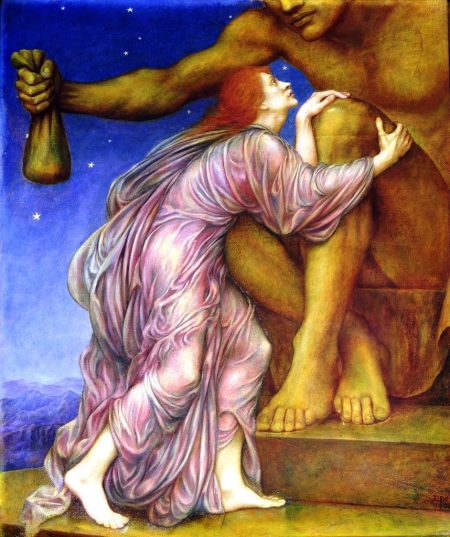
[image] Woman, man, and worship of Mammon. Oil on canvas painting by Evelyn De Morgan, circa 1909. Her work shows extraordinary insights into the relationship of women and men under the prevailing gender structure of family law. Preserved in the De Morgan Centre (London, UK), via Wikimedia Commons.

The man’s hand gesture in De Morgan’s painting is appropriately similar to that of men displaying their emasculation. See, e.g., the illumination of Attis castrating himself on folio 343v of a manuscript of Augustine’s De civitate Dei {City of God}, trans. from Latin into French by Raoul de Presles. Made in Paris about 1475, MS. MMW 10 A 11, in Koninklijke Bibliotheek, The Hague.

References:

Balzaretti, Ross. 2002. “Liutprand of Cremona’s Sense of Humour.” Ch. 5 (pp. 114-28) in Guy Halsall, ed., Humour, History and Politics in Late Antiquity and the Early Middle Ages. Cambridge: Cambridge University Press.

Chiesa, Paolo, ed. 1998. Liudprand of Cremona. Antapodosis; Homelia pachalis; Historia Ottonis; Relatio de Legatione Constantinopolitana. Corpus Christianorum, Continuatio Mediaevalis, 156. Turnholt: Brepols.

Grabowski, Antoni. 2015. “From Castration to Misogyny. The Meaning of Liudprand of Cremona’s Humour.” Acta Poloniae Historica. 112: 243.

Levine, Robert. 1991. “Liudprand of Cremona: History and Debasement in the Tenth Century.” Mittellateinisches Jahrbuch. 26:70–84.

Pieniądz, Aneta. 2010. “Kobieta, honor i polityka we wczesnym średniowieczu.” Pp. 408-24 in Bartoszewicz, Agnieszka, ed. 2010. Świat średniowiecza: studia ofiarowane Profesorowi Henrykowi Samsonowiczowi. Warszawa: Wydawnictwa Uniwersytetu Warszawskiego.

Squatriti, Paolo, trans. 2007. The Complete Works of Liudprand of Cremona. Washington: Catholic University of America Press.

Wright, F.A., trans. 1930. The Works of Liudprand of Cremona. London: Routledge & Kegan Paul.
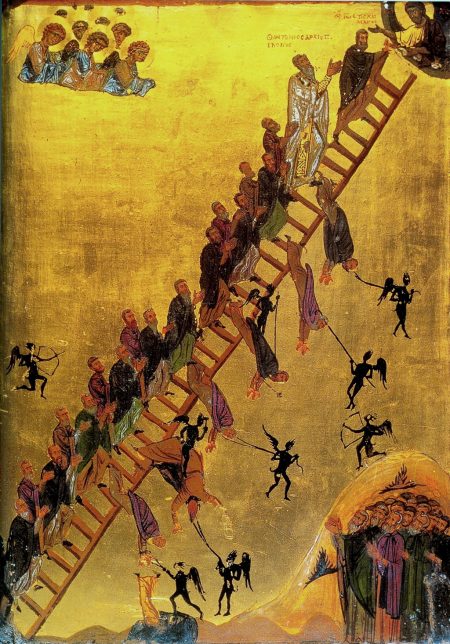
intricate, conflicted self in Climacus’s Ladder of Divine Ascent

John Climacus, Ladder of Divine Ascent

The seventh-century desert monk John Climacus was intellectually self-conscious. That’s a mental level above the artificial intelligence of a robot or the evolved programming of simple life-forms. Self-consciousness is a being’s mysterious ability to move to a point of view outside of itself and to think about itself as another being might do. John Climacus thought about himself in the conventional biblical categories of body/flesh and soul/spirit. In doing so, he perceived an intricate, conflicted self. That intricate, conflicted self remains relevant today to men seeking to climb the ladder from subordinate beings to beings intimate with God.

Gynocentric society teaches men that they are naturally demonic. Men self-consciously grappling with the demonic construction of men experience inner conflict:

By what rule or manner can I bind this body of mine? By what precedent can I judge him? Before I can bind him he is let loose, before I can condemn him I am reconciled to him, before I can punish him I bow down to him and feel sorry for him. How can I hate him when my nature disposes me to love him? How can I break away from him when I am bound to him forever? … How can I argue with him when all the arguments of nature are on his side?

Modern medicine offers men highly sophisticated male-to-female gender reassignment treatment. But that treatment cannot be successful for men who cannot overcome their self-identification as men by nature, even when they live within societies deeply gender-biased against men.

Under gynocentrism, men are divided between their social selves and their natural selves. The gynocentrically constructed self ponders the natural man:

He is my helper and my enemy, my assistant and my opponent, a protector and a traitor. I am kind to him and he assaults me. If I wear him out he gets weak. If he has a rest he becomes unruly. If I upset him he cannot stand it. If I mortify him I endanger myself. If I strike him down I have nothing left by which to acquire virtues. I embrace him. And I turn away from him.

What is this mystery in me? … How can I be my own friend and my own enemy? Speak to me! Speak to me, my yoke-fellow, my nature! I cannot ask anyone else about you. How can I remain uninjured by you? How can I escape the danger of my own nature?

The natural man responds:

I will never tell you what you do not already know. I will speak the knowledge we both have. … if you have learned the sure and rooted weakness within both you and me, you have manacled my hands. If you starve your longings, you have bound my feet , and they can travel no further. If you have taken up the yoke of obedience, you have cast my yoke aside. If you have taken possession of humility, you have cut off my head.

Men orienting themselves toward love of God must suppress their love of self and their longings, and practice obedience and humility in relation to God. Men, however, tend to confuse God with various goddesses — beautiful women, their wives, and the women who actually rule the mundane world. In relation to these goddesses, men must preserve their love of self, honor their own longings, and decisively reject obedience and humility, as well as castration culture. Victory in men’s inner conflicts and struggles isn’t merely one-sided.

Monks and other great men throughout history have heroically succeeded in rejecting gyno-idolatry and in loving women and God. As John Climacus recognized through his Ladder of Divine Ascent, progress is a matter of steps. Today, most men urgently need to take the first step. They must cultivate love of self in relation to the women they wrongly perceive to be goddesses. Then men can ascend to the next steps of pursuing their own interests and rejecting obedience and humility toward women-goddesses. Men must acquire a firm sense of themselves as having equal human dignity to women before they can hope to love women and God as fully human beings.

*  *  *  *  *

Read more:

Notes:

The above quotes are from John Climacus, Κλῖμαξ {Ladder of Divine Ascent}, from Step 15 (Περὶ ἁγνείας {On Chastity}), from Greek trans. Luidhéid & Russell (1982) pp. 185-6.  Here’s the ancient Greek text (right column).

[image] The Ladder of Divine Ascent, as described by John Climacus. Twelfth-century icon in the Saint Catherine’s Monastery, Mount Sinai, Egypt. Image thanks to Pvasiliadis and Wikimedia Commons.

Reference:

Luibhéid, Colm and Norman Russell, trans. 1982. John Climacus: the Ladder of Divine Ascent. New York: Paulist Press.

medieval literature’s intricate sexual lies show engaged minds

unhappy wife and husband

In the relatively enlightened medieval period, persons sought the truth. They sought the truth even if someone said that knowing the truth would make them feel bad. They sought the truth even if someone declared that stating the truth would make them feel unwelcomed and unsafe. Listen and be astonished! With open, engaged minds, medieval persons actually grappled with the complexities of women and men lying about their sexual encounters.

Medieval thinkers seriously examined gender differences related to lying about sexual encounters. Consider, for example, Cicero, a classically inclined priest at the church of Saint Mark near Perugia in early-fifteenth-century Italy. He ended a sermon at that church with a question for the men:

“Brothers,” he said, “I desire that you free me from a great uncertainty. During Lent, when I heard your wives’ confessions, not one confessed that she had violated the fidelity that she owes her husband. You, on the other hand, all generally admitted that you had sex with other men’s wives. In order that I no longer vacillate in doubt, I desire to know from you: who and where are the women you have fucked?”

{ “Fratres,” inquit, “magno quidem errore liberari a vobis cupio. Hac Quadregesima, cum audirem confessiones uxorum vestrarum, nullam reperi quae non profiteretur se fidem viro inviolatam servasse: vos autem ferme omnes fassi estis aliorum uxores cognovisse. Ne ergo hac in dubitatione diutius verser, scire a vobis cupio, quae aut ubinam sint istae mulieres fututae.” }[1]

More recent empirical evidence indicates that, within the same population, women report having many fewer heterosexual partners than the men report.[2] That’s not mathematically possible. As defenders of Bill Clinton’s handling of his affair with Monica Lewinsky instructed the world, lying about sex is common behavior. Men tend to lie that they had sex with more women than they actually did, and women tend to lie that they had sex with fewer men than they actually did. At a social level, this gender differences correlates with denial and obfuscation of statistics on women raping men.

Medieval stories recognized complexities in lying about sex. For example, a medieval townsmen named after the gyno-idolator Dante heard from friends that his wife was cuckolding him. He bitterly criticized her for betraying their marriage. But she swore that she was faithful:

She asserted that all was concocted by malevolent persons who envied their peaceful life together.

{ asserens ea a malevolis confingi, qui eorum quieti inviderent. }[3]

Like many husbands, this husband believed his wife about her sexual behavior. He challenged his friends who told of her infidelity:

“Oh! Don’t deafen me with more such words. Tell me,” he said, “can you possibly know better about her misdeeds than she herself?”

{ “Ohe! ne me his verbis obtundatis amplius. Dicite,” inquit, “ne illa an vos sua errata melius nostis?” }

Thus challenged, his friends truthfully affirmed that, as his wife had stated, they couldn’t know more about her misdeeds than she did. The husband then condemned his friends:

She affirms that you all are liars. I have more faith in her alone than in all of you here together.

{ Illa vos omnes mentiri affirmat, cui soli magis quam vobis omnibus praesto fidem. }

The crux of the story is the wife both lies and tells the truth about sex. The husband is a fool because he believes that his wife must either always tell the truth or always lie about sex.

An unrecorded variant of the medieval story recognizes that lying about sex could be taken to the meta-level of lying about lying. In this variant, the husband questions whether his friends could know as much about his wife sexual misdeeds as she does. Assuming his friends included the men who had been sleeping with his wife, they could know as much about her sexual misdeeds as she does. But to avoid revealing that they had betrayed their friend, they lie and affirm that his wife knows more about her misdeeds than they do. When the husband then declares that his friends are liars, he again makes the mistake of assuming that persons always tell the truth or always lie about sex.[4]

wife suspects husband of affair with cook

Medieval stories recognized, as should all defendants hauled before college sex-crime tribunals, that remaining silent is wiser than telling the truth in some cases. For example, a wealthy fuller lived with his wife and many man-servants and maid-servants. The fuller lusted after the prettiest and most charming of his young maids. He wasn’t content merely to engage in the male gaze. But his direct approach was redirected through his wife’s indirect approach:

With him much more than frequently asking her for sex, she brought this matter to the lady of the house. She advised her to assent to her master’s request. At the appointed day and hour at a secret and dark place, the lady substituted herself for the maid. The husband came and had sex with the woman, not knowing that she was his wife.

{ Cum eam super coitu requisivisset saepius, illa rem detulit ad matronam. Ejus consilio assentitur patrono. Praestituta die atque hora, in locum secretum ac subobscurum, matrona latuit pro ancilla. Accessit vir, mulieremque cognovit, nesciens uxorem esse. }[5]

The fuller felt delightedly fulfilled. He was willing to share his delight:

After finishing his work, he left the room, narrated what he had achieved to one of his young men, and urged him to go and likewise thrust with the maid. The young man went in. The woman took him for her husband and didn’t say anything. After that, the husband sent in another young man. The woman again took this man for her husband, and had intercourse for a third time. All three men she thought were her husband, and they believed that she was the maid.

{ Peracto opere, exiens a conclavi, quid egisset narravit uni ex junioribus, eumque hortatus est ut etiam ipse ancillam, prout credebat, subagitaret. Accessit ille, quem mulier pro viro accepit, nihil locuta. Cum post eum et item alter a viro missus esset, mulier existimans maritum esse, tertium congressum passa est: et ipsa virum, et illi ancillam esse opinati. }

The wife subsequently lied to her husband about this sexual affair. Her husband, knowing the truth, wisely remained silent:

Afterwards the woman secretly left the place. During the night she rebuked her husband for being so lustful towards their maid as to have sex with the maid three times in one day. The husband said nothing about his error and his wife’s fault, which he himself had caused.

{ Digressa occulte postmodum a loco mulier, noctu maritum redarguebat, qui in se esset remissus, et in ancillam adeo libidinosus, ut una die ter se pro ancilla cognovisset. Dissimulavit vir errorem suum, et uxoris, cujus ipse causa fuisset, peccatum. }

Sometimes staying silent is better than telling the truth. Life is complicated. That’s reality. In contrast, today’s simplistic “listen and believe” dogma promotes fantasy, ignorance, and anti-men bigotry. Persons who aspire to achieve at least a medieval level of enlightenment should be skeptical about what they have heard. They should also wonder about what they haven’t heard. An engaged, questioning mind is especially important in considering woman’s and men’s claims about sexual encounters.

*  *  *  *  *

Read more:

Notes;

[1] Poggio Bracciolini, Facetiae 123, “The obscene question of a certain priest {Interrogatio obscena cujusdam sacerdotis},” Latin text from Poggio (1879) vol. 2, pp. 4-5, my English translation with help from that of id. Here’s the Latin text in machine-readable form.

[2] Mitchell et al. (2018) studied a “stratified probability sample survey of 15,162 men and women aged 16 to 74 years in Britain, interviewed between September 2010 and August 2012.” Men in that survey reported having an average of 14.1 sexual partners in the course of their lives, while women reported an average of 7.1 sexual partners. That gender difference isn’t consistent with reasonable estimates of gender differences in homosexual couplings and gender differences in extra-population sexual coupling. Women and men must be differently misreporting their sexual affairs.

Poorly regulated female hypergamy generates societies in which men’s sexual opportunities are much more unequal that women’s sexual opportunities. In the British survey, the 99th percentile in partner counts is a man reporting 110 sexual partners and a woman reporting 50 sexual partners. Mitchell et al. (2018). A review of field research indicates that the actual gender difference is probably even greater. Id. computed gender differences in partner counts with partner counts capped by gender at the 99th percentile. That approach essentially ignores large, important gender inequality in sexual opportunities. That extreme gender inequality appears to be related to elite men’s analysis of gender differences and, more generally, to elite men’s policy choices to further gynocentric society (the “Ghengis Khan” effect; Zerjal et al. (2003)). Underscoring men’s sexual welfare disadvantage, in the British survey “10.8% of men reported ever having paid for opposite-sex sex, compared with 0.1% of women.” Id.

[3] Facetiae 139, “The story of Dante, who frequently scolded his wife {Fabula Dantis qui saepius uxorem increpabat},” Latin text from Poggio (1879) vol. 2, pp. 28-9, my English translation with help from that of id. The subsequent two quotes are from id.

On Dante’s relation with his wife Gemma, see Boccaccio’s Little Treatise in Praise of Dante {Trattatello in laude di Dante}. Poggio elsewhere humorously recounted “a joke of the celebrated Dante … Dante, our Poet {jocatio Dantis clarissimi … Dantes, Poeta noster}. Facetiae 121. See also Facetiae 57 & 58.

[4] While this version of the story isn’t recorded to my knowledge, it’s consistent with medieval Latin rhetorical sophistication in addressing sex and marital life.

[5] Facetiae 238, “The marvellous deed that happened to an English fuller with his wife {Fulloni in Anglia accidit res miranda cum uxore},” Latin text from Poggio (1879) vol. 2, pp. 173-5, my English translation with help from that of id. The subsequent two quotes are from id.

Facetiae 270, “About a miller deceived by his wife, who fed him five eggs for breakfast {De molendinario ab uxore decepto et quinque ovis refecto},” tells a similar story about a miller. In this case the husband and only one servant had sex with the wife. The wife served her husband with five eggs as a reward for this sexual service.

[images] (1) Wife and husband, Wagoner County, OK, 1939. From photograph (excerpt, enhanced) in Farm Security Administration, Office of War Information Photograph Collection. Item LC-USF33-012252-M2 (b&w film nitrate neg.) LC-DIG-fsa-8a26409 (digital file from original neg.), U.S. Library of Congress.(2) Wife suspects husband of embracing young cook. Wife looking at husband holding coat with flour hand prints on back; young cook standing in corner apprehensively. Image titled: “Good heavens!” Single image (excerpt, enhanced) from stereo card created by Underwood & Underwood, c. 1900. Item LC-USZ62-79747 (b&w film copy neg.) in U.S. Library of Congress.

References:

Mitchell, Kirstin R., Catherine H. Mercer, Philip Prah, Soazig Clifton, Clare Tanton, Kaye Wellings & Andrew Copas. 2018. “Why Do Men Report More Opposite-Sex Sexual Partners Than Women? Analysis of the Gender Discrepancy in a British National Probability Survey.” The Journal of Sex Research. DOI: 10.1080/00224499.2018.1481193

Poggio. 1879. Gian Francesco Poggio Bracciolini. The facetiae or jocose tales of Poggio, now first translated into English with the Latin text. Paris: Isidore Liseux (vol. 1, vol. 2).

Zerjal, Tatiana, Xue, Yali, Bertorelle, Giorgio, Wells, R. Spencer, Bao, Weidong, Zhu, Suling, Qamar, Raheel, et al. 2003. “The Genetic Legacy of the Mongols.”  American Journal of Human Genetics. 72 (3): 717-21.