Lucian’s True Story: a seminal work of meninist literature

Lucian of Samosata’s second-century True Story is a fantastic, seminal work of meninist literature. Lucian dared to imagine a society in which men conceived and carried to birth children via their bodies, theirselves.[1] Men were thus not biologically subject to the fundamental gender inequality in paternity knowledge. Moreover, men weren’t exposed to acute gender bias in child custody and “child support” rulings. In this men-only society, men couldn’t be subject to gender bias in criminal justice such as is starkly evident today in highly gender disproportionate incarceration of men. The elimination of these gender biases is as fantastic as men walking on the moon without any women overlooking their steps. Lucian dared to imagine gynocentric society subverting itself and permitting, even just temporarily, an alternate place of gender justice in the heavens.
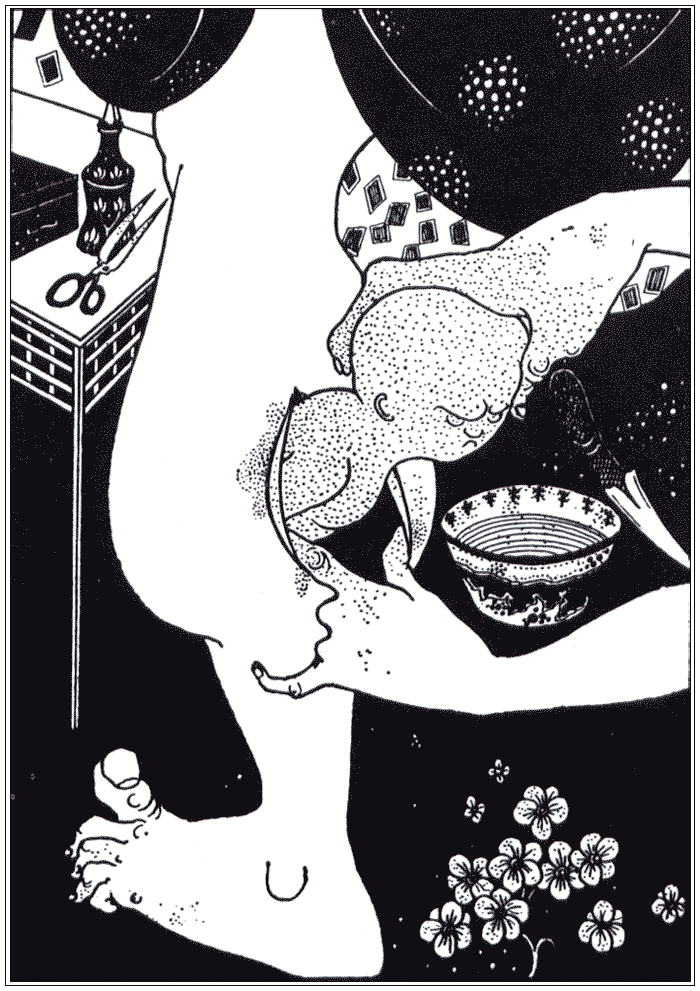
man giving birth to child

Lucian imagined men’s penises as not just partnering to transmit life into a new generation, but also as a strong, independent aid to propulsion. Odysseus had himself bound to a ship’s mast to repress his sexuality in the circumstances of Sirens singing. That’s like men castrating themselves to avoid the risk of forced financial fatherhood. Men liberating themselves sexually with their own hands can be more enjoyable. Consider men in the ocean, transcending the socially constructed, technologically genderlessness of modern windsurfing:

They lie on their backs on the water, and erecting their penises, which are very large, they spread sails on them, holding the sheets in their hands, and as soon as the wind strikes them, away they sail.

{ ὕπτιοι κείμενοι ἐπὶ τοῦ ὕδατος ὀρθώσαντες τὰ αἰδοῖα – μεγάλα δὲ φέρουσιν – ἐξ αὐτῶν ὀθόνην πετάσαντες καὶ ταῖς χερσὶν τοὺς ποδεῶνας κατέχοντες ἐμπίπτοντος τοῦ ἀνέμου ἔπλεον. }[2]

“Men need women like fish need fins.” No, that’s not right, it’s this: “men need women like fish need wind.” Lucian was prescient in affirming the value of men’s sexuality. Lucian’s True Story challenges deeply entrenched castration culture.

woman windsurfing

Modern classical philology, subservient to dominant gynocentric ideology, has obscured Lucian’s figure of men’s strong, independent sexuality. Early in the seventeenth-century, Francis Hickes, a reclusive scholar-farmer who was the son of an English tapestry weaver, provided a reasonably good English translation of men’s sexual windsurfing in Lucian’s True Story:

As they lie upon their backs in the water and their privy members standing upright, which are of a large size and fit for such a purpose, they fasten thereto a sail, and holding their cords in their hands, when the wind has taken it, are carried up and down as please themselves.[3]

In the original Greek, the word αἰδοῖᾰ clearly means in context “penises.” That’s the most progressive translation in our time of oppressive gynocentrism. The relevant, direct sense of the singular Greek substantive is “honored, respected part.” Hickes translated αἰδοῖᾰ as “privy members.” In early modern English, privy meant “private, exclusive,” yet carried honor through terms such as the king’s “privy chamber {private room}.” Hickes’s translation is acceptable, particularly given that he was a reclusive rustic unaware of historically entrenched systemic sexism.

Across the past three centuries, translations of Lucian’s True Story have refused to acknowledge the extensive value of men’s penises, even out at sea. In 1780, Thomas Francklin, Doctor of Divinity and Greek professor at the University of Cambridge, ended medieval appreciation of incarnated human life and lowered the curtain on men’s sexual windsurfing:

they fastened to their middle a sail, and holding the lower part of the rope in their hands, were carried along by the wind.[4]

These men sailed without anything functioning as a mast. That’s a ridiculous fantasy, one characteristic of castration culture. Francklin, not only a prude but also a pedant, added a footnote:

their middle] Lucian says ὀρθώσαντες τὰ αἰδοῖα, ἐξ αὐτῶν ὀθόνην πετάσαντεςm &c. which the learned reader, if he thinks proper, may interpret for himself.

Nothing is improper about men’s penises, which are a vital part of the cosmos. In 1820, another English translation suggested the horrible fate of Sincopus by engaging in periphrasis: the man “erects his middle mast.” A translation in 1899 similarly dehumanized men.[5] Men do not have masts. Meninism is the radical notion that men are human beings. Men should not be socially constructed as ships that serve women in commodity trade for exotic luxury goods.

The status of men’s sexual windsurfing continued to worsen across the modern era. In 1879, a scholar at Trinity College, Oxford, authored through Oxford University’s Clarendon Press an edition of the original text of Lucian’s True Story. This text was “edited with introduction and notes for the use of middle forms in schools.”[6] It excised from Lucian’s ancient Greek text the sentence concerning men’s sexual windsurfing. A castrated, ignorance-promoting ancient Greek text of Lucian’s True Story was thus distributed to schools under the authority of an elite educational institution.

Subsequent English translations cut more specifically men’s penises. An influential, scholarly translation for Oxford’s Clarendon Press in 1905 created an implicit gender gap:

they float on their backs, erect a sail, and then, holding the sheets with their hands, catch the wind.[7]

On what did these men erect their sails? That’s a socially constructed gender gap in this translation’s description. A recent commentator aptly observed that this translation works to “reduce the Phallonauts to Phallonots.” Moreover, the authors excised passages describing men having sexual freedom and reproductive autonomy. The Vice-Chancellor of Oxford University himself proofread this translation. The authors even explicitly thanked the Vice-Chancellor for valuable advice on “the difficult subject of excision.” Making this subject difficult is ideological obfuscation. It’s simple. Excising men’s genitals reflects castration culture and systemic sexism.

Another widely disseminated translation of Lucian’s True Story shows repressive anxiety about representing men’s penises. The 1913 translation for the Loeb Classical Library described the sexually windsurfing men as having “hoisted their never-mind-whats.” Never mind what? Men’s penises are at the center of their human being! The reprinting of this translation in 1921 substituted “jury-masts” for “never-mind-whats.”[8] That obscures the anxiety about men’s sexuality with a poor figure. A jury-mast is a low-quality, hastily constructed mast. Men’s penises, in contrast, have been finely crafted through biological evolution for millennia. To this day, “jury-masts” deplorably represents men’s penises in the influential Loeb edition of Lucian’s True Story.

Men students having a fully functional sense of their own gender identity deserve to be affirmed and allowed to stand erect, protected from shame. The most recent translation of Lucian’s True Story, published in 2005, describes the men engaging in sexual windsurfing as “erecting their organs.”[9] A tongue is an organ. A toe is an organ. So too is the liver. These men weren’t windsurfing with just any organ. They were windsurfing with their erect penises. All professors should profess nothing less than philological correctness in teaching classics.

In 1962, New York University classics professor Lionel Casson erected himself above the modern, anti-meninist practice of translation. Professor Casson provided a scintillating translation of men’s sexual windsurfing in Lucian’s True Story:

a man would lie on his back in the water, induce an erection, hoist a sail on it (their penises were enormous), and holding the sheets in his hands, bowl along before the wind.[10]

Not pandering to prurient tastes, Casson followed the ancient Greek in not describing explicitly how a man would “induce an erection.” At the same time, Casson evoked Lucian’s sense of classical pastoral with “bowl along before the wind.” Bowling requires balls, which these men surely had and enjoyed. Living within gynocentric society, Casson credited his wife for reviewing his translation in manuscript. With admirable meninist respect for forefathers, Casson also credited his father:

My father, as always, read and reread every page of the manuscript. The dialogue throughout has profited from his fine feeling for idiom and the exposition from his uncompromising insistence on clarity.

Classical philology’s gender failures must be relegated to the past. Moving forward, all professors teaching Lucian’s True Story should offer students an English translation at least as true and beautiful as Lionel Casson’s.

Underscoring the importance of truthful representation in translation, Lucian’s account of men’s sexual windsurfing leads into an account of women’s violence against men. Women’s violence against men tends to be socially sophisticated. In this case, Lucian and his men had endured hunger, captivity, and brutal battles before they landed on an island. What appeared to be beautiful young women like Nausicaa and her servant-girls came to welcome them. But unlike Nausicaa and her servant-girls, these young women dressed and acted like courtesans. Each woman paired off with a man and brought him back to her home as her guest. Before a woman took him home, Lucian noticed human bones and skulls piled on the ground. He prayed for his safety and the safety of his men. Then he went with the woman to her home. Men must learn to be more wary of women.

Lucian at least believed his eyes and was unafraid to question a woman. That’s necessary to ensure men’s safety:

A little while later, as my hostess was serving me, I got a glimpse of her legs. They weren’t a woman’s limbs but a donkey’s shanks. Drawing my sword, I seized her and tied her up. Then I interrogated her thoroughly. She very reluctantly admitted to me that she and the others were women of the sea called Ass-legs and that that their food was the strangers who came to the island. “We get them drunk,” she explained, “go to bed with them, and then attack them in their sleep.”

{ μετ’ ὀλίγον δὲ τῆς ξένης διακονουμένης εἶδον τὰ σκέλη οὐ γυναικός, ἀλλ’ ὄνου ὁπλάς: καὶ δὴ σπασάμενος τὸ ξίφος συλλαμβάνω τε αὐτὴν καὶ δήσας περὶ τῶν ὅλων ἀνέκρινον. ἡ δέ, ἄκουσα μέν, εἶπεν δὲ ὅμως, αὐτὰς μὲν εἶναι θαλαττίους γυναῖκας Ὀνοσκελέας προσαγορευομένας, τροφὴν δὲ ποιεῖσθαι τοὺς ἐπιδημοῦντας ξένους. “ἐπειδὰν γάρ,” ἔφη, “μεθύσωμεν αὐτούς, συνευνηθεῖσαι κοιμωμένοις ἐπιχειροῦμεν.” }[11]

In short, these Ass-legs women raped and murdered men. Yet this story has deeper significance than merely drawing needed attention to women raping men and violence against men. Why did Lucian draw his sword before he seized this criminal woman and tied her up? Holding a sword would have impeded those manual acts.

Lucian’s drawn sword affirms the value of men’s penises against the murderous Ass-legs women. Lucian’s preceding description of men’s sexual windsurfing depicts the autonomous value of men’s penises. But by the grace of God, human sexuality can also bring women and men together in pleasure and fruitfulness. Lucian raised his sword in strong protest against the Ass-legs women exploiting men’s sexuality and murdering men. After Lucian alerted his men and saved their lives, he returned to the criminal Ass-legs woman he had seized. She had dissolved into water. What was reality here? Lucian thrust his sword into the water. It turned into blood, the true remains of that blood-thirsty woman. Lucian’s sword indicates the revelatory importance of the penis’s action.[12] Eliminating men and their penises promotes a world of deceptions and lies.

Lucian revealing truth with sword

Earlier Lucian and his men came across what seemed to be a place of men’s delightful dreams. A river flowed with wine rather than water. Its source was the roots of beautiful, naked women growing like grapevines. They had grapes growing out of their fingers. Instead of hair, they had branches flourishing with leaves and grapes. These women, some exotic beauties but most merely local women, warmly welcomed Lucian and his men:

The women called out to welcome us as we came up, some in Lydian, some in Indian, but most in Greek. They also started kissing us on the lips. Everyone they kissed immediately became drunk and began to stagger. We weren’t able to pick the grapes because, as we pulled them off, the women would cry out in pain. They were burning with desire to have sexual intercourse with us. Two of my men tried it. They couldn’t be pried loose, because they were held fast by their penises. Their penises had grow into and become grafted onto the vines. Soon the two men became entwined in a network of tendrils, sprouted shoots from their fingers, and looked as if they themselves were ready to bear fruit.

{ ἀπὸ δὲ τῶν δακτύλων ἄκρων ἐξεφύοντο αὐταῖς οἱ κλάδοι καὶ μεστοὶ ἦσαν βοτρύων. καὶ μὴν καὶ τὰς κεφαλὰς ἐκόμων ἕλιξί τε καὶ φύλλοις καὶ βότρυσι. προσελθόντας δὲ ἡμᾶς ἠσπάζοντο καὶ ἐδεξιοῦντο, αἱ μὲν Λύδιον, αἱ δ᾽ Ἰνδικήν, αἱ πλεῖσται δὲ τὴν Ἑλλάδα φωνὴν προϊέμεναι. καὶ ἐφίλουν δὲ ἡμᾶς τοῖς στόμασιν· ὁ δὲ φιληθεὶς αὐτίκα ἐμέθυεν καὶ παράφορος ἦν. δρέπεσθαι μέντοι οὐ παρεῖχον τοῦ καρποῦ, ἀλλ᾽ ἤλγουν καὶ ἐβόων ἀποσπωμένου. αἱ δὲ καὶ μίγνυσθαι ἡμῖν ἐπεθύμουν· καὶ δύο τινὲς τῶν ἑταίρων πλησιάσαντες αὐταῖς οὐκέτι ἀπελύοντο, ἀλλ᾽ ἐκ τῶν αἰδοίων ἐδέδεντο· συνεφύοντο γὰρ καὶ συνερριζοῦντο. καὶ ἤδη αὐτοῖς κλάδοι ἐπεφύκεσαν οἱ δάκτυλοι, καὶ ταῖς ἕλιξι περιπλεκόμενοι ὅσον οὐδέπω καὶ αὐτοὶ καρποφορήσειν ἔμελλον. }[13]

Men’s delightful dreams turn into nightmares when sexually ravenous women insist on taking permanent possession of men’s bodies. Men typically respect women’s feelings and try to avoid causing women pain. Women should do likewise for men. More fundamentally, women must understand that men’s sexuality is a time-bounded gift to them.[14] Assimilating men into women isn’t in truth fruitful.

Unlike public discourse today, medieval literature openly and honestly depicted the systemic repression of men’s sexuality. For example, early in the ninth century, Methodius became the patriarch of Constantinople. That great Byzantine city was the capital of what remained of the Roman Empire. Amid intense political conflict over icons, one’s woman’s unsubstantiated accusation of rape was enough to threaten to topple the eminent Methodius and subject him to harsh penal punishment. Methodius, however, had a biological defense against unjust penal persecution:

The man most worthy of all reverence and honor in everyone’s sight bared his genitals. No one could not notice that his genitals had withered from disease and were deprived of all natural strength. This fact filled his evil-celebrating slanderers with shame. Pious persons, on the other hand, were glad. Surrounding him with enormous joy, they congratulated and hugged Methodius, who had no means of satisfying his sexual desire.

{ Homo omni reverentia atque honore dignissimus, in conspectu omnium pudenda nudavit: quae nemo non videbat morbo quodam emarcuisse, omnique naturali vi esse privata. pudore hoc factum opplevit calumniatores et malis gaudentes, pios autem laetitia: qui ingenti cum gaudio Methodium cingentes salutabant atque amplectebantur, neque habebant quo modo voluptati suae satisfacerent. }[15]

Sadly learning from Methodius’s horrifying experience of persecution, some men sought what seemed to be the only effective defense against a false accusation of rape:

And from this with greater understanding some men quietly solicited where a man might seek for this means of withering his genitals.

{ et quidam notioribus placide aggressus ex eo quaesivit quonam modo virilia eius ita emarcuissent. }

Grotesquely unjust persecution of men for alleged sexual crimes tends to cause men to droop with fear. Castration culture damages men’s sexuality and promotes the development of a barren, cruel society. That harm to men should be a serious social concern, since such a society is ultimately bad for women.

Literature that affirms the goodness of men’s sexuality is vital for overcoming the deeply entrenched injustices of castration culture. Achieving social justice depends on meninist literary critics recovering and celebrating obscured masterpieces of meninist consciousness. With his True Story, Lucian wrote a wonderful, seminal work of meninist literature. Lucian’s True Story deserves to be treated with philological correctness and taught to every student who aspires to be educated and truly enlightened.[16]

* * * * *

Read more:

Notes:

[1] Lucian’s True Story might be more accurately called True Stories {Ἀληθῆ διηγήματα}. It’s also called True History {Vera Historia} or True Histories {Verae historiae}. The title True Story seems to me to best reflect the play of Lucian’s text. On Lucian’s concern for truth, see e.g. Whitmarsh (2001), pp. 71-87, and Parrett (2013).

In the society of men on the moon, men engage in same-sex marriage and have sexual intercourse by thrusting one spouse’s penis into the other spouse’s hollow of the knee. Men themselves bear children:

Indeed it is not females but males that do the child-bearing. Marriage is between males, and there isn’t even a word for “women.” Men under twenty-five are the wives; men over twenty-five, the husbands. The embryo is carried not in the belly but in the man’s calf. Once conception takes place, the calf swells up. After a course of time, it is cut open and the child, not yet alive, is extracted. Life is induced by placing the child, mouth wide open, toward the wind.

{ μὲν τὸ μὴ ἐκ γυναικῶν γεννᾶσθαι αὐτούς, ἀλλ᾽ ἀπὸ τῶν ἀρρένων· γάμοις γὰρ τοῖς ἄρρεσι χρῶνται καὶ οὐδὲ ὄνομα γυναικὸς ὅλως ἴσασι. μέχρι μὲν οὖν πέντε καὶ εἴκοσι ἐτῶν γαμεῖται ἕκαστος, ἀπὸ δὲ τούτων γαμεῖ αὐτός· κύουσι δὲ οὐκ ἐν τῇ νηδύϊ, ἀλλ᾽ ἐν ταῖς γαστροκνημίαις· ἐπειδὰν γὰρ συλλάβῃ τὸ ἔμβρυον, παχύνεται ἡ κνήμη, καὶ χρόνῳ ὕστερον ἀνατεμόντες ἐξάγουσι νεκρά, θέντες δὲ αὐτὰ πρὸς τὸν ἄνεμον κεχηνότα ζῳοποιοῦσιν. }

Lucian of Samosata, True Story 1.22, ancient Greek text from Casey, Nimis & Hayes (2014), English translation (with minor changes) from Casson (1962) p. 23. Ancient Greek myth describes Athena and Dionysus being born from the male god Zeus’s head and thigh, respectively. Lucian satirically referred to these myths in Dialogi Deorum 12.1. Deriu (2017) pp. 5-6. Lucian seems in part to be satirizing the classical Socratic model of men teaching boys. Id. pp. 15-7. The Socratic model certainly isn’t the only possible model of male society.

Another race of men on the moon reproduces differently, but also with gender autonomy. Among these men, called Arboreals (tree-men):

A man’s right testicle testicle is cut off and planted in the ground. This produces a huge tree of flesh with a trunk like a penis. It has branches and leaves and as fruit bears eighteen-inch acorns. When ripe, these are gathered, the shells cracked open, and men are hatched from them.

{ ὄρχιν ἀνθρώπου τὸν δεξιὸν ἀποτεμόντες ἐν γῇ φυτεύουσιν, ἐκ δὲ αὐτοῦ δένδρον ἀναφύεται μέγιστον, σάρκινον, οἷον φαλλός· ἔχει δὲ καὶ κλάδους καὶ φύλλα· ὁ δὲ καρπός ἐστι βάλανοι πηχυαῖοι τὸ μέγεθος. ἐπειδὰν οὖν πεπανθῶσιν, τρυγήσαντες αὐτὰς ἐκκολάπτουσι τοὺς ἀνθρώπους. }

Lucian, True Story 1.22, sourced similarly.

[2] Lucian, True Story 2.45, ancient Greek text from Casey, Nimis & Hayes (2014), English trans. from Costa (2005) p. 232, with “penises” substituted for “organs.” All subsequent quotes from Lucian’s True Story have ancient Greek text from Casey, Nimis & Hayes (2014), which includes helpful reading notes.

[3] Lucian, True Story 2.45, English trans. from Hickes (1634), spelling modernized. Francis Hickes died in 1630. His son Thomas Hickes had his father’s translations of Lucian published. Thomas dedicated this book to “the Right Worshipful Dr. Duppa, Dean of Christ-Church, and Vice-Chancellor of the famous University in Oxford” (spelling modernized). He implored the Vice-Chancellor for patronage. On the life of Francis Hickes, see Thomas Hickes’s prefatory note “To the honest and judicious reader” and the introduction to Hickes et al. (1894).

On early English translations of Lucian, Craig (1921) and Sheldon (1919). Id. p. 21, misspelled Hickes’s name and failed to acknowledge his 1634 publication. Referring to Sheldon (1901) by title without mentioning its author, Sheldon went on review his own translation of Lucian:

It is literal, in the sense that it reproduces the author’s thought with conscientious exactness. At the same time the style is idiomatic and vivacious. The translator has been at no little pains to preserve the life and warmth, the bouquet, of the original, halting not at the use of familiar, colloquial language when the text seemed to warrant it. … Here and there in this version the colloquial tone is, perhaps, somewhat overdone, a fault, however, in the right direction; but the liveliness of the style is uniformly maintained without resort to such doubtful devices. Preceding the translation there is a clear, practical, and notably complete study of Lucian, as man and author. … Full notes — too full, perhaps, but interesting and illuminating for the general reader — are placed at the foot of the page, where they ought to be, if they ought to be at all. The London Saturday Review said of this version as a whole: “It has all the attractiveness of an original work.”

Sheldon (1919) pp. 24-5. Sheldon’s translation of Lucian’s works doesn’t include Lucian’s True Story. Here’s a historical perspective on faithful translation.

As part of a proposed, multi-translator project to publish all of Lucian’s works in English translation, John Dryden in 1696 wrote a life of Lucian. Dryden died in 1700. But Dryden’s life of Lucian was included in the posthumous Dryden (1711). That work includes Thomas Brown’s translation of Lucian’s Vera Historia. Brown’s translation of men’s sexual windsurfing was similar to Hickes’s:

they lay flat on their backs in the water, with their privities that are said to be of an extraordinary size, standing erect, to which they fastened the sail, and then holding the string in their hands, sailed as the wind carried them.

Dryden (1711) vol. 3, p. 184. Brown died in 1704, so his translation certainly was completed before then. Craig (1921) pp. 157-8.

[4] Lucian, True Story 2.45, English trans. from Francklin (1780) v. 1, p. 447. The subsequent quote is from id. A translation in 1901 similarly obliterated men’s penises:

Soon we perceived men sailing in the water, after a new fashion, by means of a sail fastened round their bodies. They hold the rope in their hands, and so are driven onward by the wind.

Campbell Davidson (1901) p. 170. Men windsurfing by means of a sail “fastened round their bodies” is completely unrealistic.

[5] For men’s sexual windsurfing, Tooke translated:

The man lays himself flat on his back upon the water, then erects his middle mast*, fastens a sail to it, holding the rope at the lower end of it in his hand, and thus sails before the wind.

Tooke (1820) vol. 2, p. 123. The asterisk appended to “mast” indicates a footnote: “Lucian says ὀρθώσαντες τὰ αἰδοῖα, (μεγάλα δὲ φέρουσιν), ἐξ αὐτῶν ὀθόνην πετάσαντες, &c.” Tooke was an Englishman who became an Anglican priest and served English merchants as a chaplain in St. Petersburg, Russia, from 1774 to 1792. His translation of Lucian is based on the German translation of Wieland (1788). For the men’s sexual windsurfing, Willson (1899), p. 147, similarly has “hoist a mast in their middle to which they attach a sail.”

[6] Jerram (1879). This book lamentably has been reprinted many times in subsequent years.

[7] Fowler & Fowler (1905) vol. 2, p. 136. The subsequent quote is from vol. 1, Preface. Fowler & Fowler’s translation of Lucian’s Vera Historia omitted almost all of sections 1.22 and 2.19. In 1981, the Great Ideas Today series of Encyclopedia Britannica (a follow-up to the Great Books canon) reproduced, without correction or attribution, Fowler & Fowler’s translation. See Adler (1981) p. 254. Redmond (2013) uses Fowler & Fowler’s translation, but silently adds in some of the expurgated text.

[8] Harmon (1913) vol. 1, p. 353 (“never-mind-whats”); reprinting in 1921 (“jury-masts”). Here’s an incorrectly dated, alternate version of a 1921 or later reprinting.

[9] Costa (2005) p. 232.

[10] Casson (1962) p. 52. The subsequent quote is from the preface to id. Reviewing id., Pearson castigated Casson for including a translation of Lucius, the Ass (Asinus):

It is a tale of neither taste nor point. Casson’s willingness to call a spade a spade leads to frequently graceless English expressions. We applaud clarity; what is most clear is that though the authenticity may be disputed, the singular vulgarity of this story cannot.

Pearson (1963) p. 140. Irrespective of whether Lucian authored it, Asinus is a magnificent classic with great relevance today. For his fine translation of that tale, Casson deserves thanks.

The Lucian of Samosata Project provides online many translations of Lucian over time, but no critical perspective on the various translations. The select bibliography of Costa (2005) mentions Harmon’s Loeb translation and declares that “two others are worth noting.” These are Fowler & Fowler (1905) and Turner (1961). Here’s how the latter translated men’s sexual windsurfing in Lucian’s True Story:

You float on your back in the water, elevate the appropriate organ — which in their case is surprisingly large — to an angle of ninety degrees, attach a sail to this improvised mast, and go scudding along before the wind, holding the sheet in one hand.

Turner (1961) p. 293. That wordy, quasi-engineering translation lacks the joyful vitality and whimsy of Lucian’s text. Turner’s translation is far less noteworthy than Casson’s.

[11] Lucian, True Story 2.46, English translation from Casson (1962), with my minor changes. Lucian’s account of the sexually alluring, men-killing donkey-footed women seems to draw upon Jason and the Argonaut’s experience with the Lemnian women, Odysseus and his men’s experience with the goddess Circe, and Odysseus’s difficulty with the Sirens. Men being strongly attracted to women, even women who treat them badly, is well-recognized in myth as well as in reality. On the mythic context of Lucian’s men-killing donkey-footed women, Newman (2017).

[12] Lucian “wields his figurative phallus, his sword, with penetrating efficiency.” Ní Mheallaigh (2009) p. 19, Ní Mheallaigh (2014) p. 215. A man does not have a phallus. In reality, he has a penis. For another academic failure to recognize the important distinction between “phallus” and “penis,” see note [3] in my post on Bernardus Silvestris’s Cosmographia. For a text-centered interpretation of Lucian’s sword figuring his penis, Larmour (1997) p. 143.

[13] Lucian, True Story 1.8, English translation from Casson (1962), with my minor changes. In his account of the sexually ravenous, men-killing vine-women, Lucian seems to have built upon Dio Chrysostom’s Libyan Myth. Dio Chrysostom, Discourses 5. On that intertextuality, Georgiadou & Larmour (1997).

Lucian may have in part been responding to Apollonius of Tyna’s wisdom regarding castration and vineyards. Late in the first century, the Roman Emperor Domitian based laws forbidding castration and eliminating vineyards. Apollonius remarked:

This fine fellow Domitian doesn’t realize that he’s sparing men and castrating the earth.

{ λέληθε δὲ ὁ θαυμασιώτατος τῶν μὲν ἀνθρώπων φειδόμενος, τὴν δὲ γῆν εὐνουχίζων. }

Philostratus, Life of Apollonius of Tyna 6.42, Greek text and English translation (modified slightly) from Jones (2005). Here’s the translation of Conybeare (1912). In Lucian’s True Story, the vineyard itself acts as an agent of castration culture. Men’s penises and fruitful vineyards in truth belong together in harmony and peace.

[14] The account of picking grapes seems deliberately contradictory. The men didn’t pick grapes, because when they picked grapes, it caused the women pain. In accordance in dominant anti-meninist ideology, ambiguity must be resolved so as to promote even more gender-disproportionate penal incarceration of men. Picking grapes, whether or not it actually occurred, thus “hints at rape.” Ní Mheallaigh (2009) p. 18, Ní Mheallaigh (2014) p. 214.

Affirming dominant ideological obfuscation of violence against men, Ní Mheallaigh interprets Lucian’s account of the sexually ravenous, men-killing vine-women as expressing “patriarchal anxiety about female sexuality, especially the fear of entrapment.” Ní Mheallaigh (2009) p. 19, Ní Mheallaigh (2014) p. 215, drawing on Larmour (1997) p. 144. Newman applies this absurd, boiler-plate academic cant to Lucian’s account of the donkey-footed women murdering men. Newman (2017) p. 93. Enlightened thinkers recognize the reality of violence against men and women raping men.

Even while debunking the modern myth of misogyny, authorities today cannot refrain from creating substitute myths in support of the gynocentric order. Here’s a blunt declaration of the truth:

The best data from contemporary social science … suggest that the very persistence of the pervasive misogyny narrative is itself a manifestation of the opposite: society is largely biased in favor of women.

Clark & Winegard (2020). But then there’s the propitiatory substitute myth:

This does not mean, of course, that there are no biases against women. For a long time, women in the West were treated as property and were considered emotional, irrational, and incapable of contributing significantly to higher culture.

Id. Given Empress Theodora’s strong, independent sexuality, the medieval requirement for a conjugal partnership in marriage, sexual feudalism and medieval men’s life expectancy shortfall, the bureaucratic reality of marriage, the sad fate of Margery Kempe’s husband, Anne of France’s advice to her daughter, and on and on, one can only marvel that the myth “women in the West were treated as men’s property” can be solemnly affirmed as truth. Since no latter than 1992, the work of evolutionary psychologists Margo Wilson and Martin Daly has promoted this ridiculous myth. For additional relevant evidence and analysis, see my post on primatology and vegetarianism, particularly note [4], and my post on medieval women choosing whether and to whom to marry.

Of course, writers have long sought to flatter their readers. This article debunking the myth of misogyny features the epigram, “Women who seek to be equal with men lack ambition. ~Timothy Leary.” Let’s build a glorious future of female supremacy. The future is female!

[15] Latin text from a translation of the mid-eleventh-century Synopsis historion of the Byzantine historian Georgius Cedrenus. Bekker & Niebuhr (1837) pp. 147-8, my English translation. The subsequent quote is similarly from id. Versions of this story also appear in the Acta Sanctorum 23 (June 14) and in the twelfth-century Byzantine historian Johannes Zonaras’s Epitome Historiarum 16.1, 4:3. Murray (2019) p. 105, notes 42-3.

Murray (2019) describes Methodius as participating in a “battle for chastity” without any regard for gynocentric suppression of men’s sexuality. Men’s sexual struggles will become much less intense when men gain reproductive rights equal to women, when adjudication of accusations of rape become gender-neutral and are judged with due process, and rape libel no longer functions as an effective political tool for promoting penal incarceration of men.

[16] Academic failures have contributed significantly to the gender injustices that Lucian’s True Story concerns and its reception reflects. One academic declared that Lucian’s True Story is “conspicuously male dominated.” Deriu (2017) p. 11. That’s like referring to a women’s caucus as “conspicuously female dominated.” According to another academic, “True Stories represents the ultimate victory of the world of the book over the world of reality.” Ní Mheallaigh (2014) p. 208. Books and reality aren’t strictly separate worlds. The ultimate victory of Lucian’s True Story would be to bring gender equality from the world of myth to the world of reality.

[images] (1) Man giving birth to a child from his calf. Illustration by Aubrey Beardsley for Hickes et al. (1894), but suppressed from that publication. Via Parrett (2013), the Savoy, and Marillier (1899). (2) Young woman windsurfing. Source photograph by Jorge Campa, August 25, 2015. Via Wikimedia Commons. (3) Lucian testing with his sword the water that remained of the Ass-legs woman. Illustration by Joseph Benwell Clark in Hickes et al. (1894).

References:

Adler, Mortimer J., ed. 1981. The Great Ideas Today, 1981. Chicago: Encyclopaedia Britannica.

Bekker, Immanuel, and Barthold Georgius Niebuhr, eds. 1837. Corpus Scriptorum Historiae Byzantinae. Vol. 9, Georgius Cedrenus, v. 2. Bonn: Weberus.

Campbell Davidson, Augusta M., trans. 1902. Translations from Lucian. London: Longmans.

Casey, Eric, Stephen Nimis, and Evan Hayes, 2014. Lucian: True History. Book 1, Book 2. Carlisle, PA: Dickinson College Commentaries.

Casson, Lionel, trans. 1962. Selected satires of Lucian. New York: W.W. Norton & Co.

Clark, Cory, and Bo Winegard. 2020. “The Myth of Pervasive Misogyny.” Quillette. July 27, 2020. Online.

Costa, Charles Desmond Nuttall, trans. 2005. Lucian: selected dialogues. Oxford: Oxford Univ. Press.

Craig, Hardin. 1921. “Dryden’s Lucian.” Classical Philology. 16 (2): 141-163.

Deriu, Morena. 2017. “How to Imagine a World Without Women: Hyperreality in Lucian’s True Histories.” Medea. 3 (1). Online.

Dryden, John. 1711. The Works of Lucian: translated from the Greek, by several eminent hands. … With the life of Lucian, a discourse on his writings, and a character of some of the present translators. Written by John Dryden. 4 volumes. London: Printed for Sam. Briscoe, and sold by J. Woodward, and J. Morphew.

Fowler, Francis George, and H. W. Fowler. 1905. The Works of Lucian of Samosata. 4 vols. Clarendon Press: Oxford.

Francklin, Thomas, trans. 1780. The Works of Lucian. Vol. 1, Vol. 2. London: Printed for T. Cadell.

Georgiadou, Aristoula and David Larmour. 1997. “Lucian’s Vine-Women (VH 1,6-9) and Dio’s Libyan Women (Orat. 5): Variations on a Theme.” Mnemosyne. 50 (2): 205-209.

Harmon, A. M. ed. and trans. 1913. Lucian. 8 vols. Loeb Classical Library 14. London: Heinemann.

Hickes, Francis, trans. 1634. Certaine select dialogues of Lucian together with his true historie, translated from the Greeke into English by Mr Francis Hickes. Whereunto is added the life of Lucian gathered out of his owne writings, with briefe notes and illustrations upon each dialogue and book, by T.H. Mr of Arts of Christ-Church in Oxford. Oxford: Printed by William Turner. (alternate instance; reprinting)

Hickes, Francis, trans. William Strang, Joseph Benwell Clark, Aubrey Beardsley, illustrations, Charles Whibley, introduction. 1894. Lucian’s True History. London: Privately printed. Reprint (without Greek text), 1902.

Jerram, C. S., ed. 1879. Luciani Vera Historia edited with Introductions and Notes for the Use of Middle Forms in Schools by C.S. Jerram, M.A. Late Scholar of Trinity College, Oxford, Editor of ‘Cebetis Tabula, ‘ &c., and Joint Editor of the ‘London Series of English Classics’. Oxford: At the Clarendon Press.

Jones, Christopher P., ed. and trans. 2005. Philostratus. Life of Apollonius of Tyana. Loeb Classical Library 16 and 17. Cambridge, MA: Harvard University Press.

Larmour, David H. J. 1997. “Sex with Moonmen and Vinewomen: The Reader as Explorer in Lucian’s Vera Historia.” Intertexts. 1: 131-46.

Marillier, H.C., intro. 1899. The Early Works of Aubrey Beardsley. London: J. Lane.

Murray, Jacqueline. 2019. “The Battle for Chastity: Miraculous Castration and the Quelling of Desire in the Middle Ages.” Journal of the History of Sexuality. 28 (1): 96-116.

Newman, Nicholas. 2017. “ποδήρεις τοὺς χιτῶνας ἐπισυρόμεναι: The Donkey-Footed Women of Lucian’s Verae Historiae in their Mythical Context.” New England Classical Journal. 44 (2): 77-97.

Ní Mheallaigh, Karen. 2009. “Monumental fallacy: the teleology of origins in Lucian’s Verae Historiae.” Ch. 2 (pp. 11-28) in Adam Bartley, ed. A Lucian for our Times. Newcastle: Cambridge Scholars.

Ní Mheallaigh, Karen. 2014. Reading Fiction with Lucian: fakes, freaks and hyperreality. Cambridge: Cambridge Univ. Press. (reviews by Zacharias E. Andreadakis and by Lawrence Kim)

Parrett, Aaron. 2013. “Lucian’s Trips to the Moon.” Public Domain Review. June 26, 2013. Online.

Pearson, J. 1963. “Book Review: Lionel Casson (tr.), Selected Satires of Lucian.” The Classical World. 56 (5): 139-140.

Redmond, Frank. 2013. “True History Decrypted: Full text and Commentary of Lucian’s True History.” Edition 2.2 (2016). The Lucian of Samosata Project. Online.

Sheldon, Winthrop Dudley. 1901. A Second-Century Satirist: or, Dialogues and stories from Lucian of Samosata. Philadelphia: D. Biddle.

Sheldon, Winthrop Dudley. 1919. “Lucian and His Translators.” The Sewanee Review. 27 (1): 17-31.

Tooke, William, trans. 1820. Lucian of Samosata. 2 vols. (vol. 1, vol. 2). London: Longman, Hurst, Rees, Orme, and Brown.

Turner, Paul, trans. 1961. Lucian: Satirical sketches. Harmondsworth: Penguin.

Whitmarsh, Tim. 2001. Greek Literature and the Roman Empire: the politics of imitation. Oxford: Oxford University Press. (reviews by Lawrence Kim and by Clifford Ando)

Wieland, Christoph Martin, trans. (German). 1788. Lucian’s von Samosata sämtliche Werke, aus dem Griechischen übersetzt, und mit Anmerkungen und Erläuterungen versehen von C.M. Wieland. 6 vols. (vol. 1, vol. 2, vol. 3, vol. 4, vol. 5, vol. 6). Leipzig: Weidmannische Buchhandlung.

Willson, John Basil Wynne, trans. and A. Payne Garnett, illustrator. 1899. Lucian’s Wonderland: being a translation of the Vera historia. Edinburgh: William Blackwood and Sons.

Chaucer, Miller’s Tale: ass-reaming theme of man’s inhumanity to man

According to Chaucer’s medieval Miller’s Tale, the wild, young, and beautiful Alisoun was cuckolding her husband, a hard-working carpenter named John. Her lover was their boarder, the cleric Nicholas. Yet another, the culturally learned parish cleric Absolon, was madly in love with Alisoun. He also sought to have sex with her.

Chaucer, Miller's Tale: Alisoun & husband John

The cleric Nicholas devised a shrewd plan to enjoy a night with Alisoun. He told her husband John that another great flood was forthcoming the following Monday. The whole world would then be washed away. While merely an unlearned carpenter, the Christian John knew the biblical story of the righteous Noah saving his family from the flood. Nicholas proposed that John tie to the roof of the house three tubs in which they could float out the flood, scheduled to last only a night. John procured three tubs, lashed them to the roof with ropes, and built a ladder for accessing them. On the fateful evening Alisoun, John, and Nicholas climbed up into the tubs. When John fell asleep, Alisoun and Nicholas climbed down for the delight of sex in the marital bed.

The cleric Absolon, educated in foolish practices of courtly love, was at Alisoun’s window late that evening, praising her sweetness and bemoaning his love sickness. No snowflake melting in fear of a man’s yearning gaze, Alisoun firmly and directly told Absolon to leave:

“Go from the window, you idiot,” she said.
“So help me God, it will not be ‘come kiss me’.
I love another — and else I were to blame —
well better than you, by Jesus, Absolon.
Go forth your way, or I will cast a stone,
and let me sleep, in the name of twenty devils!”

{ “Go fro the wyndow, Jakke fool,” she sayde;
“As help me God, it wol nat be `com pa me.’
I love another — and elles I were to blame —
Wel bet than thee, by Jhesu, Absolon.
Go forth thy wey, or I wol caste a ston,
And lat me slepe, a twenty devel wey!” }[1]

Absolon begged for a kiss for the love of Jesus. Alisoun secured Absolon’s promise to leave if he had a kiss. She then called him forth to the window. In the darkness of night, Alisoun’s white flesh shone like a moon at the window. Absolon moved in to kiss what he though was her mouth. Kissing her, he felt the hair of a beard beneath her orifice. He had kissed the bottom of her ass![2] With a laugh she pulled back and slammed the window shut.

Thoroughly humiliated, the courtly lover Absolon resolved on revenge. He borrowed from a smith a hot plow blade. Then he went back to Alisoun’s window and said that he would give a gold ring for another kiss. Nicholas was then taking a piss:

And he opened up the window hastily,
and he put out his ass stealthily
over the buttocks, to the thighs.
And then spoke this clerk, this Absolon,
“Speak, sweet bird, I know not where you are.”
This Nicholas then let fly a fart
as great as if it were a thunderbolt,
and with that stroke Absolon was almost blinded.
But he was ready with his hot iron,
and he stabbed Nicholas in the middle of the ass.

{ And up the wyndowe dide he hastily,
And out his ers he putteth pryvely
Over the buttok, to the haunche-bon;
And therwith spak this clerk, this Absolon,
“Spek, sweete bryd, I noot nat where thou art.”
This Nicholas anon leet fle a fart
As greet as it had been a thonder-dent,
That with the strook he was almoost yblent;
And he was redy with his iren hoot,
And Nicholas amydde the ers he smoot. }[3]

A gas attack violates international conventions on war. Sexual violence against men is far too prevalent.[4] Penetrated with the hot plow blade, Nicholas was egregiously wounded:

Off goes the skin a hand’s breadth about.
The hot plow blade so burned his rump
and for the pain he thought he would die.
As if he were crazy, for woe he began to cry,
“Help! Water! Water! Help, for God’s heart!”

{ Of gooth the skyn an hande-brede aboute,
The hoote kultour brende so his toute,
And for the smert he wende for to dye.
As he were wood, for wo he gan to crye,
“Help! Water! Water! Help, for Goddes herte!” }

John was asleep in a tub tied to the roof. Nicholas’s cries for water jolted John awake. John in the darkness thought that the flood had come. He quickly sliced the ropes holding the tubs to the roof. His tub then crashed hard on the floor far below. The cuckolded husband sprawled on the ground in a daze with a broken arm.[5] Students, write this down: the theme of Chaucer’s Miller’s Tale is man’s inhumanity to man!

From the enormously influential ancient Greek Homeric Iliad to present-day life, violence is vastly disproportionately violence against men. Elite young men in late-medieval England had nearly ten years less of expected life than did elite young women. Women’s life-expectancy privilege came from women suffering much less violence than men did. Alisoun suffered no injury in the Miller’s Tale. In contrast, Nicholas and John were seriously wounded. Making men’s lives matter starts with noticing injuries to men.

Chaucer, Robin the Miller playing bagpipes

Cuckolding injures men: it threatens men’s legitimate reproductive interest in knowing their biological children. Women know for certain who their biological children are. Without modern DNA testing, men don’t know. This inequality in parental knowledge is a fundamental gender inequality. Gynocentric society attempts to shame and coerce men into silently and compliantly accepting this fundamental gender inequality. In the Miller’s Tale, the drunk Miller explicit revealed the ideological imperative:

A husband shall not be inquisitive
of God’s secrets, nor of his wife’s.
So long as he may find God’s plenty there,
of the rest he need not inquire.

{ An housbonde shal nat been inquisityf
Of Goddes pryvetee, nor of his wyf.
So he may fynde Goddes foyson there,
Of the remenant nedeth nat enquere. }

This ideological imperative associates the wife with God.[6] It demands that the husband be grateful for his wife having sex with him. He should not inquire whether his wife is also having sex with other men. He should accept being cuckolded and not knowing whether children of the marriage are his biological children. Like the drunk Miller of the Miller’s Tale, men are complicit in allowing this ideological regime of cuckolding to continue.[7] The theme of Chaucer’s Miller’s Tale is man’s inhumanity to man!

*  *  *  *  *

Read more:

Notes:

[1] Geoffrey Chaucer, Canterbury Tales, Miller’s Tale, vv. 3708-13, Middle English text from the Harvard Chaucer Website, my modernized English, benefiting from that of id., and the glossed texts by the University of Glasgow’s STELLA, and Jack Lynch. This tale is told by Robin the Miller in response to the knight’s tale.

On the reception of the Miller’s Tale to the present, Beidler (2015). The Harvard Chaucer Website calls this tale “the best of all the fabliaux in English or French,” declares that it has “a plot of breath-taking perfection,” and cites the critic Henry Seidel Canby claiming that when Nicholas is crying in pain after he received an ass-reaming, “it seems ‘as if the heavens opened, and the gods looked down and smiled.’”

Subsequent quotes are similarly sourced from the Miller’s Tale. They are vv. 3801-10 (And he opened up the window…), 3811-15 (Off goes the skin…), and 3163-66 (A husband shall not be inquisitive…).

[2] Academic scholars of Chaucer have associated Nicholas kissing Alisoun’s ass with patriarchal oppression. As always, it’s an issue of holes:

Which hole? Alison’s sense of balance would have to be rather remarkable were she to hang only her anus, and not her vagina, out the shot window. But, since Absolon gets a mouthful of hair, he apparently didn’t kiss her backside and miss her vagina, as the Miller has with his singular noun. (See v. 3732: “And at the window she put out her hole {And at the window out she put her hol}).” While Nicholas is obsessed with Alison’s private parts, and the Miller, in telling his tale, shifts continually between holes and “pryvetee,” the Miller himself reveals his confusion about, and maybe even his ignorance of, female anatomy. … Elaine Hansen and E. Jane Burns generalize the Miller’s confusion into that of patriarchy, and lament another patriarchal appropriation of women’s bodies.

Bishop (2002) p. 240, with my inserted explanatory parenthetical. The references are to Hansen (1992) and Burns (1993). Teachers today can easily address students’ “ignorance of female anatomy” by encourage them to browse readily accessible online porn. While I haven’t benefited from teachers concerned to overcome such ignorance, I speculate that it’s possible for hair to exist on a variety of places on a woman’s ass.

[3] Absolon had good reason to fear for his safety when Nicholas farted. Absolon felt threatened by farting:

In all the town there was no brew house or tavern
that he did not visit to provide pleasure —
any where a merry barmaid was.
But truth to say, he was somewhat squeamish
about farting, and fussy about speech.

{ In al the toun nas brewhous ne taverne
That he ne visited with his solas,
Ther any gaylard tappestere was.
But sooth to seyn, he was somdeel squaymous
Of fartyng, and of speche daungerous. }

Miller’s Tale, vv. 3334-8.

[4] Under gynocentrism, sexual violence against men is treated much less seriously than sexual violence against women. Thus Tripp’s declaration of fact:

the fact remains that branding someone with a red hot piece of iron is a violent and hateful act. Certainly “unBoethian,” and in the case of a man attacking a woman, even darker than that.

Tripp (1986) p. 211.

[5] The Miller’s Tale specifies that Alisoun was eighteen years old (v. 3223) and her husband John was “old” (v. 3225). Such an age difference tends to prompt ageism and blaming the cuckolding victim:

John the Carpenter was asking for trouble by taking a wife too young for him; he becomes thus the victim of his own gullibility and the agent of his own social humiliation.

Tripp (1986) p. 211. A large age difference between husband and wife doesn’t necessarily imply cuckolding, nor justify cuckolding or ageist bigotry.

Despite the hostile pressures of ageism, age-diverse marriages have been successful. Medieval literature explicitly recognized the possibility of joy and contentment in age-diverse marriages. That’s not just an aspect of the relatively liberal and tolerant medieval period. In 1943, Oona O’Neill, age 18, married Charlie Chaplin, age 54. Oona and Charlie had a happy, 34-year-long marriage that produced eight children and lasted to the day of Charlie Chaplin’s death in 1977.

[6] Reading “pryvetee” narrowly as “sexual organs,” Bishop savors Alisoun’s private parts:

The Miller’s Tale thus blasphemously — and deliciously — elevates Alison’s private parts and their unknowability to the level of God’s.

Bishop (2002) p. 240. Along with Bishop’s focus on female sexual organs, she makes a ridiculous knowledge claim about male sexual organs:

Western culture has surrounded the penis with fearsome sanctity for centuries.

Id. p. 241. To the contrary, penises historically have been disparaged, ridiculed, and brutalized to a much greater extent than vaginas have been. Castration is deeply entrenched in Western culture.

[7] In Boccaccio’s Decameron, Madonna Filippa cuckolded her husband Rinaldo. On trial for adultery, she argued against wasting what remained of her sexual desire after she had fully satisfied her husband. Madonna Filippa’s argument won widespread public acclaim. She prevailed against being charged with adultery. Chaucer picked up the key argument of Boccaccio’s story and embedded it in a more general statement of gynocentric ideology.

Academics have uncritically celebrated the gynocentric bias of the Miller’s Tale:

In the end Alisoun, like love, remains free and we surmise in control of herself — and the situation.

Tripp (1986) p. 211. Men deserve as much control of themselves and their situations as Alisoun has. Relatively to women, men disproportionately pay for sex, men lack control over biological parenthood, and men are subject to forced financial fatherhood. Gynocentrism isn’t merely a modern phenomenon:

The independence and freedom allotted woman here hints at a certain preference for that gender, which seems to receive further support in the treatment of Alisoun. A striking example of Alisoun’s favoring by the Miller is the fact that, by the end of the tale, she is the only figure who avoids some sort of punishment.

Lavezzo (2017). The penal bias of punishment in the Miller’s Tale is consistent with the highly gender-disproportionate incarceration of men today. Women’s privileged status shows no fragility in the Miller’s Tale, or in scholars’ criticism of it. Cf. Friedman (2019).

[images] (1) This illustration (color enhanced) for Chaucer’s Miller’s Tale depicts Alisoun and her husband John, who labored as a carpenter, as well as the young cleric suitor Absolon at the window. By W. Russell Flint from Farjeon (1930). Version from 1913 publication. (2) Robin the Miller plays the bagpipes. Illumination on folio 34v of the early fifteenth-century Ellesmere Manuscript of the Canterbury Tales. Preserved as MS. EL 26 C 9 in Huntington Library (San Marino, California). Source image via Wikimedia Commons.

References:

Beidler, Peter G. 2015. The Lives of the Miller’s Tale: the roots, composition and retellings of Chaucer’s bawdy story. Jefferson, NC: McFarland.

Bishop, Louise M. 2002. “‘Of Goddes pryvetee nor of his wyf’: Confusion of Orifices in Chaucer’s Miller’s Tale.” Texas Studies in Literature and Language. 44 (3): 231-246.

Burns, E. Jane. 1993. Bodytalk: when women speak in old french literature. Philadelphia: University of Pennsylvania Press.

Farjeon, Eleanor. 1930. Tales from Chaucer: the Canterbury tales done into prose. Boston: Hale, Cushman & Flint.

Friedman, John Block. 2019. “Bottom-Kissing and the Fragility of Status in Chaucer’s Miller’s Tale.” The Chaucer Review. 54 (2): 119-140.

Hansen, Elaine Tuttle. 1992. Chaucer and the Fictions of Gender. Berkeley: University of California Press.

Lavezzo, Kathy. 2017. “The Miller’s Tale: Protest, Complaint, and Uprising in the Miller’s Tale.” Essay Chapter in The Open Access Companion to the Canterbury Tales. Online.

Tripp,, Raymond P. 1986. “The Darker Side to Absolon’s Dawn Visit.” The Chaucer Review. 20 (3): 207-212.

castration: sexual violence against men historically entrenched

Homer protecting groin in Raphael's Parnassus fresco

Amid much public concern to obliterate gender gaps, castration culture remains entrenched in oppressive human history. The ancient Greek epic Odyssey, composed about 2700 years ago, records a horrific act of sexual violence against the man Melanthius:

They led Melanthius out through the hall and court,
then cut off his nose and ears with pitiless bronze sword,
tore out his testicles for the dogs to eat raw
and with enraged hearts cut off his hands and feet.

{ ἐκ δὲ Μελάνθιον ἦγον ἀνὰ πρόθυρόν τε καὶ αὐλήν·
τοῦ δ᾿ ἀπὸ μὲν ῥῖνάς τε καὶ οὔατα νηλέι χαλκῷ
τάμνον, μήδεά τ᾿ ἐξέρυσαν, κυσὶν ὠμὰ δάσασθαι,
χεῖράς τ᾿ ἠδὲ πόδας κόπτον κεκοτηότι θυμῷ. }[1]

Since it’s gender-normative, violence against men typically isn’t gender-marked. Sexual violence against men often isn’t recognized, and when recognized, it’s commonly excused. In fact, castration has long been a normal practice. A mid-thirteenth-century Galician-Portuguese song praised this sort of prowess:

As for her husband, in castrating pigs
no one is his equal from Burgos to Carrion,
and none like her could emasculate male chicks
so beautifully, may God forgive me.

{ E seu marido, de crastar verrões
nom lh’acham par, de Burgos a Carrion,
nem [a] ela de capar galiões
fremosament’ assi Deus mi perdom. }[2]

Castration culture is an aspect of systemic sexism. Both women and men, as well as children who ridicule boys’ genitals, are complicit in castration culture.

Women have been both agents of castration culture and staunch opponents of castrating their beloved men. In Wales in 1402, Welsh women reportedly mutilated dead English soldiers after the Welsh victory in the Battle of Bryn Glas:

neither the cruelty of Tomyris nor yet of Fulvia is comparable to this of the Welsh women, which is worthy to be recorded to the shame of a sex pretending to the title of weak vessels, and yet raging with such force of fierceness and barbarism. For the dead bodies of the Englishmen, being about a thousand lying upon the ground imbued in their own blood, was a sight a man would think grievous to look upon, and so far from exciting and stirring up affections of cruelty that it should rather have moved the beholders to commiseration and mercy. Yet did the women of Wales cut off their privities {genitals} and put one part thereof into the mouths of every dead man, in such sort that the cullions {testicles} hung down to their chins; and not so contented, they did cut off their noses and thrust them into their tails {anuses} as they laid on the ground mangled and defaced.[3]

Women didn’t just commit sexual violence against dead men. A seventeenth-century English ballad celebrates the humiliation of a man whom women castrated:

Remember the time that Bridget held,
while Margery, Nancy, Joan, and Kate
did for your wicked actions geld you.
Therefore, therefore never stand contending,
since I the truth have thus related.
Where e’er you go, ye rascal ye know,
you are by all young women hated.[4]

Another seventeenth-century English ballad tells of nine angry young women attacking a man:

There was a young man lived of late
but twenty miles from London,
who by nine maidens cruel hate
poor lad he was near undone.
For Kate and Molly with Nan and Dolly,
they scornfully beheld him.
Nay likewise Bess, with Joan no less,
all vowed that they would geld him.

He feared then to lose his life;
they over him did swagger.
And Joan pulled out the fatal knife,
as long as any dagger.
Although he see it, he could not flee it,
so strong and stout they held him.
Thus Joan and Bess, with Prue and Priss,
did vow and swear they’d geld him.[5]

Just as did a Byzantine wife in tenth-century Italy, this man’s sweetheart Susan intervened to save his testicles:

Take pity of a harmless maid,
and do not be too cruel.
Then with a sigh and sob she said,
he is my dearest jewel.
Then don’t abuse him, but pray excuse him.
Her words with comfort filled him.
Then says Doll, and so says Moll ,
we will forbear to geld him.

In another seventeenth-century ballad, a wife referred to her husband’s testicles as “jewels.”[6] In short, sweetheart Susan saved her dearest jewel’s jewels. This great woman deserves a seat at the table in a monumental work of meninist art yet to be created and prominently exhibited.

castrated man

Systemic sexism compels some oppressed men to the desperate act of self-castration. Men historically have lacked women’s certainty about biological parenthood. Despite the current availability of DNA paternity testing to eliminate gender inequality in parental knowledge, men tend to be shamed and socially coerced into not gaining that fundamental gender equality. In the Roman Empire, a baker suspecting his wife of adultery cut off his own testicles to ensure that he knew that any pregnancy would not attributable to his semen.[7]

Men castrated themselves not just for gender equality in parental knowledge, but also to avoid the crushing burden of politically imposed forced financial fatherhood. Men, from Peisistratus in ancient Athens to impoverished men today, have with good reason sought to use birth control. A seventeenth-century English medical authority reported:

We had two in this our City of Norwich which endeavored to castrate themselves upon the very thoughts of not marrying, mistrusting that if ever they should have any children, they could not maintain them. The first of which had taken out and cut off both his testicles, but hereby occasioning such a flux of blood as was past his skill to stop, he sent for a chirurgeon {surgeon} of our town who speedily stops this and heals up the wound, and cures the patient. The second not being so courageous, but entering upon his intended operation, could not with such dexterity act his part; but upon undertaking to take the first out, he occasions such a flux of blood as he thought would speedily have rewarded his bold attempt with death. Hence was forced to send for a chirurgeon, who after having stopped the flux did agglutinate the wound, and the patient remains in very good health.[8]

Grotesquely irrational “child support” laws encourage men to avoid sex of reproductive type. Men castrating themselves is an extreme way to avoid sex of reproductive type. Like men coercing women into having abortions, self-castration is a horrible effect of men lacking reproductive choice.

Amid the long and terrible history of castration culture, some good-hearted persons successfully resisted this systemic oppression. Young and old on the Greek island of Samos across the Aegian sea from Corinth about 2600 years ago resisted the castration order of the Corinthian tyrant Periander:

Periander son of Cypselus sent to Alyattes at Sardis three hundred boys, sons of notable men in Corcyra, to be made eunuchs. The Corinthians who brought the boys put in at Samos. When the Samians heard why the boys were brought, first they bade them take sanctuary in the temple of Artemis. Then the Samians would not tolerate the suppliant boys to be dragged from the temple. When the Corinthians tried to starve the boys out, the Samians made a festival which they still similarly celebrate. As long as the boys took refuge, nightly dances of young men and women were arranged. As a popular rule for this festival, the people brought to the temple cakes of sesame and honey that the Corcyraean boys could snatch to eat. This continued to be done till the Corinthian guards left their posts and departed. The Samians then took the boys back to Corcyra.

{ Κερκυραίων γὰρ παῖδας τριηκοσίους ἀνδρῶν τῶν πρώτων Περίανδρος ὁ Κυψέλου ἐς Σάρδις ἀπέπεμψε παρὰ Ἀλυάττεα ἐπ᾿ ἐκτομῇ προσσχόντων δὲ ἐς τὴν Σάμον τῶν ἀγόντων τοὺς παῖδας Κορινθίων, πυθόμενοι οἱ Σάμιοι τὸν λόγον, ἐπ᾿ οἷσι ἀγοίατο ἐς Σάρδις, πρῶτα μὲν τοὺς παῖδας ἐδίδαξαν ἱροῦ ἅψασθαι Ἀρτέμιδος· μετὰ δὲ οὐ περιορῶντες ἀπέλκειν τοὺς ἱκέτας ἐκ τοῦ ἱροῦ, σιτίων δὲ τοὺς παῖδας ἐργόντων Κορινθίων, ἐποιήσαντο οἱ Σάμιοι ὁρτήν, τῇ καὶ νῦν ἔτι χρέωνται κατὰ ταὐτά. νυκτὸς γὰρ ἐπιγενομένης, ὅσον χρόνον ἱκέτευον οἱ παῖδες, ἵστασαν χοροὺς παρθένων τε καὶ ἠιθέων, ἱστάντες δὲ τοὺς χοροὺς τρωκτὰ σησάμου τε καὶ μέλιτος ἐποιήσαντο νόμον φέρεσθαι, ἵνα ἁρπάζοντες οἱ τῶν Κερκυραίων παῖδες ἔχοιεν τροφήν. ἐς τοῦτο δὲ τόδε ἐγίνετο, ἐς ὃ οἱ Κορίνθιοι τῶν παίδων οἱ φύλακοι οἴχοντο ἀπολιπόντες· τοὺς δὲ παῖδας ἀπήγαγον ἐς Κέρκυραν οἱ Σάμιοι. }[9]

No better reason could exist for a festival than to save boys from castration. Surely the young men and women dancing defiantly in that temple of Artemis passionately intermingled in beautiful patterns.

Desiring that the species of animals persist consistently and stably and not perish, the creator established renewing by means of their sexual intercourse and procreation. Through this renewal they do not totally die. The creator therefore constructed animals with natural organs that are fitting and proper for this work. The creator furthermore infused into those organs such marvelous strength and lovely delightfulness that all animals exceedingly delight in sexual intercourse. To the contrary, if animals disliked sexual intercourse, the species of animals certainly would perish.

{ Creator volens animalium genus firmiter ac stabiliter permanere et non perire, per coitum illud ac per generationem disposuit renovari, ut renovatum interitum ex toto non haberet. Ideoque complasmavit animalibus naturalia membra que ad hoc opus apta forent et propria, eisque tam mirabilem virtutem et amabilem delectationem inseruit ut nullum sit animalium quod non pernimium delectetur coitu. Nam si animalia coitum odirent, animalium genus pro certo periret. }[10]

Castration culture is a terrible injustice entrenched from the very foundations of Western civilization. For millennia complacent elites have tolerated or even promoted castration culture.[11] Today everyone must explicitly denounce castration culture and commit to the long and hard work of overcoming it.

The soldier’s pole is fall’n: young boys and girls
are level now with men; the odds is gone,
and there is nothing left remarkable
beneath the visiting moon.[12]

*  *  *  *  *

Read more:

Notes:

[1] Odyssey 22.474-7, ancient Greek text of Murray (LCL, 1919) via Perseus, my English translation, benefiting from that of id. Odysseus’s putative son Telemachus and two loyal men agricultural servants castrated Melanthius, a disloyal agricultural servant in Penelope and Odysseus’s household. Outside of the Homeric tradition, Penelope viciously controlled Odysseus’s reproductive capacity. She contrived to have Odysseus murder his extramarital son Euryalus.

Feeding a man’s testicles to dogs isn’t an idiosyncratic practice. While classical Greek authors widely condemned it, bodily mutilation of living and dead men apparently was an accepted practice in the Homeric world. Kucewicz (2016). Bodily mutilation of men included castration. Before the beggar Irus engaged in a boxing match with the disguised Odysseus, the Penelope-courting suitor Antinous similarly threatened him:

If this man conquers you and proves stronger,
I will throw you onto a black ship and to the mainland
send you, to King Echetus, the maimer of all men.
He will cut off your nose and ears with pitiless bronze sword,
tear off your testicles and give them raw to dogs to eat.

{ αἴ κέν σ᾿ οὗτος νικήσῃ κρείσσων τε γένηται,
πέμψω σ᾿ ἤπειρόνδε, βαλὼν ἐν νηὶ μελαίνῃ,
εἰς Ἔχετον βασιλῆα, βροτῶν δηλήμονα πάντων,
ὅς κ᾿ ἀπὸ ῥῖνα τάμῃσι καὶ οὔατα νηλέι χαλκῷ,
μήδεά τ᾿ ἐξερύσας δώῃ κυσὶν ὠμὰ δάσασθαι. }

Odyssey 18.83-87, sourced as above. King Echetus apparently was an archaic institutional representative of castration culture. Underscoring the prominence of such a threat, the Trojan King Priam feared dogs chewing on his dead body’s genitals:

But when dogs chew the grey head and grey beard
and genitals of a slain old man, that disgrace
is truly most pitiable for us grief-filled mortals.

{ ἀλλ᾽ ὅτε δὴ πολιόν τε κάρη πολιόν τε γένειον
αἰδῶ τ᾽ αἰσχύνωσι κύνες κταμένοιο γέροντος,
τοῦτο δὴ οἴκτιστον πέλεται δειλοῖσι βροτοῖσιν. }

Iliad 22.74-6, ancient Greek text of Murray (LCL, 1924) via Perseus, my English translation benefiting from that of id. and Ian Johnston. Men historically have been disparaged sexually as being like dogs. Castration culture gains support in part through disparagement of men’s sexuality.

For a medieval example of a dog attacking and injuring a man’s testicles, see the thirteenth-century Old French fabliau Constant du Hamel, vv. 890-7 in A and B manuscripts. The Old French text and English translation of Dubin (2013) pp. 808-11 doesn’t represent this sexual violence. On the textual issue, Burrows (2000).

[2] Fernão Garcia Esgaravunha, “Joam Coelho’s mistress-housekeeper {Esta ama, cuj’é Joam Coelho},” vv. 15-18 (from stanza 3), Galician-Portuguese text (manuscript B 1511) from Cantigas Medievais Galego-Portuguesas, my English translation, benefiting from that of Zenith (1995) p. 77 (song 37).

[3] Holinshed (1577), v. 3, p. 34 (in 1808 reprinting), with modernized capitalization, punctuation, and spelling. Holinshed apparently inserted this account as an addendum under the year 1405 (year 6 of King Henry IV’s reign). He evidently drew it from the Chronica Maiora of Thomas Walsingham:

Then was perpetrated a crime never heard of before. After the battle the Welsh women came to the slaughtered bodies and cut off their genitals. In the mouth of each man they placed his penis, with the testicles hanging down above his chin. They pressed the dead men’s severed noses into the men’s anuses.

{ Ibique perpetratum est facinus, a saeculis inauditum: nam foeminae Wallencium, post conflictum, accesserant ad corpora peremptorum et, abscindentes membra genitalia, in ore cujuslibet posuerunt membrum pudendum, inter dentes testiculis dependentibus, supra mentum; et nasos abscissos presserunt in culis eorundem. }

Chronica Maior, within entry for the year 1402, Latin text from Trokelowe, Blaneford & Riley (1866) p. 341, my English translation, benefiting from that of Preest (2005) p. 322. This account occurs within Annales Ricardi Secundi et Henrici Quarti, now regarded to be part of Walsingham’s Chronica Maior. Eska cites both accounts and characterizes the story as fabricated anti-Welsh propaganda. Eska (2013) pp. 149-50.

[4] Verses from “Robin the Plow-man’s Courage; / OR, / Harry the Millers miserable misfortune / in Courting of young Kate, who declared he had lost his / his Testicles, and therefore far unfit for Wedlock” (Pepys Ballads 3.305), first published in the late-seventeenth century. For this and subsequent ballad quotes, I’ve modernized capitalization, punctuation, and spelling for ease of reading. All the ballads cited are available in the excellent English Broadside Ballad Archive.

Another ballad associates women sexually assaulting men with women castrating men:

I wonder that this age is grown
to such a vast confusion
that maids won’t let young men alone,
but by a strange intrusion
they take much pleasure to gain their treasure —
their very fingers itches.
So that men’s care is now to wear
a padlock on their breeches.

The tidings soon began to spread
through e’ery town and village,
How young maids was by fury led,
so that they vow’d to pillage
the young men’s treasure and use their pleasure —
they rob them of their riches.
So that they swear they now will wear
a padlock on their breeches.

Beginning verses of ballad “The Hartford-shire Mens / Fears of the Maidens Furies. / It being an Answer to the Nine Maidens Attempt in Gelding the / Young-man” (Pepys Ballads 3.276), first published 1685-1688. According to authoritative current statistics, women rape men about as aften as men rape women. Rape is violence against a person’s sexuality. Raping men is thus related to castrating men.

More generally, violent agency is often gender-structured as women inciting men to violence. A woman incites her husband to castrate a man in the ballad “The Maltster caught in a Trap / Or, The Witty Ale-Wife. / This Ale-wife she was run upon the Maltster’s score / Full Twenty pounds for Malt, I think, and more: / But he desir’d a bit of Venus Game, / And I think he paid full dearly for the same: / He made a Discharge I say for once, / And glad he was that he could save his Stones: / He was lamfateed till his bones were sore; / He has made a vow he’l ne’r come there no more; / The Ale-wifes Husband did so belabour him, / That made him stink and piss for very shame” (Crawford.EB.606), first published late in the seventeenth century. In the thirteenth-century Old French fabliau Constant du Hamel, Ysabel and her woman servant Galestrot contrive to have Ysabel’s husband Constant du Hamel rape three women. For an Old French text with English translation, Dubin (2013) pp. 760-813 (fabliau 55).

[5] Verses from “The Nine Maidens Fury / TO THE / Hartford=Shire Man. / Who would have gelded him, but that his Sweetheart Susan coming in, begged his pardon” (Pepys Ballads 3.275), first published between 1685 and 1688. The subsequent quote above is similarly from this ballad.

[6] See the ballad “THE / Quaker’s Wives Lamentation / For the LOSS of / Her Husbands Jewels, / VVho Gelded himself (in Petticoat-Lane,) to vex his wife” (Pepys Ballads 3.302), probably first published late in the seventeenth century.

[7] Recounted in Browne (1678) pp. 327-8, citing Galen’s Ars Medica through the Latin translation of Martin Akakia (Acakia) (Venice, 1549). Martin Akakia (1500-1551) was a physician to King Francis I of France. The story doesn’t appear in the Greek text and English translation of Ars Medica that Johnston (2016) provides. However, the textual tradition of Galen is voluminous and complex. The ultimate source of this story is unclear, but it plausibly could come from Galen.

[8] Browne (1678) p. 327, with modernized capitalization, punctuation, and spelling. Juvenal and other authorities have long attested that men deprived of their testicles could still uses their penises to have sex with women. Cf. Skuse (2020) p. 386. These men couldn’t, however, make women pregnant. That prevented them from fruitfully cuckolding other men. Under “child support” laws, infertile men could still be legally subject to forced financial fatherhood.

[9] Herodotus, Histories / The Persian Wars 3.48, ancient Greek text and English translation (with my adaptation for ease of reading) from Godley (1920). The English translation of Macaulay (1890) is also freely available online. One hopes that this tyrant Periander differed from the Periander that some included among the seven sages of Greece and Rome.

[10] Constantinus Africanus, Book of Sexual Intercourse {Liber de coitu}, prologue, Latin text from Cartelle (1983), my English translation benefiting from those of Delany (1969), p. 56, and Wallis (2010), p. 511. Constantini Africani Opera (Basil, 1536) is freely available online and provides a fairly good Latin text of De coitu.

An eleventh-century scholar physician-monk from north Africa, Constantinus Africanus migrated to southern Italy. He translated De coitu from an Arabic work of Ibn al-Jazzār. Ibn al-Jazzār was a tenth-century Muslim physician (died about 979) working in what’s presently Tunisia. By early in the twelfth century, scholars associated with the medical school of Salerno in southern Italy wrote a similar work entitled The Small Book of Sexual Intercourse {Liber minor de coitu}. On that work, Bifulco et at. (2018). Durham Cathedral Library MS. C.IV.12 documents that Liber minor de coitu was written no later than early in the twelfth century.

[11] Skuse (2020) provides an appalling example of moral obtuseness and  intellect-degrading instrumental scholarly work in support of dominant gynocentric ideology. Id. shows some awareness of the gender oppression that men experience. However, following the conventional rhetorical tactic of dominant gynocentric ideology, it attributes injustice against men to “patriarchal and patrilineal structures”:

The above accounts make clear that in removing their generative potential, self-castrating men literalized their feelings of emasculation and powerlessness. In changing their bodies, they also sought to abdicate a masculine identity based on heteronormativity, patrilineage and patriarchal authority; a role whose requirements they found impossible to fulfil. … The masculine ideal was, they felt, one to which they could never attain. Their control over their own circumstances was insufficient to ensure the smooth running of the patriarchal and patrilineal structures on which ‘manhood’ was posited. Even more frustratingly, they found that their desire for sex persistently threatened their pursuit of an orderly lifestyle. Self-geldings occurred in part because men felt that they could not trust women, and in part because they did not trust themselves.

Skuse (2020) pp. 391, 393. The ideological intent seems to be to blame men for castrating themselves and obscure the real circumstances that induce men to self-castration:

To geld oneself was a curiously masochistic response to fears of cuckoldry or conjugal disorder. … The self-castrators in these stories clearly wish to reassert control over the women with whom they are involved, primarily by enforcing their celibacy.

Id. p. 378, 390. Self-castration cannot be meanfully understood apart from the history of disparaging men’s sexual organs; acute injustices of penal-biased punishment, particularly for domestic violence; the politically imposed, crushing financial burdens of forced financial fatherhood; and absurdly irrational practices of paternity assignment. Skuse refers to accounts of self-castration as “blackly humorous anecdotes.” Id. p. 392. In fact, self-castration is the ultimate protest against lack of power to change grotesque gender injustices.

[12] William Shakespeare, Antony and Cleopatra 4.15.67–70. Cleopatra speaks these words right after Antony dies.

[images] (1) Homer protecting his groin. Detail from Raphael’s fresco The Parnassus. Painted in 1511. Via Wikimedia Commons. (2) The castrated man Harry the Miller, from late-seventeenth-century ballad “Robin the Plow-man’s Courage.”

References:

Bifulco, Maurizio, Emmanuele A. Jannini, Vieri Boncinelli, and Simona Pisanti. 2018. “The modernity of medieval sexual medicine.” Fertility and Sterility. Published online Dec. 5, 2018.

Browne, John. 1678. A compleat discourse of wounds, both in general and particular whereunto are added the severall fractures of the skull, with their variety of figures: as also a treatise of gunshot-wounds in general. London: Printed by E. Flesher for William Jacob. (alternate text)

Burrows, Daron. 2000. “Constant du Hamel: Textual Tradition and Ecclesiastical Castration.” French Studies Bulletin. 21 (76): 2-4.

Cartelle, Enrique Montero, ed. 1983. Constantini Liber de coitu: el tratado de andrologia de Constantino el Africano: estudio y edicion critica. Monografias de la Universidad de Santiago de Compostela 77. Santiago de Compostela, Spain: Universidad de Santiago de Compostela.

Delany, Paul. 1969. “Constantinus Africanus’ De Coitu: A Translation.” The Chaucer Review. 4 (1): 55-65.

Dubin, Nathaniel. 2013. The Fabliaux. New York: Liveright.

Eska, Charlene M. 2013. “‘Imbrued in their owne bloud’: Castration in Early Welsh and Irish Sources.” Ch. 7 (pp. 149-173) in Tracy, Larissa. Castration and Culture in the Middle Ages. Woodbridge, Suffolk, UK: Boydell & Brewer.

Godley, A. D., ed. and trans. 1920. Herodotus. The Persian Wars. Loeb Classical Library 117-120. Cambridge, MA: Harvard University Press.

Holinshed, Raphael. 1577. Chronicles of England, Scotland, and Ireland. 3 vols. London: Imprinted by Henry Bynneman for John Harrison. (1808 reprinting in six volumes)

Johnston, Ian, ed. and trans. 2016. Galen. On the Constitution of the Art of Medicine. The Art of Medicine. A Method of Medicine to Glaucon. Loeb Classical Library 523. Cambridge, MA: Harvard University Press.

Kucewicz, Cezary. 2016. “Mutilation of the Dead and the Homeric Gods.” The Classical Quarterly. 66 (2): 425-436.

Preest, David, trans. 2005. The Chronica maiora of Thomas Walsingham, 1376-1422. Woodbridge: Boydell Press.

Skuse, Alanna. 2020. “‘One Stroak of His Razour’: Tales of Self-Gelding in Early Modern England.” Social History of Medicine. 33 (2): 377-393.

Trokelowe, John de, Henry Blaneford, and Henry T. Riley. 1866. Johannis de Trokelowe et Henrici de Blaneforde: monachorum S. Albani, necnon quorundam anonymorum Chronica et annales, regnantibus Henrico Tertio, Edwardo Primo, Edwardo Secundo, Ricardo Secundo, et Henrico Quarto. London: Longmans, Green, Reader, and Dyer.

Wallis, Faith. 2010. Medieval Medicine: a reader. Toronto, Canada: University of Toronto Press.

Zenith, Richard, trans. 1995. 113 Galician-Portuguese Troubadour Poems. Manchester: Carcanet, in association with Calouste Gulbenkian Foundation, Instituto Camões.

Noah’s wife saved from flood: blame Bible, not blameless Noah

Once upon a time, the world was corrupt and filled with violence and women treating men badly. Today’s political leaders commit billions of dollars annually to combat violence against women while showing no concern for violence against men. In the primordial biblical world, Noah’s wife reportedly was an ungrateful, spiteful, and vicious woman. Yet Hebrew scripture records that Noah saved his wife’s life from the great flood that swept away all corruption and violence and other women treating men badly.

In our benighted age of gynocentric silencing of meninist voices, few know the difficulties that Noah endured with his ungrateful, spiteful, and vicious wife. About 1700 years ago, extra-biblical texts declared that Noah’s wife was named Norea. Norea regarded herself as a specially privileged gnostic know-it-all. God reportedly wanted to get rid of Noah’s wife Norea, and Noah probably did too:

Then these people who are presenting us with Philistion’s mimes all over again give a reason why Norea sought but was not allowed to join Noah in the ark. The ruler who made the world, they say, wanted to destroy her in the flood with all the rest. They say that she sat down in the ark and burned it a first time and a second time and a third time. And this is why the building of Noah’s ark itself took many years — it was burned many times by Norea.

{ εἶτα τὴν αἰτίαν ὑποτίθενται οὑτοι οἱ τὰ τοῦ Φιλιστίωνος ἡμῖν αὐθις προφερόμενοι, ὅτι πολλάκις βουλομένη μετὰ τοῦ Νῶε ἐν τῇ κιβωτῷ γενέσθαι οὐ συνεχωρεῖτο, τοῦ ἄρχοντος, φησίν, τοῦ τὸν κόσμον κτίσαντος βουλομένου αὐτὴν ἀπολέσαι σὺν τοῖς ἄλλοις ἅπασιν ἐν τῷ κατακλυσμῷ. αὐτὴν δέ φησιν ἐπικαθιζάνειν ἐν τῇ λάρνακι καὶ ἐμπιπρᾶν αὐτήν, καὶ πρῶτον καὶ δεύτερον καὶ τρίτον· ὅθεν δὴ εἰς ἔτη πολλὰ ἐλήλακεν ἡ τῆς αὐτοῦ τοῦ Νῶε λάρνακος κατασκευὴ διὰ τὸ πολλάκις αὐτὴν ὑπ’ αὐτῆς ἐμπεπῆσθαι. }[1]

The Qur’an, the holy book of Islam revealed early in the seventh century, declares that Noah’s wife was a disbeliever who betrayed her husband. According to the Qur’an, God condemned Noah’s wife to the fire of Hell.[2] Noah’s wife doesn’t appear on a beautiful, sixteenth-century Muslim painting of Noah’s ark amid the flood. Perhaps in Muslim understanding God condemned Noah’s wife to the fire of Hell through the waters of the flood.

Islamic Noah's ark at sea

According to Hebrew scripture, God commanded Noah to save his wife’s life. In contrast to the demigods that produced a world of corruption and violence and women treating men badly, Noah was just an ordinary farmer who enjoyed drinking wine. He was a righteous, blameless man who walked with God and found favor in the eyes of the Lord. God ordered Noah to take onto the ark Noah’s three sons, his wife, and his three daughters-in-law.[3] The righteous Noah obeyed God’s commands. Although then an elderly man, Noah labored in back-breaking physical work for a hundred years to build an ark to save his family. Yet despite all Noah did for her, Noah’s wife rained upon him abuse and grief. For those with eyes that see and ears that hear, ungrateful, spiteful, and vicious wives exist in today’s postdiluvian world.[4]

Medieval Christians understood Noah’s wife to be ungrateful, spiteful, and vicious. After God revealed to Noah news of the coming flood and commanded him to build an ark, Noah in the Towneley medieval biblical plays rushed home to get approval from his ruling earthly authority, his wife:

Lord, homeward I hasten,
as fast as I may.
My wife will I ask
what she has to say,
and I am aghast
that we get into some fray
between us both,
for she is very touchy,
for little often angry.
If anything wrong be,
soon she is wrathful.

{ Lord, homward will I hast
As fast as that I may.
My wife will I frast
What she will say,
And I am agast
That we get som fray
Betwixt us both,
For she is full tethee,
For litill oft angré;
If anythyng wrang be
Soyne is she wroth. }[5]

Noah submissively addressed his wife. She in response disparaged him and complained about him:

Noah: May God assist you, dear wife,
how fare you?

Wife: Now as ever I thrive
worse for seeing you.
Tell me, right now,
where have you so long been?
To death we may be driven
or to life, for you
couldn’t care less.
While I sweat or toil,
you do what you think,
yet of meat and of drink
have we very scant.

{ Noah: God spede, dere wife,
How fayre ye?

Wife: Now as ever myght I thryfe
The wars I thee see.
Do tell me, belife,
Where has thou thus long be?
To dede may we dryfe
Or lif, for thee,
For want.
When we swete or swynk
Thou dos what thou thynk,
Yit of mete and of drynk
Have we veray skant. }

Noah noted the increase in taxes. But Noah’s wife blamed everything on him and men in general:

Noah: Wife, we are hard beset
with taxes new.

Wife: But you are worthy to be clad
in bruises black and blue.
For you are always afraid,
be it false or true.
So God knows I am led,
and that do I rue
very badly.
For I risk being bound to you
even until tomorrow.
You speak forever of sorrow —
God send you at once that fill.
(to the playgoers)
We women must be wary
of all bad husbands.
I have one, by Mary,
who deprived me of postpartum rest.
If he pesters, I slow-pedal,
irrespective of his erection,
with dissembling saying sorry,
wringing both my hands
for dread.
Yet it’s otherwise,
for with game and guile
I shall smite and smile
and requite him his deserts.

{ Noah: Wife, we ar hard sted
With tythyngys new.

Wife: Bot thou were worthi be cled
In Stafford blew,
For thou art alway adred,
Be it fals or trew.
Bot God knowes I am led,
And that may I rew,
Full ill.
For I dar be thi borow
From even unto morow;
Thou spekys ever of sorow —
God send thee onys thi fill.
We women may wary
All ill husbandys.
I have oone, bi Mary,
That lowsyd me of my bandys.
If he teyn I must tary,
Howsoever it standys,
With seymland full sory,
Wryngand both my handys
For drede;
Bot yit otherwhile,
What with gam and with gyle,
I shall smyte and smyle
And qwite hym his mede. }

Noah’s wife talks here of her husband being physically abused, chides him for being afraid, denies his sorrows and prays that he be afflicted with them, and speaks of deceptively depriving her husband of sex. She later told him that she wishes he were dead and said that other women feel the same way about their husbands:

Lord, I would be at ease
and heartily fully whole
when I would be receiving
a widow’s dole.
(to Noah)
For your soul, without lamenting,
I would give a penny’s bail.
So would more, no doubt,
that I see in this place —
the wives that are here.
For the life that they lead,
they wish their husbands were dead.
For as sure as I eat bread,
so do I wish my sir were.

{ Lord, I were at ese
And hertely full hoylle,
Might I onys have a measse
Of wedows coyll.
For thi saull, without lese,
Shuld I dele penny doyll.
So wold mo, no frese,
That I se on this sole
Of wifys that ar here,
For the life that thay leyd,
Wold thare husbandys were dede;
For as ever ete I brede,
So wold I oure syre were. }

In the relatively enlightened medieval period, women were recognized to be highly talkative and very socially sophisticated. Most medieval peasants surely would have regarded as risible that modern academic banality — anti-meninist claims about “silencing women.” The medieval Noah called his wife “ram shit {ramskyt}” for her verbal abuse of him.

Noah's wife resisting boarding ark

Noah’s wife also physically abused her husband. In the York medieval biblical plays, she refused to believe what Noah said about the incipient, massive flood:

Now, Noah, in faith, your wits are waste.
This fare no longer will I hear. It’s in vain.
You are nearly insane. I am aghast.
Farewell. I will go home again.

{ Now, Noye, in faythe thee fonnes full faste.
This fare wille I no lenger frayne;
Thou arte nere woode, I am agaste.
Farewele, I wille go home agayne. }[6]

When Noah told his wife about all the work he had done to build an ark to save his family, Noah’s wife complained that he hadn’t told her sooner about that long, arduous labor. She then physically assaulted him:

Wife: Noah, you might have let me know of it.
Early and late there you went out,
and I — at home you let me sit.
You were nowhere to see properly about.

Noah: Lady, you should hold me excused of it.
It was God’s will, without doubt.

Wife: What, you wish for that to go free?
Nay, by my truth, you’re getting a clout.

{ Uxor: Noye, thou myght have leteyn me wete.
Erly and late thou wente theroutte
And ay at home thou lete me sytte
To loke that nowhere were wele aboutte.

Noe: Dame, thou holde me excused of itt;
It was Goddis wille, withowten doutte.

Uxor: What, wenys thou so for to go qwitte?
Nay, be my trouthe, thou getis a clowte. }

Noah’s wife struck her husband because he followed God’s commands. The Qur’an with good reason called Noah’s wife a disbeliever. She apparently regarded her will as superior to God’s will:

Noah: I beg you, lady, be quiet.
Thus God would have it done.

Wife: You should have sought to know my will —
if I would assent, not going until.
And Noah, for that same lack of skill,
this bargain shall costly come.

{ Noe: I pray thee, dame, be stille.
Thus God wolde have it wrought.

Uxor: Thow shulde have witte my wille
Yf I wolde sente thertille,
And Noye, for that same skylle,
This bargan sall be bought. }

In the Chester biblical plays, Noah’s wife whacked her husband after he welcomed her into the ark:

Noah: Welcome, wife, into this boat.

Wife: Have you that for your mark of shame!
(she hits him)

Noah: Aha, by Mary, she is violent.
Yet it’s good to be alive still.

{ Noe: Welcome, wyffe, into this boote.

Noe’s wyffe: Have thou that for thy note!

Noe: Aha, marye, this ys hotte;
yt is good for to be still. }[7]

In the Towneley biblical plays, after his wife had struck him twice, Noah acknowledged her power and sought to keep peace through love:

You can both bite and whine
with a roar.
(to the playgoers)
For all that she strikes,
yet fast she will shriek.
In faith I perceive no woman like her
in all middle earth.
But I will maintain for her love,
for I have work to do.

{ Thou can both byte and whyne
With a rerd.
For all if she stryke,
Yit fast will she skryke.
In fayth I hold none slyke
In all medill erd.
Bot I will kepe charyté
For I have at do. }[8]

Noah was a battered husband. Battered wives have in effect legal license to kill their husbands. Yet only in the Towneley biblical plays did Noah strike his wife. Gynocentric society and men themselves have long ignored and excused women’s domestic violence against men.

Noah’s wife dominated her husband. In the serious, mutual domestic violence that the Towneley play depicts, Noah’s wife finished on top:

See how she can groan,
yet I lie under her.
Now wife,
in haste let us go,
for my back is nearly broken in two.

{ Se how she can grone
And I lig under.
Bot wife,
In this hast let us ho,
For my bak is nere in two. }

In the Chester play, Noah explicitly confesses that his wife rules over him:

Lord, oh that women are crabby, aye,
and none are meek, I dare well say.
That is well seen by me today,
in witness of you, each one.
Good wife, let rest all this noisy despair
that you make in this place here,
for they all believe that you are my master —
and so you are, by saint John.

{ Lord, that weomen bine crabbed aye,
and non are meeke, I dare well saye.
That is well seene by mee todaye
in witnesse of you eychone.
Good wiffe, lett be all this beare
that thou makest in this place here,
for all the weene that thou arte mastere-
and soe thou arte, by sayncte John. }[9]

Noah’s wife insisted that Noah take on the ark all her female friends:

Yes, sir, set up your sail
and row forth with evil luck,
for without any fail
I will not leave this town
until I have with me my friends, each one —
one foot further from them I will not be gone.
They shall not drown, by saint John,
and I may save their life.
They loved me full well, by Christ.
But you will let them onto your ship,
or else row forth, Noah, when you wish
and get yourself a new wife.

{ Yea, syr, sett up your seale
and rowe forthe with evell hayle;
for withowten any fayle
I will not owt of this towne.
But I have my gossips everyechone,
one foote further I will not gone.
They shall not drowne, by sayncte John,
and I may save there life.
The loved me full well, by Christe.
But thou wilte lett them into thy chiste,
elles rowe forthe, Noe, when thy liste
and gett thee a newe wyfe. }

In a characteristic act of gender exclusion, Noah’s wife showed no concern for her husband’s friends. His friends could all drown, as far as she was concerned. But she and her friends insisted that the ark wait for them while they enjoyed a drink:

The flood comes flowing in full fast,
on every side it spreads full far.
For fear of drowning I am aghast;
good friends, let us drawn near.
And let us drink before we depart,
for oftentimes we have done so.
For at one draft you drink a quart,
and so will I do before I go.
Here’s a tankard full of sweet wine, good and strong.
It will rejoice both heart and tongue.
Though Noah think us delayed ever so long,
yet we will be drinking quickly.

{ The fludd comes fleetinge in full faste,
one everye syde that spredeth full farre.
For fere of drowninge I am agaste;
good gossippe, lett us drawe nere.
And lett us drinke or wee departe,
for oftetymes wee have done soe.
For at one draught thou drinke a quarte,
and soe will I doe or I goe.
Here is a pottell full of malnesaye good and stronge;
yt will rejoyse both harte and tonge.
Though Noe thinke us never soe longe,
yett wee wyll drinke atyte. }

Men have not only tolerated but supported women’s privileges for far too long. That must end. Gender equality requires that women not be on top of men, that women not rule over men, and that women not have the privilege to control when the ark will depart.[10]

Medieval biblical plays reached a large audience of ordinary folk. Not benighted with learned gender bigotry, these ordinary medieval folk had common sense of the difficulties in women and men’s relationships. Today leading institutions and authorities, along their masses of faithful adherents, disseminate grotesque, enormously damaging gender lies. Pondering the behavior of Noah’s wife in medieval biblical plays is a way to perceive the truth apart from today’s dominant, all-encompassing myths.

*  *  *  *  *

Read more:

Notes:

[1] Epiphanius of Salamis, Panarion {Πανάριον} 26.1.7-8, ancient Greek text from Holl (1915), English translation (with minor changes for ease of reading) from Williams (2009) p. 91. Epiphanius wrote his Panarion about 375 GC. A sixteenth-century Latin translation of the Panarion gave it the name Against Heresies {Adversus Haereses}. William’s translation has the putative name of Noah’s wife as Noria. That’s equivalent to the more common form Norea. On Noah and his wife in Gnosticism, Minov (2010).

Many different names have been reported for Noah’s wife. Epiphanius states that the name of Noah’s wife was actually Barthenos. Panarion 26.1.6. Early Christian and Islamic sources name Noah’s wife as Haykêl (or Haikal). She was the daughter of Namûs (or Namousa), who in turn was the daughter of Enoch. The Genesis Rabba midrash calls Noah’s wife Naamah, the daughter of Lamech in the line of Cain. She was the sister of Tubal-cain. Medieval Jewish authorities echo the name Naamah for Noah’s wife. Underscoring her importance to academic scholarship, one scholar cataloged 103 names attributed to Noah’s wife. Utley (1941). The many different names used for Noah’s wife may indicate the universality and importance of her character as a woman.

Philistion apparently was a pioneering producer of mime shows. Martial refers to the “mimes of funny Philistion {mimi ridiculi Philistionis}.” Martial, Epigrams 2.41.15. In the sixth century, Cassiodorus wrote:

Moreover, the mime, who is now only considered with derision, was devised with such great care by Philistion that his performance was set down in writing, to the extent that by trivial thoughts it would calm a world seething with consuming cares.

{ Mimus etiam, qui nunc tantummodo derisui habetur, tanta Philistionis cautela repertus est, ut eius actus poneretur in litteris, quatenus mundum curis edacibus aestuantem laetissimis sententiis temperaret. }

Cassiodorus, Variae epistolae 4.51.10, Latin text via the Latin Library, English translation from Bjornlie (2019).

Noah spent many years building the ark. Williams noted:

The building of the ark requires 100 years at Apocalypse of Paul 50 (H-R II p. 740); 300 at Ginza 409,4-5; 120 at Genesis Rabbah 30.7.

Williams (2009) p. 91, n. 10. According to the York Corpus Christi Plays 9.133, Noah spent 100 years building the ark. Davidson (2011).

[2] Qur’an, Surah 66, Al Taḥrīm {ٱلتَّحْرِيم} v. 10. For an English translation, Ali (2007). Ali describes this surah as being about “how far the turning away from sex or the opposition of one sex against another or a want of harmony between the sexes may injure the higher interests of society.” Id. p. 1489. Prior to recent decades, Noah’s wife was regarded as a bad woman:

She was a very wicked woman, intimately concerned with man’s misery. Like Eve and Delilah and Lot’s Wife she betrayed her husband to the devil or to his instruments on earth. It was through her legendary self that the devil learned that Noah was building the Ark and hindered him, and also with her help that Satan entered the Ark and gnawed a hole in the bottom.

Utley (1941) p. 450. For a review of relevant folklore, Mill (1941).

[3] Genesis 6:1-4 (generation of demigods), Genesis 6:9, 9:20 (Noah’s character and occupation); Genesis 6:18 (God’s command to Noah to save his wife’s life, as well of those of his three sons and daughters-in-law). Demigods such as Hercules were a feature of traditional Greco-Roman religion. Early rabbinic writings disparaged Noah for his drunkenness and failure to produce more children after the flood. However, the sixth-century Jewish poet Yannai credited Noah was having postdiluvian sex with his wife. Lieber (2009) pp. 345-52. Given reports of the appalling behavior of Noah’s wife in the face of the catastrophic flood, Noah surely would been blameless for a maintaining a separate bedroom from his wife after the flood. On the other hand, honoring his marital obligation to his wife underscores Noah’s righteousness. Ancient accounts give Noah a full, varied character like that of many ordinary righteous men throughout history. Lieber (2009).

The third-century Jewish sage Rav argued that Ham castrated Noah when Noah was drunk and uncovered in his tent. Babylonian Talmud, San 70a; see Goldenberg (2005). Castration is a significant element of ancient Greek theogony. Incorporating castration into the genesis of the mortal world would help to explain castration culture. Irrespective of the correctness of sage Rav’s interpretation, it should be recognized as culturally perceptive and wise-thinking.

The Genesis account of the flood doesn’t mention the personal name of Noah’s wife. If she was Tubal-cain’s sister Naamah (Genesis 4:22), then she was a descendant of the brother-killing Cain. That’s consistent with her being an ungrateful, spiteful, and vicious woman. Yet Genesis clearly states that God commanded Noah to save his wife’s life. God’s ways are not men’s ways. To mere mortals, God’s will can seem inscrutable. Perhaps God saved Noah’s wife to prevent knowledgeable, pious women from swelling with gender-supremacist pride: the future is female! Here’s an alternate analysis of why Noah’s wife wasn’t named.

Recent interpretations of the biblical flood and the saving ark have favored focusing on Noah’s wife. Consider, for example, Rabbi Sandy Eisenberg Sasso’s book:

From award-winning author Sandy Eisenberg Sasso, a new story which lights our spiritual imaginations.

When God tells Noah to bring the animals of the world onto the ark, God also calls on Naamah, Noah’s wife, to save each plant on Earth.

Entrusted with this task, Naamah sets off to every corner of the world, discovering a fabulous array of growing things, and gathering seeds, bulbs, cuttings, spores, and roots. She fills a room on the ark with every type of plant–from amaryllis, soybeans, and wheat to lilies, moss, and even dandelions. Then, after 40 long days and nights on the ark, the most important part of Naamah’s work begins.

In this new story, based on an ancient text, Naamah’s wisdom and love for the natural harmony of the earth inspires us to use our own courage, creativity, and faith to carry out Naamah’s work today.

Amazon blurb for Sasso (1996). Sasso’s myth, which serves to buttress dominant gynocentric ideology, was “endorsed by Protestant, Catholic, and Jewish religious leaders.” Publisher’s Weekly selected this book to be among “Best Books of the Year” in 1996.

[4] A large body of feminist scholarship has sought to teach students that Noah’s wife represents a marginalized, justice-promoting, praiseworthy, unruly woman of herstory. See, e.g. studies discussed in Normington (2001) and Normington (2013).

From a sophisticated medieval perspective, Noah’s shrewish wife may be understood as the corrupted gynocentric church, the bride of Christ abusing her husband. Edminster (2005), Ch. 4. Ordinary medieval men probably understood Noah’s wife in relation to medieval men’s sexed protests. Too few students today have been exposed to these important views. Deeply entrenched hostility to meninist literary interpretation has biased current scholarship and teaching. All literary authorities must take immediate, dramatic affirmative action to make medieval literary studies inclusive and welcoming of meninist voices.

[5] Towneley Plays, Noah, beginning “Proceeding, Noah with his sons. Wakefield {Processus Noe cum filiis. Wakefeld}.” vv. 265-73, Middle English text from Epp (2018), my English modernization, benefiting from those of Rose (1961) and Fox & Hill (2005). Harvard’s Geoffrey Chaucer Website provides a text apparently based on that of Pollard (1898).

The Towneley Plays refer to the plays contained in Huntington MS HM 1. At the beginning of the nineteenth century, the Towneley family of Towneley Hall near Burnley, Lancashire, owned that manuscript. It’s earlier history isn’t known, but it was probably written in the mid-sixteenth century. The Towneley plays themselves probably date from roughly the fourteenth century. These plays draw on perceptions of Noah’s wife existing more than a millennium earlier.

Because of references within the manuscript to Wakefield, the Towneley Plays have been called the Wakefield Mystery Plays. Certain of the plays include a distinctive stanzaic rhyme form. Those plays have been associated with an author called the “Wakefield Master.” Epp (2018), Introduction, argues the connection to Wakefield and the attribution to a “Wakefield Master” aren’t credible.

Subsequent quotes from the Towneley Noah play are similarly sourced. The next three quotes are Towneley Noah play vv. 274-86 (May God assist you…), 287-312 (Wife, we are hard beset…), 560-72 (Lord, I would be at ease…).

[6] York Corpus Christi Plays, 9. The Flood, vv. 89-92, Middle English text from Davidson (2011), my modernized English, benefiting from that of Scoville & Yates (2003). The plays survive in London, British Library, MS. Add. 35290, written mainly about 1463 to 1477. The plays themselves were performed from no later than 1374 through 1579, when they were suppressed. See id., Introduction.

Subsequent quotes from the York Noah play are similarly sourced. The next two quotes are York Noah play vv. 113-20 (Noah, you might have let me know…) and 121-6 (I beg you, lady, be quiet…).

[7] Chester Mystery Cycle 3, Noah’s Flood (originally performed by the Waterleaders & Drawers of Dee) vv. 245-8, Middle English text from NeCastro (2018), my modernized English, benefiting from those of Rhys (1909) and Johnston (2010). Mills (1992) is the most scholarly modernization. Subsequent quotes from the Chester Noah play are similarly sourced.

[8] Towneley Noah Play, vv. 333-40. The subsequent quote is id. vv. 592-6 (See how she can groan…).

[9] Chester Noah play vv. 105-112. The subsequent two quotes are id. vv. 197-208 (Yes, sir, set up your sail…) and 225-36 (The flood comes flowing in full fast…). The Chester Noah play characterizes the self-indulgence of Noah’s wife in part through her choice of animals to bring into the ark. Kiser (2011) pp. 26-30.

[10] Geoffrey Chaucer, who apparently wrote mainly for women of the English royal court, imagined the solution to Noah’s difficulties was for him to build another whole ark just for his wife:

“Have you not heard,” said Nicholas, “also
of the sorrow of Noah with his companionship,
before he could get his wife onto the ship?
He would rather, I dare well venture,
than at that time to have all his black gelded rams,
better that she had had a ship for herself alone.”

{ “Hastou nat herd,” quod Nicholas, “also
The sorwe of Noe with his felaweshipe,
Er that he myghte gete his wyf to shipe?
Hym hadde be levere, I dar wel undertake,
At thilke tyme, than alle his wetheres blake
That she hadde had a ship hirself allone.” }

Chaucer, Canterbury Tales, The Miller’s Tale, vv. 3538-43, Middle English text from the Harvard Chaucer website, my modernized English. Chaucer wrote the Canterbury Tales between 1392 and 1395. Chaucer here not only seeks to burden Noah with a huge amount of additional work, but also suggests that Noah was a fool. Gelded rams would not have been able to be fruitful and multiply after the flood had receded.

[images] (1) Noah’s ark amid the waters of the flood. Painting (cropped slightly; color enhanced) attributed to Miskin. Painted in Mughal dynasty, Reign of Akbar, c. 1590. Preserved as accession # F1948.8 in the Freer Gallery of Art (Washington, DC, USA). (2) Noah attempting to pull his wife into the ark and save her life. She has a devil on her back. Illumination (excerpt) from the Ramsey Abbey Psalter, made in England, East Anglia or London, c. 1300-1310. On folio 1v of the Morgan Library MS M. 302 (New York, USA). Concerning this illumination, Bennett (1982). (3) Chester Noah Play performed by the Liverpool University Players at the Merseyside Maritime Museum, England, on May 4, 2013. Via YouTube video.

References:

Ali, Abdullah Yusuf. 2007. The Meaning of the Holy Quran: complete translation with selected notes. Al Ain, United Arab Emirates: Zayed House for Islamic Culture.

Bennett, Adelaide. 1982. “Noah’s Recalcitrant Wife in the Ramsey Abbey Psalter.” Notes in the History of Art. 2 (1): 2-5.

Bjornlie, Michael Shane. 2019. Flavius Magnus Aurelius Cassiodorus. The Variae: the complete translation. Oakland, California: University of California Press.

Davidson, Clifford. 2011. The York Corpus Christi Plays. Kalamazoo, Mich: Published for TEAMS (the Consortium for the Teaching of the Middle Ages) in association with the University of Rochester by Medieval Institute Publications.

Deimling, Hermann, ed. 1892. The Chester Plays. London: Published for the Early English Text Society by K. Paul, Trench, Trübner.

Edminster, Warren. 2005. The Preaching Fox: festive subversion in the plays of the Wakefield Master. New York: Routledge.

Epp, Garrett, ed. 2018. The Towneley Plays. Kalamazoo: Medieval Institute Publications.

Fox, Barry, and Janet Hill. 2005. “Medieval English Mystery (or Guild or Corpus Christi or Pageant) Episodes.” Online, Acadia University, Canada.

Goldenberg, David M. 2005. “What Did Ham Do to Noah?” Pp. 257-265 in Mauro Perani, ed. “The words of a wise man’s mouth are gracious”, Qoh 10,12: Festschrift for Günter Stemberger on the occasion of his 65th birthday. Berlin: De Gruyter.

Holl, Karl, ed. 1915. Epiphanius. Ancoratus und Panarion haer. 1 – 33. Die griechischen christlichen Schriftsteller der ersten drei Jahrhunderte. Leipzig: Hinrichs.

Johnston, Alexandra. 2010. The Chester Plays: adapted as an acting text. Online.

Kiser, Lisa J. 2011. “The Animals in Chester’s Noah’s Flood.” Early Theatre. 14 (1): 15-44.

Lieber, Laura. 2009. “Portraits of Righteousness: Noah in Early Christian and Jewish Hymnography.” Zeitschrift Für Religions- Und Geistesgeschichte. 61 (4): 332-355.

Lumiansky, R. M., and David Mills. 1986. The Chester Mystery Cycle. London: For the Early English Text Society by the Oxford University Press.

Mill, Anna Jean. 1941. “Noah’s Wife Again.” PMLA. 56 (3): 613-626.

Mills, David. 1992. The Chester Mystery Cycle: a new ed. with modernised spelling. East Lansing, Mich: Colleagues Press.

Minov, Sergey. 2010. “Noah and the Flood in Gnosticism.” Pp. 215-236 in M.E. Stone, A. Amihay and R.A. Clements, eds. Noah and His Book(s). SBL Early Judaism and Its Literature 28. Atlanta, USA: Society of Biblical Literture.

NeCastro, Gerard. 2018. The Moral Comedies. From Stage to Page – Medieval and Renaissance Drama. The Chester Cycle. Online, Medievalit.com.

Normington, Katie. 2001. “Giving Voice to Women: Teaching Feminist Approaches to the Mystery Plays.” College Literature. 28 (2): 130-154.

Normington, Katie. 2013. “‘Faming of the Shrews’: Medieval Drama and Feminist Approaches.” Yearbook of English Studies. 43: 105-120.

Pollard, Alfred W., ed. 1898. English Miracle Plays, Moralities, and Interludes; specimens of the pre-Elizabethan drama. Oxford: Clarendon Press.

Rhys, Ernest. 1909. Everyman and Other Old Religious Plays. London: Dent.

Rose, Martial. 1961. The Wakefield Mystery Plays. New York: W. W. Norton & Co.

Sasso, Sandy Eisenberg. 1996. A Prayer for the Earth: the story of Naamah, Noah’s wife. Woodstock, Vt: Jewish Lights Pub.

Scoville, Chester N. and Kimberley M. Yates. 2003. “The York Plays: A modernization.” Online.

Utley, Francis Lee. 1941. “The One Hundred and Three Names of Noah’s Wife.” Speculum. 16 (4): 426-452.

Williams, Frank, trans. 2009. The Panarion of Epiphanius of Salamis. Book 1 (sects 1-46). 2nd ed., rev. and expanded. Nag Hammadi and Manichaean Studies, vol. 63. Leiden: Brill.